
Theory · A2 Licence - Motorcycle · Module 12 of 18
Priority of passage
You learn how to decide who goes first at junctions, roundabouts, narrow sections, gradients and railway crossings, applying the relevant traffic controls first. You learn when you must give way on your motorcycle to pedestrians, cyclists and emergency vehicles, and recognise the exceptions that often determine the exam answer.
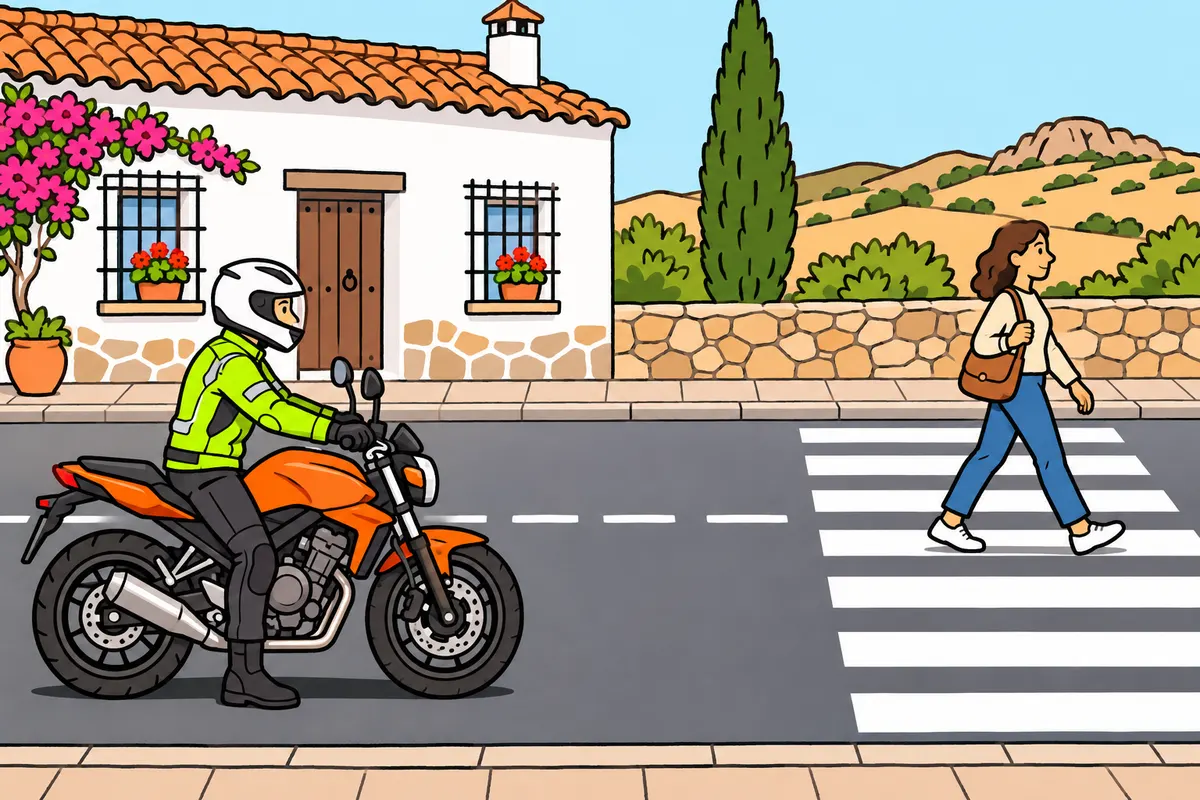
1Make it clear that you are giving way
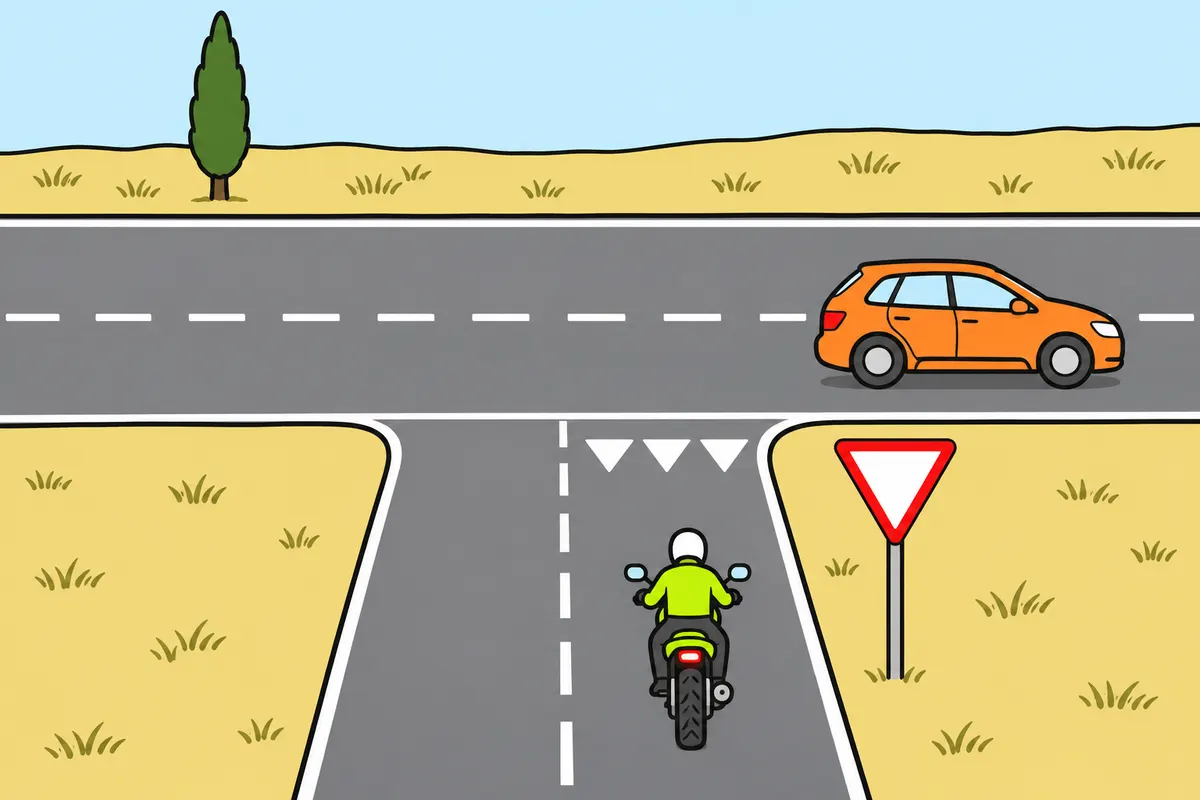
When giving way, show your intention and let others pass without sudden braking or swerving.
Remember
- Slow down early to show you will give way.
- Proceed only if others need not brake or change direction suddenly.
- You need space to complete your whole movement.
- Stop if a sign or instruction requires it.
- Even with priority, check that you can proceed safely.
Exam trap: Wrong: giving way always means stopping. Right: continue slowly only if you respect priority and no sign or instruction requires a stop.
Read the full explanation
- When you must give way, reduce your speed progressively and early enough for the other driver to understand your intention. On a motorcycle, approaching the edge of the junction quickly and braking at the last moment makes it harder for others to know whether you intend to respect their priority. [RGC, art. 58](https://www.boe.es/buscar/act.php?id=BOE-A-2003-23514#a58)
- You may only start, continue or resume moving once you are sure that you do not force the vehicle with priority to change speed or direction abruptly. The available space must accommodate your entire manoeuvre: fitting the motorcycle’s front wheel between two vehicles does not fulfil your duty to give way. [RGC, art. 58](https://www.boe.es/buscar/act.php?id=BOE-A-2003-23514#a58)
- Giving way may require you to stop, or allow you to continue slowly if you actually respect priority. A complete stop is compulsory when a sign or instruction requires it, even if no other vehicle is approaching; STOP and give way impose different requirements. [RGC, art. 56](https://www.boe.es/buscar/act.php?id=BOE-A-2003-23514#a56)
- Having priority does not remove your duty to ride cautiously. As a motorcycle safety guideline, check whether the other driver actually slows down and leave room to stop if they enter your path; both the legal answer about who goes first and collision prevention must guide your decision. [RGC, arts. 46 and 58](https://www.boe.es/buscar/act.php?id=BOE-A-2003-23514#a46)
2Hierarchy of traffic controls
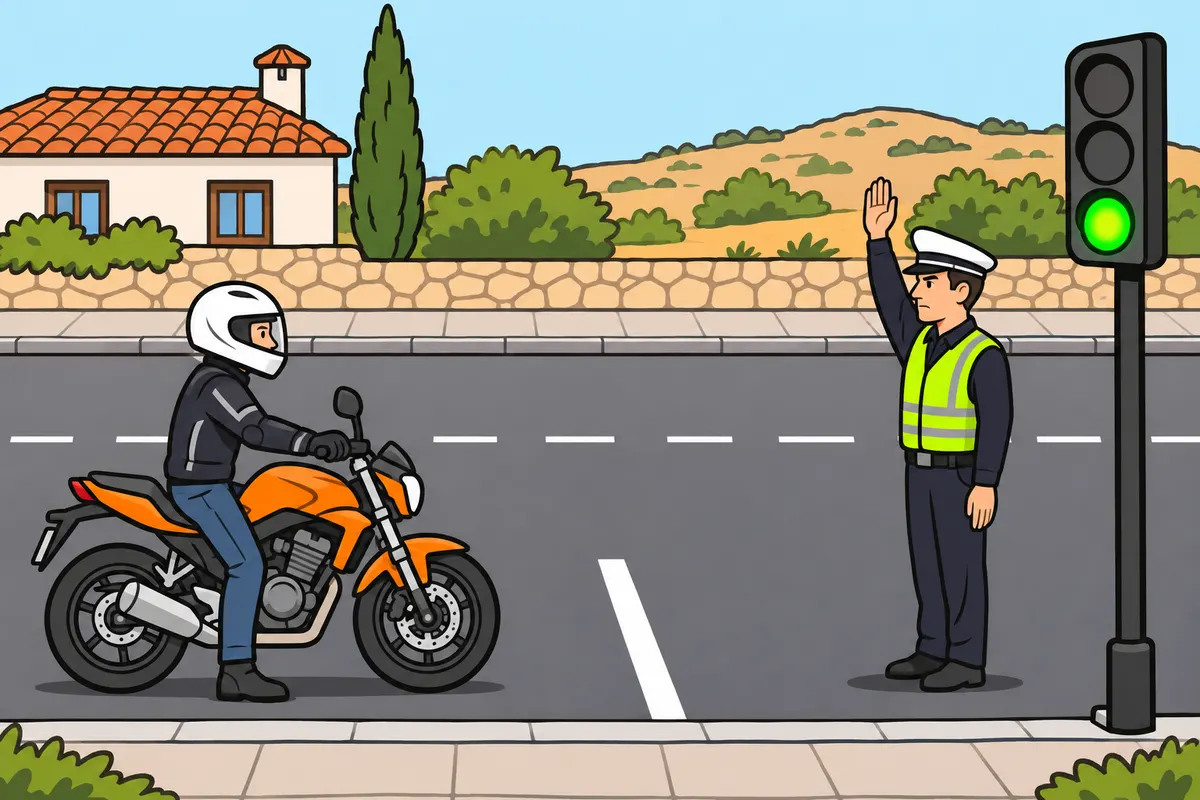
When traffic instructions conflict, follow the one with the highest authority.
| Traffic control | Authority, highest first |
|---|---|
| Officers | Before all other controls |
| Temporary signs, barriers and guidance markers | Before traffic lights |
| Traffic lights | Before upright signs |
| Upright signs | Before road markings |
| Road markings | Lowest priority |
Remember
- Check that the instructions apply to your route.
- Obey the officer even if the traffic light says otherwise.
- For conflicting signs of the same type, follow the more restrictive one.
- Follow compatible instructions together.
Exam trap: Wrong: green lets you disobey an officer. Right: follow the officer’s instruction.
Read the full explanation
- Resolve conflicting instructions using this hierarchy: traffic officers’ instructions and signals; temporary signs and delineation that modify normal road use, delineating devices and guidance markers; traffic lights; upright signs; road markings. This order determines which instruction you obey when two requirements are incompatible. [RGC, art. 133](https://www.boe.es/buscar/act.php?id=BOE-A-2003-23514#a133)
- Where signs of the same type appear to conflict, the more restrictive one takes precedence. First identify which ones apply to your path: a sign for another approach or a traffic light exclusively for cycles does not automatically regulate your motorcycle. [RGC, art. 133 and Annex I, section 4.4](https://www.boe.es/buscar/act.php?id=BOE-A-2003-23514#a133)
- An officer’s instruction to proceed overrides a red light; an instruction to stop overrides a green light. You must immediately obey instructions from officers directing traffic, including when the rest of the junction appears to allow you through. [RGC, arts. 56 and 141](https://www.boe.es/buscar/act.php?id=BOE-A-2003-23514#a141)
- You comply with compatible instructions together; the hierarchy resolves conflicts between them. Flashing amber lights and lane-control signals are explained in “Traffic lights and permission to proceed”. [RGC, art. 133 and Annex I, sections 4.2 and 4.3](https://www.boe.es/buscar/act.php?id=BOE-A-2003-23514#a133)
3Officers’ signals at junctions
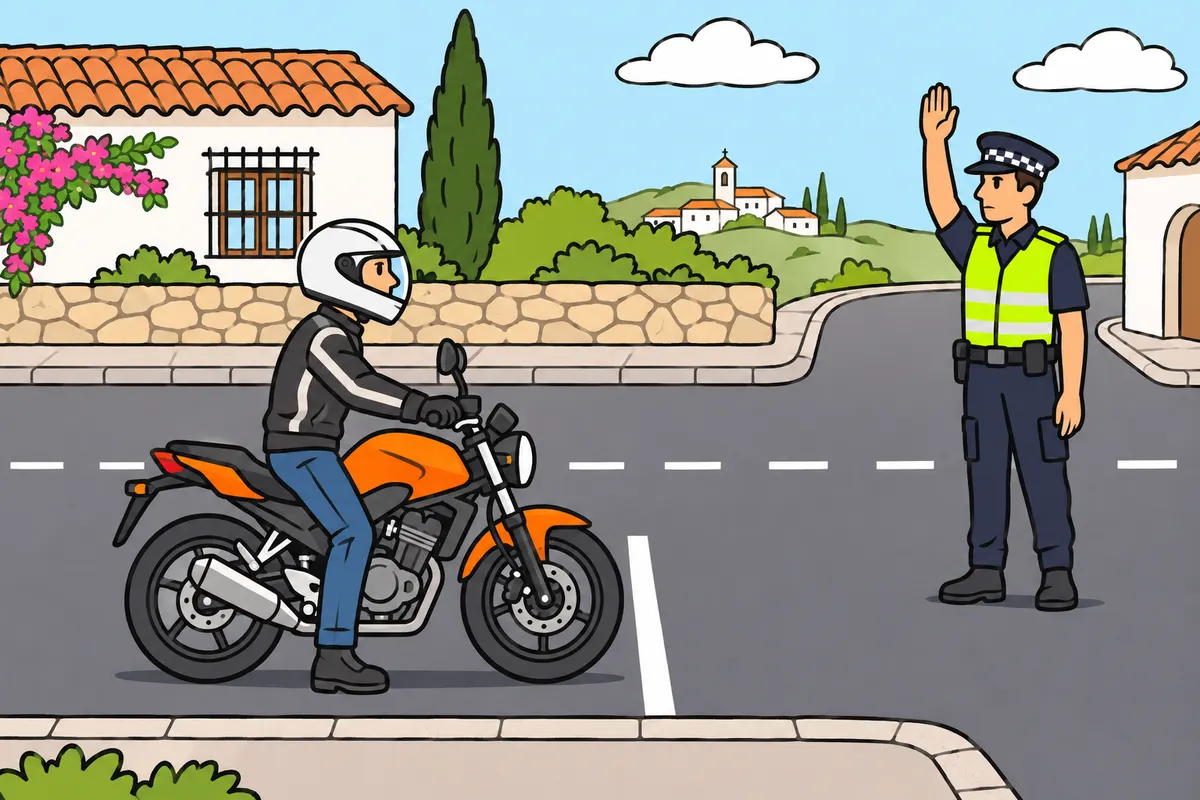
Follow the officer’s gestures, lights and whistle signals.
| Officer’s signal | What you must do |
|---|---|
| Arms held horizontally | Stop if your direction crosses the line of the arms |
| Red or amber light swung towards you | Stop |
| Short, repeated whistle blasts | Stop |
| Long whistle blast | You may move again |
| Arm moving up and down towards you | Slow down |
Remember
- For a raised vertical arm, stop unless you cannot do so safely.
- If already inside the junction, this gesture does not require you to stay there.
- Stop before the line; without one, before the officer or junction.
- Follow any instruction to stop at a specific place.
Exam trap: Wrong: lowered arms end the stop instruction. Right: it continues until the officer changes position or gives another signal.
Read the full explanation
- An arm raised vertically orders you to stop when approaching the officer, unless you cannot do so safely enough. If the officer gives this signal at a junction you have already entered, the instruction does not require you to remain stopped inside it. [RGC, art. 141 and Annex I, section 1.1](https://www.boe.es/buscar/act.php?id=BOE-A-2003-23514#a141)
- With one or both arms extended horizontally, you must stop if you approach from a direction crossing the line indicated by the arms, whichever way you are travelling. The instruction remains in force even if the officer lowers their arms, until they change position or give another signal. [RGC, art. 141 and Annex I, section 1.1](https://www.boe.es/buscar/act.php?id=BOE-A-2003-23514#a141)
- When ordered to stop, wait before the nearest stop line or, if there is none, immediately before the officer; at a junction, stop before entering. The officer may then indicate a specific place to stop, so you must also follow that instruction. [RGC, art. 141 and Annex I, section 1.1](https://www.boe.es/buscar/act.php?id=BOE-A-2003-23514#a141)
- A swinging red or amber light requires you to stop if the officer directs it towards you. Short, repeated whistle blasts order vehicles to stop, and one long blast allows you to resume moving; an arm moved up and down requires the drivers it is directed at, according to the officer’s position, to slow down. [RGC, Annex I, section 1.1](https://www.boe.es/buscar/act.php?id=BOE-A-2003-23514#ani)
4Traffic lights and permission to proceed
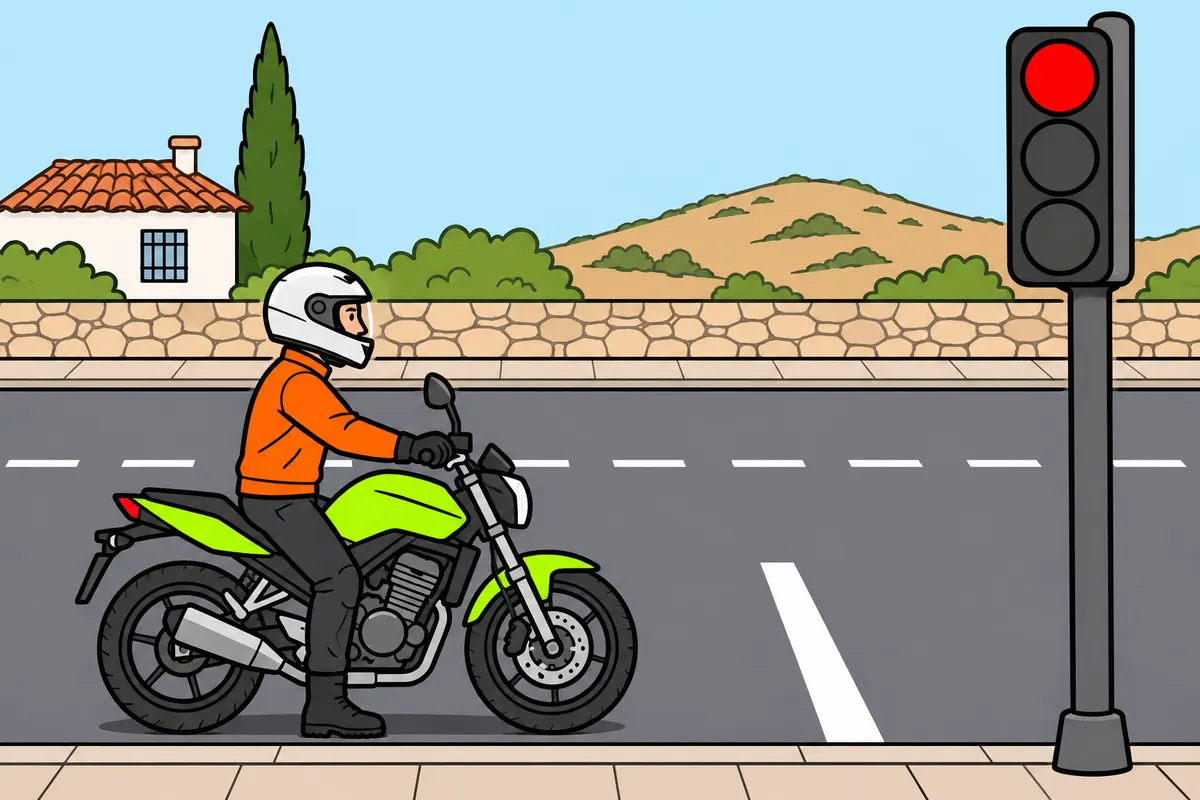
Check what each light means and whether you must give way before proceeding.
| Light | What you must do |
|---|---|
| Steady red | Stop |
| Steady amber | Stop, unless too close to stop safely when it appears |
| Flashing amber | Take extra care; check for pedestrians still crossing and give way where required |
| Steady green | You may proceed with priority, respecting your duties when turning |
| Flashing amber at a crossing with pedestrian lights | As a general rule, follows steady red and cannot coincide with steady pedestrian green |
Remember
- At red, wait before the nearest preceding stop line, or before the light.
- If the light is inside or beyond the junction, wait before entering.
- When turning on green, respect pedestrian and cyclist priority.
- With a green arrow on black, give way to traffic in your destination lane.
- Protect people crossing; a green lane arrow does not cancel stop or give-way duties.
- With lights off, follow officers and signs; without these, apply general rules.
Exam trap: Wrong: flashing amber cancels STOP. Right: you must still stop at STOP.
Read the full explanation
- A steady red light prohibits passage: you must remain before the light or the nearest preceding stop line, if there is one. If the light is within or beyond the junction, wait before entering the junction and respect the line before it. [RGC, art. 56 and Annex I, section 4.2](https://www.boe.es/buscar/act.php?id=BOE-A-2003-23514#a56)
- A steady amber light requires you to stop as for red, unless you are so close when it comes on that you cannot stop safely enough. Flashing amber requires you to take extra care and give way where required; if there is a STOP sign, you must make the stop it requires. As a general rule, at a crossing with pedestrian lights, flashing amber for vehicles cannot coincide with steady green for pedestrians and must be preceded by steady red. If you see flashing amber, check whether pedestrians are still crossing and give way where required. [RGC, Annex I, section 4.2.d](https://www.boe.es/buscar/act.php?id=BOE-A-2003-23514#ani)
- Steady green allows you to proceed with priority. When turning, you must respect the cyclist and pedestrian priority situations explained in their sections; the duty to keep the junction clear is covered in “Keeping junctions clear and approaching them”. [RGC, arts. 59, 64 and 65; Annex I, section 4.2](https://www.boe.es/buscar/act.php?id=BOE-A-2003-23514#a59)
- A green arrow on a circular black background allows you to follow its direction even if another light is on at the same time. You must proceed cautiously, let traffic in the lane you are joining pass and avoid endangering anyone crossing the carriageway: the arrow does not give you unconditional passage. [RGC, Annex I, section 4.2](https://www.boe.es/buscar/act.php?id=BOE-A-2003-23514#ani)
- A downward green arrow on a lane-control signal allows you to use that lane, but you must obey signs or markings requiring you to stop or give way. If a junction’s traffic lights are off, follow officers and other signs; in their absence, apply the general rules. [RGC, arts. 56 and 57; Annex I, section 4.3](https://www.boe.es/buscar/act.php?id=BOE-A-2003-23514#a57)
5Give way and STOP
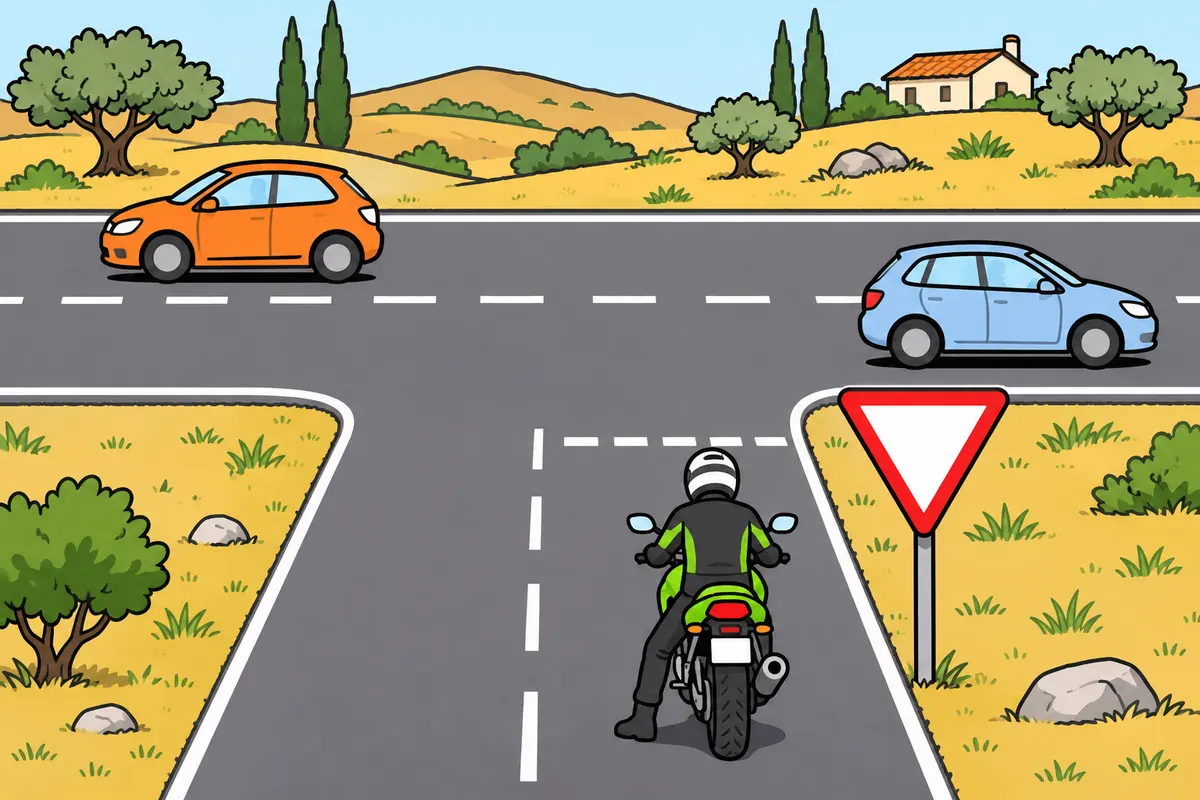
At STOP, stop completely, then give way.
| Sign | What you must do |
|---|---|
| Give way | Give way; stop if necessary |
| STOP | Always stop, then give way |
Remember
- Look both ways and give way to vehicles on the priority road.
- At STOP, stop at the line; without one, immediately before the junction.
- If you cannot see, move cautiously and stop again where you can see safely.
- Make your own stop when your turn comes.
- A broken give-way line does not turn give way into STOP.
Exam trap: Wrong: skip the first stop if visibility is poor. Right: stop where required, then stop again where you can see safely.
Read the full explanation
- The R-1 Give way sign requires you to let vehicles on the road you are approaching or in the lane you wish to join pass. Slow down, look both ways and stop if necessary; the duty applies to vehicles approaching from both right and left. [RGC, art. 56 and Annex I](https://www.boe.es/buscar/act.php?id=BOE-A-2003-23514#a56)
- The R-2 Mandatory stop or STOP sign requires you to bring your motorcycle to a complete stop at the stop line or, if there is none, immediately before the junction. You must then give way to vehicles on the priority road; passing very slowly, even with good visibility and no traffic, does not fulfil the stop requirement. [RGC, art. 56 and Annex I](https://www.boe.es/buscar/act.php?id=BOE-A-2003-23514#a56)
- If you do not have sufficient visibility from the place of your first stop, move forward cautiously and stop again where you can see without endangering anyone. [RGC, Annex I, sign R-2 and marking M-4.1](https://www.boe.es/buscar/act.php?id=BOE-A-2003-23514#ani)
- When waiting behind another vehicle at a STOP sign, you must make your own stop at the legally required place when your turn comes. The vehicle ahead having stopped and crossed does not establish that you can proceed: look again, because approaching traffic may have changed. [RGC, art. 56 and Annex I](https://www.boe.es/buscar/act.php?id=BOE-A-2003-23514#a56)
- The continuous transverse line M-4.1 marks the stopping limit you must not cross when complying with the corresponding instruction or sign. The broken line M-4.2 establishes the give-way limit, subject to the regulatory exception for abnormal circumstances reducing visibility; its presence alone does not turn a give way into a STOP. [RGC, Annex I, transverse markings](https://www.boe.es/buscar/act.php?id=BOE-A-2003-23514#ani)
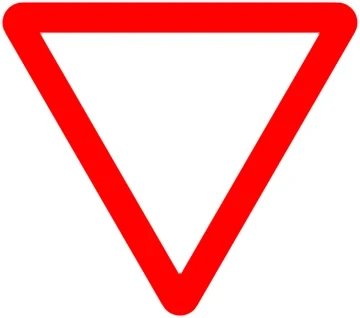 R-1
 R-2
6Junctions without priority signs
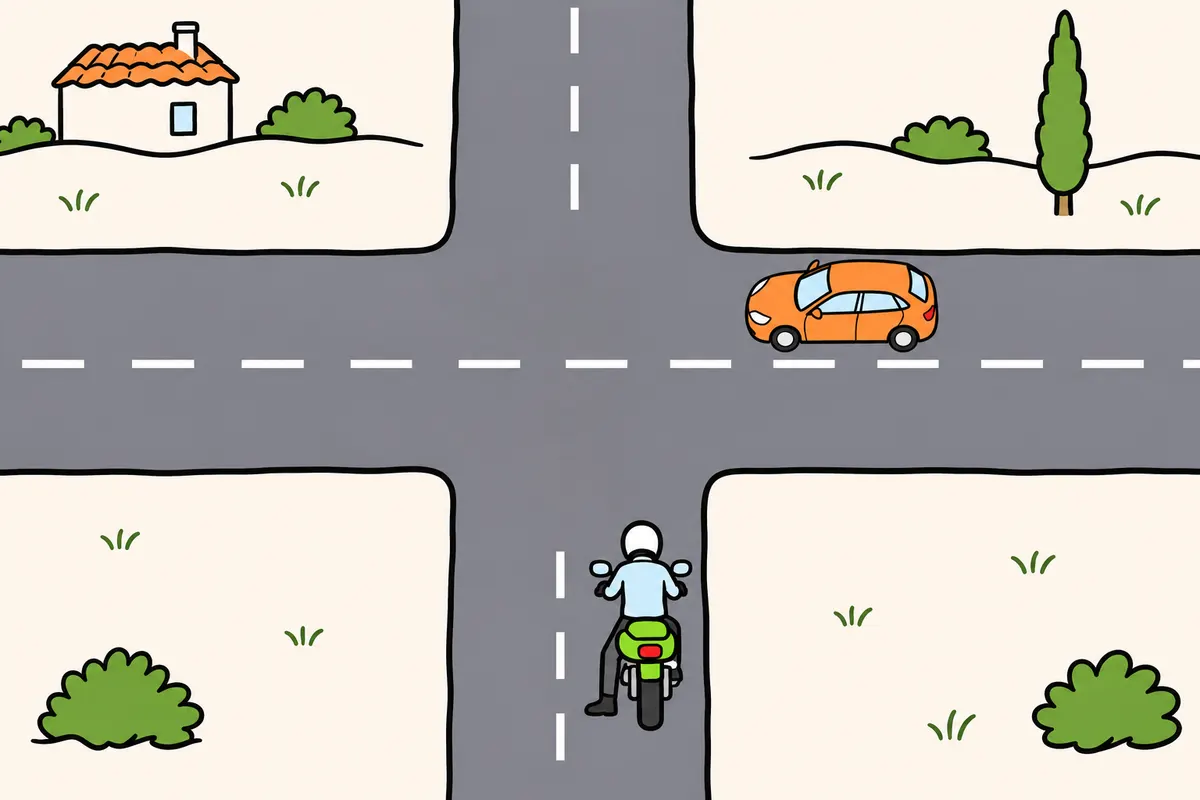
Without priority signs, give way to your right unless an exception applies.
| Case without priority controls | What you must do |
|---|---|
| You approach a paved road from an unpaved road | Give way to traffic on the paved road |
| A tram approaches, even from your left | Let the tram pass |
| You join an autopista or autovía | Give way to traffic already there |
Remember
- Your motorcycle’s size gives you no special priority.
- A street’s width or good condition does not decide priority.
- Without signs or exceptions, give way to your right, even from a narrow street.
Exam trap: Wrong: you have priority from a dirt road because you approach from the right. Right: give way to traffic on the paved road.
Read the full explanation
- In the absence of a sign regulating priority, you must give way to vehicles approaching from your right, subject to the regulatory exceptions. The rule applies to your motorcycle just as it does to a car: your smaller size or greater ability to accelerate gives you no special priority. [RGC, art. 57](https://www.boe.es/buscar/act.php?id=BOE-A-2003-23514#a57)
- Width, the appearance of a main road or a better road surface do not determine priority on their own. If both roads are paved and there are no signs or other exceptions, you must apply priority to the right even if the vehicle comes from a narrower or less well-maintained street. [RGC, art. 57](https://www.boe.es/buscar/act.php?id=BOE-A-2003-23514#a57)
- Vehicles on a paved road have priority over those approaching on an unpaved road. If you ride out of a dirt road onto a paved road, you must give way even if you approach from the right of the vehicle travelling on the latter. [RGC, art. 57.1.a](https://www.boe.es/buscar/act.php?id=BOE-A-2003-23514#a57)
- Rail vehicles have priority over other users in this situation. If a tram approaches from your left at an uncontrolled junction, you must let it pass; the general priority-to-the-right rule does not override this exception. [RGC, art. 57.1.b](https://www.boe.es/buscar/act.php?id=BOE-A-2003-23514#a57)
- Traffic on an autopista (motorway) or autovía (dual carriageway) has priority over joining traffic. The roundabout exception is covered in “Entering roundabouts”, where it applies to your motorcycle joining the circular carriageway. [RGC, art. 57.1.c and d](https://www.boe.es/buscar/act.php?id=BOE-A-2003-23514#a57)
7Keeping junctions clear and approaching them
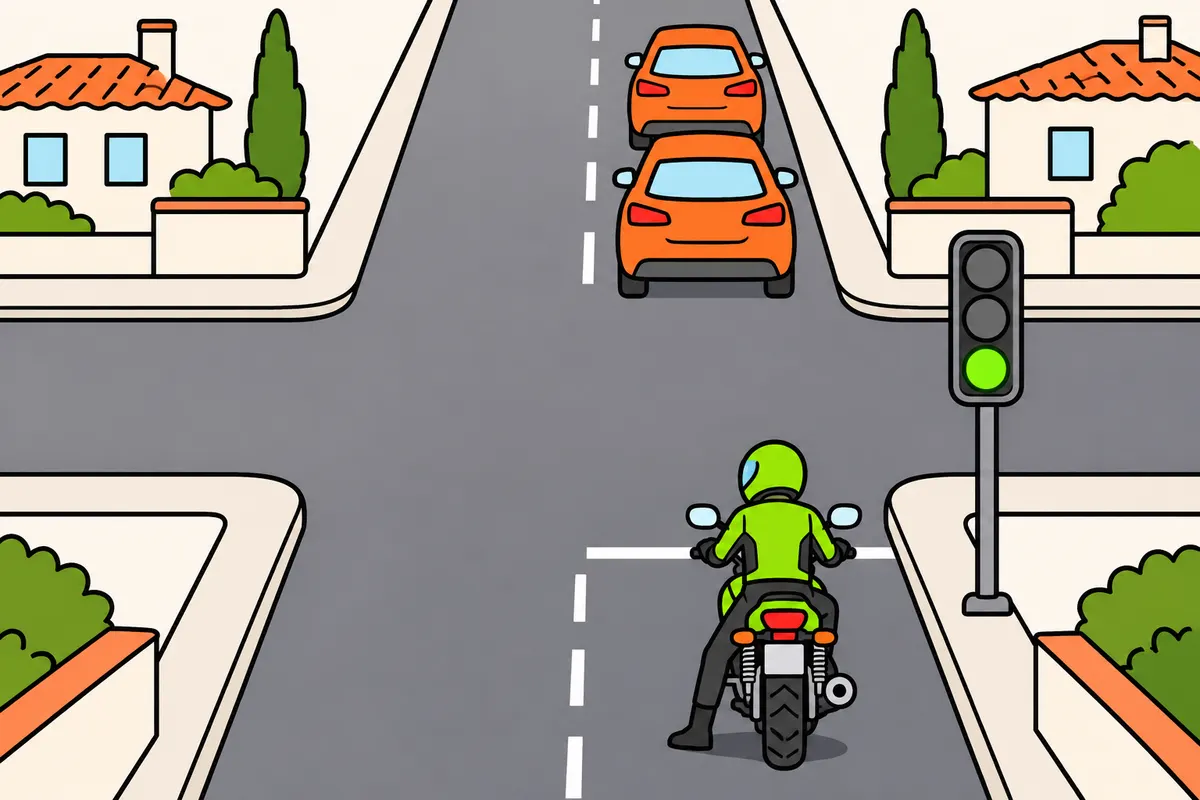
Wait outside a junction if you would stop inside and block crossing traffic.
Remember
- Look at the junction early and decide before crossing.
- With poor visibility, slow down and prepare to stop.
- Do not block junctions or pedestrian or cycle crossings, even on green.
- The observation stages are not compulsory stops.
- If blocking a junction with traffic lights, leave without waiting for your green.
- When leaving, do not obstruct traffic moving in the permitted direction.
Exam trap: Wrong: green allows you to block the junction. Right: wait outside if you expect to stop and block crossing traffic.
Read the full explanation
- Organise your observation into approach, entry position and crossing: identify the junction from a distance, reach a point where you can decide, and cross when safe. These are learning stages, not three compulsory stops; stopping depends on signs and traffic. [RGC, arts. 46, 56 and 58](https://www.boe.es/buscar/act.php?id=BOE-A-2003-23514#a46)
- You must moderate your speed when approaching junctions with poor visibility and be able to stop when necessary. As a motorcycle guideline, slow down well before reaching the waiting point so you can observe and maintain balance without hurried braking. [RGC, art. 46](https://www.boe.es/buscar/act.php?id=BOE-A-2003-23514#a46)
- Do not enter a junction or pedestrian or cycle crossing if you can foresee being stopped there and obstructing crossing traffic. You must wait before it even if you have priority, the light is green or the vehicle ahead has started moving. [RGC, art. 59.1](https://www.boe.es/buscar/act.php?id=BOE-A-2003-23514#a59)
- If you are already stopped inside a signal-controlled junction and obstruct traffic, you must leave without waiting for permission for your direction, provided you do not hinder those moving in the permitted direction. This duty to clear the junction requires you to check the paths open to other users. [RGC, art. 59.2](https://www.boe.es/buscar/act.php?id=BOE-A-2003-23514#a59)
8Turning, joining traffic and lanes
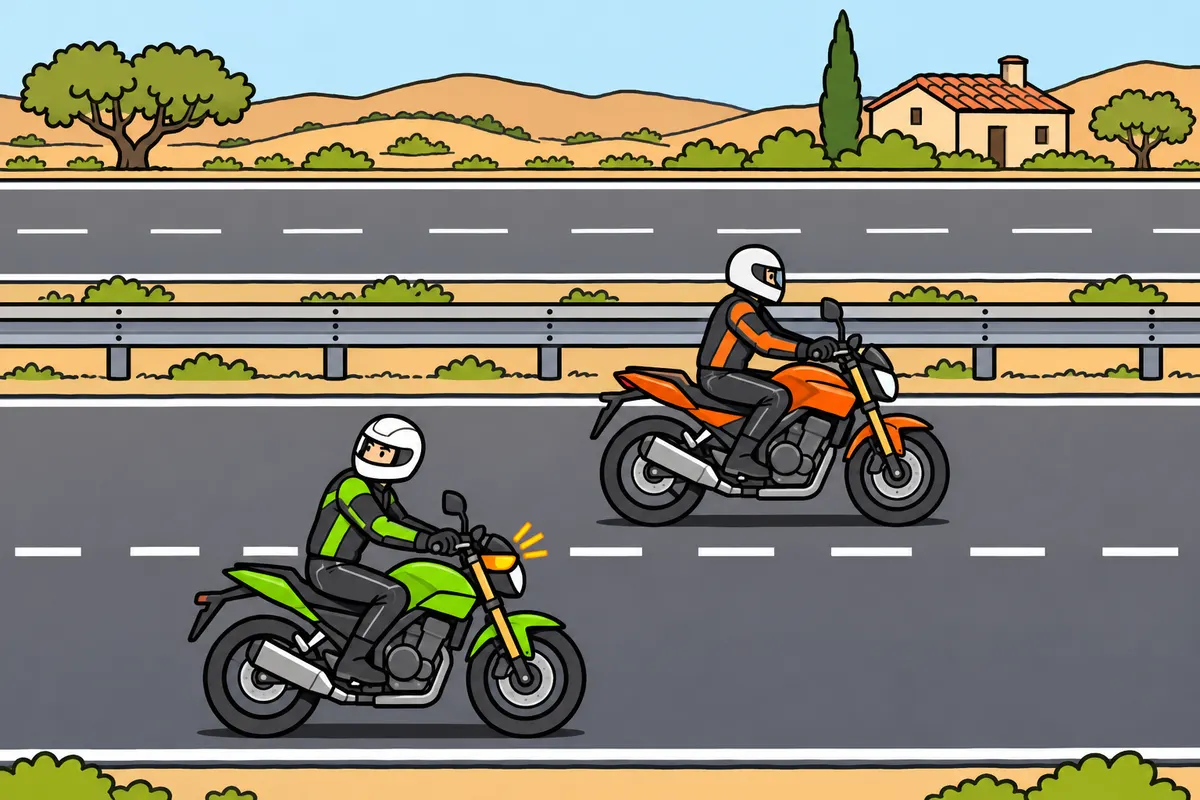
When joining traffic or turning, respect priority and avoid danger.
Remember
- Respect the priority rules for your intended movement.
- Join traffic or change direction only when you can do so safely.
Exam trap: Wrong: you can join traffic without respecting priority. Right: respect priority and move safely.
Read the full explanation
- When joining traffic or changing direction on your motorcycle, you must respect the applicable priority and manoeuvre without danger; turns, lane changes, moving off from a stop and acceleration lanes are covered in the Motorcycle manoeuvres module. [RGC, arts. 72, 73 and 74](https://www.boe.es/buscar/act.php?id=BOE-A-2003-23514#a72)
9Entering roundabouts
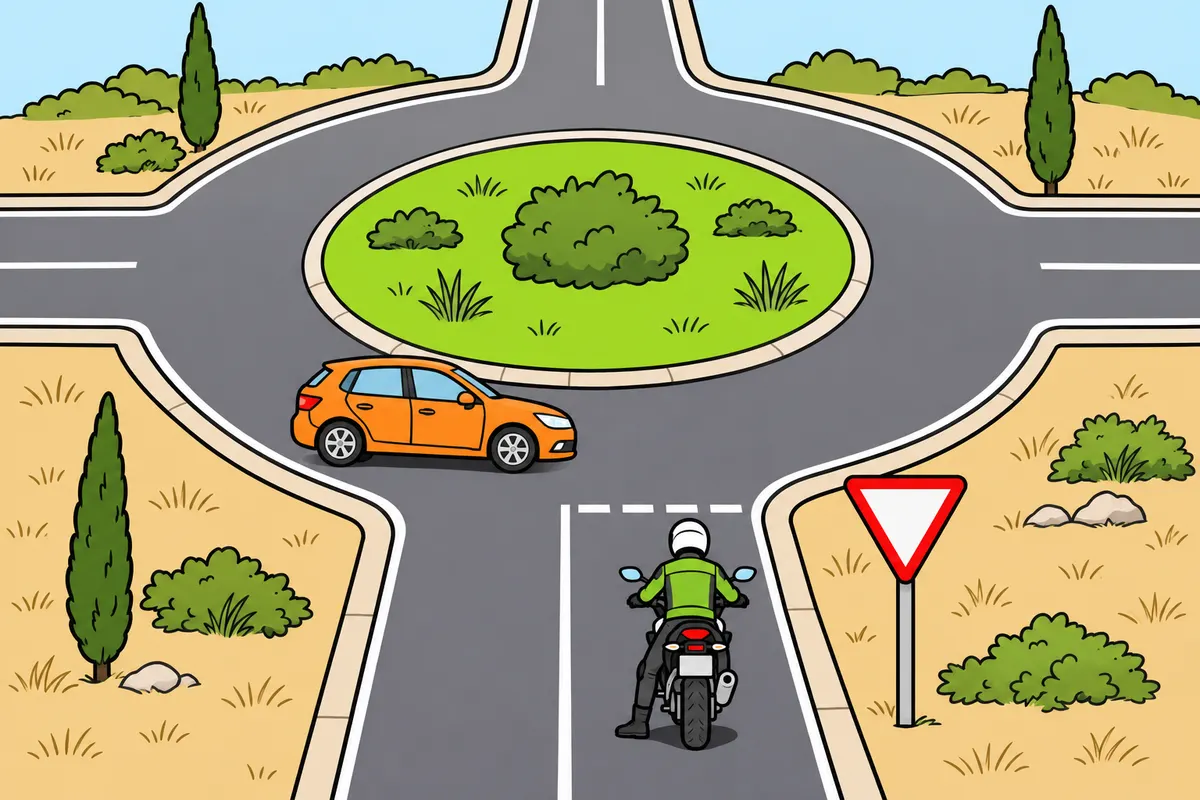
When entering a roundabout, give way to traffic inside unless traffic controls say otherwise.
| Roundabout type | How you decide priority |
|---|---|
| Circular roundabout | Give way to traffic inside unless controls say otherwise |
| Split roundabout | Apply the signs or general rules at each junction |
Remember
- Keep the centre of the roundabout on your left.
- To return the way you came, continue around to the correct exit.
- Do not cross the island or travel the wrong way.
- Check the gap; do not rely only on another vehicle’s indicator.
Exam trap: Wrong: traffic following the curve always has priority at a split roundabout. Right: follow signs; without controls or another exception, give way to your right.
Read the full explanation
- To enter a roundabout, you must let traffic on the circular carriageway pass, unless traffic controls establish a different priority. A bus inside has priority because of its position, just like a bicycle or motorcycle, rather than because of its service. [RGC, arts. 56 and 57](https://www.boe.es/buscar/act.php?id=BOE-A-2003-23514#a57)
- You must go around the centre of the roundabout keeping it on your left. To return to the road you came from, follow the circular carriageway in that direction to the appropriate exit; your intention to change direction does not allow you to cross the island or reverse the direction of travel. [RGC, art. 43.2](https://www.boe.es/buscar/act.php?id=BOE-A-2003-23514#a43)
- Before entering, assess the position and path of vehicles in the roundabout’s lanes. As a safety guideline, do not rely solely on another vehicle having an indicator on: you must have a gap allowing you to join without forcing braking or an abrupt change of direction. [RGC, art. 58](https://www.boe.es/buscar/act.php?id=BOE-A-2003-23514#a58)
- At a split roundabout, where routes may cross the central area, do not automatically give priority to traffic following the curve. Resolve each junction according to its signs and, if there are no controls or applicable exceptions, priority to the right. [RGC, arts. 56 and 57](https://www.boe.es/buscar/act.php?id=BOE-A-2003-23514#a57)
10Lanes and leaving a roundabout
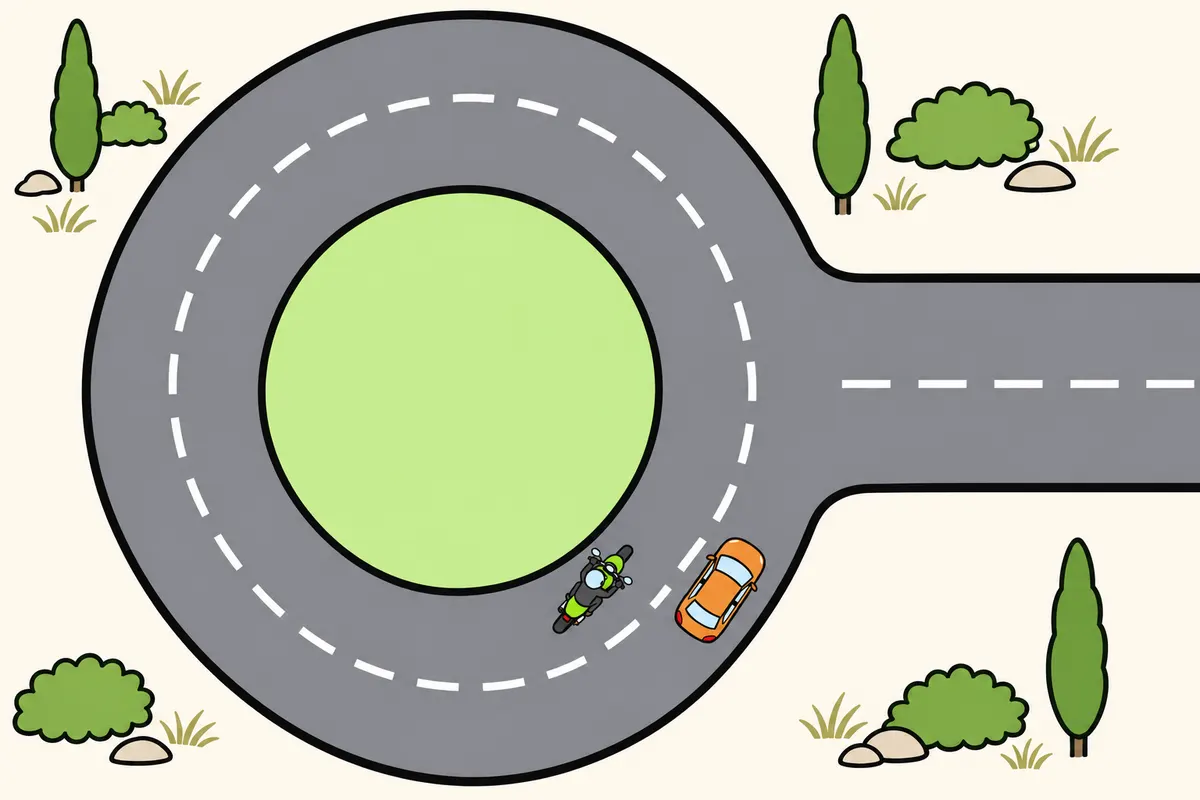
To leave a roundabout, give way to traffic in the lane you need.
Remember
- At a conventional roundabout, prepare to leave from the outer right-hand lane.
- Use another route if signs allow or require it.
- Before changing lanes, give way to traffic already in that lane.
- If you cannot leave safely, go around again.
- Follow arrows, guided lanes and traffic lights.
Exam trap: Wrong: being inside lets you cut across the outer lane to exit. Right: give way to traffic there; go around again if you cannot exit safely.
Read the full explanation
- Lane-use rules and road signs apply within a roundabout. Being inside gives you priority over traffic wishing to enter, but does not give you priority to move across another vehicle already occupying the adjacent lane. [RGC, arts. 57 and 74](https://www.boe.es/buscar/act.php?id=BOE-A-2003-23514#a74)
- At a conventional roundabout with concentric lanes, prepare to exit from the outer right-hand lane unless signs require or allow another path. Before moving from an inner lane into that lane, you must observe and give way to traffic already in it. [RGC, arts. 74 and 75](https://www.boe.es/buscar/act.php?id=BOE-A-2003-23514#a74)
- If you cannot reach the exit lane safely, continue around the roundabout and prepare for another circuit. Cutting across from an inner lane in front of a car or another motorcycle continuing in the outer lane breaches the priority of the lane you enter. [RGC, art. 74.2](https://www.boe.es/buscar/act.php?id=BOE-A-2003-23514#a74)
- At roundabouts with arrows, guided lanes or traffic lights, adapt your path to their specific controls. To decide priority, distinguish entry, lane changing and exit: resolve each conflict using the sign or rule applicable to that movement. [RGC, arts. 56 and 74; Annex I](https://www.boe.es/buscar/act.php?id=BOE-A-2003-23514#a56)
11Cyclists’ priority
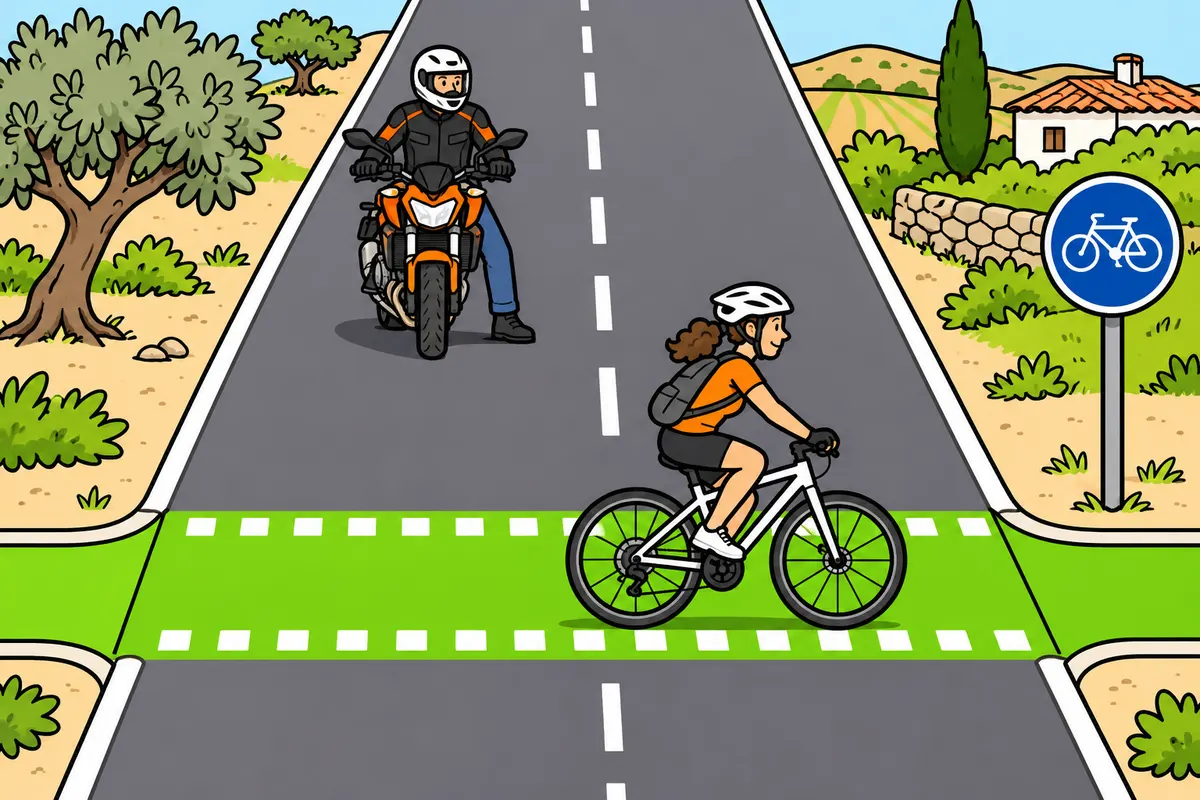
Give way to cyclists where they have priority and protect their path.
| Case | What you must do |
|---|---|
| Properly signposted cycling space | Give way when crossing it |
| You turn into another road with a cyclist nearby | Respect the cyclist’s priority |
| Group together: first cyclist starts crossing or enters roundabout | Let the whole group pass |
Remember
- Give way on properly signposted cycle lanes, cycle crossings and hard shoulders.
- When turning into another road, give way to nearby cyclists whose path you cross.
- If the first cyclist has started crossing, let the whole group pass.
- Also let the group pass if the first cyclist has entered the roundabout.
- Outside these cases, apply the general rules between vehicles.
Exam trap: Wrong: you can ride between cyclists travelling as a group. Right: let the whole group pass if the first cyclist has started crossing or entered the roundabout.
Read the full explanation
- You must give way to cyclists using a properly signposted cycle lane, cycle crossing or arcén (hard shoulder). When crossing these spaces on your motorcycle, wait until you can complete the movement without interrupting their passage; priority does not depend on the bicycle approaching from your right. [RGC, art. 64.2.a](https://www.boe.es/buscar/act.php?id=BOE-A-2003-23514#a64)
- If you turn right or left to enter another road and a cyclist is nearby, you must respect their priority in the situation specified by the regulations. As a practical guideline, also check the side along which a bicycle may continue if your turn cuts across its path. [RGC, art. 64.2.b](https://www.boe.es/buscar/act.php?id=BOE-A-2003-23514#a64)
- When a group of cyclists rides together and the first has started crossing or entered a roundabout, you must let the group pass. In the exam, the first cyclist’s arrival changes the answer for the members following them; you must not split the group by riding between them. [RGC, art. 64.2.c](https://www.boe.es/buscar/act.php?id=BOE-A-2003-23514#a64)
- Outside the specific situations giving cyclists priority, the general rules between vehicles apply. A bicycle does not have universal priority because of its vulnerability, but you must take extra care to protect it; overtaking distances and procedures are covered in the Motorcycle manoeuvres module. [RGC, arts. 46 and 64](https://www.boe.es/buscar/act.php?id=BOE-A-2003-23514#a64)
12Pedestrians at crossings, turns and pavements
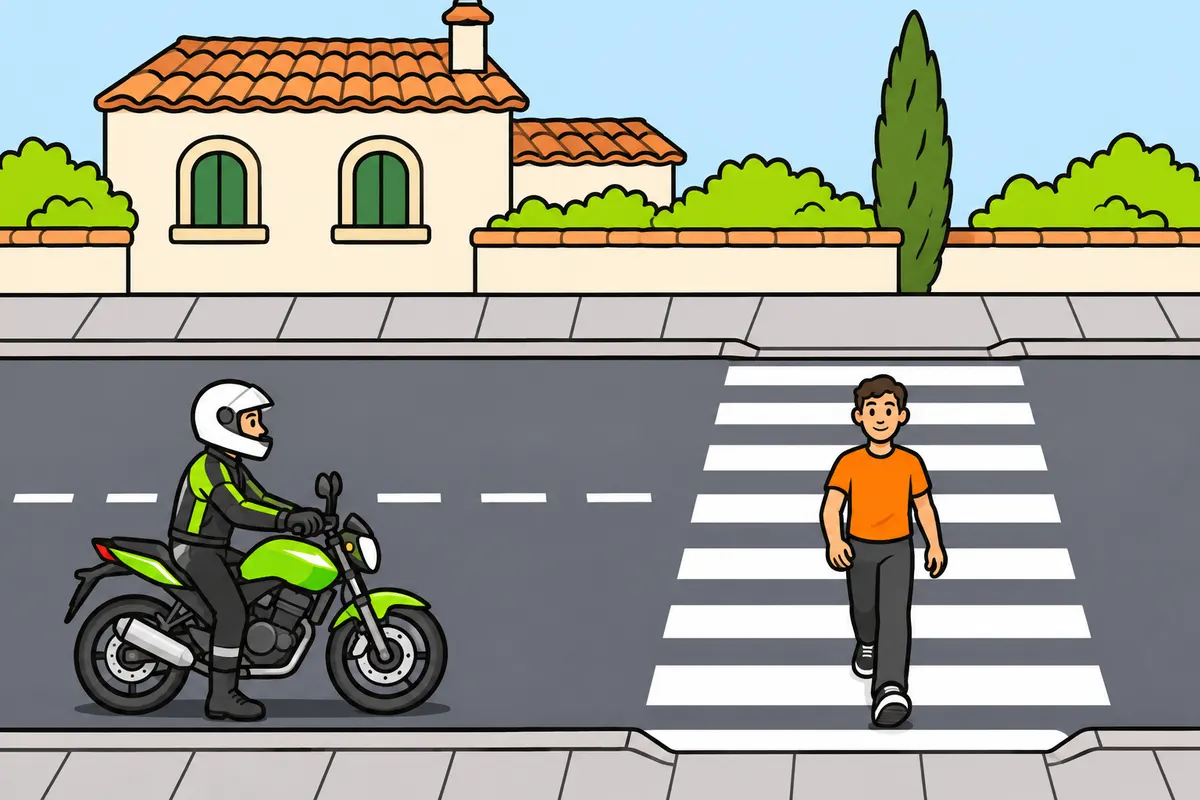
Give way to pedestrians where they have priority, even without a painted crossing.
| Where you meet pedestrians | When you must give way |
|---|---|
| Marked crossings, pavements and pedestrian areas | Respect their priority |
| Road you enter when turning | Give way if pedestrians are crossing, even without a painted crossing |
| Hard shoulder you cross | Give way if pedestrians use it because no pedestrian area is available |
| Pedestrian area you cross at an authorised vehicle access | Give way to people using it |
| Shared-level street designed to favour pedestrians | Give way anywhere on the carriageway |
Remember
- Follow the traffic lights directed at you.
- Before moving off, check for people still finishing their crossing.
- At garage entrances and exits, give way to people continuing along the pavement.
Exam trap: Wrong: when turning, you only give way at painted crossings. Right: give way to pedestrians crossing the road you are entering.
Read the full explanation
- Pedestrians have priority at properly marked crossings, on pavements and in other pedestrian areas. You must approach in a way that allows you to let them pass; the white stripes of marking M-4.3 indicate a crossing where drivers must respect that priority. [RGC, art. 65 and Annex I](https://www.boe.es/buscar/act.php?id=BOE-A-2003-23514#a65)
- If you turn into a road and pedestrians are crossing it, you must give way even if there is no painted crossing. This duty applies to turns in either direction: having room to pass in front of someone does not authorise you to cut across their path on your motorcycle. [RGC, art. 65.1.b](https://www.boe.es/buscar/act.php?id=BOE-A-2003-23514#a65)
- When crossing a hard shoulder used by pedestrians who have no pedestrian area available, you must let them pass. This situation concerns crossing their path; you must recognise it even if the person is not using a marked crossing or is not at a junction. [RGC, art. 65.1.c](https://www.boe.es/buscar/act.php?id=BOE-A-2003-23514#a65)
- When crossing a pedestrian area at a place authorised for vehicles, you must give way to those using it. At a garage entrance or exit, pedestrians continuing along the pavement retain priority, and you must wait before crossing their path. [RGC, art. 65.2](https://www.boe.es/buscar/act.php?id=BOE-A-2003-23514#a65)
- At signal-controlled crossings, you must follow the signals directed at your traffic. As a preventive guideline, check whether anyone is still finishing crossing before moving off; having a green light does not justify endangering them. [RGC, arts. 46 and 56; Annex I, section 4](https://www.boe.es/buscar/act.php?id=BOE-A-2003-23514#a56)
- In an area with a single-level carriageway and pavement, designed and adapted to favour pedestrian movement, you must give way to pedestrians anywhere on the carriageway; the speed limit is covered in the Speed and distances on a motorcycle module, under “Streets: 20, 30 and 50 km/h”. [Traffic Act, Annex I, definition 83](https://www.boe.es/buscar/act.php?id=BOE-A-2015-11722#ani)
13Stops, processions and pedestrian priority
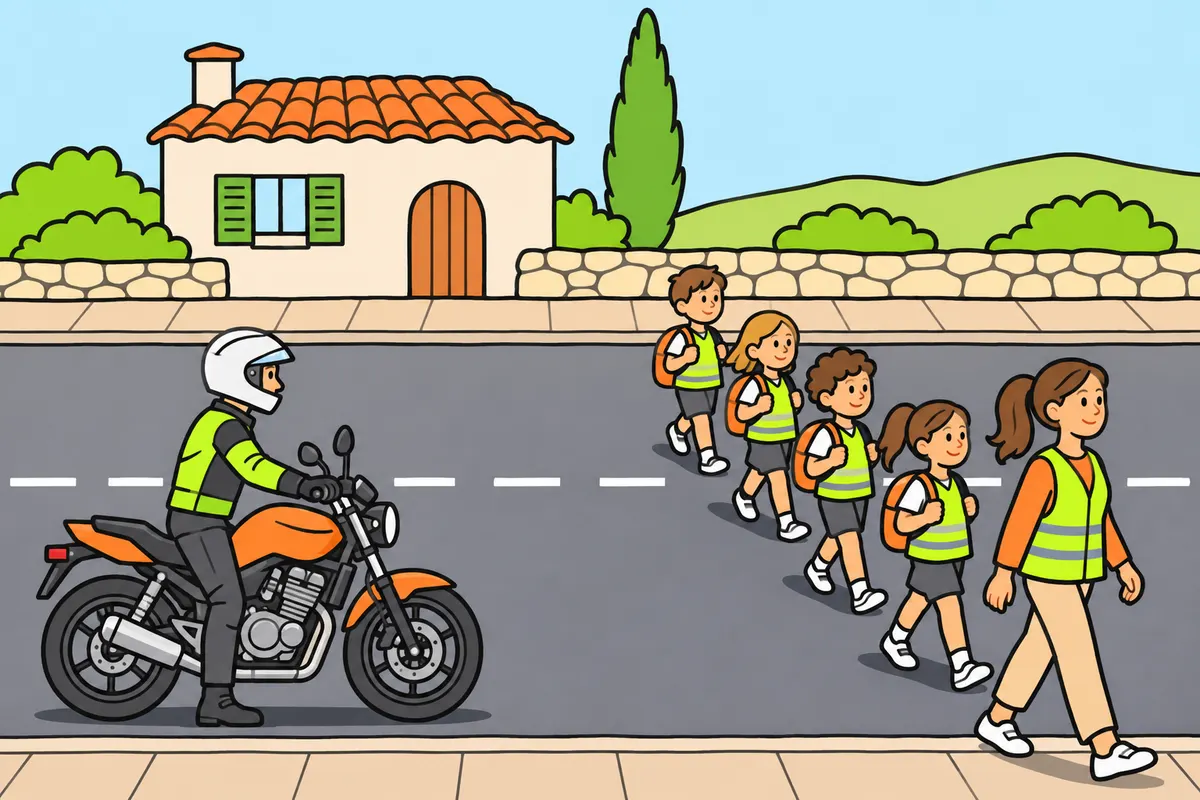
Recognise special pedestrian priority cases and always take care to avoid hitting people.
| Zone sign | What you must do |
|---|---|
| S-28: living and play zone | Respect pedestrian priority throughout the traffic area |
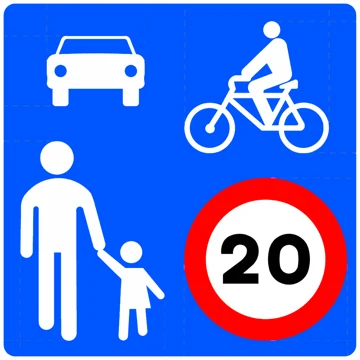
| S-47: shared zone | Respect pedestrian priority throughout the traffic area |
Remember
- At signposted stops, give way to people boarding or who have left public transport.
- This applies between the vehicle and the nearest pedestrian area or refuge.
- Let school groups in line, organised processions and military units on foot pass.
- An informal group is not automatically an organised procession.
- Even if someone crosses wrongly, take care to avoid hitting them.
Exam trap: Wrong: in living or shared zones, you only give way at painted crossings. Right: pedestrians have priority throughout the traffic area.
Read the full explanation
- You must give way to people about to board or who have alighted from public transport at a signposted stop when they are between the vehicle and the nearest pedestrian area or refuge. Check this space before continuing alongside the bus, because it may form part of the passengers’ protected route. [RGC, art. 65.1.d](https://www.boe.es/buscar/act.php?id=BOE-A-2003-23514#a65)
- Military units on foot, school groups in line and organised processions have priority under the terms of the regulations. If you encounter a school group crossing in line, you must allow it to pass; this specific situation does not turn every informal group of pedestrians into an organised procession. [RGC, art. 65.1.e](https://www.boe.es/buscar/act.php?id=BOE-A-2003-23514#a65)
- The S-28 Zona de estancia y juego (living and play zone) sign gives priority to pedestrians, who may use the entire traffic area, so you must give way on your motorcycle even without a painted crossing; the limit and conditions of use are covered in the Speed and distances on a motorcycle module, under “Areas for staying and playing, and shared zones”. [RGC, Annex I, sign S-28](https://www.boe.es/buscar/act.php?id=BOE-A-2003-23514#ani)
- The S-47 Zona de coexistencia (shared zone) sign establishes a space shared with vehicles and cyclists where you must respect pedestrians’ priority; they may use the entire traffic area. Its limit and conditions of use are covered in the Speed and distances on a motorcycle module, under “Areas for staying and playing, and shared zones”. [RGC, Annex I, sign S-47](https://www.boe.es/buscar/act.php?id=BOE-A-2003-23514#ani)
- Vehicles’ general priority over pedestrians on the carriageway and hard shoulder is subject to all the specified exceptions. If someone crosses improperly, you must take the necessary precautions to avoid hitting them; the exam may ask about legal priority without removing your duty of care. [RGC, arts. 46 and 64.1](https://www.boe.es/buscar/act.php?id=BOE-A-2003-23514#a64)
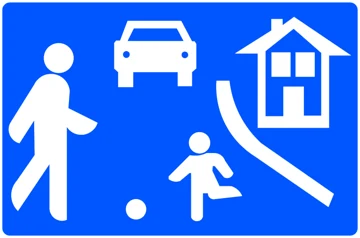 S-28
 S-47
14Animals crossing
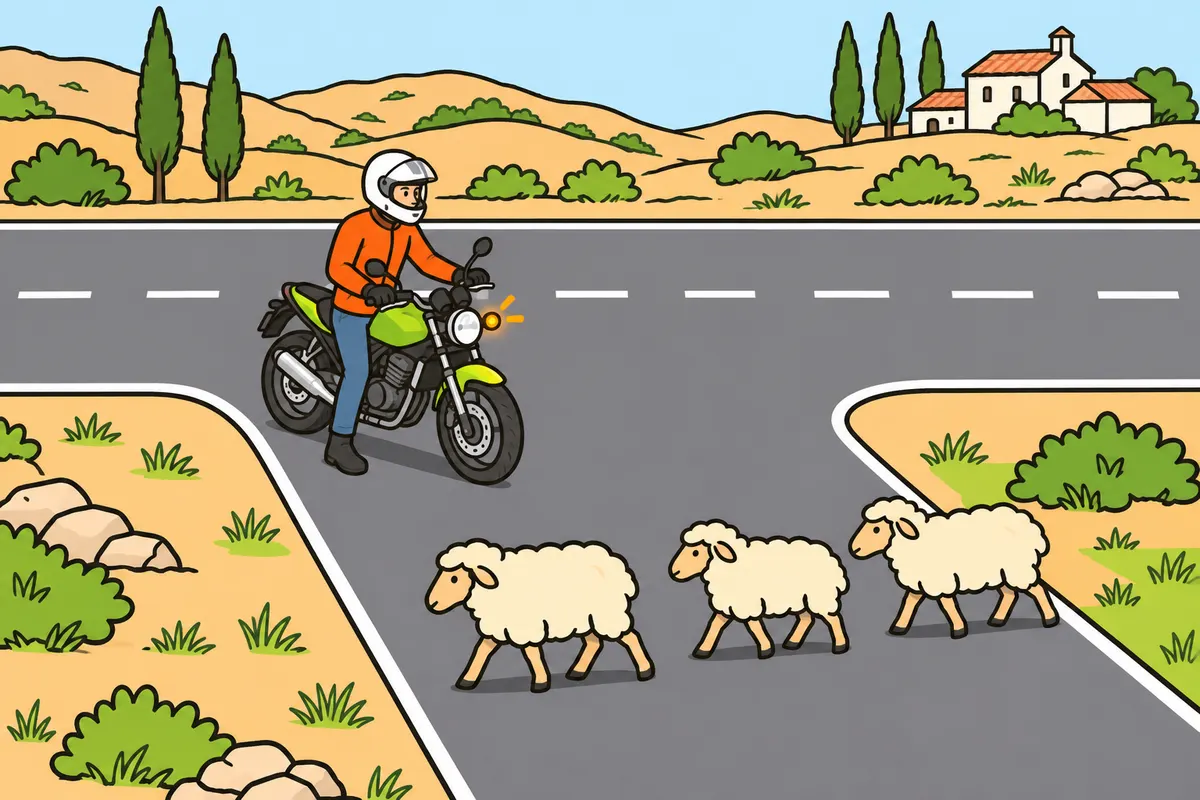
Give way to animals in the specified cases and slow down when approaching them.
| Case | What you must do |
|---|---|
| Properly signposted livestock route | Give way to animals |
| You turn into a road that animals are crossing | Let them pass |
| You cross a hard shoulder used by animals without a livestock route available | Give way to animals |
Remember
- Recognise a signposted livestock route by its “Cañada” panel and accompanying signs.
- Slow down near animals and prepare to stop.
Exam trap: Wrong: when turning, you only give way to animals at livestock crossings. Right: also give way if animals cross the road you are entering.
Read the full explanation
- You must give way to animals on properly signposted cañadas (livestock routes). These are identified by the domestic-animal crossing sign and a supplementary panel bearing “Cañada”, together with the corresponding speed-limit signs; a livestock route is a specific priority situation. [RGC, art. 66](https://www.boe.es/buscar/act.php?id=BOE-A-2003-23514#a66)
- If you turn into another road and animals are crossing it, you must let them pass even if there is no special crossing for them. The rule concerns the path you cross when turning, so you must look at the destination road before starting the manoeuvre. [RGC, art. 66.1.b](https://www.boe.es/buscar/act.php?id=BOE-A-2003-23514#a66)
- When crossing a hard shoulder used by animals with no livestock route available, you must give way to them. Outside these exceptions, vehicles have general priority, but you must moderate your speed when approaching animals and be able to stop when necessary. [RGC, arts. 46 and 66](https://www.boe.es/buscar/act.php?id=BOE-A-2003-23514#a66)
15Controlled narrow sections
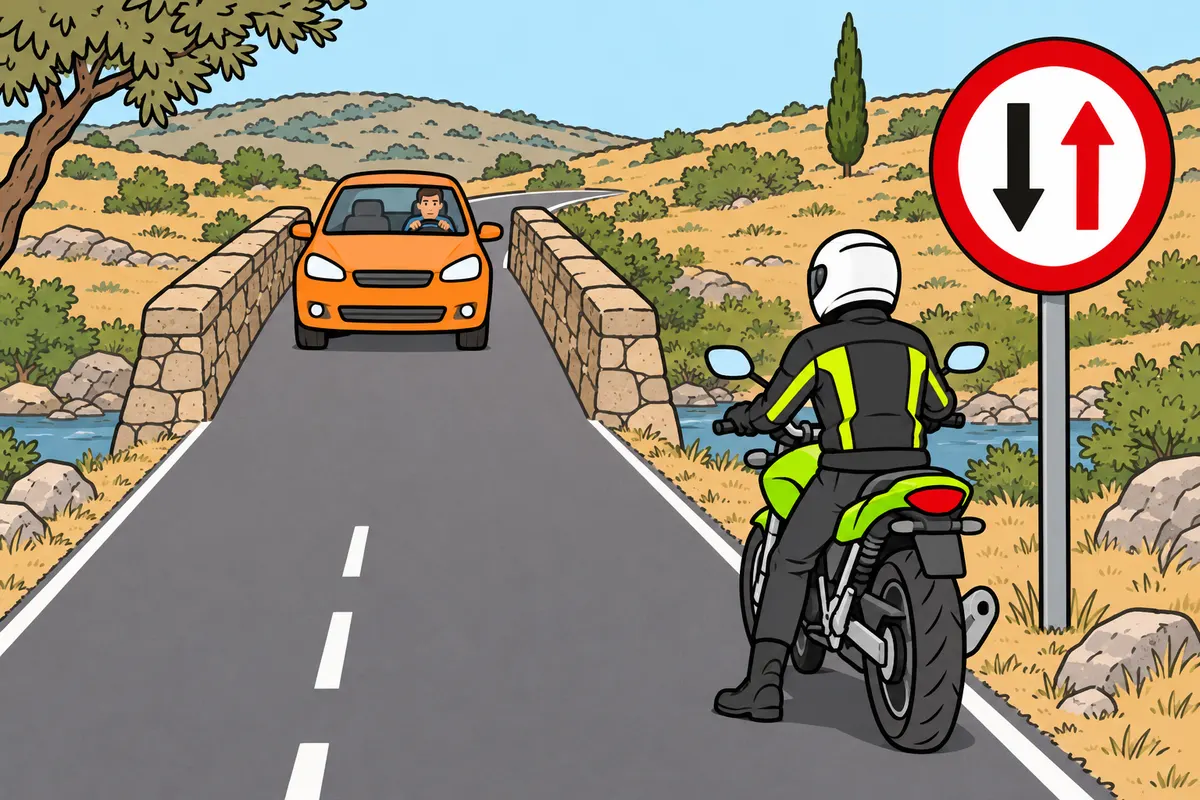
At a controlled narrow section, follow instructions and signs before entering.
| Sign or affected vehicles | Rule |
|---|---|
| R-5 | Do not enter if you would force oncoming traffic to stop |
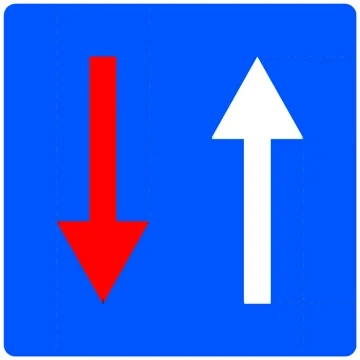
| R-6 | You have priority; continue only if safe |
| Vehicles requiring special authorisation | Cannot pass each other on bridges with carriageways under 6 m |
| Vehicles requiring special authorisation | Each needs at least 3 m |
Remember
- Obey officers, authorised staff and signs.
- Even on a narrow motorcycle, do not enter if passing would be unsafe.
- Having priority does not allow you to cause a collision.
- On narrow bridges, reverse if you cannot pass and your sign requires giving way.
Exam trap: Wrong: the minimum width applies to all vehicles. Right: this width condition concerns vehicles requiring special authorisation passing each other.
Read the full explanation
- Narrow-section rules resolve encounters between vehicles travelling in opposite directions when passing each other is impossible or very difficult. First follow officers, authorised personnel and signs; your motorcycle being narrow does not allow you to enter if the two vehicles still cannot pass safely. [RGC, arts. 60, 61 and 62](https://www.boe.es/buscar/act.php?id=BOE-A-2003-23514#a60)
- R-5 gives priority to oncoming traffic: you must not enter if crossing forces approaching vehicles to stop. R-6 indicates your priority over oncoming traffic; you may continue cautiously when passage is safe, without forcing a collision if the section is occupied. [RGC, arts. 58 and 61; Annex I](https://www.boe.es/buscar/act.php?id=BOE-A-2003-23514#a61)
- On a narrow bridge or other narrow crossing structure, you must follow the signs regulating passage. If two vehicles cannot pass each other and your end has a priority-to-oncoming-traffic or give-way sign, you must reverse to let the other vehicle pass. [RGC, art. 61.1 and 2](https://www.boe.es/buscar/act.php?id=BOE-A-2003-23514#a61)
- Vehicles requiring special authorisation cannot pass each other on bridges with a carriageway less than 6 metres wide, so that each has at least 3 metres. This is a condition for encounters between those vehicles; on your motorcycle, you must still respect the controls and ensure safe passage is possible. [RGC, art. 61.3](https://www.boe.es/buscar/act.php?id=BOE-A-2003-23514#a61)
 R-5
 R-6
16Prior entry and roadworks
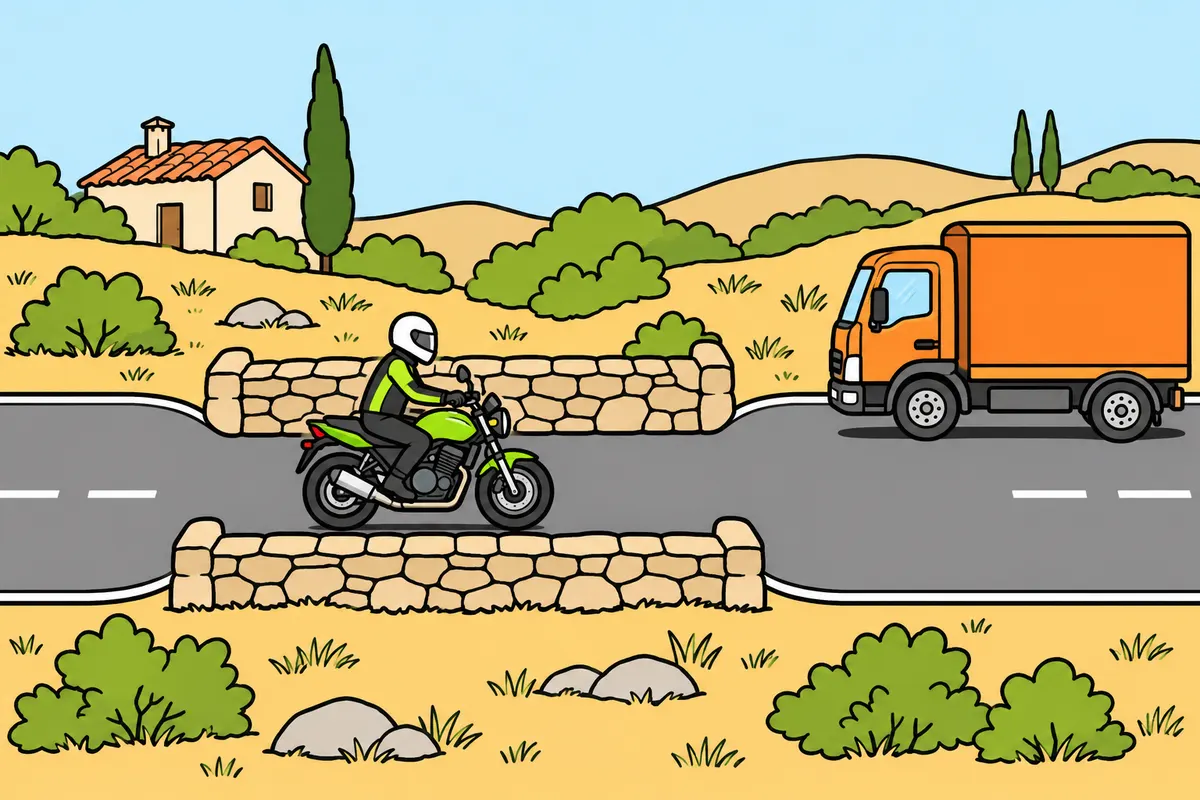
At an ordinary narrow section without signs, let whoever entered first pass.
| Case | What you must do |
|---|---|
| Ordinary narrow section without signs | Let whoever entered first pass |
| Doubt about who entered first | Apply the order based on difficulty of manoeuvring |
| Roadworks controlled by staff | Follow their instructions |
Remember
- If unsure who entered first, apply the order based on difficulty of manoeuvring.
- Vehicle size alone does not override prior entry.
- At roadworks, follow the indicated route and obey staff.
- Wait behind earlier arrivals travelling your way, keeping as far right as possible.
- Allow urgent passage through roadworks when possible without danger or damage.
Exam trap: Wrong: a lorry always passes before your motorcycle. Right: at an ordinary narrow section without signs, first check who entered first.
Read the full explanation
- At a general narrow section without specific signs, whoever enters first has priority. If you have already entered on your motorcycle before a lorry arrives from the opposite end, your prior entry is the initial criterion; the lorry’s size does not automatically override that rule. [RGC, art. 60.1](https://www.boe.es/buscar/act.php?id=BOE-A-2003-23514#a60)
- If there is doubt about who entered first, the regulatory order based on difficulty of manoeuvring applies. Do not resolve the encounter solely by measuring each vehicle’s proximity to the start of the section or assuming that sounding the horn gives anyone a right to pass. [RGC, arts. 60 and 62](https://www.boe.es/buscar/act.php?id=BOE-A-2003-23514#a62)
- On a road with works, you must travel where indicated and obey the personnel regulating passage. If another vehicle travelling in your direction arrived before you and is waiting, position yourself behind it, as far right as possible, and follow it through when appropriate. [RGC, art. 60.2, 4 and 5](https://www.boe.es/buscar/act.php?id=BOE-A-2003-23514#a60)
- Urgent passage by police, fire, civil protection and rescue or medical services through the section under repair is permitted whenever possible without danger or damage to the works. You must follow the personnel’s controls and leave space for this operation, without moving into the work area on your own initiative. [RGC, art. 60.3](https://www.boe.es/buscar/act.php?id=BOE-A-2003-23514#a60)
17Order based on difficulty of manoeuvring
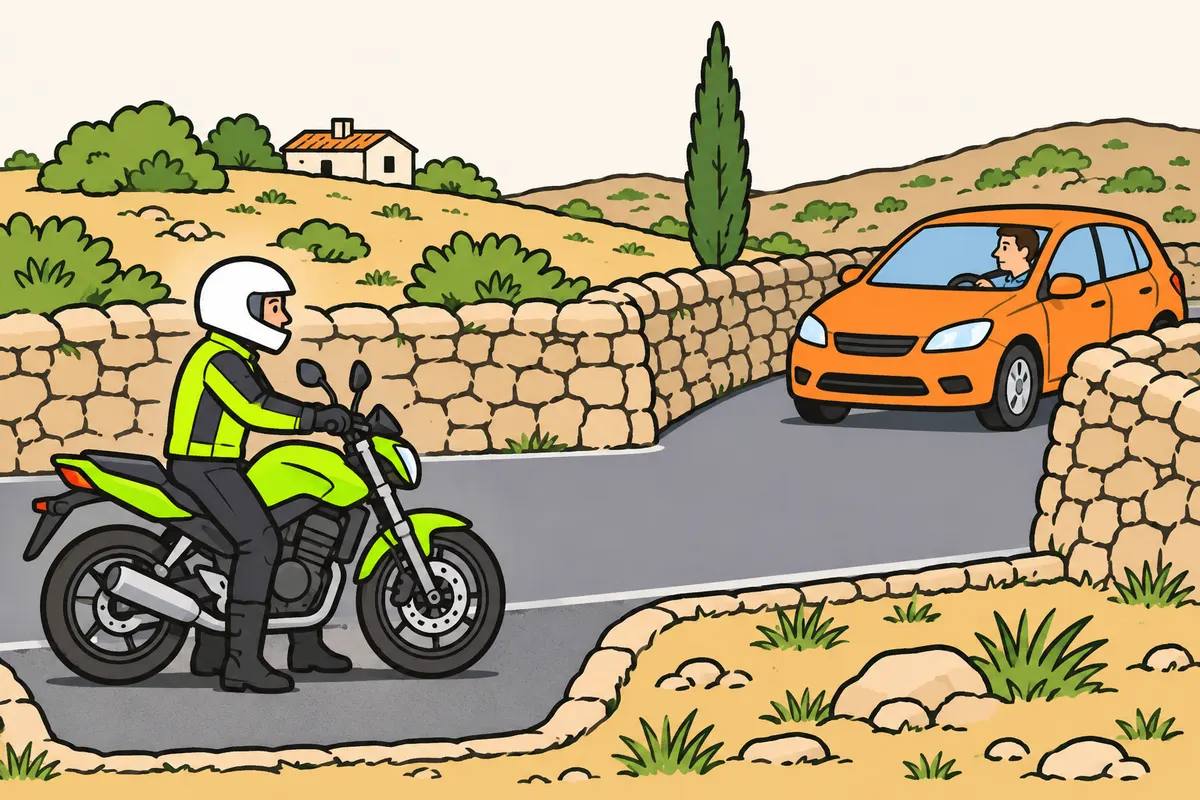
When the manoeuvring order applies, your motorcycle without a sidecar belongs to the last group.
| Vehicles: when this classification applies | Priority, first to last |
|---|---|
| Special vehicles and special transport exceeding general mass or size limits | First |
| Vehicle combinations, except cars with trailers in the fourth group | Second |
| Animal-drawn vehicles | Third |
| Motor caravans and cars towing trailers with maximum authorised mass up to 750 kg | Fourth |
| Collective passenger transport | Fifth |
| Lorries, tractor units and vans | Sixth |
| Cars and car-derived vans | Seventh |
| Special vehicles within general mass and size limits; quadricycles, including light quadricycles | Eighth |
| Three-wheeled motor vehicles and mopeds; motorcycles with sidecars | Ninth |
| Motorcycles, two-wheeled mopeds and bicycles | Tenth |
Remember
- Use this order when it applies to deciding who must reverse.
- Without a sidecar, reverse for a car when this classification applies.
- With a sidecar, you belong to a different group.
- For matching vehicle types or unlisted cases, compare the distance each must reverse.
- The vehicle needing to reverse further has priority.
- For equal reversing distances, compare greater width, length or maximum authorised mass.
Exam trap: Wrong: exclude a trailer of exactly 750 kg. Right: that value is included; use its maximum authorised mass, not its current load.
Read the full explanation
- When the order in article 62 applies because one vehicle must reverse, first come special vehicles and special transport exceeding the general mass or dimension limits. Second come vehicle combinations, except cars with trailers expressly included in the fourth group. [RGC, art. 62.1.a and b](https://www.boe.es/buscar/act.php?id=BOE-A-2003-23514#a62)
- The third group is animal-drawn vehicles. Fourth come motor caravans and cars towing trailers with a maximum authorised mass of up to 750 kg: exactly 750 kg is included, and the reference is the trailer’s MMA (maximum authorised mass), not its current load. [RGC, art. 62.1.c and d](https://www.boe.es/buscar/act.php?id=BOE-A-2003-23514#a62)
- Fifth come vehicles intended for collective passenger transport; sixth, lorries, tractor units and vans; seventh, cars and car-derived vans. Therefore, in this situation, a bus passes before a lorry, and a lorry before a car. [RGC, art. 62.1.e to g](https://www.boe.es/buscar/act.php?id=BOE-A-2003-23514#a62)
- The eighth group comprises special vehicles not exceeding the general mass or dimension limits, quadricycles and light quadricycles. The ninth comprises three-wheeled motor vehicles, motorcycles with sidecars and three-wheeled mopeds. [RGC, art. 62.1, letters h) and i)](https://www.boe.es/buscar/act.php?id=BOE-A-2003-23514#a62)
- The tenth group includes motorcycles, two-wheeled mopeds and bicycles. On your motorcycle without a sidecar, you belong to this last group: if this classification applies and you meet a car, you must let it pass by reversing yourself; the classification differs with a sidecar. [RGC, art. 62.1.j](https://www.boe.es/buscar/act.php?id=BOE-A-2003-23514#a62)
- Between vehicles of the same type or in unlisted cases, the vehicle that would have to reverse further has priority. If the distance is equal, greater width, length or maximum authorised mass is considered; between two motorcycles of the same type, start by comparing the reversing distance required. [RGC, art. 62.1](https://www.boe.es/buscar/act.php?id=BOE-A-2003-23514#a62)
18Steep gradients and who reverses
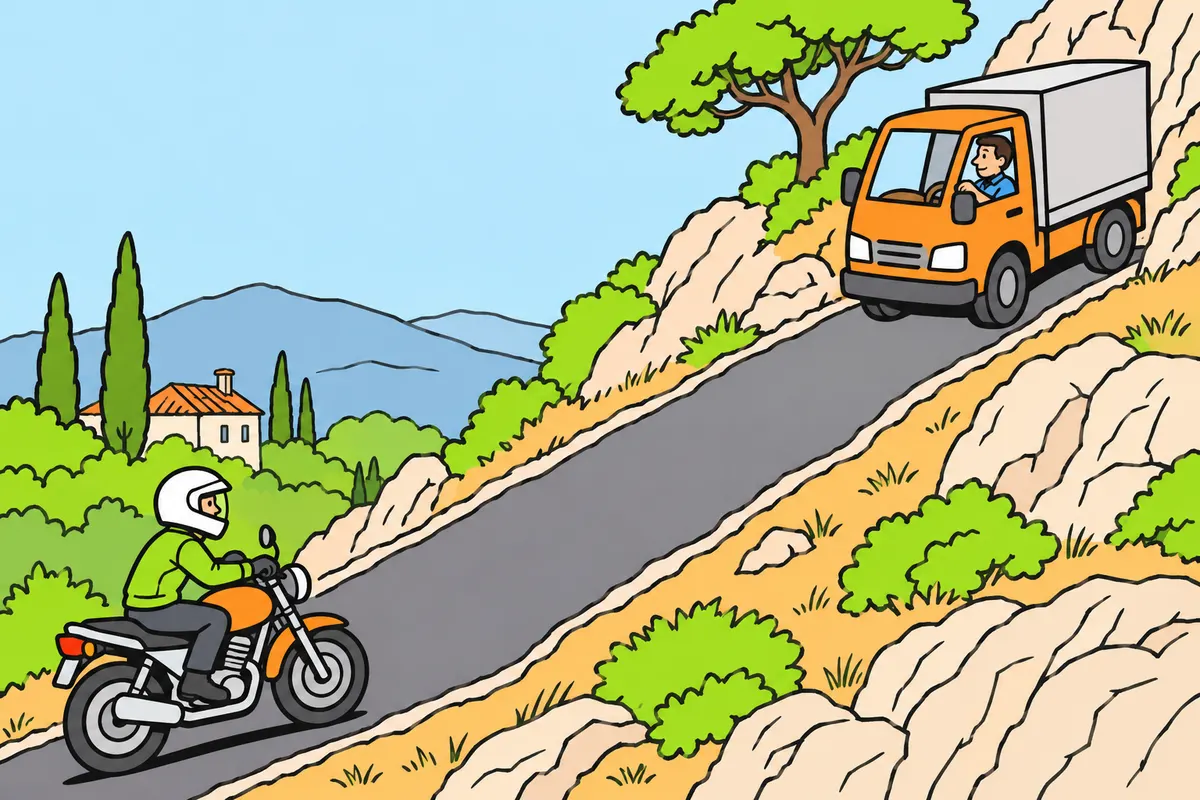
On a steep narrow section, you normally give way to the uphill vehicle.
| Case on a steep narrow section | How you resolve passage |
|---|---|
| Passing impossible or very difficult, unless controls say otherwise | Give priority to the uphill vehicle |
| Uphill vehicle can reach a designated lay-by first | It must use that option |
Remember
- Apply this rule when passing is impossible or very difficult.
- First respect any instructions or signs controlling passage.
- A steep gradient starts at 7 %, including that exact value.
- If the uphill vehicle can reach a designated lay-by first, it must.
- This rule can give your uphill motorcycle priority over a downhill lorry.
- If unsure about gradient or passing-place distance, use the order by manoeuvring difficulty.
Exam trap: Wrong: the downhill vehicle must always reverse. Right: on a steep narrow section, the uphill vehicle must use a designated lay-by if it can reach it first.
Read the full explanation
- On a steep section so narrow that passing is impossible or very difficult, the uphill vehicle has priority. You must apply this specific rule before deciding by vehicle category, subject to any signs or instructions regulating passage. [RGC, art. 63](https://www.boe.es/buscar/act.php?id=BOE-A-2003-23514#a63)
- A gradient of at least 7 % counts as steep; exactly 7 % is included. The percentage describes the gradient, not a separation distance or speed limit, and the special rule also requires the specified narrowness conditions. [RGC, art. 63.1](https://www.boe.es/buscar/act.php?id=BOE-A-2003-23514#a63)
- The exception applies when the uphill vehicle can reach a designated lay-by first. In that case, this possibility must be used instead of always requiring the downhill vehicle to reverse; observe where the lay-by is in relation to both vehicles. [RGC, art. 63.1](https://www.boe.es/buscar/act.php?id=BOE-A-2003-23514#a63)
- If you are riding uphill and a lorry is coming downhill, the steep-gradient rule may give you priority even though your vehicle comes later in the general classification. If you are unsure of the gradient or the distance to the lay-by, you must decide using the criteria in article 62. [RGC, art. 63.1](https://www.boe.es/buscar/act.php?id=BOE-A-2003-23514#a63)
19Priority vehicles on urgent duty
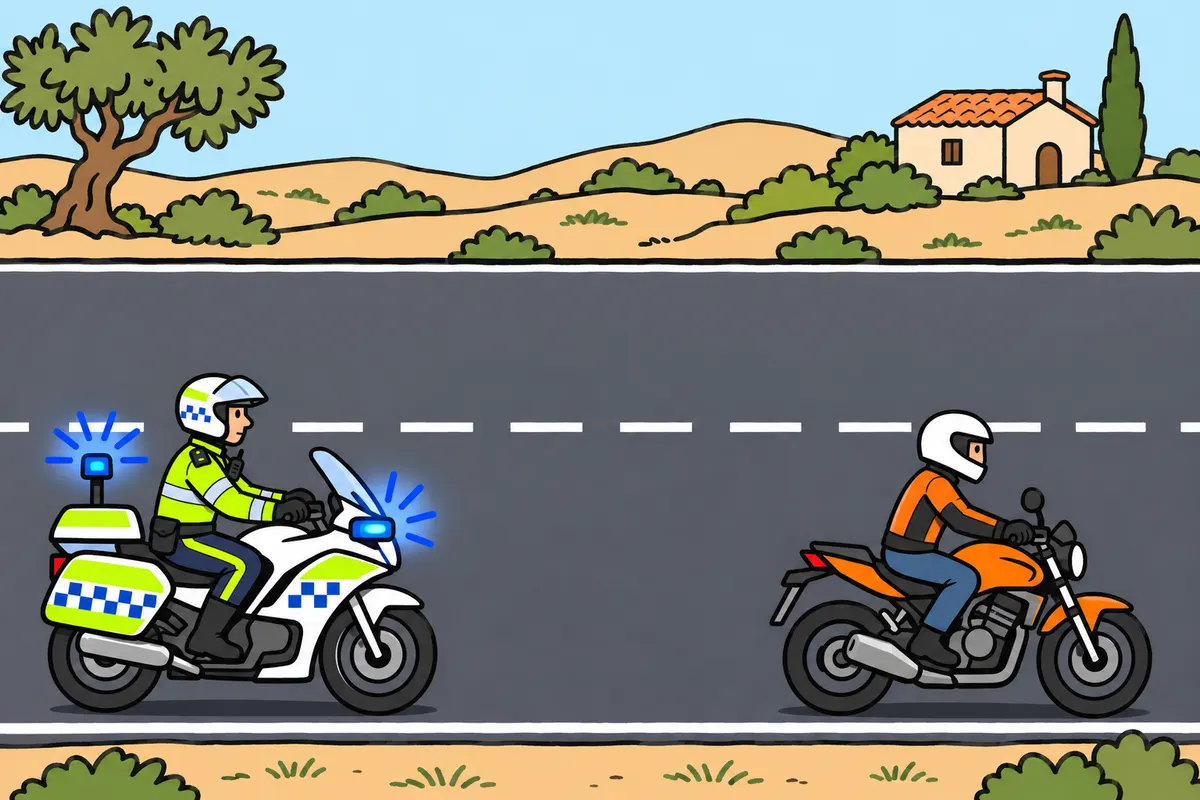
Recognise a priority vehicle by its urgent duty and required warning signals.
| Vehicle or warning | How you interpret it |
|---|---|
| Urgent duty with the required signals | Make way for its priority passage |
| Light only, when omitting the siren creates no danger | Recognise that priority can still apply |
| Ambulance without urgent duty | Apply ordinary rules |
| Breakdown or maintenance vehicle with warning light | Do not give it priority-vehicle powers |
Remember
- Let police, fire, civil protection, rescue and medical vehicles pass on signalled urgent duty.
- Medical services may be public or private.
- Officers’ instructions also bind priority-vehicle drivers.
- Before overriding priority, their driver must check that others are making way.
- Urgency does not allow anyone to endanger others.
- On autopistas and autovías, exceptional emergency manoeuvres must also be safe.
Exam trap: Wrong: without a siren, there is never priority. Right: the vehicle can use only its light if omitting the siren puts nobody in danger.
Read the full explanation
- Police, fire, civil protection and rescue, and public or private medical-service vehicles have priority over other vehicles and users when on urgent duty and announcing their presence as required by the regulations. This may be a police motorcycle: bodywork or size alone does not determine that status. [RGC, arts. 67 and 68](https://www.boe.es/buscar/act.php?id=BOE-A-2003-23514#a68)
- The general warning combines a light signal and a special audible warning device. They must use only the light when omitting the siren poses no danger to others; therefore a priority vehicle on urgent duty can retain priority even when you hear no audible warning. [RGC, art. 68.2](https://www.boe.es/buscar/act.php?id=BOE-A-2003-23514#a68)
- An ambulance travelling without being on urgent duty is subject to the ordinary rules. A breakdown or maintenance vehicle does not gain the powers of priority vehicles by doing its work or displaying a warning light; you must identify the service and the regulatory conditions of the situation. [RGC, arts. 67 and 68](https://www.boe.es/buscar/act.php?id=BOE-A-2003-23514#a67)
- Drivers of priority vehicles may use certain exemptions concerning speed, road use and signals under their own responsibility and after making sure they endanger nobody. Officers’ instructions and signals are always compulsory, including for those on urgent duty. [RGC, art. 68.1](https://www.boe.es/buscar/act.php?id=BOE-A-2003-23514#a68)
- Before overriding priority or passing a light against them, the priority-vehicle driver must take extra precautions and check that there is no risk of hitting anyone and that others have stopped or are making way. Urgency does not allow entry into a junction on the assumption that everyone has seen the vehicle. [RGC, art. 67.2](https://www.boe.es/buscar/act.php?id=BOE-A-2003-23514#a67)
- On an autopista or autovía, a priority vehicle on urgent duty may exceptionally turn around, reverse, use the central reservation and crossovers, or travel against the traffic on the hard shoulder, without compromising safety. Officers responsible for traffic may also position their vehicles wherever assistance or service requires, taking the appropriate precautions. [RGC, art. 68.1](https://www.boe.es/buscar/act.php?id=BOE-A-2003-23514#a68)
20How to make way for an emergency vehicle
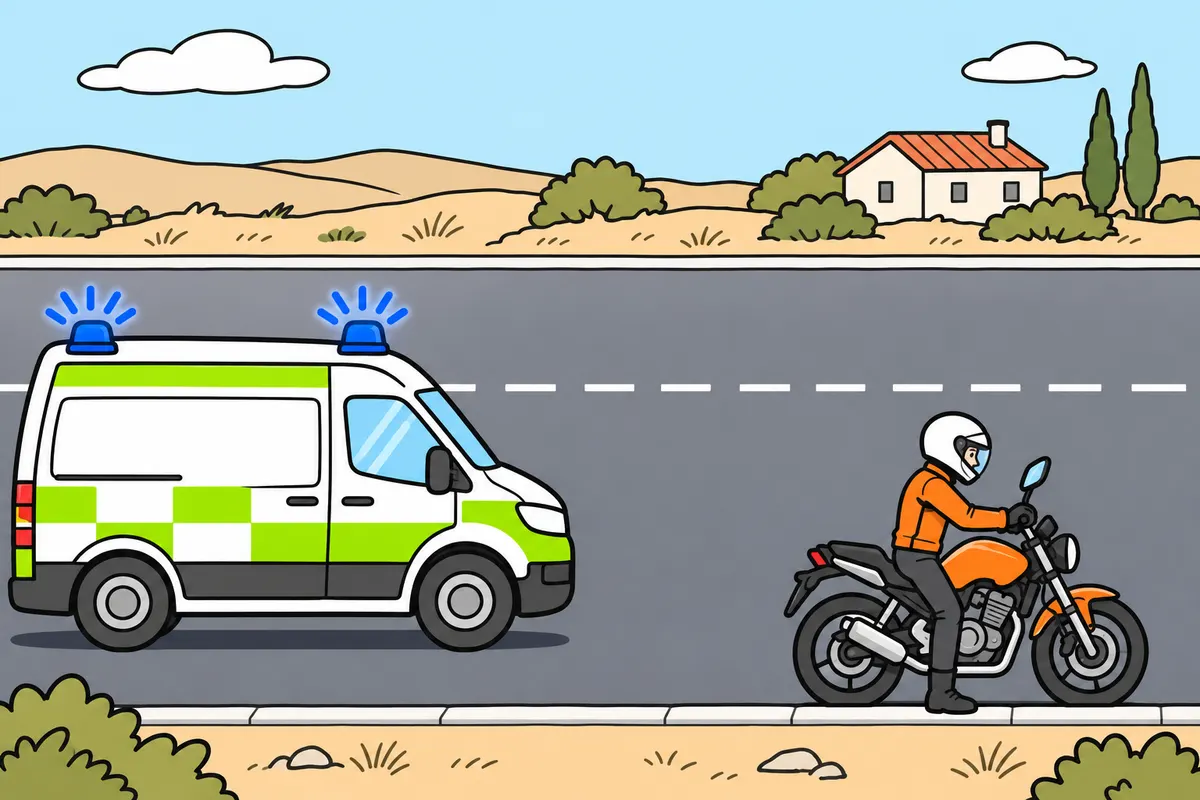
Make way for an emergency vehicle with safe, predictable movements.
| Police warning | What you must do |
|---|---|
| Police behind you: required presence signals plus forward-facing flashing or strobing red light | Stop cautiously on the right, ahead of them, without creating risks |
Remember
- When you notice its signals, make way; normally move to the right.
- Stop if necessary.
- Check your mirrors and slow down without sudden movements.
- Do not follow the emergency vehicle to use the gaps.
- If police order you to stop, follow their instructions.
- On your motorcycle, remain seated unless the officer tells you otherwise.
Exam trap: Wrong: making way gives you emergency-driver exemptions. Right: make way safely and follow officers’ instructions.
Read the full explanation
- As soon as you notice a priority vehicle’s special signals, you must take appropriate measures to help it pass. You normally move to the right and stop if necessary; in queues on an autopista or autovía, you must follow the emergency-corridor arrangement. [RGC, art. 69](https://www.boe.es/buscar/act.php?id=BOE-A-2003-23514#a69)
- As a motorcycle guideline, check your mirrors, slow down predictably and avoid a sudden manoeuvre that closes the gap for passage. Choose a place where the motorcycle is stable and does not force the emergency vehicle to change direction repeatedly to avoid people trying to move aside. [RGC, art. 69](https://www.boe.es/buscar/act.php?id=BOE-A-2003-23514#a69)
- Making way does not give you the priority driver’s exemptions. Follow officers’ instructions and perform the manoeuvre the situation allows without endangering pedestrians or other vehicles; you must not follow the emergency vehicle to benefit from the gaps others open. [RGC, arts. 58, 68 and 69](https://www.boe.es/buscar/act.php?id=BOE-A-2003-23514#a69)
- If a police vehicle positions itself behind you and, in addition to announcing its presence as required, displays a forward-facing flashing or strobing red light, you must stop cautiously on the right, ahead of it, where you do not create greater risks or inconvenience. You must remain in the vehicle; on your motorcycle, remain seated on it unless the officer instructs you otherwise. You must follow the officer’s instructions over the loudspeaker or by any other means you can clearly perceive. [RGC, art. 69](https://www.boe.es/buscar/act.php?id=BOE-A-2003-23514#a69)
21Emergency corridor in traffic queues
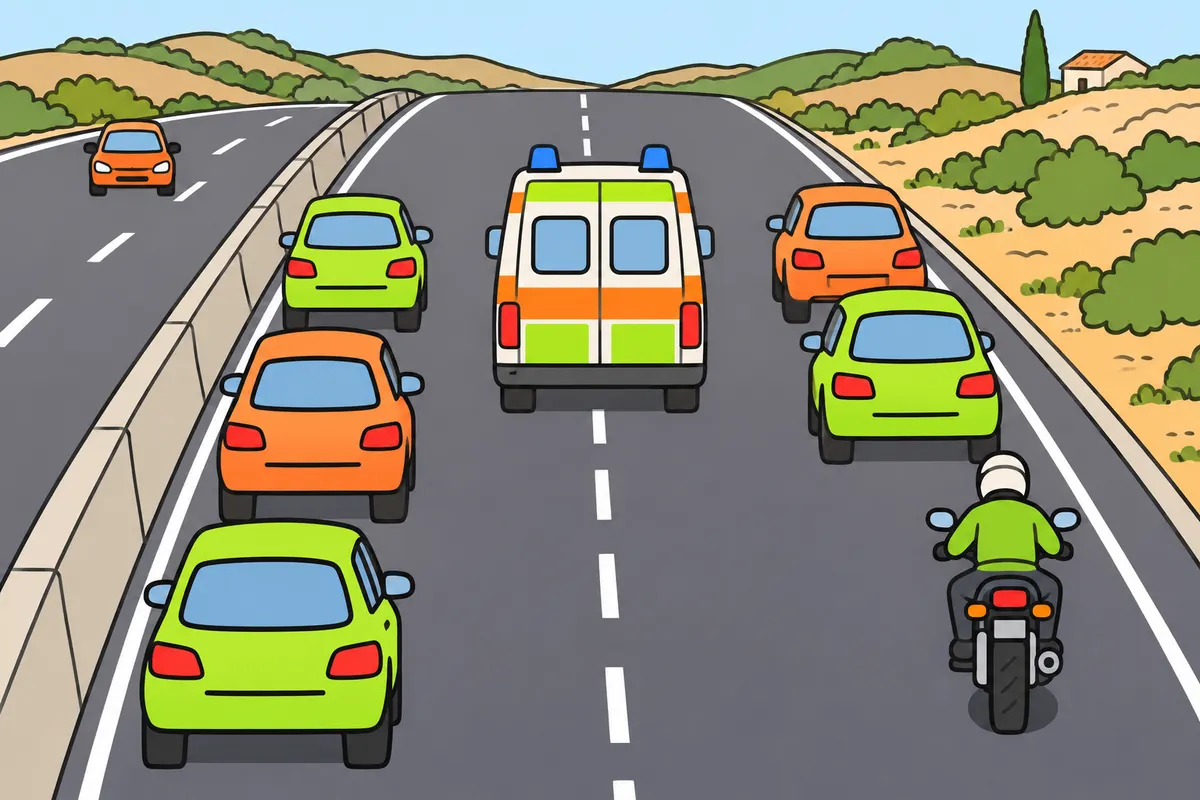
In queues on autopistas and autovías, leave space for priority vehicles.
Remember
- When stopped or moving at walking pace, move aside to leave space.
- This space lets approaching priority vehicles pass.
- You must also cooperate when riding a motorcycle.
Exam trap: Wrong: you can ride along the emergency corridor. Right: leave that space for priority vehicles.
Read the full explanation
- On autopistas and autovías, when a queue makes you travel at walking pace or stop, you must move aside to leave space for approaching priority vehicles. This space is the emergency corridor; you must also cooperate when riding a motorcycle. [RGC, art. 32.1](https://www.boe.es/buscar/act.php?id=BOE-A-2003-23514#a32)
- The allocation of space with two lanes or with three or more, and lane arrangements when snow makes driving difficult, are covered in the Using the road on your motorcycle module, under “Emergency corridors and riding in snow”. [RGC, art. 32.1 and 2](https://www.boe.es/buscar/act.php?id=BOE-A-2003-23514#a32)
22Emergency in a private vehicle
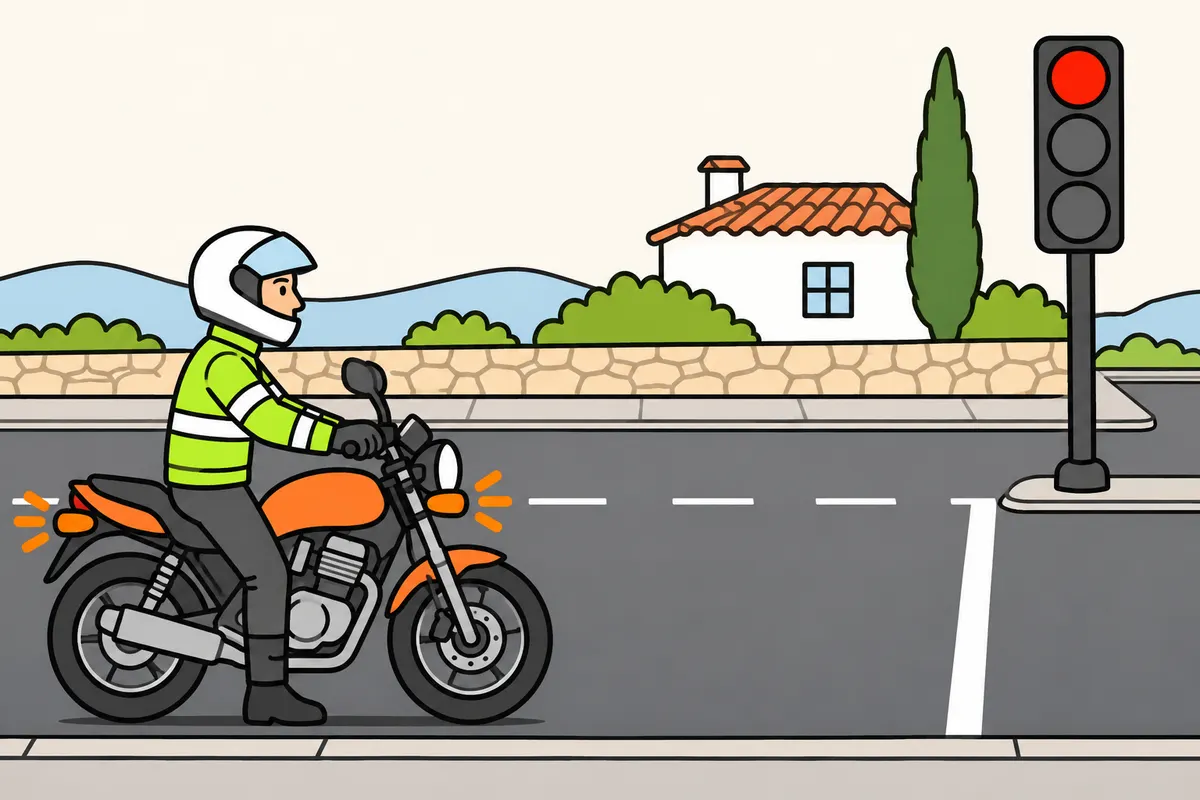
An exceptional emergency in your private vehicle does not let you break traffic rules.
Remember
- This applies only to particularly serious circumstances with no other means available.
- Sound your horn intermittently.
- Also use hazard lights if fitted, or a handkerchief or similar warning.
- Use available warnings while keeping full control of the motorcycle and your balance.
- Respect traffic rules, especially at junctions.
- You must justify the serious circumstances if officers ask.
Exam trap: Wrong: a private emergency allows you to ignore a traffic light. Right: obey it; others must help you pass.
Read the full explanation
- If particularly serious circumstances force you to use your motorcycle to perform a service normally reserved for priority vehicles and you cannot use any other means, the exceptional rules for an emergency in a private vehicle apply. The necessity must meet both conditions: particularly serious circumstances and the impossibility of using any other means. [RGC, art. 70.1](https://www.boe.es/buscar/act.php?id=BOE-A-2003-23514#a70)
- Try to make others aware of the emergency by sounding the horn intermittently and using hazard warning lights, if fitted, or waving a handkerchief or using a similar method. On your motorcycle, use the means available while keeping full control of the motorcycle and your balance as you give the warning. [RGC, art. 70.1](https://www.boe.es/buscar/act.php?id=BOE-A-2003-23514#a70)
- You must obey the traffic rules, paying particular attention to junctions, during this exceptional service too. Other road users must help you proceed in accordance with article 69, taking appropriate measures and normally moving to the right or stopping if necessary; you remain subject to the signs and priority rules at each junction. [RGC, art. 70.2](https://www.boe.es/buscar/act.php?id=BOE-A-2003-23514#a70)
- Officers may require you at any time to justify the particularly serious circumstances prompting the service. You must be able to explain the necessity that forces you to act and why you cannot use any other means. [RGC, art. 70.3](https://www.boe.es/buscar/act.php?id=BOE-A-2003-23514#a70)
23Level crossings and opening bridges
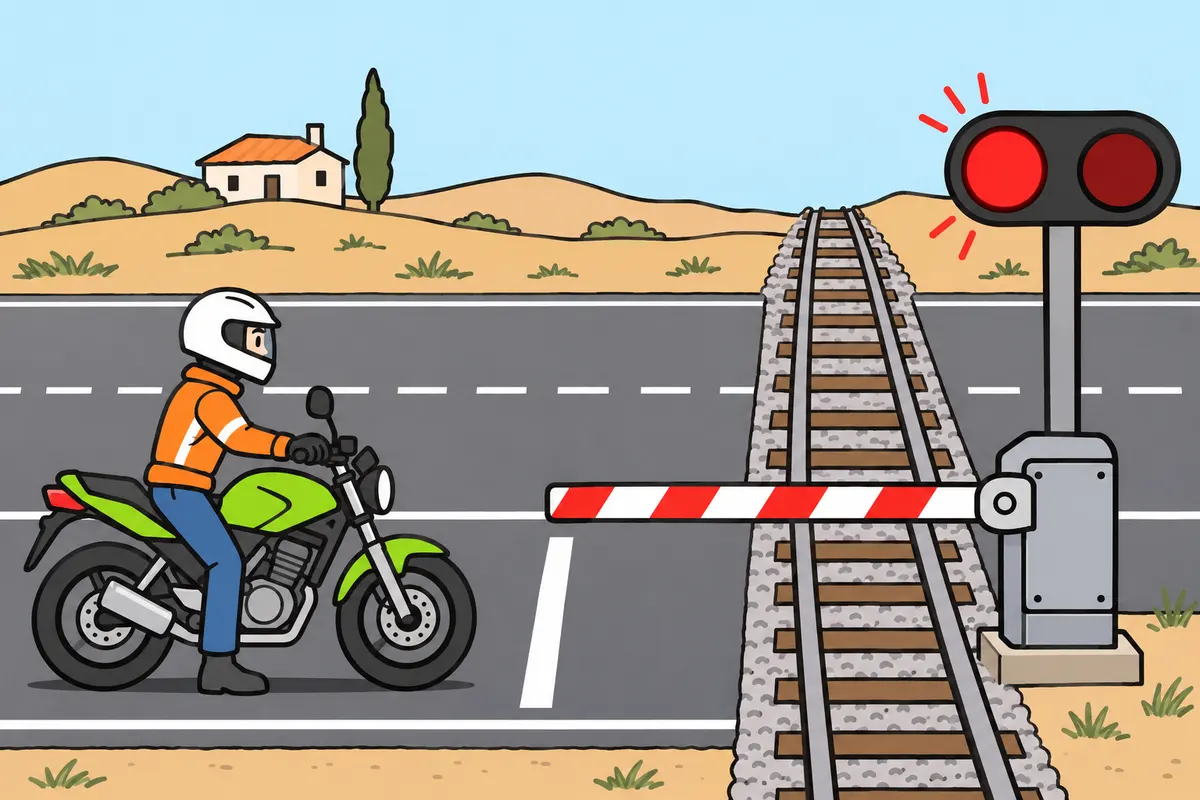
Cross level crossings and opening bridges only when you can clear them safely.
| Case | What you must do |
|---|---|
| Barrier or half-barrier rising or lowering | Stop |
| Flashing red or alternating red lights | Do not pass |
| Blocked exit | Wait outside so you do not become stranded |
Remember
- Slow below the maximum speed and take extra care.
- If closed or the barrier is moving, wait behind vehicles already stopped.
- Do not ride around the end of a half-barrier.
- Do not enter against a prohibiting light, even with the barrier raised.
- Without barriers or traffic lights, check that no rail vehicle is approaching.
- Check that the exit is clear and cross without delay.
Exam trap: Wrong: you can cross while the barrier rises. Right: wait until passage is clear and no signal prohibits entry.
Read the full explanation
- When approaching a level crossing or opening bridge, you must take extra care and reduce your speed below the maximum permitted. This duty applies even if you know the location or it appears open; observe the controls and check that you can clear the area completely. [RGC, art. 95.1](https://www.boe.es/buscar/act.php?id=BOE-A-2003-23514#a95)
- If it is closed or the barrier or half-barrier is moving, you must stop behind those waiting in your lane until passage is clear. The prohibition includes both rising and lowering movements; on a motorcycle, you cannot use the space beside a half-barrier. [RGC, arts. 95.2 and 96.1](https://www.boe.es/buscar/act.php?id=BOE-A-2003-23514#a96)
- You cannot enter when the light prohibits passage, even if the barrier is raised. One flashing red light or two alternating red lights temporarily prohibit passage before a level crossing or at the entrance to an opening bridge, among other specified locations. [RGC, art. 96.1 and Annex I, section 4.2](https://www.boe.es/buscar/act.php?id=BOE-A-2003-23514#a96)
- At a level crossing without barriers, half-barriers or traffic lights, you must make sure that no rail vehicle is approaching before entering. The absence of closure devices does not mean automatic permission or remove railway priority. [RGC, art. 96.2](https://www.boe.es/buscar/act.php?id=BOE-A-2003-23514#a96)
- Cross the railway without delay and only after checking that there is no risk of becoming stranded on it because of traffic or another cause. If the exit is occupied, wait outside even if you can still fit the motorcycle before the last rail; you need space to complete the crossing. [RGC, art. 95.3](https://www.boe.es/buscar/act.php?id=BOE-A-2003-23514#a95)
24Stranded on railway tracks or an opening bridge
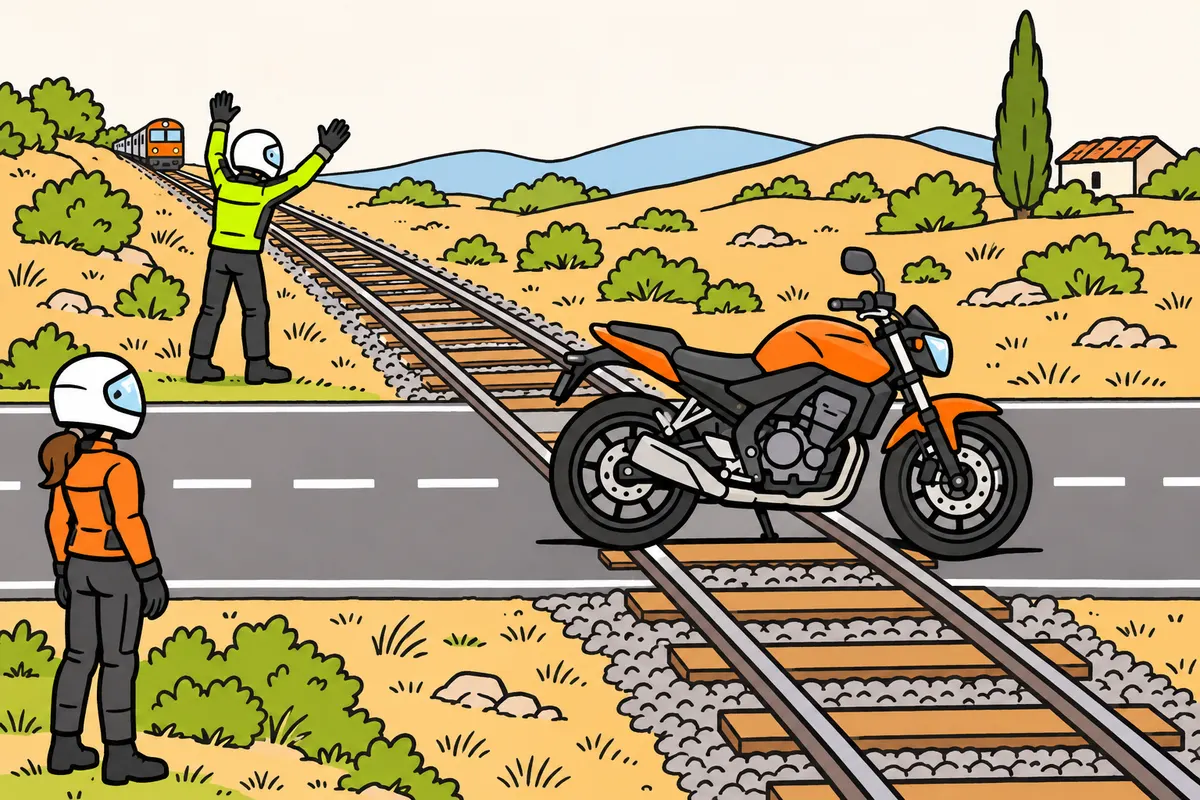
If stranded on tracks or an opening bridge, move people out, clear it and warn.
Remember
- If stopped by circumstances beyond your control, quickly move occupants out of danger.
- Also act to clear the crossing if a load falls onto it.
- Clear the crossing as soon as possible.
- If you cannot, immediately warn approaching train drivers and road users early enough.
- These duties also apply on an opening bridge.
Exam trap: Wrong: calling for help is enough if you cannot clear the crossing. Right: also immediately warn of the obstruction using the means available.
Read the full explanation
- If circumstances beyond your control leave you stopped with your motorcycle on a level crossing, or a load falls onto it, you must take appropriate measures to evacuate occupants quickly and clear the crossing as soon as possible. Protect your passenger too if you have one: remaining in the danger area requires immediate action. [RGC, art. 97.1](https://www.boe.es/buscar/act.php?id=BOE-A-2003-23514#a97)
- If you cannot clear the crossing, you must immediately take the measures available to warn approaching train drivers and road users sufficiently early. Calling for assistance does not replace the need to warn of the obstruction and prevent others from entering the danger area. [RGC, art. 97.1](https://www.boe.es/buscar/act.php?id=BOE-A-2003-23514#a97)
- The same duties to evacuate, clear the way and give warning apply if these circumstances occur on an opening bridge. General breakdown and accident procedures are covered in the Accidents, breakdowns and assistance module, and tunnel and underpass procedures in the Using the road on your motorcycle module. [RGC, art. 97.2](https://www.boe.es/buscar/act.php?id=BOE-A-2003-23514#a97)
Deciding priority at a junction
Decide which controls apply and enter only if you can complete the crossing.
- Identify officers, temporary controls, traffic lights, upright signs and markings affecting your path.
- If there are no priority controls, check the exceptions and apply priority to the right where appropriate.
- Slow down early and stop if required by an instruction, a STOP sign or the need to give way.
- Observe the vehicles, pedestrians and cyclists whose paths you cross.
- Check that the exit is clear and cross without forcing abrupt changes of speed or direction.
Deciding who reverses
Apply the criterion specific to the narrow section, bridge or gradient.
- Obey signs and instructions from officers or authorised personnel.
- If it is a narrow section on a steep gradient, apply uphill priority and the lay-by exception.
- At a general uncontrolled narrow section, identify who entered first.
- If there is doubt about entry, or an unsigned bridge must be resolved by vehicle type, apply the order in article 62.
- Between vehicles of the same type or unlisted cases, compare reversing distance and, if equal, width, length or MMA.
Making way for an emergency vehicle
Open a continuous, predictable route for the priority vehicle.
- Locate the emergency vehicle and check nearby traffic in your mirrors.
- In an ordinary situation, help it pass by normally moving to the right and stopping if necessary.
- In a queue on an autopista or autovía, leave the corridor between the two lanes if there are only two; with more lanes, between the leftmost lane and the one next to it.
- Move predictably and follow officers’ instructions.
- Keep the space clear until the emergency vehicle passes, then resume moving while respecting others’ priority.
Crossing a level crossing
Check permission and the exit before occupying the tracks.
- Reduce your speed below the maximum and observe signs, lights and barriers.
- Wait in your lane if it is closed, the barriers are moving or the light prohibits passage.
- If there are no barriers, half-barriers or traffic lights, make sure no rail vehicle is approaching.
- Check that you can leave completely without becoming trapped.
- Cross without delay; if circumstances beyond your control block the crossing, evacuate, try to clear it and warn of the danger if you cannot.
Finished this module?
Mark it as read and you will see your progress on the theory list.