
Theory · A2 Licence - Motorcycle · Module 13 of 18
Passengers and loads on motorcycles
You learn who can accompany you and where they must sit, how to position and secure luggage, and which mass and load projection limits you must observe. You study load marking and the conditions for towing a trailer with your motorcycle.
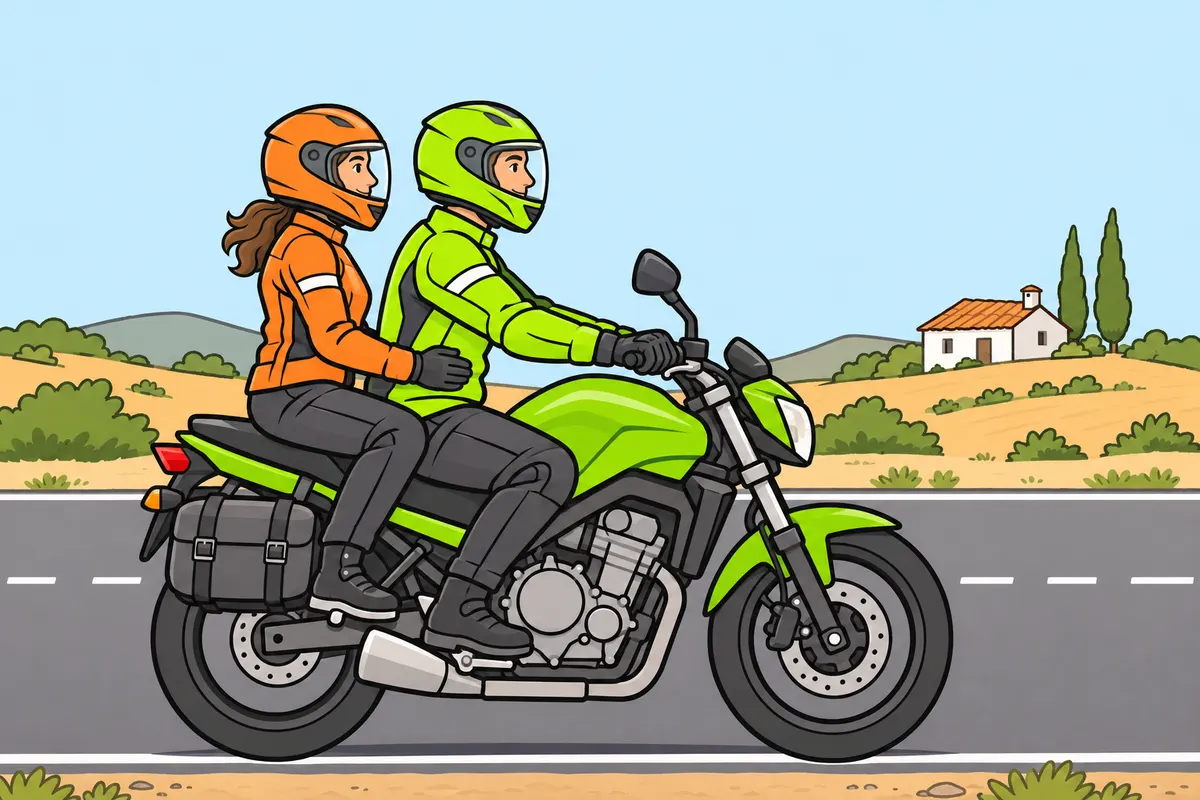
1Authorised seats and passenger position
Carry your passenger only in an authorised seat behind you.
Remember
- Check the authorised seats in your vehicle registration certificate.
- Do not exceed the authorised seats or maximum authorised mass.
- Do not carry passengers in a top box or on a luggage rack.
- Your passenger must sit behind you, with a leg on each side.
- Check that your passenger keeps both feet on the footrests.
Exam trap: Wrong: you can carry a child between you and the handlebars. Right: use an authorised rear seat, with a leg on each side and both feet on the footrests.
Read the full explanation
- You may carry a passenger on the rear seat if this is recorded in your motorcycle’s permiso de circulación (vehicle registration certificate). [RGC, art. 12.1](https://www.boe.es/buscar/act.php?id=BOE-A-2003-23514#a12)
- You must use the seats designed and equipped for people, without exceeding the authorised number of seats or the maximum authorised mass. A top box or luggage rack does not count as a seat. [RGC, art. 9.1](https://www.boe.es/buscar/act.php?id=BOE-A-2003-23514#a9) [RGC, art. 10.1](https://www.boe.es/buscar/act.php?id=BOE-A-2003-23514#a10)
- Your passenger must sit behind you, astride the motorcycle, with both feet resting on the side footrests. You must never place a passenger between your body and the handlebars, even if the passenger is a child. [RGC, art. 12.1](https://www.boe.es/buscar/act.php?id=BOE-A-2003-23514#a12)
2Passenger age and the exception for children
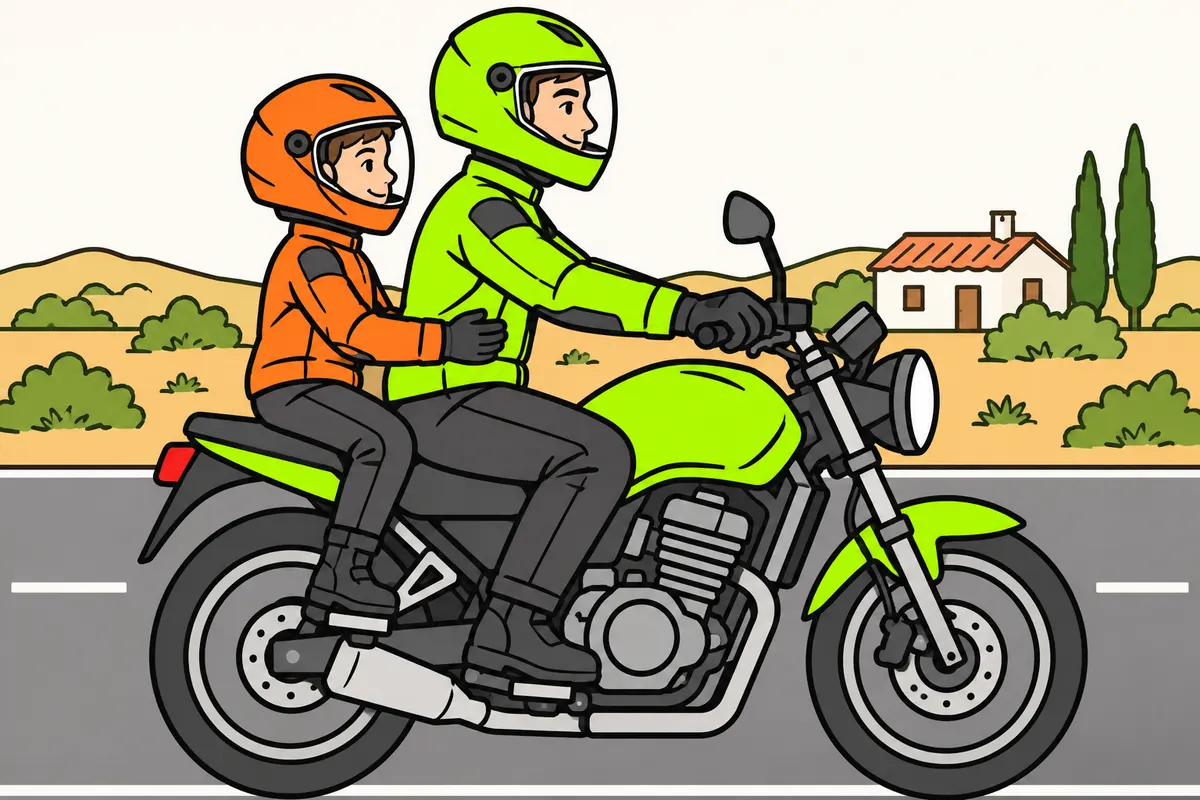
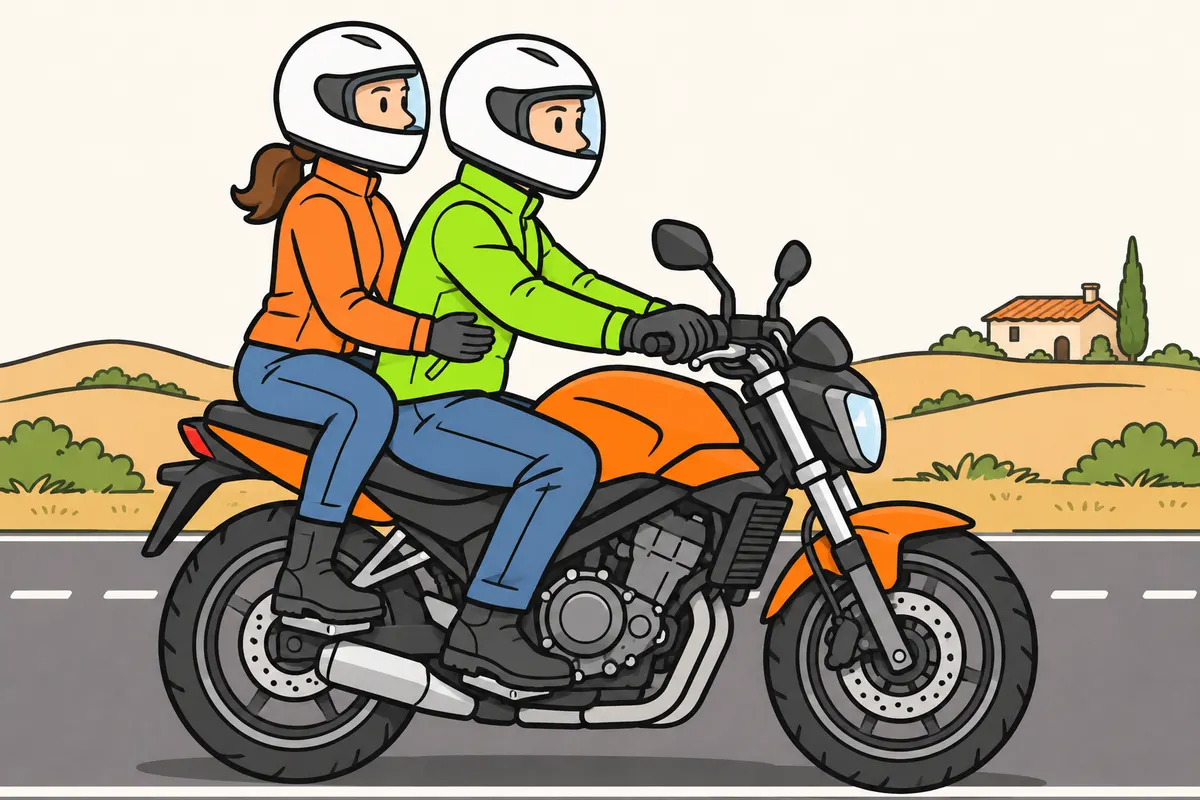
Check your passenger's age and your permission to carry a child.
| Case | Passenger's age | Who can ride the motorcycle |
|---|---|---|
| General rule | Over twelve years old | You need no family relationship |
| Exception for children | Over seven years old | You must be their parent, guardian or an adult authorised by them |
Remember
- Normally, you can carry passengers over twelve years old.
- Under this general rule, you need no family relationship.
- The exception lets you carry children over seven years old.
- You must be their parent, guardian or an adult authorised by them.
- You must meet the same safety conditions.
- You can use the exception on urban and interurban roads.
Exam trap: Wrong: any adult can carry a child over seven years old. Right: you must be their parent, guardian or an adult authorised by them, and meet the same safety conditions.
Read the full explanation
- As a general rule, you may carry a passenger over twelve years of age if the stated safety conditions are met. You do not need to be related to the passenger for this general rule to apply. [RGC, art. 12.1](https://www.boe.es/buscar/act.php?id=BOE-A-2003-23514#a12)
- As an exception, you may carry a child over seven years of age if you are their father, mother or guardian, or an adult authorised by them. The child must meet the same safety conditions as other passengers. [RGC, art. 12.2](https://www.boe.es/buscar/act.php?id=BOE-A-2003-23514#a12) [Ley de Tráfico (Traffic Act), art. 13.5](https://www.boe.es/buscar/act.php?id=BOE-A-2015-11722#a13)
- The exception for children applies on both urban and interurban roads. [RGC, art. 12.2](https://www.boe.es/buscar/act.php?id=BOE-A-2003-23514#a12) [Ley de Tráfico (Traffic Act), art. 13.5](https://www.boe.es/buscar/act.php?id=BOE-A-2015-11722#a13)
3Passengers on a motorcycle with a sidecar
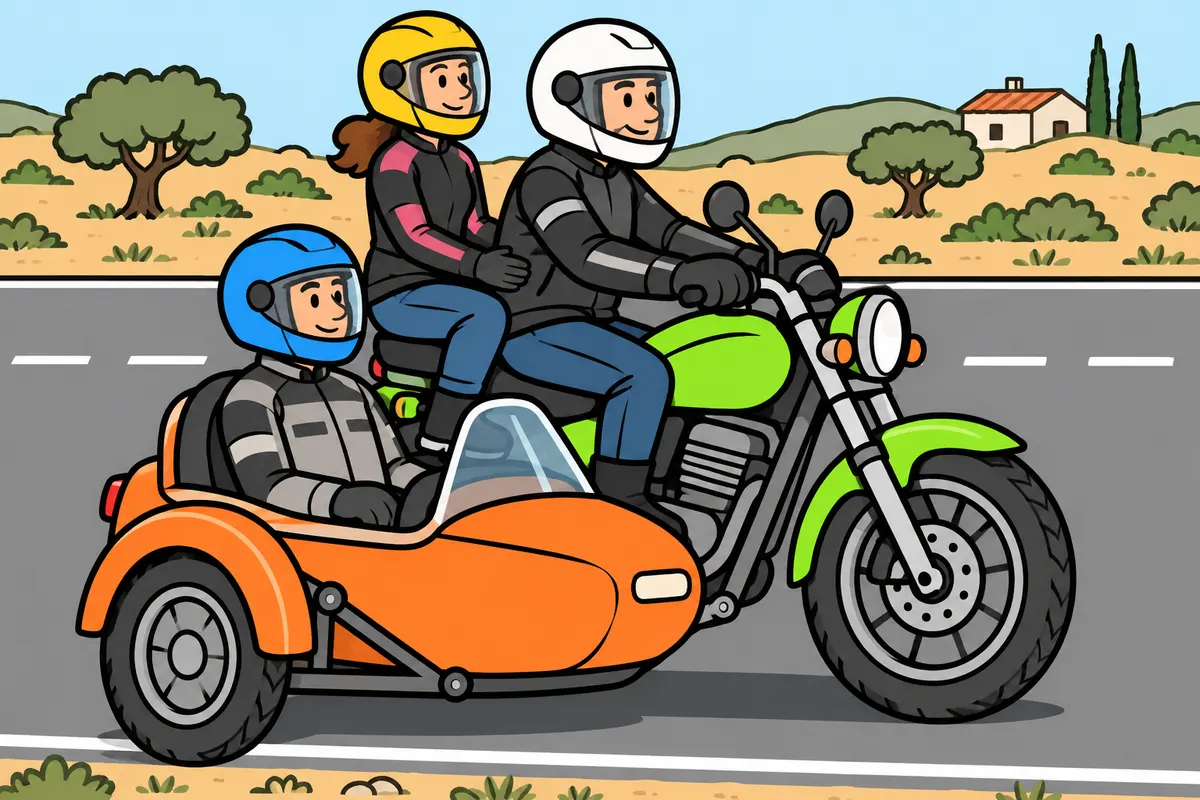
With a sidecar, check authorised seats and put each passenger in the correct place.
| Seat on a motorcycle with sidecar | Passenger's position |
|---|---|
| Sidecar | In its own specially equipped seat |
| Rear seat, if authorised | Behind you, with a leg on each side |
Remember
- Check the authorised seats for your motorcycle with its sidecar.
- Put the sidecar passenger in its specially equipped seat.
- Carry another passenger behind you only if that seat is authorised.
- Arrange luggage so it cannot obstruct or injure anyone.
- Follow the age rules and family exception on every road.
Exam trap: Wrong: you can ignore passenger ages with a sidecar. Right: you must follow the age restrictions and conditions of the family exception on every road.
Read the full explanation
- With a sidecar, you must check the authorised number of seats for that configuration: article 12 provides for the sidecar occupant and, if authorised, a passenger behind you. [RGC, art. 12.1](https://www.boe.es/buscar/act.php?id=BOE-A-2003-23514#a12)
- The sidecar occupant must use the seat specifically provided for them; sitting astride applies to the motorcycle’s rear seat. You must protect and arrange luggage so that it does not obstruct or risk injuring the occupants. [RGC, art. 10](https://www.boe.es/buscar/act.php?id=BOE-A-2003-23514#a10) [RGC, art. 12](https://www.boe.es/buscar/act.php?id=BOE-A-2003-23514#a12)
- The age restrictions and the family exception also cover motorcycles with sidecars on all types of road. [Ley de Tráfico (Traffic Act), art. 13.5](https://www.boe.es/buscar/act.php?id=BOE-A-2015-11722#a13)
4Compulsory passenger equipment
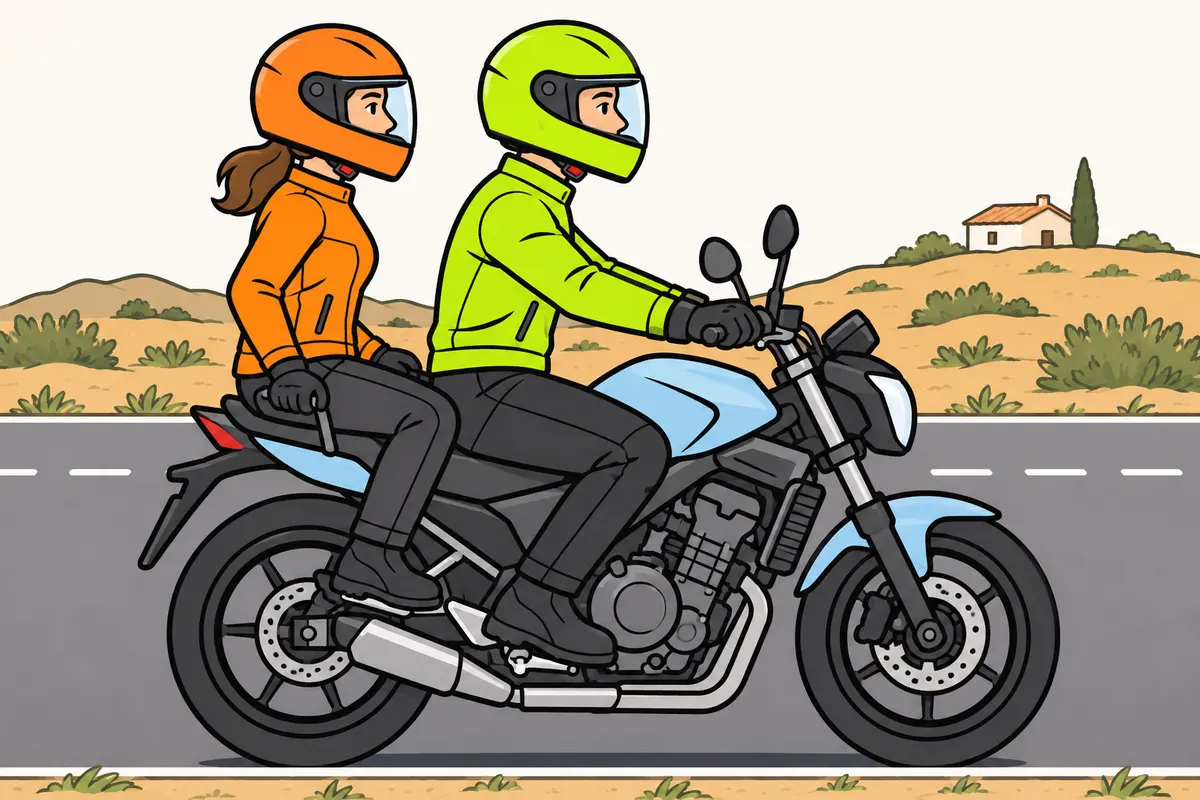
Check that you and your passenger wear the equipment required for the road.
| Case on your motorcycle | Required equipment |
|---|---|
| Without the stated exemption, every road | Wear a fastened approved helmet and closed footwear |
| Without the stated exemption, interurban roads | Also wear protective gloves |
| Protective structure and seat belts recorded on your vehicle roadworthiness test card | Wear your seat belt on every road; helmet, gloves and closed footwear are exempt |
Remember
- Wear an approved UNECE R22 helmet, correctly fastened, on every road.
- Make sure your passenger wears the same required equipment.
- Wear closed footwear covering your whole foot on every road.
- Also wear protective gloves on interurban roads.
- The temporary permission for certified moped helmets does not cover your motorcycle.
- A windscreen or backrest does not replace a protective structure.
Exam trap: Wrong: a windscreen lets you ride without a helmet. Right: exemption from helmets, gloves and closed footwear requires a protective structure and seat belts recorded on your vehicle roadworthiness test card; you must wear the seat belt on every road.
Read the full explanation
- You and your passenger must wear helmets type-approved under UNECE Regulation R22, properly fastened, on every road. [RGC, art. 118.1.a](https://www.boe.es/buscar/act.php?id=BOE-A-2003-23514#a118) The authorisation to use certified helmets for one year from 1 October 2026 applies only to mopeds, not to your A2 motorcycle. [RD 518/2026, Transitional Provision 1.ª and Final Provision 3.ª](https://www.boe.es/buscar/doc.php?id=BOE-A-2026-13889)
- You and your passenger must wear closed footwear covering the whole foot on every road and protective gloves on interurban roads. Equipment selection and fit are covered in «Motorcycle protective equipment». [RGC, art. 118](https://www.boe.es/buscar/act.php?id=BOE-A-2003-23514#a118)
- If your motorcycle has a protective structure and seat belts, and this is recorded on the ITV (vehicle roadworthiness test) card, you and your passenger must wear the seat belts on every road and are exempt from wearing helmets, gloves and closed footwear. A windscreen or backrest does not establish that this exemption applies. [RGC, art. 118](https://www.boe.es/buscar/act.php?id=BOE-A-2003-23514#a118)
5Maximum mass and luggage capacity
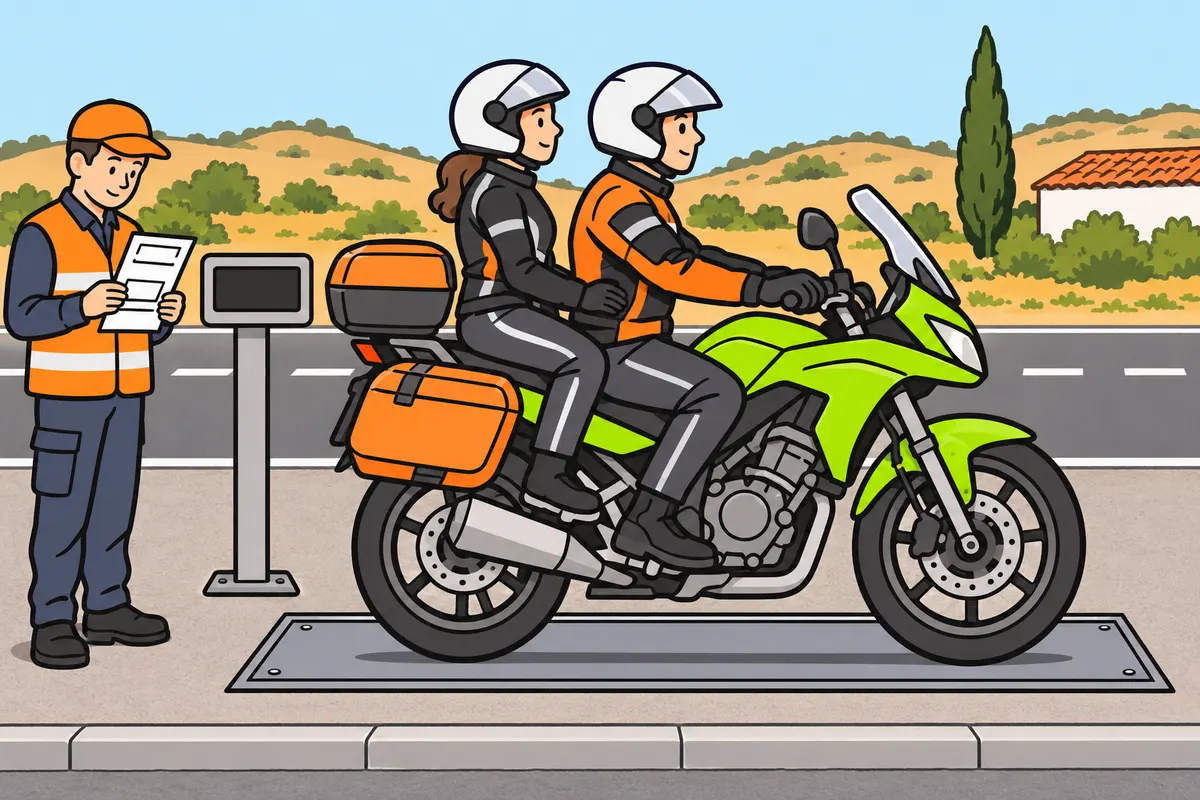
Add all the weight and respect each luggage case and support's capacity.
Remember
- MMA means the maximum permitted mass of your loaded vehicle.
- Include your motorcycle, yourself, your passenger, accessories and luggage.
- Check mass limits on your vehicle roadworthiness test card.
- Respect the total limit and each axle's limit.
- Also respect the capacity of luggage cases, supports and mountings.
Exam trap: Wrong: MMA tells you how much luggage you can add. Right: it also includes your motorcycle, yourself, your passenger and accessories; respect each component's limits too.
Read the full explanation
- The MMA (maximum authorised mass) is the maximum mass at which you may use the laden vehicle on public roads. To check it, you must add together the masses of the motorcycle, rider, passenger, accessories and luggage. [Ley de Tráfico (Traffic Act), annex I.37](https://www.boe.es/buscar/act.php?id=BOE-A-2015-11722#anI)
- You must check the ITV card and comply with the total mass and axle mass limits applicable to your motorcycle. [RGC, art. 9](https://www.boe.es/buscar/act.php?id=BOE-A-2003-23514#a9) [RGV, annex IX](https://www.boe.es/buscar/act.php?id=BOE-A-1999-1826#anix)
- You must also comply with the capacities specified by the manufacturer for luggage cases, supports and mountings. The motorcycle’s capacity does not authorise you to overload any of its components. [RGC, art. 14](https://www.boe.es/buscar/act.php?id=BOE-A-2003-23514#a14)
6Positioning, securing and visibility of the load
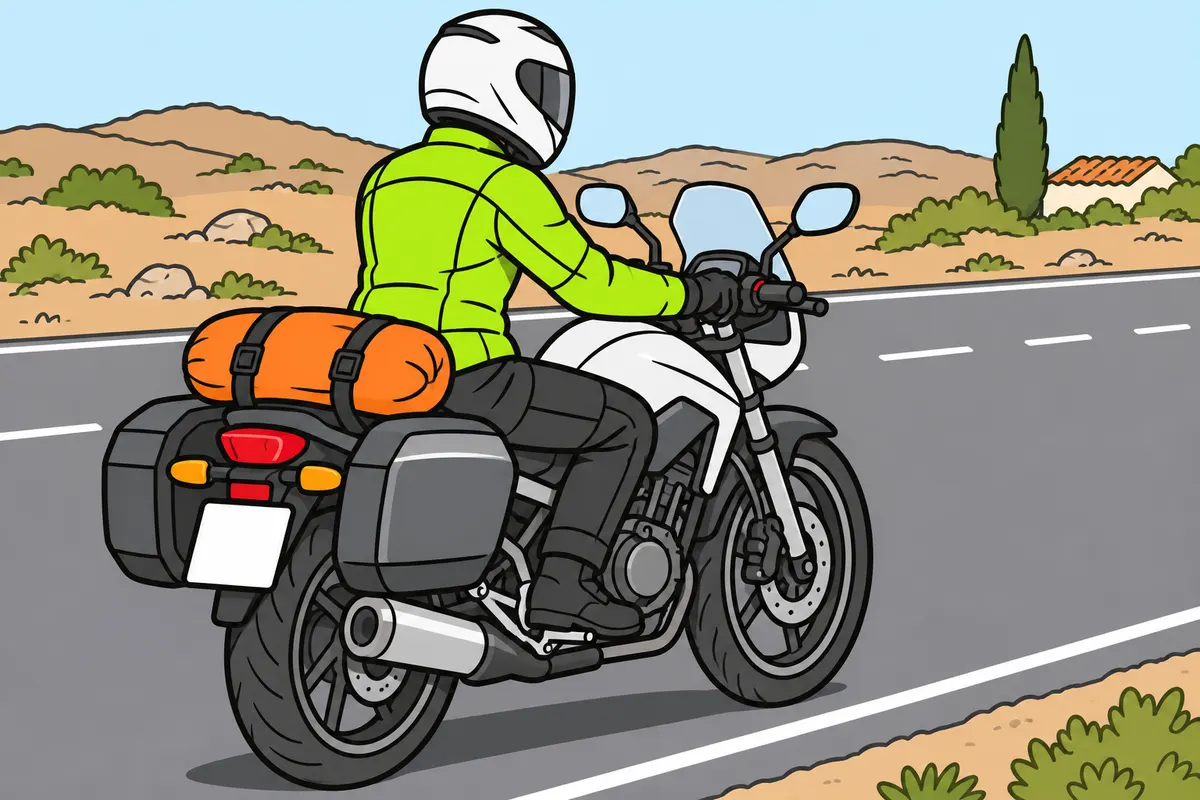
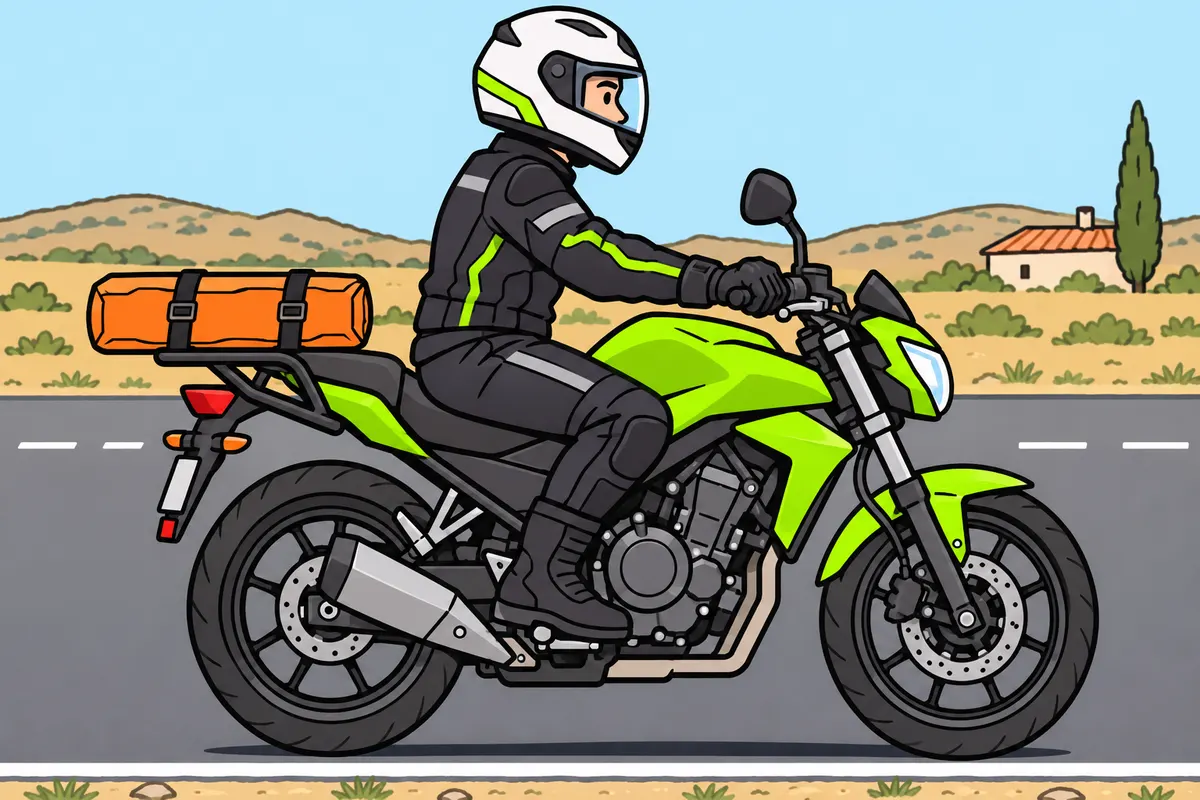
Position and secure luggage so you stay stable, see clearly and move freely.
Remember
- Stop your load dragging, falling or moving dangerously.
- Secure objects inside your luggage cases and tuck away loose straps.
- Put heavy items low, near the centre; balance your side cases.
- Keep lights, light signals, number plate, compulsory markings and your hand signals visible.
- Keep vision, attention, movement, controls and handlebars clear; prevent objects or animals interfering.
- Fully cover dusty materials or anything that could fall; avoid noise and nuisance.
Exam trap: Wrong: securing your load is enough. Right: also keep stability, vision, attention and free movement, without hiding signals; dangerous, harmful, unhealthy or particularly troublesome loads have extra rules.
Read the full explanation
- You must position and, where necessary, secure the load and its accessories to prevent them from dragging, falling, shifting dangerously or compromising stability. Also secure objects that could move inside panniers or boxes, and tuck away the ends of straps. [RGC, art. 14](https://www.boe.es/buscar/act.php?id=BOE-A-2003-23514#a14)
- When preparing your luggage, place heavy items low down and close to the centre of the motorcycle, in the spaces provided, and balance the loads in the side panniers. [DGT, motorcycle luggage](https://revista.dgt.es/es/reportajes/2023/06JUNIO/0608-como-llevar-equipaje.shtml)
- Your load must not obscure the lights, light-signalling devices, number plate, compulsory markings or your hand signals. [RGC, art. 14](https://www.boe.es/buscar/act.php?id=BOE-A-2003-23514#a14)
- You must maintain your vision, attention and freedom of movement: a tank bag must not obstruct the controls or handlebars, and objects or animals you carry must not interfere with you. [RGC, art. 18](https://www.boe.es/buscar/act.php?id=BOE-A-2003-23514#a18)
- You must avoid unnecessary noise, dust and other avoidable nuisance; materials that give off dust or could fall must be completely and effectively covered. Dangerous, harmful, unhealthy or particularly troublesome loads are also subject to their specific regulations. [RGC, art. 14](https://www.boe.es/buscar/act.php?id=BOE-A-2003-23514#a14)
- Riding with a passenger and the effects of a load on handling are covered in «Motorcycle riding techniques»; tyre and suspension adjustments are covered in «Motorcycle mechanics and maintenance».
7Load projections on a motorcycle less than one metre wide
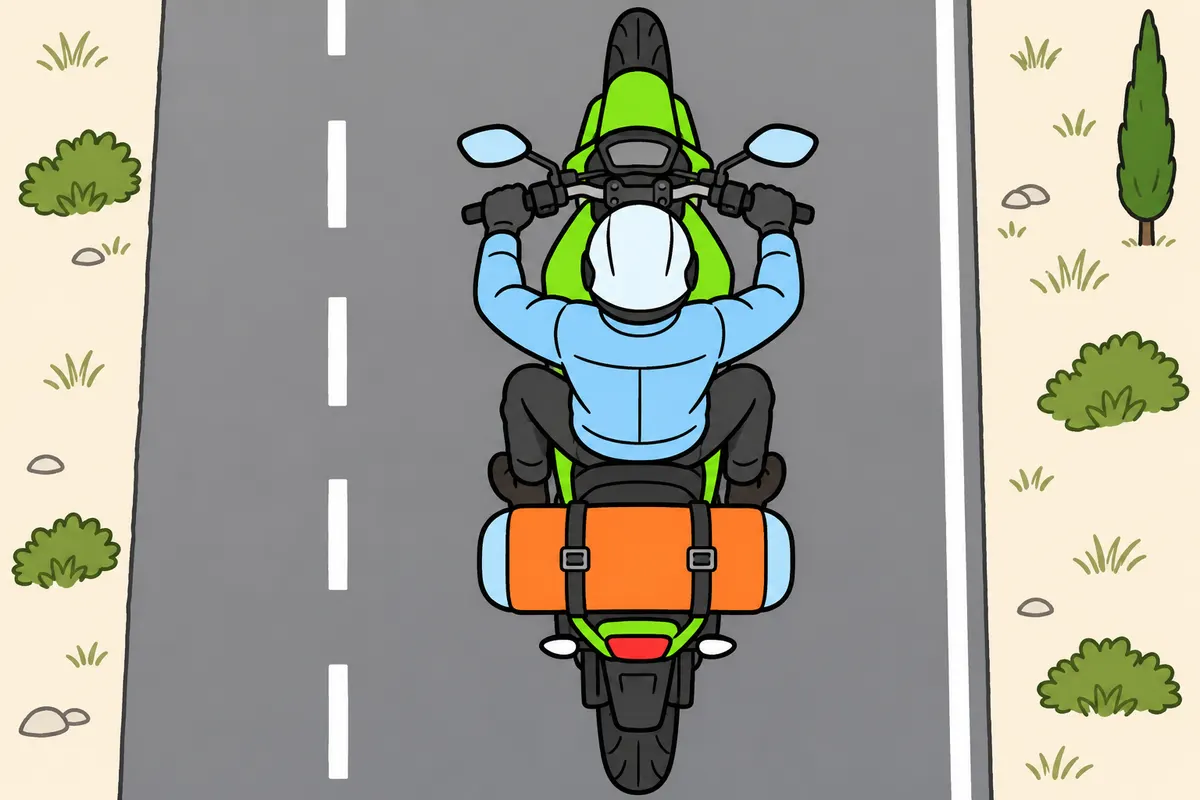
If your motorcycle is less than one metre wide, measure any load sticking out carefully.
| Position: motorcycle less than one metre wide | Load limit |
|---|---|
| Front | Must not stick out |
| Rear | Up to 25 cm from the rearmost point |
| Each side | Up to 50 cm from the lengthwise centre line |
Remember
- Respect authorised overall dimensions and road restrictions.
- If your motorcycle is under one metre wide, nothing may stick out ahead.
- At the rear, measure from your motorcycle's rearmost point.
- At each side, measure from your motorcycle's centre line.
- Less load on one side cannot allow extra on the other.
- Protect ends that stick out to prevent harm.
Exam trap: Wrong: you can add 50 cm beyond each edge of your motorcycle. Right: if it is less than one metre wide, measure those 50 cm from the lengthwise centre line on each side.
Read the full explanation
- You must comply with the authorised overall dimensions of the laden vehicle and the restrictions on the road. As a general rule, the load must remain within the outline of the vehicle viewed from above, except for the exceptions provided by the regulations. [RGC, art. 13](https://www.boe.es/buscar/act.php?id=BOE-A-2003-23514#a13) [RGC, art. 15.1](https://www.boe.es/buscar/act.php?id=BOE-A-2003-23514#a15)
- If your motorcycle is less than one metre wide, the load must not project forwards and may project up to 25 cm behind, measured from the rearmost point of the vehicle. [RGC, art. 15.4](https://www.boe.es/buscar/act.php?id=BOE-A-2003-23514#a15)
- On this motorcycle, the load may extend no more than 50 cm to either side of the longitudinal axis. You must measure from the centre line, not from the edges of the bodywork; you cannot offset an excess on one side with a shorter extension on the other. [RGC, art. 15.4](https://www.boe.es/buscar/act.php?id=BOE-A-2003-23514#a15)
- You must protect the end of any permitted projection to reduce the consequences of a scrape or collision and prevent damage or danger to other road users. [RGC, art. 15.5](https://www.boe.es/buscar/act.php?id=BOE-A-2003-23514#a15)
8Marking the motorcycle load
Check whether your load needs a panel or lights, depending on overhang and visibility.
| Side marking: load beyond vehicle's side and over 40 cm from position light | At night or when visibility is significantly reduced |
|---|---|
| Facing forwards, at each side end | White light and reflector |
| Facing backwards, at each side end | Red light and reflector |
Remember
- Motorcycle under one metre wide: permitted rear overhang needs no V-20.
- Recognise V-20: a square reflective panel with diagonal red and white stripes.
- When required, place it behind your load, perpendicular to your motorcycle's lengthwise centre line.
- Check whether your load sticks out beyond your vehicle's sides.
- Measure sideways from the outer edge of the corresponding position light.
- Beyond 40 cm, mark it at night or when visibility is significantly reduced.
Exam trap: Wrong: you always need V-20 when a load sticks out behind. Right: on your motorcycle less than one metre wide, you need no panel for rear overhang up to 25 cm.
Read the full explanation
- On your motorcycle less than one metre wide, you do not need a V-20 panel for a load projecting up to 25 cm behind: article 15.6 requires it only in the cases covered by paragraphs 2 and 3. [RGC, art. 15.6](https://www.boe.es/buscar/act.php?id=BOE-A-2003-23514#a15)
- The V-20 is a square reflective panel with diagonal red and white stripes; when it is required, you must place it at the rear end of the load, perpendicular to the vehicle’s axis. [RGV, annex XI, V-20](https://www.boe.es/buscar/act.php?id=BOE-A-1999-1826#v-20) [RGC, art. 15.6](https://www.boe.es/buscar/act.php?id=BOE-A-2003-23514#a15)
- If the load projects sideways beyond the vehicle’s overall width and its end is more than 40 cm from the outer edge of the corresponding position light, you must mark it at night or when visibility is significantly reduced: a white light and reflector facing forwards, and a red light and reflector facing backwards, at each lateral end. You measure this distance from the light, not from the axis. [RGC, art. 15.7](https://www.boe.es/buscar/act.php?id=BOE-A-2003-23514#a15)
9Sidecar one metre wide or more: interpretation of the rules in this module
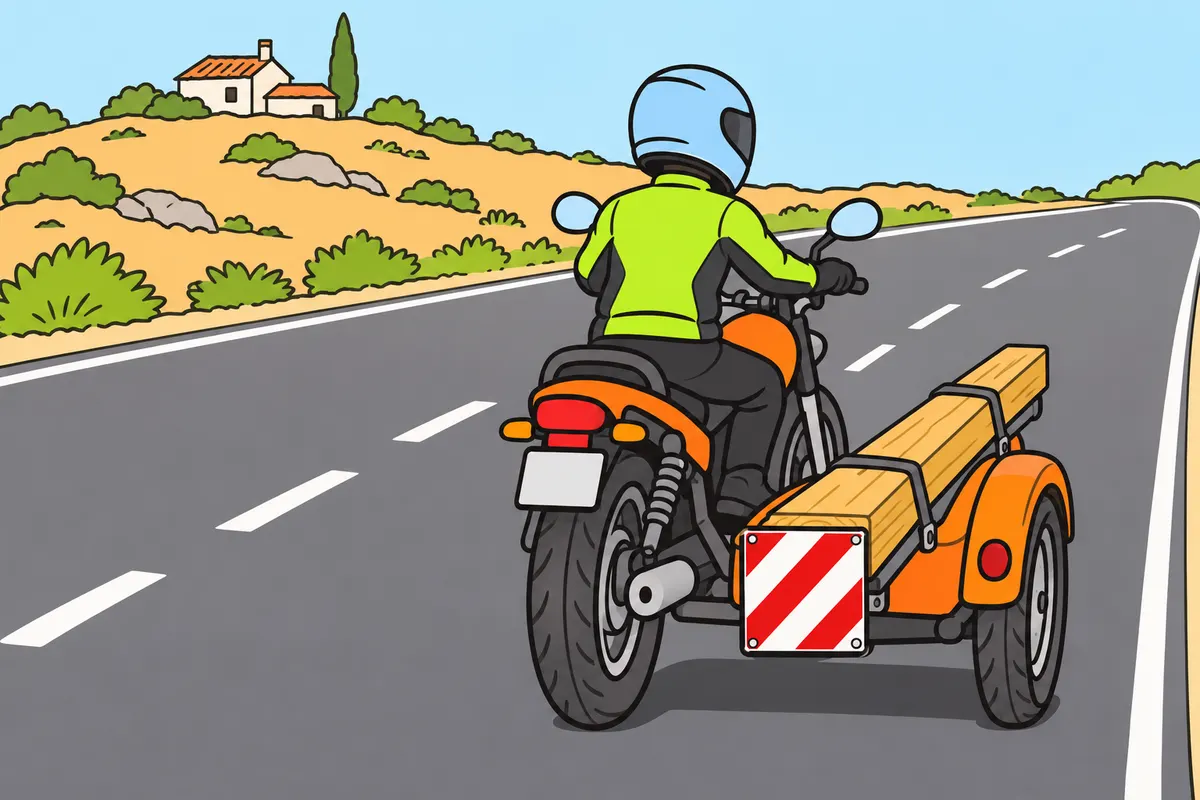
With a sidecar at least one metre wide, calculate rear overhang using percentages and mark it.
| Load: motorcycle with sidecar at least one metre wide | Maximum rear overhang |
|---|---|
| General rule | 10 % of your vehicle's length |
| Indivisible load: you cannot split it | 15 % of your vehicle's length |
Remember
- Use this rule if your motorcycle with sidecar is at least one metre wide.
- Calculate rear overhang using your vehicle's length.
- Use V-20 to mark this overhang.
- Add a red light between sunset and sunrise.
- Also add it when weather or environmental conditions significantly reduce visibility.
Exam trap: Wrong: V-20 is always enough with a sidecar at least one metre wide. Right: for rear overhang, add a red light between sunset and sunrise, or when weather or environmental conditions significantly reduce visibility.
Read the full explanation
- If your motorcycle with a sidecar is one metre wide or more, you may carry a load projecting behind by up to 10 % of the vehicle’s length, or up to 15 % if it is indivisible. You must mark this projection with the V-20 and add a red light between sunset and sunrise or when weather or environmental conditions significantly reduce visibility. [RGC, art. 15.3 and 15.6](https://www.boe.es/buscar/act.php?id=BOE-A-2003-23514#a15)
10Trailer: mass, permitted times and occupancy
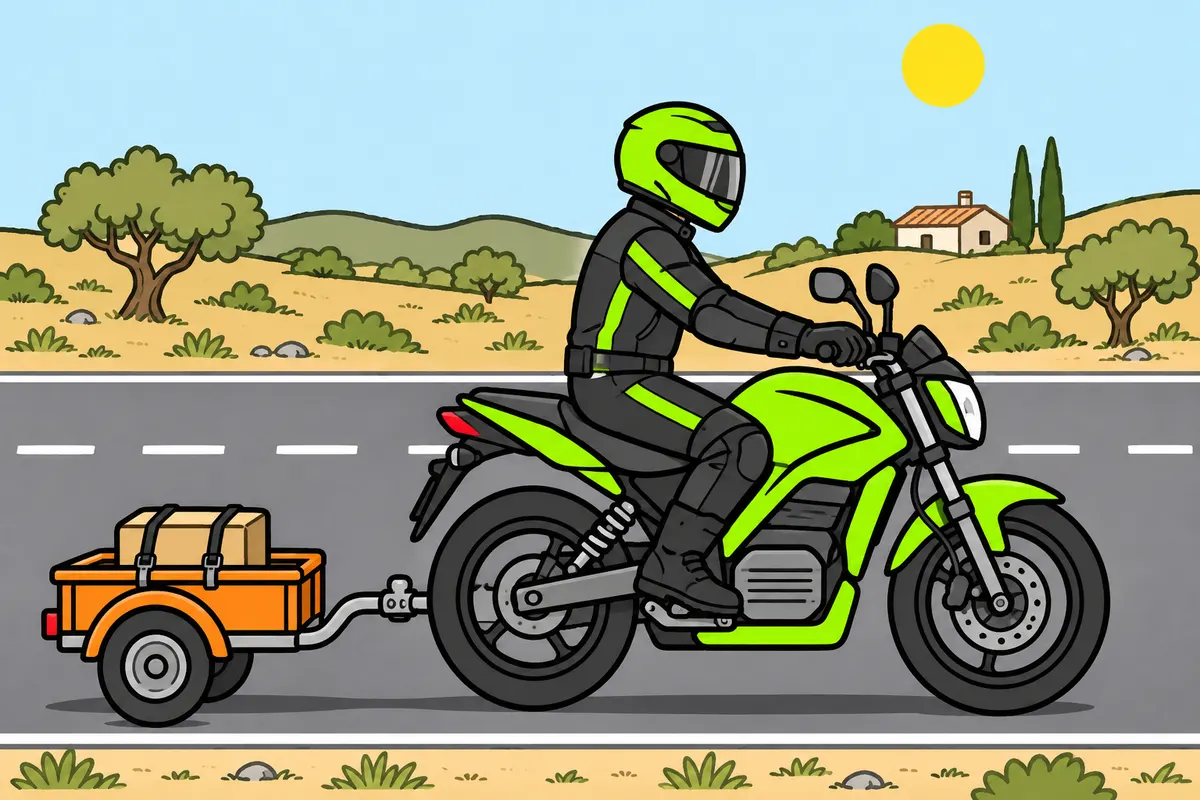
Tow only with a suitable motorcycle, within weight limits, during daylight and with clear visibility.
Remember
- Check that your motorcycle is technically suitable for towing a trailer or semi-trailer.
- Count the trailer's weight together with its load.
- Calculate the maximum using your motorcycle's unladen mass.
- Ride during daylight, without conditions that reduce visibility.
- Do not carry people in your trailer.
- In urban traffic, also follow local council rules.
Exam trap: Wrong: you calculate 50 % using MMA or your loaded motorcycle's mass. Right: use its unladen mass; trailer and load together must stay within that maximum and the combination's technical limits.
Read the full explanation
- You may tow a trailer or semi-trailer with a technically suitable motorcycle if the mass of the towed vehicle, including its load, does not exceed 50 % of the motorcycle’s unladen mass. You do not calculate this percentage using the MMA (maximum authorised mass) or the laden motorcycle. [RGC, art. 12.3](https://www.boe.es/buscar/act.php?id=BOE-A-2003-23514#a12)
- As a calculation example, a motorcycle with an unladen mass of 200 kg allows a maximum of 100 kg for the trailer and its load, always subject to the technical requirements of the combination. [RGC, art. 12.3](https://www.boe.es/buscar/act.php?id=BOE-A-2003-23514#a12)
- You must ride during daylight and in conditions that do not reduce visibility. You must not carry people in the trailer. In urban traffic, you must comply with the relevant municipal by-law. [RGC, art. 12.3](https://www.boe.es/buscar/act.php?id=BOE-A-2003-23514#a12)
11Speed with a trailer
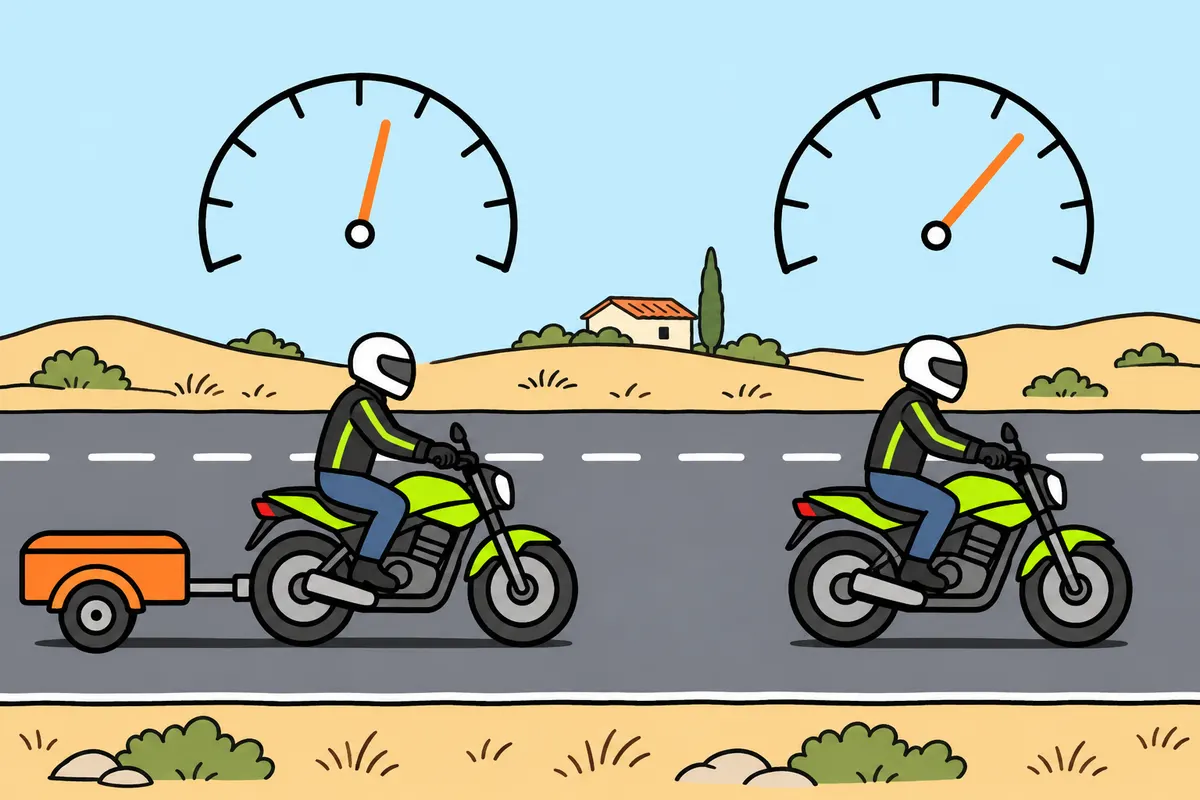
With a trailer, reduce the general speed limit by a percentage and obey lower limits.
| Road for motorcycles | General speed limit | With a trailer |
|---|---|---|
| Motorway or dual carriageway | 120 km/h | 108 km/h |
| Conventional road | 90 km/h | 81 km/h |
Remember
- Reduce the relevant general speed limits by 10 %.
- Use a percentage; do not subtract ten kilometres per hour.
- Always obey any lower limit that applies.
- These speeds follow the course’s interpretation.
- See «Speed and distances on a motorcycle», section «Motorcycle with a trailer».
Exam trap: Wrong: with a trailer, you subtract 10 km/h from the general limit. Right: reduce the relevant general speed limit by 10 % and obey any lower limit that applies.
Read the full explanation
- With a trailer, you must reduce the corresponding general speed limits in article 48 by 10 %. You must apply a percentage, not subtract ten kilometres per hour. [RGC, art. 12.3](https://www.boe.es/buscar/act.php?id=BOE-A-2003-23514#a12)
- With the general motorcycle limit of 120 km/h on an autopista (motorway) or autovía (dual carriageway with motorway characteristics), the result is 108 km/h; with the limit of 90 km/h on a conventional road, it is 81 km/h. You must comply with any lower applicable limit. You study the tables and how to adapt your speed in «Speed and distances on a motorcycle». [RGC, art. 48](https://www.boe.es/buscar/act.php?id=BOE-A-2003-23514#a48) [RGC, art. 12.3](https://www.boe.es/buscar/act.php?id=BOE-A-2003-23514#a12) This is the course’s interpretation explained in «Speed and distances on a motorcycle», section «Motorcycle with a trailer».
12Loading and unloading
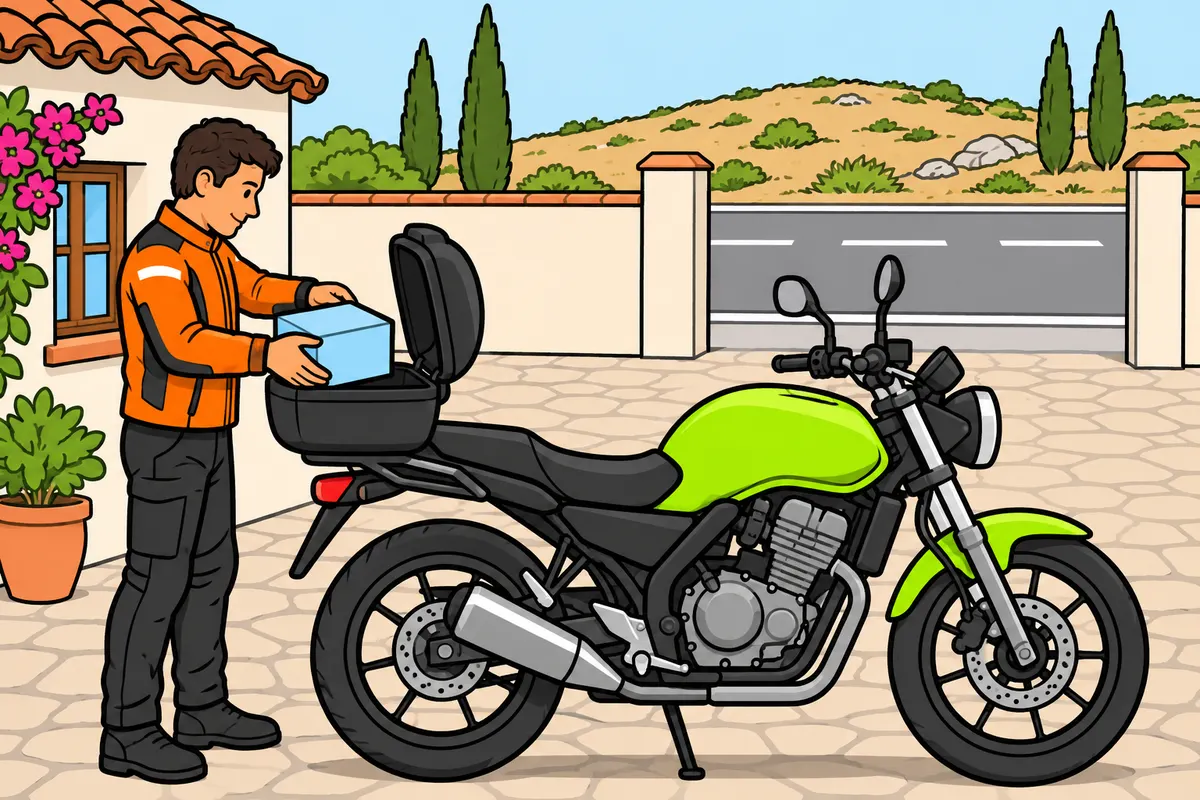
Load and unload off the road unless using the road is unavoidable.
Remember
- Load and unload off the road whenever you can.
- If using the road is unavoidable, prevent danger and serious disruption.
- Follow stopping and parking rules.
- In built-up areas, follow local council rules on times and places.
- Work near the road edge if possible; finish quickly, without unnecessary noise or nuisance.
- Do not leave goods on the carriageway, hard shoulder or pedestrian areas.
Exam trap: Wrong: you can unload on the road for convenience. Right: only do so if unavoidable; prevent danger and serious disruption, follow stopping and parking rules and, in built-up areas, local rules on times and places.
Read the full explanation
- You must load and unload off the road. If doing so on the road is unavoidable, you must prevent danger and serious disruption, comply with stopping and parking rules and, in built-up areas, comply with municipal provisions on times and places. [RGC, art. 16](https://www.boe.es/buscar/act.php?id=BOE-A-2003-23514#a16)
- Wherever possible, you must work on the side nearest the edge of the carriageway, with the means to finish quickly and avoiding unnecessary noise and disturbance. You must not place goods on the carriageway, the arcén (hard shoulder) or pedestrian areas. [RGC, art. 16](https://www.boe.es/buscar/act.php?id=BOE-A-2003-23514#a16)
Check whether you can carry the passenger
Check the seat, age and safety conditions.
- Check the seats listed in the permiso de circulación (vehicle registration certificate) and the load capacity.
- Check the age and, if you use the exception for children, the family relationship or the authorisation given to the adult rider.
- Check the compulsory equipment and the position on the rear seat.
Prepare your luggage
Check capacity, securing arrangements and dimensions before riding.
- Check the MMA (maximum authorised mass) and the limits for luggage cases, supports and mountings.
- Distribute and secure the contents and check fastenings and straps.
- Keep controls, your view, lights and the number plate unobstructed.
- Measure load projections and check their protection and any required marking.
Finished this module?
Mark it as read and you will see your progress on the theory list.