
Theory · A2 Licence - Motorcycle · Module 14 of 18
Motorcycle risks and prevention
You learn to recognise risks involving visibility, grip, weather, speed, group riding and fatigue, and to reduce them on your motorcycle. You can answer exam questions that require you to distinguish a legal obligation from a recommendation and choose the answer that preserves control, space and time to react.
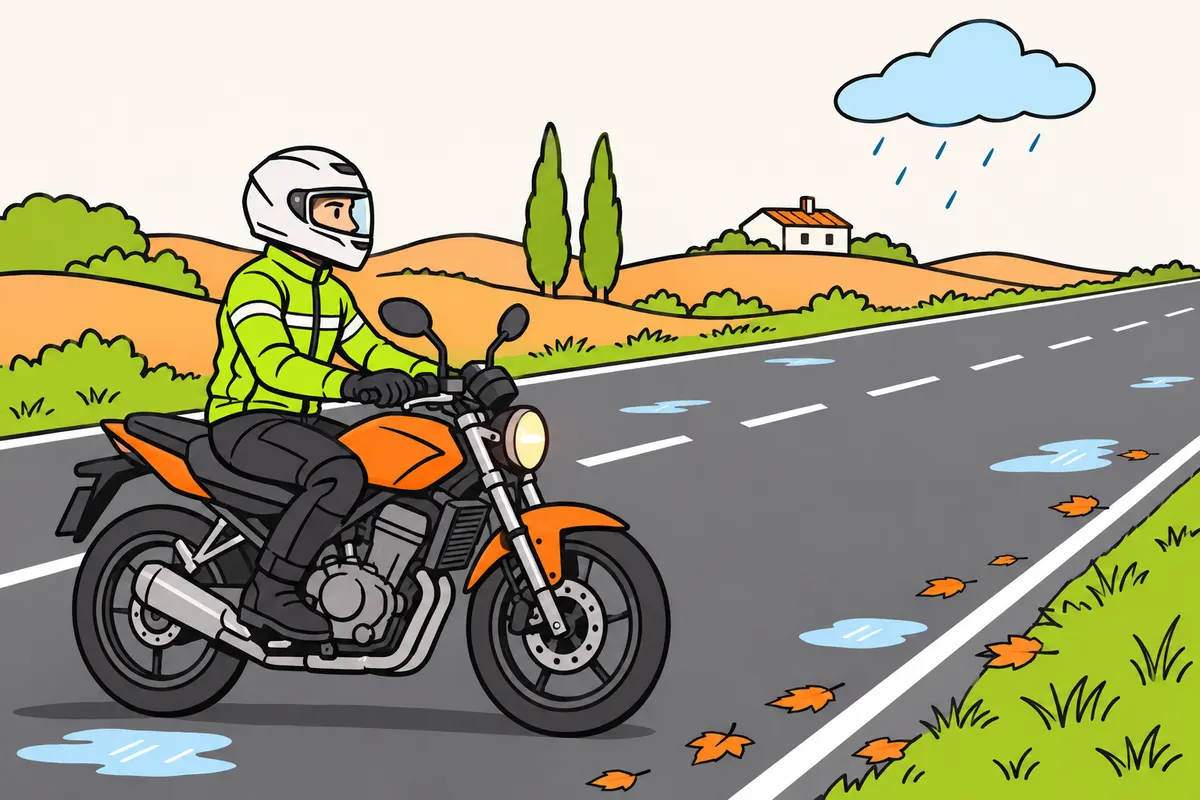
1Your vulnerability on a motorcycle
On a motorcycle, you need a safety margin because your body is exposed.
Remember
- Set off rested and choose a suitable route.
- Accidents often involve the person, the vehicle and the road and its surroundings.
- Expect changes in grip and visibility.
- Your helmet reduces injuries, but your body remains exposed.
- Distractions, inappropriate or excessive speed, alcohol or other drugs,
- and fatigue or sleepiness are common causes.
Exam trap: Wrong: your helmet protects you from every impact. Right: your body remains exposed during a fall.
Read the full explanation
- On a two-wheeled motorcycle, you must maintain your balance and share the road with vehicles of much greater mass. Your small outline can be difficult to spot, and you have no passenger compartment to protect you. A manoeuvre that a car can cope with can cause you to fall if you lose grip.
- Accidents involve the human factor, the vehicle and the road and its surroundings, almost always in combination. The most frequent causes include distractions, inappropriate or excessive speed, alcohol or other drug use, and fatigue or sleepiness. A wet road surface, limited experience and entering a bend too fast can combine to leave you with no margin for error. [DGT, Cuestiones de seguridad vial (Road safety issues), unit 1](https://sede.dgt.gob.es/export/sites/dgt/.galleries/permisos-de-conducir/certificacion-aptitud-profesores-formacion-vial/2026/MANUAL-II-Cuestiones-de-Seguridad-Vial.pdf) [DGT, causes of running off the road](https://www.dgt.es/comunicacion/noticias/20260522-salidas-de-via-nos-matamos-solos/) [RGCond, Annex V.B.1.2.ª](https://www.boe.es/buscar/act.php?id=BOE-A-2009-9481#av).
- You can reduce risks through specific decisions: set off well rested, choose a suitable route and anticipate changes in grip and visibility.
- Your helmet and protective equipment reduce the consequences of a fall, but your body remains exposed to impacts with the road surface and other vehicles. See «Motorcycle protective equipment» for guidance on choosing them and the requirements that apply.
2Experience and your personal safety margin
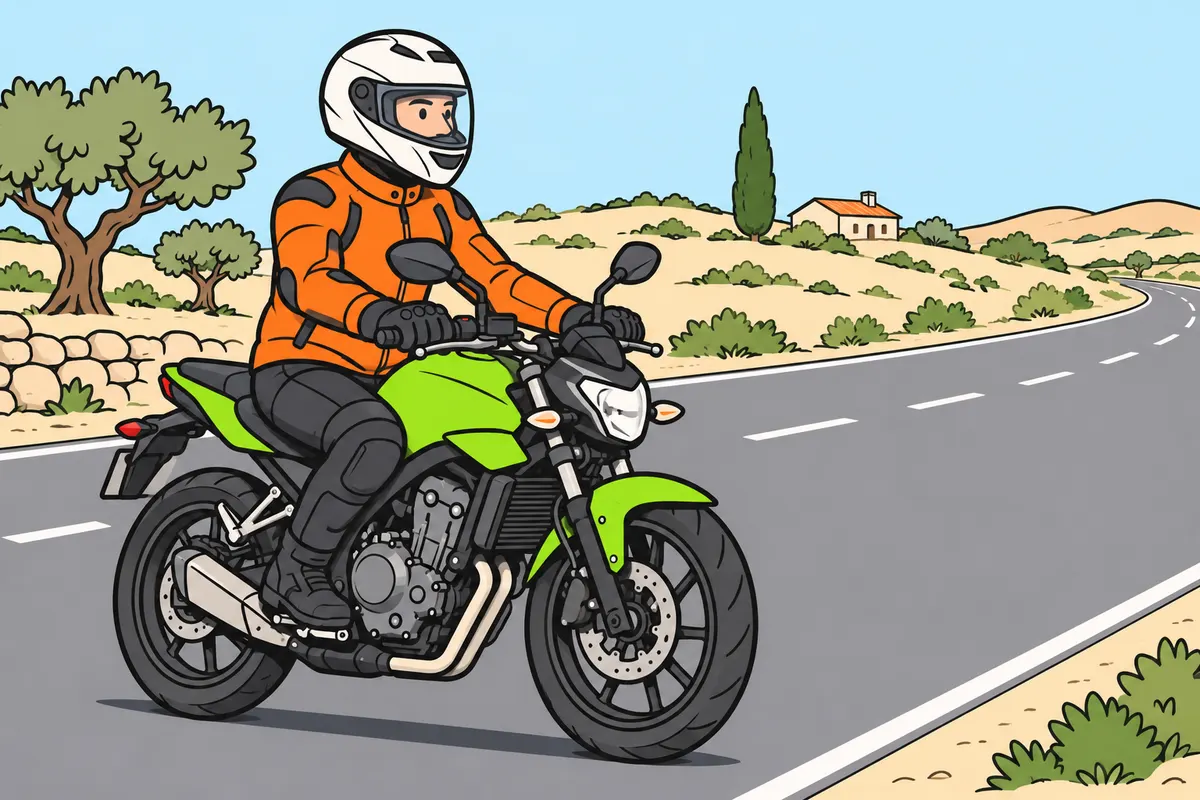
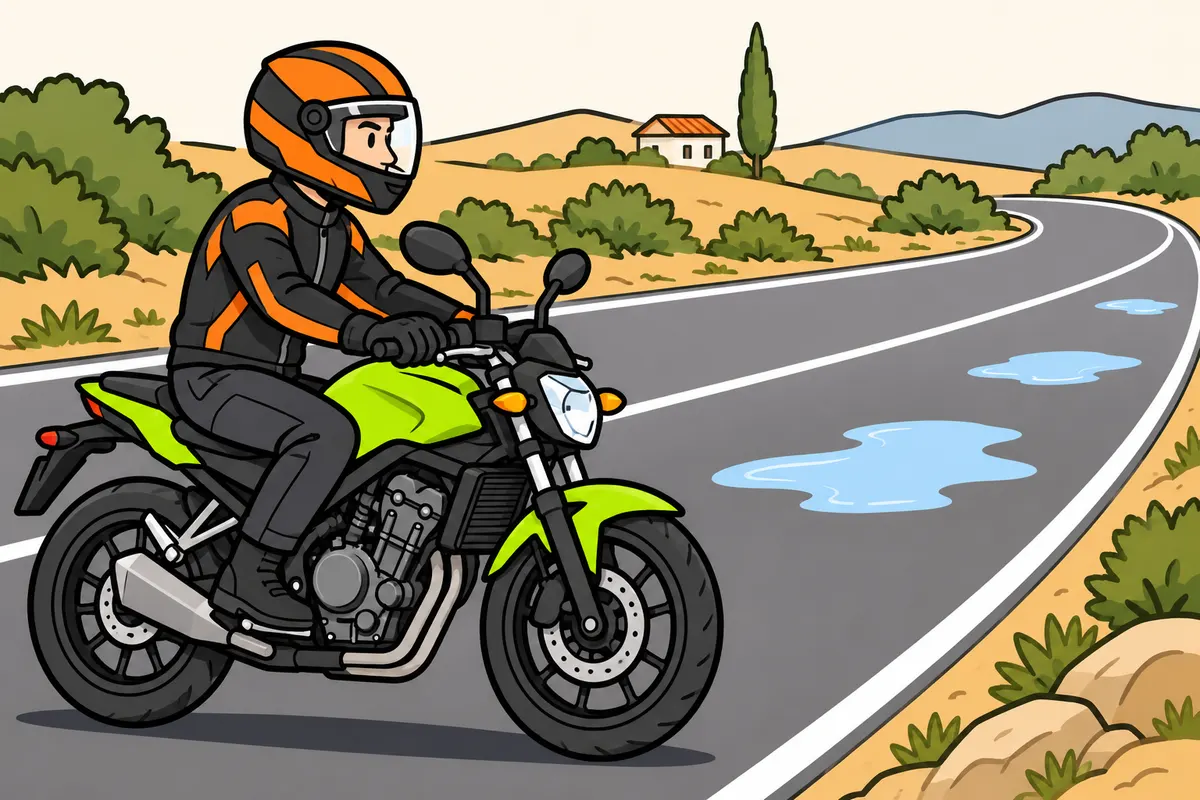
You must gradually get used to each motorcycle and ride within your abilities.
| Motorcycle type | What you must remember |
|---|---|
| Sports motorcycle | It does not guarantee stability on oil or ice. |
| Adventure motorcycle | It does not guarantee stability on oil or ice. |
| Scooter | It does not guarantee stability on oil or ice. |
Remember
- Practise using the controls in suitable conditions.
- Gradually choose more demanding routes.
- Check the weather, route and alternatives before setting off.
- Postpone your journey if weather or tiredness makes it unwise.
Exam trap: Wrong: your licence proves you can control every permitted motorcycle. Right: you must adapt to the particular model.
Read the full explanation
- You must gradually familiarise yourself with how your motorcycle responds, especially if you change models. Weight, height, power delivery and ergonomics affect your ability to control it. A motorcycle that your licence allows you to ride may require practical familiarisation before you tackle rain or heavy traffic.
- If using the controls is not yet automatic for you, it takes up your attention and can make you tire sooner. Practise in suitable conditions and gradually increase the difficulty of your routes.
- A sports motorcycle, an adventure motorcycle and a scooter have different characteristics depending on the model, and no category guarantees stability on oil or ice. You must adapt your decisions to the particular vehicle and your abilities.
- Before setting off, check the weather forecast, conditions along your route and possible alternatives. If wind, snow or your tiredness make the journey unwise, you can postpone it or choose another means of transport.
3Looking ahead and spotting nearby hazards
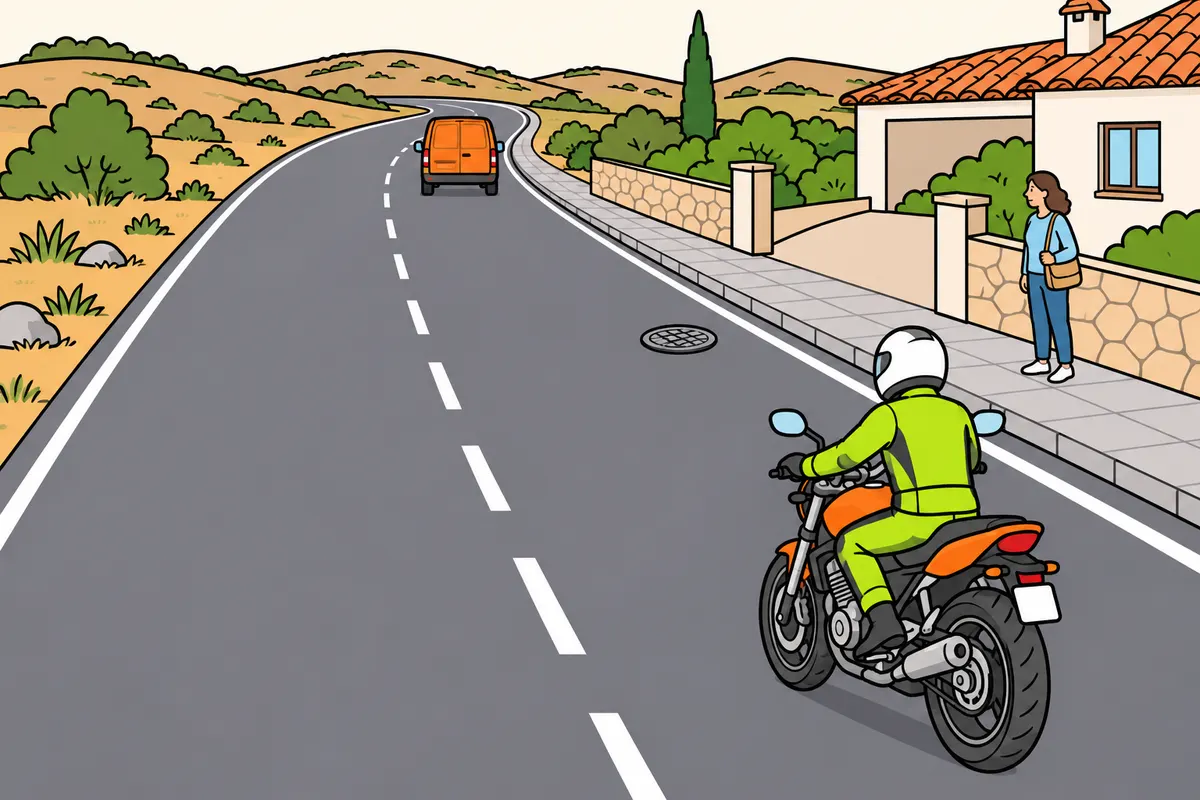
You must leave space to see hazards and respond in time.
Remember
- Do not follow closely: the vehicle ahead can hide the road surface.
- Watch garages, junctions and gaps between parked cars.
- Prepare to respond carefully even when you have priority.
- If you cannot see properly, fix the problem somewhere safe.
Exam trap: Wrong: priority means you need not expect others’ mistakes. Right: another road user may not see you.
Read the full explanation
- Spills, access covers and side entrances can remain hidden until you are very close; see «Preventive and efficient motorcycle riding» for techniques for scanning your surroundings.
- Leave enough space behind the vehicle ahead so that it does not block your view of the road surface or side entrances. If you ride close behind a van, you lose visibility precisely when you need more time to assess a hazard. Increasing the gap gives you more information and more room to respond.
- You must pay attention to places where someone may appear: between parked cars, behind a bus, in a garage or near a junction. Even if you have priority, prepare a cautious response. Having priority does not prevent another road user from making a mistake or failing to spot you.
- You must maintain an adequate field of vision and pay attention at all times. A misted-up visor or a load that makes it difficult to look around compromises this obligation; correct the problem in a safe place before continuing. [RGC, art. 18](https://www.boe.es/buscar/act.php?id=BOE-A-2003-23514#a18).
4Making yourself visible
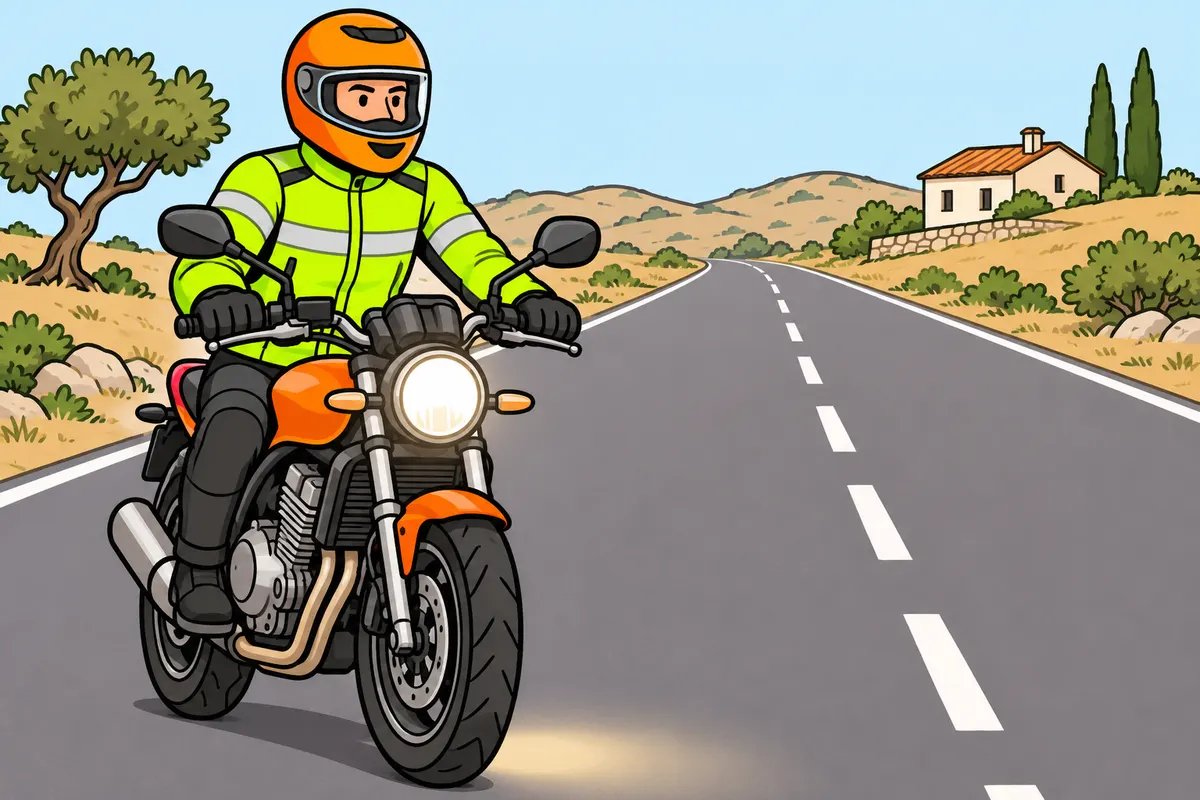
You must use dipped beam and help others see your motorcycle.
| Help with being visible | What you must know |
|---|---|
| Light or bright colours | They stand out depending on the background and light. |
| Reflective items | They return the light they receive. |
| Exhaust noise | It may not reach other drivers. |
Remember
- On your motorcycle, use dipped beam during the day on every road.
- Use visible colours and reflective items to help others see you.
- Choose a legal position where you can see and be seen.
- Leave space near drivers waiting to turn or join the road.
- Signal your intentions and move predictably.
Exam trap: Wrong: daytime running lights are enough on your motorcycle. Right: use dipped beam during the day on every road.
Read the full explanation
- You can make yourself easier to recognise by wearing light or brightly coloured equipment and retroreflective elements. The colours stand out depending on the background and ambient light; reflective elements return the light that reaches them. Neither ensures that every driver has seen you or replaces your motorcycle's lights.
- On a motorcycle, you must use dipped beam during the day on every road; position lights or daytime running lights alone do not meet this obligation. All vehicles must also use dipped beam during the day in reversible lanes, temporary additional lanes or lanes opened to traffic travelling in the opposite direction to normal, and in the other circumstances covered by articles 41 and 42. See «Motorcycle lights and signals». [RGC, art. 104.a and b](https://www.boe.es/buscar/act.php?id=BOE-A-2003-23514#a104).
- Choose a legal position within your lane where you can see and be seen, with clearance from obstacles. No part of the lane is always the safest: bends, vehicles blocking your visibility, doors and dirt on the road surface all vary.
- A driver may look towards you without recognising your motorcycle, or misjudge your distance and approach speed. Keep a safety margin around drivers waiting to join traffic or turn.
- Your exhaust noise may not reach another driver or help them locate you. Communicate your intentions with the appropriate signals and predictable movements.
5Other vehicles' blind spots
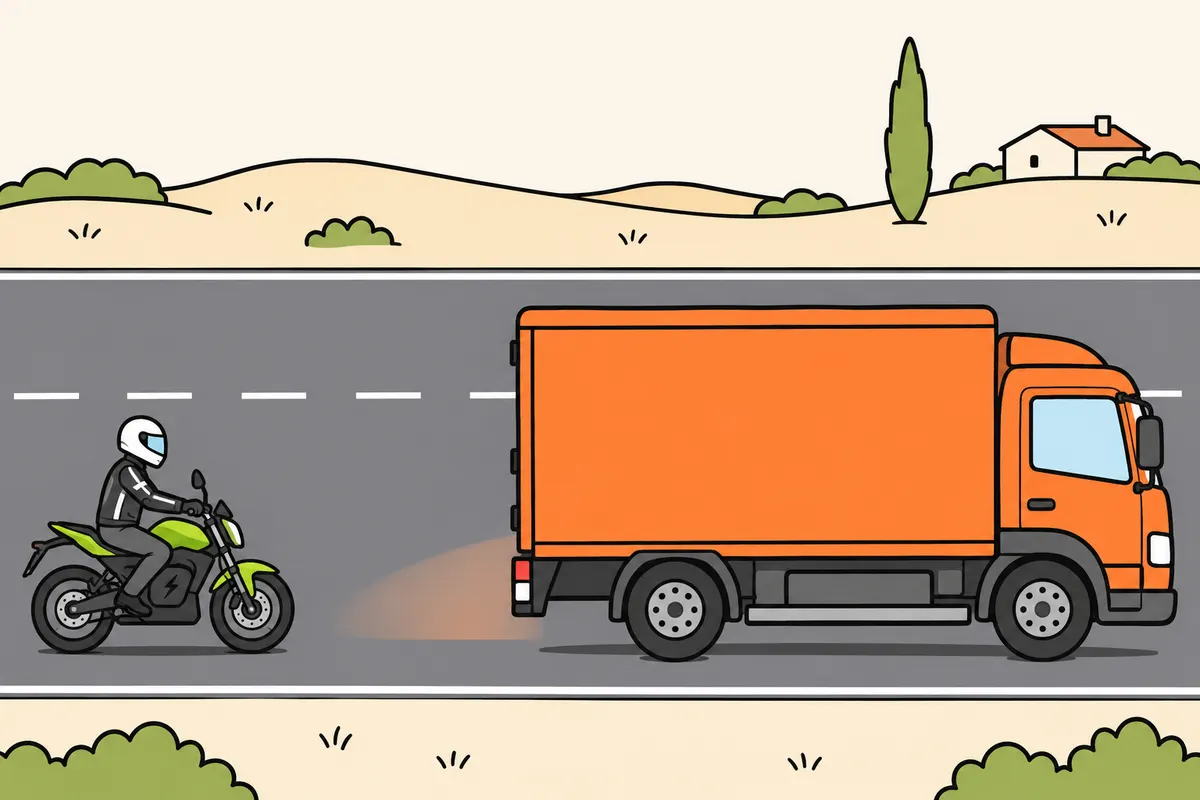
You must avoid areas where other drivers cannot see you.
Remember
- Do not stay alongside another vehicle longer than necessary.
- If passing safely within the limits is impossible, stay well behind.
- Avoid waiting close to a lorry’s cab or front right corner.
- Keep a safe escape route when another vehicle turns or moves across.
- Do not rely completely on blind spot detectors.
Exam trap: Wrong: seeing the driver in their mirror proves they see you. Right: they may not have noticed you.
Read the full explanation
- A blind spot is an area that another driver cannot see using their usual means of observation. It can exist beside a car, a van or a lorry. Your motorcycle's narrow width makes it easy for it to remain hidden even when it seems very close to the driver.
- Avoid staying alongside another vehicle, especially near its rear, for longer than necessary. If you cannot pass through that area safely and within the limits, keep your distance behind it.
- Near lorries and buses, you must anticipate blind spots in front, behind and along the sides. Do not position yourself close to the cab or at the front right-hand corner while waiting to join traffic. A large vehicle can start turning and close a gap that seemed wide enough for your motorcycle.
- Seeing the driver in their mirror is a useful guide to avoiding some blind spots, but it does not prove that they are looking at you or have recognised you. You must not assume that every vehicle has blind spot detectors or that these systems always detect a motorcycle.
- If a vehicle signals a turn or starts moving across, keep a safe escape route and avoid placing yourself in its path. See «Motorcycle manoeuvres» for a full explanation of overtaking and lane changes; here, the focus is on anticipating that you may not be seen.
6Your mirrors and direct vision
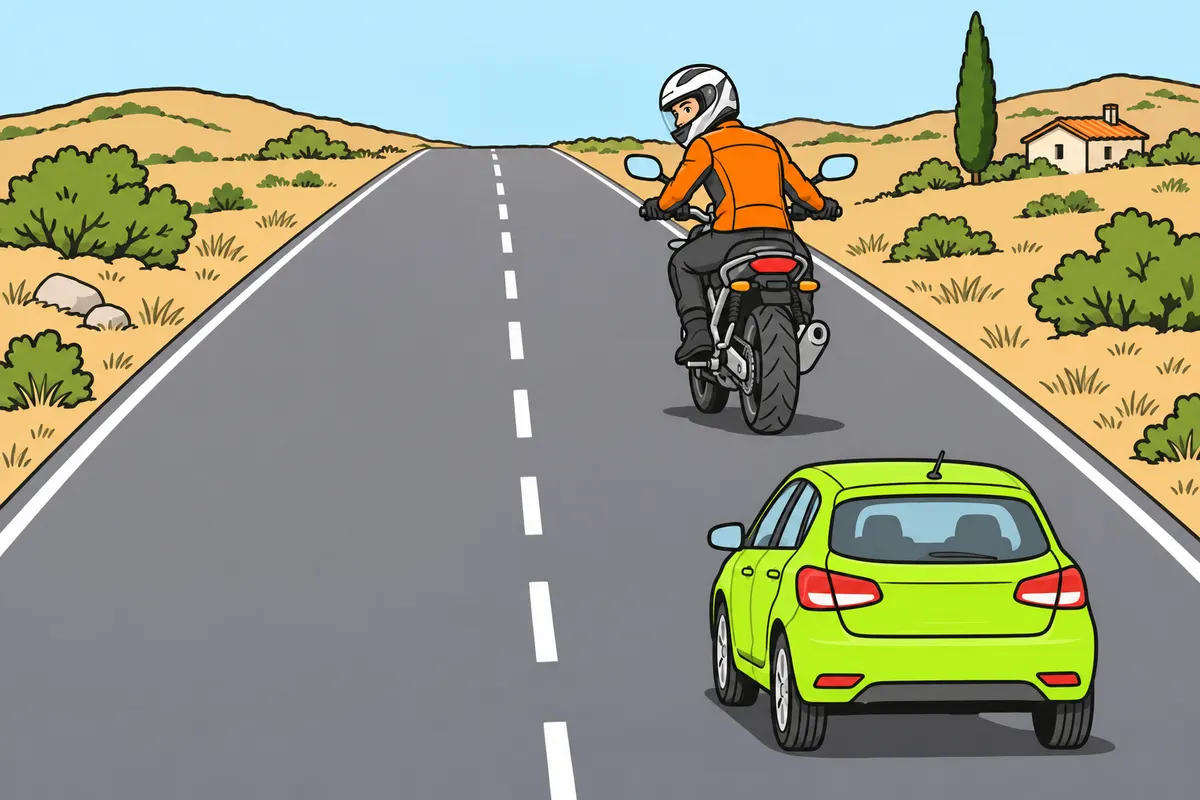
Before each manoeuvre, check your mirrors let you judge vehicles approaching you.
Remember
- A poorly adjusted or vibrating mirror can hide vehicles from you.
- See mirror checks in “Motorcycle mechanics and maintenance”.
- Before each manoeuvre, check you can judge the vehicle approaching alongside you.
Exam trap: Wrong: your mirrors always show vehicles clearly. Right: vibration or poor adjustment can hide them.
Read the full explanation
- See «Motorcycle mechanics and maintenance» for mirror checks and «Preventive and efficient motorcycle riding» for checking blind spots.
- Vibration or a poorly adjusted mirror can hide the very vehicle approaching in the next lane; before each manoeuvre, check that the image lets you judge its approach.
7Grip: recognise the road surface
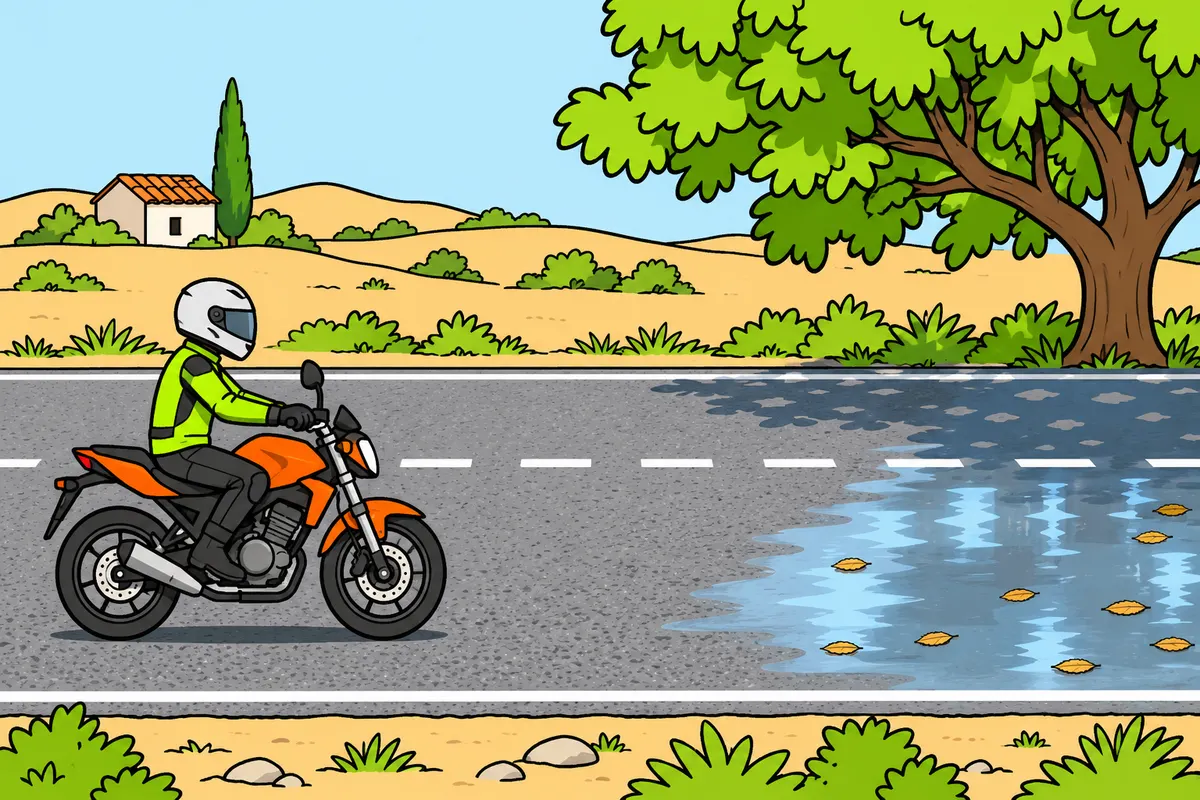
You must adapt your speed and movements to the grip available.
| Road surface condition | Grip you should expect |
|---|---|
| Rough, dry and clean | Usually offers better grip. |
| Polished, dirty or wet | May offer less grip. |
| Smooth, damp cobblestones | Can be particularly slippery. |
Remember
- Do not judge grip only by the colour of the asphalt.
- Avoid heavy braking and sharp turning at the same time.
- Slow down before reaching a surface with uncertain grip.
- Slow down if you could spray water or throw gravel at others.
Exam trap: Wrong: a dry surface guarantees grip. Right: check whether it is clean and rough too.
Read the full explanation
- A rough, dry and clean road surface usually offers better grip than a polished, contaminated or wet one. Expect smooth, damp cobblestones to be particularly slippery; the colour of the asphalt alone does not tell you how much grip it offers.
- The available grip has to cover braking, acceleration and changes of direction. If you demand a sharp turn and heavy braking at the same time, you can exceed that grip. You must reduce these demands when the road surface changes and avoid leaning steeply on surfaces with uncertain grip.
- Anticipate transitions: a dry stretch can lead into a damp area under trees, a repair or a joint. Slow down before you reach it and maintain a steady line.
- You must moderate your speed on slippery surfaces and when you could spray water or throw up loose chippings at other road users. [RGC, art. 46.1.g](https://www.boe.es/buscar/act.php?id=BOE-A-2003-23514#a46).
8Paint, covers and rails
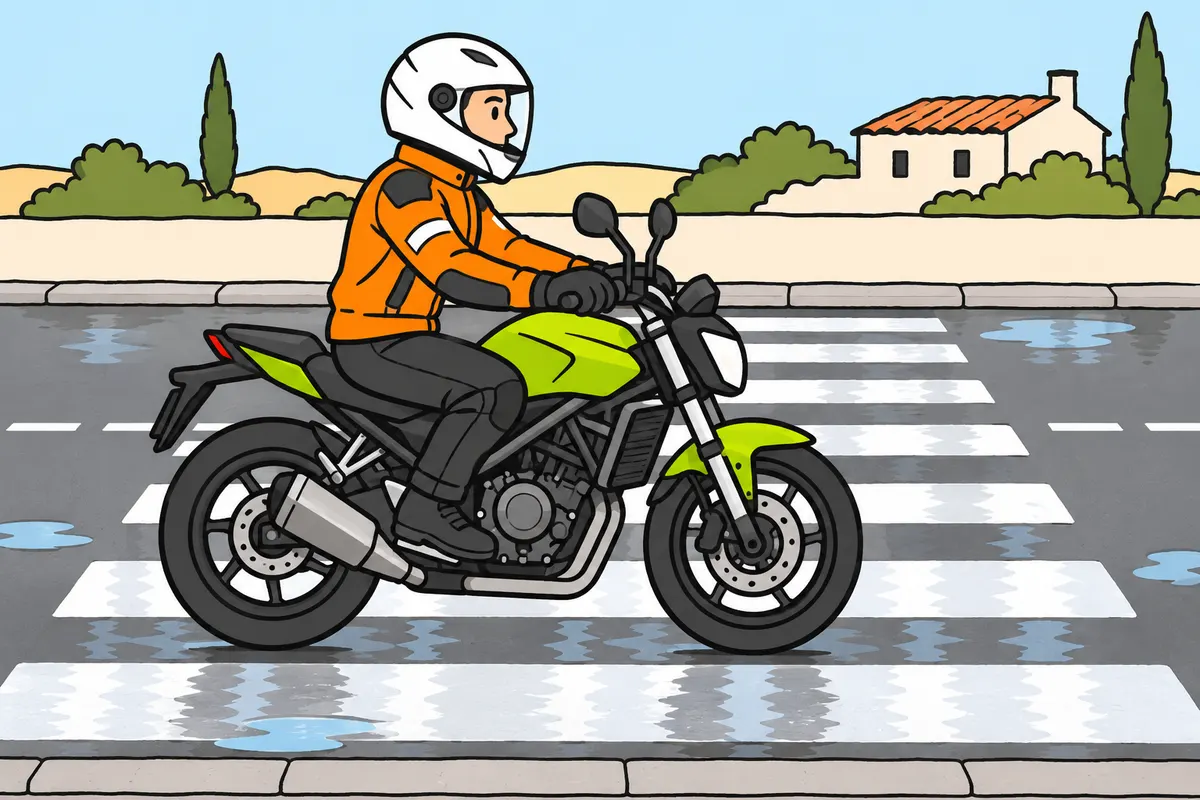
You must expect paint, metal and rails to make your wheels slip.
| Surface | What you should expect on your motorcycle |
|---|---|
| Wet paint | May offer less grip than the nearby surface. |
| Wet covers and metal plates | Can be very slippery. |
| Rails almost parallel to your path | Can deflect your wheel or make it slip. |
Remember
- Watch for wet crossings, arrows and wide painted lines.
- On bends and at junctions, successive markings can change grip repeatedly.
- Wet covers, grates and metal plates can make you slip.
- Rails can deflect your wheel when almost parallel to your path.
Exam trap: Wrong: wet covers grip as well as nearby asphalt. Right: they can be very slippery even when the rest of the lane looks uniform.
Read the full explanation
- Conventional road marking paint can offer less grip than the adjacent surface, especially when wet. You must anticipate this at pedestrian crossings, arrows and wide lines.
- On a bend or at a junction, you can encounter several markings in succession, so grip changes repeatedly during the same turn.
- Inspection covers, drainage grilles and metal plates can be very slippery when wet. Their surfaces can interrupt the grip provided by the asphalt along your line, even when the rest of the lane looks uniform.
- Tram rails can cause your wheel to slip or deflect it, especially if you approach them almost parallel to them; how to cross them is explained in «Motorcycle riding techniques», in the section «Gradients and slippery surfaces».
9Oil, sand, loose chippings and leaves
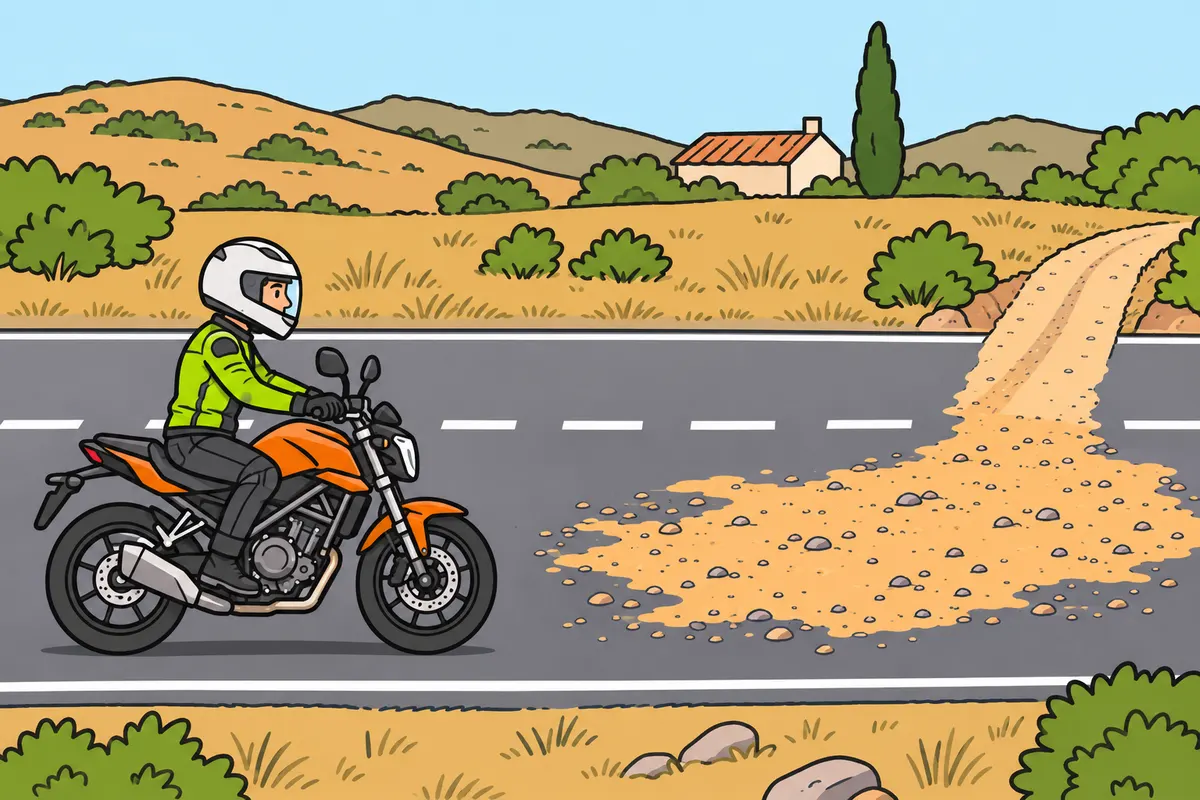
You must expect spills and loose material to reduce your grip.
| Material on the road | Hazard you should expect |
|---|---|
| Oil or fuel | You can lose grip when braking, accelerating or turning. |
| Sand or gravel | Your wheels can slide; material can be thrown towards you. |
| Wet leaves or mud | You can lose grip and miss hidden obstacles. |
Remember
- Watch for spills at junctions and where vehicles stop.
- Avoid spills only with a small, legal, safe adjustment that surprises nobody.
- On sand or gravel, increase your distance from the vehicle ahead.
- Wet leaves and mud can also hide potholes.
Exam trap: Wrong: spills are slippery only in rain. Right: oil can reduce grip even when surrounding asphalt is dry.
Read the full explanation
- You must watch for oil or fuel patches, especially at junctions and where vehicles stop. If you can avoid a patch with a small, legal and safe adjustment, do so early and without surprising others.
- A patch can be difficult to recognise by its colour and can extend beyond the visible area. On oil or fuel, you can lose grip when braking, accelerating or turning, even when the surrounding asphalt is dry.
- Loose sand and chippings reduce contact with the road surface and can make your wheels slide. Increase your distance from the vehicle ahead because of the reduced grip and the possibility of material being thrown up. Pay particular attention at road edges, entrances to tracks, repairs and bends where material accumulates.
- Wet leaves and mud can hide potholes, markings and edges as well as reducing grip. You must treat an accumulation as a hazard even if the rest of the road is dry.
10Potholes, joints and roadworks
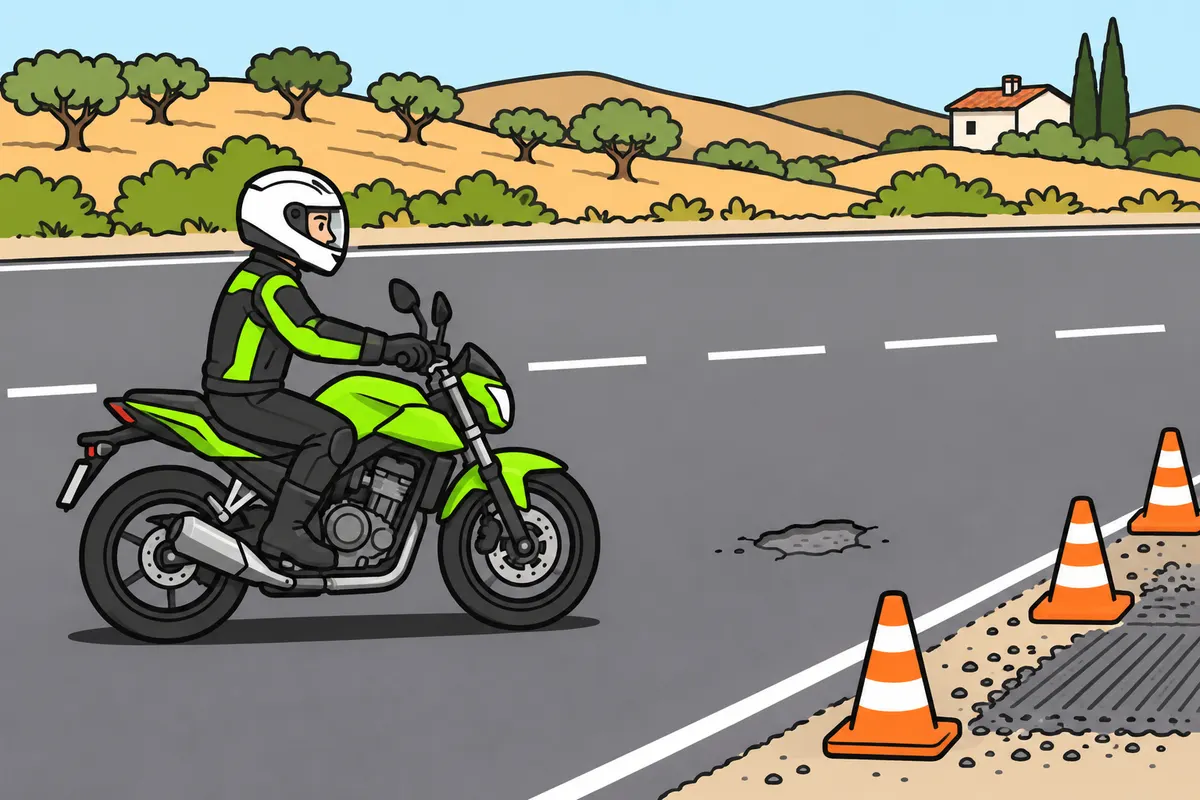
You must spot uneven surfaces early and slow down before reaching them.
Remember
- Leave space to spot potholes and joints early.
- A pothole can make you lose stability and damage your motorcycle.
- At roadworks, slow down before the area.
- At roadworks, increase separation and allow room for your body.
- After an impact, stop safely if you notice vibration or steering changes.
Exam trap: Wrong: roadworks are safe when workers are absent. Right: uneven surfaces and obstacles may remain.
Read the full explanation
- You must look for potholes, cracks, steps in the surface and longitudinal joints well in advance. An uneven surface can affect your steering or momentarily take weight off a wheel. Keep enough distance so that the vehicle ahead does not hide the obstacle until the last moment and you can decide what to do without rushing.
- A pothole can cause a loss of stability and damage your tyre, wheel rim or steering; how to ride over it when you cannot safely avoid it is explained in «Motorcycle riding techniques», in the section «Gradients and slippery surfaces».
- At roadworks, you can encounter loose aggregate, milled surfaces, changes in level and narrow lanes. Slow down before the area, increase your distance and avoid blindly following the line taken by the vehicle ahead. You must assess the space available for your motorcycle and your body, not just for your wheels.
- The danger can continue even when you cannot see anyone working. Observe the temporary layout, the road surface and the obstacles on each stretch. Detailed interpretation of signs and delineation devices is covered in «Signs and their order of priority»; here you must associate roadworks with reduced lateral clearance and uneven grip.
- After an impact, a new vibration, a loss of pressure or steering that responds differently can indicate damage. You must stop somewhere safe to check your motorcycle before continuing; continuing to ride can worsen the defect and the loss of control.
11Rain and wet road surfaces
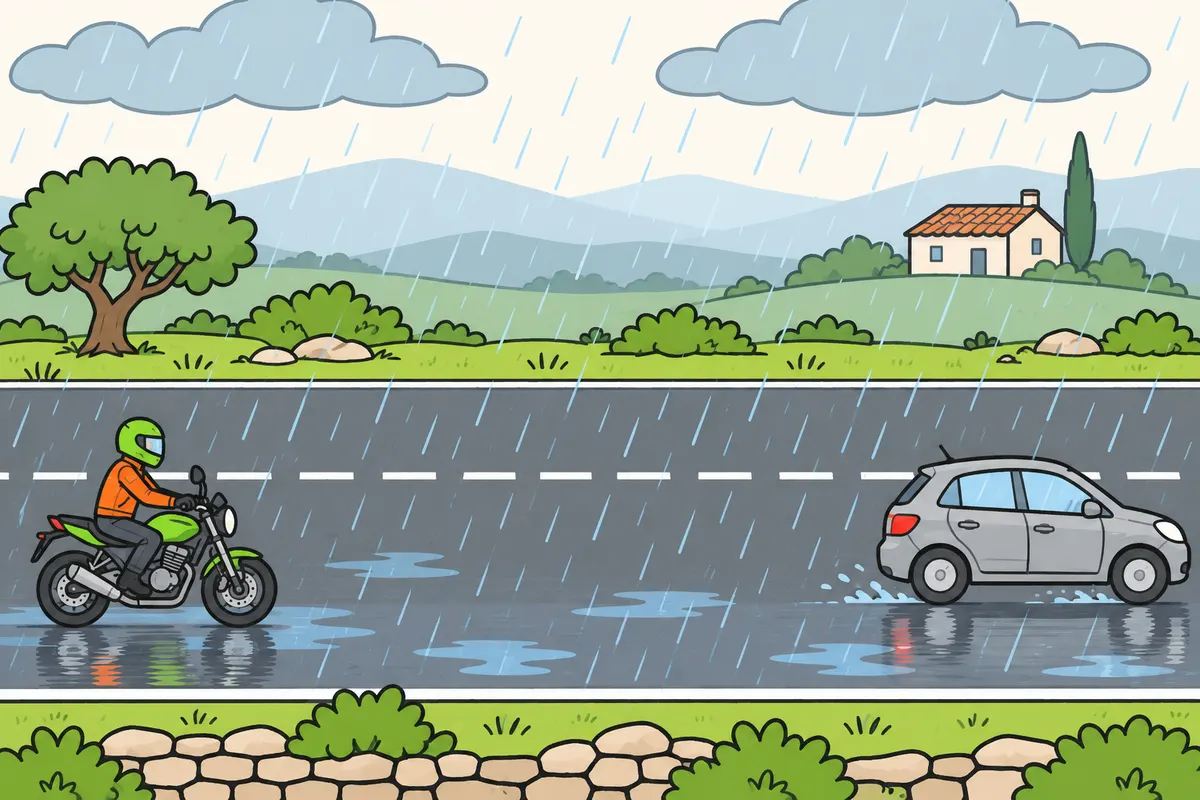
In rain, you must slow down and leave more space to keep vision and control.
Remember
- After dry weather, the first drops can make the road very slippery.
- Expect water, reflections and spray to block your view.
- Do not start overtaking unless you can see far enough.
- If vision or control becomes inadequate, wait somewhere safe and permitted.
- Choose somewhere away from moving traffic that is not liable to flood.
Exam trap: Wrong: any hard shoulder is suitable for resting in rain. Right: find somewhere safe and permitted away from moving traffic.
Read the full explanation
- In rain, you must allow for poorer visibility, reduced grip and a longer stopping distance at the same time. Reduce your speed and increase your distance before you need to brake heavily. [RGC, arts. 45 and 54](https://www.boe.es/buscar/act.php?id=BOE-A-2003-23514#a45).
- The first drops after a dry spell can mix with dust and grease to form a particularly slippery film. Heavy rain adds other risks, such as standing water and difficulty distinguishing the edges of the road surface. You must assess how conditions on the stretch change as you ride.
- In rain, the combination of water on your visor, reflections and reduced grip can delay your response when the vehicle ahead brakes. Refer to «Motorcycle riding techniques», in the section «Brake with both brakes», for how to control the force you apply to each brake.
- Spray from large vehicles can suddenly block your view. Increase your safety margin and avoid starting to overtake if you cannot see far enough.
- If rain prevents you from maintaining sufficient visibility or control, find a permitted, safe place away from traffic to wait. Avoid places liable to flood and do not use just any arcén (hard shoulder) as a rest area. Warning others when you are immobilised in an emergency is covered in «Accidents, breakdowns and assistance».
12Standing water and aquaplaning
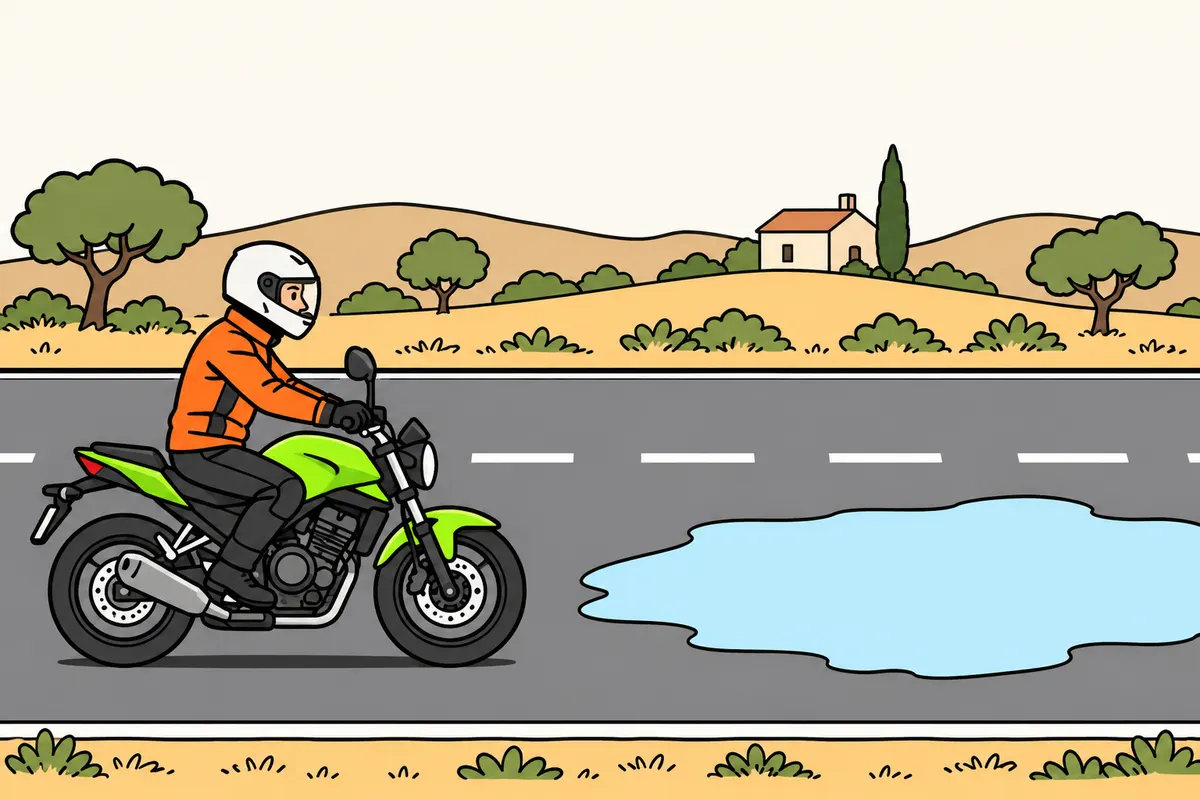
You must slow down before puddles to avoid losing contact with the road.
Remember
- You can lose steering and balance if your tyre cannot clear enough water.
- Risk depends on speed, water, tyre condition and pressure.
- If contact is lost, avoid sudden movements and ease off the throttle gently.
- Do not enter flowing water or water of unknown depth.
- Afterwards, gently check brakes at low speed when safe, following your manual.
- If normal braking does not return, stop and ask for assistance.
Exam trap: Wrong: aquaplaning only affects cars. Right: it can affect your motorcycle, even after rain stops.
Read the full explanation
- You can experience aquaplaning, also called hydroplaning, when your tyre cannot disperse enough water and loses effective contact with the road surface. On a motorcycle, this loss compromises both steering and balance and can occur while puddles remain after rain.
- The risk depends on your speed, the amount of water and the characteristics and condition of your tyre, including its pressure. You must slow down before dips and areas of standing water, where water depth can increase within the same stretch.
- If you feel a loss of contact, avoid abrupt use of the brakes, throttle or steering. Gently ease off the throttle and try to maintain a steady line until you regain grip.
- A puddle can conceal its depth, a pothole or a grille. Do not enter a flooded carriageway if the depth is unknown or the water is flowing; find a safe alternative.
- After getting wet, your brakes can temporarily lose effectiveness. When it is safe and without surprising others, check their response at low speed by applying them gently, following the manual. If they do not return to normal operation, stop and request assistance.
13Fog, smoke and dust
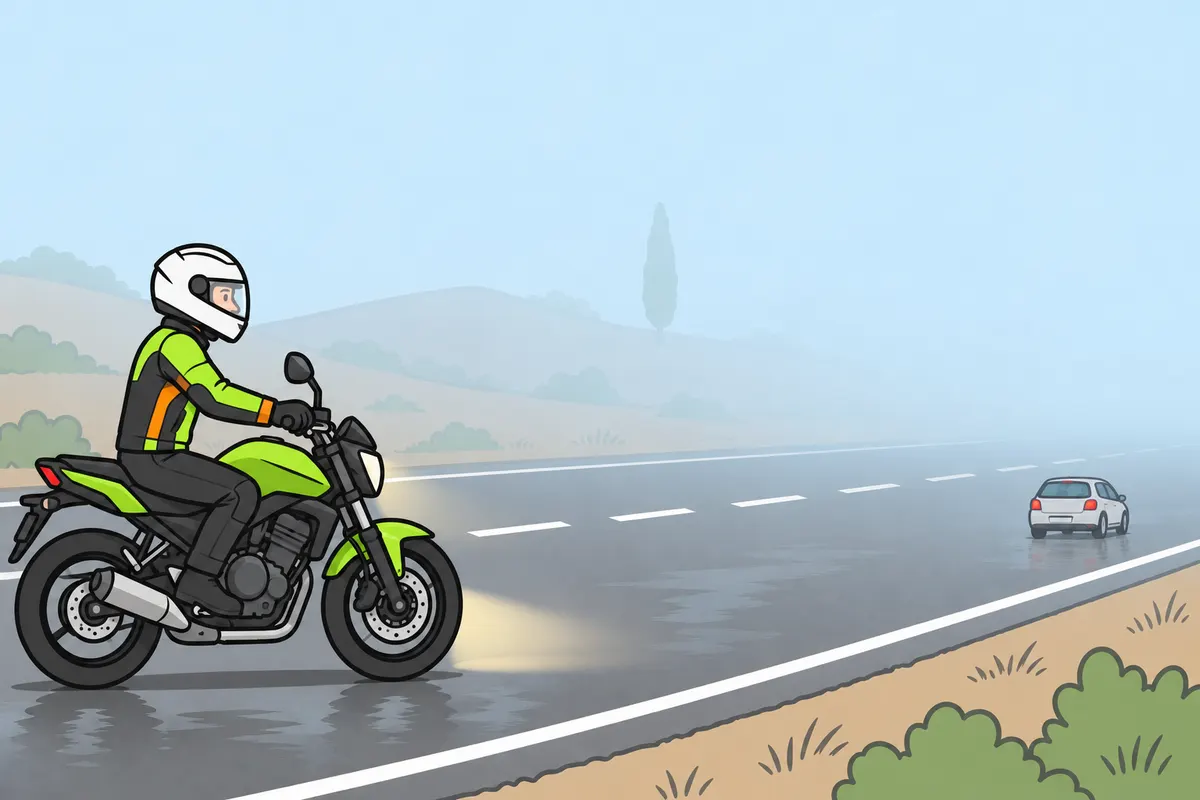
You must slow down and use suitable lights in fog, smoke or dust.
| Condition | Rear fog light, if fitted to your motorcycle |
|---|---|
| Thick fog | You must switch it on. |
| Very heavy rain | You must switch it on. |
| Heavy snowfall | You must switch it on. |
| Dense clouds of dust or smoke | You must switch it on. |
| These conditions clear | You must switch it off. |
Remember
- Increase your distance and keep your visor and other viewing surfaces clean.
- Do not use the lights ahead as your only guide.
- Use dipped beam: main beam can reflect back and worsen your view.
- Slow down smoothly before entering smoke or dust.
Exam trap: Wrong: use your rear fog light in any fog. Right: if fitted, use it only in particularly poor conditions and switch it off when they clear.
Read the full explanation
- In fog, you see less and others may spot you later. Its moisture can also wet the carriageway and your visor. You must reduce your speed, increase your following distance and keep the surfaces you see through clean, without using the lights of the vehicle ahead as your only guide to the route.
- In fog or airborne particles, main beam can reflect light back towards you and make visibility worse. Use dipped beam and consult «Motorcycle lights and signals» for the use of fog lights.
- If your motorcycle has a rear fog light, you must switch it on only in particularly unfavourable conditions, such as thick fog, very heavy rain, heavy snowfall or dense clouds of dust or smoke. Switch it off when these conditions clear. [RGC, art. 106](https://www.boe.es/buscar/act.php?id=BOE-A-2003-23514#a106).
- A cloud of smoke or dust can suddenly hide a traffic queue, a junction or an obstacle. Slow down in a controlled way before entering it, avoid overtaking without a clear view and look for a safe alternative if you cannot continue.
14Snow and ice
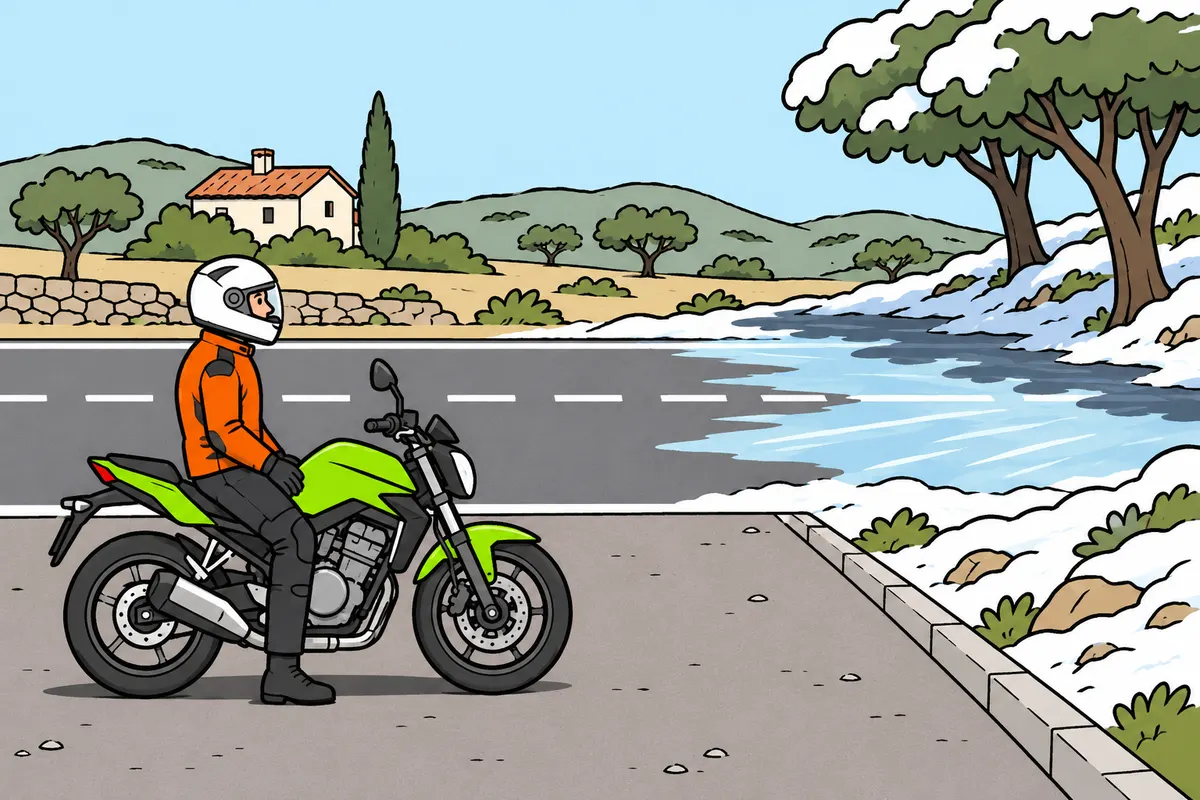
In snow or ice, you must assess whether you have enough grip to continue.
Remember
- Expect ice in damp shade, on bridges and in dips during intense cold.
- Slow down before suspect areas and avoid sudden movements.
- Consider where you can stop and put your foot down.
- Wheel tracks may contain compacted snow and ice.
- Obey restrictions and officers’ instructions.
- Avoid or stop your journey if grip is insufficient.
Exam trap: Wrong: no visible snow means no ice. Right: you may find ice patches without visible snow.
Read the full explanation
- Snow can hide the course of the road and reduces grip; ice can cause you to lose your balance with even the smallest corrections. On a motorcycle, you must consider avoiding or interrupting your journey if there is not enough grip.
- You must suspect ice in damp, shaded areas, on bridges and flyovers, and in dips, especially in very cold conditions at night and in the early morning. The absence of visible snow does not prove that the road surface is free of ice patches. Slow down before suspect areas and avoid sudden movements.
- Snow also reduces your ability to balance at low speed or put your foot down when stopping. Grip can differ between the tracks left by vehicles and the edges of the carriageway. You must take account of the condition of the places where you need to stop.
- Snow-covered slopes add a risk of wheelspin uphill and sliding downhill. Stopping can leave you without enough grip to move off again.
- You must obey restrictions and officers’ instructions and choose a safe alternative when you cannot continue. Wheel tracks can contain compacted, frozen snow, with less grip than their appearance suggests. Assess that surface before deciding to continue. [RGC, art. 132](https://www.boe.es/buscar/act.php?id=BOE-A-2003-23514#a132).
15Crosswinds and gusts
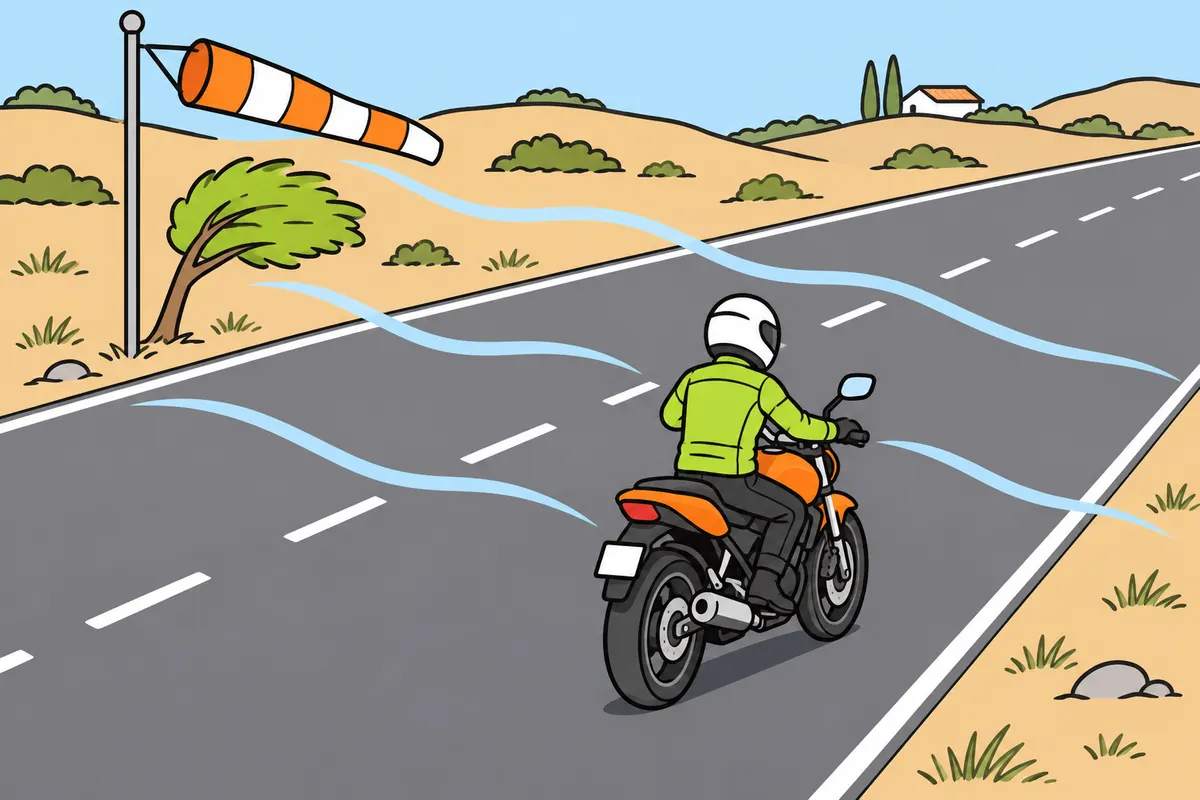
In wind, you must slow down and leave space to maintain your path.
Remember
- Leave space from road edges, vehicles and oncoming traffic.
- Expect gusts on bridges, in open areas and at tunnel exits.
- Wind can change as buildings, barriers or trees end.
- Watch for branches and objects that may enter your path.
- If you cannot maintain your path safely, stop your journey somewhere safe.
Exam trap: Wrong: another motorcycle reliably shields you from wind. Right: keep your own safety margin.
Read the full explanation
- A crosswind can push you off course and force you to correct your balance. In strong winds, you must moderate your speed and leave a safety margin from the edge, other vehicles and oncoming traffic. [RGC, art. 45](https://www.boe.es/buscar/act.php?id=BOE-A-2003-23514#a45).
- A gust can arrive suddenly and die away while you are still compensating for its force, with a risk of veering towards the opposite side; the control technique is covered in «Motorcycle riding techniques», in the section «Wind and large vehicles».
- Anticipate gusts on bridges, in open areas, at tunnel exits and where barriers, buildings or trees end. Also watch for branches and other objects that may fall or encroach onto the carriageway. Other vehicles veering off course can also reduce the space available to you.
- Headwinds and tailwinds can also bring turbulence and changes in direction that affect stability. If you cannot stay on course with a sufficient safety margin, find a safe place to stop your journey; another motorcycle does not give you reliable protection.
16Large vehicles and the shielding effect
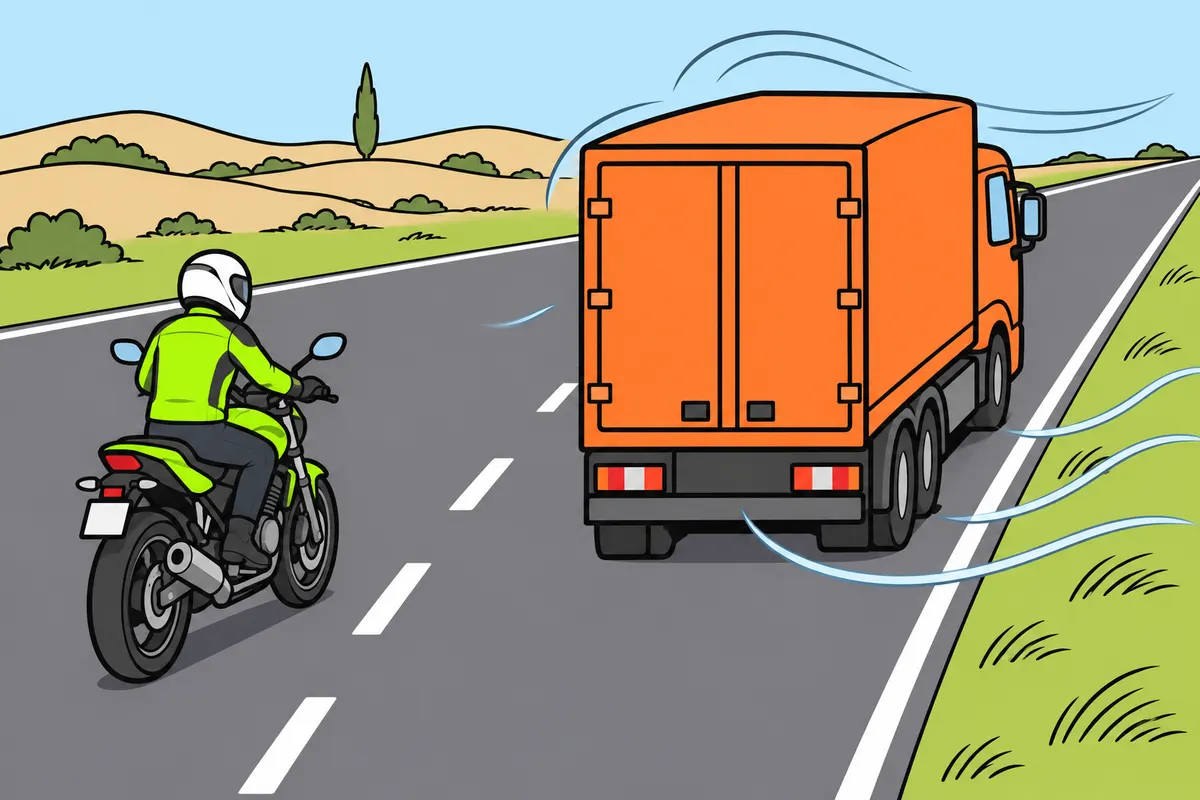
You must expect sudden wind changes when passing large vehicles.
| Overtaking a lorry on its left, wind from your right | What you should expect |
|---|---|
| Alongside it | The force may suddenly drop: adjust your correction smoothly. |
| As you pass it | You may feel the full wind again. |
Remember
- Expect turbulence when meeting or overtaking a lorry.
- Do not overtake if gusts or limited space prevent safe separation.
- Before accelerating, consider the speed limit and time needed to correct your path.
- Luggage, panniers and your windscreen can change your response to wind.
- Follow the manufacturer’s conditions of use.
Exam trap: Wrong: move closer to a lorry for shelter. Right: keep separation and expect changes in wind force as you pass.
Read the full explanation
- As you approach a lorry, you must anticipate turbulence and changes in your exposure to the wind, both when passing it in the opposite direction and when overtaking it. Its bulk can briefly shelter you and leave you exposed as you emerge from its shelter.
- If the wind comes from the right and you overtake on the left, the lorry can suddenly reduce the sideways force as you draw alongside it. You must smoothly adjust the correction you are making so that you do not move closer to it. As you pass it, you can feel the full force of the wind again.
- Do not start overtaking if gusts or the available space prevent you from keeping a safe gap. Increasing your speed indiscriminately reduces the time available to correct your course and can break the speed limit.
- The fairing can provide some relief from wind and rain, but its effectiveness depends on its design. Panniers, the windscreen and the load alter the exposed surface area and can change your motorcycle’s sensitivity to gusts. You must maintain a safety margin and follow the manufacturer’s conditions of use.
17Cold, heat and sun glare
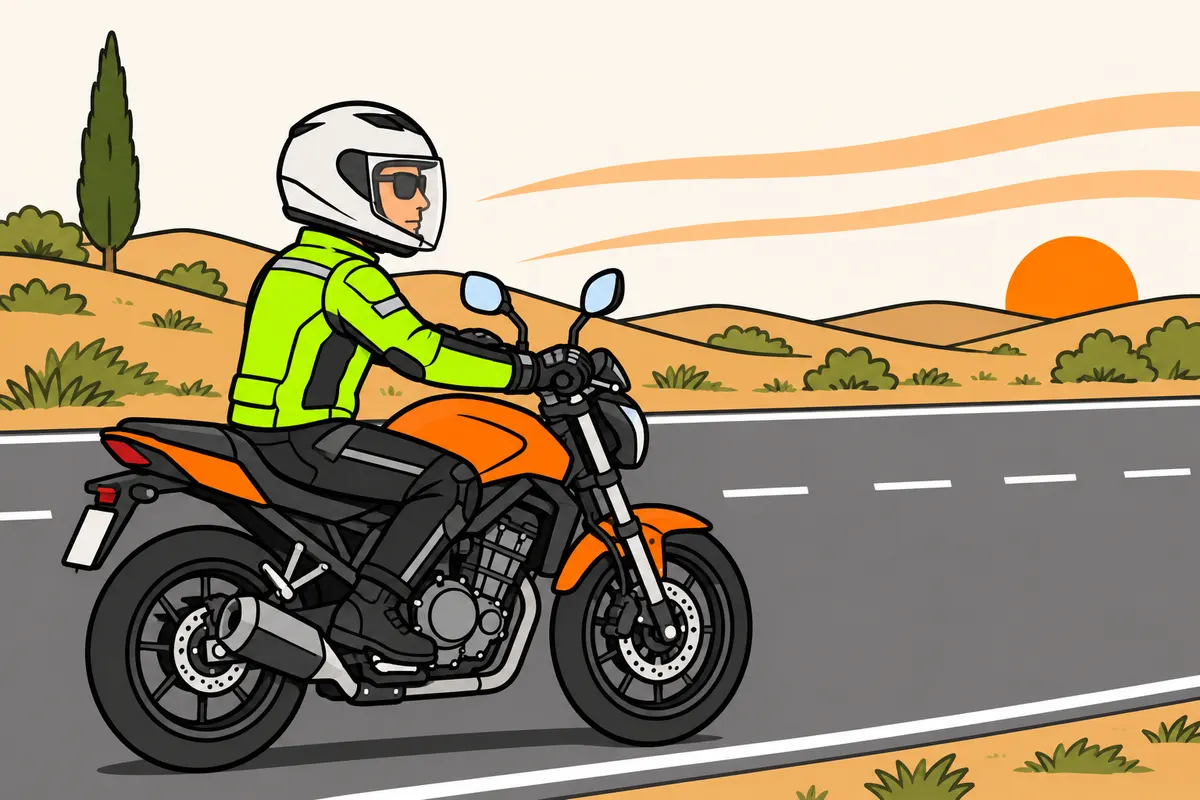
You must protect yourself from cold, heat and sunlight to keep control and vision.
| Condition | What you should expect |
|---|---|
| Cold | You may lose feeling in your hands and feet. |
| Heat | You may become tired, dehydrated and sleepy. |
| Low sun | You may be dazzled; others may also fail to see you. |
Remember
- In cold weather, stop somewhere sheltered if stiffness or shivering affects your movements.
- In heat, rest and drink water during stops.
- Choose protective clothing with a good fit and suitable ventilation.
- In low sun, use suitable eye protection and slow down before losing vision.
- Keep your visor and mirrors clean.
Exam trap: Wrong: a very dark visor suits all lighting. Right: avoid it at night or in low light.
Read the full explanation
- In cold weather, you can lose feeling in your hands and feet and operate the controls less effectively. Wear suitable equipment and stop in a sheltered place if stiffness or shivering reduces your precision; for advice on choosing clothing, consult «Motorcycle protective equipment».
- In hot weather, you can tire sooner and suffer dehydration, reduced attention and drowsiness. Plan breaks, drink water during stops and avoid the most demanding hours where possible.
- Choose protective clothing that allows adequate ventilation without sacrificing strength or fit. Clothing that flaps can distract you and increase the effort you need to make.
- A low sun can dazzle you at dawn, at dusk or as you come out of a bend. Use eye protection suitable for riding and reduce your speed before you lose your view. Bear in mind that a driver travelling towards the sun may also have difficulty spotting your motorcycle.
- You must avoid a very dark visor at night or in low light and observe its restrictions on use. A scratched or dirty visor scatters light and makes glare worse. Clean and maintain your visor and mirrors; keeping your view clear is necessary in both sunshine and rain.
18Night riding and how far you can see
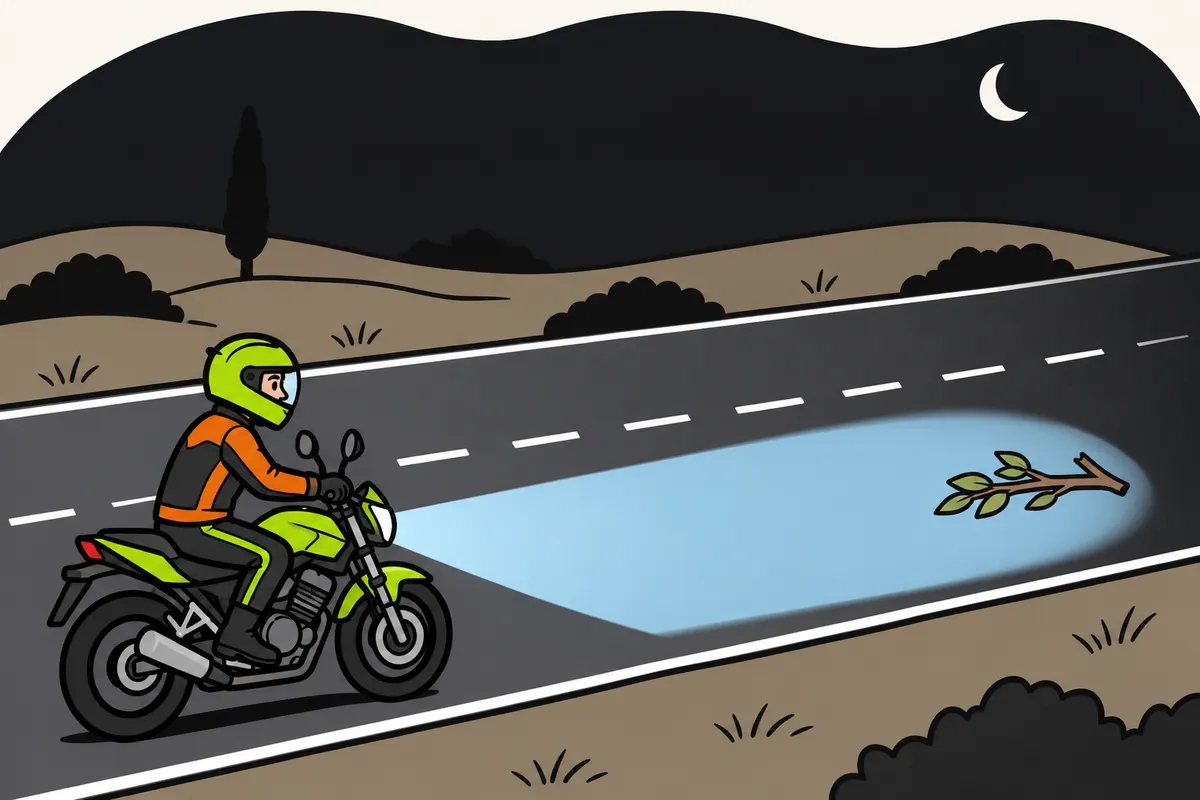
At night, you must be able to stop within the distance you can see.
Remember
- Stay alert even when traffic is light.
- Adapt your speed when moving from a lit area into darkness.
- When changing to dipped beam, adjust your speed to the shorter visible distance.
- Slow down before bends where your headlight cannot show your whole path.
- Before overtaking, you need to see space for the whole manoeuvre.
- Avoid dazzling through mirrors; adjust your lights when someone overtakes you.
Exam trap: Wrong: keep your speed because the limit allows it. Right: you must stop within the distance you can see.
Read the full explanation
- At night, you find it harder to recognise people, obstacles, distances and changes in the road surface. You must pay greater attention even when there is little traffic. An empty road does not guarantee that you see an animal, a patch on the road surface or a stationary vehicle in time, and fatigue can build up without you noticing.
- When you move from a lit area into a dark one, your eyes need time to adapt. Avoid maintaining a speed chosen for the previous stretch and do not stare at bright lights.
- You must be able to stop within the distance you can see. When you switch from main beam to dipped beam, adapt your riding to the shorter range of visibility; do not maintain your speed simply because the limit allows it. [RGC, art. 45](https://www.boe.es/buscar/act.php?id=BOE-A-2003-23514#a45).
- On a bend, the beam may illuminate less of the path you are about to follow and hide the fact that the bend tightens. Adjust your speed beforehand and keep a safety margin within your lane, including for your body as you lean.
- If you intend to overtake at night, you need a clear view of the space for the whole manoeuvre and must avoid dazzling the driver ahead through their mirrors. If you are being overtaken, adjust your lights as the other vehicle moves ahead.
19Lights and night-time dazzle
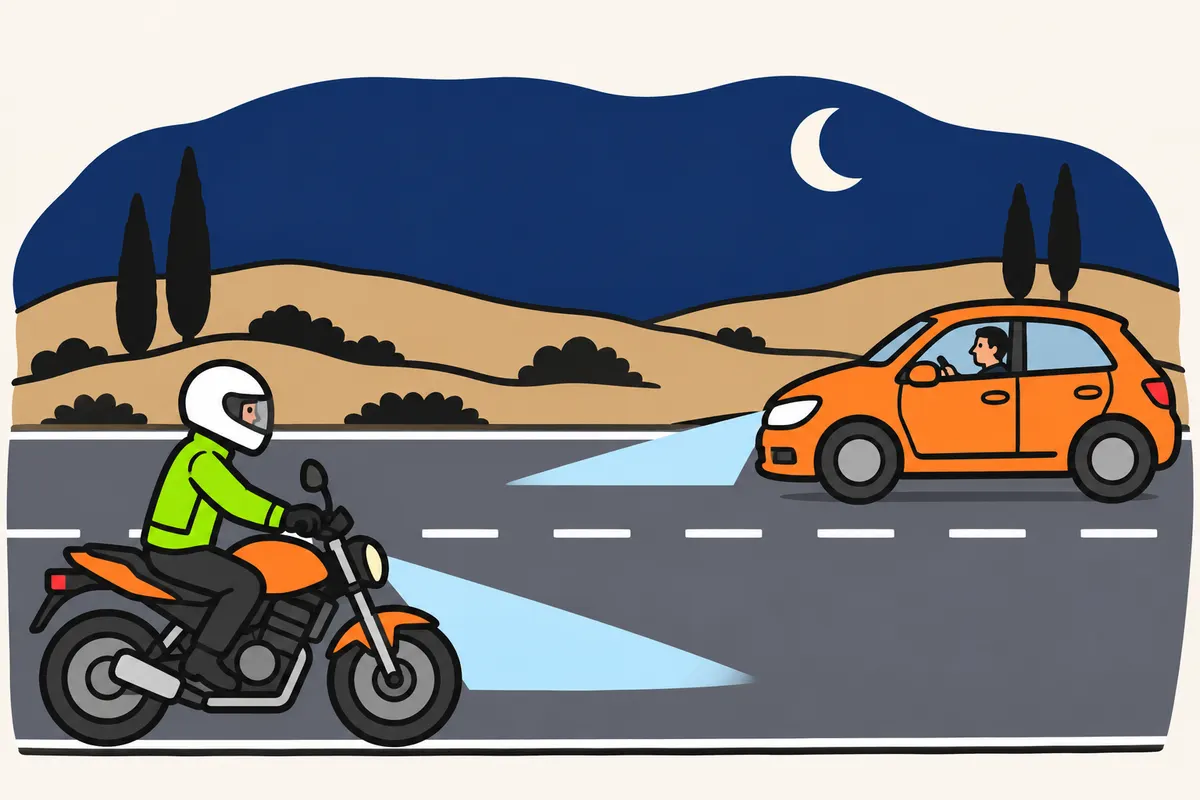
You must choose lights for the conditions and avoid dazzling others.
| Situation: motorcycle with main beam | When you must use it, unless dipped beam is required |
|---|---|
| Outside built-up areas, at night, on an inadequately lit road | Above 40 km/h, without dazzling others. |
| Inadequately lit tunnels, underpasses or stretches marked as tunnels | At any time, above 40 km/h, without dazzling others. |
Remember
- Change to dipped beam whenever you might dazzle others, including through mirrors.
- On bends, consider where your headlight points.
- If dazzled, slow down as necessary, even to a stop.
- Avoid looking directly at the dazzling light.
- Check headlight alignment when carrying a passenger or luggage.
- Keep your lights clean.
Exam trap: Wrong: main beam is never compulsory during daylight. Right: if fitted, use it above 40 km/h in insufficiently lit tunnels unless dipped beam is required, especially to avoid dazzling others.
Read the full explanation
- You must use main beam, if your motorcycle has it, at more than 40 km/h: outside built-up areas at night on inadequately lit roads; and at any time in inadequately lit tunnels, underpasses and stretches marked as tunnels. You must use dipped beam when appropriate, especially to avoid dazzling others; see «Motorcycle lights and signals». [RGC, art. 100.1](https://www.boe.es/buscar/act.php?id=BOE-A-2003-23514#a100).
- You must switch from main beam to dipped beam as soon as there is any possibility of dazzling others, including through their mirrors. On a bend, you must consider the direction of the beam; you cannot keep main beam on just because the other vehicle still seems far away. [RGC, art. 102](https://www.boe.es/buscar/act.php?id=BOE-A-2003-23514#a102).
- If you are dazzled, slow down as much as necessary, even to a stop. Avoid looking directly at the light source and use safe reference points to guide your path. [RGC, art. 102](https://www.boe.es/buscar/act.php?id=BOE-A-2003-23514#a102).
- Check that your headlamp remains correctly aimed when you carry a passenger or luggage, and keep the lights clean. A beam aimed too low reduces your range of vision; one aimed too high can disturb others.
20Speed and stopping distance
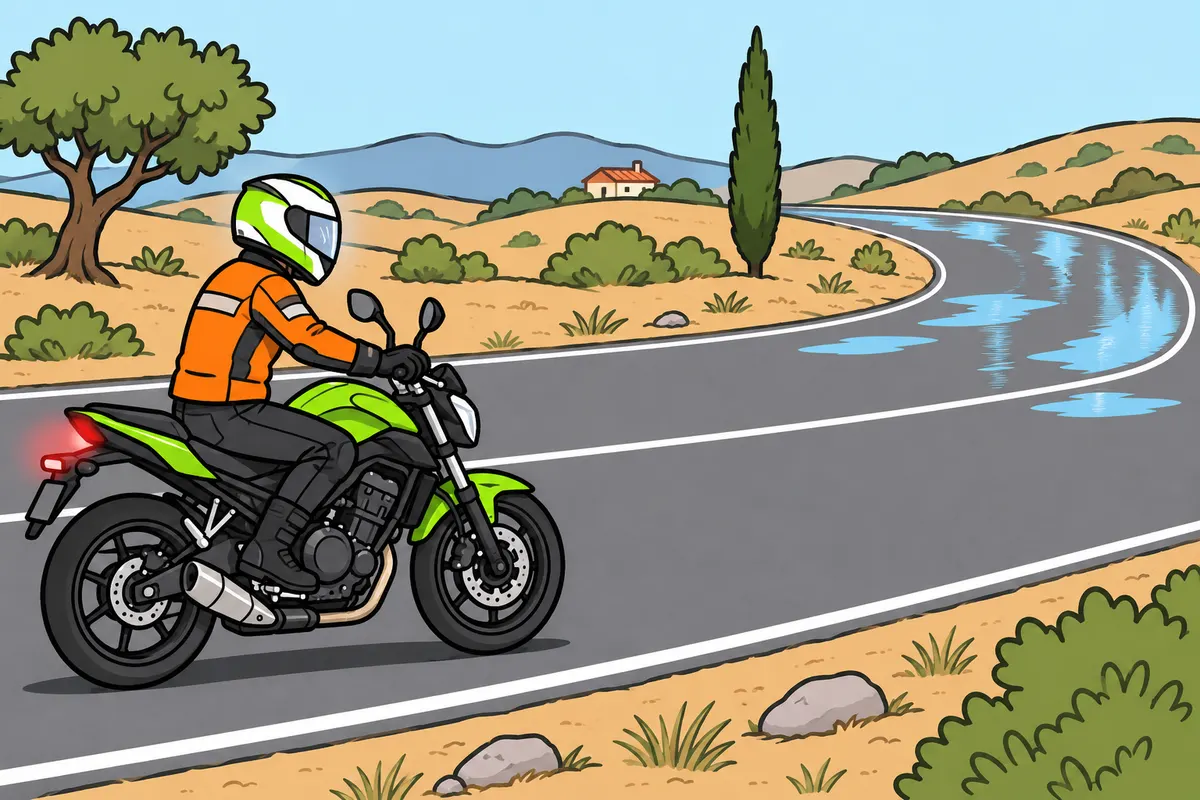
You must adapt your speed because the limit does not guarantee safe riding.
| Change | Effect you should expect |
|---|---|
| Higher speed | You cover more distance while reacting and need more room to brake. |
| Fatigue increases your reaction time | At the same speed, your reaction distance increases. |
| Slippery surface | Mainly increases your braking distance, with other conditions unchanged. |
Remember
- Slow down when grip, visibility or tiredness requires it.
- Your stopping distance includes reaction distance and braking distance.
- Higher speed leaves you less time to understand hazards.
- Slow down before entering a bend.
- Avoid sudden braking while leaning.
Exam trap: Wrong: your light motorcycle always stops sooner than a car. Right: a shorter stopping distance is not guaranteed.
Read the full explanation
- You can comply with the maximum speed limit and still be riding too fast for a wet bend, limited visibility or your level of tiredness. The «Speed and distances on a motorcycle» module explains the limits; here you must decide when safety requires you to slow down below them.
- At higher speeds, you cover more distance while perceiving and reacting, and you need more room to brake. Your total stopping distance is the sum of your reaction distance and braking distance. A light motorcycle does not guarantee a shorter braking distance than every passenger car, especially with poor grip or poorly controlled braking.
- At the same speed, if fatigue makes you take longer to react, your reaction distance increases. If all other conditions remain the same, a slippery road surface mainly increases the distance you need during braking.
- At higher speeds, you also have less time to interpret signs, access points and sideways movements. The term tunnel vision refers to a reduction in your useful field of vision; it is not a name for fatigue. Speeding up to finish a demanding journey sooner increases your workload.
- On a bend, a higher speed and a smaller radius increase the demands of turning. Slow down beforehand and avoid entering without any grip in reserve. Braking is not prohibited on every bend, but an abrupt action while your motorcycle is leaning can exceed the available grip; no technique guarantees that you can recover from entering a bend without a safety margin.
21Maintaining a safety gap
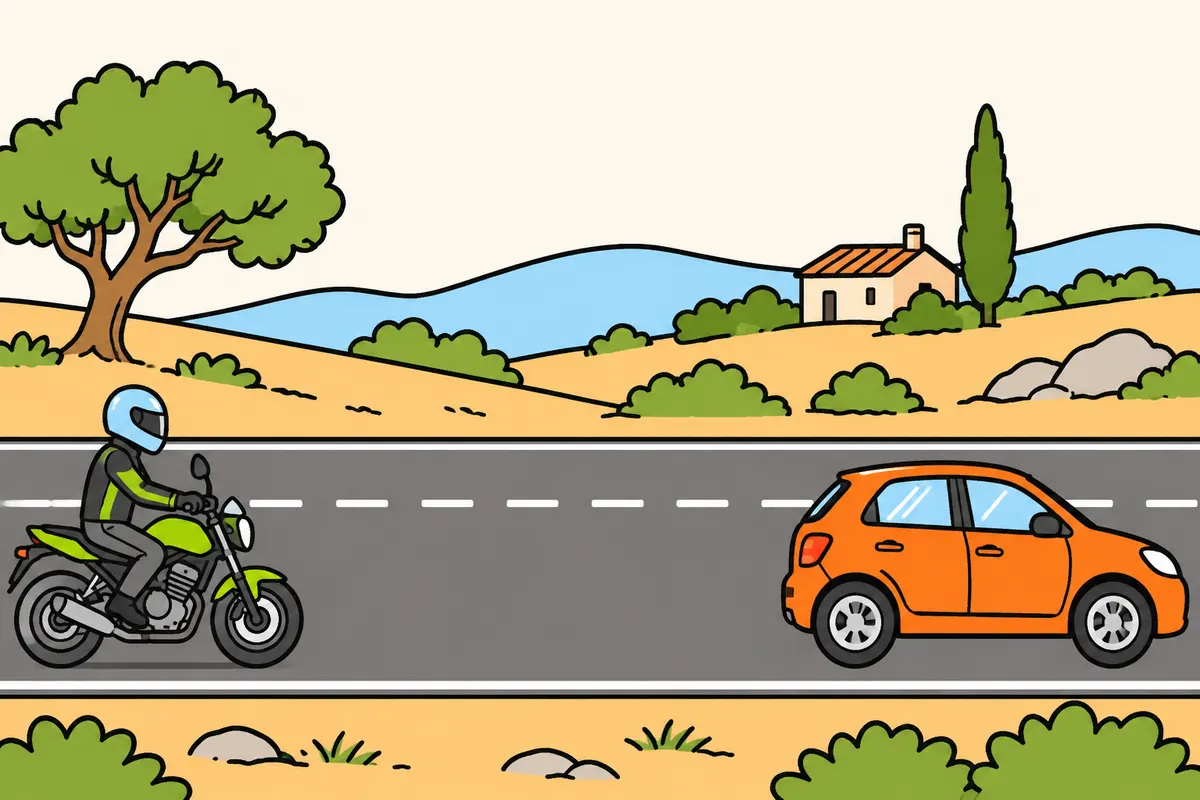
You must leave enough space to stop if the vehicle ahead brakes.
Remember
- Leave distance in towns and traffic queues too.
- Adapt your distance to speed, grip and braking.
- Increase your margin in rain, gravel, poor visibility or on uneven surfaces.
- With luggage or a passenger, reassess the distance you need.
- Do not shorten your distance because you have ABS.
- As you approach a queue, remember traffic coming from behind.
Exam trap: Wrong: ABS creates grip on ice or oil. Right: it helps reduce wheel locking but cannot create grip.
Read the full explanation
- You must leave enough distance to stop without a collision if the vehicle ahead brakes sharply. Adjust this gap to your speed, grip and braking performance; you also need it in towns and in traffic queues. [RGC, art. 54](https://www.boe.es/buscar/act.php?id=BOE-A-2003-23514#a54).
- In rain, on loose chippings, with reduced visibility or on an uneven road surface, you must increase your safety margin. Carrying a load or a passenger also requires you to reconsider it because your motorcycle handles differently. The margin you need varies with the conditions along your route.
- ABS helps reduce wheel locking, but it does not create grip on oil, ice or standing water. Do not shorten your following distance because you have it.
- When someone follows you too closely, you have less room to slow down for a spillage or a traffic queue. See «Preventive and efficient motorcycle riding» for the preventive response.
- As you approach a traffic queue, a vehicle coming up behind you may have little room to stop. The risk of a rear-end collision increases if its driver notices the queue late or expects you to keep moving. On a motorcycle, a rear impact can knock you off and leave you exposed to other traffic.
22Group riding: organising without pressure
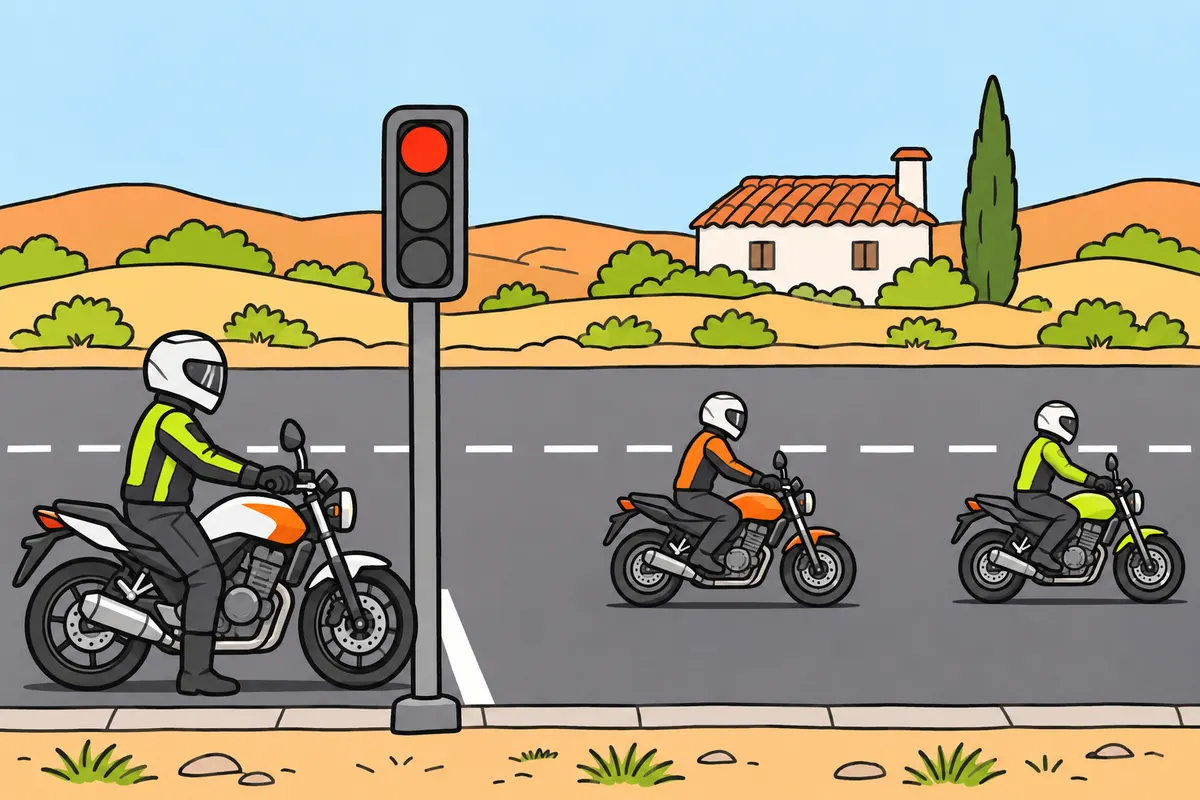
In a group, you must keep your own pace and agree how to organise your journey.
Remember
- Tell the group if you need to slow down or stop.
- Agree on your route, breaks and safe meeting places.
- Plan what to do if separated, so nobody chases the group.
- As recommended, adapt your pace to the least experienced rider and least capable motorcycle.
- Experienced riders can help from the front and rear.
Exam trap: Wrong: keep up with the group even when struggling. Right: keep your own pace and explain your needs.
Read the full explanation
- Pressure to keep up with the group can make you enter bends too fast or attempt overtaking without a safety margin. Keep to your own pace and let the others know if you need to slow down or stop.
- Before setting off, agree on your route, rest stops and safe places to regroup. Plan what to do if you become separated so that nobody needs to chase the others.
- As a preventive recommendation, adapt your pace to the least experienced rider and the least capable motorcycle. You can place experienced motorcyclists at the front and rear to guide the group and spot difficulties.
- Positioning and formation while riding are covered in «Motorcycle riding techniques», in the section «Ride in a group without competing».
23Group riding: positioning and gaps
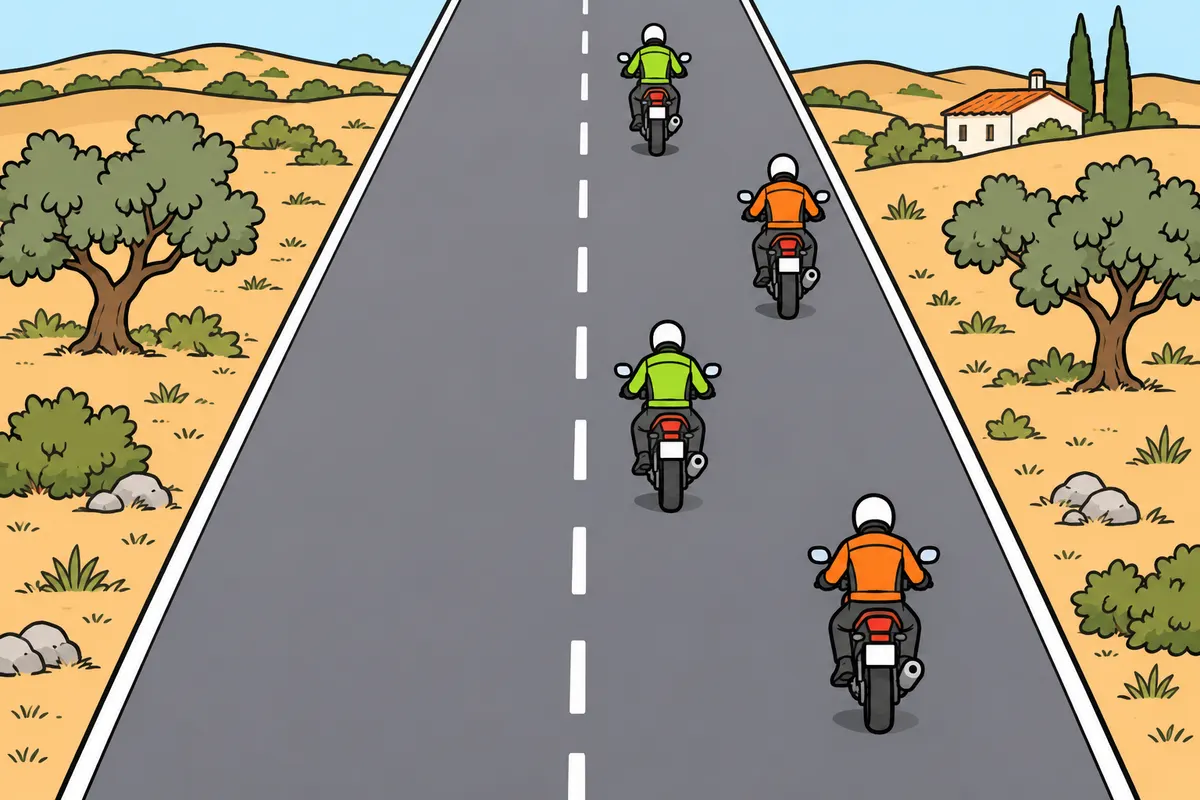
In a group, you must keep visibility, space and your own judgement for each manoeuvre.
Remember
- Avoid a formation so close that it blocks your view of the road.
- Keep space to avoid obstacles within your lane.
- Assess each overtake yourself.
- Check your own visibility and space to return to your lane.
Exam trap: Wrong: you can overtake because your companion passed. Right: check your own space and visibility.
Read the full explanation
- A formation that is too tight can block your view of the road surface and leave you less space to avoid an obstacle. Keep enough room to choose a safe path within your lane; practical positioning is covered in «Motorcycle riding techniques», in the section «Ride in a group without competing».
- Assess each overtaking manoeuvre for yourself: the fact that another rider has overtaken does not guarantee that you have enough visibility and space to move back in.
- The gap you need to leave so that another driver can overtake you and move in also depends on the road and traffic; see «Speed and distances on a motorcycle» for the conditions of this rule.
24Fatigue and sleepiness on a motorcycle
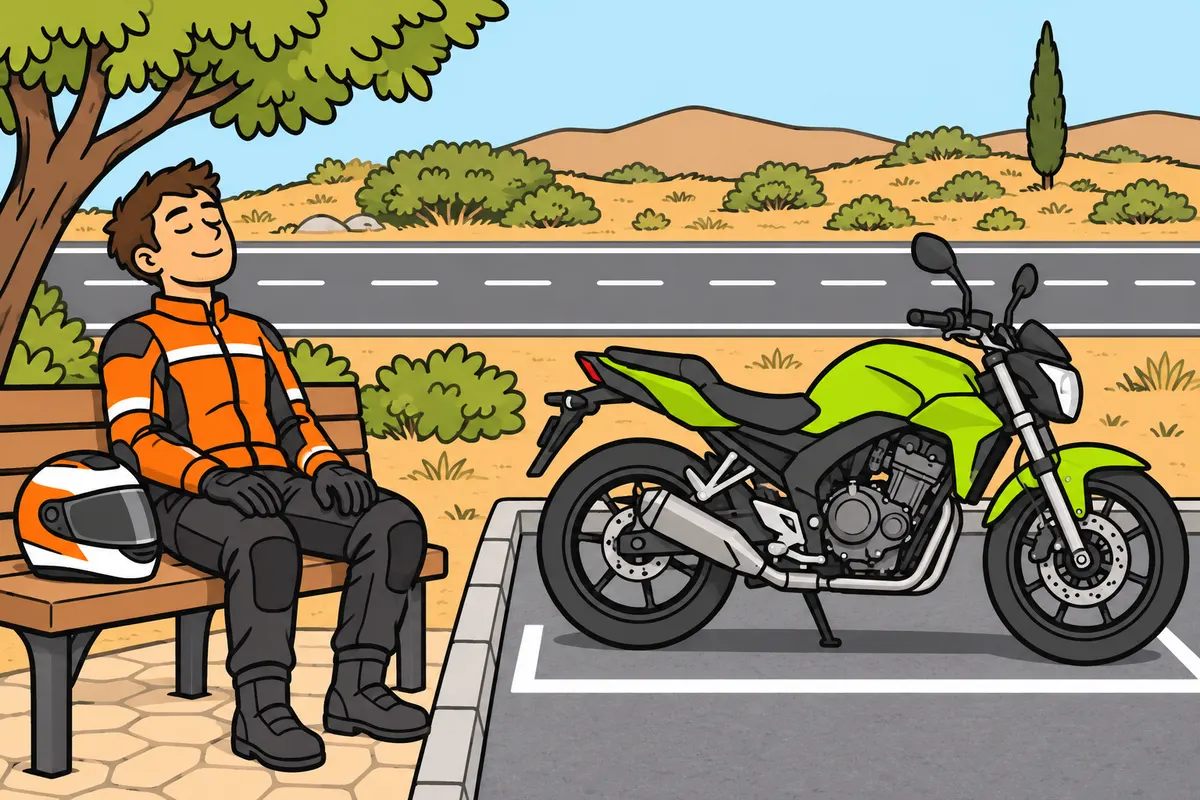
You must stop when tired, even before your planned break.
Remember
- The effort of riding can make your movements less precise.
- As a preventive guide, rest every 2 hours or 200 km, whichever comes first.
- On a motorcycle, you may need more frequent breaks.
- Stop sooner if you feel tired.
Exam trap: Wrong: wait for your planned break even when tired. Right: stop sooner; the guideline does not guarantee you remain alert.
Read the full explanation
- Riding a motorcycle requires you to maintain your posture, withstand wind and cold, and pay attention to your balance. This effort can tire you and reduce the precision with which you operate the brakes, throttle and steering.
- As general preventive guidance, the DGT advises you to rest every 2 hours or 200 km, whichever you reach first. On a motorcycle, you may need more frequent breaks because of the effort and exposure to the elements. You must stop sooner if you feel tired: this recommendation does not guarantee that you can ride without fatigue throughout that interval. [DGT, Advice before travelling, 27-06-2018](https://revista.dgt.es/es/reportajes/2018/06JUNIO/0627preparar-el-viaje.shtml).
- The general symptoms of fatigue and sleepiness, your need for sleep and the effects of medicines or other personal factors are covered in «Your fitness to ride safely», in the sections «Fatigue: causes, symptoms and response», «Sleep, drowsiness and microsleeps» and «Resting and deciding whether to continue».
25Inexperience and differences between road users
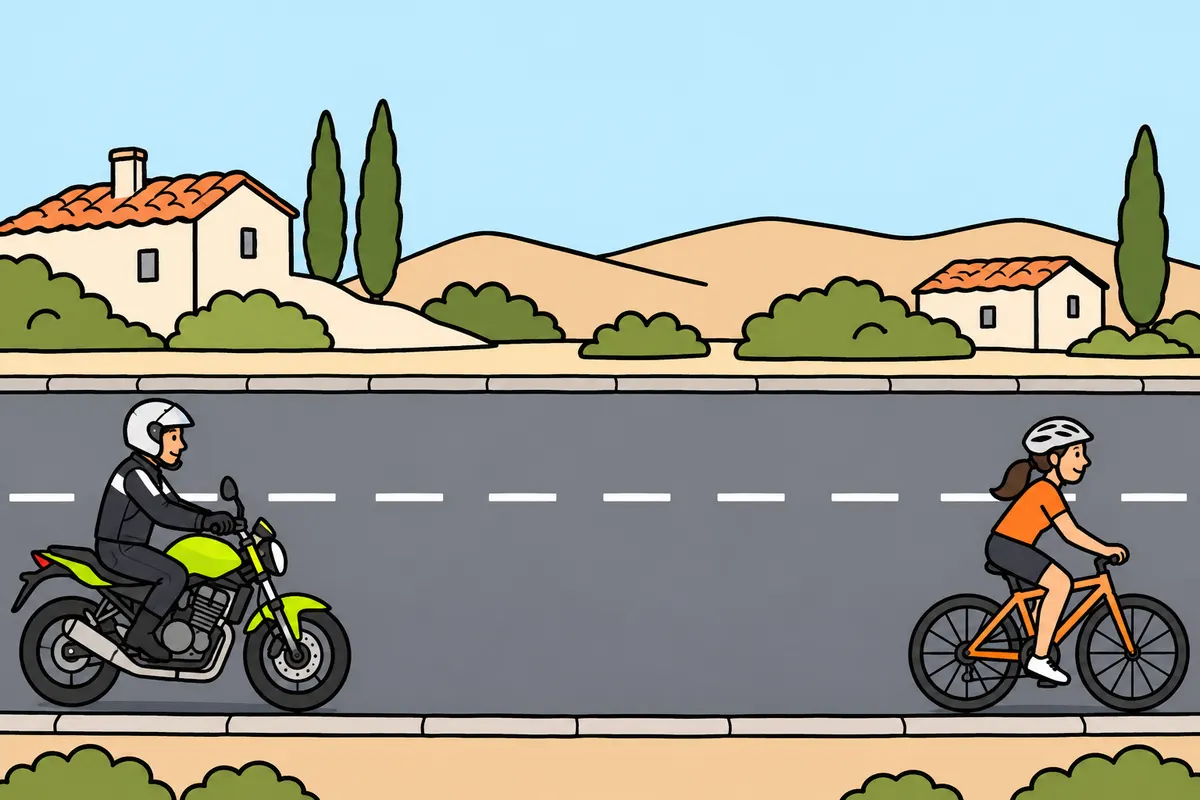
You must expect other road users’ difficulties and leave them time and space.
| Other vehicle | What you should expect from your motorcycle |
|---|---|
| Car | You can be hidden in its blind spots. |
| Lorry or bus | Can block your view, need more turning space and change the wind. |
Remember
- Do not pressure inexperienced road users.
- Do not judge their ability by their vehicle.
- Expect unexpected movements from pedestrians, cyclists, moped riders and other motorcyclists.
- Remember that children may act unpredictably.
- Give people extra time to cross when they need it.
Exam trap: Wrong: a vehicle tells you its driver’s ability. Right: expect mistakes and leave a safety margin.
Read the full explanation
- When other road users have little experience, you must anticipate hesitation, unexpected braking or mistakes in judging your approach. Give them time and space to correct their mistakes; do not pressure them or judge their ability by the vehicle they use.
- When approaching pedestrians, cyclists, mopeds or other motorcycles, anticipate changes of course and difficulties in noticing you. Children can act unpredictably, and some people need more time to cross. Priority rules are explained in «Priority of passage», and overtaking clearances in «Motorcycle manoeuvres», in the section «Overtaking vulnerable road users».
- You must adapt your anticipation to the type of vehicle: a car can hide you in its blind spots; lorries and buses can block your view, need more space when turning and change the wind you encounter. Apply the safety margins described in «Other vehicles' blind spots» and «Large vehicles and the shielding effect».
26Risks when riding through tunnels
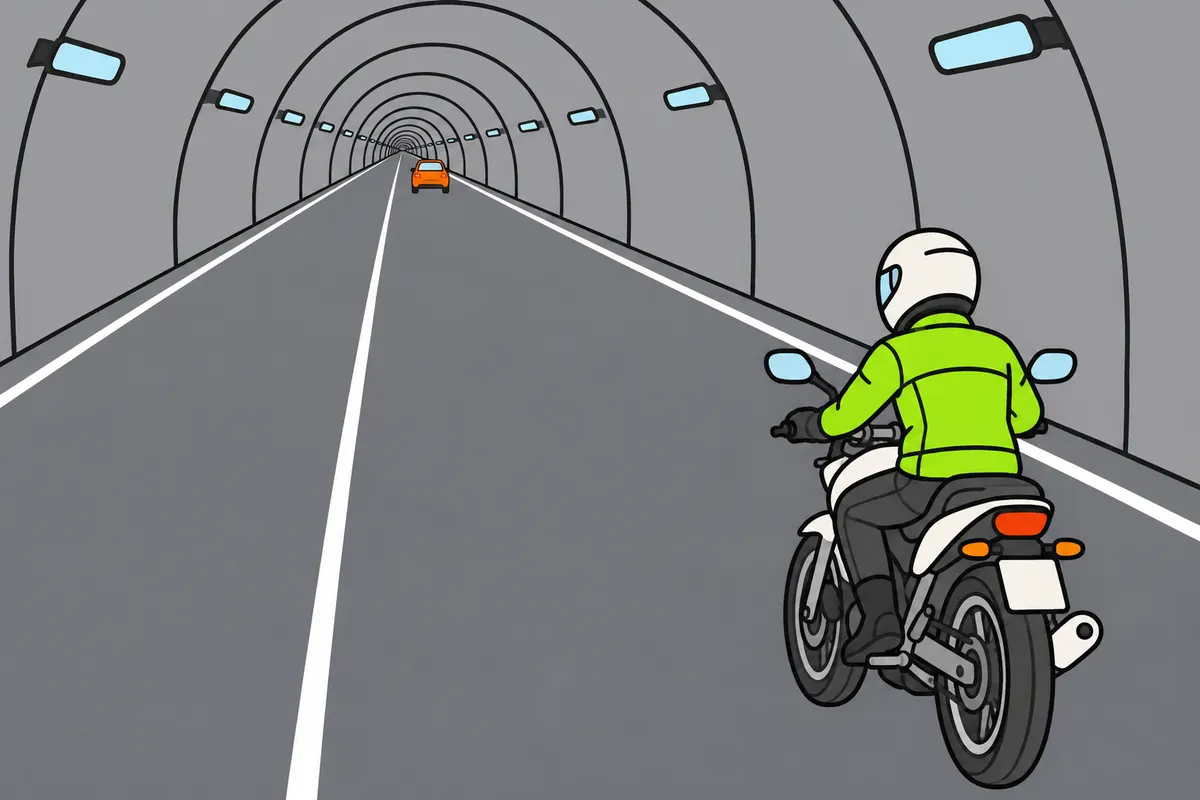
In tunnels, you must adapt your vision and keep the required distance.
Remember
- Expect hidden queues and adapt your speed before entering.
- Avoid staring at bright lights.
- At exits, expect sun glare and crosswind gusts.
- In tunnels and underpasses, keep the specified distance.
- Obey traffic lights, information displays and public address announcements.
Exam trap: Wrong: any gap is enough on a motorcycle in tunnels. Right: in tunnels and underpasses, you must keep the specified distance.
Read the full explanation
- When entering a tunnel, you must allow for your eyes adjusting to the change in light and anticipate traffic queues hidden from view. Slow down in good time according to what you can see and avoid staring at the lights; when leaving, anticipate sun glare and crosswind gusts.
- In tunnels and underpasses, you must keep the specified gap and obey traffic lights, information panels and public address announcements; the figures are covered in «Speed and distances on a motorcycle», in the section «Tunnels and underpasses». [RGC, art. 95.6 and 7](https://www.boe.es/buscar/act.php?id=BOE-A-2003-23514#a95).
Recognise a surface with little grip
Relate the appearance of the road surface to the risk for your motorcycle.
- Identify wet paint, metal, oil, sand or loose gravel as possible causes of loss of grip.
- Assess whether the hazard is confined to one spot or continues through the bend or junction.
- Consider whether water, leaves or dirt also conceal irregularities in the road surface.
- See the technique for riding over these surfaces in «Motorcycle riding techniques», section «Gradients and slippery surfaces».
Respond to reduced visibility
Adapt your riding to the distance you can actually see.
- Identify fog, spray, darkness, reflections or a misted-up visor, and also observe the traffic behind you.
- Slow down in a controlled way, increase your following distance and use appropriate lighting without dazzling others.
- Check that you can stop within the distance you can see, and slow down further if you cannot.
- If you cannot continue safely, find a safe place where stopping is permitted, away from moving traffic, and wait until conditions are suitable again.
Decide what to do when you become fatigued on a ride
Your need for rest depends on your condition, including when you ride in a group.
- Recognise poor concentration, stiffness, yawning or unintentional changes of pace.
- Stop trying to keep up with the group and find a safe place where stopping is permitted.
- Stop and rest; if you feel sleepy, sleep before considering continuing.
- Reassess your ability and the remaining route; resume only if you can ride safely, or find another option.
Check what you know
Real questions from the bank on this topic. Pick an answer to see the explanation.
Finished this module?
Mark it as read and you will see your progress on the theory list.