
Theory · D Licence - Bus · Module 4 of 18
The bus tachograph
You learn to use the bus’s analogue, digital or smart tachograph to record your activity using the appropriate recording medium and card. This module explains manual entries, border crossings, printouts, checks and downloads, as well as exemptions, lost or faulty cards, equipment faults and offences and their consequences.
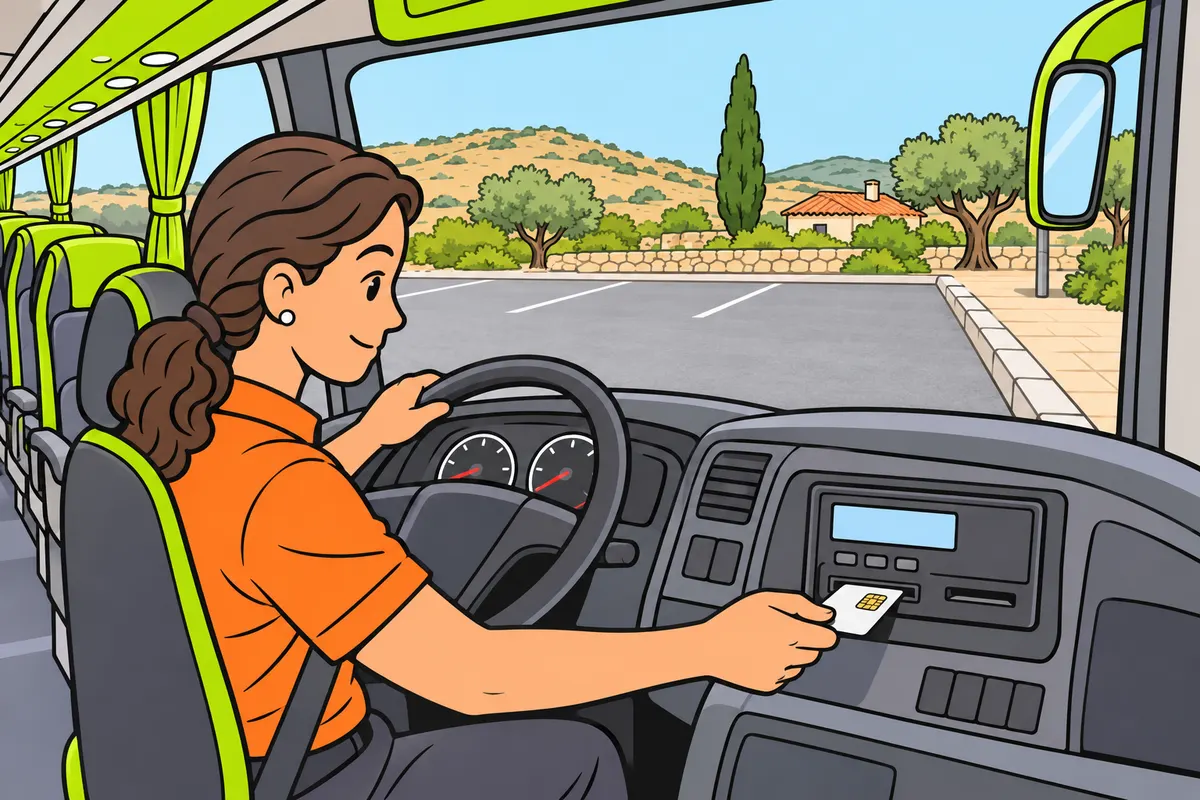
1What it records and what it is for
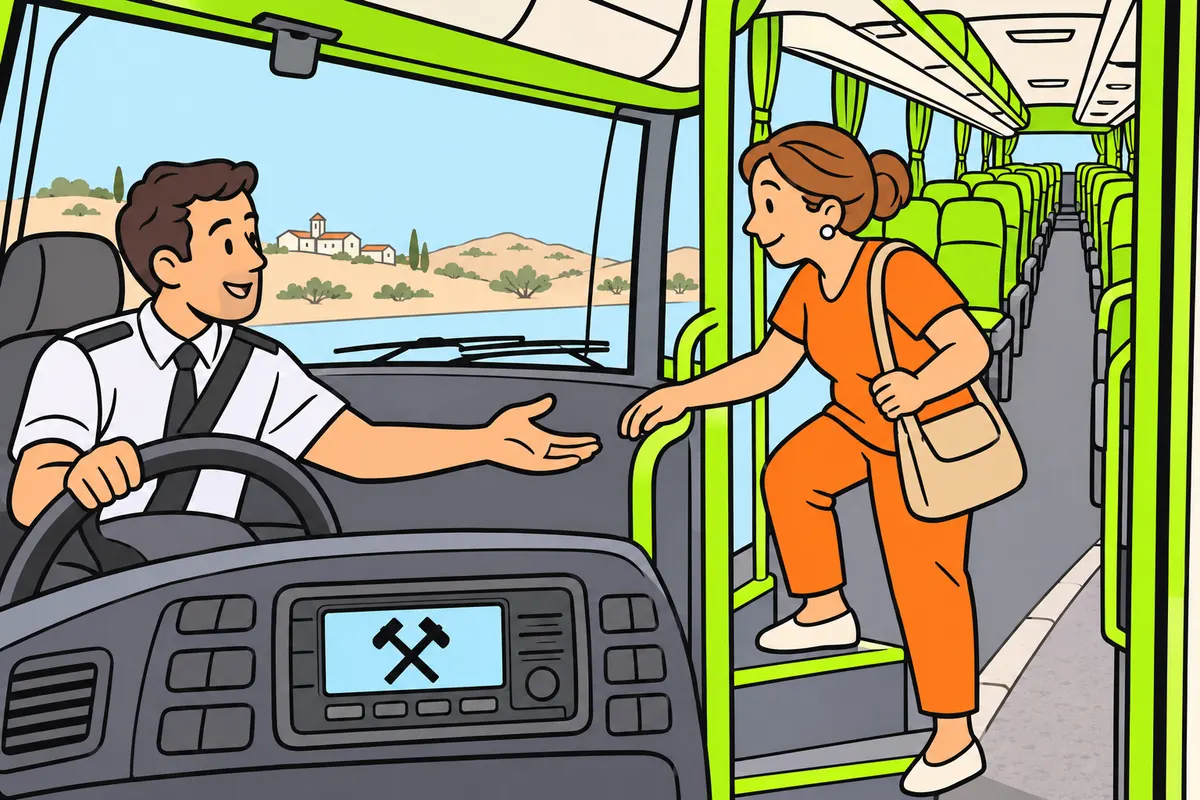
You use the tachograph to record bus movements and your activities.
Remember
- You record distance, speed and what you do during the service.
- You distinguish driving, other work, availability and rest.
- Helping passengers can be work even when you are parked.
- You must respect the limits and select your actual activity.
Exam trap: Wrong: the tachograph stops you driving further. Right: it records activities; you must respect the limits.
Read the full explanation
- The tachograph is a recording device: it displays, records, prints and stores data about the movement of your bus and your activities. Its records allow compliance with social legislation in road transport to be checked and establish what you have done during your service. [Regulation 165/2014, arts. 2 and 4](https://www.boe.es/buscar/doc.php?id=DOUE-L-2014-80362).
- The device records distance and speed and distinguishes between driving, other work, availability, and breaks or rest periods. In a coach, time spent attending to passengers can also count as your work even while the vehicle remains parked. [Regulation 165/2014, arts. 4 and 34](https://www.boe.es/buscar/doc.php?id=DOUE-L-2014-80362).
- You cannot regard the tachograph as a speed limiter or a device that physically prevents you from continuing to drive. Even when the device records correctly and displays warnings, you must observe the limits and select your actual activity. How to calculate the permitted times is covered in the “Driving times and rest periods” module. [Regulation 165/2014, arts. 4 and 32](https://www.boe.es/buscar/doc.php?id=DOUE-L-2014-80362).
2When your bus requires a tachograph
You need a tachograph according to your bus capacity and the service you operate.
Remember
- You count vehicle capacity, even when you carry few passengers.
- You must also record empty journeys linked to the service.
- If exempt and regulated work alternate, account for the relevant periods.
- You record commercial driving outside these rules as other work.
Exam trap: Wrong: you decide by bus weight. Right: check capacity and whether your service falls within the rules.
Read the full explanation
- You must use a tachograph for transport operations within its scope. For passenger transport, the general criterion is vehicles constructed or permanently adapted to carry more than nine people, including you as the driver, and intended for that purpose; this means more than eight passengers in addition to you. [Regulation 561/2006, art. 2.1.b](https://www.boe.es/buscar/doc.php?id=DOUE-L-2006-80632). [Regulation 165/2014, art. 3](https://www.boe.es/buscar/doc.php?id=DOUE-L-2014-80362).
- For passenger transport, the requirement depends on the stated capacity, regardless of the mass of the bus. Carrying only a few passengers or making an empty journey associated with the service does not exempt you either; the definition of carriage by road includes empty vehicles. [Regulation 561/2006, arts. 2 and 4.a](https://www.boe.es/buscar/doc.php?id=DOUE-L-2006-80632).
- Regulation 561/2006 applies to transport operations within the Union and between the Union, Switzerland and the countries of the European Economic Area; certain international operations outside that area are subject to the AETR. [Regulation 561/2006, art. 2](https://www.boe.es/buscar/doc.php?id=DOUE-L-2006-80632).
- If you alternate between exempt operations and operations within scope, account for the corresponding periods and record commercial driving outside the scope of the Regulation as other work. [Regulation 561/2006, art. 6.5](https://www.boe.es/buscar/doc.php?id=DOUE-L-2006-80632).
3Services and vehicles that may be exempt
You can claim an exemption only when you meet all its conditions.
| Case | What you must check |
|---|---|
| Regular passenger service | Whole route no longer than 50 km |
| Historic bus | Legally recognised status and non-commercial use |
| Licence or CAP courses | Specially equipped vehicle and all exemption conditions |
Remember
- You check the whole regular service route.
- Carrying tourists or schoolchildren does not itself exempt you.
- Private bus use does not automatically exempt you either.
- For the historic vehicle exception, you need legal recognition and non-commercial transport.
- Keep the tachograph installed and inspected if it supplies a compulsory speed limiter.
Exam trap: Wrong: your section under 50 km exempts a long route. Right: count the whole regular service route.
Read the full explanation
- If you drive a regular passenger service whose route does not exceed 50 km, that service is excluded from Regulation 561/2006 and from the requirement to use a tachograph under Regulation 165/2014. The relevant length is that of the entire route: driving only a short section of a longer route does not in itself qualify you for the exception. [Regulation 561/2006, art. 3.a](https://www.boe.es/buscar/doc.php?id=DOUE-L-2006-80632). [Regulation 165/2014, art. 3.1](https://www.boe.es/buscar/doc.php?id=DOUE-L-2014-80362).
- Exclusions apply to vehicles used in emergencies or rescue operations, specialised vehicles used for medical purposes, and vehicles of certain public bodies when used in their official functions and under their responsibility. Road tests for technical development, repair or maintenance, and new or rebuilt vehicles not yet put into service, are also excluded. [Regulation 561/2006, art. 3.c to g](https://www.boe.es/buscar/doc.php?id=DOUE-L-2006-80632).
- You can apply the Spanish exceptions under RD 640/2007 to official transport operations, driving instruction or courses to obtain a driving licence or CAP (Certificate of Professional Competence) using specially equipped vehicles, and certain services operated entirely within enclosed sites, such as airports. These exceptions require you to meet their specific conditions; carrying schoolchildren or tourists does not in itself create an exemption. [RD 640/2007, art. 2.a, l and n](https://www.boe.es/buscar/act.php?id=BOE-A-2007-10557#a2).
- Private use of the bus does not in itself constitute an exemption. The European exception for historic vehicles requires them to qualify as historic under the applicable legislation and to be used for non-commercial transport; the goods transport exception does not automatically extend to passenger transport. [Regulation 561/2006, art. 3.h and i](https://www.boe.es/buscar/doc.php?id=DOUE-L-2006-80632).
- Even if your service is exempt from using a tachograph, you must keep the tachograph installed and inspected when the vehicle is required to have a speed limiter and its speed signal comes from the tachograph. [RD 640/2007, art. 3](https://www.boe.es/buscar/act.php?id=BOE-A-2007-10557#a3).
4Analogue, digital and smart
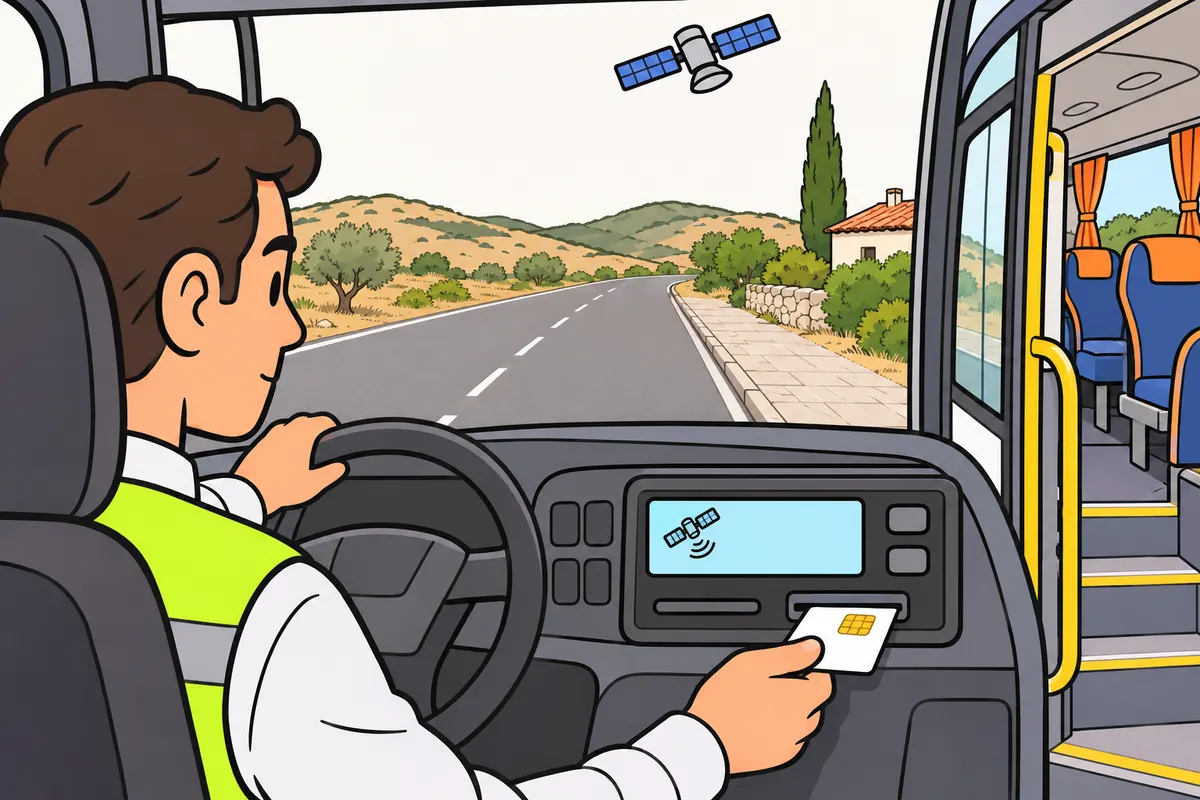
You must know your tachograph type and the functions you need to use.
| Equipment or bus requiring tachograph | What you use or remember |
|---|---|
| Analogue | Record chart |
| Digital | Personal card and vehicle memory |
| Smart version 2 | Automatically records border crossings |
| First registered from 21 August 2023 | Smart version 2 |
| Registered in one Member State, operating in another: analogue or old digital | Replace with smart version 2 by 31 December 2024 |
| Registered in one Member State, operating in another: smart version 1 | Smart version 2 required on 19 August 2025 |
Remember
- You use charts with analogue equipment and your card with digital equipment.
- Smart equipment adds satellite positioning and communication for checks.
- The position interval is not a break or a renewal of available time.
- Version 2 smart equipment records borders automatically; you still enter activities.
- Identify your coach as carrying passengers.
Exam trap: Wrong: every digital tachograph automatically records borders. Right: recognise this function in smart version 2.
Read the full explanation
- With an analogue tachograph, you use record sheets, known as tachograph charts, on which your activities are traced. With a digital tachograph, you use your personal card, and information is stored electronically both on the card and in the vehicle unit, according to the functions of the device. [Regulation 165/2014, art. 2 and Annex I](https://www.boe.es/buscar/doc.php?id=DOUE-L-2014-80362).
- A smart tachograph is a digital tachograph with additional satellite positioning and communication functions for enforcement checks. Positioning covers the start and end of your daily working period and every three hours of accumulated driving. [Regulation 165/2014, arts. 8 and 9, as amended by Regulation 2020/1054, art. 2](https://boe.es/buscar/doc.php?id=DOUE-L-2020-81223).
- A version 2 smart tachograph automatically records border crossings; you remain responsible for entering your activities. It also includes functions relating to loading or unloading operations and the type of transport, goods or passengers; select passenger transport as the transport type for your coach. [Regulation 165/2014, art. 8, as amended by Regulation 2020/1054, art. 2.5](https://boe.es/buscar/doc.php?id=DOUE-L-2020-81223). [Regulation 2021/1228, Annex](https://www.boe.es/buscar/doc.php?id=DOUE-L-2021-81052).
- You must have a version 2 smart tachograph in a bus subject to this requirement and first registered on or after 21 August 2023. This version is also compulsory if the bus is registered in one Member State and operates in another Member State: the deadline for replacing an analogue or first-generation digital tachograph is 31 December 2024, and the requirement to replace a version 1 smart tachograph applies from 19 August 2025. [Regulation 165/2014, art. 3.4 and 4 bis, as amended by Regulation 2020/1054, art. 2.2](https://boe.es/buscar/doc.php?id=DOUE-L-2020-81223). [Regulation 2021/1228, art. 2](https://www.boe.es/buscar/doc.php?id=DOUE-L-2021-81052). [DGT, international bulletin 29, p. 1](https://www.dgt.es/export/sites/web-DGT/.galleries/downloads/conoce_la_dgt/que-hacemos/boletin-internacional/internacional/BOLETIN-INTERNACIONAL-N29-ES.pdf).
5Tachograph chart: selection and care
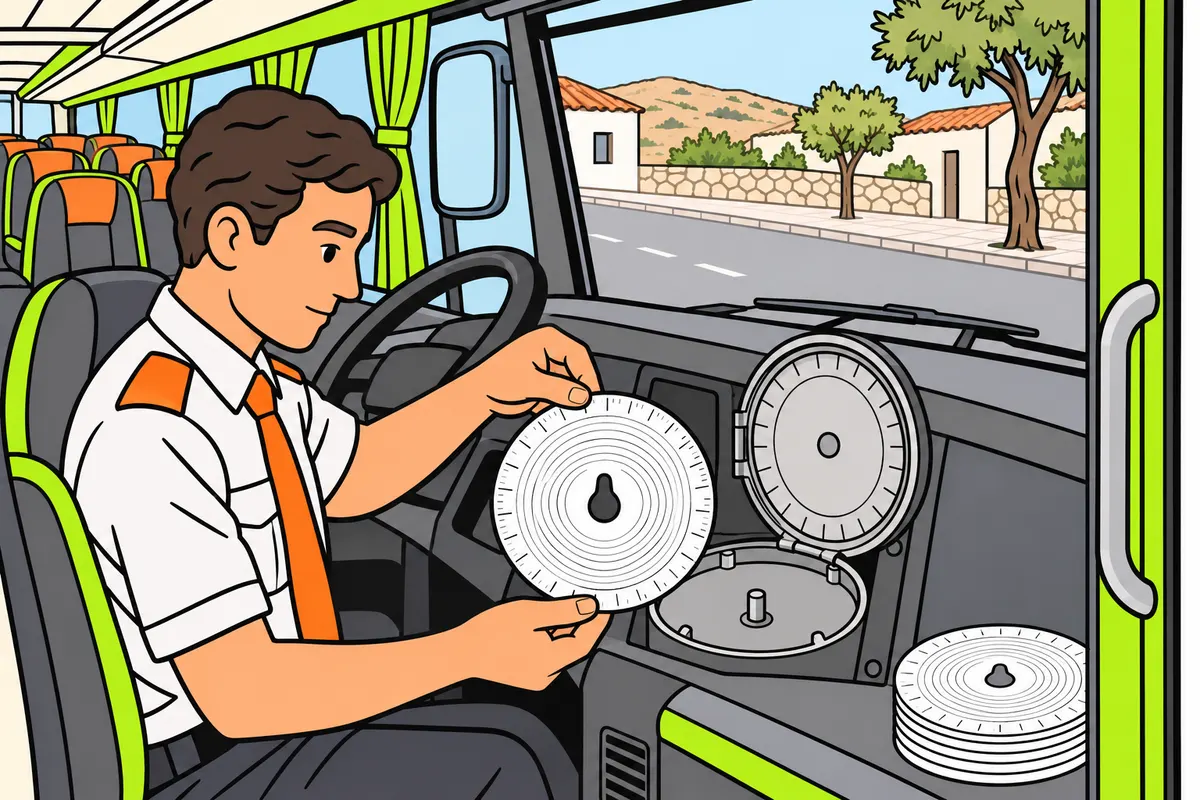
You must use a compatible chart and keep its records readable.
Remember
- You choose an approved sheet for that tachograph model.
- You carry enough sheets, including spares for damaged sheets.
- Do not use a chart beyond its intended period.
- If a chart is damaged, keep it with its replacement.
- You align the chart with official time in the vehicle’s registration country.
Exam trap: Wrong: you must always change charts at midnight. Right: respect the intended period and prevent overlapping traces.
Read the full explanation
- The record sheet must be type-approved and compatible with the model of analogue tachograph in your bus. Your company must give you enough sheets for the service, including those needed to replace sheets that are damaged or retained during a check. [Regulation 165/2014, arts. 17 and 33.1](https://www.boe.es/buscar/doc.php?id=DOUE-L-2014-80362).
- Record sheets have a minimum recording capacity of 24 hours, and you cannot use an ordinary 24-hour chart beyond its intended period. Prevent a further rotation from overlapping the traces and making them unreadable; a change of calendar date does not automatically invalidate a recording started the previous afternoon. [Regulation 165/2014, art. 34.1 and Annex I, IV.a](https://www.boe.es/buscar/doc.php?id=DOUE-L-2014-80362).
- Keep the sheet and its traces clean and legible. If a sheet containing records is damaged, you must keep it together with the spare sheet you use to replace it. [Regulation 165/2014, arts. 34.2 and 35.1](https://www.boe.es/buscar/doc.php?id=DOUE-L-2014-80362).
- Set the time marking on the chart to the official time of the country where your bus is registered. Check the reference before recording: a sheet with correctly completed details in its centre can show incorrect times if it is positioned incorrectly in relation to the scale on the device. [Regulation 165/2014, art. 34.5.a](https://www.boe.es/buscar/doc.php?id=DOUE-L-2014-80362).
6Details you must write on the chart
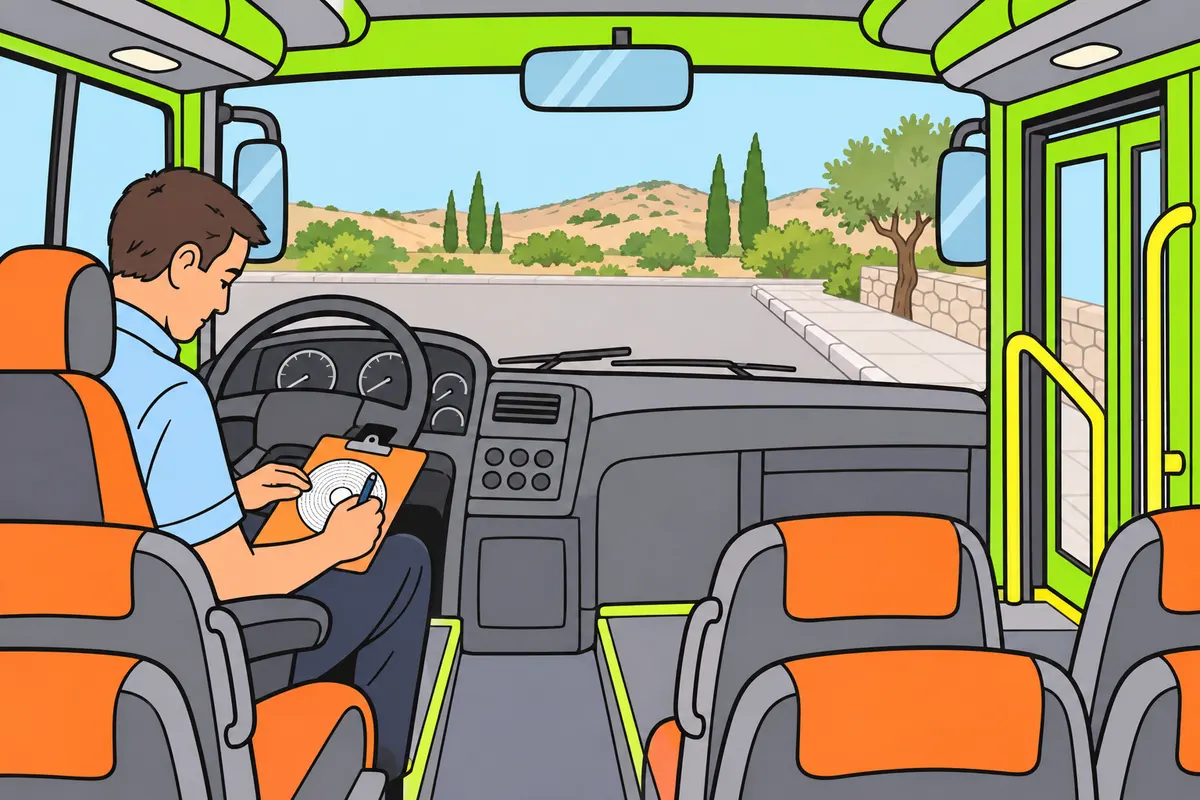
You must identify yourself and complete chart details throughout your working day.
| When | What you enter on the chart |
|---|---|
| Start | Full name, date, place, registration and starting odometer reading |
| Finish | Date, place and final odometer reading |
| Bus change | Next registration, change time and both vehicles’ odometer readings |
Remember
- You enter your full name, registration, starting date, place and odometer reading.
- When finishing, add the date, place and final odometer reading.
- The chart place and country symbol are separate details.
- When changing buses, record the change time and both odometer readings.
- Away from the vehicle, enter actual activities when you cannot use the equipment.
Exam trap: Wrong: every gap without driving is rest. Right: enter the work, availability or rest you actually had.
Read the full explanation
- When you start a sheet, write your first name and surname, the start date and place, the registration number of your bus and the initial odometer reading. [Regulation 165/2014, art. 34.6.a to d](https://www.boe.es/buscar/doc.php?id=DOUE-L-2014-80362).
- When you finish, add the end date and place and the final odometer reading. The specific place entered on the chart and the country symbol are separate details; entering countries is explained in “Starting your working period”. [Regulation 165/2014, art. 34.6](https://www.boe.es/buscar/doc.php?id=DOUE-L-2014-80362). [Regulation 2020/1054, art. 2.11.c](https://boe.es/buscar/doc.php?id=DOUE-L-2020-81223).
- If you change buses during the day, record the registration number of the next vehicle, the time of the change and the odometer readings of both vehicles. Check that the sheet is compatible with the next device; you must document the vehicle change without obscuring the activity in the first vehicle. [Regulation 165/2014, art. 34.6.c to e](https://www.boe.es/buscar/doc.php?id=DOUE-L-2014-80362).
- When you are away from the vehicle and cannot use the device, enter other work, availability, and breaks or rest periods legibly on the sheet using the permitted procedures. [Regulation 165/2014, art. 34.3](https://www.boe.es/buscar/doc.php?id=DOUE-L-2014-80362).
7The four cards and their colours
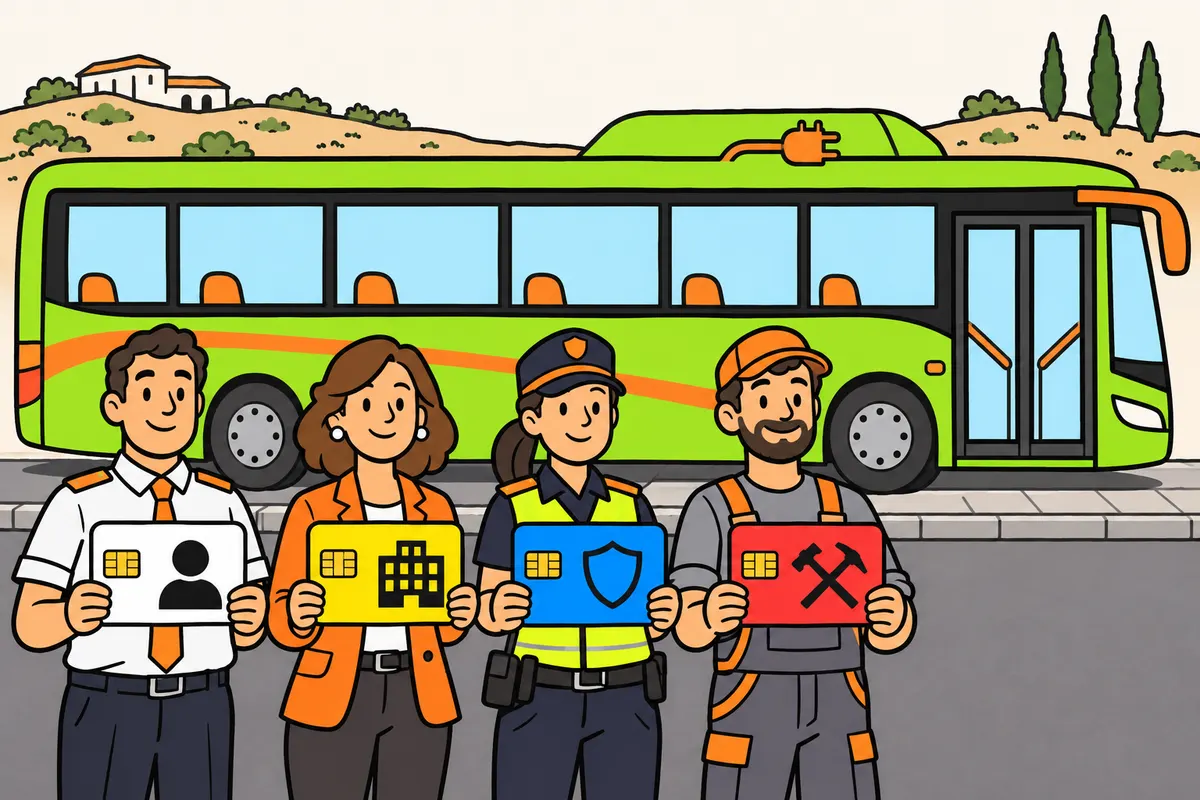
You must recognise each card by its colour and purpose.
| Card | Colour | Purpose |
|---|---|---|
| Driver | Mainly white | Identifies you and stores your activities |
| Company | Yellow | Accesses company data and manages access locks |
| Control | Blue | Allows officers to check records |
| Workshop or test centre | Red | Allows authorised technical functions |
Remember
- You use your driver card to drive with a digital tachograph.
- Your card does not replace your category D licence or CAP.
- A company card does not replace your personal card.
Exam trap: Wrong: the control card is green. Right: its prescribed colour is blue.
Read the full explanation
- The driver card has a predominantly white background. It identifies you and allows your activities to be stored; you use it to drive a bus with a digital tachograph. It does not replace your D licence or CAP (Certificate of Professional Competence): each document certifies a different qualification. [Order FOM/1190/2005, art. 2](https://www.boe.es/buscar/act.php?id=BOE-A-2005-7137#a2). [Regulation 2016/799, Annex IC, section 4.1, requirement 234](https://www.boe.es/buscar/doc.php?id=DOUE-L-2016-80895).
- The company card has a predominantly yellow background. It identifies the company that owns or leases the vehicle and allows it to view, transfer and print its data, as well as manage company access locks. [Order FOM/1190/2005, art. 2](https://www.boe.es/buscar/act.php?id=BOE-A-2005-7137#a2). [Regulation 2016/799, Annex IC, sections 3 and 4.1](https://www.boe.es/buscar/doc.php?id=DOUE-L-2016-80895).
- The control card has a predominantly blue background. It identifies the enforcement officer and enforcement body and allows them to read, print or transfer information from the tachograph and cards. [Order FOM/1190/2005, art. 2](https://www.boe.es/buscar/act.php?id=BOE-A-2005-7137#a2). [Regulation 2016/799, Annex IC, section 4.1, requirement 234](https://www.boe.es/buscar/doc.php?id=DOUE-L-2016-80895).
- The workshop or test centre card has a predominantly red background. Authorised personnel use it for permitted technical functions, such as testing, activation, calibration and data transfer. [Order FOM/1190/2005, art. 2](https://www.boe.es/buscar/act.php?id=BOE-A-2005-7137#a2). [Regulation 2016/799, Annex IC, section 4.1, requirement 234](https://www.boe.es/buscar/doc.php?id=DOUE-L-2016-80895).
8Card ownership and validity
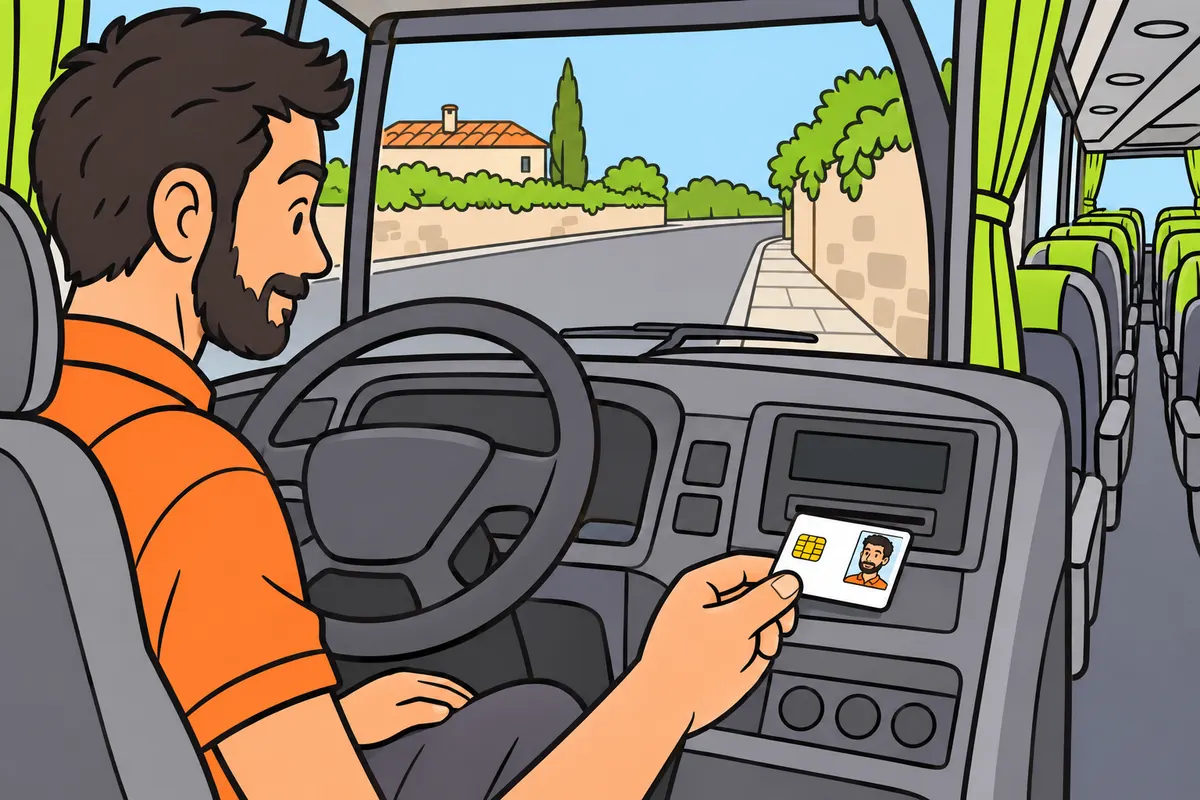
You must drive with your own valid card and renew it in time.
| Card in Spain | Validity |
|---|---|
| Driver | Five years |
| Company | Five years |
| Control | Five years |
| Workshop or test centre | One year |
Remember
- You hold only one valid driver card and use only your own.
- As a driver and business owner, you can hold cards for both roles.
- You apply for renewal before your card expires.
- Do not confuse validity with storage capacity or record retention time.
Exam trap: Wrong: an expired card lets you drive without one. Right: expiry does not qualify for the loss or fault exception.
Read the full explanation
- You may hold only one valid driver card and may use only your own. The authority of the Member State where you normally reside issues it, and Member States mutually recognise each other’s cards. [Regulation 165/2014, arts. 26, 27 and 30](https://www.boe.es/buscar/doc.php?id=DOUE-L-2014-80362).
- In Spain, your driver card is valid for five years; company and control cards for five years; and the workshop or test centre card for one year. The validity period does not indicate how much activity the card stores or how long you must keep the records. [Order FOM/1190/2005, arts. 5, 11, 16 and 21](https://www.boe.es/buscar/act.php?id=BOE-A-2005-7137). [Regulation 165/2014, arts. 25.1 and 26.6](https://www.boe.es/buscar/doc.php?id=DOUE-L-2014-80362).
- If you are both a driver and a business owner, you may hold your driver card and company cards. Your company may apply for as many as it needs, up to a maximum of 62. [Order FOM/1190/2005, arts. 3 and 10](https://www.boe.es/buscar/act.php?id=BOE-A-2005-7137).
- To renew your driver card, apply at least 15 working days before it expires, as required by the European Regulation. You must not drive using an expired card or treat its expiry as loss or malfunction that allows you to use the exceptional provisions for driving without a card. [Regulation 165/2014, arts. 27, 28 and 29](https://www.boe.es/buscar/doc.php?id=DOUE-L-2014-80362).
9Activities: recognise the four symbols
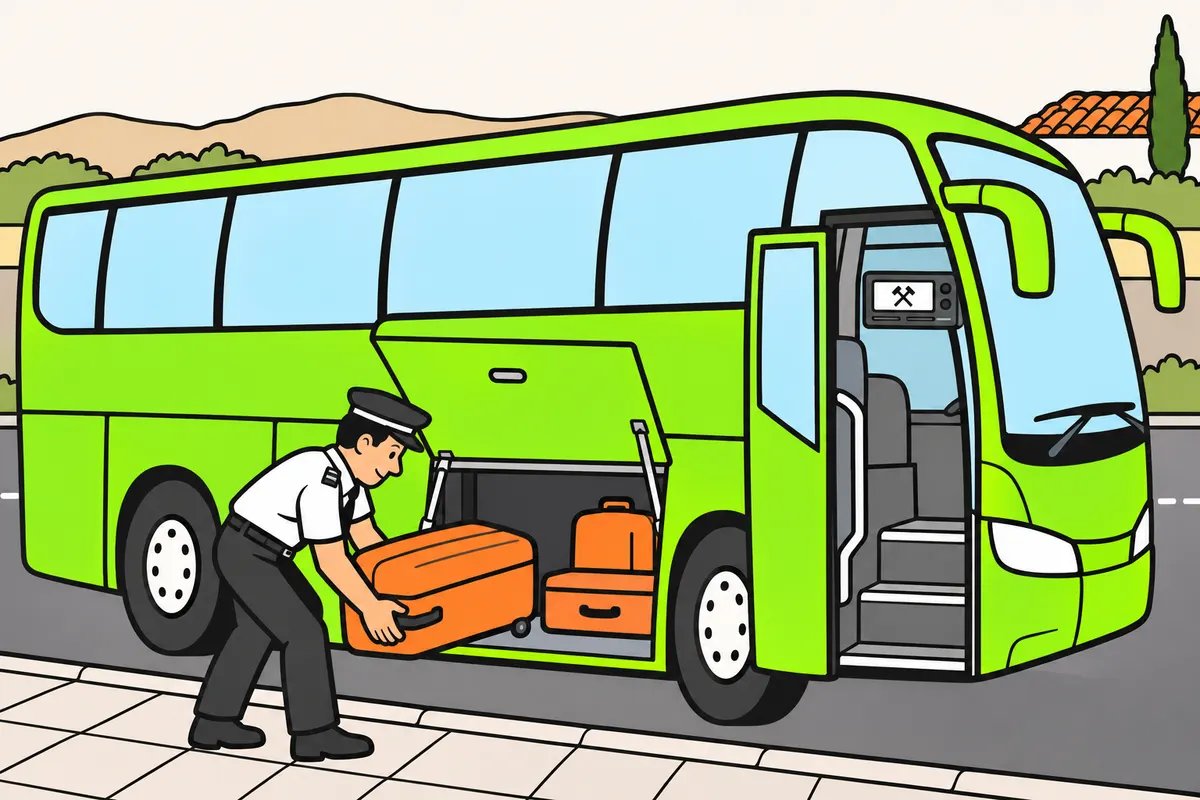
You must choose the symbol matching what you actually do.
| Symbol | Activity you recognise |
|---|---|
| Steering wheel | Driving |
| Crossed hammers | Other work |
| Square with diagonal line | Availability |
| Bed | Break, rest, annual leave or sick leave |
Remember
- You record helping passengers, cleaning and handling luggage as work.
- You include work for another employer, even outside transport.
- You check that your card is inserted.
- Being stationary does not mean you are resting.
- In multi-manning, beside the driver or on a bunk while moving, you record availability.
- In multi-manning, you can take a 45-minute moving break without helping the driver.
Exam trap: Wrong: you select rest while selling tickets. Right: select other work because you are working.
Read the full explanation
- The steering wheel represents driving. It covers the time you spend driving the bus; do not confuse it with your entire working day. [Regulation 165/2014, art. 34.5.b](https://www.boe.es/buscar/doc.php?id=DOUE-L-2014-80362).
- The crossed hammers represent other work. You use them for tasks such as checking the coach, cleaning, helping with luggage or assisting passengers when these tasks count as work. This also includes work for another employer, even in a sector other than transport. [Regulation 165/2014, art. 34.5.b.ii](https://www.boe.es/buscar/doc.php?id=DOUE-L-2014-80362).
- The square crossed by a diagonal represents availability. In multi-manning, the time you spend as the second driver sitting beside the driver or in a bunk while the vehicle is moving counts as availability, except for the 45-minute break in a moving vehicle under article 7 of Regulation 561/2006, which you may take if you do not assist the person driving (see “Driving times and rest periods”). [Regulation 165/2014, art. 34.5.b.iii](https://www.boe.es/buscar/doc.php?id=DOUE-L-2014-80362). [Regulation 2016/799, Annex IC, Appendix 3](https://www.boe.es/buscar/doc.php?id=DOUE-L-2016-80895). [Regulation 561/2006, art. 7, as amended by Regulation 2020/1054, art. 1.5](https://boe.es/buscar/doc.php?id=DOUE-L-2020-81223).
- The bed represents a break or rest, annual leave or sick leave. You study the conditions for a period to qualify as a break in “Driving times and rest periods”. [Regulation 165/2014, art. 34.5.b.iv, as amended by Regulation 2020/1054, art. 2.11.b](https://boe.es/buscar/doc.php?id=DOUE-L-2020-81223).
10Selector and special conditions
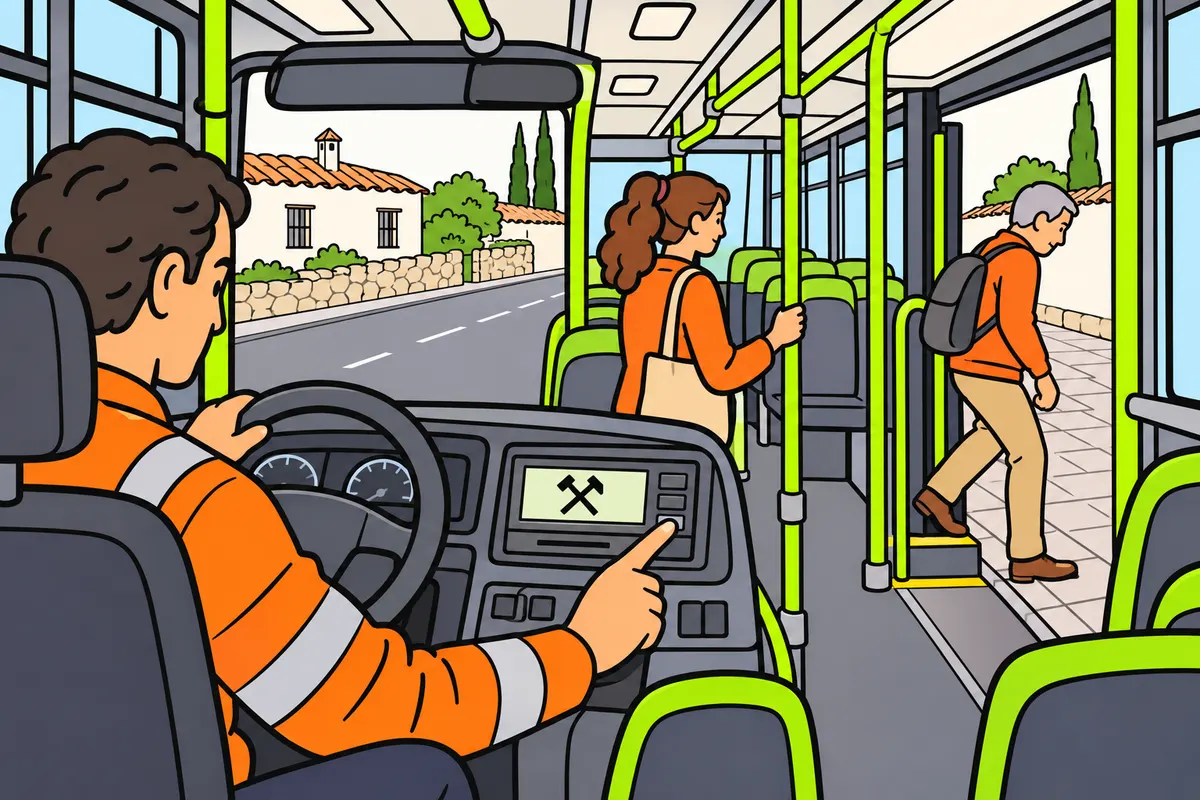
You must change the selector with your activity and justify special modes.
| Case | What you record |
|---|---|
| Helping passengers | Other work |
| Actual break | Break or rest |
| Service genuinely outside the rules | OUT; this does not mean rest |
| Legally qualifying rest on a ferry or train | Rest and ferry/train condition |
Remember
- When you stop, check which activity the equipment records.
- If you help passengers get off, select other work.
- Use OUT only for a service genuinely outside the rules.
- For qualifying rest on a ferry or train, also select the ferry/train condition.
- The operating mode does not remove your need for manual entries.
Exam trap: Wrong: OUT creates an exemption. Right: use it only for a service genuinely outside the rules. Keep commercial driving outside the rules recorded as other work if you later operate a regulated service.
Read the full explanation
- The selector must reflect the nature of your activity. After stopping to help passengers get off, check that “other work” is selected; when you start an actual break, select break or rest. [Regulation 165/2014, arts. 32.2 and 34.5](https://www.boe.es/buscar/doc.php?id=DOUE-L-2014-80362).
- OUT indicates an out-of-scope operation; it does not count as rest or create an exemption. You may use it only when the service is actually excluded; if you drive commercially outside the scope and then carry out a service within scope, keep the record as other work. [Regulation 561/2006, art. 6.5](https://www.boe.es/buscar/doc.php?id=DOUE-L-2006-80632). [Regulation 2016/799, Annex IC, section 3.6](https://www.boe.es/buscar/doc.php?id=DOUE-L-2016-80895).
- If you take a rest on board a ferry or train under the legal conditions, add the ferry/train condition to the rest symbol. [Regulation 165/2014, art. 34.5.b.v, as amended by Regulation 2020/1054, art. 2.11.b](https://boe.es/buscar/doc.php?id=DOUE-L-2020-81223).
- The equipment’s operating modes are operational, control, calibration and company. These modes depend on the cards and functions used. [Regulation 2016/799, Annex IC, section 2.3](https://www.boe.es/buscar/doc.php?id=DOUE-L-2016-80895).
11Manual entries without gaps
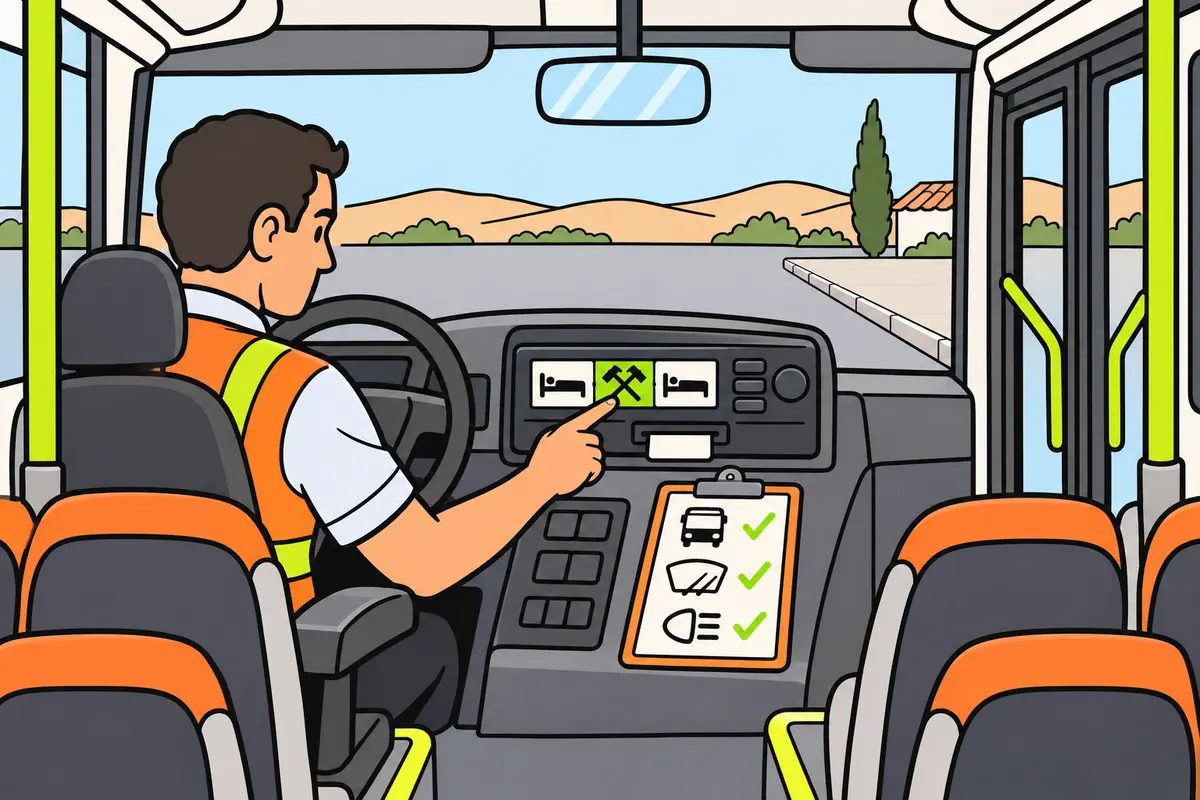
You must manually complete activities that were not recorded.
Remember
- When inserting your card, complete the time since you last removed it.
- You enter bus preparation as work.
- Check dates, times and activity order before confirming.
- On smart equipment, distinguish local entry time from UTC storage time.
- You record annual leave and sick leave with the break or rest symbol.
- Do not routinely replace manual entries with company certificates.
Exam trap: Wrong: you accept rest for all time away from the vehicle. Right: record what you actually did.
Read the full explanation
- When you insert your card, fill in any unrecorded periods since you last removed it: other work, availability, breaks and rest. For example, if you carry out preparatory tasks before boarding the bus, enter them as other work. [Regulation 165/2014, art. 34.3](https://www.boe.es/buscar/doc.php?id=DOUE-L-2014-80362).
- Enter activities with the correct dates and times and review the sequence before confirming it. In smart tachographs, the manual entry function uses the local time of the configured time zone, while data storage is referenced to UTC; check which time reference the device displays to avoid shifting the times of your working day. [Regulation 2016/799, Annex IC, sections 3.3 and 3.6.2](https://www.boe.es/buscar/doc.php?id=DOUE-L-2016-80895).
- To fill in periods of annual leave and sick leave, use manual entry with the bed symbol explained in “Activities: recognise the four symbols”. [Regulation 165/2014, art. 34.3](https://www.boe.es/buscar/doc.php?id=DOUE-L-2014-80362). [Regulation 2020/1054, art. 2.11.b](https://boe.es/buscar/doc.php?id=DOUE-L-2020-81223).
- The Regulation prevents Member States from requiring you to provide documents proving your activities away from the vehicle and requires you to record those periods using the prescribed methods. Any special documents required to justify a different regulatory regime serve their own purpose. [Regulation 165/2014, art. 34.3](https://www.boe.es/buscar/doc.php?id=DOUE-L-2014-80362).
12Starting your working period
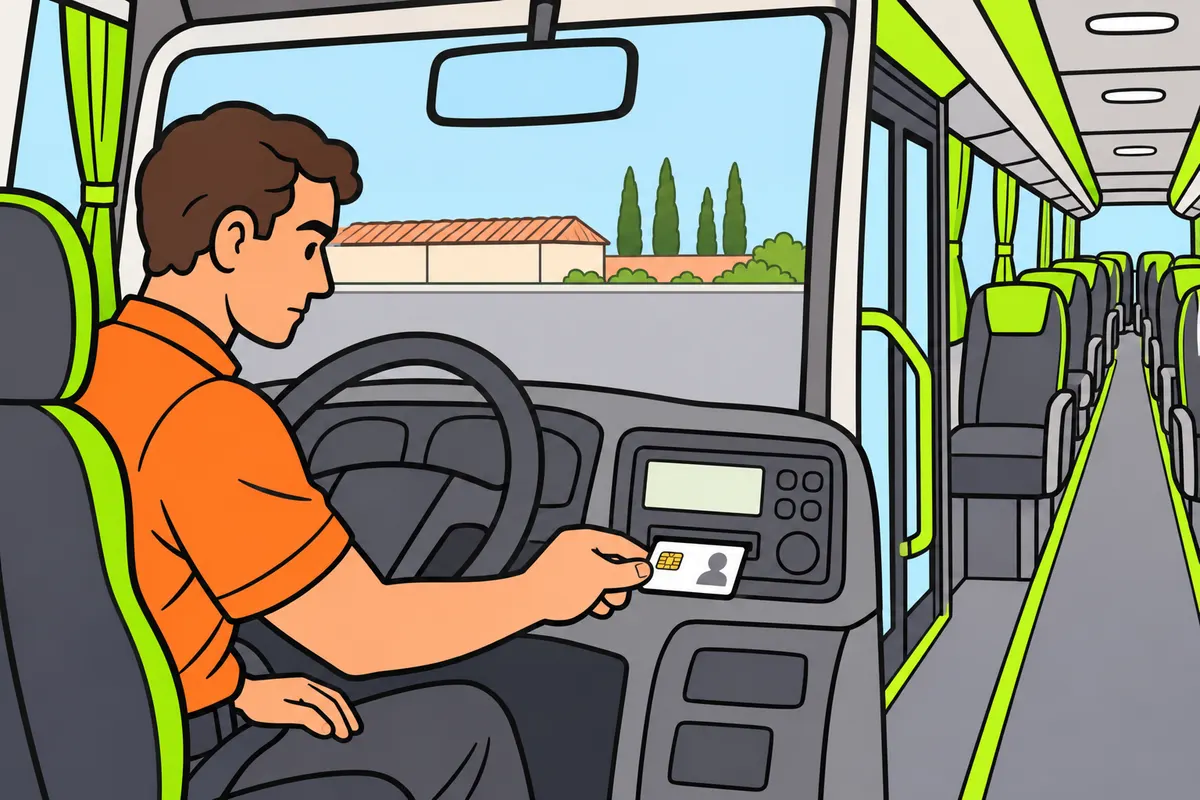
You must prepare your records before you start driving the bus.
Remember
- You use your sheet or card from when you take charge of the bus.
- You check your identification, equipment and required sheets or paper.
- Insert your card into the driving driver’s slot before moving the bus.
- You complete missing activities and location details requested by the equipment.
- In Spain, also select the autonomous community when the equipment requests it.
- Do not restart your history for each journey within the same working day.
Exam trap: Wrong: every digital unit removes country entries. Right: check whether automatic position recording allows you to omit them.
Read the full explanation
- Use your record sheet or card every day you drive, from the moment you take charge of the bus. Before moving it, check your identification, the equipment’s readings, the recording medium and, if the tachograph is digital, the ability to print. [Regulation 165/2014, arts. 33.1 and 34.1](https://www.boe.es/buscar/doc.php?id=DOUE-L-2014-80362).
- With a digital tachograph, insert your card into the slot for the person driving, complete any outstanding activity entries and record the country where your daily period begins whenever you are required to enter it. [Regulation 165/2014, art. 34.1, 3, 4 and 7](https://www.boe.es/buscar/doc.php?id=DOUE-L-2014-80362). [Regulation 2020/1054, art. 2.11](https://boe.es/buscar/doc.php?id=DOUE-L-2020-81223).
- If you make several journeys during the same working day, you must not artificially restart your record at each departure. The sequence must reflect the tasks, driving and waiting you actually do between services. [Regulation 165/2014, art. 34](https://www.boe.es/buscar/doc.php?id=DOUE-L-2014-80362).
- Enter the symbols for the countries where you start and finish, using the equipment’s functions. The exemption from making this entry applies only to equipment that automatically records location data in accordance with article 8 of the Regulation. [Regulation 165/2014, art. 34.7, as amended by Regulation 2020/1054, art. 2.11.d](https://boe.es/buscar/doc.php?id=DOUE-L-2020-81223).
- When the equipment requests geographical information in addition to the country, enter it; in Spain, the device also asks for the comunidad autónoma (autonomous community). The country and region are location data, distinct from your activity and identity. [Regulation 165/2014, art. 34.7, as amended by Regulation 2020/1054, art. 2.11.d](https://boe.es/buscar/doc.php?id=DOUE-L-2020-81223). [Regulation 2016/799, Annex IC, Appendix 1, sections 2.121 and 2.122](https://www.boe.es/buscar/doc.php?id=DOUE-L-2016-80895).
13Driver changes and changing buses
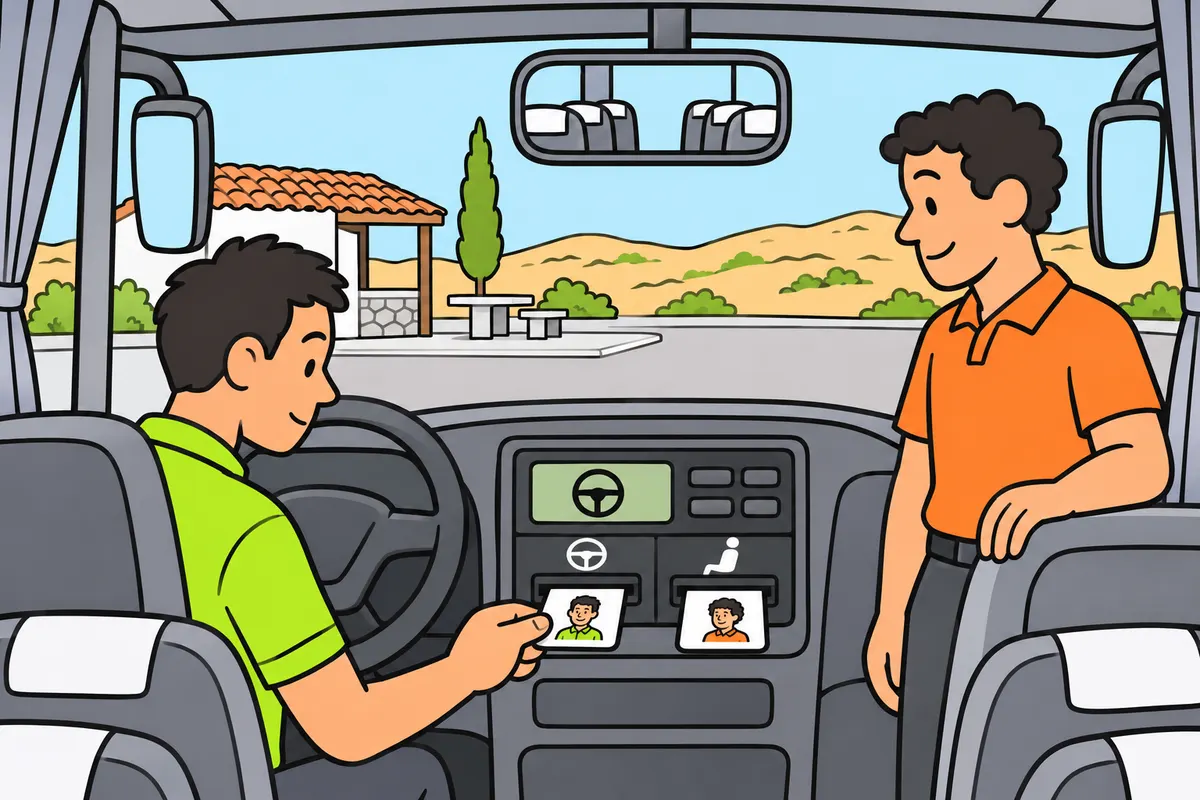
You must maintain your records when changing drivers or buses.
| Situation | What you do |
|---|---|
| Digital driver change | Position each card according to its holder’s role |
| Analogue driver change | Ensure driving appears on the actual driver’s sheet |
| Switching between analogue and digital | Carry your card, required sheets and printouts |
Remember
- Each driver uses their own card in the correct slot.
- When you swap driving duties, swap card positions to match.
- With analogue equipment, each driver needs their own sheet.
- When changing digital buses, you keep using your personal card.
- When switching equipment types, keep the required charts and printouts too.
Exam trap: Wrong: both cards can go in any order. Right: the slots must match who actually drives.
Read the full explanation
- If you travel as a two-driver crew, you must each insert your own card into the slot corresponding to your role. When you swap driving duties, swap the cards between the slots so that driving time is attributed to the person actually driving. [Regulation 165/2014, art. 34.4](https://www.boe.es/buscar/doc.php?id=DOUE-L-2014-80362).
- With an analogue tachograph, you must make the necessary changes so that driving information is recorded on the chart of the person at the wheel. [Regulation 165/2014, art. 34.4](https://www.boe.es/buscar/doc.php?id=DOUE-L-2014-80362).
- If you change coaches, maintain a continuous record of your activities and use your card in the next vehicle with a digital tachograph. If you alternate between analogue and digital tachographs, you must also carry the required charts and printouts: your card does not automatically include the traces on a chart you used in another bus. [Regulation 165/2014, arts. 34 and 36](https://www.boe.es/buscar/doc.php?id=DOUE-L-2014-80362). [Regulation 2020/1054, art. 2.12](https://boe.es/buscar/doc.php?id=DOUE-L-2020-81223).
14Border crossings
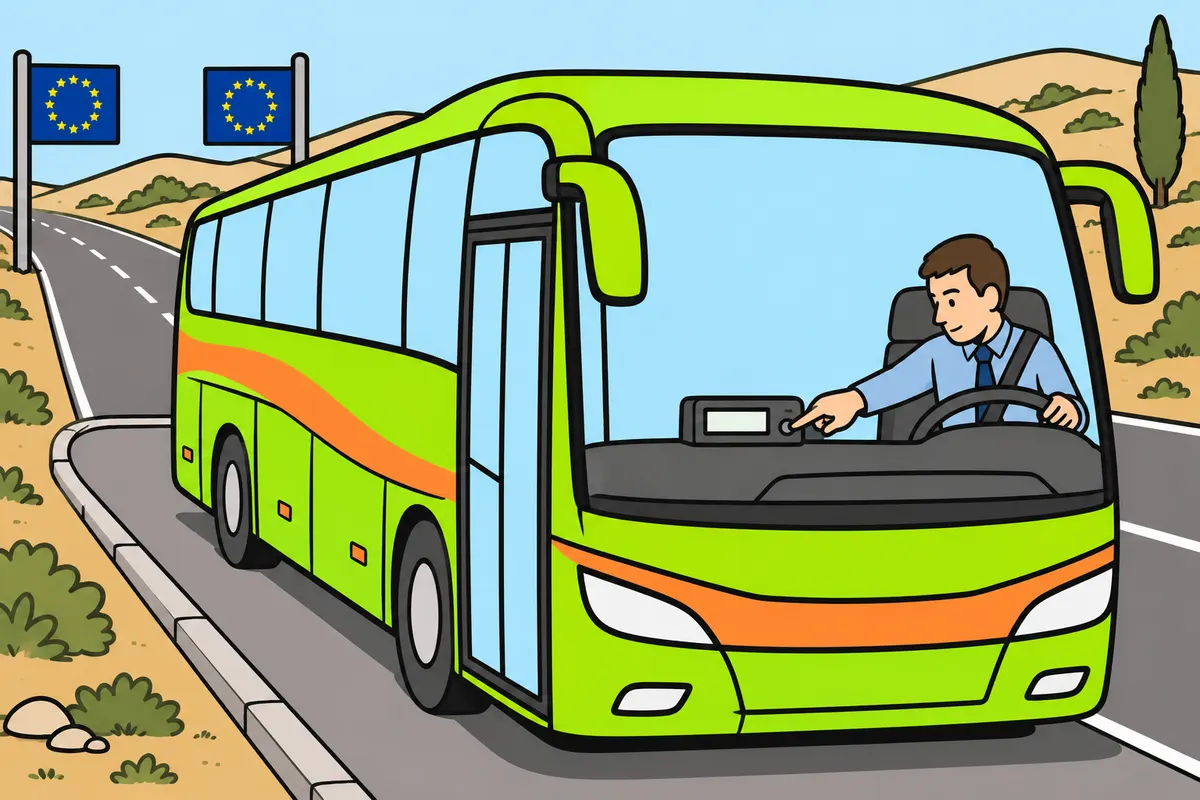
You must record the country after a border crossing unless your equipment records it automatically.
| Equipment | Member State border record |
|---|---|
| Analogue | Enter the country at the start of the first stop |
| Digital without automatic border recording | Enter the country at the start of the first stop |
| Smart version 2 | Automatically records the crossing |
Remember
- Enter the country when your first stop after crossing a Member State border begins.
- You stop at the nearest possible stopping place at or after the border.
- On a ferry or train, enter the arrival country when manual entry is required.
- The country entry does not reset your accumulated driving time.
- You keep your other activity records correct.
Exam trap: Wrong: entering the country starts a new working day. Right: it records the border without resetting accumulated driving.
Read the full explanation
- With an analogue tachograph, enter the symbol of the country you enter after crossing a Member State's border at the start of your first stop in that country. You must make this stop at the nearest possible stopping place at or after the border. [Regulation 165/2014, art. 34.6.f, as amended by Regulation 2020/1054, art. 2.11.c](https://boe.es/buscar/doc.php?id=DOUE-L-2020-81223).
- With a digital tachograph that does not automatically record the crossing, also enter the country you enter at the start of that first stop. On tachographs that use this function, you enter it as the place where the daily period begins: this entry documents the border crossing and does not erase or reset accumulated driving time. [Regulation 165/2014, art. 34.7, as amended by Regulation 2020/1054, art. 2.11.d](https://boe.es/buscar/doc.php?id=DOUE-L-2020-81223). [Regulation 2021/1228, annex, appendix 15, MIG_025](https://www.boe.es/buscar/doc.php?id=DOUE-L-2021-81052).
- If you cross on board a ferry or train, enter the country symbol at the port or station of arrival when a manual entry is required. [Regulation 165/2014, art. 34.6 and 7, as amended by Regulation 2020/1054, art. 2.11](https://boe.es/buscar/doc.php?id=DOUE-L-2020-81223).
- With a version 2 smart tachograph, the crossing is recorded automatically, with no manual border entry when the tachograph complies with article 8. [Regulation 165/2014, arts. 8 and 34.7, as amended by Regulation 2020/1054, art. 2](https://boe.es/buscar/doc.php?id=DOUE-L-2020-81223).
15End of the working day and removal
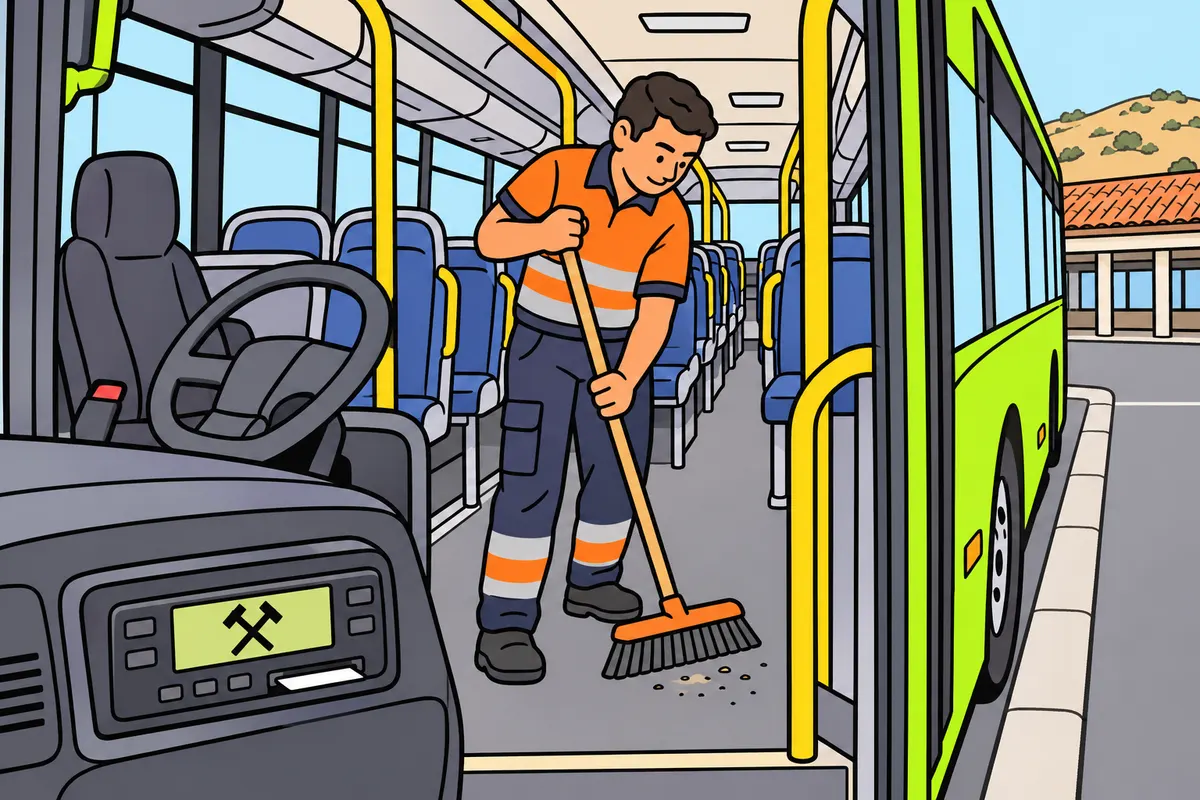
You must close your records correctly when your daily work ends.
Remember
- You record the finishing country when required, and your activity afterwards.
- If using a chart, complete its closing details.
- Helping passengers or preparing the bus remains work after driving ends.
- You keep your sheet, card and necessary supporting documents.
- When reinserting your card, complete the interval with your actual activities.
Exam trap: Wrong: you can remove your card whenever driving ends. Right: wait until the daily period ends, unless removal is authorised or needed to enter the country after a border crossing. When changing vehicles, transfer your sheet or card without gaps.
Read the full explanation
- At the end of your working period, correctly record the country where it ends when this entry is required, and your subsequent activity. With an analogue tachograph, you must complete the closing details on the chart. Your final duties towards passengers and preparing the bus form part of your work after the last driving period. [Regulation 165/2014, art. 34](https://www.boe.es/buscar/doc.php?id=DOUE-L-2014-80362). [Regulation 2020/1054, art. 2.11](https://boe.es/buscar/doc.php?id=DOUE-L-2020-81223).
- You must not remove the chart or card before the end of the daily period, unless removal is authorised or necessary to enter the country after crossing a border. When changing vehicles, you must transfer the chart or card; this does not allow you to drive for any period without a record or conceal tasks carried out in between. [Regulation 165/2014, art. 34.1, as amended by Regulation 2020/1054, art. 2.11.a](https://boe.es/buscar/doc.php?id=DOUE-L-2020-81223).
- You must keep the chart or card and the supporting documents needed for your next service. When you reinsert the card, fill in the period since its removal with the activities you actually carried out. [Regulation 165/2014, arts. 34 and 36](https://www.boe.es/buscar/doc.php?id=DOUE-L-2014-80362).
16Printouts and identification
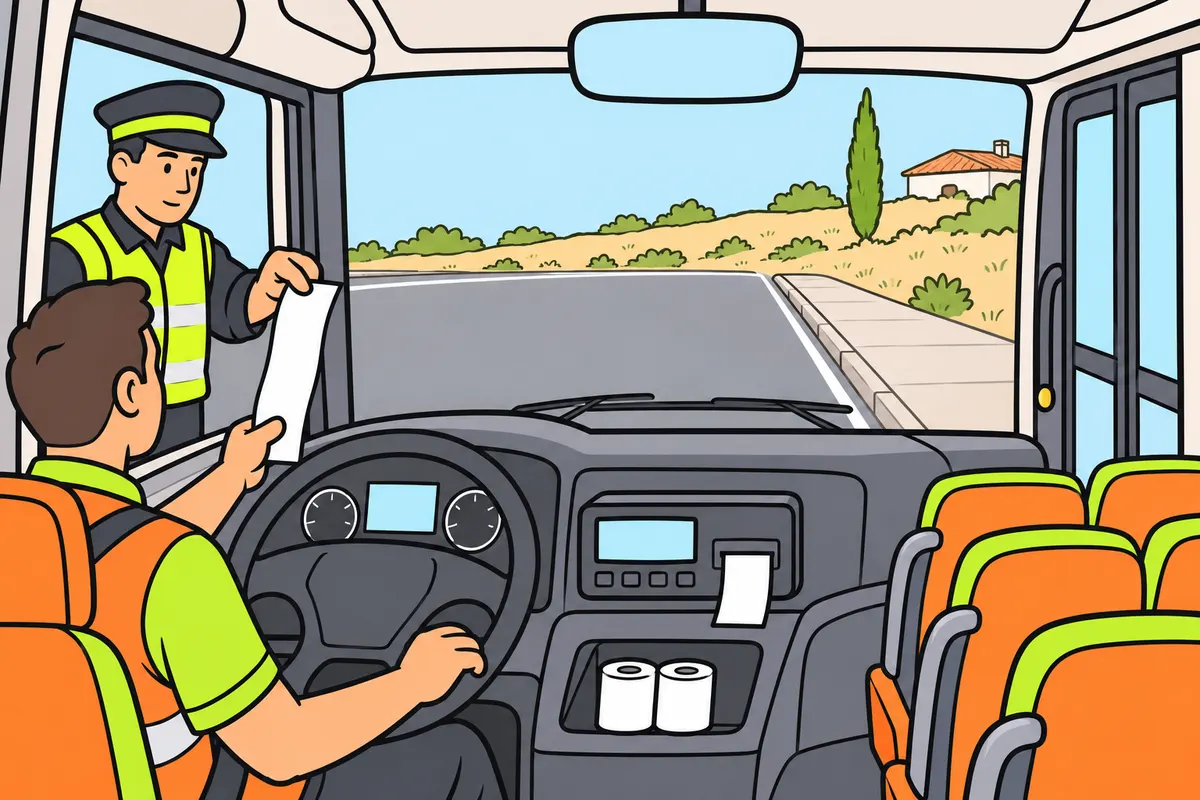
You must be able to print records and identify yourself on card incident printouts.
| Procedure | What you obtain |
|---|---|
| Printout | Paper document |
| Download | Electronic copy with digital signature |
Remember
- You carry enough suitable paper for the service.
- You obtain the printout requested by the officer.
- For card incidents, follow the full procedure in “Lost, stolen or faulty card”.
- You keep the printouts and your handwritten notes together.
- Check the UTC reference where applicable and keep the paper readable.
Exam trap: Wrong: printing replaces electronic storage. Right: the company must keep the required electronic records.
Read the full explanation
- When an enforcement officer requests a printout, produce it using the bus's tachograph; the company must provide you with enough suitable paper for the service. [Regulation 165/2014, art. 33.1](https://www.boe.es/buscar/doc.php?id=DOUE-L-2014-80362).
- A printout provides a paper document, while a download copies electronic data with its digital signature. You may need a printout because of an incident or a check, but it does not replace the electronic file the company must keep. [Order FOM/1190/2005, arts. 22, 23 and 24](https://www.boe.es/buscar/act.php?id=BOE-A-2005-7137).
- If a card problem requires printouts, follow the full procedure in «Lost, stolen or faulty card». Your handwritten identification allows the bus's record to be attributed to you when the tachograph cannot do this through your card; you must keep the printed data and its annotations together. [Regulation 165/2014, art. 35.2](https://www.boe.es/buscar/doc.php?id=DOUE-L-2014-80362).
- A printout shows its date, vehicle and personal identification details, and the activities and incidents it contains. Check the UTC time reference where applicable and keep the document legible; a photograph or an informal note does not automatically replace the document you must produce. [Regulation 2016/799, annex IC, appendix 4](https://www.boe.es/buscar/doc.php?id=DOUE-L-2016-80895). [Regulation 165/2014, art. 36](https://www.boe.es/buscar/doc.php?id=DOUE-L-2014-80362).
17What you must produce during a check
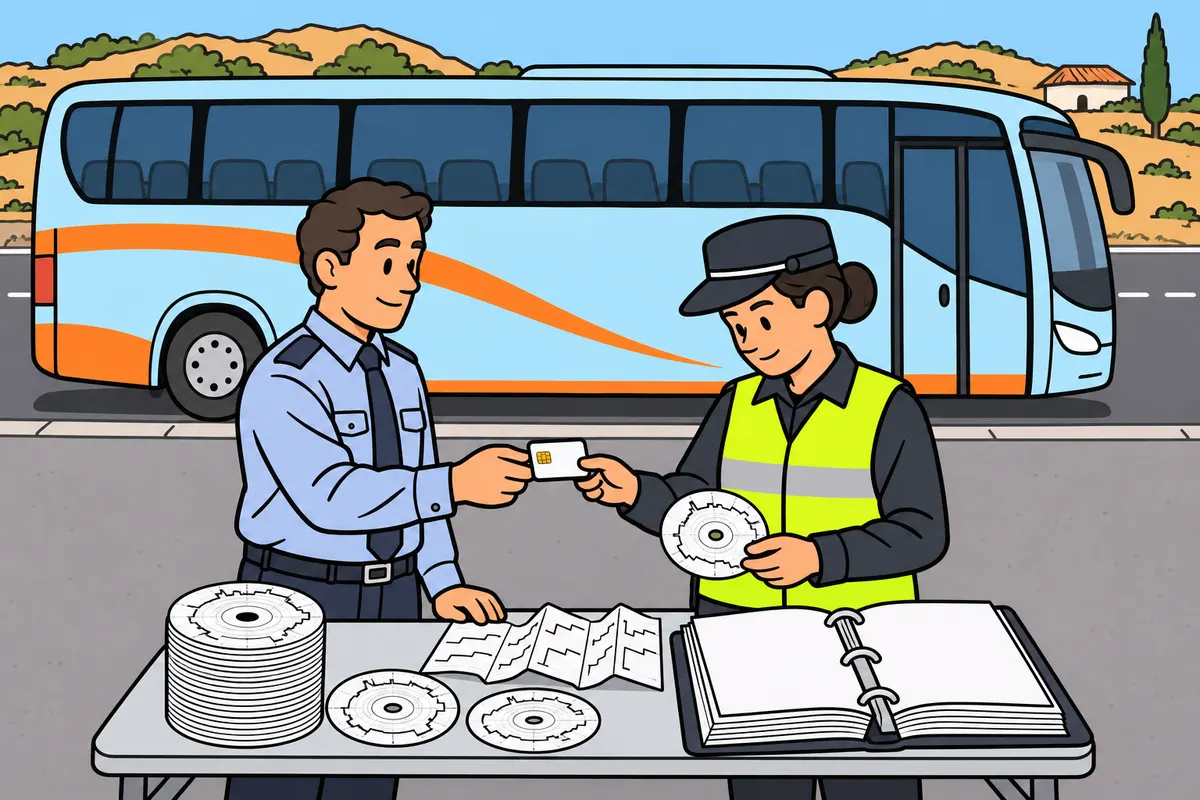
You must produce records for today and the required previous days.
| Equipment you use | What you produce for the required period |
|---|---|
| Analogue | Sheets, required manual records and printouts, and your card if you have one |
| Digital | Card, required manual records and printouts, and any analogue charts used |
Remember
- You also carry the current day’s records.
- You keep records even after changing vehicles or employers.
- Carry required analogue charts even if you drive a digital bus today.
- Do not assume your card always holds all required information.
- You help the officer carry out checks.
Exam trap: Wrong: records since your last download are enough. Right: produce today’s records and the previous 56 days through the prescribed means.
Read the full explanation
- You must be able to produce records for the current day and the previous 56 days. With an analogue tachograph, you must show the relevant charts, the required manual entries and printouts, and your driver card if you have one. This period covers your activities even if you use several vehicles or work for different companies. [Regulation 165/2014, art. 36.1, as amended by Regulation 2020/1054, art. 2.12](https://boe.es/buscar/doc.php?id=DOUE-L-2020-81223).
- With a digital tachograph, you must produce your card, the required manual records and printouts for the current day and the previous 56 days, and the charts for any days in that period when you drive with an analogue tachograph. [Regulation 165/2014, art. 36.2](https://www.boe.es/buscar/doc.php?id=DOUE-L-2014-80362). [Regulation 2020/1054, art. 2.12](https://boe.es/buscar/doc.php?id=DOUE-L-2020-81223).
- Ensure that the required information is available by the means prescribed by the regulations, taking into account the tachograph and card you use. The version 2 specifications increase the cards' capacity for recording driver activities. [Regulation 2021/1228, annex, introduction](https://www.boe.es/buscar/doc.php?id=DOUE-L-2021-81052). [Regulation 165/2014, art. 36](https://www.boe.es/buscar/doc.php?id=DOUE-L-2014-80362).
- Assist with checks: the officer may analyse charts, displayed, printed or transferred data, and other accepted documents. If there are reasonable grounds to suspect fraud, the officer may order tests at an authorised workshop; the absence of an alarm on the display does not prevent checks of the installation and calibration. [Regulation 165/2014, arts. 36.3 and 38](https://www.boe.es/buscar/doc.php?id=DOUE-L-2014-80362).
18Downloads: 28 days and 90 days
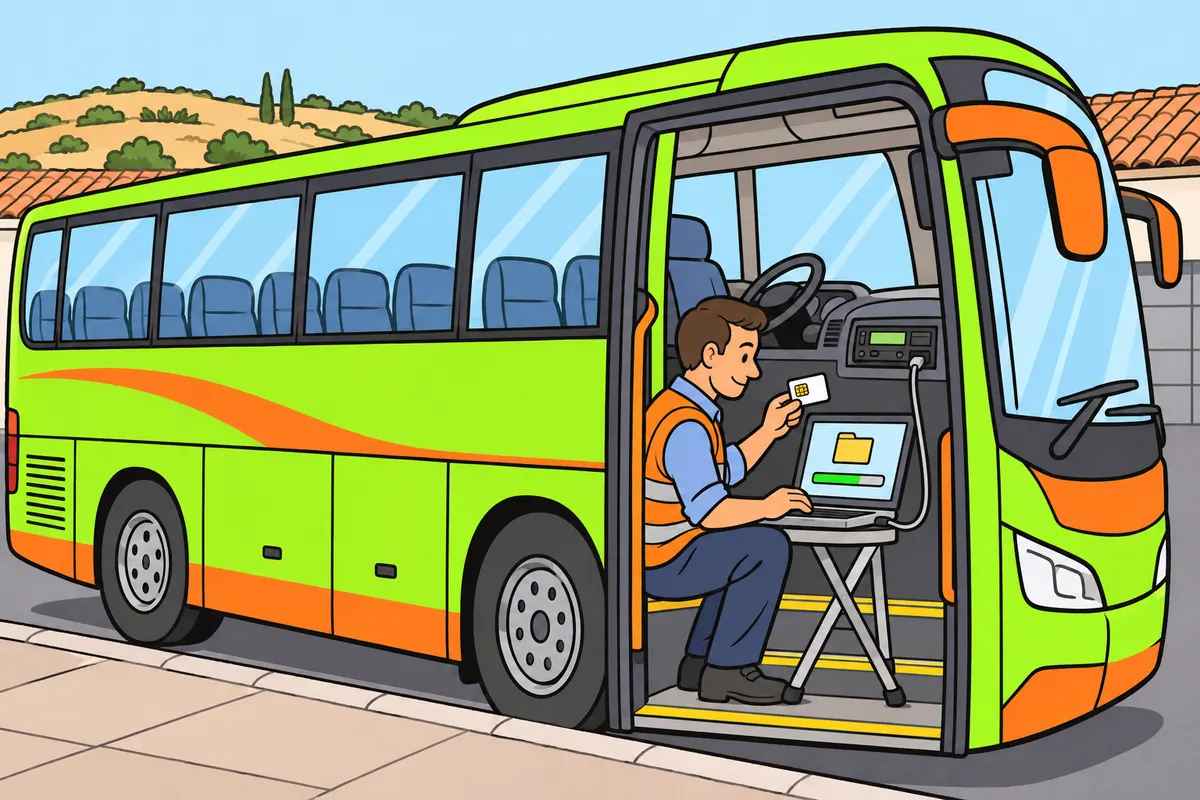
You must download data on time and earlier if it could be lost.
| Data source | Maximum download interval |
|---|---|
| Driver card | 28 days with recorded activity |
| Vehicle unit | 90 days with recorded activity |
Remember
- You count days with recorded activity.
- You download earlier if data recovery is at risk.
- You allow your card download when leaving the company or when it expires.
- You download before returning your card to the issuer, where required.
- You comply with download requests from the authorities.
- Downloading makes a copy; it does not erase or change your card.
Exam trap: Wrong: you can always wait until the maximum interval. Right: download earlier when required, including before transferring or handing over the vehicle or returning it to the lessor.
Read the full explanation
- The European maximum intervals between downloads of relevant data are 28 days for the driver card and 90 days for the vehicle unit. The calculation counts days with recorded activity, and the transfer must prevent data loss. [Regulation 581/2010, art. 1](https://www.boe.es/buscar/doc.php?id=DOUE-L-2010-81210).
- Downloads must take place sooner in the circumstances specified by Spanish regulations. Spanish regulations require a download from the vehicle unit before the vehicle is transferred, handed over or returned to the lessor, in the event of a fault if the data can still be retrieved, and when required by the authorities. [Order FOM/1190/2005, art. 24](https://www.boe.es/buscar/act.php?id=BOE-A-2005-7137#a24).
- Make your card available for downloading when you leave the company, when it expires, before returning it to the issuing authority where applicable, and when required by the authorities. Downloading does not erase or alter the card: it creates a copy of the data together with the digital signature that allows its authenticity to be checked. [Order FOM/1190/2005, arts. 22 and 24](https://www.boe.es/buscar/act.php?id=BOE-A-2005-7137).
19Storage and company duties
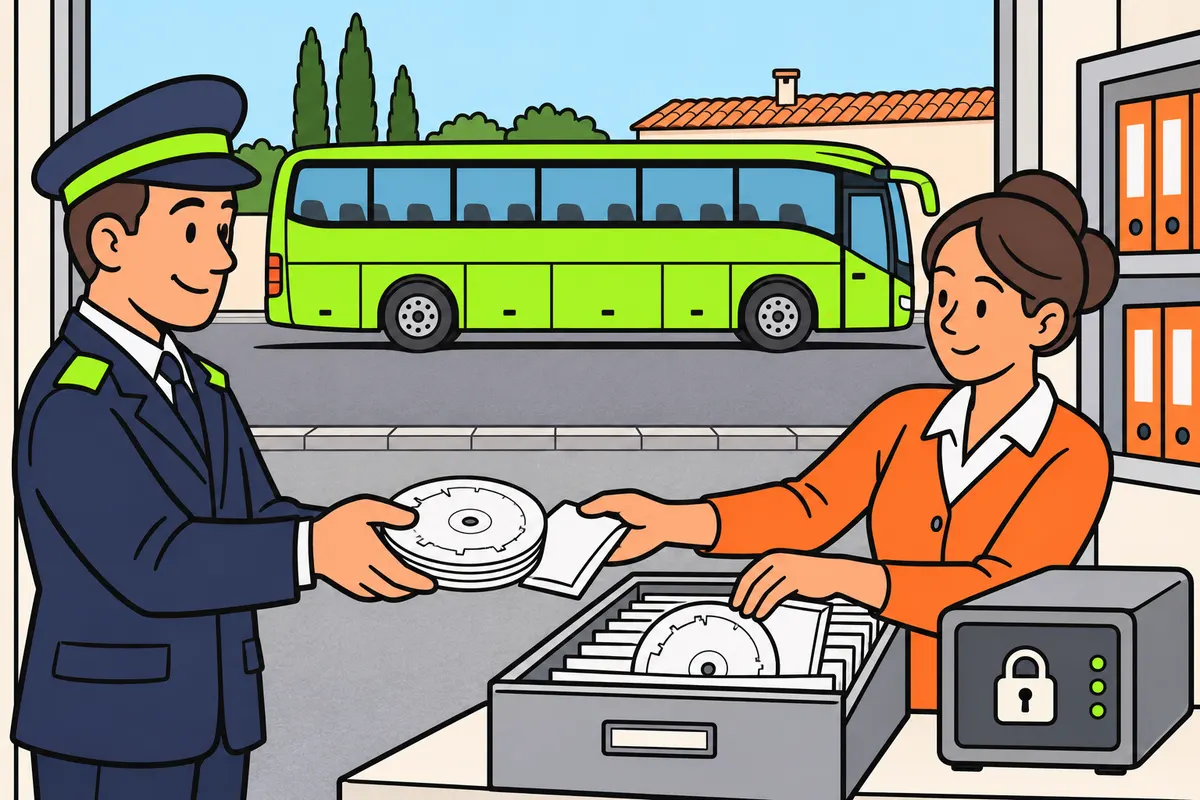
You must record correctly and help the company keep the data.
| Company records | Minimum retention |
|---|---|
| Sheets and required card incident printouts | One year after use |
| Necessary digital data | 365 days from recording; employment law duties also apply |
Remember
- The company must keep records ordered, readable and secure.
- You can request copies of your records.
- You allow valid downloads so the company can keep the required files.
- You must receive training on the equipment you use.
- The company must check use and provide enough sheets or paper.
- A company instruction does not allow you to record false data.
Exam trap: Wrong: a spreadsheet replaces digital files. Right: the company must keep the prescribed files.
Read the full explanation
- The company must keep the record sheets and printouts made under article 35 for at least one year after use, in chronological order and legible. If you request them, the company must give you copies of the sheets and printouts, as well as the data downloaded from your card and printed versions of that data. It must also make the records available to authorised enforcement officers. [Regulation 165/2014, art. 33.2](https://www.boe.es/buscar/doc.php?id=DOUE-L-2014-80362).
- In its digital archive, the company must keep the necessary data for at least 365 days from the date it is recorded, ensuring its security and accuracy, without prejudice to its obligations under employment law. You must provide a valid download; a list of hours entered into a spreadsheet does not replace the required files. [Order FOM/1190/2005, arts. 23, 24, 25 and 26](https://www.boe.es/buscar/act.php?id=BOE-A-2005-7137).
- The company must give you suitable training and instructions on the equipment you use. It must check its use regularly, provide recording materials and offer no incentives that encourage misuse. If a service involves changing coach and equipment model, you must know the necessary functions before you start recording. [Regulation 165/2014, art. 33.1](https://www.boe.es/buscar/doc.php?id=DOUE-L-2014-80362).
- The company has its own responsibilities, and you must use the equipment and your card correctly. The record must show what actually happens, even if it reveals that the service planning needs to be corrected. [Regulation 165/2014, arts. 32 and 33](https://www.boe.es/buscar/doc.php?id=DOUE-L-2014-80362).
20Lost, stolen or faulty card
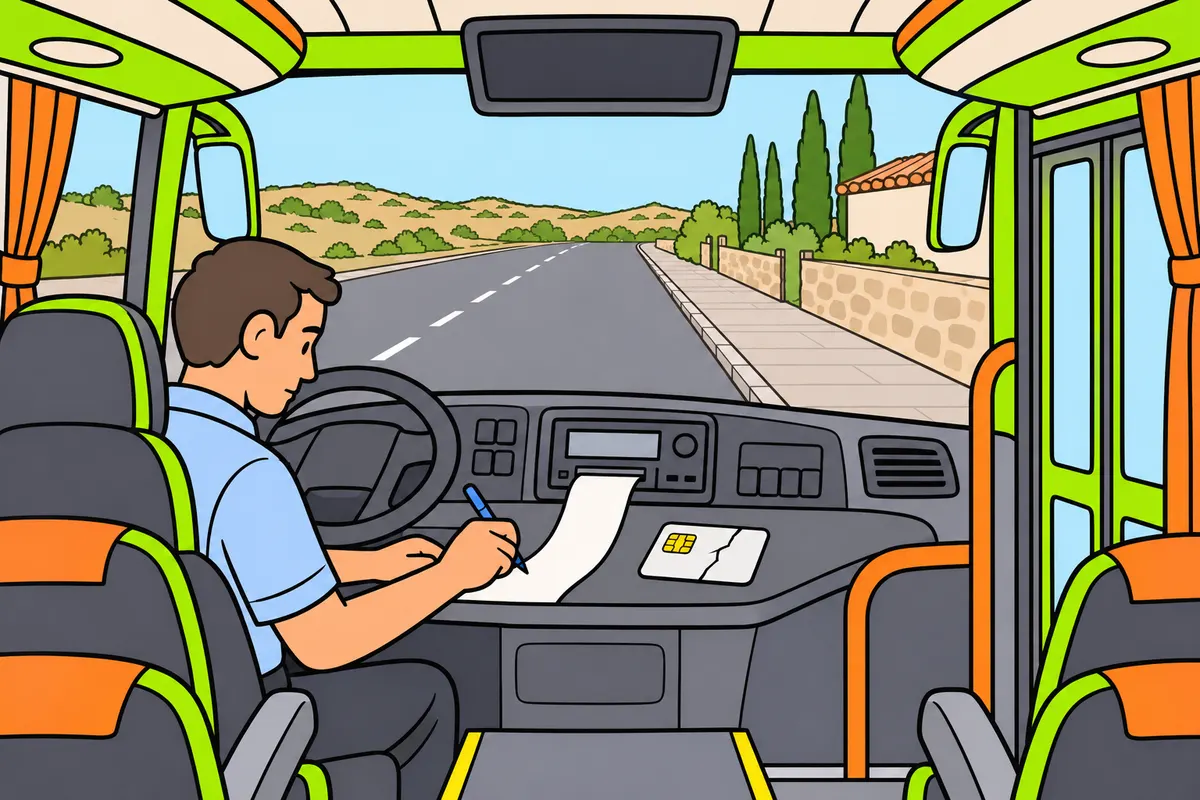
If your card is lost or faulty, report it, request replacement and record using printouts.
| Case | What you remember |
|---|---|
| Loss, theft, damage or malfunction | Exceptional driving without a card requires justification and printouts |
| More than fifteen calendar days needed | Only if necessary to return the vehicle to its premises |
| Forgotten, expired or first card application | You cannot use this exception |
Remember
- Return a damaged or faulty card to the authority where you normally live.
- You report theft in the country where it happened.
- Report loss to issuing and normal residence countries, if different.
- Print at journey start and end; identify yourself and sign both printouts.
- Complete any missing required activity periods.
- You must justify why you cannot produce or use your card.
Exam trap: Wrong: you can use the exception for a forgotten card. Right: it covers justified loss, theft, damage or malfunction. The maximum is fifteen calendar days, unless longer is necessary to return the vehicle to its premises.
Read the full explanation
- If your card is damaged or malfunctions, you must return it to the competent authority in your State of normal residence. If it is stolen, you must formally report the theft to the authorities in the State where it happens; if you lose it, you must notify the authorities in the issuing State and in your State of normal residence if they are different. [Regulation 165/2014, art. 29.2 and 3](https://www.boe.es/buscar/doc.php?id=DOUE-L-2014-80362).
- You must apply for a replacement following damage, malfunction, loss or theft within seven calendar days. The authority must provide another card within eight working days of receiving your detailed application. Your application deadline counts every calendar day; the issue deadline is expressed in working days. [Regulation 165/2014, art. 29.4](https://www.boe.es/buscar/doc.php?id=DOUE-L-2014-80362).
- In these cases, you may drive without a card for a maximum of fifteen calendar days, or longer if necessary to return the vehicle to its premises, provided you can justify why you cannot produce or use the card. [Regulation 165/2014, arts. 27 and 29.5](https://www.boe.es/buscar/doc.php?id=DOUE-L-2014-80362).
- At the start of the journey, you must print out the vehicle details, add your first name and surname, your card number or driving licence number and your signature, and enter the required periods of other work, availability and rest. At the end, you must print out the recorded activities and add any missing activities since the initial printout, again adding your identification details and signature. [Regulation 165/2014, art. 35.2](https://www.boe.es/buscar/doc.php?id=DOUE-L-2014-80362).
21Tachograph faults
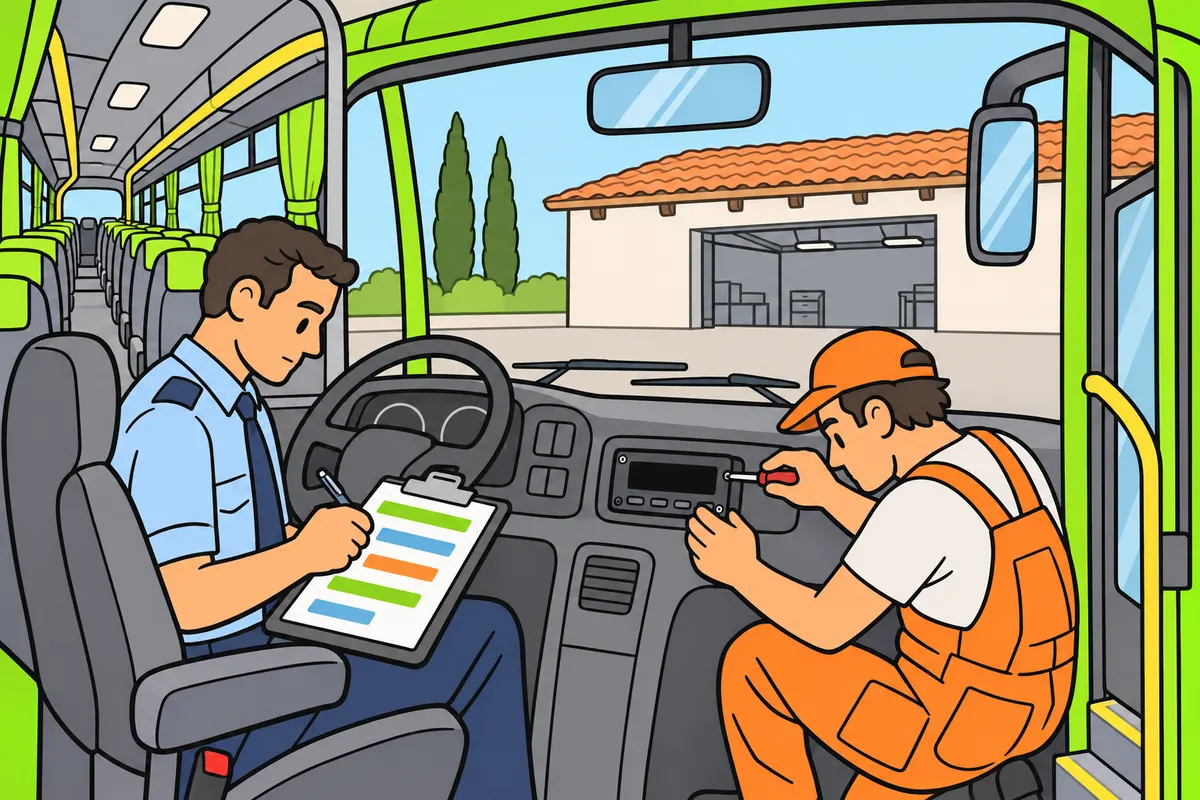
If your tachograph fails, record your activities and arrange authorised repair.
Remember
- You tell the company about the fault.
- The company must arrange repair as soon as possible at an authorised workshop.
- You record all periods the equipment fails to record or print correctly.
- You add your full name, card or licence number, and signature.
- You keep the temporary sheet with your record sheets or card.
- Distinguish equipment faults from card problems: you must follow different procedures.
Exam trap: Wrong: you can always delay repair for a week. Right: repair as soon as possible. If you cannot return to the company within one week of the fault or its discovery, arrange repair during the journey.
Read the full explanation
- If the tachograph fails, report the fault to the company and keep a record of your activities using the prescribed means. The company must have it repaired by an authorised fitter or workshop as soon as circumstances permit; a fault does not make your service an exempt activity. [Regulation 165/2014, art. 37](https://www.boe.es/buscar/doc.php?id=DOUE-L-2014-80362).
- If the bus cannot return to the company's premises within one week of the breakdown or the discovery of the malfunction, arrange for the repair to take place during the journey. [Regulation 165/2014, art. 37.1](https://www.boe.es/buscar/doc.php?id=DOUE-L-2014-80362).
- Enter your first name and surname, card number or driving licence number, signature and all periods that the equipment does not record or print correctly. You may do this on the record sheets or on a temporary sheet attached to them or kept with your card; you must keep the sequence of activities legible. [Regulation 165/2014, art. 37.2](https://www.boe.es/buscar/doc.php?id=DOUE-L-2014-80362).
- An equipment fault requires repair and temporary recording; a card problem requires the relevant notifications, replacement and printouts. [Regulation 165/2014, arts. 29, 35 and 37](https://www.boe.es/buscar/doc.php?id=DOUE-L-2014-80362).
22Inspection, calibration and seals
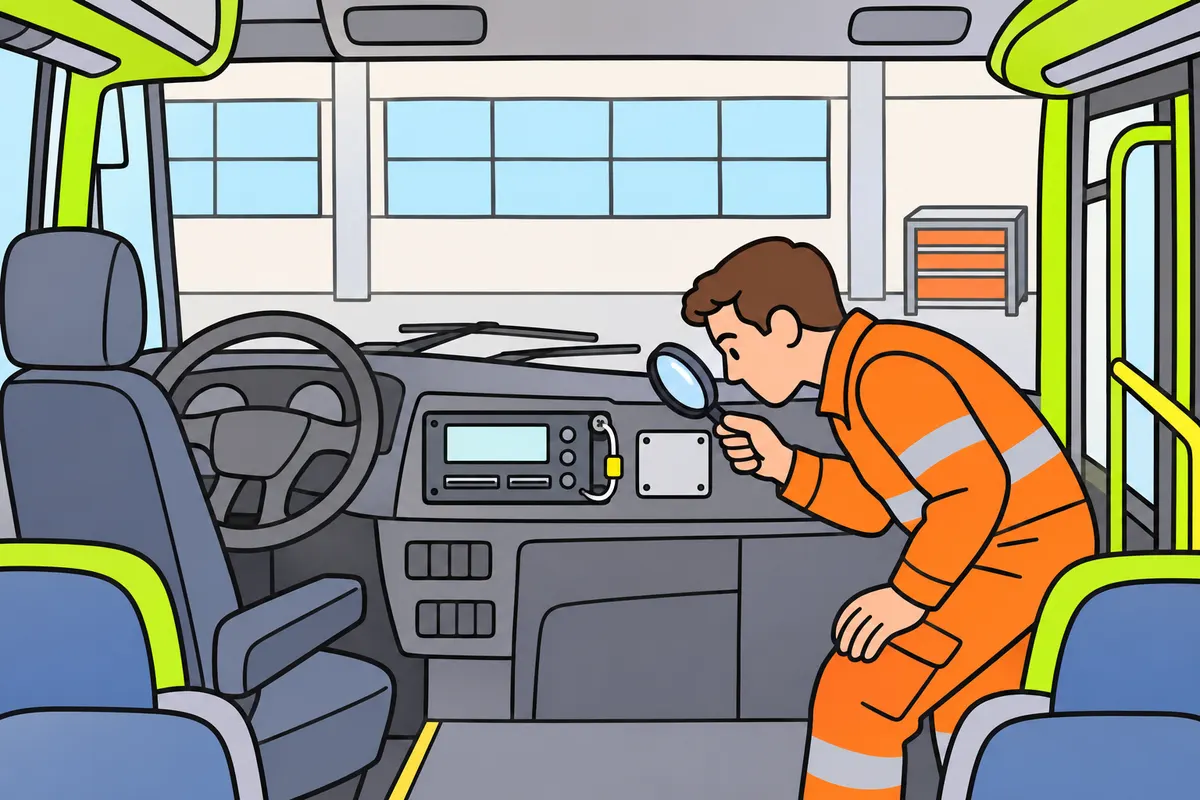
You must keep your tachograph inspected and respect its seals.
Remember
- You check that periodic inspection takes place at an authorised workshop.
- Only authorised personnel may install or repair the equipment.
- You keep the installation plaque visible and accessible.
- You report any incident affecting measurement accuracy.
- If an officer removes a seal, keep the documents recording their intervention.
Exam trap: Wrong: you can break seals for convenience. Right: if repair or modification requires removal, carry a declaration stating date, time and reason. Replace seals without delay, within seven days, using the authorised procedure.
Read the full explanation
- The tachograph requires inspection at an authorised workshop at least every two years. The inspection checks its installation, operation, type approval, plaque, seals and absence of tampering, as well as tyre data. [Regulation 165/2014, art. 23](https://www.boe.es/buscar/doc.php?id=DOUE-L-2014-80362).
- Installation and repair must be carried out by authorised fitters, workshops or manufacturers. Calibration matches the recording to the vehicle's characteristics, and the installation plaque must be visible and accessible. You must report any issue that affects the reliability of its measurements. [Regulation 165/2014, arts. 22 and 23](https://www.boe.es/buscar/doc.php?id=DOUE-L-2014-80362).
- You must not break seals to make the equipment easier to use. If a vehicle repair or modification requires their removal, a declaration stating the date, time and reason must be kept on board. The seals must be replaced without undue delay and no later than seven days after their removal or breakage, using the authorised procedure. Before replacing them, the workshop checks and calibrates the tachograph; this check is not required when a seal is removed or broken for an inspection and replaced by an enforcement officer. [Regulation 165/2014, art. 22.5](https://www.boe.es/buscar/doc.php?id=DOUE-L-2014-80362). [Regulation 2020/1054, art. 2.9](https://boe.es/buscar/doc.php?id=DOUE-L-2020-81223).
- If an officer removes a seal during a check, they must keep their control card inserted from its removal until the end of the inspection, including the fitting of another seal. Their written declaration identifies the vehicle, the officer, their authority and Member State, the card number, the removed seal, the date and time of removal and the new seal if they fit one. They may replace it if they have sealing equipment and a unique special mark. Keep the documentation relating to the work carried out. [Regulation 165/2014, art. 22.5, as amended by Regulation 2020/1054, art. 2.9](https://boe.es/buscar/doc.php?id=DOUE-L-2020-81223).
23Tampering and remote checks
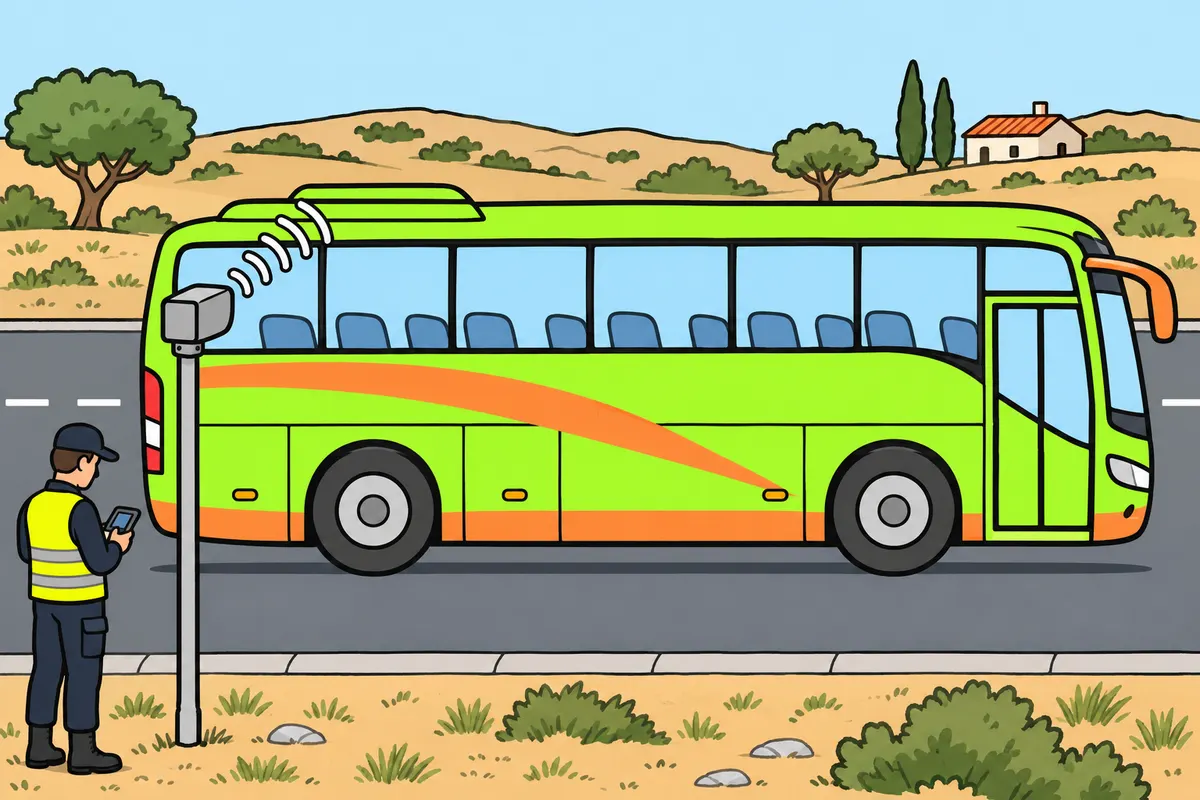
You must not tamper with records and can face checks without warnings.
Remember
- Do not falsify, hide, delete or destroy records.
- Do not carry devices intended for tachograph tampering, even when switched off.
- Do not use another person’s card or one superseded by a later duplicate.
- Do not remove your card to hide driving.
- Remote communication detects possible problems and helps select vehicles for checks.
- You can also face checks without remotely detected problems.
Exam trap: Wrong: remote detection automatically imposes a fine. Right: it provides indications that may lead to checks of the vehicle and tachograph.
Read the full explanation
- You must not falsify, conceal, delete or destroy data on the chart, equipment, card or printouts. You must not tamper with them to falsify records or make them inaccessible. The prohibition also covers carrying devices intended for such tampering on board, even when you are not using them at that moment. [Regulation 165/2014, art. 32.3](https://www.boe.es/buscar/doc.php?id=DOUE-L-2014-80362).
- You must not use someone else's card, a sheet bearing another person's name or a card that must be superseded by a later duplicate. [Regulation 165/2014, arts. 27 and 34](https://www.boe.es/buscar/doc.php?id=DOUE-L-2014-80362). [LOTT (Land Transport Organisation Act), art. 140.22](https://www.boe.es/buscar/act.php?id=BOE-A-1987-17803#a140).
- The smart tachograph allows remote communication to detect signs of possible infringements and select vehicles for checks. This communication is limited to the prescribed data and does not amount to a full inspection of your entire working day. [Regulation 165/2014, art. 9](https://www.boe.es/buscar/doc.php?id=DOUE-L-2014-80362). [Regulation 2020/1054, art. 2.6](https://boe.es/buscar/doc.php?id=DOUE-L-2020-81223).
- Early remote communication does not itself result in a fine for you or the company. The authority may use the indications to check the vehicle and tachograph, and may also carry out random checks even when it detects no anomalies remotely. [Regulation 165/2014, art. 9.8](https://www.boe.es/buscar/doc.php?id=DOUE-L-2014-80362).
24Offences and consequences
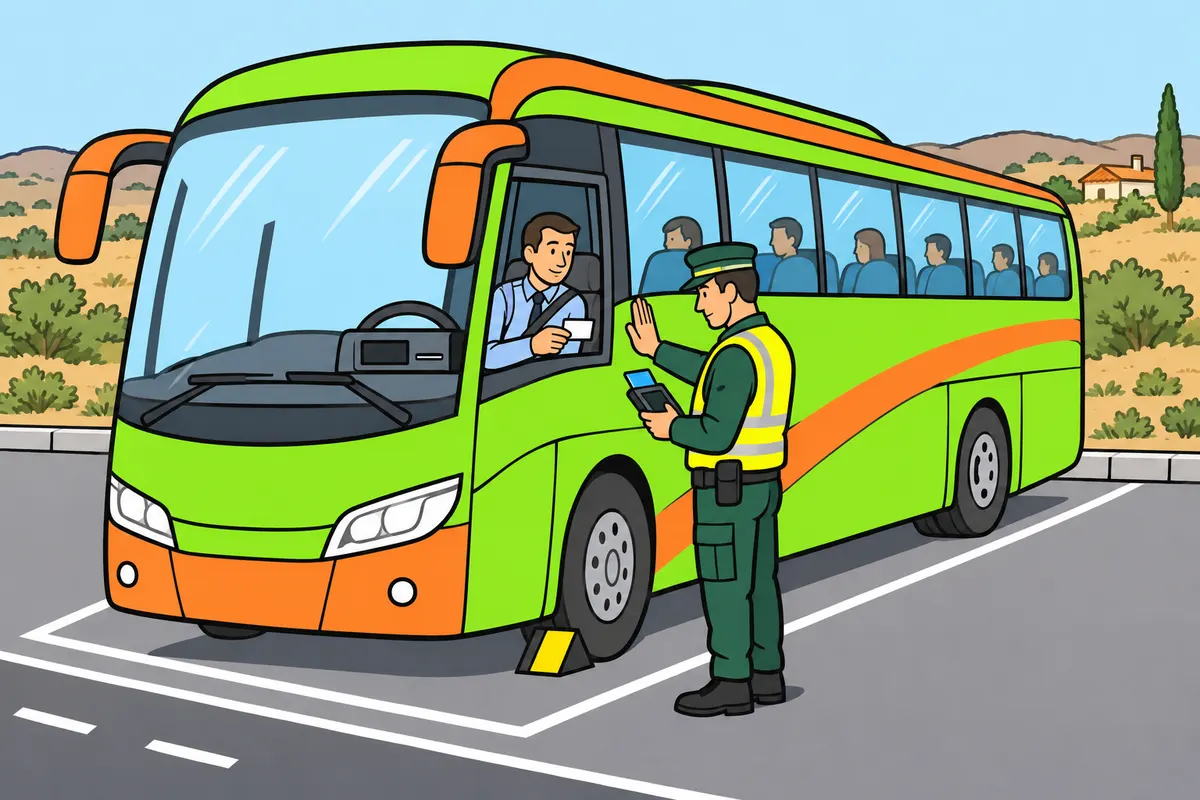
You can face fines and other consequences depending on the offence and your involvement.
| Offence | Consequence under the applicable legal conditions |
|---|---|
| Tachograph tampering | Transport fine of 4,001 to 6,000 euros |
| Not having the mandatory tachograph: article 140.20 | Transport fine of 2,001 to 4,000 euros |
| Not inserting the required card or record sheet, inserting it incorrectly or using another driver’s card: article 140.22 | Transport fine of 2,001 to 4,000 euros |
| Selector use, inspection or records on board | Transport fine of 1,001 to 2,000 euros |
| You participate or assist in installing or activating components that alter tachograph use | Traffic fine of 500 euros |
| Your participation or assistance as driver in installing or activating tampering components is necessary | Loss of six points |
Remember
- Tampering can be punished even when installed components are inactive.
- You distinguish transport penalties from traffic penalties.
- You lose six points if your involvement or assistance as driver is necessary.
- Tampering detected on the road immobilises your bus until the cause is removed.
- Follow authority instructions; the company must arrange a solution for passengers.
Exam trap: Wrong: every irregularity costs you six points. Right: this loss requires your necessary participation or assistance as driver in installing or activating tampering components.
Read the full explanation
- Tampering with the tachograph is a very serious transport offence: the general fine provided for under article 140.10 is 4,001 to 6,000 euros. This also covers installing components intended to alter its measurements, even if they are inactive; the transport operator and those involved in the tampering or installation are liable as provided by law. [LOTT, arts. 140.10 and 143.1.i](https://www.boe.es/buscar/act.php?id=BOE-A-1987-17803).
- Failure to have a compulsory tachograph is an offence under article 140.20; failure to insert the required card or sheet, inserting it incorrectly or using another driver's card falls under 140.22. These offences carry a fine of 2,001 to 4,000 euros. [LOTT, arts. 140.20, 140.22 and 143.1.h](https://www.boe.es/buscar/act.php?id=BOE-A-1987-17803). Incorrect use of the selector (140.26), breaches of requirements concerning calibration, inspection, authorised workshops, seals or plaques (140.34), and failure to carry previously used sheets or compulsory printouts on board (140.35) carry fines of 1,001 to 2,000 euros. [LOTT, arts. 140.26, 140.34, 140.35 and 143.1.g](https://www.boe.es/buscar/act.php?id=BOE-A-1987-17803).
- If you take part in or help with fitting or activating components that alter the normal operation of the tachograph, you commit a very serious traffic offence punishable by a fine of 500 euros. If your participation or assistance as the driver is necessary, you lose six points. [Traffic Act, arts. 77.m, 80.1 and Annex II.7](https://www.boe.es/buscar/act.php?id=BOE-A-2015-11722).
- Tampering detected during a roadside check requires the bus to be immobilised until the cause is removed. Follow the authority's instructions, and the company must arrange a solution for the passengers. [LOTT, art. 143.4.a](https://www.boe.es/buscar/act.php?id=BOE-A-1987-17803#a143).
Preparing and closing a working day with a digital tachograph
Keep a complete sequence of records from when you take charge of the bus until you finish work.
- Check that your card is valid, the equipment works and paper is available; insert your card into the slot for the person driving.
- Enter any outstanding periods since the last card removal and check their dates, times and activities before confirming.
- Record the starting country where required and select other work for preparation tasks.
- During the service, check the activity when you stop and manage driver changes and borders according to the equipment.
- When you finish your tasks, record the end of work and the finishing country where required; keep your card and documents for the next service.
Recording a border crossing
Distinguish automatic recording by a version 2 smart tachograph from the manual entry required with other equipment.
- Check whether the equipment automatically records the crossing in accordance with article 8 of Regulation 165/2014.
- If a manual entry is required, make your first stop at the nearest possible stopping place at or after the border.
- At the start of that stop, enter the symbol of the country you are entering using the equipment’s procedure or on the chart.
- If you cross by ferry or train, make the required entry at the port or station of arrival.
- Continue recording your actual activity; entering a country does not reset your driving times.
Continuing with a lost, stolen or faulty card
The exception requires you to provide evidence of the incident and replace the card within the deadlines.
- Report the theft, notify the loss or return the faulty card, as appropriate.
- Apply for a replacement within seven calendar days and keep evidence of the incident.
- At the start of the journey, print the vehicle details and add your identification, signature and the required activity periods.
- At the end, print the record and add any unrecorded activities, together with your identification and signature.
- Observe the maximum of fifteen calendar days without a card, unless a longer period is necessary and justified to return the vehicle to its premises.
Dealing with an equipment fault
Keep your activity traceable and arrange an authorised repair.
- Report the fault and identify which periods are not recorded or printed correctly.
- Write those periods, your first name and surname, card or driving licence number and signature on the prescribed temporary recording medium.
- Keep the temporary sheet with the chart or your card.
- Arrange with the company for an authorised workshop to repair the equipment as soon as circumstances allow.
- If you cannot return to the company’s premises within one week of the fault occurring or being detected, have the repair carried out during the journey.
Finished this module?
Mark it as read and you will see your progress on the theory list.