
Theory · C+E Licence - Articulated Truck · Module 10 of 13
Driving techniques for heavy vehicle combinations
You learn to control the stability and full swept path of a heavy vehicle combination: wind, snaking, jackknifing, cutting in and outward swing. You prepare for turns, reversing and approaches to loading bays, also considering how your vehicle affects other road users’ visibility and safety.
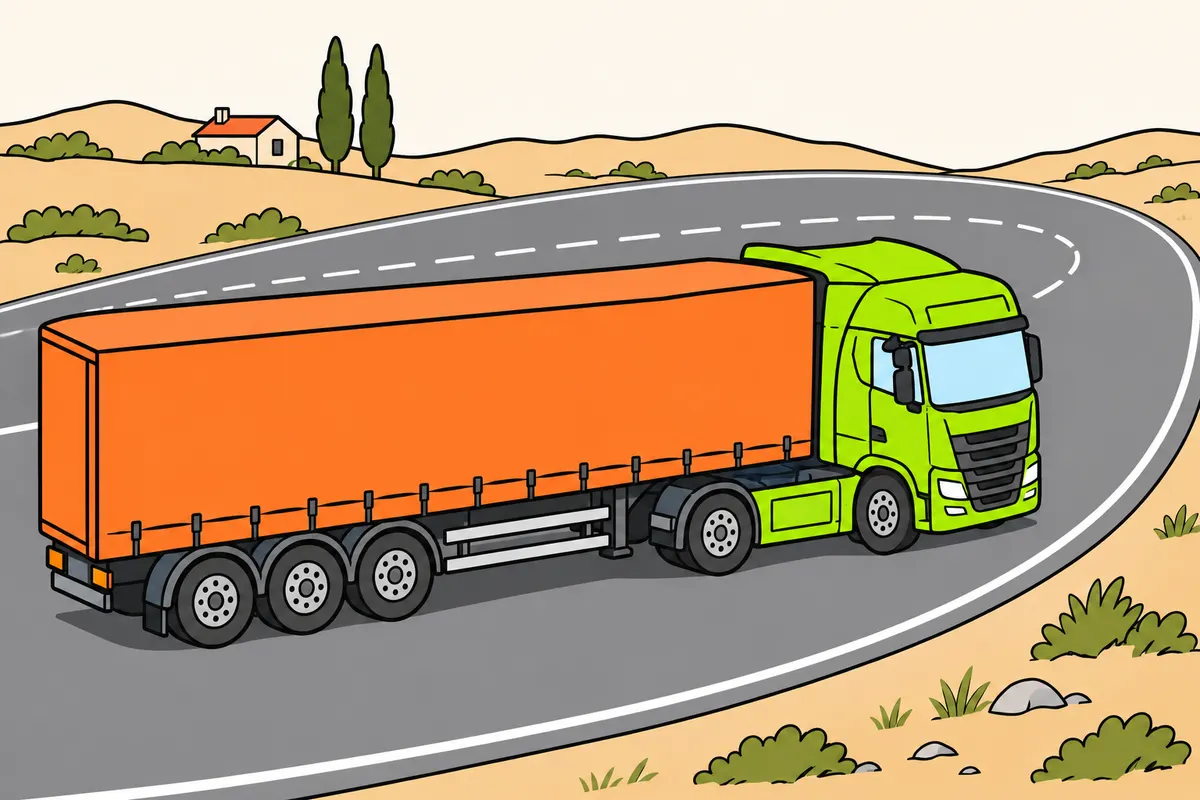
1Prepare the combination and route
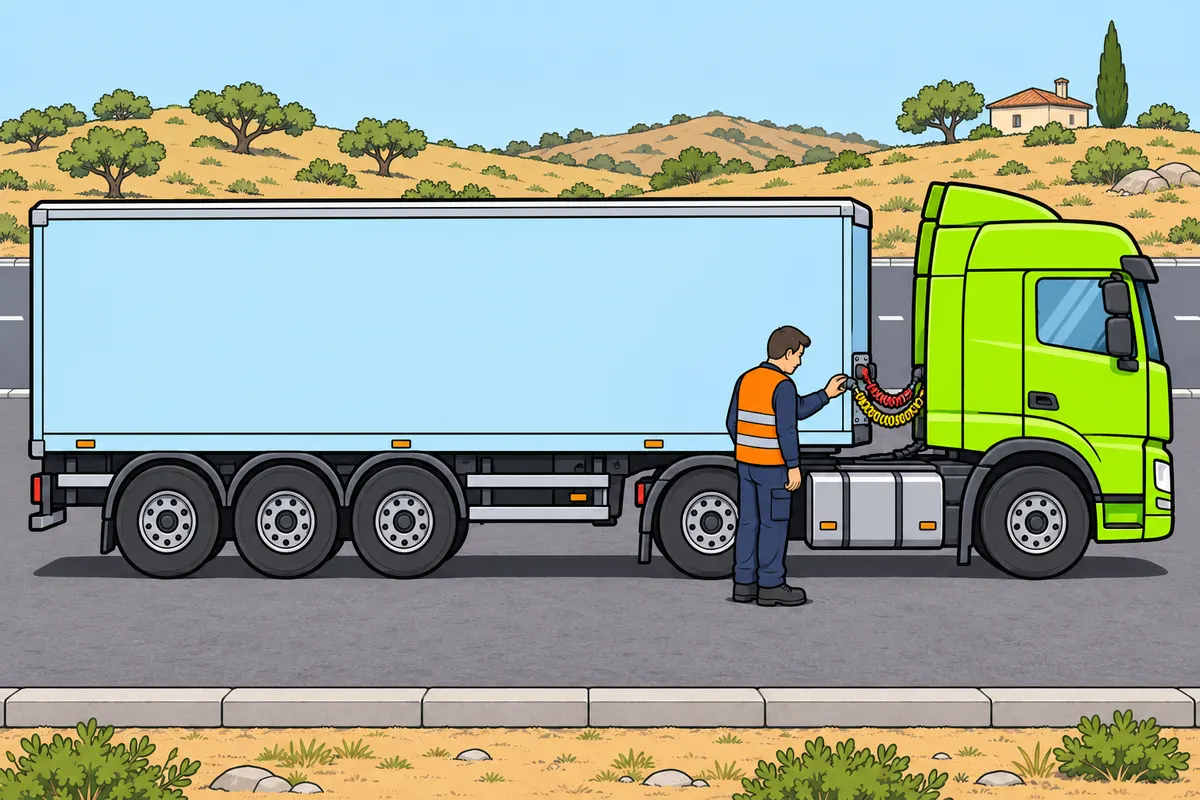
Plan your route and check the whole combination before setting off.
Remember
- Choose a route suited to your dimensions, mass and load.
- Plan legal places to stop or turn round if you cannot pass.
- Check the coupling lock, connections and raised, secured support legs.
- Leave room for cables and hoses to move without becoming trapped.
- Check tyres, lights and brakes on the tractor unit and trailer.
- Adjust your seat, mirrors, head restraint and seat belt while stationary.
Exam trap: Wrong: you leave because the tractor unit is sound. Right: check the trailer too and resolve faults that affect safety.
Read the full explanation
- Before setting off, study the route using the actual dimensions and mass of the combination, including its load. Identify access points, low bridges and other overhead obstructions, restrictions and turning spaces; also plan where you can legally stop or turn round if you encounter an impassable section. A route suitable for the towing vehicle alone may be unsuitable for the combination.
- Check that the coupling is locked, the electrical and air connections are secure, and the supports are retracted and secured. Allow cables and pipes enough freedom to move as the combination articulates, without dragging or becoming trapped; preparation for the test includes checking the coupling, brake and connections. [RGCond, Annex V.B.3](https://www.boe.es/buscar/act.php?id=BOE-A-2009-9481#anv).
- Check the tyres, lights and brake operation on both units; pay attention to pressure gauges and vehicle warnings before moving off. A towing vehicle in good condition does not compensate for a defective towed vehicle. If you detect a fault that compromises safety, resolve it before driving; “Maintenance and inspection of the vehicle combination” covers these checks in detail.
- With the vehicle stationary, adjust your seat, mirrors, head restraint and seat belt; check that the doors are closed. You must demonstrate preparation for safe driving in the practical test and know the reference points on your test vehicle. [RGCond, Annex V.B.3](https://www.boe.es/buscar/act.php?id=BOE-A-2009-9481#anv).
2Load and dynamic behaviour
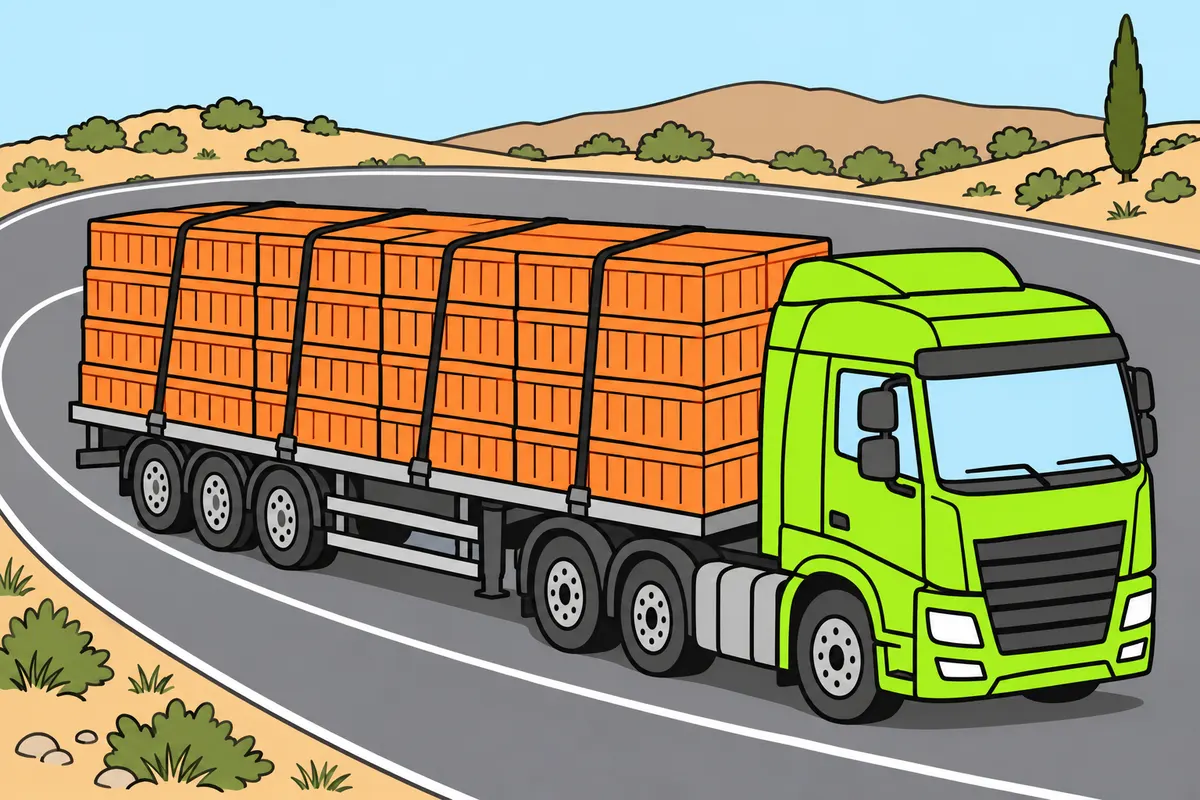
Adapt your driving to how your load is spread, its height and its movement.
| Your combination’s condition | What you need to expect |
|---|---|
| High load | You face a greater risk of overturning. |
| Liquids or moving loads | Anticipate braking and changes of direction. |
| Empty | Your grip changes and you remain exposed to wind. |
Remember
- Check “Safe, well-distributed loads” for positioning and securing goods.
- Spread your load without overloading axles or reducing grip elsewhere.
- Keep within technical and authorised limits.
- Slow before turning; avoid combining tight turns with heavy braking.
Exam trap: Wrong: you forget wind when empty. Right: adapt your driving when empty too.
Read the full explanation
- Know how the load is distributed between the towing and towed vehicles and between their axles. Avoid concentrating the load on one side or in one area in a way that overloads axles or reduces the grip needed on others. You must comply with both the technical and authorised limits; consult “Maximum dimensions and masses” for mass limits and “Safe, well-distributed loads” for positioning and securing goods.
- A high load raises the centre of gravity and reduces your safety margin against overturning when taking bends or making sudden changes of course. Slow down before turning and avoid combining a tight turn with heavy braking. Even if the goods do not shift, the combination can lose stability because of an inappropriate speed.
- With liquids or goods that can move inside their containers, anticipate braking and changes of direction: their movement can prolong or alter the combination’s response. Do not become complacent with an empty vehicle either; the available grip changes and the side surfaces remain exposed to the wind. Always adapt your technique to the type of load and vehicle. [RGC, art. 45](https://www.boe.es/buscar/act.php?id=BOE-A-2003-23514#a45).
3Look well ahead and monitor blind spots
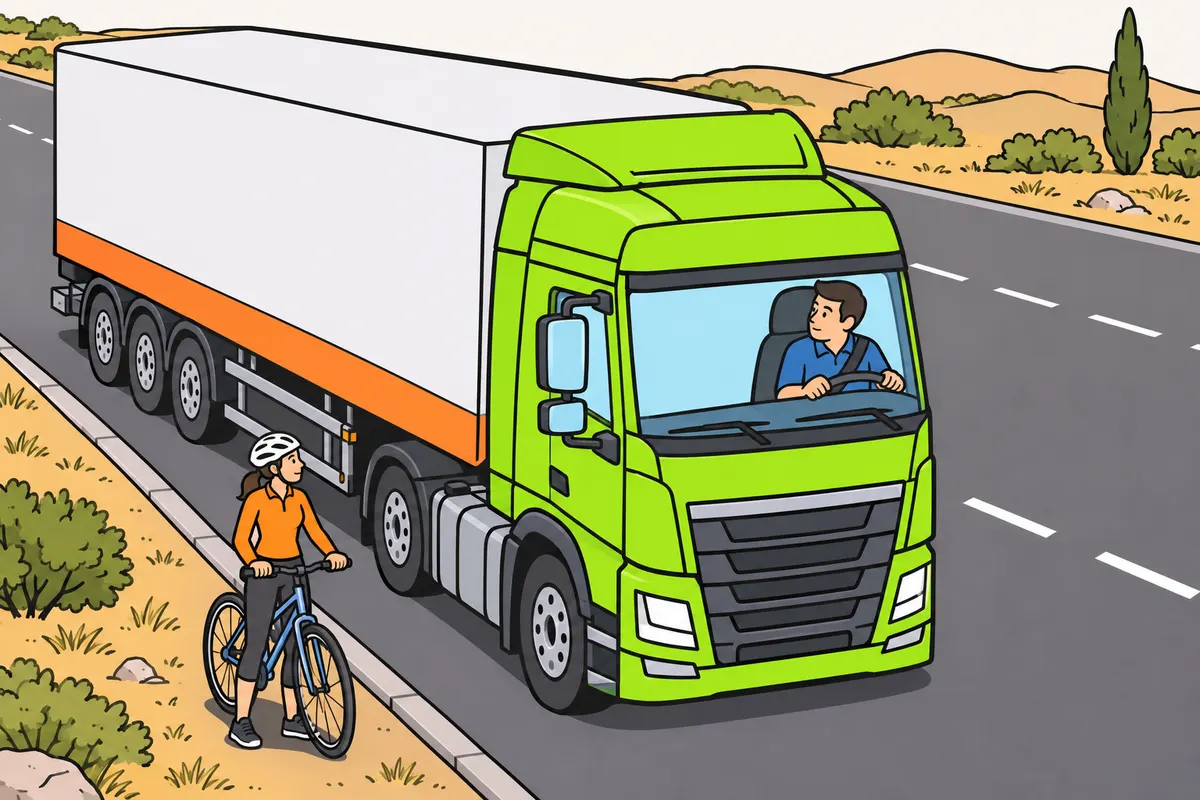
Look far ahead, nearby and in your mirrors, remembering areas you cannot see.
Remember
- Keep observing even on familiar routes when you do not intend to overtake.
- Adjust and clean your mirrors to monitor the trailer.
- Remember that your view changes as you turn.
- Before moving off, turning or changing lanes, check the surrounding areas.
- Pay particular attention beside your cab, on your right and behind.
- Use cameras as aids and know their limits.
Exam trap: Wrong: you assume nobody is there because your mirror shows nobody. Right: check areas outside your view.
Read the full explanation
- Alternate between looking well ahead, checking the area close to you and checking your mirrors. Spotting a traffic queue, a crest or a narrowing of the road early allows you to slow down progressively and avoid improvised manoeuvres. Keep observing on every road, including when you know the route and do not intend to overtake.
- Adjust your mirrors to monitor the sides and the path of the towed vehicle, and keep them clean. The view changes during a turn: part of the semi-trailer may hide another area from you. Do not assume a space is clear simply because no road user appears in the mirror; take account of areas you cannot see.
- Before moving off, changing lanes or turning, check especially around the cab, along the right-hand side and behind the vehicle. A cyclist or pedestrian may be out of sight and enter the combination’s swept area. Cameras and assistance systems supplement your observation; you must know their limitations and remain in control.
- Stay attentive and maintain a sufficient field of vision to observe the path of the whole combination. [RGC, art. 18](https://www.boe.es/buscar/act.php?id=BOE-A-2003-23514#a18).
4Smooth control inputs and appropriate speed
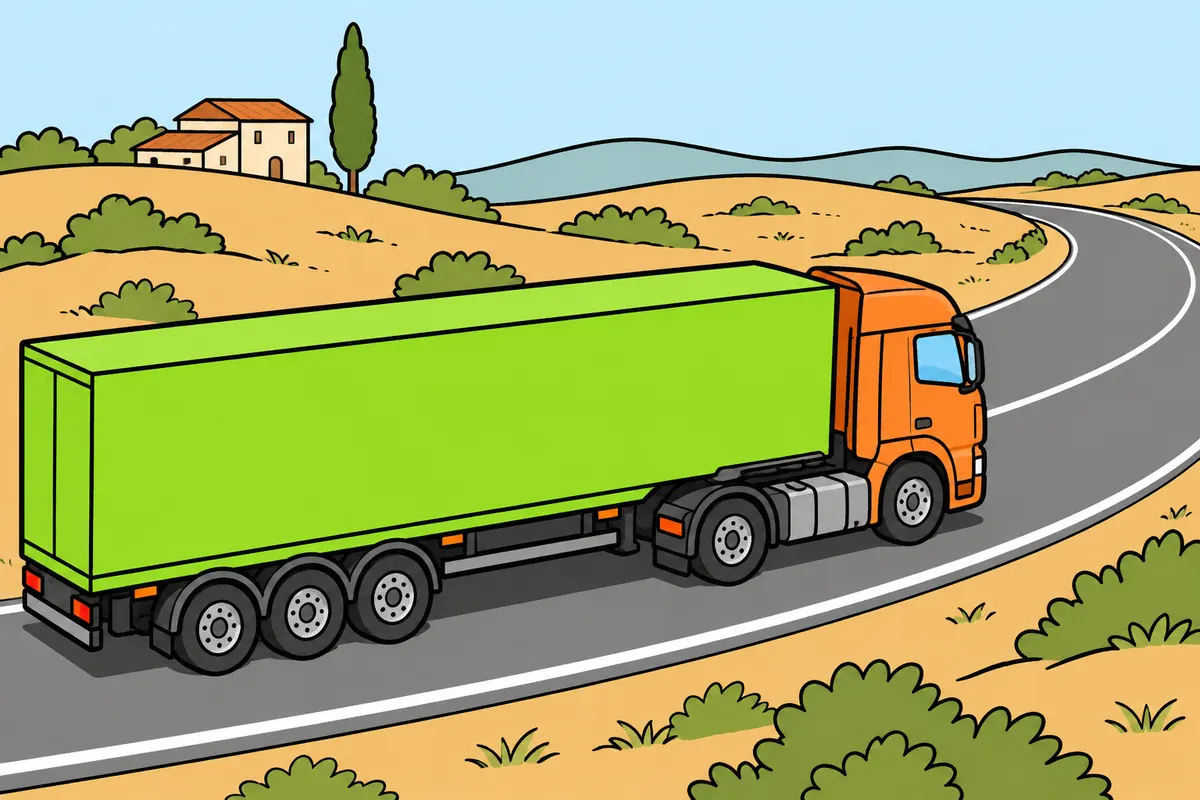
Use the controls smoothly and adapt your speed to the conditions.
Remember
- Accelerate, change gear, brake and steer gradually.
- Choose a speed that lets you stop within the distance you can see.
- Consider your condition, road, load, vehicle, traffic and weather.
- Check limits in “Speed and distances for vehicle combinations”.
Exam trap: Wrong: you assume the maximum limit is always safe. Right: slow further when conditions require it.
Read the full explanation
- Accelerate, change gear, brake and steer progressively. Smooth inputs avoid sudden load transfers and help the towing and towed vehicles maintain a stable path. You must remain in control of the combination at all times; driving in a hurry or making violent corrections reduces the margin you need to deal with an unexpected event. [RGC, art. 17](https://www.boe.es/buscar/act.php?id=BOE-A-2003-23514#a17).
- Choose a speed that allows you to stop within the distance you can see to be clear and before foreseeable obstacles. You must take account of your own condition, the road, the vehicle, the load, traffic and the weather. The maximum speed limit is an upper limit: a tight bend, a roundabout or an approach to a loading bay may require a much lower speed. [RGC, art. 45](https://www.boe.es/buscar/act.php?id=BOE-A-2003-23514#a45). Consult “Speed and distances for vehicle combinations” for the combination’s limits on each type of road and the conditions that require you to reduce your speed.
5Separation and stopping margin
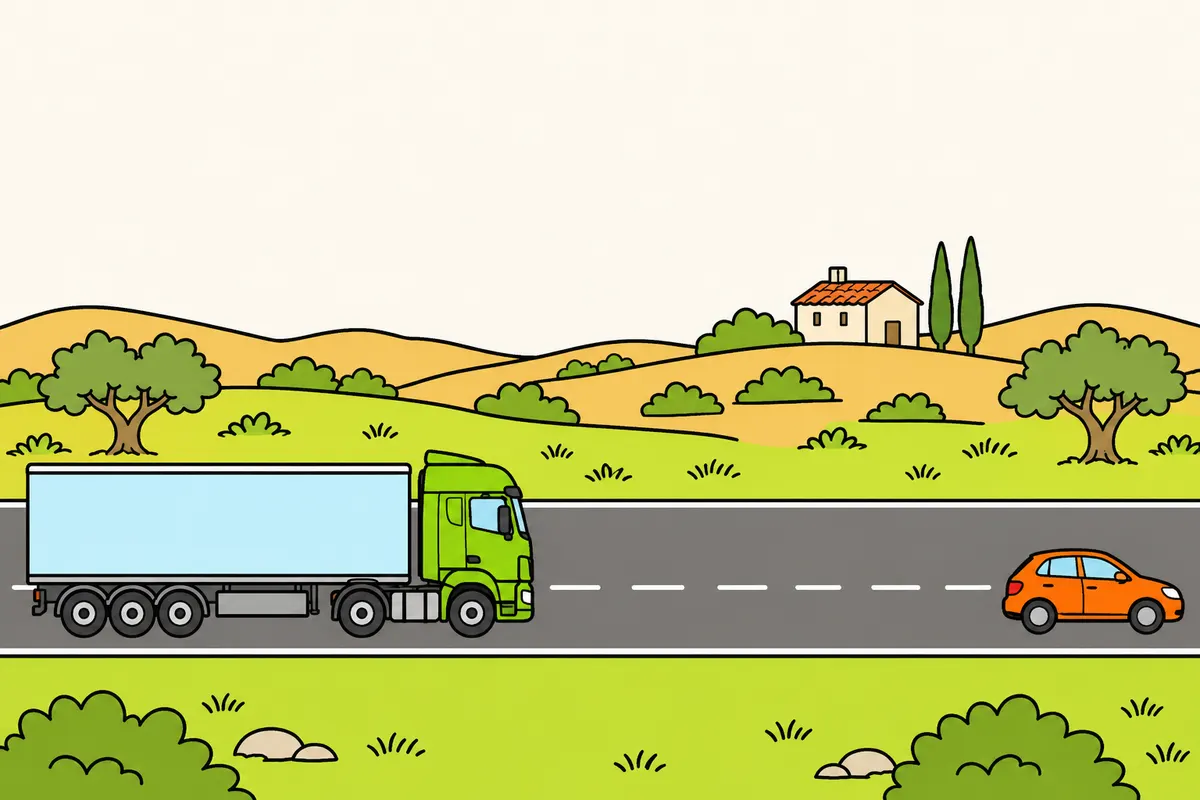
Keep space ahead to slow smoothly and keep your combination stable.
Remember
- Leave space to slow down without braking abruptly.
- If another vehicle enters that space, restore the margin smoothly.
- Check reaction and braking distances in “Speed and distances for vehicle combinations”.
- Check additional separation and tunnel distances there too.
Exam trap: Wrong: you brake abruptly to restore space. Right: restore the margin smoothly to keep your trailer stable.
Read the full explanation
- Keep enough space ahead of the combination to slow down progressively, without relying on sudden braking that compromises the stability of the towed vehicle. If another vehicle moves into that space, restore the margin smoothly. Consult “Speed and distances for vehicle combinations” for the gap needed to avoid a collision, reaction and braking distances, additional separation and distances in tunnels.
6Anticipate queues
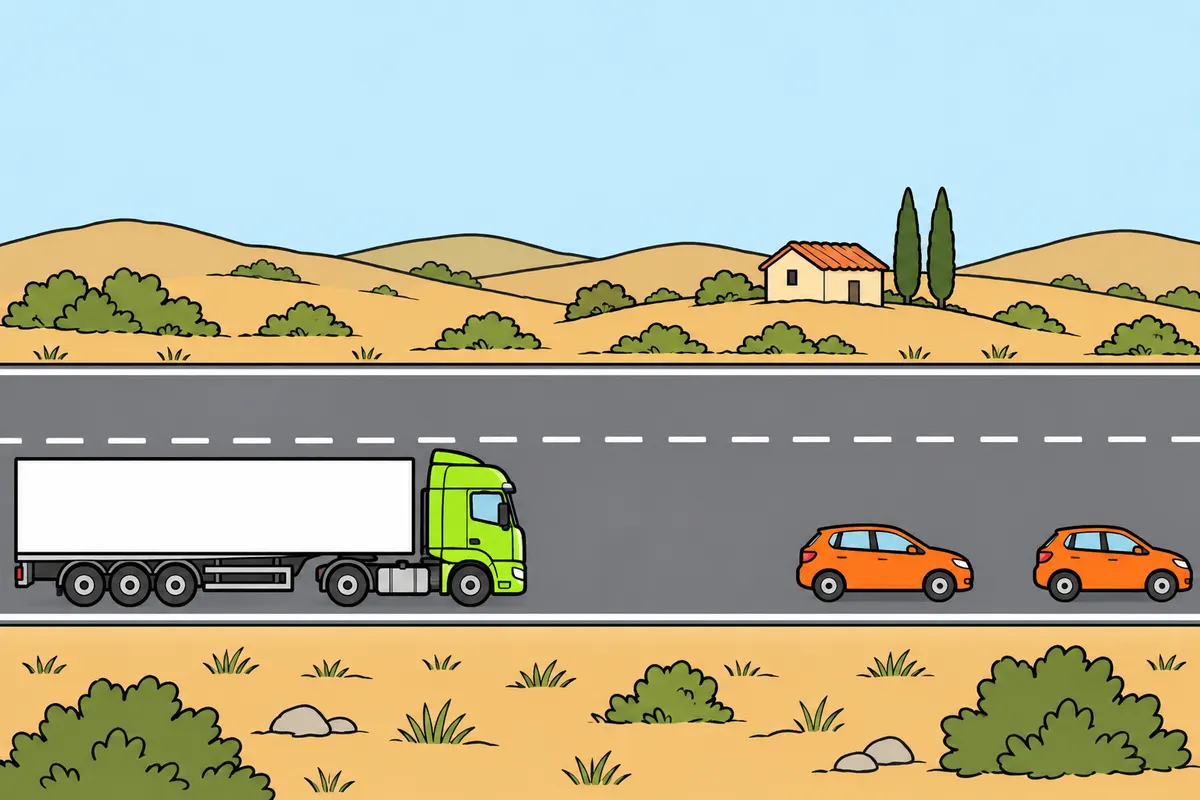
Slow early when approaching a queue and keep space to react.
Remember
- Slow gradually and check behind without neglecting the road ahead.
- Avoid stopping close behind the vehicle ahead.
- When moving off, avoid closing the whole gap immediately.
- When making room for emergency vehicles, monitor your axles and rear end.
- Help emergency vehicles pass: normally move right or stop if necessary.
Exam trap: Wrong: you check only the cab when making room. Right: monitor your axles and the trailer’s rear end too.
Read the full explanation
- When approaching a traffic queue, slow down progressively and keep space to react. Also check behind to identify approaching road users, without neglecting the road ahead. Stopping very close to the vehicle in front reduces your room to manoeuvre; when moving off again, avoid accelerating to close the entire gap immediately.
- When moving aside to make room for emergency vehicles, also monitor the position of the axles and the rear end of the towed vehicle: the towing vehicle may move aside while the rear still blocks the way. Help them pass as circumstances require, normally by moving to the right or stopping if necessary. [RGC, art. 69](https://www.boe.es/buscar/act.php?id=BOE-A-2003-23514#a69).
7Crosswinds and changes in exposure
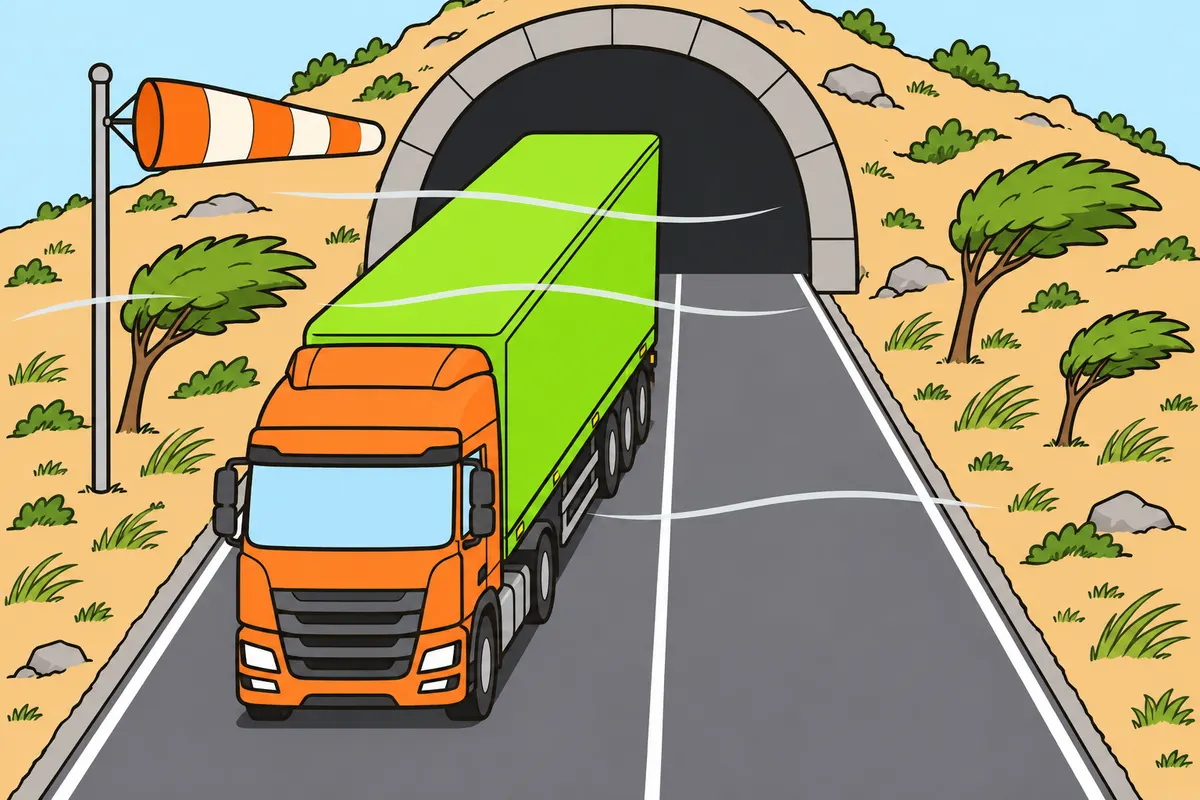
Expect gusts and stay in control with lower speeds and gentle steering corrections.
Remember
- Hold the wheel firmly and slow before exposure to wind.
- Leave space sideways to correct without approaching edges or other vehicles.
- Expect wind changes when leaving tunnels or sheltered areas.
- Expect changes in wind shelter when passing large vehicles.
- Avoid swerving in anticipation.
- If you cannot stay in control, find a permitted, sheltered place to stop safely.
Exam trap: Wrong: you accelerate to escape wind. Right: slow in advance; even empty, you can be blown off course or overturn.
Read the full explanation
- In crosswinds, reduce your speed in good time, hold the steering wheel firmly and make gentle corrections. A long, tall combination exposes a large surface area to the wind; driving unladen does not eliminate the risk of being blown off course or overturning. There is no single safe speed for every vehicle and every gust. [RGC, art. 45](https://www.boe.es/buscar/act.php?id=BOE-A-2003-23514#a45).
- Pay particular attention when leaving a tunnel, crossing a viaduct or leaving an area sheltered by buildings, screens or trees. The wind can strike suddenly. Keep a lateral safety margin and avoid moving close to the edge or other vehicles before entering that area, because you need space to maintain your course.
- When passing a large vehicle coming the other way or overtaking one, the shelter from the wind can change for a few moments and disappear as you pass it. Anticipate this change without making a pre-emptive swerve. Check that you can keep the combination within the space available to it before starting a manoeuvre that leaves you alongside for a long time.
- If the conditions prevent you from controlling the combination, find a sheltered place where stopping is permitted and stop safely. Do not accelerate to get out of the dangerous area sooner. Experience does not neutralise a gust or allow you to maintain the same speed at all times; you must adapt your driving to the actual conditions throughout the journey.
8How you affect other road users’ visibility and safety
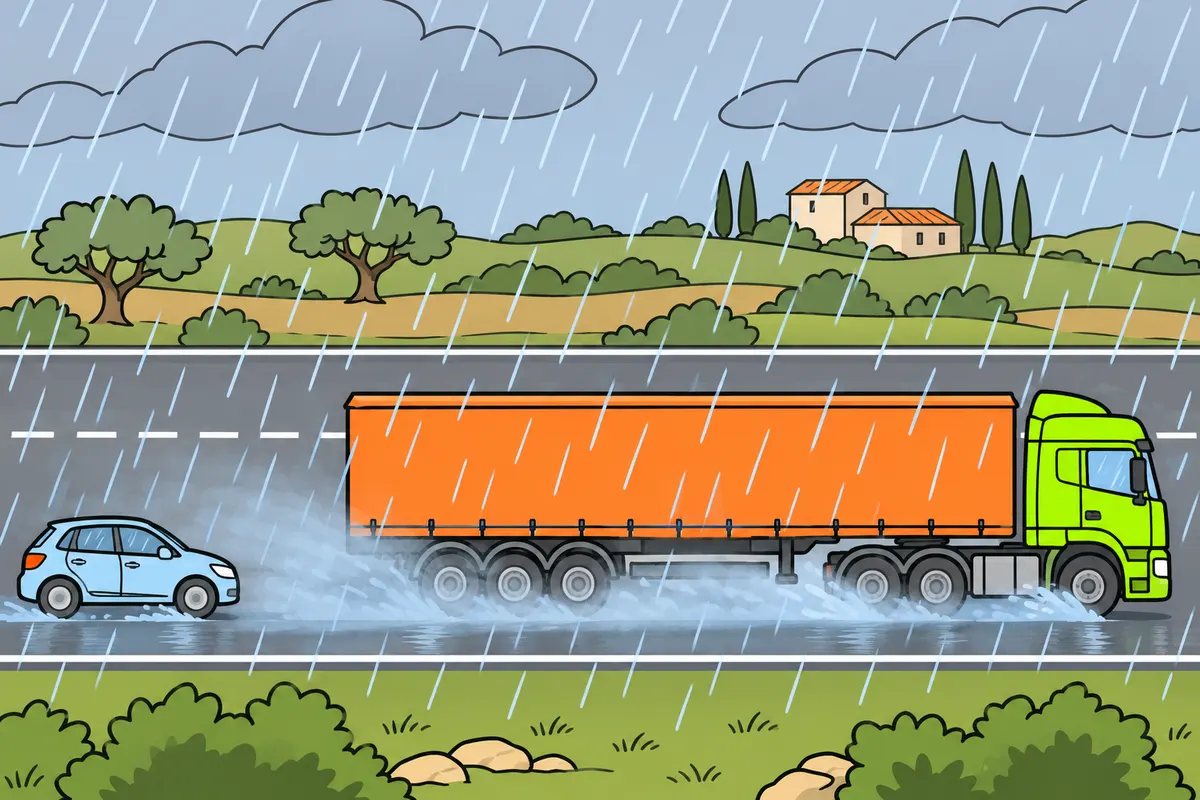
Remember that your combination can block other people’s view.
| Situation with your combination | What you can cause |
|---|---|
| Rain | Your wheel spray can block other drivers’ view. |
| Pedestrian crossing | You can hide pedestrians from drivers in other lanes. |
Remember
- In rain, adapt your speed to the spray you create.
- Avoid sudden changes of direction while others pass alongside.
- When giving way, wait until your path is clear.
- Do not wave pedestrians across assuming other drivers can see them.
Exam trap: Wrong: you assume other drivers see the pedestrian you see. Right: remember your combination can hide them.
Read the full explanation
- In rain, the combination's wheels throw up a cloud of spray behind and to the sides, which can momentarily obscure the view of those following or overtaking you. Adapt your speed and avoid sudden changes of course while they pass alongside you. [DGT, Caution: heavy vehicles](https://revista.dgt.es/es/educacion-formacion/conducir-mejor/2021/0420-Vehiculos-pesados-cerca.shtml).
- The combination's length and height can hide a pedestrian on a crossing from drivers in other lanes. When you stop to give way to them, remain stopped until your path is clear and avoid signalling them to cross on the assumption that others can see them too. From your position, you cannot guarantee their safety in the adjacent lane. [DGT, Road safety issues, pedestrian crossings](https://sede.dgt.gob.es/export/sites/dgt/.galleries/permisos-de-conducir/certificacion-aptitud-profesores-formacion-vial/2024/Manual-II-Cuestiones-de-Seguridad-Vial-2024.pdf#page=1).
9Body roll, snaking and loss of stability
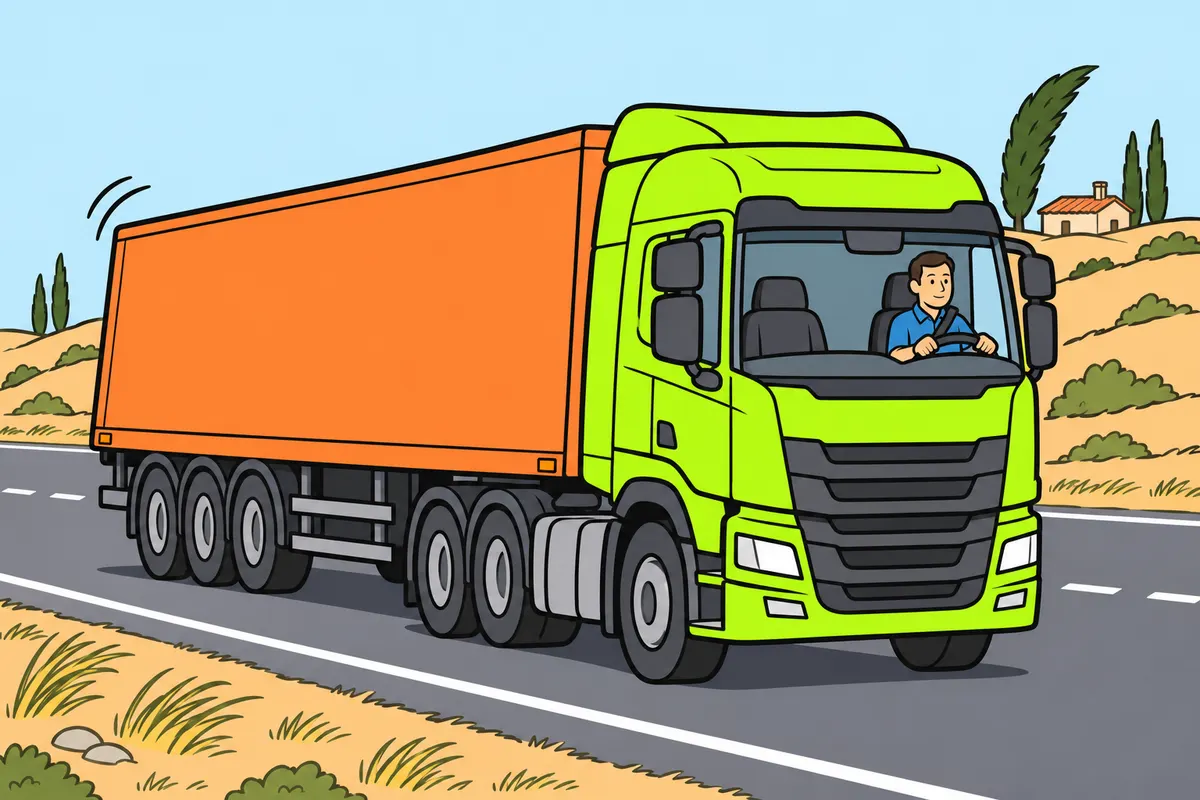
If your combination starts swaying, avoid sudden reactions and check the cause before continuing.
| Movement of your combination | What you need to recognise |
|---|---|
| Body roll | Your vehicle’s body rocks sideways. |
| Snaking | Your trailer moves alternately to either side. |
| Jackknifing | Your tractor unit and trailer fold at an excessive angle. |
Remember
- Avoid accelerating, braking sharply or swerving from side to side.
- Ease off the accelerator gently and keep your steering steady.
- Follow your vehicle’s safety instructions.
- When safe to stop, check your load, restraints, tyres and coupling.
- Do not continue while safety remains affected.
- Do not rely on electronic aids to enter bends quickly.
Exam trap: Wrong: you try to correct snaking by swerving. Right: keep steering steady and ease off the accelerator gently.
Read the full explanation
- Body roll is the swaying of the bodywork; snaking involves the towed vehicle moving alternately from side to side. Both indicate a reduced margin of stability. Speed, wind, a poorly distributed load, play in the coupling or the condition of the tyres and suspension can contribute to them.
- If swaying starts, avoid accelerating, braking sharply or trying to counter it with alternating sharp steering inputs. Ease off the accelerator gently, keep your steering steady and follow the safety instructions for your vehicle and its systems. A violent reaction can increase the angle at the coupling and cause you to lose control of the combination.
- When you can stop safely, check the cause before continuing: the load, its securing system, tyres and the connection between the vehicles all need attention. You do not solve repeated snaking by getting used to it. If you need an inspection or repair, do not resume driving while safety remains compromised.
- Distinguish snaking from the combination folding, known as jackknifing: the towing and towed vehicles form an excessive angle, and you lose control of your course. You must prevent this through appropriate speed, sufficient grip and smooth control inputs. Electronic stability and anti-lock braking systems are aids and do not allow you to enter a bend too fast.
10Bends: slow down before entering
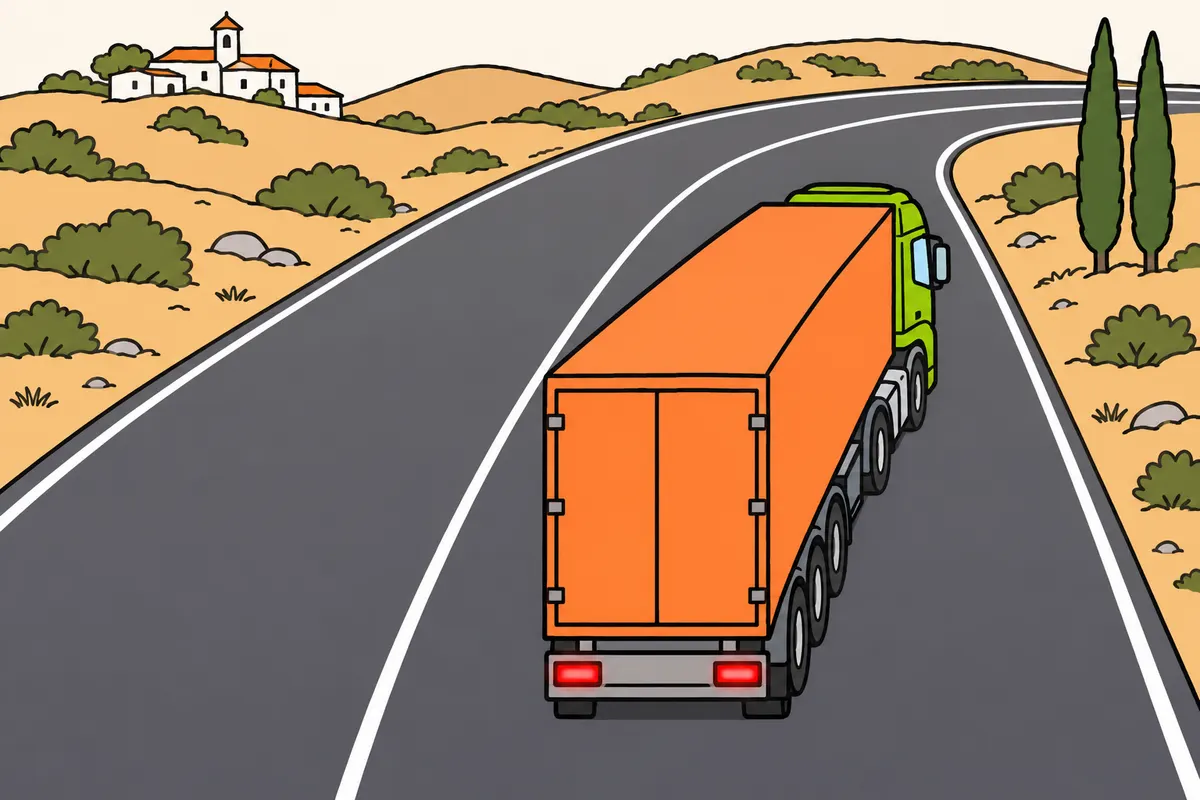
Choose your speed and gear before entering a bend.
Remember
- Check the bend, visibility, slope, banking and road surface.
- Adapt your speed to your load, rain and wind too.
- Keep a steady path within your space.
- If you must slow in the bend, do so as gently as safety allows.
- Accelerate gradually as you straighten the steering and check the whole combination’s path.
- Do not enter opposing traffic’s space; wait if you cannot pass safely.
Exam trap: Wrong: you expect to skid before overturning. Right: with a high load, you can lose stability without skidding.
Read the full explanation
- Assess the bend's radius, visibility, gradient, banking and road surface before you reach it. Adjust your speed and gear on the approach so that you can negotiate it without sudden braking or steering inputs. The same bend can require a different speed with a different load, rain or wind.
- Enter at a speed that allows you to keep the combination stable and within the space available to it. A high load increases susceptibility to overturning: the vehicle does not need to skid to lose stability. Do not rely solely on the feeling of safety in the cab to judge what is happening to the towed vehicle.
- Maintain a smooth course and avoid sudden braking or abrupt gear changes within the bend. If you need to adjust your speed, do so as smoothly as safety allows. On the exit, accelerate gradually when you can straighten the steering and have checked the path of the entire combination.
- Do not enter the opposite side of the road to improve your line or assume that the absence of traffic allows you to cut the bend. You must anticipate both the towed vehicle cutting in and the space occupied by the bodywork. If you cannot pass safely while complying with the traffic conditions, wait or find another solution. [RGC, art. 45](https://www.boe.es/buscar/act.php?id=BOE-A-2003-23514#a45).
11Cutting in and outward swing
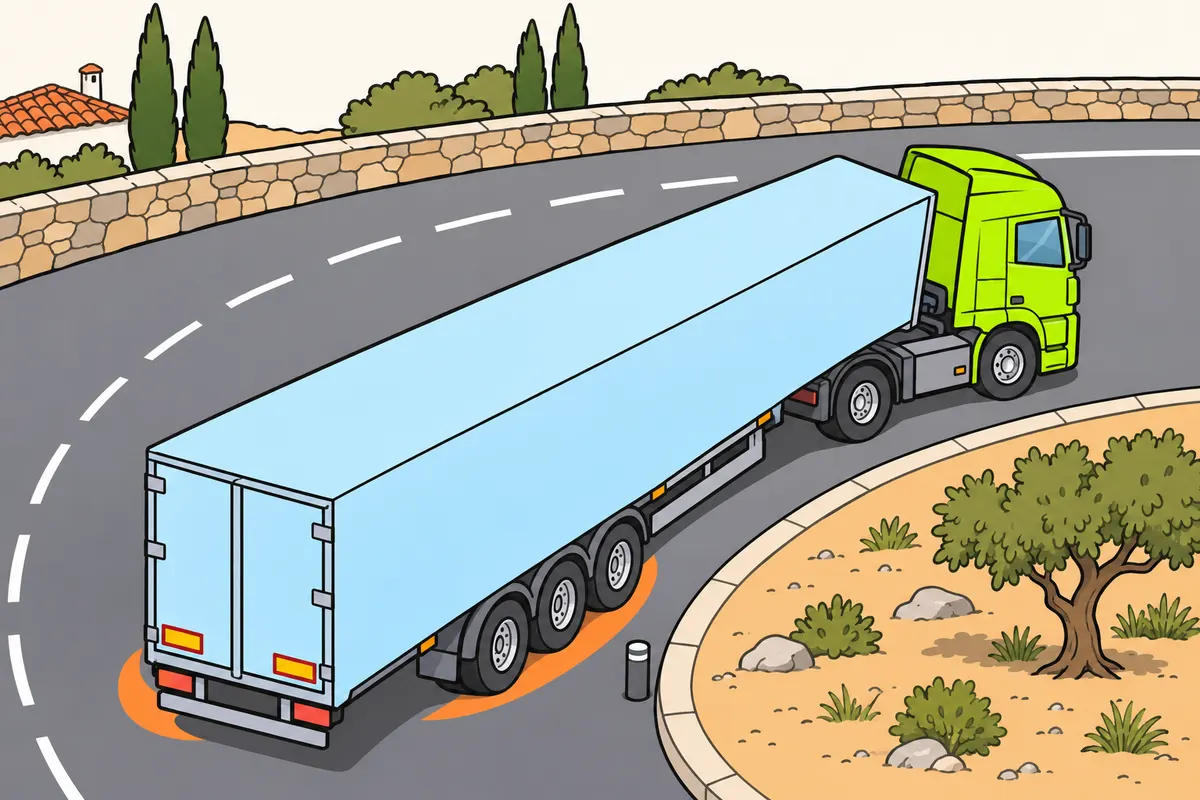
When turning, watch your inner wheels and the body swinging outwards.
| Effect when turning your combination | What you need to watch |
|---|---|
| Cutting in | Your trailer’s wheels may follow a path further inside. |
| Outward swing | Your bodywork behind the rear wheels may swing outwards. |
Remember
- Do not assume clearance for your cab means clearance for your trailer.
- Watch kerbs, posts, traffic islands and people on both sides.
- Learn your combination’s reference points; they differ between combinations.
- If you need a wider turn, observe, signal and wait for a safe gap.
- Stop if you lose the space you need.
Exam trap: Wrong: you think a wider turn gives you priority. Right: respect anyone occupying the other lane.
Read the full explanation
- When you drive forwards through a tight turn at low speed, the wheels of a semi-trailer with fixed axles usually follow a path further inside the turn than the tractor unit's wheels. A trailer can also cut in. You must judge where its axles pass in relation to kerbs, traffic islands, posts and nearby road users; getting the cab through is not enough.
- The bodywork occupies more than just the tracks of the tyres. The rear overhang can swing outwards during the turn and come close to a vehicle, wall or pedestrian on the other side. Monitor both sides: while the wheels track inwards, another part of the combination can occupy space outside that path.
- The behaviour depends on wheelbases, overhangs, articulation points and any steering axles. Learn the reference points for your configuration and check the space at low speed. A road train with a pivoting front axle does not respond exactly like a tractor unit with a semi-trailer; do not apply the same steering reference to every combination.
- If your dimensions require you to swing wide for a turn, you must take every precaution to avoid danger. This does not give you priority over anyone occupying another lane. Observe, signal the necessary movement, wait for a gap and monitor the swing throughout the manoeuvre; if you lose your safety margin, stop. [RGC, art. 76](https://www.boe.es/buscar/act.php?id=BOE-A-2003-23514#a76).
12Urban turns and narrow passages
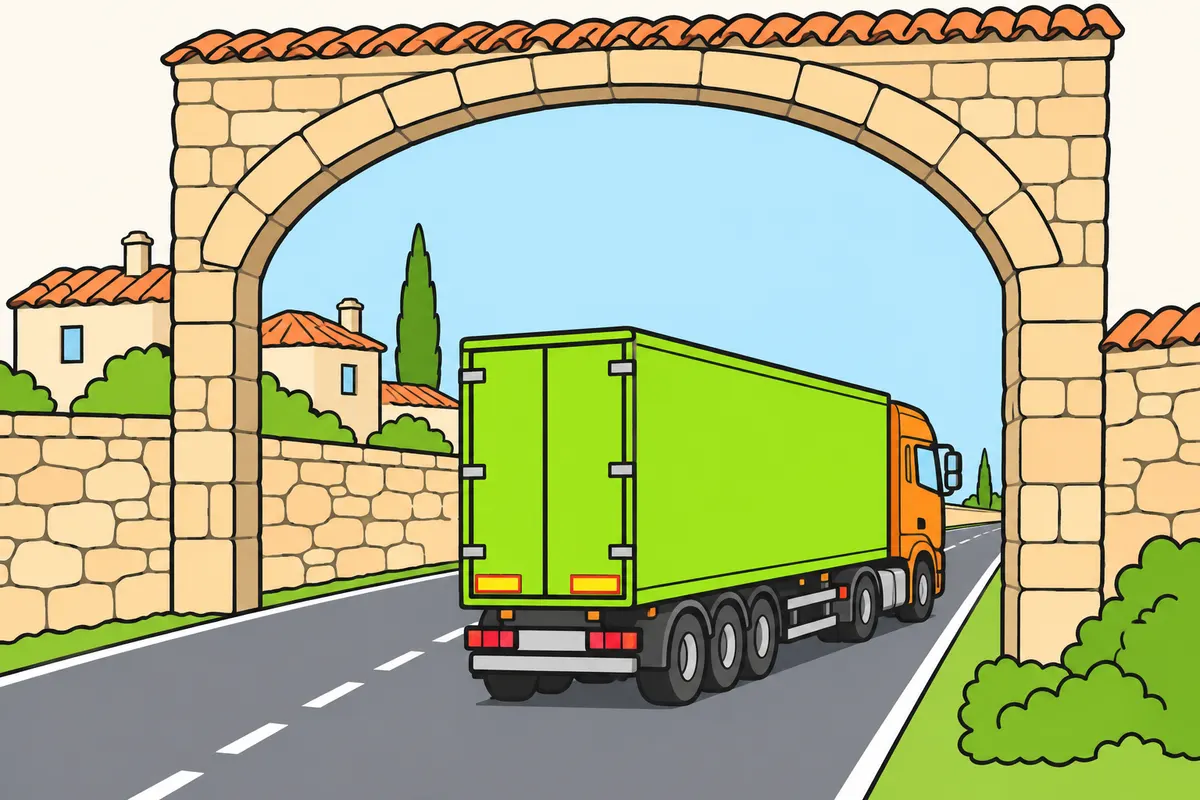
Check all the space you need before turning or entering narrow passages.
| Situation with your combination | What you need to check |
|---|---|
| Right turn | Nobody is where your wheels will cut in. |
| Left turn | You can complete the turn and clear the junction. |
| Narrow passage | There is enough width and height for your whole combination. |
Remember
- Before turning right, look for people and vehicles alongside your right side.
- Signal each movement and move only when safe.
- Avoid entering junctions if you expect to stop inside and block crossing traffic.
- Check width and height, including mirrors, load and protruding parts.
- At junctions with poor visibility, proceed only when you can check passage is safe.
- Respect priority; your size does not let you force your way through.
Exam trap: Wrong: you enter a junction because you have priority. Right: do not enter if you expect to stop inside and block crossing traffic.
Read the full explanation
- Before turning right, check that no cyclist, motorcyclist or pedestrian is alongside your right-hand side or in the space into which the wheels cut in. If you need to swing wide, avoid making the movement look like a definite turn in the opposite direction. You must signal each movement and carry it out only when it is safe. [RGC, art. 74](https://www.boe.es/buscar/act.php?id=BOE-A-2003-23514#a74).
- When turning left, assess whether the combination's length allows you to complete the crossing and clear the junction. Do not enter a junction if you expect to become stationary within it and obstruct crossing traffic, even if you have priority. A queue on the other side can leave the towed vehicle blocking the junction long after the towing vehicle has passed through. [RGC, art. 59](https://www.boe.es/buscar/act.php?id=BOE-A-2003-23514#a59).
- Before a narrow passage, check the available width and height along the entire route, allowing for mirrors, the load and any projecting parts. Slow down before entering and maintain reference points on both sides. Sounding the horn or knowing the location does not establish that the passage is clear or remove the need to stop if there is insufficient space.
- At junctions with restricted visibility, slow down and advance only when you can check that you can pass safely. Avoid relying on the vehicle's size to force your way through. Signs and priority rules determine who goes first; your driving technique must prevent the need to manoeuvre from becoming a risk to others. [RGC, art. 46](https://www.boe.es/buscar/act.php?id=BOE-A-2003-23514#a46).
13Roundabouts with a long combination
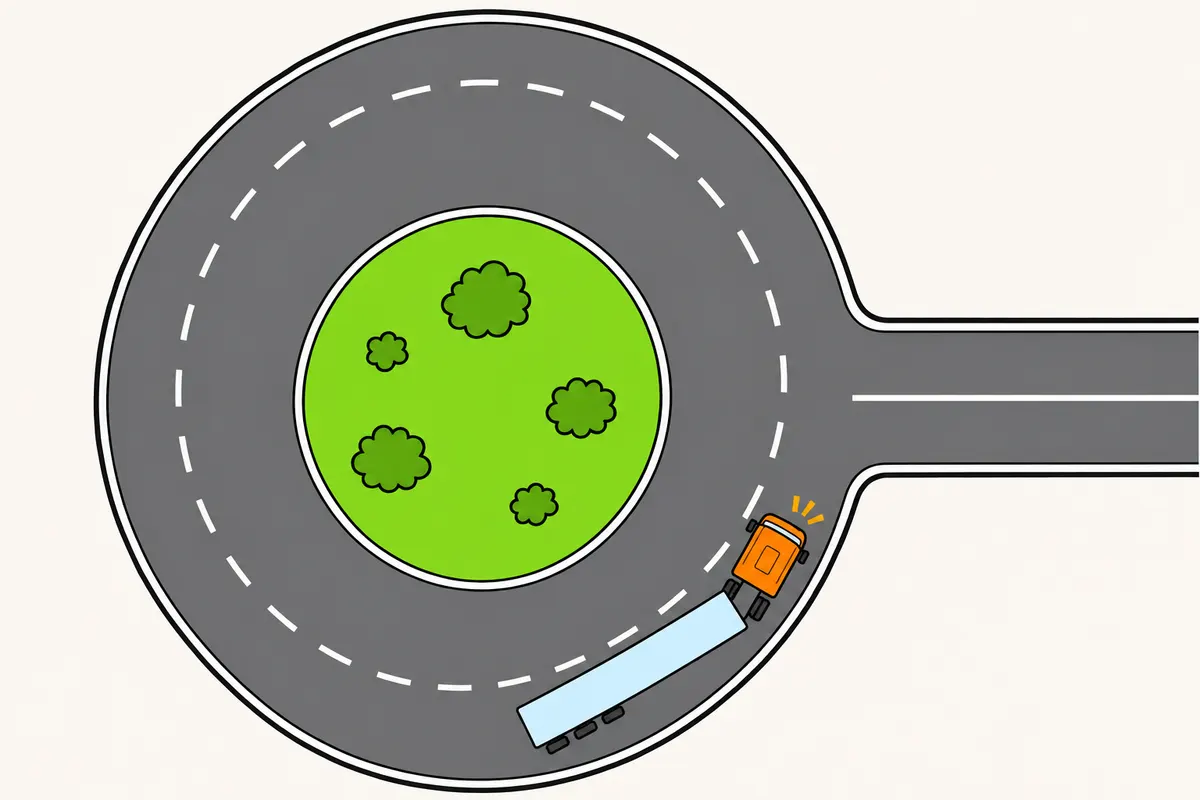
Enter slowly and prepare your exit with room for your whole combination.
Remember
- Give way to traffic already circulating, unless signs set different rules.
- Choose a gap allowing for your full length and acceleration.
- Before occupying another lane, check, respect its traffic’s priority and signal.
- On standard roundabouts, prepare your exit from the outer lane, following signs and markings.
- If you cannot position yourself safely, continue round.
- Signal your exit and keep speed low until your whole combination has left.
Exam trap: Wrong: you exit from an inner lane across traffic on your right. Right: move safely into the outer lane beforehand, following signs and markings.
Read the full explanation
- Adjust your speed before entering, observe the traffic and give way to those already on the roundabout, unless signs establish a different rule. Assess whether a gap accommodates the whole combination: its acceleration and length make a gap that suits a car insufficient. Do not force anyone with priority to brake sharply. [RGC, art. 57](https://www.boe.es/buscar/act.php?id=BOE-A-2003-23514#a57).
- Anticipate the towed vehicle cutting in towards the central island and the outward swing. On a small roundabout, you may need more than one lane because of the combination's dimensions. Before moving into another lane, you must check that it is clear, respect the priority of anyone travelling in it and signal your movement; you must not swing out abruptly into another vehicle's path. [RGC, art. 76](https://www.boe.es/buscar/act.php?id=BOE-A-2003-23514#a76).
- On an ordinary roundabout, you must prepare to exit by moving into the outer lane beforehand, following any signs or markings that direct traffic movements. If you cannot do this safely, continue round to give yourself time to prepare. Do not cut across from an inner lane through the path of anyone travelling to your right. [DGT, driving on roundabouts](https://revista.dgt.es/es/reportajes/2014/10OCTUBRE/1009glorietas.shtml).
- Signal right to exit and watch the inside of the turn, the pavement and nearby crossings. Do not consider the manoeuvre complete when the cab leaves: you must check that the towed vehicle leaves the roundabout without mounting the kerb or hitting a road user. Keep your speed low until the whole combination is aligned with the exit road.
14Joining traffic and changing lanes
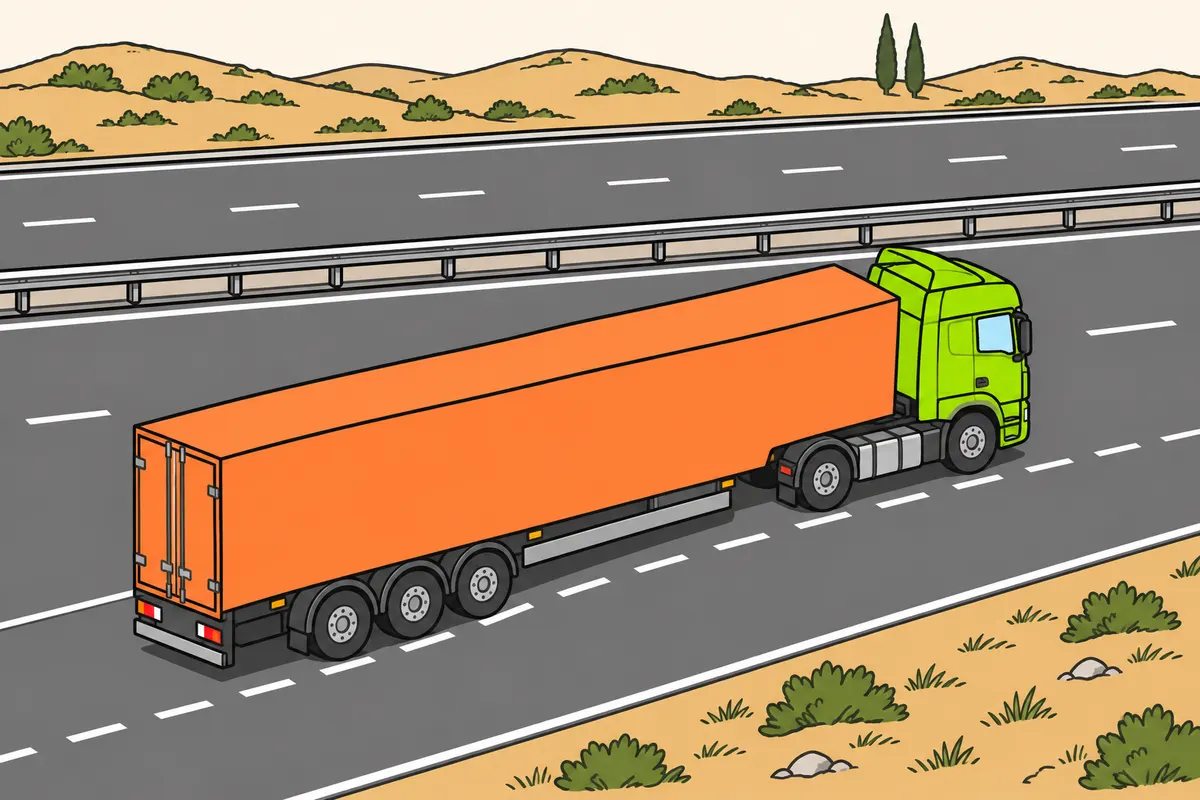
Choose a gap large enough to move your whole combination safely.
Remember
- Allow for your length and the acceleration available with your load.
- Move gradually.
- Check that your trailer is also within your chosen lane.
- Check priority and signalling in “Manoeuvres with goods vehicle combinations”.
- When joining traffic, keep observing until both units have fully joined.
Exam trap: Wrong: you check only that your cab fits. Right: find space for your whole combination.
Read the full explanation
- When joining traffic, bear in mind that the towing vehicle may enter the lane while the towed vehicle still occupies the access road; keep observing until both units have fully joined. For priority and signalling when joining traffic and changing lanes, consult “Manoeuvres with goods vehicle combinations”.
- Assess a gap early that accommodates your full length and the acceleration available with your load. Move the combination gradually and check that the towed vehicle also stays within your chosen lane.
15Overtaking: judge time and space
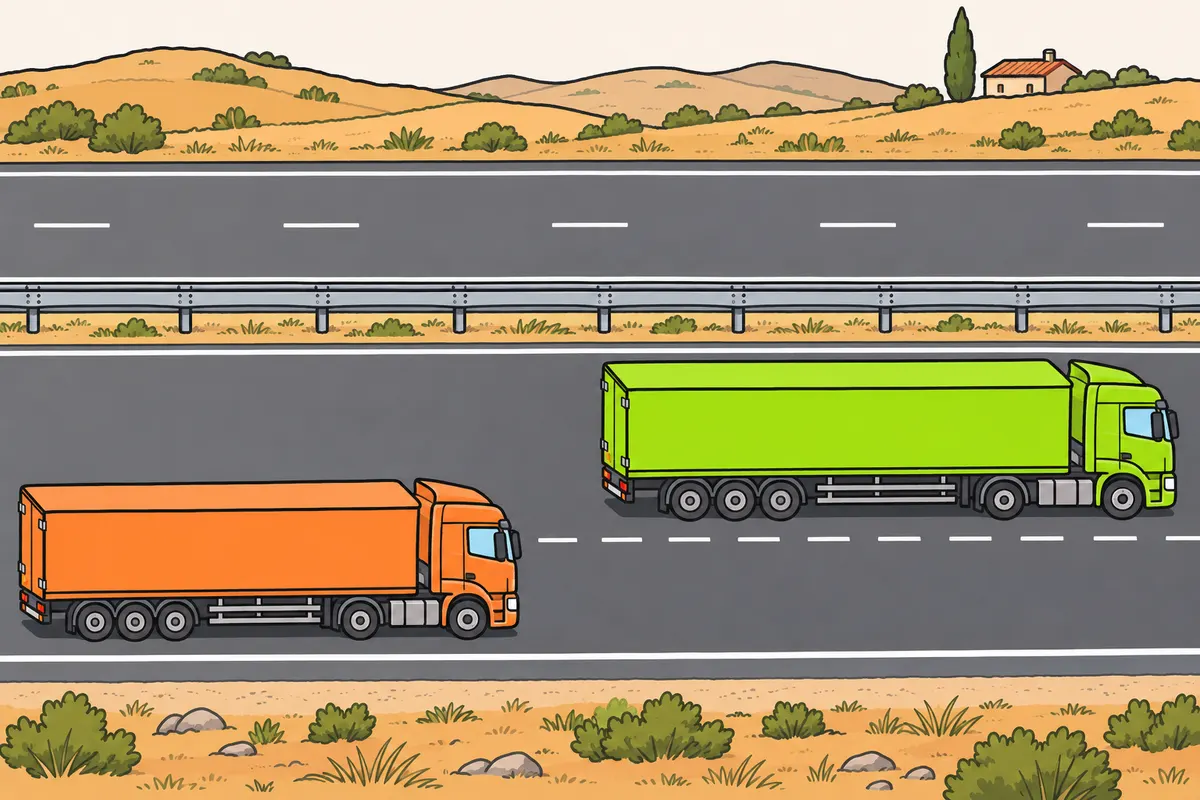
Overtake only when you can finish quickly, with enough space and within your limits.
Remember
- Allow for both vehicles’ lengths, the gradient and your acceleration with your load.
- Do not move close behind the vehicle ahead to look past its corner.
- Expect overtaking to take much longer when speeds are very similar.
- R-306: do not overtake any motor vehicle, even without entering opposing traffic’s space.
- Return gradually when your whole trailer has passed the other vehicle with a margin.
- Check other prohibitions and conditions in “Manoeuvres with goods vehicle combinations”.
Exam trap: Wrong: with R-306, you overtake a car without entering opposing traffic’s space. Right: R-306 prohibits you from overtaking any motor vehicle, including cars and motorcycles, even without entering the opposing side.
Read the full explanation
- Assess the length of both vehicles, the gradient and your acceleration with the load. Calculate the space needed until your rear end has passed, without moving close to the vehicle ahead to look round its corner.
- With two lorries whose limiters keep their speeds close to 90 km/h, a small speed difference makes overtaking take much longer: these are known as ‘elephant overtakes’. Start only if the difference allows you to complete the manoeuvre quickly within your limits and with enough space; the limiter does not guarantee that margin. [RD 1417/2005, art. 4](https://www.boe.es/buscar/act.php?id=BOE-A-2005-19990#a4). [RGC, art. 85](https://www.boe.es/buscar/act.php?id=BOE-A-2003-23514#a85).
- Check that your lorry is allowed to overtake on the stretch of road: sign R-306 prohibits you from overtaking any motor vehicle, including cars and motorcycles, even if you do not enter the opposite direction of travel. Consult the other prohibitions and conditions in “Manoeuvres with goods vehicle combinations”. [RD 465/2025, catalogue of signs, R-306](https://www.boe.es/buscar/doc.php?id=BOE-A-2025-12199).
- Before returning to your lane, check in your mirrors that the entire towed vehicle has passed the vehicle you are overtaking, and leave a margin before moving back gradually. [RGC, art. 85](https://www.boe.es/buscar/act.php?id=BOE-A-2003-23514#a85).
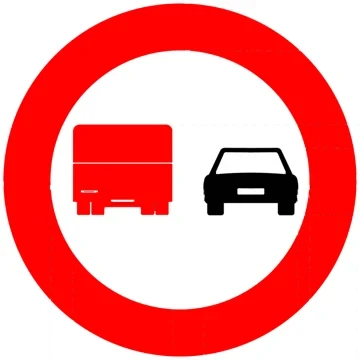 R-306
16Overtaking vulnerable road users
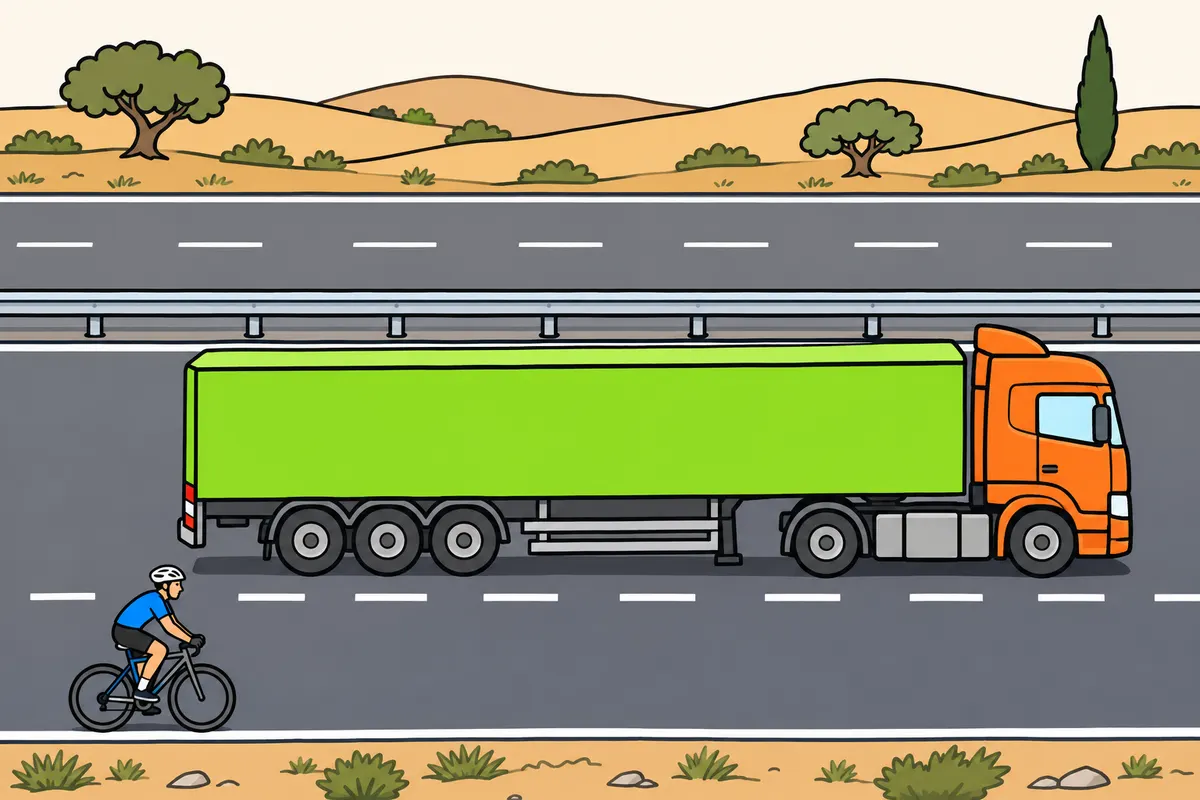
Keep your sideways clearance until your whole combination has passed the vulnerable road user.
Remember
- Check clearances, lane changes and speed reductions in “Manoeuvres with goods vehicle combinations”.
- Remember that air displaced by your combination can destabilise cyclists and motorcyclists.
- Do not cut in immediately in front of them.
Exam trap: Wrong: you return when only your cab has passed. Right: keep sideways clearance until your rear end has passed.
Read the full explanation
- Prepare to overtake a vulnerable road user along a steady path that also allows the towed vehicle to pass without coming too close alongside them. Consult the required clearances, lane change and speed reduction in “Manoeuvres with goods vehicle combinations”.
- Maintain lateral clearance until your rear end has passed: the air displaced by the combination can destabilise a cyclist or motorcyclist. Avoid cutting in immediately in front of them.
17When others overtake you
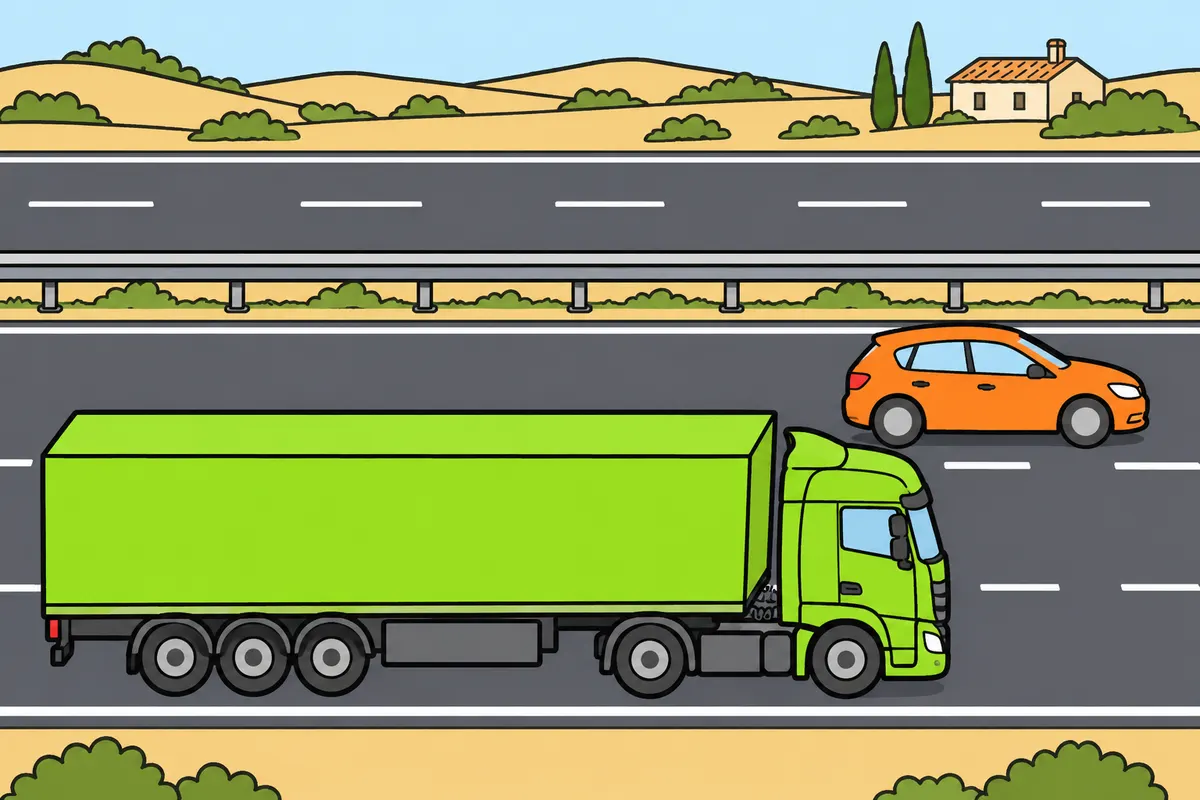
Help others overtake without routinely driving on the hard shoulder.
| Case: your vehicle above 3,500 kg | What you must do |
|---|---|
| Normal driving | Drive on the carriageway. |
| Emergency | You may use the hard shoulder for emergency reasons. |
| Oncoming traffic or carriageway width, profile or condition prevents easy, safe overtaking | Slow down or move onto a usable hard shoulder. |
Remember
- Keep a predictable path so your trailer stays clear of the overtaking vehicle.
- Above 3,500 kg, normally drive on the carriageway.
- Before using a usable hard shoulder, check its strength, width and continuity.
- Keep your trailer away from drops and other road users.
- Check your duties when being overtaken in “Manoeuvres with goods vehicle combinations”.
Exam trap: Wrong: you always use the hard shoulder to let others pass. Right: if oncoming traffic or the carriageway’s width, profile or condition prevents easy, safe overtaking, slow down or move onto a usable hard shoulder; if it is unusable, slow down.
Read the full explanation
- Maintain a predictable path when another vehicle travels alongside you, so that a steering correction by the towing vehicle does not bring the towed vehicle closer to it. Consult your obligations as the driver being overtaken in “Manoeuvres with goods vehicle combinations”.
- With a vehicle over 3,500 kg, you must drive on the carriageway; article 31.1 reserves use of the arcén (hard shoulder) for emergencies. Article 86.3 provides for the specific case of letting others pass: you must slow down or move onto a usable hard shoulder when oncoming traffic or the width, profile or condition of the carriageway prevents others from overtaking you easily and safely. [RGC, art. 31](https://www.boe.es/buscar/act.php?id=BOE-A-2003-23514#a31). [RGC, art. 86](https://www.boe.es/buscar/act.php?id=BOE-A-2003-23514#a86).
- In that specific case, check that the hard shoulder can support the combination and is sufficiently wide and continuous. Keep the towed vehicle away from changes in level and road users; if the hard shoulder is unusable, help others pass by slowing down in accordance with article 86.3. [RGC, art. 86](https://www.boe.es/buscar/act.php?id=BOE-A-2003-23514#a86).
18Descents: prepare to control your speed
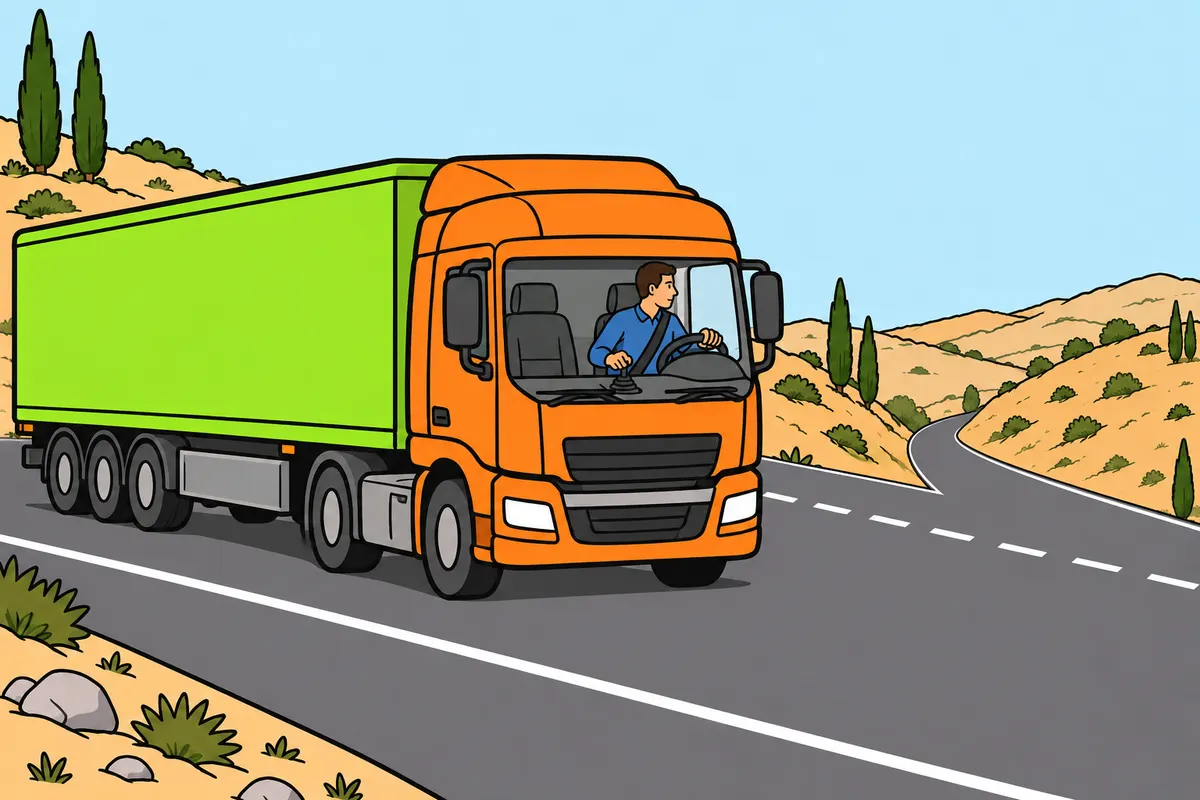
Prepare your speed and gear before starting a long descent.
Remember
- Before descending, assess the gradient and its length.
- Choose speed and gear to hold back your loaded combination throughout the descent.
- Check where you could stop safely.
- Check gears and brake overheating in “Trailer and vehicle combination braking”.
Exam trap: Wrong: you wait until you gain speed to prepare. Right: prepare your speed and gear before starting a long descent.
Read the full explanation
- Before starting a long descent, select a speed and gear ratio that allow you to hold back the loaded combination throughout the descent. Assess the gradient and its length before gravity increases your speed; also check where you can stop safely. For gear ratio selection and preventing brake overheating, consult “Trailer and vehicle combination braking”.
19Retarders: progressive use and limitations
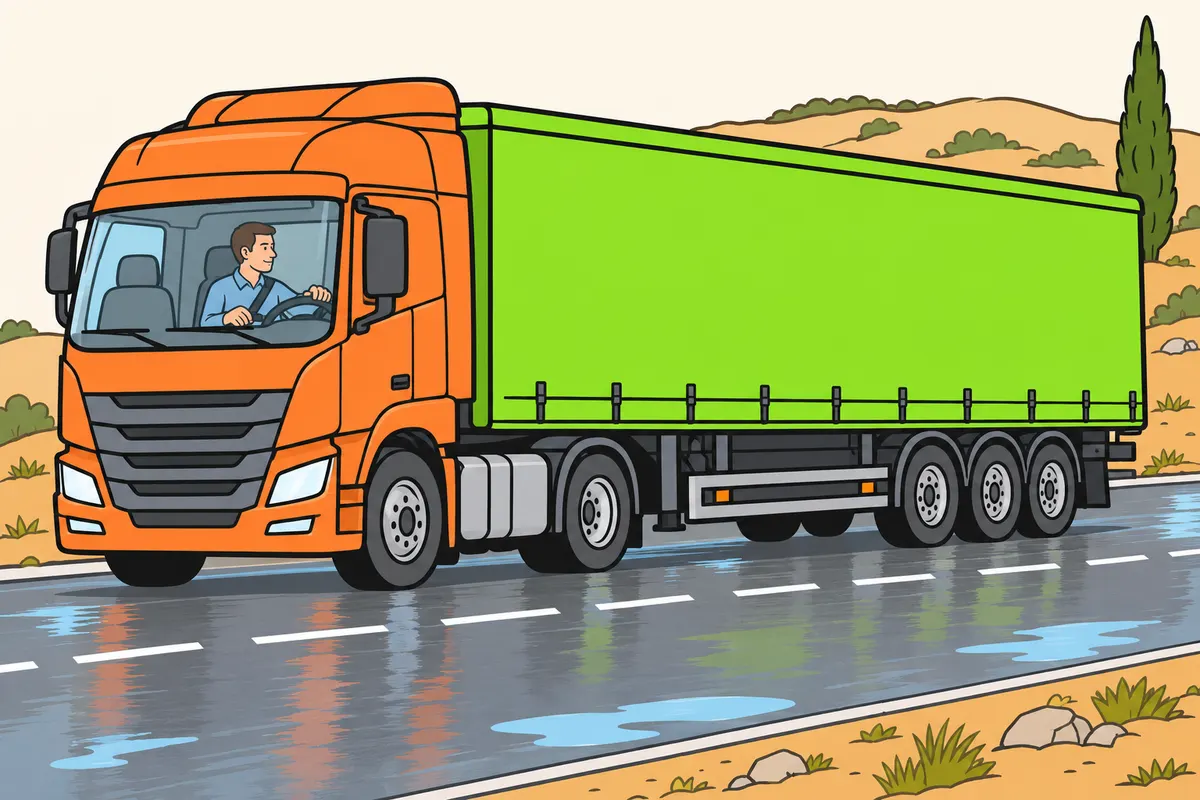
Use engine braking and retarders gradually, following grip limits and the manufacturer’s instructions.
Remember
- Apply engine braking or the retarder gradually.
- Follow the manufacturer’s instructions.
- Watch your combination’s response and grip on the axles where it acts.
- On slippery surfaces, excessive braking force can make your combination unstable.
- Check combined brake use in “Trailer and vehicle combination braking”.
Exam trap: Wrong: you use your retarder without considering grip. Right: check its limits and apply it gradually, following the manufacturer’s instructions.
Read the full explanation
- Apply the engine brake or retarder progressively, following the manufacturer's instructions, and monitor the combination's response and the grip of the axles on which it acts. On slippery surfaces, excessive braking force from these systems can destabilise the vehicle. See how they work and how to combine them with the service brake in «Trailer and vehicle combination braking».
20Rain, slippery surfaces and poor visibility
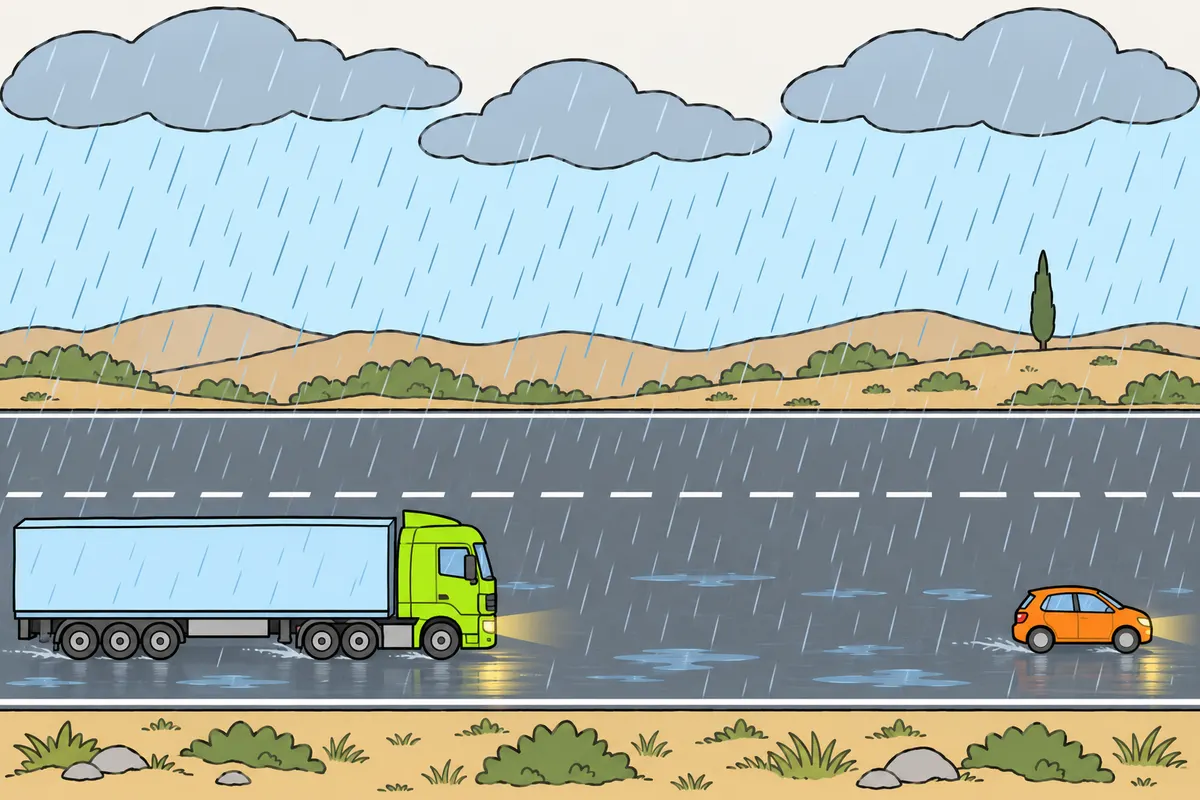
With poor grip or visibility, slow early and leave more space.
Remember
- In rain or on slippery surfaces, slow and increase separation before needing to brake.
- Avoid sudden acceleration, braking and steering.
- Prepare speed reductions on straight sections before bends.
- With poor visibility, adapt your speed and use the required lights.
- Do not move close to another vehicle to follow its lights.
- In snow, expect less space near the edge for your trailer’s axles.
Exam trap: Wrong: you rely on aids to maintain your dry-road pace. Right: slow down even without a sign warning of the dangerous surface.
Read the full explanation
- In rain or on slippery road surfaces, reduce your speed and increase your following distance before you need to brake. Avoid sudden acceleration, braking and steering, especially on wet road markings, metal covers or areas of standing water. You must adapt your driving even if no sign warns you of the dangerous road surface. [RGC, art. 46](https://www.boe.es/buscar/act.php?id=BOE-A-2003-23514#a46).
- You use grip both to brake and to change direction. If you demand too much of it at once, you can lose control; prepare to slow down on the straight and enter bends with a safety margin. Driver assistance systems do not allow you simply to maintain the pace you use on dry surfaces, nor do they compensate for unsuitable or defective tyres.
- In fog, heavy rain, dust or smoke, adjust your speed to the distance you can see and use the required lights. Do not move close to another vehicle to follow its lights: you reduce your reaction time and may reach the obstacle it has encountered. Keep checking your mirrors, access points and road markings. [RGC, art. 45](https://www.boe.es/buscar/act.php?id=BOE-A-2003-23514#a45).
- When snow makes driving difficult, anticipate that a build-up near the edge may reduce the usable space for the towed vehicle's axles. Maintain a path you can control without sudden corrections; see how to adapt your speed to these conditions in «Speed and distances for vehicle combinations».
21Reversing: check and protect
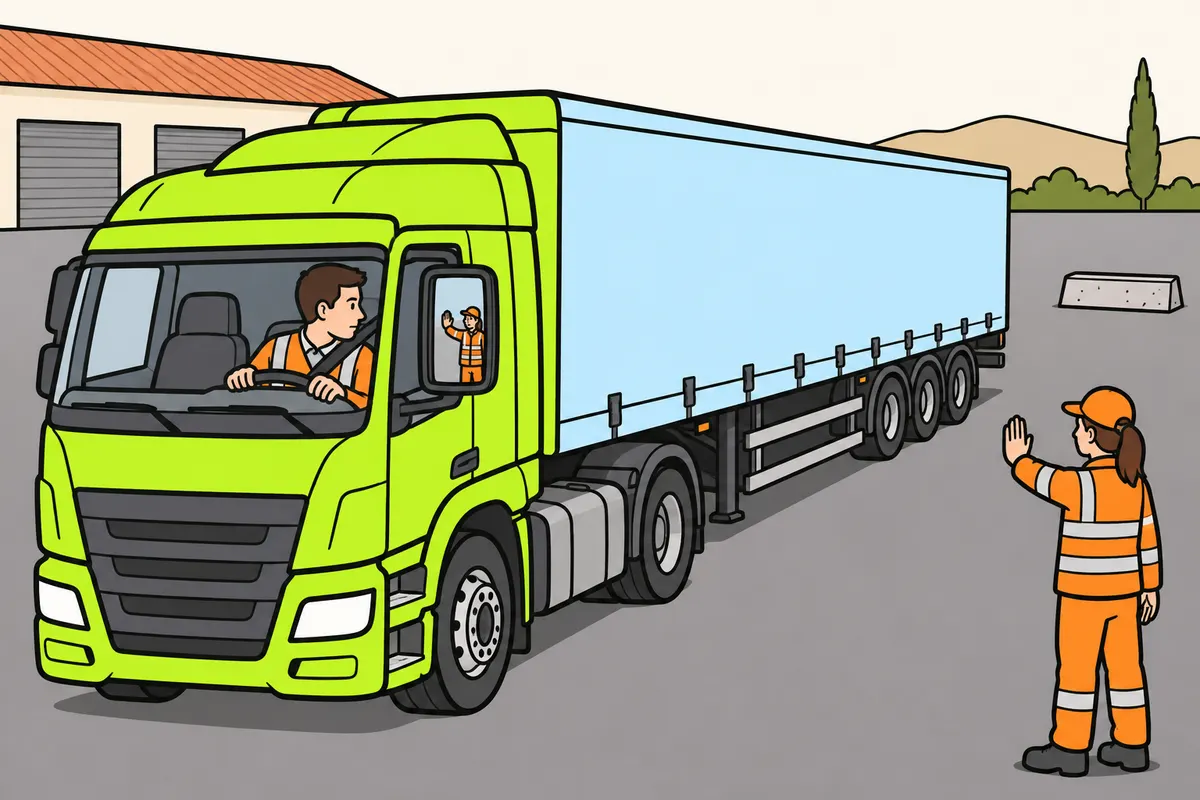
Reverse only when you can monitor the space and understand your guide’s signals.
Remember
- Before reversing, check your path, bodywork clearance and low obstacles.
- Check legal cases and limits in “Manoeuvres with goods vehicle combinations”.
- Agree clear signals with your guide.
- Keep your guide visible, outside your path and places where they could become trapped.
- Stop if you lose sight of them or do not understand their signal.
Exam trap: Wrong: you leave responsibility to your guide. Right: you remain responsible and must monitor the space.
Read the full explanation
- Before reversing, inspect the path of the axles and the space needed by the bodywork, including low obstacles that disappear from your mirrors as you approach. See the circumstances in which reversing is legally permitted and the legal limits in «Manoeuvres with goods vehicle combinations».
- If someone guides you, agree on clear signals and a visible position for them outside the vehicle's path and any areas where they could be trapped. Stop if you lose sight of them or do not understand a signal. Their help does not transfer your responsibility or allow you to move the combination into a space you cannot monitor and control.
22Reversing in a straight line
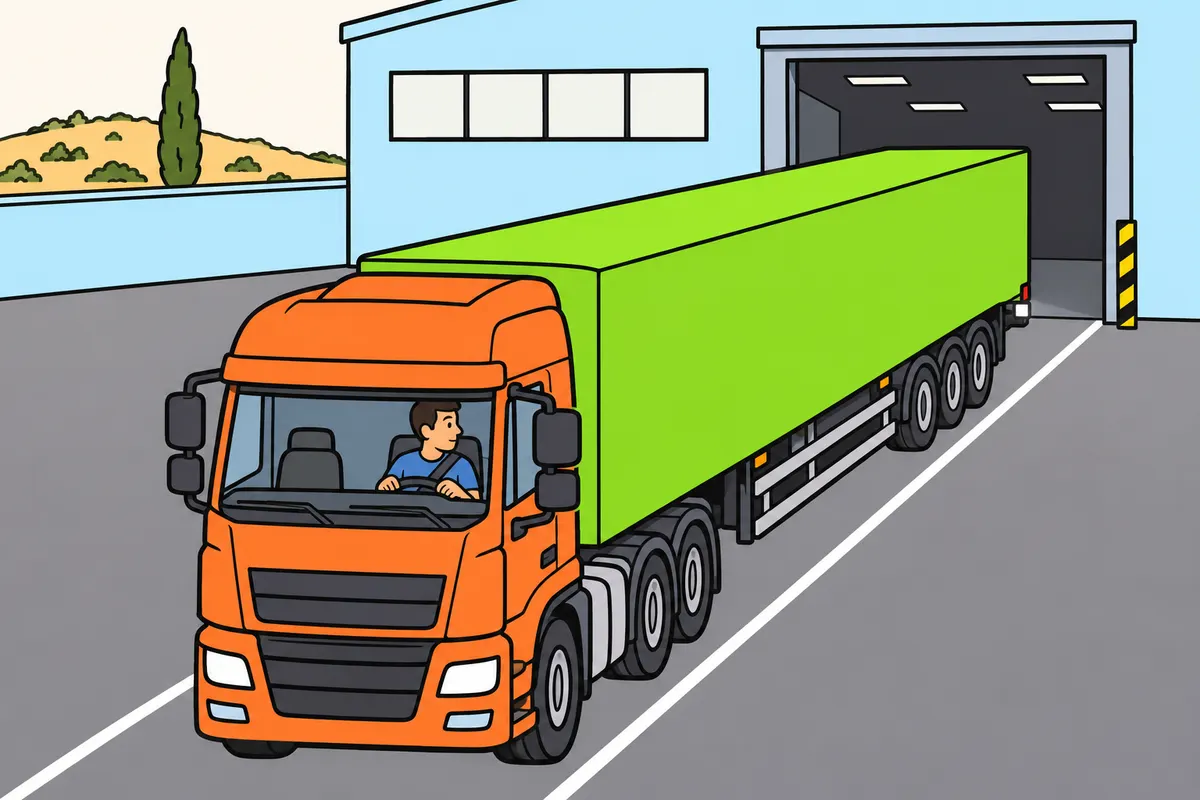
Reverse very slowly, checking both mirrors and making small corrections.
Remember
- Align your combination by moving forwards first, only where legal and safe.
- Check height, doors, loading bays and obstacles above and below.
- Compare your trailer’s sides with the boundaries in both mirrors.
- In a conventional articulated vehicle, wait for its response before adding more steering.
- If badly misaligned, stop; move forwards to correct only where permitted and safe.
- Monitor the angle between vehicles, connections and clearance from your cab.
Exam trap: Wrong: you steer sharply expecting an immediate response. Right: in a conventional articulated vehicle, make small corrections and watch their effect before steering further.
Read the full explanation
- Position yourself by moving forwards until the towing and towed vehicles are aligned with the space you intend to reverse into, provided you can do so legally and safely. Good initial positioning reduces later corrections. Also check height clearance, doors, loading bays and obstacles that may be above or below your usual view in the mirrors.
- Reverse at a very low speed, keeping reference points in both mirrors. Compare the position of the towed vehicle's sides with the edges of the passage and spot any deviation early. Do not focus solely on the mirror that gives you the best view of your destination: the other side may also be approaching an obstacle.
- In a conventional articulated vehicle, turning the tractor unit changes the articulation angle, with a delayed response from the semi-trailer. Make small corrections and observe their effect before turning the steering wheel further. Do not hold a large steering input while expecting an immediate response, as you may then find it difficult to restore alignment.
- If the alignment deteriorates significantly, stop and, if the location and manoeuvre allow it, move forwards to restore alignment before reversing again. Monitor the vehicle's articulation limits, the connections and the distance between the cab and semi-trailer. Excessive turning can cause damage even at a minimal speed.
23Reversing round a bend
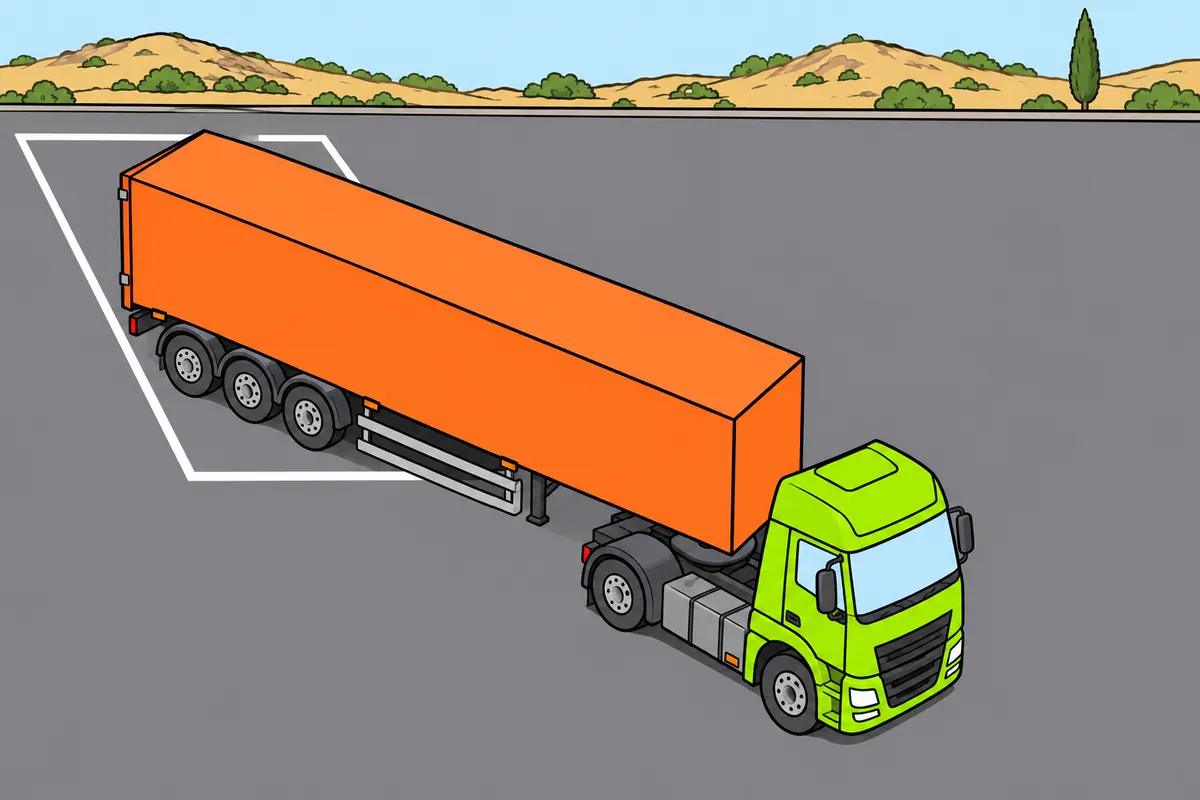
When reversing round bends, anticipate your path and adapt corrections to your combination.
| Your vehicle when reversing | Where you want the rear to go | What you need to do |
|---|---|---|
| Conventional articulated vehicle | Left | Start steering slightly right; then straighten and follow. |
| Conventional articulated vehicle | Right | Start steering slightly left; then straighten and follow. |
| Trailer with a pivoting front axle | Chosen side | Monitor drawbar and front axle; make small, early corrections. |
Remember
- Allow room for your rear end and your tractor unit on the opposite side.
- Watch inside the bend, your tractor unit’s movement and the hidden side.
- If you lack reliable reference points, stop and check or ask for guidance.
- Reduce the angle between vehicles before your trailer reaches its final direction.
- Practise with your combination in a suitable enclosed area.
Exam trap: Wrong: you apply semi-trailer reference points to every trailer. Right: adapt your corrections to its articulation points.
Read the full explanation
- First assess where the rear of the towed vehicle needs to go and how much space the towing vehicle needs on the opposite side. In an articulated vehicle, you need to create an articulation angle to start turning in reverse: you initially steer the tractor unit to move the rear of the semi-trailer towards the desired side, then follow and correct its path.
- As a guide for a conventional articulated vehicle, if you want to move the rear of the semi-trailer to the left, start with a small turn of the steering wheel to the right; to move it to the right, turn the wheel to the left. You must straighten up and follow its path in time to limit the angle. This guidance is not a universal procedure for trailers with different articulation arrangements.
- Monitor the inside of the bend, the area swept by the towing vehicle and the side that becomes harder to see. In general, positioning yourself to get a better direct view of the side towards your destination makes control easier, but never replaces checking the hidden side. If you lack reliable reference points, stop and check or ask for guidance.
- Before the towed vehicle reaches its final orientation, progressively reduce the articulation angle so that you finish aligned. If you wait until it has fully turned, the angle may continue to tighten and you may overshoot the intended path. Practise anticipating this with your combination in a suitable enclosed area; do not learn by improvising on a road in use.
- With a trailer that has a pivoting front axle, you must monitor both the angle of the drawbar relative to the lorry and the orientation of the front axle relative to the trailer. The response of these articulation points requires small, early corrections; start aligned and move forwards to restore alignment if the angles become too tight and you can do so safely. Do not automatically apply the steering guidance for a semi-trailer.
24Parking and securing on a slope
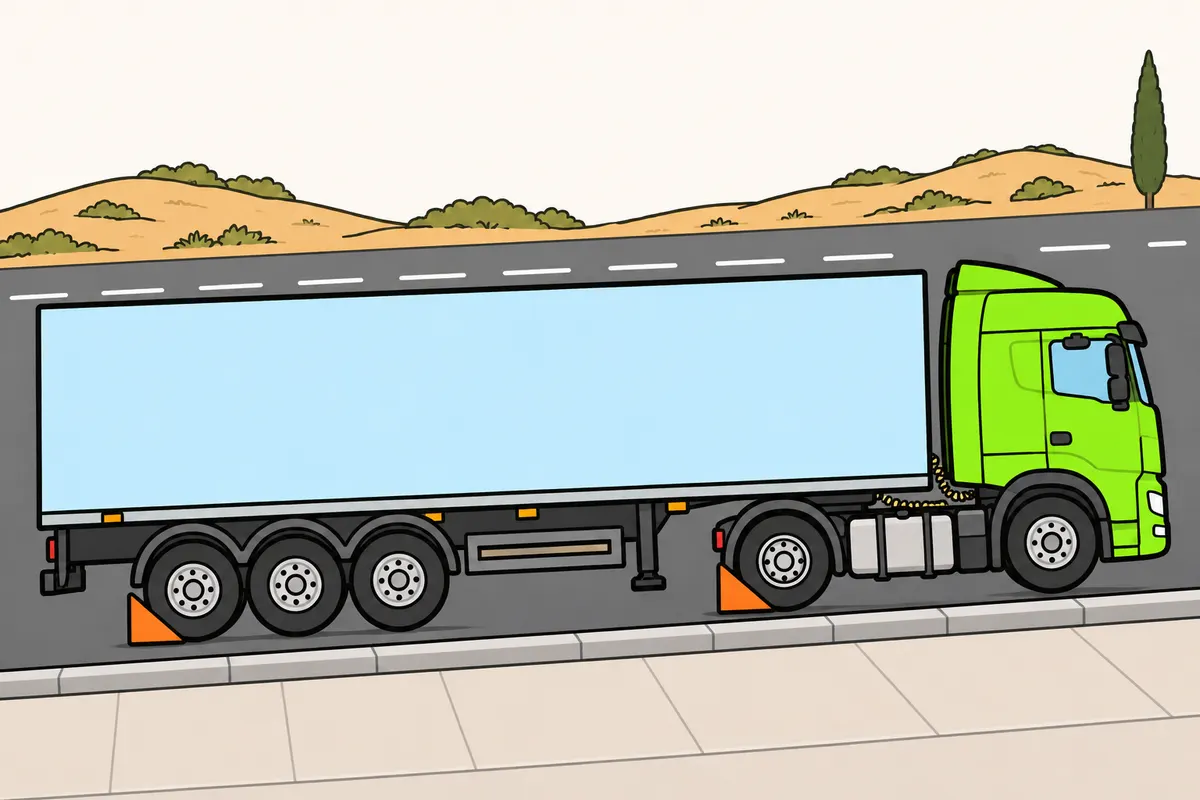
Choose firm ground with space to park your whole combination and leave afterwards.
Remember
- Leave space for your whole combination, overhangs and departure.
- Do not block access points or endanger other road users.
- Check ground firmness and slope before approaching.
- Check that the ground also supports your trailer’s axles and support legs.
- Check parking and securing on slopes in “Manoeuvres with goods vehicle combinations”.
Exam trap: Wrong: you choose ground because it supports your tractor unit. Right: check that it also supports your trailer’s axles and support legs.
Read the full explanation
- Choose a position that leaves room for the whole combination, its overhangs and your subsequent departure, without blocking access points or creating a danger for other road users. Assess the firmness of the ground and the slope before approaching: an area that supports the towing vehicle may be unsuitable for the towed vehicle's axles or supports. See the rules on parking and securing vehicles on slopes in «Manoeuvres with goods vehicle combinations».
25Practical test: manoeuvres G, K and M
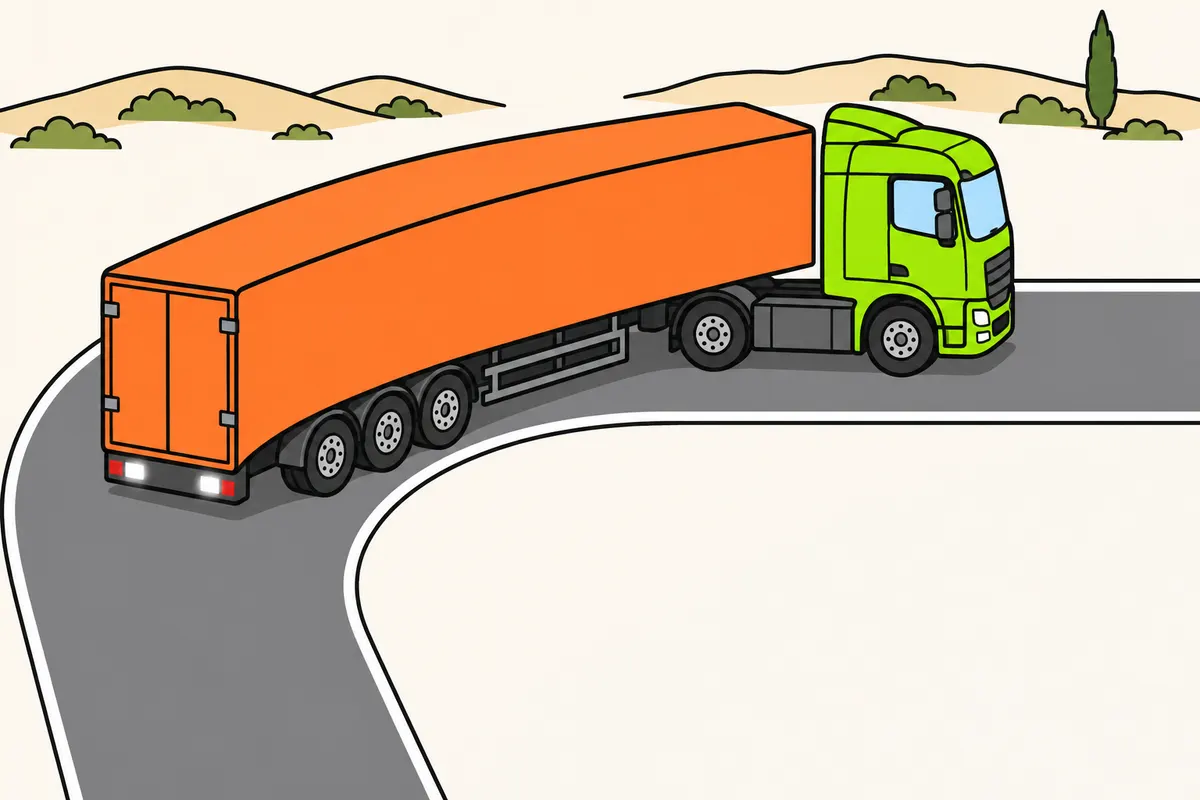
Prepare your licence’s manoeuvres without mixing up their conditions.
| Test or vehicle | What you need to distinguish |
|---|---|
| G for C+E | You reverse straight and round a bend. |
| K for C+E | You approach a loading platform. |
| M for C+E | You couple and uncouple; you may get out once during the reversing approach. |
| N for B+E | This is not part of your C+E test. |
| G with an articulated vehicle | You practise in a lane between 3.50 and 4.50 m wide. |
| G with a rigid lorry and trailer with a pivoting front axle | You practise in a lane 7 m wide. |
Remember
- In G, start at least 10 m before the bend and reverse steadily.
- After the bend, reverse at least another 10 m in a straight line.
- In G, do not stop or turn the steering while stationary.
- In G, avoid mounting kerbs, pressing against them, crossing boundaries or touching markers.
- In M, secure and detach your trailer; leave your tractor unit alongside.
- In M, move forwards again to face your trailer at least 10 m away.
Exam trap: Wrong: you make a forward correction in G with any articulated vehicle. Right: the allowance for one forward correction applies to combinations with a trailer with a pivoting front axle; do not generalise it.
Read the full explanation
- For C+E, you must carry out G, reversing in a straight line and round a bend; M, coupling and uncoupling; and K, approaching a loading platform safely. Preparation and the manoeuvres required for each licence are set out in Annex V.B.3; execution is described in Annex VI.C.4. [RGCond, Annex V.B.3](https://www.boe.es/buscar/act.php?id=BOE-A-2009-9481#anv). [RGCond, Annex VI.C.4](https://www.boe.es/buscar/act.php?id=BOE-A-2009-9481#anvi).
- In G, position the rear at least 10 m from the start of the bend, reverse along the straight section, follow the bend and continue for at least another 10 m along the final straight section. You must maintain a steady pace and keep the combination approximately centred. The layout simulates a right-hand or left-hand corner. [RGCond, Annex VI.C.4](https://www.boe.es/buscar/act.php?id=BOE-A-2009-9481#anvi).
- The bend in G has an angle of approximately 90° and a minimum radius of 3.50 m. For articulated vehicles, the annex specifies a lane width between 3.50 and 4.50 m; for a rigid vehicle with a trailer with a pivoting front axle, 7 m. Practise with the specific configuration and dimensions of your test area. [RGCond, Annex VI.C.4](https://www.boe.es/buscar/act.php?id=BOE-A-2009-9481#anvi).
- In G, you must not mount or push against the kerb, drive any wheel onto or beyond the lane boundaries, touch boundary markers, stop during the manoeuvre or turn the steering wheel while the vehicle is stationary. The annex allows one forward correction for combinations with a trailer with a pivoting front axle; do not assume this is allowed for every articulated vehicle. [RGCond, Annex VI.C.4](https://www.boe.es/buscar/act.php?id=BOE-A-2009-9481#anvi). Manoeuvre N, parking safely for loading or unloading in B+E, is not part of the C+E manoeuvres; do not confuse its conditions with those of G or K. [RGCond, Annex V.B.3](https://www.boe.es/buscar/act.php?id=BOE-A-2009-9481#anv).
- In M, you must immobilise and uncouple the towed vehicle, leave the towing vehicle alongside it and drive forwards again until you face it at a distance of at least 10 m before approaching in reverse. The annex allows you to get out once during this approach to make checks. The technical procedure for connections, locking and supports is covered in «Safe coupling and uncoupling». [RGCond, Annex VI.C.4](https://www.boe.es/buscar/act.php?id=BOE-A-2009-9481#anvi).
26Approaching a loading bay and manoeuvre K
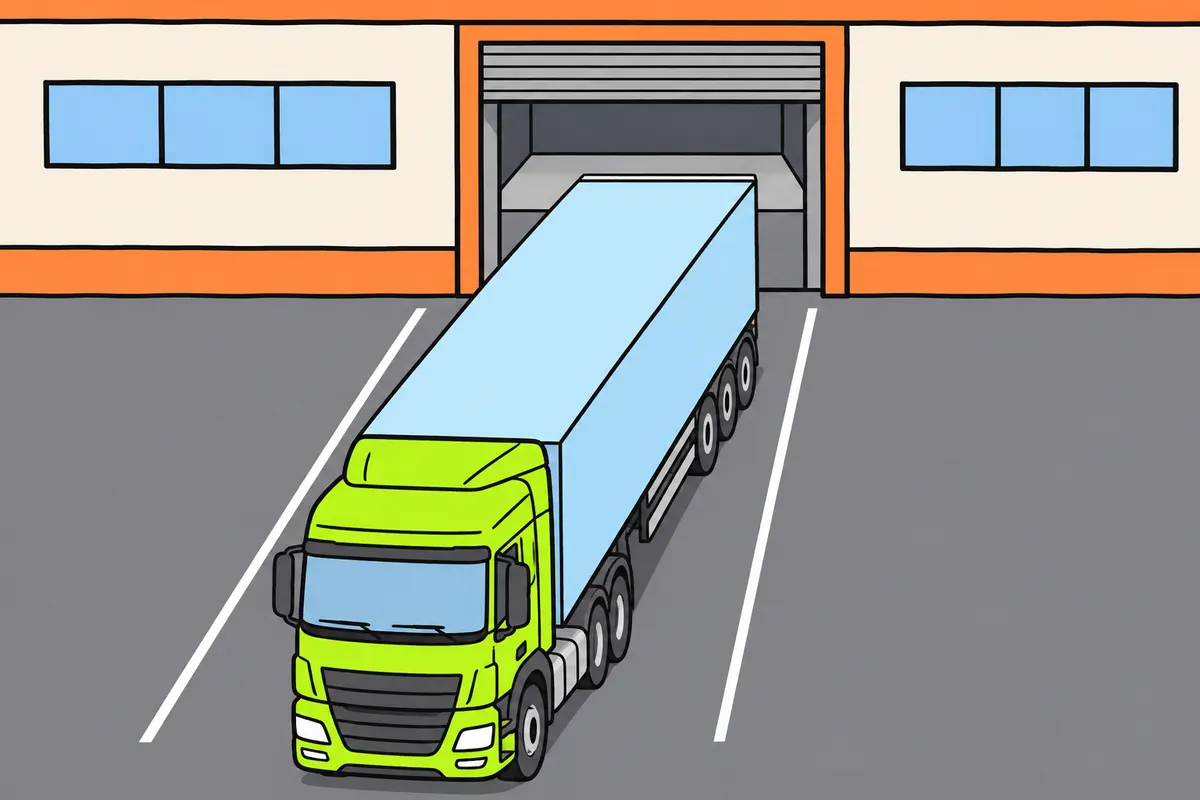
Approach the loading bay slowly, keeping your combination centred without touching the platform.
Remember
- Position your combination centrally and at right angles to the platform.
- Check nobody is between your vehicle and bay, and no obstacles surround your path.
- Reverse slowly and steadily, watching both sides.
- In K, you may get out once during approach; secure your vehicle first.
- At work, secure your combination before operations and follow the required procedures.
- Before leaving, check operations have finished and secure doors and equipment.
Exam trap: Wrong: you touch the bay to stop. Right: in K, finish centred, no more than 0.60 m away, without touching; do not let anyone stand between them to measure.
Read the full explanation
- Prepare your approach with the combination centred and perpendicular to the platform. Check that there is nobody between the vehicle and the loading bay and no obstacles in the swept area. Move slowly and steadily, using reference points on both sides so that you do not bring one corner of the body close while the other remains far away.
- In manoeuvre K, you must start with the rear of the body at least 10 m from the ramp or platform. Reverse until the load compartment is centred and no more than 0.60 m away, without touching the installation. Do not confuse this distance with those for other manoeuvres or licences. [RGCond, Annex VI.C.4](https://www.boe.es/buscar/act.php?id=BOE-A-2009-9481#anvi).
- During the approach in K, you may get out once to carry out the necessary checks. You must secure the vehicle before leaving the driving position. The prescribed layout provides for a platform 3.50 m wide and 1.20 m high, and a lane at least 25 m long and 6 m wide. [RGCond, Annex VI.C.4](https://www.boe.es/buscar/act.php?id=BOE-A-2009-9481#anvi).
- In actual work, immobilise the combination before starting operations and follow the procedures for the site and the vehicle. Do not use contact with the loading bay to stop, or allow anyone to stand between the two to measure the distance. Before moving off, check that operations are complete, the surrounding area is clear and the doors and equipment are secured.
Turning with the whole combination
Anticipate the path of the inner wheels and outward swing before turning the steering wheel.
- Check the exit, mirrors and areas you cannot see.
- Slow down before the turn and assess the path of the axles, bodywork and overhangs.
- Signal and check priority before taking up the space you need.
- Turn progressively, watching both sides.
- Maintain control until the rear end has passed; stop if you lose your safety margin.
Reversing round a bend in a real manoeuvre
Position the combination, create the articulation angle and straighten up with small movements.
- Check that you may legally reverse and limit the distance.
- Inspect the destination and swept path; arrange assistance if visibility is insufficient.
- Set up your starting position and gradually create the angle you need.
- Watch both sides and follow the turn without making the articulation angle too sharp.
- Stop if you lose your reference points or someone appears; pull forwards to correct your position if this is permitted and safe.
- Straighten up before reaching the destination and secure the combination.
Check what you know
Real questions from the bank on this topic. Pick an answer to see the explanation.
Finished this module?
Mark it as read and you will see your progress on the theory list.