
Theory · AM Licence - Moped · Module 13 of 18
Passengers and loads on a moped
You learn to check who can accompany you on your moped and how to carry luggage without compromising control. You answer questions about children, seats, masses, projections, the V-20 panel and trailers, distinguishing narrow mopeds from light quadricycles.
1Seats, documents and authorised mass
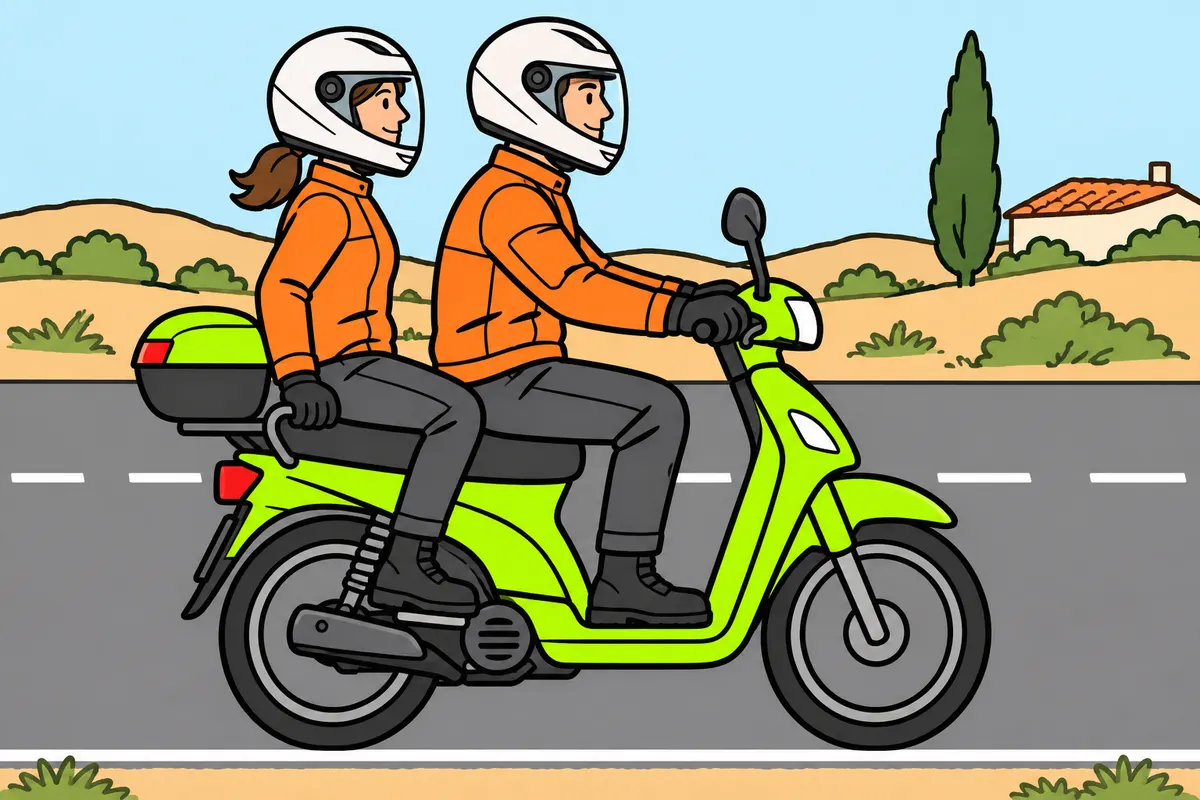
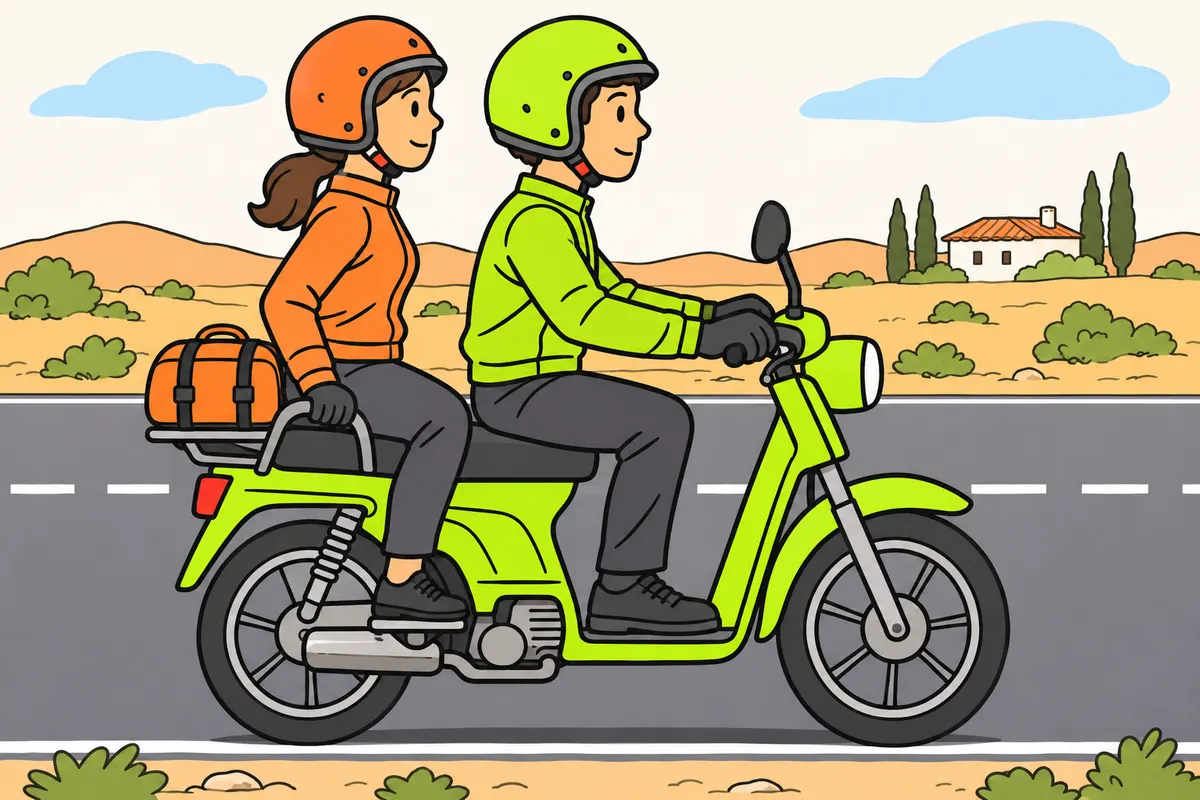
You can carry passengers and luggage only within the authorised limits.
Remember
- Count your seat and every passenger's seat, including children's seats.
- Check passenger authorisation on your moped's vehicle registration certificate.
- Your AM licence allows you to drive.
- Carry passengers only when you meet the vehicle and passenger requirements.
- Respect the maximum weight, including people, luggage and accessories.
- Check the weight limits of your top box and its supports too.
Exam trap: Wrong: an empty seat lets you add any luggage. Right: you must also respect the maximum authorised weight.
Read the full explanation
- You must respect the authorised number of seats, including your own: with one seat you travel alone, and with two you can carry a passenger if you meet the requirements. A child also occupies a seat. [RGC, art. 9](https://www.boe.es/buscar/act.php?id=BOE-A-2003-23514#a9).
- To carry a passenger on your moped, its licencia or permiso de circulación (vehicle registration certificate) must state that this is permitted. Your AM licence proves your entitlement to drive. [RGC, art. 12.1](https://www.boe.es/buscar/act.php?id=BOE-A-2003-23514#a12).
- You can obtain an AM licence at 15 and carry a passenger when the vehicle and passenger transport requirements are met. [RGCond, art. 4.2](https://www.boe.es/buscar/act.php?id=BOE-A-2009-9481#a4). [RGC, art. 12](https://www.boe.es/buscar/act.php?id=BOE-A-2003-23514#a12).
- You must respect the maximum authorised mass, including people, luggage and accessories: an empty seat does not guarantee spare load capacity. [RGC, art. 9](https://www.boe.es/buscar/act.php?id=BOE-A-2003-23514#a9).
- As practical advice, check the permitted load of the top box and its mounting brackets in the accessory manufacturer’s instructions. When preparing your luggage, take account of the capacity of each installed component and its conditions of use: available space in the top box does not mean its anchorages can support any weight.
2General passenger age requirement
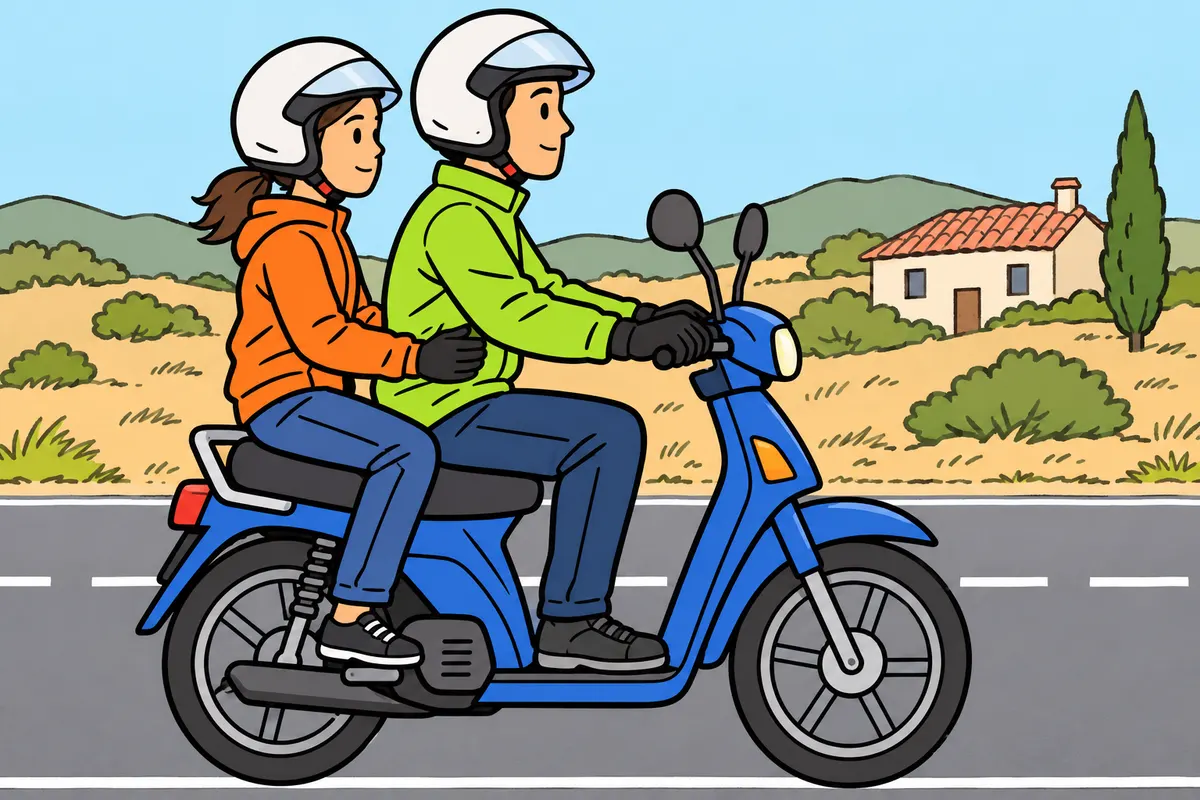
Generally, you can carry passengers over twelve years old if you meet the other requirements.
Remember
- Check your passenger's age separately from your own.
- Also meet the vehicle authorisation, seating position and protection requirements.
Exam trap: Wrong: meeting the age requirement is enough. Right: also meet the vehicle authorisation, seating position and protection requirements.
Read the full explanation
- As a general rule, you can carry a passenger over twelve years old, subject to the vehicle authorisation, seating position and protection requirements explained in this module. You check the passenger’s age separately from your age as an AM licence holder. [RGC, art. 12.1](https://www.boe.es/buscar/act.php?id=BOE-A-2003-23514#a12).
3Children and the family exception
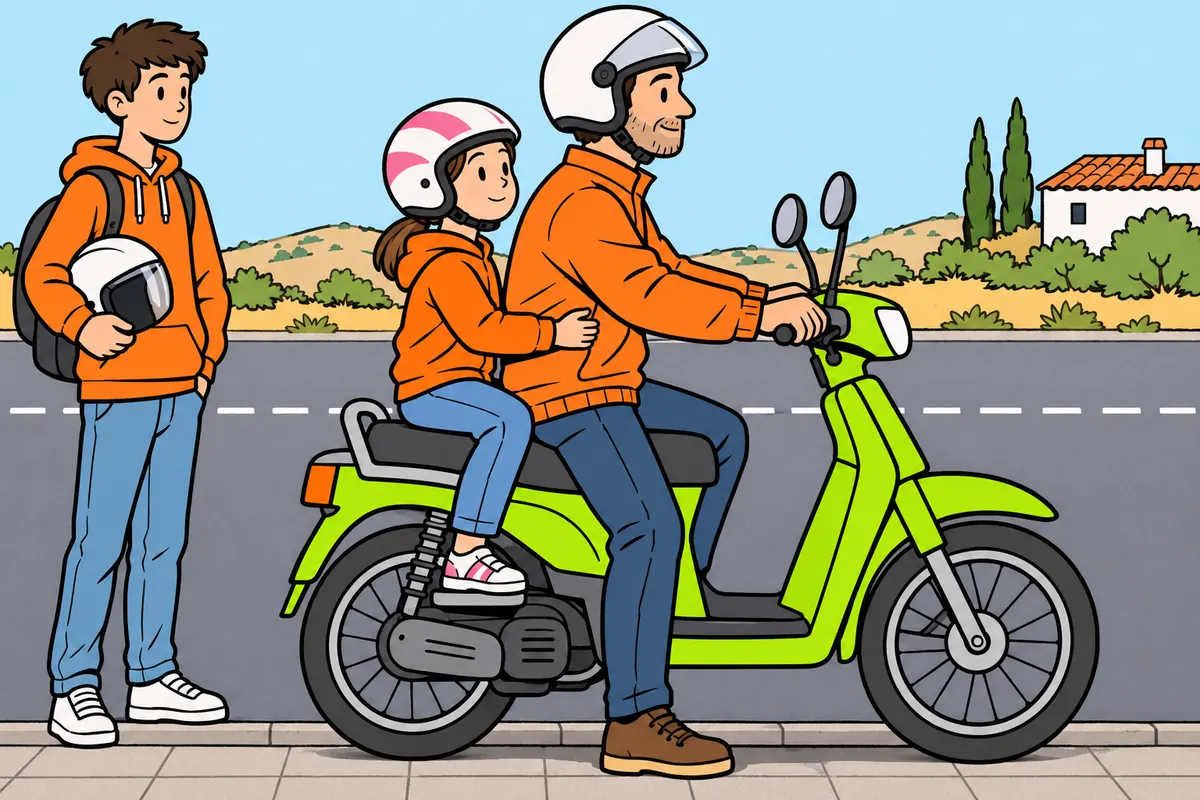
You can carry children over seven under the family exception if you meet its conditions.
Remember
- You can use the exception if you are their parent or guardian.
- You also qualify as an adult authorised by their parent or guardian.
- Also meet the seat, seating position and protection requirements.
Exam trap: Wrong: at 16, family permission is enough for you as a friend. Right: you must be their parent or guardian, or an adult authorised by them. The child must be over seven. Also meet the requirements in “Passenger seat and seating position” and “Protection for both occupants”.
Read the full explanation
- As an exception, you can carry a child over seven years old if you are their father, mother or guardian, or an adult authorised by them. You must also meet the seat and seating position requirements in “Passenger seat and seating position” and the protection requirements in “Protection for both occupants”. [RGC, art. 12.2](https://www.boe.es/buscar/act.php?id=BOE-A-2003-23514#a12). [Ley de Tráfico (Traffic Act), art. 13.5](https://www.boe.es/buscar/act.php?id=BOE-A-2015-11722#a13).
- At 16, being a friend authorised by the family does not allow you to use the exception reserved for authorised adults. [RGC, art. 12.2](https://www.boe.es/buscar/act.php?id=BOE-A-2003-23514#a12).
4Passenger seat and seating position
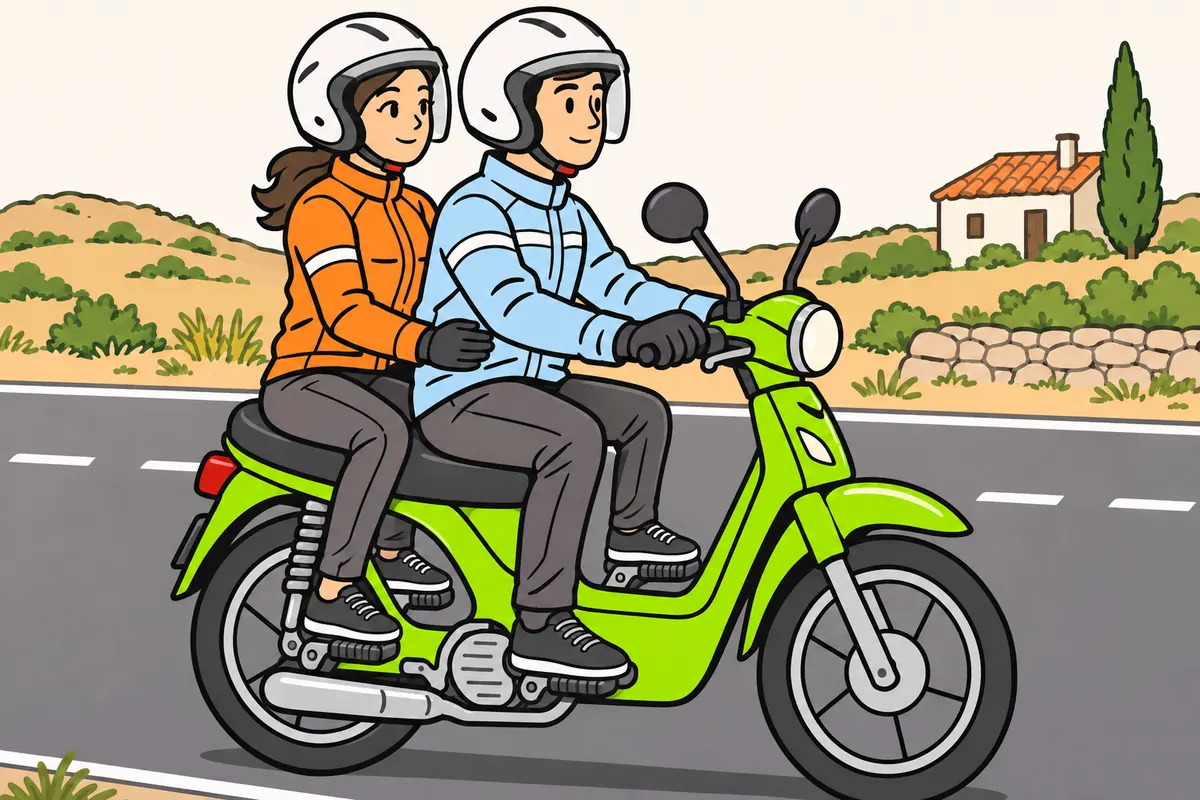
On your two-wheeled moped, your passenger must sit behind you.
Remember
- Carry your passenger on their seat, never between you and the handlebars.
- Check they sit with a leg on each side.
- Require them to keep their feet on the side footrests.
- Do not turn a luggage rack into a seat by adding a cushion.
Exam trap: Wrong: meeting the age requirement allows feet to hang unsupported. Right: your passenger must keep their feet on the footrests and use the required seating position.
Read the full explanation
- On a two-wheeled moped, you must carry your passenger on their seat behind you, never between your body and the handlebars. [RGC, art. 12.1](https://www.boe.es/buscar/act.php?id=BOE-A-2003-23514#a12).
- The passenger must sit astride, with one leg on each side and their feet supported on the side footrests throughout the journey, even if they meet the age requirement. [RGC, art. 12.1](https://www.boe.es/buscar/act.php?id=BOE-A-2003-23514#a12).
- You and your passenger must occupy the places designed and equipped for you; you cannot turn the luggage rack into a seat by adding a cushion. [RGC, art. 10](https://www.boe.es/buscar/act.php?id=BOE-A-2003-23514#a10).
5Protection for both occupants
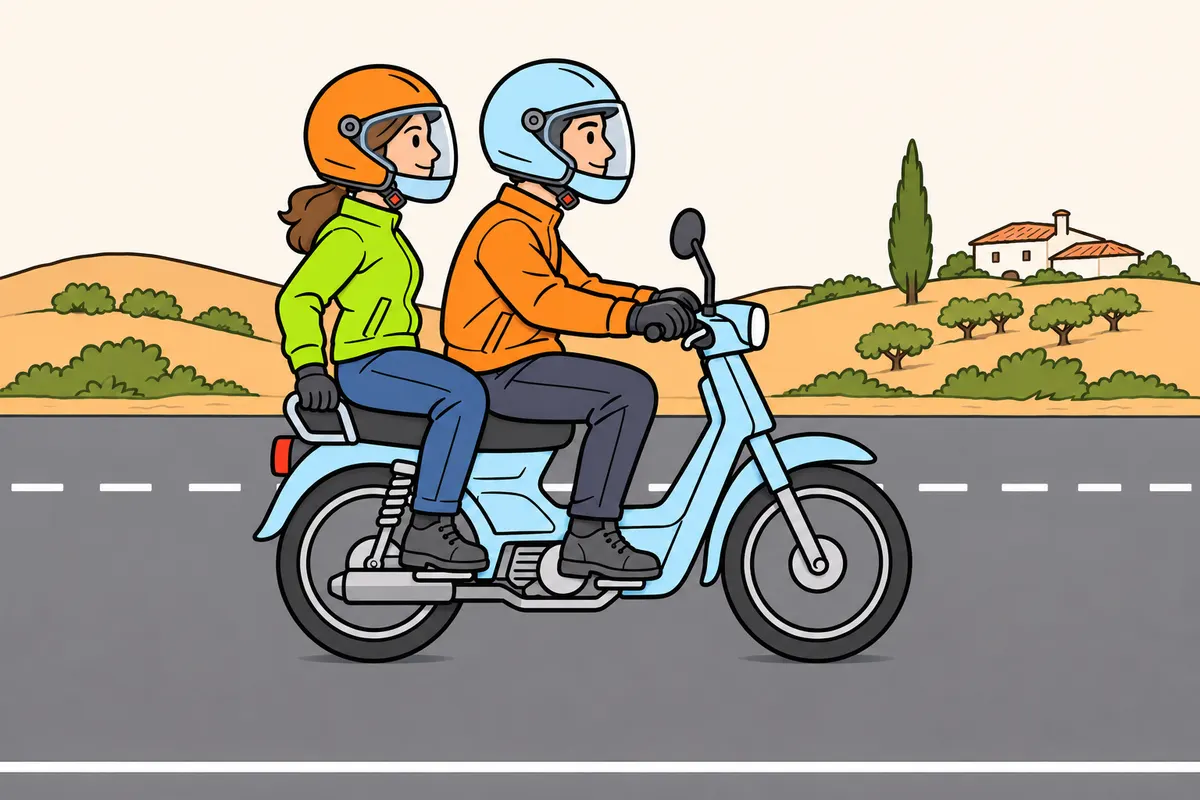
You and your passenger must wear the protection required for your vehicle and road.
| Vehicle case | Protection for you and your passenger |
|---|---|
| No applicable exemption | Helmet and closed footwear on every road; also protective gloves on interurban roads |
| Protective structure and seat belts recorded on the ITV card or certificate of characteristics | Seat belts on every road; exempt from helmets, gloves and closed footwear |
Remember
- Wear a properly fastened UNECE R22 approved helmet; check your passenger's helmet too.
- You can use certified protective helmets for one year from 1 October 2026.
- Wear closed footwear covering your whole foot on every road, unless exempt.
- On interurban roads, also wear protective gloves, unless exempt.
- Check your passenger meets the same requirements.
- With a documented protective structure and seat belts, use the belts on every road.
Exam trap: Wrong: seat belts alone give you an exemption. Right: you also need a protective structure, with both recorded on the ITV card or certificate of characteristics. Use the seat belts on every road.
Read the full explanation
- You and your passenger must wear helmets approved under UNECE Regulation R22 and properly fastened on every road, unless an applicable exemption applies. [RGC, art. 118](https://www.boe.es/buscar/act.php?id=BOE-A-2003-23514#a118).
- You can use certified protective helmets on a moped for one year from 1 October 2026. Consult “Protective equipment for moped riders”. [RD 518/2026, First Transitional Provision and Third Final Provision](https://www.boe.es/buscar/doc.php?id=BOE-A-2026-13889).
- You and your passenger must wear closed footwear covering the whole foot on every road and protective gloves on interurban roads, unless an applicable exemption applies. [RGC, art. 118](https://www.boe.es/buscar/act.php?id=BOE-A-2003-23514#a118).
- If the vehicle has a protective structure and seat belts, and this is recorded on its ITV (vehicle roadworthiness test) card or certificate of characteristics, you must use those seat belts on every road and are exempt from wearing helmets, gloves and closed footwear. You study equipment selection and adjustment in the “Protective equipment for moped riders” module. [RGC, art. 118](https://www.boe.es/buscar/act.php?id=BOE-A-2003-23514#a118).
6Passengers in light quadricycles
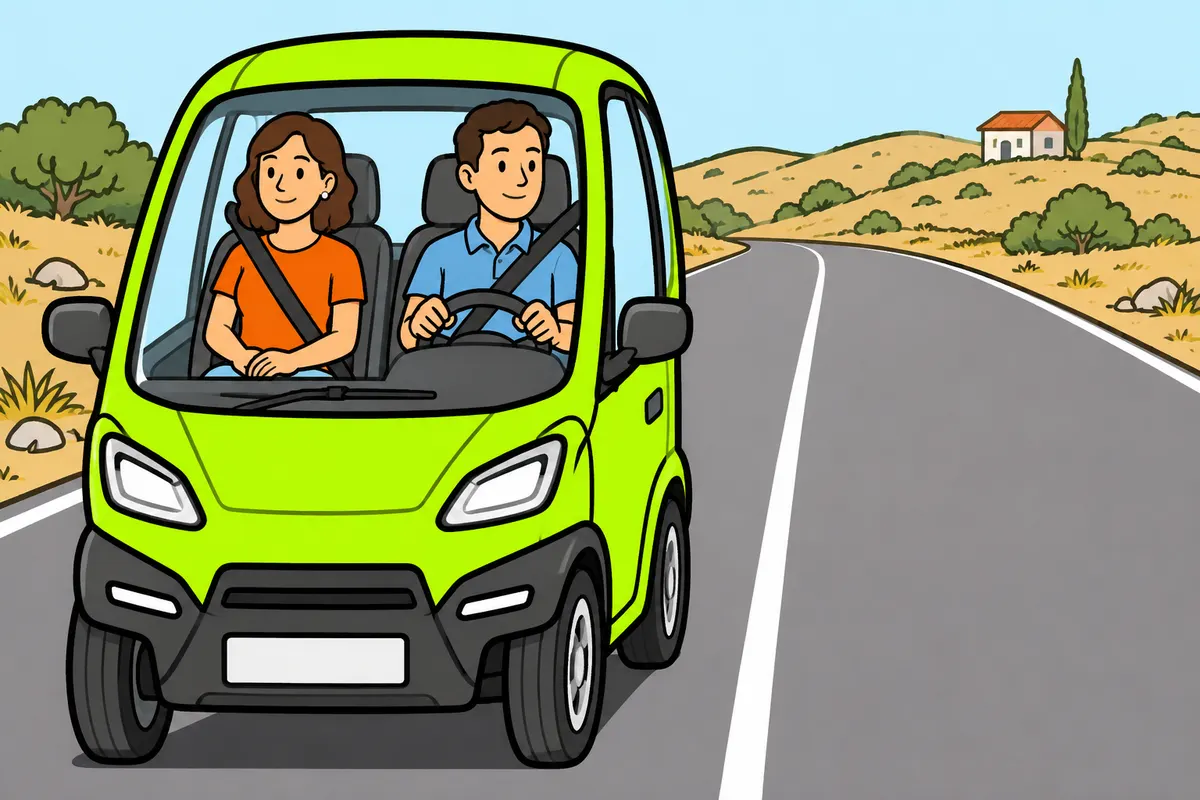
In your quadricycle's passenger compartment, everyone needs an authorised seat and the required restraint.
| Quadricycle with passenger compartment: child up to 135 cm | Permitted seat with child restraint |
|---|---|
| General rule | Rear seat |
| No rear seats | You can use the front seat |
| All rear seats occupied by children up to 135 cm | You can use the front seat |
| Impossible to fit all restraint systems in the rear | You can use the front seat |
Remember
- Check your quadricycle's authorised seats and their layout.
- For children up to 135 cm, use approved restraints suited to height and weight.
- Fit the restraint following the manufacturer's instructions.
- Seat the child behind you, except in the cases shown in the table.
- If you fit a rear-facing restraint in front, deactivate the front airbag.
Exam trap: Wrong: you can always choose the front seat. Right: for children up to 135 cm in quadricycles with a passenger compartment, use a rear seat except in the cases shown. Use an approved child restraint suited to height and weight.
Read the full explanation
- If you drive a light quadricycle, you must identify its seats and their actual layout. Your passenger must occupy the conventional seat in their authorised seating position inside the passenger compartment. [RGC, art. 10](https://www.boe.es/buscar/act.php?id=BOE-A-2003-23514#a10).
- If you carry a child 135 cm tall or shorter in a quadricycle with a passenger compartment, you must use an approved child restraint system suited to their height and weight. They must occupy a rear seat; they can occupy the front seat if the vehicle has no rear seats, if all rear seats are occupied by children of that height, or if it is impossible to install all the restraint systems in them. If you install a rear-facing system in the front, you must deactivate the front airbag. Install the system according to the manufacturer’s instructions, which state in which vehicles and how you can use it safely. [RGC, art. 117.1, 3 and 4](https://www.boe.es/buscar/act.php?id=BOE-A-2003-23514#a117).
7Getting on and off safely
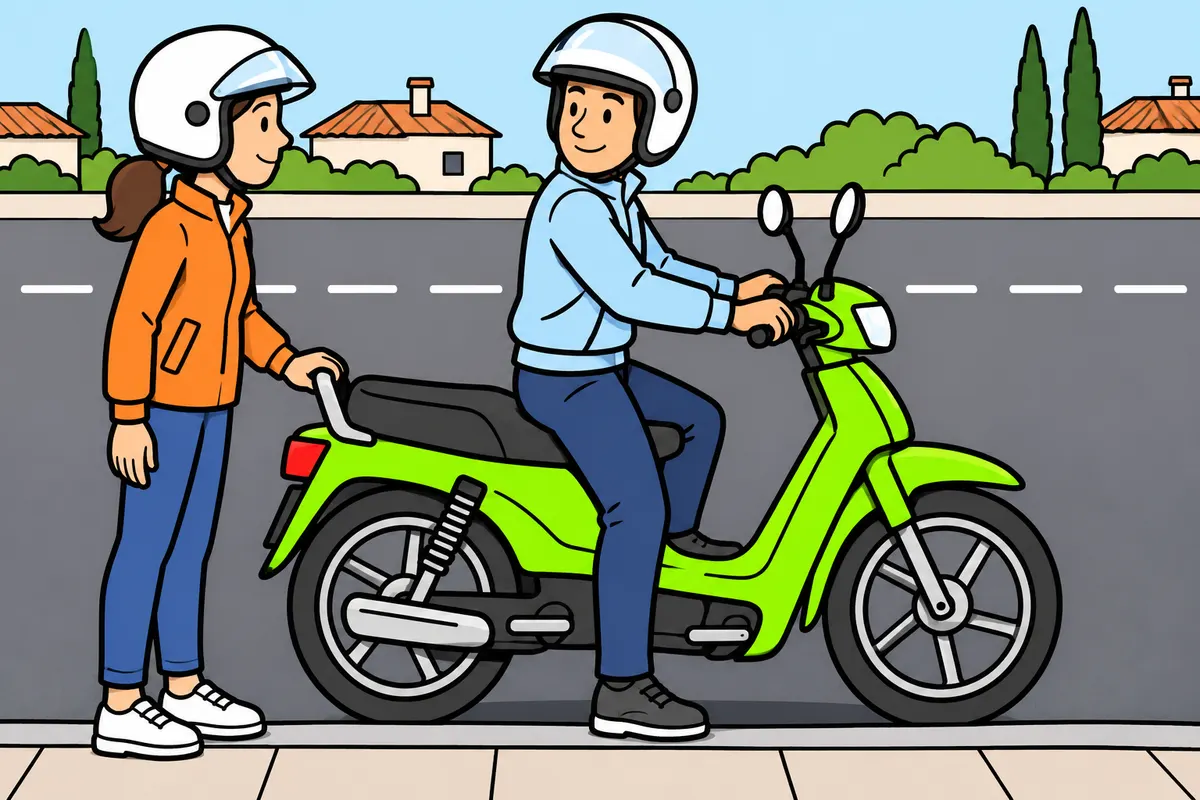
Allow people to get on or off only when stopped and without creating danger.
Remember
- Stop completely before allowing anyone to get on, get off or open doors.
- Generally, use the side nearest the edge of the road.
- Check you cause no danger or obstruction; wait for traffic to pass.
- Agree when your passenger gets on or off, and keep your moped stable.
- Set off when you are both correctly seated; keep doors closed while moving.
- Before opening a door, also check for cyclists approaching on that side.
Exam trap: Wrong: checking traffic ahead is enough before opening a door. Right: also check the door's side, especially for an approaching cyclist.
Read the full explanation
- You must only allow people to get on or off when the vehicle is stationary. As a general rule, you must use the side nearest the edge of the road and check that this does not create danger or obstruct other road users; waiting for traffic to pass forms part of this check. [RGC, art. 114](https://www.boe.es/buscar/act.php?id=BOE-A-2003-23514#a114).
- As practical guidance, agree with your passenger when to get on or off and keep the moped stable; set off with both of you correctly positioned.
- If the quadricycle has doors, you must keep them closed while moving and open them only when the vehicle is completely stationary. Before opening a door or getting out, you must check that you do not create danger, particularly for a cyclist approaching on that side; checking only traffic ahead is insufficient. [RGC, art. 114](https://www.boe.es/buscar/act.php?id=BOE-A-2003-23514#a114).
8Load placement, visibility and animals
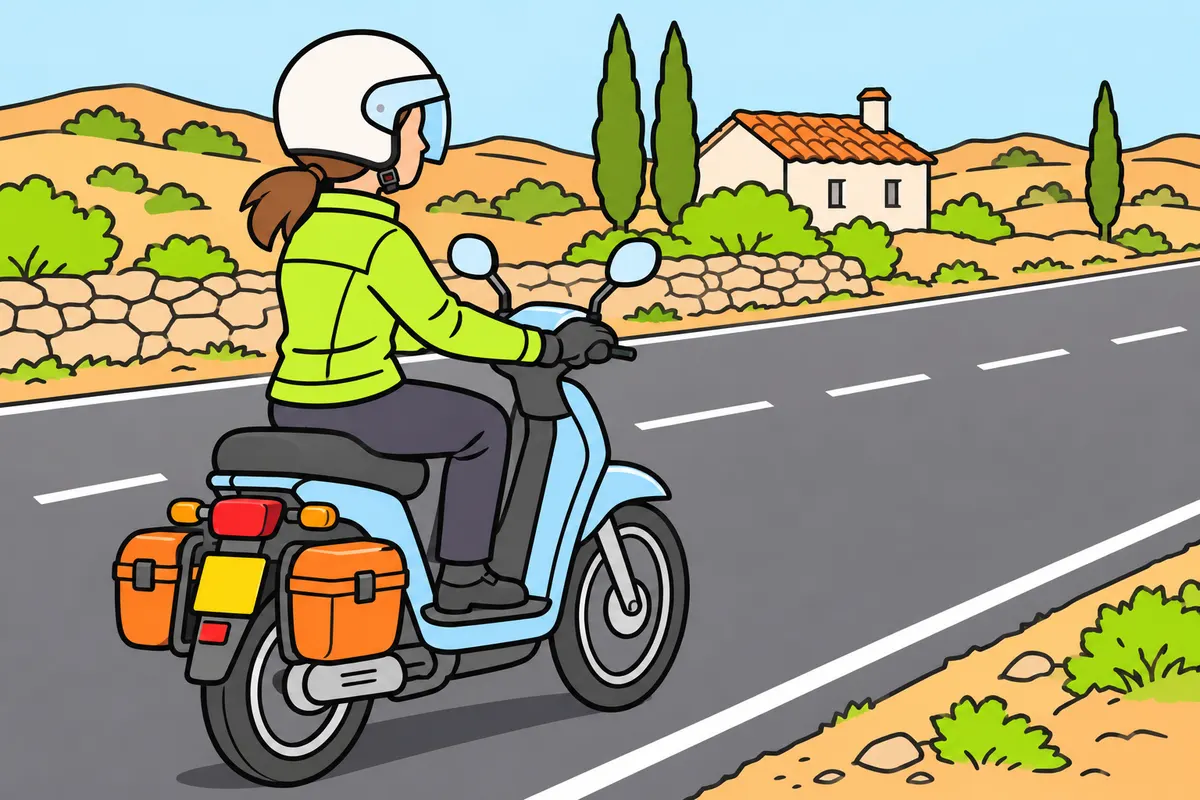
Position your load and animals so you keep balance, visibility and control.
Remember
- Balance weight between both sides; avoid placing it high or far from the centre.
- Use compatible, securely fitted luggage racks, top boxes or panniers within their limits.
- Keep your handlebars, controls and movements clear.
- In your quadricycle, protect occupants from objects that could fly forwards.
- Do not cover lights, number plates, compulsory markings or your arm signals.
- Use a suitable, secure animal carrier; prevent interference with you or danger to anyone.
Exam trap: Wrong: a gap between seats protects any item. Right: if your vehicle allows people and loads together, you must maintain the protection required for that load.
Read the full explanation
- You must distribute and, where necessary, secure the load so that it cannot compromise stability. On a moped, as practical guidance, balance the weight between both sides and avoid concentrating it unnecessarily high up or far from the vehicle’s centre, following the locations and limits specified by the manufacturer. [RGC, art. 14](https://www.boe.es/buscar/act.php?id=BOE-A-2003-23514#a14).
- Use a compatible, properly secured luggage rack, top box or panniers as a practical transport solution. You must keep the steering and control area free of swinging bags and objects that interfere with the throttle, brakes or movement, preserving your freedom of movement and control. [RGC, art. 18](https://www.boe.es/buscar/act.php?id=BOE-A-2003-23514#a18). [RGC, art. 14](https://www.boe.es/buscar/act.php?id=BOE-A-2003-23514#a14).
- In a quadricycle with a load compartment, you must position objects so that they do not obstruct occupants or injure them if thrown forwards. If the vehicle is authorised to carry people and loads together, you must maintain the adequate protection required for that load; a gap between seats does not guarantee that an item is protected. [RGC, art. 10](https://www.boe.es/buscar/act.php?id=BOE-A-2003-23514#a10). [RGC, art. 14](https://www.boe.es/buscar/act.php?id=BOE-A-2003-23514#a14).
- Your load and accessories must not obscure lights, light signals, the number plate, compulsory identification markings or arm signals. [RGC, art. 14](https://www.boe.es/buscar/act.php?id=BOE-A-2003-23514#a14). [RGC, art. 18](https://www.boe.es/buscar/act.php?id=BOE-A-2003-23514#a18).
- If you transport an animal, you must position it so that it does not interfere with you or compromise the safety of occupants or other road users. As a recommendation, use a compatible, securely fastened system in a suitable space so that it remains in place throughout the journey. [RGC, art. 18](https://www.boe.es/buscar/act.php?id=BOE-A-2003-23514#a18).
9Securing and effectively covering the load
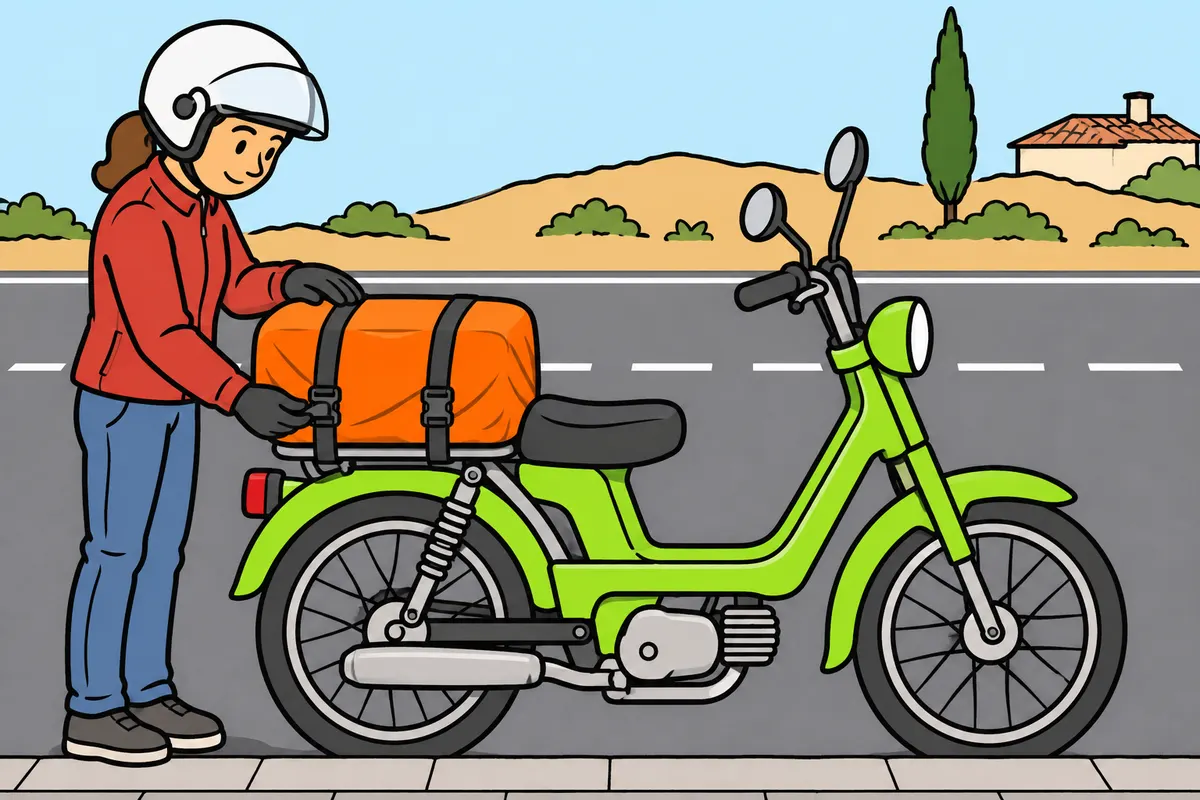
Secure your load so it cannot fall, drag or move dangerously.
Remember
- Check the container, supports, straps and fastenings.
- Keep loose ends away from wheels and moving parts.
- Completely and effectively cover materials that produce dust or could fall out.
- Avoid unnecessary noise, dust and other nuisance.
- Also follow specific rules for materials causing nuisance, harm, health risks or danger.
Exam trap: Wrong: small containers avoid the rules for dangerous materials. Right: you must follow those rules even with small containers and on a moped.
Read the full explanation
- You must arrange the load and its accessories and, if necessary, secure them so that they cannot fall, drag along the ground or shift dangerously. Also check the container and its anchorages. [RGC, art. 14](https://www.boe.es/buscar/act.php?id=BOE-A-2003-23514#a14).
- As a practical check, make sure straps are tight, fastenings work and no loose ends remain near wheels or moving parts. [RGC, art. 14](https://www.boe.es/buscar/act.php?id=BOE-A-2003-23514#a14).
- If you transport materials that produce dust or can fall out, you must cover them completely and effectively. [RGC, art. 14](https://www.boe.es/buscar/act.php?id=BOE-A-2003-23514#a14).
- You must avoid noise, dust and other avoidable nuisance from the load. You must also comply with the specific rules for materials that cause nuisance or are harmful, unhealthy or dangerous, even when the container is small or you transport them on a moped. [RGC, art. 14](https://www.boe.es/buscar/act.php?id=BOE-A-2003-23514#a14).
10Dimensions and protection of projections
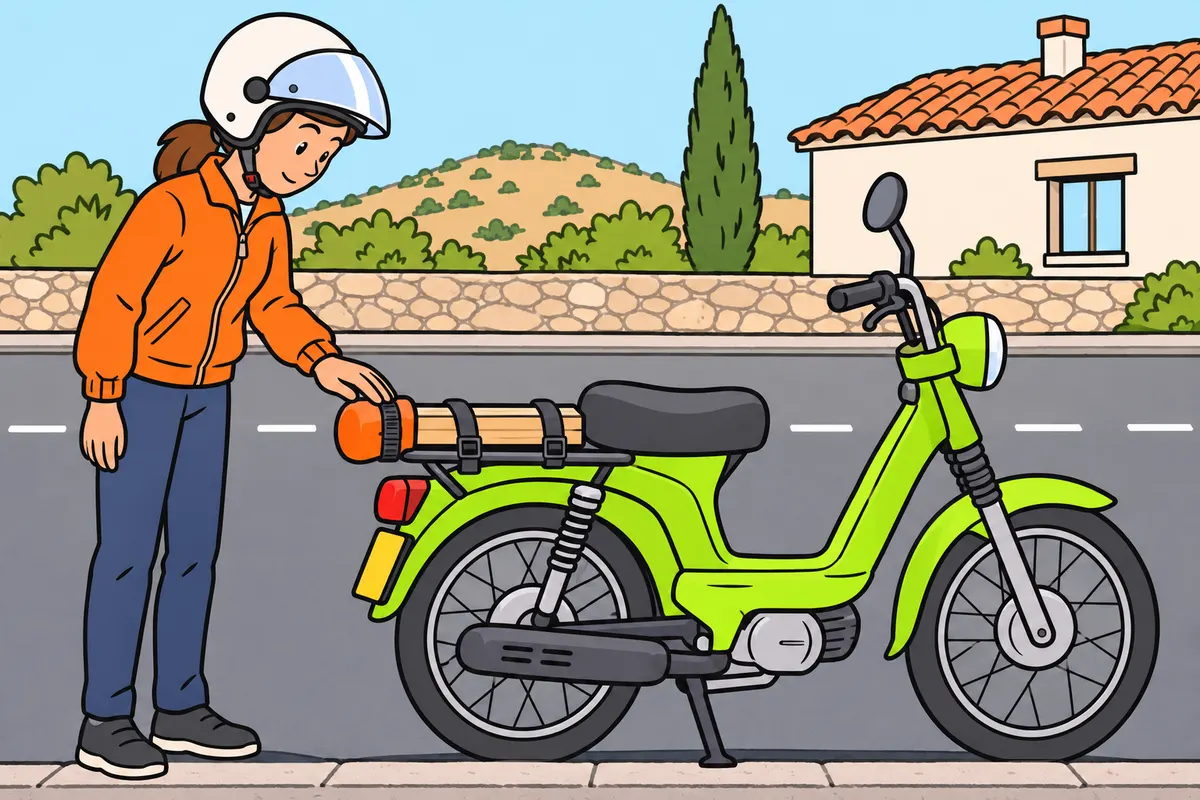
Check your loaded vehicle's overall dimensions and how far its load sticks out.
Remember
- Respect vehicle and road limits for length, width and height.
- Generally, keep your load inside the vehicle's outline when viewed from above.
- Only let loads stick out in permitted cases and within permitted limits.
- You need supplementary authorisation if an indivisible load inevitably exceeds general dimension limits.
- Protect permitted ends sticking out, especially rigid or sharp parts.
- Secure that protection too.
Exam trap: Wrong: meeting the projection limit allows any total height or width. Right: also respect the loaded vehicle's overall dimensions and road limits.
Read the full explanation
- The overall dimensions of the laden vehicle and the distance an object projects beyond the vehicle are different measurements. The length, width and height of the combination must comply with both vehicle rules and road restrictions; meeting a permitted projection limit does not allow you to ignore these other limits. [RGC, art. 13](https://www.boe.es/buscar/act.php?id=BOE-A-2003-23514#a13).
- The plan view is the outline occupied by the vehicle when seen from above. As a general rule, you must keep the load within this outline; you can only allow it to project in the cases and within the measurements specified in article 15. [RGC, art. 15](https://www.boe.es/buscar/act.php?id=BOE-A-2003-23514#a15). [RGC, art. 13](https://www.boe.es/buscar/act.php?id=BOE-A-2003-23514#a13).
- If an indivisible load inevitably exceeds the general dimensional limits, you need the corresponding supplementary authorisation to transport it. [RGC, art. 13](https://www.boe.es/buscar/act.php?id=BOE-A-2003-23514#a13).
- If the load projects within the permitted limits, you must protect its end to reduce the consequences of a scrape or collision and prevent harm to other road users. As practical guidance, cover rigid or sharp parts and secure that protection too. [RGC, art. 15.5](https://www.boe.es/buscar/act.php?id=BOE-A-2003-23514#a15).
11Mopeds less than one metre wide
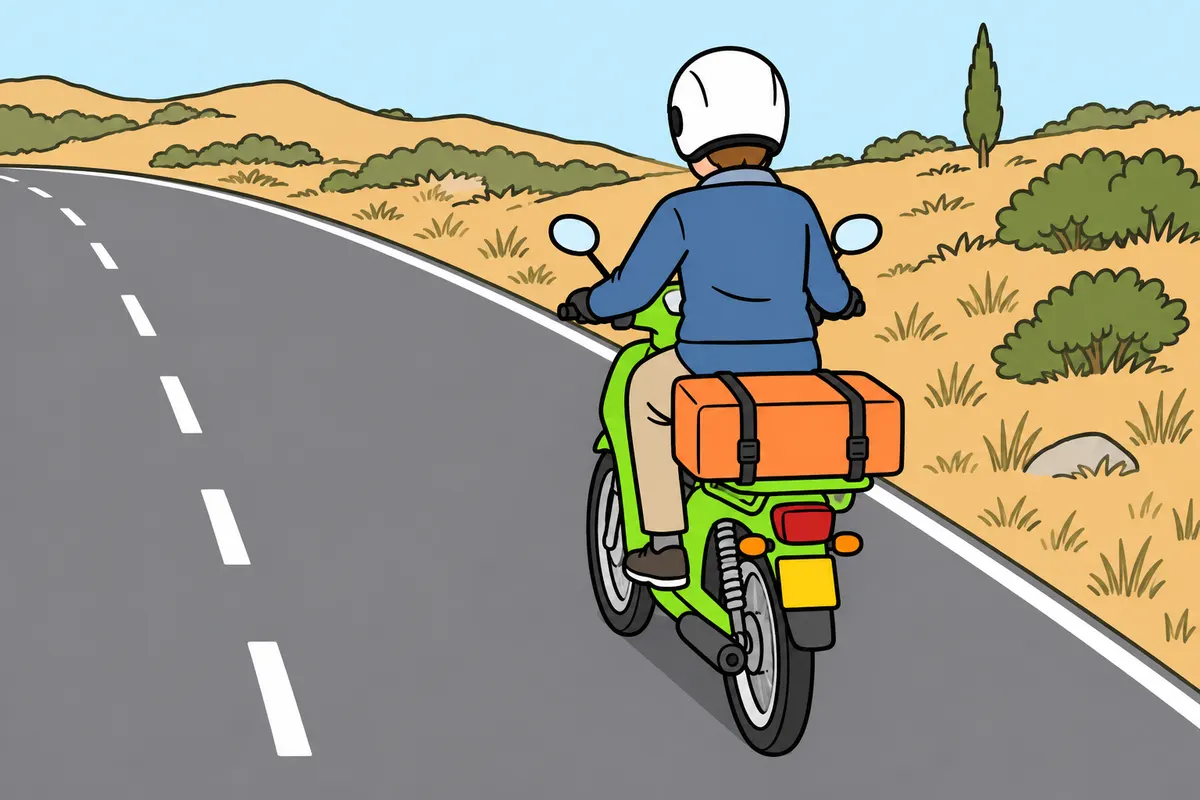
If your vehicle is less than a metre wide, fixed limits apply to projecting loads.
| Vehicle less than 1 m wide: direction | Load limit |
|---|---|
| Front | No projection allowed |
| Rear | Up to 25 cm beyond the vehicle |
| Each side | Up to 0.50 m from the centreline |
Remember
- If your vehicle is less than 1 m wide, allow no front projection.
- At the rear, allow no more than 25 cm.
- At each side, measure from the vehicle's centreline.
- Do not measure from the side edges.
- Check stability and load securing too.
Exam trap: Wrong: add 0.50 m from each side edge. Right: if your vehicle is less than 1 m wide, measure that 0.50 m from its centreline.
Read the full explanation
- If the vehicle is less than 1 m wide, you must apply the specific rules: the load must not project at the front and can project at the rear by a maximum of 0.25 m, that is, 25 cm. This rear limit is a fixed measurement; it does not depend on calculating 10 % or 15 % of the length. [RGC, art. 15](https://www.boe.es/buscar/act.php?id=BOE-A-2003-23514#a15).
- Laterally, the load can extend no further than 0.50 m on each side of the vehicle’s longitudinal centreline. You must measure from the centreline dividing it into right and left halves; this reference lets you check the width occupied by the luggage regardless of the shape of the bodywork. [RGC, art. 15](https://www.boe.es/buscar/act.php?id=BOE-A-2003-23514#a15).
- For example, on a symmetrical moped 0.70 m wide, each edge is 0.35 m from the centreline. The load limit is 0.50 m from that same centreline, so it can project 0.15 m beyond each edge; this calculation helps you understand the reference point and does not remove the need to check stability and securing. [RGC, art. 15](https://www.boe.es/buscar/act.php?id=BOE-A-2003-23514#a15).
12Loads on wider quadricycles
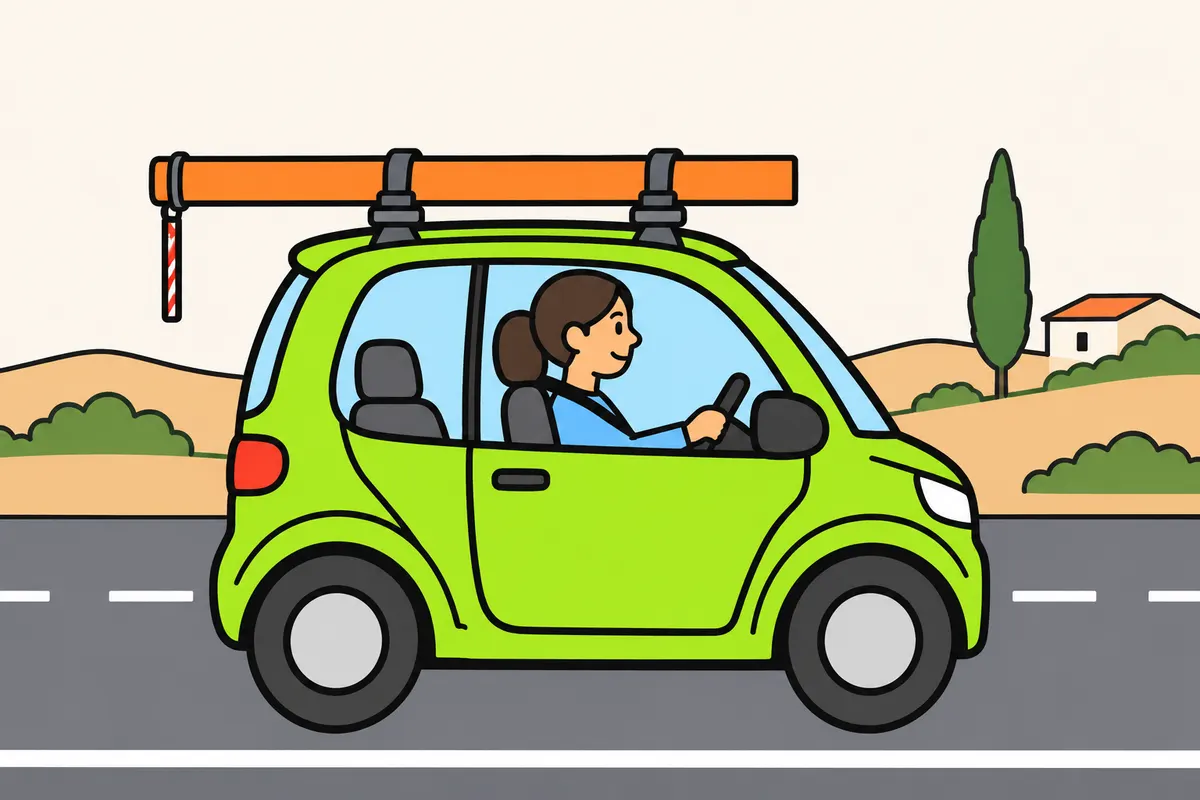
For your wider quadricycle, calculate rear projection using vehicle length and load type.
| Load: quadricycle at least 1 m wide, not exclusively for goods | Maximum rear projection |
|---|---|
| General rule | 10 % of vehicle length |
| Indivisible | 15 % of vehicle length |
Remember
- Apply this rule if your quadricycle is at least 1 m wide.
- It must also not be intended exclusively for carrying goods.
- Calculate the percentage using the vehicle's length.
- Use 15 % only for loads you cannot divide.
- This rule allows no front or side projections.
Exam trap: Wrong: you can always use 15 %. Right: for quadricycles at least 1 m wide and not intended exclusively for goods, that rear limit requires an indivisible load.
Read the full explanation
- If your quadricycle is 1 m wide or more and is not intended exclusively for carrying goods, the load can project at the rear by up to 10 % of its length. If the load is indivisible, the maximum rear projection is 15 %; this provision does not authorise front or side projections. [RGC, art. 15](https://www.boe.es/buscar/act.php?id=BOE-A-2003-23514#a15).
- For a hypothetical vehicle 3 m long subject to this rule, you must calculate a rear projection of 0.30 m at 10 % and 0.45 m at 15 %. Apply the percentage to the vehicle’s length. [RGC, art. 15](https://www.boe.es/buscar/act.php?id=BOE-A-2003-23514#a15).
13Vehicles intended for carrying goods
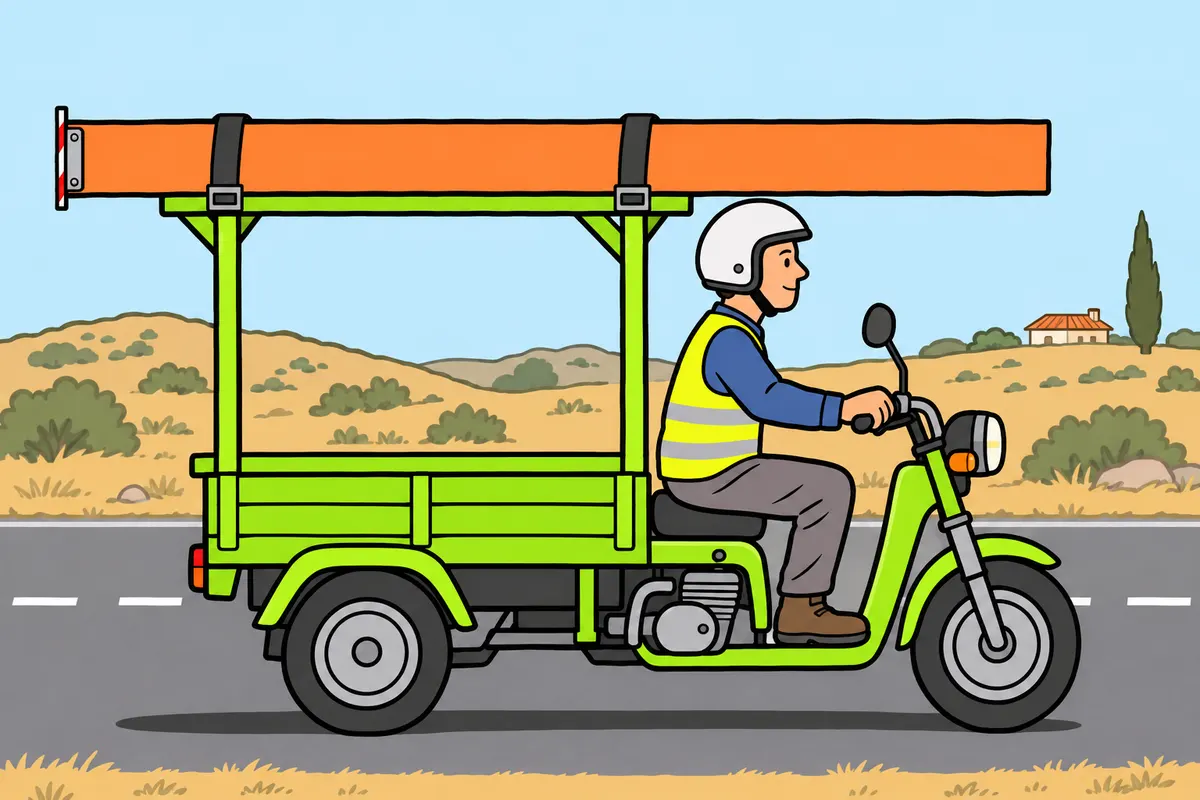
If your vehicle carries goods exclusively, check the special rules for indivisible loads.
| Goods-only AM vehicle at least 1 m wide | Indivisible load condition | Maximum |
|---|---|---|
| Front and rear; vehicle up to 5 m long | Item of indivisible length | A third of vehicle length beyond each end |
| Sides | Smallest load dimension exceeds vehicle width | 0.40 m per side and 2.55 m overall width; respect stricter technical or road limits |
Remember
- Apply this rule to goods-only AM vehicles at least 1 m wide.
- Up to 5 m long, allow a third of vehicle length beyond each end.
- This front and rear projection requires items whose length cannot be divided.
- For side projections, the indivisible load's smallest dimension must exceed your vehicle's width.
- Do not exceed 0.40 m per side or 2.55 m overall width.
- Respect any stricter technical or road limits.
Exam trap: Wrong: you can apply the thirds rule to any AM vehicle. Right: it requires a goods-only vehicle at least 1 m wide, no longer than 5 m, and an item of indivisible length.
Read the full explanation
- If an AM vehicle is 1 m wide or more and is intended exclusively for carrying goods, you must check the rule for indivisible loads in article 15.2. On vehicles up to 5 m long, items of indivisible length can project by a maximum of one third of the vehicle’s length at the front and another third at the rear. [RGC, art. 15](https://www.boe.es/buscar/act.php?id=BOE-A-2003-23514#a15).
- For side projections under these rules, the smaller dimension of the indivisible load must exceed the vehicle’s width. It can project by up to 0.40 m on each side, provided the overall width does not exceed 2.55 m; you must also comply with technical limits and road restrictions, which can be stricter. [RGC, art. 15](https://www.boe.es/buscar/act.php?id=BOE-A-2003-23514#a15).
14When you need the V-20 panel
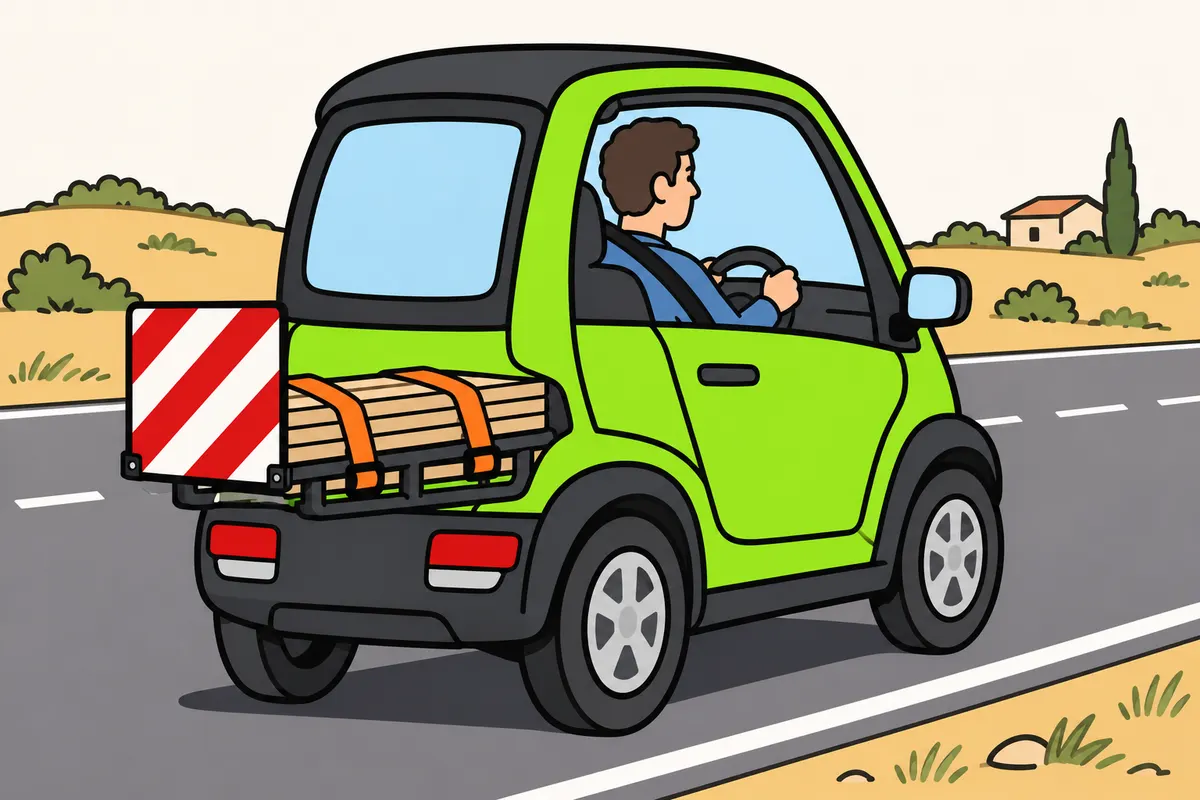
Check your vehicle's rules to decide whether its rear load needs a V-20 panel.
| Vehicle and permitted rear projection | V-20 required under this provision? |
|---|---|
| Vehicle covered by article 15, paragraphs 2 or 3 | Yes, by day and at night |
| Vehicle less than 1 m wide; legal rear projection up to 25 cm | No |
Remember
- Under paragraphs 2 or 3, use V-20 for rear projections day and night.
- In these cases, fit the panel even if the load sticks out very little.
- Below 1 m wide, legal rear projections up to 25 cm need no panel.
- On quadricycles at least 1 m wide, mark rear projections covered by paragraph 3.
Exam trap: Wrong: all AM vehicles are exempt from V-20. Right: fit it for rear projections covered by article 15, paragraphs 2 or 3. Vehicles less than 1 m wide fall outside that requirement.
Read the full explanation
- The V-20 sign, a panel for projecting loads, identifies a rear projection. You must use it when a load projects at the rear of vehicles subject to paragraphs 2 or 3 of article 15, both by day and at night; there is no allowance of a few centimetres in these cases. [RGC, art. 15](https://www.boe.es/buscar/act.php?id=BOE-A-2003-23514#a15).
- Article 15.6 expressly requires V-20 for vehicles covered by its paragraphs 2 and 3, without including the case in paragraph 4 for vehicles less than 1 m wide. In that case, a legal rear projection of up to 25 cm does not require the panel under this provision. [RGC, art. 15.4 and 15.6](https://www.boe.es/buscar/act.php?id=BOE-A-2003-23514#a15).
15Fitting one or two panels
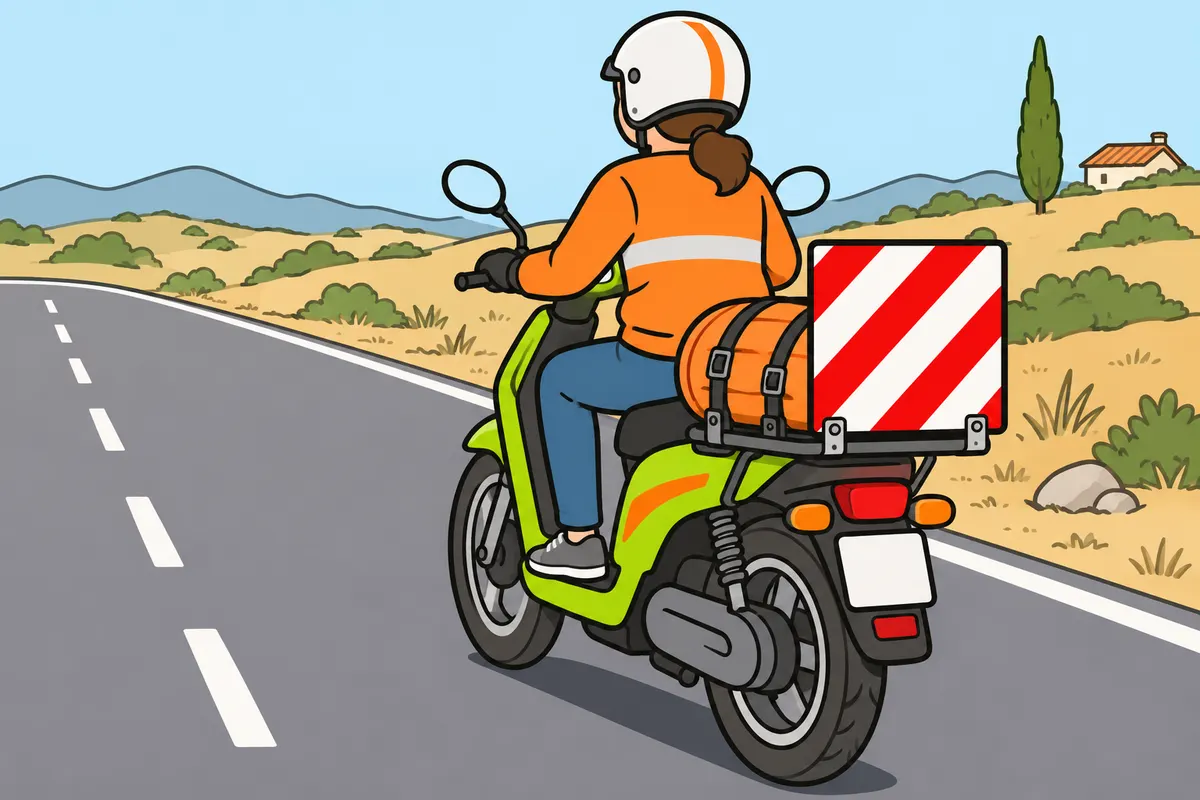
Secure your panel facing backwards; use two when the load projects across the full width.
| Rear load requiring panels | Panels |
|---|---|
| General case | One panel at the rearmost end |
| Projects lengthways across the full rear width | Two panels, one at each end; stripes form an upside-down V |
Remember
- Use a regulation V-20: square, with reflective red and white diagonal stripes.
- Fit it at the rearmost end of the load.
- Keep it perpendicular to the vehicle's centreline and visible from behind throughout your journey.
- If your rear projection spans the full width, fit a panel at each end.
- Arrange those panels' stripes to form an upside-down V.
Exam trap: Wrong: arrange the stripes into an upright V. Right: when the load projects lengthways across the full rear width, fit two panels with stripes forming an upside-down V.
Read the full explanation
- You must place the V-20 at the rearmost end of the load so that it remains perpendicular to the vehicle’s longitudinal axis at all times. Its face must be visible from behind; secure the panel so that it maintains this orientation throughout the journey. [RGC, art. 15](https://www.boe.es/buscar/act.php?id=BOE-A-2003-23514#a15).
- The V-20 is a square panel with retroreflective red and white diagonal stripes; you must use a panel that complies with the regulations. [RGV, Annex XI, V-20](https://www.boe.es/buscar/act.php?id=BOE-A-1999-1826#v-20).
- If the load projects lengthways across the full width of the rear, you must fit two panels transversely, one at each end of the projecting load or material. You must orient their stripes to form an inverted V; the width of the projection determines when you need two panels. [RGC, art. 15](https://www.boe.es/buscar/act.php?id=BOE-A-2003-23514#a15).
16Lights for projecting loads
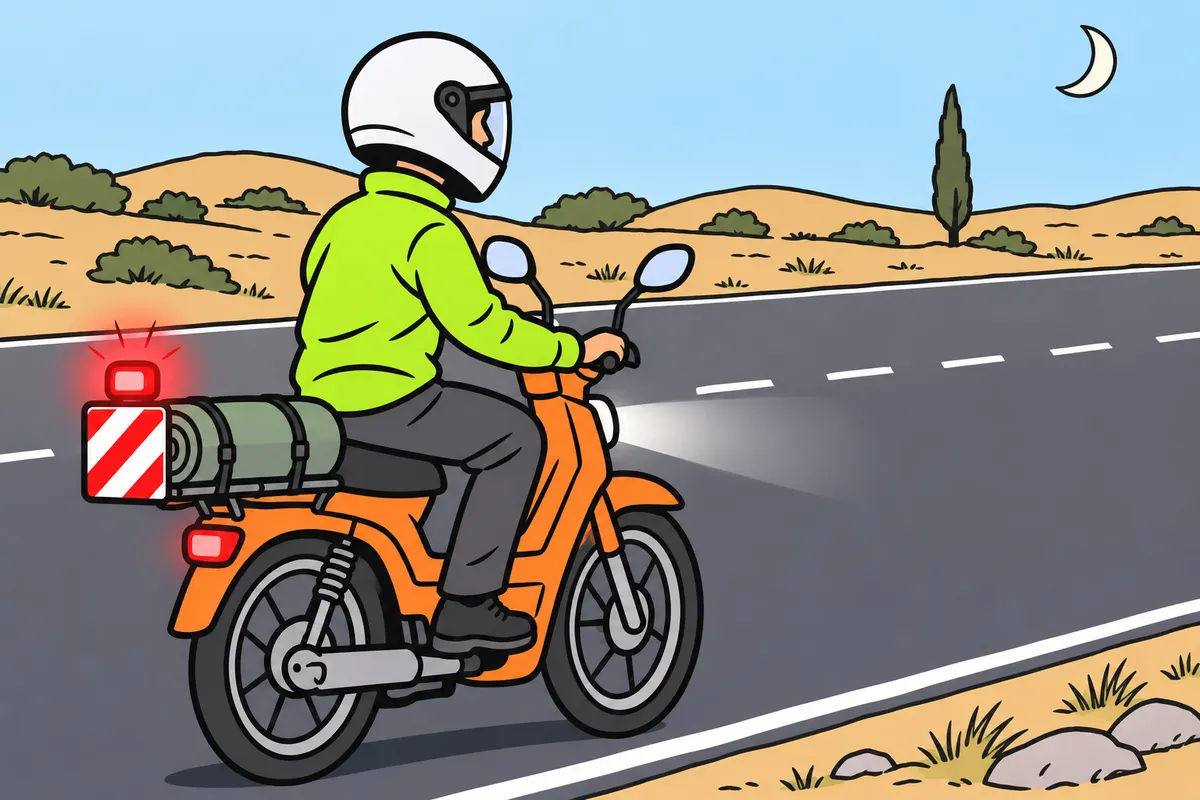
Add the required lights to projecting loads at night or when visibility is significantly reduced.
| Permitted projection: night or significantly reduced visibility | Marking you must add |
|---|---|
| Rear projection requiring marking under paragraph 6 | Red light as well as the panel |
| Front projection on a vehicle whose rules allow it | White light |
| Side projection over 0.40 m beyond the corresponding position light's outer edge | At each end: white light and reflector facing forwards; red light and reflector facing rearwards |
Remember
- At night or with significantly reduced visibility, check the lights for projecting loads.
- If rear marking under paragraph 6 applies, add a red light to the panel.
- In these conditions, mark any legal front projection with a white light.
- For side projections, measure from the corresponding position light's outer edge.
- If it extends over 0.40 m beyond that edge, follow the table.
Exam trap: Wrong: measure the side threshold from the centreline. Right: measure from the corresponding position light's outer edge. Mark each end when it extends beyond that edge by over 0.40 m, at night or with significantly reduced visibility.
Read the full explanation
- In the rear-marking cases covered by paragraph 6, you must add a red light to the load when travelling between sunset and sunrise or in weather or environmental conditions that significantly reduce visibility. This light supplements the required panel; it does not replace it. [RGC, art. 15](https://www.boe.es/buscar/act.php?id=BOE-A-2003-23514#a15).
- If a vehicle subject to rules allowing a front projection has a legal front projection, you must mark it with a white light at night or when visibility is significantly reduced. [RGC, art. 15](https://www.boe.es/buscar/act.php?id=BOE-A-2003-23514#a15).
- If a side projection extends more than 0.40 m beyond the outer edge of the corresponding position light, you must mark each end at night or when visibility is significantly reduced: a white light and reflector facing forwards, and a red light and reflector facing rearwards. You measure this threshold from the light, not from the vehicle’s centreline. [RGC, art. 15.7](https://www.boe.es/buscar/act.php?id=BOE-A-2003-23514#a15).
17Trailers: mass, time of day and occupants
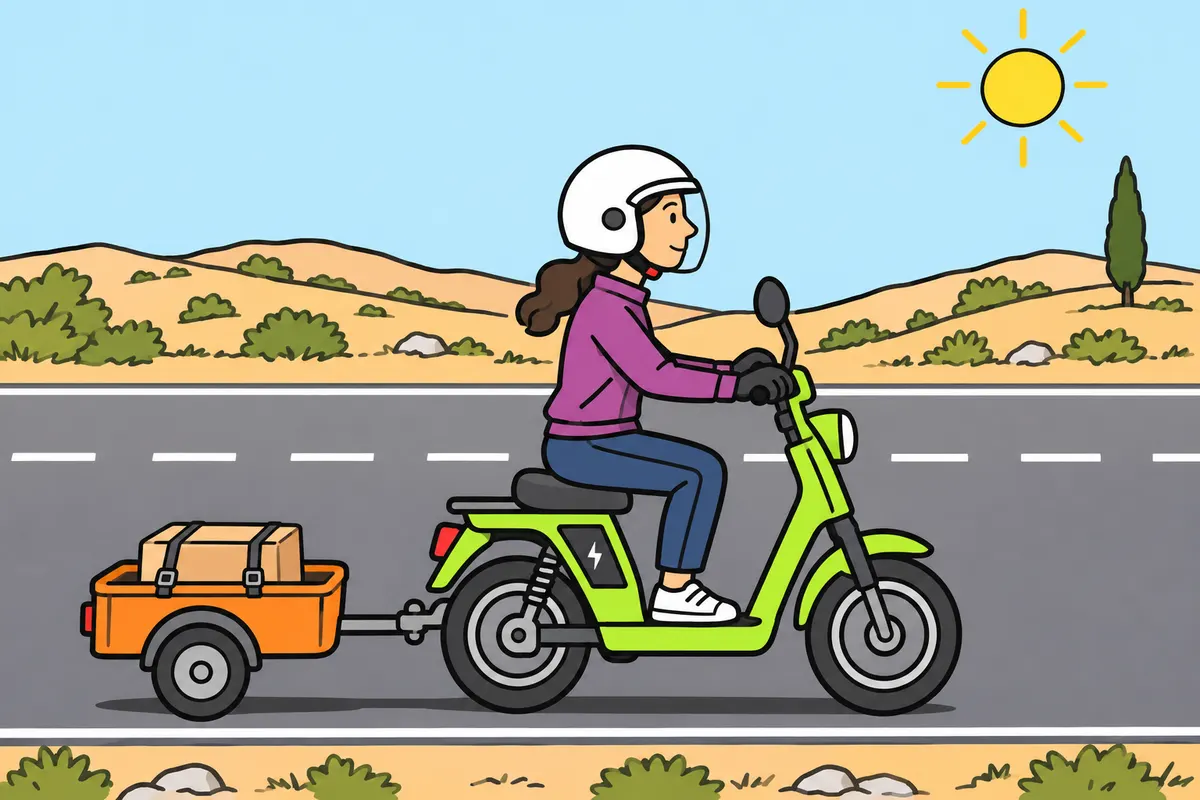
You can tow a compatible trailer within weight limits, in daylight and under other conditions.
| Moped travel with a trailer | Condition |
|---|---|
| Always | By day with good visibility |
| Urban area | Also follow the municipal by-law |
Remember
- Check your moped's technical compatibility and limits.
- The loaded trailer must not exceed 50 % of your moped's empty weight.
- Do not add your weight, your passenger's weight or luggage to that reference.
- Tow only by day and without conditions that reduce visibility.
- In towns, also follow the local council's rules.
- Carry nobody in the trailer, even with seats or on a short journey.
Exam trap: Wrong: you can tow at night if visibility is good. Right: tow only by day and without conditions that reduce visibility. In towns, also follow local council rules.
Read the full explanation
- You can tow a trailer or semi-trailer with your moped under the following conditions and respecting the vehicle’s technical compatibility and limits. [RGC, art. 12.3](https://www.boe.es/buscar/act.php?id=BOE-A-2003-23514#a12).
- The trailer’s mass must not exceed 50 % of the towing vehicle’s unladen mass. You must use the unladen mass as the reference, without adding your weight or your passenger’s; for example, for a towing vehicle with an unladen mass of 100 kg, half is 50 kg for the towed vehicle including its load. [RGC, art. 12](https://www.boe.es/buscar/act.php?id=BOE-A-2003-23514#a12).
- Whenever you travel with a trailer, you must do so by day and in conditions that do not reduce visibility; in urban areas, you must also follow the municipal by-law. [RGC, art. 12.3.a](https://www.boe.es/buscar/act.php?id=BOE-A-2003-23514#a12).
- You must not carry people in the towed vehicle. This ban covers both adults and children and applies even if the trailer has space to sit down or the journey is short. [RGC, art. 12.3.c](https://www.boe.es/buscar/act.php?id=BOE-A-2003-23514#a12).
18Speed and trailer checks
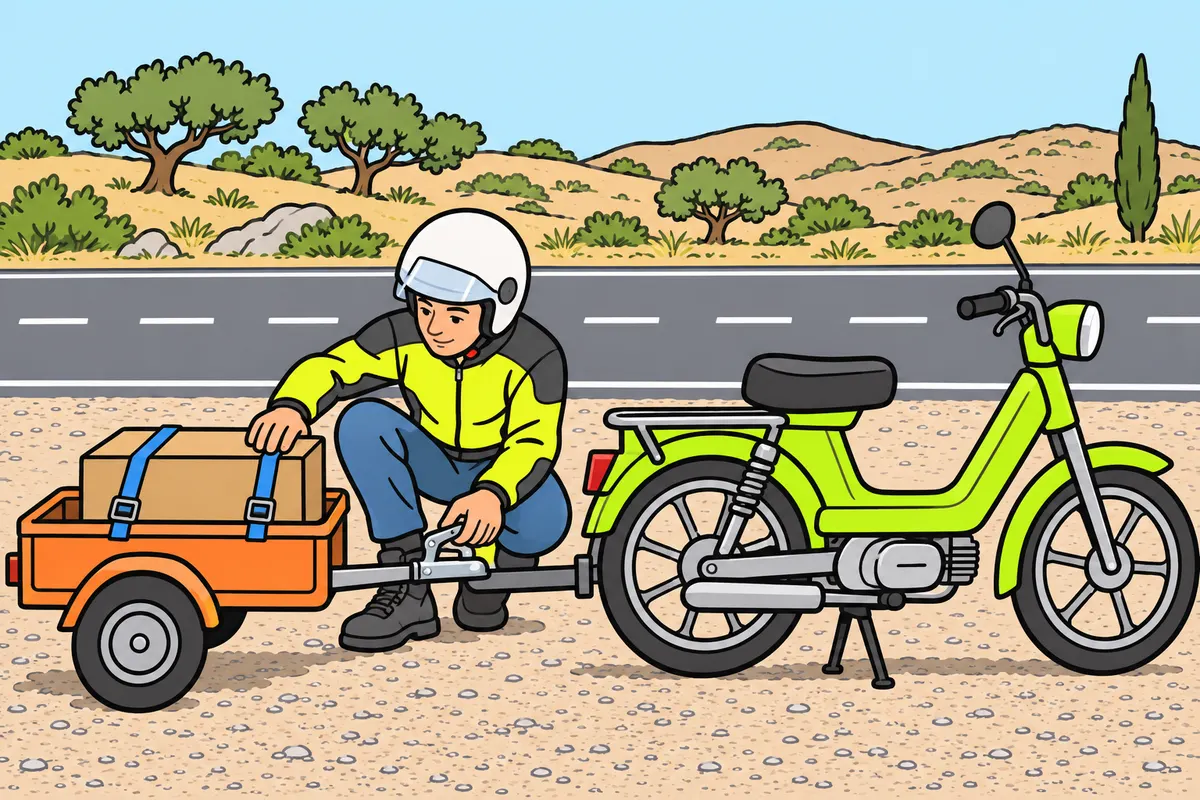
With a trailer, reduce your general speed limit and check the coupling before setting off.
Remember
- Reduce your vehicle's general speed limit by 10 %.
- Check the coupling is secure; follow the manufacturer's instructions.
- Check the trailer connections.
- Check you can turn without the load rubbing against your moped.
- Fix any play, loose fastenings or coupling damage before setting off.
Exam trap: Wrong: reducing speed is enough. Right: reduce the general speed limit by 10 %; also check the coupling, connections and turning space. Fix any problems before setting off.
Read the full explanation
- When travelling with a trailer, you must reduce the vehicle’s general speed limit specified in article 48 by 10 %; you study the calculation and route limits in the “Speed and safe following distances” module. [RGC, art. 12.3.b](https://www.boe.es/buscar/act.php?id=BOE-A-2003-23514#a12).
- As a practical check before setting off, check that the coupling is secure and that the trailer is attached according to its manufacturer’s instructions. Check its connections and the space needed to turn without the load rubbing against the moped. If you find play, loose fastenings or damage to the coupling, resolve these before starting your journey.
19Loading and unloading without creating danger
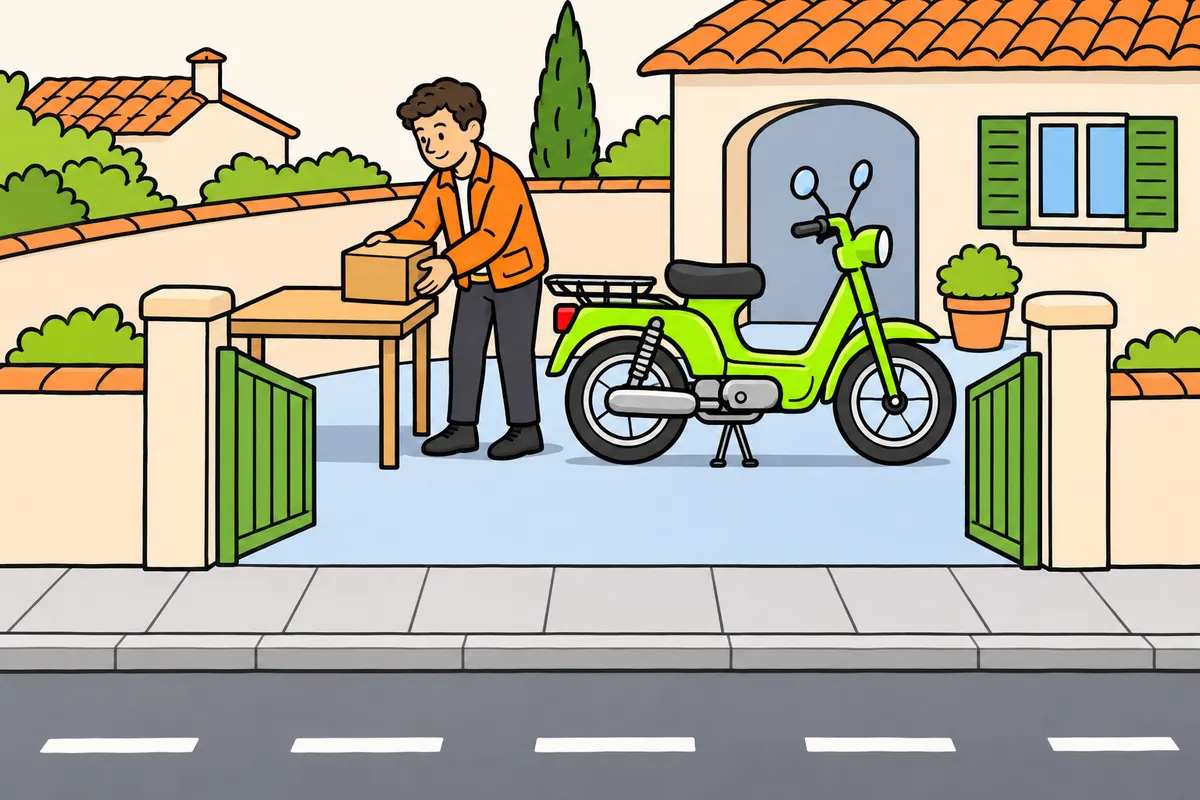
Load and unload off the road without creating danger or unnecessary nuisance.
Remember
- Use the road only if unavoidable, without causing danger or serious traffic disruption.
- Follow stopping and parking rules, and local council rules on places and times.
- Whenever possible, work on the side nearest the edge of the carriageway.
- Keep people away from traffic; prepare equipment to work quickly without unnecessary nuisance.
- Do not leave goods on the carriageway, hard shoulder or pedestrian areas.
- Afterwards, check for objects, straps or covers that could cause falls.
Exam trap: Wrong: you can leave a bag on the pavement briefly. Right: do not place goods in pedestrian areas, even while unloading.
Read the full explanation
- You must load and unload off the road. You can only use the exception allowing this on the road when doing so is unavoidable, avoiding danger and serious disruption to traffic. [RGC, art. 16](https://www.boe.es/buscar/act.php?id=BOE-A-2003-23514#a16).
- You must comply with stopping and parking rules and, in built-up areas, the places and times set by the municipal authority. As a rule for the operation, you must carry it out on the side nearest the edge of the carriageway wherever possible and check that you do not expose other people to traffic. [RGC, art. 16](https://www.boe.es/buscar/act.php?id=BOE-A-2003-23514#a16).
- You must have sufficient means to load or unload quickly and avoid unnecessary noise or nuisance. [RGC, art. 16](https://www.boe.es/buscar/act.php?id=BOE-A-2003-23514#a16).
- You must not place goods on the carriageway, the arcén (hard shoulder) or pedestrian areas. A bag temporarily placed on the pavement still occupies a pedestrian area; prepare a suitable destination for the load and, when you finish, check that no objects, straps or covers remain that could cause trips or falls. [RGC, art. 16](https://www.boe.es/buscar/act.php?id=BOE-A-2003-23514#a16).
Authorising and preparing your passenger
Complete the checks before setting off.
- Check the vehicle’s seats and authorisation to carry a passenger.
- Check the general age requirement or all the requirements for the family exception.
- Check that you do not exceed the authorised mass when you add the person and luggage.
- On a two-wheeled moped, position your passenger behind you, sitting astride with their feet on their footrests.
- Check protective equipment for both of you, or the seat belts under the documented exemption.
- Allow your passenger to get on with the vehicle stationary and confirm a stable position before setting off.
Measuring and marking the load
First choose the rules that apply to your vehicle.
- Check the vehicle’s intended use and whether it is less than one metre wide.
- On a narrow vehicle, measure from the centreline: 0.50 m on each side, no front projection and up to 0.25 m at the rear.
- For other vehicles, apply the limits corresponding to the vehicle’s intended use and whether the load is indivisible.
- Check overall dimensions, mass, securing and protection of the ends.
- If the rear projection falls under paragraphs 2 or 3, fit V-20; use two panels forming an inverted V if it occupies the full rear width.
- Check the marking lights required for the projection and visibility, keeping the number plate and devices visible.
Preparing to transport a load with a trailer
Check the vehicle, load and journey conditions together.
- Check the technical compatibility and documented limits of the moped and trailer.
- Calculate 50 % of the towing vehicle’s unladen mass and check the laden trailer’s mass.
- Rule out carrying people in the trailer.
- Always travel with a trailer by day and in conditions that do not reduce visibility; in urban areas, also follow the municipal by-law.
- Reduce the general speed limit by 10 % and respect any lower limit.
- Consult the by-law for the urban route and check the coupling and load before setting off.
Finished this module?
Mark it as read and you will see your progress on the theory list.