
Theory · AM Licence - Moped · Module 14 of 18
Risk factors when riding a moped
You learn to recognise risks involving visibility, road surfaces, weather, speed, group riding, tunnels, other road users’ inexperience and fatigue on your moped or light quadricycle. You can choose measures to reduce each danger and distinguish legal obligations from safety advice in the exam.
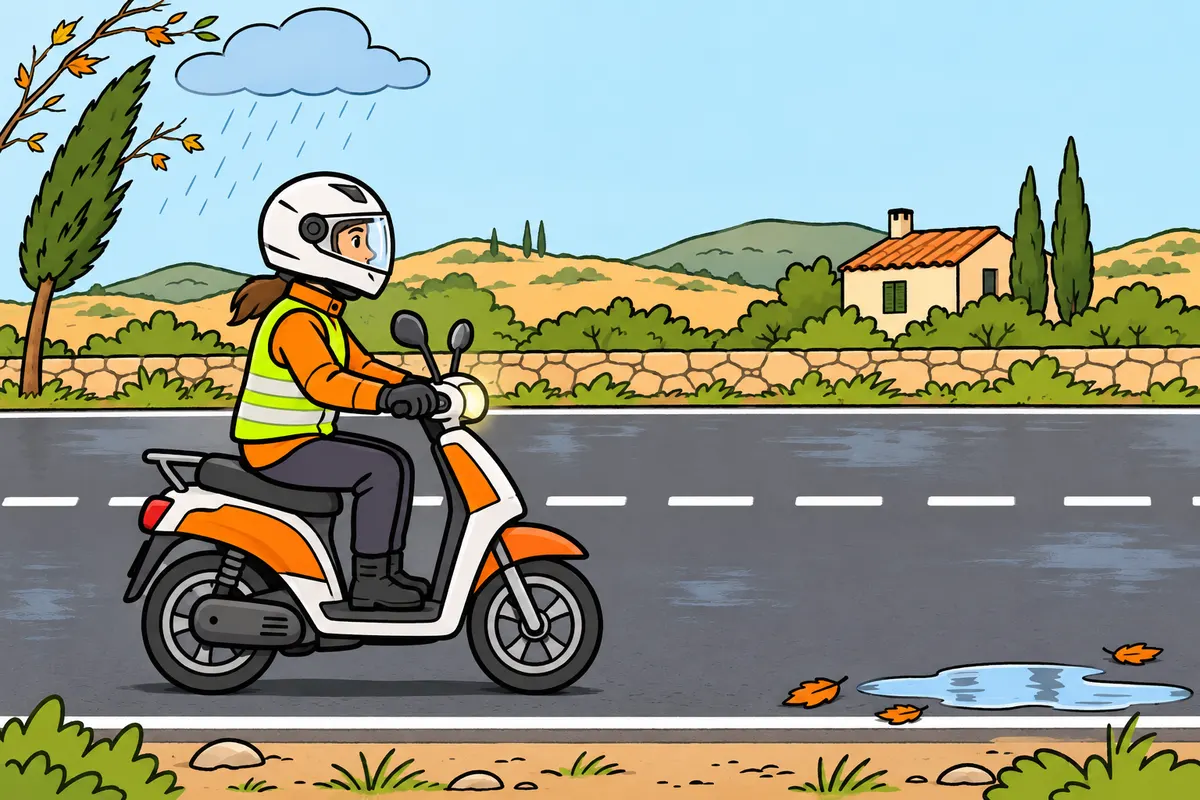
1Recognise your vulnerability
You need balance, grip and space to reduce the risks of riding your moped.
| Source of risk | Example |
|---|---|
| You | Tiredness |
| Your vehicle | Worn tyre |
| The road | Oil spill |
Remember
- On your two-wheeled moped, losing grip can make you fall.
- Your small size makes you harder to see.
- Slow down when several dangers combine.
- In a light quadricycle, you must also consider visibility and grip.
Exam trap: Wrong: assess each danger separately. Right: consider how risks combine.
Read the full explanation
- On a two-wheeled moped, you depend on balance and tyre grip to stay upright. A loss of grip that causes another vehicle to slide can cause you to fall. Its small size also makes it harder for others to spot you: you must combine control, visibility and safety margins.
- You can face several risks at once: rain on road paint, wind when passing a lorry or fatigue on a night journey. Assess their combined effect and make the journey less demanding. Each difficulty seeming small on its own does not mean you can keep the same speed and following distance.
- Risk factors can come from you, your vehicle, the road or your surroundings. Your tiredness is a human factor; a worn tyre is a vehicle factor, and an oil spill affects the road surface. Identifying the source allows you to choose a useful measure, without attributing every collision to a single cause.
- If you drive a light quadricycle, you still face risks from low visibility, limited grip and differences in speed from other vehicles. Adapt your precautions to your vehicle, its load and its instructions.
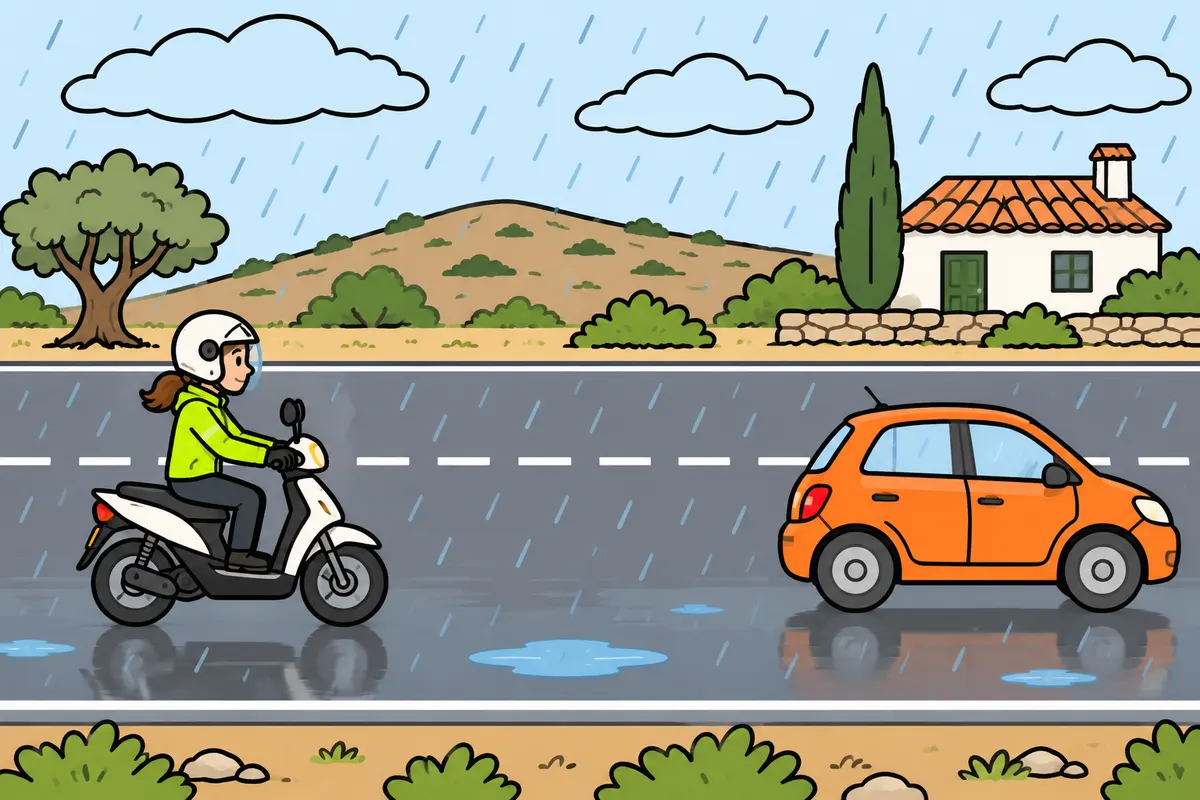
2Adapt your speed to the danger
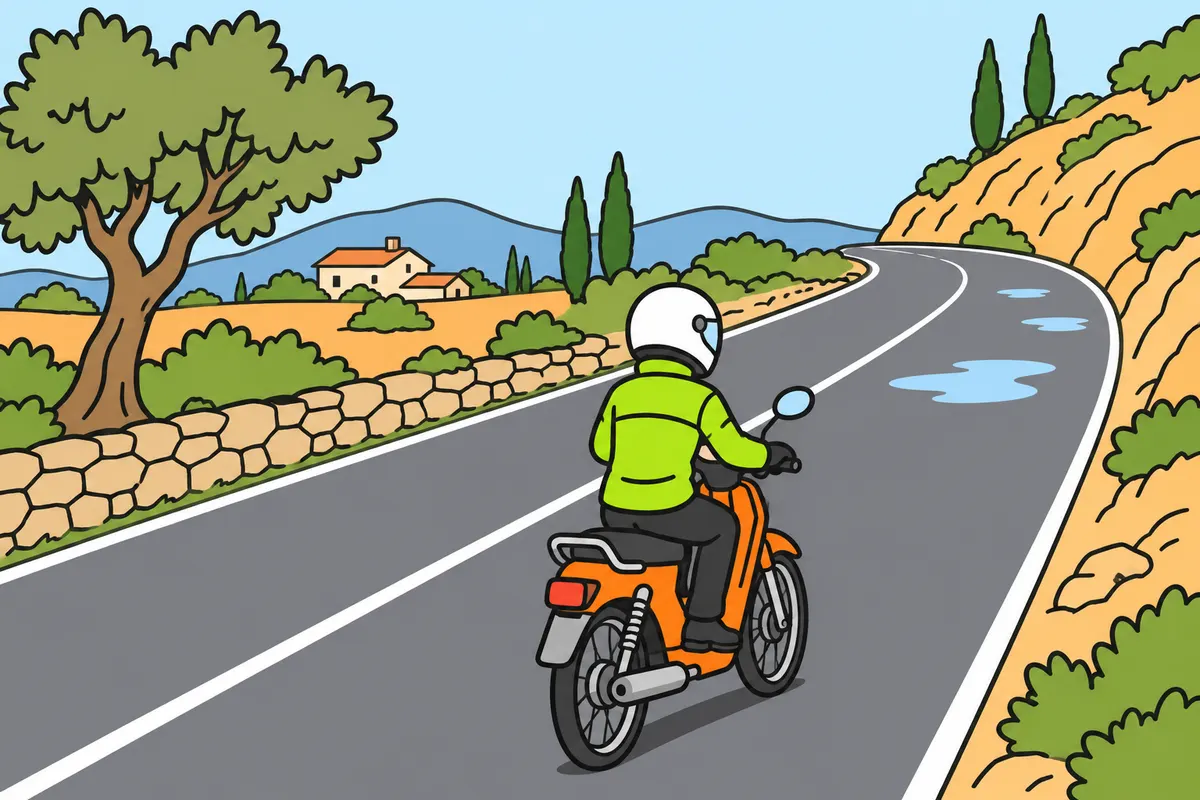
Choose a speed that lets you stop within the distance you can see.
Remember
- Obey speed limits and slow down further when danger requires it.
- Check the limits for your vehicle and road type.
- With bad weather or poor visibility, slow down and stop if necessary.
- Avoid spraying water or throwing loose chippings onto others.
Exam trap: Wrong: obeying the maximum is always enough. Right: slow down further when conditions require it.
Read the full explanation
- You must obey the limit and also choose a speed that allows you to stop within the distance you can see and for any obstacles that may appear. You can therefore travel at an inappropriate speed without exceeding the maximum: a blind bend or an oil spill may require a much lower speed. [RGC, art. 45](https://www.boe.es/buscar/act.php?id=BOE-A-2003-23514#a45).
- The legal maximum depends on the type of road; consult the figures for mopeds and light quadricycles in the Speed and safe following distances module, “45 km/h: roads and maximum design speed” and “Tracks and unpaved roads”. [RGC, art. 48](https://www.boe.es/buscar/act.php?id=BOE-A-2003-23514#a48).
- In town, the street layout determines the limit: consult the Speed and safe following distances module, “Streets with a shared level surface” and “One lane in each direction: 30 km/h”. [RGC, art. 50](https://www.boe.es/buscar/act.php?id=BOE-A-2003-23514#a50).
- You must slow down, stopping when necessary, for slippery surfaces, reduced visibility, dazzle or adverse weather. You must also avoid spraying water or throwing loose chippings onto other road users. [RGC, art. 46](https://www.boe.es/buscar/act.php?id=BOE-A-2003-23514#a46).
3Understand the distance you need to stop
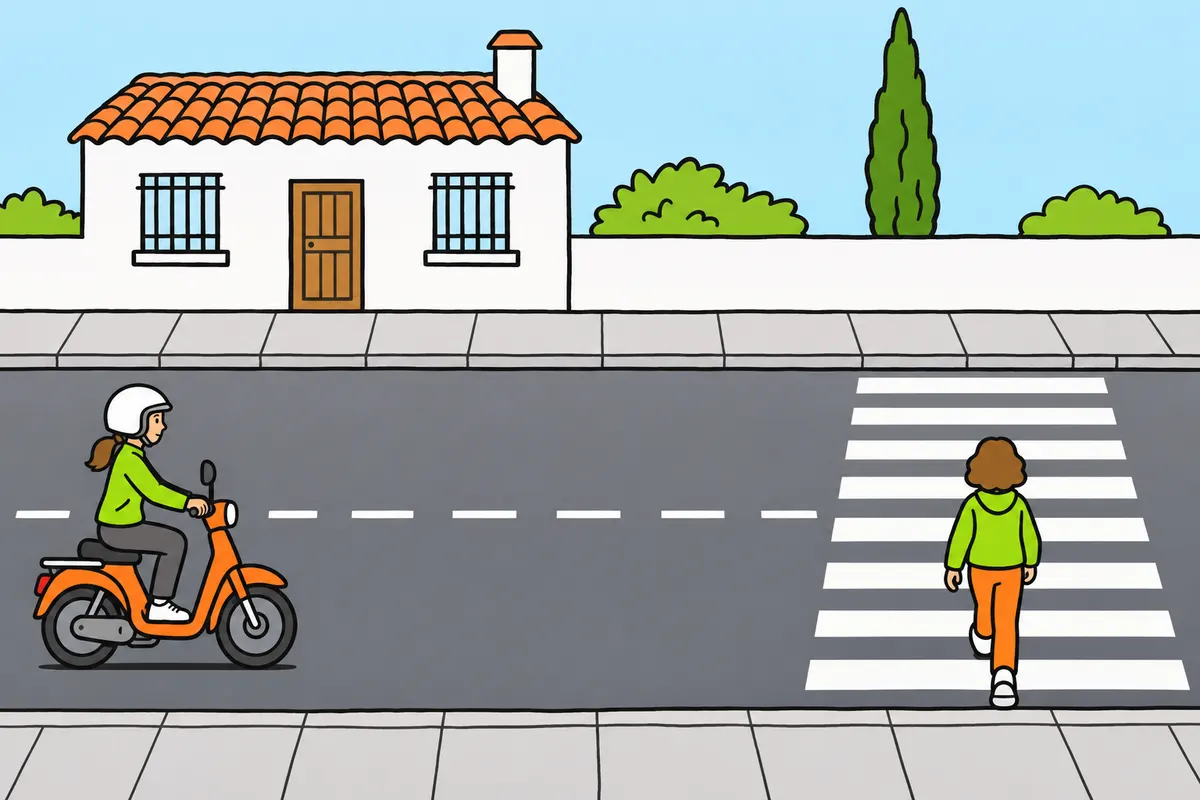
You need space to react and then brake until you stop.
| Distance | What you travel |
|---|---|
| Reaction | Before you apply the brakes |
| Braking | From applying the brakes until you stop |
| Stopping | Reaction distance plus braking distance |
Remember
- You keep moving while you notice danger and decide what to do.
- At higher speeds, you travel further before braking.
- When sleepy or tired, you may react later.
- Look along your route and to its sides to spot danger early.
- Your braking depends on the surface, tyres, brakes, speed and load.
Exam trap: Wrong: wet roads always increase braking distance equally. Right: the increase depends on conditions.
Read the full explanation
- During the time you take to detect a danger, decide and act, your moped keeps moving. This is your reaction distance; you then cover the braking distance before stopping. Your stopping distance is the sum of both, so effective brakes do not eliminate the metres you cover before applying them.
- With the same reaction time, you cover more metres at a higher speed. When tired or sleepy, you may take longer to respond and travel even further before braking. Wet surfaces mainly affect grip and braking distance: this effect is different from a human delay in reacting.
- High speed also leaves you less time to interpret a garage exit, a bend or an opening door. Avoid focusing only on the point immediately in front of your wheel; scan your route and its sides to detect anything that may require you to slow down in good time.
- Braking distance varies with the surface, water, speed, tyres, brakes and load. To choose your safety margin, consider the actual situation: on wet surfaces or ice, the increase in distance depends on the combination of these factors.
4Keep a safety margin ahead and behind
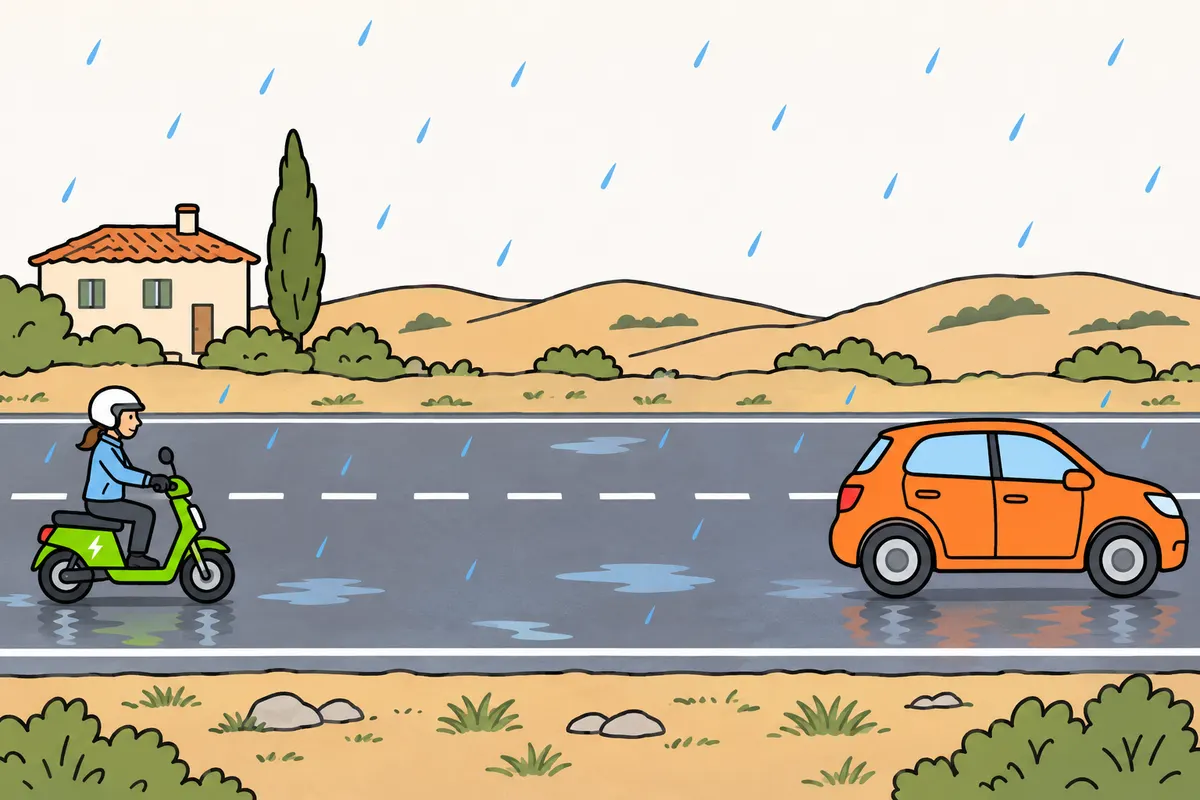
Leave space to brake without crashing or surprising those behind you.
Remember
- Leave more space in rain, darkness, loose chippings or fog.
- If someone follows too closely, gently increase your space ahead.
- Do not brake sharply to punish someone following you.
- Glance briefly at mirrors while keeping attention ahead.
- Before slowing considerably, check behind and warn others, except in immediate danger.
Exam trap: Wrong: the same gap always works. Right: adapt it to speed, grip and braking.
Read the full explanation
- Your following distance must allow you to respond if the vehicle ahead brakes; the full rule is explained in the Defensive and efficient driving module, “Leave a margin ahead and behind”. [RGC, art. 54.1](https://www.boe.es/buscar/act.php?id=BOE-A-2003-23514#a54).
- In rain, darkness, loose chippings or fog, you must increase your margin compared with good conditions. Keeping further back from the vehicle ahead also improves your view and reduces spray on your helmet visor. You must be able to respond to an obstacle that the vehicle hides until the last moment.
- If someone follows too closely, gently increase your distance from the vehicle ahead so you can anticipate slowing down and brake progressively. Do not accelerate to escape or brake sharply to punish them. Watching them constantly adds another risk by distracting you: combine brief mirror checks with attention ahead.
- Except in imminent danger, before slowing down considerably you must check that you can do so without endangering those behind and give the appropriate warning, avoiding abrupt actions. Anticipation is especially useful when moving from dry tarmac to a wet or uneven area. [RGC, art. 53](https://www.boe.es/buscar/act.php?id=BOE-A-2003-23514#a53).
5Make yourself visible without becoming complacent
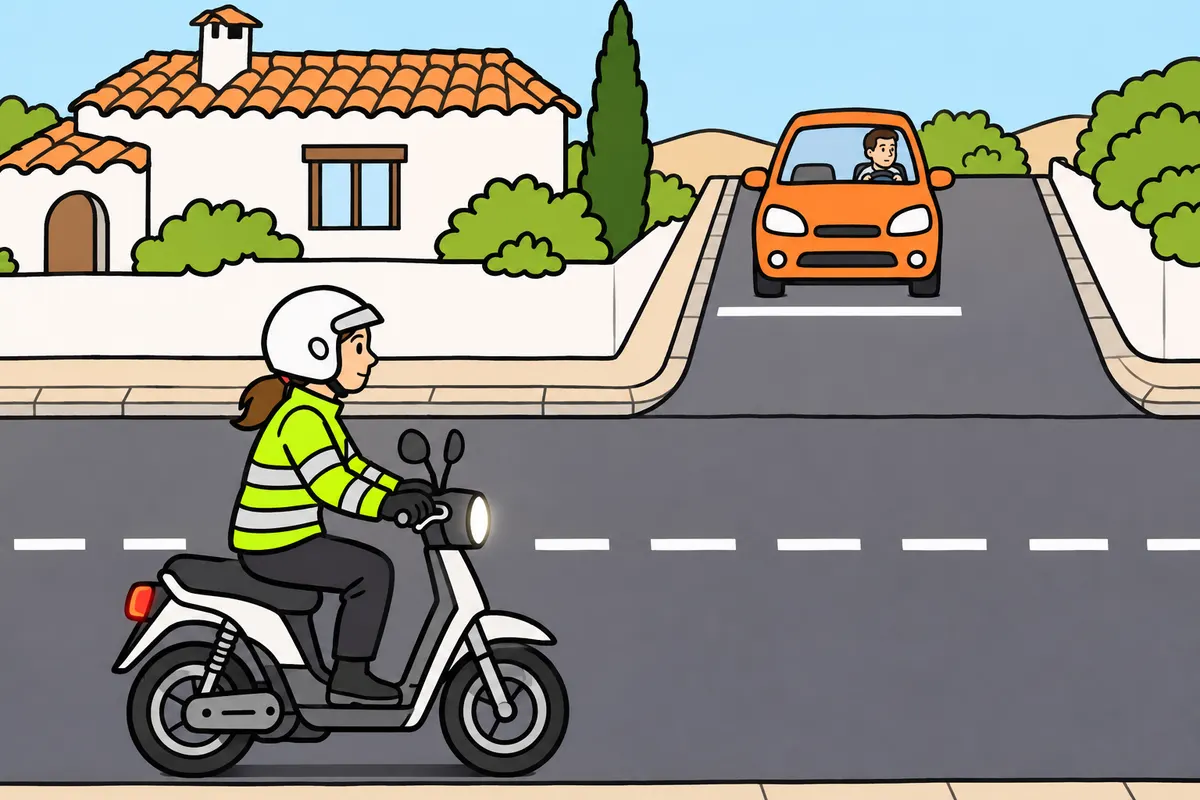
Make yourself visible and keep space even when you think others have seen you.
Remember
- Wear light or bright clothing and items that reflect light.
- Keep your lamps and reflectors clean and working.
- Check that your load does not hide your vehicle’s signals.
- Keep a steady path without zigzagging.
- Be ready to stop even if another driver has looked at you.
Exam trap: Wrong: eye contact guarantees someone will give way. Right: keep enough space to stop.
Read the full explanation
- Try to ensure others can identify your presence and path in good time. A moped can be hidden behind a car, a refuse container or a parked vehicle. As you approach junctions, consider that another driver may look towards your road without noticing you, and be ready to respond.
- You can improve your visibility with light or bright clothing that contrasts with your surroundings and retroreflective items that reflect headlamp light back towards its source. These are preventive measures, especially useful at night; they do not replace lights or guarantee that everyone sees you. [DGT: Riding a moped](https://www.dgt.es/muevete-con-seguridad/viaja-seguro/en-ciclomotor/).
- You must keep the devices that make you visible clean and working, including lamps and reflectors. A backpack or a poorly positioned load can obscure them. If you carry anything, check before setting off that it does not cover your signals or restrict your movements; load rules belong to the Passengers and loads on a moped module.
- Follow a steady, predictable path: do not zigzag to attract attention or suddenly appear alongside another vehicle. Making eye contact with a driver does not guarantee that they give way either. Keep a safe alternative and enough room to stop without depending on their reaction.
6Use your lights to be seen
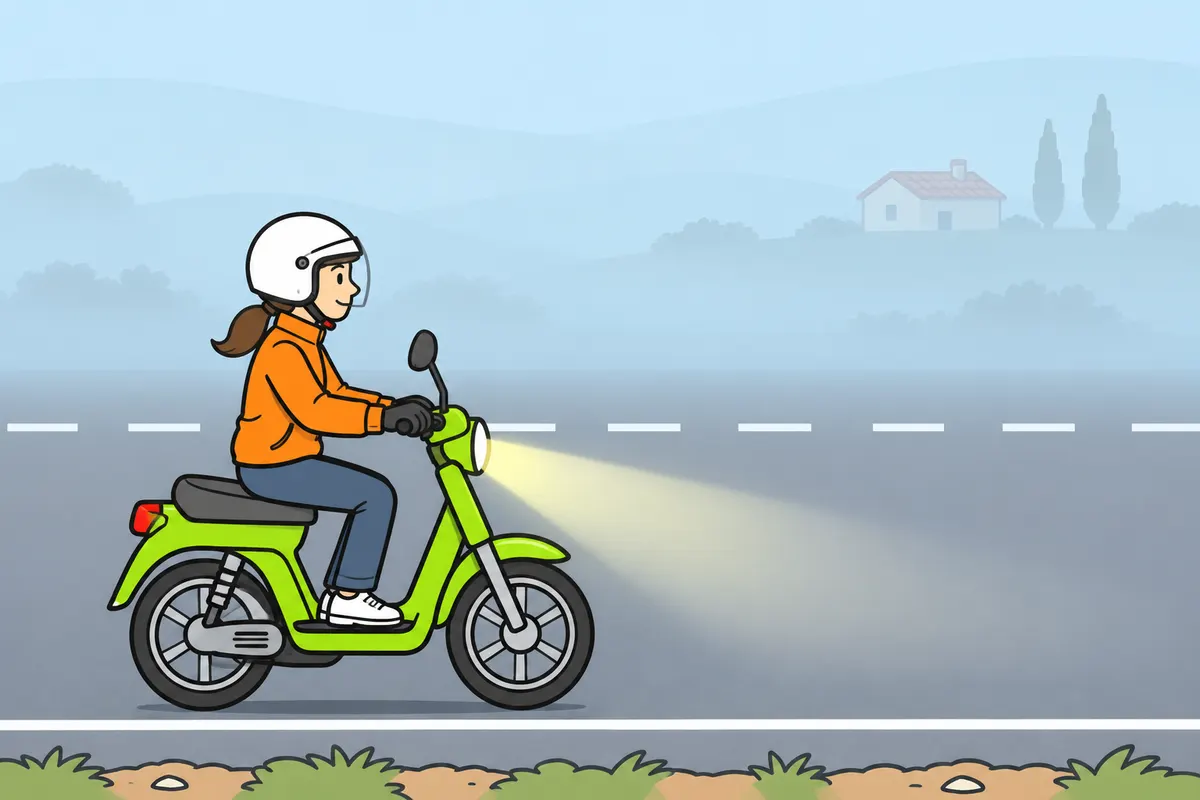
Switch on your lights when required and check that they are correctly adjusted.
| Situation on your moped | Use of lights |
|---|---|
| Clear day, outside tunnels and other compulsory cases | Dipped beam recommended |
| Night, tunnel or underpass | Lights compulsory |
| Visibility significantly reduced by fog, heavy rain, snow, smoke or dust | Lights compulsory during daylight too |
Remember
- Use the required lights at night, in tunnels and in underpasses.
- Use them during daylight too if weather significantly reduces visibility.
- On your moped, normally use position lights and dipped beam in poor visibility.
- A beam aimed too high dazzles; too low reduces what you can see.
Exam trap: Wrong: your moped always needs daytime dipped beam like a motorcycle. Right: on clear days, outside tunnels and other compulsory cases, it is recommended.
Read the full explanation
- On a clear day, outside tunnels and other situations where lights are compulsory, using dipped beam is recommended to make your moped visible. The specific daytime obligation for motorcycles in article 104 does not make a moped a motorcycle; in this case, it is a recommendation. [RGC, art. 104](https://www.boe.es/buscar/act.php?id=BOE-A-2003-23514#a104).
- You must use the appropriate lights between sunset and sunrise and at any time in tunnels and underpasses. You study the full choice of lights in the Moped lights and signals module. [RGC, art. 98](https://www.boe.es/buscar/act.php?id=BOE-A-2003-23514#a98).
- If fog, heavy rain, snow, smoke or dust significantly reduces visibility, you must switch on your lights during the day too. On your moped, position lights and dipped beam are the normal solution for seeing and being seen without dazzling others; switch them on as soon as these conditions arise. [RGC, art. 106](https://www.boe.es/buscar/act.php?id=BOE-A-2003-23514#a106).
- Check the alignment: a beam aimed too high can cause discomfort, while one aimed too low shortens the distance you can see. You must correct the fault and adapt your speed to the distance you can actually see, especially on bends and descents.
7Keep your view clear
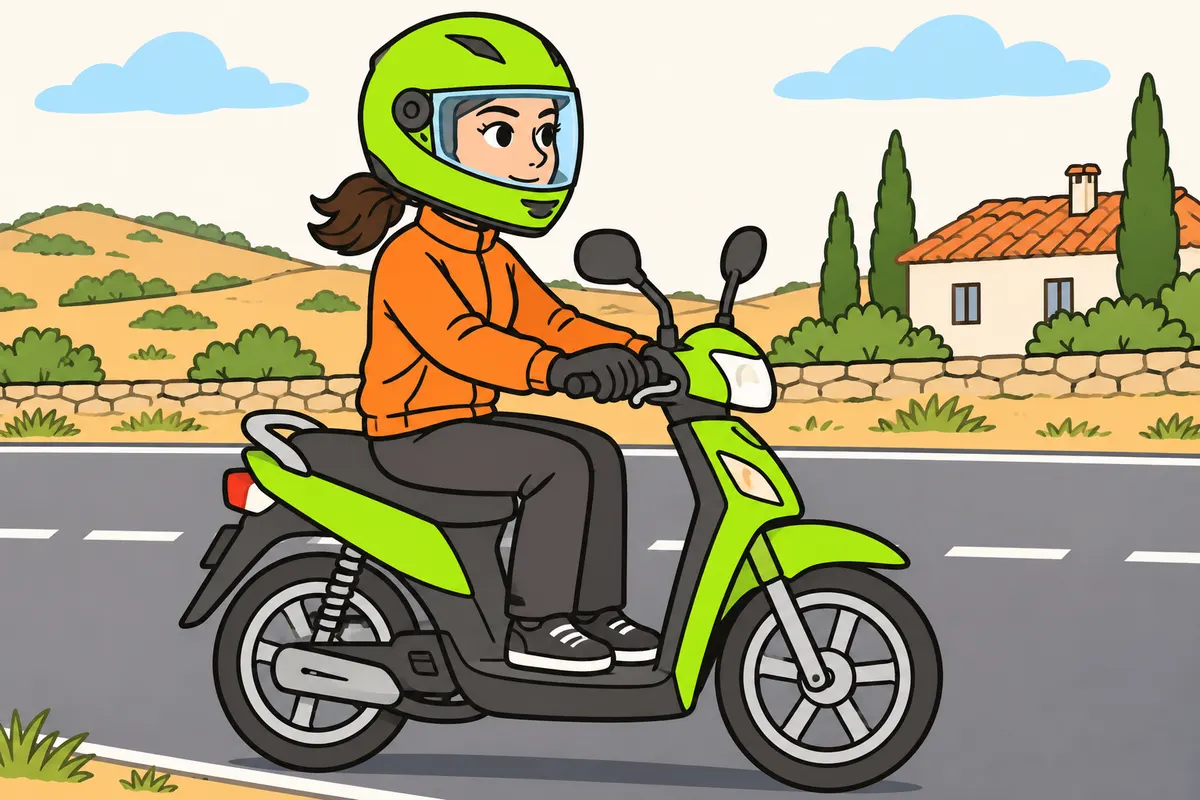
Keep your view clear and adjust your mirrors before setting off.
Remember
- Clean your helmet visor and prevent misting.
- In your enclosed quadricycle, keep the windscreen, windows and mirrors clear.
- Adjust your mirrors before setting off, in your normal driving position.
- Check hidden areas when necessary and safe.
- With low sun, slow down before your view becomes poor.
- If you cannot see enough, find a safe place to stop.
Exam trap: Wrong: correctly adjusted mirrors show everything. Right: check hidden areas when necessary and safe.
Read the full explanation
- You must keep your helmet visor clean and free of scratches that impair your view, and prevent it from misting up. Droplets, dirt and reflections can hide pedestrians or small surface defects. Prepare the appropriate ventilation or anti-fog system for your helmet according to its instructions, without making distracting adjustments while riding.
- In a light quadricycle with a cabin, you must keep the windscreen, windows and mirrors clear. If the glass mists up, use suitable ventilation and demisting; do not continue by looking through a small clear patch. Poor side visibility also makes it harder to check junctions and detect approaching road users.
- You must adjust your mirrors before setting off, sitting in your normal driving position. Check them with brief glances and check the areas they do not cover when necessary and safe, while maintaining attention ahead. Correctly adjusted mirrors improve your information but do not eliminate all blind spots.
- Low sun can make it hard to distinguish a traffic light, bend or vehicle. Slow down in good time and use eye protection suited to the light level and compatible with your helmet; a very dark visor can impair your view in a tunnel. If you cannot see what you need to continue, find a safe place to stop.
8Avoid other drivers’ blind spots
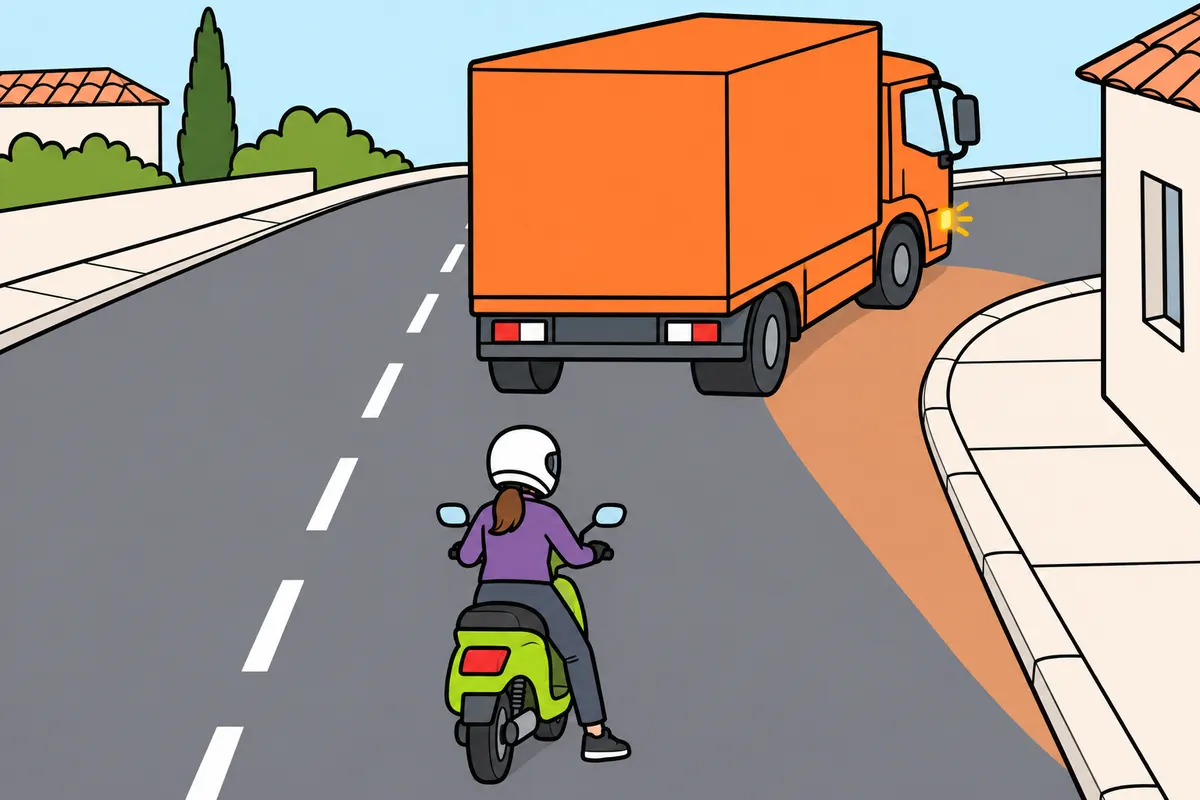
You can be hidden even when you can clearly see the vehicle near you.
| Vehicle | Voluntary blind spot sticker |
|---|---|
| Bus or coach | May carry it |
| Lorry or light commercial vehicle | May carry it |
| Car | Sticker is not intended for it |
Remember
- Expect blind spots ahead, behind and beside large vehicles.
- Do not move alongside the right side of a lorry that is turning.
- Even if you fit beside the kerb, the lorry could trap you.
- Do not trust the absence of a blind spot sticker.
Exam trap: Wrong: seeing their mirror means they see you. Right: keep a safety margin.
Read the full explanation
- A blind spot is an area a driver cannot see directly or through their mirrors in the conditions concerned. You can disappear into it even if you can see the vehicle perfectly. Lorries, buses and vans can have large hidden areas, including near their front.
- The sides and rear of a large vehicle can be outside its driver’s view. Anticipate a manoeuvre starting without the driver detecting you; seeing their image in a mirror does not guarantee that they are looking at you either. You study observation and positioning guidance in the Defensive and efficient driving module, “Your blind spots and those of others”.
- As you approach the right-hand side of a lorry that is about to turn, you can be hidden, and its path can close the space between the vehicle and the kerb. Your moped may fit into that gap and still expose you to being run over or trapped.
- You may see the voluntary blind spot warning sticker on buses and coaches, lorries and light commercial vehicles such as delivery vans; it is not intended for cars. Its absence does not prove that the driver can see everything around them. [DGT: instruction VEH 21/05](https://www.dgt.es/export/sites/web-DGT/.galleries/downloads/muevete-con-seguridad/normas-de-trafico/VEH-vehiculos/Instruccion_VEH_21_05.pdf).
9Detect hidden hazards in town
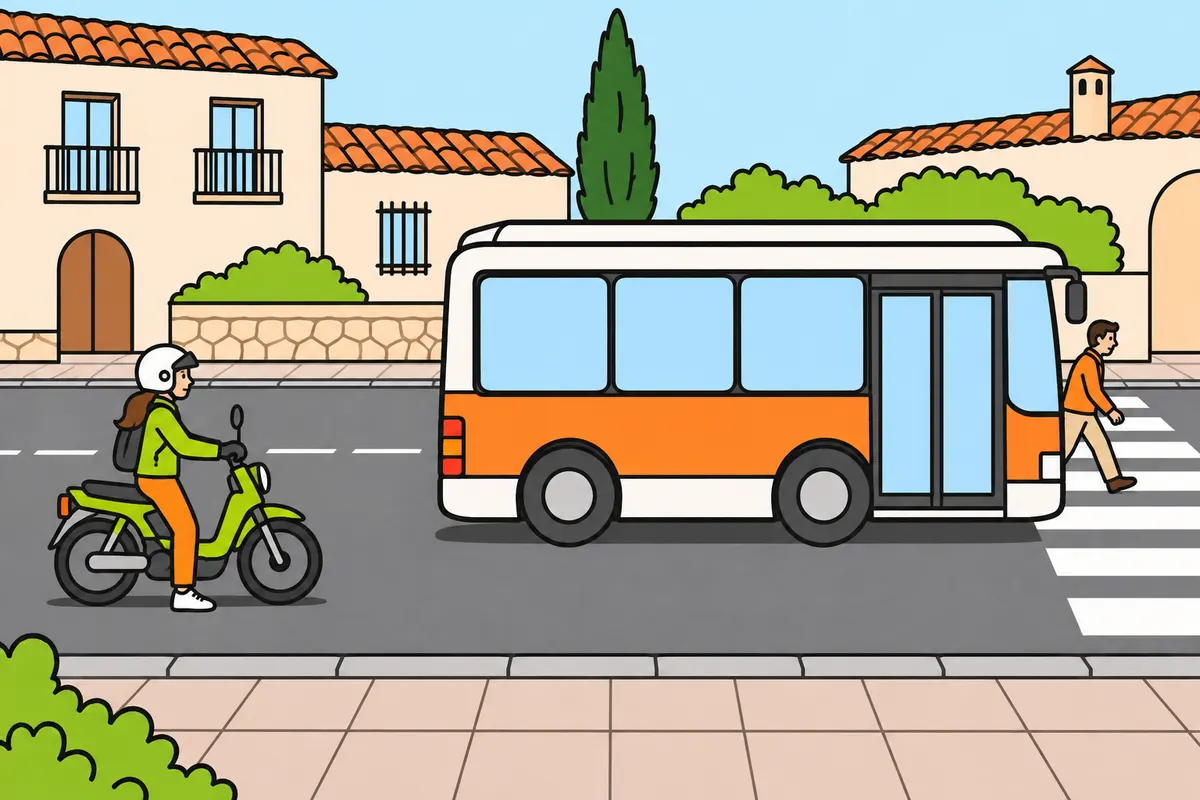
Slow down and leave space for dangers hidden from view.
Remember
- Watch for opening doors and people between parked vehicles.
- Slow down near pedestrian crossings, exits with poor visibility and places children may appear.
- A stopped bus may hide someone crossing.
- Before passing a stopped vehicle, find out why it stopped.
- Change position to improve your view only when legal and safe.
Exam trap: Wrong: having priority prevents a collision with a pedestrian. Right: slow down to react in time.
Read the full explanation
- When passing parked vehicles, you must anticipate opening doors, people emerging between them and vehicles moving off. Look for clues without fixing your gaze on just one, and keep a lateral margin within the space you can legally use. Your small size does not make it safe to pass very close to doors.
- You must slow down as you approach pedestrian crossings, exits with limited visibility or places where children may appear. A stationary bus can hide someone crossing in front of it. Having priority does not prevent you from hitting someone if you arrive too fast to respond. [RGC, art. 46](https://www.boe.es/buscar/act.php?id=BOE-A-2003-23514#a46).
- Assess the situation around the vehicle ahead for yourself: it may pass before a pedestrian reaches the crossing, or it may hide a sign and an obstacle from you. If a vehicle stops at a crossing area, try to establish why before continuing along its side.
- Before changing position to improve your view, you must check traffic and ensure that the movement is legal and safe. Do not enter an oncoming lane or a reserved area to get around an obstruction to your view. When you cannot gain sufficient visibility, slow down and wait for safe conditions.
10Assess the road surface and tyres
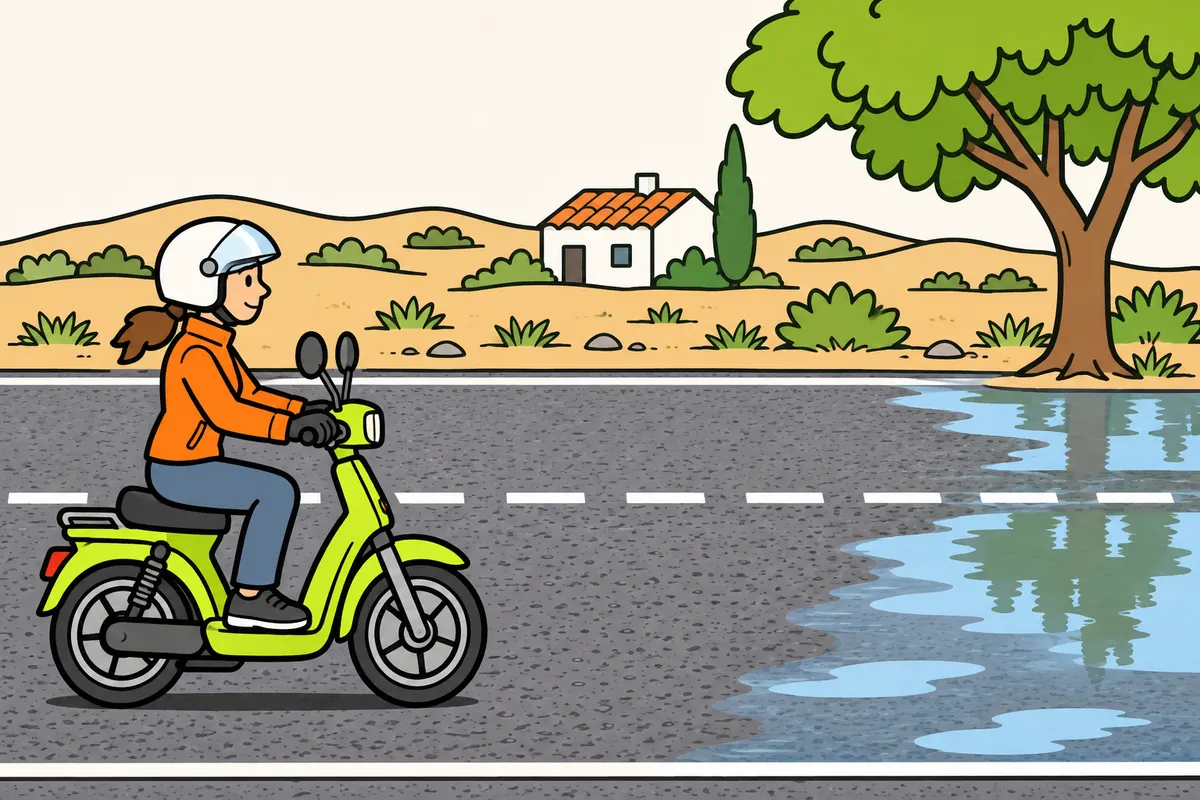
Adapt your riding to the surface and maintain your tyres as the manufacturer instructs.
| Equipment | How it protects you |
|---|---|
| Wheels, brakes, steering and suspension | Help you avoid collisions |
| Helmet and other protective equipment | Reduce the consequences |
Remember
- Slow down before reaching a shiny or doubtful surface.
- Use the tyre pressure specified by the manufacturer.
- Tyre tread helps disperse water but does not always guarantee grip.
- Prepare smooth movements when the surface material changes.
Exam trap: Wrong: lower tyre pressure for rain. Right: use the pressure specified by the manufacturer.
Read the full explanation
- You can expect better grip on a dry, clean, rough surface than on a polished, wet or contaminated one. A shiny stretch may contain water, oil or very smooth material. Look ahead and adapt your speed before your wheels reach the doubtful area.
- Tyre tread helps disperse water but does not guarantee grip at every speed. You must keep your tyres in good condition and use the pressure specified by the manufacturer, checked according to its instructions. Do not arbitrarily reduce the pressure for riding in rain.
- Wheels, brakes, steering and suspension contribute to active safety by helping you avoid a collision. Your helmet and other protective equipment reduce its consequences. To prevent a fall on a wet bend, adapt your speed to the available grip.
- Watch for changes of material: from tarmac to cobblestones, from repaired surfaces to metal, or from a dry area to a shaded, damp one. Grip can change within a few metres. Plan a smooth path and avoid testing grip by deliberately braking or turning sharply.
11Road paint, metal and rails
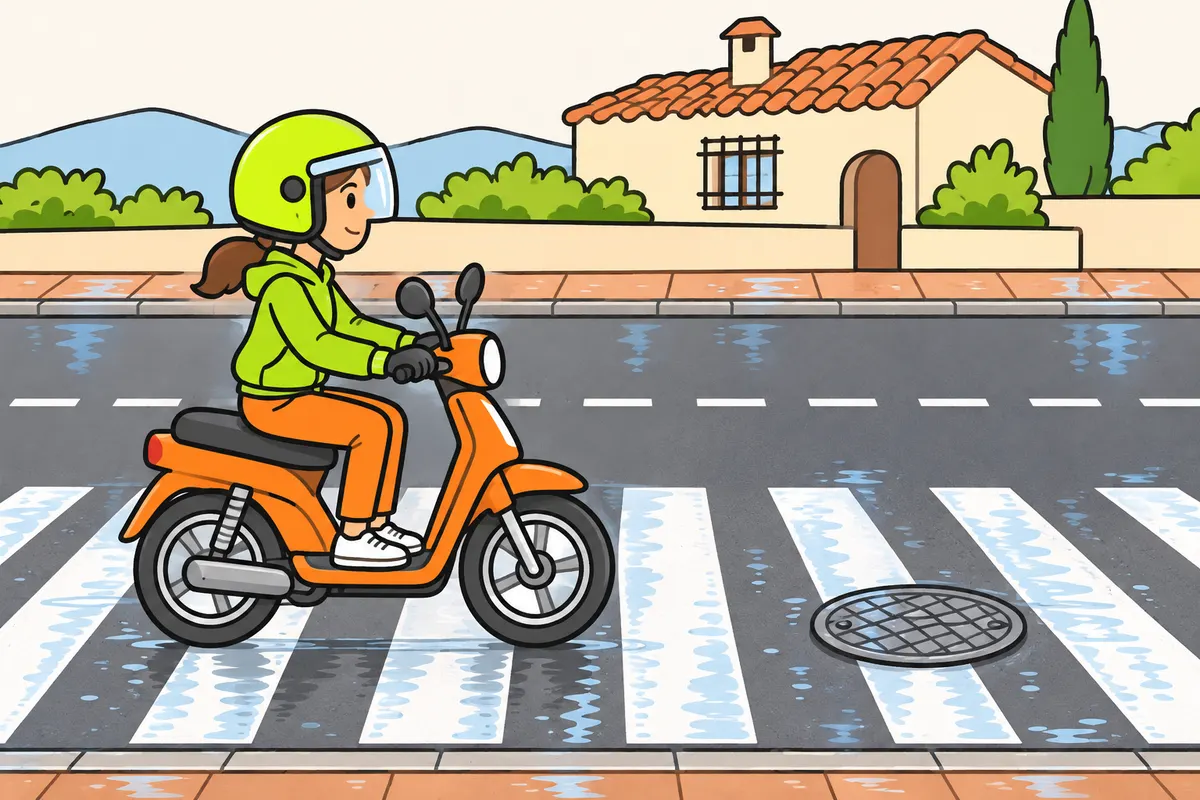
Slow down before crossing paint, metal or rails that may be slippery.
Remember
- Wet paint may offer less grip than the surrounding surface.
- Keep a steady path and stay as upright as the route allows.
- Avoid sudden movements on slippery surfaces.
- Obey markings and avoid dangerous spaces when trying to avoid slippery surfaces.
- Do not follow a rail groove unnecessarily.
Exam trap: Wrong: you must never brake on paint. Right: avoid sudden actions, but respond to immediate danger.
Read the full explanation
- Painted road markings, especially when wet, can offer less grip than the surrounding surface. Anticipate them at pedestrian crossings, arrows and large painted areas. The danger depends on the material and its condition: this does not mean that riding on all paint is prohibited or that you can disobey a marking to avoid it.
- If you must cross a slippery surface, slow down beforehand and try to cross on a steady path with your moped as upright as the route allows. Avoid accelerating, braking or changing direction abruptly on it. If an immediate danger appears, respond as necessary; do not interpret smoothness as an absolute ban on braking.
- Inspection covers, metal plates and rails can become very slippery when wet. Identify them in good time, especially when turning or entering a roundabout. Do not swerve with the steering wheel or handlebars to avoid them if this puts you in the path of another vehicle or forces you into a dangerous space.
- On two wheels, you must also anticipate a groove or rail affecting your steering. Choose a safe way across without unnecessarily following its groove, and maintain control of both controls. Detailed cornering and path techniques belong to the Moped riding techniques module; here, you must recognise the danger and approach at a suitable speed with adequate margins.
12Oil, loose chippings, leaves and potholes
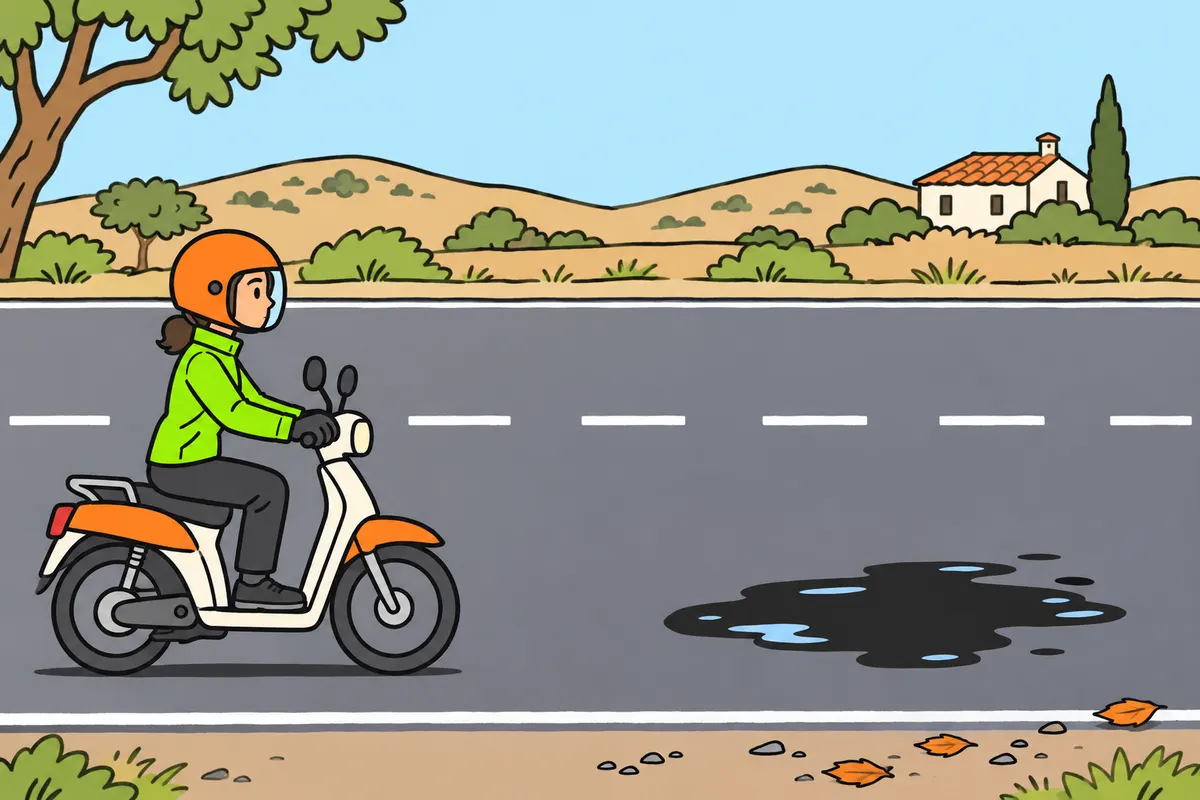
Spot spills, loose material and potholes early so you can cross without sudden movements.
Remember
- Avoid oil spills only when you can do so safely.
- If you must cross them, slow down beforehand and avoid sudden movements.
- With loose chippings, leave more space and avoid throwing stones.
- Wet leaves can be slippery and hide holes.
- If you cannot avoid a pothole, try to cross straight and steady.
Exam trap: Wrong: accelerating on oil protects you. Right: slow down beforehand and cross smoothly.
Read the full explanation
- A patch of oil, fuel or grease can greatly reduce grip. Be suspicious of shiny areas or stains, and avoid riding over them if you can do so safely. If crossing is unavoidable, slow down beforehand and cross without abrupt movements.
- Loose sand and chippings make stable tyre contact with the surface difficult. You may find them on the arcén (hard shoulder), bends, track entrances and at roadworks. Increase your following distance to avoid being struck by flying material, and slow down to avoid throwing it onto others yourself. [RGC, art. 46](https://www.boe.es/buscar/act.php?id=BOE-A-2003-23514#a46).
- Wet leaves, mud and plant debris can also be slippery and hide paint, holes or edges. Take extra care even if it is not raining at the time.
- Potholes, ruts and bumps can destabilise you. Slow down before reaching them and avoid swerving around them without checking to the sides; if you cannot avoid a pothole, try to cross it with the vehicle straight and stable. Do not follow so closely that you only discover a defect when you have no room to respond.
13Rain and the first drops
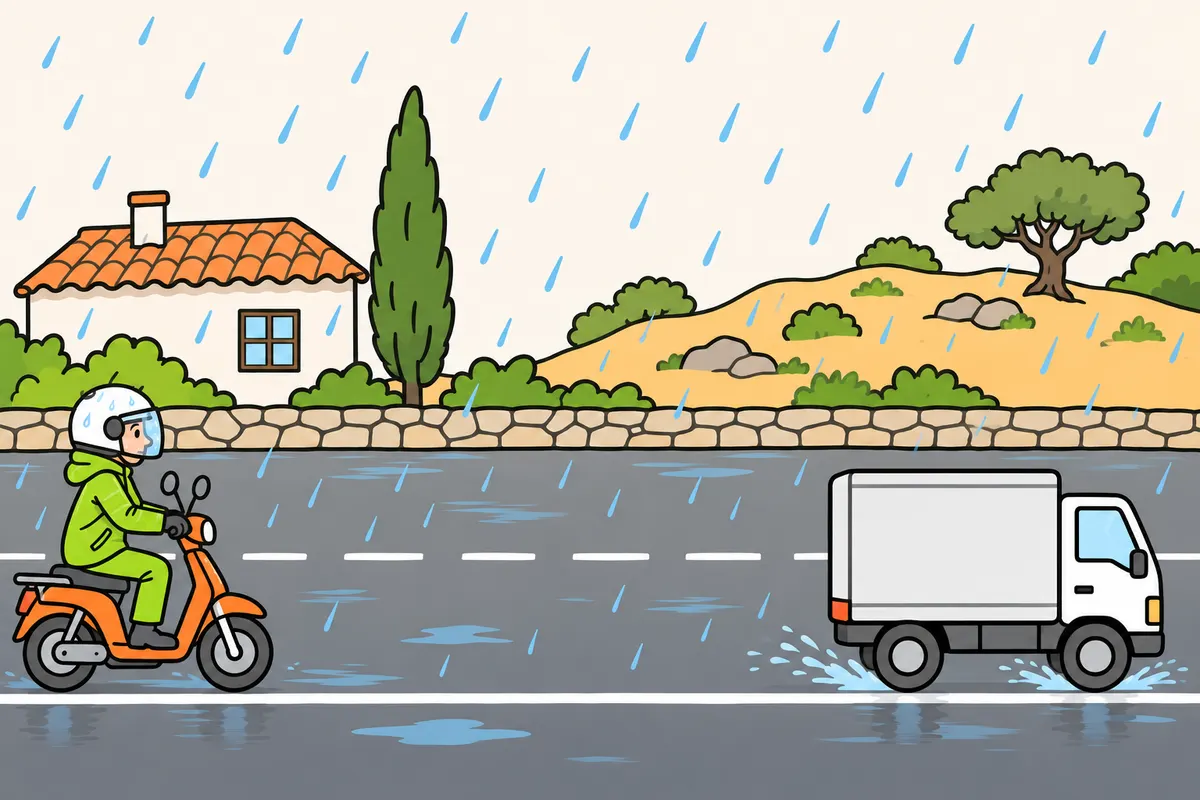
In rain, you see less clearly and need more space to brake.
Remember
- Slow down and increase your following distance.
- The first drops after dry weather can make roads very slippery.
- For a planned slowdown, brake early and gradually.
- On your two-wheeled moped, avoid leaning too much.
- Spray from large vehicles can hide the road.
Exam trap: Wrong: rain prohibits all overtaking. Right: only overtake with enough visibility and space.
Read the full explanation
- In rain, you face two different problems: poorer vision and less grip. Water on your visor and spray can prevent you from recognising a danger, while the wet surface can lengthen braking distance. You must slow down and increase your following distance, even on a familiar route.
- The first drops after a dry spell can mix with dust and grease to form a very slippery film. Assess the surface even in light rain and without large puddles.
- Use the accelerator, steering and brakes smoothly. For a planned reduction in speed, start braking early and progressively; avoid discovering the available grip by entering a bend too fast. On two wheels, you must reduce the need to lean and avoid sudden changes on wet paint or metal.
- Spray from a lorry or bus can momentarily hide the road. Increase your safety margin and avoid starting a manoeuvre whose safety depends on continuing to see through that spray. Rain alone does not prohibit all overtaking, but you cannot overtake without sufficient visibility and space.
14Puddles and loss of contact
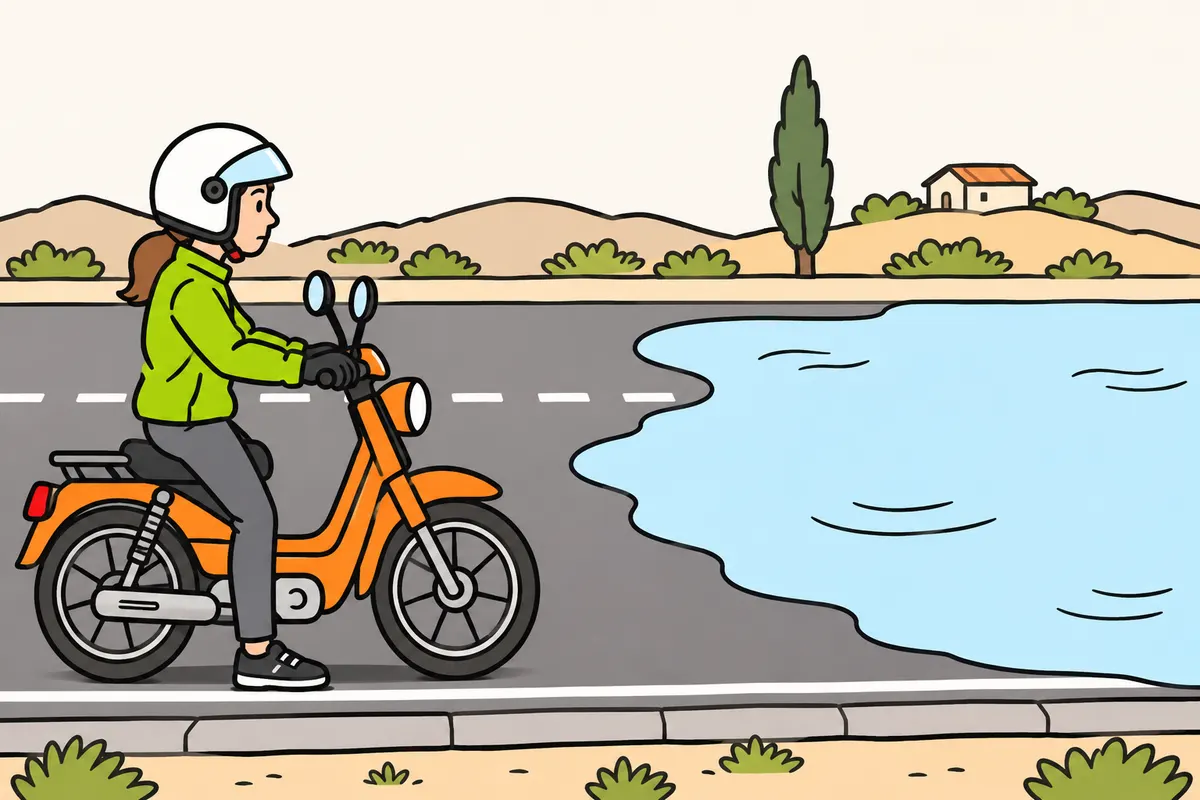
Avoid water of unknown depth; you can lose grip and braking power.
Remember
- A puddle can hide potholes or displaced covers.
- Do not enter flooded areas of unknown depth.
- Even a small puddle can impair your view and grip.
- Aquaplaning happens when your tyres lose effective contact with the road over water.
- After a puddle, your brakes may temporarily work less well.
Exam trap: Wrong: you can cross because another vehicle did. Right: that does not prove it is safe for you.
Read the full explanation
- A puddle can hide a pothole, a displaced cover or greater depth than it appears to have. You must avoid flooded areas and water of unknown depth: your moped can lose stability or be swept away. Do not use the wheel of the vehicle ahead as proof that crossing is safe for you.
- Even a small puddle can change grip as you enter and leave, and cause splashes that impair your view. Loss of contact on water reduces your ability to steer and brake. After crossing, water can temporarily reduce brake effectiveness and increase stopping distance. You study use of the controls and restoring wet brakes in the Moped riding techniques module, “Slippery surfaces and wet brakes”.
- Aquaplaning occurs when a tyre fails to disperse water and loses effective contact with the surface. Standing water, speed and tyre condition affect the risk. This risk also affects mopeds.
15Snow, ice and shaded areas
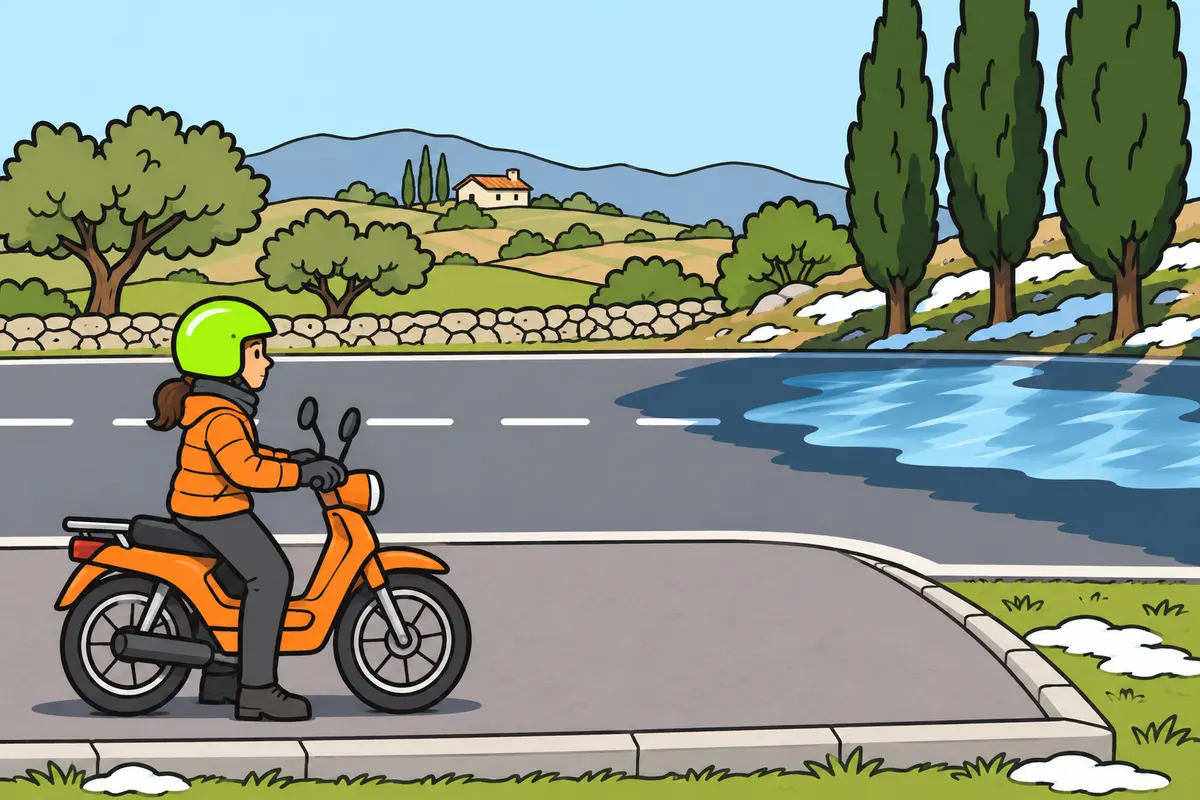
With snow or ice, consider postponing your journey and avoid sudden movements.
Remember
- Obey restrictions and instructions from the authorities.
- Expect possible ice in damp, shaded areas, on bridges and overpasses.
- There may be ice even without snow nearby.
- Check wheel tracks: compacted snow may be icy.
- If you lose stability or cannot stop safely, find a safe alternative.
Exam trap: Wrong: wheel tracks guarantee grip. Right: check their condition because they may be icy.
Read the full explanation
- Snow makes the road layout harder to see and reduces grip; when compacted, it can turn to ice. On a two-wheeled moped, the risk of falling makes postponing the journey or finding a safe alternative particularly advisable. You must obey restrictions and instructions from the authorities, even if you consider your journey necessary.
- Suspect ice in damp, shaded areas, on bridges and overpasses, especially at night and in the early hours. It can be present even if you see no snow on the rest of the road. Anticipate the area and greatly increase your available safety margin.
- Other vehicles’ wheel tracks do not guarantee good grip: compacted snow may be icy. Assess their condition before following them and avoid abrupt acceleration, braking and steering corrections. With an automatic, you cannot select gears that it does not have; follow your vehicle’s specific instructions.
- If you cannot maintain balance, your path or a reasonable stopping distance, do not persist in continuing. Find an alternative or a safe place to interrupt your journey.
16Fog, smoke and dust
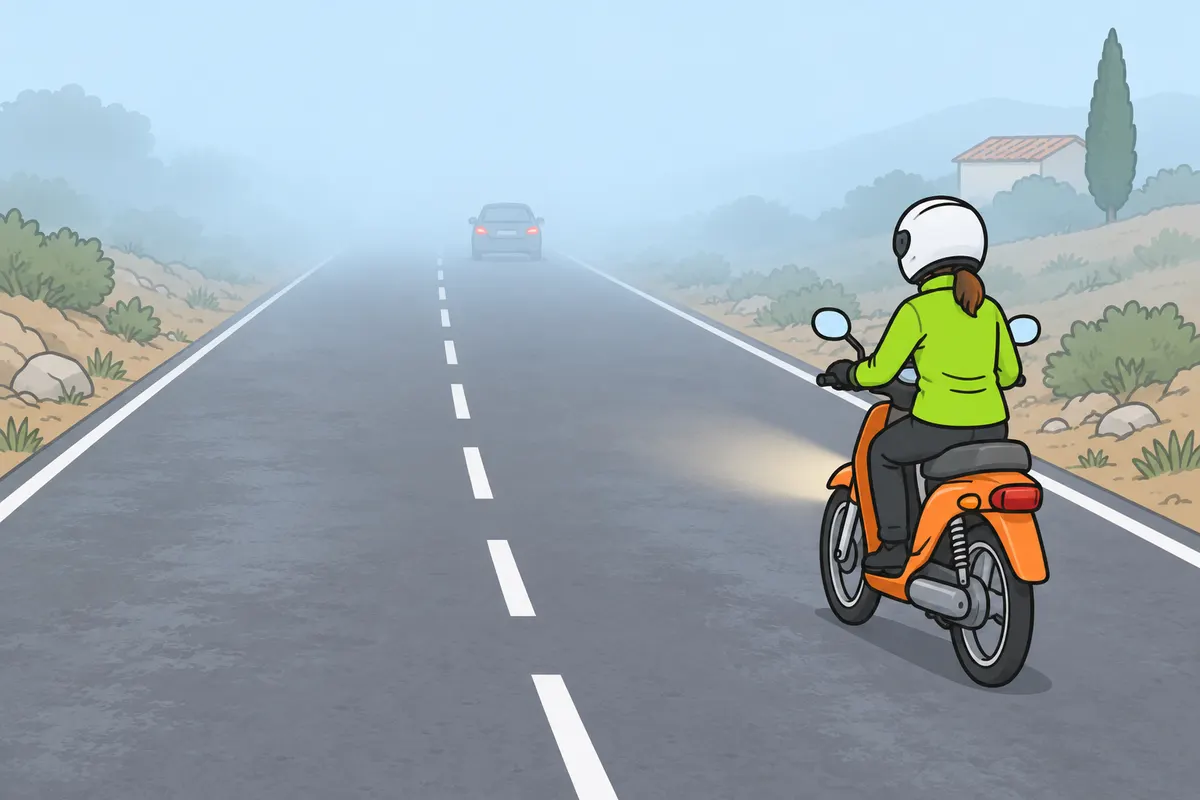
In fog, smoke or dust, adapt your riding to the distance you can see.
Remember
- Leave more space and do not follow only the lights ahead.
- Use the required lights when visibility drops significantly.
- Main beam can reflect off fog and make your view worse.
- Watch for damp surfaces and misted windows too.
- If you cannot see safely, find somewhere to stop out of traffic.
Exam trap: Wrong: any fog allows rear fog lights. Right: if fitted, use them only in particularly adverse conditions, such as thick fog or very heavy rain.
Read the full explanation
- In fog, you must adapt your speed to the distance you can actually see, increase your following distance and avoid using the lights of the vehicle ahead as your only reference. It may brake, take the wrong path or disappear into the fog. Following closely to avoid losing it reduces the very margin you need to stop.
- Main beam can reflect off fog droplets and impair your view, so consider dipped beam; use the lighting explained in “Use your lights to be seen”. If your vehicle has a rear fog lamp, its use requires particularly adverse conditions, such as thick fog or very heavy rain. [RGC, art. 106.2](https://www.boe.es/buscar/act.php?id=BOE-A-2003-23514#a106).
- You must anticipate moisture on the carriageway and condensation on your visor or windows, as well as difficulty seeing outside. At junctions and bends, you have fewer reference points for judging distances. Slow down before entering and do not try to compensate for uncertainty by using the horn or following another vehicle closely.
- A cloud of dust or smoke can suddenly hide stationary vehicles and change grip if it deposits material on the surface. If you spot it, slow down gently before entering, keep a safety margin and follow the guidance in “Use your lights to be seen”. If you cannot continue with a safe view, find a suitable place to stop out of traffic.
17Crosswinds and gusts
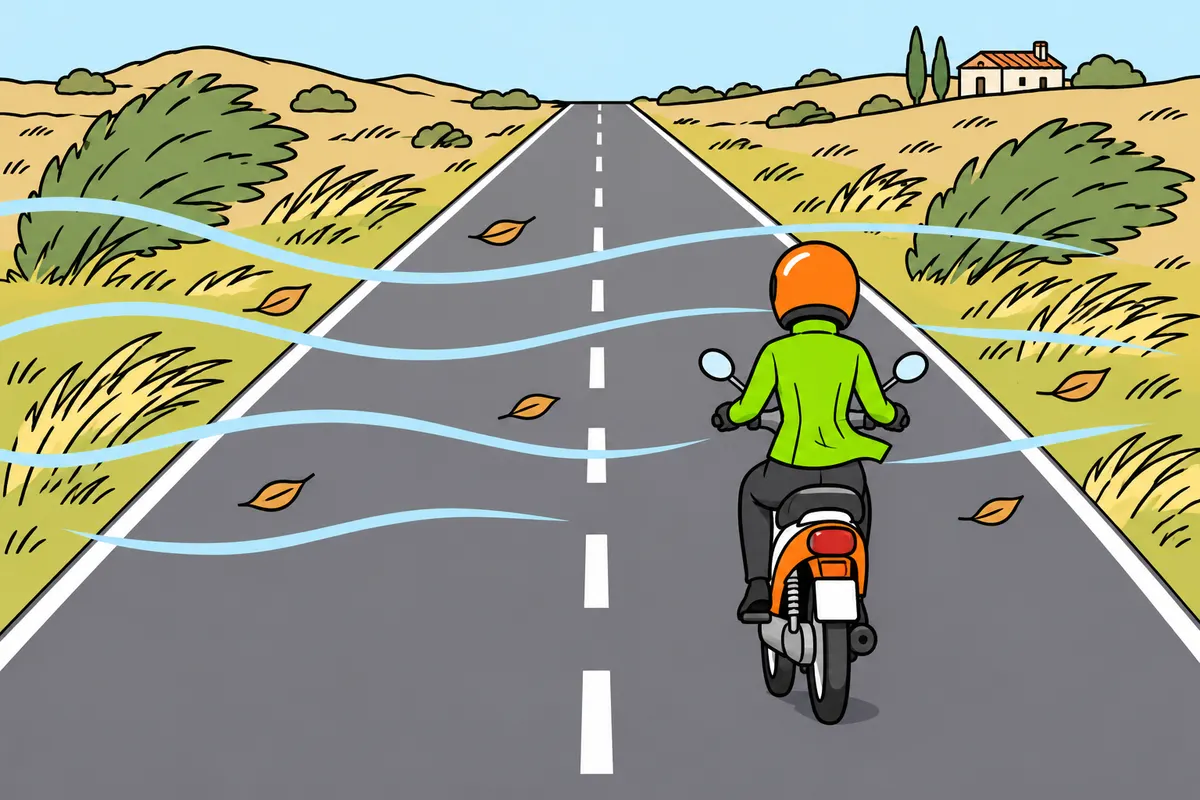
Anticipate gusts and keep enough space to maintain a safe path.
Remember
- Crosswinds can push you sideways and make you lose balance.
- Headwinds and tailwinds can also change.
- Assess your space to the sides before entering exposed areas.
- Bulky loads and loose clothing catch more wind.
- If you cannot keep a safe path, stop somewhere sheltered where stopping is permitted.
Exam trap: Wrong: trust the wind to keep the same strength. Right: expect changes in direction and strength.
Read the full explanation
- Crosswinds and gusts can push your moped off course and make you lose balance. Headwinds and tailwinds do not eliminate the risk either: they can change direction or strength and affect your speed. Assess wind strength and how exposed the stretch is, as well as what you feel at that moment.
- A gust can use up the lateral margin between your moped and a vehicle or obstacle. Assess that space before entering an exposed stretch; you study posture, handlebar use and corrections in the Moped riding techniques module, “Wind, descents and room to react”.
- A bulky load and loose clothing can increase the area exposed to the wind and make it harder to hold your course. Assess this risk when preparing your luggage and equipment.
- Observe trees, dust and other signs of changes in wind without taking your attention away from the road. If gusts prevent you from maintaining a safe path, interrupt your journey in a sheltered place where stopping is permitted.
18Anticipate the wind shielding effect
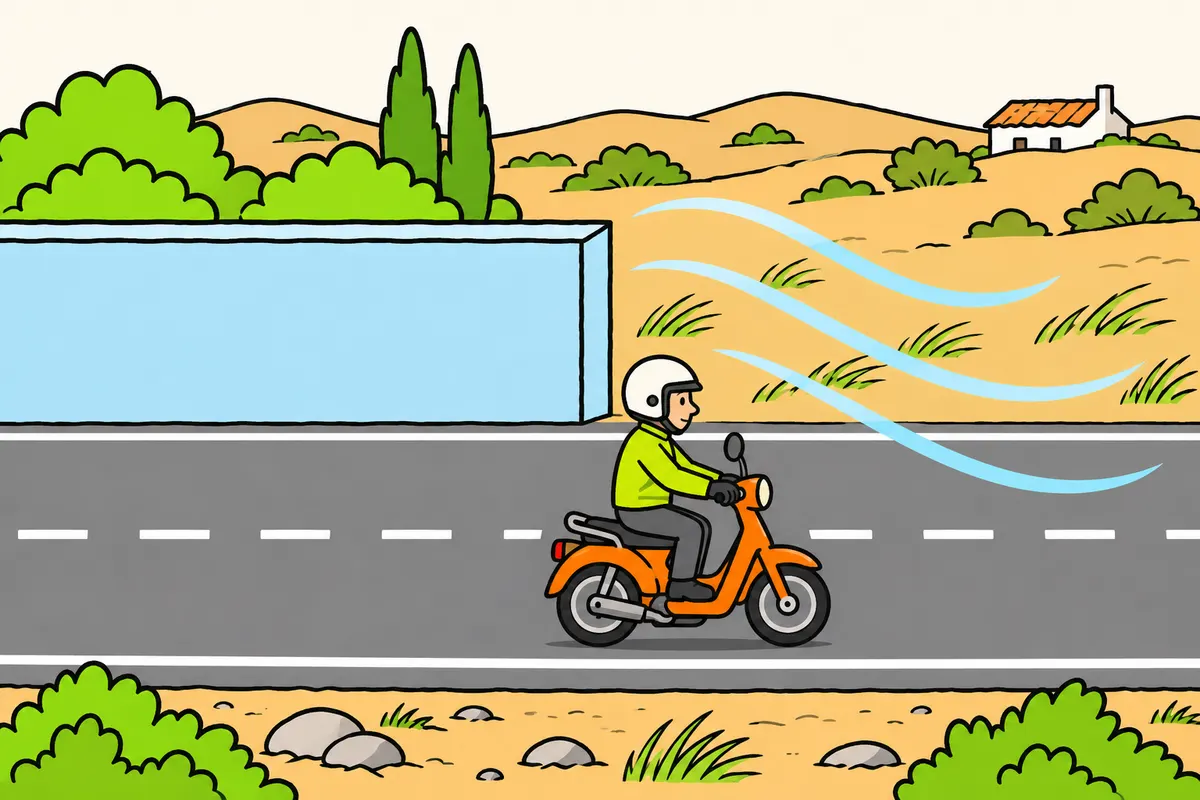
Expect changes in wind when entering or leaving a sheltered area.
Remember
- A lorry, building or trees can shelter you from wind temporarily.
- When you leave its shelter, the wind pushes you again.
- When entering shelter, your earlier correction could steer you towards the vehicle.
- You can also lose balance when a large vehicle overtakes you.
- Do not follow closely behind a lorry for shelter.
Exam trap: Wrong: keep the same correction beside a sheltering lorry. Right: expect the wind force to change.
Read the full explanation
- A lorry, building, roadside barrier or group of trees can temporarily shelter you from the wind. When that shelter ends, the force returns and you can be displaced unexpectedly. You must anticipate this on bridges, when leaving sheltered areas and when passing large vehicles, without waiting for the gust to hit.
- The force also changes as you enter a sheltered area: the correction you use against the wind can steer you towards the vehicle shielding you. Anticipate this change; you study correction techniques in the Moped riding techniques module, “Wind, descents and room to react”.
- If a large vehicle overtakes you, its passage and turbulence can affect your moped’s balance. Anticipate this change in force even when you are not the one overtaking.
- When meeting a lorry on a narrow road, assess the wind, width and condition of the road edge together. You must slow down before passing each other if you need more control, and maintain a safe margin. Do not seek shelter by following closely behind a large vehicle: you lose visibility and braking space.
19Keep a safety margin at night
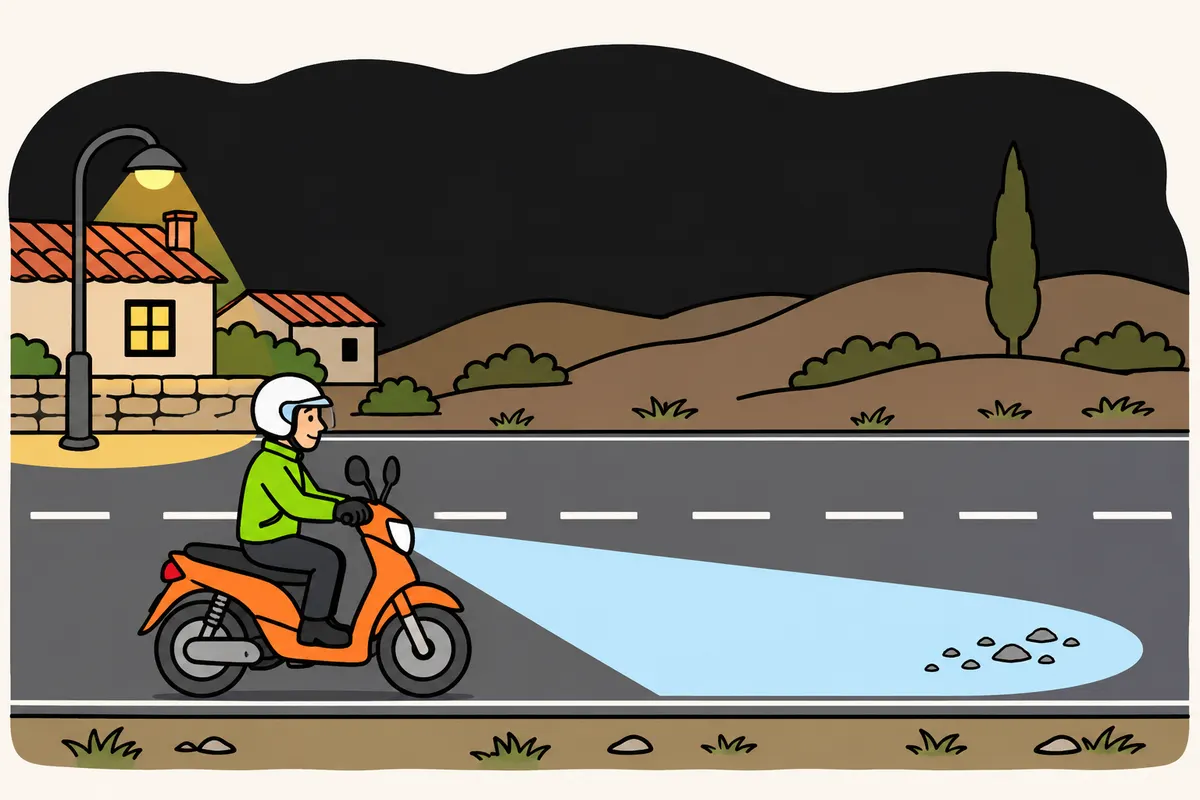
At night, adapt your speed to the obstacles you can distinguish with your headlamps.
Remember
- Watch the sides of the road too.
- Expect reduced vision when moving from light into darkness.
- In built-up areas, use position lights and dipped beam even with street lighting.
- If you have main beam, use it under the required conditions without dazzling others.
Exam trap: Wrong: ride at night using only position lights. Right: also use the required lighting.
Read the full explanation
- At night, you find it harder to recognise people, objects and distances, and some obstacles appear in your headlamp beam only when they are already close. Adapt your speed to that visible area and pay extra attention to the sides. Light traffic does not allow you to maintain a speed at which you cannot stop in time.
- When moving from a lit stretch to a dark one, your eyes need to adapt. Anticipate reduced vision before the dark area, especially on bends and when leaving built-up areas. Do not assume you can immediately distinguish a pedestrian in dark clothing, an animal or loose chippings on the carriageway.
- You must use the appropriate lights; in built-up areas at night, you need position lights and dipped beam, whether or not lighting is sufficient. Position lights alone make your presence visible but do not allow you to see the road while driving. [RGC, art. 101](https://www.boe.es/buscar/act.php?id=BOE-A-2003-23514#a101).
- On a dark road, if your moped has main beam, its use depends on the regulatory conditions and avoiding dazzle. You study the detailed choice in the Moped lights and signals module. For this risk, adapt your speed to the useful range of your headlamps and the obstacles you can recognise.
20Respond to dazzle
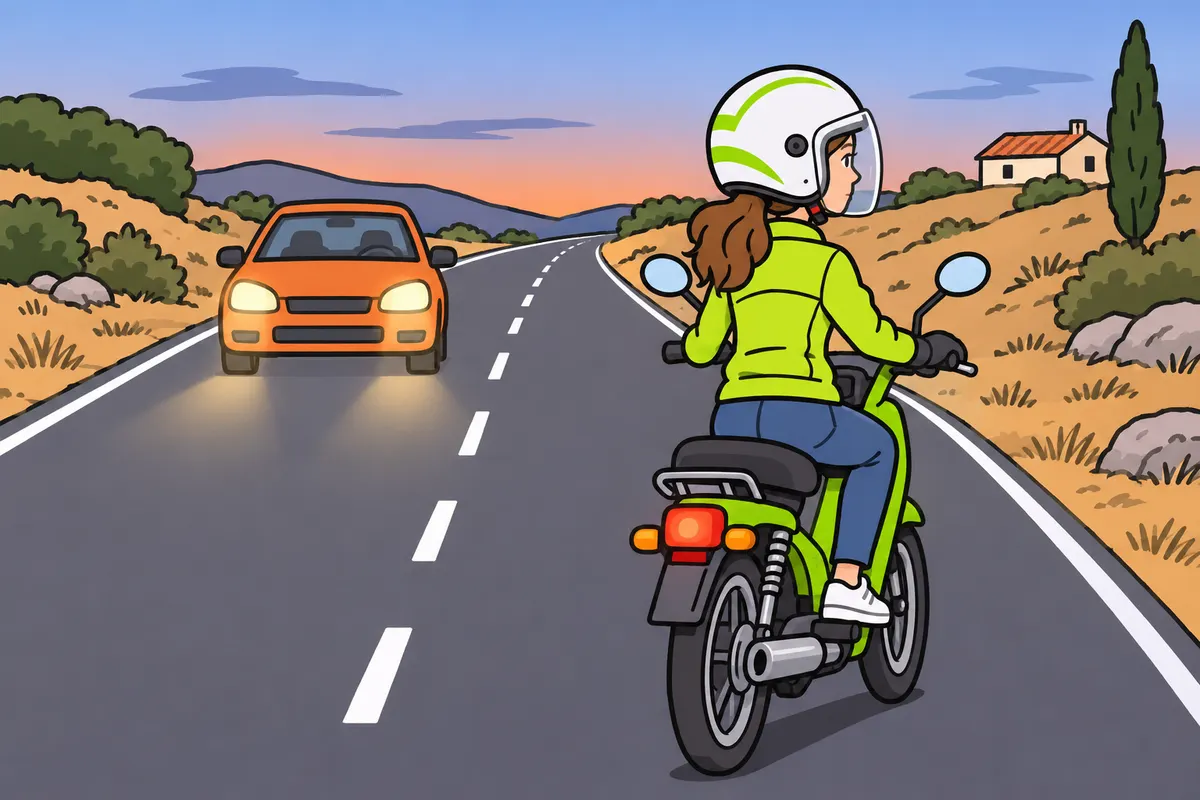
If dazzled, slow down until you are safe, stopping if necessary.
Remember
- Do not look straight at headlamps.
- Use right-hand edge reference points without moving onto the hard shoulder.
- Do not retaliate with main beam or accelerate.
- Switch to dipped beam as soon as you could dazzle anyone, including through mirrors.
- Do not wear sunglasses or use a dark visor at night.
- If you must stop, avoid creating another danger.
Exam trap: Wrong: use sunglasses against night-time dazzle. Right: they reduce vision; slow down as much as necessary.
Read the full explanation
- If you are dazzled, you must reduce your speed as much as necessary, even stopping, while avoiding running into vehicles or pedestrians travelling in your direction. Maintain control, your path and the lights needed to be seen. [RGC, art. 102](https://www.boe.es/buscar/act.php?id=BOE-A-2003-23514#a102).
- Avoid looking directly at headlamps; use reference points along the right-hand edge without steering towards the hard shoulder or losing sight of your path. Do not retaliate with main beam or accelerate to finish passing sooner. If you need to stop, take the precautions the situation allows without creating another danger.
- You must switch from main beam to dipped beam as soon as you could dazzle anyone, including drivers ahead through their mirrors and users of other roads. [RGC, art. 102](https://www.boe.es/buscar/act.php?id=BOE-A-2003-23514#a102).
- Do not use sunglasses or a dark visor to combat dazzle at night: they reduce the available light and make obstacles harder to recognise. Keep your eye protection clean, as dirt and scratches scatter light. You must address poor vision by reducing risk and restoring visibility, without darkening the scene further.
21Ride in a group without pressure
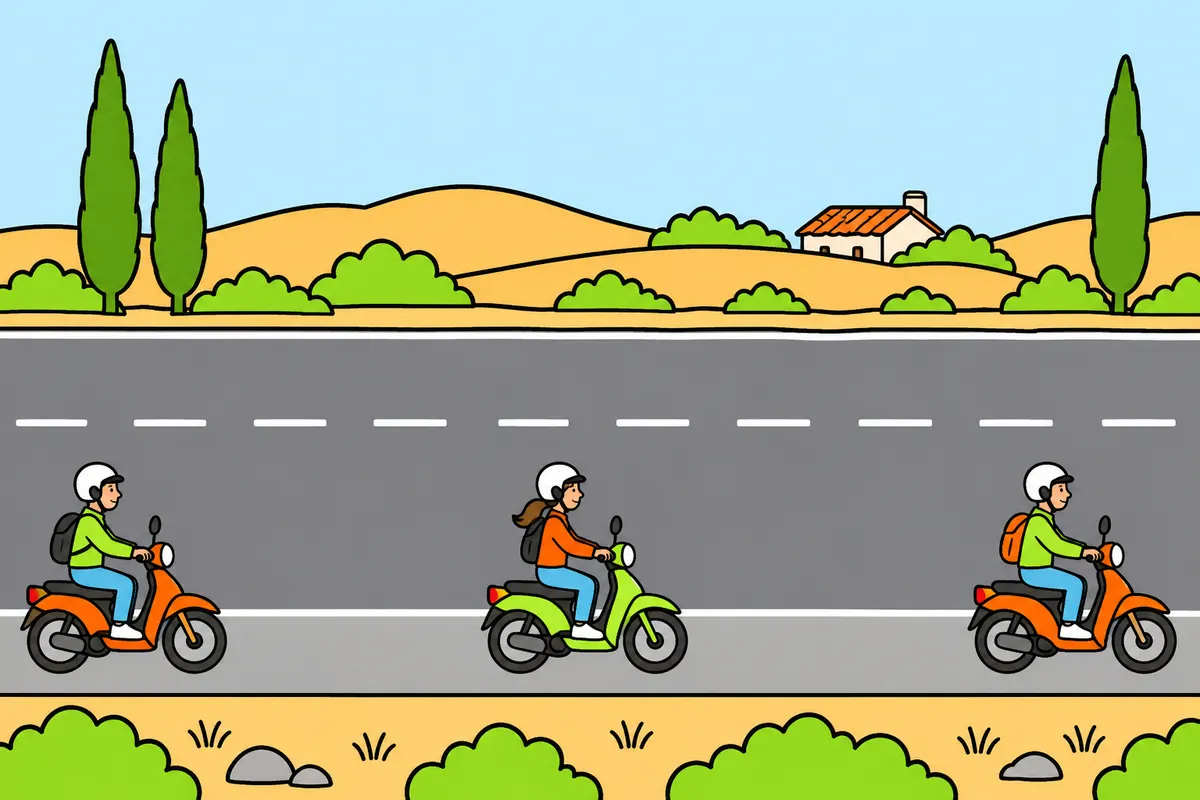
In a group, decide for yourself and keep a safe speed and following distance.
| Situation on your moped | What you must do |
|---|---|
| Hard shoulder or necessary carriageway space | Never ride alongside others |
| You do not signal an intention to overtake | Also leave space for others to overtake safely |
| Built-up areas; overtaking prohibited; several lanes in your direction; traffic too congested for overtaking | No additional gap required to help others overtake |
Remember
- Agree on your route and safe meeting places.
- If you lose the group, do not accelerate or pass red lights to follow.
- Do not copy manoeuvres beyond your experience.
- Do not race: competitions on public roads require exceptional authorisation.
- Do not close gaps to prevent others coming between group members.
Exam trap: Wrong: ride alongside others because the hard shoulder is wide. Right: on your moped, never ride alongside others on the hard shoulder or necessary carriageway space.
Read the full explanation
- In a group, watching only the rider ahead can hide changes in traffic from you: also scan your route and keep the margin explained in “Keep a safety margin ahead and behind”. The following-distance exception for bicycles travelling in a group does not apply to mopeds. [RGC, art. 54.1](https://www.boe.es/buscar/act.php?id=BOE-A-2003-23514#a54).
- Under the hard shoulder rules in article 36, you must ride your moped in single file; consult the Moped manoeuvres module, “Hard shoulder, single file and limits on riding alongside”, for the prohibition on riding side by side. [RGC, art. 36.2](https://www.boe.es/buscar/act.php?id=BOE-A-2003-23514#a36).
- Before setting off, you can agree on the route and safe meeting points. If you lose the group, keep a safe speed and rejoin later: do not go through a red light or attempt an overtake without visibility to follow them. Each driver must decide according to what they see and the rules that apply to them.
- Do not race, copy lean angles or braking beyond your experience, or let jokes or conversation absorb your attention. Speed competitions on public roads are prohibited except in the exceptional authorised case. [RGC, art. 55](https://www.boe.es/buscar/act.php?id=BOE-A-2003-23514#a55).
- If you do not signal an intention to overtake, you must also leave space for anyone behind to overtake you safely. This additional obligation has four exceptions: in built-up areas, where overtaking is prohibited, where there is more than one lane in your direction, or when traffic is too congested to allow overtaking. Do not close gaps to prevent others coming between group members. [RGC, art. 54](https://www.boe.es/buscar/act.php?id=BOE-A-2003-23514#a54).
22Identify fatigue early
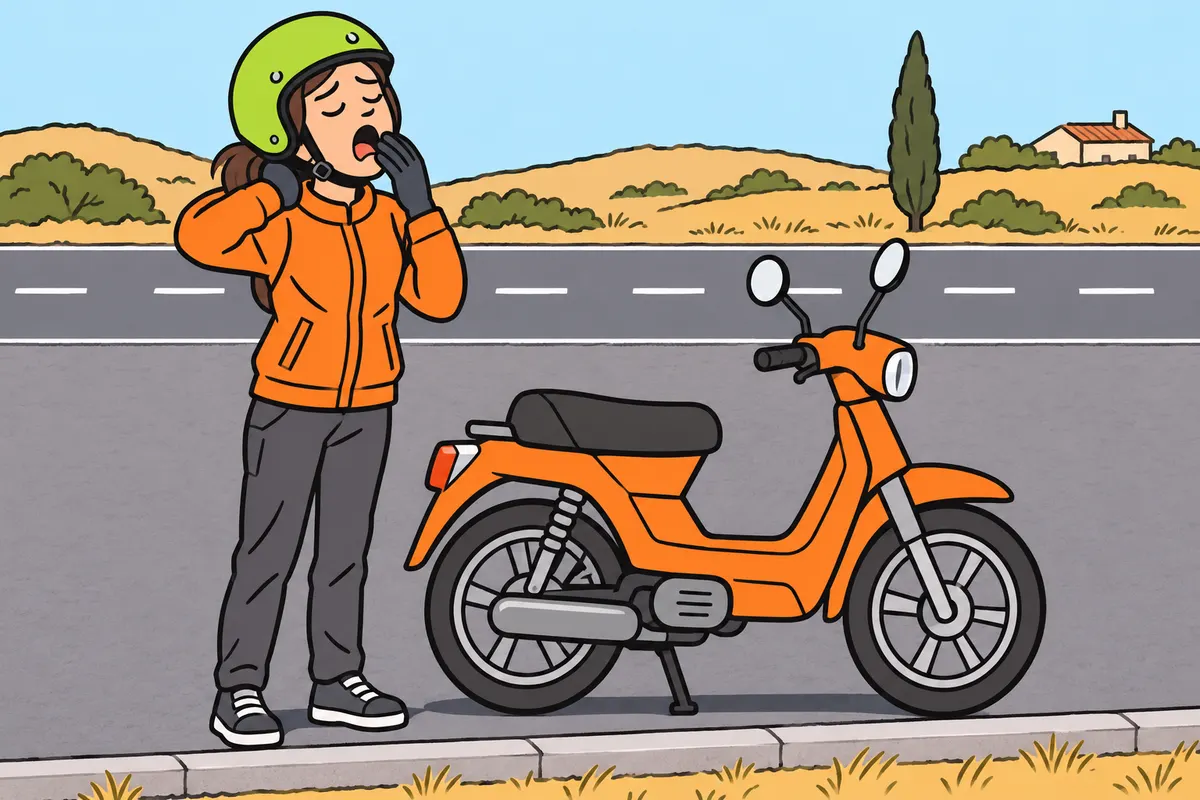
Recognise tiredness and stop before you lose your ability to drive.
Remember
- When tired, you observe less and react more slowly.
- You can start tired even if you have travelled little.
- Watch for yawning, heavy eyes, discomfort and difficulty concentrating.
- Wind, noise, bad weather and heavy traffic can tire you more.
- As a beginner, do not push yourself to match an experienced rider.
- If you feel worse, find somewhere safe where stopping is permitted.
Exam trap: Wrong: wait until you are extremely tired. Right: notice symptoms early and interrupt your journey.
Read the full explanation
- When fatigued, you may observe less, react more slowly and make slow or imprecise movements. Exposure to wind, noise, vibration, poor surfaces and an uncomfortable posture increases the effort of riding a moped. You do not need to cover many kilometres: you can start tired from activities before setting off.
- Watch for yawning, back or neck discomfort, constant changes of posture, heavy eyes and difficulty concentrating. Recognising them early allows you to interrupt your journey before losing your ability to respond.
- Night driving, bad weather and heavy traffic can demand greater concentration and contribute to tiredness. If you are a beginner, many tasks still require conscious attention; do not try to compensate by forcing yourself to match an experienced driver’s pace. Reduce the demands and plan a journey you can complete while rested.
- Before setting off, assess whether you are fit to drive; if your condition worsens on the way, find a safe place where stopping is permitted. You study sleepiness, medicines and other personal impairments in general in the Your fitness to drive module. [DGT: Driving while fatigued](https://www.dgt.es/muevete-con-seguridad/evita-conductas-de-riesgo/conducir-con-fatiga/).
23Rest and protect your attention
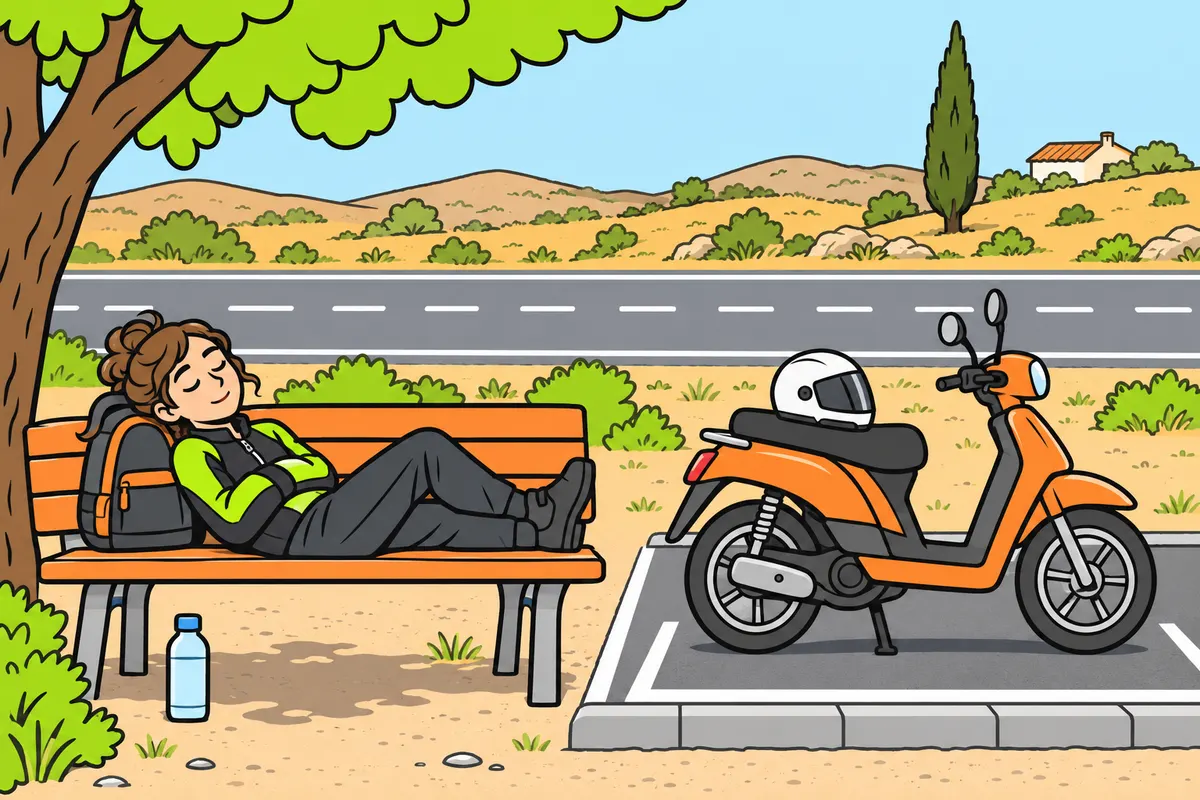
Rest before setting off and stop before tiredness prevents you from driving.
Remember
- Plan breaks; stop sooner if effort, cold or tiredness makes it advisable.
- Use breaks to move, rest and drink water.
- Avoid heavy meals and setting off very hungry or thirsty.
- If sleepy, stop somewhere safe and sleep as much as you need.
- Coffee, music and fresh air do not replace sleep.
- Do not let an arrival time make you skip breaks.
Exam trap: Wrong: wait until two hours have passed despite feeling sleepy. Right: stop sooner and sleep if needed.
Read the full explanation
- Start your journey rested and plan breaks. For long journeys, the DGT recommends stopping every two hours or every 200 km; this is preventive advice, not an interval that allows you to continue while fatigued. On a moped, you must stop sooner if effort, cold or tiredness makes it advisable. [DGT: Signs of tiredness](https://revista.dgt.es/es/reportajes/2025/12DICIEMBRE/1219-N276-Senales-del-cansancio.shtml).
- Use breaks to rest, change posture, move around and hydrate. Avoid heavy meals before driving and do not start your journey very hungry or thirsty. Preparation should help you maintain attention, but no drink or food replaces the rest you need to be fit to drive.
- If you become sleepy, stop somewhere safe and sleep as much as you need before resuming. Fresh air, music, conversation or coffee do not provide a solution that allows you to keep driving while drowsy. You can suffer a brief lapse of attention without noticing in time. [DGT: Sleepiness or tiredness](https://www.dgt.es/muevete-con-seguridad/evita-conductas-de-riesgo/Conducir-con-sueno-o-cansancio).
- Avoid setting an arrival time that forces you to skip breaks or continue when you do not have proper control. If you are in a group, say that you need to stop and use an agreed safe place. Your recovery determines when you can continue; others’ impatience does not reduce fatigue.
24Cold, heat and deciding whether to continue
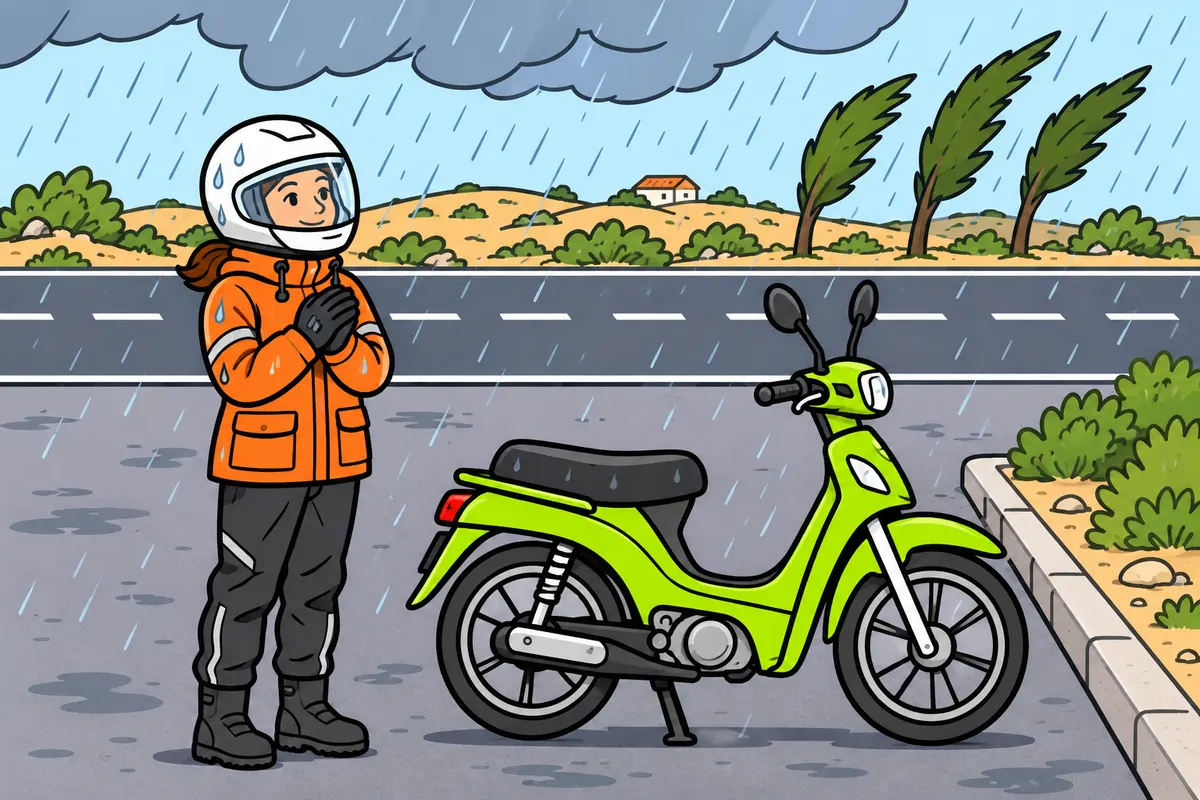
Adapt your equipment and decide whether the weather lets you continue safely.
Remember
- Cold can reduce your feeling and precise control.
- Choose equipment that protects you and lets you move.
- In hot weather, drink water during stops and keep your protection.
- In your enclosed quadricycle, check ventilation and temperature.
- Check the weather before setting off and during your journey.
- Stop somewhere permitted and safe, away from traffic and flood-prone areas.
Exam trap: Wrong: trust your equipment in any weather. Right: reassess and stop if you cannot continue safely.
Read the full explanation
- Cold, wet clothing and wind can numb you and impair precise use of the controls. Use weather-appropriate equipment that preserves movement and sensitivity, and take breaks before losing dexterity. Do not compensate for stiff hands by gripping the handlebars rigidly or riding faster.
- In hot weather, you can tire more easily and lose concentration; in an enclosed quadricycle, also monitor ventilation and cabin temperature. Hydrate during stops and choose suitable equipment without sacrificing protection.
- Before setting off, check conditions along your route and assess alternatives if storms, ice, strong gusts or very poor visibility are expected. You must reassess them during your journey: a sheltered stretch may lead to an exposed one. Experience and good equipment help, but do not make every weather situation safe.
- If you need to interrupt your journey, find a safe place where stopping is permitted, away from traffic and flood-prone areas; slow down and signal the manoeuvre in advance when possible. You study breakdown warnings and action at collisions in the Accidents, breakdowns and first aid module.
25Recognise tunnel risks
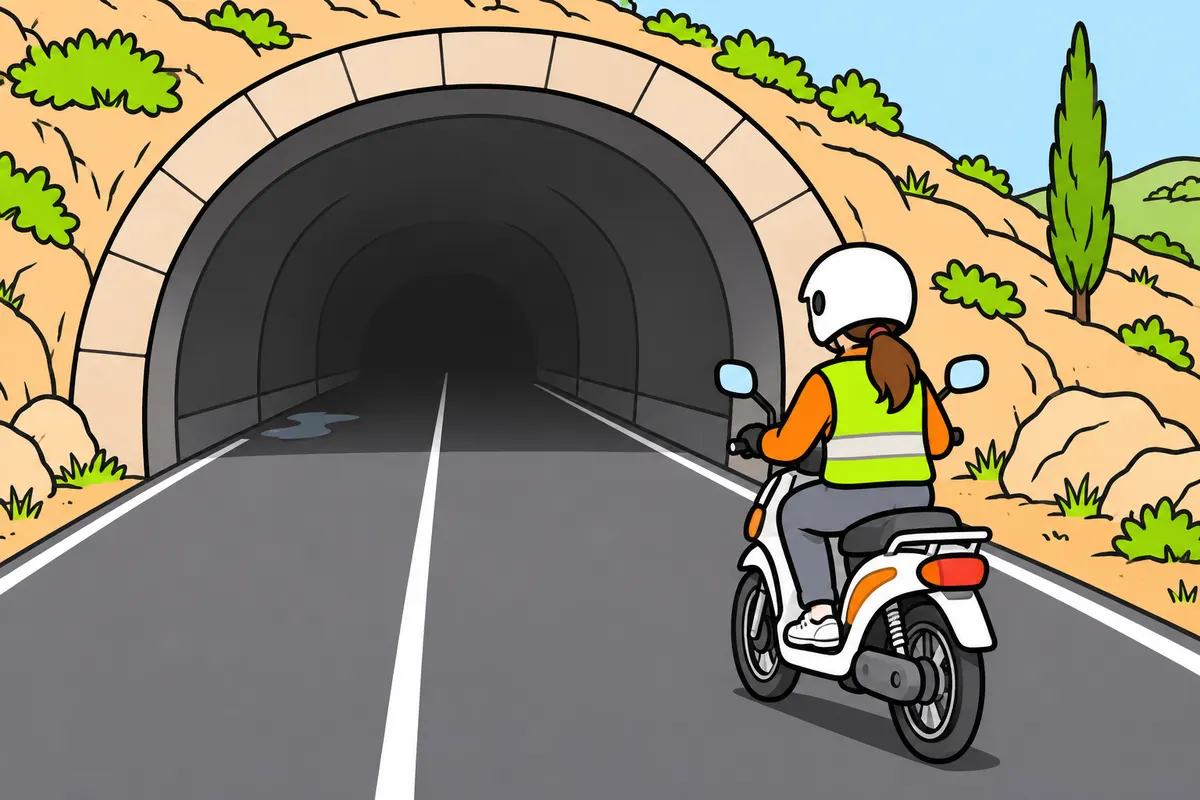
Expect changes in light and grip when travelling through a tunnel.
Remember
- Adapt your speed when entering and leaving.
- Changes in light can make seeing and being seen harder.
- Inside, dampness or oil can reduce grip.
- Do not voluntarily stop or park inside a tunnel.
Exam trap: Wrong: stop in a tunnel to adjust equipment. Right: you cannot stop there voluntarily.
Read the full explanation
- When entering and leaving a tunnel, the change in light can make it harder for you to see obstacles and for others to detect your moped. You must anticipate this and adapt your speed; lighting is covered in section 6. Inside, you may encounter dampness or oil patches that reduce grip. You cannot voluntarily stop or park in a tunnel; you study breakdowns and emergencies in the Accidents, breakdowns and first aid module, “Breaking down inside a tunnel” and “Fire or queuing traffic in a tunnel”. [RGC, art. 94](https://www.boe.es/buscar/act.php?id=BOE-A-2003-23514#a94).
26Anticipate other road users’ inexperience
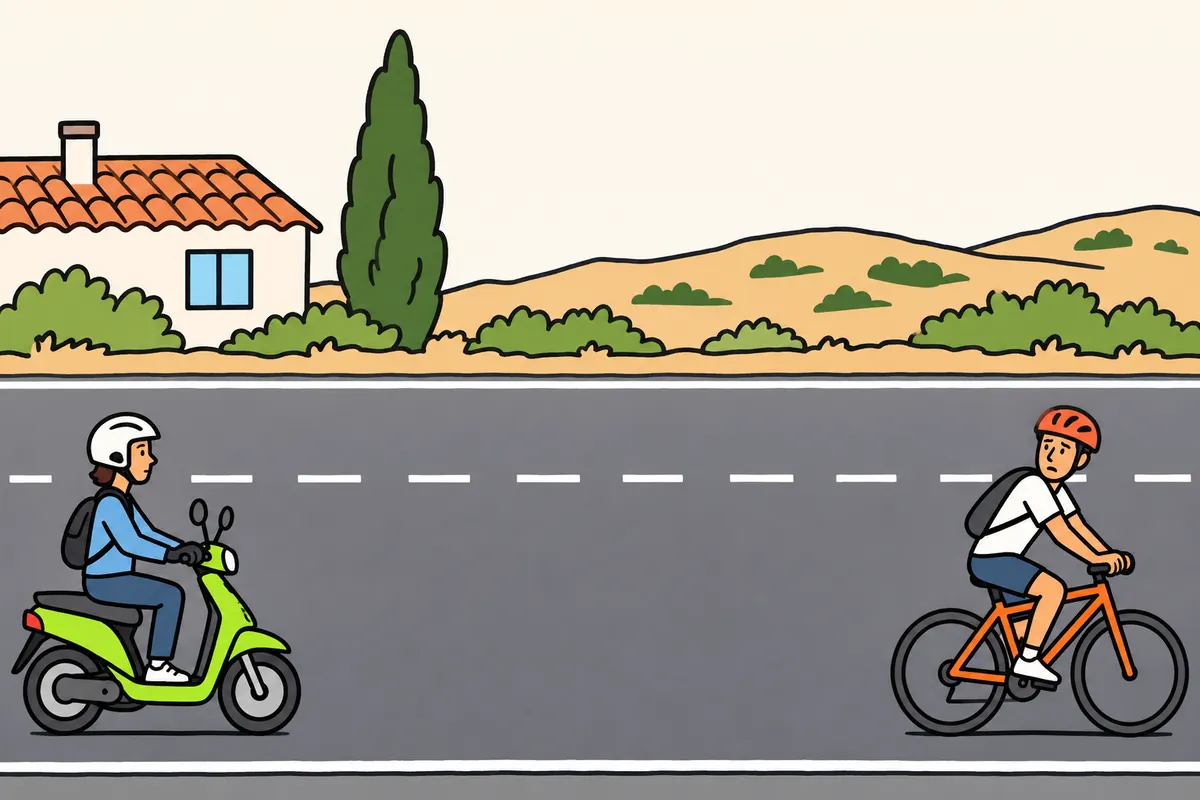
Leave space for hesitation and mistakes by other drivers or cyclists.
Remember
- They may misjudge your speed or change direction unexpectedly.
- If a manoeuvre looks uncertain, leave space for a possible correction.
- Do not pressure them by approaching closely or giving unnecessary warnings.
- Do not judge experience only by age or vehicle.
Exam trap: Wrong: trust an unsure person to judge your path correctly. Right: expect mistakes and keep space.
Read the full explanation
- An inexperienced driver or cyclist may misjudge your speed, hesitate when joining traffic or change course unexpectedly. You must anticipate these errors and keep room to respond on your moped, without pressuring them by approaching closely or giving unnecessary warnings.
- You cannot infer someone’s experience solely from their age or vehicle. If you see an unsteady path or hesitant manoeuvre, assess what you observe and leave room for a possible correction. You study general anticipation guidance in the Defensive and efficient driving module.
Crossing an area with uncertain grip
Prepare before your wheels reach wet paint, loose chippings or a spill.
- Observe the surface and the sides; identify the danger and check traffic behind.
- Slow down early and increase your following distance, avoiding surprising others.
- Choose a legal, steady path, without sudden deviations or entering other spaces.
- Cross with smooth movements and as little lean as the route allows.
- Gradually resume your speed once you check that sufficient grip returns.
Recognising a stretch exposed to wind
Assess changes in wind force before they affect your moped.
- Identify bridges, exits from sheltered areas and vehicles that may shield you.
- Assess the margin available for a gust and the condition of the road edge.
- Consult the wind handling technique in the Moped riding techniques module, “Wind, descents and room to react”.
- If the wind prevents you from maintaining a safe path, find a place where stopping is permitted to interrupt your journey.
Deciding whether you can continue
Act on poor vision, loss of control or signs of tiredness.
- Identify what is failing: visibility, grip, stability or your ability to pay attention.
- Slow down under control and increase your safety margin without being distracted by equipment adjustments.
- If you cannot continue safely, find an exit or a place out of traffic where stopping is permitted.
- Signal and stop with the necessary precautions.
- Resume only when conditions and your state allow safe driving; if you are sleepy, you need to sleep.
Check what you know
Real questions from the bank on this topic. Pick an answer to see the explanation.
Finished this module?
Mark it as read and you will see your progress on the theory list.