
Theory · D Licence - Bus · Module 11 of 18
Passenger transport and minors
You learn to organise passenger boarding, alighting and the distribution of passengers and luggage, and to distinguish restraint requirements and who is responsible. You learn the rules for school transport, the escort and the V-10 sign, together with accessible assistance for people with reduced mobility.
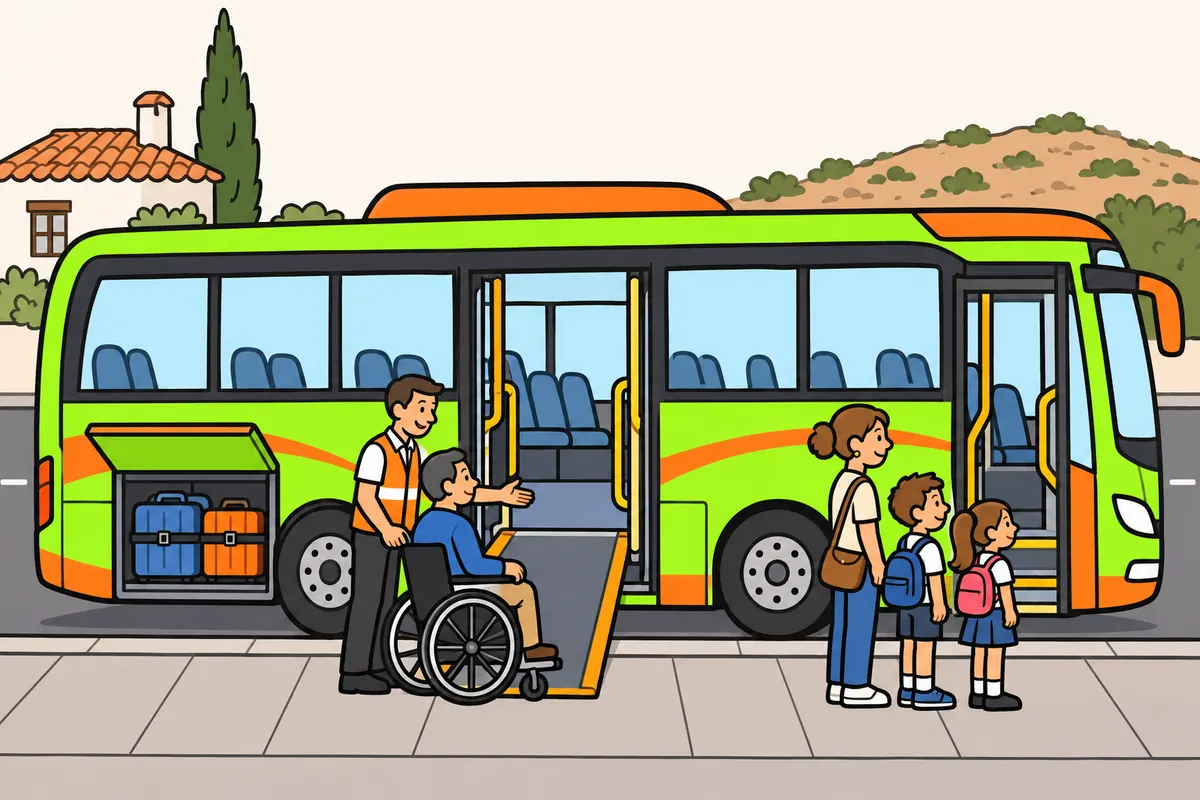
1Authorised capacity and passenger distribution
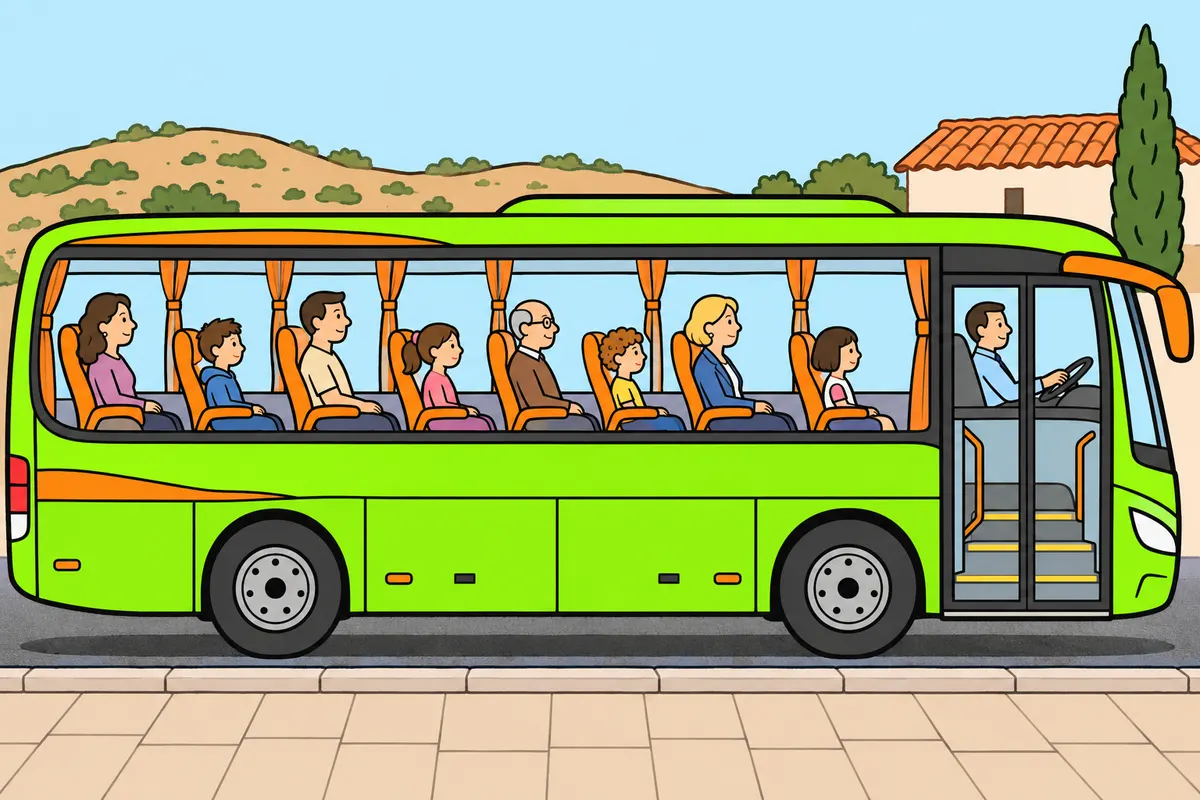
Respect passenger capacity and maximum weight, counting everyone aboard.
Remember
- Count everyone aboard and check the plates inside the bus.
- Do not exceed the maximum weight with passengers and luggage.
- Carry people only in places designed for them.
- Do not use steps, doorways or the luggage hold as passenger places.
- On regulated school services, give each minor their own place.
Exam trap: Wrong: Empty seats mean you can load more suitcases. Right: Check the maximum authorised weight too.
Read the full explanation
- Observe the bus's authorised capacity, shown on plates inside it, and count all its occupants. [RGC, art. 9.1](https://www.boe.es/buscar/act.php?id=BOE-A-2003-23514#a9).
- Passengers and their luggage must not exceed the maximum authorised mass. Both limits apply at the same time: a bus with empty seats may not have enough load capacity for more suitcases. The technical values are covered in Bus dimensions and masses. [RGC, art. 9](https://www.boe.es/buscar/act.php?id=BOE-A-2003-23514#a9).
- You may carry people only in places intended and equipped for them. The staircase, a doorway or the luggage hold are not makeshift passenger spaces; nor may you turn one seat into a double seat because its occupants are small or the journey is short. [RGC, art. 10](https://www.boe.es/buscar/act.php?id=BOE-A-2003-23514#a10).
- On school and minors' transport services covered by the royal decree, each child must have their own seat or place, with the regulatory dimensions. [RD 443/2001, art. 4](https://www.boe.es/buscar/act.php?id=BOE-A-2001-8503#a4).
2When you may carry standing passengers
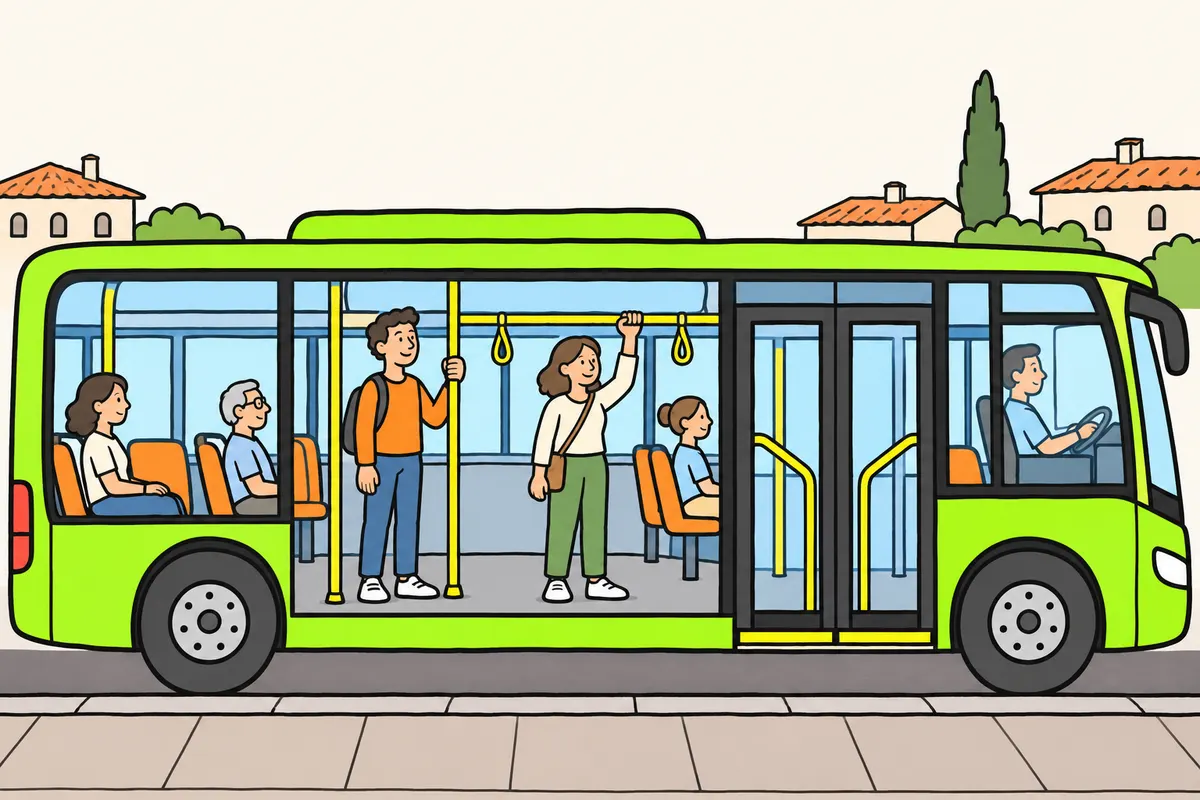
Carry standing passengers only when both the vehicle and service allow it.
| Bus classification | Standing passengers |
|---|---|
| 06: urban | Allowed if the service permits; respect authorised capacity. |
| 07: short-distance | In the aisle on short journeys, if the service permits. |
| 08: long-distance | Not allowed, even on short journeys. |
Remember
- Check the bus classification and service conditions.
- Always respect the authorised capacity.
- Keep standing areas available for passengers.
- Recommend holding rails and grab handles.
- Start and brake smoothly.
Exam trap: Wrong: A long-distance coach allows standing passengers on short trips. Right: Everyone must sit.
Read the full explanation
- The vehicle and service must allow standing passengers. Classification by use 06, urban, provides for seats and standing places; classification 07, short distance, allows passengers to travel standing in the aisle on short journeys. [RGV, Annex II.C](https://www.boe.es/buscar/act.php?id=BOE-A-1999-1826#iic).
- If you drive a vehicle classified by use as 08, long distance, all passengers must be seated. Making a short journey in that coach does not change its classification or allow you to carry standing passengers because all the seats have been sold. [RGV, Annex II.C](https://www.boe.es/buscar/act.php?id=BOE-A-1999-1826#iic).
- On a bus that allows standing passengers, keep the areas intended for them available and allow them to hold on. Recommend using the rails and handholds, avoiding unnecessary movement and signalling a request to stop in good time. An aisle authorised for passengers does not thereby become a luggage storage area. [RGC, art. 11](https://www.boe.es/buscar/act.php?id=BOE-A-2003-23514#a11).
- Adjust your starts and stops to the passengers' balance, taking particular care if you carry people who are standing, elderly or have difficulty holding on. The relevant speed limits are covered in Bus speed and following distances. [RGC, art. 11](https://www.boe.es/buscar/act.php?id=BOE-A-2003-23514#a11).
3Boarding and alighting with the bus stationary
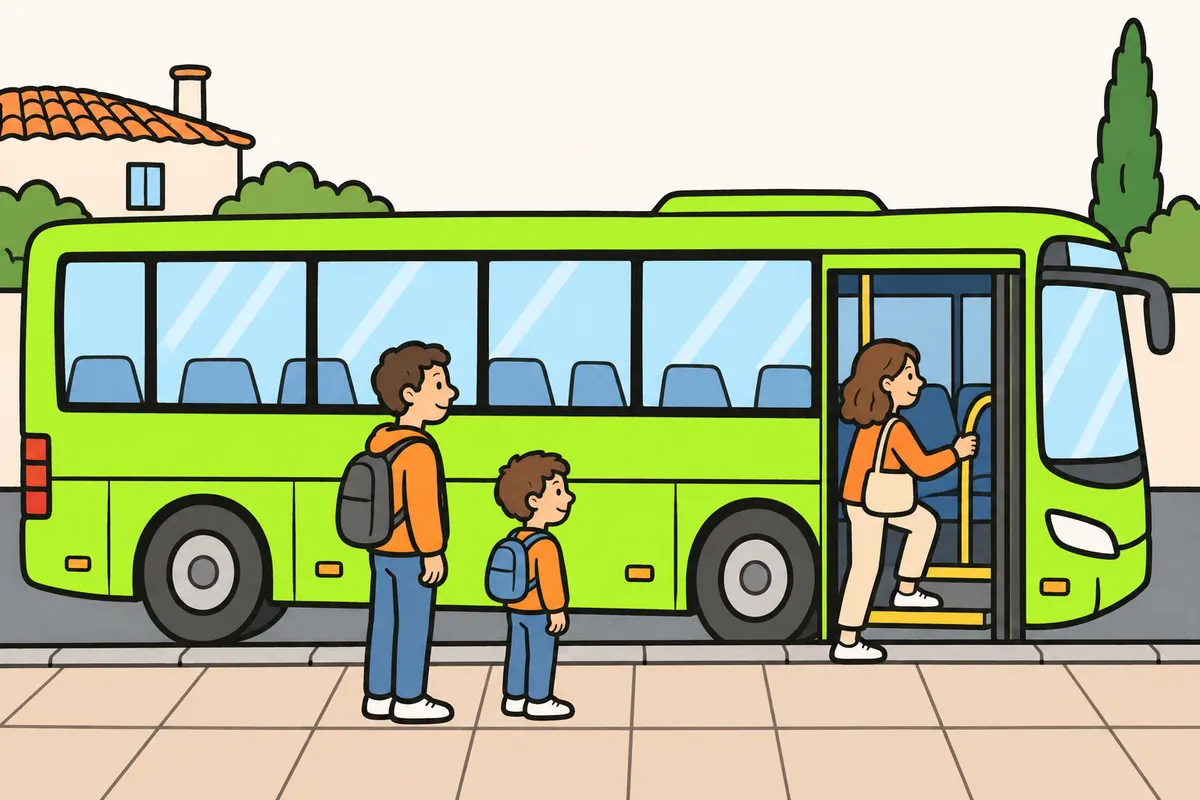
Stop completely before opening the doors or letting passengers board or leave.
Remember
- Check that opening doors and letting passengers leave causes no danger or obstruction.
- Generally, use the side nearest the edge of the road.
- Stop and move off near the right edge, without sudden movements.
- Watch steps, doors and people beside the bus.
- Share supervision with the person in charge, if present.
- Prevent unauthorised people from operating the doors.
Exam trap: Wrong: You can open doors while moving very slowly. Right: Stop completely first.
Read the full explanation
- Bring the bus to a complete stop before opening the doors, and check that opening them or allowing passengers to get off creates no danger or obstruction for other road users. [RGC, art. 114](https://www.boe.es/buscar/act.php?id=BOE-A-2003-23514#a114).
- As a general rule, facilitate boarding and alighting on the side nearest the edge of the road, and only while the vehicle is stationary. If the bus has doors on the right, position it at the stop so that passengers have safe access from the waiting area. [RGC, art. 114](https://www.boe.es/buscar/act.php?id=BOE-A-2003-23514#a114).
- Stop and move off close to the right-hand edge and without sudden movements. While passengers board and alight, you and the attendant, if there is one, must look after them. Pay attention to the steps, people still holding on to the door and children who remain beside the vehicle. [RGC, art. 11](https://www.boe.es/buscar/act.php?id=BOE-A-2003-23514#a11).
- Unauthorised people must not open the doors of public transport or close them at stops in a way that obstructs boarding. Give clear instructions on using the designated entrances; emergency mechanisms serve a safety purpose and do not replace the normal operation of the doors. [RGC, art. 114](https://www.boe.es/buscar/act.php?id=BOE-A-2003-23514#a114).
4Checks before moving off again
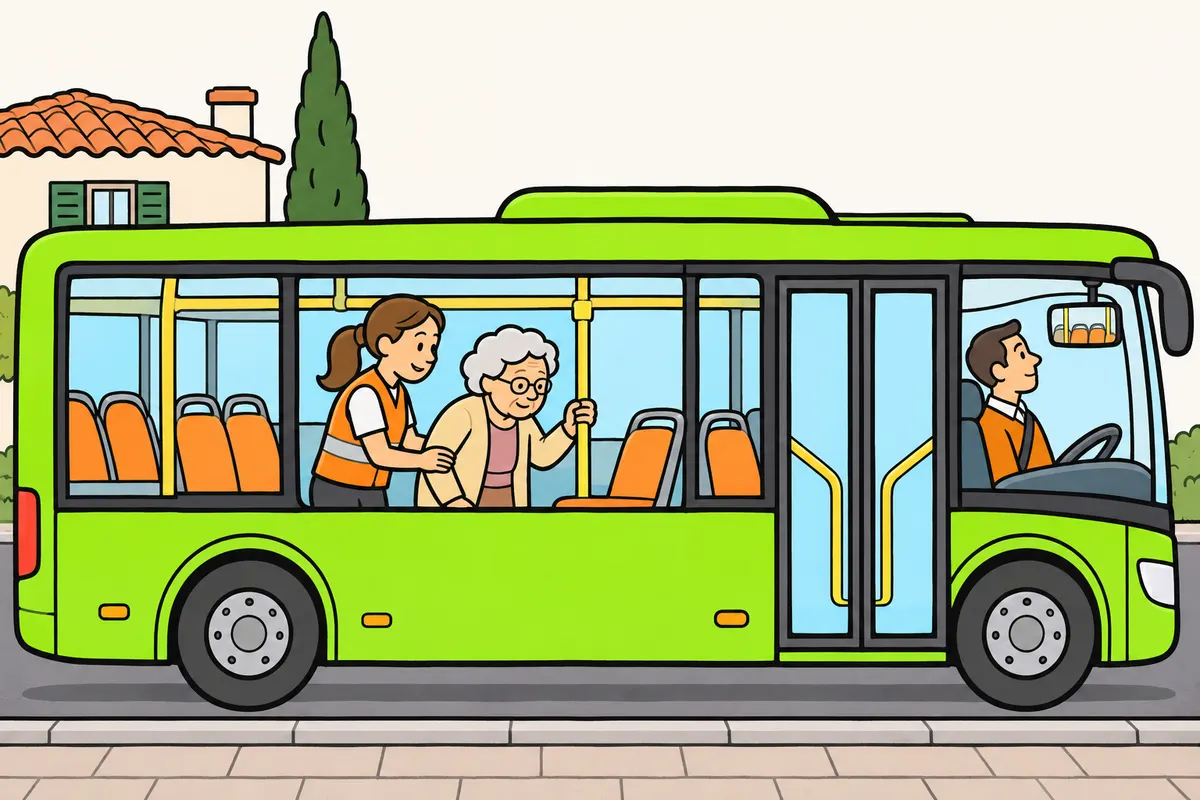
Before moving off, check nobody is trapped and wait until passengers are stable.
Remember
- Check everyone has finished boarding or leaving safely.
- Check nobody, no clothing, bag or mobility aid is trapped.
- Always drive with the doors closed.
- Keep your view and movements clear.
- Wait until passengers can remain stable as you move off.
- Move off smoothly and keep watching traffic.
Exam trap: Wrong: Closing the doors is enough. Right: Check nobody is trapped and wait until passengers can stay stable as you move off.
Read the full explanation
- Before moving off, check the entrances and immediate surroundings and make sure no person, backpack, item of clothing or mobility aid is trapped. [RGC, art. 11](https://www.boe.es/buscar/act.php?id=BOE-A-2003-23514#a11).
- Drive with the doors closed. If a problem prevents you from providing the service safely, arrange a safe stop to resolve it. [RGC, art. 114](https://www.boe.es/buscar/act.php?id=BOE-A-2003-23514#a114).
- Keep your freedom of movement, field of vision and constant attention to driving. Position passengers so that they do not interfere with you. Do not move off while dealing with a query that requires you to look away from the road. [RGC, art. 18](https://www.boe.es/buscar/act.php?id=BOE-A-2003-23514#a18).
- If a passenger needs help reaching their seat, allow the necessary time and coordinate with the attendant. Wait until they can remain stable as you move off. [RGC, art. 11](https://www.boe.es/buscar/act.php?id=BOE-A-2003-23514#a11).
5Luggage in the hold and passenger compartment
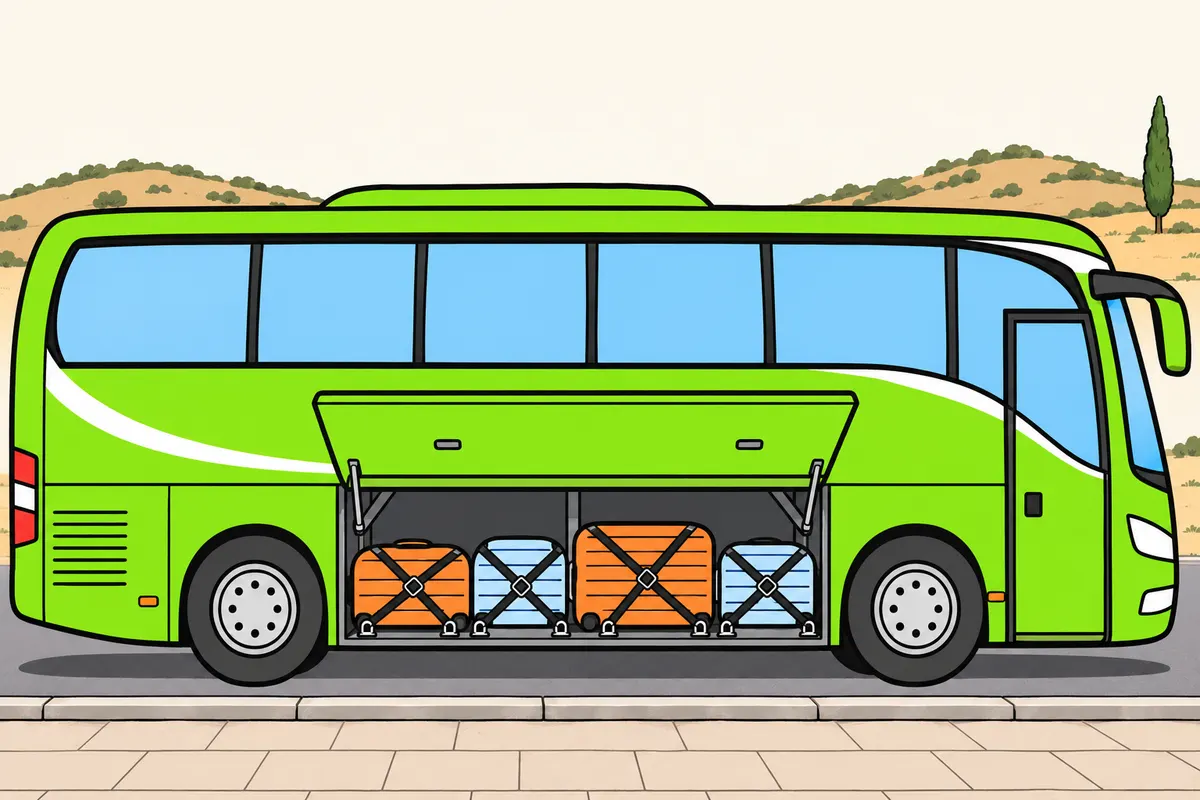
Place luggage safely so it cannot cause injuries, move dangerously or upset stability.
Remember
- Secure luggage when necessary and check compartment catches.
- Spread the weight without harming stability.
- Do not hide lights, plates, signs or your arm signals.
- Avoid preventable noise and nuisance.
- Keep your view and movements clear.
- Check luggage carriers before departure and after handling luggage.
Exam trap: Wrong: Luggage only needs to fit. Right: Respect maximum weight and distribute the load safely.
Read the full explanation
- Place and, where necessary, secure luggage so that it cannot fall or move dangerously. A loose suitcase can hit a passenger or block a door during braking. Check that compartments are closed and use the designated securing systems. [RGC, art. 14](https://www.boe.es/buscar/act.php?id=BOE-A-2003-23514#a14).
- Distribute items without compromising the bus's stability. As a safe practice, place heavier items in suitable spaces and avoid concentrations that adversely affect load distribution. [RGC, art. 14](https://www.boe.es/buscar/act.php?id=BOE-A-2003-23514#a14).
- The load and accessories must not obscure lights, light signals, number plates, compulsory markings or the driver's hand signals. They must not cause avoidable noise or disturbance either. If you use a luggage rack, check how the load is placed before setting off and after any handling during the service. [RGC, art. 14](https://www.boe.es/buscar/act.php?id=BOE-A-2003-23514#a14).
- Make sure hand luggage does not restrict your view or movement. Recommend that passengers place it in the designated spaces, checking that it can remain there safely. [RGC, art. 18](https://www.boe.es/buscar/act.php?id=BOE-A-2003-23514#a18).
6Clear aisles and luggage conditions
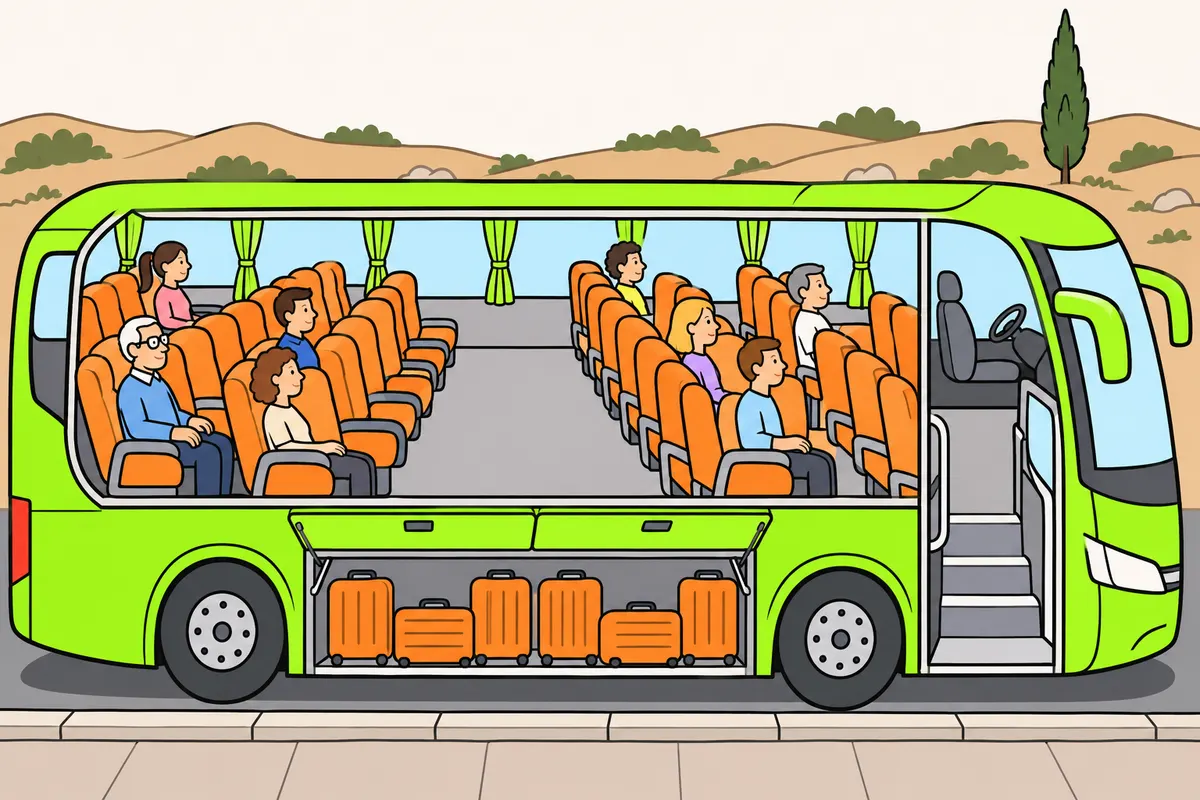
Keep passageways clear and explain where passengers must put luggage.
Remember
- Keep doors and passageways clear for people to move and reach exits.
- Passengers must not unnecessarily block passageways.
- Explain luggage conditions before or during boarding.
- Check ticket luggage allowances and how to handle extra luggage.
- Check the rules before accepting a possibly dangerous item.
Exam trap: Wrong: A light bag may block the aisle. Right: Keep passageways clear, and passengers must not unnecessarily obstruct them.
Read the full explanation
- Keep doors and passageways clear; place suitcases so that people can move around inside and reach the exits. On public passenger transport, passengers must not unnecessarily obstruct these passageways. [RGC, art. 11.2.d](https://www.boe.es/buscar/act.php?id=BOE-A-2003-23514#a11).
- Tell passengers how to place luggage and hand luggage when they board or immediately beforehand. Explain which items may remain in the passenger compartment and which must go in the hold under the service's conditions, using information passengers can understand. [Order FOM/1230/2013, art. 4](https://www.boe.es/buscar/act.php?id=BOE-A-2013-7218#a4).
- Check the service conditions to find out what luggage is included in the ticket and how excess luggage is handled.
- You must not accept dangerous substances or objects outside the rules that specifically regulate them. Before allowing a questionable item on board, follow the service instructions and check whether it is permitted. [RGC, art. 11](https://www.boe.es/buscar/act.php?id=BOE-A-2003-23514#a11).
7Driver and passenger seat belts
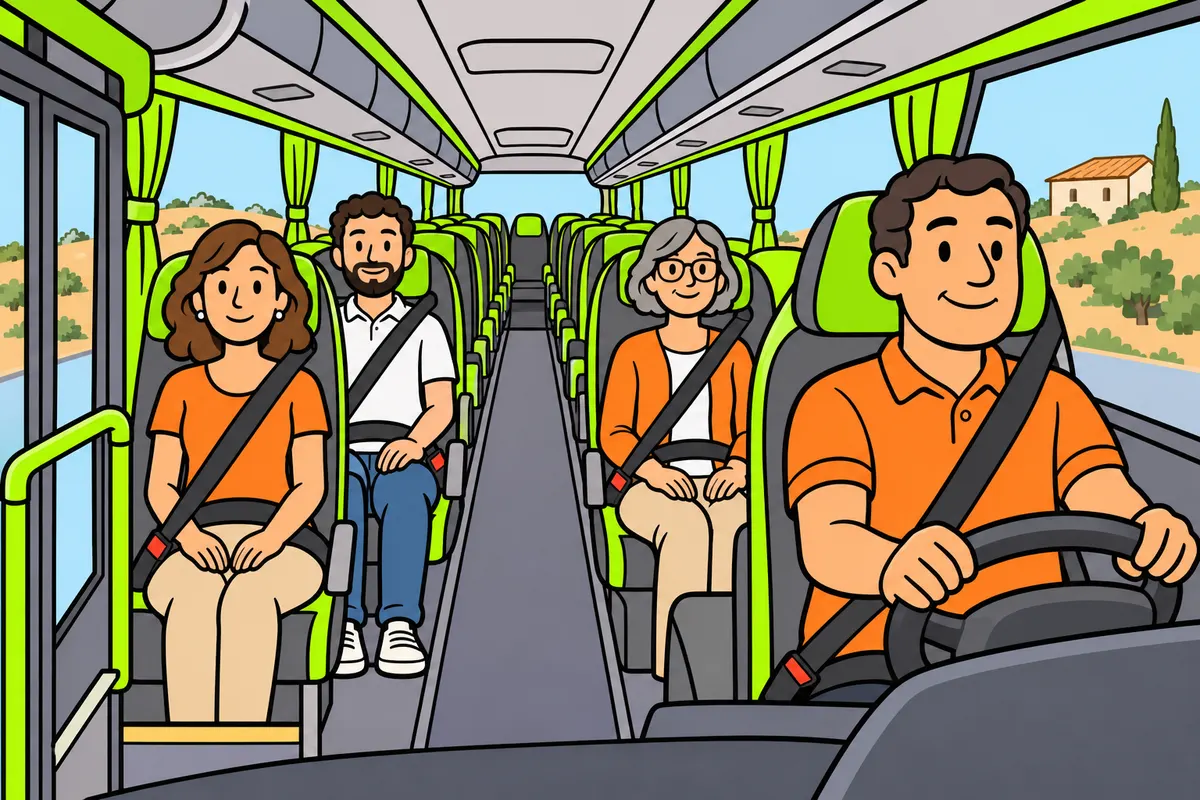
Wear the fitted seat belt unless a legal exemption applies.
| Case on your bus | Seat belt use |
|---|---|
| Fitted belt, no legal exemption | You must wear it. |
| Vehicle lawfully without belts | You cannot use a device that is absent. |
| Driver reversing or parking | You may remove your belt during the manoeuvre. |
| Valid medical exemption | Show the certificate to officers. |
Remember
- Fasten your belt correctly inside and outside built-up areas.
- Passengers must use fitted belts unless legally exempt.
- Use a fitted belt even when fitting it was not compulsory.
- You may remove your belt while reversing or parking.
- For serious medical reasons or disability, show your exemption certificate to officers.
- Certificates from another EU State need an official translation.
Exam trap: Wrong: You need no belt in town. Right: Wear the fitted belt unless legally exempt.
Read the full explanation
- As the driver, you must wear the approved seat belt fitted to your seat correctly fastened, unless you are legally exempt. This requirement applies on urban and interurban roads. [RGC, art. 117.1](https://www.boe.es/buscar/act.php?id=BOE-A-2003-23514#a117).
- Passengers must wear any fitted seat belt while travelling on urban and interurban roads, unless they are legally exempt. [RGC, art. 117.1](https://www.boe.es/buscar/act.php?id=BOE-A-2003-23514#a117).
- In a vehicle that legally has no seat belts, you do not have to use a device that is not fitted. Whether belts must be fitted depends on the vehicle's technical requirements; occupants must use them, including when a belt has been fitted even though it was not compulsory equipment. [RGC, art. 117.1 and second additional provision](https://www.boe.es/buscar/act.php?id=BOE-A-2003-23514#a117).
- You may unfasten your seat belt while reversing or parking. You are also exempt if you have a medical certificate on serious medical grounds or because of a disability, which you must show to the authorities. A certificate issued by the competent authority of another EU state needs an official translation to be valid in Spain. [RGC, art. 119](https://www.boe.es/buscar/act.php?id=BOE-A-2003-23514#a119).
8Information on restraint systems
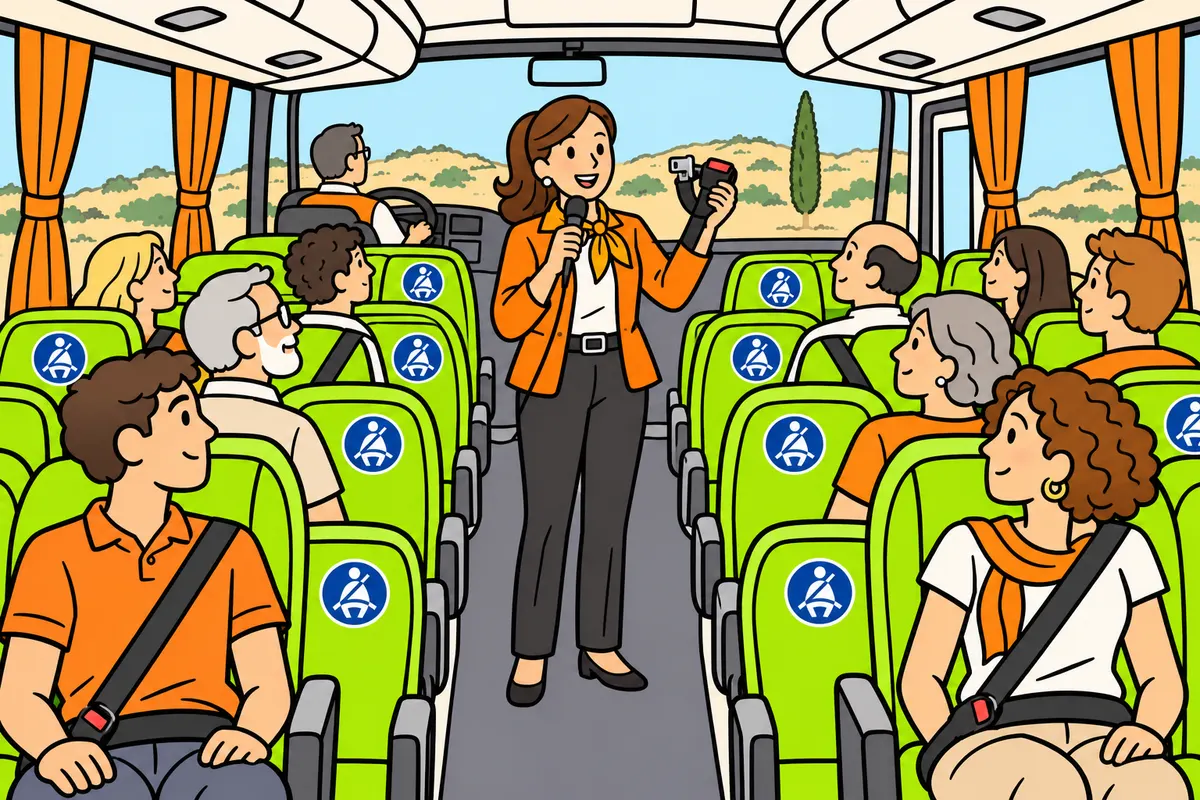
Make sure passengers receive information about compulsory use of restraint systems.
Remember
- Apply this duty on buses with more than nine seats, including yours.
- Explain compulsory use of belts and approved child restraints.
- You, the guide or the group leader can give this information.
- You can use audiovisual information or prescribed notices and pictograms visible at each seat.
- If your chosen method fails, use another permitted method.
Exam trap: Wrong: A failed recording removes your duty. Right: Provide the information another permitted way.
Read the full explanation
- On every bus with more than nine seats, including yours, you must ensure passengers are told that seat belts and approved child restraint systems must be used. The driver, guide or person in charge of the group may give this information. [RGC, art. 117.2](https://www.boe.es/buscar/act.php?id=BOE-A-2003-23514#a117).
- You may give this information using audiovisual material, or the prescribed notices and pictograms displayed at every seat. If the intended means does not work or is unavailable, you must provide the information by another permitted means. [RGC, art. 117](https://www.boe.es/buscar/act.php?id=BOE-A-2003-23514#a117).
- The general safety and accessibility information that the company must provide is covered in Passenger safety and emergencies. [Orden FOM/1230/2013 (Ministerial Order), art. 4](https://www.boe.es/buscar/act.php?id=BOE-A-2013-7218#a4).
9Children: age, height and restraints on buses
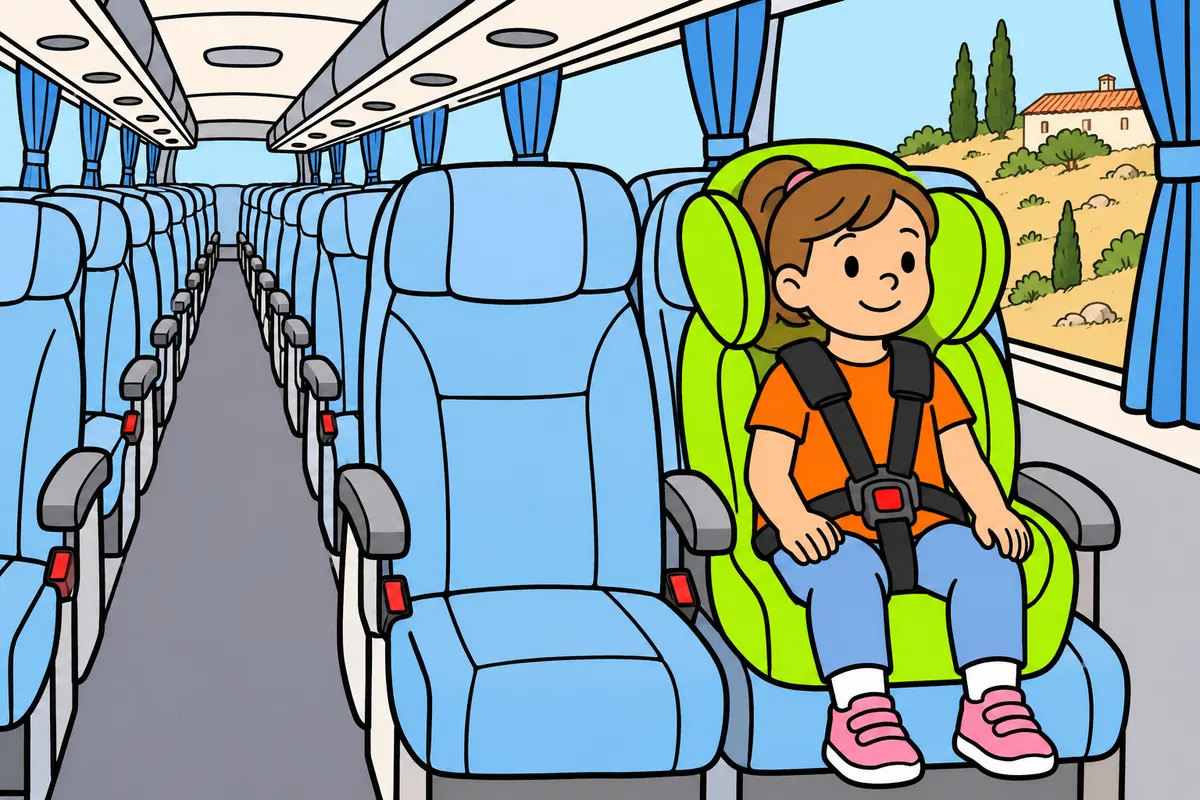
Protect children on buses according to their age, height and weight.
| Minors on buses with more than nine seats | Protection |
|---|---|
| Aged three or over, up to 135 cm | Approved child restraint suitable for height and weight. |
| These minors, without child restraints available | Seat belt, if suitable for height and weight. |
| Under three | Plan protection; use a compatible approved solution when available. |
Remember
- Apply this rule in vehicles with more than nine seats.
- Minors aged three or over, up to 135 cm, need approved child restraints.
- Choose restraints suitable for their height and weight.
- Without child restraints, they must wear belts suitable for their height and weight.
- For children under three, plan protection with the operator and responsible adults.
- Use compatible approved protection when available; being held does not guarantee safety.
Exam trap: Wrong: Any belt is a suitable alternative. Right: On buses with more than nine seats, minors aged three or over and up to 135 cm must use belts suitable for their height and weight when child restraints are unavailable.
Read the full explanation
- On your bus, apply the rule for vehicles with more than nine seats. Children aged three or over who are 135 cm tall or shorter must use an approved child restraint system suitable for their height and weight. A height of exactly 135 cm is included. [RGC, art. 117](https://www.boe.es/buscar/act.php?id=BOE-A-2003-23514#a117).
- If you do not have these child restraint systems, those children must use seat belts if the belts are suitable for their height and weight. Suitability matters: the presence of any seat belt does not automatically mean it protects every child properly. Check the restraint provided for that seat. [RGC, art. 117](https://www.boe.es/buscar/act.php?id=BOE-A-2003-23514#a117).
- The specific bus rule for these children starts at age three. To transport a younger child, plan their protection with the company and those responsible for them, and use a compatible approved solution where available. Do not infer from the article that carrying the child in your arms guarantees their safety. [RGC, art. 117](https://www.boe.es/buscar/act.php?id=BOE-A-2003-23514#a117).
- Do not automatically apply to a coach the car rule that places certain children in rear seats and lists exceptions for front seats. The article distinguishes between vehicles with up to nine seats and those with more than nine; buses follow the rule for vehicles with more than nine seats. [RGC, art. 117](https://www.boe.es/buscar/act.php?id=BOE-A-2003-23514#a117).
10Who is responsible for failing to use restraints
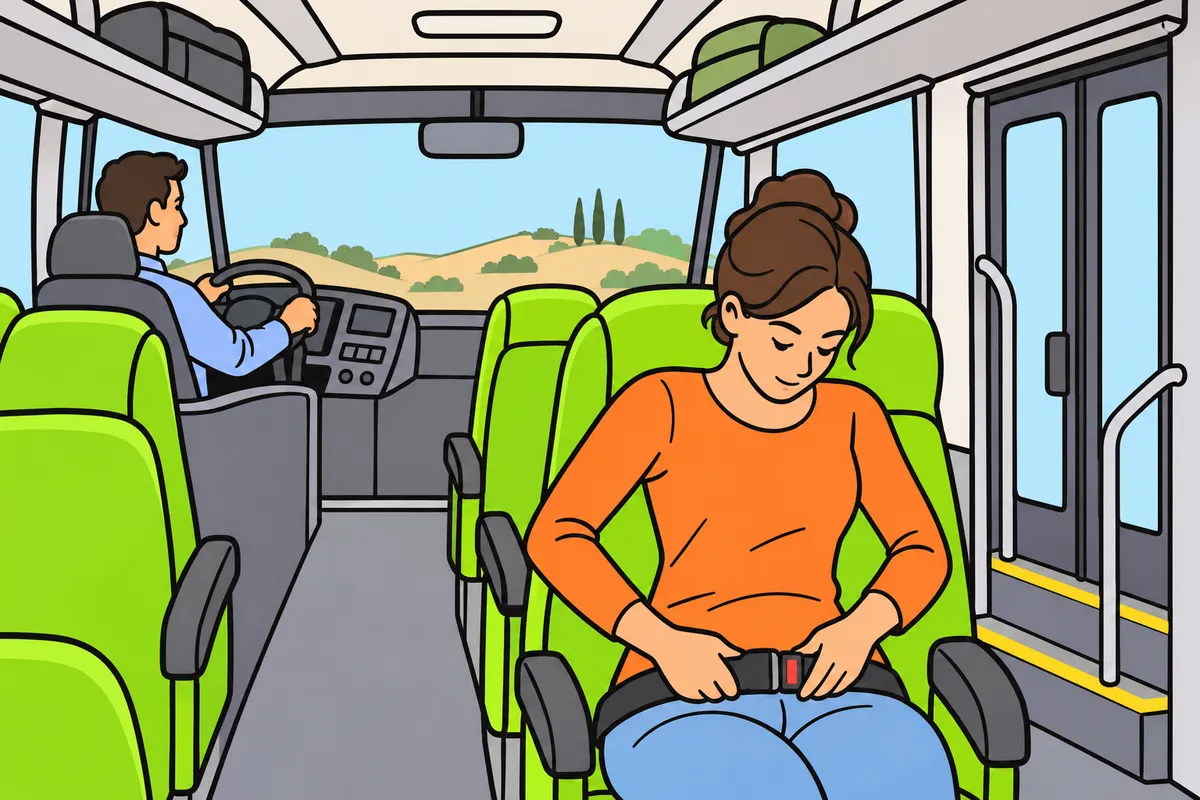
Distinguish who breaks restraint rules from who is responsible for the penalty.
| Case | Responsibility |
|---|---|
| Adult without a belt | The passenger breaking the rule is responsible. |
| Failure to use child restraints | You are responsible, except under the professional exemption below. |
| Professional driver providing a public service to others | You are exempt from responsibility for occupants’ restraint breaches. |
| Offender under eighteen | Joint fine liability: parents, tutors, foster carers, legal or actual guardians, in that order. |
Remember
- Generally, the person breaking the rule is responsible.
- Adult passengers are responsible for not wearing their belts.
- As a professional providing public services to others, you are exempt from occupants’ breaches.
- You must still inform passengers and drive safely.
- You are responsible for child restraints, except under that professional exemption.
- For offenders under eighteen, specified adults share liability for the fine.
Exam trap: Wrong: A category D licence alone gives exemption. Right: You must drive professionally, providing public services to others.
Read the full explanation
- As a general rule, the person who commits an offence is responsible for it. An adult passenger who does not wear their seat belt is responsible for their own conduct. Your duty to inform and protect passengers still applies. [Traffic Act, art. 82](https://www.boe.es/buscar/act.php?id=BOE-A-2015-11722#a82).
- If you are a professional driver providing a public service to third parties, you are not considered responsible when occupants fail to meet their restraint requirements. This exception requires both conditions to be met. [Traffic Act, art. 13.4](https://www.boe.es/buscar/act.php?id=BOE-A-2015-11722#a13).
- As a general rule, the driver is responsible when child restraint systems are not used, subject to the legal exception for professional drivers described above. [Traffic Act, art. 82.a](https://www.boe.es/buscar/act.php?id=BOE-A-2015-11722#a82).
- When a person under eighteen commits an offence, the law makes their parents, guardians, foster carers and legal or de facto custodians jointly liable for the fine, in that order. This financial liability is in addition to that of the minor who committed the offence. [Traffic Act, art. 82.b](https://www.boe.es/buscar/act.php?id=BOE-A-2015-11722#a82).
11Treatment of passengers and passenger conduct
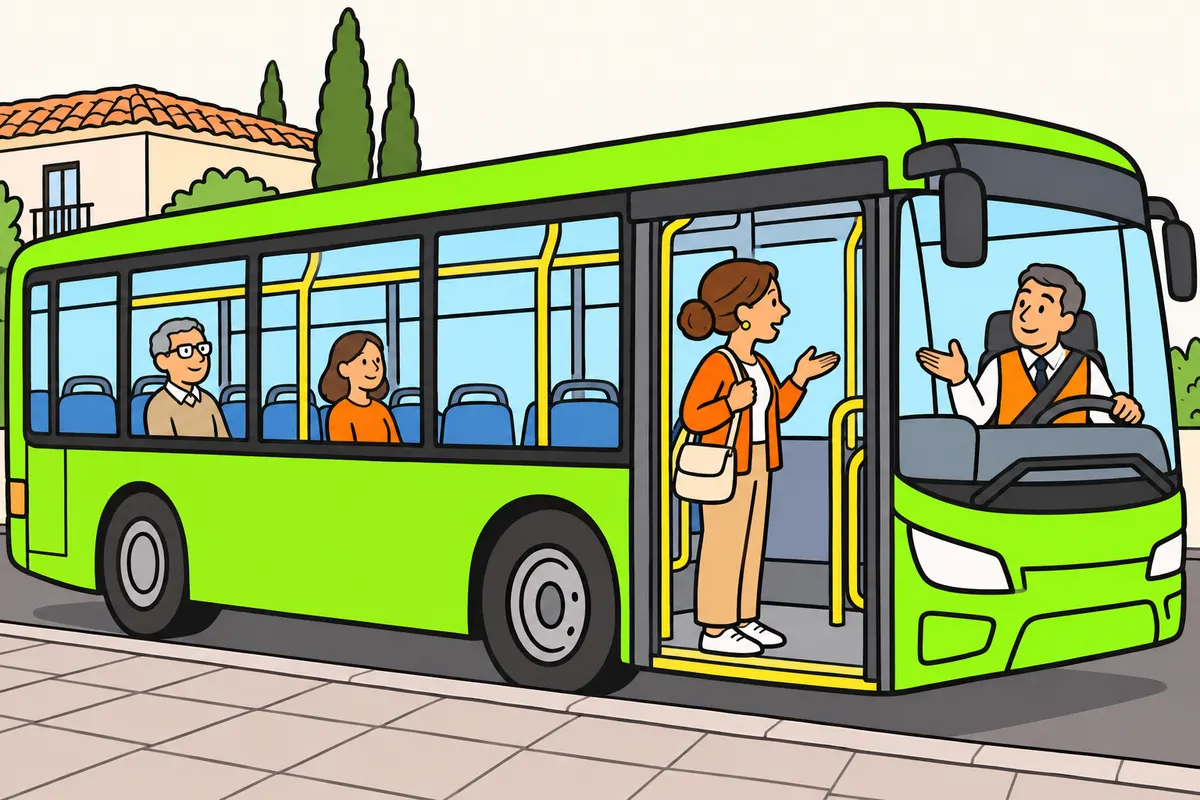
Protect passengers, prevent distractions and require safe behaviour while treating everyone respectfully.
Remember
- Watch passenger safety during travel, boarding and leaving.
- Share this duty with the person in charge, if present.
- Prevent passengers from distracting you while driving.
- Require passengers to use designated doors, follow instructions and not block passageways.
- Require everyone to respect the smoking ban on urban and interurban public transport.
- Treat passengers respectfully, including during disagreements.
Exam trap: Wrong: Eject a passenger immediately while moving. Right: On public passenger services, refuse entry or order people breaking the prohibitions to leave; first arrange safe stopping and alighting.
Read the full explanation
- On any bus, you must safeguard passengers during the journey and while they board and alight, together with the person in charge if there is one. This duty covers public and private services, both urban and interurban. [RGC, art. 11.1](https://www.boe.es/buscar/act.php?id=BOE-A-2003-23514#a11).
- On a public collective passenger service, passengers must not distract you while you are driving. If you need to settle a disagreement or deal with a complex request, wait for a safe opportunity. Chatting while looking towards the passenger compartment distracts you from the attention you need to drive. [RGC, art. 11](https://www.boe.es/buscar/act.php?id=BOE-A-2003-23514#a11).
- Passengers must board and alight at the places designated for each operation and follow service instructions given by you or the person in charge. They must not board after being told that the vehicle is full, or unnecessarily obstruct areas intended for the movement of people. [RGC, art. 11.2.b-d and g](https://www.boe.es/buscar/act.php?id=BOE-A-2003-23514#a11).
- On a public collective passenger service, you and the person in charge must refuse entry to, and order to leave, anyone who breaches the prohibitions in article 11.2.a-g. Carry out this duty without creating a new danger: if an incident occurs while the bus is moving, first arrange a safe stop and safe alighting. [RGC, art. 11.2.a-g](https://www.boe.es/buscar/act.php?id=BOE-A-2003-23514#a11).
- Observe the ban on smoking on urban and interurban public transport and ensure passengers comply with it. [Ley 28/2005 (Law 28/2005), art. 7](https://www.boe.es/buscar/act.php?id=BOE-A-2005-21261#a7).
- Treat passengers considerately, including when explaining a prohibition or dealing with an incident. Disrespectful words or actions by company staff are classified as an offence; requiring safe conduct does not authorise you to insult or treat anyone contemptuously. [LOTT, art. 142.11](https://www.boe.es/buscar/act.php?id=BOE-A-1987-17803#a142).
12Scope of school transport and transport of minors
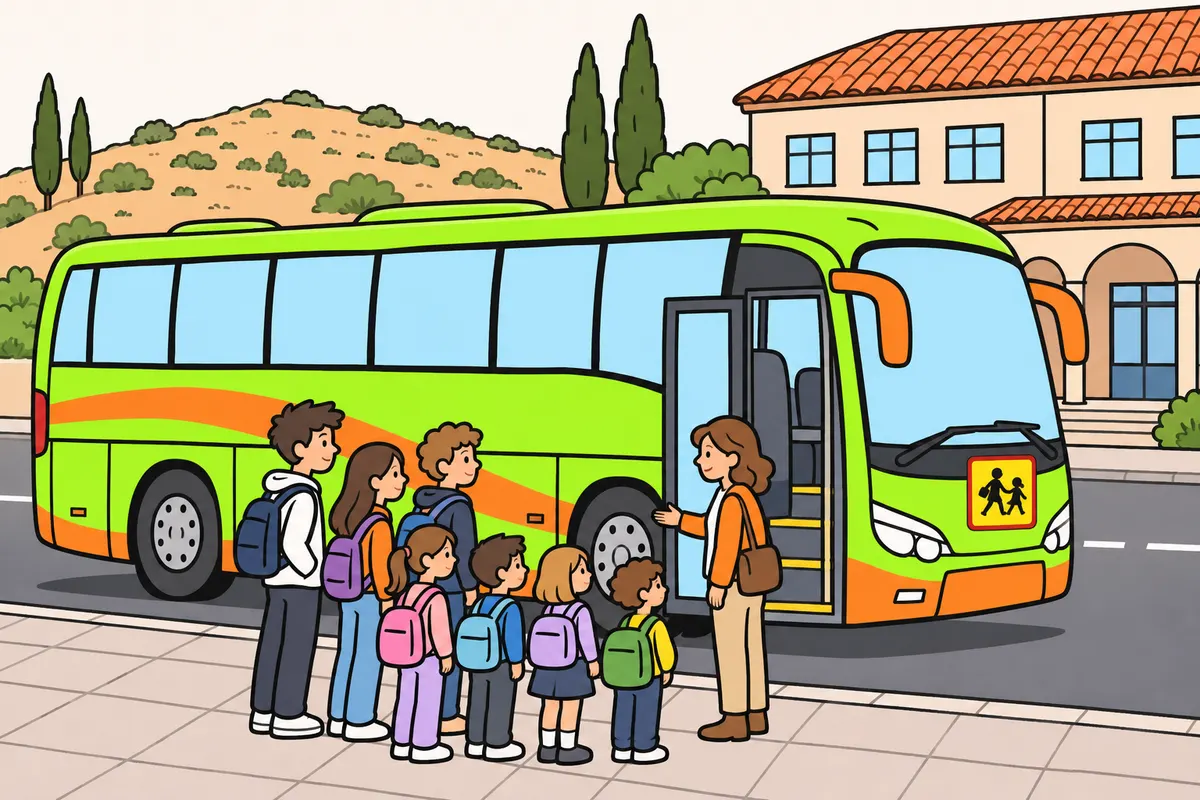
Identify the service before applying school transport and minors’ transport rules.
| Service | When the rules apply |
|---|---|
| Special-purpose regular public school transport (transporte regular de uso especial) | At least one third of pupils were under sixteen at the school year’s start. |
| General-purpose regular services (regular de uso general) | Half or more of places reserved in advance for under-sixteens. |
| Occasional public bus transport (discrecional) | At least three quarters of passengers under sixteen. |
| Complementary private road transport (privado complementario) | At least one third of passengers under sixteen. |
Remember
- Check the required proportion for each service type.
- For special-purpose school services, use ages at the school year’s start.
- For general-purpose services, count places reserved in advance.
- For occasional and complementary private services, count passengers under sixteen.
Exam trap: Wrong: Every service uses the same proportion. Right: Identify the service and count pupils, reservations or passengers as required.
Read the full explanation
- Apply RD 443/2001 to special-use regular public school transport when at least one third of the pupils carried were under sixteen at the start of the school year. The relevant date is the start of the school year, and the group counted is the pupils carried. [RD 443/2001, art. 1](https://www.boe.es/buscar/act.php?id=BOE-A-2001-8503#a1).
- On a general-use regular service, the rules apply to journeys on which half or more of the vehicle's seats have been reserved in advance for people under sixteen. Calculate the percentage using the seats reserved in advance. [RD 443/2001, art. 1](https://www.boe.es/buscar/act.php?id=BOE-A-2001-8503#a1).
- On occasional public bus transport, the rules apply when at least three quarters of the passengers are under sixteen. For complementary private road transport, one third of the passengers being under that age is enough. Identify the type of service before calculating. [RD 443/2001, art. 1](https://www.boe.es/buscar/act.php?id=BOE-A-2001-8503#a1).
13Calculate percentages without confusing ages
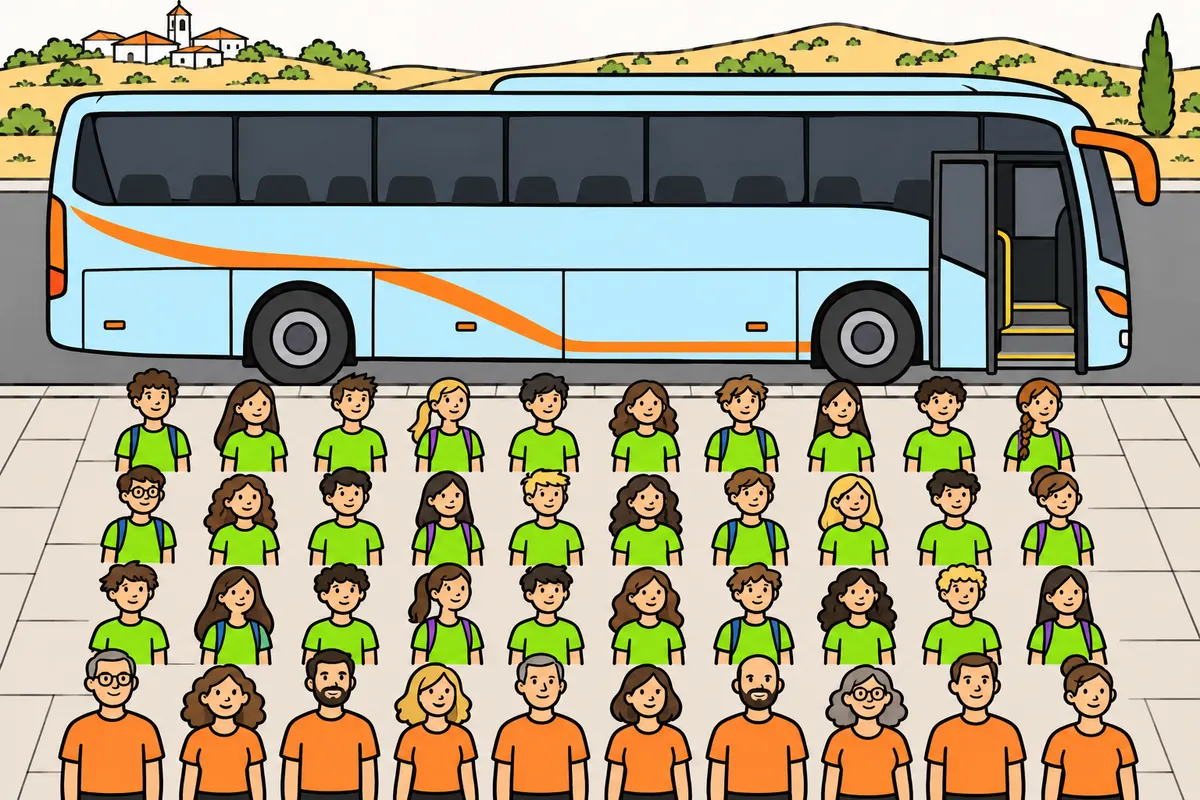
Calculate each proportion using the correct age and group.
| Service and example | Result |
|---|---|
| Occasional: forty passengers | Thirty under-sixteens reach the threshold; twenty-nine do not. |
| General-purpose: forty places | Twenty reserved in advance for under-sixteens reach the threshold. |
| Complementary private: thirty passengers | Ten under-sixteens reach the threshold. |
Remember
- Someone aged exactly sixteen is not under sixteen.
- For general-purpose services, count advance reservations even if occupancy changes.
- For special-purpose school services, use ages at the school year’s start.
- Do not round the minimum number of people down.
- Identify whether you count reservations, pupils at school year’s start or actual passengers.
- Check “Services on which an escort is compulsory”: it uses a different age.
Exam trap: Wrong: Count passengers present on general-purpose services. Right: Count places reserved in advance for under-sixteens.
Read the full explanation
- On an occasional service with forty passengers, thirty minors under sixteen make up three quarters, bringing the journey within the scope of the royal decree. With twenty-nine, you do not reach that specific threshold. Anyone who is exactly sixteen is not included in the group of minors under that age. [RD 443/2001, art. 1](https://www.boe.es/buscar/act.php?id=BOE-A-2001-8503#a1).
- On a general-use regular service with forty seats, reserving twenty in advance for minors under sixteen reaches half. The relevant figure is the advance reservation, even if the actual occupancy of the other seats later changes. [RD 443/2001, art. 1](https://www.boe.es/buscar/act.php?id=BOE-A-2001-8503#a1).
- On a private supplementary service with thirty passengers, ten minors under sixteen make up one third. For special-use school transport, instead check what proportion of pupils were under that age at the start of the school year; do not round down a minimum number of people. [RD 443/2001, art. 1](https://www.boe.es/buscar/act.php?id=BOE-A-2001-8503#a1).
- First check whether the figure refers to reserved seats, pupils at the start of the school year or actual passengers. Then apply the threshold for the relevant service. The escort calculation uses a different age and is explained in “Services on which an escort is compulsory”. [RD 443/2001, arts. 1 and 8](https://www.boe.es/buscar/act.php?id=BOE-A-2001-8503#a1).
14Services on which an escort is compulsory
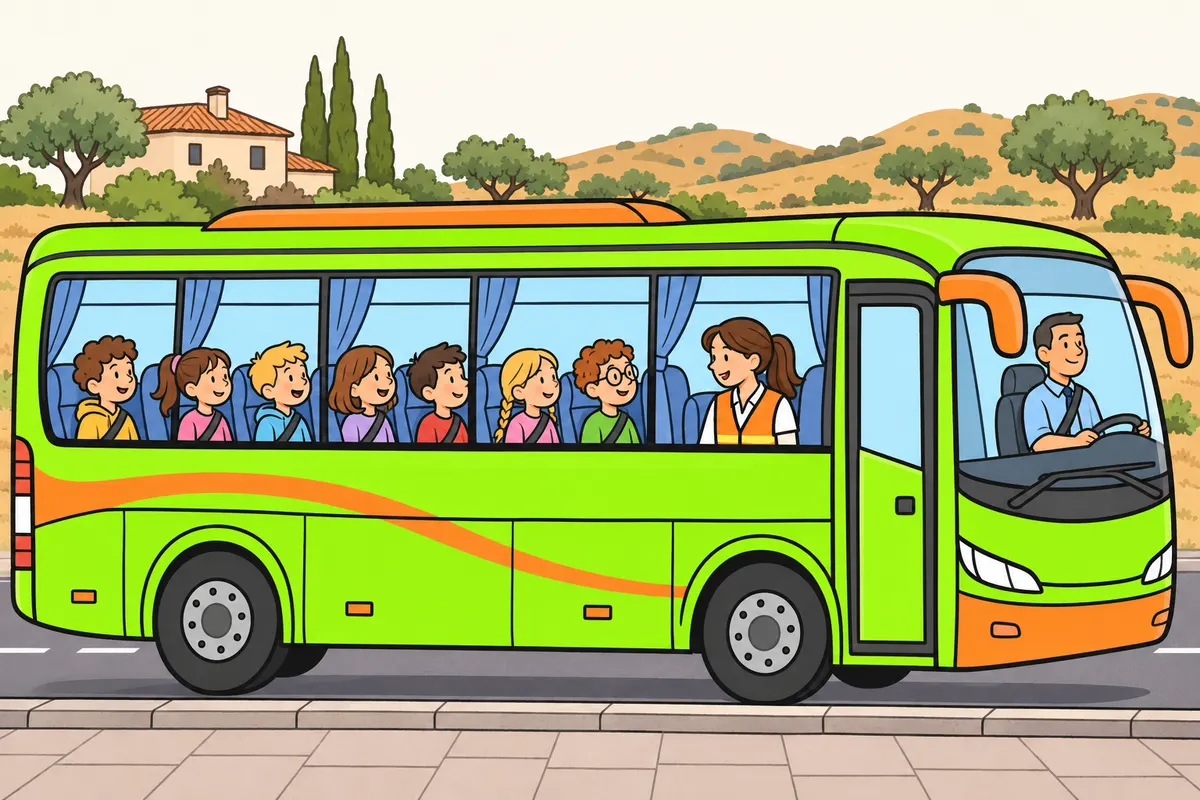
Carry an escort when required by the service, authorisation or passengers carried.
| Covered service | When you need an escort |
|---|---|
| Occasional public bus transport covered by article 1.c | Always: at least three quarters of passengers are under sixteen. |
| Special-purpose regular school transport | If required by authorisation or when carrying special-education pupils. |
| Complementary private transport | For special-education pupils, or if origin or destination differs from home or educational centre. |
| Any covered service operated by bus | If at least 50 % of passengers are under twelve. |
Remember
- First check whether the service falls under the minors’ transport rules.
- On occasional public bus services covered by article 1.c, always carry an escort.
- For special-purpose school services, check authorisation requirements and special-education pupils.
- For special-education pupils, require the escort to have the necessary occupational qualifications.
- On every covered bus service, also check passenger ages.
Exam trap: Wrong: Only special-education pupils require an escort. Right: Covered occasional public bus services always require one; other compulsory cases also apply.
Read the full explanation
- You must always carry an escort on an occasional public bus service included in article 1.c. The obligation depends on the type of service covered, regardless of whether special education pupils are travelling. [RD 443/2001, art. 8](https://www.boe.es/buscar/act.php?id=BOE-A-2001-8503#a8).
- On a special-use regular school service, you must carry an escort when the authorisation says so and whenever you carry pupils from special education centres. In the latter case, the escort must have the vocational qualification needed to care for those pupils. [RD 443/2001, art. 8](https://www.boe.es/buscar/act.php?id=BOE-A-2001-8503#a8).
- On an included private supplementary service, you must carry an escort if you carry special education pupils or if the origin or destination is somewhere other than the minors’ home or school. A school trip may fall into this category. [RD 443/2001, art. 8](https://www.boe.es/buscar/act.php?id=BOE-A-2001-8503#a8).
- On any of the services in article 1 operated by bus, you must carry an escort if at least 50% of the passengers are under twelve. On an included journey with forty passengers, twenty of them under twelve meets this threshold; do not calculate the percentage using only the schoolchildren. [RD 443/2001, art. 8](https://www.boe.es/buscar/act.php?id=BOE-A-2001-8503#a8).
15Escort requirements and duties
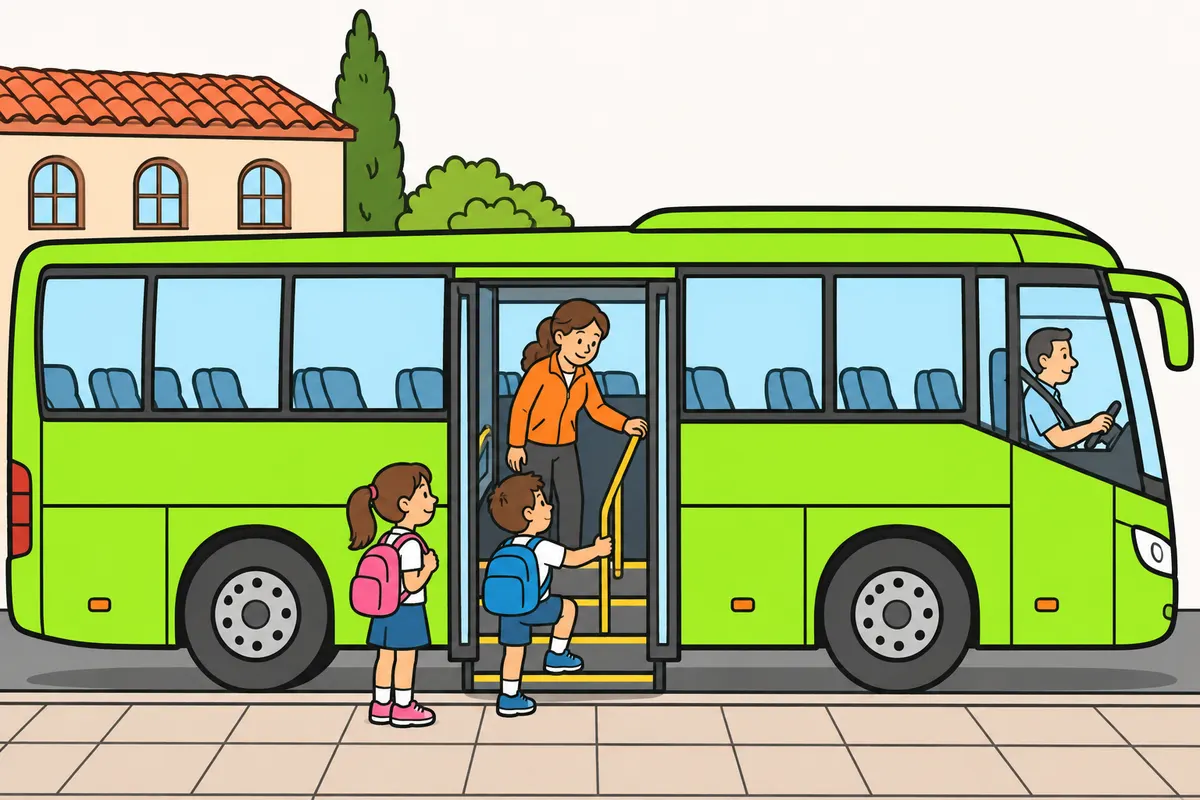
Your compulsory escort must be a suitable adult other than yourself.
Remember
- Check they know safety mechanisms and can look after the minors.
- They must supervise minors during travel, boarding and leaving.
- Check accreditation by the organiser or, through express agreement, the carrier.
- Seat the escort near the central or rear door.
- Where required, they accompany pupils to and from inside the school grounds.
- The carrier must ensure their presence, whoever must supply them.
Exam trap: Wrong: You can drive and act as compulsory escort. Right: Another person must do it; do not operate without them unless not operating creates greater risk for the minors.
Read the full explanation
- When an escort is compulsory, provide at least one suitable adult who is not you. They must know the vehicle’s safety mechanisms and look after the minors during the journey, boarding and alighting. [RD 443/2001, art. 8](https://www.boe.es/buscar/act.php?id=BOE-A-2001-8503#a8).
- The organising body certifies the escort, unless there is an express agreement for the carrier to do so. Certification does not necessarily mean that the escort has an employment relationship with the organiser. [RD 443/2001, art. 8](https://www.boe.es/buscar/act.php?id=BOE-A-2001-8503#a8).
- The escort sits beside the central or rear service door. This position lets them supervise boarding and alighting and look after the group. Where appropriate, they also accompany pupils to and from inside the school grounds. [RD 443/2001, art. 8.1](https://www.boe.es/buscar/act.php?id=BOE-A-2001-8503#a8).
- If an escort is compulsory, you must not operate the service without one on board unless not operating the service would put the minors at greater risk. The carrier is responsible for ensuring the escort is present, regardless of who must provide one under the contract; repeated absences may constitute a breach of contract. [RD 443/2001, art. 8](https://www.boe.es/buscar/act.php?id=BOE-A-2001-8503#a8).
16School routes and choice of stops
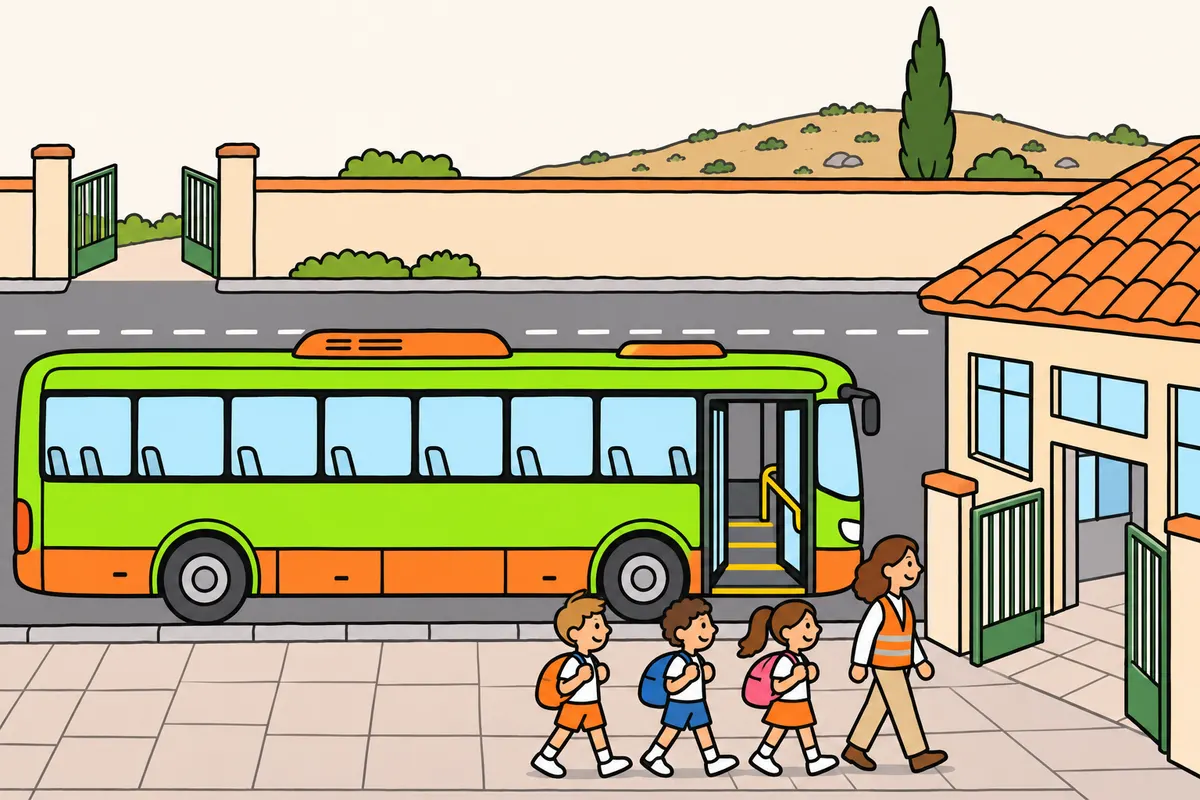
Follow authorised stops and check that children can reach and leave them safely.
| Service | Route and stops |
|---|---|
| Special-purpose regular school transport | Follow the authorisation. |
| Covered occasional and complementary private transport | Seek maximum safety; apply regulatory stopping conditions at centres. |
| General-purpose regular services with reservations for minors | Follow concession or authorisation; changes need authorisation. |
Remember
- On special-purpose school services, follow the authorised route and stops.
- Use a stop inside school grounds where possible.
- Otherwise, provide safe access and a stop on your right.
- If across the road, minimise crossing and require safety measures.
- On covered excursions, also seek the safest stopping conditions.
- On general-purpose services with reservations, follow the service’s route and stops.
Exam trap: Wrong: A school stop only needs room for the bus. Right: Check pedestrian access and safe crossing where needed.
Read the full explanation
- On a special-use regular school service, you must follow the route and stops in the authorisation. Before granting it, the transport authority informs the traffic authority of their location; the latter may propose changes. If three days pass without a proposal, the authorisation may be granted for the planned route, without preventing later justified changes. [RD 443/2001, art. 10](https://www.boe.es/buscar/act.php?id=BOE-A-2001-8503#a10).
- Where possible, the stop at the school must be inside its grounds. If that is not possible, it must provide the safest possible access and be on the right-hand side in the direction of travel. Know the walking route between the stop and the school. [RD 443/2001, art. 10](https://www.boe.es/buscar/act.php?id=BOE-A-2001-8503#a10).
- If it is not possible to place the stop on the same side of the road as the school, crossing the road must be minimised and appropriate measures taken to make it safe, including signs and an officer’s presence where appropriate. Be alert to minors crossing the area after alighting. [RD 443/2001, art. 10](https://www.boe.es/buscar/act.php?id=BOE-A-2001-8503#a10).
- On included occasional and private supplementary services, the relevant companies or bodies must seek the safest possible stopping conditions. Stops at schools, cultural, sports or leisure centres must meet the conditions in paragraph 1. [RD 443/2001, art. 10](https://www.boe.es/buscar/act.php?id=BOE-A-2001-8503#a10).
- On a general-use regular service with seats reserved for minors, you must use the route and stops in its concession or authorisation. The competent authority may authorise changes to stops requested by the company or the person reserving the seats, to ensure safety without undermining traffic prohibitions applying to the service. [RD 443/2001, art. 10.2](https://www.boe.es/buscar/act.php?id=BOE-A-2001-8503#a10).
17How schoolchildren board and alight
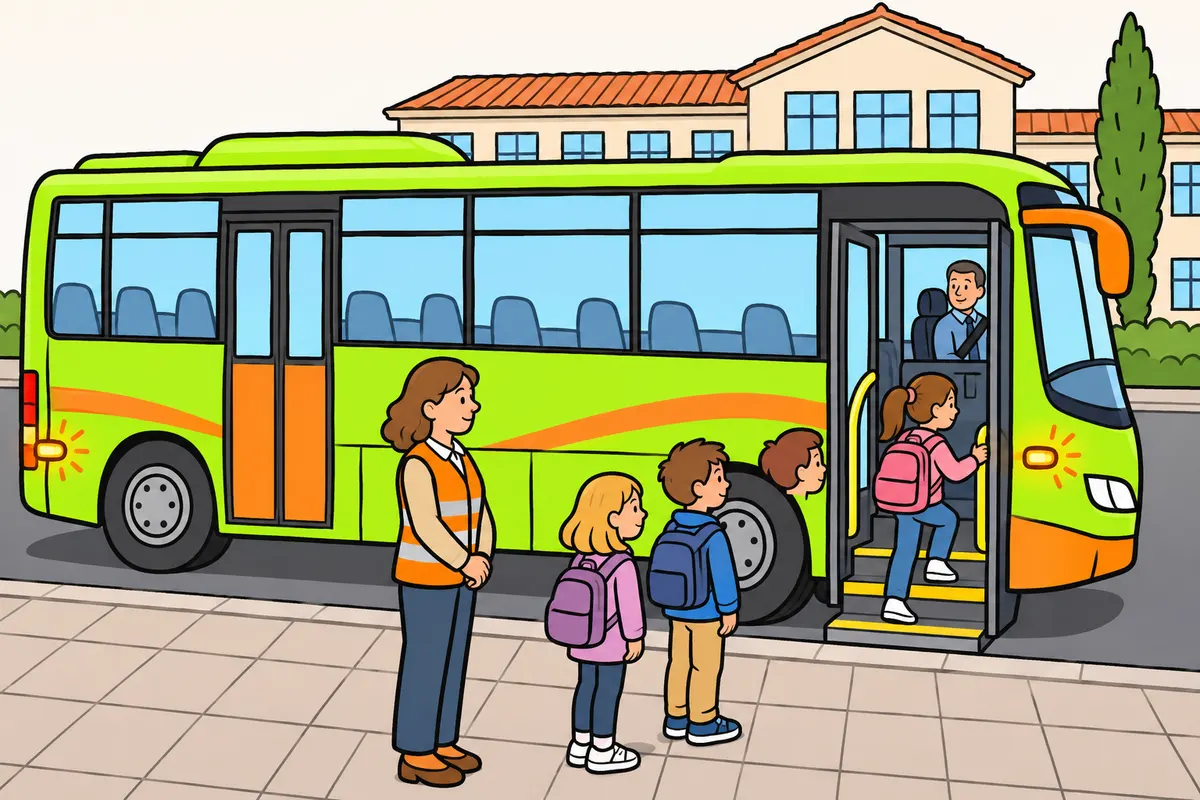
Use the door nearest the supervisor and switch on hazards while schoolchildren board or leave.
Remember
- Use the door nearest you or, where applicable, the escort.
- Without an escort on a two-door bus, use the front door for both operations.
- Near school, require adult supervision for orderly boarding and leaving.
- Require this supervision wherever the special-purpose school service authorisation specifies.
- Use hazard warning lights during boarding and leaving, by day and night.
- Check for children beside the bus before moving off smoothly.
Exam trap: Wrong: Stop supervision replaces the compulsory escort. Right: Supervision at a stop and an escort during the journey are separate requirements.
Read the full explanation
- Use the door nearest to you or, where applicable, the escort for minors to board and alight. On a two-door bus without an escort, use the front door. [RD 443/2001, art. 10](https://www.boe.es/buscar/act.php?id=BOE-A-2001-8503#a10).
- Near the school, an adult must supervise orderly boarding and alighting. This supervision is also required at a special-use school stop where the authorisation expressly says so. Supervision at the stop applies to that operation; an escort must be present during the journey in the cases described in “Services on which an escort is compulsory”. [RD 443/2001, art. 10](https://www.boe.es/buscar/act.php?id=BOE-A-2001-8503#a10).
- Switch on the hazard warning lights at stops while passengers are boarding or alighting, both by day and at night. This instruction refers to the vehicle’s simultaneous hazard warning indicators; there does not need to be a breakdown to use them for this school transport operation. [RD 443/2001, art. 4](https://www.boe.es/buscar/act.php?id=BOE-A-2001-8503#a4).
- Before leaving a school stop, check whether a child is still near the entrances or has crouched down close to the bus. [RGC, art. 11](https://www.boe.es/buscar/act.php?id=BOE-A-2003-23514#a11).
18V-10: identifying a school transport service
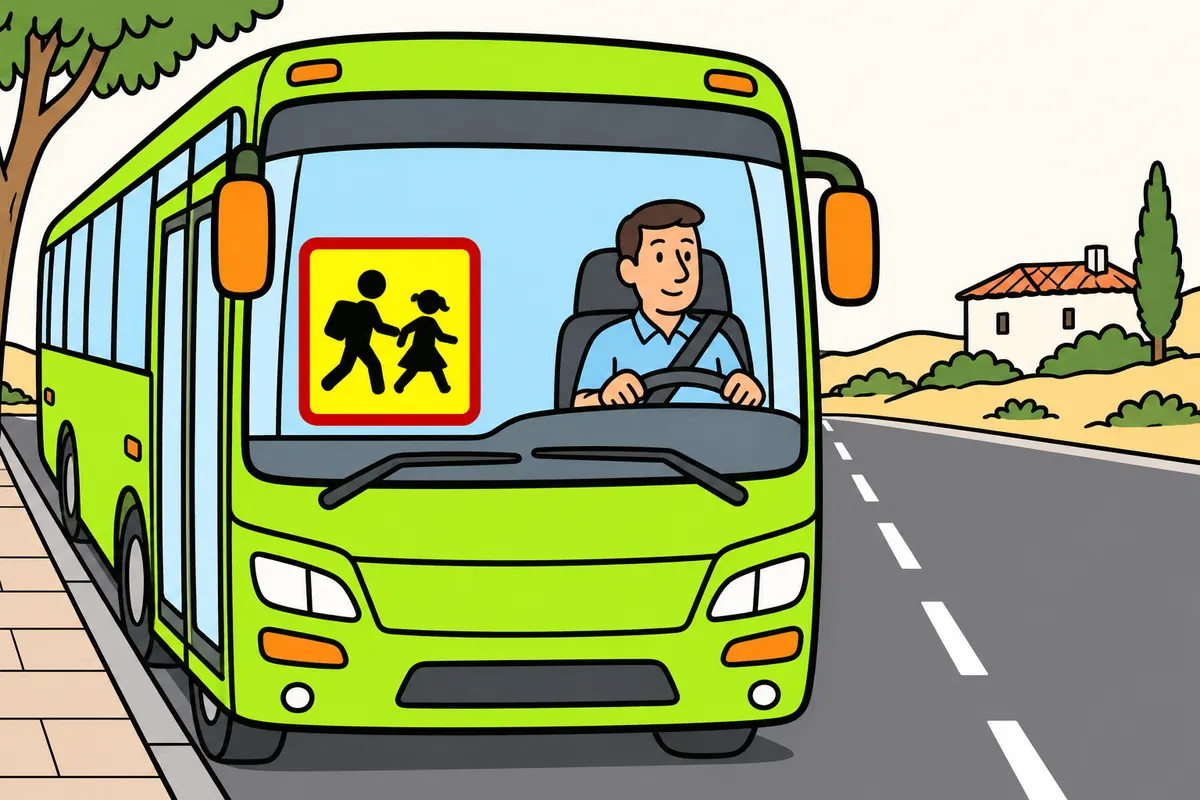
Identify school transport with the V-10 sign and distinguish its different versions.
| Vehicles using square V-10 alternative without lower wording | Position and size |
|---|---|
| Up to 19 places | Rear only; sides of 20 cm. |
| More than 19 places, up to 10 m long | Front and rear; sides of 20 cm. |
| Over 10 m long | Front and rear; sides of 36 cm. |
Remember
- On covered services, display the V-10 so people outside can see it.
- Generally, place it inside, at the front and rear.
- Fix it securely, perpendicular to the bus’s length.
- Check you can fit and remove it without tools.
- With the prescribed illuminated pictogram, activate it when any door unlatches, before fully opening.
- Distinguish this lighting from the hazard warning lights.
Exam trap: Wrong: Wait twenty seconds before leaving. Right: No compulsory wait applies. The illuminated pictogram may stay lit for at most twenty seconds after moving off; also meet the technical limit of twenty seconds from closing the doors.
Read the full explanation
- During services covered by RD 443/2001, you must identify the bus with the V-10. The general provision requires it to be placed inside, at the front and at the rear, visible from outside; you may use the alternative in Annex XI of the RGV described below. [RD 443/2001, art. 5](https://www.boe.es/buscar/act.php?id=BOE-A-2001-8503#a5).
- Check that the sign is securely fixed, perpendicular to the vehicle’s axis, with a system that lets you fit and remove it easily without tools. [RGV, Annex XI, V-10](https://www.boe.es/buscar/act.php?id=BOE-A-1999-1826#v-10).
- You may use the square V-10 without the lower wording “transporte escolar” (school transport): up to 19 seats, at the rear only and 20 cm square; with more than 19 seats and up to 10 m in length, at the front and rear and 20 cm square; over 10 m, both signs must be 36 cm square. [RGV, Annex XI, V-10.4](https://www.boe.es/buscar/act.php?id=BOE-A-1999-1826#v-10).
- You may use the specified alternative pictogram fitted with a light and meeting the regulatory requirements. Its outline must light up at stops so that minors can board or alight; article 5.2 allows it to remain lit for up to twenty seconds after you move off. The RGV technical specification requires it to activate when the latch on any door is unlocked, before the door is fully opened, and counts its twenty-second allowance from when the doors close; you must also meet this device requirement. [RD 443/2001, art. 5.2](https://www.boe.es/buscar/act.php?id=BOE-A-2001-8503#a5); [RGV, Annex XI, V-10.5.b and d](https://www.boe.es/buscar/act.php?id=BOE-A-1999-1826#v-10).
- The illumination of this outline and the hazard warning indicators are separate devices. The use of the latter while passengers board and alight is explained in “How schoolchildren board and alight”; the allowance for the pictogram does not set a mandatory waiting time before you move off. [RD 443/2001, arts. 4.2.6.ª and 5.2](https://www.boe.es/buscar/act.php?id=BOE-A-2001-8503#a4).
19Duration of each school journey
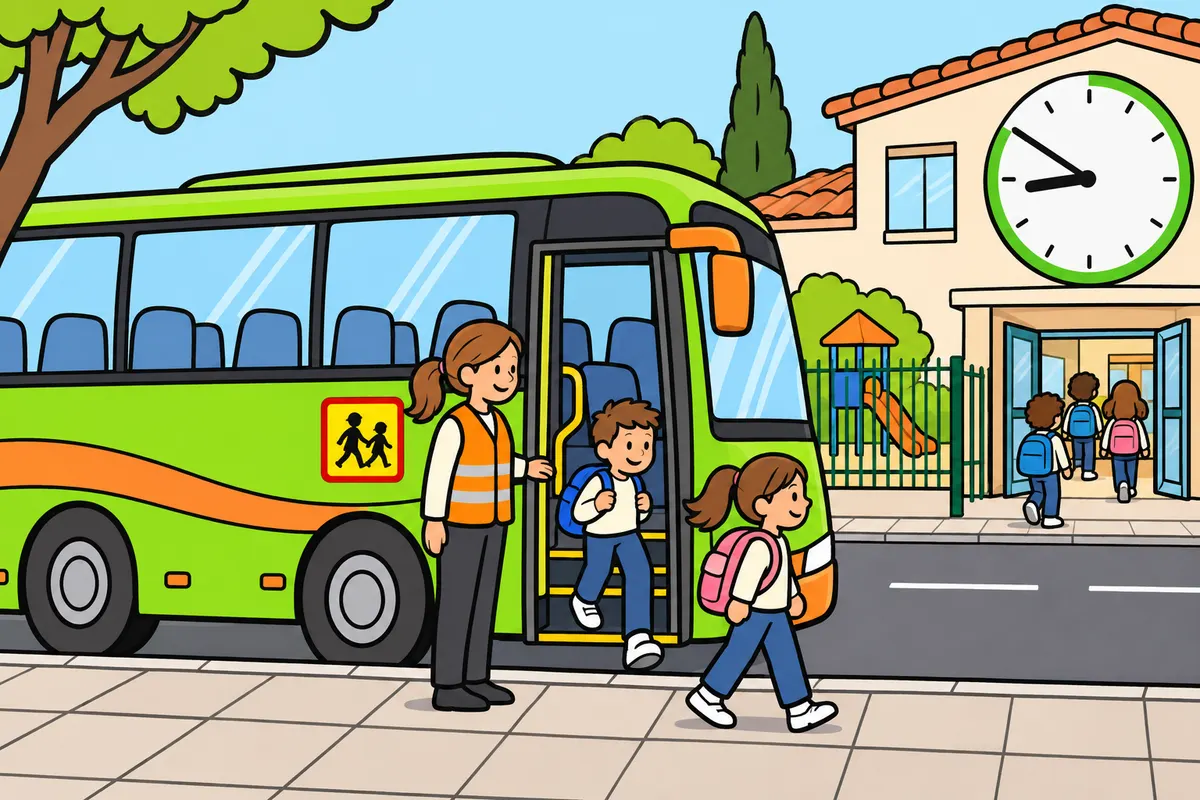
Plan less than one hour per child, each way, between home and school.
Remember
- Count from each child’s boarding until they leave.
- Include intermediate stops.
- Reach the maximum duration only in duly justified exceptional cases.
- Do not automatically apply this limit to every excursion.
- Respect your driving and rest times.
- Report regular delays for route review; do not drive dangerously.
Exam trap: Wrong: One hour covers both directions together. Right: Normally, each child must spend less than one hour each way between home and school.
Read the full explanation
- Plan the timetables and routes for transport between home and school so that, under normal circumstances, each child spends less than one hour on the vehicle in each direction. Calculate this for each pupil, from boarding to alighting, including intermediate stops. [RD 443/2001, art. 11](https://www.boe.es/buscar/act.php?id=BOE-A-2001-8503#a11).
- You may reach this maximum duration only in duly justified exceptional cases. [RD 443/2001, art. 11](https://www.boe.es/buscar/act.php?id=BOE-A-2001-8503#a11).
- This rule applies to journeys between home and the school where pupils study. Do not automatically treat it as a journey-time limit for every excursion, but any transport covered must comply with your driving times and rest periods, covered in “Driving times and rest periods”. [RD 443/2001, art. 11](https://www.boe.es/buscar/act.php?id=BOE-A-2001-8503#a11).
- The organising body must plan routes without exceeding the permitted maximum time. If a regular duration problem arises, you must report it so that the service can be reviewed; making up time by driving dangerously is incompatible with your duty to protect children. [RD 443/2001, art. 13](https://www.boe.es/buscar/act.php?id=BOE-A-2001-8503#a13).
20Age of vehicles used for school transport
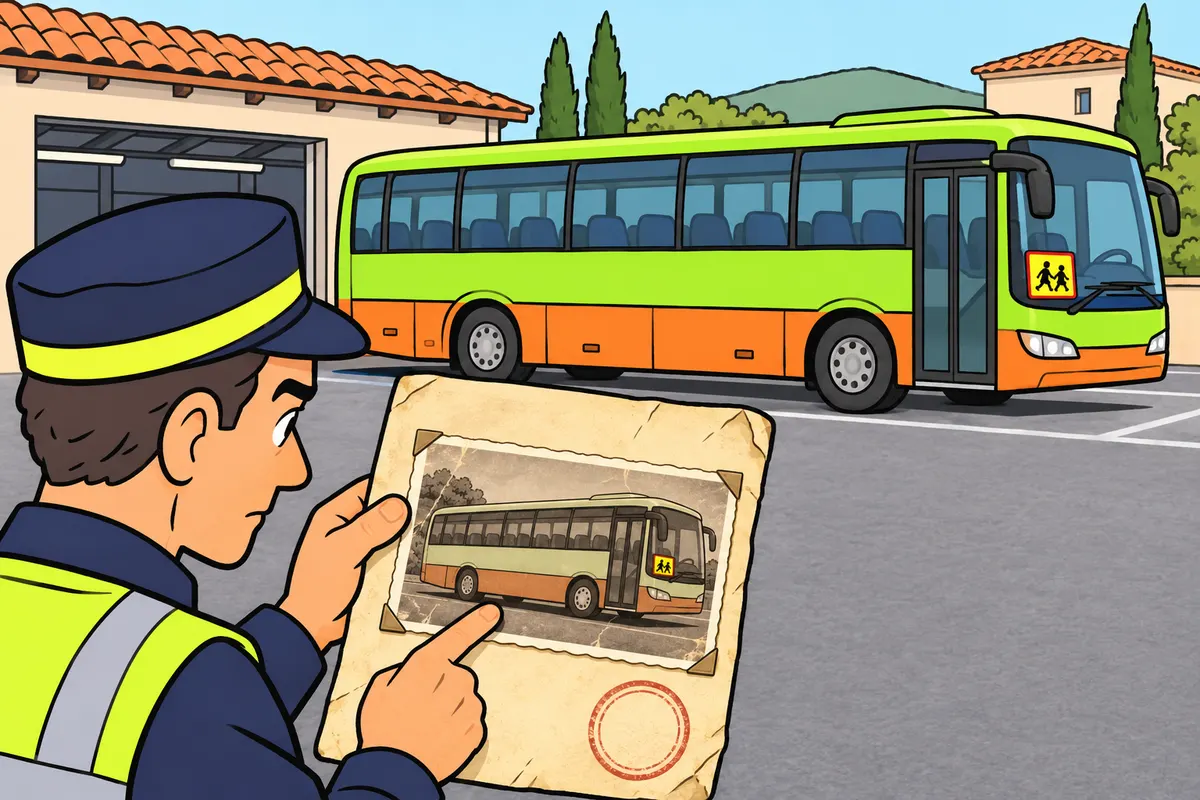
Check permitted vehicle age for the service and territory.
| Vehicles and regime | Age and conditions |
|---|---|
| Special-purpose school transport: general regime | Up to ten years at the school year’s start. |
| General special-purpose school transport: over ten, up to sixteen years | Prove previous service of this type, or provide a scrapping certificate for another vehicle assigned to school transport authorisation in the current or previous school year. |
| All covered transport: general regime | No more than sixteen years at school year’s start, from first registration or entry into service. |
| Special-purpose school transport: Baleares, Canarias, Ceuta and Melilla | Under ten; or over ten and under eighteen, with school service under the same operator since before ten and the specific inspection passed. |
Remember
- For general special-purpose school transport, the ordinary limit is ten years.
- Count from first registration to the school year’s start.
- For this calculation, the school year starts on 1 September.
- For older vehicles, check the age limit and required evidence.
- Under the general regime, no covered transport may exceed sixteen years.
- In Baleares, Canarias, Ceuta and Melilla, check the territorial special-purpose service rule.
Exam trap: Wrong: Ten years is always the maximum. Right: Distinguish general admission conditions up to sixteen years and the territorial exception.
Read the full explanation
- As a general rule for the special school transport use in article 1.a, you must use vehicles no more than ten years old at the start of the school year, counted from their first registration. For this calculation, the start date is 1 September. [RD 443/2001, art. 3](https://www.boe.es/buscar/act.php?id=BOE-A-2001-8503#a3).
- You may assign a vehicle that is more than ten years old if it is no more than sixteen years old and you prove that it has been carrying out the same type of transport, or provide the scrapping certificate for another vehicle assigned to a school transport authorisation in the current or previous school year. [RD 443/2001, art. 3](https://www.boe.es/buscar/act.php?id=BOE-A-2001-8503#a3).
- Under the general regime, no transport covered may use vehicles that are more than sixteen years old at the start of the school year, counted from their first registration or entry into service. [RD 443/2001, art. 3](https://www.boe.es/buscar/act.php?id=BOE-A-2001-8503#a3).
- If the scenario is in the Balearic Islands, the Canary Islands, Ceuta or Melilla, check the territorial exception: for special school transport use, vehicles under ten years old are allowed, as are vehicles over ten but under eighteen if they have provided school transport for the same company since before reaching ten years old and pass the specific inspection. [RD 443/2001, fourth additional provision](https://www.boe.es/buscar/act.php?id=BOE-A-2001-8503#dacuarta).
21Specific technical conditions for school transport
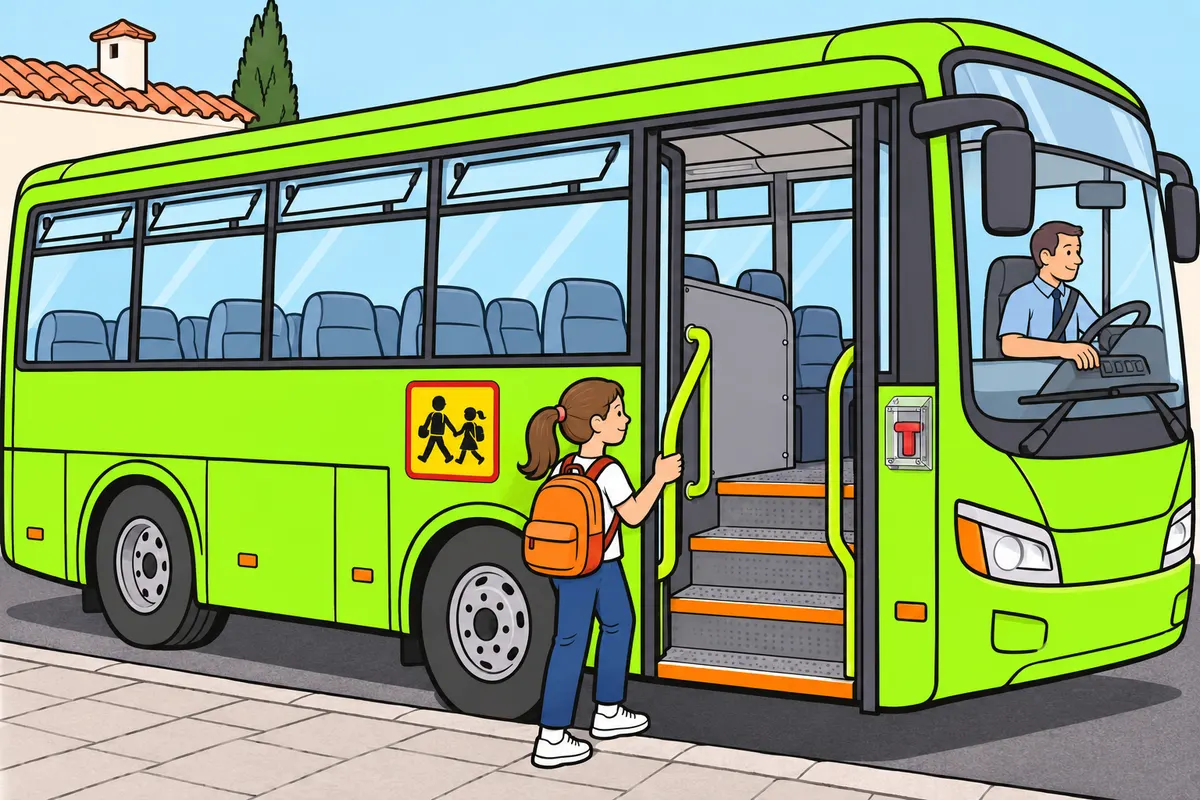
Check the specific protective features and equipment required on school buses.
| Covered school transport vehicles and conditions | Required equipment or type approval |
|---|---|
| Covered school buses: driver’s seat | Check the transparent protective screen meets UNE 26-362-2:1984; its size may be reduced if height is insufficient. |
| Double-decker buses | UNECE Regulation 107. |
| Single-deck buses, more than 22 seats, classes II and III | Superstructure strength: Regulation 66. |
| All covered services | Carry a first-aid kit. |
| Buses registered on or after 1 January 2002 | Check emergency exits are marked inside using a fluorescent device. |
| Registered on or after 1 January 2002, maximum authorised weight at least 12 t | A function must stabilise speed on long descents without service brakes, emergency brakes or handbrake. |
| Registered on or after 1 January 2002, more than 23 seats | Carry two extinguishers rated 21A/113B: one near you; the other between the rear stairwell and the seat in front of it. |
Remember
- Operate service doors and protect emergency controls against improper use.
- Do not disable mechanisms beyond what type approval allows.
- Check windows open only in their upper third.
- Protect seats facing stairwells or lacking a seat back within 80 cm.
- Check non-slip flooring, accessible handles and brightly coloured step edges.
- If you cannot see doors and their surroundings adequately, optical devices are required.
Exam trap: Wrong: Any aisle-facing seat suits a minor. Right: In school transport vehicles with more than nine seats, under-sixteens may occupy these seats only with fitted belts and must use them under regulatory conditions.
Read the full explanation
- Your seat must be protected by a transparent screen that meets the minimum requirements of standard UNE 26-362-2:1984; if there is insufficient height, its size may be reduced accordingly. You must operate the service doors, and their emergency controls must be protected against improper use by children. You must not disable those mechanisms except as permitted by the type-approval regulations. The opening part of the windows is limited to the upper third. [RD 443/2001, art. 4.2.1.ª, 2.ª and 3.ª](https://www.boe.es/buscar/act.php?id=BOE-A-2001-8503#a4).
- Seats facing stairwells, and seats without protection from a seatback in front located no more than 80 cm away horizontally, measured between the front of its seatback and the rear of the preceding seat, must have adequate fixed protection. When arranging passengers, keep the protective features of these exposed seats operational. [RD 443/2001, art. 4.2.4.ª](https://www.boe.es/buscar/act.php?id=BOE-A-2001-8503#a4).
- On vehicles with more than nine seats used for school transport and the transport of minors, children under sixteen may occupy seats facing an aisle only if those seats have a seat belt fitted. They must use it in accordance with the regulations. Check that specific seat before assigning it to a child. [RGC, fourth additional provision](https://www.boe.es/buscar/act.php?id=BOE-A-2003-23514#dacuarta).
- For this transport, double-decker buses must be type-approved in accordance with UNECE Regulation 107. Single-decker buses with more than 22 seats in Classes II and III are subject to the superstructure strength requirement in Regulation 66 referred to in the article. [RD 443/2001, art. 4](https://www.boe.es/buscar/act.php?id=BOE-A-2001-8503#a4).
- The bus must have a non-slip floor, accessible handrails beside the doors and brightly coloured step edges. If direct vision is insufficient, optical devices must be fitted to detect passengers in the areas inside and outside the doors. The use of emergency equipment is covered in “Passenger safety and emergencies”. [RD 443/2001, art. 4](https://www.boe.es/buscar/act.php?id=BOE-A-2001-8503#a4).
- On services covered by RD 443/2001, you must carry a first-aid kit. Article 4.4 sets out the following additional requirements according to the bus registration date: 1 January 2002 or later. On these buses, emergency exits must be marked on the inside by a fluorescent device. If the maximum authorised mass is 12 t or more, the bus must have a function that stabilises its speed on long descents without using the service brake, emergency brake or parking brake. If it has more than 23 seats, it must carry two fire extinguishers with a 21A/113B rating: one near the driver and the other between the rear stairwell and the seat in front of it. [RD 443/2001, arts. 4.2.27 and 4.4.1.º, 2.º y 4.º](https://www.boe.es/buscar/act.php?id=BOE-A-2001-8503#a4).
22Assisting people with reduced mobility
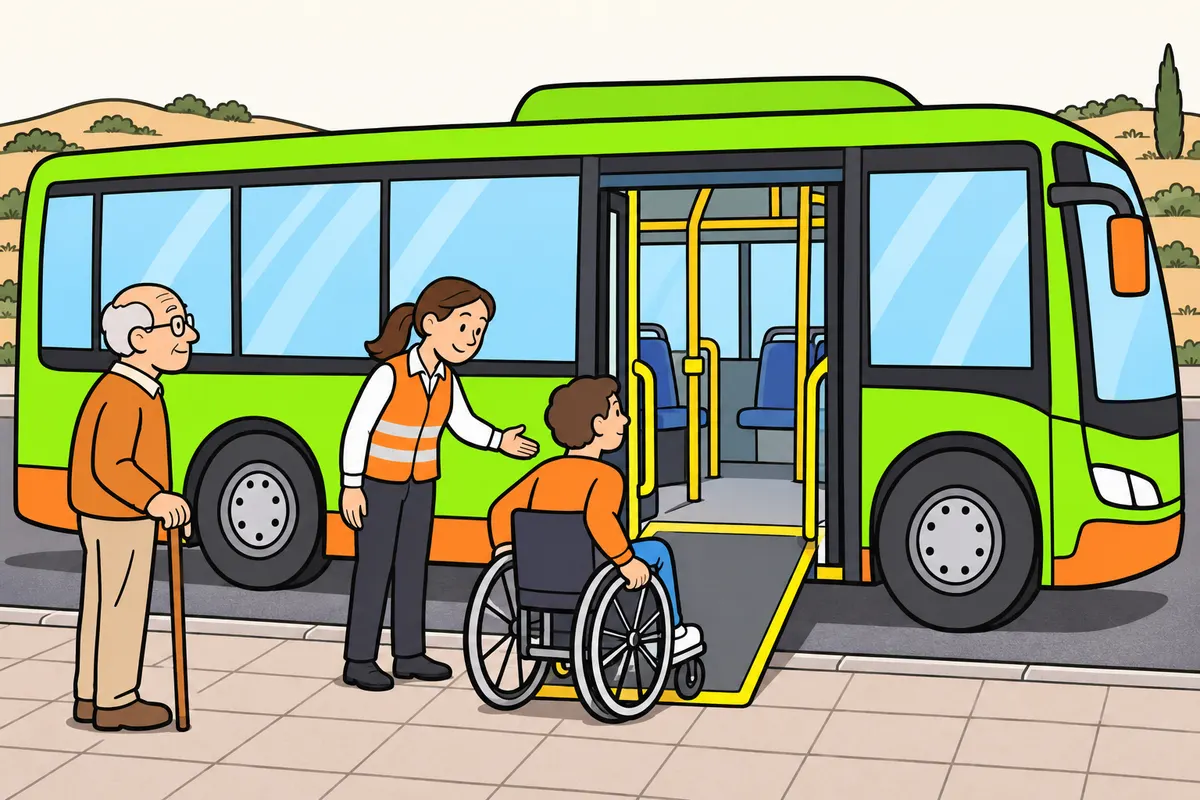
Adapt your help and boarding equipment to each person with reduced mobility.
| Vehicle or service | Reduced mobility measures |
|---|---|
| General-purpose regular interurban services | Seats near entrances, non-slip flooring and supports. |
| Class I low-floor urban buses | At least four marked seats near entrance, with supports and accessible stop-request control. |
| School transport taking pupils with severe motor impairments to special education | Technical boarding aids; coordinate with the qualified escort. |
Remember
- Allow enough time for boarding, leaving and reaching seats.
- Do not assume everyone with reduced mobility uses a wheelchair.
- Know your bus’s ramp, lift and kneeling system.
- Secure the bus and clear the area before using equipment.
- Follow equipment instructions and avoid injuring people.
- On school transport, reserve necessary places near doors.
Exam trap: Wrong: Reserved places are only for wheelchair users. Right: On class I low-floor urban buses, reserve at least four seats near the entrance for people with reduced mobility without wheelchairs.
Read the full explanation
- Allow the time and provide the means needed for access. On regular interurban services for general use, seats are reserved near the entrances, and non-slip flooring and support features are provided for boarding and alighting. Do not assume that reduced mobility means using a wheelchair: adapt your assistance to the person. [RD 1544/2007, annex IV](https://www.boe.es/buscar/act.php?id=BOE-A-2007-20785#aniv).
- On low-floor Class I urban buses, at least four seats near the entrance must be reserved for people with reduced mobility who do not use a wheelchair. They must be marked and have support features and an accessible stop-request control; keep those reserved seats available throughout the service. [RD 1544/2007, annex V](https://www.boe.es/buscar/act.php?id=BOE-A-2007-20785#anv).
- Familiarise yourself with the ramp or lift systems and the bus’s kneeling function. As a practical procedure, secure the vehicle, keep the deployment area clear and operate the equipment according to its instructions. Avoid injuring people while the body lowers or the device is stowed. [RD 1544/2007, annex V](https://www.boe.es/buscar/act.php?id=BOE-A-2007-20785#anv).
- On school transport, you must reserve the necessary seats near the doors for people with reduced mobility. If you carry pupils with severe motor impairments to special education, the vehicle must have technical aids for boarding and alighting. You must coordinate their use with the qualified escort. [RD 443/2001, art. 4](https://www.boe.es/buscar/act.php?id=BOE-A-2001-8503#a4).
23Passengers in wheelchairs
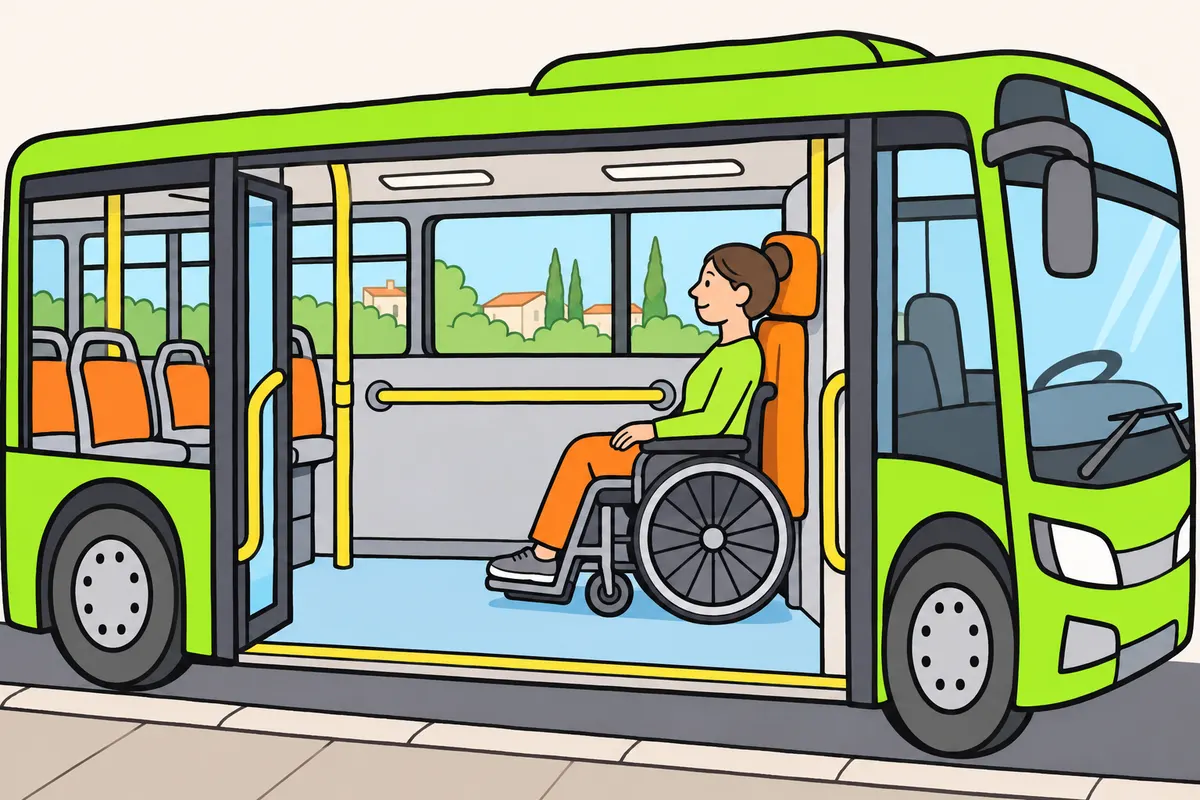
Check wheelchair space and the occupant’s protection separately.
| Vehicle or service | Wheelchair travel conditions |
|---|---|
| Class I low-floor urban bus | Longitudinal space at least 1,300 mm by 750 mm; rear-facing wheelchair with padded back support. |
| Regular interurban route extending beyond one autonomous community | Access in your own wheelchair, boarding facilities and free space for technical aids. |
Remember
- On class I low-floor urban buses, keep the access route clear.
- Keep the wheelchair space free of steps and obstacles.
- In that urban space, position the wheelchair facing backwards.
- Support the back and head; keep the side grab handle accessible.
- Check wheelchair securement and occupant restraints separately.
- Follow the vehicle’s system; wheelchair brakes do not replace required anchorages.
Exam trap: Wrong: Wheelchairs must face backwards on every coach. Right: This orientation applies to the described space on class I low-floor urban buses.
Read the full explanation
- On a low-floor Class I urban bus, the wheelchair space must be free of steps and obstacles and measure at least 1,300 mm long and 750 mm wide. Its longer side must follow the bus’s longitudinal axis; you must also keep the route from the door clear. [RD 1544/2007, annex V](https://www.boe.es/buscar/act.php?id=BOE-A-2007-20785#anv).
- In that space on an urban bus, you must position the wheelchair facing backwards, with the passenger’s back and head supported by the padded backrest or partition and access to the side handrail. Check the position and use the safety devices provided by the manufacturer. Do not apply that orientation to every approved coach configuration. [RD 1544/2007, annex V](https://www.boe.es/buscar/act.php?id=BOE-A-2007-20785#anv).
- On regular interurban routes whose itinerary extends beyond one autonomous community, access must be available for passengers travelling in their own wheelchair, together with means for them to board in it. You must provide free space for their technical aids; orthoses and devices required by a disabled passenger are carried free of charge in the luggage hold in accordance with the annex. [RD 1544/2007, annex IV](https://www.boe.es/buscar/act.php?id=BOE-A-2007-20785#aniv).
- As a safe practice, check separately that the wheelchair is secured and that its occupant is restrained according to the vehicle’s system. The wheelchair brake does not replace the anchorage required by an approved configuration, and a strap securing the wheelchair is not equivalent to the passenger’s seat belt. [RGC, art. 18](https://www.boe.es/buscar/act.php?id=BOE-A-2003-23514#a18).
24Non-discriminatory access and assistance
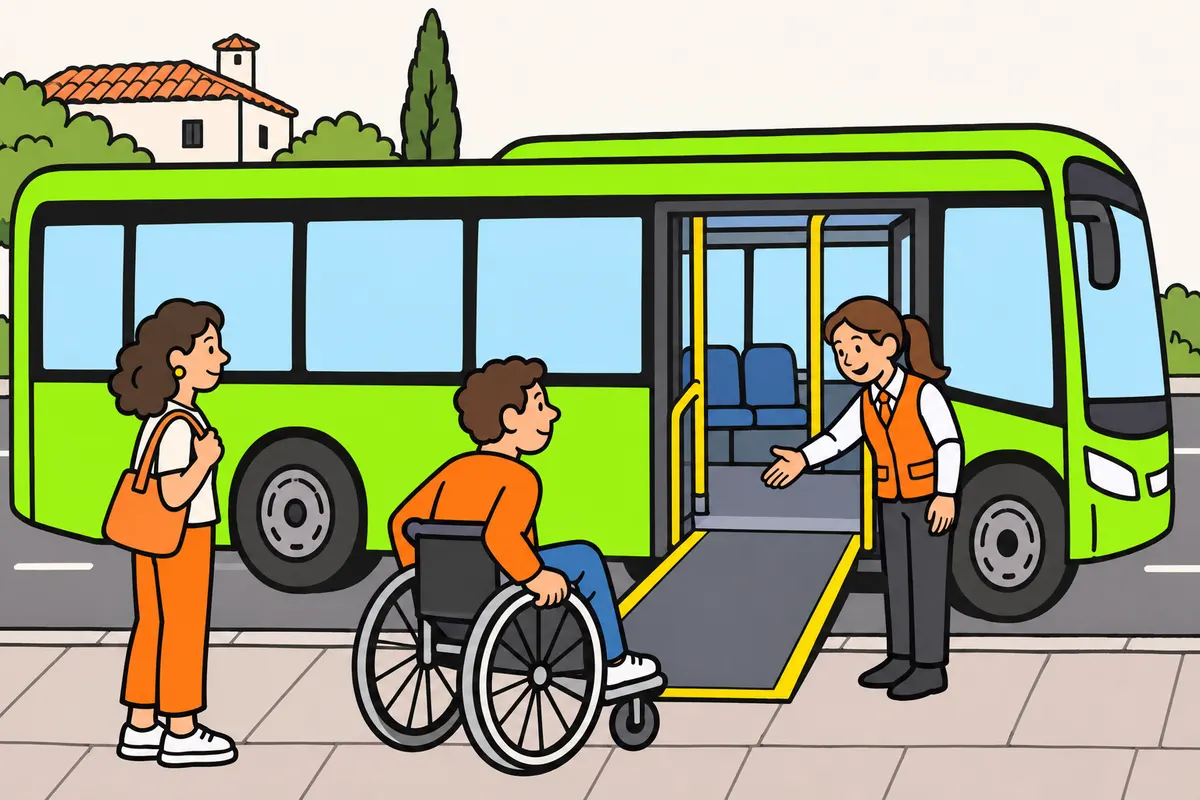
Provide access without discrimination and coordinate assistance with the operator.
| Applicable assistance on regular services from 250 km | Timing |
|---|---|
| Notify need for assistance | At least 36 hours before. |
| An arrival time is specified | Arrive then; no more than 60 minutes before departure may be required. |
| No arrival time is specified | Arrive at least 30 minutes before departure. |
Remember
- On covered regular services, do not refuse access or charge extra because of disability.
- Apply only legal safety exceptions or physical impossibility of safe transport.
- For regulated assistance, check service distance and deadlines.
- Without advance notice, coordinate reasonable efforts to provide help.
Exam trap: Wrong: No advance notice means automatic refusal. Right: Make reasonable efforts to assist; apply only legal safety exceptions or physical impossibility of safe transport.
Read the full explanation
- On regular services covered by Regulation 181/2011, you must not refuse a reservation, ticket or boarding because of disability or reduced mobility, or charge an additional fee for it. The exceptions concern applicable safety requirements or the physical impossibility of providing safe transport because of the vehicle or infrastructure. [Regulation (EU) 181/2011, arts. 2, 9 and 10](https://www.boe.es/buscar/doc.php?id=DOUE-L-2011-80347).
- Where the assistance regime applies to regular services with a scheduled distance of 250 km or more, the need must be notified at least 36 hours in advance. You must arrive at the stated time, no more than 60 minutes before departure, or at least 30 minutes before if no time was stated. [Regulation (EU) 181/2011, arts. 2 and 14](https://www.boe.es/buscar/doc.php?id=DOUE-L-2011-80347).
- If prior notification is missing, reasonable efforts must be made to provide assistance. The lack of notice is not, by itself, grounds for refusing the journey. Coordinate the specific needs with the company. [Regulation (EU) 181/2011, art. 14.4](https://www.boe.es/buscar/doc.php?id=DOUE-L-2011-80347).
25Assistance dogs and other animals
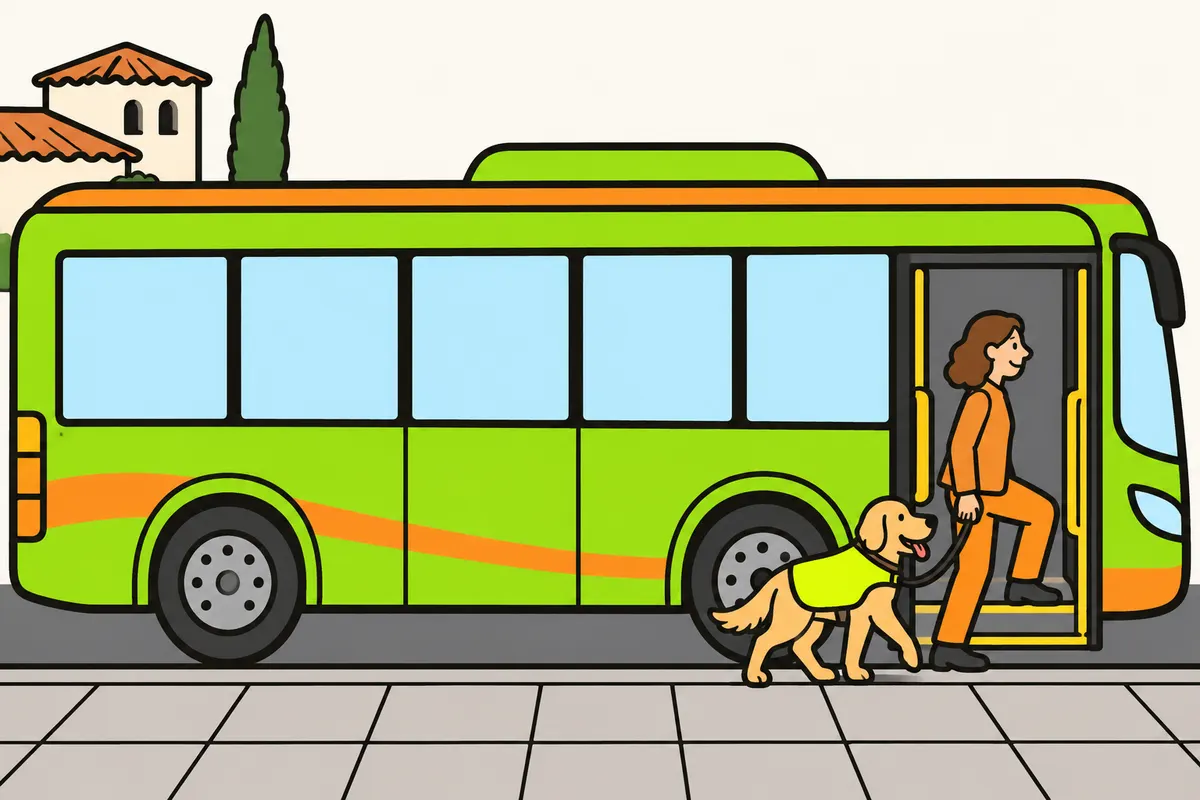
Admit recognised assistance dogs and distinguish their rights from ordinary pet conditions.
| Animal on passenger transport | Access |
|---|---|
| Recognised assistance dog | Under legal conditions, without ticket or supplement; does not count towards passenger capacity. |
| Other animals on public passenger transport | Only with a designated place for transport and compliance with service conditions. |
Remember
- Admit the person with their recognised assistance dog under legal conditions.
- Do not restrict this right to blind people.
- Do not charge a ticket or supplement for an assistance dog.
- Do not count it towards passenger capacity or the dog quota.
- Give it priority in reserved spaces beside its user.
- Do not refuse it under a general animal ban.
Exam trap: Wrong: Always treat assistance dogs as pets. Right: They have specific access rights; apply only legal limitations for obvious inadequate hygiene or health, or imminent serious risk to people or the dog.
Read the full explanation
- You must allow a person accompanied by their recognised assistance dog to travel on public transport, subject to the legal conditions. This right covers guide dogs and other accredited forms of assistance; you must not treat all of them as ordinary pets or restrict access to blind people alone. [RD 409/2025, arts. 3, 6 and 7](https://www.boe.es/buscar/act.php?id=BOE-A-2025-10490).
- You must not require a ticket or supplement for the assistance dog. It does not count towards the vehicle's maximum passenger capacity or the permitted number of dogs, and it has priority in the use of reserved spaces next to its user. [RD 409/2025, art. 7.1.d](https://www.boe.es/buscar/act.php?id=BOE-A-2025-10490#a7).
- This right is subject to the legal restrictions where there are clear signs of inadequate hygiene or health conditions, or an imminent and serious risk to the safety of people or the dog. Apply these restrictions only where there is a specific legally established reason. [RD 409/2025, art. 7.2](https://www.boe.es/buscar/act.php?id=BOE-A-2025-10490#a7).
- On public collective transport, carrying other animals is prohibited unless a designated place is provided for their transport, without prejudice to the rules for assistance dogs. Apply the specific conditions of the service and distinguish the right to assistance from the ordinary admission of pets. [RGC, art. 11](https://www.boe.es/buscar/act.php?id=BOE-A-2003-23514#a11).
Make a stop with passengers
Control access and check the surroundings before moving off again.
- Bring the bus alongside the designated area and stop it completely without jolting.
- Check that opening the doors and alighting will not create a hazard; open the doors intended for the operation.
- Monitor boarding and alighting and provide any necessary accessibility assistance.
- Check that nobody is trapped and that passengers and luggage are safely positioned.
- Close the doors, check the surroundings and move off smoothly.
Decide whether a school transport escort is required
First check whether the service is within scope, then check its conditions.
- Identify the type of transport and apply the threshold in Article 1 of RD 443/2001.
- For an included occasional service, require an escort.
- For special-use transport, check the authorisation and special education conditions; for private supplementary transport, check special education and the origin and destination.
- On any included service operated by bus, require an escort if at least half of the passengers are under twelve.
- Check suitability, that the escort is an adult, accreditation, knowledge of the vehicle and qualifications where applicable.
- Check that the escort occupies a seat next to the central or rear service door and confirm their presence before departure.
Prepare wheelchair access
Use the vehicle equipment and check the wheelchair and its occupant.
- Confirm the person’s needs and the intended accessible space.
- Secure the bus and check that you can deploy the ramp or lift safely.
- Operate the equipment according to its instructions and provide unobstructed access.
- Position the wheelchair in the space and orientation required for that configuration.
- Apply and check the specified wheelchair securing and occupant restraint devices.
- Stow the equipment, check access points and doors, and move off smoothly.
Check what you know
Real questions from the bank on this topic. Pick an answer to see the explanation.
Finished this module?
Mark it as read and you will see your progress on the theory list.