
Theory · D Licence - Bus · Module 10 of 18
Bus dimensions and masses
You learn the limits on bus dimensions, total mass and axle load distribution, the conditions for towing trailers and the use of the speed limiter. You can interpret route restrictions and the rules on projecting loads and special transport.
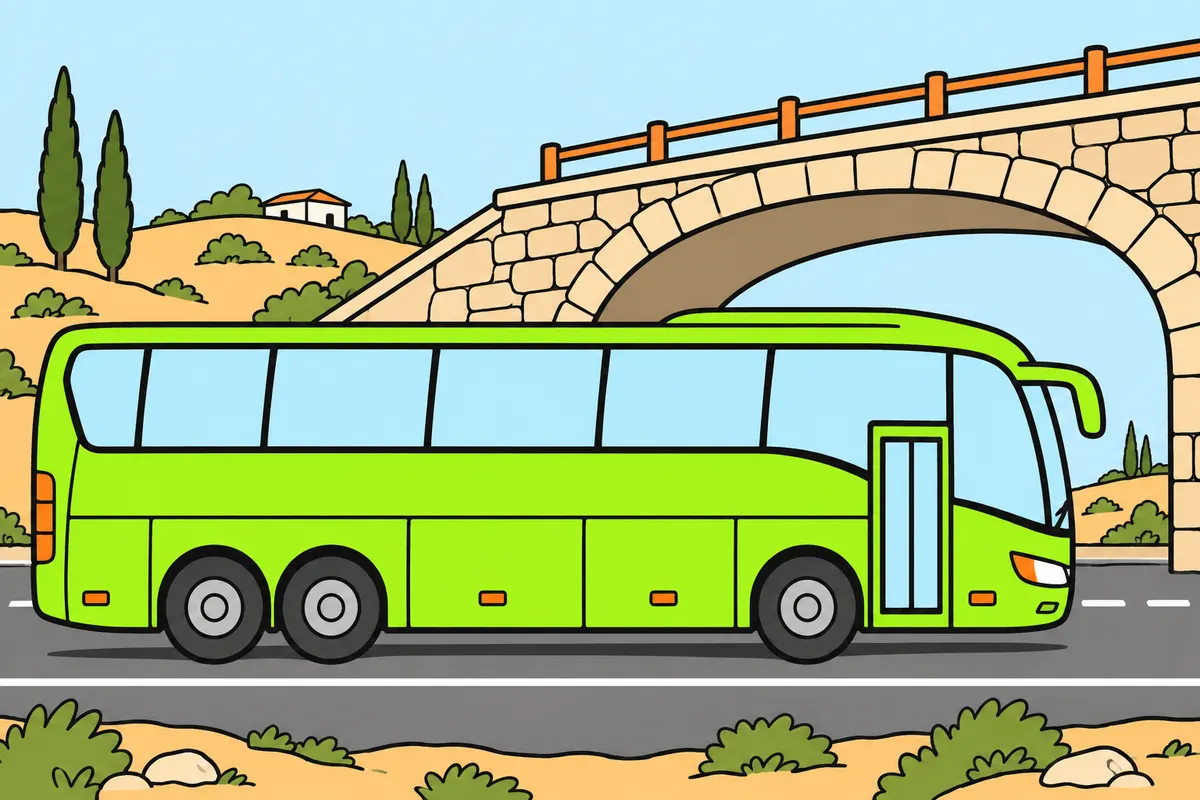
1Tare, running order and laden mass
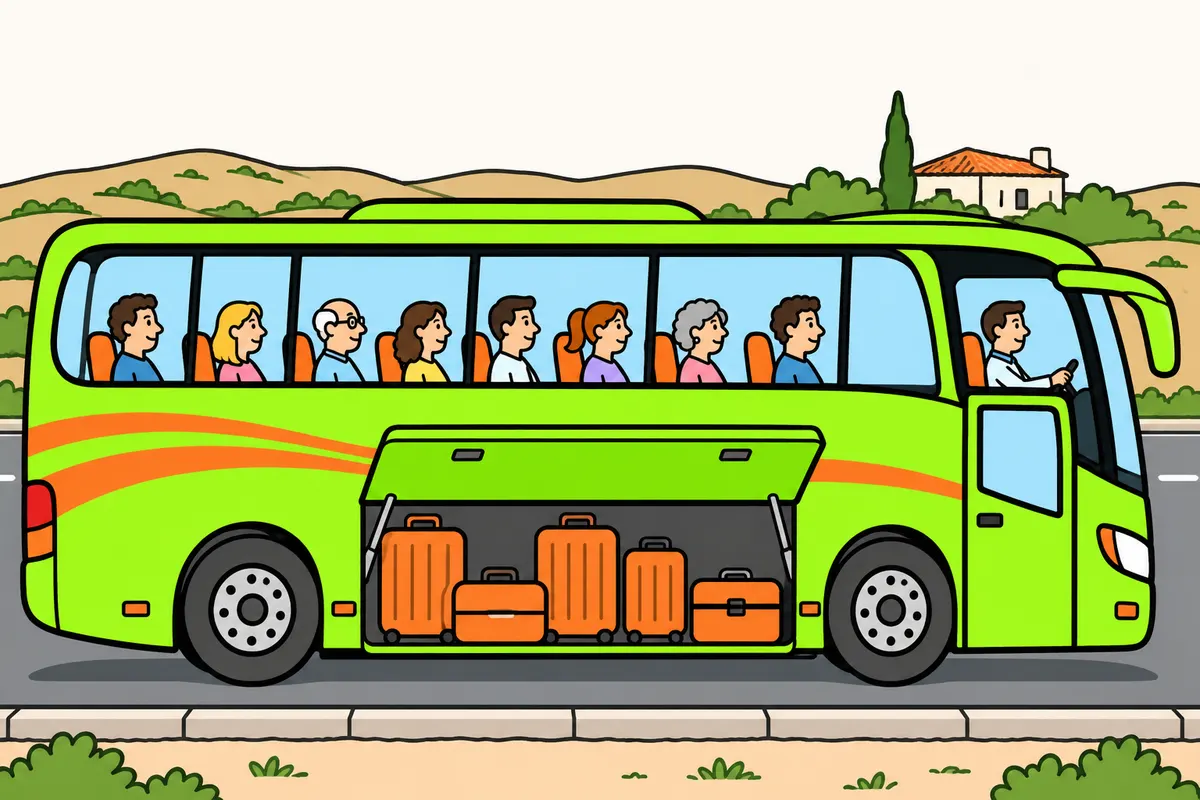
Tell tare, running order and laden mass apart.
| Mass | What it includes |
|---|---|
| Tare | Equipped bus and necessary supplies |
| Running order | Tare, standard driver and attendant if carried |
| Laden mass | Actual mass on the journey, including people and loads |
Remember
- Tare includes authorised equipment and necessary supplies.
- Tare does not include staff, passengers or cargo.
- Add the standard driver and any attendant to find running order.
- Laden mass is the actual mass on this journey, including people and luggage.
Exam trap: Wrong: add a standard mass for every passenger. Right: running order adds the standard driver and, for a bus, an attendant if carried.
Read the full explanation
- Tare is the mass of the bus with its authorised fixed equipment and the necessary supplies of water, fuel, lubricants, spare parts, tools and accessories; it does not include service personnel, passengers or cargo. [RGV, Annex IX](https://www.boe.es/buscar/act.php?id=BOE-A-1999-1826#anix).
- To obtain the mass in running order, you add the standard driver mass of 75 kg to the tare and, for buses and coaches, a further 75 kg for the attendant if one is carried. Passenger masses form part of the laden mass. [RGV, Annex IX](https://www.boe.es/buscar/act.php?id=BOE-A-1999-1826#anix).
- The laden mass is the actual mass of the vehicle during that journey, with its cargo, service personnel and passengers. You also count luggage: a coach with every seat occupied can have a different mass depending on the luggage it carries. [RGV, Annex IX](https://www.boe.es/buscar/act.php?id=BOE-A-1999-1826#anix).
- If a coach has a tare of 12,000 kg, its mass in running order is 12,075 kg with the standard driver and no attendant, or 12,150 kg with both. This example applies the standard masses in the definition; weighing determines the actual mass of the laden vehicle. [RGV, Annex IX](https://www.boe.es/buscar/act.php?id=BOE-A-1999-1826#anix).
2Authorised and technical maximum masses
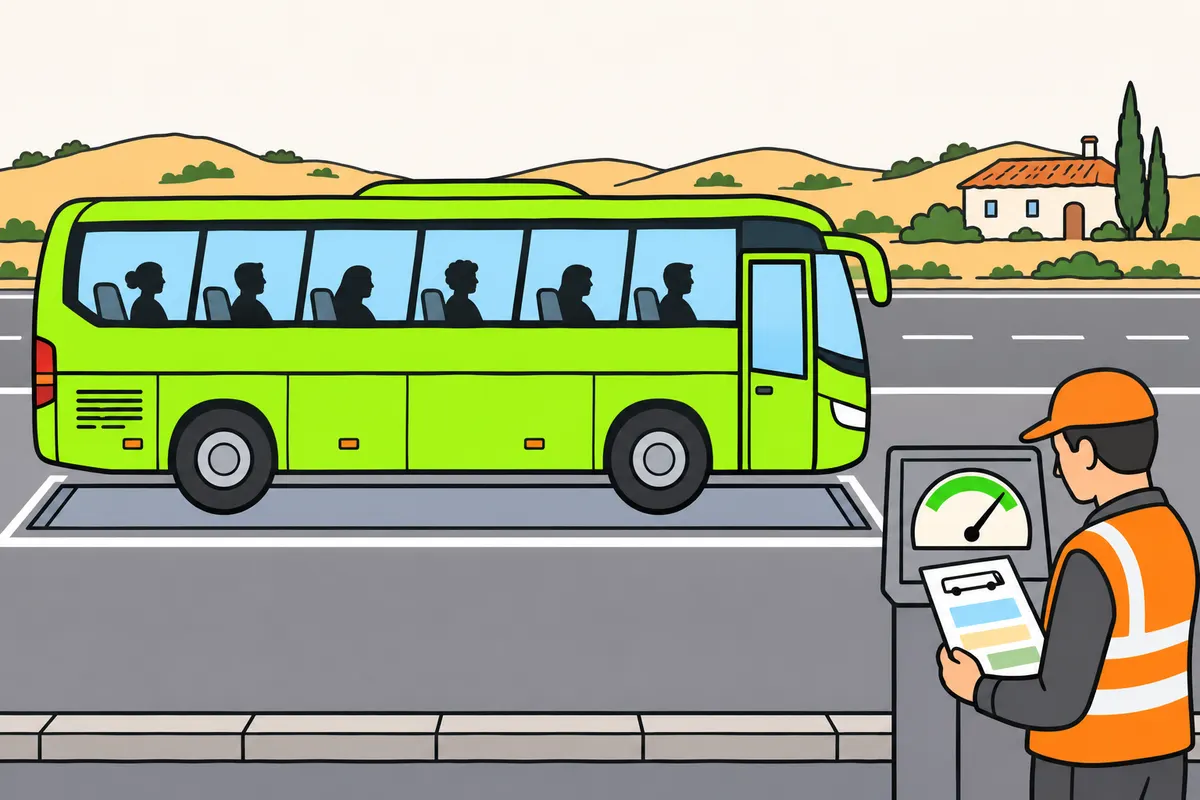
Respect every mass limit for your bus and any trailer combination.
| Limit | What you check |
|---|---|
| MMA | Maximum authorised mass for road use when loaded |
| Technical maximum | Capacity set by the manufacturer |
| Axle mass | Weight carried through all wheels on that axle |
| Combination | Combination limits and maximum towable mass |
Remember
- Check the maximum authorised mass (MMA) in your vehicle documents.
- Also respect technical limits and axle limits.
- Count all wheels on each axle, including twin wheels.
- Check combination limits if you tow a trailer.
Exam trap: Wrong: use the full technical capacity on the road. Right: also respect your authorised MMA and every other applicable limit.
Read the full explanation
- The maximum authorised mass, MMA, is the maximum mass at which you may use the laden vehicle on public roads. The technically permissible maximum mass is based on its construction and is specified by the manufacturer. [RGV, Annex IX](https://www.boe.es/buscar/act.php?id=BOE-A-1999-1826#anix).
- Your bus must simultaneously comply with the limit for its category, the MMA assigned to the bus, its technical limits and its axle limits. If the table allows 19.50 t but your vehicle is authorised for 19 t, your limit is 19 t; the table does not in itself amend your vehicle documents. [RGV, Annex IX](https://www.boe.es/buscar/act.php?id=BOE-A-1999-1826#anix).
- The axle mass is the mass transmitted to the ground by all the wheels attached to that axle. The calculation includes both sides and all twin wheels fitted to the axle. [RGV, Annex IX](https://www.boe.es/buscar/act.php?id=BOE-A-1999-1826#anix).
- For a vehicle combination, you also distinguish between the maximum authorised mass of the combination, its technical maximum mass and the towable mass. The combination must comply with its maximum, as well as the individual limits of the bus and trailer. [RGV, Annex IX](https://www.boe.es/buscar/act.php?id=BOE-A-1999-1826#anix).
3Maximum bus width
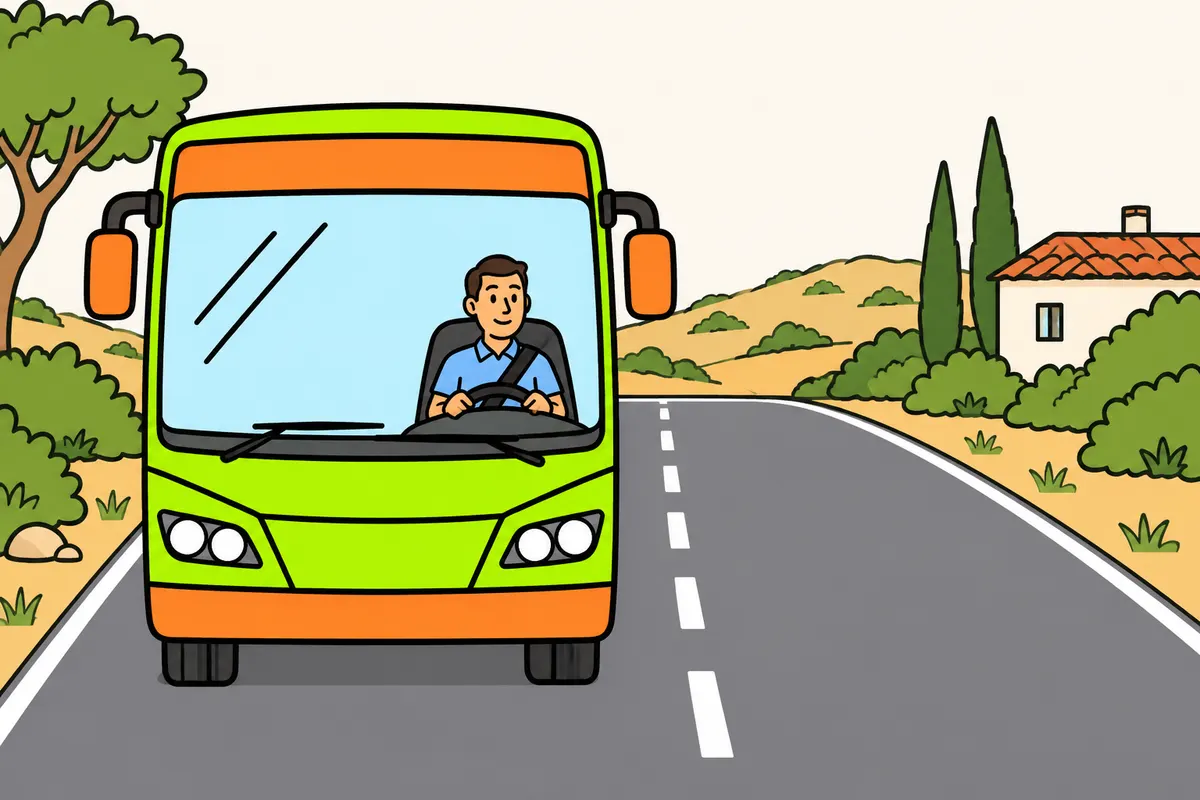
Check your permitted width and the space your bus actually occupies.
| Bus type | Maximum width |
|---|---|
| Ordinary bus | 2.55 m |
| Specially equipped for prisoners | 2.60 m |
Remember
- More axles or standing passengers do not give you extra width.
- Check projecting parts before using narrow passages.
- The prisoner exception requires a central cell compartment and central aisle.
- The compartment must be separate from front and rear driving or escort areas.
Exam trap: Wrong: apply the exception to any bus carrying prisoners. Right: require the specified cell compartment, separation and central aisle.
Read the full explanation
- The general maximum authorised width is 2.55 m. This is the limit for an ordinary bus and does not change because it has more axles, carries standing passengers, operates an occasional service or is articulated. [RGV, Annex IX](https://www.boe.es/buscar/act.php?id=BOE-A-1999-1826#anix).
- The specific exception for buses specially equipped to transport prisoners allows 2.60 m. This equipment comprises a central cell compartment, separated from the front and rear driving or escort areas, and a central aisle. [RGV, Annex IX](https://www.boe.es/buscar/act.php?id=BOE-A-1999-1826#anix).
- Dimensions are determined in accordance with the type-approval regulations applicable to the vehicle category. To plan a narrow route, you also need to know the physical space occupied by the bodywork and its projections; compliance with the statutory width does not guarantee that you can pass an oncoming vehicle at every narrow point. [RGV, Annex IX](https://www.boe.es/buscar/act.php?id=BOE-A-1999-1826#anix).
4Height and overhead obstacles
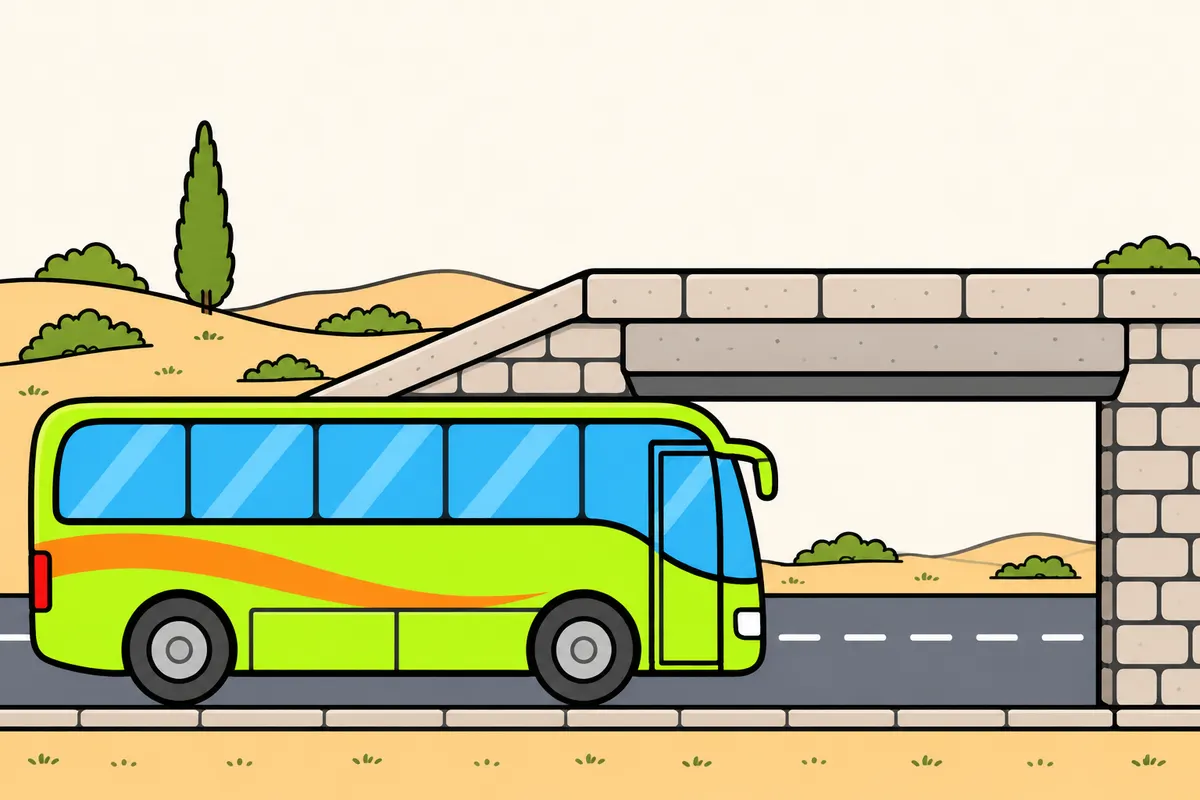
Check your bus height and the clearance under every overhead obstacle.
| Bus class | Maximum height |
|---|---|
| General | 4.00 m |
| Class I urban bus | 4.20 m |
Remember
- Include loads and fitted equipment when measuring height.
- Check clearance under bridges and overhead installations.
- Entering a town does not give your coach the urban exception.
Exam trap: Wrong: use the urban height allowance for any coach in town. Right: the exception applies to Class I buses.
Read the full explanation
- The general maximum height of a bus, including its load and installed equipment, is 4.00 m. [RGV, Annex IX](https://www.boe.es/buscar/act.php?id=BOE-A-1999-1826#anix).
- Class I urban buses have a maximum height of 4.20 m. This exception depends on the vehicle class; you cannot apply it to a Class II or III coach because you are driving through a city, or to any double-decker bus simply because of its appearance. [RGV, Annex IX](https://www.boe.es/buscar/act.php?id=BOE-A-1999-1826#anix).
- The clearance along your route may be lower than the maximum height for your category. Your load must not obstruct passage under bridges, viaducts or overhead installations. [RGV, Annex IX](https://www.boe.es/buscar/act.php?id=BOE-A-1999-1826#anix).
5Length of rigid and articulated buses and combinations
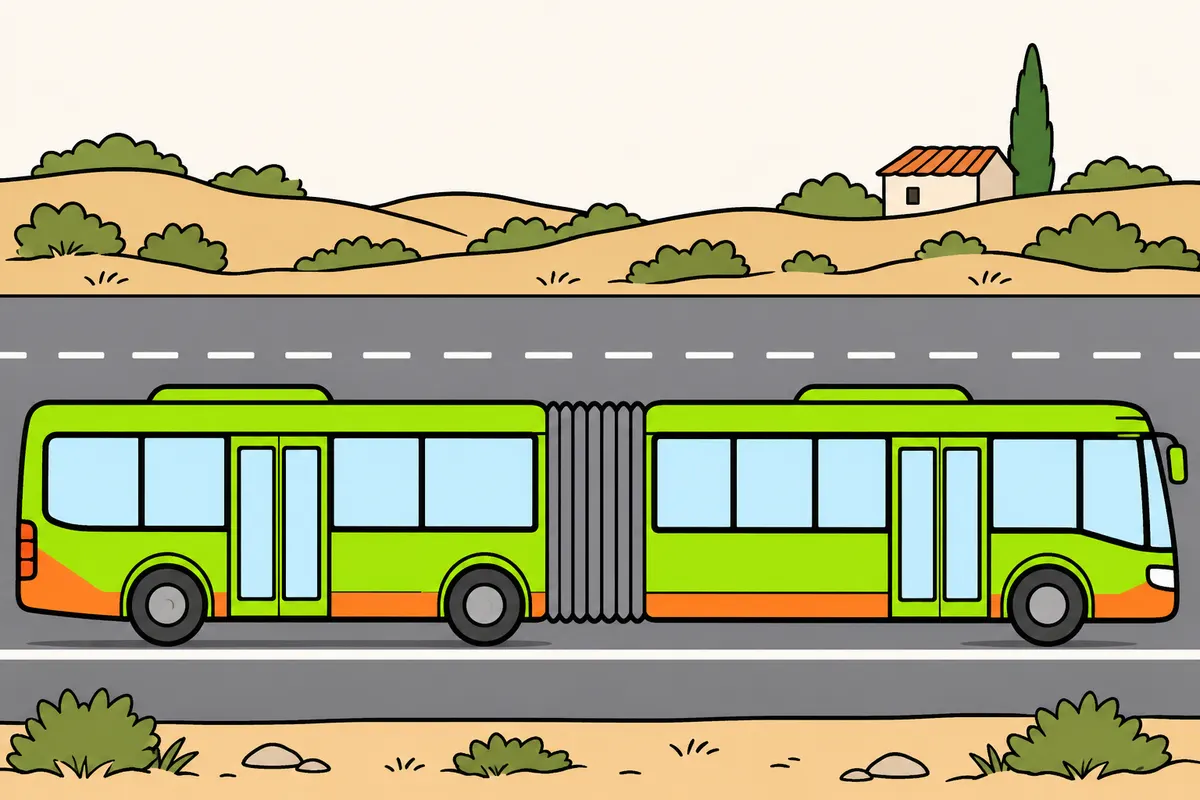
Choose the length limit for your bus and include any trailer.
| Bus or bus combination | General maximum length |
|---|---|
| Two-axle rigid bus | 13.50 m |
| Rigid bus with more than two axles | 15.00 m |
| Articulated bus | 18.75 m |
| Bus and trailer: complete combination | 18.75 m |
Remember
- You can drive an articulated bus with D.
- You need D+E if the trailer MMA exceeds 750 kg.
- Include the trailer when measuring the whole combination.
Exam trap: Wrong: measure only the bus in a combination. Right: include the trailer, even when you carry no passengers.
Read the full explanation
- With a D licence, you may tow a trailer with an MMA of up to 750 kg; if it exceeds that mass, you need D+E. An articulated bus is a single vehicle and you may drive it with D. [RGCond, art. 4](https://www.boe.es/buscar/act.php?id=BOE-A-2009-9481#a4). [RGV, Annex II, definition of an articulated bus](https://www.boe.es/buscar/act.php?id=BOE-A-1999-1826).
- For a two-axle rigid bus, the general maximum length is 13.50 m. For a rigid bus with more than two axles, it is 15.00 m; this second rule covers both three and four axles and does not depend on the vehicle's passenger capacity. [RGV, Annex IX, table 3](https://www.boe.es/buscar/act.php?id=BOE-A-1999-1826#anix).
- For an articulated bus, the general maximum length is 18.75 m. The table has a separate row for articulated buses, based on their passenger vehicle configuration. [RGV, Annex IX, table 3](https://www.boe.es/buscar/act.php?id=BOE-A-1999-1826#anix).
- For a bus towing a trailer, the 18.75 m applies to the entire combination, including the trailer. If the combination measures 19 m, it exceeds that maximum; a small trailer or driving without passengers does not allow you to add length to the limit. [RGV, Annex IX, table 3](https://www.boe.es/buscar/act.php?id=BOE-A-1999-1826#anix).
6Ski racks and removable accessories
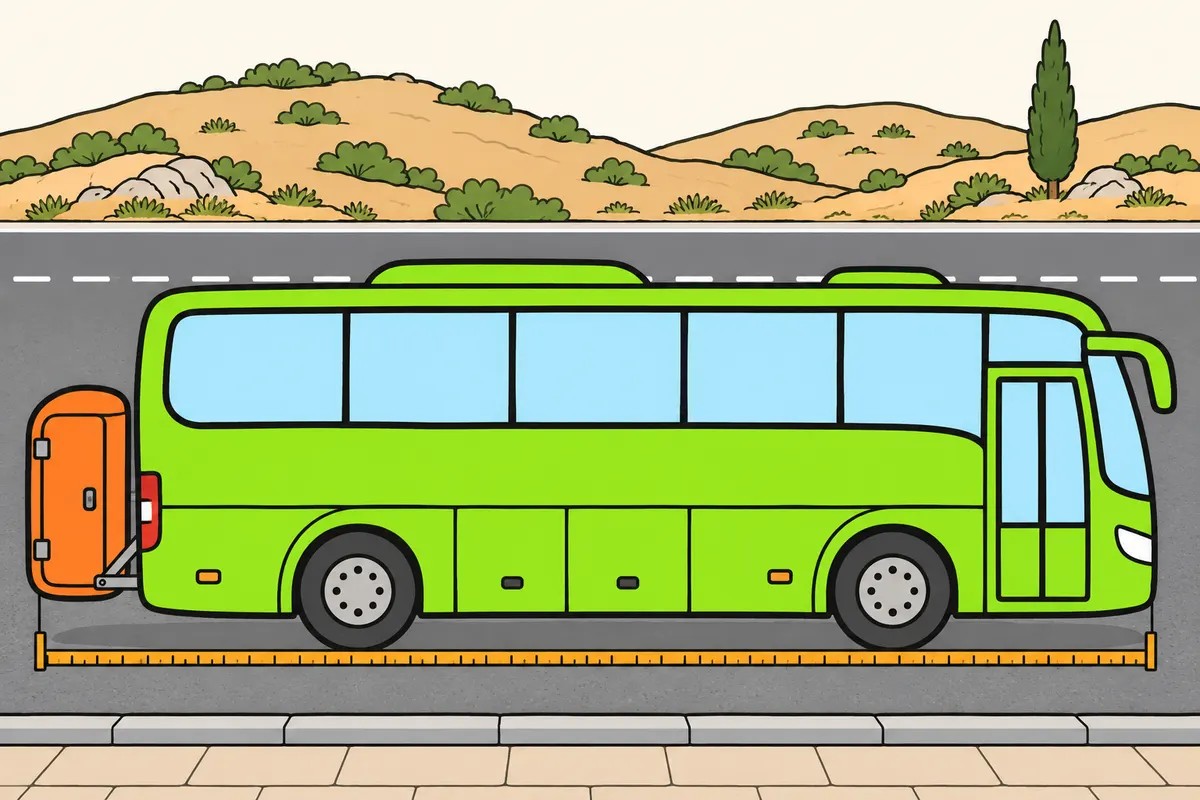
Include ski racks and removable accessories within your maximum bus length.
Remember
- Measure your bus with the accessory fitted.
- You can fit it if the total stays within the applicable maximum.
- Being removable does not give an accessory extra length.
- Projecting-load percentages do not remove this maximum.
Exam trap: Wrong: add a ski rack beyond a two-axle rigid bus already measuring 13.50 m. Right: the accessory must fit within that maximum.
Read the full explanation
- The length of the bus includes removable accessories, such as a ski rack. You can remove them because they are detachable, but while they are fitted, they form part of the total measurement. [RGV, Annex IX](https://www.boe.es/buscar/act.php?id=BOE-A-1999-1826#anix).
- If a two-axle rigid bus already measures 13.50 m, you cannot add a rear ski rack that increases the total to 14 m under the ordinary rules. If the bus is shorter, you may fit one provided the resulting length complies with the maximum for its configuration. [RGV, Annex IX](https://www.boe.es/buscar/act.php?id=BOE-A-1999-1826#anix).
7Maximum authorised mass of two-axle buses
Check the class of your two-axle bus to choose its general MMA.
| Two-axle buses | General MMA |
|---|---|
| Class I urban bus | 20 t |
| Classes II and III | 19.50 t |
| General two-axle motor vehicle row, excluding buses | 18 t |
Remember
- Check the vehicle class, rather than where the service runs.
- Do not use the general row that excludes buses.
- Correct any excess weight, even if seats remain empty.
- Check each axle too.
- The 18 t general row is for vehicles other than buses.
Exam trap: Wrong: use 18 t for every two-axle vehicle, or give a Class II coach 20 t. Right: buses use their class row: 20 t for Class I and 19.50 t for Classes II and III; the general 18 t row excludes buses.
Read the full explanation
- For a two-axle class I urban bus, the general MMA (maximum authorised mass) is 20 t. This figure applies to that regulatory class: you can identify it in the vehicle specifications; the commercial name and the location of the service do not determine its class. [RGV, Annex IX, table 2](https://www.boe.es/buscar/act.php?id=BOE-A-1999-1826#anix).
- For two-axle class II and III buses, used for interurban and long-distance services, the general limit in the table is 19.50 t. [RGV, Annex IX, table 2](https://www.boe.es/buscar/act.php?id=BOE-A-1999-1826#anix).
- The 18 t in the general row for two-axle motor vehicles excludes buses. You use the vehicle type classification together with the number of axles to select the applicable row. [RGV, Annex IX, table 2](https://www.boe.es/buscar/act.php?id=BOE-A-1999-1826#anix).
- If your class III coach actually weighs 19.60 t, you must adjust the load when its maximum authorised mass is 19.50 t. Empty seats or securely fastened luggage do not compensate for excess mass; you must also check that each axle stays within its own limit. [RGV, Annex IX, table 2](https://www.boe.es/buscar/act.php?id=BOE-A-1999-1826#anix).
8Three- and four-axle vehicles: masses
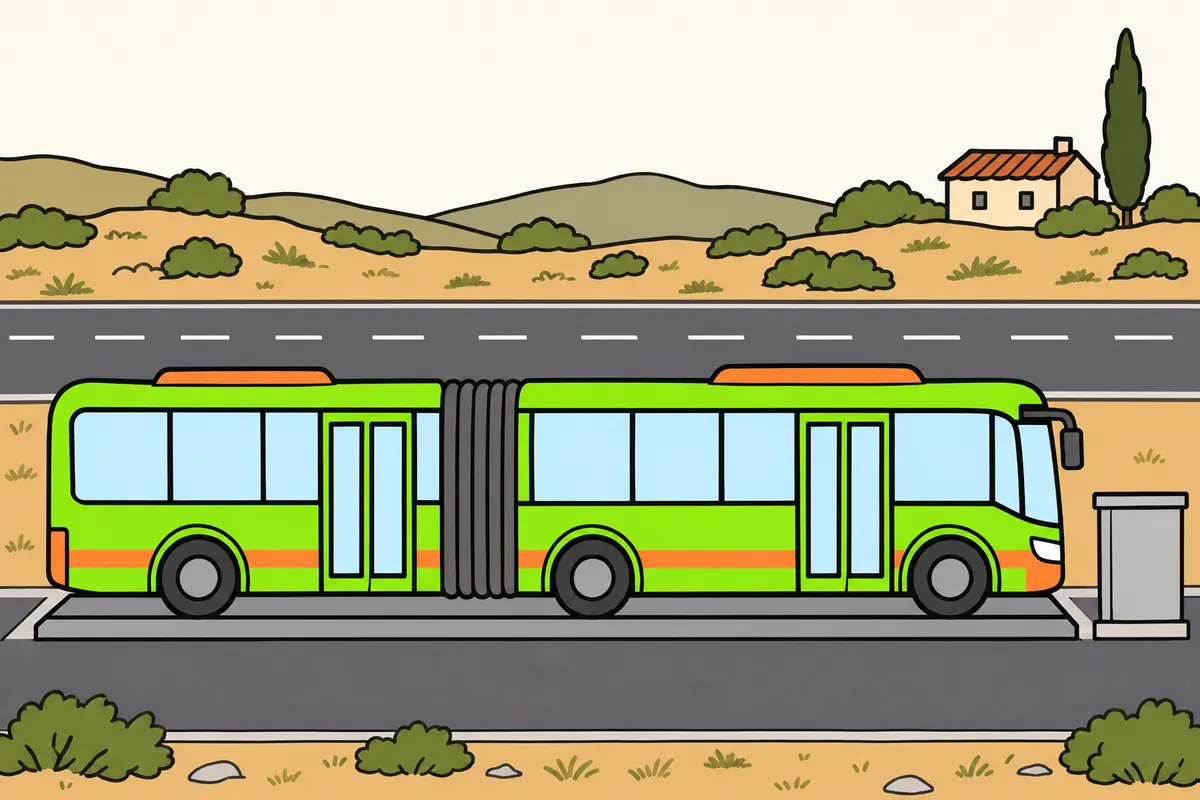
Check your axle count and vehicle layout before choosing the maximum mass.
| Motor vehicle configuration | General or conditional maximum |
|---|---|
| Three axles: general row | 25 t |
| Three axles: either option listed above | 26 t |
| Three-axle articulated bus | 28 t |
| Four-axle rigid vehicle: two steering axles and either option above | 32 t |
| Other four-axle rigid vehicles | 31 t |
Remember
- For higher masses, check tyres and suspension.
- Option: driving axle with twin tyres and air suspension or a recognised equivalent.
- Or: each driving axle has twin tyres and a maximum mass of 9.5 t.
- For 32 t, your rigid vehicle also needs four axles, including two steering axles.
- Always respect your vehicle’s technical and authorised limits.
Exam trap: Wrong: allow 28 t for a three-axle rigid vehicle. Right: that figure applies to a three-axle articulated bus.
Read the full explanation
- The general row for three-axle motor vehicles sets a limit of 25 t. You can reach 26 t when the driving axle has twin tyres and air suspension or a recognised equivalent, or when each driving axle has twin tyres and the maximum mass of each axle does not exceed 9.5 t. [RGV, Annex IX, table 2](https://www.boe.es/buscar/act.php?id=BOE-A-1999-1826#anix).
- For a three-axle articulated bus, the specific general limit is 28 t. To select this row, you check that the vehicle meets all three characteristics: it is a bus, is articulated and has three axles. [RGV, Annex IX, table 2](https://www.boe.es/buscar/act.php?id=BOE-A-1999-1826#anix).
- For four-axle rigid vehicles with two steering axles, the table allows 32 t provided that the driving axle has twin tyres and air suspension or an equivalent, or that each driving axle has twin tyres and a maximum mass of 9.5 t. For other four-axle rigid vehicles, the general figure is 31 t. [RGV, Annex IX, table 2](https://www.boe.es/buscar/act.php?id=BOE-A-1999-1826#anix).
- These masses are the upper limits for each configuration. You check length and mass separately: the fact that a rigid vehicle with more than two axles can measure 15 m does not automatically entitle you to the mass allowed for another configuration. [RGV, Annex IX, table 2](https://www.boe.es/buscar/act.php?id=BOE-A-1999-1826#anix).
9Propulsion technologies and mass increases
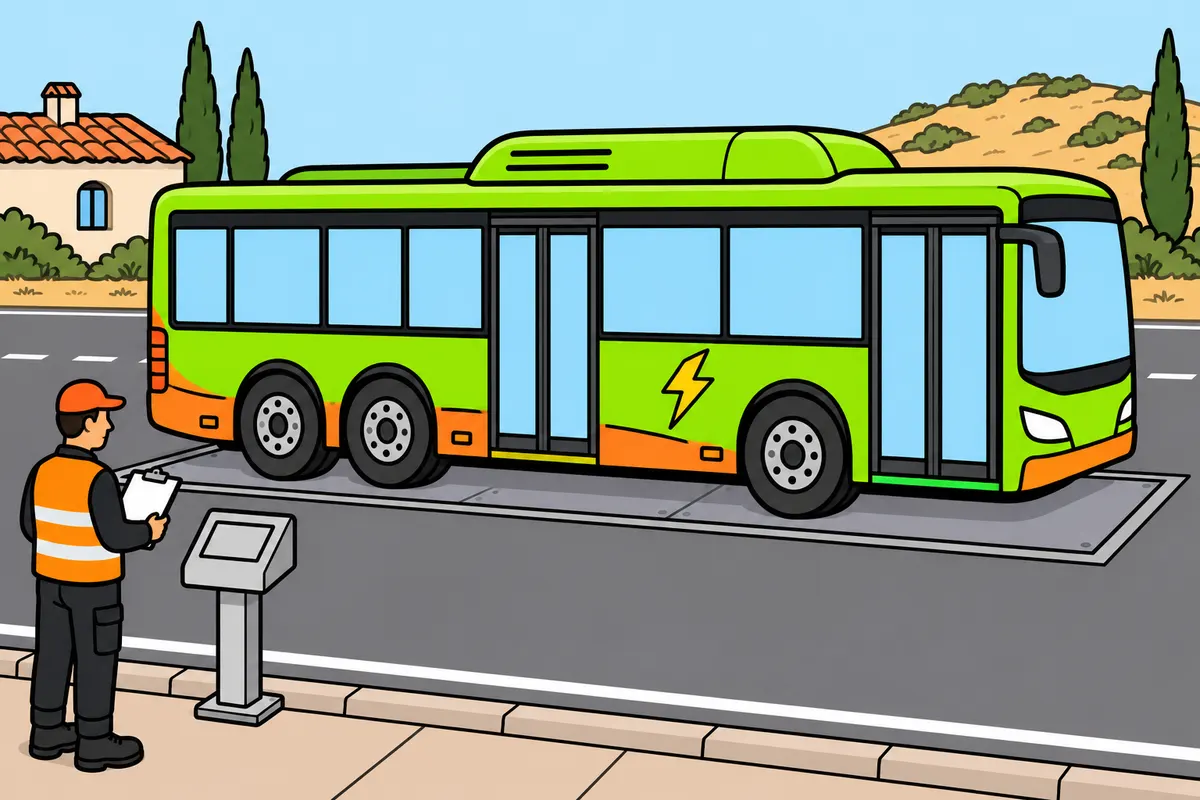
Apply propulsion-related mass increases only when the table and your vehicle allow them.
| Cases covered by the note | Conditional maximum increase |
|---|---|
| Alternative fuel | Up to 1 t for extra technology mass |
| Zero emissions | Up to 2 t for extra technology mass |
| Urban services | Up to 1 t more, above the technology increase |
Remember
- Check that the table row refers to the relevant note.
- Link the increase to the extra mass needed for the technology.
- Check authorisation, technical limits and axle limits.
- The two-axle bus rows do not refer to that note.
- If the question excludes increases, use the general limit.
Exam trap: Wrong: add every increase to any bus. Right: check the row, technology, required extra mass and authorisation; respect technical and axle limits.
Read the full explanation
- Note 1 to the table allows you to increase the MMA of the vehicles or combinations it covers by the additional mass required for alternative-fuel technology, up to 1 t, or zero-emission technology, up to 2 t. The increase corresponds to the additional weight required for propulsion in the rows that refer to this note. [RGV, Annex IX, table 2](https://www.boe.es/buscar/act.php?id=BOE-A-1999-1826#anix).
- For vehicles intended for services in urban environments, the note provides for up to 1 t extra on top of the stated technology-related increases. Your vehicle must also comply with its technically permissible maximum mass and the maximum axle masses. [RGV, Annex IX, table 2](https://www.boe.es/buscar/act.php?id=BOE-A-1999-1826#anix).
- For your two-axle bus, the class I, II and III rows in table 2 do not refer to note (1); you therefore cannot add the technology-related increases provided for in that note to their limits. [RGV, Annex IX, table 2](https://www.boe.es/buscar/act.php?id=BOE-A-1999-1826#anix).
10Single axles: driving and non-driving
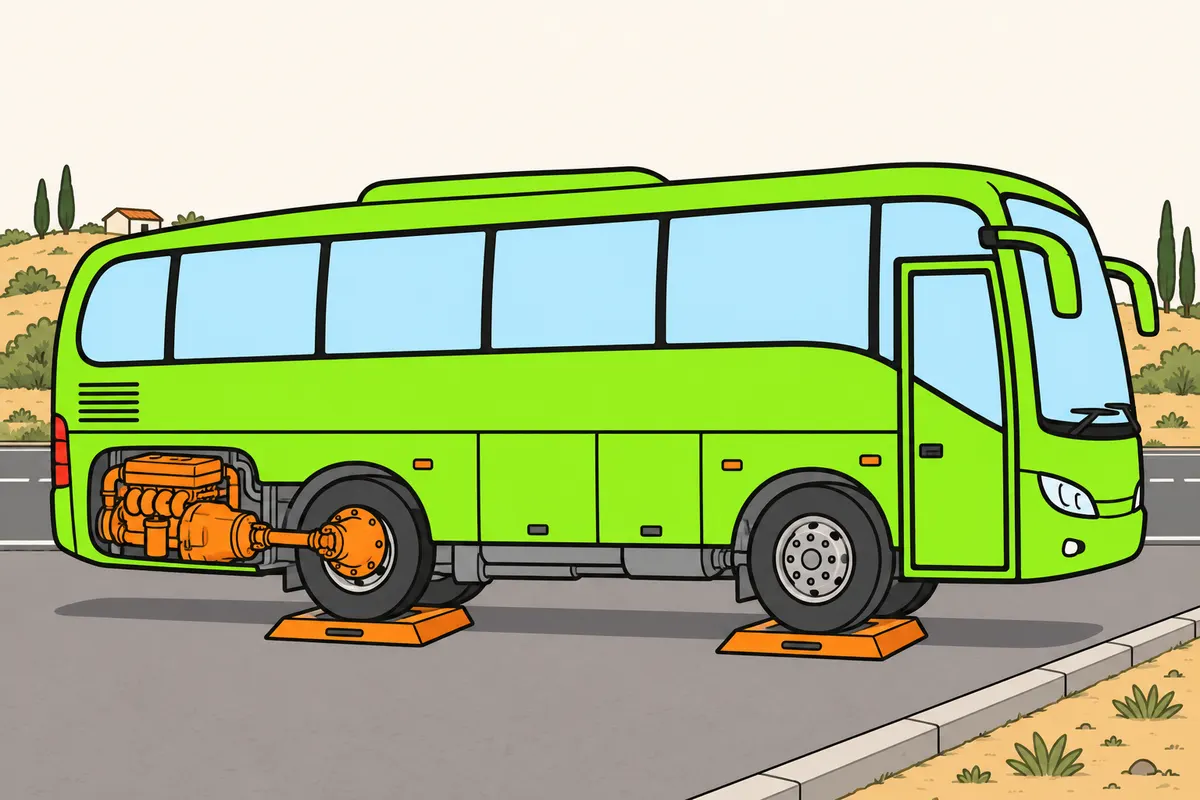
Check whether each axle drives your bus and which class your bus belongs to.
| Single axle and vehicle | Table maximum |
|---|---|
| Non-driving | 10 t |
| Driving: general | 12 t |
| Driving: Class I bus | 13 t |
| Driving: Class II or III bus | 12.6 t |
Remember
- Do not decide from the axle’s front or rear position.
- Respect each axle limit and the whole vehicle limit.
- Check the load your tyres can carry too.
Exam trap: Wrong: allow 13 t on a Class III coach’s driving axle. Right: its specific general maximum is 12.6 t.
Read the full explanation
- For a single non-driving axle, the maximum in the table is 10 t. For a general single driving axle, it is 12 t; the two figures depend on whether that axle receives driving power, rather than whether it is at the front or rear. [RGV, Annex IX](https://www.boe.es/buscar/act.php?id=BOE-A-1999-1826#anix).
- On class I urban buses, the single driving axle can reach 13 t. On class II and III interurban buses, the maximum for the single driving axle is 12.6 t. [RGV, Annex IX](https://www.boe.es/buscar/act.php?id=BOE-A-1999-1826#anix).
- For a two-axle class II coach, you can have general limits of 19.50 t for the vehicle and 12.6 t for its driving axle; one figure does not replace the other. [RGV, Annex IX](https://www.boe.es/buscar/act.php?id=BOE-A-1999-1826#anix).
- With a total mass of 19 t and 13 t actually supported by the driving axle of a class III coach, you must correct the distribution even though the total is below 19.50 t. You must keep tyre loads within their load ratings and comply with the regulatory conditions. [RGV, Annex IX](https://www.boe.es/buscar/act.php?id=BOE-A-1999-1826#anix).
11Motor vehicle tandem axle
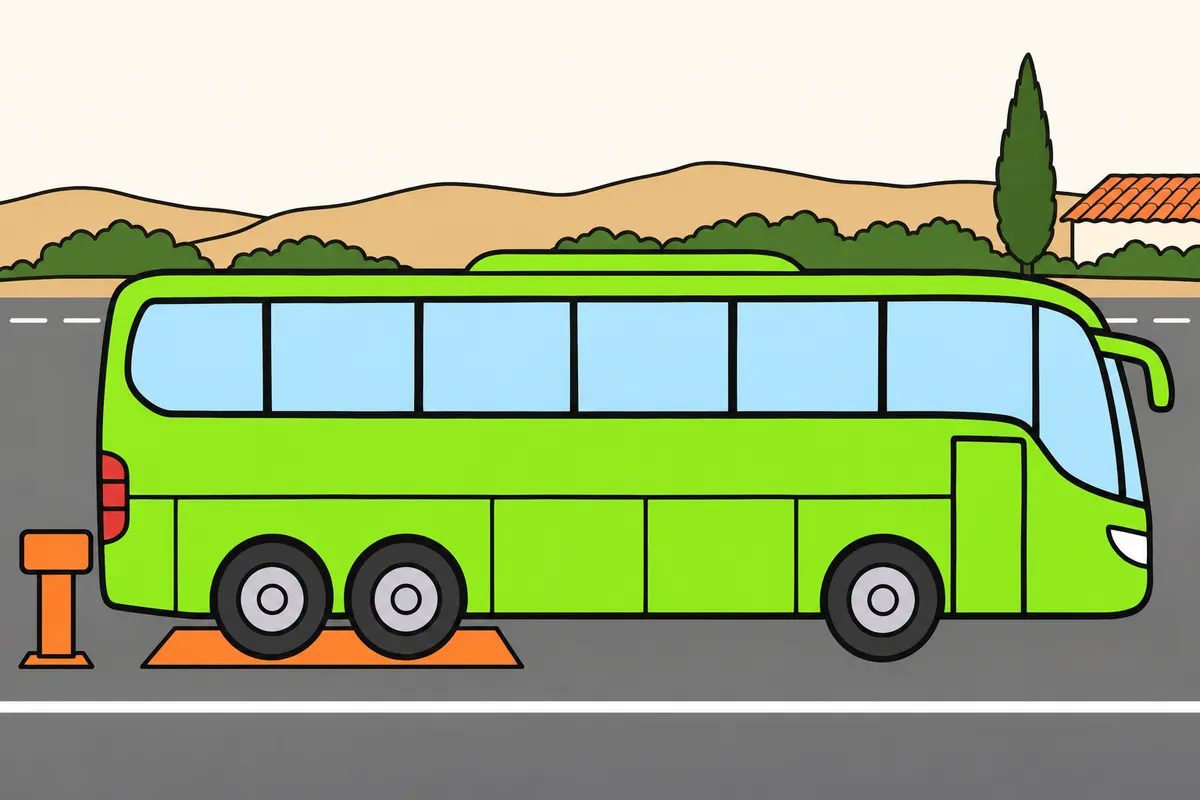
Measure axle spacing to find the limit for the whole tandem group.
| Motor vehicle tandem axle spacing | Maximum for whole group |
|---|---|
| Below 1.00 m | 12 t |
| At least 1.00 m, below 1.30 m | 16 t |
| At least 1.30 m, below 1.80 m | 18 t; 19 t with either option above |
Remember
- Apply the figure to the whole group, rather than each axle.
- For 19 t, check either option below within the last spacing interval.
- Driving axle: twin tyres and air suspension or a recognised equivalent.
- Or each driving axle: twin tyres and maximum mass of 9.5 t.
- Also check load distribution and total bus limits.
Exam trap: Wrong: put exactly 1.30 m in the lower interval. Right: from there to below 1.80 m, allow 18 t, or 19 t if the listed conditions are met.
Read the full explanation
- The spacing d between the two axles determines the range applicable to the tandem. On a motor vehicle, the maximum for the group is 12 t if d is less than 1.00 m, and 16 t if d is at least 1.00 m but less than 1.30 m. [RGV, Annex IX](https://www.boe.es/buscar/act.php?id=BOE-A-1999-1826#anix).
- If the spacing is at least 1.30 m but less than 1.80 m, the ordinary limit for the motor vehicle's tandem axle is 18 t. With a spacing of exactly 1.30 m, the group falls within this range. [RGV, Annex IX](https://www.boe.es/buscar/act.php?id=BOE-A-1999-1826#anix).
- Within this last range, you can apply 19 t when the driving axle has twin tyres and air suspension or a recognised equivalent, or when each driving axle has twin tyres and its maximum mass does not exceed 9.5 t. [RGV, Annex IX](https://www.boe.es/buscar/act.php?id=BOE-A-1999-1826#anix).
- The tandem figure limits the sum of the masses supported by both axles. For example, a group limited to 18 t with 9 t on each axle reaches that maximum; with 9 t and 10 t, it exceeds it. When loading the bus, you check the group as well as the vehicle total. [RGV, Annex IX](https://www.boe.es/buscar/act.php?id=BOE-A-1999-1826#anix).
12Trailer axle groups
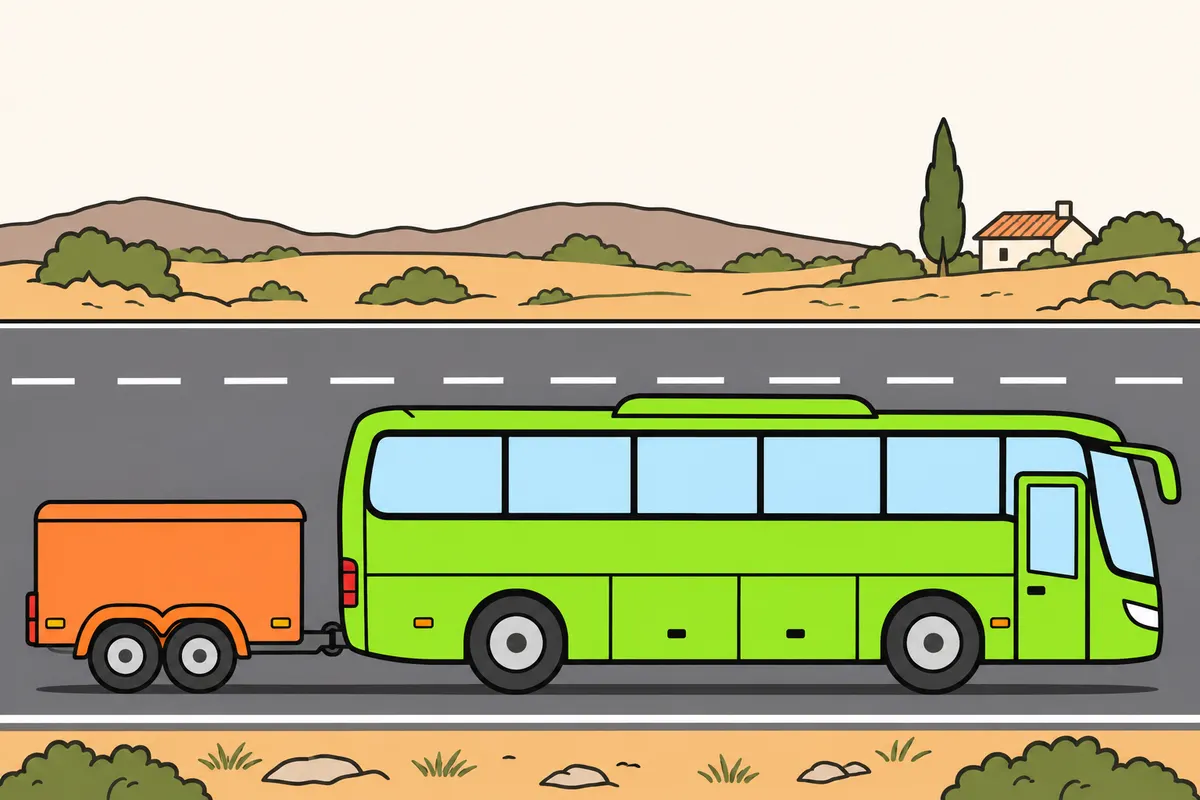
Respect the authorised axle and tyre masses of your light trailer.
Remember
- Check the technical limits in your light trailer’s documents.
- Respect the authorised masses of its axles and tyres.
Exam trap: Wrong: check only your light trailer’s axles. Right: also respect its authorised tyre masses and the technical limits in its documents.
Read the full explanation
- For your bus's light trailer, you must comply with the authorised masses for its axles and tyres, within the technical limits stated in its documentation. [RGV, Annex IX, sections 2.1.3 and 2.1.4](https://www.boe.es/buscar/act.php?id=BOE-A-1999-1826#anix).
13Mass distribution and traction
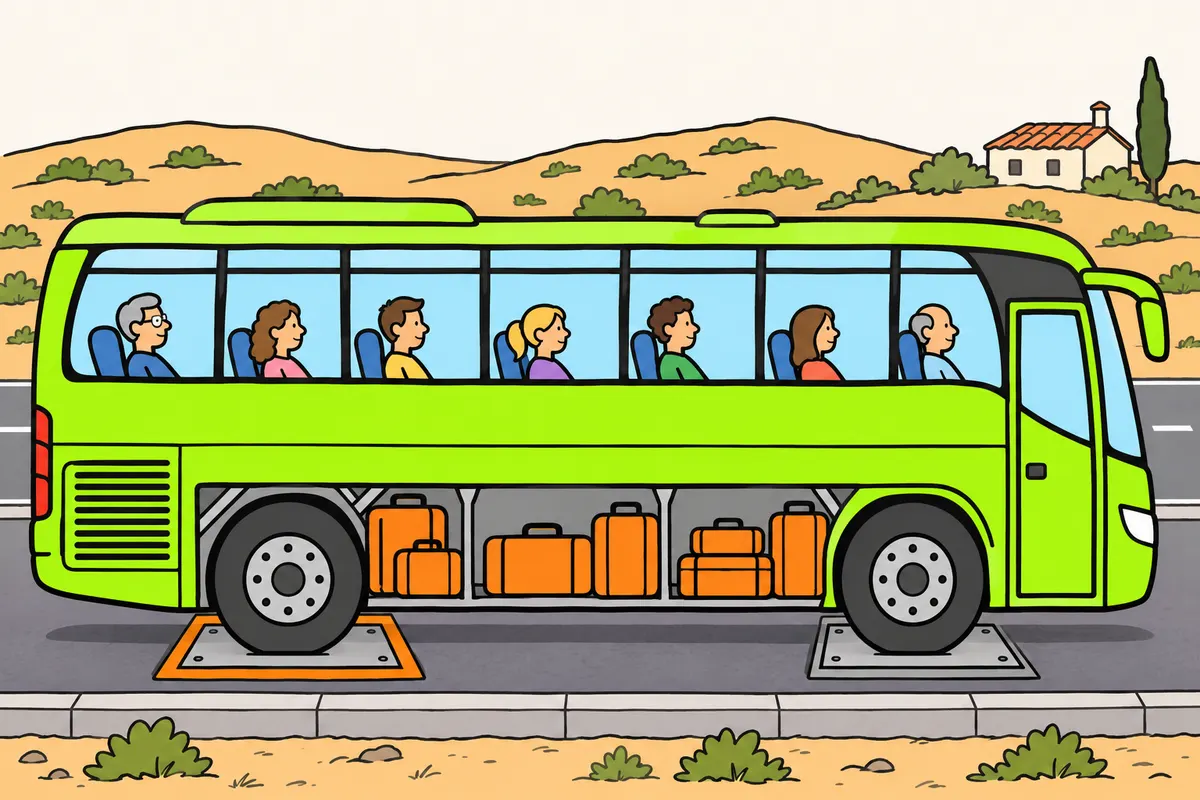
Distribute passengers and luggage to respect the total mass and each axle limit.
Remember
- Keep at least 25 % of laden mass on the driving axles.
- If an axle is overloaded, safely reduce or redistribute the load.
- Check the limits again before driving.
- Road surface pressure is different from tyre inflation pressure.
Exam trap: Wrong: assume the total mass limit is enough. Right: also check each axle and keep at least 25 % on the driving axles.
Read the full explanation
- The mass supported by the driving axle or axles must be at least 25 % of the total laden mass of the vehicle or combination. For a laden bus weighing 20 t, this requires at least 5 t on the driving axles. [RGV, Annex IX](https://www.boe.es/buscar/act.php?id=BOE-A-1999-1826#anix).
- When preparing for the journey, you position passengers and luggage taking into account their effect on the loads supported by the bus's axles. If weighing reveals an overload at a particular point, you must safely reduce or redistribute the load and check the result before driving. [RGV, Annex IX](https://www.boe.es/buscar/act.php?id=BOE-A-1999-1826#anix).
- The pressure exerted on the road surface by pneumatic tyres or wheels of similar elasticity must not exceed 9 kg/cm² of gross contact area; this value is not the tyre inflation pressure. [RGV, Annex IX](https://www.boe.es/buscar/act.php?id=BOE-A-1999-1826#anix).
14The bus speed limiter
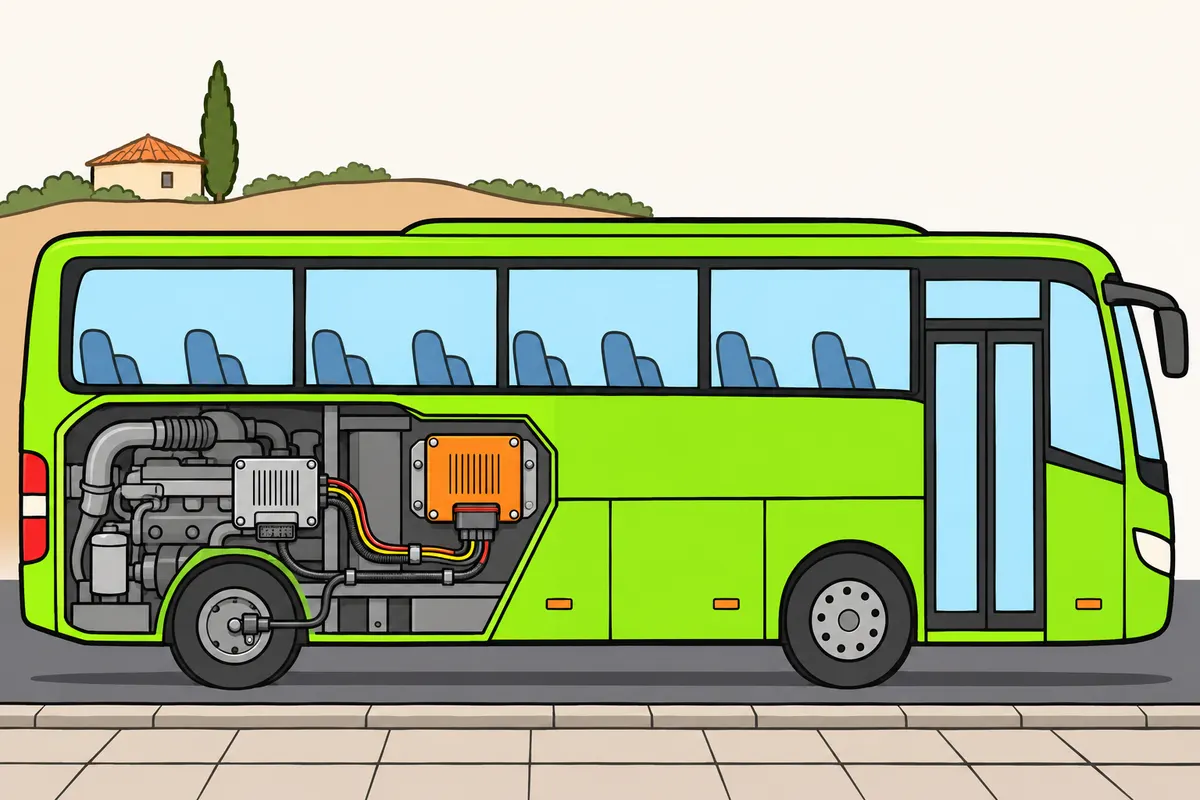
Keep your speed limiter working correctly and always obey driving speed limits.
| Bus case within the scope | Requirement or exemption |
|---|---|
| M2/M3: at least four wheels, design speed above 25 km/h | Setting must prevent speeds above 100 km/h |
| M3 above 10 t | Registered from 1 January 1988 |
| M2 and M3 up to 10 t | Registered from 1 January 2005 |
| M2 and M3 up to 10 t, meeting Euro 3 | Registered between 1 October 2001 and 1 January 2005 |
| Armed Forces, security forces, civil protection, fire or other emergency services | Exempt |
| Scientific road tests | Exempt |
| Only urban public services | Exempt |
| Construction prevents exceeding the required setting | Exempt |
| Workshop removes tachograph seals for limiter work | Issue a certificate with date and reason; carry it with an invoice copy |
| Parts needing seals after removal | May remain unsealed for up to seven days |
Remember
- Check category, mass, registration date and emissions.
- Use an approved limiter fitted and checked by an authorised workshop.
- Keep it working, its seals intact and its installation plate attached.
- Have it checked after a fault or a broken or removed seal.
- If tachograph seals are removed, carry the workshop certificate and an invoice copy.
- Do not help alter the limiter; this very serious offence costs 6 points.
Exam trap: Wrong: drive at 100 km/h because your limiter allows it. Right: obey the road and vehicle limits, even when lower.
Read the full explanation
- The scope covers M2, M3, N2 and N3 vehicles with at least four wheels and a design speed above 25 km/h. For your M2/M3 bus, the setting must prevent you from exceeding 100 km/h [RD 1417/2005, arts. 2 and 3](https://www.boe.es/buscar/act.php?id=BOE-A-2005-19990).
- Article 5 of RD 1417/2005 determines the requirement by category and registration date: M3 vehicles over 10 t registered on or after 1 January 1988; M2 and M3 vehicles up to 10 t registered on or after 1 January 2005, and those registered between 1 October 2001 and 1 January 2005 that comply with Euro 3. [RD 1417/2005, art. 5](https://www.boe.es/buscar/act.php?id=BOE-A-2005-19990).
- Exemptions apply to vehicles used by the Armed Forces, security forces, civil protection, fire services and other emergency services; also to those intended for scientific road tests, those used solely for urban public services and those whose design prevents them from exceeding the required setting [RD 1417/2005, art. 7](https://www.boe.es/buscar/act.php?id=BOE-A-2005-19990).
- The installed device must be type-approved and comply with the regulatory technical requirements. Its installation and the checking of its operation must be carried out by an organisation or workshop authorised by the competent authority for industry. You are responsible for keeping it working correctly, preserving its seals and keeping the installation plate attached. [RD 1417/2005, arts. 6, 8.1 and 8.2 and Annex, sections 5 and 6](https://www.boe.es/buscar/act.php?id=BOE-A-2005-19990).
- If it fails, or a seal is broken or removed, you must have it checked. After checking it, the workshop places a visible plate in the cab showing the selected speed: «v = ... km/h». [RD 1417/2005, arts. 8 and 15 and Annex, section 5](https://www.boe.es/buscar/act.php?id=BOE-A-2005-19990). If the workshop removes tachograph seals as necessary to install, connect or check the limiter, it must issue a certificate stating the date and reason for removal; you must carry it on board together with a copy of the invoice. Components requiring seals may remain unsealed for a maximum of seven days. [RD 1417/2005, first additional provision](https://www.boe.es/buscar/act.php?id=BOE-A-2005-19990).
- The limiter setting is a technical ceiling; your speed must comply with the limits for the road and the vehicle. Driving speeds are covered in «Bus speed and following distances». [RGC, arts. 45, 48 and 52](https://www.boe.es/buscar/act.php?id=BOE-A-2003-23514).
- If you participate in, or provide necessary assistance with, the installation or activation of components that alter the normal operation of the limiter, you commit a very serious offence and lose 6 points. [Ley de Tráfico (Traffic Act), art. 77.m and Annex II.7](https://www.boe.es/buscar/act.php?id=BOE-A-2015-11722).
15Towable mass and coupling load
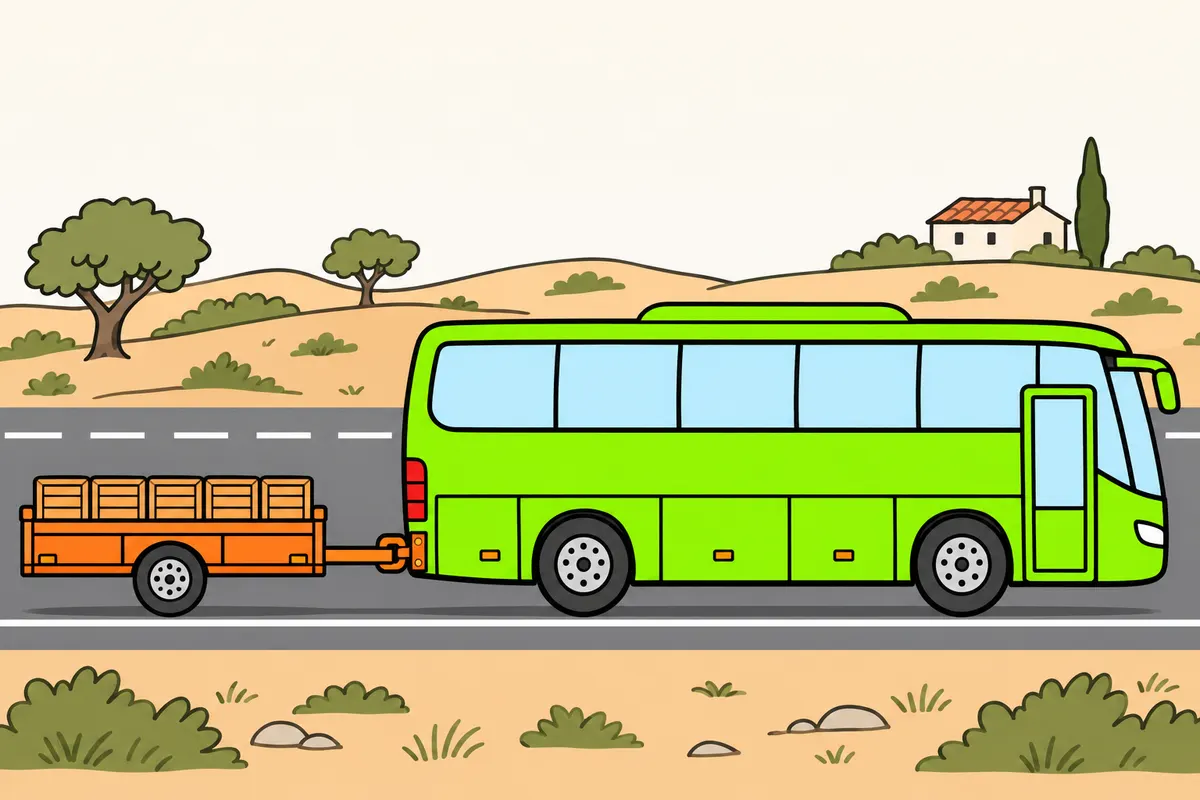
Check your towable mass and the weight the coupling transfers to your bus.
| Bus or trailer case | Limit you must check |
|---|---|
| Centre-axle trailer coupling, load evenly distributed | Lower of 10 % of trailer maximum mass and 1,000 kg; also technical limits |
| Category M bus: trailer with overrun or continuous brakes | No more than towing vehicle MMA or 3,500 kg; also technical limits |
| Unbraked trailer | Half the bus’s unladen mass increased by 75 kg; maximum 750 kg and technical limit |
Remember
- Respect your bus’s construction limits and the coupling’s strength.
- Count coupling weight in the bus mass and its rear axle loads.
- Check the combination’s technical and legal maximum masses.
- Adding MMA and maximum towable mass does not remove those combination limits.
Exam trap: Wrong: put all centre-axle trailer weight on its wheels in your calculation. Right: add vertical coupling load to the bus and its rear axles.
Read the full explanation
- The towable mass is limited by the bus's construction and the strength of the coupling. The maximum mass of the towing vehicle and trailer combination is expressed as the towing vehicle's MMA (maximum authorised mass) plus its MMR (maximum towable mass), but is limited by the combination's technical maximum and legally permissible maximum. [RGV, Annex IX](https://www.boe.es/buscar/act.php?id=BOE-A-1999-1826#anix).
- With a centre-axle trailer, part of the weight is transmitted vertically to the coupling. This load counts towards the mass of the towing bus and the loads on its rear axles. [RGV, Annex IX](https://www.boe.es/buscar/act.php?id=BOE-A-1999-1826#anix).
- With the centre-axle trailer's load evenly distributed, the maximum authorised vertical load on the coupling must not exceed the lower of 10 % of the trailer's maximum mass and 1,000 kg. You must also observe the technical limits of the vehicle and the coupling itself. [RGV, Annex IX, section 4.2](https://www.boe.es/buscar/act.php?id=BOE-A-1999-1826#anix).
- For a category M bus, the towable mass with overrun or continuous braking must not exceed the towing vehicle's MMA or 3,500 kg, and must also comply with its technical limits. [RGV, Annex IX, sections 4.1.1 and 4.1.2](https://www.boe.es/buscar/act.php?id=BOE-A-1999-1826#anix).
- For an unbraked trailer, the towable mass must not exceed half the bus's tare mass plus 75 kg, subject to a maximum of 750 kg and the technical limit. [RGV, Annex IX, section 4.1.2.1](https://www.boe.es/buscar/act.php?id=BOE-A-1999-1826#anix).
16Turning circle and swept path of the bus
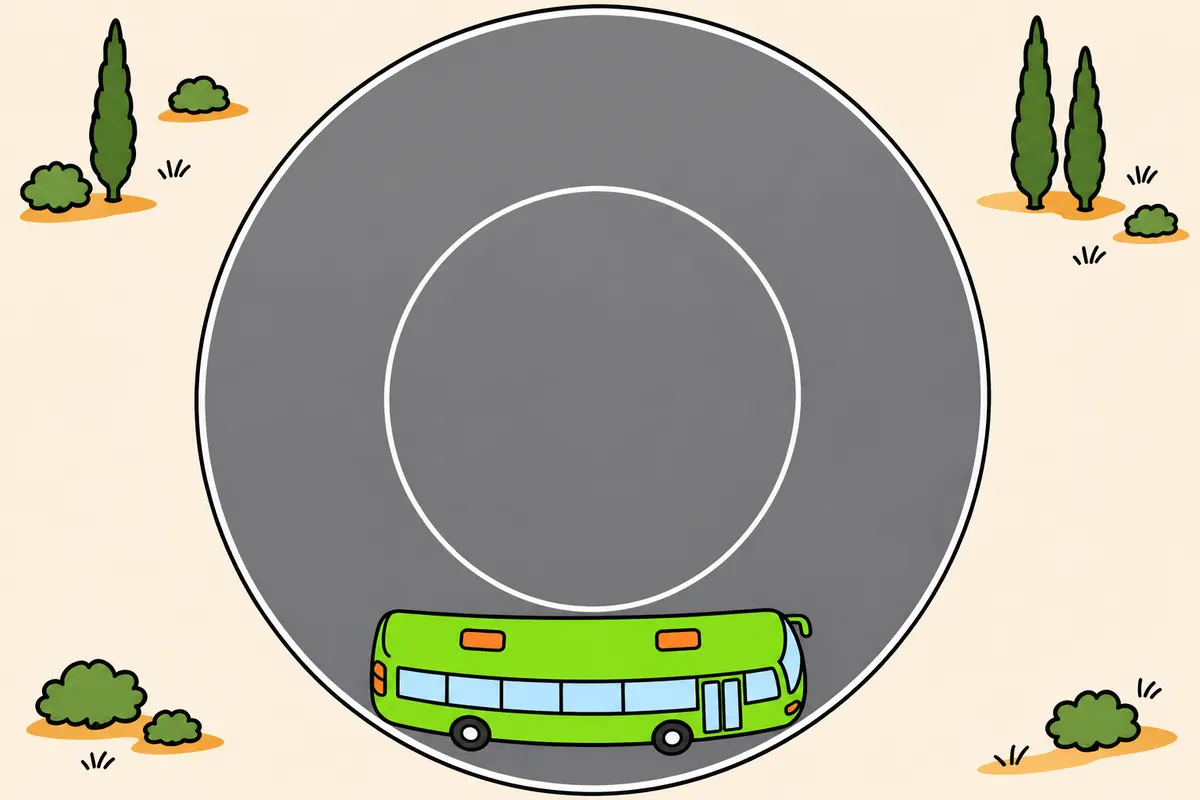
Check your turning space and how far the ends of your bus swing.
| Bus test | Maximum beyond outer reference plane |
|---|---|
| Entering from a straight line | 0.60 m |
| Following the 12.5 m radius circle: rigid M2 or M3 | 0.8 m |
| Following the 12.5 m radius circle: articulated M2 or M3 | 1.2 m |
| Following the circle with lift axles raised | The stated limits still apply |
Remember
- You must be able to complete the circle in both directions.
- Do not confuse radii with diameters.
- Keep every outer point within the required circles.
- For articulated buses, start with rigid sections aligned with the outer reference plane.
- Allow for the ends swinging out when you turn.
Exam trap: Wrong: treat 12.50 m as a diameter or lane width. Right: it is the outer radius for the turning test.
Read the full explanation
- Every motor vehicle and combination must be able to complete a full 360-degree circular path in either direction between two concentric circles with an outer radius of 12.50 m and an inner radius of 5.30 m. No outermost point may extend beyond these circular boundaries. [RGV, Annex IX](https://www.boe.es/buscar/act.php?id=BOE-A-1999-1826#anix).
- The regulatory figures are radii. The corresponding outer diameter is 25 m and the inner diameter is 10.60 m; the space between the two radii is 7.20 m, but this difference is not a lane width that permits any real-world manoeuvre. [RGV, Annex IX](https://www.boe.es/buscar/act.php?id=BOE-A-1999-1826#anix).
- Under the specific requirement for the bus to enter this circular area from a straight line, no part must extend more than 0.60 m beyond the vertical plane tangent to its outer side, marked with the vehicle stationary. If it is articulated, its rigid sections must initially be aligned with that plane. [RGV, Annex IX](https://www.boe.es/buscar/act.php?id=BOE-A-1999-1826#anix).
- The Annex also sets limits on how far M2 or M3 vehicles may extend beyond the plane while following the circle with a radius of 12.5 m: 0.8 m for rigid vehicles and 1.2 m for articulated vehicles, including with lift axles raised. This requirement concerns following the circle; when manoeuvring, you anticipate the sweep of the overhangs. [RGV, Annex IX](https://www.boe.es/buscar/act.php?id=BOE-A-1999-1826#anix).
17How far a load may project
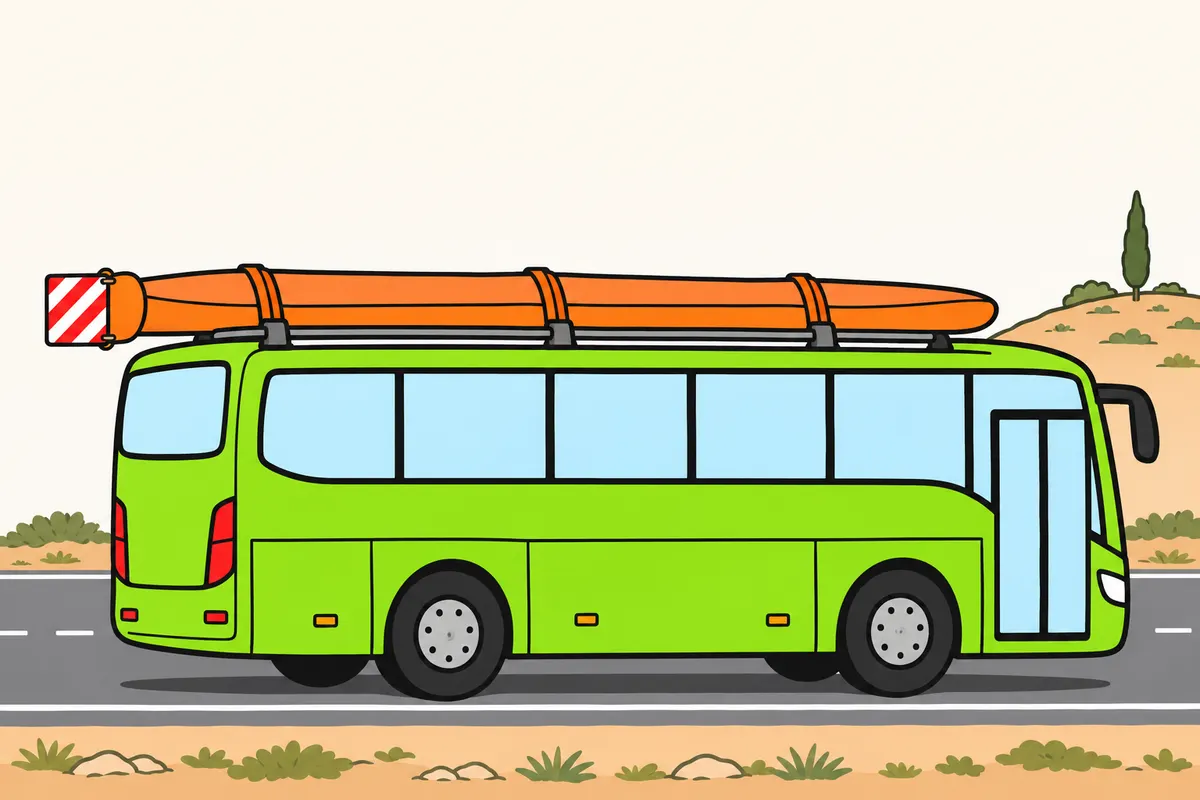
Your bus load may project only to the rear and within the limits.
| Loads on buses, not exclusively goods vehicles | Maximum rear projection |
|---|---|
| General | 10 % of vehicle length |
| Indivisible | 15 % of vehicle length |
Remember
- Do not let loads project at the front or sides.
- Also respect maximum dimensions for the vehicle and its load.
- Do not use percentages to extend accessories beyond the maximum.
- Protect the projecting end and avoid harming other road users.
- Preferring to keep luggage together does not make it indivisible.
Exam trap: Wrong: use 15 % to exceed the maximum overall length. Right: even indivisible loads must respect maximum dimensions and the removable-accessory rule.
Read the full explanation
- As a general rule, the load must remain within the vehicle's outline when viewed from above. On vehicles not intended exclusively for goods, such as a bus, it may project to the rear by up to 10 % of the vehicle's length, or up to 15 % if the load is indivisible. [RGC, arts. 13 and 15](https://www.boe.es/buscar/act.php?id=BOE-A-2003-23514#a15).
- For a 12 m bus, the percentage calculation gives 1.20 m for an ordinary load and 1.80 m for an indivisible load. The result is subject to the applicable overall limit: the percentage does not allow you to exceed the maximum dimensions of the vehicle and its load or disregard the specific rule on removable accessories. [RGC, arts. 13 and 15](https://www.boe.es/buscar/act.php?id=BOE-A-2003-23514#a15).
- You must not carry a load on the bus that projects to the front or to either side. [RGC, art. 15.3](https://www.boe.es/buscar/act.php?id=BOE-A-2003-23514#a15).
- The projecting end must be protected, and you must take precautions during transport to avoid harm to other road users. An indivisible load is not simply luggage that you prefer to keep together: the rule links it to the impossibility of dividing the consignment without unnecessary cost or risk of damage. [RGC, art. 15.5](https://www.boe.es/buscar/act.php?id=BOE-A-2003-23514#a15). [RGV, Annex IX](https://www.boe.es/buscar/act.php?id=BOE-A-1999-1826#anix).
18Marking a projecting load
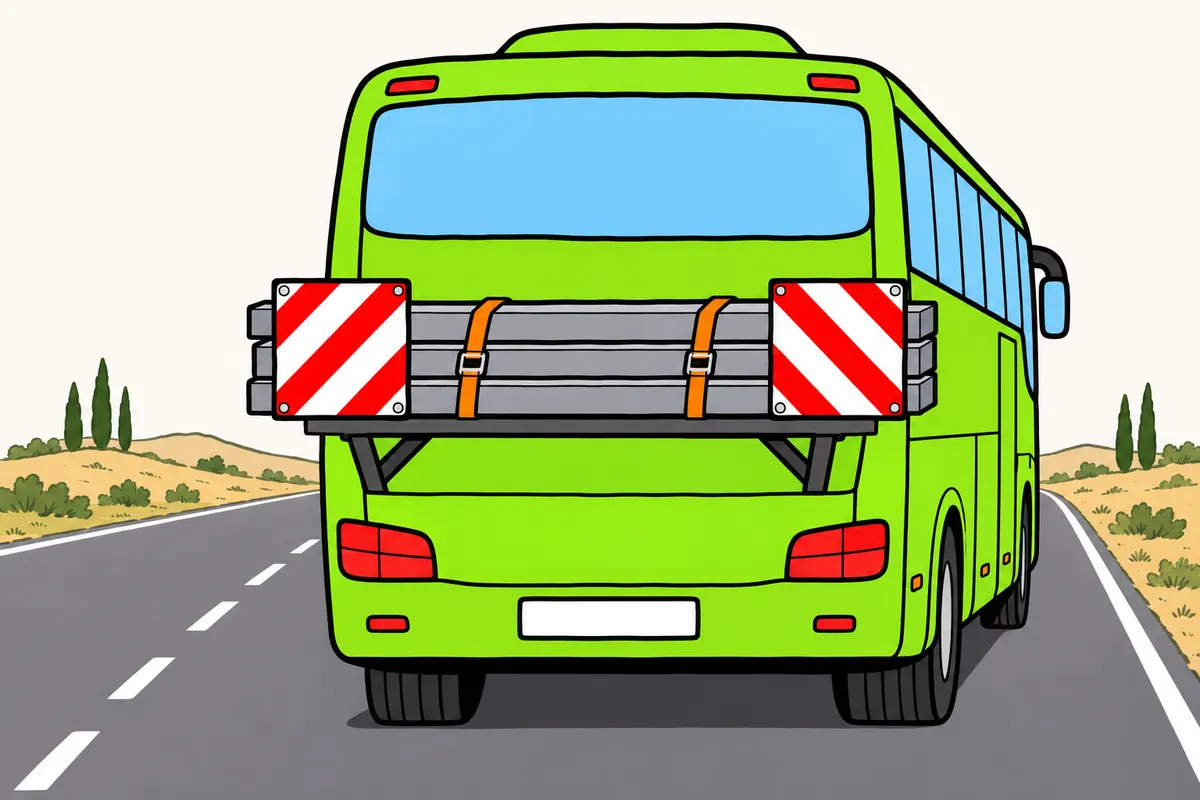
Always mark rear-projecting loads and add a light when required.
| Load projecting behind your bus | Panels you must fit |
|---|---|
| Does not cover the full rear width | V-20 at its rear end |
| Covers the full rear width | Two V-20 panels, one at each side end |
Remember
- Fit V-20 at the rear end, perpendicular to the vehicle’s length.
- Display it by day in good visibility too.
- With two panels, arrange the stripes as an inverted V.
- At night or in significantly reduced visibility, add a red rear light.
Exam trap: Wrong: fit one central panel when the projecting load covers the full rear width. Right: fit two panels, one at each side end, with stripes forming an inverted V.
Read the full explanation
- You must mark a load projecting to the rear with the V-20 panel, placed at its rearmost end and kept perpendicular to the vehicle's longitudinal axis at all times. You must also display it in daylight with good visibility. [RGC, art. 15](https://www.boe.es/buscar/act.php?id=BOE-A-2003-23514#a15).
- If the load projects lengthways across the full rear width, you must fit two panels, one at each side of the projecting load or material. Their stripes must form an inverted V. [RGC, art. 15](https://www.boe.es/buscar/act.php?id=BOE-A-2003-23514#a15).
- Between sunset and sunrise, or in conditions that significantly reduce visibility, you must add a red light to the load projecting to the rear. [RGC, art. 15.6](https://www.boe.es/buscar/act.php?id=BOE-A-2003-23514#a15).
19Total mass and axle mass signs
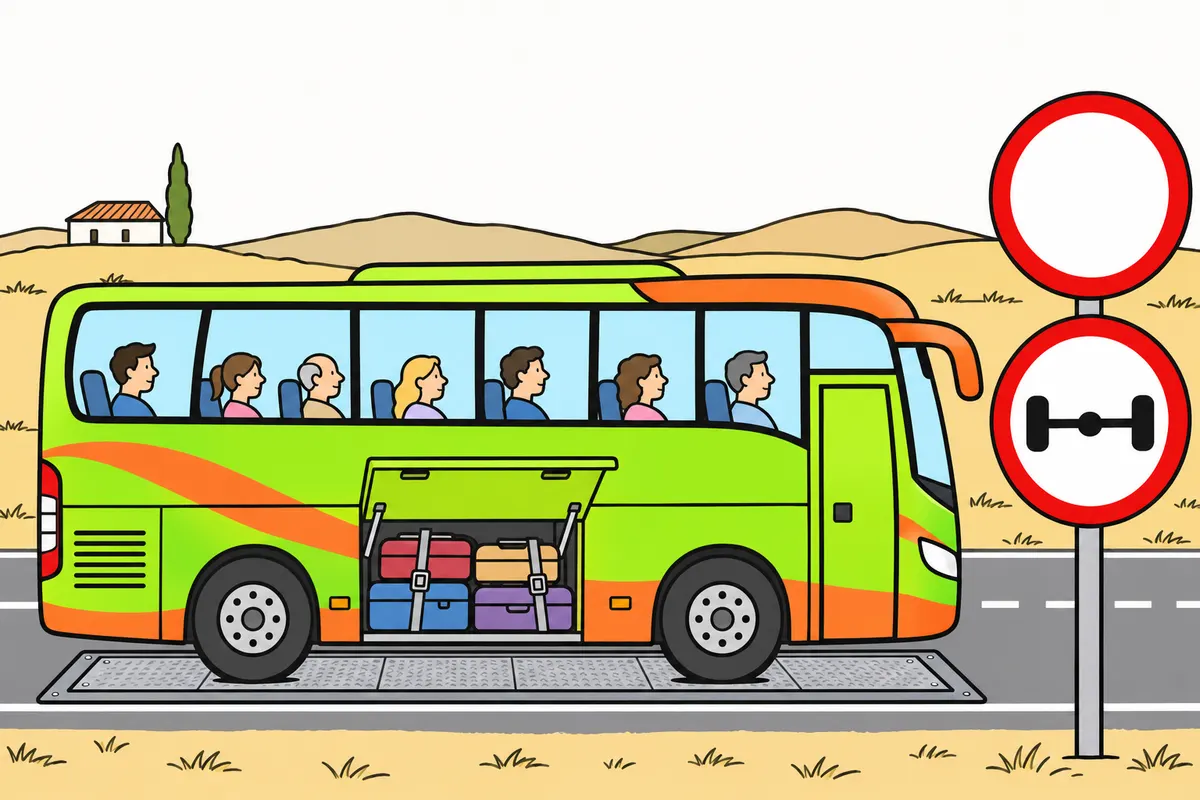
At mass signs, check your actual total weight or the weight on each axle.
| Sign | Weight you must compare |
|---|---|
| R-201: total mass | Actual laden mass of your bus |
| R-202: axle mass | Actual mass on any axle, through all its wheels |
Remember
- Include people and luggage in the actual weight.
- Do not use MMA to interpret a total mass limit sign.
- Check actual distribution; do not divide the total equally between axles.
- Matching the figure does not itself exceed the signed limit.
- Also respect other restrictions and your vehicle limits.
Exam trap: Wrong: pass R-202 because your average axle weight complies. Right: no axle may exceed the displayed figure.
Read the full explanation
- R-201, Mass limit, prohibits you from proceeding if your laden mass exceeds the number of tonnes shown. To decide whether you can proceed, you use the actual weight of your bus on that journey, including people and luggage. [Official catalogue, R-201 and R-202, RD 465/2025](https://www.boe.es/buscar/doc.php?id=BOE-A-2025-12199).
- If your bus has an MMA (maximum authorised mass) of 19.50 t but actually weighs 14 t, an R-201 sign showing 15 t does not prohibit you from proceeding on mass grounds. If it weighs 16 t, it does; you must also comply with the other restrictions on the road and your vehicle's limits. [Official catalogue, R-201 and R-202, RD 465/2025](https://www.boe.es/buscar/doc.php?id=BOE-A-2025-12199).
- R-202, Axle mass limit, requires you to check the mass transmitted by any axle through all its wheels. To interpret it, you use the actual distribution of mass between the axles, which may be uneven. [Official catalogue, R-201 and R-202, RD 465/2025](https://www.boe.es/buscar/doc.php?id=BOE-A-2025-12199).
- At an R-202 sign showing 10 t, you cannot proceed in a bus with 11 t on one axle, even if the other axles carry less and the total complies with its MMA. For both signs, matching the figure does not in itself constitute the excess that defines the prohibition. [Official catalogue, R-201 and R-202, RD 465/2025](https://www.boe.es/buscar/doc.php?id=BOE-A-2025-12199).
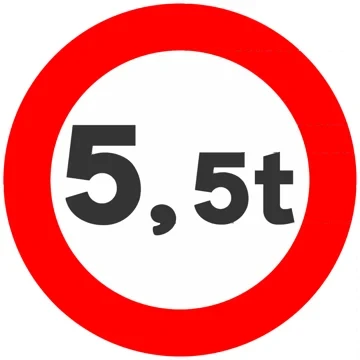 R-201
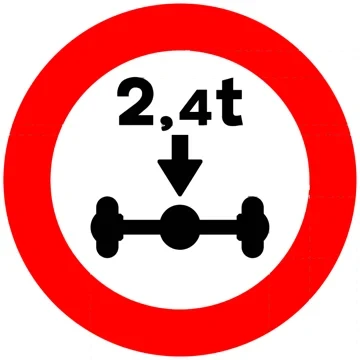 R-202
20Length, width and height signs
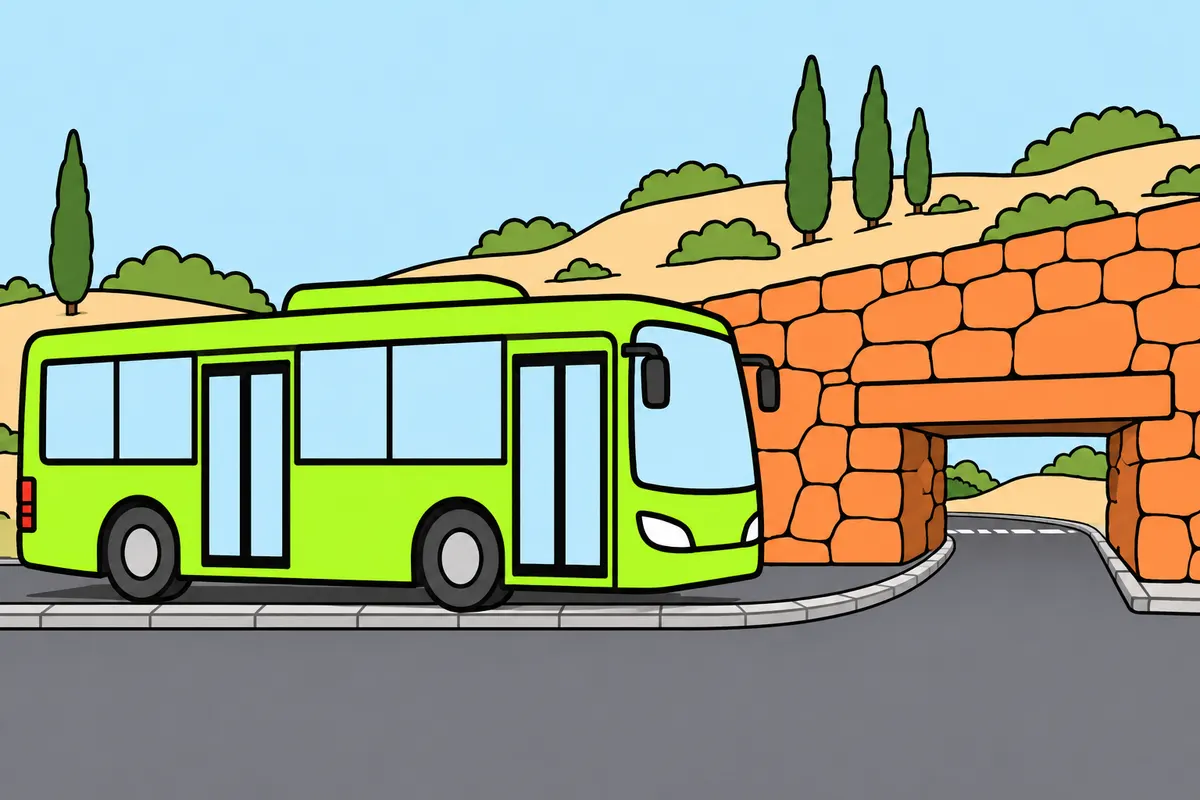
Compare the actual dimensions of your bus and load with the signs.
| Sign | Vehicle or combination measurement, including load |
|---|---|
| R-203 | Maximum length |
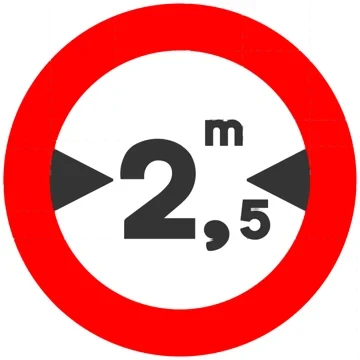
| R-204 | Maximum width |
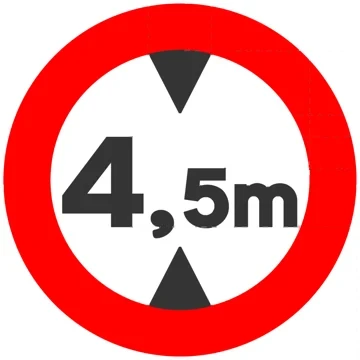
| R-205 | Maximum height |
Remember
- Include the trailer, accessories and equipment where relevant.
- Check your vehicle measurements before choosing your route.
- Meeting the general maximum does not let you exceed a route restriction.
Exam trap: Wrong: enter a passage because your bus meets the general height limit. Right: at R-205, do not pass if your actual height with load exceeds the sign.
Read the full explanation
- R-203, Length limit, prohibits you from proceeding in a vehicle or combination whose maximum length, including its load, exceeds the figure shown. You include the trailer and any relevant accessories in your calculation: you cannot pass a 10 m limit in a 12 m bus simply because it is empty. [Official catalogue, R-203 to R-205, RD 465/2025](https://www.boe.es/buscar/doc.php?id=BOE-A-2025-12199).
- For R-204, Width limit, you compare the figure with the maximum width of your vehicle, including its load. You cannot enter a passage limited to 2.50 m in a bus 2.55 m wide; complying with the general statutory width limit does not exempt you from the specific limit. [Official catalogue, R-203 to R-205, RD 465/2025](https://www.boe.es/buscar/doc.php?id=BOE-A-2025-12199).
- R-205, Height limit, prohibits you from proceeding if the maximum height of your vehicle and its load exceeds the figure shown. You cannot drive a class I urban bus 4.10 m high through a passage limited to 4 m, even though its category allows up to 4.20 m. [Official catalogue, R-203 to R-205, RD 465/2025](https://www.boe.es/buscar/doc.php?id=BOE-A-2025-12199).
- Before reaching a point where you cannot continue, you compare the actual dimensions of the configuration you are driving with the restrictions along your route. Consult the details of your vehicle and its equipment to obtain the dimensions of that configuration. [Official catalogue, R-203 to R-205, RD 465/2025](https://www.boe.es/buscar/doc.php?id=BOE-A-2025-12199).
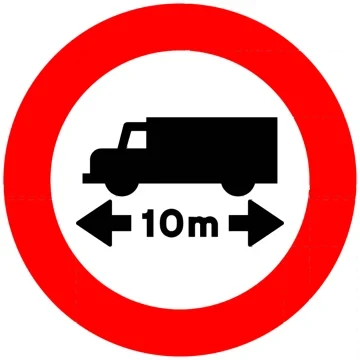 R-203
 R-205
 R-204
21Safe loading within the limits
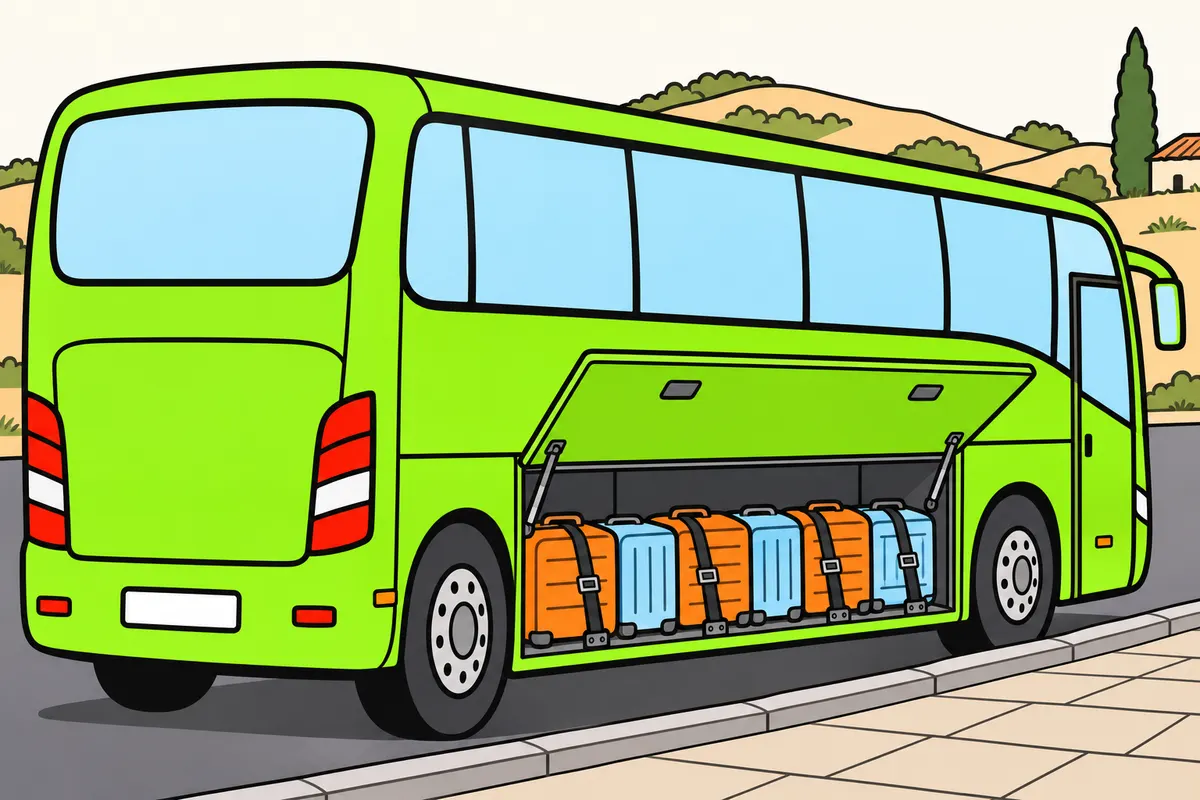
Place and secure luggage to keep your bus stable and compulsory equipment visible.
Remember
- Distribute luggage to keep your bus stable.
- Secure it when necessary to prevent falling, dragging or dangerous movement.
- Keep lights, plates and compulsory markings visible.
- Check ski racks and other external carriers too.
Exam trap: Wrong: cover lights with a ski rack because it meets the length limit. Right: keep lights, plates and compulsory markings visible.
Read the full explanation
- You must distribute and, where necessary, secure luggage and its accessories so that they do not drag, fall or move dangerously. Your loading arrangement must maintain the bus's stability. [RGC, art. 14](https://www.boe.es/buscar/act.php?id=BOE-A-2003-23514#a14).
- You must keep lighting devices, light signals, plates and compulsory identification markings visible. This obligation also applies to ski racks and other external carriers: being able to fit them within the maximum length does not authorise you to obscure these items. [RGC, art. 14](https://www.boe.es/buscar/act.php?id=BOE-A-2003-23514#a14).
- You can find details on placing luggage in the hold and passenger compartment in «Passenger transport and minors».
22Authorisations to exceed the limits
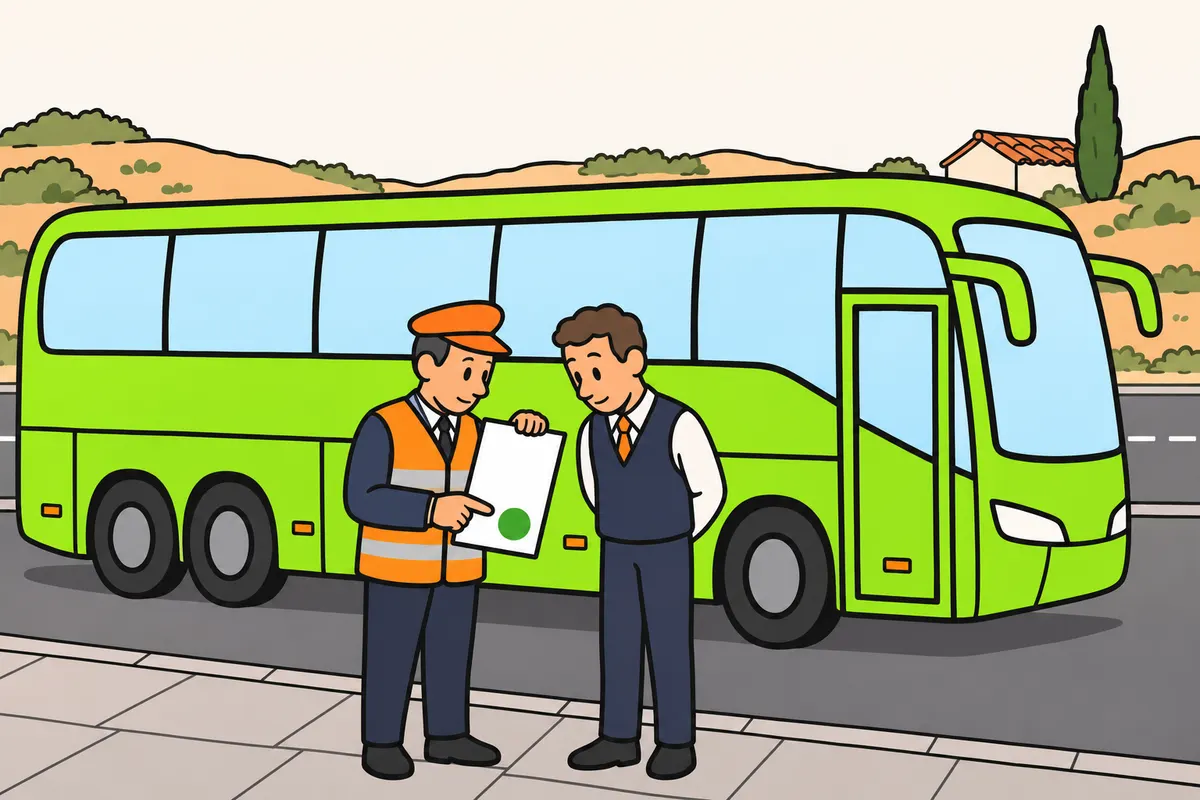
Before exceeding limits, obtain the special authorisation required for your case.
| Case | What you must check |
|---|---|
| Special technical characteristics or indivisible load | Traffic authority authorisation, binding road authority report and appropriate transport checks |
| Authorisation granted | Conditions, number of journeys and period of use |
Remember
- First check general limits, vehicle limits and road limits.
- Respect its conditions, duration and permitted journeys.
- Do not treat authorisation as a permanent increase in MMA.
Exam trap: Wrong: use authorisation to increase MMA permanently. Right: it is specific and conditional; it does not automatically allow more passengers or divisible luggage.
Read the full explanation
- For normal road use, you must comply with the statutory masses and dimensions. The competent traffic authority may grant a special authorisation because of your vehicle's technical characteristics or an indivisible load, subject to a binding report from the road authority and the relevant transport checks. [RGV, art. 14](https://www.boe.es/buscar/act.php?id=BOE-A-1999-1826#a14).
- The authorisation may limit the number of journeys or its period of use. Its scope is subject to the conditions set by the competent authority for the authorised vehicle or transport operation; you may drive only within that scope. [RGV, art. 14](https://www.boe.es/buscar/act.php?id=BOE-A-1999-1826#a14).
23Driving under special transport authorisations
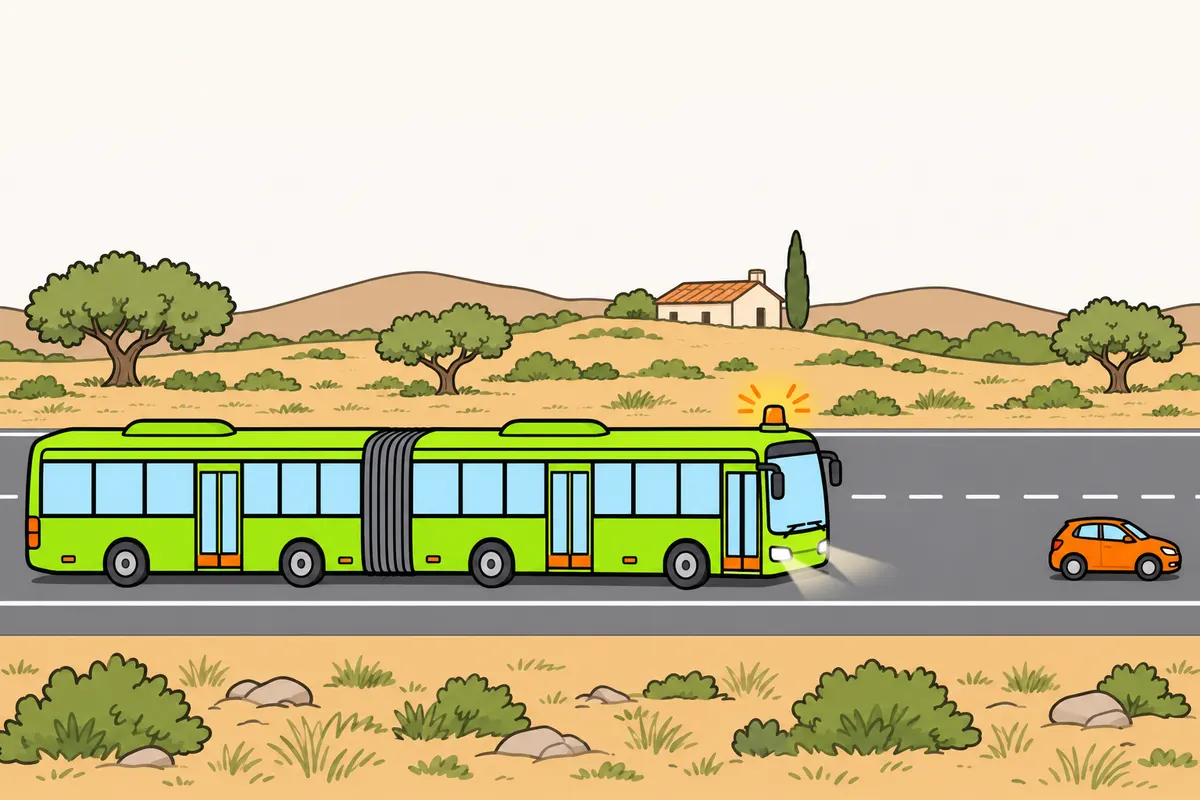
When driving under special authorisation, follow the driving conditions it specifies.
Remember
- Check the driving conditions in your special authorisation.
- Follow them when driving your bus under that authorisation.
Exam trap: Wrong: drive under special authorisation without checking its conditions. Right: follow the driving conditions your authorisation specifies.
Read the full explanation
- If you drive the bus under a special authorisation, you must comply with the driving conditions it sets. [RGV, art. 14](https://www.boe.es/buscar/act.php?id=BOE-A-1999-1826#a14).
Check the bus before the journey
Apply all limits to the actual configuration you are going to drive.
- Identify the bus class, the number of axles and whether it is rigid, articulated or part of a combination.
- Check the vehicle’s authorised and technical masses and dimensions and, where applicable, its towable mass.
- Include people, luggage and accessories; check the total mass and actual distribution across axles or axle groups.
- Compare the resulting length, width and height with the statutory limits and the signs along the route.
- Correct any excess and check that the load is secured and that lights and plates are visible before driving.
Decide whether you can pass a restriction
Each sign requires you to compare a specific measurement.
- Identify R-201, R-202, R-203, R-204 or R-205 and read the figure and unit.
- For R-201, use the laden mass; for R-202, use the actual load on the most heavily loaded axle.
- For dimension restriction signs, include the load, trailer and accessories as applicable.
- If you exceed the figure, find a suitable route; if you do not exceed it, check the other restrictions too.
Check a projecting load
The projection percentage and its marking must also comply with the overall limit.
- Check that the load can legally be carried on the vehicle and whether it is indivisible.
- For a bus, calculate the maximum rear projection of 10 % or 15 % if the load is indivisible.
- Check the overall dimensions and the rule that includes removable accessories within the maximum length.
- Protect the end and fit V-20; use two panels forming an inverted V if the load occupies the full rear width.
- Add the red light at night or when visibility is significantly reduced, and check that compulsory devices are not obscured.
Finished this module?
Mark it as read and you will see your progress on the theory list.