
Theory · LVA Licence - Agricultural Vehicle · Module 5 of 16
The agricultural vehicle and its equipment
You learn to recognise the agricultural vehicles you can drive with LVA and check their limits, registration and ITV (vehicle roadworthiness test). You distinguish rollover protection, the seat belt, lighting and the V-2 warning light, and prepare implements and couplings to avoid the most common exam confusions.
1Which vehicles you can drive with LVA
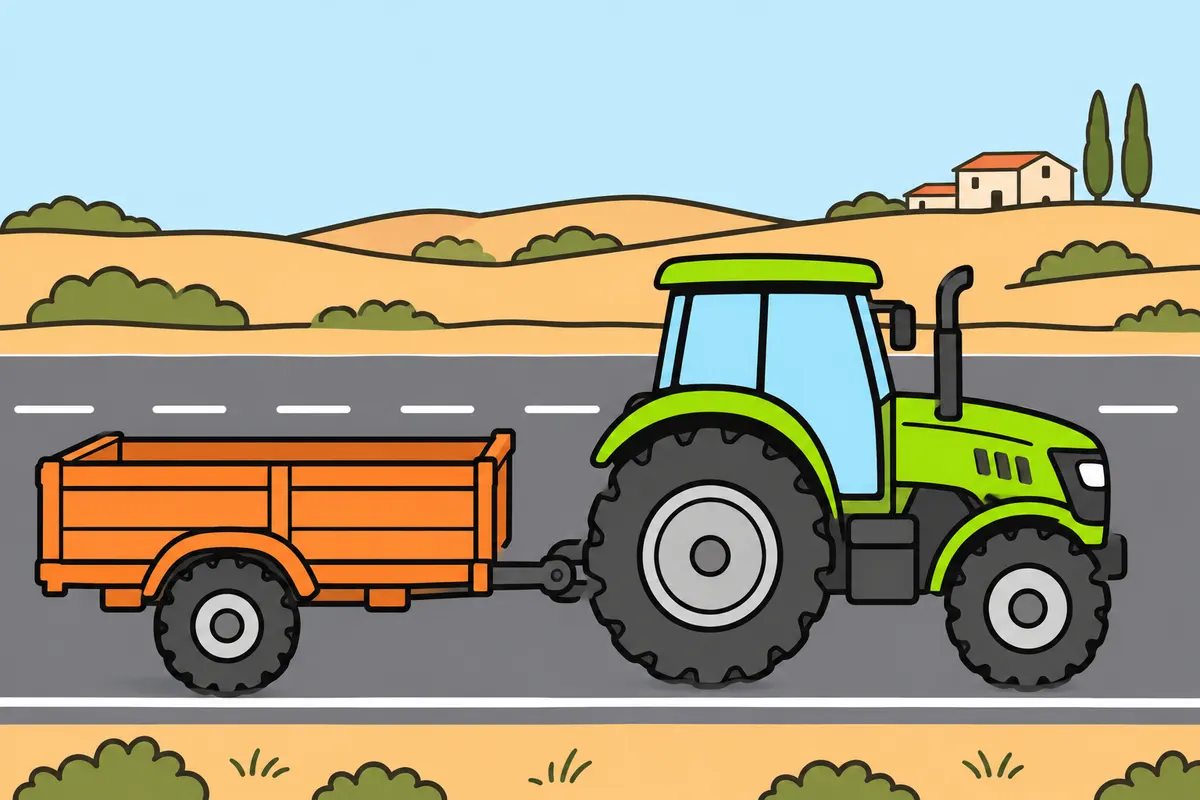
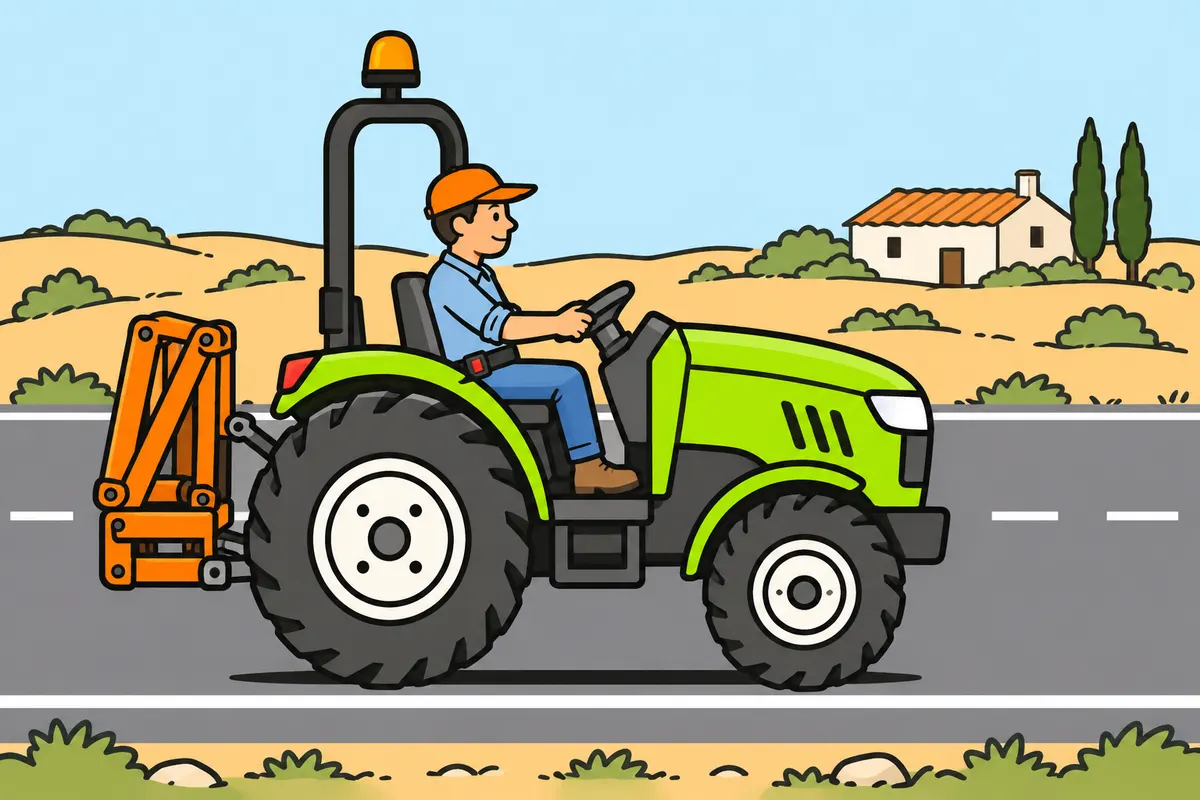
LVA covers agricultural vehicles within ordinary limits and with design speed up to 45 km/h.
Remember
- Check the powered vehicle and the combination you form.
- Keep within ordinary mass and dimension limits.
- You need B if you exceed ordinary limits or the design-speed limit.
- A valid B licence covers vehicles that LVA covers.
- If you obtain B, your LVA licence ceases to be valid.
Exam trap: Wrong: driving slowly always lets you use LVA. Right: if design speed exceeds 45 km/h, you need B.
Read the full explanation
- The LVA licence allows you to drive self-propelled special agricultural vehicles and their combinations within its scope. You must check both the characteristics of the powered unit and those of the combination you form: authorisation to drive a particular tractor does not automatically cover every combination with a trailer or machinery. [RGCond, arts. 5.9 and 6.1.b](https://www.boe.es/buscar/act.php?id=BOE-A-2009-9481#a5).
- To drive with an LVA licence alone, you must comply with the ordinary mass and dimension limits and the maximum design speed must not exceed 45 km/h. Although article 6.1.b describes the licence using an “or” condition, you must read it together with article 5.9, which requires a category B driving licence in cases that exceed those limits. [RGCond, arts. 5.9 and 6.1.b](https://www.boe.es/buscar/act.php?id=BOE-A-2009-9481#a5).
- The design speed is a technical characteristic. Choosing to drive more slowly does not change that characteristic or extend your licence entitlement: you need a category B driving licence for a tractor designed to exceed 45 km/h, even if you intend to drive it more slowly throughout the journey. [RGCond, arts. 5.9 and 6.1.b](https://www.boe.es/buscar/act.php?id=BOE-A-2009-9481#a5).
- With a valid category B driving licence, you can drive the vehicles covered by LVA without obtaining a separate agricultural licence. If you obtain a category B driving licence while holding LVA, your LVA licence ceases to be valid and your driving entitlement comes from your category B driving licence; you do not need to combine the two authorisations. [RGCond, arts. 5.9 and 6.1.b](https://www.boe.es/buscar/act.php?id=BOE-A-2009-9481#a5).
2Check the limits without confusing the figures
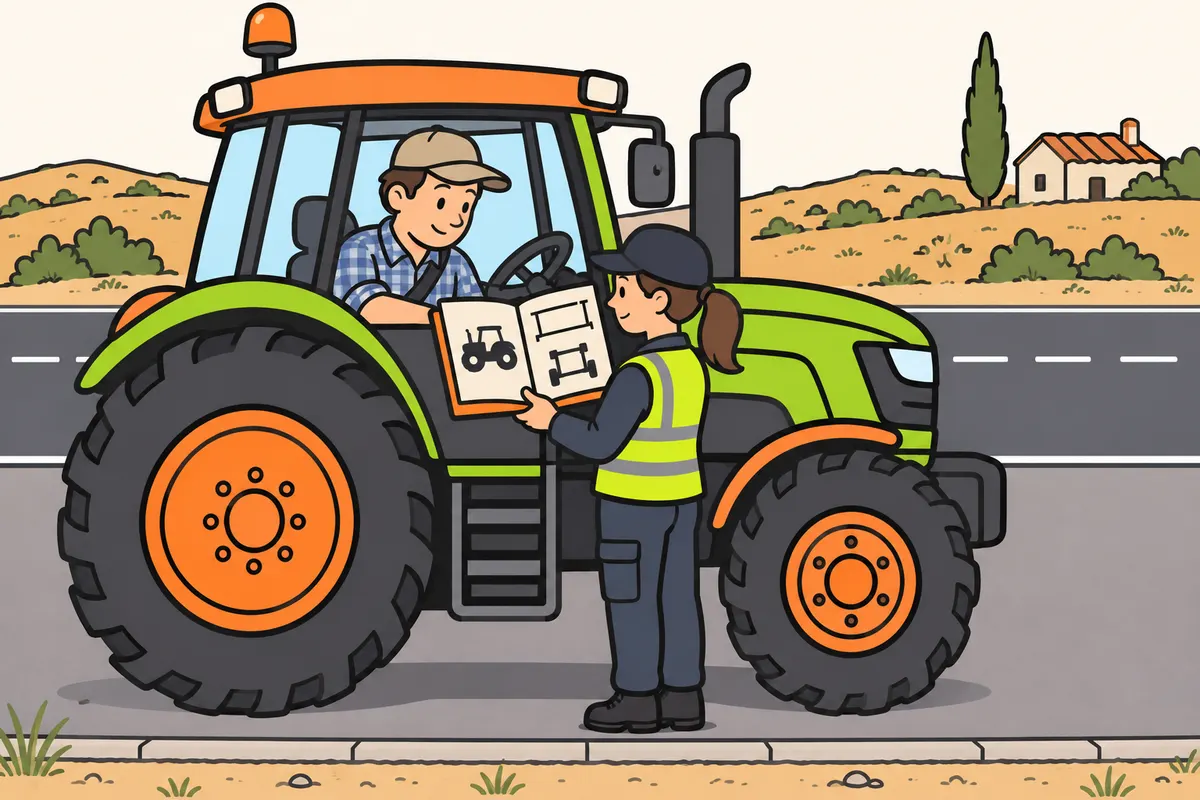
Keep your licence limits, ITV rules and road speed limits separate.
| Wheeled tractor case | What you must check |
|---|---|
| Built to exceed 40 km/h but not 45 km/h | Can fall within LVA if it meets the other conditions |
| That same tractor | Its ITV follows the group exceeding 40 km/h |
Remember
- Do not automatically apply the 3,500 kg limit to your tractor.
- Check the masses and dimensions for your configuration.
- You must meet the requirements and pass the tests.
Exam trap: Wrong: 45 km/h always allows that speed on roads. Right: you must obey road speed limits.
Read the full explanation
- You can obtain an LVA licence from the age of 16. The age requirement identifies the licence, but does not extend the range of vehicles you can drive: you must meet the requirements and pass the relevant tests. Obtaining the licence and taking the tests are covered in the “LVA licence, tests and obeying signs” module. [RGCond, arts. 5.9 and 6](https://www.boe.es/buscar/act.php?id=BOE-A-2009-9481#a6).
- Do not automatically apply the 3,500 kg limit associated with other driving entitlements to an agricultural tractor. Article 5.9 refers to the limits for ordinary vehicles; you must check the masses and dimensions applicable to the particular configuration and its technical documentation. [RGCond, arts. 5.9 and 6](https://www.boe.es/buscar/act.php?id=BOE-A-2009-9481#a6).
- In an exam scenario, distinguish three questions: which driving entitlement you need, which inspections apply to the vehicle and how fast you may drive. The 45 km/h threshold defines the scope of the driving entitlement; it does not replace the driving speed limits explained in “Speed and distances for agricultural vehicles”. [RGCond, arts. 5.9 and 6](https://www.boe.es/buscar/act.php?id=BOE-A-2009-9481#a6).
- A wheeled tractor with a maximum design speed above 40 km/h but no higher than 45 km/h can fall within the scope of LVA if it meets the other conditions. However, its ITV (vehicle roadworthiness test) follows the specific category for tractors that exceed 40 km/h. [RD 920/2017, art. 6](https://www.boe.es/buscar/act.php?id=BOE-A-2017-12841#a6) [RGCond, arts. 5.9 and 6](https://www.boe.es/buscar/act.php?id=BOE-A-2009-9481#a6).
3Recognise the agricultural tractor
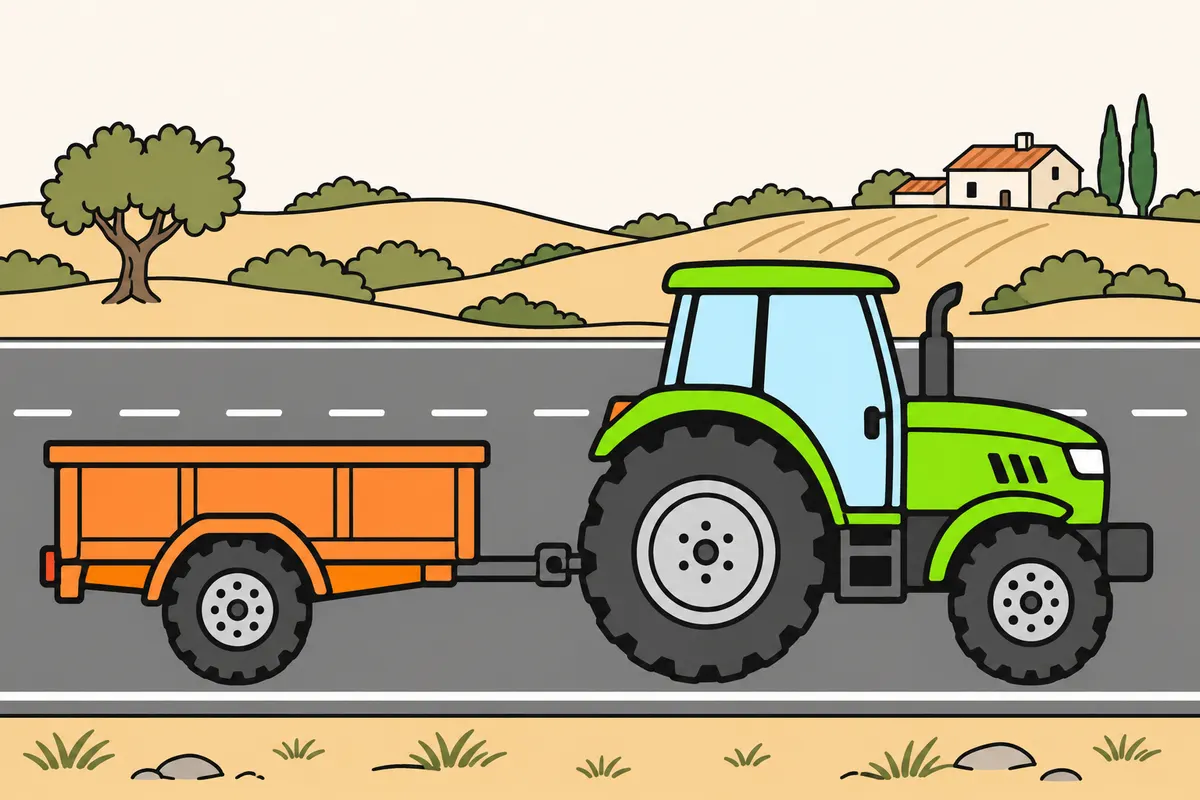
Recognise an agricultural tractor by its purpose and classification.
Remember
- You can pull, push, carry or operate agricultural equipment.
- Distinguish the tractor from equipment it carries or tows.
- Check its characteristics to see whether your LVA is enough.
Exam trap: Wrong: being a special vehicle means exceeding ordinary dimensions. Right: check its characteristics.
Read the full explanation
- An agricultural tractor is a self-propelled special vehicle with two or more axles designed to pull, push, carry or power agricultural implements, machinery or trailers. You can identify different functions in the same tractor: pulling a trailer and powering an implement are different uses. [RGV, Annex II.A](https://www.boe.es/buscar/act.php?id=BOE-A-1999-1826#iia).
- Classification as a special vehicle does not necessarily mean that the tractor exceeds ordinary dimensions. Agricultural machinery and its trailers are included in the regulatory definition of a special vehicle; you must then check their characteristics to determine whether your LVA licence is sufficient. [RGV, Annex II.A](https://www.boe.es/buscar/act.php?id=BOE-A-1999-1826#iia).
- When studying a photograph, distinguish the unit that provides traction from the equipment it carries or tows. This distinction allows you to identify which lights the tractor needs, which number plate the trailer must display and the actual dimensions of the equipment. [RGV, Annex II.A](https://www.boe.es/buscar/act.php?id=BOE-A-1999-1826#iia).
4Identify the walking tractor
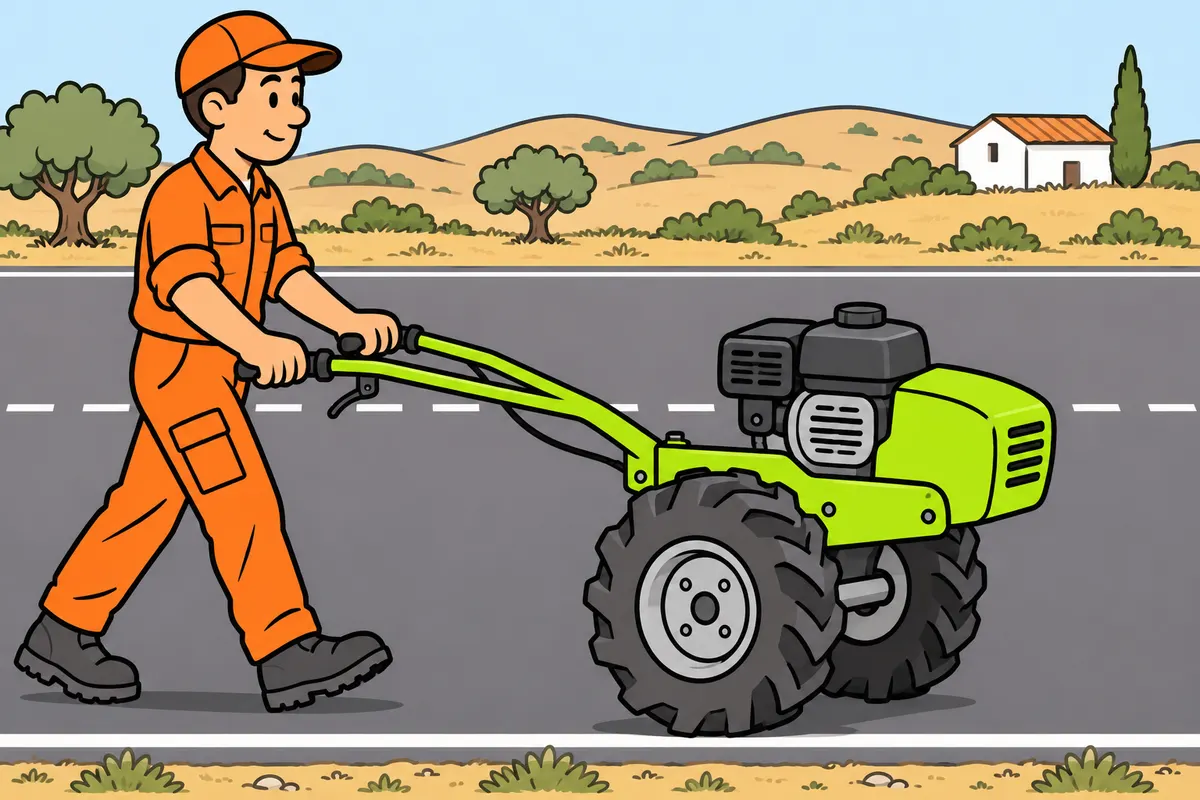
Identify a motocultor by its single axle and how you control it.
Remember
- You normally steer it using handlebars while walking.
- Some let you drive from a seat built into the attached equipment.
- Do not improvise seats or add passenger places.
Exam trap: Wrong: adding a trailer turns a motocultor into a tractor. Right: the extra axle alone does not change its category.
Read the full explanation
- A motocultor (walking tractor) is a self-propelled special vehicle with one axle, steered using handlebars by a person walking. [RGV, Annex II.A](https://www.boe.es/buscar/act.php?id=BOE-A-1999-1826#iia).
- You can also steer some walking tractors from a seat incorporated into a trailer, an agricultural machine, an implement or an auxiliary wheeled frame. This possibility forms part of their definition; it does not mean that you may improvise a seat or add passenger seats. [RGV, Annex II.A](https://www.boe.es/buscar/act.php?id=BOE-A-1999-1826#iia).
5Self-propelled machine, carrier and agricultural transporter
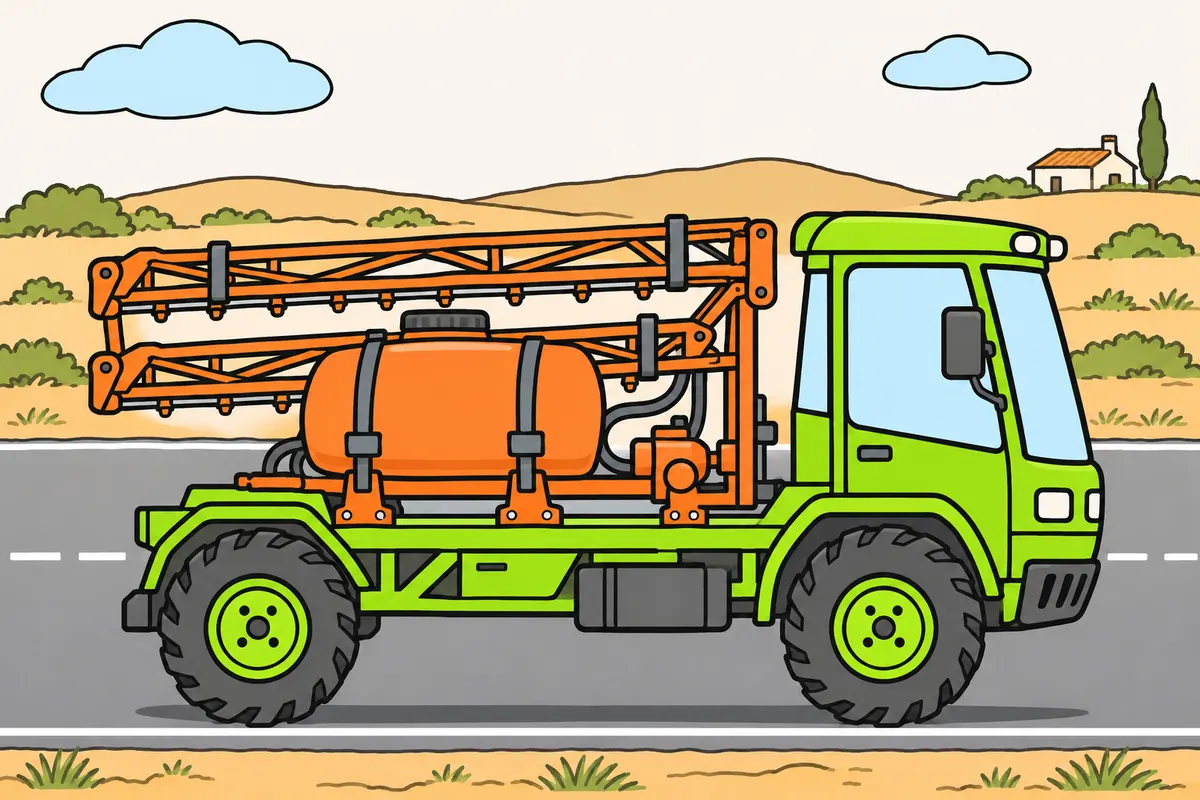
Distinguish these agricultural machines by the work they are built to do.
| Agricultural vehicle | Function you must recognise |
|---|---|
| Self-propelled machine | Does work using its own engine |
| Portador | Carries agricultural machines on itself |
| Tractocarro | Transports agricultural products in the fields |
Remember
- Check the classification and technical details.
- Check design speed, masses and dimensions to see whether LVA is enough.
Exam trap: Wrong: the commercial name decides whether LVA is enough. Right: check its classification and limits.
Read the full explanation
- A self-propelled agricultural machine is a self-propelled special vehicle with two or more axles built to carry out agricultural work. A self-propelled combine harvester is a useful example to help you recognise the concept: it carries out the work under its own power, without needing another vehicle to tow it. [RGV, Annex II.A](https://www.boe.es/buscar/act.php?id=BOE-A-1999-1826#iia).
- A portador (carrier) is a self-propelled special vehicle with two or more axles designed to carry agricultural machines. You must distinguish carrying a machine on the vehicle from towing it: the location of the equipment changes the space occupied and the items you must check before driving. [RGV, Annex II.A](https://www.boe.es/buscar/act.php?id=BOE-A-1999-1826#iia).
- A tractocarro (agricultural transporter) is a self-propelled special vehicle with two or more axles intended especially for transporting agricultural products in the field. Do not classify it as a tractor solely because of its engine or wheels; its design purpose defines this category. [RGV, Annex II.A](https://www.boe.es/buscar/act.php?id=BOE-A-1999-1826#iia).
- These categories can fall within the agricultural driving entitlement when they comply with its limits. The commercial name does not determine whether LVA is sufficient: you must check the classification and technical data, particularly the design speed and authorised masses and dimensions. [RGV, Annex II.A](https://www.boe.es/buscar/act.php?id=BOE-A-1999-1826#iia).
6Agricultural trailer and towed agricultural machine
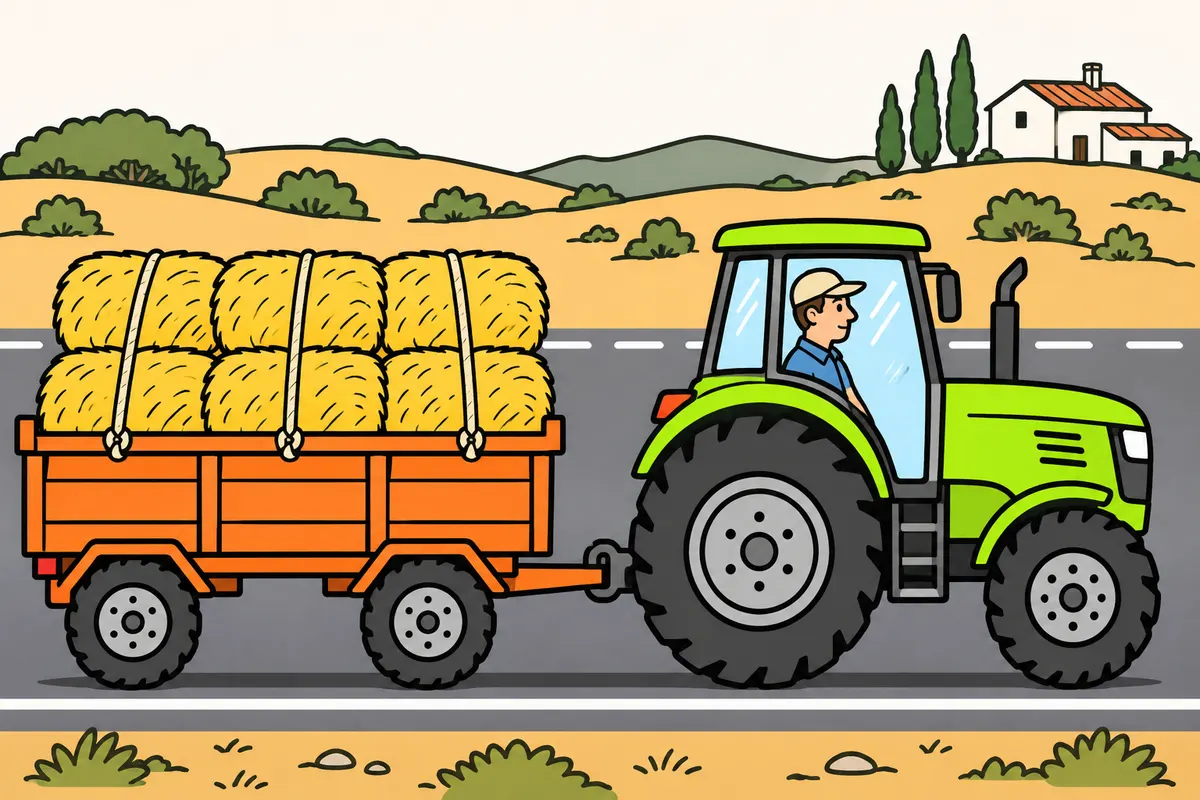
Distinguish transporting products, doing agricultural work and using unpowered implements.
| Agricultural item | What you must recognise |
|---|---|
| Trailer or semi-trailer | Its purpose is transport |
| Towed machine | Does work; needs another vehicle to move |
| Unpowered soil cultivation implement | Not considered a vehicle |
Remember
- Distinguish the towed machine from the vehicle pulling it.
- The definition excludes other towed machinery with a mass below 750 kg.
- For registration, check whether MMA exceeds 750 kg.
Exam trap: Wrong: every wheeled implement needs vehicle registration. Right: identify its category first.
Read the full explanation
- An agricultural trailer is a special transport vehicle intended to be towed by an agricultural tractor, walking tractor, carrier or self-propelled agricultural machine. The definition includes agricultural semi-trailers. Its transport function allows you to distinguish it from a machine that directly carries out agricultural work. [RGV, Annex II.A](https://www.boe.es/buscar/act.php?id=BOE-A-1999-1826#iia).
- A towed agricultural machine is built to carry out agricultural work and needs an agricultural vehicle to pull or push it for travel and manoeuvring. The machine and the towing vehicle retain their separate identities within the combination. [RGV, Annex II.A](https://www.boe.es/buscar/act.php?id=BOE-A-1999-1826#iia).
- Agricultural implements are tools or instruments without an engine, intended to prepare or cultivate the soil, and are not considered vehicles for the purposes of the RGV. The definition of a towed agricultural machine also excludes other towed agricultural machinery with a mass of less than 750 kg. [RGV, Annex II.A](https://www.boe.es/buscar/act.php?id=BOE-A-1999-1826#iia).
- Do not confuse that exclusion from the definition with the registration threshold: for registration, you must consider the MMA (maximum authorised mass) and whether it exceeds 750 kg. Nor can you conclude that any object with wheels is a trailer subject to registration without first identifying its category. [RGV, art. 28](https://www.boe.es/buscar/act.php?id=BOE-A-1999-1826#a28) [RGV, Annex II.A](https://www.boe.es/buscar/act.php?id=BOE-A-1999-1826#iia).
7Ordinary dimensions and technical limits
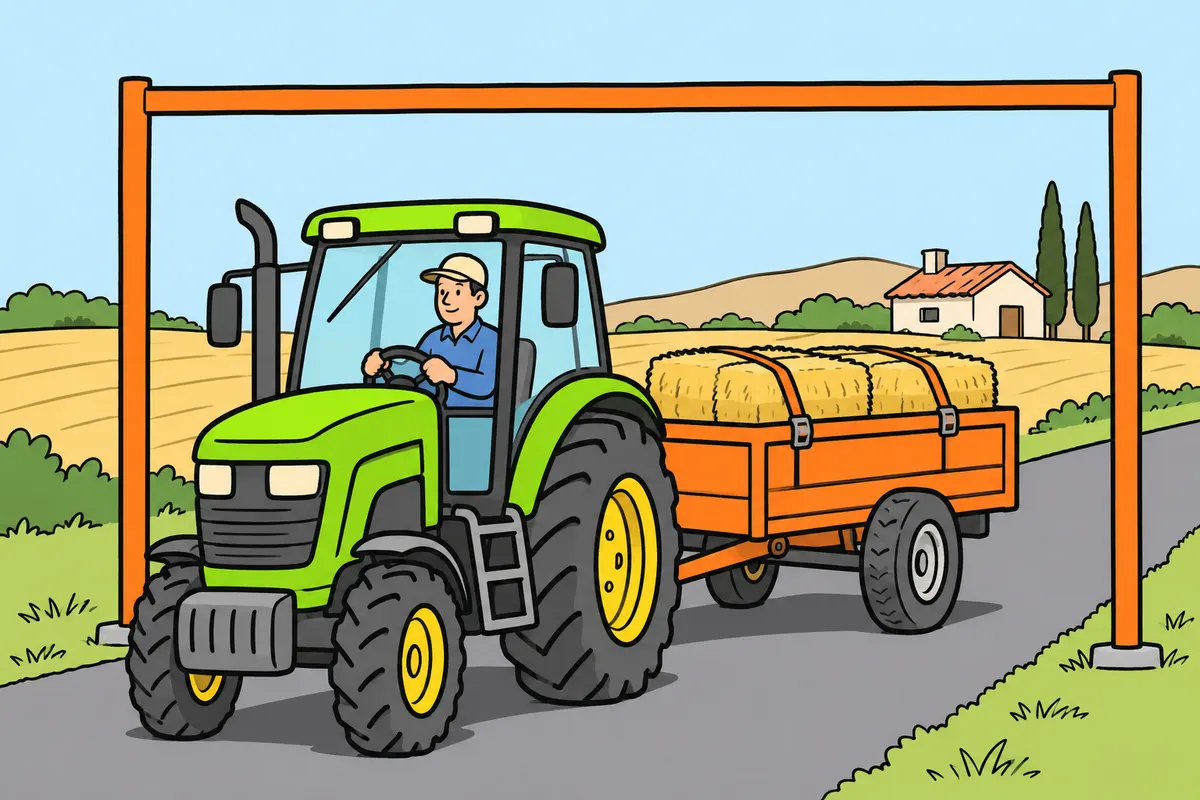
You must respect ordinary dimensions and the technical limits of each configuration.
| General configuration or agricultural group 2 case | Length or condition to follow |
|---|---|
| Motor vehicle other than a bus | 12.00 m |
| Trailer | 12.00 m |
| Articulated vehicle other than a bus | 16.50 m |
| Road train | 18.75 m |
| Group 2 agricultural vehicle: permanently exceeds maximum masses or dimensions by design | You need B; follow the special road-use conditions |
| Group 2: cannot reach 60 km/h on level ground and wants to use an autovía | Only if there is no alternative route or suitable service road, and your additional road-use authorisation allows it |
| Group 2: wider than 3.50 m on an autovía | Escort vehicle behind, at least 50 m away |
| Group 2: wider than 3.50 m on other roads | Escort vehicle in front; see the speed exception below |
| Group 2: travels below half the road’s general speed limit | Escort vehicle behind, at least 50 m away |
| Group 2 agricultural vehicles needing B: distance from vehicle ahead | Keep at least 50 m |
| Group 2 agricultural vehicles needing B: faster traffic behind | Make overtaking easier; stop if needed without causing others to change speed or direction abruptly |
| Group 2 agricultural vehicles: dangerous weather or visibility below 150 m ahead or behind | Stop driving and leave the road platform |
| Group 2 agricultural vehicles: width over 5 m | You need a police escort |
| Group 2 agricultural vehicles: notice for that escort | As registered keeper, give at least 72 hours’ notice to officers in the departure province and the body designated by the road authority |
| Group 2 agricultural vehicles: contents of that notice | Give the place, date, time and registration numbers; attach a copy of the authorisation |
Remember
- Check the documentation, axles and towing capacity.
- There is no single maximum mass for all agricultural vehicles.
- An additional road-use authorisation does not extend your LVA.
- If you permanently exceed maximum limits by design, you need B and relevant authorisations.
- In that case, remove the header or cutter bar if fitted.
- Under those rules, stop and park off the carriageway and hard shoulder.
Exam trap: Wrong: special authorisation lets you keep using LVA beyond ordinary limits. Right: you also need B.
Read the full explanation
- As general reference figures for ordinary dimensions, you must remember a width of 2.55 m and a height of 4.00 m, including the load. The general length for a motor vehicle other than a bus and for a trailer is 12.00 m; you must apply the value corresponding to the configuration. [RGV, annex IX, section 3.1, table 3](https://www.boe.es/buscar/act.php?id=BOE-A-1999-1826#A3-3).
- The general table provides for 16.50 m for articulated vehicles other than buses and 18.75 m for road trains. Do not treat these figures as automatic authorisation for any agricultural combination: you must also respect its technical limits and the prescribed method for determining its dimensions. [RGV, annex IX, section 3.1, table 3](https://www.boe.es/buscar/act.php?id=BOE-A-1999-1826#A3-3).
- There is no single maximum mass that you can assign to all tractors and agricultural combinations. You must check the documentation, configuration and applicable ordinary limits, as well as the technical limits of each vehicle, its axles and its towing capacity. [RGV, art. 14 and annex IX, sections 2 and 3](https://www.boe.es/buscar/act.php?id=BOE-A-1999-1826#A3-3).
- If the vehicle exceeds the ordinary limits, the supplementary road-use authorisation and your driving licence address different matters. You must meet the administrative requirements for the vehicle and hold category B in the circumstances covered by article 5.9; the special authorisation does not extend your LVA entitlement. [RGCond, art. 5.9](https://www.boe.es/buscar/act.php?id=BOE-A-2009-9481#a5) [RGV, art. 14 and annex IX, section 3.1, table 3](https://www.boe.es/buscar/act.php?id=BOE-A-1999-1826#A3-3).
- If the special agricultural vehicle or its combination permanently exceeds the maximum masses or dimensions because of its construction, it falls within group 2 of annex III of the RGC. You need a category B licence to drive it under article 5.9; these road-use conditions apply to vehicles beyond the scope of LVA. [RGC, annex III, group 2](https://www.boe.es/buscar/act.php?id=BOE-A-2003-23514#aniii) [RGCond, art. 5.9](https://www.boe.es/buscar/act.php?id=BOE-A-2009-9481#a5).
- In this group 2, you may drive on an autovía (dual carriageway motorway) even if the vehicle cannot reach 60 km/h on level ground, but only when there is no alternative route or suitable service road and your supplementary authorisation allows it. You must keep the header or cutter bar detached at all times if the vehicle has one. [RGC, annex III, group 2, points 1 and 2](https://www.boe.es/buscar/act.php?id=BOE-A-2003-23514#aniii) [RGC, art. 38.3](https://www.boe.es/buscar/act.php?id=BOE-A-2003-23514#a38).
- When the width of the group 2 vehicle exceeds 3.50 m, you must have an escort vehicle: behind you and at least 50 m away on autovías, and ahead of you on other roads. If you drive at less than half the generic speed limit for the road, the escort vehicle must be behind you with that minimum separation. [RGC, annex III, group 2, point 3](https://www.boe.es/buscar/act.php?id=BOE-A-2003-23514#aniii).
- The specific lighting and signalling requirements for these group 2 vehicles are covered in «Agricultural lighting and signalling», in the section «Lights during the day». [RGC, annex III, section 1.ª, point 4](https://www.boe.es/buscar/act.php?id=BOE-A-2003-23514#s1-14).
- For these group 2 vehicles and combinations, which require category B, you must keep at least 50 m behind the vehicle ahead and make it easier for faster vehicles to overtake, stopping if necessary without causing others to change speed or direction abruptly. You must stop and park off the carriageway and the arcén (hard shoulder). Stop driving and leave the road platform if the weather creates a risk or you do not have at least 150 m of visibility both ahead and behind. If your width exceeds 5 m, you need a police escort: the registered keeper must give at least 72 hours’ notice to the officers in the province of departure and the body designated by the road authority, stating the place, date, time and registration numbers and enclosing a copy of the authorisation. [RGC, annex III, section 1.ª, points 1, 2, 6 and 8](https://www.boe.es/buscar/act.php?id=BOE-A-2003-23514#s1-14).
8Calculate agricultural width for road use
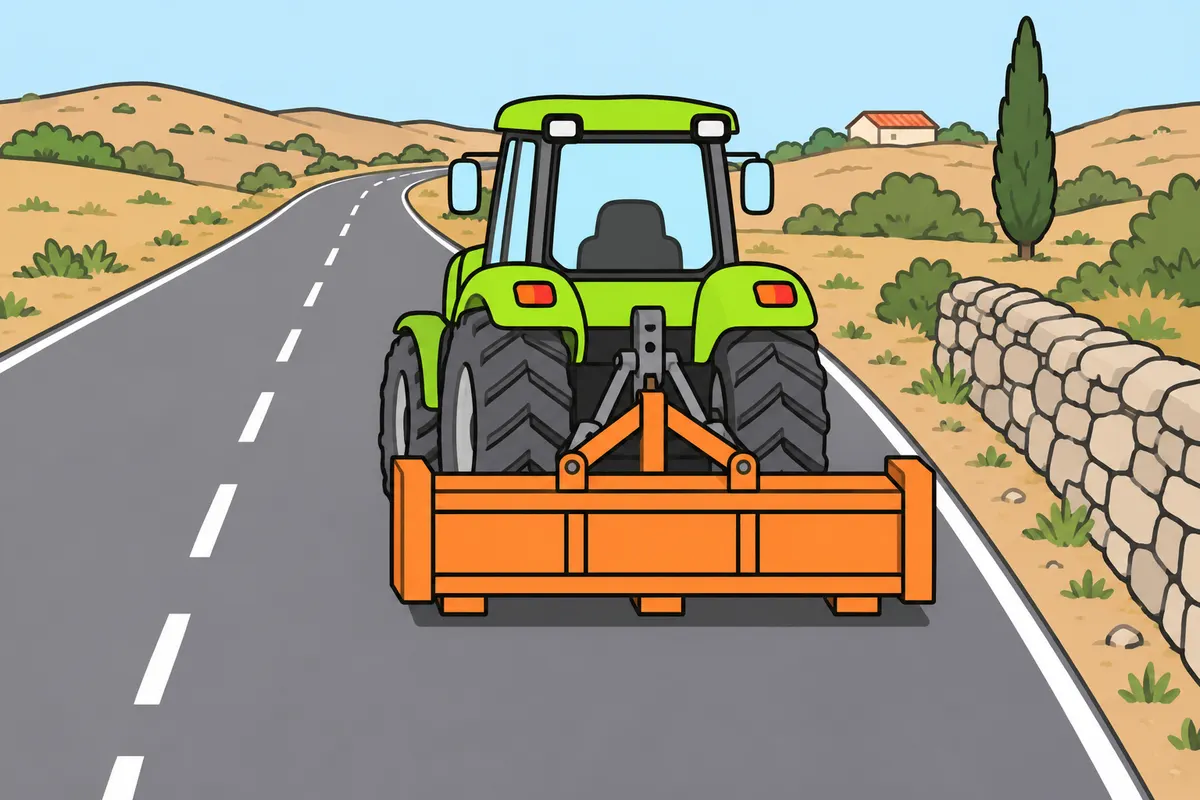
Calculate road-use width according to your vehicle and equipment.
| Agricultural vehicle or equipment | How you calculate width |
|---|---|
| Tractor, portador, motocultor, tractocarro and their trailers | Stationary width, including the load |
| Tools, implements and equipment mounted, fully mounted or semi-mounted on tractors or motocultores | Deduct the right-hand projection beyond the outer face of the right wheels; maximum 0.50 m |
| Agricultural machine | Deduct 0.50 m; not if folding or removable parts remain unfolded or fitted |
Remember
- Measure the vehicle or equipment while stationary.
- For a combination, use the greatest calculated individual width.
- Allow space for the real physical width when passing obstacles.
Exam trap: Wrong: you can always deduct 0.50 m. Right: apply the rule for each item and fold or remove parts where required.
Read the full explanation
- For agricultural tractors, carriers, walking tractors, agricultural transporters and their trailers, the width for road use is the width of the stationary vehicle, including any load. You must measure the actual transport configuration: looking only at the cab width may overlook projecting wheels, equipment or loads. [RGV, annex IX.3.3](https://www.boe.es/buscar/act.php?id=BOE-A-1999-1826#A3-3).
- For agricultural tools, implements and equipment mounted, carried or semi-carried on tractors or walking tractors, you start with the width of the stationary equipment. You deduct the amount projecting to the right beyond the outer face of the wheels on that side, up to a maximum deduction of 0.50 m. [RGV, annex IX.3.3](https://www.boe.es/buscar/act.php?id=BOE-A-1999-1826#A3-3).
- For agricultural machines, you deduct 0.50 m from the width of the stationary machine. You cannot apply this reduction if it has folding or detachable parts and you drive without folding or removing them. For a combination, you must use the greatest individual width calculated under the applicable rules. [RGV, annex IX.3.3](https://www.boe.es/buscar/act.php?id=BOE-A-1999-1826#A3-3).
- For example, equipment 2.90 m wide with a right-hand projection of 0.20 m beyond the wheels has a width for road use of 2.70 m under this formula. The legal deduction does not physically remove the projection: you must allow space for its actual width when passing obstacles. [RGV, annex IX.3.3](https://www.boe.es/buscar/act.php?id=BOE-A-1999-1826#A3-3).
9Vehicle registration and the agricultural register
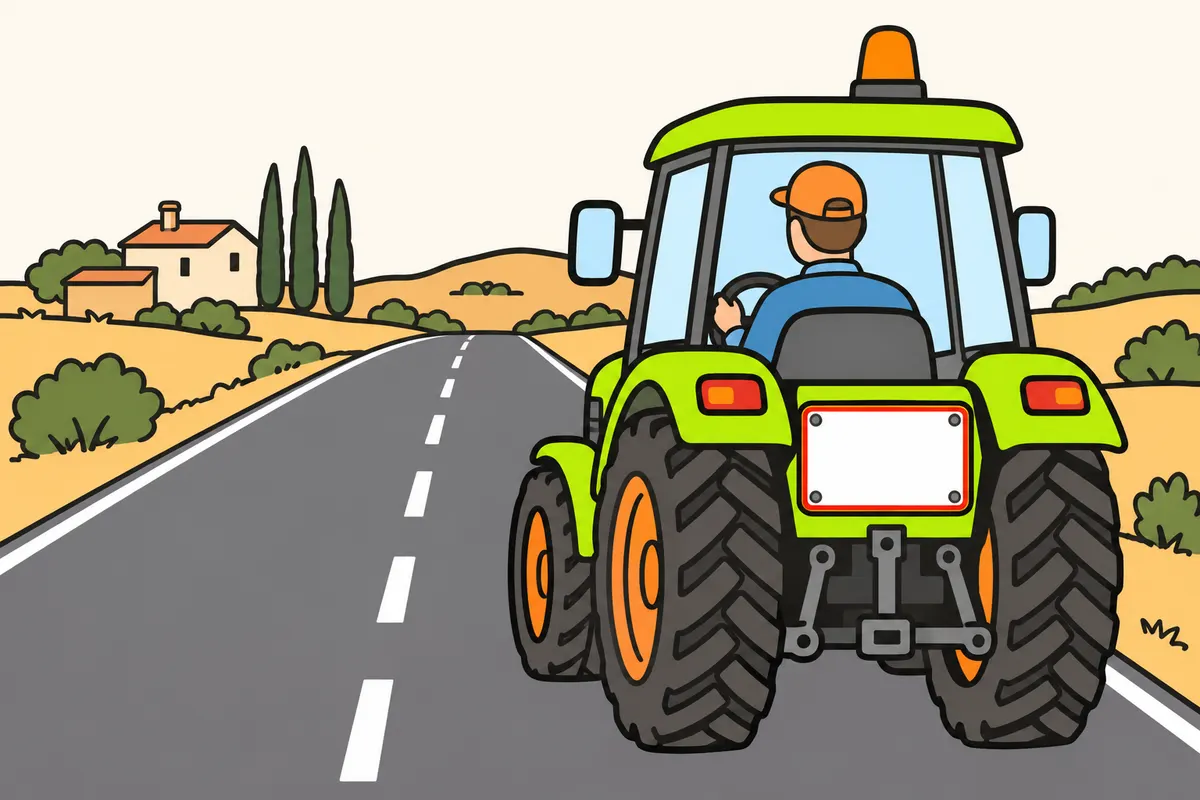
For road use, complete the agricultural registration and vehicle registration procedures that apply.
| Special vehicle | When you must register it for road use |
|---|---|
| Self-propelled | Whatever its mass |
| Trailer, semi-trailer or towed machine | If its MMA exceeds 750 kg |
Remember
- First enter your agricultural vehicle in ROMA.
- Then apply to the DGT for road registration.
- Check that the number plate, vehicle and documents match.
Exam trap: Wrong: unloading a trailer removes its need for registration. Right: this depends on MMA, not its weight that day.
Read the full explanation
- You must register self-propelled special vehicles for road use, whatever their mass. There is no general exemption because a tractor is small, you use it on only a few days or it belongs to a farm; you must distinguish road use from work within the property. [RGV, arts. 25 and 28](https://www.boe.es/buscar/act.php?id=BOE-A-1999-1826#a28).
- You must register special trailers, semi-trailers and towed machines when their MMA (maximum authorised mass) exceeds 750 kg. The threshold refers to the maximum authorised mass, rather than the weight you carry that day: unloading a trailer does not remove the requirement for it to have its own registration number. [RGV, arts. 25 and 28](https://www.boe.es/buscar/act.php?id=BOE-A-1999-1826#a28).
- Before applying to the DGT to register a special agricultural vehicle, you must enter it in the relevant Registro Oficial de Maquinaria Agrícola (ROMA, Official Register of Agricultural Machinery) through the competent authority in your autonomous community. Article 28.2 of the RGV establishes the order of these two procedures; articles 17 and 18 of RD 448/2020 govern agricultural registration. [RGV, art. 28.2](https://www.boe.es/buscar/act.php?id=BOE-A-1999-1826#a28) [RD 448/2020, arts. 17 and 18](https://www.boe.es/buscar/act.php?id=BOE-A-2020-4666).
- You must check that the vehicle identification matches its documentation. Keeping a number plate from another tractor on the farm is not enough: the registration number identifies the specific vehicle. The documents you must carry and the procedures for changing the registered keeper are covered in «Driver and agricultural vehicle documentation». [RGV, arts. 25 and 28](https://www.boe.es/buscar/act.php?id=BOE-A-1999-1826#a28).
10Recognise the tractor’s number plate
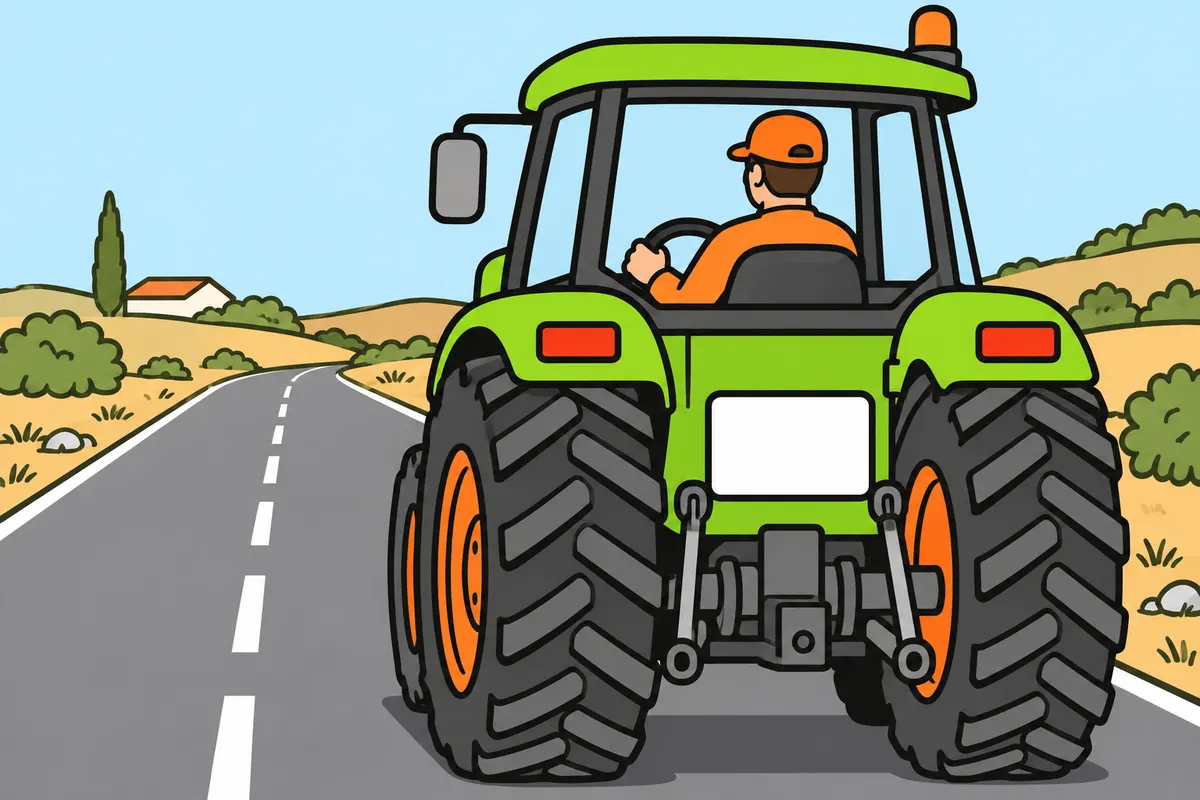
Recognise the special number plate and keep it visible behind your tractor.
Remember
- Recognise the white reflective background and matt red characters.
- The sequence starts with E.
- Fit the rectangular plate at the rear, centred or on the left.
- Keep it vertical or nearly vertical, perpendicular to the vehicle’s length.
- Clean off mud and stop equipment hiding it.
Exam trap: Wrong: your tractor needs a front plate like a car. Right: self-propelled agricultural vehicles carry their plate at the rear.
Read the full explanation
- The standard number plate for a special vehicle has a white retroreflective background and matt red characters. Its sequence consists of the letter E, four digits and three letters. This plate identifies the special vehicle. [RGV, annex XVIII.I and III](https://www.boe.es/buscar/act.php?id=BOE-A-1999-1826#anxviii).
- You must fit a self-propelled special agricultural vehicle with one flat rectangular plate at the rear, in the centre or on the left. It must be vertical or nearly vertical and perpendicular to the median longitudinal plane. [RGV, annex XVIII.I and III](https://www.boe.es/buscar/act.php?id=BOE-A-1999-1826#anxviii).
- You must keep the number plate visible and legible. Mud, a tool, the load or an implement must not obscure it: checking the plates after agricultural work is part of preparing the vehicle for road use. [RGC, art. 14](https://www.boe.es/buscar/act.php?id=BOE-A-2003-23514#a14) [RGV, annex XVIII.I and III](https://www.boe.es/buscar/act.php?id=BOE-A-1999-1826#anxviii).
11Plates on towed vehicles
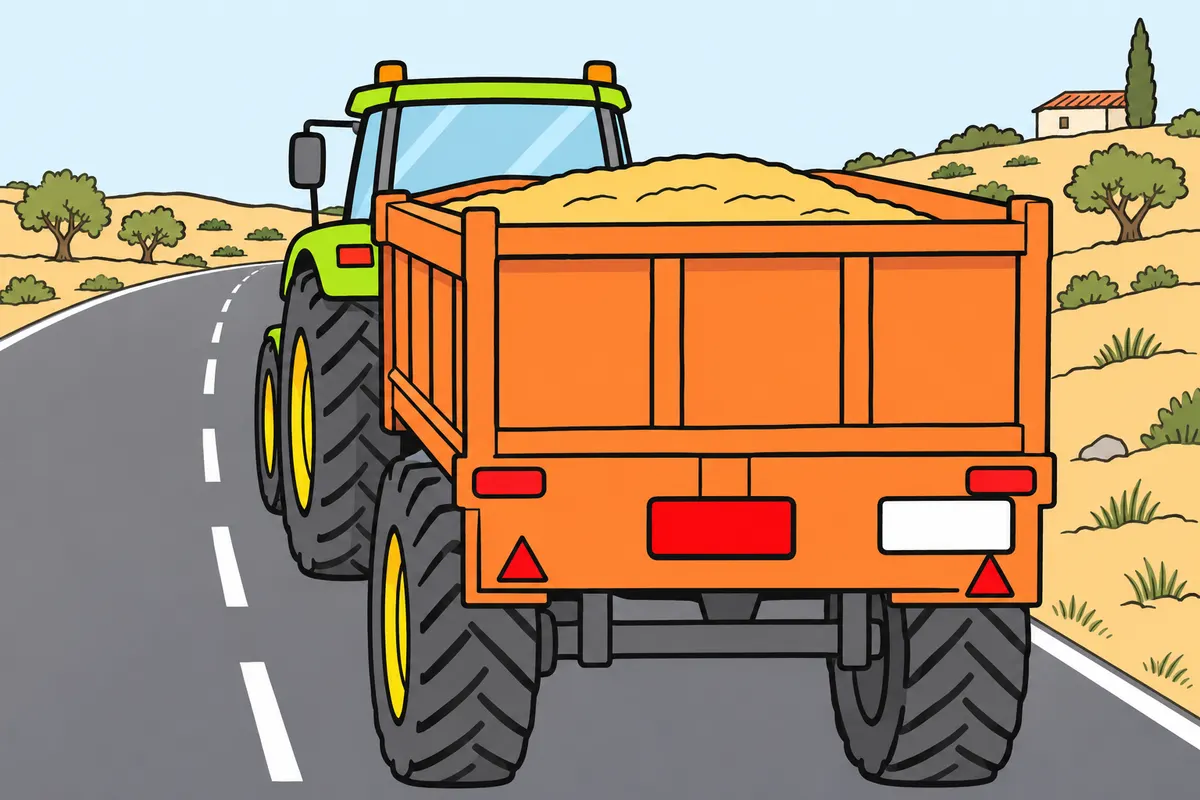
Check the trailer plates and ensure they identify the tractor towing it.
| Agricultural trailer, semi-trailer or towed machine | Plates you must display at the rear |
|---|---|
| MMA above 750 kg | Own plate centred; towing vehicle number on the right |
| MMA of 750 kg or less, within that category | Only towing vehicle number, centred or on the left |
Remember
- If you change tractors, check the plate repeating the tractor number.
- The trailer keeps its own registration number.
- Keep the plates vertical or nearly vertical.
Exam trap: Wrong: its own plate replaces the tractor number. Right: above 750 kg MMA, you must display both.
Read the full explanation
- If your trailer, semi-trailer or towed agricultural machine exceeds 750 kg MMA, you must fit its own number plate at the rear, vertical or nearly vertical and centred on the median longitudinal plane. You must also display another plate on the right showing the towing vehicle’s registration number. [RGV, annex XVIII.III](https://www.boe.es/buscar/act.php?id=BOE-A-1999-1826#anxviii).
- For other trailers, semi-trailers and towed agricultural machines, you must fit a single rear plate showing the same registration number as the towing vehicle, in the centre or on the left. The 750 kg limit is included in this group, provided the vehicle belongs to that category. [RGV, annex XVIII.III](https://www.boe.es/buscar/act.php?id=BOE-A-1999-1826#anxviii).
- If you use the same trailer with different tractors, check the duplicate plate for the towing vehicle before setting off. The trailer’s own registration number remains linked to it; the plate reproducing the tractor’s registration number must match the vehicle forming the combination on that journey. [RGV, annex XVIII.III](https://www.boe.es/buscar/act.php?id=BOE-A-1999-1826#anxviii).
12ITV (vehicle roadworthiness test) for agricultural vehicles
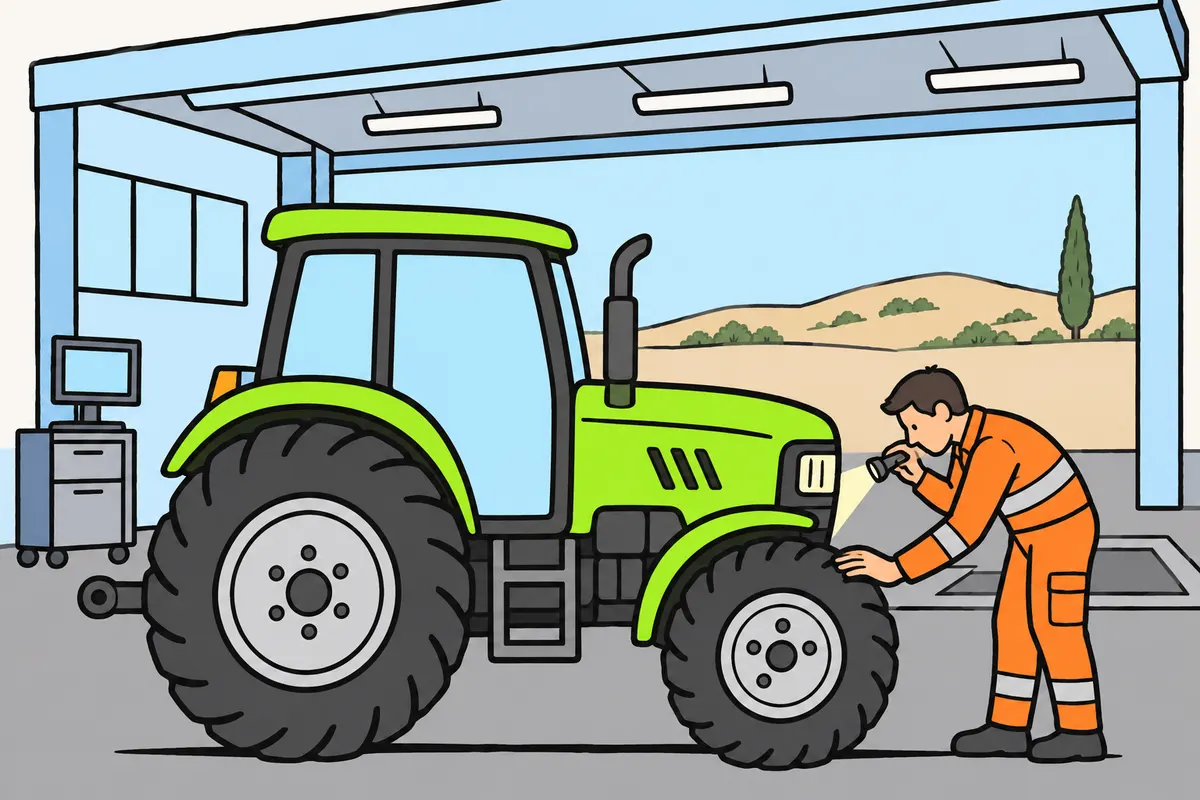
Work out ITV requirements from the category and maximum manufacturing speed.
| Agricultural group | Schedule you must check |
|---|---|
| Wheeled tractor exceeding 40 km/h by manufacture | Specific group |
| Rest of the agricultural group | Different schedule |
Remember
- Identify the category before checking the ITV schedule.
- Do not confuse a favourable ITV result with your driving entitlement.
- Always respect masses, dimensions and towing capacity.
Exam trap: Wrong: passing ITV lets you drive any tractor with LVA. Right: a favourable ITV does not replace B when required.
Read the full explanation
- To determine when you must have the ITV (vehicle roadworthiness test), identify the vehicle category and maximum design speed: wheeled tractors exceeding 40 km/h have a different schedule from the rest of the agricultural group. Consult the frequency table and the consequences of each result in «Driver and agricultural vehicle documentation». [RD 920/2017, art. 6.1](https://www.boe.es/buscar/act.php?id=BOE-A-2017-12841#a6).
- You must not confuse the ITV with an entitlement to drive. A favourable inspection checks technical roadworthiness within its scope; it does not bring a tractor requiring category B within LVA entitlement or allow you to exceed masses, dimensions or towing capacity. [RGCond, art. 5.9](https://www.boe.es/buscar/act.php?id=BOE-A-2009-9481#a5) [RD 920/2017, art. 6](https://www.boe.es/buscar/act.php?id=BOE-A-2017-12841#a6).
13ROPS: rollover protection
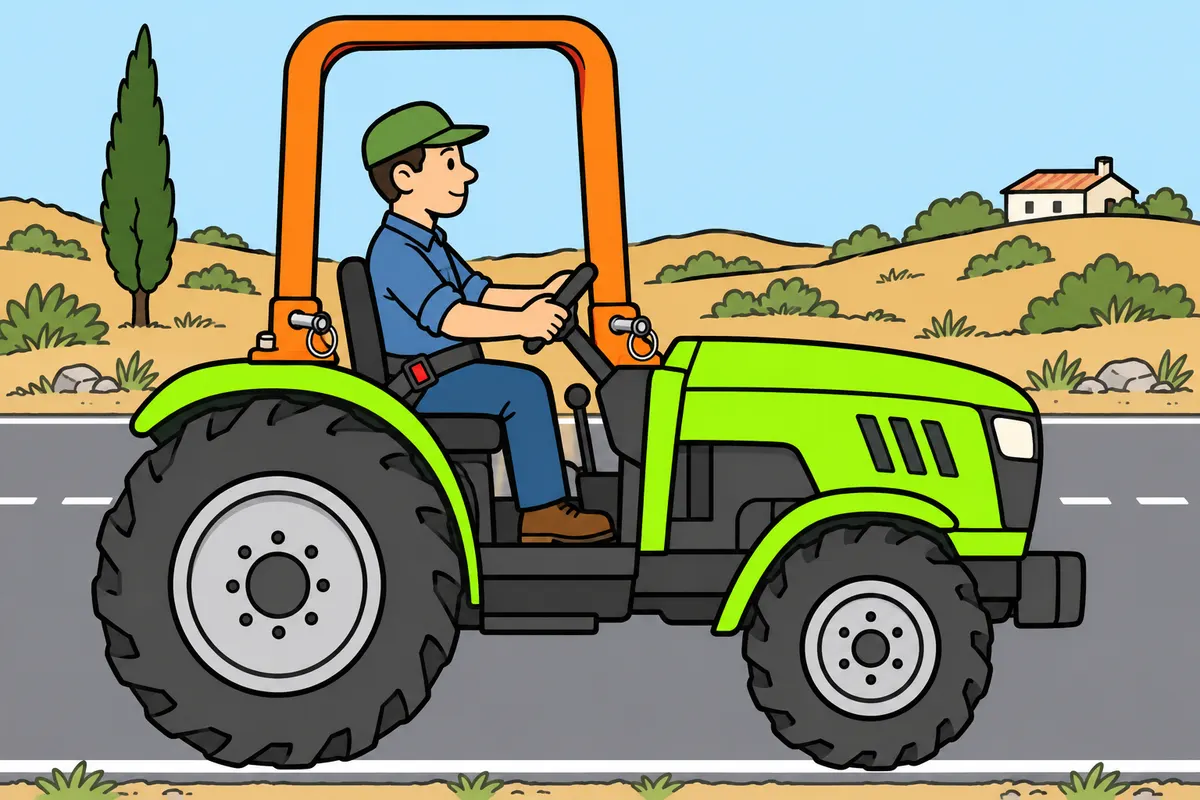
Check that approved rollover protection is fitted and ready to protect you.
| Tractor case | What you must check |
|---|---|
| At least 40 years since first ROMA entry, without approved protection | No deregistration for ownership change, other activity or temporary withdrawal, including dealer delivery; inheritance excepted |
| Used tractor from another Member State, without approved protection | You cannot enter it in ROMA |
| Tractor from a third country | You need prior EC type approval or the relevant industrial authority approval |
Remember
- Check whether your tractor needs approved protection under the applicable criteria and dates.
- Do not confuse a sun canopy with rollover protection.
- Drive with the folding roll bar raised and secured.
- Check the structure and fixings; avoid improvised changes.
- The structure protects your space but does not prevent loss of stability.
Exam trap: Wrong: fitting the roll bar is enough even when folded. Right: raise and secure it for road use.
Read the full explanation
- Your tractor must have an officially approved rollover protection frame or cab, in accordance with the applicable criteria and the dates on which it becomes compulsory in Annex I. This structure, known as ROPS, protects the driver’s space; it does not prevent loss of stability. [RD 448/2020, art. 7.1 and Annex I](https://www.boe.es/buscar/act.php?id=BOE-A-2020-4666#a7).
- A sun canopy or a cab that only protects against the weather does not establish that you have rollover protection. You must check that the structure is suitable for your machine and correctly installed; its outward appearance does not prove its protective function. [DGT, agricultural vehicle safety](https://revista.dgt.es/es/reportajes/2024/06JUNIO/0620-N270-VehiculosAgricolas.shtml).
- If your tractor has a folding roll bar, you must keep it correctly raised and secured when driving. Having it fitted but folded down is not equivalent to using it in its protective position. Set it in that position before setting off and check its fixings in accordance with the manufacturer’s instructions. [DGT, agricultural vehicle safety](https://revista.dgt.es/es/reportajes/2024/06JUNIO/0620-N270-VehiculosAgricolas.shtml).
- As a practical check, you must inspect the structure and its anchor points and avoid improvised modifications. Protection depends on the complete set of parts installed for that tractor: adding accessories, drilling or altering components without a technical check can compromise the function you expect them to perform. [DGT, agricultural vehicle safety](https://revista.dgt.es/es/reportajes/2024/06JUNIO/0620-N270-VehiculosAgricolas.shtml).
- If at least 40 years have passed since your tractor was first registered in ROMA (Official Register of Agricultural Machinery) and it has no approved protective structure, you cannot arrange its deregistration for a change of ownership, a move to another activity or temporary deregistration, including handing it over to a dealer; changes of ownership through inheritance are exempt. [RD 448/2020, arts. 7.2 and 17.3](https://www.boe.es/buscar/act.php?id=BOE-A-2020-4666#a7).
- You cannot register a used tractor from another Member State in ROMA without an approved protective structure. If it comes from a third country, it needs prior EC type-approval or the corresponding approval from the competent industrial authority. [RD 448/2020, arts. 7.3 and 8](https://www.boe.es/buscar/act.php?id=BOE-A-2020-4666#a7).
14Seat belt and protected space
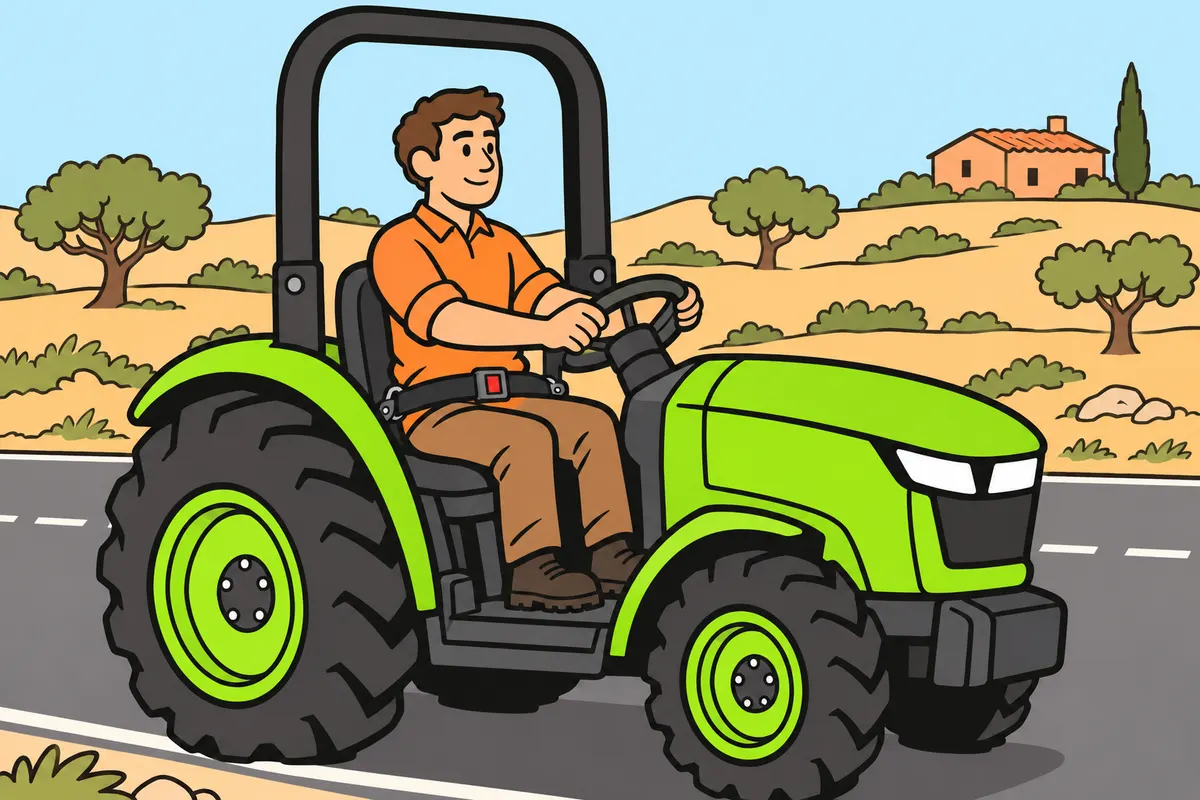
Use the fitted seat belt to stay within the protected space.
Remember
- Fasten the approved belt correctly on urban and interurban roads if fitted.
- The cab or roll bar does not replace your belt.
- Driving slowly, alone or nearby does not exempt you.
- Do not remove or disable a required belt.
- At work, work-equipment rules require limiting rollover risk.
- Provide restraint if crushing between the equipment and ground is a risk.
Exam trap: Wrong: a cab means you do not need a belt. Right: use it when fitted; you need not use a non-existent belt.
Read the full explanation
- You must wear the approved seat belt, correctly fastened, on urban and interurban roads when your vehicle has one fitted. Driving slowly, travelling alone or making a short journey does not constitute a general exemption for you as the driver of an agricultural vehicle. [RGC, art. 117.1](https://www.boe.es/buscar/act.php?id=BOE-A-2003-23514#a117).
- The seat belt and protective structure work together: you must remain restrained within the protected space. Having a roll bar or a safety cab does not replace fastening your seat belt; nor must you interpret the belt as a guarantee of stability or permission to take greater risks. [RGC, art. 117.1](https://www.boe.es/buscar/act.php?id=BOE-A-2003-23514#a117).
- Article 117 does not require you to use a non-existent seat belt in a vehicle that has none fitted. Technical equipment requirements are separate from that rule on use: it does not authorise you to remove a required seat belt or drive with its restraint system disabled. [RGC, art. 117.1](https://www.boe.es/buscar/act.php?id=BOE-A-2003-23514#a117).
- When workers use the vehicle, work equipment regulations require the risk of overturning to be limited and a restraint to be provided where there is a risk of being crushed between the equipment and the ground. You must distinguish this workplace safety duty from the straightforward traffic question of using the fitted seat belt. [RD 1215/1997, Annex I.2.1.d](https://www.boe.es/buscar/act.php?id=BOE-A-1997-17824) [RGC, art. 117.1](https://www.boe.es/buscar/act.php?id=BOE-A-2003-23514#a117).
15Driving position and seating places
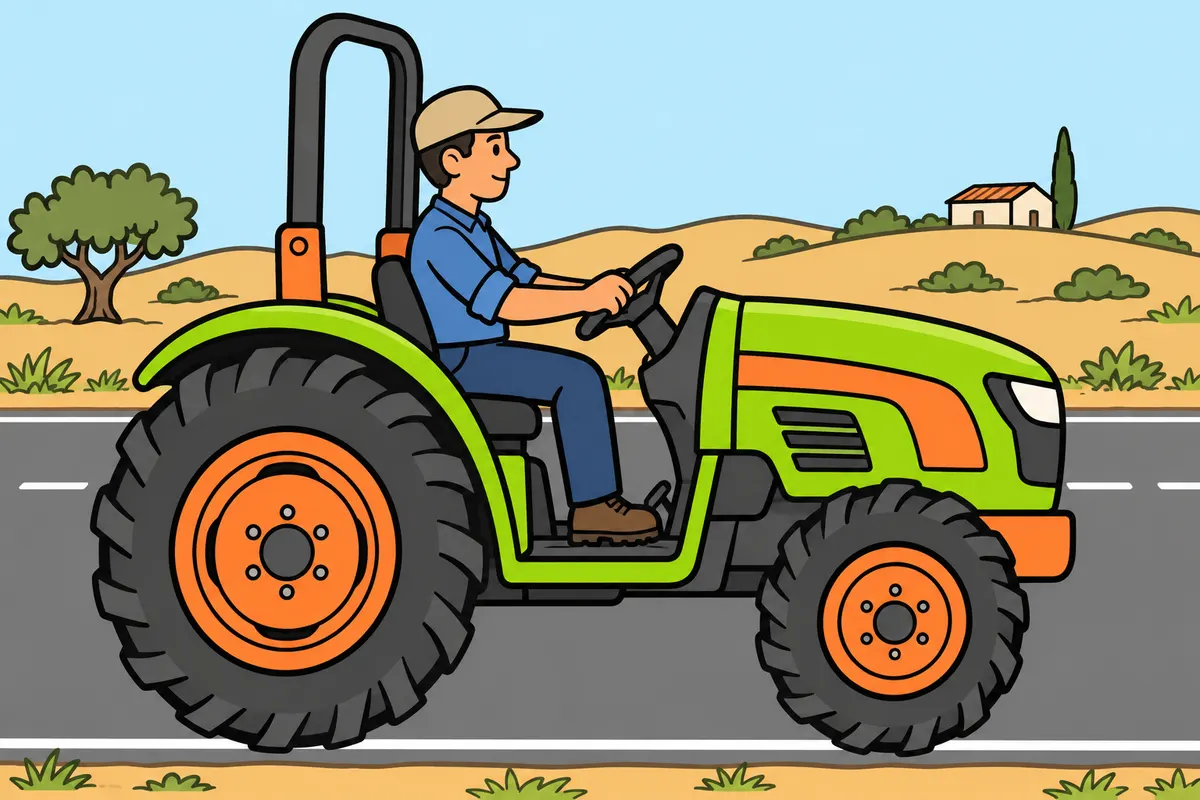
Keep your view and controls clear, and carry people only in authorised places.
Remember
- Place objects clear of pedals, your movements and your view.
- Clean windows and mirrors before setting off.
- Adjust mirrors from your driving position.
- Remember that mirrors do not remove every blind spot.
- If you have only one seat, only you can travel.
- Do not carry passengers on mudguards, steps, implements or in gaps.
Exam trap: Wrong: driving slowly lets you carry people outside seats. Right: use only authorised places equipped for passengers.
Read the full explanation
- You must retain freedom of movement and the necessary field of vision. A front-mounted implement, objects on the dashboard or tools beside the pedals can prevent this. Before driving, correct their position; reducing your speed does not make an obstruction that prevents proper control acceptable. [RGC, arts. 9, 10 and 18](https://www.boe.es/buscar/act.php?id=BOE-A-2003-23514#a18).
- As practical preparation, clean the windows and mirrors and adjust the mirrors from your driving position. You also need a clear view behind you and to the sides in daylight. Adjusting the mirrors improves your observation, but does not allow you to assume that all blind spots disappear. [RGC, arts. 9, 10 and 18](https://www.boe.es/buscar/act.php?id=BOE-A-2003-23514#a18).
- You may carry only the authorised number of people, in places intended and equipped for them. If your tractor has only one seat, you are the only person who may travel on it: the mudguards, steps, implement and a space beside the seat are not additional seating places. [RGC, arts. 9, 10 and 18](https://www.boe.es/buscar/act.php?id=BOE-A-2003-23514#a18).
16Compulsory tractor lighting
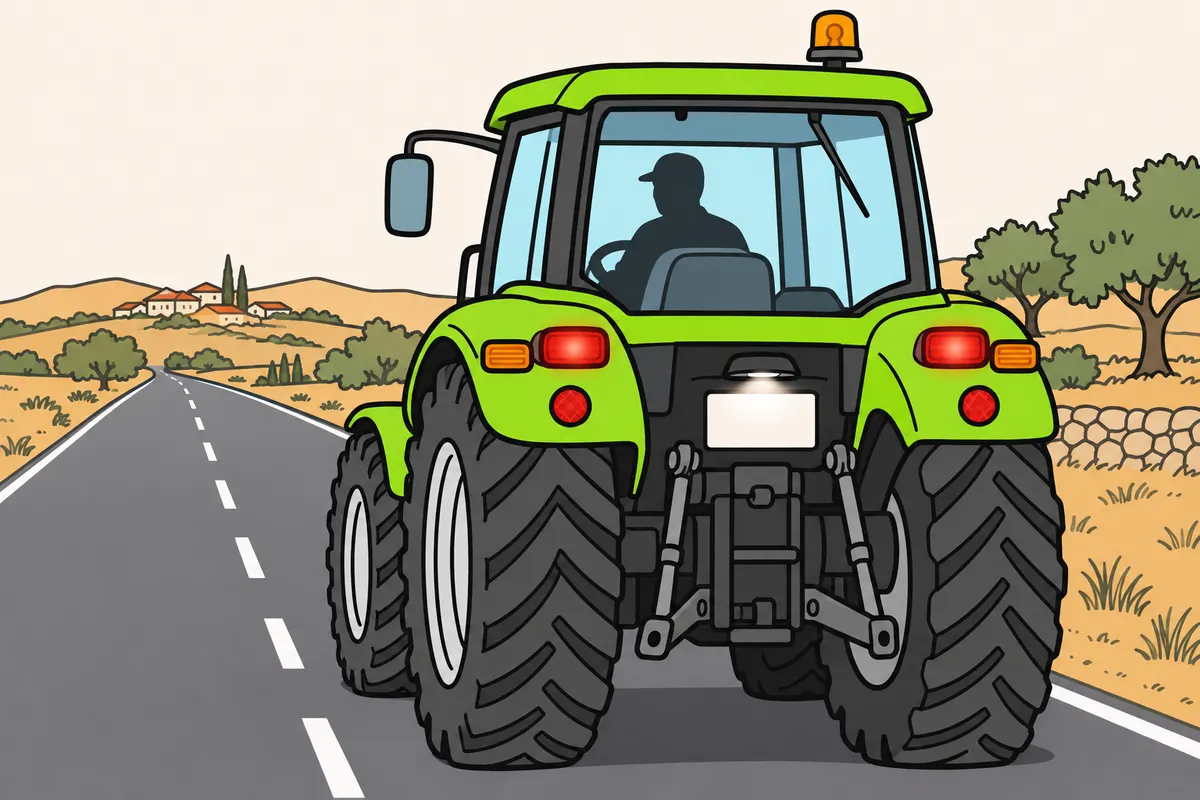
Check your tractor’s compulsory lights and reflectors before road use.
| Agricultural tractor device | Colour or condition |
|---|---|
| Dipped beam, front position and number plate lighting | White |
| Rear position lights and rear reflectors | Red |
| Indicators and hazard lights | Amber |
| Red brake lights: maximum authorised speed above 25 km/h | Compulsory |
| Red brake lights: maximum authorised speed of 25 km/h or less | Optional |
Remember
- Check dipped beam, indicators with hazard lights, and rear number plate lighting.
- Check front and rear position lights and non-triangular rear reflectors.
- Do not mistake an illuminated reflector for a working position light.
- Keep lights and reflective surfaces clean.
Exam trap: Wrong: the amber beacon replaces your tractor lights. Right: you also need its compulsory lighting.
Read the full explanation
- Your agricultural tractor must have dipped-beam headlights, direction indicators with hazard warning lights, rear number plate lighting and front and rear position lights. It must also have non-triangular rear reflectors; you must check these items even if you have a yellow rotating beacon fitted. [RGV, art. 16.6 and Annex X](https://www.boe.es/buscar/act.php?id=BOE-A-1999-1826#a16).
- Brake lights are compulsory on your tractor when its maximum authorised speed exceeds 25 km/h. For tractors that do not exceed that speed, they are optional under Annex X. [RGV, art. 16.6 and Annex X](https://www.boe.es/buscar/act.php?id=BOE-A-1999-1826#a16).
- To recognise them in the exam, you must associate dipped beam and front position lights with white; rear position lights, brake lights and rear reflectors with red; and direction indicators and hazard warning lights with amber. Number plate lighting is white and must illuminate the plate without replacing the lights that indicate the vehicle’s presence. [RGV, art. 16.6 and Annex X](https://www.boe.es/buscar/act.php?id=BOE-A-1999-1826#a16).
- Reflectors return the light they receive; you must distinguish them from lamps that produce light. Seeing them lit up by another vehicle’s headlights does not prove that your tractor’s rear position lights work. Check both and keep their surfaces clean. [RGV, art. 16.6 and Annex X](https://www.boe.es/buscar/act.php?id=BOE-A-1999-1826#a16).
17Optional lights and work lights
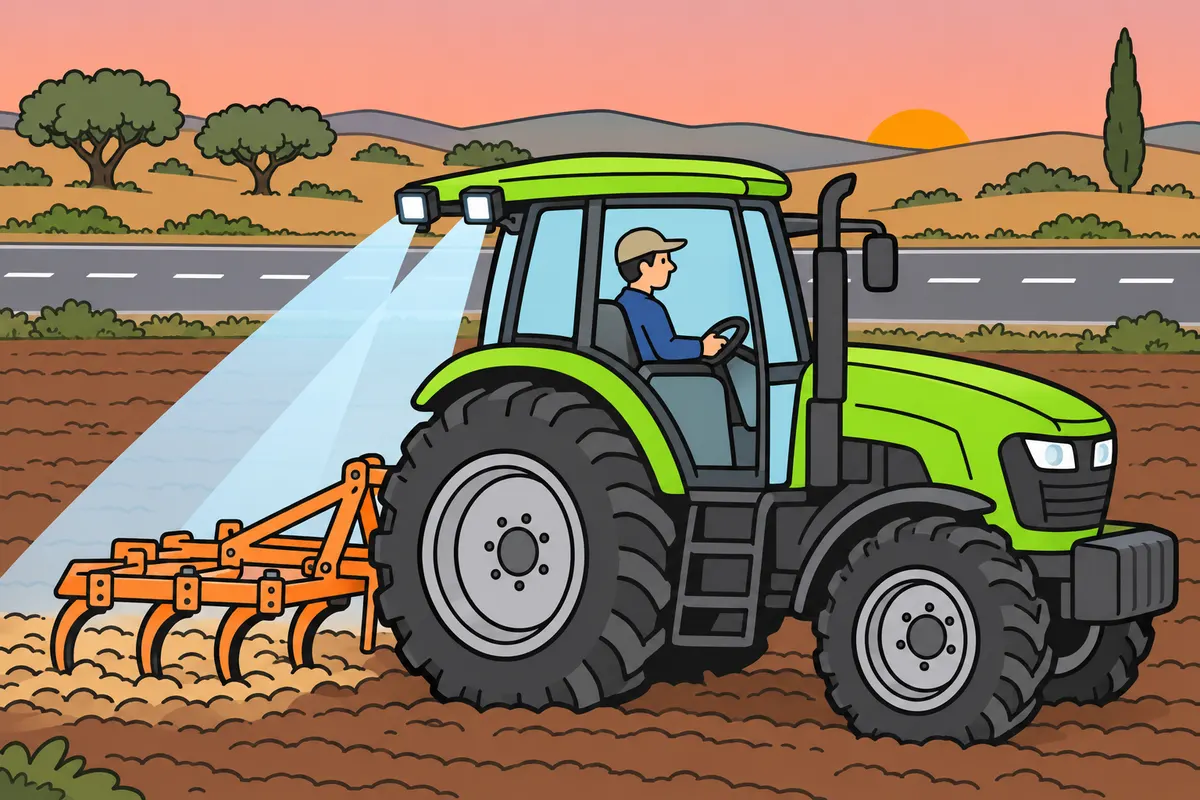
Distinguish optional tractor lights from those needed for road use.
| Agricultural tractor width | Fitting end-outline marker lamps |
|---|---|
| Above 2.10 m | Optional |
| 2.10 m or less | Prohibited |
Remember
- You may fit main beam, reversing, fog, interior and work lights.
- Do not automatically copy a car’s lighting requirements.
- Use work lights to light your task.
Exam trap: Wrong: work lamps replace road lighting. Right: you need the appropriate road lights.
Read the full explanation
- Your tractor may have main-beam headlights, reversing lights, front and rear fog lights, interior lighting, work lights and other permitted optional devices. Their installation must comply with the conditions in Annex X. [RGV, art. 17.6 and Annex X](https://www.boe.es/buscar/act.php?id=BOE-A-1999-1826#a17).
- Your tractor’s end-outline marker lamps are optional if its width exceeds 2.10 m and are prohibited in all other cases under these regulations. [RGV, art. 17.6 and Annex X](https://www.boe.es/buscar/act.php?id=BOE-A-1999-1826#a17).
- A work light illuminates a work area or process. You can recognise it by its purpose of illuminating agricultural work; lighting for road use has its own statutory equipment requirements. [RGV, art. 17.6 and Annex X](https://www.boe.es/buscar/act.php?id=BOE-A-1999-1826#a17).
18Machines and walking tractors: suitability for night-time use
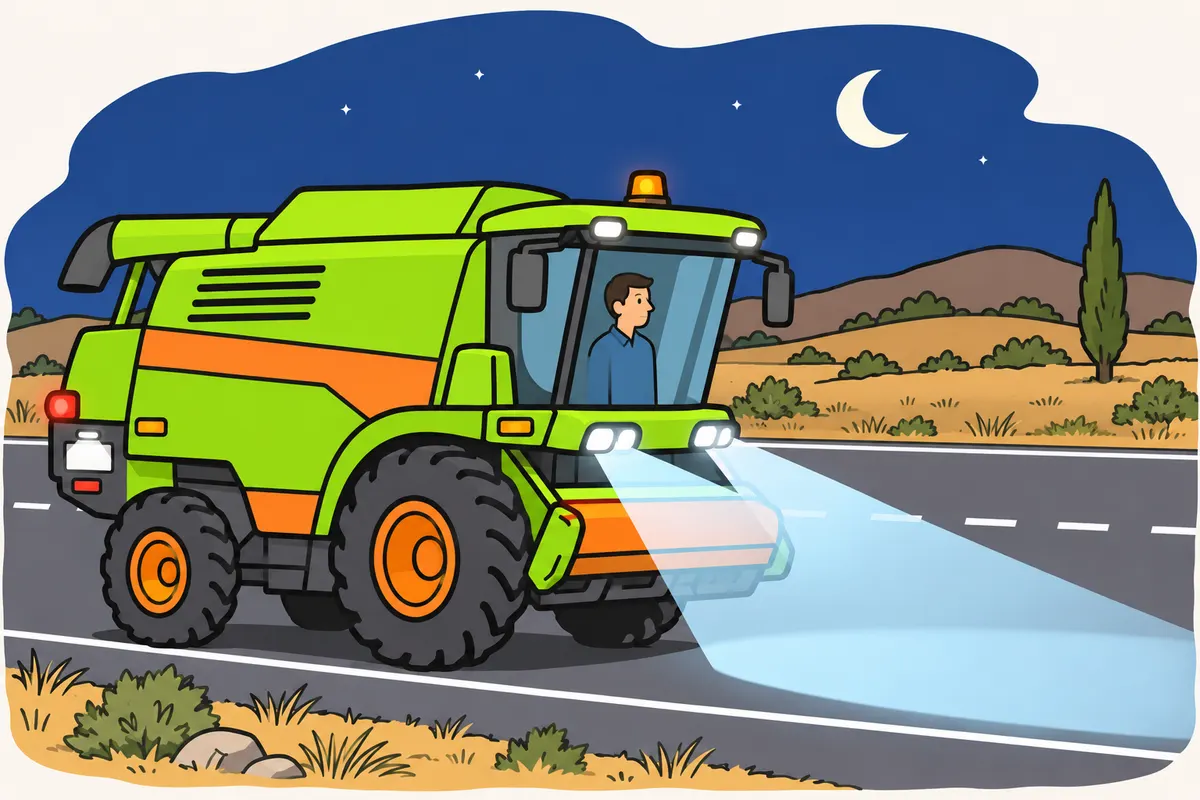
Check whether your machine or motocultor suits night-time use, tunnels or poor visibility.
| Agricultural machine or motocultor | Equipment according to suitability for night, tunnels and poor visibility |
|---|---|
| Suitable self-propelled machine | Tractor equipment; brake lights depend on the speed condition |
| Unsuitable self-propelled machine | Non-triangular rear reflectors; brake lights if maximum authorised speed exceeds 25 km/h |
| Suitable motocultor | Dipped beam, front and rear position lights, indicators with hazard lights, non-triangular rear reflectors, number plate lighting |
| Unsuitable motocultor | Non-triangular rear reflectors; indicators with hazard lights if it has electrical equipment |
Remember
- Check vehicle suitability and the conditions along your route.
- Having some lights does not allow unsuitable vehicles to travel in those conditions.
- Do not automatically require every tractor light on a motocultor.
Exam trap: Wrong: reflectors let an unsuitable machine travel through a tunnel. Right: you must respect its suitability.
Read the full explanation
- You must check whether a self-propelled agricultural machine is suitable for driving at night, through tunnels or in conditions that significantly reduce visibility. If it is, its compulsory equipment is that specified for tractors in Article 16.6, subject to the specific condition concerning brake lights. [RGV, art. 16, paragraphs 7–10](https://www.boe.es/buscar/act.php?id=BOE-A-1999-1826#a16).
- For a self-propelled agricultural machine unsuitable for those conditions, Article 16.8 requires non-triangular rear reflectors and brake lights if its maximum authorised speed exceeds 25 km/h. This reduced equipment does not authorise you to choose a night-time route or one through a tunnel. [RGV, art. 16, paragraphs 7–10](https://www.boe.es/buscar/act.php?id=BOE-A-1999-1826#a16).
- Your walking tractor, if suitable for those conditions, must have dipped-beam headlights, front and rear position lights, direction indicators with hazard warning lights, non-triangular rear reflectors and rear number plate lighting. You must learn its own list: you cannot automatically require it to have all the compulsory lights of a faster tractor. [RGV, art. 16, paragraphs 7–10](https://www.boe.es/buscar/act.php?id=BOE-A-1999-1826#a16).
- Your walking tractor, if unsuitable for those conditions, must have non-triangular rear reflectors and, if it has electrical equipment, direction indicators with hazard warning lights. When deciding whether to set off, you must consider that suitability and the expected conditions, as well as physically checking which devices work. [RGV, art. 16, paragraphs 7–10](https://www.boe.es/buscar/act.php?id=BOE-A-1999-1826#a16).
19Agricultural trailer lighting
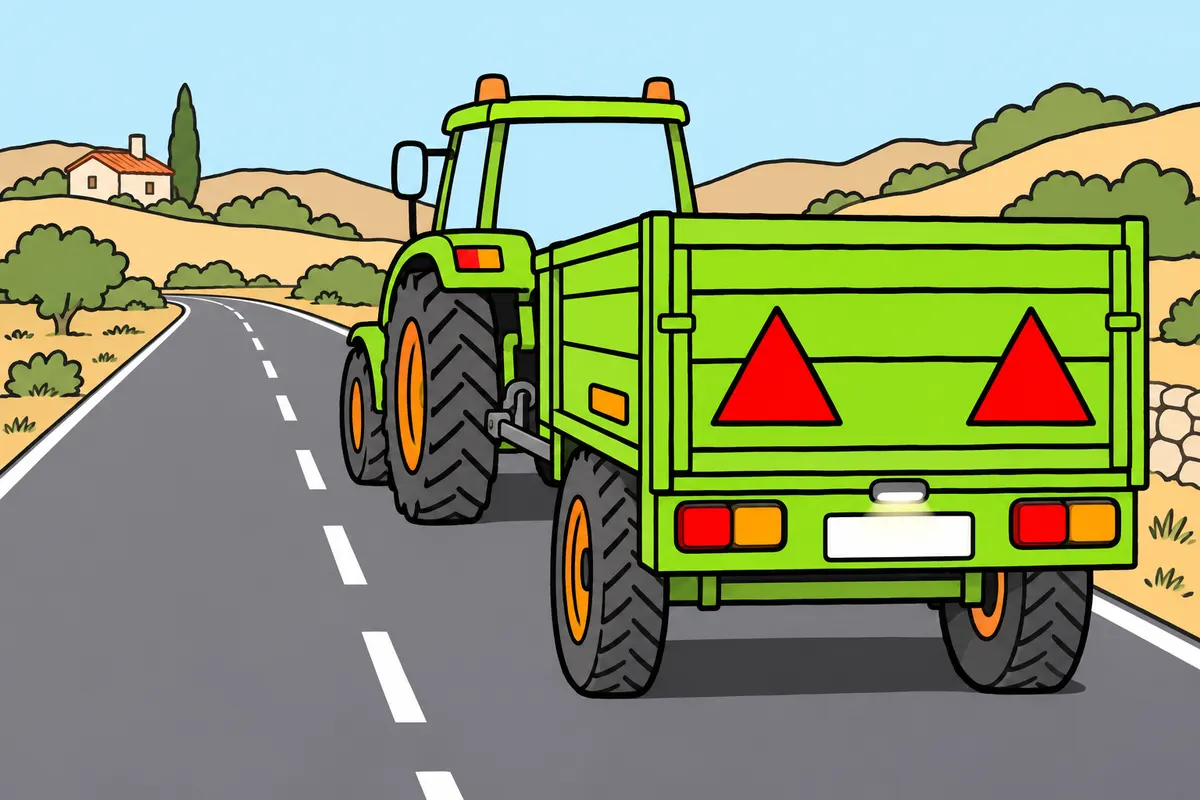
Check your agricultural trailer’s lights and reflectors according to its width.
| Towed agricultural vehicle and case | What you must check |
|---|---|
| Towed machine suitable for night, tunnels or poor visibility | Equipment listed for an agricultural trailer |
| Unsuitable towed machine | Non-triangular front and triangular rear reflectors; rear indicators unless the tractor indicators remain visible |
Remember
- Check rear position lights, number plate lighting and rear indicators.
- Check the front and side devices too.
- Fit triangular rear reflectors with one vertex pointing upwards.
- For width thresholds, see “Agricultural lighting and signalling”:
- Front position lights: “Equipment by category and vehicle signs”.
- End-outline lamps: “End-outline marker lamps: width and agricultural requirements”.
Exam trap: Wrong: a trailer has the same rear reflectors as a tractor. Right: agricultural trailer rear reflectors are triangular.
Read the full explanation
- Your agricultural trailer must have rear position lights, rear number plate lighting and rear direction indicators. Its rear reflectors must be triangular with one vertex pointing upwards. [RGV, art. 16, paragraphs 11–13](https://www.boe.es/buscar/act.php?id=BOE-A-1999-1826#a16).
- The trailer’s equipment also includes front and side devices; see their characteristics in «Agricultural lighting and signalling», section «Side marker lamps and reflectors». [RGV, art. 16.11](https://www.boe.es/buscar/act.php?id=BOE-A-1999-1826#a16).
- The width of the trailer determines additional lighting requirements; see the threshold for front position lights in «Agricultural lighting and signalling», section «Equipment by category and vehicle signs», and the threshold for end-outline marker lamps in the section «End-outline marker lamps: width and agricultural requirements» of the same module. [RGV, art. 16.11](https://www.boe.es/buscar/act.php?id=BOE-A-1999-1826#a16).
- Your towed agricultural machine suitable for use at night, in tunnels or in reduced visibility must have the devices in the previous paragraph. If it is unsuitable for these conditions, it has a specific reduced set of equipment, with rear indicators unless the tractor’s indicators remain visible, non-triangular front reflectors and triangular rear reflectors. The use of these devices is explained in «Agricultural lighting and signalling», in «Equipment by category and vehicle signs». [RGV, art. 16, paragraphs 11–13](https://www.boe.es/buscar/act.php?id=BOE-A-1999-1826#a16).
20V-2: when you must use it
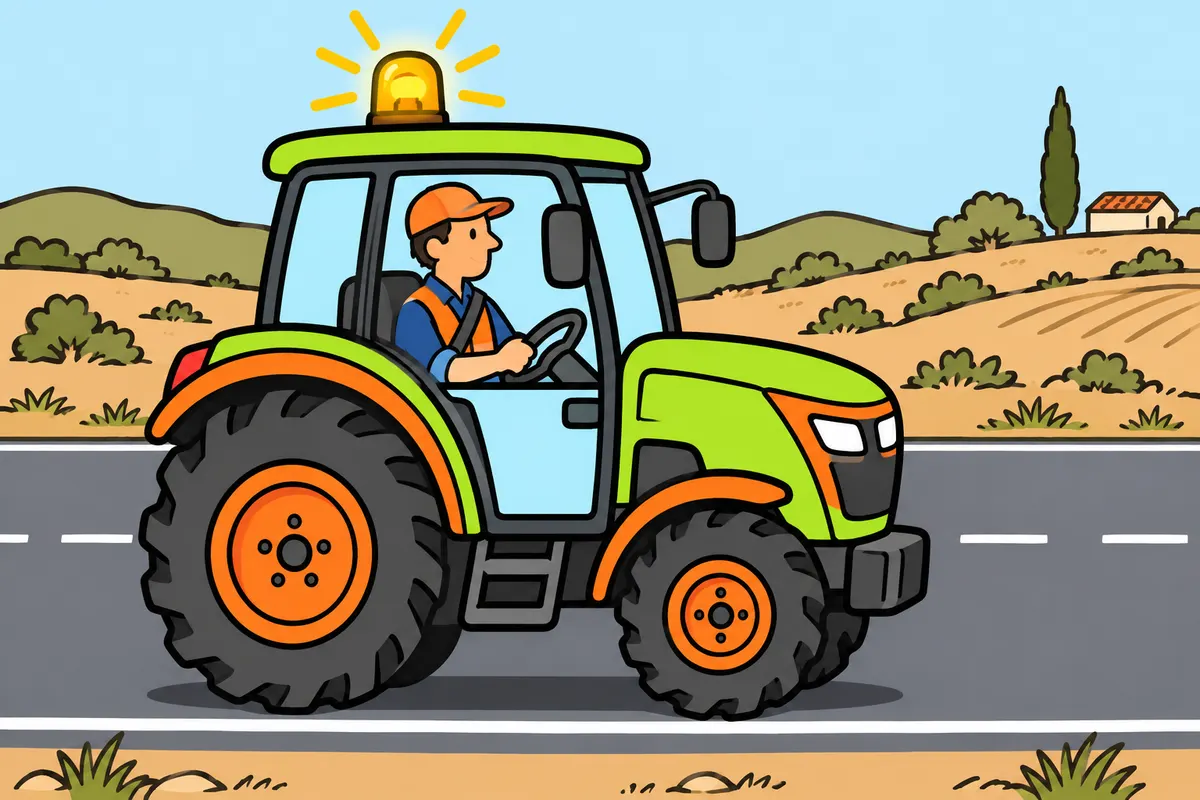
Use V-2 on public roads when your special vehicle travels at no more than 40 km/h.
Remember
- Use it by day and at night.
- Check your actual driving speed, not just maximum design speed.
- The amber light does not give you priority.
- If it fails, switch on dipped beam and hazard lights together.
Exam trap: Wrong: at exactly 40 km/h, you do not need V-2. Right: driving a special vehicle on public roads, you must use it at that speed too.
Read the full explanation
- The V-2 is the warning light for a vehicle that presents an obstacle on the road. You must use it when driving your special vehicle on roads open to public use at a speed not exceeding 40 km/h, both by day and by night. [RGC, art. 71.3](https://www.boe.es/buscar/act.php?id=BOE-A-2003-23514#a71).
- This obligation depends on the speed at which you are travelling. You must not confuse it with the maximum design speed of 45 km/h that defines the scope of the LVA licence: if you drive a machine covered by that licence at 30 km/h, you must use the V-2 under the conditions in article 71.3. [RGC, art. 71.3](https://www.boe.es/buscar/act.php?id=BOE-A-2003-23514#a71).
- The amber light warns of the vehicle’s presence and the obstacle it may present; it does not give you priority. You must continue to obey signs, priority rules and traffic conditions. [RGC, art. 71.3](https://www.boe.es/buscar/act.php?id=BOE-A-2003-23514#a71).
- If the V-2 fails, you must use dipped beam together with the direction indicators operating as hazard warning lights. [RGC, art. 71.3](https://www.boe.es/buscar/act.php?id=BOE-A-2003-23514#a71).
21V-2: characteristics and installation
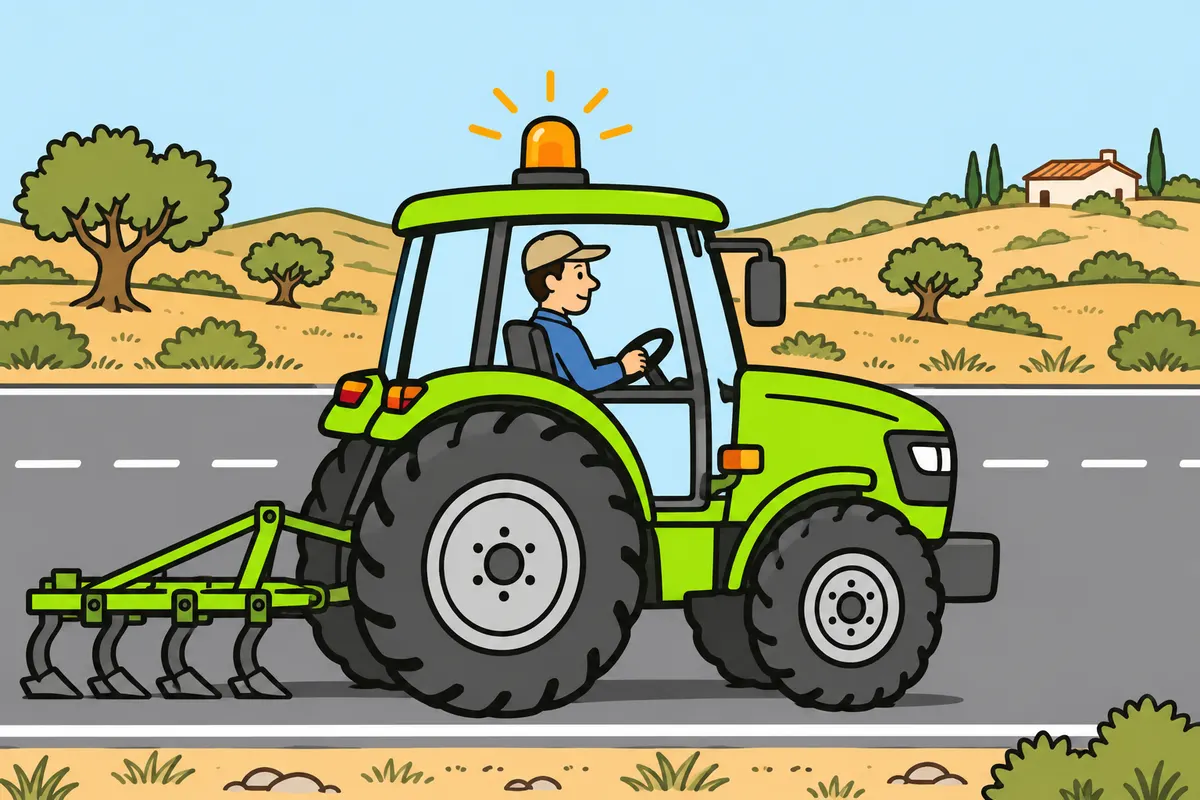
Fit an approved V-2 that is visible in every direction.
Remember
- Check that its amber lights are approved.
- Place it above the highest indicators.
- Keep loads and implements from hiding it.
- Do not reduce your view or weaken the protective structure.
- You do not need specific administrative permission to use it.
- If you must use it, you may add the approved red-and-white striped markings.
Exam trap: Wrong: you can fit any amber lamp to any vehicle. Right: use approved V-2; it is prohibited on vehicles that are not obstacles in the regulatory circumstances.
Read the full explanation
- The V-2 must consist of one or more amber lights type-approved under UNECE Regulation number 65. You must be able to distinguish it from lighting devices intended for other services; you cannot replace it with any yellow lamp chosen because it looks similar. [RGV, Annex XI, sign V-2](https://www.boe.es/buscar/act.php?id=BOE-A-1999-1826#v-2).
- It must be visible in all directions from 100 m. Before setting off, check that the implement, load or part of the machine does not obscure it. Seeing it from the seat or from the front does not prove that it is visible to someone approaching from behind. [RGV, Annex XI, sign V-2](https://www.boe.es/buscar/act.php?id=BOE-A-1999-1826#v-2).
- You must position it above the highest direction indicators. Its installation must not impair your visibility or the strength of the protective structure. You must not solve a height problem by drilling into or making improvised alterations to the rollover protection bar. [RGV, Annex XI, sign V-2](https://www.boe.es/buscar/act.php?id=BOE-A-1999-1826#v-2).
- You can use the V-2 without specific administrative authorisation. You must not fit or use it on vehicles that do not present an obstacle in the circumstances specified by the regulations; the rotating beacon does not replace supplementary authorisation to use the road either. [RGV, Annex XI, V-2, paragraphs 2 and 5](https://www.boe.es/buscar/act.php?id=BOE-A-1999-1826#v-2).
- If you are required to use the V-2 on your vehicle, you may voluntarily add retroreflective markings with alternating red and white stripes around its outline, meeting the regulatory specifications. [RGV, Annex XI, V-2, paragraph 4](https://www.boe.es/buscar/act.php?id=BOE-A-1999-1826#v-2).
22Speed plates and slow-moving vehicles
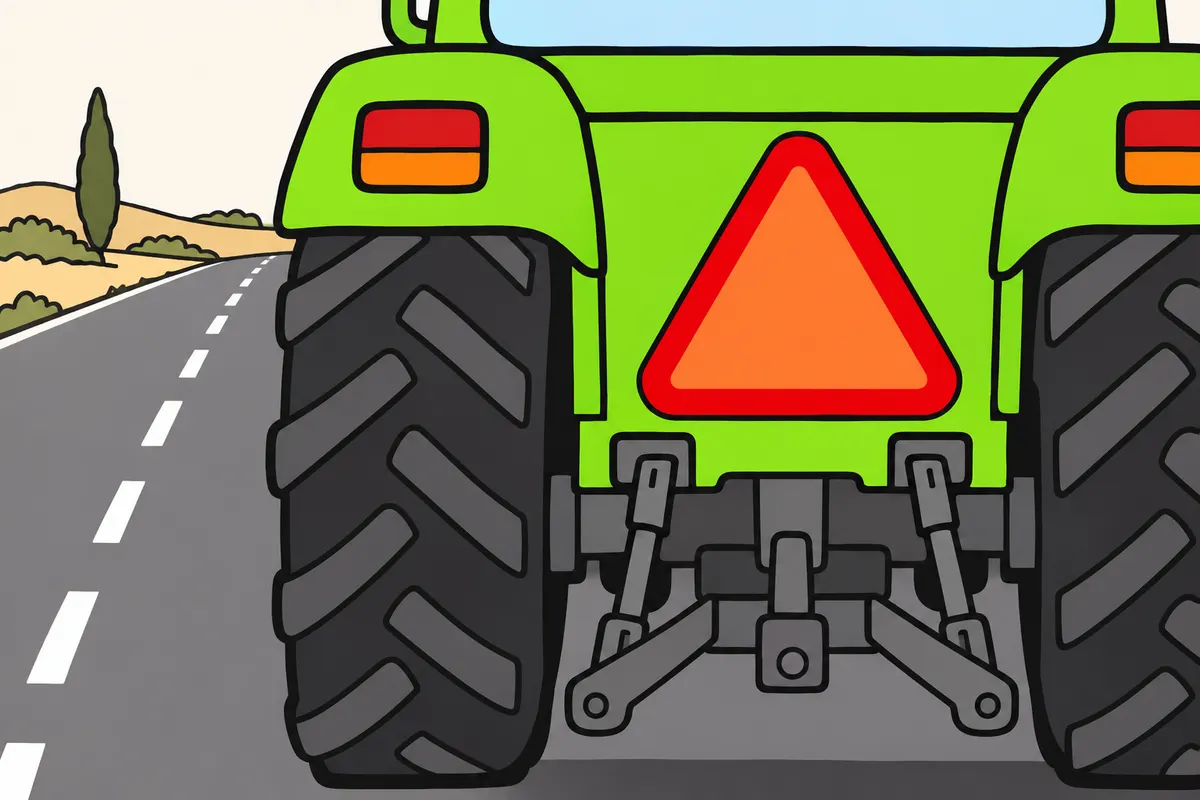
Distinguish the plate limiting your speed from the one identifying a slow-moving vehicle.
| Sign | What you must distinguish |
|---|---|
| V-4 | Shows the speed your vehicle must not exceed |
| V-5 | Identifies a vehicle or combination unable to exceed 40 km/h by design |
| V-5 when V-4 is required | Optional |
Remember
- Keep V-4 visible at the rear of special vehicles and their combinations.
- You need it even if only one part of the combination is special.
- Obey any lower limit applying to your route.
- Do not confuse these plates with registration plates or the V-2 light.
Exam trap: Wrong: driving slowly makes any tractor a slow-moving vehicle. Right: V-5 identifies a maximum design speed not exceeding 40 km/h.
Read the full explanation
- The V-4 sign indicates the speed that you must not exceed in the vehicle. You must display it at the rear, visible at all times, on special vehicles and combinations that include them, even if only one component is a special vehicle. You must check that the implement does not obscure the plate. [RGV, Annex XI, signs V-4 and V-5](https://www.boe.es/buscar/act.php?id=BOE-A-1999-1826#v-4).
- The figure on the V-4 does not allow you to exceed a lower limit applicable to your route. You must also comply with road restrictions and adapt your speed; the full rules are covered in «Speed and distances for agricultural vehicles». [RGV, Annex XI, signs V-4 and V-5](https://www.boe.es/buscar/act.php?id=BOE-A-1999-1826#v-4).
- The V-5 identifies a motor vehicle or combination that cannot exceed 40 km/h by design. The classification depends on its design: a tractor built to reach 45 km/h does not become a vehicle within that definition because you drive it at 20. [RGV, Annex XI, V-5](https://www.boe.es/buscar/act.php?id=BOE-A-1999-1826#v-5) [RGV, Annex XI, signs V-4 and V-5](https://www.boe.es/buscar/act.php?id=BOE-A-1999-1826#v-4).
- The V-5 is optional on vehicles or combinations on which you must display the V-4. [RGV, Annex XI, signs V-4 and V-5](https://www.boe.es/buscar/act.php?id=BOE-A-1999-1826#v-4).
23Prepare implements for transport
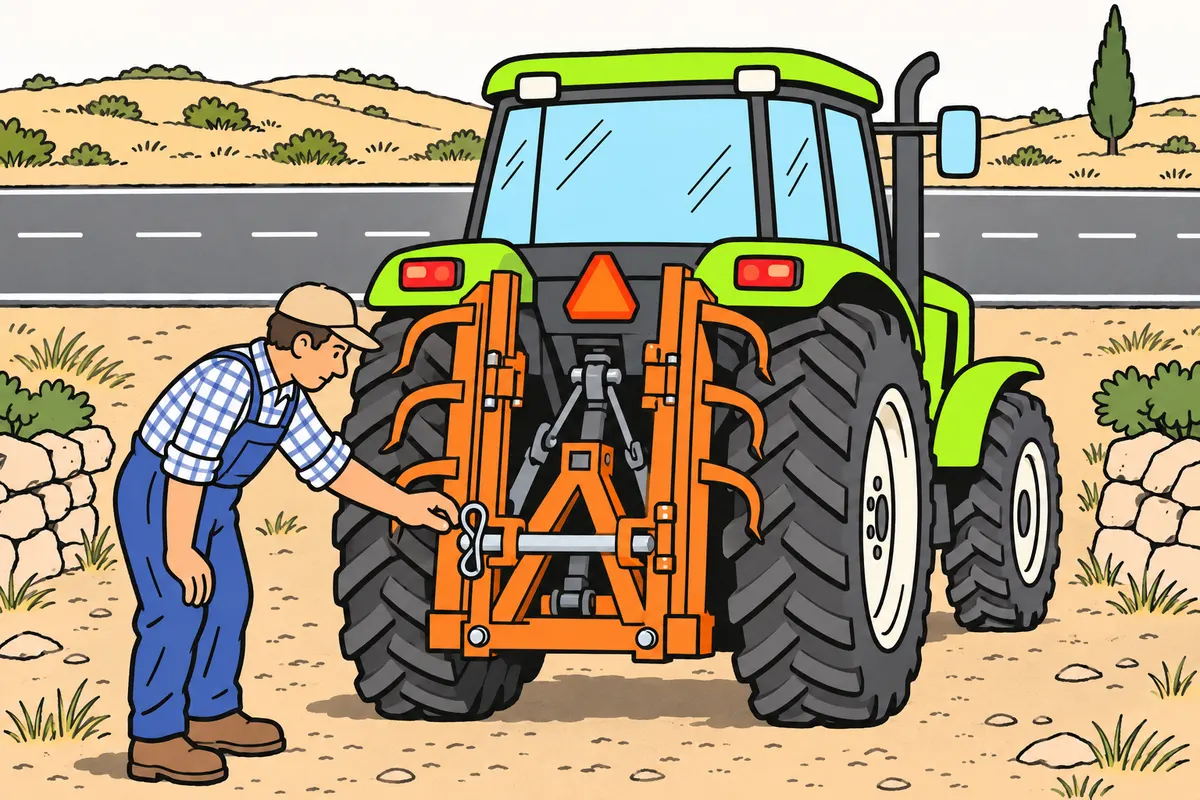
Prepare and secure implements before entering a public road.
Remember
- Use public roads for travel, not agricultural work.
- Put implements in their transport position following the manufacturer’s instructions.
- Check folding parts, locks and fixings.
- Stop tools or materials falling, dragging or moving dangerously.
- Keep lights, signs and plates visible.
- With mounted implements, check projections, mass distribution, stability, your view and control.
Exam trap: Wrong: you may carry loads on roads with any special vehicle. Right: it must be specifically intended for special transport services, and you need the corresponding authorisation.
Read the full explanation
- You may use public roads with a special agricultural vehicle only to travel; you must not carry out the agricultural work for which it is built on those roads. Article 71.1 also prohibits driving special vehicles carrying loads, except those specifically intended for special transport services with the corresponding authorisation. Transport and securing loads are covered in «Loads, implements and agricultural traffic». [RGC, art. 71.1](https://www.boe.es/buscar/act.php?id=BOE-A-2003-23514#a71).
- Before moving from agricultural work onto the road, you must place the implements in their transport position in accordance with the manufacturer’s instructions. As a practical check, inspect the relevant folding mechanisms, locks and fastenings; simply raising the equipment does not prove that it is secured. [RGC, arts. 14 and 18](https://www.boe.es/buscar/act.php?id=BOE-A-2003-23514#a14).
- You must prevent tools, materials or accessories from falling, dragging or moving dangerously. You must also place small, light objects securely; you must not leave them loose near the controls or hang them from any convenient point to gain space in the cab. [RGC, arts. 14 and 18](https://www.boe.es/buscar/act.php?id=BOE-A-2003-23514#a14).
- Your equipment must not compromise stability or obscure compulsory lighting, signs or plates. You must check the combination from outside, especially from behind: checking the tractor’s lights without the implement fitted may not reflect what other road users will see. [RGC, arts. 14 and 18](https://www.boe.es/buscar/act.php?id=BOE-A-2003-23514#a14).
- With a mounted implement, you must take account of projections and changes in weight distribution when preparing the vehicle. You must position it so that you retain visibility and control; securing equipment and the rules on projections are covered in detail in «Loads, implements and agricultural traffic». [RGC, arts. 14 and 18](https://www.boe.es/buscar/act.php?id=BOE-A-2003-23514#a14).
24Compatible couplings and equipment
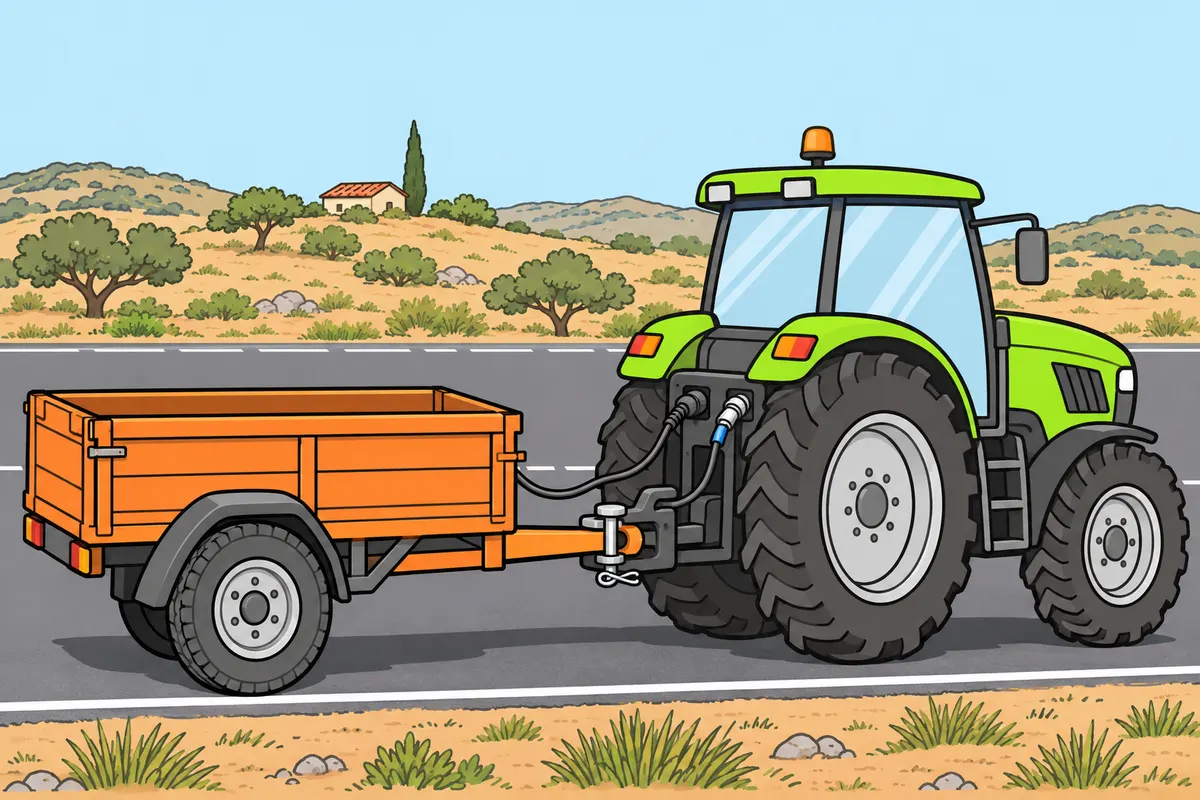
Form compatible combinations and respect braking requirements and the strictest technical limits.
| Agricultural vehicle or unit | Condition you must check |
|---|---|
| Tractor or portador | May tow agricultural trailers, towed machines and implements within limits |
| Self-propelled machine | Trailer and towed machine must form a working unit and appear in its certificate |
| Motocultor | May tow agricultural trailers, single-axle towed machines and implements, within limits |
| Motocultor without brakes | Do not attach units without brakes, with overrun brakes, or brakes you cannot operate from your seat |
| Unbraked agricultural trailer, except header trailers | Maximum MMA 1,500 kg |
| Header trailer | May have no service brake |
| Unbraked towed agricultural machine | Maximum MMA 3,000 kg |
| Towed agricultural unit with overrun brakes only | Maximum MMA 6,000 kg; also respect other limits |
Remember
- Check the coupling and mechanical, electrical and braking connections.
- The coupling needs a device preventing it from coming loose.
- Respect towing capacity and the strictest mass ratios.
- Distinguish these limits from the 750 kg registration threshold.
Exam trap: Wrong: a coupling pin fitting proves you can tow. Right: check compatibility, brakes, documentation and every applicable limit.
Read the full explanation
- You must assemble combinations with compatible couplings and suitable mechanical, electrical and braking connections. The coupling needs a component that prevents it from coming undone. The fact that the pin fits into a hole does not in itself prove that the trailer and tractor are compatible for road use. [RGV, art. 13 and Annex IX.5](https://www.boe.es/buscar/act.php?id=BOE-A-1999-1826#A5).
- You may tow agricultural trailers, towed agricultural machines and implements with agricultural tractors and carriers within the regulatory conditions and limits. With self-propelled agricultural machines, the trailers and towed machines must form a working unit with them and be recorded as such on their certificado de características (certificate of technical characteristics). [RGV, art. 13 and Annex IX.5](https://www.boe.es/buscar/act.php?id=BOE-A-1999-1826#A5).
- You may tow agricultural trailers, single-axle towed agricultural machines and implements with walking tractors, subject to the applicable restrictions. If your walking tractor has no brakes, you must not couple it to a towed unit with no brakes, with overrun brakes or with brakes that you cannot operate from the driving position. [RGV, art. 13 and Annex IX.5](https://www.boe.es/buscar/act.php?id=BOE-A-1999-1826#A5).
- You must comply with the technical towing capacity and the mass ratios applicable to the combination. For unbraked agricultural trailers, the maximum MMA (maximum authorised mass) is 1,500 kg; for unbraked towed agricultural machines, it is 3,000 kg. Header trailers may have no service brake: this provision establishes that exception without assigning them a specific mass figure. [RGV, Annex IX, paragraph 5.6.2.1](https://www.boe.es/buscar/act.php?id=BOE-A-1999-1826#A5). [RGV, Annex VIII.2, notes (2) and (4)](https://www.boe.es/buscar/act.php?id=BOE-A-1999-1826#A2-4).
- With overrun brakes only, the MMA of your towed agricultural unit must not exceed 6,000 kg. This ceiling does not replace the technical limits or the other conditions applicable to the combination. You must distinguish these braking thresholds from the 750 kg threshold that determines whether separate registration is required. [RGV, Annex IX, paragraph 5.6.2.2](https://www.boe.es/buscar/act.php?id=BOE-A-1999-1826#A5). [RGV, Annex VIII.2, notes (2) and (4)](https://www.boe.es/buscar/act.php?id=BOE-A-1999-1826#A2-4).
Decide whether LVA is sufficient
Check the vehicle and combination before driving.
- Identify the self-propelled agricultural vehicle category and the equipment it carries or tows.
- Check its documentation for its maximum design speed, masses and dimensions.
- Check that it exceeds neither the applicable ordinary limits nor a maximum design speed of 45 km/h.
- If it exceeds any of these limits, you need B; check the vehicle's authorisations for road use separately.
- If it falls within the scope of LVA, check that your driving entitlement is valid and prepare the equipment for the journey.
Switch from work to road use
Check the equipment in its actual transport configuration.
- Put implements in the transport position and secure their locking devices following the manufacturer's instructions.
- Check the combination's compatibility, pins, connections and fastenings.
- Check masses, dimensions, visibility and seating places; secure tools and objects.
- Clean and check lights, reflectors, number plates and other plates; check that V-2 is visible.
- Raise and secure the rollover protection bar where fitted, adjust the seat and fasten the fitted seat belt.
- Check brakes, steering, tyres and mirrors in accordance with the manufacturer's instructions; correct defects that compromise safety before setting off.
Check what you know
Real questions from the bank on this topic. Pick an answer to see the explanation.
Finished this module?
Mark it as read and you will see your progress on the theory list.