
Theory · LVA Licence - Agricultural Vehicle · Module 6 of 16
Road use with agricultural vehicles
You learn to choose the carriageway, lane or arcén (hard shoulder) appropriate for your agricultural vehicle according to its MMA (maximum authorised mass) and the traffic arrangements on the road. You distinguish prohibited roads, special lanes, road markings and tunnel rules to deal with situations in the LVA test.
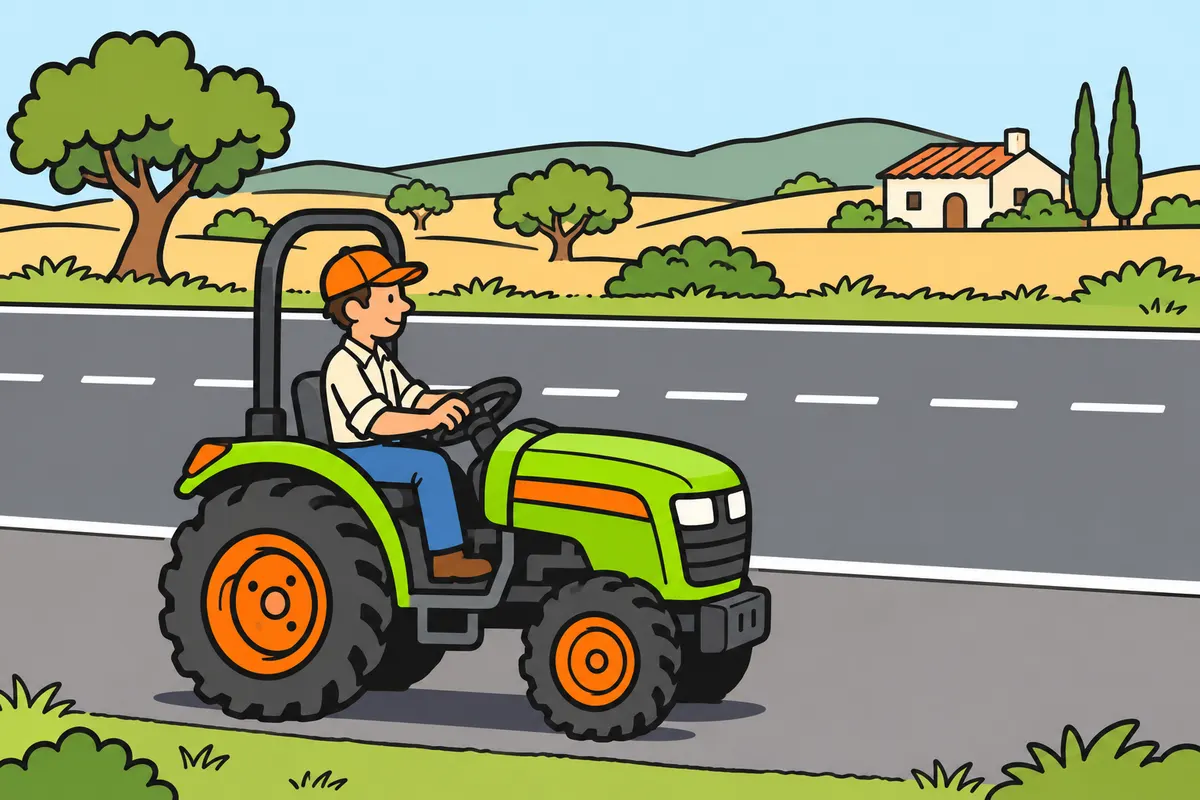
1Decide where you may drive
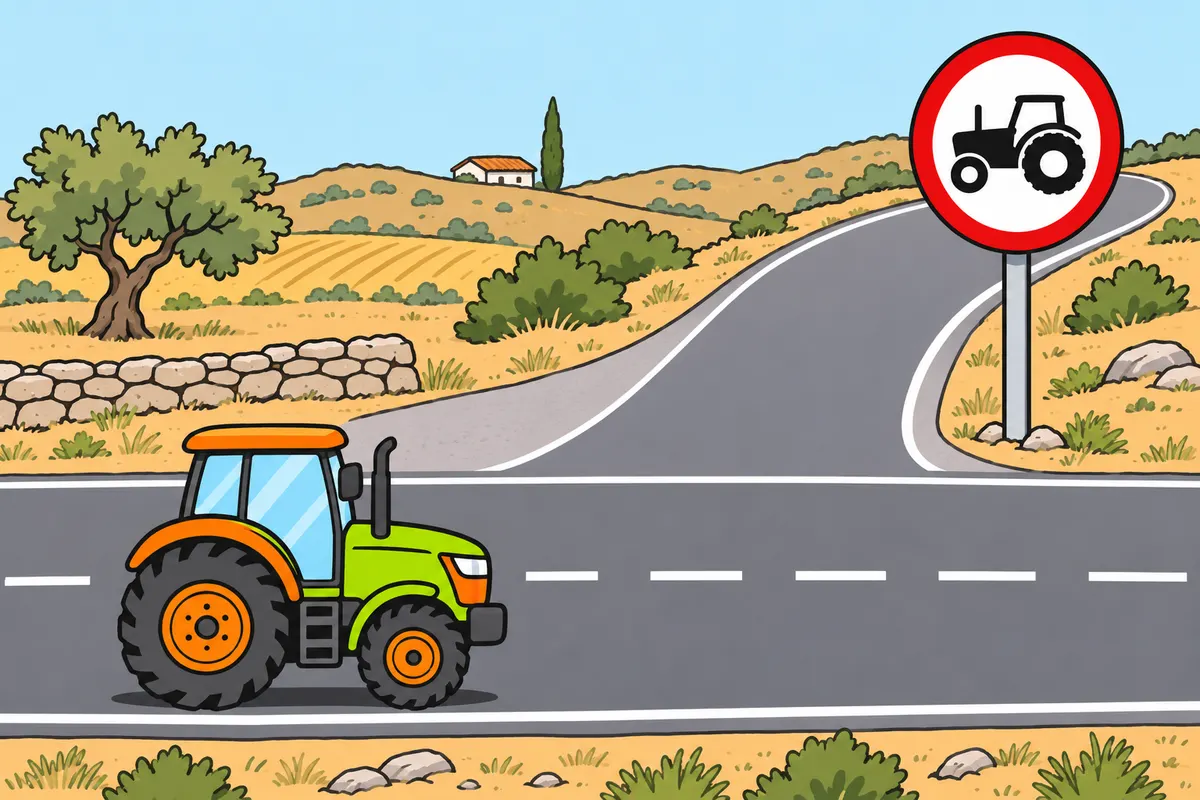
Check whether your vehicle may enter before choosing where to drive.
Remember
- Check access, the permitted direction and where you must drive.
- Your licence does not allow you onto every road.
- Obey closures, restrictions and compulsory routes.
- Look at signs, markings and entrances.
Exam trap: Wrong: you may enter because the hard shoulder is wide. Right: first check whether your vehicle is allowed onto the road.
Read the full explanation
- To choose where to drive your agricultural vehicle, identify where access is permitted, the authorised direction of travel and the part of the road your vehicle must use. In an image, locate the carriageways, dividers, lanes and arcén (hard shoulder) before positioning the tractor; your driving licence and permission to use a road are separate matters.
- The authorities may change the direction of traffic, close a road, restrict access for certain classes of vehicle or impose compulsory routes for safety, traffic flow or environmental reasons. You must follow these arrangements even on familiar journeys between farms. [RGC, art. 37](https://www.boe.es/buscar/act.php?id=BOE-A-2003-23514#a37)
2Keep to the right
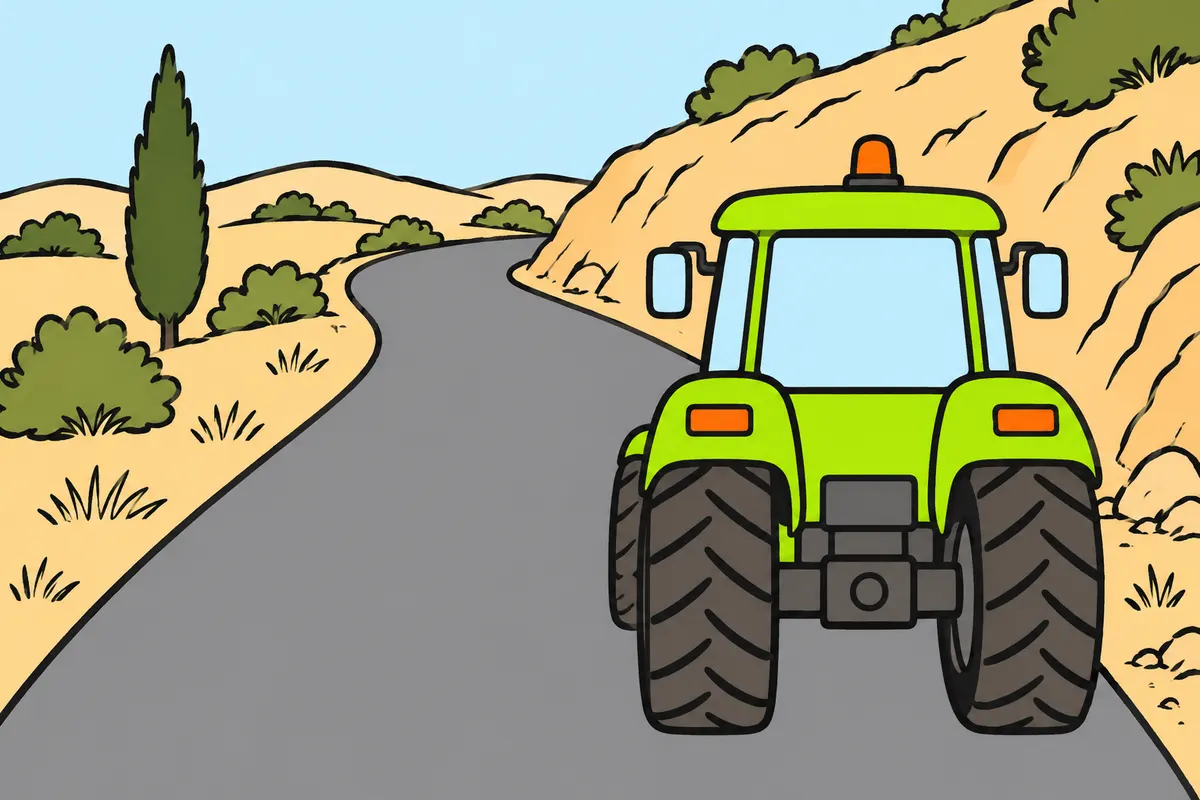
Keep right and leave enough room to pass oncoming traffic safely.
Remember
- Keep near the edge while leaving enough space beside you.
- Allow for the full width of your tractor and its equipment.
- On bends with poor visibility, keep the whole opposite half clear.
- Do the same at crests with poor visibility.
- Do this even without lines or visible oncoming vehicles.
- Do not drive onto the pavement to move aside.
Exam trap: Wrong: without a painted line, you may use the centre on a blind bend. Right: keep the whole opposite half clear.
Read the full explanation
- You must drive on the right and as close as possible to the edge of the carriageway, leaving the lateral clearance needed to pass oncoming traffic safely. This rule requires particular care with a wide tractor: you must also take account of the space occupied by the vehicle's components. [RGC, art. 29](https://www.boe.es/buscar/act.php?id=BOE-A-2003-23514#a29)
- On bends and at crests with restricted visibility, you must leave the half of the carriageway for oncoming traffic completely clear. This duty applies even if there is no painted line and you cannot see anyone approaching; the restricted visibility itself may prevent you from spotting them. [RGC, art. 29](https://www.boe.es/buscar/act.php?id=BOE-A-2003-23514#a29)
- You must not make the centre of a narrow road your normal driving position to keep away from the edge. You must maintain control and safe lateral clearance within the space for your direction of travel. If passing looks difficult, anticipate the situation and avoid encroaching on the path of oncoming traffic. [RGC, art. 29](https://www.boe.es/buscar/act.php?id=BOE-A-2003-23514#a29)
- Keeping to the right does not mean driving your wheels onto a pavement or using any strip at the side of the road. You must apply the specific hard shoulder rule when it applies to your vehicle and respect the boundaries between areas used for traffic. The exceptions for passing obstacles are covered in «Manoeuvres with agricultural vehicles». [RGC, art. 29](https://www.boe.es/buscar/act.php?id=BOE-A-2003-23514#a29)
- To help other vehicles overtake your agricultural vehicle, consult «Manoeuvres with agricultural vehicles», section «When another vehicle overtakes you»; it also explains the exception for overtaking slow agricultural vehicles on stretches where overtaking is prohibited.
3Up to 3,500 kg: the right-hand hard shoulder
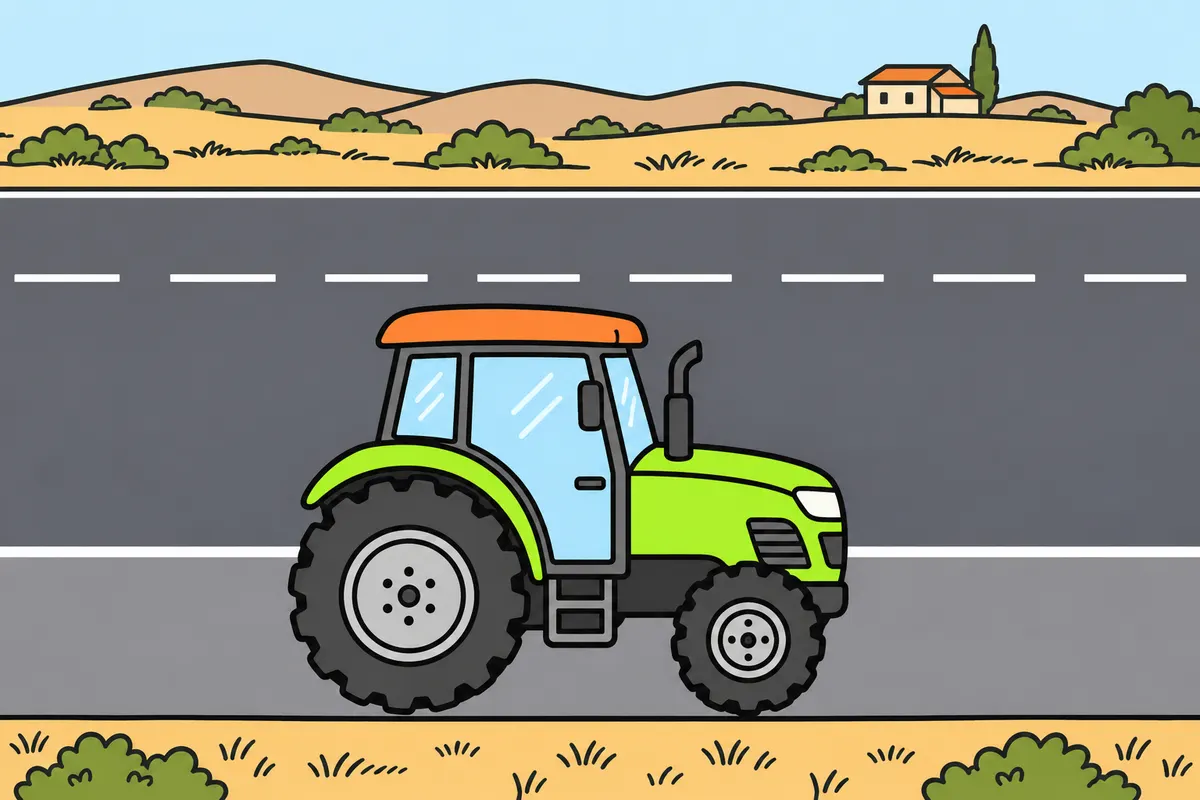
With MMA up to 3,500 kg, use the right-hand hard shoulder when conditions allow.
| Special vehicle up to 3,500 kg, without its own space | Where you must drive |
|---|---|
| Usable and sufficient right-hand hard shoulder | On that hard shoulder |
| Hard shoulder absent, unusable or insufficient | Only as much carriageway as necessary |
Remember
- MMA means maximum authorised mass, not your weight today.
- At exactly 3,500 kg, you belong to this group.
- If space is specifically provided for your vehicle, follow that arrangement.
- Without that space, use the right-hand hard shoulder if usable.
- The hard shoulder must also be wide enough for your vehicle.
- If absent or unsuitable, use only as much carriageway as necessary.
Exam trap: Wrong: when unladen, you decide using unladen mass. Right: use MMA; up to 3,500 kg, without space specifically provided for your vehicle, you must use a usable and sufficient right-hand hard shoulder.
Read the full explanation
- If you drive a special vehicle whose MMA (maximum authorised mass) does not exceed 3,500 kg and there is no road or part of a road specifically reserved for it, you must use the hard shoulder on your right when it is usable and wide enough. This is an obligation subject to those conditions, not a choice between two equivalent driving positions. [RGC, art. 36](https://www.boe.es/buscar/act.php?id=BOE-A-2003-23514#a36)
- The limit includes exactly 3,500 kg. When answering, you must look at the maximum authorised mass, not the unladen mass or the weight you carry on that journey. An unloaded vehicle retains its MMA and the road use rule that follows from it. [RGC, art. 36](https://www.boe.es/buscar/act.php?id=BOE-A-2003-23514#a36)
- If there is no hard shoulder, or it is unusable or too narrow, you must use only as much of the carriageway as is essential. [RGC, art. 36](https://www.boe.es/buscar/act.php?id=BOE-A-2003-23514#a36)
- You must assess whether the hard shoulder is suitable for your particular vehicle, taking account of its width and configuration. The fact that a bicycle can pass does not show that you can do so with your agricultural vehicle. You must also avoid confusing the mere presence of a paved strip at the side with a usable hard shoulder. [RGC, art. 36](https://www.boe.es/buscar/act.php?id=BOE-A-2003-23514#a36)
- If part of the road is specifically reserved for your class of vehicle, you must follow that arrangement. The hard shoulder rule applies when no such space exists. Before applying it from memory, identify the conditions in the question and the signs and markings on that stretch. [RGC, art. 36](https://www.boe.es/buscar/act.php?id=BOE-A-2003-23514#a36)
4Over 3,500 kg: the carriageway
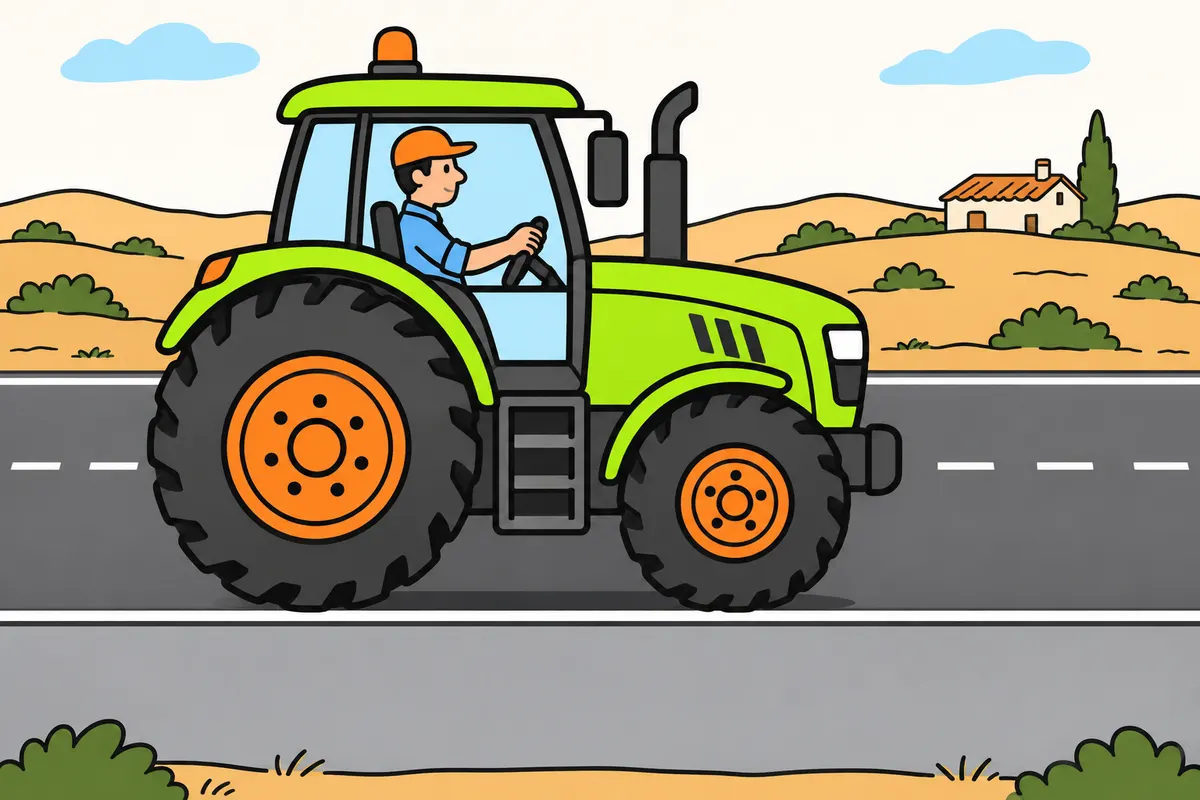
With MMA over 3,500 kg, use the carriageway except in an emergency.
Remember
- Do not use the hard shoulder for normal driving.
- A wide hard shoulder does not change this rule.
- Driving slowly is not an emergency by itself.
- A queue behind you does not allow you onto the hard shoulder.
Exam trap: Wrong: above 3,500 kg, you use the hard shoulder to let a queue pass. Right: use the carriageway; use the hard shoulder only in an emergency.
Read the full explanation
- If your special vehicle has an MMA above 3,500 kg, you must drive on the carriageway and not on the hard shoulder, except in an emergency. [RGC, arts. 30.1 and 31.1](https://www.boe.es/buscar/act.php?id=BOE-A-2003-23514#a30) ([art. 31.1](https://www.boe.es/buscar/act.php?id=BOE-A-2003-23514#a31))
- A tractor's usual slow speed does not in itself constitute an emergency. If your MMA requires you to use the carriageway, you must not move onto the hard shoulder solely because a queue has formed behind you. You must help traffic flow while following the applicable rules. [RGC, arts. 30.1 and 31.1](https://www.boe.es/buscar/act.php?id=BOE-A-2003-23514#a30) ([art. 31.1](https://www.boe.es/buscar/act.php?id=BOE-A-2003-23514#a31))
- A wide and apparently strong hard shoulder does not change the MMA threshold. In an exam scenario involving a special vehicle above 3,500 kg, you must choose the carriageway as the normal driving position, even if the illustration makes it look as though the vehicle fits entirely on the strip at the side. [RGC, arts. 30.1 and 31.1](https://www.boe.es/buscar/act.php?id=BOE-A-2003-23514#a30) ([art. 31.1](https://www.boe.es/buscar/act.php?id=BOE-A-2003-23514#a31))
- The emergency exception distinguishes normal driving from an exceptional need. To choose a lane within the carriageway, you must then apply the rules on two-way traffic, built-up areas and the number of lanes. [RGC, arts. 30.1 and 31.1](https://www.boe.es/buscar/act.php?id=BOE-A-2003-23514#a30) ([art. 31.1](https://www.boe.es/buscar/act.php?id=BOE-A-2003-23514#a31))
5Share the hard shoulder without driving side by side
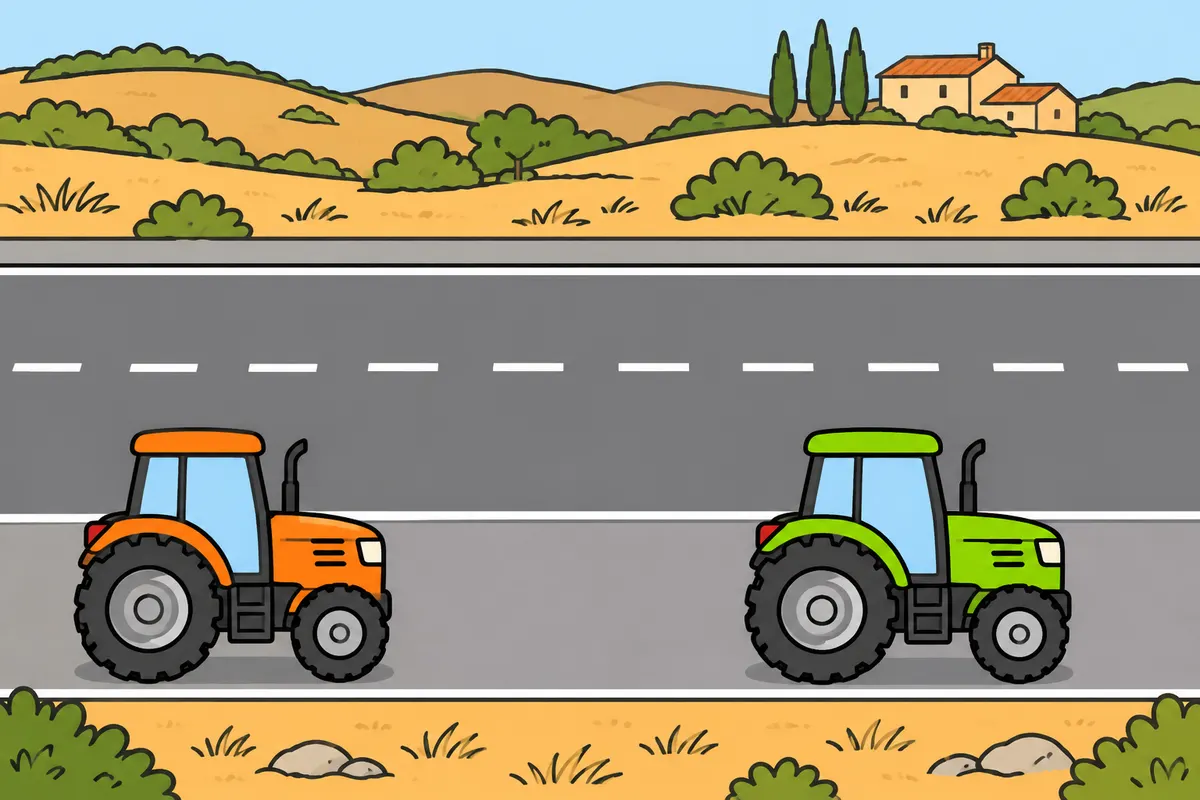
Do not drive alongside another vehicle from the same group of hard shoulder users.
Remember
- Do not drive your agricultural vehicle alongside another vehicle from the same group.
- The exception allowing cyclists to ride two abreast does not cover your tractor.
- When overtaking under this group’s rule, do not exceed either limit.
- Overtake only with enough safety, space and visibility.
- Keep driving correctly around motorcycles exceptionally authorised to use the hard shoulder.
Exam trap: Wrong: you may exceed 15 seconds if you stay below 200 metres. Right: in this overtaking situation, exceeding either limit makes it prohibited.
Read the full explanation
- If your vehicle is among those listed in the first paragraph of article 36.1, you must observe the prohibition on travelling side by side. You must not continue driving your agricultural vehicle alongside another vehicle in the same group as though the hard shoulder had two normal lanes. [RGC, art. 36](https://www.boe.es/buscar/act.php?id=BOE-A-2003-23514#a36)
- The exception allowing cyclists to ride two abreast does not apply to your tractor. Sharing their obligation to use the hard shoulder does not mean you share all their exceptions. Each exception applies to the class of vehicle specified in the rule. [RGC, art. 36](https://www.boe.es/buscar/act.php?id=BOE-A-2003-23514#a36)
- When overtaking under article 36.5, you must not keep the vehicles alongside each other for more than 15 seconds or travel more than 200 metres in that way. Exceeding either limit is enough for it to be prohibited; you do not need to exceed both at once. [RGC, art. 36](https://www.boe.es/buscar/act.php?id=BOE-A-2003-23514#a36)
- The 15 seconds and 200 metres are limits for that specific situation, not automatic permission to overtake. You must also meet the general conditions for safety, space and visibility. How to carry out the manoeuvre is covered in «Manoeuvres with agricultural vehicles». [RGC, art. 36](https://www.boe.es/buscar/act.php?id=BOE-A-2003-23514#a36)
- You may encounter motorcycles on stretches where use of the right-hand hard shoulder is exceptionally authorised and traffic in the lanes is at a standstill due to congestion. Their riders must avoid putting you at risk and leave the hard shoulder if necessary; that authorisation does not remove your obligation to drive correctly. [RGC, art. 36](https://www.boe.es/buscar/act.php?id=BOE-A-2003-23514#a36)
6Two-way carriageways with two or three lanes
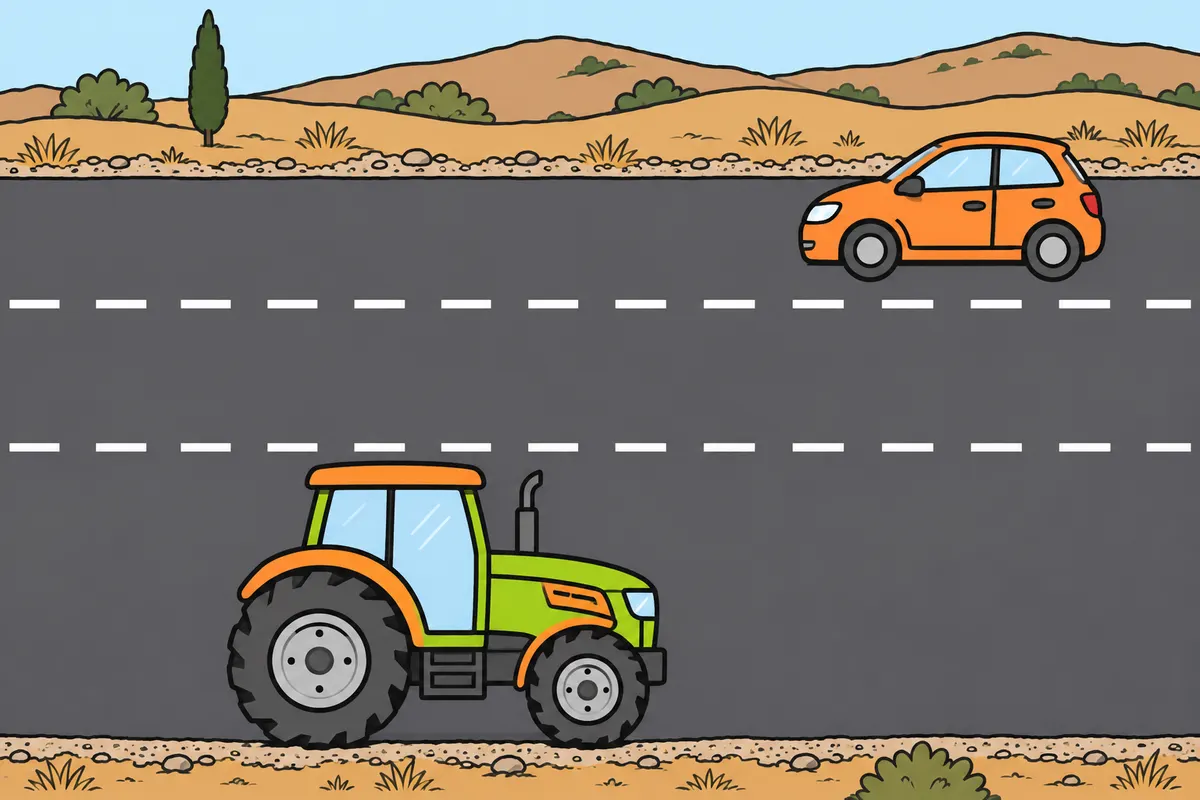
On two-way roads, keep right when you must use the carriageway.
| Two-way carriageway | Lane use when you must use the carriageway |
|---|---|
| Two lanes in total, with or without markings | Use the right-hand lane |
| Three lanes in total, separated by broken lines | Normally right; centre only for overtaking or turning left |
Remember
- With two lanes in total, use the right, even without lines.
- With three total lanes separated by broken lines, normally use the right.
- Then use the centre only for overtaking or turning left.
- Do not use the far-left lane: it is for oncoming traffic.
- If you must use the hard shoulder, these rules do not override that.
Exam trap: Wrong: with three total lanes separated by broken lines, you may normally use the centre. Right: on this two-way carriageway, normally use the right; reserve the centre for overtaking or turning left.
Read the full explanation
- On a two-way carriageway with two lanes, you must use the one on your right when you are required to drive on the carriageway. The rule applies whether or not the lanes are separated by road markings; the absence of a line does not give you a free choice of where to drive. [RGC, art. 30](https://www.boe.es/buscar/act.php?id=BOE-A-2003-23514#a30)
- If there are three lanes in total, traffic travels in both directions and the lanes are separated by broken lines, you must normally drive in the right-hand lane. You use the centre lane only for necessary overtaking and for turning left. It is not a normal lane for driving your tractor for kilometres at a time. [RGC, art. 30](https://www.boe.es/buscar/act.php?id=BOE-A-2003-23514#a30)
- On that three-lane carriageway, you must not use the lane furthest to your left: it is for oncoming traffic. You must count the total number of lanes on the carriageway and not assume you have two available simply because the centre lane is temporarily empty. [RGC, art. 30](https://www.boe.es/buscar/act.php?id=BOE-A-2003-23514#a30)
- Do not confuse three lanes in total serving both directions with three lanes for your direction of travel. These are different situations with different rules. If your agricultural vehicle must use the hard shoulder, you must not use this layout to justify leaving a usable hard shoulder that is wide enough. [RGC, art. 30](https://www.boe.es/buscar/act.php?id=BOE-A-2003-23514#a30)
7Multiple lanes outside built-up areas
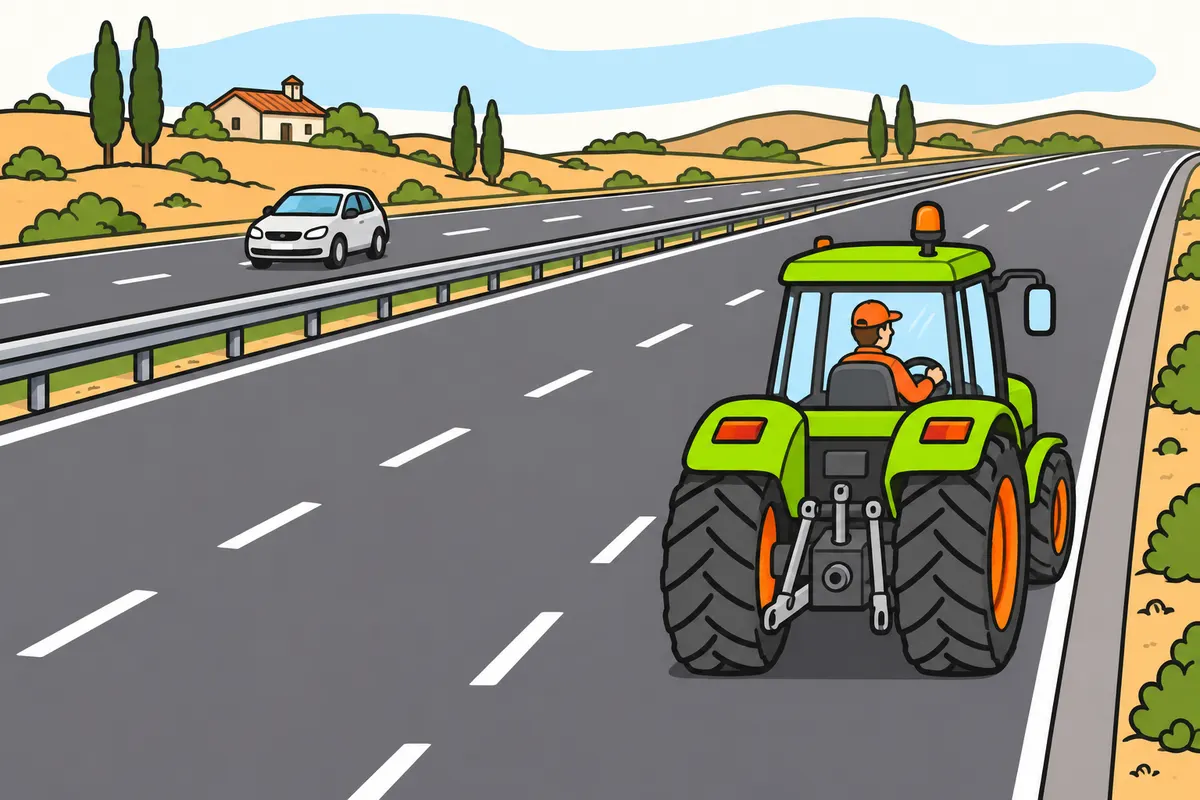
Outside built-up areas, normally use the right-hand lane and respect lane restrictions.
| Outside built-up areas: three or more lanes in your direction | Permitted lanes |
|---|---|
| Special vehicle not required to use the hard shoulder | Normally right; also its immediate neighbour when appropriate, without obstructing others |
| Combination over 7 metres | Normally right; also its immediate neighbour when appropriate, without obstructing others |
Remember
- With your special vehicle over 3,500 kg, normally use the right-hand lane.
- Use other permitted lanes when road or traffic conditions make this advisable.
- Do not obstruct drivers behind you.
- With three or more lanes in your direction, check the special restriction.
- With a trailer, check the total length of your combination.
Exam trap: Wrong: outside built-up areas, you may use any empty lane. Right: with three or more lanes in your direction, a special vehicle not required to use the hard shoulder may use only the right and its immediate neighbour under the permitted conditions, without obstructing others.
Read the full explanation
- Outside built-up areas, when you drive your special vehicle weighing more than 3,500 kg on a carriageway with several lanes in your direction, you must normally use the lane furthest to the right. You may use the other permitted lanes if road or traffic conditions make this advisable, without obstructing anyone following you. [RGC, art. 31](https://www.boe.es/buscar/act.php?id=BOE-A-2003-23514#a31)
- If there are three or more lanes in your direction, you normally use the right-hand lane in a special vehicle that is not required to use the arcén (hard shoulder), and you may use the lane immediately next to it under the conditions laid down in the regulations. You must not move into the other lanes in that direction for convenience or because they are empty. [RGC, art. 31](https://www.boe.es/buscar/act.php?id=BOE-A-2003-23514#a31)
- The restriction to the right-hand lane and the lane immediately next to it also applies to vehicle combinations more than 7 metres long. If you drive a tractor with a trailer, you must check the length of the combination when answering the question. The expression “more than 7” does not include exactly 7 metres under this criterion. [RGC, art. 31](https://www.boe.es/buscar/act.php?id=BOE-A-2003-23514#a31)
- To apply these rules, count only the lanes in your direction and check whether you are outside a built-up area. A road with two lanes in each direction and one with three present different situations for a heavy tractor or a long combination. [RGC, art. 31](https://www.boe.es/buscar/act.php?id=BOE-A-2003-23514#a31)
8Choosing a lane in built-up areas
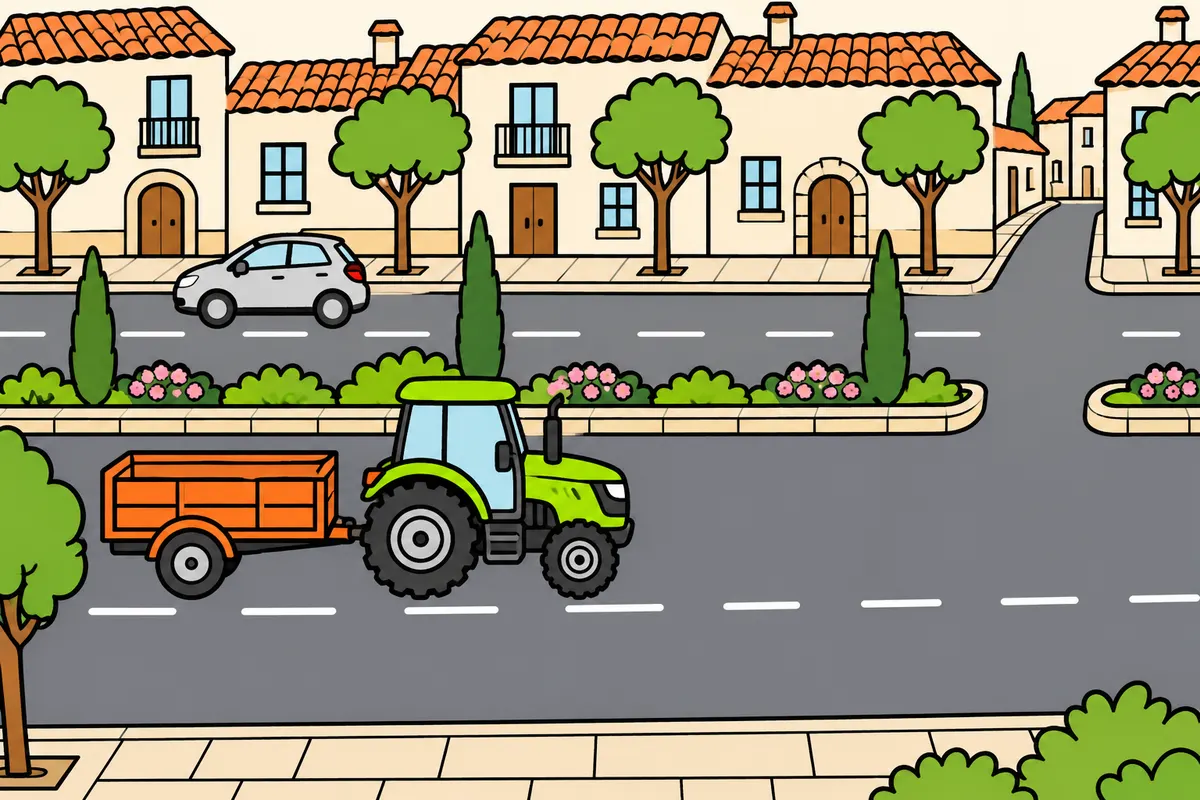
In built-up areas, you may choose a lane for your destination when conditions allow.
Remember
- You need at least two marked lanes in your direction.
- Choose the lane you need without obstructing others.
- Leave it only to prepare a turn, overtake, stop or park.
- Obey markings that allow or prohibit movements.
- This rule does not apply on autopistas or autovías.
- Without these lane markings, keep right.
Exam trap: Wrong: any wide street lets you choose a lane. Right: in built-up areas, outside autopistas and autovías, you need at least two marked lanes in your direction and must not obstruct others.
Read the full explanation
- In a built-up area, if there are at least two lanes in your direction marked by longitudinal road markings, you may, as the driver of a special vehicle, use the lane that best suits your destination, provided you do not obstruct others. You must choose it in good time, especially if you are towing a trailer. [RGC, art. 33](https://www.boe.es/buscar/act.php?id=BOE-A-2003-23514#a33)
- Once you have chosen your lane, you must only leave it to prepare for a turn, overtake, stop or park. When choosing a lane to suit your destination, you must also follow the markings that permit or prohibit movements. [RGC, art. 33](https://www.boe.es/buscar/act.php?id=BOE-A-2003-23514#a33)
- This rule does not apply to autopistas and autovías (motorways), even where they pass through a built-up area. In your case, you must also first take account of the access prohibition for the agricultural vehicle you drive with an LVA licence. Being between buildings does not turn every carriageway into a street where you can freely choose your lane. [RGC, art. 33](https://www.boe.es/buscar/act.php?id=BOE-A-2003-23514#a33)
- If there are no markings defining these lanes, you must not assume that you have the same freedom of choice simply because the street is wide. You must follow the general rule of keeping to the right and comply with the traffic arrangements in place. The requirement for marked lanes forms part of the legal conditions. [RGC, art. 33](https://www.boe.es/buscar/act.php?id=BOE-A-2003-23514#a33)
9Urban spaces and directions authorised for bicycles
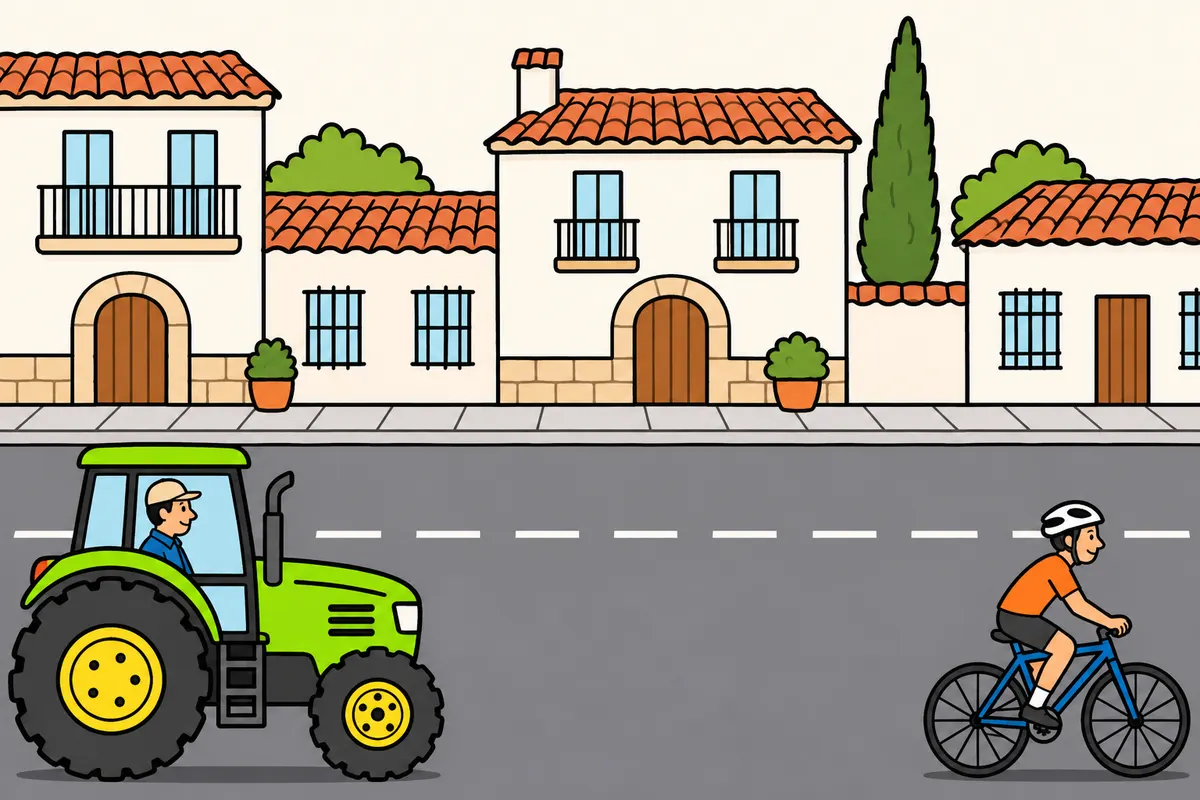
Respect urban spaces and exceptions that allow only bicycles to travel against traffic.
Remember
- Do not drive your agricultural vehicle on pavements.
- Check municipal restrictions in residential priority zones.
- The bicycle exception does not let you drive against traffic.
- For an authorised oncoming bicycle, move safely to your right.
- If you cannot, vehicles travelling in the road’s designated direction have priority.
- Check following distances in “Speed and distances for agricultural vehicles”.
Exam trap: Wrong: if a bicycle travels against traffic, you may too. Right: the exception is for bicycles, with municipal authorisation and advance signs, on single-lane urban roads limited to 30 km/h or less.
Read the full explanation
- You must not drive your agricultural vehicle on pavements: these spaces are reserved for pedestrians to move around and spend time. You must not use them to get out of a traffic queue either. You must keep to the part of the road appropriate to your vehicle and respect areas reserved for other users. [RGC, art. 152.1](https://www.boe.es/buscar/act.php?id=BOE-A-2003-23514#a1-5)
- In residential priority zones or areas, you must check municipal access and traffic restrictions. You must not assume that being close to a farm authorises you to drive through any restricted area. Access arrangements may differ from those in nearby streets. [RGC, art. 152.3](https://www.boe.es/buscar/act.php?id=BOE-A-2003-23514#a1-5)
- On urban roads with a single lane and a speed limit of 30 km/h or below, the municipal authority may allow bicycles to travel in both directions, with advance signs. You must anticipate this authorised traffic without assuming that you may also drive your tractor along the street in the opposite direction. [RGC, art. 153.6](https://www.boe.es/buscar/act.php?id=BOE-A-2003-23514#a1-6)
- When you meet a bicycle under these authorised two-way arrangements, you must move over to your right to allow it to pass safely. If this is not possible, you have priority if you are travelling in the normal direction established for the road. The authorisation to travel in the opposite direction applies to bicycles. [RGC, art. 153.6](https://www.boe.es/buscar/act.php?id=BOE-A-2003-23514#a1-6)
- For the following distance behind cyclists in the same urban lane, see “Speed and distances for agricultural vehicles”, section “A safe following distance prevents rear-end collisions”. [RGC, art. 153.4](https://www.boe.es/buscar/act.php?id=BOE-A-2003-23514#a1-6)
10Count lanes and respect their restrictions
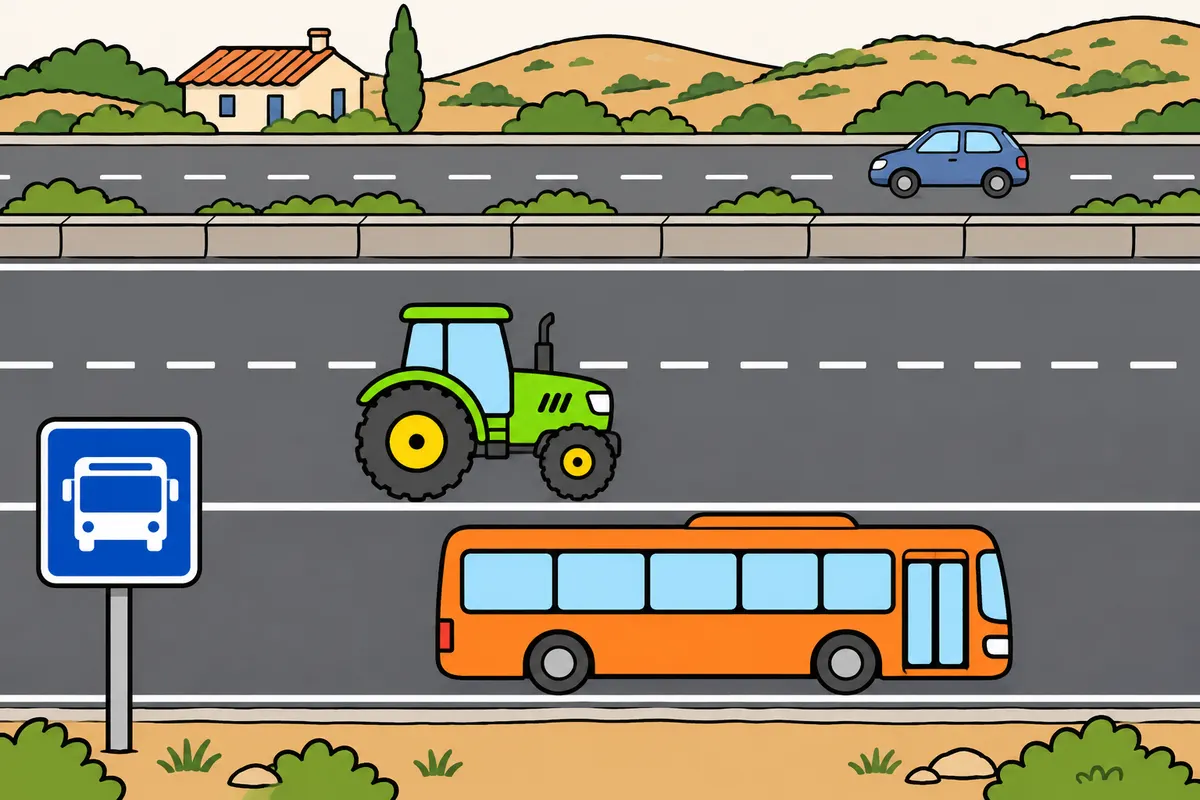
Count only general traffic lanes and respect who may use each lane.
Remember
- Do not count lanes reserved for vehicles or manoeuvres when applying general rules.
- Do not use a bus lane to overtake a queue.
- Your agricultural vehicle is not generally allowed in VAO (high-occupancy vehicle) lanes.
- Carrying a passenger does not change your vehicle class.
- Follow signs for slow-vehicle lanes.
Exam trap: Wrong: a broken line makes a bus lane a general traffic lane. Right: it may allow certain manoeuvres, but you must respect the reservation.
Read the full explanation
- When applying the general rules on the number of lanes, you must not count lanes reserved for particular vehicles or manoeuvres. An exclusive bus lane alongside two general traffic lanes does not give you three ordinary lanes to choose from. [RGC, art. 34](https://www.boe.es/buscar/act.php?id=BOE-A-2003-23514#a34)
- You must use reserved lanes and lanes regulated by speed in accordance with their signs. You must not use a bus lane to overtake a traffic queue in your tractor. A broken dividing line may allow certain manoeuvres without turning the reserved lane into a general traffic lane. [RGC, art. 35](https://www.boe.es/buscar/act.php?id=BOE-A-2003-23514#a35) [RGC, Annex I, catalogue of road markings](https://www.boe.es/buscar/act.php?id=BOE-A-2003-23514#ani)
- Your agricultural vehicle is not in one of the categories generally permitted in VAO (high-occupancy vehicle) lanes. Carrying a passenger does not turn your tractor into a passenger car, motorcycle or vehículo mixto adaptable (vehicle adaptable for carrying people or goods). You must distinguish the occupancy requirement from the authorised vehicle category. [RGC, art. 35](https://www.boe.es/buscar/act.php?id=BOE-A-2003-23514#a35)
- If a lane is reserved for slow vehicles, you must follow its signs and check which users are required to use it. You must not confuse this lane with a hard shoulder or a temporary additional lane. Markings M-1.6 and M-1.7 may separate an additional lane that you must use if you drive a slow vehicle. [RGC, Annex I, catalogue of road markings](https://www.boe.es/buscar/act.php?id=BOE-A-2003-23514#ani)
11One-way roads and separate carriageways
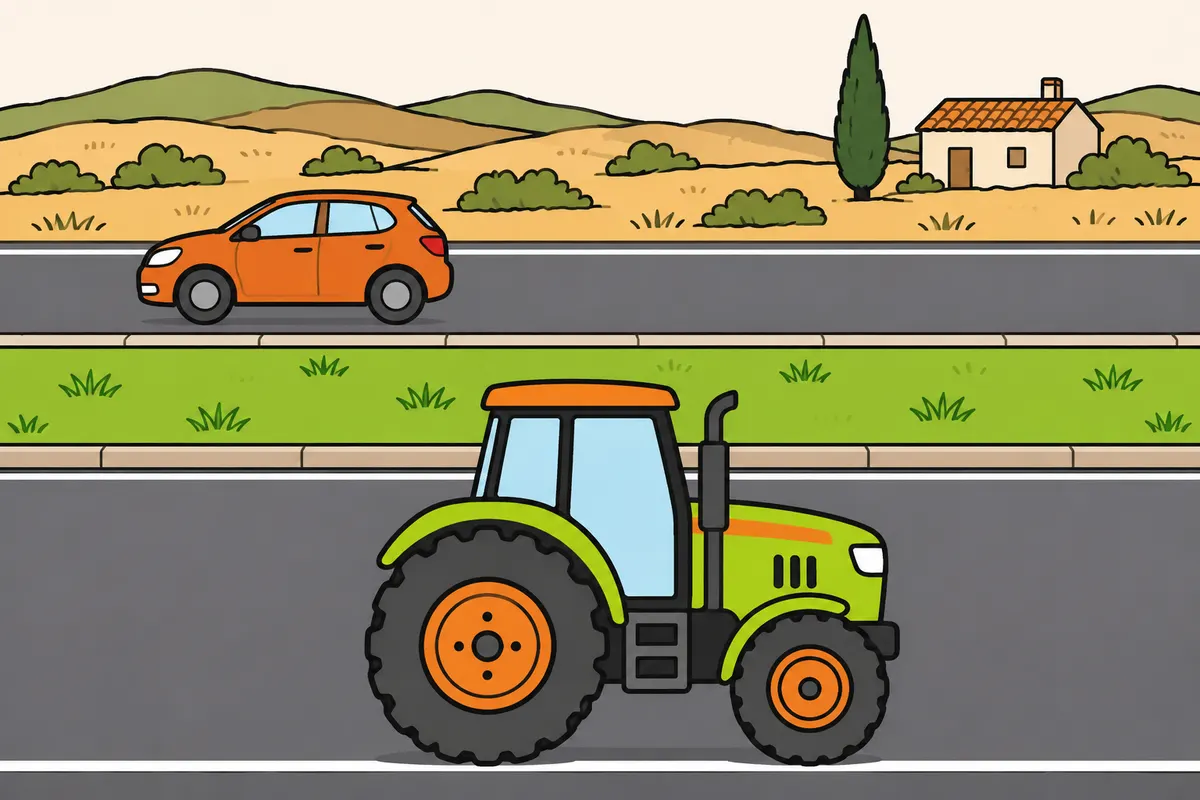
Follow the authorised direction and use the correct carriageway.
| Road | How you must drive |
|---|---|
| One-way | Only in the authorised direction |
| Two separate carriageways | Use the one on your right |
| Three carriageways | Centre: one-way or two-way as signed; outer: one-way unless signed otherwise |
Remember
- Do not drive against traffic to reach a farm sooner.
- With two separate carriageways, use the one on your right.
- With three carriageways, check signs before entering the centre one.
- The outer carriageways are one-way unless signs show another arrangement.
- Do not cross central reservations or dividers to shorten your route.
Exam trap: Wrong: you may choose the clearest carriageway. Right: with two separate carriageways, use the one on your right in your direction of travel.
Read the full explanation
- A one-way road does not allow you to drive in the opposite direction, even if the entrance to the farm is nearby. Follow the authorised direction and find a permitted route. You must not infer that a road is one-way solely from the number of visible lanes either. [RGC, art. 29](https://www.boe.es/buscar/act.php?id=BOE-A-2003-23514#a29)
- If a road is divided lengthways into two carriageways by a central reservation or separators, you must use the carriageway on your right in relation to your direction of travel. You must not choose the other one because it looks clearer or has a more convenient entrance to the land you are heading for. [RGC, art. 44](https://www.boe.es/buscar/act.php?id=BOE-A-2003-23514#a44)
- If there are three carriageways, you may find that the central one is designated for traffic in one or both directions, permanently or temporarily, according to the signs. You use the outer carriageways in one direction, unless signs indicate different arrangements. You must check the specific arrangements before entering the central carriageway. [RGC, art. 44](https://www.boe.es/buscar/act.php?id=BOE-A-2003-23514#a44)
- A service road has its own access points and is not a lane of the main road. The fact that the two run close together does not remove the access restrictions on either. Follow the authorised connections and directions without crossing central reservations or separators to shorten your route. [RGC, arts. 37 and 44](https://www.boe.es/buscar/act.php?id=BOE-A-2003-23514#a44)
12Traffic islands and roundabouts guide your path
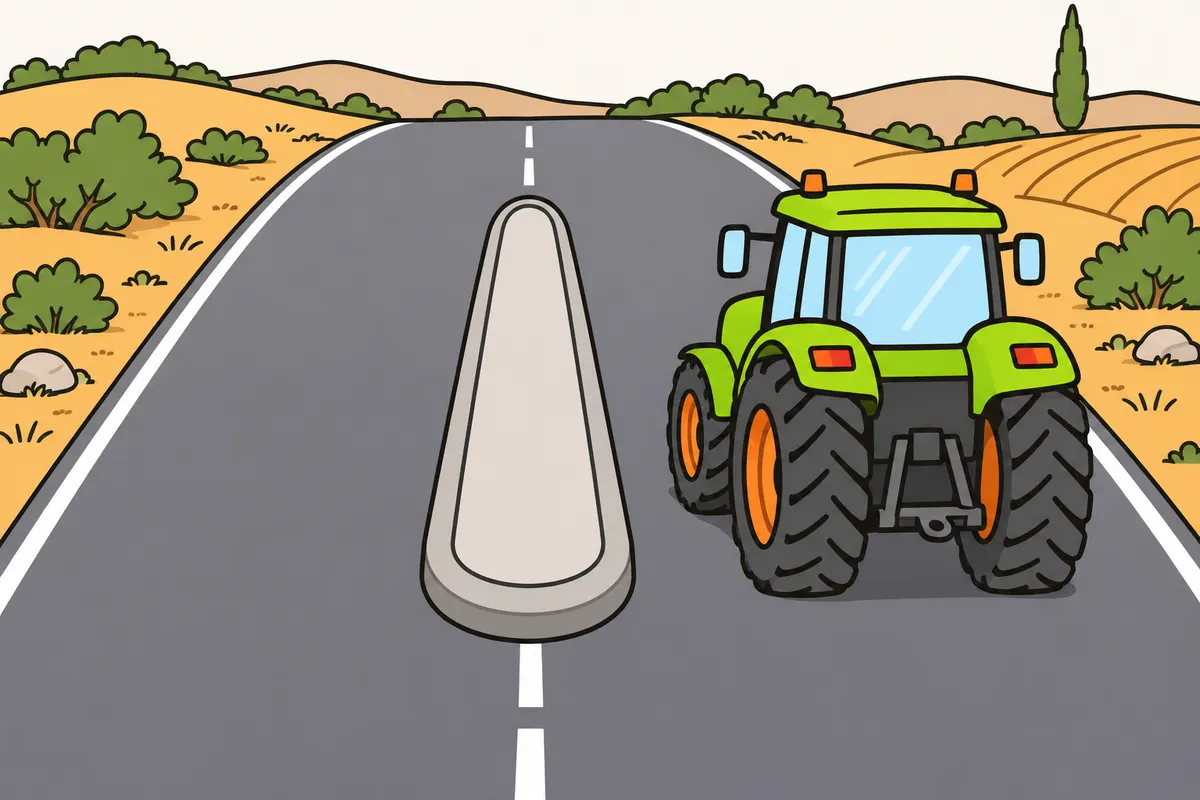
Pass islands on the permitted side; at roundabouts, keep the centre on your left.
| Island location | Side you may pass |
|---|---|
| General rule | Right |
| One-way road or part for one direction only | Either side, as the traffic arrangement allows |
Remember
- Normally, pass traffic islands and refuges on their right.
- On one-way roads, you may pass either side as the layout allows.
- This also applies to islands within the part for one direction only.
- In squares and roundabouts, keep the centre on your left.
- Keep wheels and implements out of excluded areas.
Exam trap: Wrong: you may pass any island on either side. Right: this exception requires a one-way road or an island within the part for one direction only, following the traffic arrangement.
Read the full explanation
- When you encounter a traffic island, a pedestrian refuge or a traffic guidance device, you must pass on the part of the carriageway to its right in your direction of travel. You must follow this guidance in an agricultural vehicle too; the width of your tractor does not allow you to choose the opposite side. [RGC, art. 43](https://www.boe.es/buscar/act.php?id=BOE-A-2003-23514#a43)
- If the traffic island is on a one-way road or within the part of a road assigned to a single direction, you may pass on either side in accordance with the traffic arrangements in place. You may only use this exception in those locations. [RGC, art. 43](https://www.boe.es/buscar/act.php?id=BOE-A-2003-23514#a43)
- In squares, at roundabouts and where roads meet, you must drive with the centre on your left. When driving around a roundabout, keep to the established direction and take account of the space your combination needs. See “Priority of passage” for priority on entry and “Manoeuvres with agricultural vehicles” for lane changes. [RGC, art. 43](https://www.boe.es/buscar/act.php?id=BOE-A-2003-23514#a43)
- The presence of a traffic island does not allow you to place wheels or implements on the area excluded from traffic. You must follow the designated passage and the markings that guide you through it. If there is not enough space for your combination to pass safely, you must not improvise a path that goes against the traffic arrangements. [RGC, art. 43](https://www.boe.es/buscar/act.php?id=BOE-A-2003-23514#a43)
13Autopistas and autovías: no access with LVA
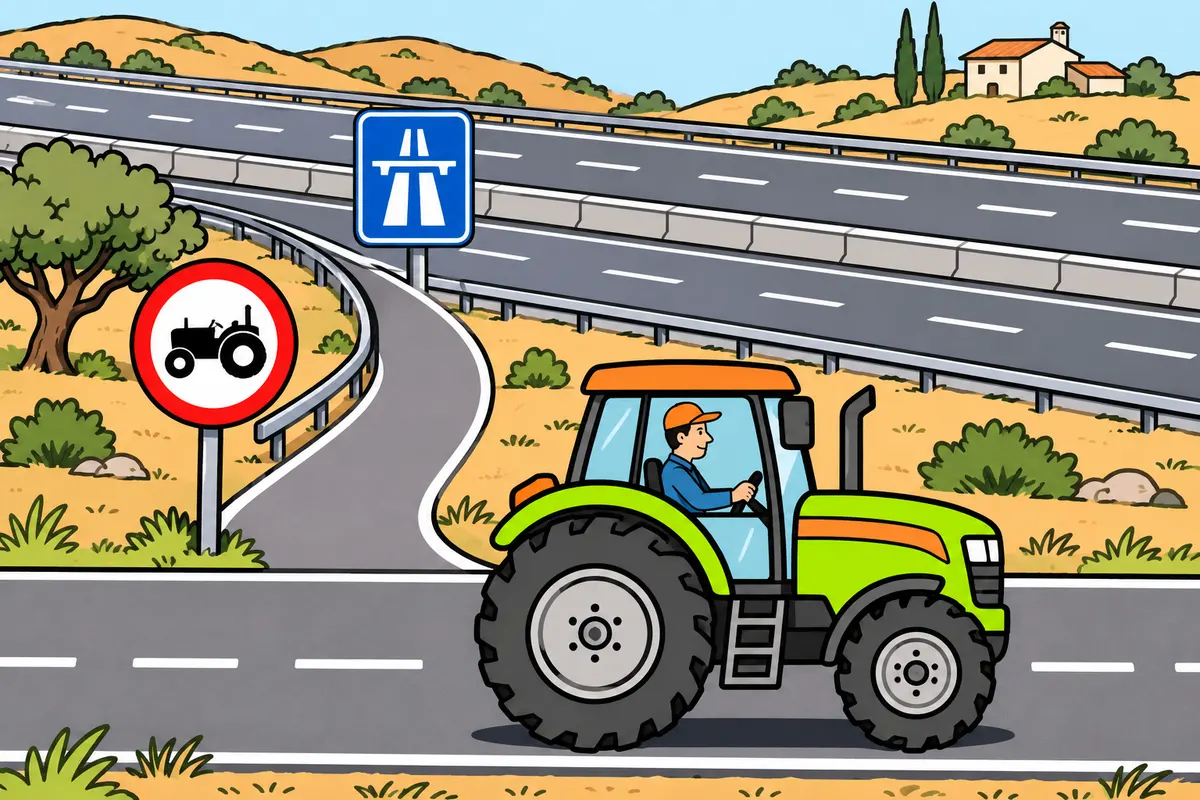
Do not enter autopistas or autovías with an agricultural vehicle driven solely with LVA.
| Vehicle | Access to autopistas and autovías |
|---|---|
| Agricultural vehicle driven solely with LVA | Prohibited |
| Moped | Prohibited |
| Vehicle for people with reduced mobility | Prohibited |
Remember
- Plan a route that allows your agricultural vehicle.
- You cannot enter using the hard shoulder or for a short journey.
- Reaching exactly 60 km/h does not meet the ordinary special-vehicle access requirement.
- Exceeding ordinary mass or dimension limits also requires category B.
- An agricultural registration plate does not replace the necessary authorisations.
Exam trap: Wrong: exceptional authorisation covers any agricultural vehicle driven with LVA. Right: for special vehicles exceeding mass or dimension limits, supplementary authorisation must expressly permit that route; do not apply that exception to your LVA.
Read the full explanation
- You must not drive an agricultural vehicle that you drive solely under an LVA licence on autopistas or autovías (motorways). You must plan a permitted alternative route; there is no general authorisation to use the arcén (hard shoulder), make a short journey or travel from one farm to another. [RGC, art. 38.3](https://www.boe.es/buscar/act.php?id=BOE-A-2003-23514#a38)
- For special vehicles that do not exceed the ordinary mass or dimension limits, article 38.3 requires the vehicle to be capable of a speed above 60 km/h on level ground and to meet the conditions in annex III. You must pay attention to ‘above’: reaching exactly 60 km/h does not meet this requirement. [RGC, art. 38.3](https://www.boe.es/buscar/act.php?id=BOE-A-2003-23514#a38)
- You must read the scope of driving solely under an LVA licence together with article 5.9 of the Reglamento de Conductores (Driver Regulations), which requires a category B licence if the vehicle's design speed exceeds 45 km/h or it exceeds the ordinary mass or dimension limits. Your LVA vehicle therefore does not meet the requirement to exceed 60 km/h for ordinary access by special vehicles. [RGCond, arts. 5.9 and 6.1.b](https://www.boe.es/buscar/act.php?id=BOE-A-2009-9481#a5)
- Under the exceptional rules for special vehicles exceeding mass or dimension limits, their supplementary authorisation must expressly permit that route. You must not apply these rules to an LVA licence or consider an agricultural number plate sufficient. You must answer the exam scenario using the vehicle characteristics and authorisations actually specified. [RGC, art. 38.3](https://www.boe.es/buscar/act.php?id=BOE-A-2003-23514#a38)
- You must not drive mopeds or vehicles for people with reduced mobility on autopistas or autovías either. These are different categories from agricultural vehicles, and the exceptions for bicycles apply to their own specified users. [RGC, art. 38.1](https://www.boe.es/buscar/act.php?id=BOE-A-2003-23514#a38)
14Reserved roads and access restrictions
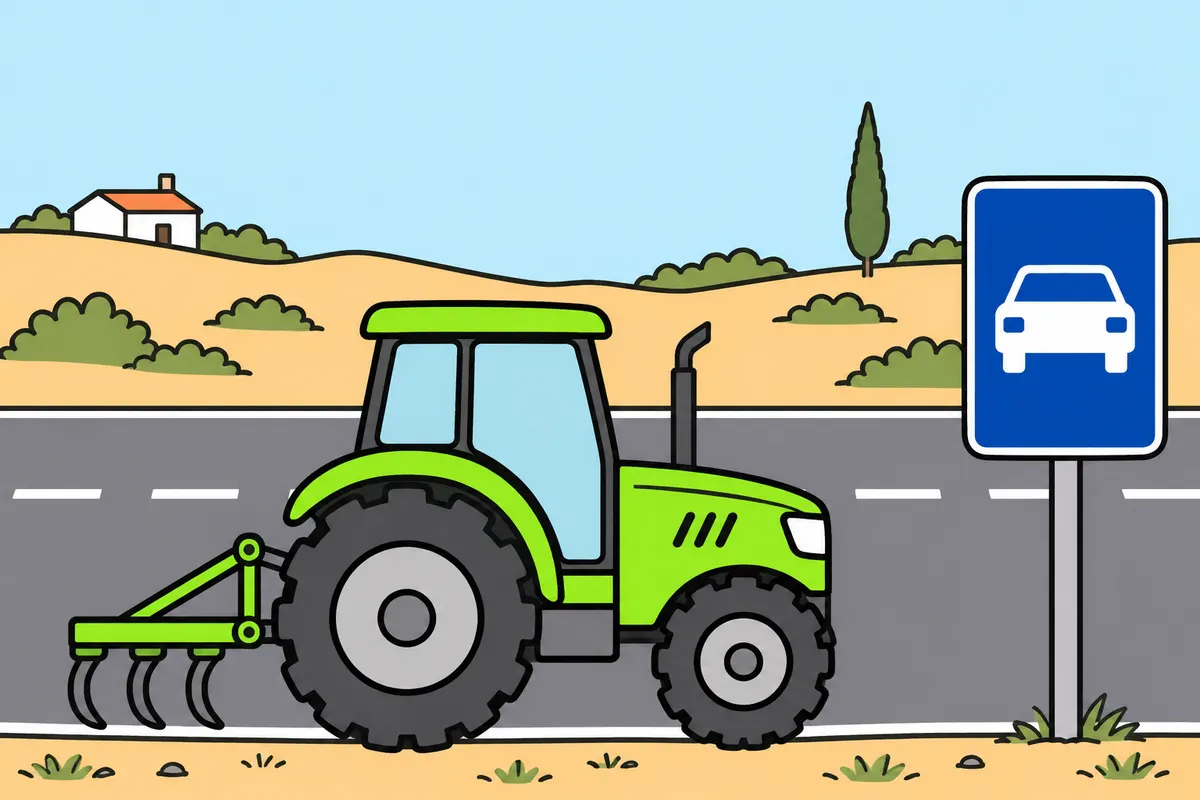
Enter only roads allowing your agricultural vehicle and obey signed restrictions.
| Sign | What it limits |
|---|---|
| R-201 | Laden mass |
| R-202 | Mass per axle |
| R-203 | Length |
| R-204 | Width |
| R-205 | Height |
Remember
- Your special vehicle is outside the legal category automóvil.
- Do not enter roads reserved exclusively for automóviles.
- On conventional roads, check prohibitions and restrictions.
- Include your load and implements when checking dimensions.
- Agricultural work does not let you ignore restrictions.
Exam trap: Wrong: your tractor is an automóvil because it has an engine. Right: special vehicles are excluded from that legal category; do not enter roads reserved exclusively for automóviles.
Read the full explanation
- You must not enter a road reserved exclusively for automobiles with your agricultural vehicle. Special vehicles are legally excluded from the definition of an automobile; having an engine and a number plate is not enough to belong to that category. The restriction to specified users remains decisive even if the road has only one carriageway. [LTSV, annex I, definitions 13 and 68](https://www.boe.es/buscar/act.php?id=BOE-A-2015-11722#ani)
- You may use roads that permit your vehicle, such as conventional roads, subject to any signposted prohibitions and restrictions. You must not learn that every track or conventional road is always open to any tractor: the authorities may impose restrictions on certain vehicles. [RGC, arts. 37 and 39](https://www.boe.es/buscar/act.php?id=BOE-A-2003-23514#a37)
- Before entering a narrow section, bridge or tunnel, you must obey the signposted restrictions: R-201 limits laden mass; R-202, axle mass; R-203, length; R-204, width; and R-205, height. You must include the load and implements when determining dimensions. [RGC, art. 37](https://www.boe.es/buscar/act.php?id=BOE-A-2003-23514#a37) [RGC, art. 39](https://www.boe.es/buscar/act.php?id=BOE-A-2003-23514#a39) [RGC, annex I, signs R-201 to R-205](https://www.boe.es/buscar/act.php?id=BOE-A-2003-23514#ani)
- You must obey a temporary closure, a compulsory route or a prohibition applying to your vehicle category even when carrying out agricultural work. You must prepare a legal alternative. Needing to reach a farm does not mean you have authorisation to cross a restricted section. [RGC, art. 37](https://www.boe.es/buscar/act.php?id=BOE-A-2003-23514#a37)
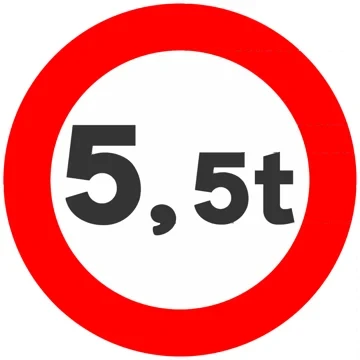 R-201
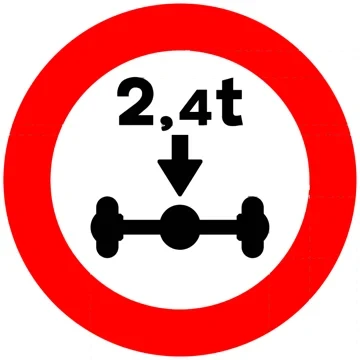 R-202
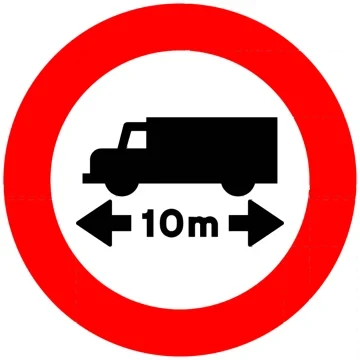 R-203
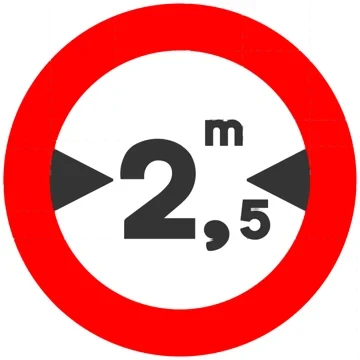 R-204
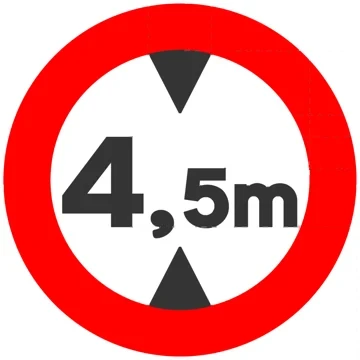 R-205
15Reversible lanes: check the direction
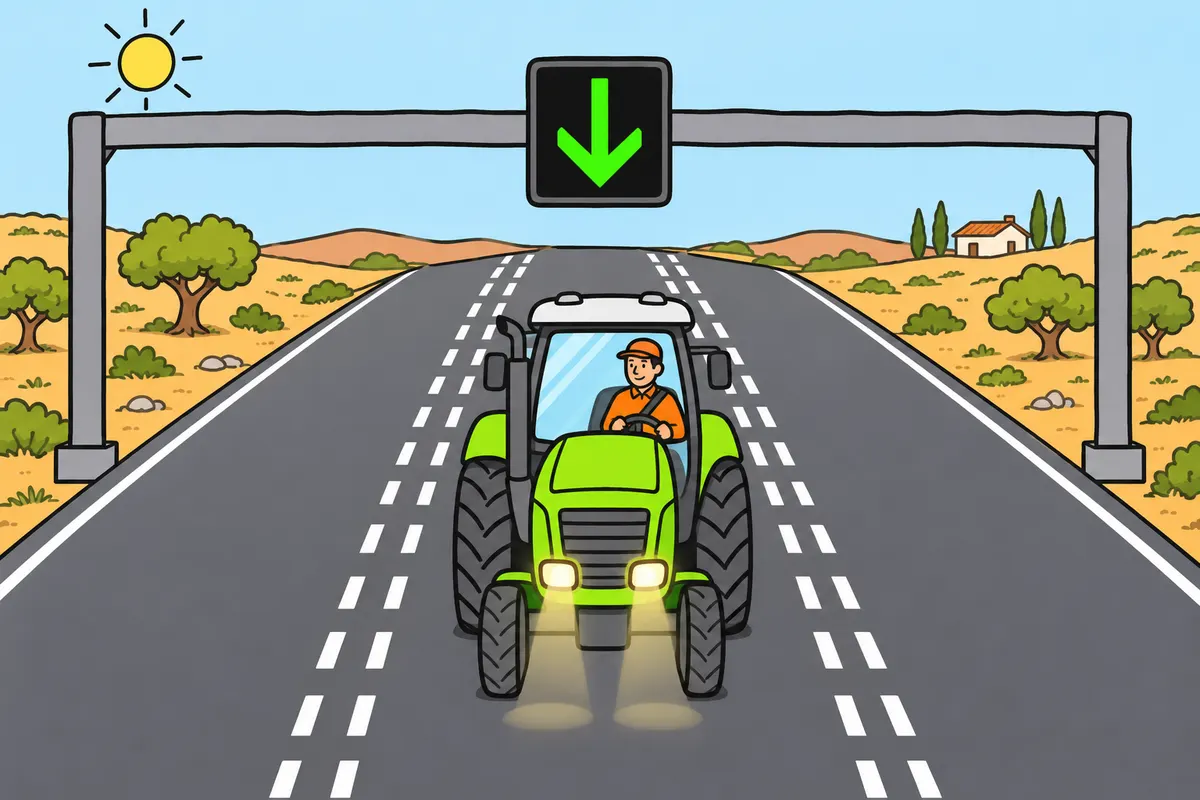
Before entering a reversible lane, check its direction and whether you may use it.
Remember
- Recognise its double broken lines and traffic controls.
- Check the lane signal or other traffic control.
- Do not rely only on the vehicle that entered before you.
- In the reversible lane, use at least dipped beam, day and night.
- Check that the road and lane allow your agricultural vehicle.
Exam trap: Wrong: reversible lanes allow only passenger cars and motorcycles. Right: there is no such general reservation; check that the road, lane and other conditions allow your agricultural vehicle.
Read the full explanation
- A lane bounded on both sides by double broken lines may be reversible: its direction alternates under the control of lane signals or other means. You must check the permission that applies to your direction of travel; another vehicle entering a few moments earlier is not enough. [RGC, art. 40](https://www.boe.es/buscar/act.php?id=BOE-A-2003-23514#a40)
- You must keep at least your dipped beam headlights on while driving in that lane, both by day and at night. Good visibility outside does not remove this obligation. This requirement applies to your use of the reversible lane; it does not make all nearby lanes reversible. [RGC, art. 40](https://www.boe.es/buscar/act.php?id=BOE-A-2003-23514#a40)
- Article 40 does not generally reserve reversible lanes exclusively for cars and motorcycles. You must check that the road, the lane and the other conditions permit your agricultural vehicle to use it. You must not confuse these rules with those for a lane opened in the opposite direction to normal to improve traffic flow. [RGC, art. 40](https://www.boe.es/buscar/act.php?id=BOE-A-2003-23514#a40)
- To recognise the different graphic forms of double broken lines and compare them with other lines, consult ‘Signs and their hierarchy’, section ‘Longitudinal lines and the hard shoulder’.
16Signals that open or close a lane
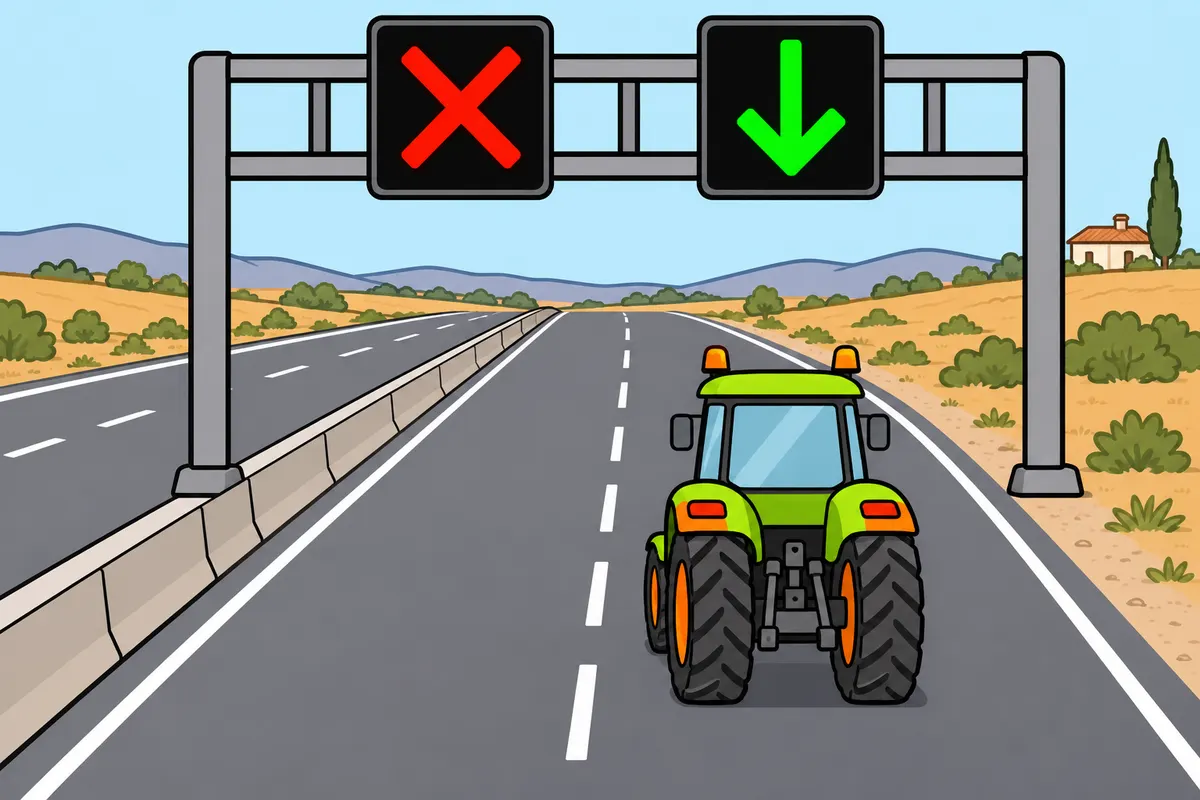
Obey the signal that allows lane use or tells you to leave.
| Lane signal | What you must do |
|---|---|
| Red cross | Leave the lane |
| Green arrow | You may use it, respecting priority and other signs |
| Diagonal white or yellow arrow | Move into the indicated lane: yours is about to close |
Remember
- With a red cross, leave the lane.
- With a green arrow, you may use it, respecting priority and other signs.
- With a diagonal white or yellow arrow, move into the indicated lane.
Exam trap: Wrong: a green arrow gives you absolute priority. Right: you must also obey stop and priority signs.
Read the full explanation
- You must leave the lane when shown a red cross; a green arrow allows you to use it while respecting priority and other signs and signals; a diagonal white or yellow arrow indicates which lane you must move into because your lane is about to close. [RGC, annex I, section 4.3](https://www.boe.es/buscar/act.php?id=BOE-A-2003-23514#ani)
17Lanes running opposite to normal: distinguish the reason
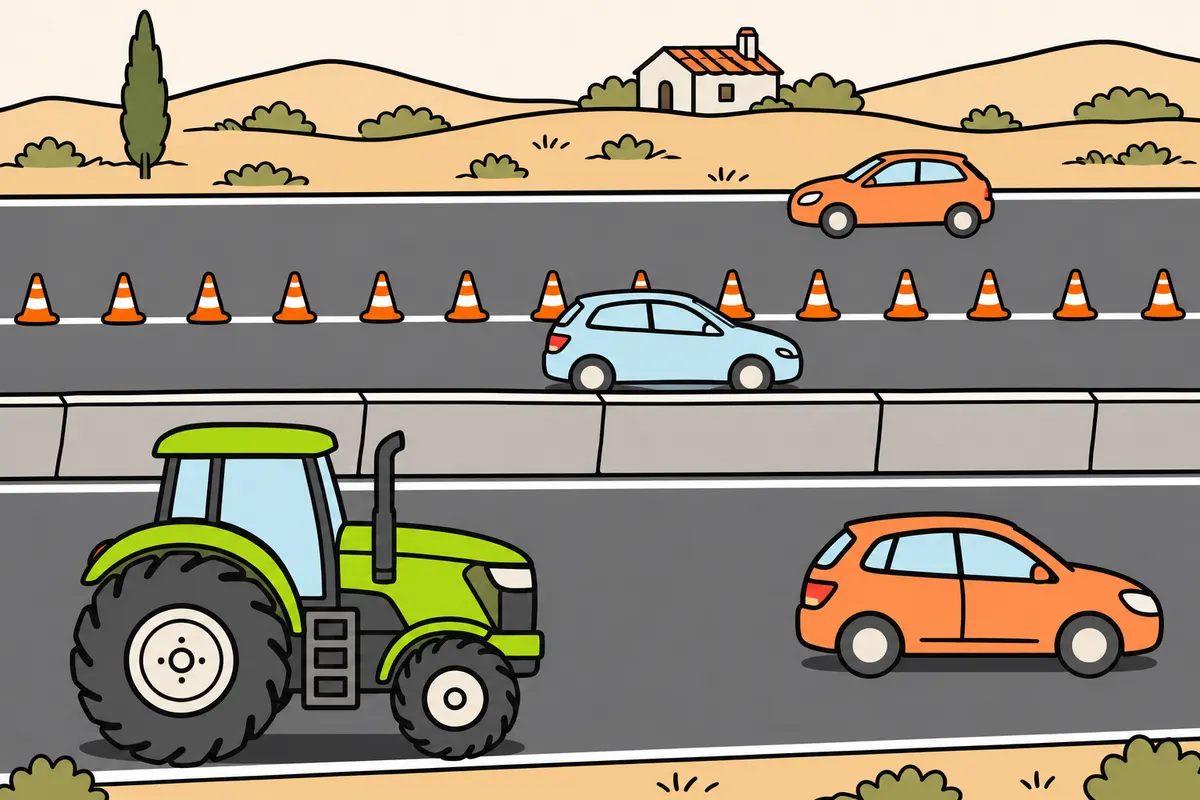
Check whether a contraflow lane is opened for traffic flow or roadworks.
| Reason for contraflow lane | Access with your LVA agricultural vehicle |
|---|---|
| Traffic flow | Prohibited: reserved for motorcycles and passenger cars without trailers |
| Roadworks | Road access must be permitted, with a compatible lower minimum established or signed |
Remember
- Do not use traffic-flow contraflow lanes with your agricultural vehicle.
- For roadworks, first check that you may enter the road.
- The 60 km/h minimum is incompatible with your LVA agricultural vehicle.
- You need a compatible lower minimum, established or signed.
Exam trap: Wrong: roadworks allow any agricultural vehicle to enter. Right: you need permission to enter the road; the 60 km/h minimum prevents your LVA agricultural vehicle from using it unless a compatible lower minimum is established or signed.
Read the full explanation
- You must not use lanes opened in the opposite direction to normal to improve traffic flow with your agricultural vehicle: they are reserved for motorcycles and cars without trailers. For lanes opened because of roadworks, you must be permitted to access the road; the minimum of 60 km/h is incompatible with your LVA agricultural vehicle unless a compatible lower minimum is set or signposted. [RGC, art. 41](https://www.boe.es/buscar/act.php?id=BOE-A-2003-23514#a41)
18Temporary additional lane
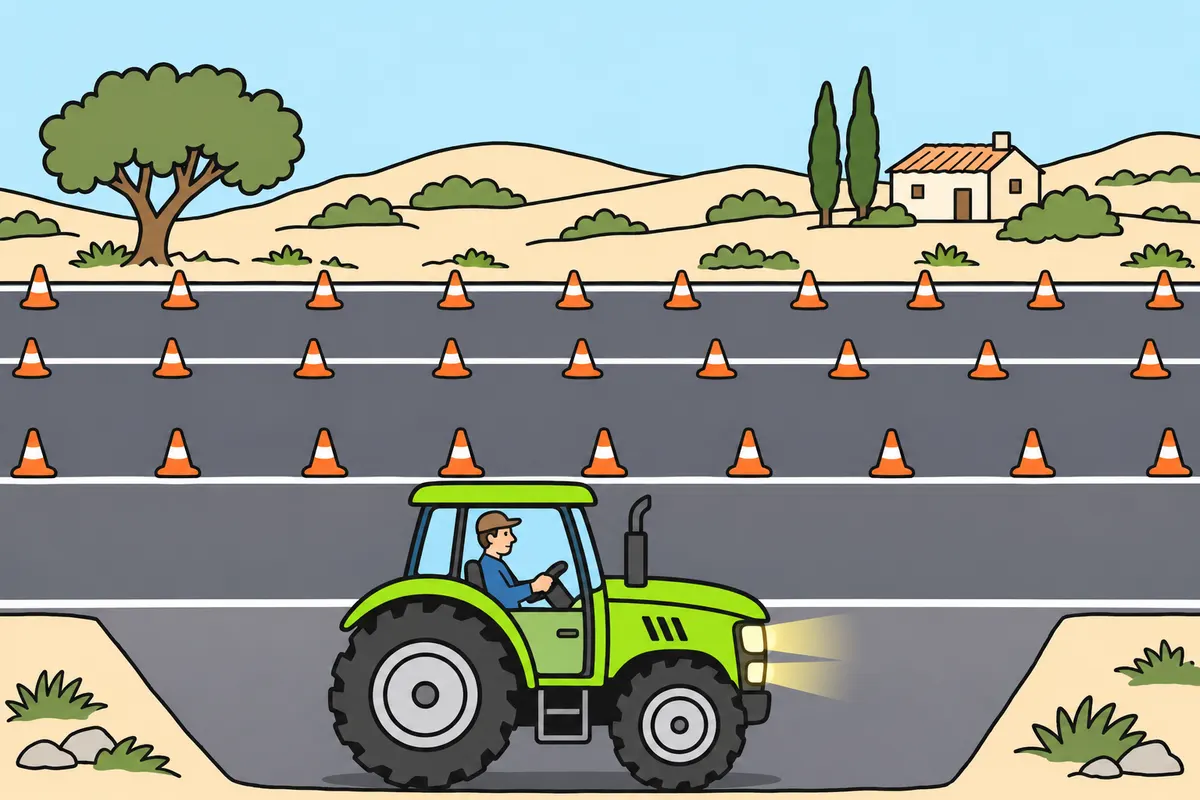
In temporary additional lanes, follow the temporary layout and check the minimum speed.
Remember
- Follow the temporary layout shown by signs.
- The 60 km/h minimum is incompatible with your LVA agricultural vehicle.
- You need a compatible lower minimum, established or signed.
- If you may use it, use dipped beam, day and night.
Exam trap: Wrong: you may enter simply because there is an additional lane. Right: with your LVA agricultural vehicle, you need a compatible lower minimum established or signed; if allowed to use it, always use dipped beam.
Read the full explanation
- In a temporary additional lane, you must follow the signposted temporary lane arrangement. The minimum of 60 km/h is incompatible with your LVA agricultural vehicle unless a compatible lower minimum is set or signposted; if you may use it, you must keep your dipped beam headlights on by day and at night. [RGC, art. 42](https://www.boe.es/buscar/act.php?id=BOE-A-2003-23514#a42)
19Broken and solid lines
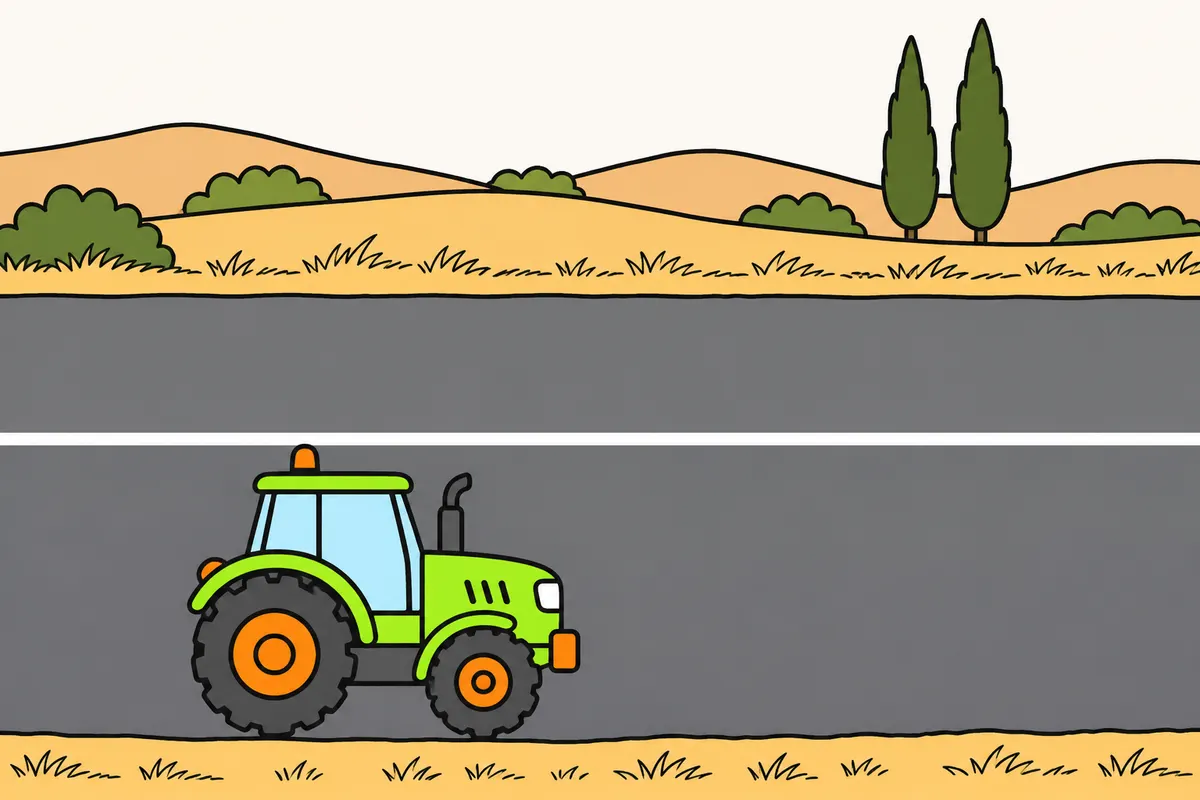
Read the lines before changing lanes or crossing them.
| Longitudinal marking | What you must do |
|---|---|
| Broken | You may cross for a permitted manoeuvre, respecting priority |
| Solid or double solid | Do not cross or drive on it, except under regulatory exceptions |
| Solid line separating directions | Also do not drive to its left, except under regulatory exceptions |
| Solid beside broken | Follow your side’s line; an exception allows returning after overtaking |
Remember
- Cross broken lines only for permitted manoeuvres, respecting priority.
- Drive on them only if lane width requires it and safety allows.
- A double solid line means the same as a single solid line.
- With solid and broken lines together, follow the line on your side.
- The edge line does not remove your hard shoulder obligation when it applies.
Exam trap: Wrong: the solid line prevents returning after overtaking from the broken-line side. Right: if these lines separate directions and you started from the broken-line side, you may cross the solid line to return after completing or abandoning overtaking.
Read the full explanation
- You may cross a broken line to carry out a permitted manoeuvre, giving way to traffic in the lane you enter; you may only drive along the line if the width of the lane requires it and safety allows. [RGC, annex I, catalogue of road markings](https://www.boe.es/buscar/act.php?id=BOE-A-2003-23514#ani)
- You must not cross or drive on a solid line between lanes or directions of travel or, if it separates opposing directions, drive to its left, except where the regulations allow; a double solid line has the same meaning. [RGC, annex I, catalogue of road markings](https://www.boe.es/buscar/act.php?id=BOE-A-2003-23514#ani)
- Where a solid line runs alongside a broken line, you must obey the line on your side; if they separate opposing directions, you may cross the solid line to return after overtaking that you started from the broken-line side, whether you complete or abandon the manoeuvre. [RGC, annex I, catalogue of road markings](https://www.boe.es/buscar/act.php?id=BOE-A-2003-23514#ani)
- The edge line marks the boundary of the carriageway: apply the rule for the arcén (hard shoulder) explained in «Up to 3,500 kg: the right-hand hard shoulder» to your agricultural vehicle. To recognise line codes and variants, see «Signs and their hierarchy», section «Longitudinal lines and the hard shoulder». [RGC, annex I, catalogue of road markings](https://www.boe.es/buscar/act.php?id=BOE-A-2003-23514#ani)
20Arrows, hatched areas and delineators
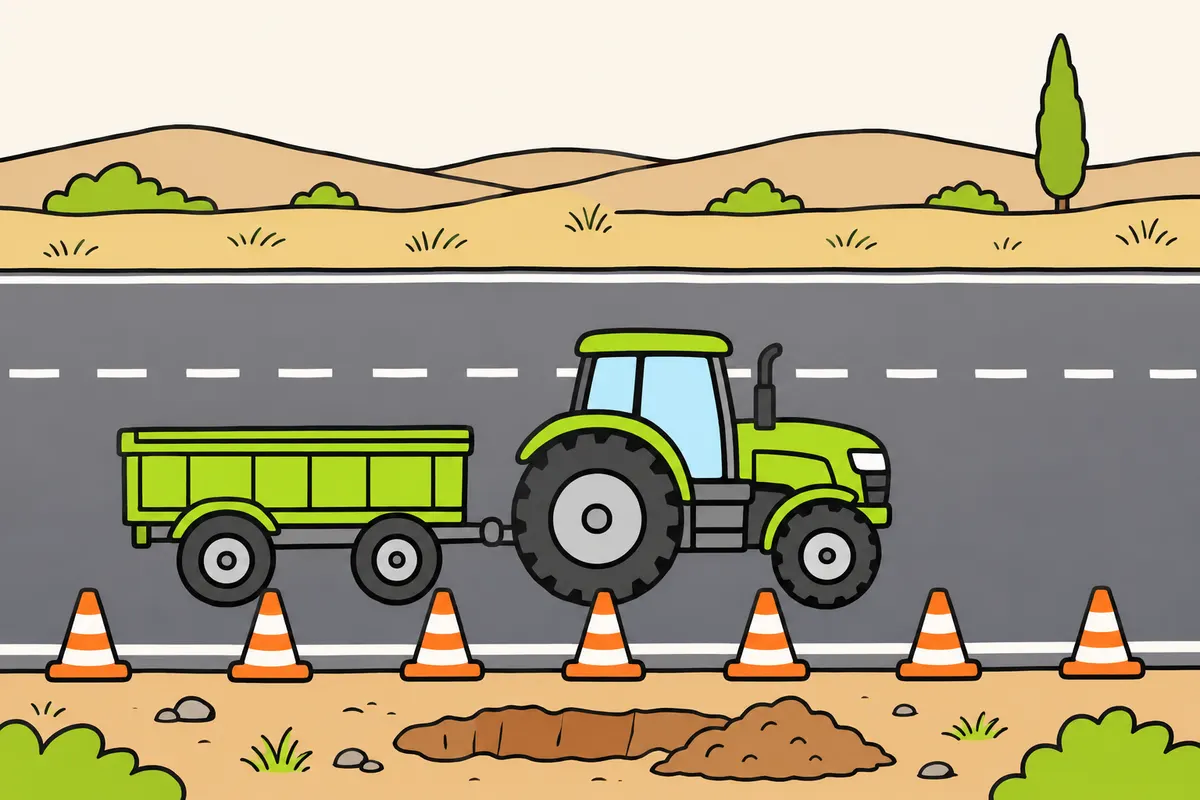
Follow arrows and the marked route without crossing closed areas.
| Marking or situation | What you must do |
|---|---|
| Arrow including straight ahead | You may change lanes while continuing straight if the lines allow |
| Hatched area bounded by a solid line | Do not enter unless you are required to use the hard shoulder |
| Cones or temporary delineators | Do not cross the line joining them |
Remember
- Follow the movements allowed or required by your lane arrows.
- At a lane-end arrow, leave as indicated, respecting priority.
- A return arrow warns of a solid line: do not start overtaking.
- If already overtaking, finish as soon as possible.
- Do not cross the real or imaginary line joining cones or temporary delineators.
- At roadworks, new markings are yellow; white markings may still apply.
Exam trap: Wrong: any tractor may enter a hatched area. Right: the exception for hatching bounded by a solid line applies only to vehicles required to use the hard shoulder.
Read the full explanation
- You must choose a lane whose arrows allow your intended movement; an arrow that includes straight ahead allows you to change lanes while continuing in that direction if the lines permit it. [RGC, annex I, catalogue of road markings](https://www.boe.es/buscar/act.php?id=BOE-A-2003-23514#ani)
- At a lane-end arrow, you must merge into the indicated lane, giving way to traffic in it; at a return arrow, you must abandon any intention to start overtaking or complete an overtaking manoeuvre already under way as soon as possible. [RGC, annex I, catalogue of road markings](https://www.boe.es/buscar/act.php?id=BOE-A-2003-23514#ani)
- You must not enter a hatched area bounded by a solid line, except if you are driving a vehicle required to use the hard shoulder: this exception matters when your agricultural vehicle belongs to that group. [RGC, annex I, catalogue of road markings](https://www.boe.es/buscar/act.php?id=BOE-A-2003-23514#ani)
- Cones and temporary delineators mark a line you must not cross; follow the designated passage, allowing enough space for the vehicle combination. For their shapes and for arrows and hatched areas, see «Signs and their hierarchy», sections «Delineators, barriers and guides» and «Arrows, inscriptions and painted areas». [RGC, annex I, section 3.1.1](https://www.boe.es/buscar/act.php?id=BOE-A-2003-23514#ani)
- At roadworks, any new road markings used are yellow; existing white markings may remain if they still apply. You must interpret the traffic layout of the stretch together with the signs and delineators, without assuming that every visible white marking still shows a usable route. [RGC, annex I, catalogue of road markings](https://www.boe.es/buscar/act.php?id=BOE-A-2003-23514#ani)
21Prepare to enter a tunnel
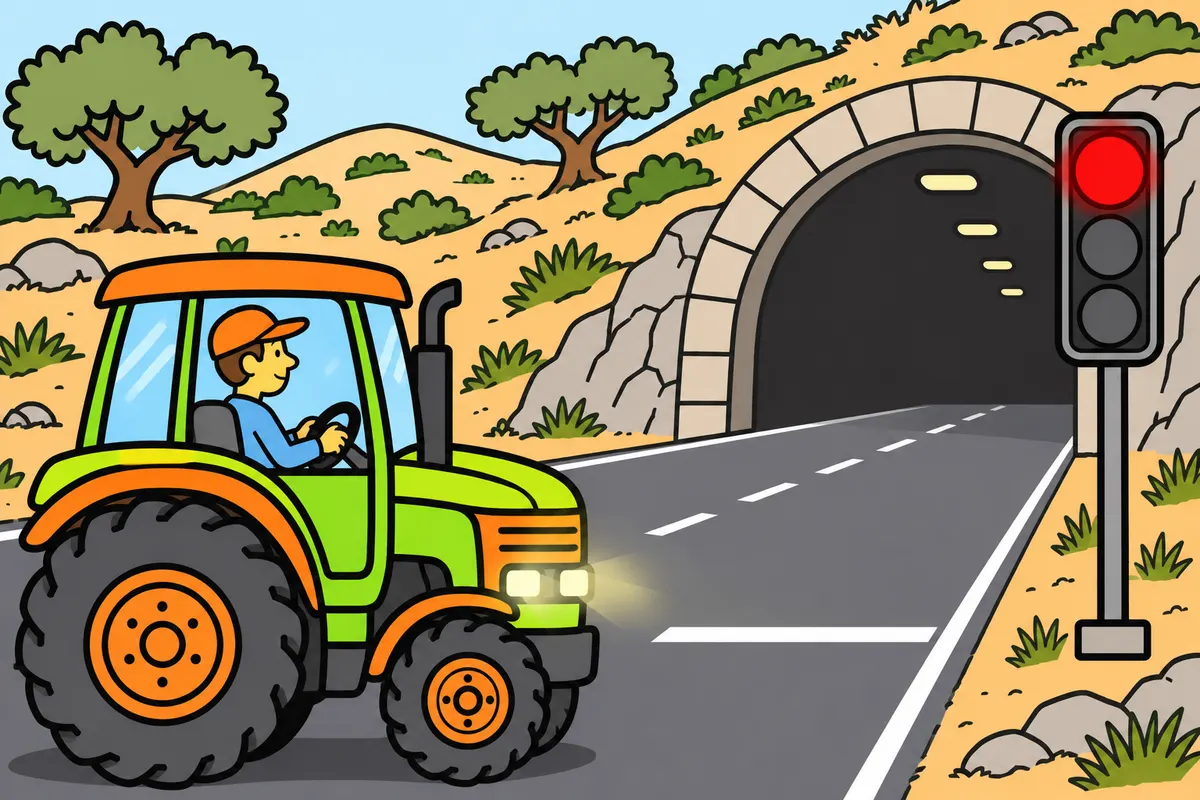
Before a tunnel, check that you may enter and obey entry signs.
Remember
- Check that the road and tunnel allow your vehicle.
- Do not enter if the entrance signal prohibits passage.
- Driving a tractor does not give you the same access as emergency teams.
- All tunnels must be signed.
- Underpasses longer than 200 metres must also be signed.
- A shorter underpass still has rules you must follow.
Exam trap: Wrong: all tunnels are closed to agricultural vehicles. Right: check that the road and tunnel allow your vehicle, and obey restrictions and entry signs.
Read the full explanation
- You must check that your vehicle is allowed in the tunnel and on the road where it is located. The presence of a tunnel does not in itself impose a general ban on agricultural vehicles. You must comply with its restrictions, entry signs and lane arrangements. [RGC, art. 37](https://www.boe.es/buscar/act.php?id=BOE-A-2003-23514#a37) [RGC, art. 39](https://www.boe.es/buscar/act.php?id=BOE-A-2003-23514#a39) [RGC, art. 95](https://www.boe.es/buscar/act.php?id=BOE-A-2003-23514#a95) [RGC, annex I, passage restrictions](https://www.boe.es/buscar/act.php?id=BOE-A-2003-23514#ani)
- You must not enter a tunnel or underpass when a traffic light at its entrance prohibits entry. Driving a tractor does not place you within the exceptions for emergency, breakdown assistance or maintenance teams. You must wait outside and follow the signs and signals. [RGC, art. 96.3](https://www.boe.es/buscar/act.php?id=BOE-A-2003-23514#a96)
- Tunnels of any length and underpasses longer than 200 metres must be signposted. This threshold concerns signposting: a shorter underpass is not exempt from its rules on that account. [RGC, art. 95.5](https://www.boe.es/buscar/act.php?id=BOE-A-2003-23514#a95)
22Lanes and following distances inside a tunnel
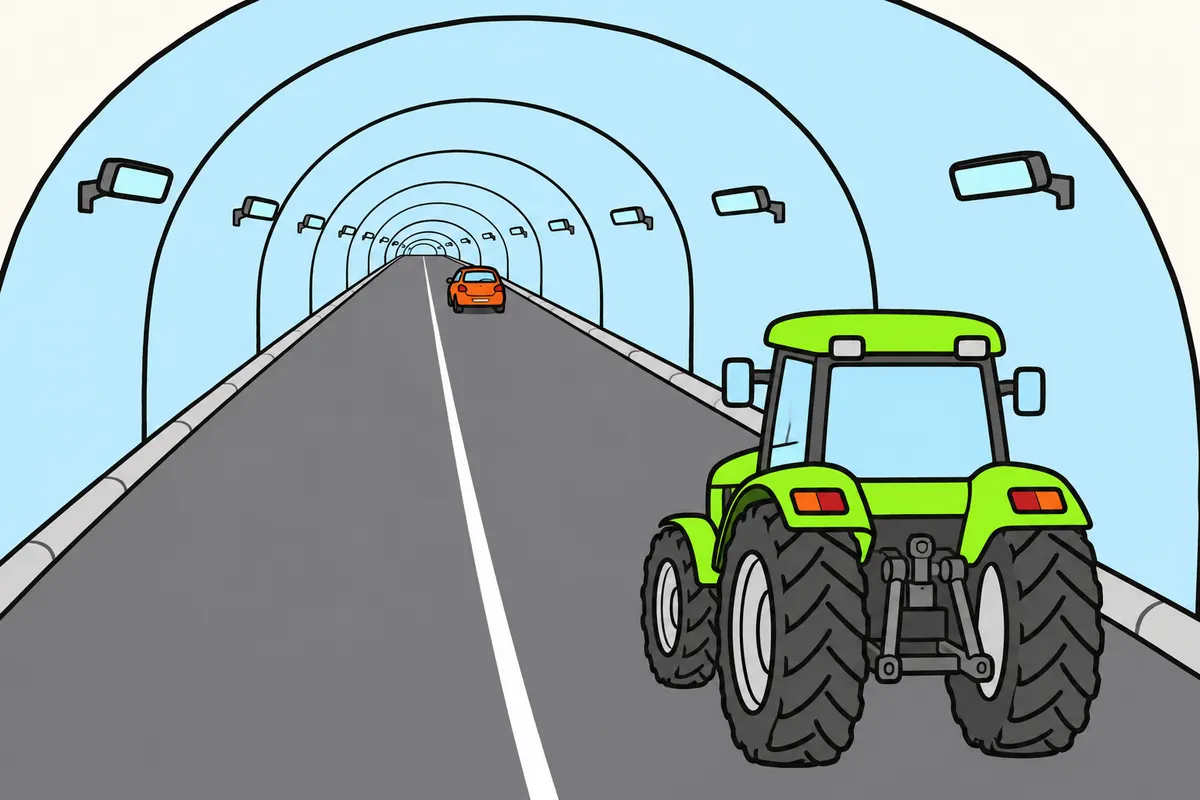
Inside tunnels, keep the required gap and obey overtaking restrictions.
| Tunnel, underpass or section signed as a tunnel | May you overtake? |
|---|---|
| Only one lane in your direction | You must not overtake |
| Two-way traffic with several lanes in your direction | Only without entering the opposite direction |
Remember
- Obey tunnel signals, panels and instructions.
- Check gaps for your MMA in “Speed and distances for agricultural vehicles”.
- Use the appropriate lights throughout, during daylight too.
- In sufficiently lit tunnels, use position lights and dipped beam.
- Do not stop voluntarily, park, turn around or reverse.
- Stops caused by traffic or emergencies have their own rules.
Exam trap: Wrong: a broken line is enough to overtake in a two-way tunnel. Right: you need more than one lane in your direction and must not enter the opposite direction; with only one lane in your direction, you cannot overtake.
Read the full explanation
- You must obey traffic lights, variable message signs and instructions given over public address systems or by other means. A lane closure indication requires you to adjust your course safely; you must not continue in that lane because you normally used it on previous journeys. [RGC, art. 95](https://www.boe.es/buscar/act.php?id=BOE-A-2003-23514#a95)
- To maintain the required following distance in tunnels and underpasses according to your agricultural vehicle’s MMA (maximum authorised mass), see «Speed and distances for agricultural vehicles», sections «Tunnels: 100 metres or four seconds» and «Tunnels with agricultural vehicles above 3,500 kg». [RGC, art. 95.6](https://www.boe.es/buscar/act.php?id=BOE-A-2003-23514#a95)
- You must use the appropriate lights throughout your journey through tunnels, underpasses and stretches signposted as tunnels, at any time of day; where they are sufficiently lit, you must use position lights and dipped beam. To choose your lights according to the lighting conditions, see «Agricultural lighting and signalling», section «When you must switch on the lights». [RGC, arts. 95.6 and 101](https://www.boe.es/buscar/act.php?id=BOE-A-2003-23514#a95) ([art. 101](https://www.boe.es/buscar/act.php?id=BOE-A-2003-23514#a101))
- You must not overtake in tunnels, underpasses or stretches signposted as tunnels with only one lane in your direction. In those with two-way traffic, you may only overtake if there are several lanes in your direction and you do not enter the opposite direction. [RGC, arts. 87.1.d and 95.6](https://www.boe.es/buscar/act.php?id=BOE-A-2003-23514#a87) ([art. 95.6](https://www.boe.es/buscar/act.php?id=BOE-A-2003-23514#a95))
- You must not stop, park, make a U-turn or reverse in a tunnel or underpass. If traffic forces you to stop or an emergency immobilises your vehicle, you must follow the specific rules for that situation; this does not allow you to carry out these manoeuvres voluntarily to look for an exit. [RGC, art. 95](https://www.boe.es/buscar/act.php?id=BOE-A-2003-23514#a95)
23Queues or breakdowns: keep the passage clear
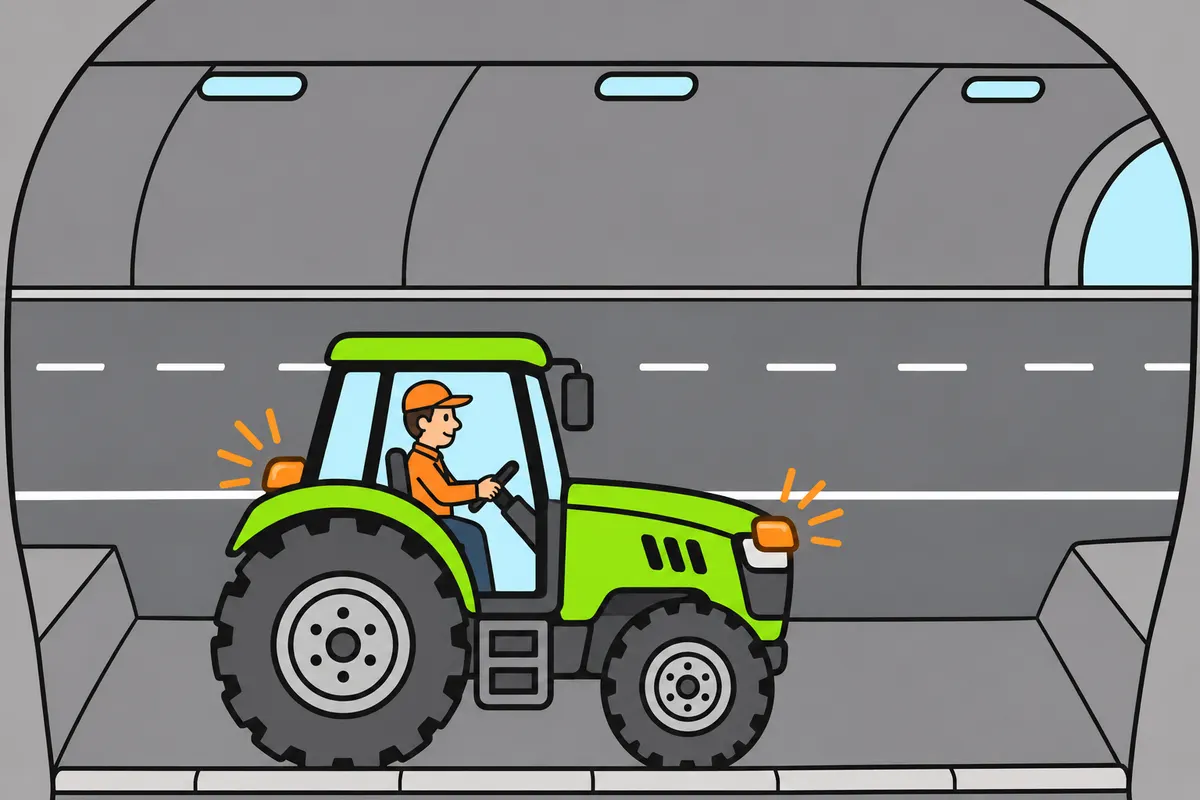
If you stop inside a tunnel, switch off the engine and keep position lights on.
| Situation inside the tunnel | What you must do |
|---|---|
| Queue | Stay inside; use hazard lights temporarily. Keep position lights on and switch off the engine as soon as you stop. If the wait lasts more than two minutes, keep the engine off and position lights on until you move again. |
| Breakdown: vehicle can move | Continue to the exit; if you cannot reach it, use an emergency area. |
| Emergency immobilises vehicle | If possible, reach the nearest emergency area in your direction; otherwise move near the right-hand edge. Switch off the engine; use hazard warning lights and keep position lights on. If you carry a V-16, position and activate it. Call for help promptly from the nearest SOS post, if there is one, and follow instructions. |
| Fire | Pull over to the right to leave room for emergency services. Leave the key in and doors open. Evacuate in the direction opposite to the fire. |
Remember
- In a queue, stay inside and switch on hazard warning lights temporarily.
- Stop as far as possible from the vehicle ahead.
- If your broken-down vehicle can move, reach the exit or an emergency area.
- If an emergency stops you, everyone leaves for the nearest refuge or exit.
- Avoid walking on the carriageway if areas closed to vehicles are available.
- In a fire, move away from it and follow instructions.
Exam trap: Wrong: in a tunnel queue, you may leave the engine running if you stay at the wheel. Right: switch it off as soon as you stop and keep the position lights on; if the wait exceeds two minutes, keep them on until you move again.
Read the full explanation
- If traffic conditions force you to stop inside a tunnel, you must remain in the vehicle, switch on the hazard warning lights temporarily and keep the position lights on. You must stop as far as possible from the vehicle ahead. Switch off the engine as soon as you stop; if the wait lasts more than two minutes, keep it switched off with the position lights on. [RGC, arts. 97.3 and 115.1-2](https://www.boe.es/buscar/act.php?id=BOE-A-2003-23514#a97)
- If you can continue driving after a breakdown, you must continue to the exit of the tunnel or underpass or, if you cannot reach it, to an emergency area. Whether you can continue safely determines where you must take the tractor. [RGC, art. 97](https://www.boe.es/buscar/act.php?id=BOE-A-2003-23514#a97)
- If an emergency prevents you from continuing inside a tunnel or underpass, position your vehicle, if possible, in the nearest emergency area in your direction of travel; if there is none, position it alongside the right-hand edge. You must switch off the engine, switch on the hazard warning lights and keep the position lights on. To warn others of the hazard, if you carry a V-16, you must position and activate it. Request help without delay from the nearest SOS emergency telephone, if there is one, and follow the instructions you receive. [RGC, art. 97.3](https://www.boe.es/buscar/act.php?id=BOE-A-2003-23514#a97)
- When your vehicle is immobilised by an emergency in this way, you and the other occupants must leave it and make your way quickly to the nearest refuge or exit, keeping off the carriageway where areas closed to vehicles are available. In a fire, move your vehicle to the right to leave room for the emergency services, leave the key in place and the doors open, and evacuate in the opposite direction to the fire. For guidance on warning others of the hazard, see «Accidents and breakdowns: protect and assist», section «Breakdown, fire and queuing in a tunnel». [RGC, art. 97.3](https://www.boe.es/buscar/act.php?id=BOE-A-2003-23514#a97)
Choose between the hard shoulder and the carriageway
Apply the rule for your vehicle before choosing a lane.
- Check that you may enter the road and whether there is a part specifically designated for your vehicle.
- Check the MMA: up to 3,500 kg includes exactly 3,500 kg.
- If you must use the hard shoulder, check that the right-hand one is usable and wide enough.
- If it is not, occupy only as much of the carriageway as necessary. If your MMA exceeds 3,500 kg, use the carriageway except in an emergency.
- Identify the permitted direction of travel and apply the rules on lanes and reserved use.
Interpret a lane with special traffic arrangements
Recognise its rules without confusing three different configurations.
- Identify whether it is a reversible lane, a lane running against the normal traffic flow or a temporary additional lane.
- Check whether your vehicle category may use it and why it has been opened.
- Read the traffic lights, panels, markings and delineators along the route.
- Check that you can comply with the applicable conditions without exceeding the limits for your agricultural vehicle.
- Use dipped beam when required and follow the designated path without crossing the line of cones.
Drive through a tunnel with your agricultural vehicle
Prepare to drive through and leave space to react.
- Check that access is permitted, the dimensions and the entrance traffic lights.
- Switch on the appropriate lights and follow the authorised lane.
- Apply the separation distance for your MMA explained in «Speed and distances for agricultural vehicles».
- Obey panels and public address announcements; observe prohibitions on manoeuvres.
- If you must stop, distinguish between a traffic queue and an emergency and follow the procedure in article 97.
Finished this module?
Mark it as read and you will see your progress on the theory list.