
Theory · A2 Licence - Motorcycle · Module 16 of 18
Accidents, breakdowns and assistance
You learn to protect an immobilised motorcycle, alert 112 and help casualties without worsening their injuries. You master the duties to assist and identify yourself, and the motorcycle-specific rules on reflective vests, V-16 beacons and helmets that are essential for answering exam questions.
1Your duty at an accident
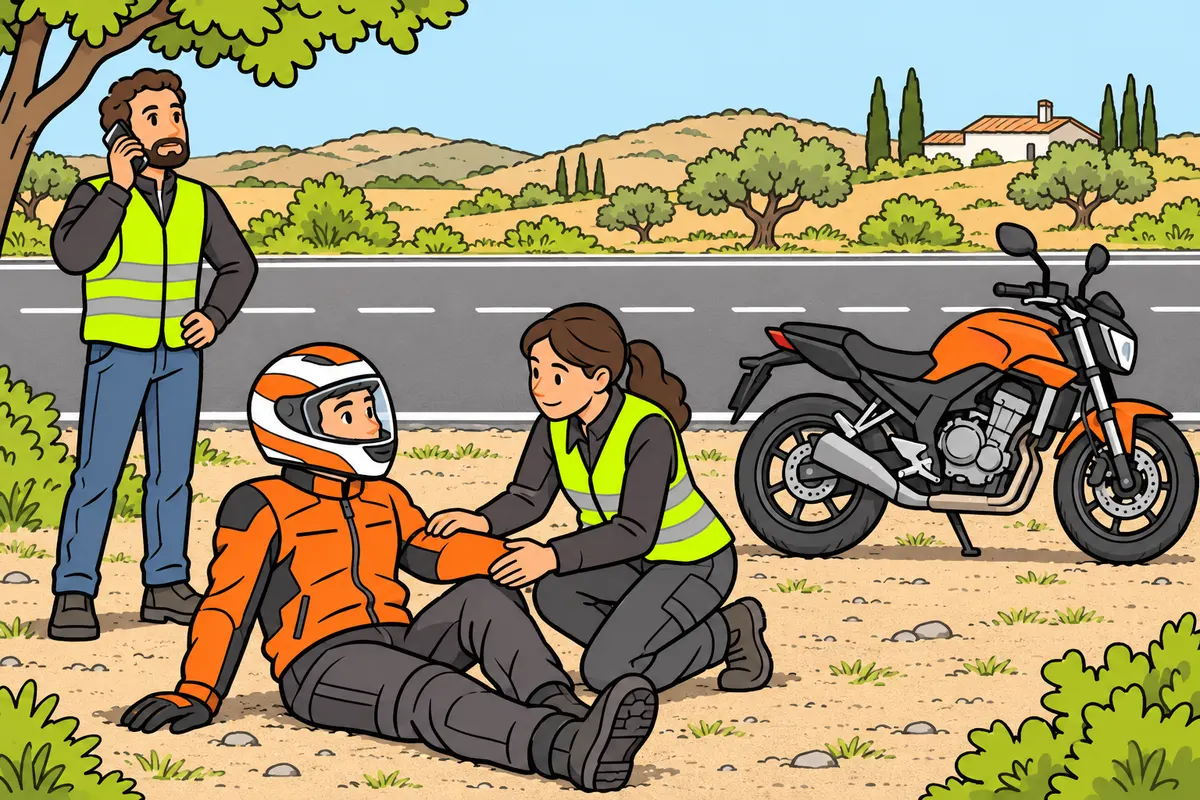
You must help after an accident and prevent further danger.
Remember
- If you are involved, stop without creating another danger.
- If you witness or learn about an accident, help or call for help.
- Cooperate to prevent harm and establish what happened.
- Assess traffic, fire, casualties and the help available.
Exam trap: Wrong: witnesses have no duties. Right: cooperate as far as you can and as relevant to you, unless your help is clearly unnecessary or the authorities or their officers have arrived.
Read the full explanation
- If you are involved in an accident, witness it or become aware of it, you must help the casualties or call for help, cooperate to prevent further harm and help restore safety and establish the facts. [Traffic Act, art. 51](https://www.boe.es/buscar/act.php?id=BOE-A-2015-11722#a51)
- If you are involved, you must stop without creating another hazard. [RGC, art. 129.2.a](https://www.boe.es/buscar/act.php?id=BOE-A-2003-23514#a129)
- If you witness an accident without being involved, you must cooperate as far as you can and as relevant to you, unless your help is clearly unnecessary or the authorities or their officers have arrived. [RGC, art. 129.3](https://www.boe.es/buscar/act.php?id=BOE-A-2003-23514#a129)
- You must assess all the circumstances to set priorities: traffic, fire, casualties and the resources available. [RGC, art. 129.2](https://www.boe.es/buscar/act.php?id=BOE-A-2003-23514#a129)
2PAS: protect, alert and assist
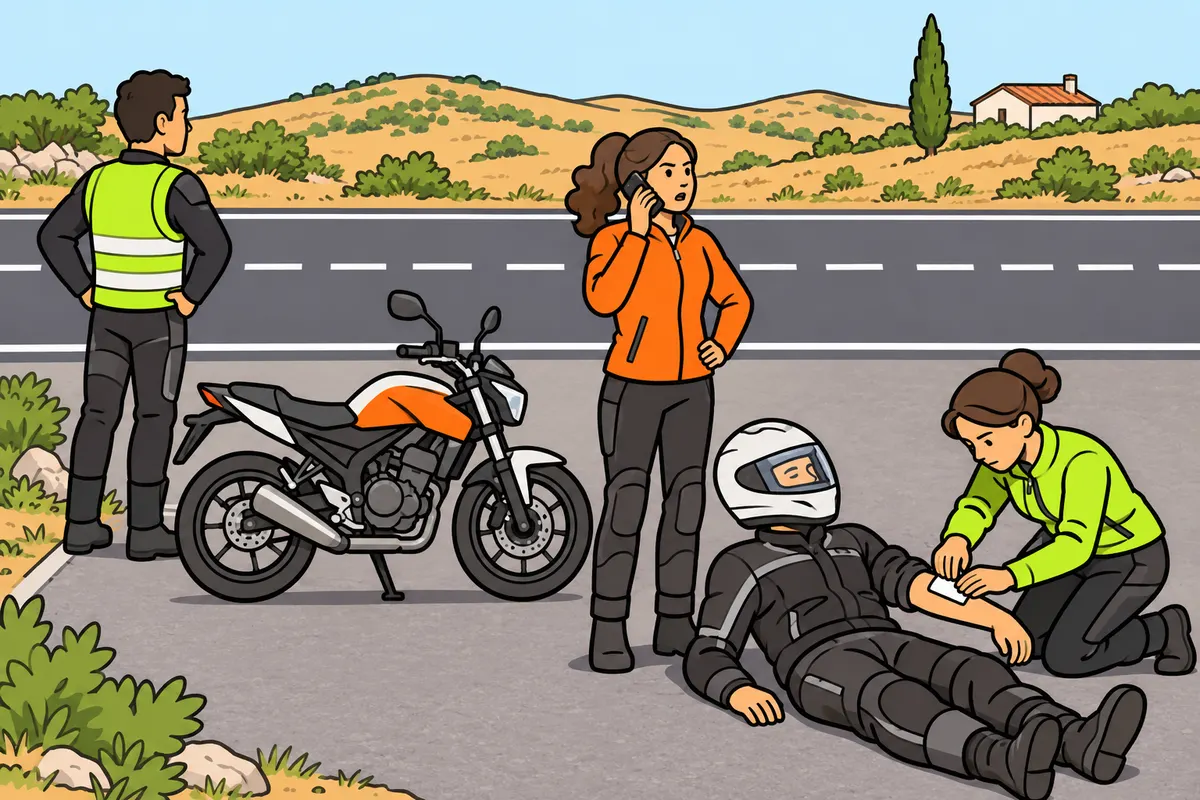
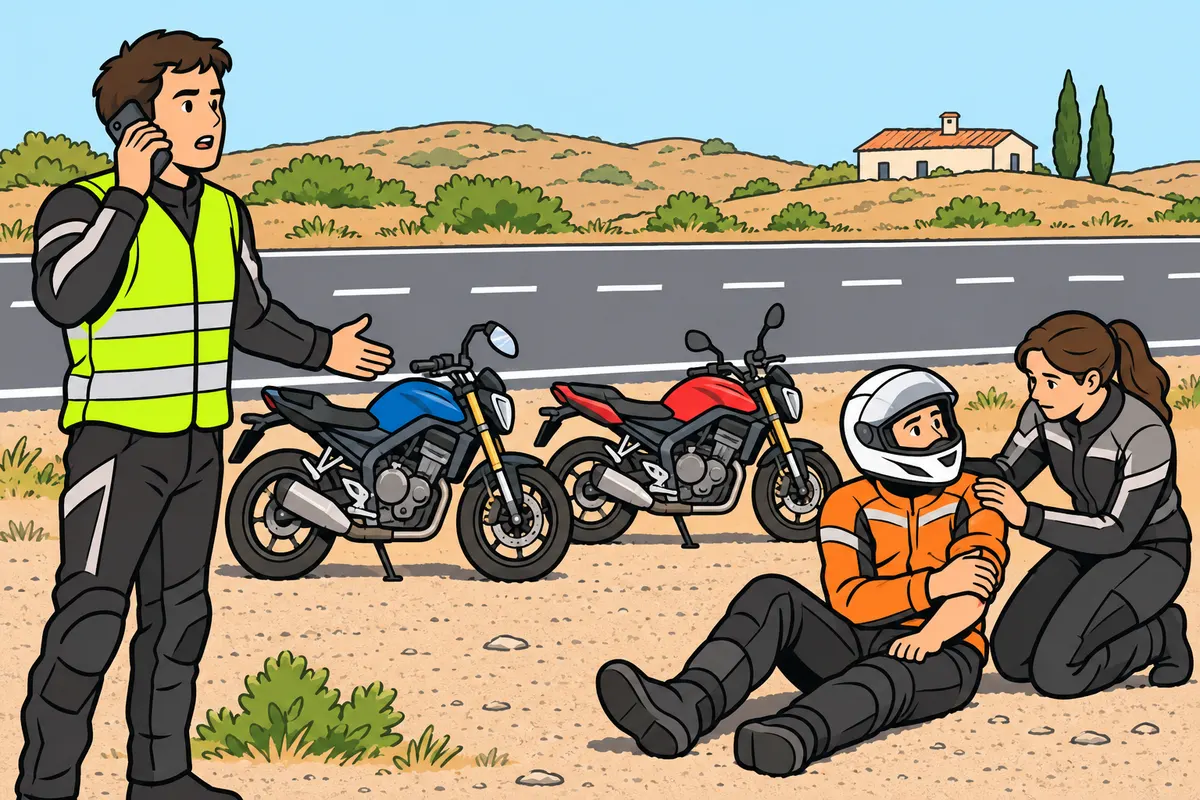
First protect, then alert, then assist.
Remember
- Prevent another accident before approaching.
- Look quickly and describe what you see; do not diagnose injuries.
- Help calmly, using techniques you know.
- If others are present, share tasks without delaying urgent help.
Exam trap: Wrong: assist before protecting. Right: protect, alert and assist, in that order.
Read the full explanation
- Apply PAS: protect, alert and assist, in that order of priority. Protecting means preventing another accident involving you, the casualties or other people; alerting activates the appropriate services; assisting means giving the initial help you know how to provide. [Sanidad (Ministry of Health), action at an accident](https://www.sanidad.gob.es/eu/ciudadanos/accidentes/docs/modulo6.pdf)
- You may also encounter PEAS: protect, evaluate, alert and assist. Evaluation is a quick observation to guide your actions and your call; describe what you see without trying to diagnose injuries. [DGT, first aid, UD1](https://sede.dgt.gob.es/export/sites/dgt/.galleries/permisos-de-conducir/certificacion-aptitud-profesores-formacion-vial/2026/MANUAL-IX-Primeros-auxilios.pdf)
- You must act quickly and calmly to attend to breathing and bleeding and call for emergency help. [Sanidad (Ministry of Health), action at an accident](https://www.sanidad.gob.es/eu/ciudadanos/accidentes/docs/modulo6.pdf)
- If several people are present, you can share out tasks: one calls, another helps provide access and another gives assistance safely. Coordinate your actions so they can take place at the same time without delaying emergency help.
3Protect yourself before approaching
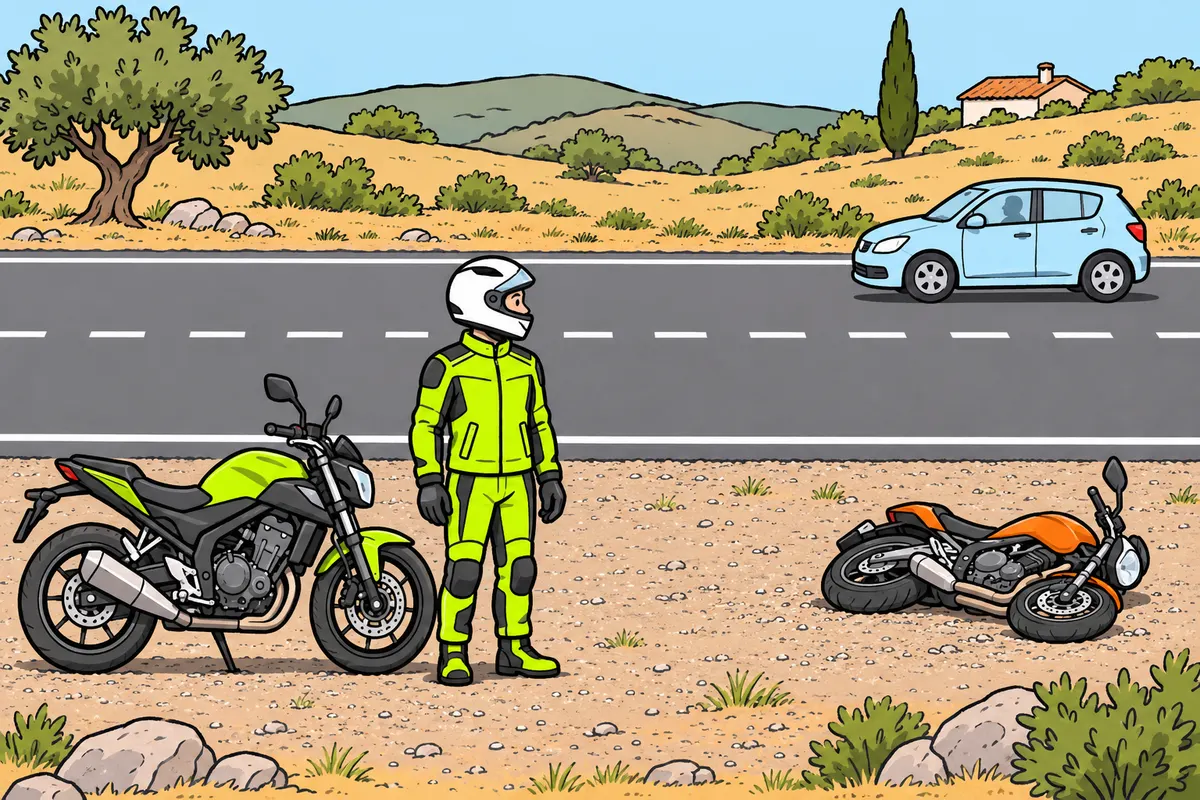
Before approaching, check that you can do so safely.
Remember
- Check traffic in both directions and how clearly you can see.
- Look for unstable vehicles and spilled liquids.
- Leave your motorcycle where it causes least obstruction; warn others of danger.
- Switch off a fallen motorcycle and prevent movement only if safe.
- Do not smoke or bring flames near spilled fuel.
- Keep access clear for emergency services.
Exam trap: Wrong: switch off a fallen motorcycle despite passing traffic. Right: do so only safely.
Read the full explanation
- Before getting off your motorcycle or approaching a casualty, you must check traffic in both directions, visibility, unstable vehicles and possible spills. [RGC, art. 129](https://www.boe.es/buscar/act.php?id=BOE-A-2003-23514#a129)
- You must immobilise your motorcycle where it causes as little obstruction as possible and mark the hazard using the means available. [RGC, arts. 129 and 130](https://www.boe.es/buscar/act.php?id=BOE-A-2003-23514#a129)
- As a protective measure, switch off the engine of a fallen motorcycle if you can do so safely and prevent it from moving. Do not smoke or create flames near spilled fuel; you must report the fire risk when calling for help. [DGT, first aid, UD1](https://sede.dgt.gob.es/export/sites/dgt/.galleries/permisos-de-conducir/certificacion-aptitud-profesores-formacion-vial/2026/MANUAL-IX-Primeros-auxilios.pdf)
- You must keep access clear for ambulances, firefighters and officers. [RGC, art. 129](https://www.boe.es/buscar/act.php?id=BOE-A-2003-23514#a129)
4Reflective vest on your motorcycle
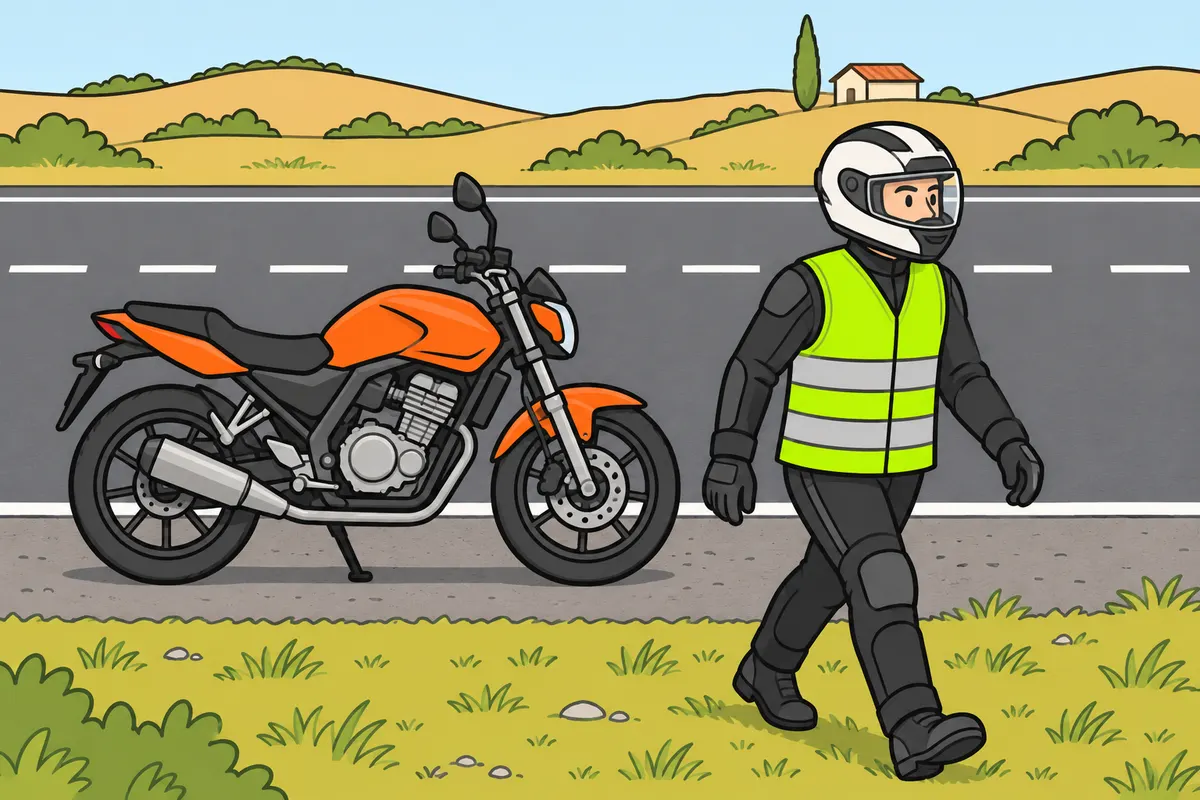
You must carry a reflective vest on your motorcycle and wear it when required.
| Your motorcycle role or situation | Vest use |
|---|---|
| You get off and enter an interurban carriageway or hard shoulder | Compulsory for you as the rider |
| You are the passenger | Recommended |
| You ride professionally | Compulsory while riding on any road |
Remember
- Carry a high-visibility reflective vest that meets the required standards.
- Put it on before facing traffic, whenever you can do so safely.
- Your passenger is also advised to wear one to be visible.
Exam trap: Wrong: you only need your vest at night. Right: as the rider, also wear it by day when leaving your motorcycle and entering the carriageway or hard shoulder of an interurban road.
Read the full explanation
- You must carry a high-visibility reflective vest on your motorcycle that meets the requirements for personal protective equipment. [RGV, annex XII.3](https://www.boe.es/buscar/act.php?id=BOE-A-1999-1826#anxii)
- As a motorcycle rider, you must wear this vest when you get off the vehicle and enter the carriageway or arcén (hard shoulder) of an interurban road. [RGC, art. 118.4](https://www.boe.es/buscar/act.php?id=BOE-A-2003-23514#a118)
- To protect yourself, put on the vest before exposing yourself to traffic whenever you can do so safely. [RGV, annex XII](https://www.boe.es/buscar/act.php?id=BOE-A-1999-1826#anxii) [RGC, art. 118](https://www.boe.es/buscar/act.php?id=BOE-A-2003-23514#a118)
- The duty to wear the vest when entering the carriageway or hard shoulder of an interurban road applies to you as the rider. Your passenger is also advised to carry and wear one to make themselves visible. [RGC, art. 118.4](https://www.boe.es/buscar/act.php?id=BOE-A-2003-23514#a118)
- If you ride a motorcycle as part of your work, you must wear a high-visibility reflective vest when riding on all types of road. [RGC, art. 118.4](https://www.boe.es/buscar/act.php?id=BOE-A-2003-23514#a118)
5Connected V-16 beacon and A2 equipment
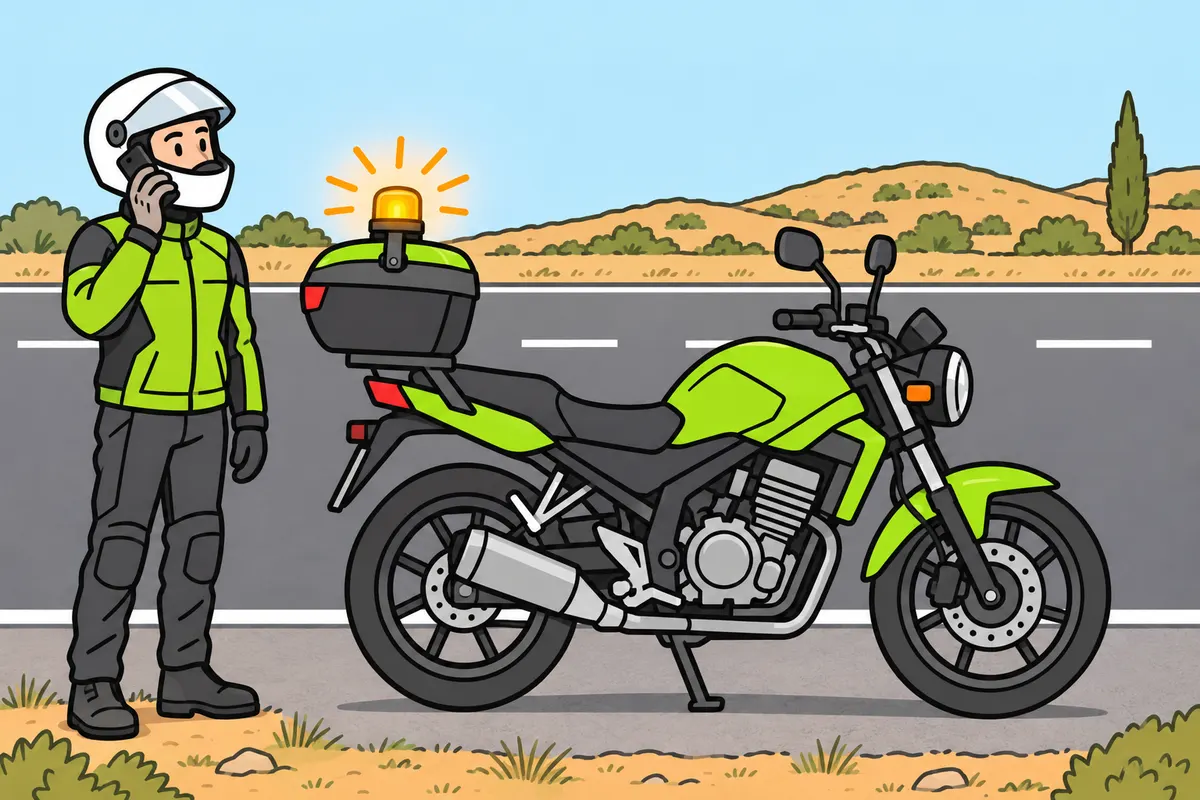
You need not carry a beacon on your motorcycle, but must use it if carried.
| Vehicle | V-16 equipment requirement |
|---|---|
| Your motorcycle | You need not carry one |
| Spanish-registered vehicle subject to this requirement | Connected and certified; triangles and unconnected beacons do not qualify |
Remember
- Check that your connected V-16 is on the DGT certified list.
- Fix it securely, as high and visible as possible, without facing traffic danger.
- Its light is amber.
- Check when its connection expires.
- You must call 112 or request recovery yourself.
Exam trap: Wrong: you can leave your compliant V-16 packed away on your motorcycle. Right: use it to warn that you are immobilised, including in tunnels.
Read the full explanation
- The regulatory advance warning device in Spain is the certified, connected V-16 warning light, required for vehicles subject to this equipment requirement. For a vehicle registered in Spain, warning triangles and a beacon without connectivity do not fulfil this regulatory function. [RGV, annex XI, V-16](https://www.boe.es/buscar/act.php?id=BOE-A-1999-1826#v-16) and [RD 159/2021, first transitional provision](https://www.boe.es/buscar/act.php?id=BOE-A-2021-4194#dt)
- You are not required to carry a V-16 as equipment on your motorcycle. The duty to use the device to warn that your motorcycle is immobilised presupposes that you have one: if you carry a regulatory V-16, you must use it, including when immobilised in a tunnel. [RGV, annex XII](https://www.boe.es/buscar/act.php?id=BOE-A-1999-1826#anxii), [RGC, art. 130.4](https://www.boe.es/buscar/act.php?id=BOE-A-2003-23514#a130) and [RGC, art. 97.3.c](https://www.boe.es/buscar/act.php?id=BOE-A-2003-23514#a97)
- If you use a V-16, check that its make and model appear on the DGT’s official list of certified devices. [RGV, annex XI, V-16.7](https://www.boe.es/buscar/act.php?id=BOE-A-1999-1826#v-16)
- You must place the beacon as high as possible on the immobilised vehicle, with maximum visibility and a suitable means of securing it to your motorcycle, without exposing yourself to traffic. [RGV, annex XI, V-16.2](https://www.boe.es/buscar/act.php?id=BOE-A-1999-1826#v-16)
- The V-16 emits amber light, visible through 360 degrees in the horizontal plane, and maintains its light performance for at least 30 minutes. Connectivity must be included in the price for at least 12 years; also check the service expiry date. [RGV, annex XI, V-16.3, 5 and 8](https://www.boe.es/buscar/act.php?id=BOE-A-1999-1826#v-16)
- The beacon transmits its location to the DGT and cannot incorporate additional functions. You must call 112 yourself or request the breakdown recovery service you need. [RGV, annex XI, V-16.9](https://www.boe.es/buscar/act.php?id=BOE-A-1999-1826#v-16)
6Lights to warn that your motorcycle is immobilised
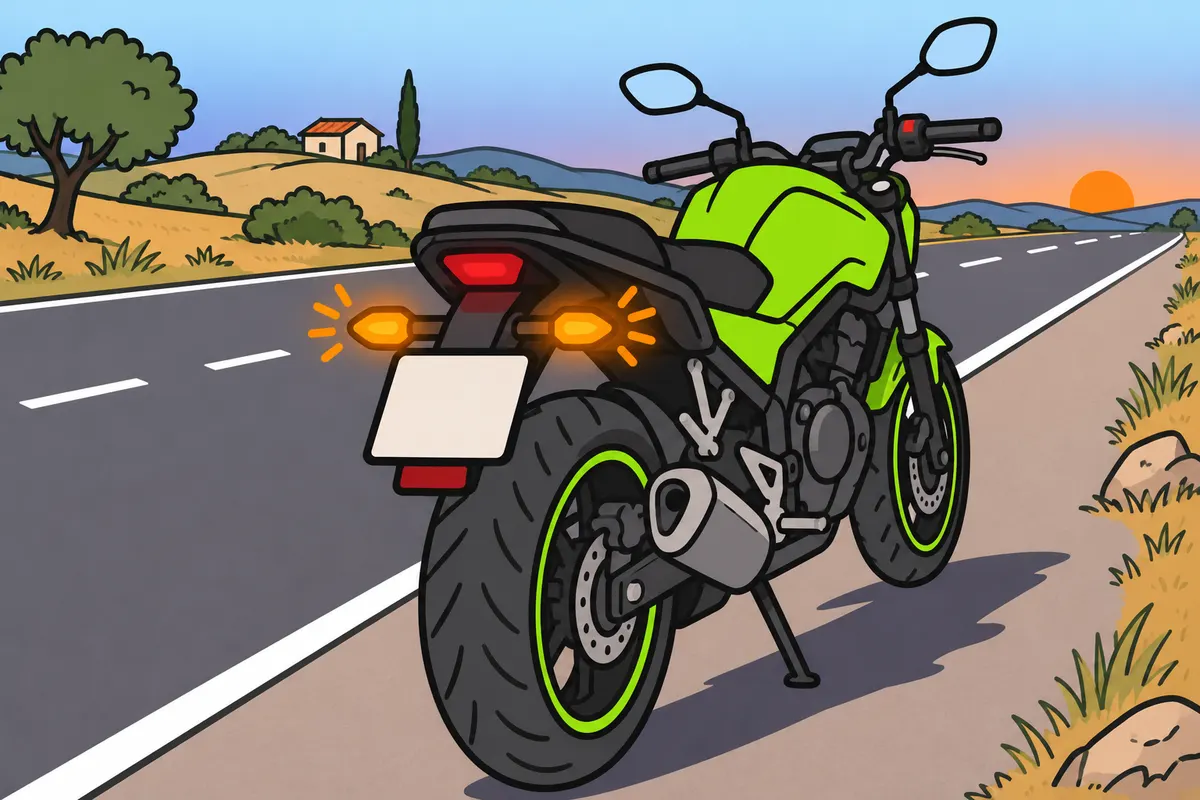
Use the required lights to warn that your motorcycle cannot move.
| Your motorcycle situation | Lights |
|---|---|
| Immobilised by breakdown or accident while the road is cleared | Hazards, if fitted |
| Immobilised on carriageway or shoulder at night or in significantly reduced visibility | Position lights; add hazards where required |
Remember
- After breakdowns or accidents, use hazards if fitted while the road is cleared.
- Also use hazards if fitted when immobilised on motorways or with poor visibility.
- When immobilised on carriageways or shoulders, keep position lights on at night.
- Also keep position lights on there when visibility is significantly reduced.
- On motorways or dual carriageways, emergency slow riding means taking the first exit.
- If continuing is unsafe, stop; warn before stopping or slowing sharply whenever possible.
Exam trap: Wrong: every breakdown while riding requires hazards. Right: use them if fitted when you cannot reach the minimum speed and there is a rear-end collision risk.
Read the full explanation
- If a breakdown or accident immobilises your motorcycle, you must switch on your hazard warning lights, if fitted, while the road is being cleared. You must also use them to warn that your motorcycle is immobilised on an autopista (motorway) or autovía (dual carriageway with motorway characteristics), or in significantly reduced visibility. [RGC, art. 130.4](https://www.boe.es/buscar/act.php?id=BOE-A-2003-23514#a130) and [RGC, art. 109.2.c](https://www.boe.es/buscar/act.php?id=BOE-A-2003-23514#a109)
- If you are immobilised on the carriageway or hard shoulder between sunset and sunrise, or in significantly reduced visibility, you must keep the position lights on. [RGC, art. 105.1](https://www.boe.es/buscar/act.php?id=BOE-A-2003-23514#a105)
- If a breakdown allows you to continue riding but prevents you from reaching the minimum speed and there is a risk of a rear-end collision, you must use your hazard warning lights if fitted. On an autopista or autovía, you must leave at the first exit if the emergency forces you to travel at an abnormally low speed; if continuing is unsafe, you must stop. [RGC, arts. 38.2 and 49](https://www.boe.es/buscar/act.php?id=BOE-A-2003-23514#a49)
- If you are about to stop or slow down considerably, you must give advance warning whenever possible by repeatedly applying your brake lights or moving your arm up and down with short, quick movements. [RGC, art. 109.2.c](https://www.boe.es/buscar/act.php?id=BOE-A-2003-23514#a109)
7Where to stop after a breakdown
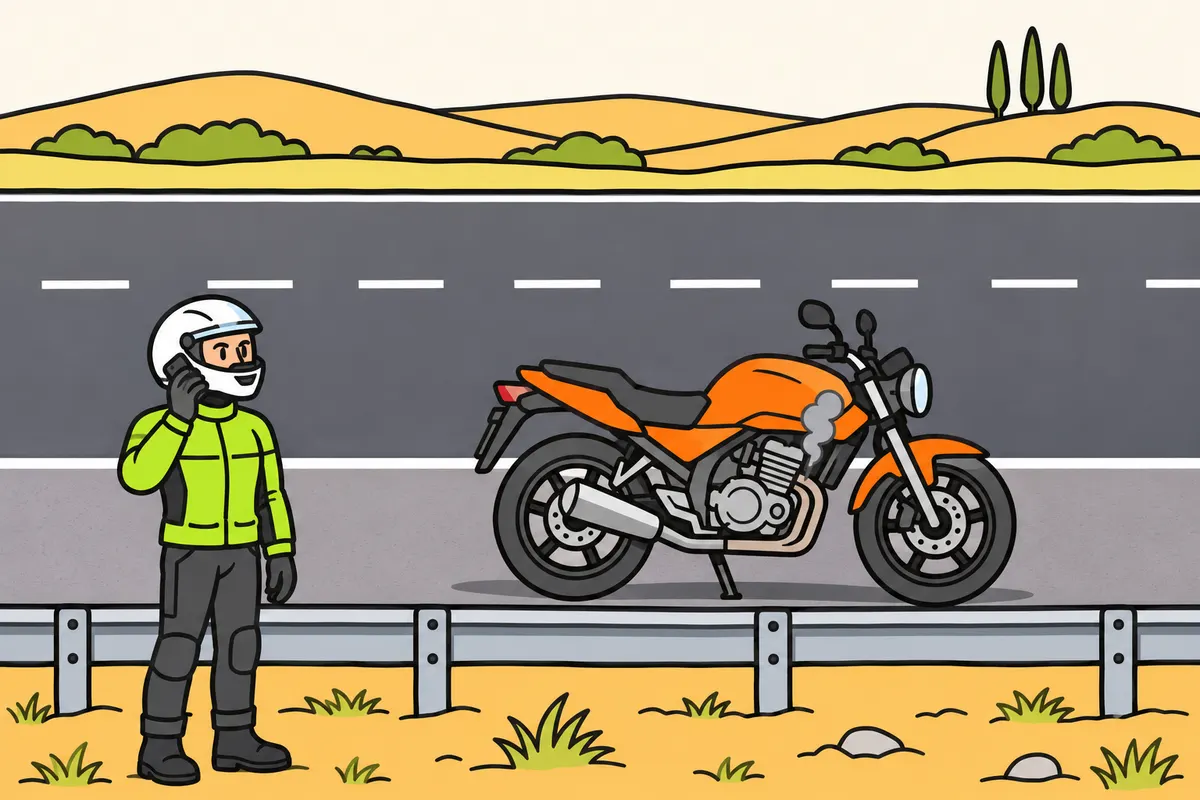
After a breakdown, seek a safe exit and avoid blocking traffic.
| Situation | Reason for stopping |
|---|---|
| Breakdown prevents you continuing | Emergency |
| Voluntary stop | Your own decision |
Remember
- If you can continue safely, do so immediately.
- If you need help, leave traffic lanes; take the right shoulder towards an exit.
- Use the first available exit; otherwise stop on that shoulder or obstruct least.
- If you cannot ride safely, make your motorcycle safe and request help.
- Warn others and remove your motorcycle or load from the carriageway when safe.
Exam trap: Wrong: a breakdown is a voluntary stop. Right: if it prevents you continuing, it is an emergency stop.
Read the full explanation
- If you can continue safely after a breakdown or accident, you must do so immediately. When you need assistance, you must leave the traffic lanes as soon as possible and head for the first available exit along the right-hand arcén (hard shoulder); if this is not possible, you must stop on that hard shoulder or where you cause the least obstruction. [RGC, art. 130.2](https://www.boe.es/buscar/act.php?id=BOE-A-2003-23514#a130)
- If your motorcycle does not respond safely, you must take measures to protect yourself and others while it is immobilised and request assistance from a safe place. [RGC, art. 130.2](https://www.boe.es/buscar/act.php?id=BOE-A-2003-23514#a130)
- If your motorcycle or its load obstructs the carriageway, you must warn other road users and remove them as soon as possible when feasible, placing them off the carriageway in accordance with parking rules and without exposing yourself to traffic. [Traffic Act, art. 51.2](https://www.boe.es/buscar/act.php?id=BOE-A-2015-11722#a51)
- A breakdown that prevents you from continuing causes an emergency stop; a voluntary stop results from your decision to stop. You must apply the safety measures for an immobilised vehicle when you break down. [RGC, art. 130](https://www.boe.es/buscar/act.php?id=BOE-A-2003-23514#a130)
8Waiting and obtaining assistance safely
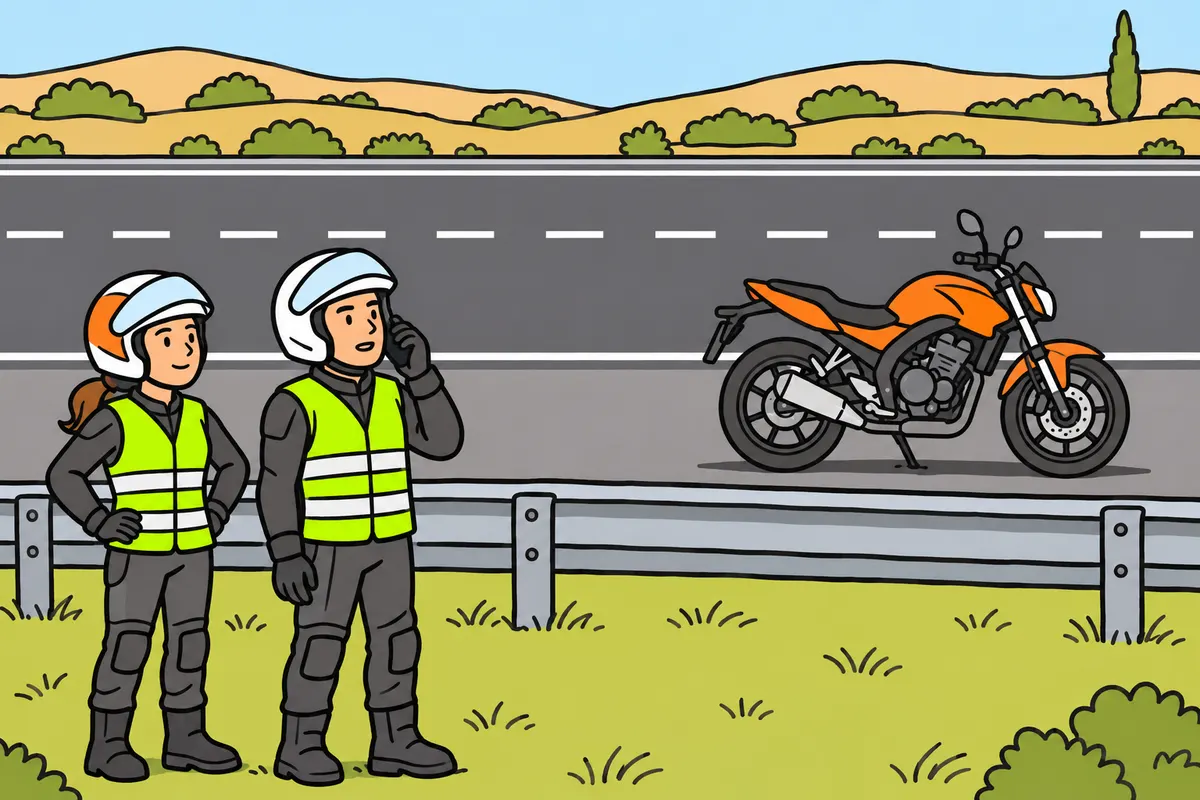
Wait for assistance somewhere protected from traffic.
| Vehicle | If you cannot leave safely |
|---|---|
| Vehicle with passenger compartment and seat belts | Stay inside with your belt fastened |
| Your motorcycle | Report the situation and seek protection; you have no such shelter |
Remember
- If you cannot continue, go to safe shelter away from carriageways and shoulders.
- Do this when such shelter is available; avoid walking or waiting in traffic.
- Get off on the side away from passing traffic.
- Help your passenger reach shelter; check for drops and other dangers.
- Give your registration, location and motorcycle condition when requesting assistance.
Exam trap: Wrong: stay seated on your motorcycle if you cannot leave safely. Right: your motorcycle has no protective passenger compartment; report the situation and seek protection.
Read the full explanation
- If your motorcycle is immobilised and cannot continue, and there is a safe place outside the road platform, you must leave it and go there, avoiding walking or remaining in traffic lanes and on hard shoulders. [RGC, art. 130.3](https://www.boe.es/buscar/act.php?id=BOE-A-2003-23514#a130)
- You must get off your motorcycle on the side away from the flow of traffic and help your passenger find a safe route to the refuge, also assessing changes in ground level and other risks at your chosen location. [RGC, art. 130.3](https://www.boe.es/buscar/act.php?id=BOE-A-2003-23514#a130)
- The provision requiring you to remain inside with your seat belt fastened when you cannot get out safely applies to vehicles with a passenger compartment and seat belts. Your motorcycle offers no such shelter: you must report the situation and seek protection without interpreting the rule for cars as an instruction to remain on your motorcycle. [RGC, art. 130.3](https://www.boe.es/buscar/act.php?id=BOE-A-2003-23514#a130)
- You can request breakdown assistance from your insurer or roadside assistance service, giving your registration number, location and the condition of your motorcycle so that suitable assistance can be sent.
9Calling 112 with useful information
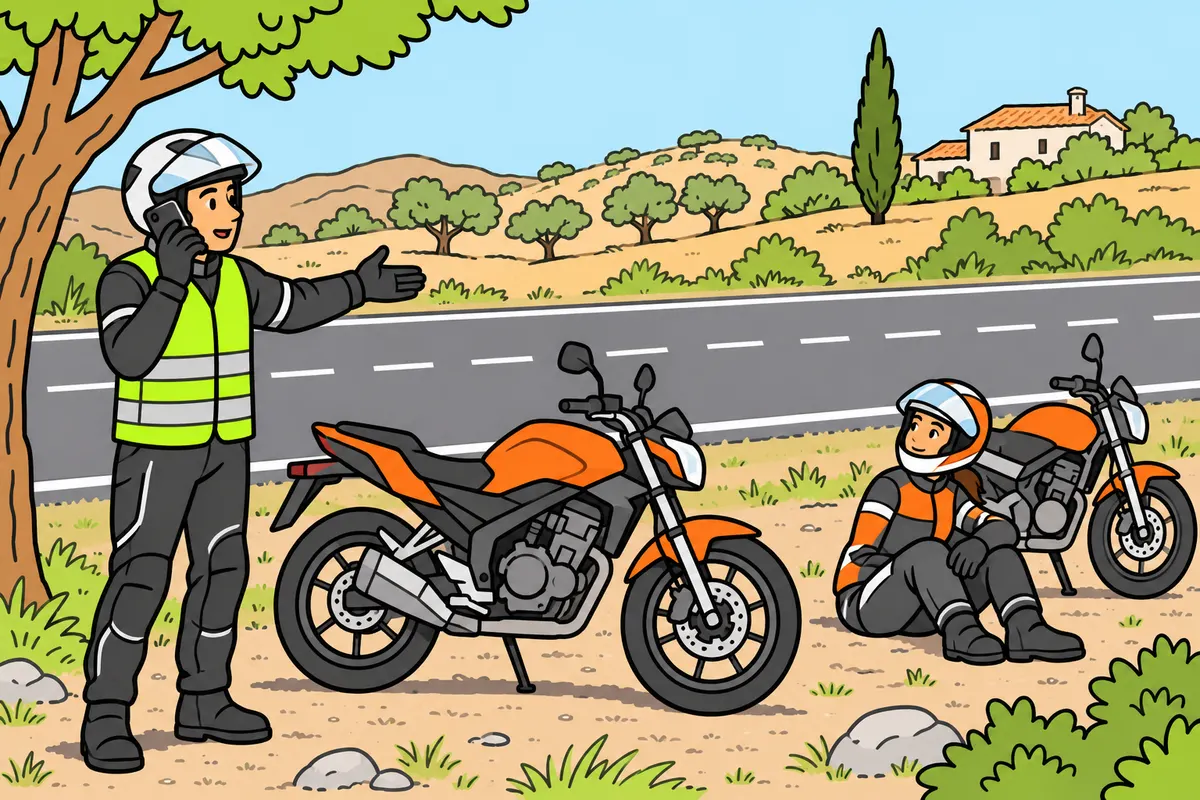
Call emergency services promptly and explain where you are and what you see.
Remember
- Give your location and direction of travel; do not invent details.
- Explain what happened and how many people and vehicles you see.
- Report trapped people; say whether casualties respond, breathe or bleed heavily.
- Report fire, smoke or spills and give a contact telephone number.
- Follow instructions; end the call only when told.
- You can use speakerphone to keep your hands free while helping.
Exam trap: Wrong: wait until you know every injury before calling. Right: call promptly and update the information later.
Read the full explanation
- You must call 112 if you need urgent help following an accident. The call is free and you can use this number in European Union countries. [DGT, first aid, UD1](https://sede.dgt.gob.es/export/sites/dgt/.galleries/permisos-de-conducir/certificacion-aptitud-profesores-formacion-vial/2026/MANUAL-IX-Primeros-auxilios.pdf)
- You must give the road or street, the kilometre point if you know it, the municipality, your direction of travel and visible landmarks. On a road with separate carriageways, giving only the road name can send help to the wrong direction of travel; specify how to reach you without inventing information. [SAMUR, contacting the emergency services](https://www.madrid.es/UnidadesDescentralizadas/Emergencias/Samur-PCivil/Samur/ApartadosSecciones/09_QueHacerEnEmergencias/Ficheros/Guia_PrimerosAuxilios_SAMUR.pdf)
- You must explain what has happened, how many vehicles and people you can see, whether anyone is trapped and whether the casualties respond, breathe or are bleeding heavily. Report any fire, smoke or spills and give a contact telephone number; do not delay the call to gather details that you can update later. [DGT, first aid, UD1](https://sede.dgt.gob.es/export/sites/dgt/.galleries/permisos-de-conducir/certificacion-aptitud-profesores-formacion-vial/2026/MANUAL-IX-Primeros-auxilios.pdf)
- You must answer the operator’s questions and follow their instructions until they tell you that you can end the call. You can use the loudspeaker to keep your hands free and provide assistance. [SAMUR, contacting the emergency services](https://www.madrid.es/UnidadesDescentralizadas/Emergencias/Samur-PCivil/Samur/ApartadosSecciones/09_QueHacerEnEmergencias/Ficheros/Guia_PrimerosAuxilios_SAMUR.pdf)
10Breakdowns and evacuation in tunnels
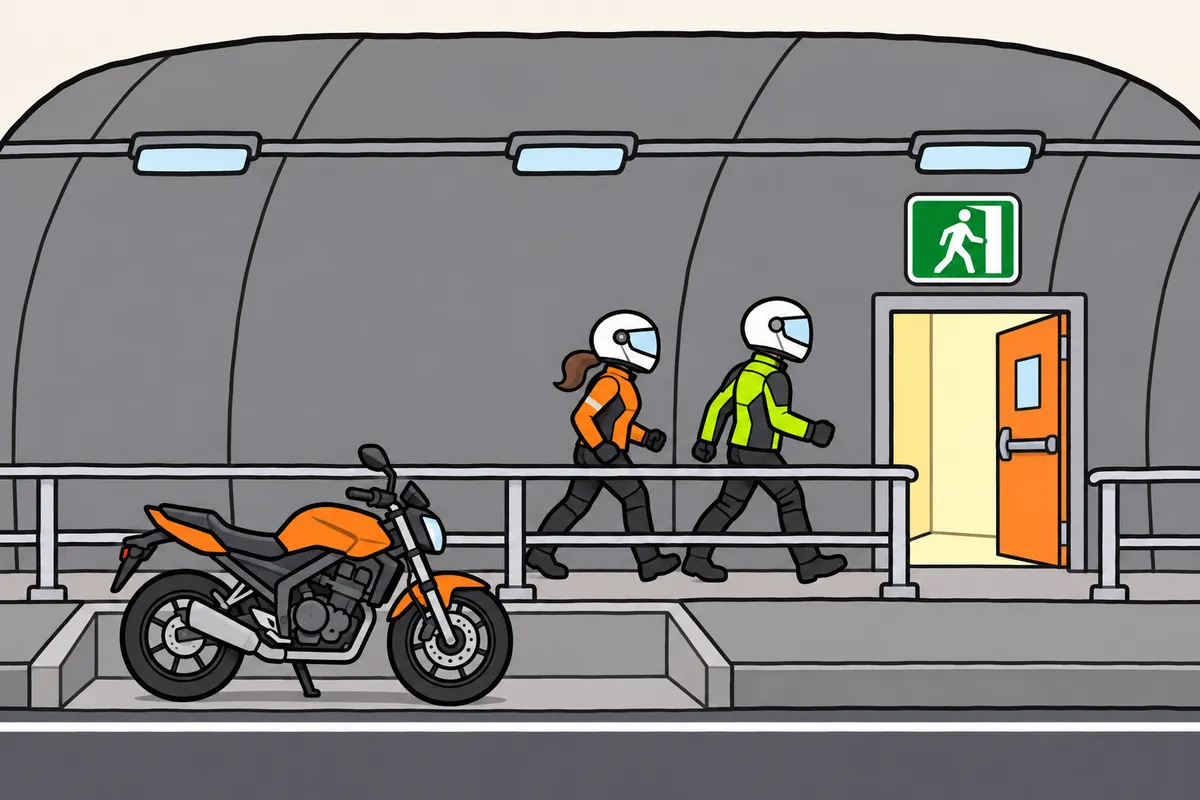
In tunnels, distinguish an emergency from a traffic queue.
| Your situation in a tunnel | What you do |
|---|---|
| Emergency immobilises you | Use the nearest emergency area in your direction; otherwise keep near the right edge |
| Breakdown requires evacuation | Take your passenger to the nearest refuge or exit, using traffic-free areas where available |
| Traffic queue | Stay on your motorcycle with your passenger; leave maximum space ahead; temporarily use hazards if fitted |
Remember
- After a breakdown, continue to the tunnel exit if you can safely.
- Otherwise seek an emergency area; if none exists, keep near the right edge.
- Use hazards if fitted and your V-16 if you carry one.
- Use SOS if safely accessible; otherwise call 112 from a protected place.
- When stopped in a tunnel, always switch off your engine.
- If you wait more than two minutes, also keep your position lights on.
Exam trap: Wrong: leave your engine running because the wait is short. Right: always switch it off when stopped in a tunnel.
Read the full explanation
- If you can continue safely after a breakdown inside a tunnel or underpass, you must proceed to the exit; if this is not possible, proceed to an area reserved for emergencies. [RGC, art. 97.3.f](https://www.boe.es/buscar/act.php?id=BOE-A-2003-23514#a97)
- If you are immobilised by an emergency, you must switch on your hazard warning lights if your motorcycle has them. You must move to the nearest emergency area in your direction of travel or, if there is none, as close as possible to the right-hand edge; if you carry a connected V-16 beacon, you must use it. [RGC, art. 97.3](https://www.boe.es/buscar/act.php?id=BOE-A-2003-23514#a97)
- You must request assistance without delay using the nearest SOS emergency telephone if there is one, and follow the instructions given. The tunnel has its own facilities that help identify your location and manage traffic; if you cannot reach them safely, report the emergency to 112 from a protected position. [RGC, art. 97.3.d](https://www.boe.es/buscar/act.php?id=BOE-A-2003-23514#a97)
- You and your passenger must leave the vehicle and go quickly to the nearest refuge or exit, using areas closed to traffic if there are any. [RGC, art. 97.3.e](https://www.boe.es/buscar/act.php?id=BOE-A-2003-23514#a97)
- If you stop inside the tunnel because of traffic conditions, you must remain on the vehicle with your passenger and temporarily switch on your hazard warning lights if you have them. You must stop as far as possible from the vehicle ahead; distinguish this traffic hold-up from evacuation due to a breakdown or fire. [RGC, art. 97.3](https://www.boe.es/buscar/act.php?id=BOE-A-2003-23514#a97)
- Whenever you stop in a tunnel, you must switch off the engine and keep the position lights on. In other enclosed places, you must also switch off the engine whenever you stop. If the wait in a tunnel or other enclosed place lasts more than two minutes, you must keep the engine off and the position lights on. [RGC, art. 115.1 and 2](https://www.boe.es/buscar/act.php?id=BOE-A-2003-23514#a115) and [RGC, art. 97.3](https://www.boe.es/buscar/act.php?id=BOE-A-2003-23514#a97)
11Fire, fuel and smoke
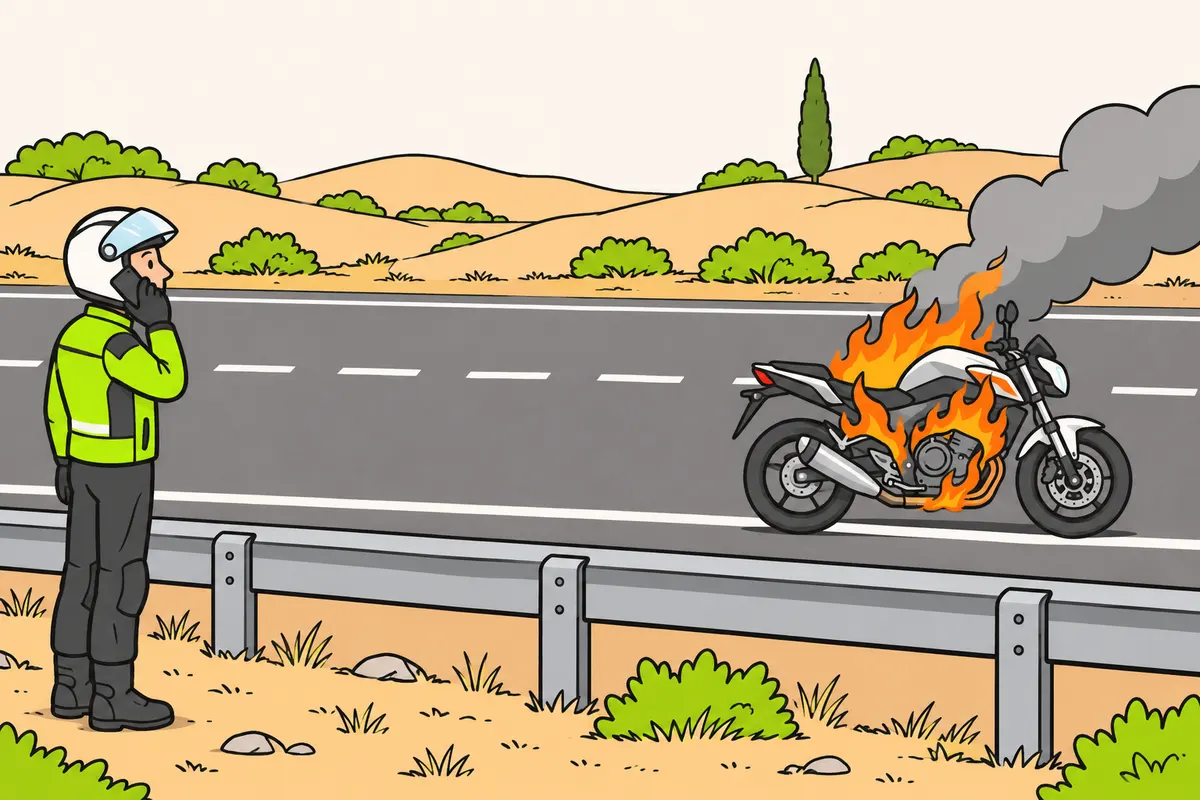
If there is a fire, avoid smoke and find a safe escape route.
| Fire location | What you do |
|---|---|
| In a tunnel | Keep right, switch off your engine, leave the key and escape away from fire |
| Your motorcycle outside a tunnel | Move people away, call 112 and avoid smoke and fuel |
Remember
- For tunnel fires, keep right, switch off your engine and leave the key.
- Head to the nearest refuge or exit, away from fire; use traffic-free areas available.
- If your motorcycle burns outside a tunnel, move people away and call 112.
- Avoid smoke and fuel; wait somewhere protected if you cannot safely control the fire.
- Keep away from dangerous goods; report only details visible from a safe place.
Exam trap: Wrong: throw water on burning petrol. Right: do not use water. Use a suitable extinguisher only if you know how, can act safely and keep an escape route.
Read the full explanation
- If there is a fire in a tunnel, you must move your vehicle towards the right to allow emergency vehicles to pass, switch off the engine and leave the key in the ignition. You must head for the nearest refuge or exit in the direction away from the fire and use areas closed to traffic where available. [RGC, art. 97.3](https://www.boe.es/buscar/act.php?id=BOE-A-2003-23514#a97)
- Outside a tunnel, if your motorcycle catches fire, you must move people away, call 112 and avoid the smoke and fuel. If you cannot control a small, developing fire without putting yourself at risk, wait for the fire service in a protected area. [DGT, first aid, UD1](https://sede.dgt.gob.es/export/sites/dgt/.galleries/permisos-de-conducir/certificacion-aptitud-profesores-formacion-vial/2026/MANUAL-IX-Primeros-auxilios.pdf)
- Do not throw water onto burning petrol. You must only use a suitable fire extinguisher if you know how to operate it, can act safely and keep an escape route available. [DGT, first aid, UD1](https://sede.dgt.gob.es/export/sites/dgt/.galleries/permisos-de-conducir/certificacion-aptitud-profesores-formacion-vial/2026/MANUAL-IX-Primeros-auxilios.pdf)
- If a vehicle carrying dangerous goods is involved, you must keep your distance, avoid touching the load or crossing spills, and report to the emergency services any signs or information visible from a safe position. [DGT, first aid, UD1](https://sede.dgt.gob.es/export/sites/dgt/.galleries/permisos-de-conducir/certificacion-aptitud-profesores-formacion-vial/2026/MANUAL-IX-Primeros-auxilios.pdf)
12If you fall off your motorcycle
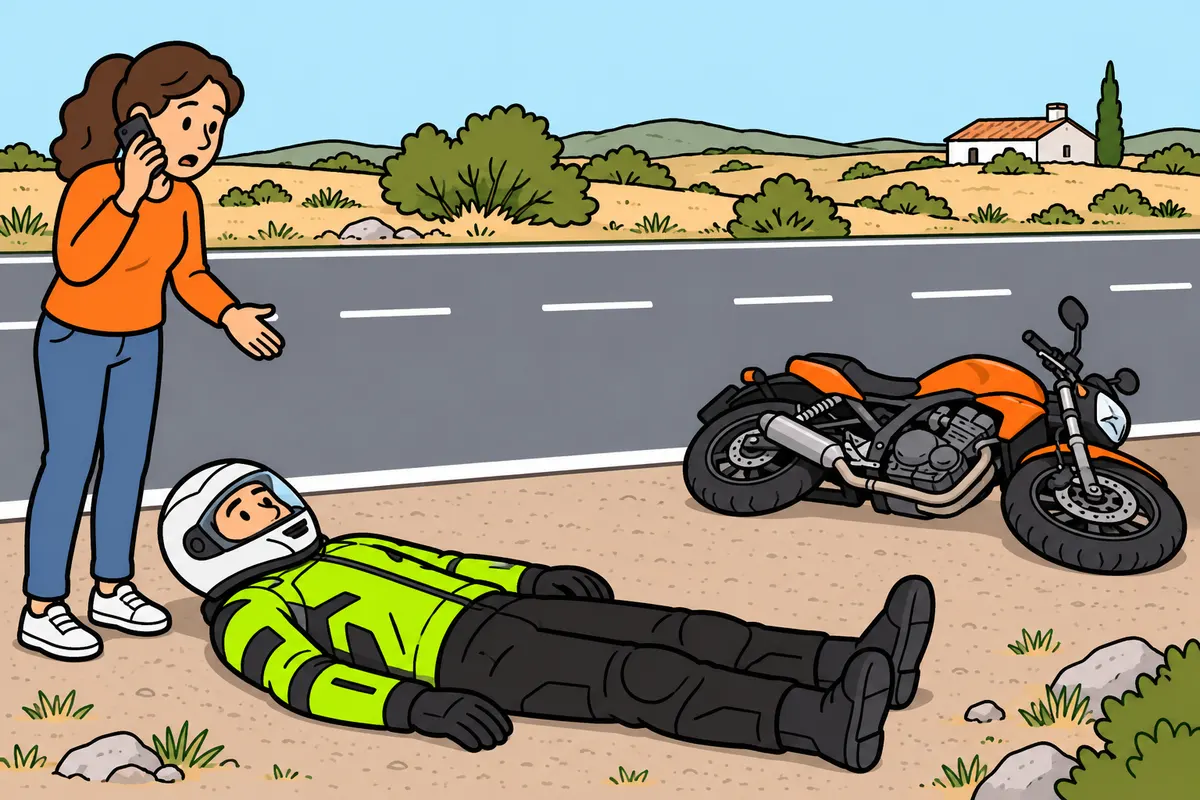
After a fall, check your condition before moving or continuing.
Remember
- Assess your injuries and traffic before getting up.
- Do not jump up to pick up your motorcycle.
- If you suspect head, neck or back injuries, avoid unnecessary movement; request help.
- Check your passenger; do not ask them to stand up to test their condition.
- Continue only if both you and your motorcycle are safe to ride.
- If uninjured, check your motorcycle somewhere protected; request assistance if unsure.
Exam trap: Wrong: never move, even in immediate danger. Right: report the danger and follow emergency instructions to escape with the least risk.
Read the full explanation
- After a fall, you must assess your condition and the danger from traffic before moving. Do not instinctively get up to pick up your motorcycle: the impact may have injured you even if you initially feel hardly any pain, and other road users may not have noticed that you are on the ground. [Sanidad (Ministry of Health), what to do at an accident](https://www.sanidad.gob.es/eu/ciudadanos/accidentes/docs/modulo6.pdf)
- If you suspect a head, neck or back injury, avoid unnecessary movement and ask for help. If there is immediate danger, you must report it and follow the emergency services’ instructions to escape it with the least risk; remaining still must not become a rule that prevents you from saving your life. [Sanidad (Ministry of Health), what to do at an accident](https://www.sanidad.gob.es/eu/ciudadanos/accidentes/docs/modulo6.pdf)
- If you have a passenger, you must also check their condition and must not encourage them to get up to test whether they are all right. Ask someone else to call for help if you cannot do so; explain that you have both fallen off the motorcycle and where you are, so that attention is not focused solely on the visible motorcycle. [RGC, art. 129](https://www.boe.es/buscar/act.php?id=BOE-A-2003-23514#a129)
- You must only set off again when your condition and that of your motorcycle allow you to do so safely. If you are uninjured, check the steering, handlebars, brakes, tyres, wheels, controls, lights and any possible leaks or damage from a protected position; if you find anything wrong or have doubts, request assistance. [RGC, art. 130.2](https://www.boe.es/buscar/act.php?id=BOE-A-2003-23514#a130)
13Helping without worsening injuries
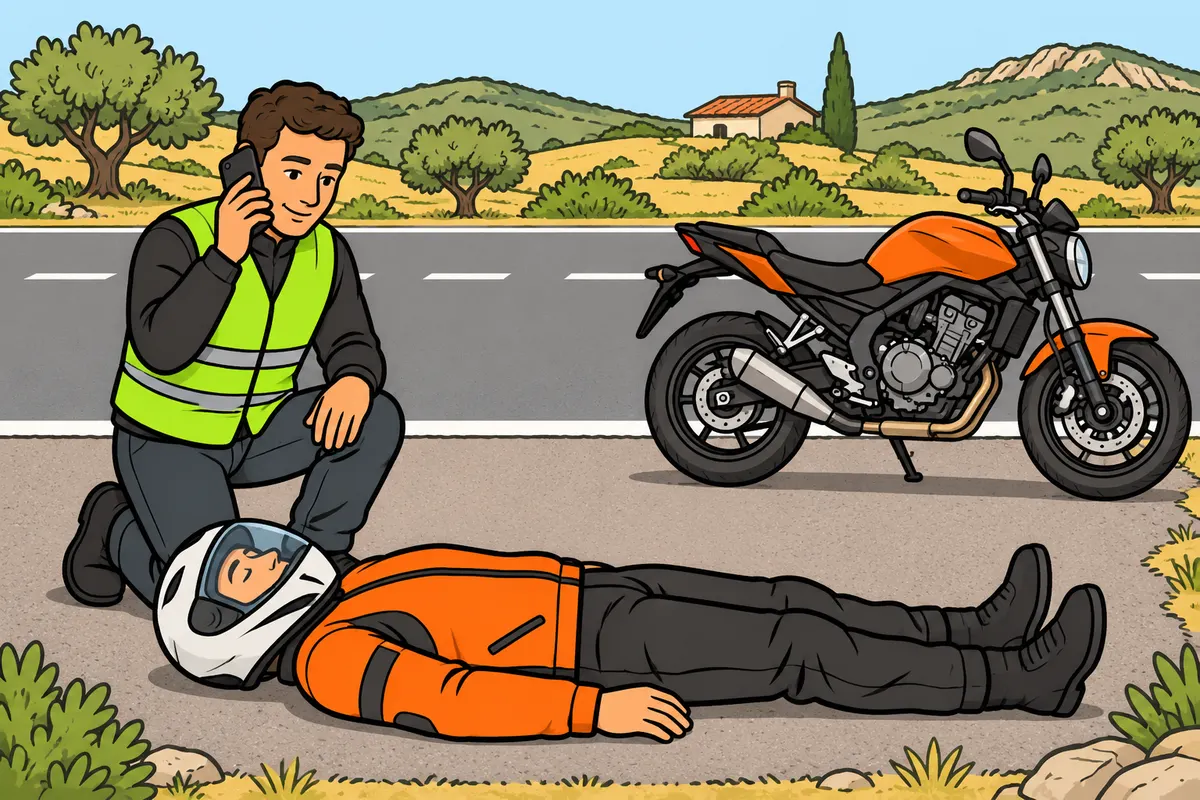
Help without moving the injured person unless essential.
Remember
- Use techniques you know and follow instructions from 112.
- Do not sit the injured person up or make them walk.
- Avoid pulling their limbs or making sudden neck movements.
- Do not force trapped people free or make a neck collar yourself.
- You can use disposable gloves to avoid contact with blood.
- Tell medical staff what happened and what you did.
Exam trap: Wrong: move an injured person for convenience. Right: consider moving them only for immediate danger or a life-saving need; try to keep head, neck and body aligned and follow emergency instructions.
Read the full explanation
- You must help within the limits of your knowledge and the instructions from 112. If you do not know a technique, explain what you observe and ask for instructions; staying with the casualty, protecting them, controlling bleeding with pressure or requesting resources can be useful interventions without performing complex procedures. [RGC, art. 129.2.d](https://www.boe.es/buscar/act.php?id=BOE-A-2003-23514#a129)
- You must not move the casualty for convenience, sit them up or make them walk. You must only consider moving them when it is essential to free them from immediate danger or meet a life-saving need, taking care to keep their head, neck and trunk aligned and following the emergency services’ instructions. [Sanidad (Ministry of Health), what to do at an accident](https://www.sanidad.gob.es/eu/ciudadanos/accidentes/docs/modulo6.pdf)
- You must avoid pulling on arms or legs and making sudden neck movements. Do not try to force a person trapped under a motorcycle out or improvise a neck collar: report that they are trapped and wait for rescue equipment unless an immediate threat requires you to act under instructions. [DGT, first aid, UD3 and UD5](https://sede.dgt.gob.es/export/sites/dgt/.galleries/permisos-de-conducir/certificacion-aptitud-profesores-formacion-vial/2026/MANUAL-IX-Primeros-auxilios.pdf)
- You can use disposable gloves to avoid contact with blood and bodily fluids. You must tell the healthcare professionals what happened and what measures you have taken. [SAMUR, hygiene measures](https://www.madrid.es/UnidadesDescentralizadas/Emergencias/Samur-PCivil/Samur/ApartadosSecciones/09_QueHacerEnEmergencias/Ficheros/Guia_PrimerosAuxilios_SAMUR.pdf)
14An injured motorcyclist’s helmet
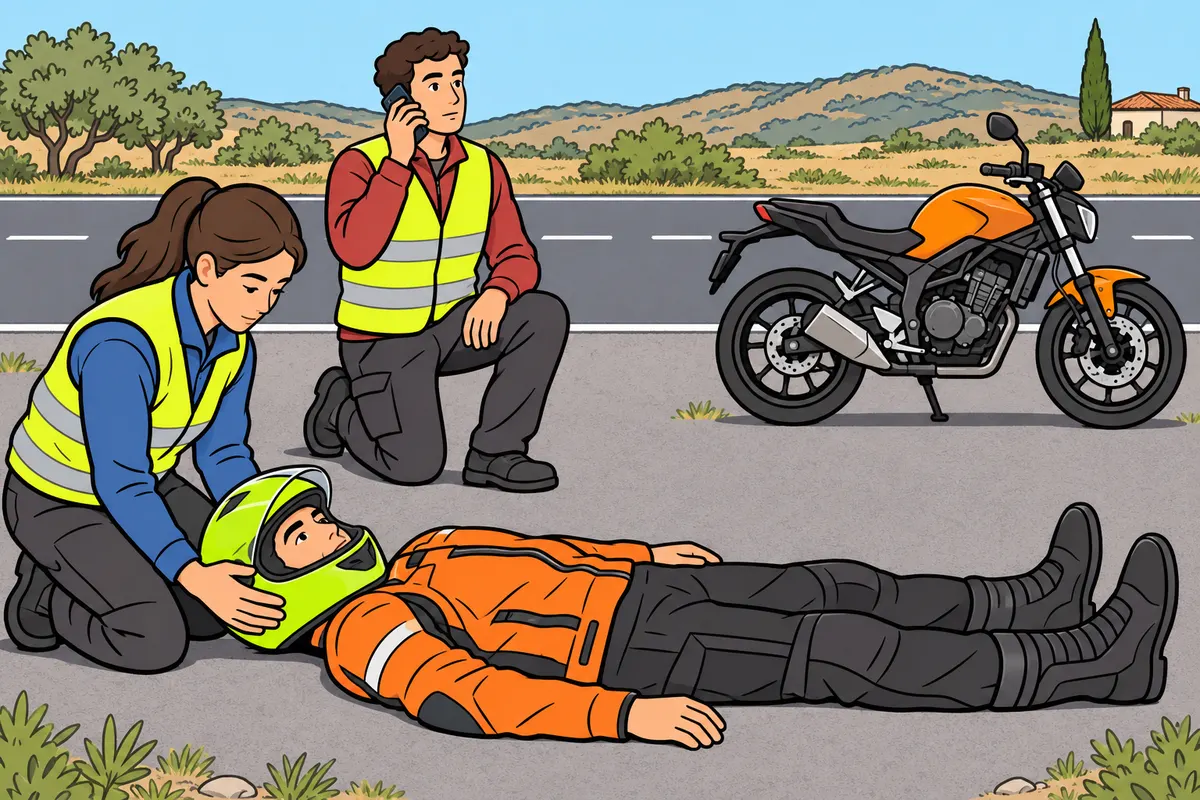
Leave the helmet on unless it prevents essential help.
| Injured motorcyclist’s situation | What you do with the helmet |
|---|---|
| General rule | Leave it on; prevent neck movement |
| Helmet obstructs breathing, or heart and breathing stop | Removal may be necessary; contact 112 and follow instructions |
Remember
- Prevent the injured rider from moving their neck.
- If conscious, ask them to stay still and keep their helmet on.
- If their helmet obstructs breathing or their heart and breathing stop, contact 112.
- Follow instructions if removing the helmet is necessary to help them.
Exam trap: Wrong: you can never remove the helmet. Right: removal may be necessary if it obstructs breathing or the heart and breathing stop; contact 112 and follow instructions.
Read the full explanation
- As a general first-aid rule, you must leave an injured motorcyclist’s helmet on and prevent their neck from moving. [DGT, first aid, UD5](https://sede.dgt.gob.es/export/sites/dgt/.galleries/permisos-de-conducir/certificacion-aptitud-profesores-formacion-vial/2026/MANUAL-IX-Primeros-auxilios.pdf)
- If the helmet makes breathing difficult or the casualty is in cardiorespiratory arrest, you may need to remove it to provide care. Tell 112 about the problem and follow their instructions; do not interpret “leave the helmet on” as preventing essential resuscitation. [DGT, first aid, UD5](https://sede.dgt.gob.es/export/sites/dgt/.galleries/permisos-de-conducir/certificacion-aptitud-profesores-formacion-vial/2026/MANUAL-IX-Primeros-auxilios.pdf)
- If the motorcyclist is conscious, you must ask them to stay still and avoid removing their helmet themselves. [Sanidad (Ministry of Health), what to do at an accident](https://www.sanidad.gob.es/eu/ciudadanos/accidentes/docs/modulo6.pdf)
15Consciousness, breathing and life-saving priorities
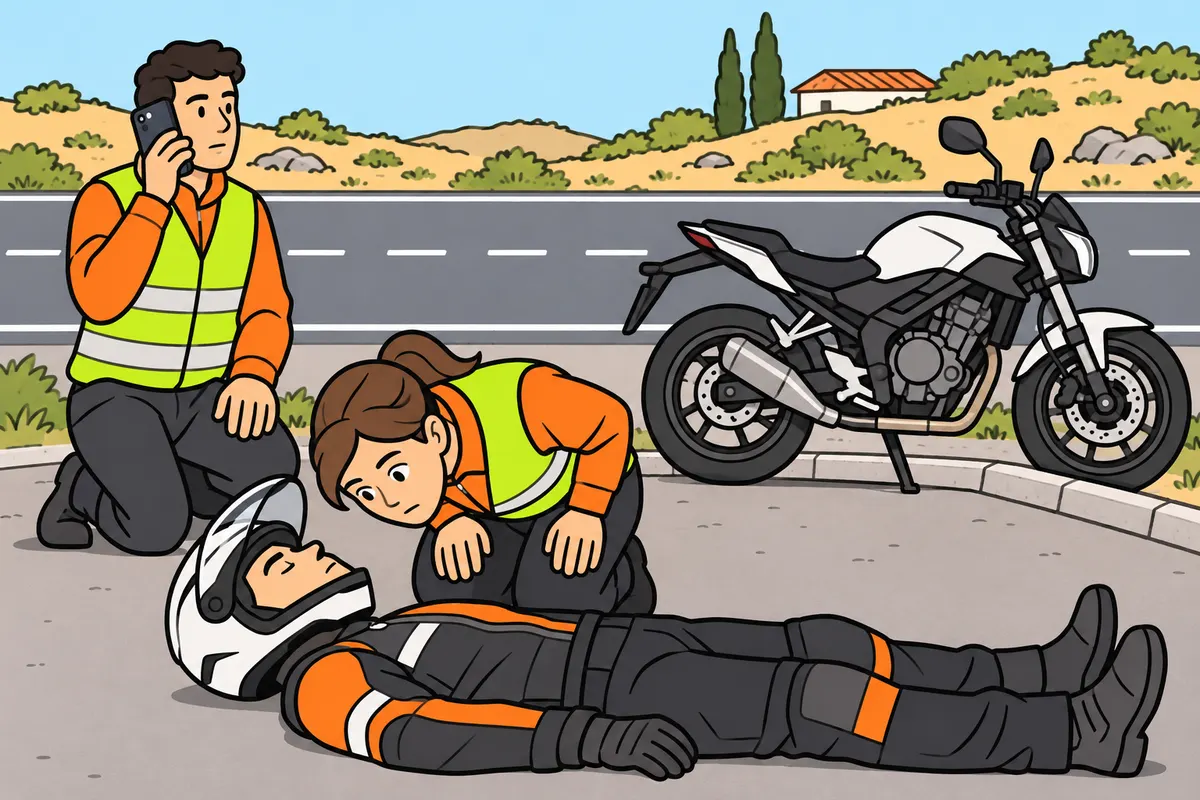
Check whether the person responds and breathes normally to identify a life-threatening emergency.
Remember
- When the surroundings are safe, speak to check whether they respond.
- If they do not respond, seek help, call 112 and follow instructions.
- Do not shake them or move their neck to get a response.
- Isolated gasps are not normal breathing.
- Unless you are a healthcare professional, do not delay resuscitation checking their pulse.
- With several casualties, follow emergency instructions and deal with life-threatening problems first.
Exam trap: Wrong: whoever shouts loudest is always most seriously injured. Right: assess life-threatening problems and do not ignore someone lying still.
Read the full explanation
- Once the surroundings are safe, you must check whether the casualty responds by speaking to them clearly. If they do not respond, call for help, call 112 and follow their instructions to check breathing; do not shake the casualty or cause their neck to move to obtain a reaction. [DGT, first aid, UD3](https://sede.dgt.gob.es/export/sites/dgt/.galleries/permisos-de-conducir/certificacion-aptitud-profesores-formacion-vial/2026/MANUAL-IX-Primeros-auxilios.pdf)
- You must spend no more than 10 seconds checking whether the casualty is breathing normally, watching their chest and checking for air moving in and out. Isolated gasps or gasping breaths do not count as normal breathing; tell the operator that the casualty is unresponsive and their breathing is abnormal. [DGT, first aid, UD3](https://sede.dgt.gob.es/export/sites/dgt/.galleries/permisos-de-conducir/certificacion-aptitud-profesores-formacion-vial/2026/MANUAL-IX-Primeros-auxilios.pdf)
- If you are not a healthcare professional, you must not waste time looking for a pulse in the neck to decide whether to start resuscitation. When the casualty is both unresponsive and not breathing normally, you must act following the instructions from 112; a difficult check must not delay compressions. [INSST, NTP 1062](https://www.insst.es/documentacion/colecciones-tecnicas/ntp-notas-tecnicas-de-prevencion/30-serie-ntp-numeros-1031-a-1065-ano-2015/ntp-1.062-primeros-auxilios-soporte-vital-basico-en-el-adulto)
- If there are several casualties, you must report how many you can see and deal with life-threatening conditions first, following the emergency services’ instructions. Do not assume that the person shouting the loudest is the most seriously injured or abandon your assessment of a motionless person to focus only on conspicuous wounds. [DGT, first aid, UD3](https://sede.dgt.gob.es/export/sites/dgt/.galleries/permisos-de-conducir/certificacion-aptitud-profesores-formacion-vial/2026/MANUAL-IX-Primeros-auxilios.pdf)
16Basic CPR
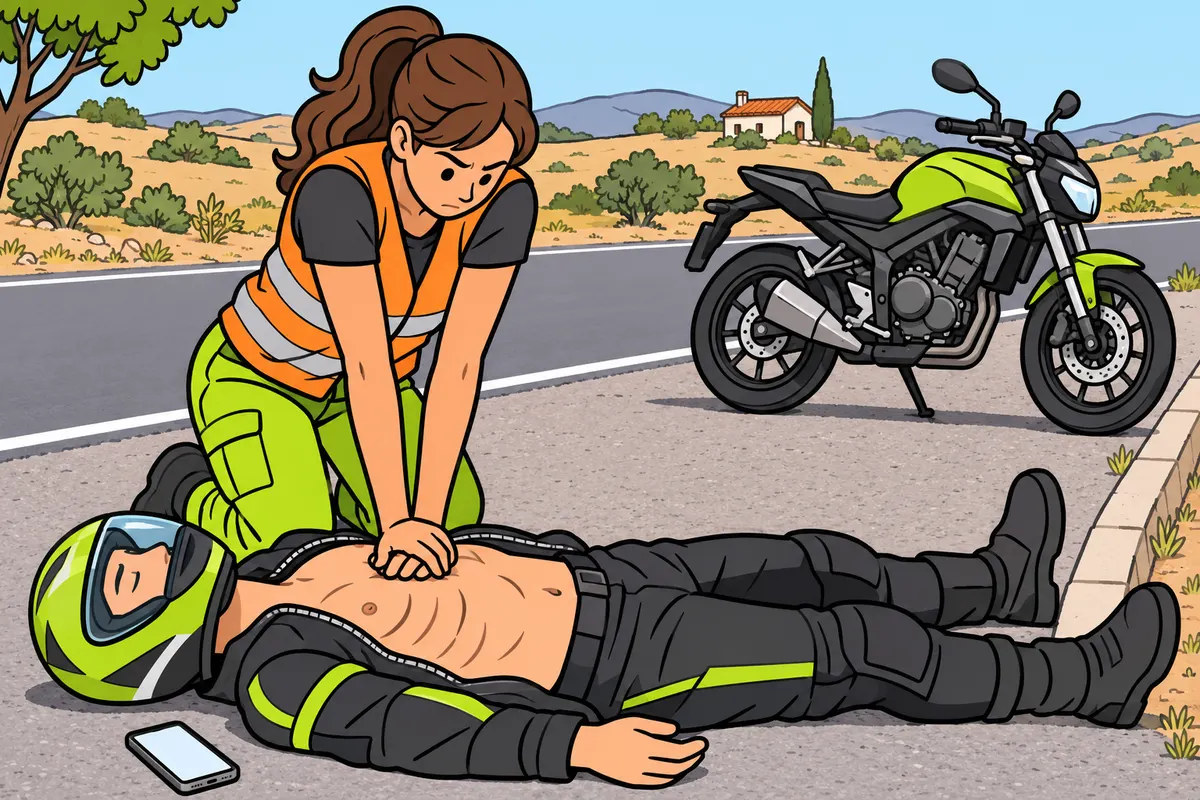
If an adult is unresponsive and not breathing normally, start chest compressions following emergency instructions.
| Your ability to give breaths | CPR for an unresponsive adult not breathing normally |
|---|---|
| You know how and can | Alternate 30 compressions and 2 breaths |
| You cannot | Give continuous compressions following the operator |
Remember
- Press in the centre of the chest, following instructions from 112.
- If you know how and can give rescue breaths, alternate them with compressions.
- If you cannot give breaths, give continuous compressions following the operator.
- If a defibrillator is available, follow its instructions and those from 112.
Exam trap: Wrong: 30:2 is the compression speed. Right: alternate 30 compressions and 2 breaths if you know how and can; the rate is 100 to 120 compressions per minute.
Read the full explanation
- If an adult is unresponsive and not breathing normally, you must start compressions in the centre of their chest following the instructions from 112, at a rate of 100 to 120 per minute. [DGT, first aid, UD4](https://sede.dgt.gob.es/export/sites/dgt/.galleries/permisos-de-conducir/certificacion-aptitud-profesores-formacion-vial/2026/MANUAL-IX-Primeros-auxilios.pdf)
- If you know how to give rescue breaths and can do so, you must alternate 30 compressions with 2 rescue breaths (30:2). If you cannot do this, give continuous compressions following the operator’s instructions. [DGT, first aid, UD4](https://sede.dgt.gob.es/export/sites/dgt/.galleries/permisos-de-conducir/certificacion-aptitud-profesores-formacion-vial/2026/MANUAL-IX-Primeros-auxilios.pdf)
- If you have a defibrillator available, you can use it following its instructions and those from 112. [DGT, first aid, UD4](https://sede.dgt.gob.es/export/sites/dgt/.galleries/permisos-de-conducir/certificacion-aptitud-profesores-formacion-vial/2026/MANUAL-IX-Primeros-auxilios.pdf)
17Bleeding: direct pressure
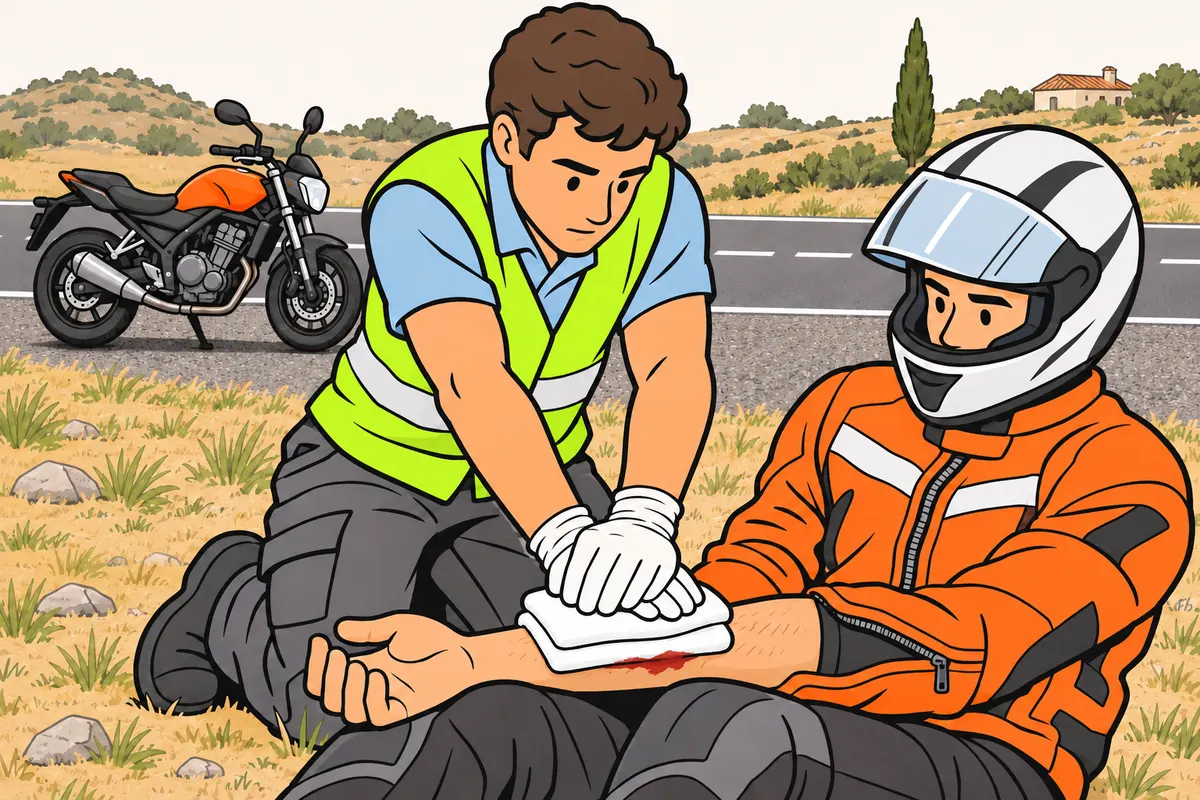
To control external bleeding, keep pressing directly on the wound.
Remember
- Press directly on the wound with clean material.
- If the material becomes soaked, add more on top.
- Keep pressing without removing the original material.
Exam trap: Wrong: remove soaked material. Right: add material on top and keep pressing.
Read the full explanation
- To control external bleeding, you must apply firm, continuous direct pressure to the wound with clean material. [DGT, first aid, UD4](https://sede.dgt.gob.es/export/sites/dgt/.galleries/permisos-de-conducir/certificacion-aptitud-profesores-formacion-vial/2026/MANUAL-IX-Primeros-auxilios.pdf)
- If the dressing becomes soaked, you must add material on top and maintain pressure without removing the first dressing. [DGT, first aid, UD4](https://sede.dgt.gob.es/export/sites/dgt/.galleries/permisos-de-conducir/certificacion-aptitud-profesores-formacion-vial/2026/MANUAL-IX-Primeros-auxilios.pdf)
18Optional first-aid reading
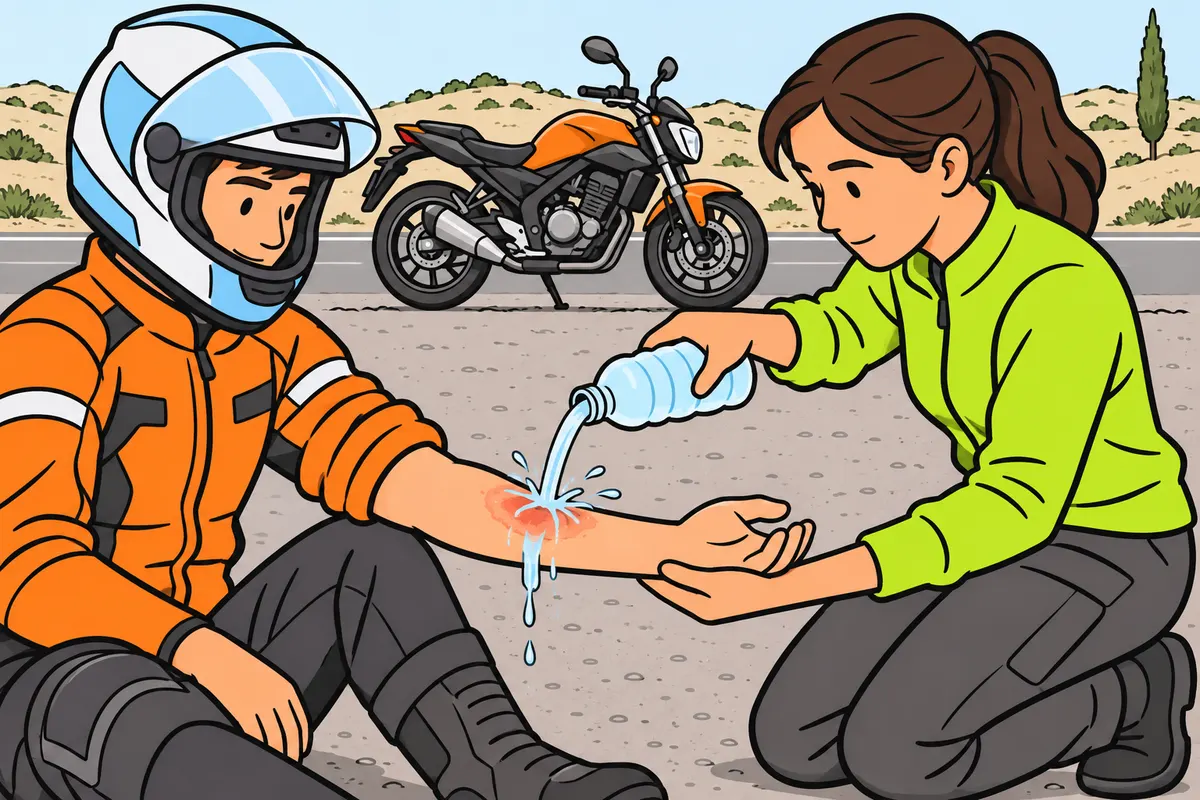
Protect burns and avoid moving bones you suspect are broken.
| Injury | How you help |
|---|---|
| Burn | You can cool it with water and cover it with clean material |
| Possible broken bone | Keep the area still; do not reposition the bone |
Remember
- You can cool burns with water and cover them with clean material.
- Do not burst blisters or pull off clothing stuck to skin.
- If you suspect a broken bone, keep the injured area still.
- Do not try to put the bone back into place.
Exam trap: Wrong: try to reposition a possibly broken bone. Right: keep the injured area still.
Read the full explanation
- For a burn, you can cool the area with water and protect it with clean material. Avoid bursting blisters or pulling off clothing stuck to the skin. [DGT, first aid, UD5](https://sede.dgt.gob.es/export/sites/dgt/.galleries/permisos-de-conducir/certificacion-aptitud-profesores-formacion-vial/2026/MANUAL-IX-Primeros-auxilios.pdf)
- If you suspect a fracture, you must keep the injured area still and avoid trying to put the bone back into place. [DGT, first aid, UD5](https://sede.dgt.gob.es/export/sites/dgt/.galleries/permisos-de-conducir/certificacion-aptitud-profesores-formacion-vial/2026/MANUAL-IX-Primeros-auxilios.pdf)
19Staying with casualties, keeping them warm and avoiding mistakes
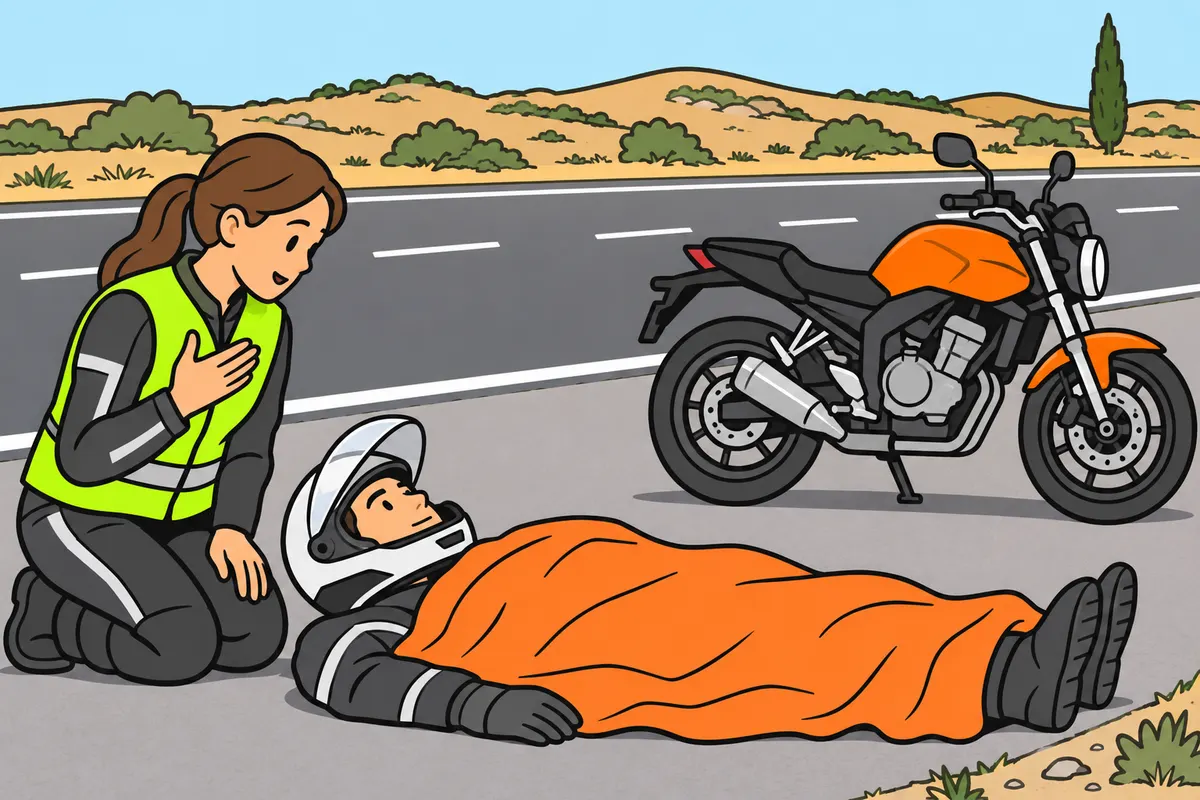
Stay calmly with the injured person and wait for medical transport.
Remember
- Speak calmly and watch for changes.
- Ask questions without making them struggle; pass information to medical staff.
- Cover them without covering their face or making them too hot.
- Loosen clothing restricting breathing only if you can avoid dangerous movement.
- Do not give medicines, food, alcohol or other drinks on your own initiative.
- Wait for medical transport; carrying them on your motorcycle may worsen their injuries.
Exam trap: Wrong: give water because the injured person is thirsty. Right: thirst does not mean drinking is safe; follow instructions from 112.
Read the full explanation
- You must speak calmly, explain that help has been called and watch for changes. Ask for information the person can give without effort and pass it on to the medical staff. [SAMUR, communicating with the casualty](https://www.madrid.es/UnidadesDescentralizadas/Emergencias/Samur-PCivil/Samur/ApartadosSecciones/09_QueHacerEnEmergencias/Ficheros/Guia_PrimerosAuxilios_SAMUR.pdf)
- You can cover the casualty to prevent heat loss, keeping their face uncovered and avoiding overheating. Loosen clothing that restricts breathing if you can do so without dangerous movements. [DGT, first aid, Unit 3](https://sede.dgt.gob.es/export/sites/dgt/.galleries/permisos-de-conducir/certificacion-aptitud-profesores-formacion-vial/2026/MANUAL-IX-Primeros-auxilios.pdf)
- You must not give the casualty medication, food, alcohol or drinks on your own initiative. Thirst does not show that drinking is safe; the casualty may have an impaired level of consciousness or injuries you are unaware of, so you must follow the instructions from 112. [DGT, first aid, Units 3 and 5](https://sede.dgt.gob.es/export/sites/dgt/.galleries/permisos-de-conducir/certificacion-aptitud-profesores-formacion-vial/2026/MANUAL-IX-Primeros-auxilios.pdf)
- You must wait for specialist medical transport; carrying the casualty as a passenger on your motorcycle can worsen their injuries. [Ministry of Health, what to do at an accident](https://www.sanidad.gob.es/eu/ciudadanos/accidentes/docs/modulo6.pdf)
20Authorities, remaining at the scene and evidence
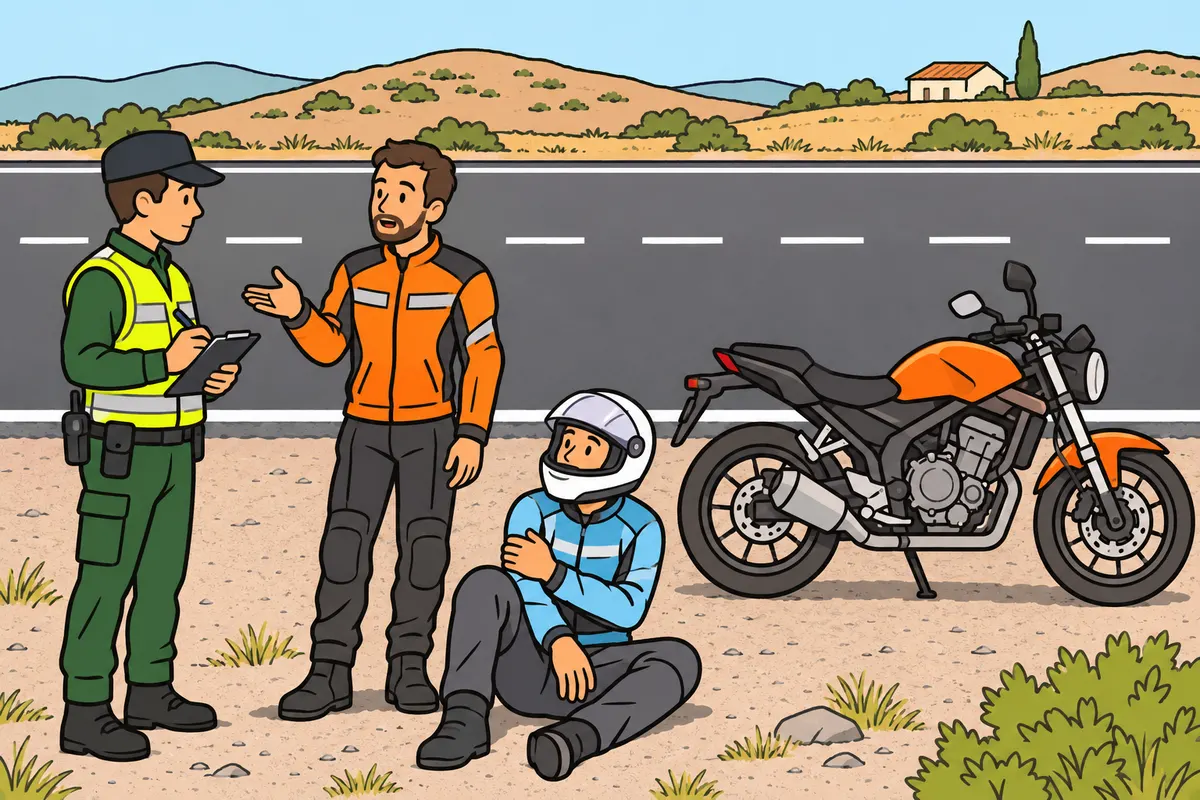
If involved with apparent casualties, you must notify the authorities and stay.
| Situation when you are involved | Notifying authorities and staying |
|---|---|
| Someone appears injured or dead | Notify authorities; stay or return; leave only with permission, to help casualties or receive care |
| Only clearly minor injuries, safety restored, nobody involved requests authorities | You need not notify authorities or stay |
Remember
- If involved with apparent injuries or deaths, notify authorities; stay or return until arrival.
- You may leave with permission, to help casualties or to receive medical care.
- Preserve evidence if someone appears dead, seriously injured, or authorities have been notified.
- Protecting casualties and traffic safety takes priority over preserving evidence.
- Report what you saw accurately; distinguish what others told you or you guessed.
Exam trap: Wrong: any minor injury lets you leave without notifying authorities. Right: the exception requires only clearly minor injuries, restored safety and nobody involved requesting the authorities.
Read the full explanation
- If you are involved and someone appears to be injured or dead, you must notify the authorities or their officers and remain at the scene or return until they arrive. You can leave if they authorise you to do so, you need to assist the injured or you need medical attention yourself. [RGC, art. 129.2.e](https://www.boe.es/buscar/act.php?id=BOE-A-2003-23514#a129)
- You do not need to notify the authorities or remain at the scene when there are only clearly minor injuries, safety has been restored and none of those involved requests it. All these conditions must be met together; if someone requests the authorities' involvement, you cannot rely on this exception to avoid notifying them. [RGC, art. 129.2.e](https://www.boe.es/buscar/act.php?id=BOE-A-2003-23514#a129)
- If anyone appears to be dead or seriously injured, or the authorities have been notified, you must preserve objects, traces and evidence useful for establishing responsibility, unless this endangers the safety of the injured or of traffic. [RGC, art. 129.2.c](https://www.boe.es/buscar/act.php?id=BOE-A-2003-23514#a129)
- You must give an accurate account of what you have observed, distinguishing it from what others have told you or what you infer. [RGC, art. 129](https://www.boe.es/buscar/act.php?id=BOE-A-2003-23514#a129)
21Identification and property damage
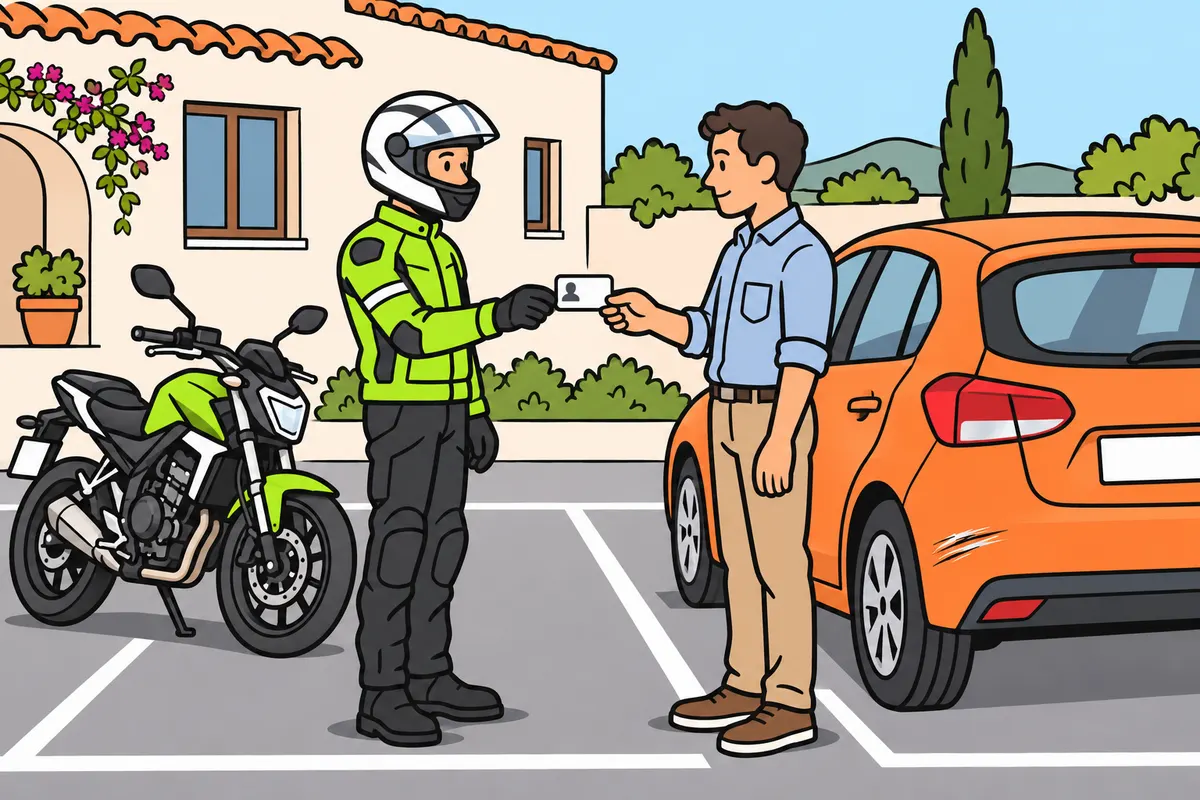
If involved, give your details when requested, even if there is only property damage.
Remember
- Give your identity and vehicle details when other people involved request them.
- If you cause only property damage, promptly give absent owners your name and address.
- You can give these directly or through officers.
- Complete the accident report somewhere safe, off the road.
- First protect people, help casualties and remove obstructions where possible.
Exam trap: Wrong: complete the accident report on the hard shoulder. Right: complete it off the road, away from carriageways and hard shoulders.
Read the full explanation
- If you are involved, you must give your identity and your vehicle details to the other people involved when they ask, including when there is only property damage. [RGC, art. 129.2.f and g](https://www.boe.es/buscar/act.php?id=BOE-A-2003-23514#a129)
- If you cause only property damage and the person affected is absent, you must give them your name and address as soon as possible, either directly or through the officers. [RGC, art. 129.2.f](https://www.boe.es/buscar/act.php?id=BOE-A-2003-23514#a129)
- You must not fill in the accident report on the road platform, which includes the carriageway and hard shoulders. You must do so in a safe place off the road; first secure the scene, attend to the casualties and remove obstacles when feasible, then complete the paperwork. [RGC, art. 130.5](https://www.boe.es/buscar/act.php?id=BOE-A-2003-23514#a130)
22Failure to assist and leaving the scene
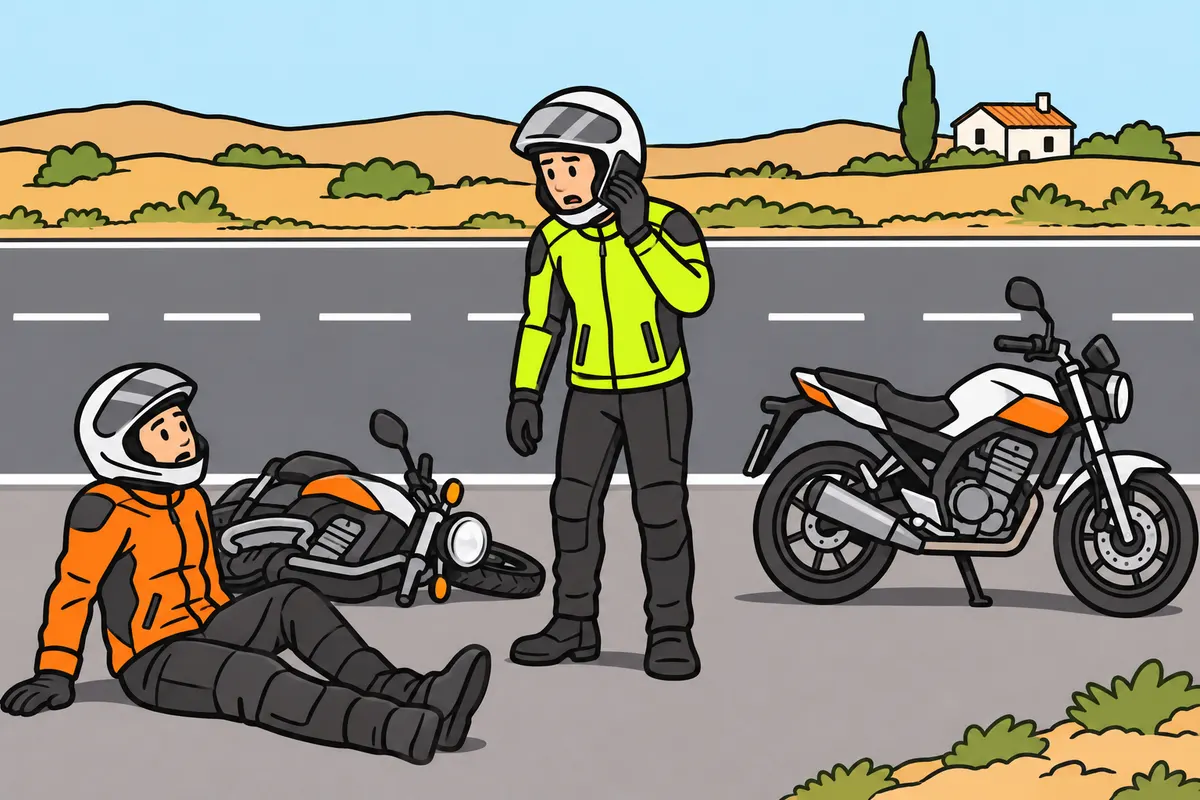
Help without risk, or urgently seek help if you cannot intervene.
| Offence and circumstances | Imprisonment | Driving disqualification |
|---|---|---|
| Failure to assist after you cause an accident by chance | 6 to 18 months | Not stated here |
| Failure to assist after you cause an accident through negligence | 6 months to 4 years | Not stated here |
| Leaving: you caused the accident through negligence | 6 months to 4 years | 1 to 4 years |
| Leaving: you caused the accident by chance | 3 to 6 months | 6 months to 2 years |
Remember
- Help someone helpless in clear, serious danger if safe for you and others.
- If you cannot intervene, urgently seek help from others.
- Danger when approaching does not excuse failing to call when you safely can.
Exam trap: Wrong: leaving the scene is only an offence if you fail to assist. Right: outside failure-to-assist cases, you may also commit an offence if, riding your motorcycle, you caused an accident involving deaths or injuries covered by articles 147.1, 149 or 150 and voluntarily leave without risk to yourself or others.
Read the full explanation
- You can commit the offence of failure to assist if you do not help a helpless person in clear and serious danger when you can do so without risk to yourself or others. If you cannot intervene, you must urgently seek help from others: danger that prevents you from approaching does not justify failing to make a call that you can make. [Código Penal (Criminal Code), art. 195.1 and 2](https://www.boe.es/buscar/act.php?id=BOE-A-1995-25444#a195)
- For the general offence of failure to assist, you face a fine calculated over 3 to 12 months. If you fail to assist after causing the accident by chance, you face 6 to 18 months in prison; if you cause it through negligence, you face 6 months to 4 years in prison. [Código Penal, art. 195](https://www.boe.es/buscar/act.php?id=BOE-A-1995-25444#a195)
- You can commit the offence of leaving the scene of an accident if, as a motorcycle rider, you cause an accident involving deaths or injuries covered by articles 147.1, 149 or 150 and voluntarily leave the scene without risk to yourself or others, outside the cases of failure to assist covered by article 195. [Código Penal, art. 382 bis](https://www.boe.es/buscar/act.php?id=BOE-A-1995-25444#a3-2)
- If the accident you leave results from negligence, you face 6 months to 4 years in prison and disqualification from driving for 1 to 4 years for leaving the scene. If it occurs by chance, you face 3 to 6 months in prison and disqualification from driving for 6 months to 2 years. [Código Penal, art. 382 bis.2 and 3](https://www.boe.es/buscar/act.php?id=BOE-A-1995-25444#a3-2)
Applying PAS when you find a fallen motorcyclist
Organise assistance and prevent a second accident.
- Check for traffic, fire and spills; stop where you do not create a hazard and wear your reflective vest when required.
- Warn other road users with the lights available and use the V-16 if you carry one, without putting yourself at risk to position it.
- Call 112 and give the location, direction of travel, casualties and hazards; allocate tasks if other people are present.
- Check responsiveness and breathing, control severe bleeding and follow the operator’s instructions; leave the helmet on unless removal is necessary to save life.
- Monitor the casualties and tell the emergency services what you know and what measures you have taken.
Dealing with a motorcycle breakdown
Decide whether you can leave the traffic flow or need to stop.
- Assess whether the motorcycle and your condition allow you to continue safely.
- If you need assistance and can proceed safely, leave the traffic lanes and use the right-hand arcén (hard shoulder) to reach the first available exit; otherwise, stop where you cause the least obstruction.
- Switch on the hazard warning lights if fitted and turn on the position lights when required; put on your reflective vest before exposing yourself to traffic if you can do so safely.
- Use the V-16 if you carry one and can position it safely; find a safe place with your passenger away from traffic lanes and hard shoulders.
- Request assistance and call 112 if anyone is injured or there is an immediate danger; complete the paperwork away from the carriageway and hard shoulders.
Responding to an unresponsive casualty
Recognise abnormal breathing and follow the life-support instructions from 112.
- Check that you can approach safely and speak to the casualty without shaking them.
- Shout for help and call 112, using speakerphone if possible.
- Check breathing for no more than 10 seconds; occasional gasps are not normal breathing.
- If the casualty is not breathing normally, start CPR as instructed by the operator; for an adult, give 100-120 compressions per minute to a depth of approximately 5 cm, without exceeding 6 cm.
- Alternate 30 compressions with 2 rescue breaths if you know how and are able to give them; otherwise, give continuous compressions.
- Use an AED (automated external defibrillator) as soon as one is available and follow its instructions until someone takes over or the casualty recovers.
Evacuating during a tunnel emergency
Use the tunnel’s emergency facilities and leave the traffic area.
- If the breakdown allows you to proceed safely, continue to the exit or emergency area.
- If you are immobilised, move to an emergency area or close to the right-hand edge, switch off the engine and turn on the appropriate lights.
- Use the V-16 if you carry one and call for assistance from the nearest SOS emergency telephone if available.
- Go with your passenger to the nearest refuge or exit, using areas closed to traffic.
- If there is a fire, leave the key in the ignition and evacuate away from the fire, following the instructions you receive.
Finished this module?
Mark it as read and you will see your progress on the theory list.