
Theory · C Licence - Truck · Module 17 of 18
Accidents, breakdowns and first aid
You learn to secure the scene when your lorry is immobilised, call 112 and provide help without worsening injuries. You master the connected V-16, high-visibility vest, fire extinguishers and the differences between breakdowns, fires and traffic queues in tunnels, as well as your duties to help and identify yourself.
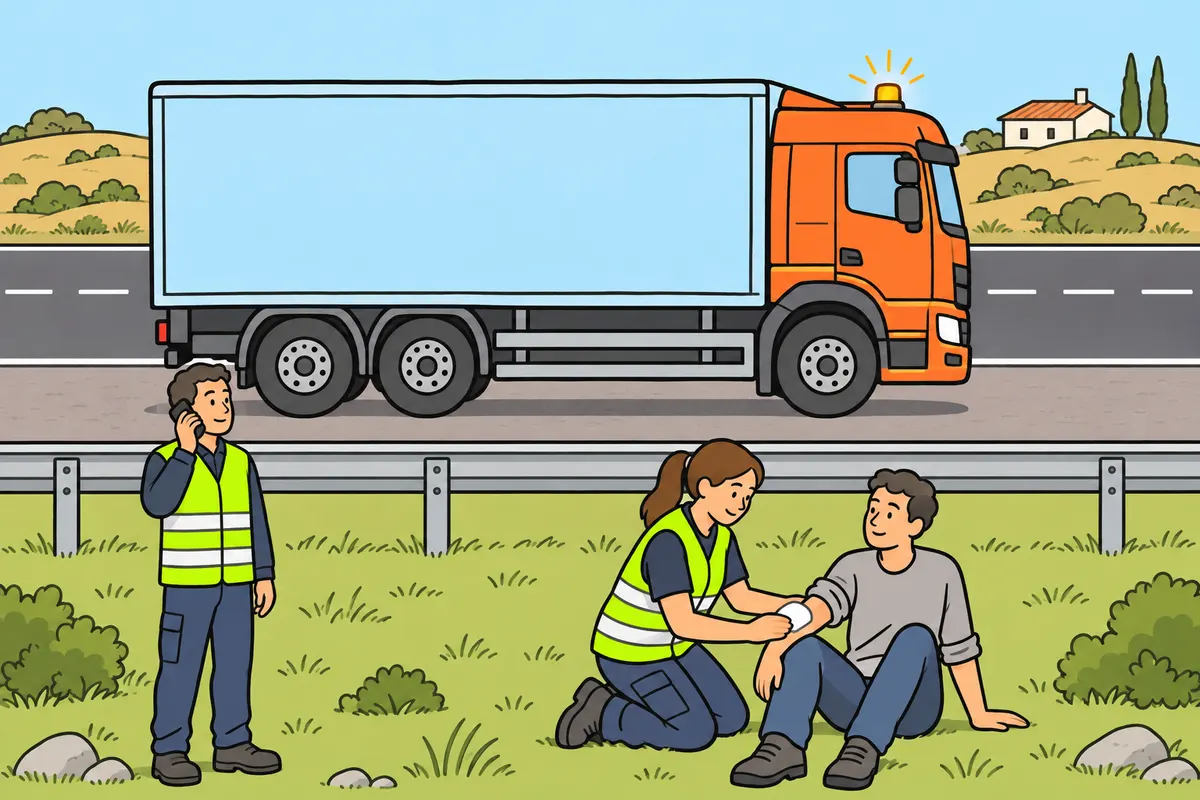
1Follow PAS
First protect, then alert, then help.
Remember
- Check for dangers before approaching.
- If involved, stop without creating another danger.
- Help even if you did not cause the accident.
- Share tasks among people who can help.
- Check that someone makes the call.
- Stay calm and follow emergency services’ instructions.
Exam trap: Wrong: Help without checking for dangers. Right: Protect first.
Read the full explanation
- You must follow PAS: proteger, alertar y socorrer (protect, alert and assist). First check that you can act without becoming another casualty; then report the emergency and provide appropriate help. Your initial assessment is part of this sequence: you need to identify the danger and the casualties before deciding how to intervene. [DGT: what to do after an accident](https://www.dgt.es/muevete-con-seguridad/que-hacer-ante-un-accidente-de-trafico/)
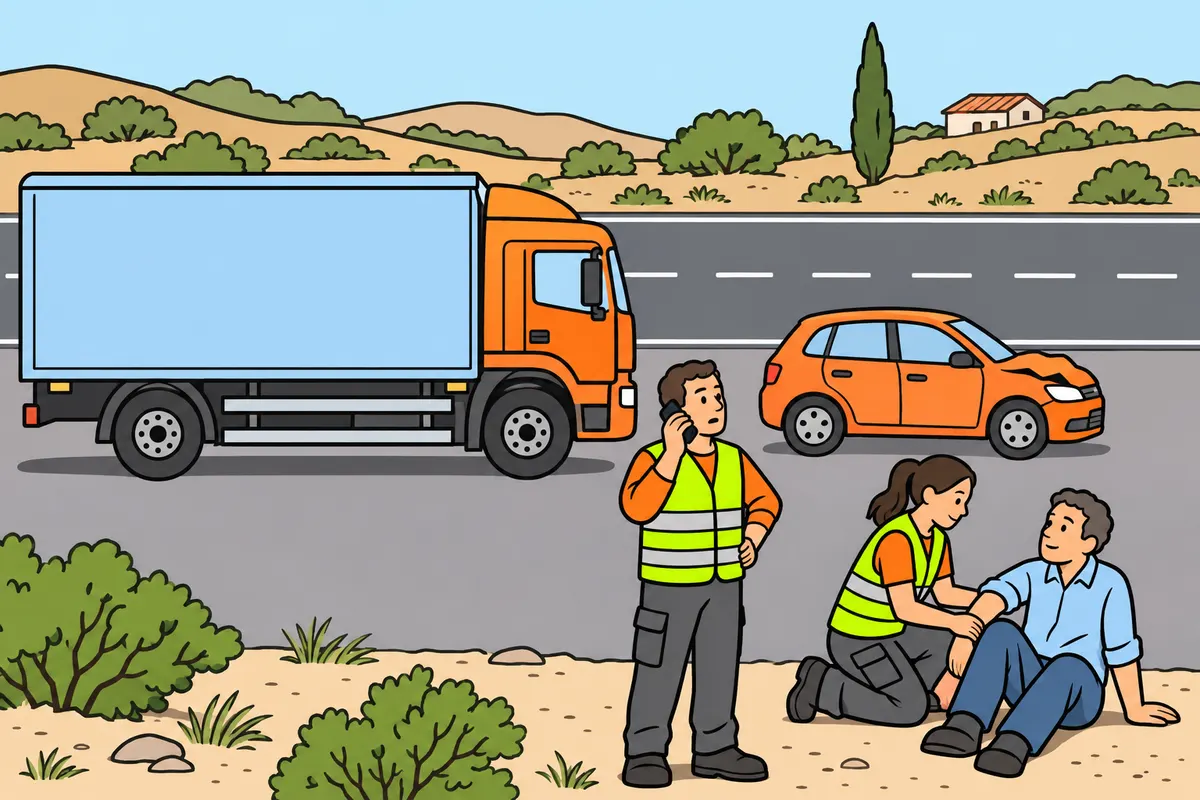
- If you are involved, you must stop without creating another hazard. Assess the whole scene: vehicles, people, fallen loads and access for the emergency services. In a lorry, a stopping position that seems convenient for you can completely hide injured people from those approaching from behind. [RGC, art. 129.2](https://www.boe.es/buscar/act.php?id=BOE-A-2003-23514#a129)
- You must cooperate to prevent further harm, help casualties and establish what happened. This duty applies if you are involved in, witness or become aware of the accident, subject to the conditions set out in the regulations. It does not depend on whether you caused the collision or are a professional driver. [RGC, art. 129.1](https://www.boe.es/buscar/act.php?id=BOE-A-2003-23514#a129)
- You must assign tasks if other people are able to help: one person can call for help while another protects the scene and assists within their knowledge. Check that someone actually makes the call; a general request addressed to no one in particular can leave it undone. Stay calm and follow the emergency services' instructions. [SUMMA 112: initial action](https://www.comunidad.madrid/hospital/summa112/ciudadanos/debe-hacer-emergencia)
2Move the lorry aside and secure it
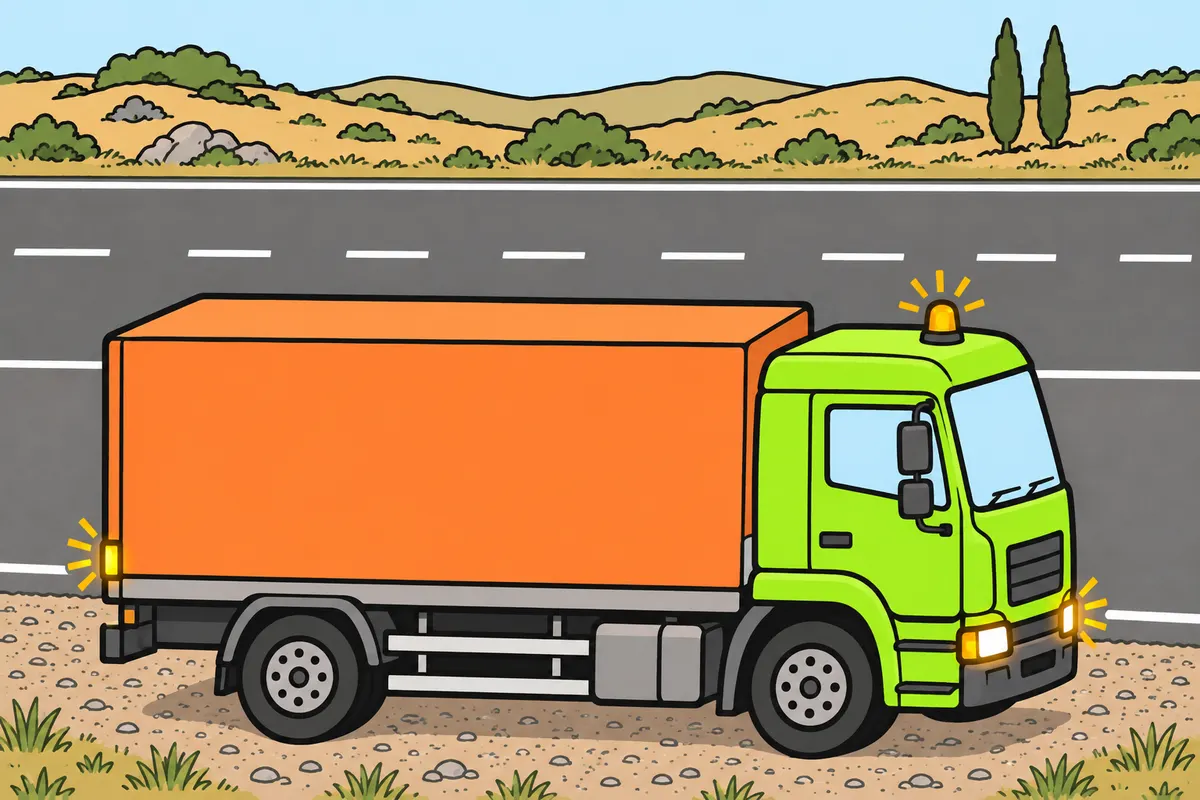
Move your lorry and its load aside without creating more danger.
Remember
- If you can continue safely, clear the traffic flow straight away.
- If you need assistance, use the right-hand hard shoulder towards the first exit.
- If you cannot reach it, stop where you cause the least obstruction.
- Mark fallen loads and arrange safe removal.
- Secure your lorry before leaving your seat.
- Protect casualties when moving the vehicle.
Exam trap: Wrong: Continue with a dangerous fault. Right: Continue only if you can do so safely.
Read the full explanation
- If you can continue safely after a breakdown or accident, you must resume driving immediately to clear the way for traffic. If you need assistance, leave the traffic lanes as soon as possible and use the right-hand arcén (hard shoulder) to reach the first available exit; if you cannot, stop on that hard shoulder or where you cause the least obstruction. This emergency action does not authorise you to drive normally with a dangerous fault. [RGC, art. 130.2](https://www.boe.es/buscar/act.php?id=BOE-A-2003-23514#a130)
- If your lorry or its load obstructs the carriageway, give a warning and take the necessary steps to remove it as quickly as possible. Whenever feasible, you must move your vehicle off the carriageway and position it in accordance with the parking rules. You must coordinate removal with protecting casualties and preserving evidence. [RGC, arts. 129 and 130](https://www.boe.es/buscar/act.php?id=BOE-A-2003-23514#a130)
- To secure your lorry before leaving the driving seat, you must apply the measures in article 92 explained in the module ‘Manoeuvres with a lorry’, section ‘Secure your lorry on a gradient’. [RGC, art. 92.3](https://www.boe.es/buscar/act.php?id=BOE-A-2003-23514#a92)
3Connected and certified V-16
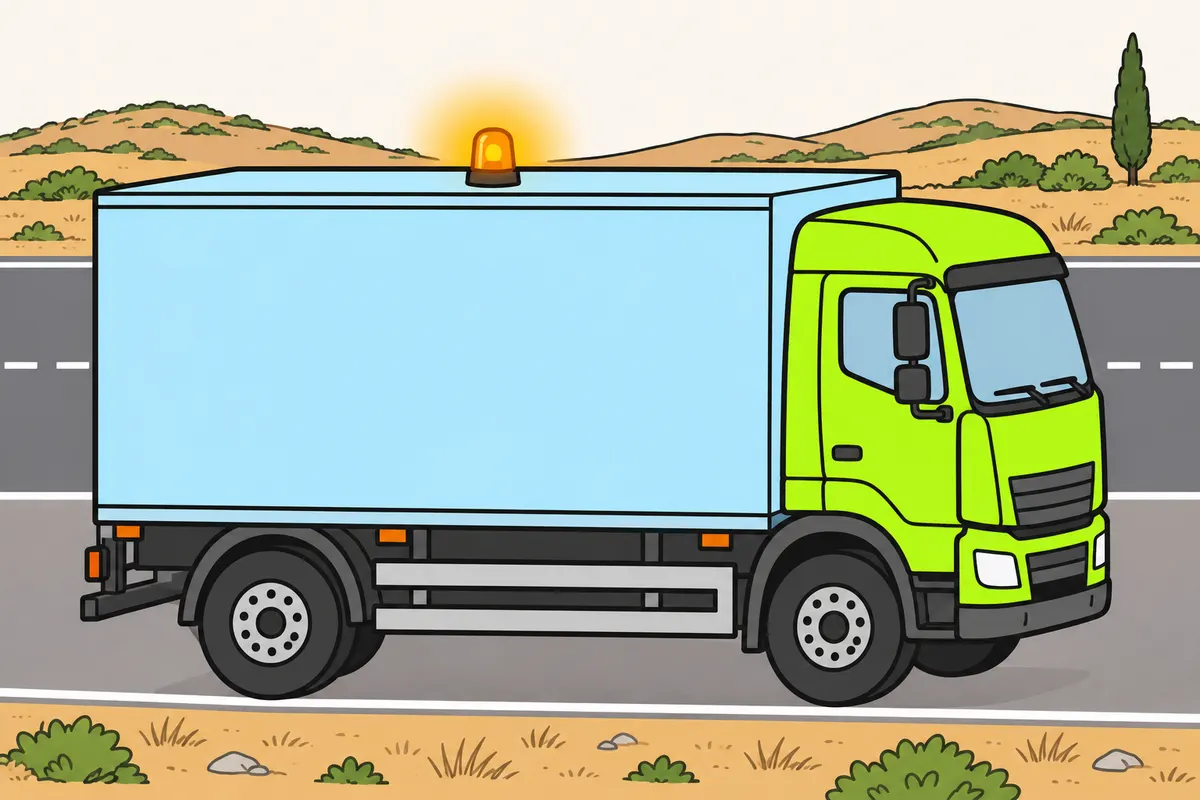
Carry a connected, certified V-16; use it when your lorry is immobilised in danger.
Remember
- Check the make and model on the official DGT list.
- Check when the connection service expires.
- The connection must work without depending on a mobile phone app.
- The beacon sends your location, but does not request an ambulance.
- Even with the beacon activated, call 112 if you need urgent help.
Exam trap: Wrong: Assume the beacon requests an ambulance. Right: Call 112 if you need urgent help.
Read the full explanation
- In your lorry registered in Spain, you must carry a connected and certified V-16 and use it to give advance warning when your vehicle is immobilised on the road in a hazardous situation. [RGC, art. 130.4](https://www.boe.es/buscar/act.php?id=BOE-A-2003-23514#a130) and [RGV, annex XII](https://www.boe.es/buscar/act.php?id=BOE-A-1999-1826#anxii)
- The V-16 signal indicates an immobilised vehicle on the carriageway or a load that has fallen onto it, and emits an amber light. You can find instructions on positioning it on your lorry in ‘Position the beacon without putting yourself at risk’. [RGV, annex XI, V-16](https://www.boe.es/buscar/act.php?id=BOE-A-1999-1826#v-16)
- You must check the make and model against the DGT's official list of certified devices. Connectivity must be built into the device itself and must not depend on a mobile phone app. Also check the service expiry date shown on the device and its packaging; an advertisement saying ‘approved’ is not enough. [RGV, annex XI, V-16.6 to 8](https://www.boe.es/buscar/act.php?id=BOE-A-1999-1826#v-16)
- The V-16 sends the incident's location to the traffic platform, but does not request an ambulance or replace your call to 112. You must not wait for other road users to receive the warning before taking the other protective measures. [DGT: questions about V-16](https://www.dgt.es/muevete-con-seguridad/tecnologia-e-innovacion-en-carretera/Dispositivos-de-presenalizacion-V16/)
4Position the beacon without putting yourself at risk
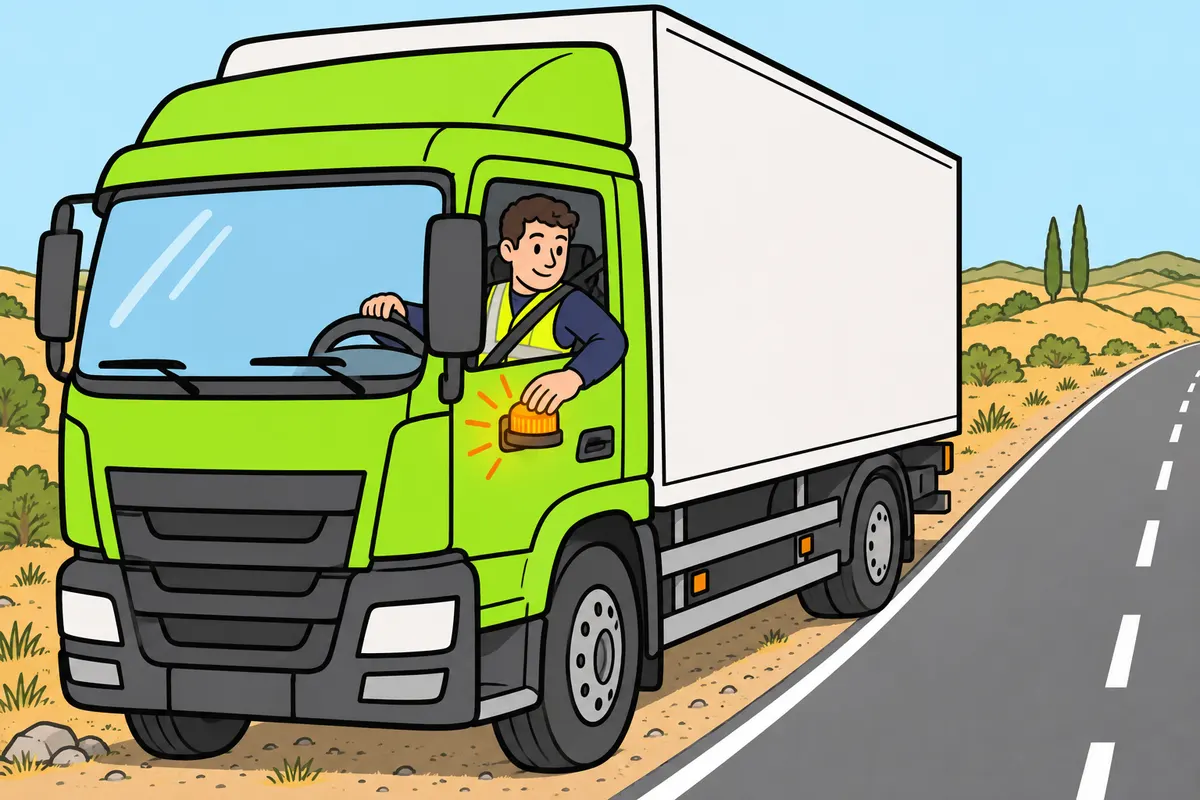
Place your beacon where others can see it and you can reach it safely.
| Rigid lorry with load body above cab | Where you place the V-16 |
|---|---|
| You can get out safely | You can place it at the rear |
| You cannot get out safely | On the highest accessible exterior part of the cab |
| You cannot get out safely or reach the roof because of its height | On the driver’s door or side |
Remember
- Activate and firmly attach your V-16.
- Do not climb onto the roof or load body to place it.
- If the load body rises above the cab, follow the table.
- Find maximum visibility without risking falls or exposure to traffic.
- The connection still sends warnings if the load body limits visibility.
- Do not walk along the hard shoulder placing triangles for your Spanish-registered lorry.
Exam trap: Wrong: Take risks to place it higher. Right: Choose a safe, accessible place.
Read the full explanation
- You must activate and secure the V-16 at the highest point you can safely reach, aiming for maximum visibility. Plan how to attach it securely to your lorry's surface in accordance with the manufacturer's instructions. You must not climb onto the load body, roof or unstable parts to reach a position that exposes you to a fall or to traffic. [RGV, annex XI, V-16](https://www.boe.es/buscar/act.php?id=BOE-A-1999-1826#v-16)
- On a rigid lorry whose load body extends above the cab, you can place the V-16 at the rear of the vehicle if you can get out safely; if you cannot get out, place it on the highest accessible exterior part of the cab and, if the roof is too high to reach, attach it to the driver's door or the side. [DGT: positioning on heavy vehicles](https://www.dgt.es/muevete-con-seguridad/tecnologia-e-innovacion-en-carretera/Dispositivos-de-presenalizacion-V16/)
- A rigid lorry's load body can extend above the cab and hide some of the light from those approaching from behind. Take this obscured area into account when assessing the position described in the previous point. Connectivity also communicates the hazard to the traffic platform, even if the bodywork limits direct visibility of the beacon. [DGT: visibility on heavy vehicles](https://www.dgt.es/muevete-con-seguridad/tecnologia-e-innovacion-en-carretera/Dispositivos-de-presenalizacion-V16/)
- The connected and certified V-16 is the only regulatory advance warning device for your lorry registered in Spain; warning triangles and beacons without connectivity do not fulfil this function. If you drive a vehicle registered in another country in international traffic in Spain, you can use warning triangles or another similar device accepted by its country of origin. [DGT: validity of V-16](https://www.dgt.es/muevete-con-seguridad/tecnologia-e-innovacion-en-carretera/Dispositivos-de-presenalizacion-V16/)
5Hazard warning lights, position lights and end-outline marker lamps
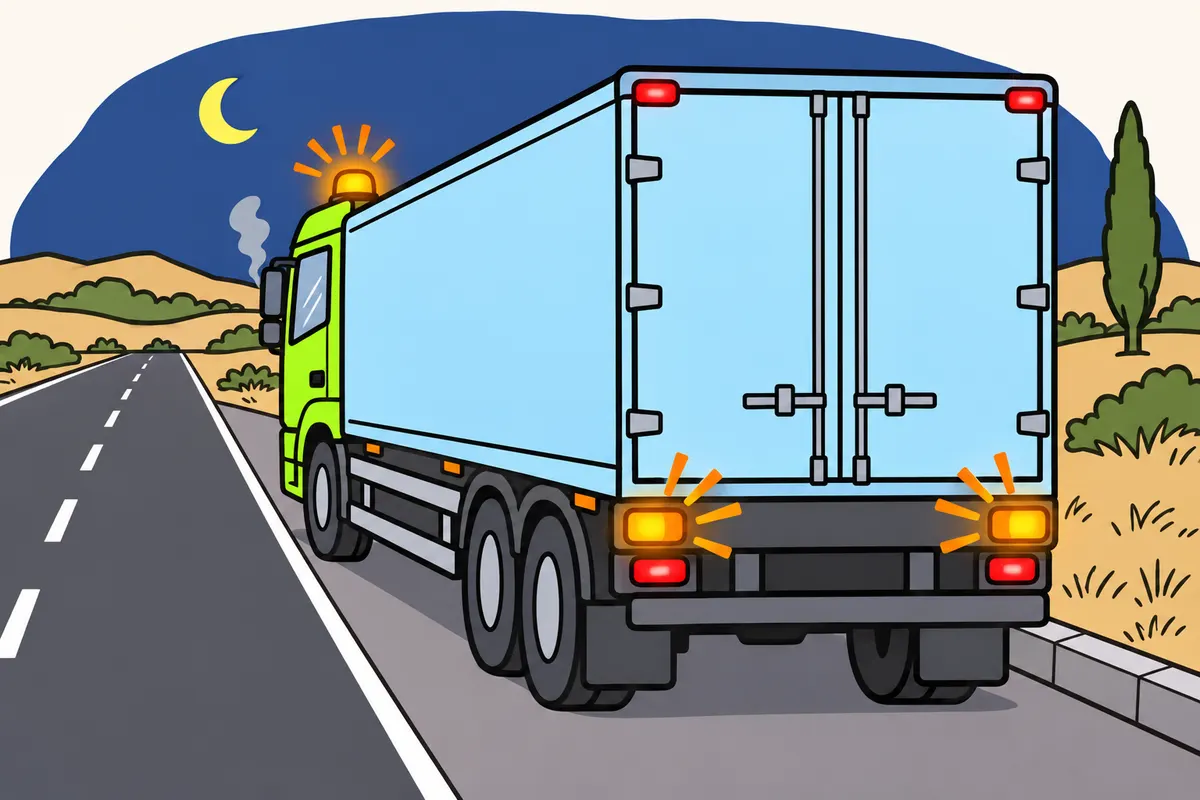
Use your beacon and required lights to warn others about your immobilised lorry.
| Situation | What you must do |
|---|---|
| Immobilised by a breakdown or accident | Switch on hazard warning lights if fitted and use the regulatory beacon |
| Immobilised at night or in poor visibility, on the carriageway or hard shoulder | Keep position lights on; also end-outline marker lamps if your lorry requires them |
Remember
- Switch on your hazard warning lights and use the regulatory beacon.
- At night or in poor visibility, keep your position lights on.
- Also keep end-outline marker lamps on if your lorry must have them.
- Watch for new dangers from a safe place and report them to those helping.
- If breakdown or accident blocks your lane, passing drivers must take extra care.
Exam trap: Wrong: Switch off position lights because hazard warning lights work. Right: Keep all required lights on.
Read the full explanation
- When warning others that your vehicle is immobilised by a breakdown or accident, you must switch on the hazard warning lights if fitted and use the regulatory advance warning device. These are not alternatives from which you can choose just one. Where required, you must also keep the position lights and end-outline marker lamps on. [RGC, art. 130.4](https://www.boe.es/buscar/act.php?id=BOE-A-2003-23514#a130)
- If a breakdown or accident immobilises your vehicle on the carriageway or hard shoulder at night or in significantly reduced visibility, you must keep the position lights on, along with the end-outline marker lamps if your lorry is required to have them. [RGC, art. 105.1](https://www.boe.es/buscar/act.php?id=BOE-A-2003-23514#a105)
- For lighting when stopping or parking at night on stretches of road through towns, consult the module ‘Lorry lights and signals’, section ‘Lights when your lorry is stationary’. [RGC, art. 105.2](https://www.boe.es/buscar/act.php?id=BOE-A-2003-23514#a105)
- Hazard warning lights warn of a temporary danger; while waiting for assistance, watch from a safe place for new risks, such as smoke, spills or shifting loads, and report them to the service dealing with the incident. [RGC, arts. 129 and 130](https://www.boe.es/buscar/act.php?id=BOE-A-2003-23514#a130)
- If your lorry is immobilised by a breakdown or accident and occupies all or part of the lane in your direction, drivers going past it must leave at least 1.5 m of lateral clearance and travel at least 20 km/h below the road's speed limit. [RGC, art. 88.1](https://www.boe.es/buscar/act.php?id=BOE-A-2003-23514#a88)
6Put on your high-visibility vest before getting out
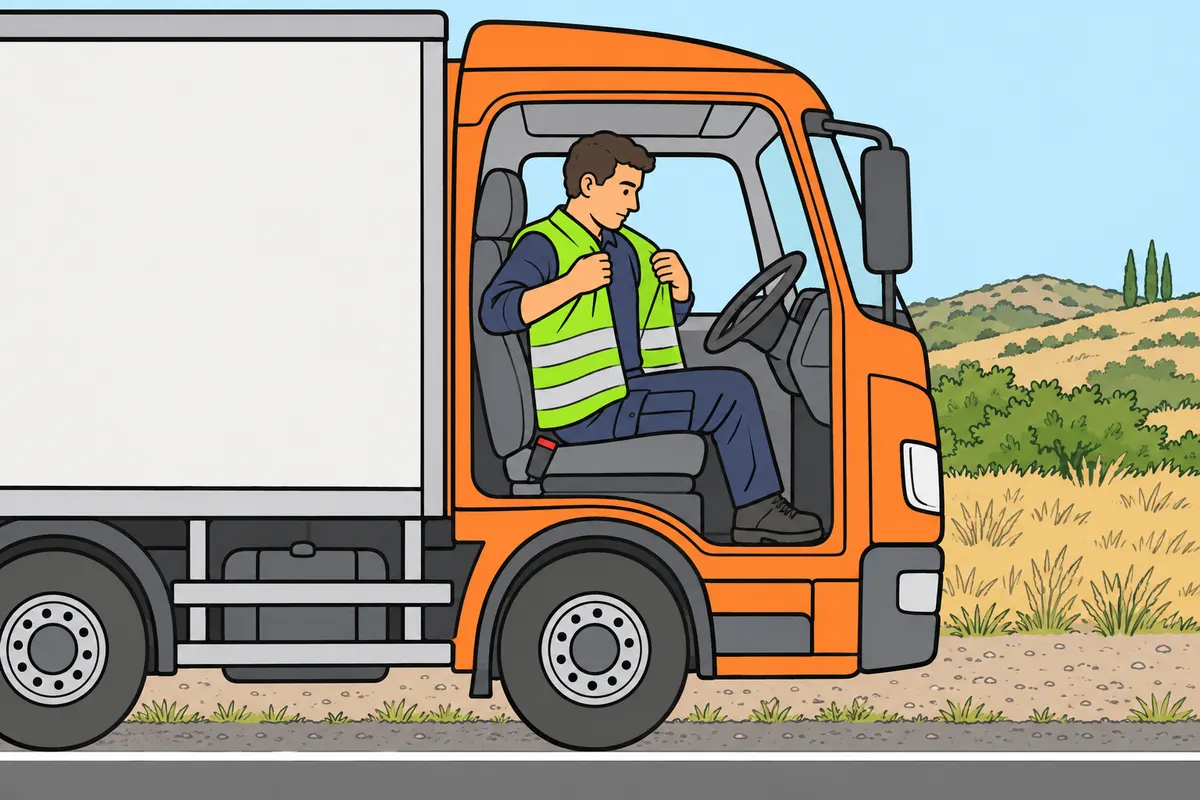
Put on your high-visibility vest inside the cab before getting out.
Remember
- Wear it on the carriageway or hard shoulder of roads outside built-up areas.
- You must wear it both day and night.
- Keep the fabric and reflective strips in good condition.
- Store it away from prolonged sunlight.
- Check for wear and follow the washing instructions.
- Only get out if you have a safe route and place to wait.
Exam trap: Wrong: Trust your vest to walk between lanes. Right: Avoid exposure to traffic.
Read the full explanation
- As the lorry driver, you must wear a reflective high-visibility vest when you get out and stand or walk on the carriageway or hard shoulder of an interurban road. This duty applies both by day and at night. Put it on inside the cab so that you are visible from the moment you get out. [RGC, art. 118.4](https://www.boe.es/buscar/act.php?id=BOE-A-2003-23514#a118)
- You must carry a vest that meets the regulatory high-visibility requirements. It has two distinct components, fluorescent fabric and retroreflective strips: you must keep both in good condition. A damaged vest does not offer you the same performance simply because it retains its shape. [RGV, annex XII.1.b](https://www.boe.es/buscar/act.php?id=BOE-A-1999-1826#anxii)
- To preserve its condition, you must store it away from prolonged sunlight and follow its washing and replacement instructions. Check for stains, wear and deterioration before relying on it.
- The vest improves your visibility, but does not physically protect you from a lorry that enters the hard shoulder. Wearing it does not authorise you to remain beside your vehicle, walk between lanes or carry out repairs exposed to traffic. Your decision to get out also depends on having a safe route and a safe place to go. [RGC, art. 130.3](https://www.boe.es/buscar/act.php?id=BOE-A-2003-23514#a130)
7Decide where to wait
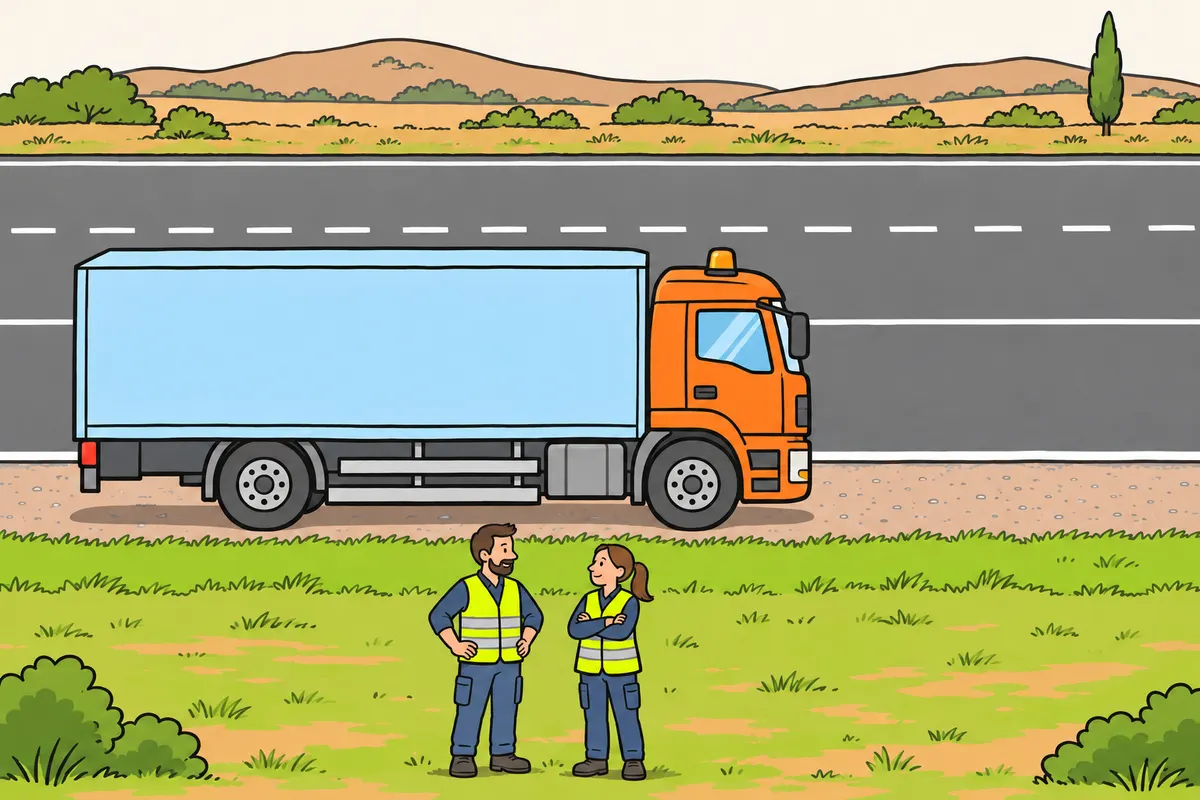
Decide whether you can get out by checking traffic and available space.
| Situation | What you must do |
|---|---|
| You can reach a safe place | Leave from the side away from traffic |
| You cannot get out safely | Stay inside with your seat belt fastened |
Remember
- If you can reach a safe place, leave from the side away from traffic.
- Do not walk or wait in lanes or on hard shoulders.
- If you cannot get out safely, stay inside with your seat belt fastened.
- Do not wait in front of or behind your lorry.
- Avoid getting trapped between your lorry and a barrier.
- Check the other side before crossing a barrier.
Exam trap: Wrong: Always get out. Right: Check whether you can reach a safe place.
Read the full explanation
- If your lorry is immobilised and cannot resume its journey, as a general rule you must get out if there is a safe place away from the carriageway and arcén (hard shoulder). You and the other occupants must leave the vehicle on the side away from the traffic flow, without walking or remaining in traffic lanes or on hard shoulders. [RGC, art. 130.3](https://www.boe.es/buscar/act.php?id=BOE-A-2003-23514#a130)
- If traffic conditions do not allow you to get out safely, you must remain in the cab with your seat belt fastened. Assess the traffic, the space outside and whether you can actually reach a safe area. [RGC, art. 130.3](https://www.boe.es/buscar/act.php?id=BOE-A-2003-23514#a130)
- You must avoid waiting in front of your lorry, behind it or between the vehicle and a barrier where a collision could trap you. As a precaution, move away from traffic and the likely path of vehicles. A barrier can provide separation, but you must not cross it without checking for a drop or another hazard on the other side.
8Give 112 useful information
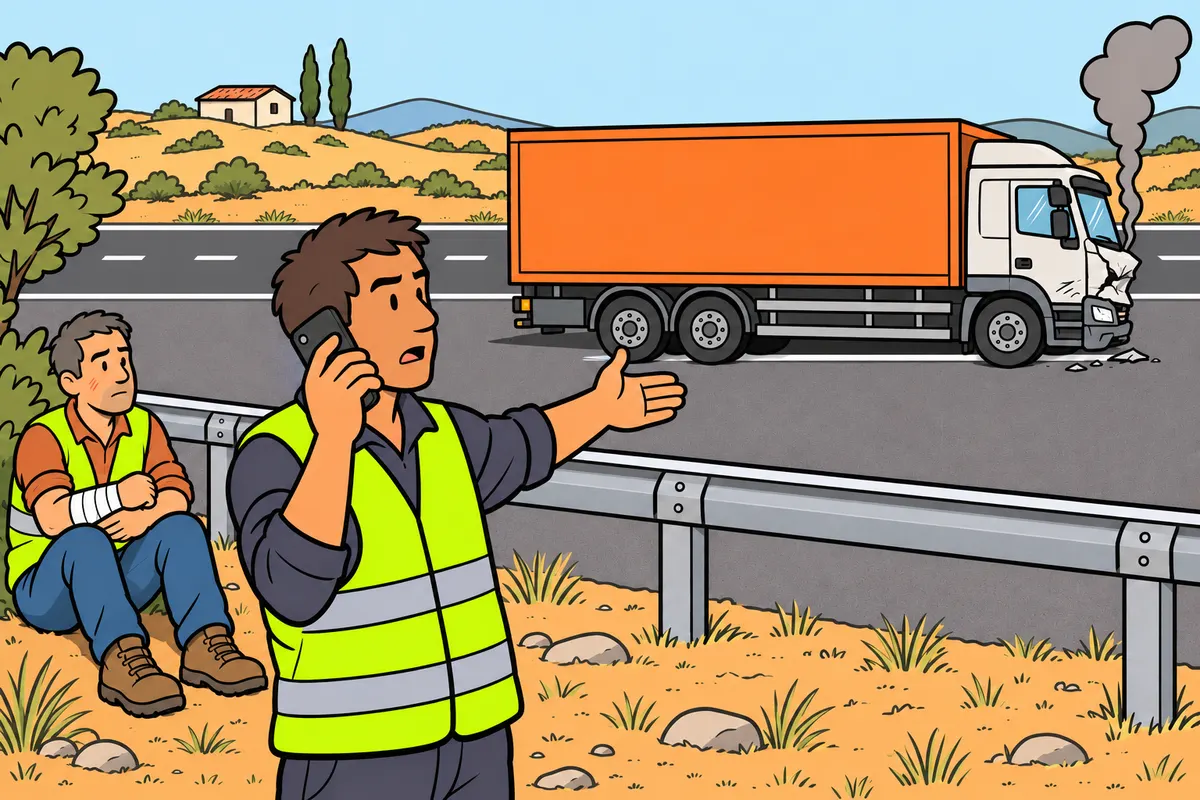
Call 112 in an emergency and explain where you are and what is happening.
| Situation | What you must do |
|---|---|
| Casualties or urgent danger | Call 112 |
| Breakdown without casualties or urgent danger | Request roadside assistance |
Remember
- Give road, kilometre point and direction; in town, give street and building number.
- Explain what happened and how many vehicles and casualties you see.
- Report anyone trapped, unconscious or bleeding heavily.
- Describe the load, smoke, spills and other dangers.
- Answer questions and stay on the line until told to hang up.
- Report any worsening condition or new danger.
Exam trap: Wrong: Give only the road name. Right: Give the precise location and direction.
Read the full explanation
- You must call 112 when there is an emergency involving casualties, a risk of fire or another situation requiring urgent intervention. For a breakdown without casualties or immediate danger, request help from the appropriate breakdown service. A recovery vehicle deals with the breakdown; 112 coordinates the resources needed in an emergency. [DGT: reporting an accident](https://www.dgt.es/muevete-con-seguridad/que-hacer-ante-un-accidente-de-trafico/)
- You must state where the incident is: the road, kilometre marker, direction of travel and visible landmarks; in a built-up area, give the street, building number or junction. If you are on a dual carriageway, specify the carriageway or direction affected. Giving only the road name can lead the emergency services to approach from the wrong direction. [DGT: information to give during the call](https://www.dgt.es/muevete-con-seguridad/que-hacer-ante-un-accidente-de-trafico/)
- You must report what has happened, how many vehicles and casualties you can see and whether anyone is trapped, unconscious or bleeding heavily. Identify the lorry, its load and visible hazards, such as smoke, a spill or a blocked tunnel. Describe what you see without inventing diagnoses or stating that someone has died because they do not respond.
- You must answer the questions, provide a contact telephone number and follow instructions without hanging up until you are told to do so. If a casualty deteriorates or a new hazard appears, report it. You can use the speakerphone to receive instructions while helping, always from a safe position. [SUMMA 112: telephone assistance](https://www.comunidad.madrid/hospital/summa112/ciudadanos/debe-hacer-emergencia)
9Provide help within your knowledge
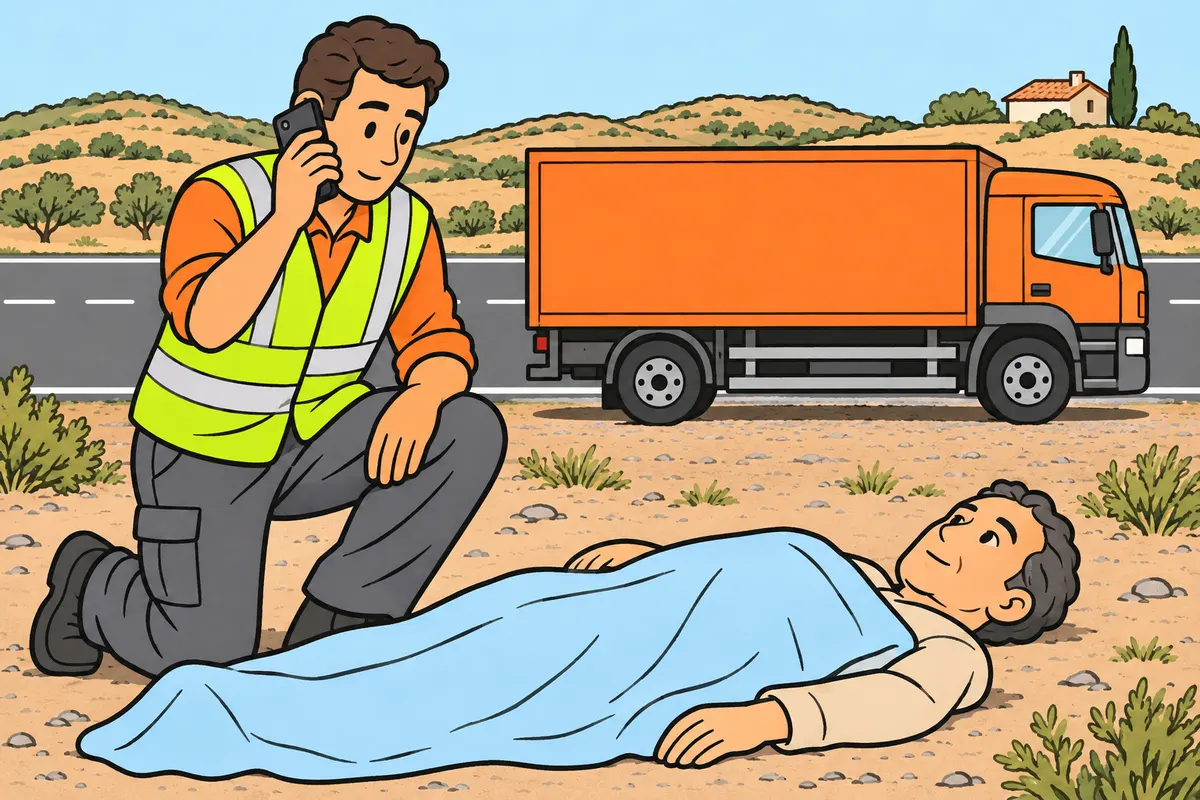
Help within your knowledge and follow emergency services’ instructions.
Remember
- Check all casualties for life-threatening dangers.
- Do not help someone first just because they shout loudest.
- Speak calmly and explain what you will do.
- Do not give food, drinks, alcohol or medicines on your own initiative.
- Protect casualties from cold and heat without moving them unnecessarily.
- Keep their faces visible.
Exam trap: Wrong: Assume someone who speaks cannot be seriously hurt. Right: Check and request medical help.
Read the full explanation
- You must provide the most appropriate help and request medical assistance. If you are not proficient in a technique, you can help by protecting people, raising the alarm, staying with casualties and following instructions from 112. Your category C licence does not make you a healthcare professional or require you to improvise interventions that worsen injuries. [RGC, art. 129.2.d](https://www.boe.es/buscar/act.php?id=BOE-A-2003-23514#a129)
- You must quickly check all casualties for life-threatening conditions. Do not treat the person shouting loudest first for that reason alone: a silent person may be unconscious or breathing poorly. Inform 112 so they can help you prioritise your actions according to what you find. [DGT: first aid, initial assessment](https://sede.dgt.gob.es/export/sites/dgt/.galleries/permisos-de-conducir/certificacion-aptitud-profesores-formacion-vial/2026/MANUAL-IX-Primeros-auxilios.pdf)
- You must speak calmly, identify yourself as someone who is helping and explain what you are going to do. Avoid arguments, blame and crowds around injured people. You can ask about pain or discomfort and report it to healthcare staff, without assuring anyone that there is no injury simply because the person responds.
- You must not give food, drinks, alcohol or medicines on your own initiative. Protect injured people from cold and heat, loosen tight clothing without moving them unnecessarily and keep their faces visible. Using water to cool a burn is not the same as giving a road casualty something to drink. [DGT: providing help](https://www.dgt.es/muevete-con-seguridad/que-hacer-ante-un-accidente-de-trafico/)
10Consciousness and breathing
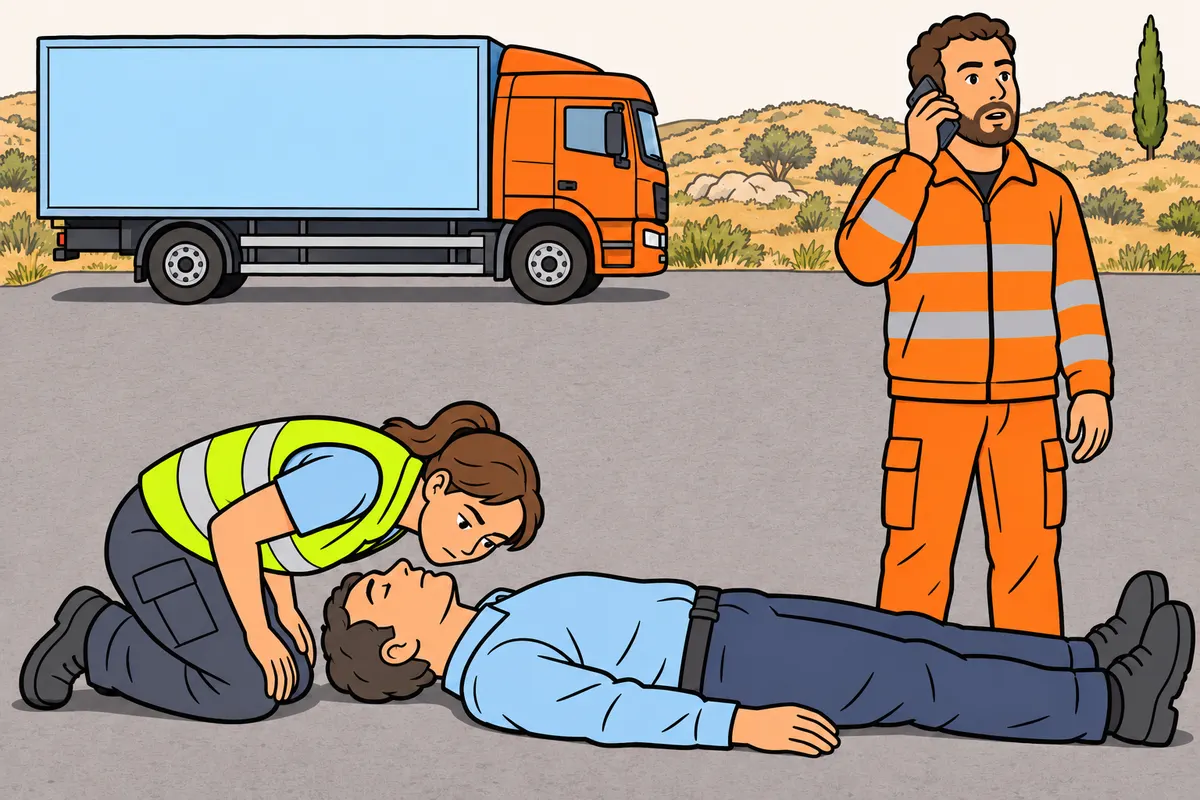
Check whether the person responds and breathes normally, without moving them unnecessarily.
| Situation | What you must do |
|---|---|
| No response and no normal breathing | Call for help and act immediately |
| No response but normal breathing | Monitor them and avoid unnecessary movement |
Remember
- Speak to check whether they respond; do not shake them.
- If they do not respond, call 112 and check their breathing.
- Do not confuse occasional gasps with normal breathing.
- Do not put fingers into their mouth without seeing what you are doing.
- If they breathe normally, monitor them and avoid unnecessary movement.
- Vomiting or blocked airway: follow 112; turn sideways, keeping head, neck, torso aligned.
Exam trap: Wrong: Treat occasional gasps as normal breathing. Right: Call and follow instructions from 112.
Read the full explanation
- From a safe position, you must check whether the person responds when you speak to them. Avoid shaking them or sitting them up to check their consciousness, especially after a collision. An initial response does not guarantee that their condition is stable: you must keep monitoring them while help arrives and report any loss of responsiveness. [DGT: first aid](https://sede.dgt.gob.es/export/sites/dgt/.galleries/permisos-de-conducir/certificacion-aptitud-profesores-formacion-vial/2026/MANUAL-IX-Primeros-auxilios.pdf)
- If the person does not respond, you must alert 112 and check whether they are breathing normally, following their instructions. Watch for chest movement and air moving in or out; do not mistake isolated, slow or irregular gasps for normal breathing. An unconscious person who is not breathing normally needs immediate action. [SUMMA 112: emergencies and resuscitation](https://www.comunidad.madrid/hospital/summa112/ciudadanos/debe-hacer-emergencia)
- You must keep the airway clear using the manoeuvre appropriate to your training and the instructions from 112. In an accident casualty, you must suspect a neck injury and avoid unnecessary movement, but protecting the neck must not prevent an essential intervention to enable breathing. Do not put your fingers blindly into their mouth. [DGT: first aid](https://sede.dgt.gob.es/export/sites/dgt/.galleries/permisos-de-conducir/certificacion-aptitud-profesores-formacion-vial/2026/MANUAL-IX-Primeros-auxilios.pdf)
- If the person is unconscious and breathing normally, you must monitor them and avoid moving them as a matter of routine. If they vomit or their position prevents you from keeping the airway open, report the problem to 112 and turn them onto their side only as much as necessary, trying to keep the head, neck and torso aligned. You must not automatically place all injured people in the same position. [DGT: first aid](https://sede.dgt.gob.es/export/sites/dgt/.galleries/permisos-de-conducir/certificacion-aptitud-profesores-formacion-vial/2026/MANUAL-IX-Primeros-auxilios.pdf)
11Basic CPR and defibrillator
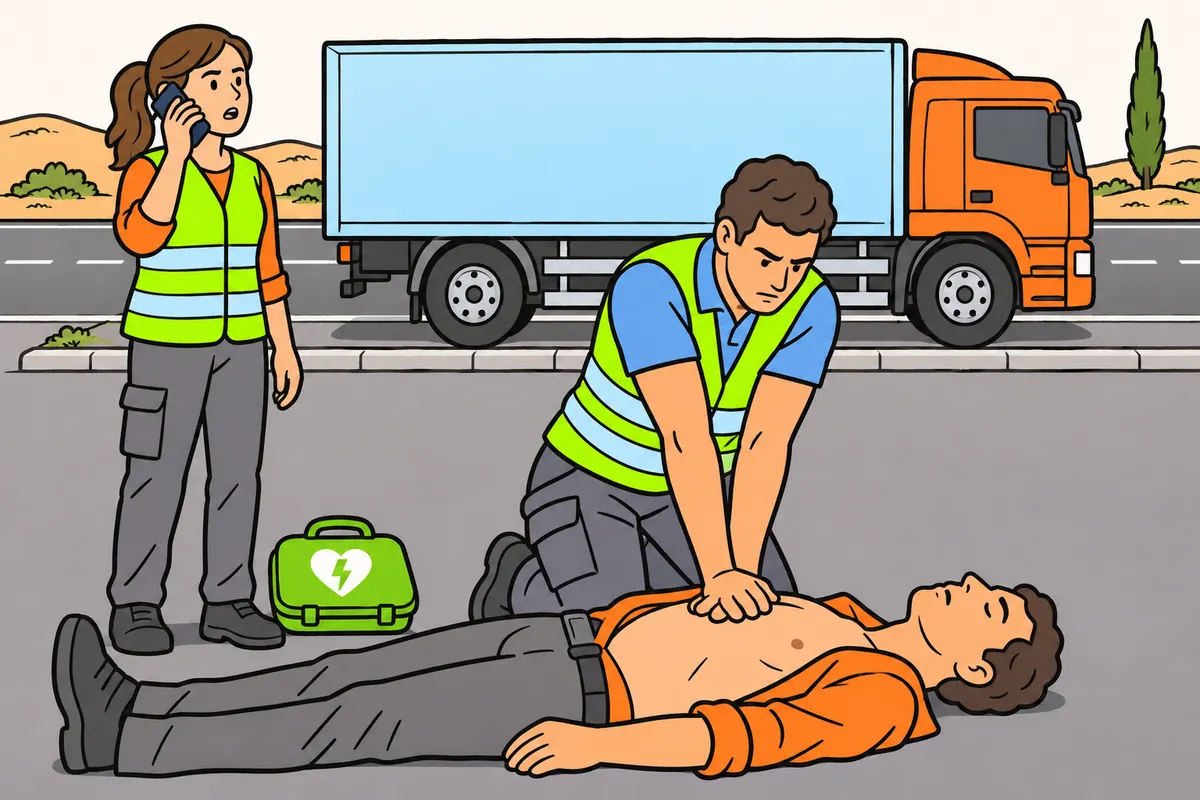
If an adult is unresponsive and not breathing normally, call for help and start compressions.
Remember
- Call 112 and ask someone to fetch an accessible defibrillator.
- Place your hands in the centre of the chest and straighten your arms.
- Compress on a firm surface and let the chest rise again.
- Cannot give rescue breaths or don't know how? Give continuous compressions following 112.
- Switch on the defibrillator and follow its instructions.
- Do not touch the casualty while it analyses or gives a shock.
Exam trap: Wrong: Wait because you cannot give rescue breaths. Right: Give compressions following 112.
Read the full explanation
- If an adult is unconscious and not breathing normally, you must call 112 for help and start chest compressions under their guidance. Ask someone else to fetch an external defibrillator if one is accessible. Do not delay action by attempting checks you are not proficient in. [SUMMA 112: guided resuscitation](https://www.comunidad.madrid/hospital/summa112/ciudadanos/debe-hacer-emergencia)
- For adult chest compressions, you must place your hands in the centre of the chest, keep your arms straight and compress the chest with the person on a firm surface. The target is 100 to 120 compressions per minute and a depth of 5 to 6 cm, allowing the chest to return to its normal position between compressions. [SAMUR: adult CPR](https://servpub.madrid.es/manualsamur/bin/view/Procedimientos%20asistenciales/Procedimientos%20SVA/PARADA%20CARDIORRESPIRATORIA/)
- If you know how to give rescue breaths and can do so, you must alternate 30 compressions with 2 rescue breaths. If you do not know how or cannot do so, give continuous compressions following instructions from 112. Minimise interruptions and continue until professionals take over, normal breathing returns, exhaustion prevents you from continuing or a hazard arises. [DGT: basic CPR](https://sede.dgt.gob.es/export/sites/dgt/.galleries/permisos-de-conducir/certificacion-aptitud-profesores-formacion-vial/2026/MANUAL-IX-Primeros-auxilios.pdf)
- If you use an external defibrillator, you must switch it on and follow its instructions. No one must touch the casualty during heart rhythm analysis or a shock; afterwards, resume compressions when instructed. The device guides the intervention and decides whether a shock is appropriate: you must not try to decide this from the injured person’s appearance. [SAMUR: defibrillation](https://servpub.madrid.es/manualsamur/bin/view/Procedimientos%20asistenciales/Procedimientos%20SVA/PARADA%20CARDIORRESPIRATORIA/)
12Control external bleeding
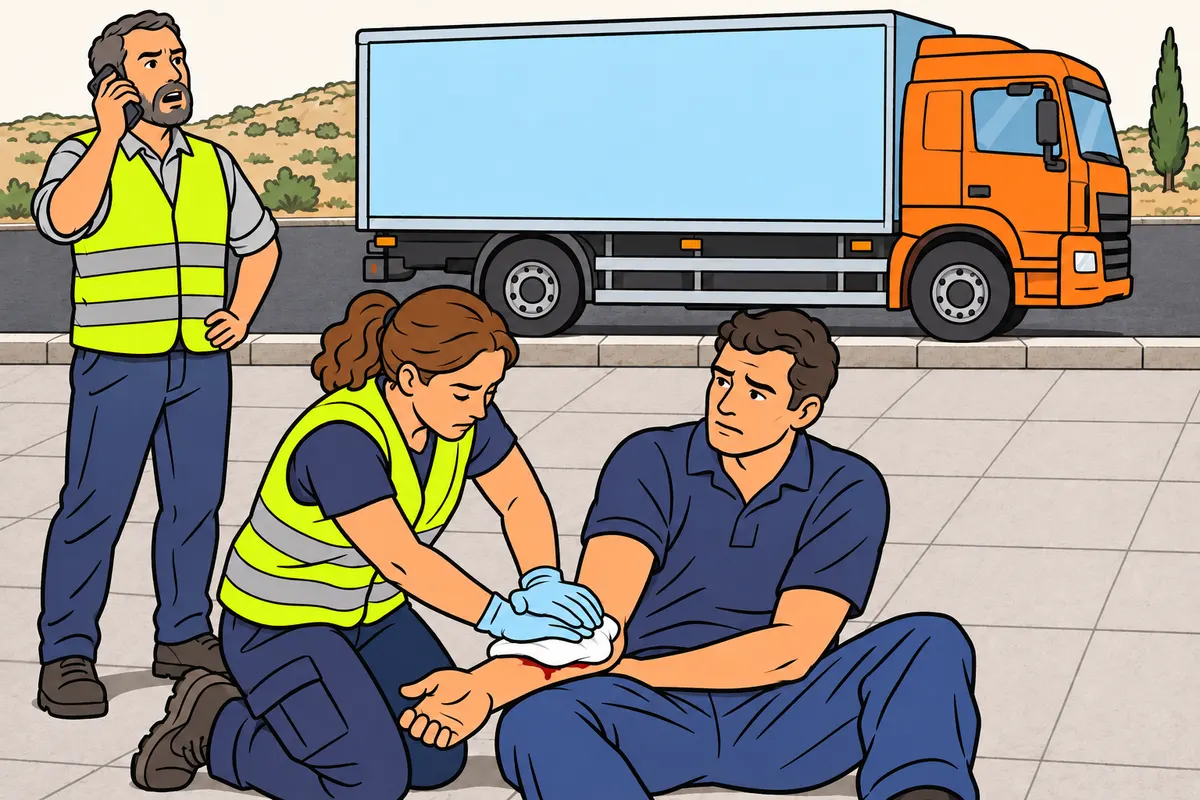
Call for help and press the wound to control heavy bleeding.
Remember
- Press firmly with gauze or a clean cloth.
- Wear gloves if you have them.
- If the cloth becomes soaked, add another without removing the first.
- Do not remove embedded objects or push bones back into wounds.
- Use a tourniquet only when necessary, following your training and 112.
- If used, record the time and do not loosen it yourself.
Exam trap: Wrong: Remove soaked gauze. Right: Add more material and keep pressing.
Read the full explanation
- If there is heavy external bleeding, you must request urgent help and apply firm, sustained direct pressure to the wound with gauze or a clean cloth. Use gloves if you have them to reduce contact with blood. The priority is to control blood loss, rather than clean the wound thoroughly. [Valencian Health Service: bleeding](https://ses.san.gva.es/es/consells/-/asset_publisher/adb40qhtj8ev/content/hemorragias)
- If the material becomes soaked, you must add more on top and maintain pressure, without removing the first layer to keep checking the wound. Removing it can disrupt the clot. You must not waste time looking for distant pressure points or raising a possibly fractured limb while bleeding continues. [DGT: first aid](https://sede.dgt.gob.es/export/sites/dgt/.galleries/permisos-de-conducir/certificacion-aptitud-profesores-formacion-vial/2026/MANUAL-IX-Primeros-auxilios.pdf)
- If an object is embedded in the wound, you must not remove it. Keep it in position and follow instructions from 112 to control bleeding around it without pushing it further in. Do not push bones or tissue into a wound or remove deeply embedded foreign objects to make the area look cleaner. [DGT: first aid](https://sede.dgt.gob.es/export/sites/dgt/.galleries/permisos-de-conducir/certificacion-aptitud-profesores-formacion-vial/2026/MANUAL-IX-Primeros-auxilios.pdf)
- If bleeding from an arm or leg is life-threatening and direct pressure does not control it, a suitable tourniquet may be necessary. You must use it in accordance with your training and instructions from 112, above the wound and never over a joint; note the time and do not loosen or remove it on your own initiative. [DGT: bleeding control](https://sede.dgt.gob.es/export/sites/dgt/.galleries/permisos-de-conducir/certificacion-aptitud-profesores-formacion-vial/2026/MANUAL-IX-Primeros-auxilios.pdf)
13Suspect internal injuries and shock
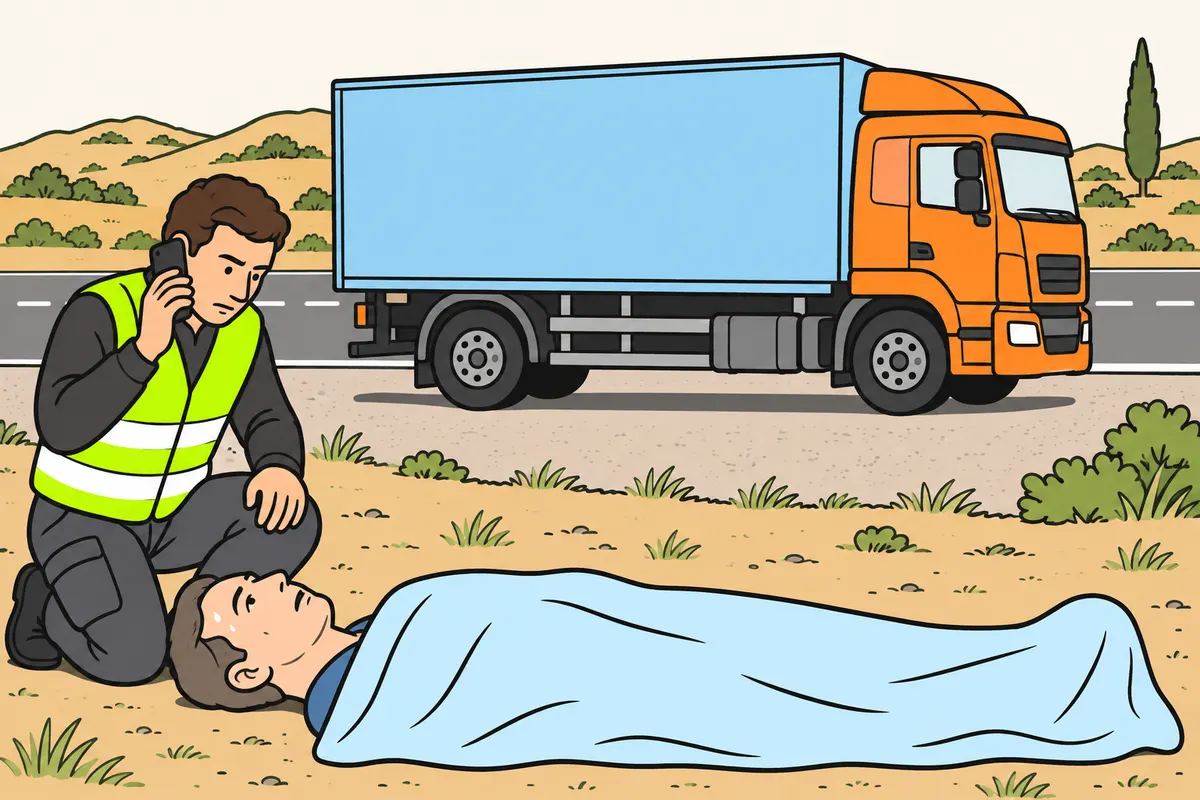
After an impact, serious blood loss can happen even when you cannot see it.
| Type of bleeding | How you can recognise it |
|---|---|
| External | You see blood coming from a wound |
| Internal | Blood stays inside the body |
| Through a natural opening | Blood from inside comes out through a natural opening |
Remember
- Report pale, cold or sweaty skin, weakness or confusion.
- Keep the casualty resting and protect them from cold.
- Monitor breathing and consult 112 before changing their position.
- Do not give water to replace lost blood.
- After head injury, report ear blood or fluid; do not block its flow.
- After a head injury, report nose bleeding or fluid; do not block it.
Exam trap: Wrong: Raise every accident casualty’s legs. Right: Ask before changing their position.
Read the full explanation
- You can recognise three types of bleeding: with external bleeding, you see blood from a wound; with internal bleeding, blood accumulates inside the body; with bleeding through a natural opening, blood comes from inside the body and flows out through that opening. The absence of visible blood does not rule out significant blood loss after a severe impact. [DGT: first aid](https://sede.dgt.gob.es/export/sites/dgt/.galleries/permisos-de-conducir/certificacion-aptitud-profesores-formacion-vial/2026/MANUAL-IX-Primeros-auxilios.pdf)
- You must report paleness, cold skin, sweating, shallow breathing, weakness or confusion. These may indicate shock, a condition in which the organs do not receive enough blood flow. You cannot determine from skin colour alone whether bleeding is internal or external, or rule out a serious condition because the casualty is still talking. [DGT: first aid](https://sede.dgt.gob.es/export/sites/dgt/.galleries/permisos-de-conducir/certificacion-aptitud-profesores-formacion-vial/2026/MANUAL-IX-Primeros-auxilios.pdf)
- You must keep the casualty at rest, protect them from the cold and monitor their breathing while waiting for help. You must not automatically raise the legs of every road casualty: they may have injuries to the spine, pelvis or limbs. Consult 112 before changing their position. [DGT: first aid](https://sede.dgt.gob.es/export/sites/dgt/.galleries/permisos-de-conducir/certificacion-aptitud-profesores-formacion-vial/2026/MANUAL-IX-Primeros-auxilios.pdf)
- If you see blood or fluid coming from an ear or the nose after a blow to the head, you must report it and must not plug the opening. Do not confuse this injury-related situation with an ordinary nosebleed. If vomiting or breathing difficulties occur, protecting the airway takes priority. [DGT: first aid](https://sede.dgt.gob.es/export/sites/dgt/.galleries/permisos-de-conducir/certificacion-aptitud-profesores-formacion-vial/2026/MANUAL-IX-Primeros-auxilios.pdf)
14Treat burns without worsening them
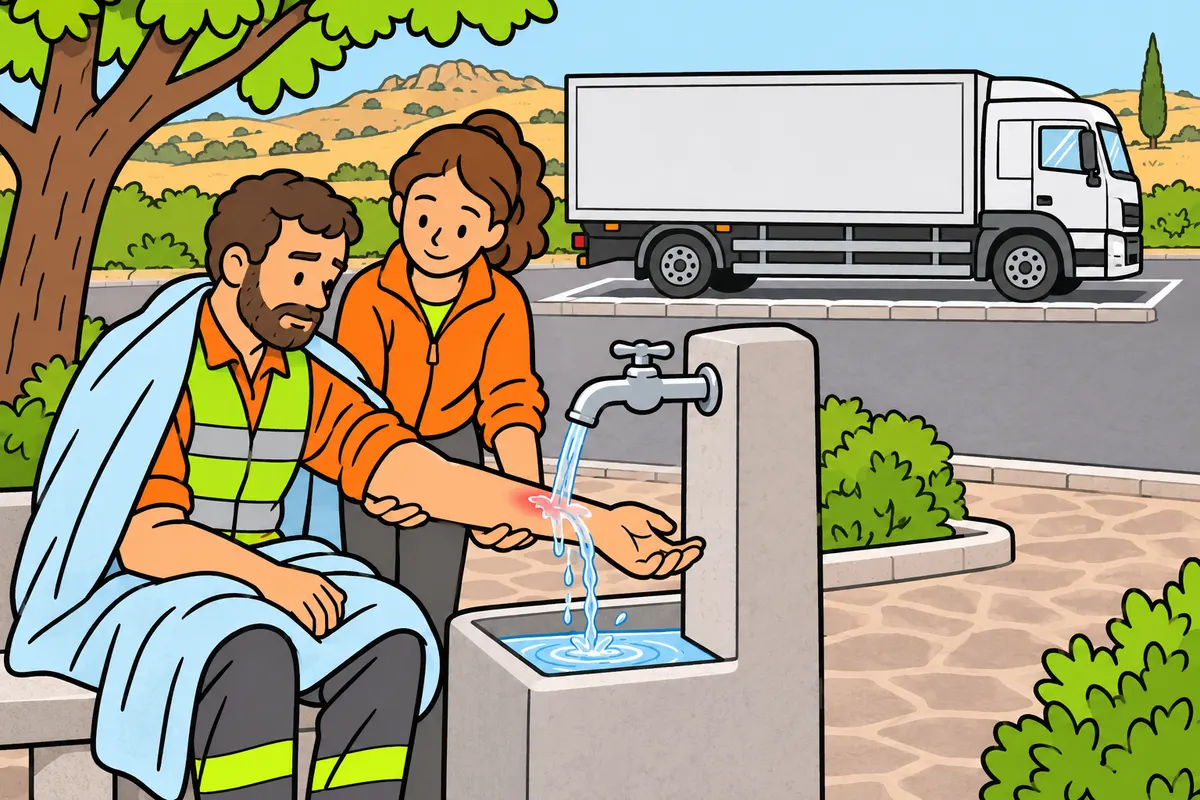
Cool a localised burn and avoid further damage.
Remember
- Use cool running water and protect the rest of the body from cold.
- Do not apply ice, oils, toothpaste or creams.
- Do not pull off stuck clothing or burst blisters.
- Cover loosely with clean material that will not stick.
- Request urgent help for serious burns or breathing problems.
- If clothing burns, safely help the person stop, drop and roll.
Exam trap: Wrong: Pull off stuck clothing. Right: Leave it and avoid further skin damage.
Read the full explanation
- You must stop exposure to heat without entering a dangerous area. For a localised thermal burn, cool the area with cool running water for 20 minutes and protect the rest of the body to prevent excessive cooling. Do not apply ice directly, or use oils, toothpaste or ointments as first aid. [INSST: burns](https://www.insst.es/documentacion/colecciones-tecnicas/ntp-notas-tecnicas-de-prevencion/15-serie-ntp-numeros-506-a-540-ano-2000/ntp-524-primeros-auxilios-quemaduras)
- You must not pull off clothing stuck to the skin or burst blisters. You can cover the area with clean, non-stick material, without applying pressure or bringing burnt surfaces together. Any clothing you remove must come away without pulling off skin; do not turn clothing removal into painful handling of the injury. [INSST: burns](https://www.insst.es/documentacion/colecciones-tecnicas/ntp-notas-tecnicas-de-prevencion/15-serie-ntp-numeros-506-a-540-ano-2000/ntp-524-primeros-auxilios-quemaduras)
- You must call for urgent help if burns are extensive or deep, affect the face or cause difficulty breathing. After a fire in the cab or a tunnel, smoke inhalation is a danger even if visible injuries are minor. Report coughing, hoarseness or breathing problems, and do not go back into the smoke to retrieve belongings. [INSST: burns](https://www.insst.es/documentacion/colecciones-tecnicas/ntp-notas-tecnicas-de-prevencion/15-serie-ntp-numeros-506-a-540-ano-2000/ntp-524-primeros-auxilios-quemaduras)
- If someone's clothing catches fire, you must not let them run and fan the flames. If you can intervene without putting yourself at risk, help them stop, drop to the ground and roll, or use water or a suitable blanket to smother the fire without covering their face. Avoid applying water to fuel or electrical equipment.
15Fractures, spine and helmet
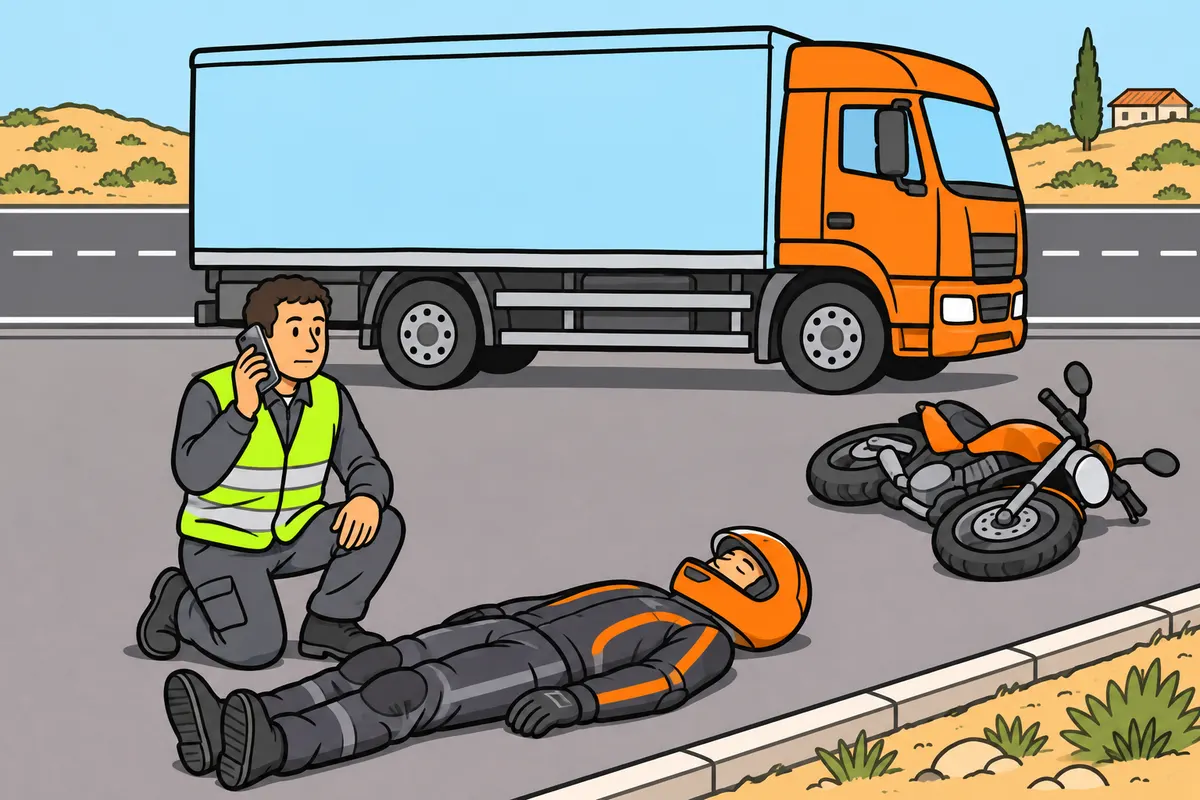
Avoid moving the casualty and leave their helmet on.
Remember
- Do not straighten broken limbs or push protruding bones back inside.
- Do not sit casualties up or ask them to walk to check their condition.
- Keep their position if they can breathe and are safe.
- Report neck pain, tingling or loss of feeling.
- Leave a motorcyclist’s helmet on, unless it blocks airway treatment or resuscitation.
- Then follow 112; whenever possible, let trained people remove it.
Exam trap: Wrong: Remove the helmet to give air. Right: Leave it on. If it prevents life-saving airway treatment or resuscitation, follow 112 and let trained people remove it whenever possible.
Read the full explanation
- If you suspect a fracture because of pain, deformity or difficulty moving a limb, you must avoid handling it and call for help. Do not try to straighten the limb, repeatedly check whether it moves or push a protruding bone back in. You can protect an open wound without pressing on the exposed bone. [INSST: fractures and traumatic injuries](https://www.insst.es/documentacion/colecciones-tecnicas/ntp-notas-tecnicas-de-prevencion/16-serie-ntp-numeros-541-a-575-ano-2001/ntp-546-primeros-auxilios-fracturas-luxaciones-y-esguinces.)
- After an impact, you must suspect possible head, neck and spinal injuries even if there are no obvious wounds. You must not sit the casualty up, pull on their arms or ask them to walk to check whether they are all right. Keep them in their current position as long as they can breathe and remain safe. [INSST: fractures and traumatic injuries](https://www.insst.es/documentacion/colecciones-tecnicas/ntp-notas-tecnicas-de-prevencion/16-serie-ntp-numeros-541-a-575-ano-2001/ntp-546-primeros-auxilios-fracturas-luxaciones-y-esguinces.)
- If the casualty is a motorcyclist, you must leave their helmet on as a general first-aid rule. Removing it for comfort, to see their face or to give them air may worsen a neck injury. If it prevents life-saving airway treatment or resuscitation, follow the instructions from 112 and leave its removal to people with suitable training whenever possible. [DGT: assistance for motorcyclists](https://www.dgt.es/muevete-con-seguridad/que-hacer-ante-un-accidente-de-trafico/)
- You must report neck pain, loss of sensation, tingling or weakness, without forcing movements to check for them. A person may have several injuries at once, some of which may be life-threatening; an obvious fracture does not rule out internal injury. A medical assessment determines which injuries are present and how to move the casualty. [INSST: fractures and traumatic injuries](https://www.insst.es/documentacion/colecciones-tecnicas/ntp-notas-tecnicas-de-prevencion/16-serie-ntp-numeros-541-a-575-ano-2001/ntp-546-primeros-auxilios-fracturas-luxaciones-y-esguinces.)
16Moving and transporting casualties are exceptional decisions
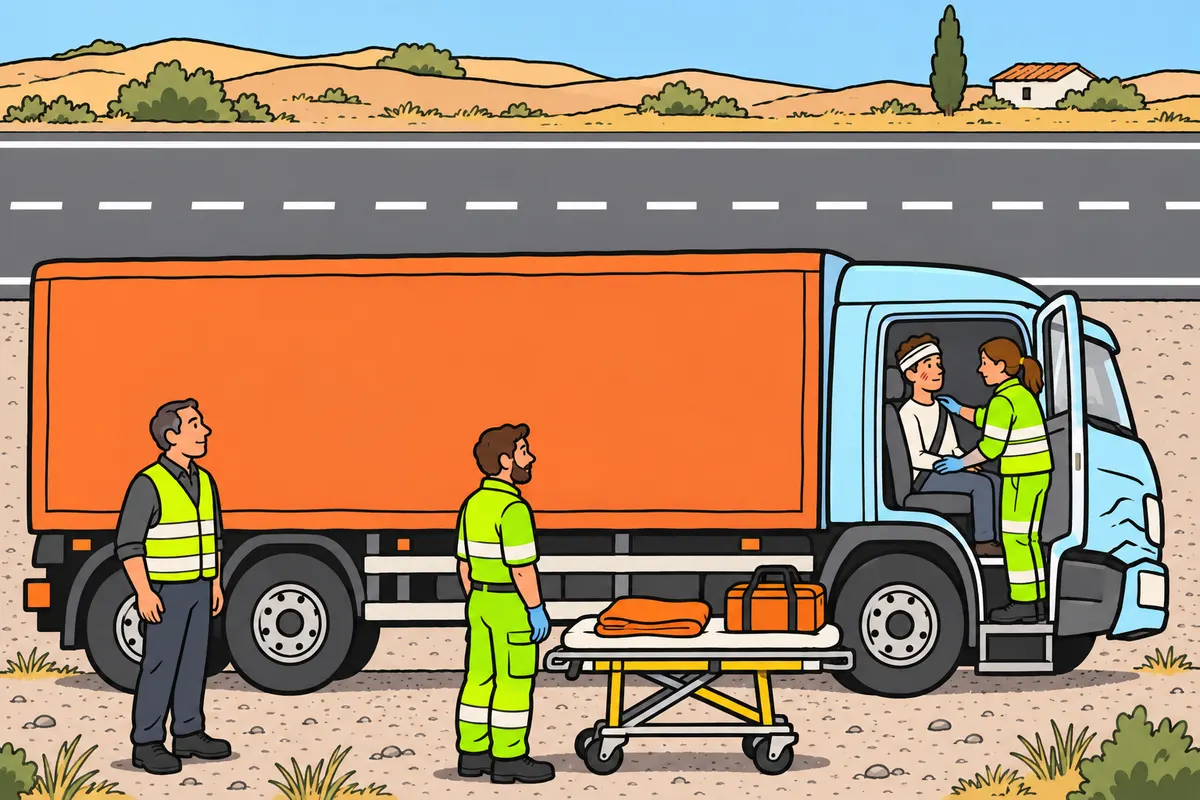
Move a casualty only when essential and wait for suitable transport.
Remember
- Do not routinely take casualties out of vehicles.
- Do not take them to hospital in your lorry’s cab or load body.
- Move them only for immediate danger, breathing or resuscitation.
- Follow instructions from 112.
- Keep head, neck and torso aligned; avoid sudden pulls.
- Do not force trapped people free or enter unstable cabs.
Exam trap: Wrong: Improvise transport to arrive sooner. Right: Wait for suitable rescue teams.
Read the full explanation
- You must not routinely remove casualties from the vehicle or take them to hospital in the cab or load body of your lorry. Wait for teams with suitable equipment to immobilise, rescue and transport them. The need for prompt treatment does not make any improvised transport the safest option. [DGT: first aid](https://sede.dgt.gob.es/export/sites/dgt/.galleries/permisos-de-conducir/certificacion-aptitud-profesores-formacion-vial/2026/MANUAL-IX-Primeros-auxilios.pdf)
- You may need to move a casualty away from immediate danger, such as imminent fire or explosion, if you can do so without disproportionate risk. Moving them may also be essential to maintain their airway or perform resuscitation. You must limit movement to what is necessary and follow the instructions from 112. [DGT: moving casualties](https://www.dgt.es/muevete-con-seguridad/que-hacer-ante-un-accidente-de-trafico/)
- If moving the casualty is essential, you must try to keep their head, neck and torso aligned as you move them, without twisting or jerking. Seek help and professional guidance when you can. Do not try to force a trapped person free or enter a cab that is unstable, tilted or affected by a shifting load. [DGT: first aid](https://sede.dgt.gob.es/export/sites/dgt/.galleries/permisos-de-conducir/certificacion-aptitud-profesores-formacion-vial/2026/MANUAL-IX-Primeros-auxilios.pdf)
17Fallen loads and lorry-specific risks
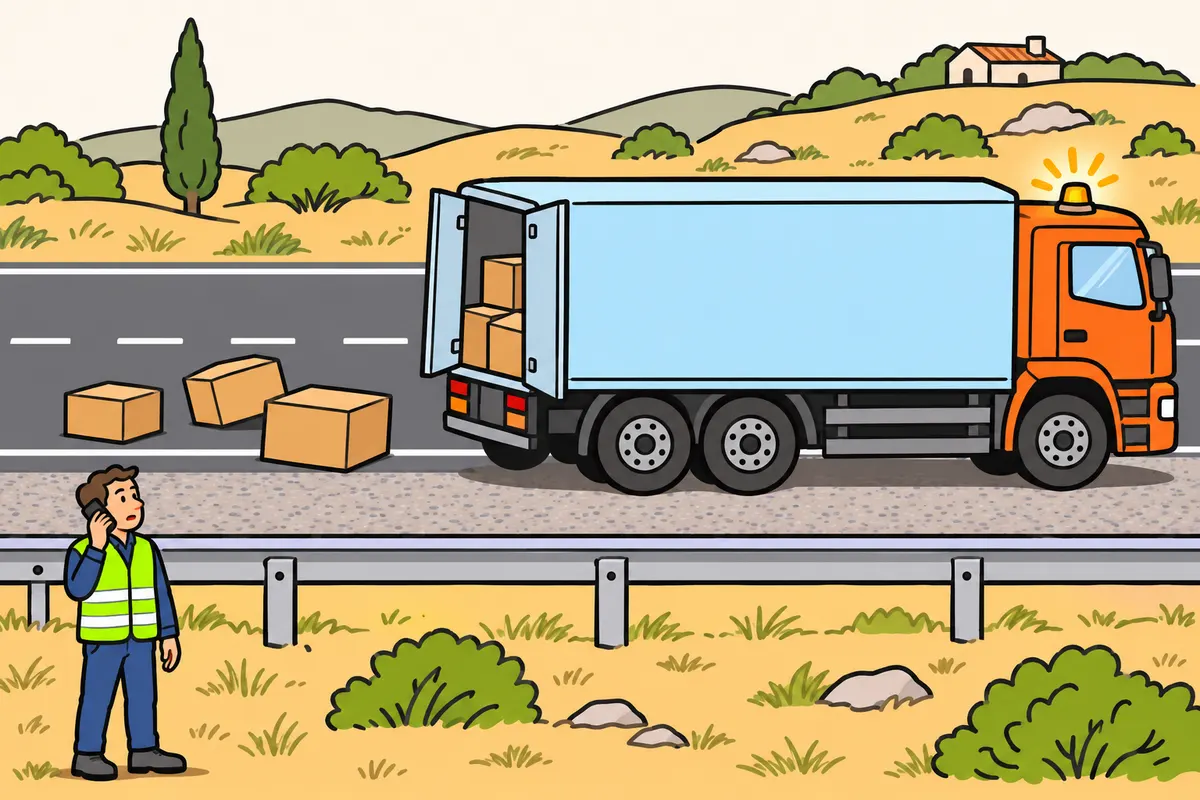
Mark fallen loads and avoid approaching dangerous loads or substances.
Remember
- Do not open doors or release restraints if the load could fall.
- Do not go under suspended loads or unstable vehicles.
- Mark fallen loads and arrange safe removal.
- Do not collect packages among moving vehicles.
- Report spills and dangerous goods without touching unknown substances.
- If blocking a level crossing, see “Immobilisation on a level crossing”.
Exam trap: Wrong: Approach a leak to read labels. Right: Report the information you already know.
Read the full explanation
- You must assess the size of the lorry and the position of its load before approaching. Goods that have shifted may fall when you open doors or release lashings. You must not go under a load body, suspended load or unstable vehicle to retrieve objects; warn others of the danger and wait for suitable rescue equipment.
- If the load falls and obstructs the carriageway, you must warn of the danger using the regulatory warning device and arrange for the load to be removed as soon as possible. You must not rush to pick up packages among moving vehicles. Inform the emergency services or the authorities so that protective measures allow safe removal. [RGC, art. 130.1 and 4](https://www.boe.es/buscar/act.php?id=BOE-A-2003-23514#a130)
- You must warn of spills, smoke, unusual smells and goods that could worsen the fire or cause contamination. Do not touch unknown substances or walk through puddles to identify the product. Provide the information you already know about the load without approaching a leak to read labels.
- If dangerous goods are involved, you must report this and apply the emergency instructions for that transport operation. A category C licence alone does not replace ADR training. You study the classes, plates, documents and specific obligations for that transport operation in «Dangerous goods: ADR basics».
- If your lorry or its load blocks a level crossing or a movable bridge due to force majeure, follow the procedure in «Safe lorry driving», section «Immobilisation on a level crossing». [RGC, art. 97.1 and 2](https://www.boe.es/buscar/act.php?id=BOE-A-2003-23514#a97)
18Emergency equipment and fire extinguishers according to MMA (maximum authorised mass)
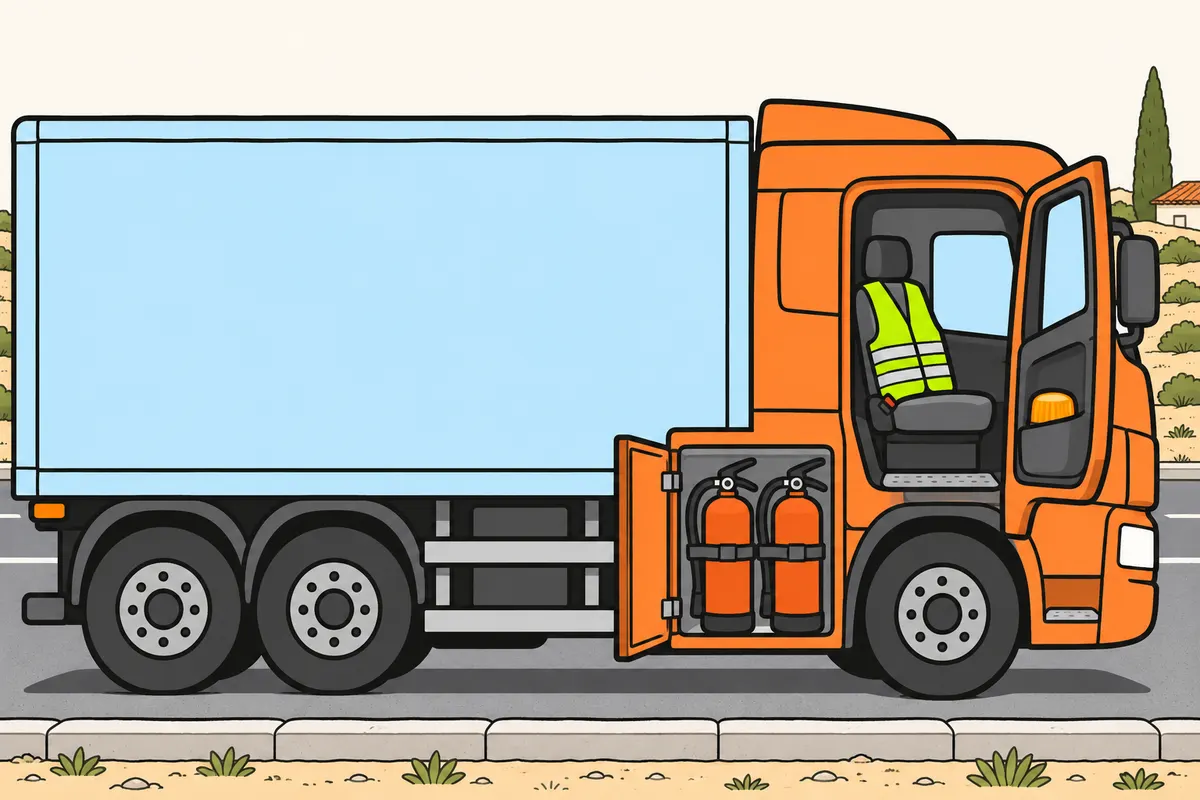
Choose fire extinguishers according to your lorry’s maximum authorised mass.
| Lorry MMA | Minimum extinguishers under general table |
|---|---|
| Over 3,500 kg up to 7,000 kg | One 21A/113B extinguisher |
| Over 7,000 kg up to 20,000 kg | One 34A/144B extinguisher |
| Over 20,000 kg | Two 34A/144B extinguishers |
Remember
- Carry a beacon, vest and suitable, usable fire-extinguishing equipment.
- Check the maximum authorised mass, called MMA.
- Do not carry fewer extinguishers because today’s load is lighter.
- Classes show firefighting performance, not the weight of the contents.
- Carry the compulsory vest; extra vests for passengers are recommended.
- Place your extinguisher within reach without blocking your exit.
Exam trap: Wrong: Require two extinguishers at exactly 20,000 kg. Right: One class 34A/144B extinguisher is required.
Read the full explanation
- In your goods lorry with an MMA of more than 3,500 kg, including categories N2 and N3, you must carry the V-16, a high-visibility reflective vest and suitable, serviceable, type-approved fire-extinguishing equipment. [RGV, annex XII.1 and 2](https://www.boe.es/buscar/act.php?id=BOE-A-1999-1826#anxii)
- Under the general table for goods vehicles, your lorry with an MMA of more than 3,500 kg and up to 7,000 kg requires at least one fire extinguisher rated 21A/113B. If its MMA exceeds 7,000 kg but does not exceed 20,000 kg, it requires at least one rated 34A/144B. The upper limit of each range is included. [Orden de 27 de julio de 1999 (Order of 27 July 1999), section two.b](https://www.boe.es/buscar/act.php?id=BOE-A-1999-16887)
- If the MMA exceeds 20,000 kg, you must carry at least two fire extinguishers rated 34A/144B under that table. Exactly 20,000 kg falls within the range requiring one 34A/144B extinguisher. These ratings indicate extinguishing performance; they are neither kilograms of extinguishing agent nor traffic sign codes. [Orden de 27 de julio de 1999, section two.b](https://www.boe.es/buscar/act.php?id=BOE-A-1999-16887)
- The order allows the minimum ADR fire-extinguisher provision according to MMA as an alternative for goods vehicles. You must also comply with the specific regulations applicable to the transport operation. You must not assume that a single small extinguisher is suitable for every lorry or that driving empty automatically reduces the equipment required. [Orden de 27 de julio de 1999, sections one and two](https://www.boe.es/buscar/act.php?id=BOE-A-1999-16887)
- Keep the vest and beacon accessible from the cab, and the extinguisher where you can reach it without blocking your exit. Follow the manufacturers’ maintenance instructions and check that the equipment is serviceable. You study routine vehicle checks in «Lorry maintenance and checks».
- The general equipment requirement is one vest, with no requirement for one per accompanying person; carrying additional vests is recommended. [RGV, annex XII.1.b and 2](https://www.boe.es/buscar/act.php?id=BOE-A-1999-1826#anxii)
19Fire outside a tunnel
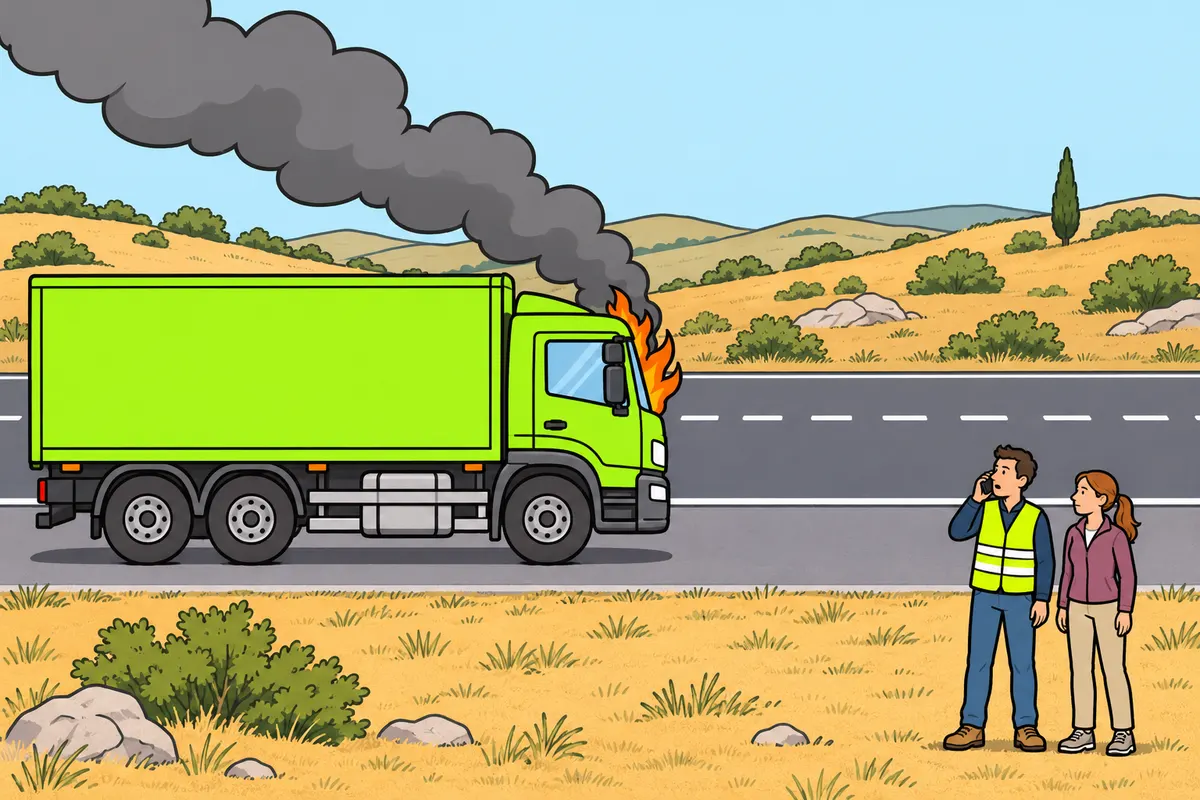
If there is a fire, stop safely, evacuate and call for help.
Remember
- Switch off the engine and call 112.
- Leave without delaying to collect belongings or save the load.
- Only tackle small fires if you know how and have suitable equipment.
- Keep an escape route and avoid breathing smoke.
- Aim the extinguisher at the base of the flames.
- Do not suddenly open the bonnet or put water on fuel or electrical equipment.
Exam trap: Wrong: Try to put out every fire. Right: Move away if you cannot act safely.
Read the full explanation
- If a fire breaks out, you must stop the lorry where you can do so safely, switch off the engine, evacuate and call 112. Put people first and keep an escape route available. You must not keep driving to save the goods or delay evacuation to collect documents or belongings.
- You must only try to put out a small fire if you have suitable equipment, know how to use it and can do so without exposing yourself to smoke or losing your escape route. If the fire grows or affects a dangerous area, move away. A portable fire extinguisher does not guarantee that you can control a fire involving a lorry or its entire load.
- If you use the fire extinguisher, you must follow its instructions, position yourself so that the smoke does not blow towards you and aim the extinguishing agent at the base of the flames. Do not throw the bonnet open to inspect a fire: the inflow of air can make it flare up. Do not approach tyres, tanks or containers exposed to heat.
- You must not smoke or produce flames near the accident or a spill. Do not indiscriminately pour water onto fuels or electrical installations; the extinguishing agent must be suitable for the fire. From a safe area, tell 112 which part of the lorry is burning, whether anyone is trapped and what load you are carrying.
20Breakdown, fire and traffic queues in tunnels
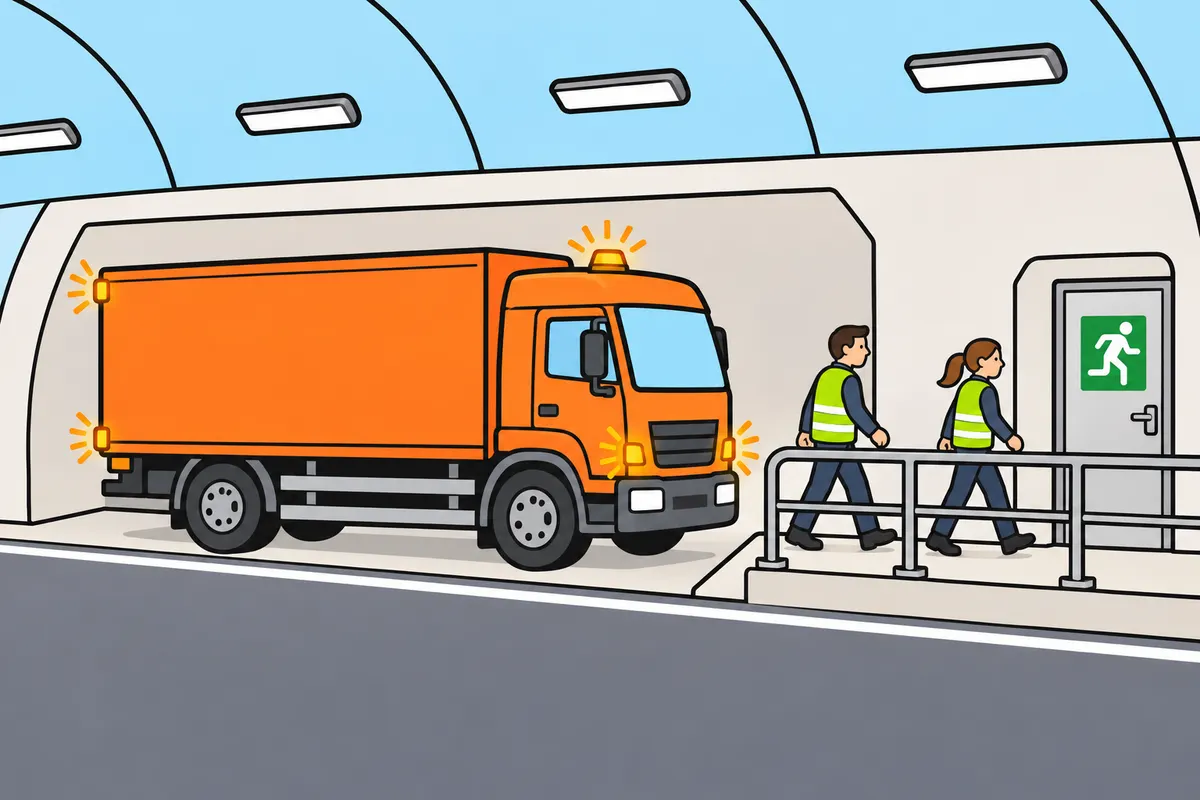
In a tunnel, act according to whether there is a breakdown, fire or traffic queue.
| Situation | What you must do |
|---|---|
| Breakdown leaves you immobilised | Switch off the engine and go to the nearest refuge or exit |
| Fire | Switch off the engine and evacuate away from the fire |
| Traffic queue | As soon as you stop: engine off, position lights on, hazard lights temporarily on, maximum gap, occupants inside |
| Wait over two minutes in a tunnel or enclosed place | Keep the engine off and position lights on |
Remember
- If you can continue safely, reach the exit or an emergency area.
- If immobilised, seek an emergency area or move towards the right-hand edge.
- Use hazard warning lights, position lights and V-16; use an available SOS telephone.
- With a fire, leave the key in the ignition and doors open.
- Evacuate towards a refuge or exit, away from the fire.
- Whenever you stop in a tunnel, switch off the engine, even at the wheel.
Exam trap: Wrong: Get out for an ordinary traffic queue. Right: Stay inside and switch off the engine.
Read the full explanation
- If the fault allows you to continue, you must drive to the exit of the tunnel or underpass; if that is not possible, drive to an area reserved for emergencies. You must not stop in a lane to examine a fault if you can safely reach a better location. [RGC, art. 97.3.f](https://www.boe.es/buscar/act.php?id=BOE-A-2003-23514#a97)
- If an emergency immobilises your vehicle, you must try to reach the nearest emergency area in your direction of travel. If there is none, move the lorry as close as possible to the right-hand edge. Switch off the engine, switch on the hazard warning lights, keep the position lights on and place and activate the regulatory V-16. [RGC, art. 97.3.a to c](https://www.boe.es/buscar/act.php?id=BOE-A-2003-23514#a97)
- You must seek help without delay using the nearest SOS emergency telephone, if there is one, and follow its instructions. You and the other occupants must leave the vehicle and make your way quickly to the nearest refuge or exit. Use areas closed to traffic where they exist: do not walk on the carriageway if these areas are available. [RGC, art. 97.3.d and e](https://www.boe.es/buscar/act.php?id=BOE-A-2003-23514#a97)
- In the event of a fire inside a tunnel or underpass, you must move the lorry to the right to make room for emergency vehicles. Switch off the engine and leave the key in the ignition and the doors open. This instruction is specific to this emergency, and you must distinguish it from the usual procedure for securing a parked vehicle. [RGC, art. 97.3](https://www.boe.es/buscar/act.php?id=BOE-A-2003-23514#a97)
- You must evacuate quickly with the other occupants towards the nearest refuge or exit in the direction away from the fire. Use areas closed to traffic where they exist. You must not go back for the goods or try to drive through the fire because the tunnel entrance or exit seems close. [RGC, art. 97.3](https://www.boe.es/buscar/act.php?id=BOE-A-2003-23514#a97)
- If you stop inside a tunnel or enclosed place, you must always switch off the engine, even if you remain at the wheel. If the wait lasts more than two minutes, you must keep the engine off and the position lights on. In a traffic queue in a tunnel, you must apply the measures in article 97.3 as soon as you stop: use the hazard warning lights temporarily to warn approaching drivers, keep the position lights on, switch off the engine, leave as much space as possible behind the vehicle ahead and keep the occupants inside the vehicle. [RGC, arts. 97.3 and 115.1-2](https://www.boe.es/buscar/act.php?id=BOE-A-2003-23514)
- Follow the traffic lights, information signs and instructions from the tunnel operators. You study normal driving through tunnels and following distances while moving in «Safe lorry driving» and «Speed and safe following distances».
21Identification, details and evidence
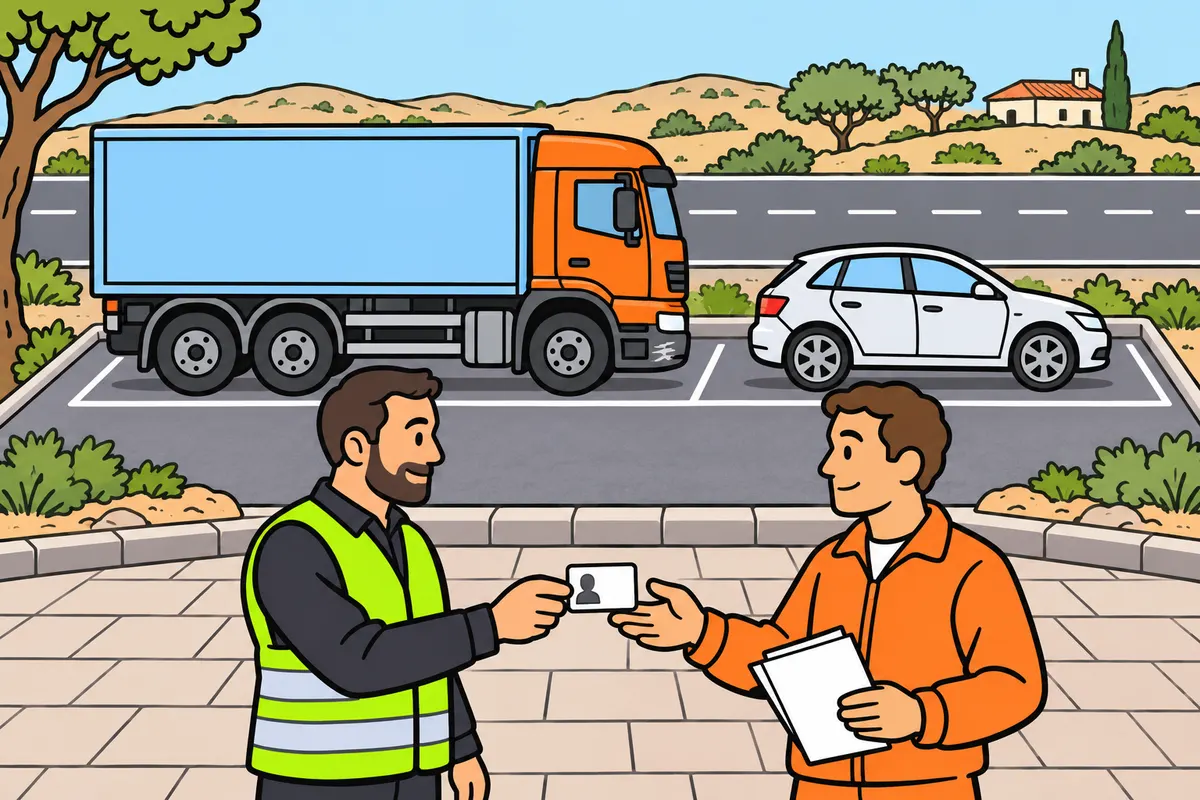
Provide your details and preserve evidence without putting anyone in danger.
Remember
- If involved, give your identity and vehicle details when asked.
- If the affected person is absent, send your name and address promptly.
- Preserve evidence with serious injuries, deaths, or when you have notified the authorities.
- Put people’s safety and traffic safety first.
- Complete the accident report in a safe place off the road.
- Do not expose yourself to traffic to take photos.
Exam trap: Wrong: Fill in the accident report on the hard shoulder. Right: Find somewhere safe off the road.
Read the full explanation
- If you are involved, you must provide your identity and vehicle details to the other people involved who request them. You must not leave without meeting these requests because the collision seems minor or because you drive a company vehicle. You must exchange details from a safe place. [RGC, art. 129.2.f and g](https://www.boe.es/buscar/act.php?id=BOE-A-2003-23514#a129)
- If there is only property damage and an affected party is absent, you must take appropriate steps to ensure they receive your name and address as soon as possible. You can provide these details directly or through the police officers. If you hit a parked vehicle, you are not relieved of your duty to identify yourself because its driver is absent. [RGC, art. 129.2.f](https://www.boe.es/buscar/act.php?id=BOE-A-2003-23514#a129)
- If someone appears to be dead or seriously injured, or you have notified the authorities, you must avoid disturbing traces and evidence that may help establish what happened. The safety of casualties and traffic takes priority: do not leave a dangerous situation unchanged solely to preserve the positions of objects. [RGC, art. 129.2.c](https://www.boe.es/buscar/act.php?id=BOE-A-2003-23514#a129)
- You must not fill in the accident report form in the lanes or on the arcén (hard shoulder): doing so on the carriageway or hard shoulder is prohibited, and you must complete it in a safe place off the road. You must not expose yourself to a collision to take photographs either. First make the scene safe and attend to anyone who needs help. [RGC, art. 130.5](https://www.boe.es/buscar/act.php?id=BOE-A-2003-23514#a130)
22Stay and fulfil your duty to help
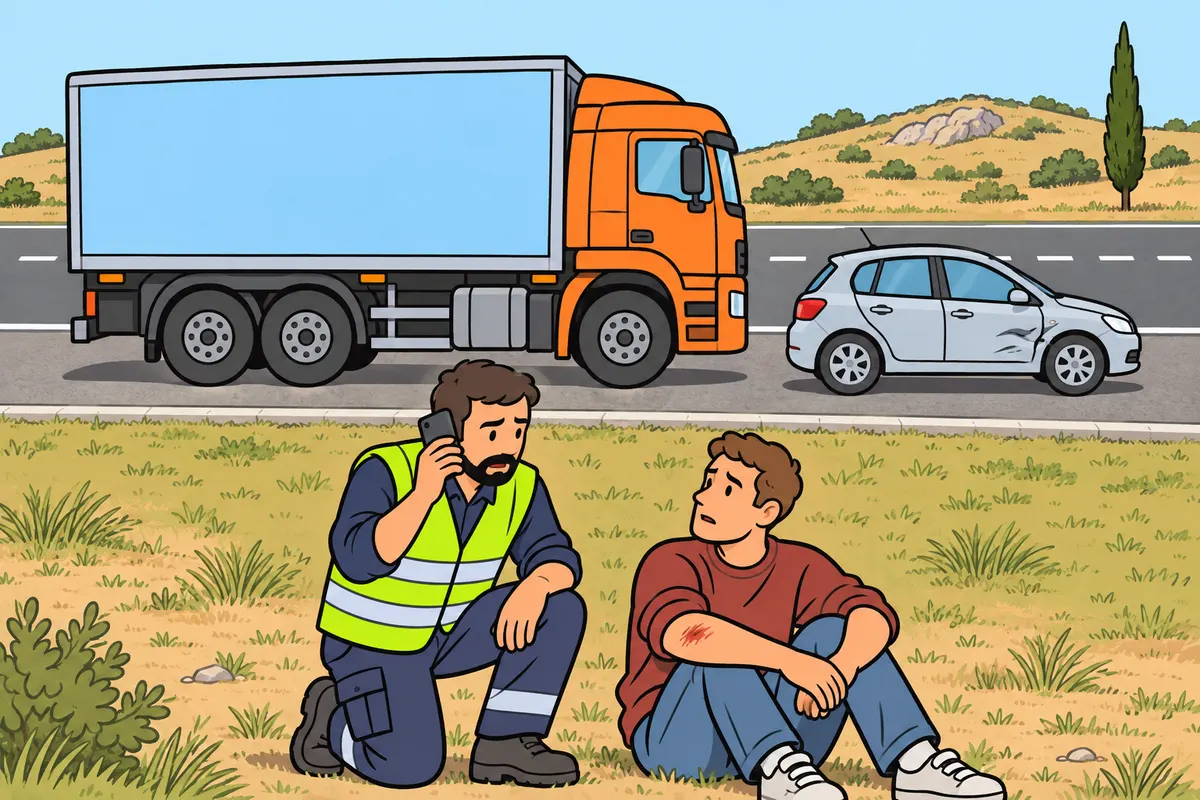
Provide necessary help and stay whenever you are required to.
Remember
- If anyone seems injured or dead, notify officers and wait for their arrival.
- You may leave if authorised or if you need to give or receive help.
- The exception requires clearly minor injuries, restored safety and nobody requesting your presence.
- Even with this exception, fulfil your duties to help and identify yourself.
- If you cannot help directly, urgently call for help.
- If you are a witness, do not stop just to look.
Exam trap: Wrong: Leave because you consider the accident minor. Right: Fulfil your duties to help and stay.
Read the full explanation
- If anyone appears to be injured or dead, you must notify the authorities or their officers and stay at or return to the scene until they arrive. You can leave if they authorise you to do so, if you must help the injured or if you need treatment yourself. [RGC, art. 129.2.e](https://www.boe.es/buscar/act.php?id=BOE-A-2003-23514#a129)
- You do not need to notify the officers or remain at the scene when the only injuries are clearly minor, safety has been restored and no one involved requests it. All these conditions must be met; your own view that the collision is minor is not enough. You must still fulfil the applicable duties to provide help and exchange details. [RGC, art. 129.2.e](https://www.boe.es/buscar/act.php?id=BOE-A-2003-23514#a129)
- If you are a witness and your assistance is clearly unnecessary, or officers are present, the regulations allow you to be exempt from taking the same actions as someone involved. If your help is needed and you can provide it, you must assist as applicable to you. You must not stop merely to look or create another obstruction. [RGC, art. 129.3](https://www.boe.es/buscar/act.php?id=BOE-A-2003-23514#a129)
- You can commit the offence of failing to provide assistance if you do not help a person who is helpless and in clear, serious danger when you can do so without risk to yourself or others. If you cannot help directly, you must urgently seek help. [CP, art. 195](https://www.boe.es/buscar/act.php?id=BOE-A-1995-25444#a195). Outside the cases covered by article 195, if you voluntarily leave the scene, without risk to yourself or others, after causing an accident involving deaths or the injuries specified in arts. 147.1, 149 or 150, you commit the offence of leaving the scene of an accident. [CP, art. 382 bis](https://www.boe.es/buscar/act.php?id=BOE-A-1995-25444#a3-2)
PAS (Protect, Alert, Assist) at a lorry accident
You must prevent further casualties and arrange appropriate help.
- Protect: stop without creating danger and assess traffic, casualties, lorry stability and the load.
- Warn: use the hazard warning lights, connected V-16 and position lights and end-outline marker lamps where required.
- Decide whether you can get out: put on your high-visibility vest and choose a route to a safe place; if getting out is unsafe, stay inside with your seat belt fastened, unless the specific emergency requires evacuation.
- Alert: call 112 and specify your location and direction of travel, casualties, anyone trapped and risks from the load.
- Assist: follow the instructions from 112, deal with life-threatening conditions within your knowledge and avoid unnecessary movement.
- Cooperate: provide access, supply the required identifying details and tell the professionals about any changes.
Unconscious casualty: initial decision
You must distinguish normal breathing from the absence of normal breathing.
- Check that you can approach safely and speak to the casualty without shaking them.
- If they do not respond, call 112 for help and follow their instructions to assess breathing and maintain the airway.
- If they are breathing normally, monitor them and avoid moving them; if they vomit or their airway is at risk, follow the instructions from 112 to turn them only as much as necessary.
- If they are not breathing normally, start chest compressions on the adult at 100-120 per minute and a depth of 5-6 cm; ask for a defibrillator.
- If you know how to give rescue breaths and can do so, alternate 30 compressions with 2 rescue breaths; otherwise, give continuous compressions.
- Follow the instructions from the defibrillator and emergency services until someone takes over or circumstances prevent you from continuing.
Breakdown in a tunnel
You must move your lorry out of the way, call for help and use refuges and exits.
- If you can drive safely, continue to the exit or, if you cannot reach it, to an emergency area.
- If your vehicle is immobilised, position it in an emergency area or close to the right-hand edge, switch off the engine and switch on the hazard warning lights and position lights.
- Activate and position the V-16 without exposing yourself to danger.
- Call for help using the nearest SOS emergency telephone, if there is one, and follow the instructions.
- Leave the vehicle with the occupants and head to the nearest refuge or exit using areas closed to traffic.
Fire in a tunnel
You must allow access for the emergency services and evacuate away from the fire.
- Move your lorry towards the right to leave room for the emergency services.
- Switch off the engine and leave the key in the ignition and the doors open.
- Evacuate quickly with the other occupants towards the nearest refuge or exit, away from the fire.
- Use areas closed to traffic where available, report the emergency and follow the tunnel instructions.
Finished this module?
Mark it as read and you will see your progress on the theory list.