
Theory · D Licence - Bus · Module 17 of 18
Accidents and assistance
You learn to secure the scene of a bus accident or breakdown, call 112 and provide help without making injuries worse. You master PAS, the connected V-16 beacon and the differences between a vehicle immobilised on the road, a tunnel emergency and a traffic queue, together with the duties to assist and identify yourself.
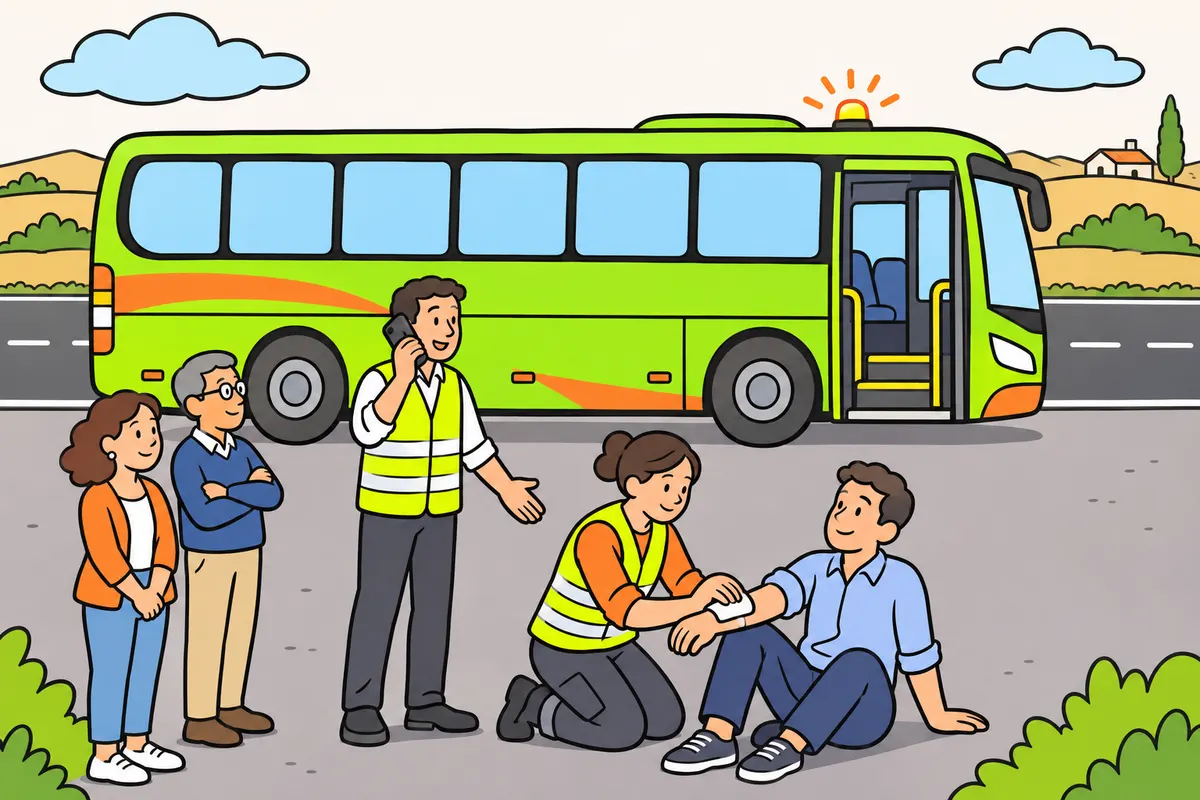
1PAS: order and priorities
Protect yourself, assess the scene, then alert and assist in that order.
Remember
- Check traffic, smoke and other dangers before you approach.
- Check your passengers' safety before you leave to help.
- Deal with threats to life first.
- You can share tasks so people help at the same time.
- In PEAS, you assess the situation before raising the alarm.
Exam trap: Wrong: you help before checking dangers. Right: protect yourself and assess the situation first.
Read the full explanation
- You must apply PAS: proteger (protect), avisar or alertar (alert) and socorrer (assist). First check that you can act without becoming another casualty; then request help and provide the assistance you know how to give. Staying calm allows you to act quickly and explain clearly what has happened. [DGT, PAS procedure](https://www.dgt.es/muevete-con-seguridad/que-hacer-ante-un-accidente-de-trafico/). In the PEAS variant, E, evaluar (assess), comes before raising the alarm. [DGT, Manual IX, unit 3](https://sede.dgt.gob.es/export/sites/dgt/.galleries/permisos-de-conducir/certificacion-aptitud-profesores-formacion-vial/2026/MANUAL-IX-Primeros-auxilios.pdf).
- You must assess the overall situation: approaching traffic, the stability of the bus, smoke, trapped people and the approximate number of people affected. This assessment helps you set priorities. [RGC (Reglamento General de Circulación — General Traffic Regulations), art. 129](https://www.boe.es/buscar/act.php?id=BOE-A-2003-23514#a129).
- You can share tasks among available people: one calls, another guides those who are safe, and someone trained deals with a life-threatening condition. PAS sets priorities and allows this simultaneous cooperation. [DGT, Manual IX, units 1 and 3](https://sede.dgt.gob.es/export/sites/dgt/.galleries/permisos-de-conducir/certificacion-aptitud-profesores-formacion-vial/2026/MANUAL-IX-Primeros-auxilios.pdf).
- Before leaving your driving position to help outside, check the situation of the occupants and the dangers around them. Equipment and evacuation arrangements are covered in the “Passenger safety and emergencies” module.
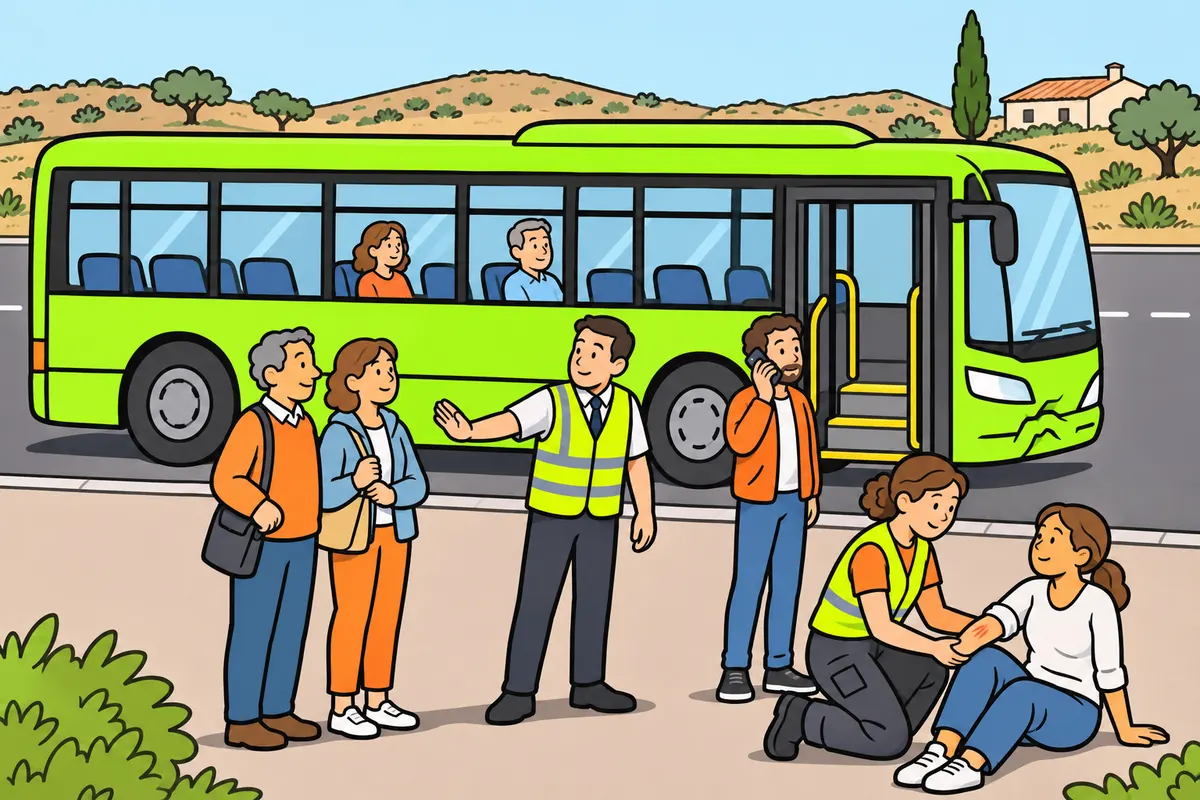
2Who must help
You must help or request help even if you did not cause the accident.
| Your situation | What you must do |
|---|---|
| You are involved | Stop safely and cooperate. |
| You only witness or learn about the accident | You need not stop if your help is clearly unnecessary or officers are already there. |
| You are involved and officers are already there | Give your identity and vehicle details to other people involved who request them, even with officers present. |
Remember
- If you are involved, stop without creating another danger.
- If you witness or learn about an accident, help or request assistance.
- If helping directly is unsafe, request urgent assistance.
- Do not attempt medical techniques you do not know.
Exam trap: Wrong: you only help if you caused the accident. Right: you must also help or request assistance if you witness or learn about it.
Read the full explanation
- If you are involved in, witness or become aware of an accident, you must assist the casualties or request assistance for them. You must also cooperate to prevent further harm, restore traffic safety and establish the facts. This duty does not depend on whether you caused the accident. [RGC, art. 129](https://www.boe.es/buscar/act.php?id=BOE-A-2003-23514#a129).
- If you are involved, you must stop without creating a new danger. In a bus, an abrupt stop can also cause passengers to fall or a rear-end collision. [RGC, art. 129](https://www.boe.es/buscar/act.php?id=BOE-A-2003-23514#a129).
- If you are only a witness or become aware of the accident, you do not need to stop when your assistance is clearly unnecessary or the authorities or their officers are already present. [RGC, art. 129.3](https://www.boe.es/buscar/act.php?id=BOE-A-2003-23514#a129). If you are involved, the presence of police officers does not release you from the duty to give your identity and vehicle details to other people involved who request them. [RGC, art. 129.2.f and g](https://www.boe.es/buscar/act.php?id=BOE-A-2003-23514#a129).
- You must urgently request assistance if you cannot help directly without risk. You do not need to perform medical techniques you do not know to play a useful role: giving accurate information, securing access and following instructions can be crucial to the response. [Código Penal, art. 195](https://www.boe.es/buscar/act.php?id=BOE-A-1995-25444#a195).
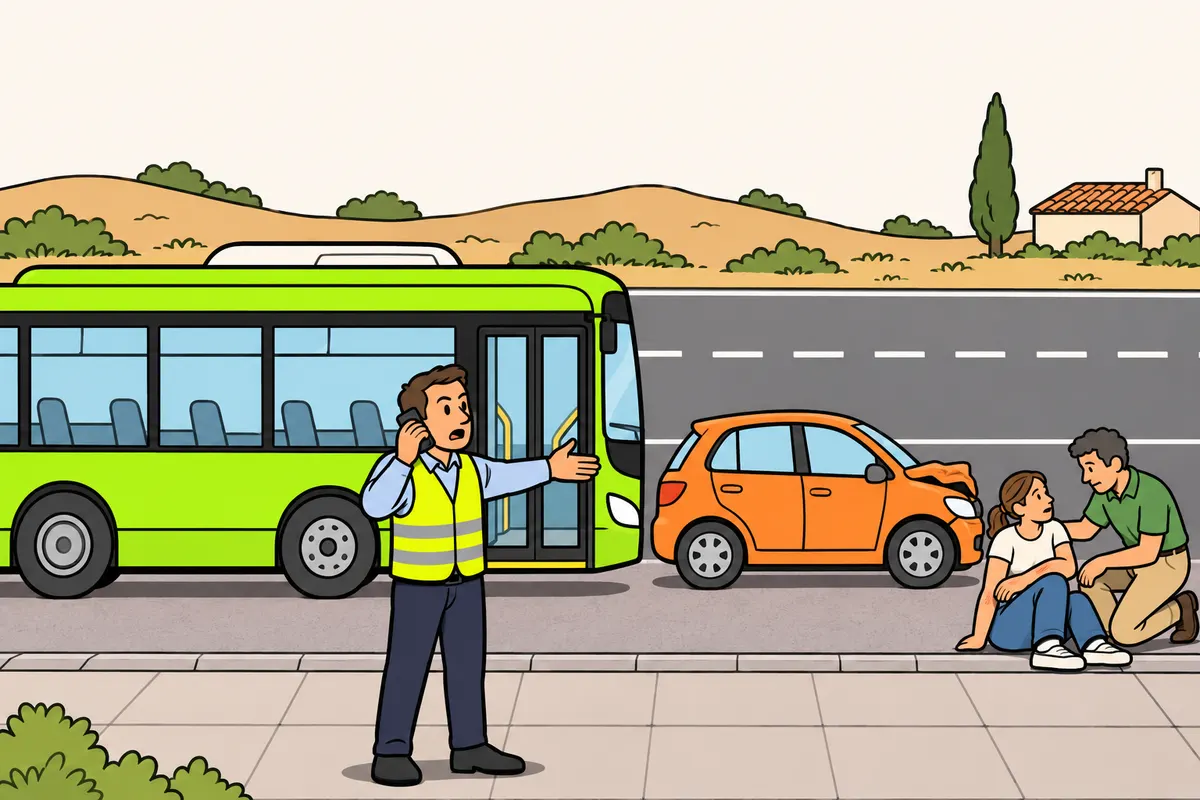
3Secure the scene without exposing yourself to danger
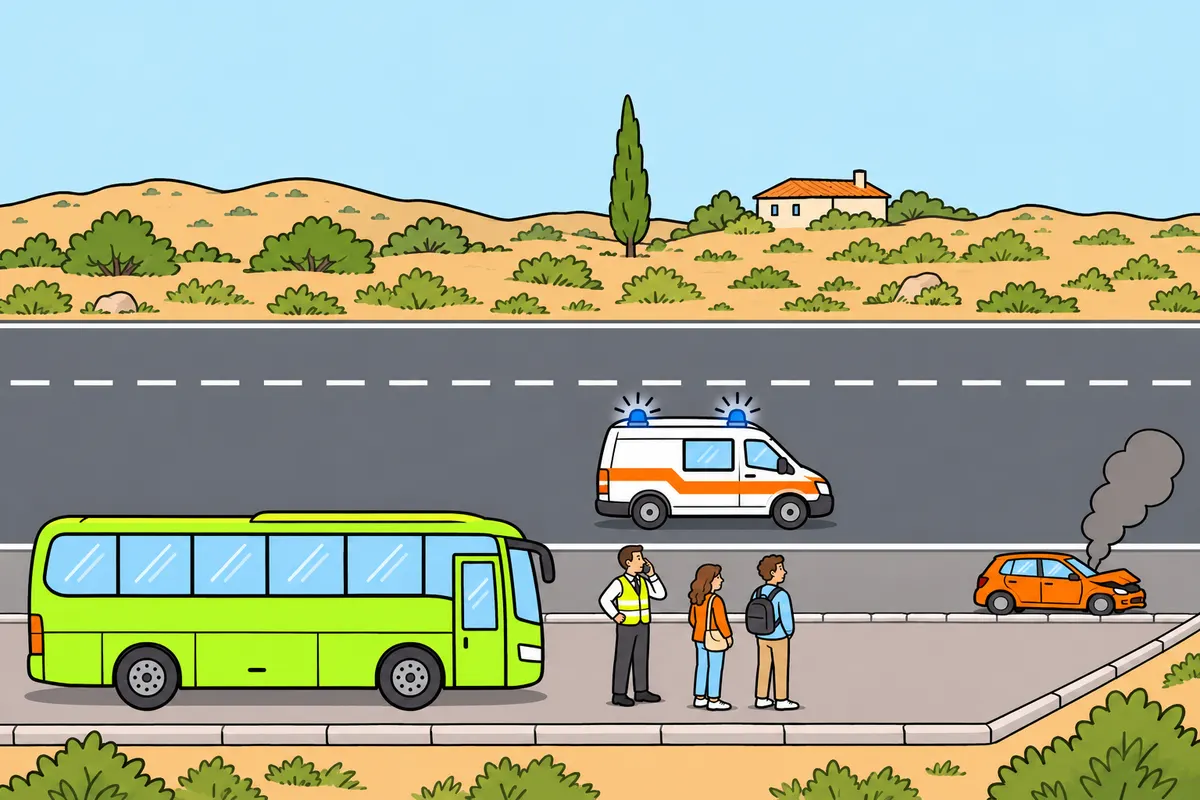
Secure the scene without putting yourself in danger or blocking emergency services.
Remember
- Leave room for ambulances and other emergency teams.
- Secure your stationary bus against movement.
- Keep away from fuel, fire, smoke and dangerous cables.
- Do not smoke or light flames near the accident.
- Preserve evidence if anyone died, suffered serious injuries, or you notified the authorities.
- Put people's safety and traffic safety first.
Exam trap: Wrong: you preserve evidence while someone remains in danger. Right: protect people and traffic first.
Read the full explanation
- You must position the bus where it does not increase the danger and leaves room for emergency services. Check the road before approaching another vehicle; avoid stopping where visibility is poor or blocking ambulance access simply to get closer. [RGC, art. 129](https://www.boe.es/buscar/act.php?id=BOE-A-2003-23514#a129).
- To secure the stationary bus, apply the parking precautions in the “Manoeuvres with the bus” module. Keep people away from spilled fuel, fire and smoke; avoid smoking or lighting flames near the accident. [RGC, art. 92](https://www.boe.es/buscar/act.php?id=BOE-A-2003-23514#a92).
- You must not enter a smoke-filled space or approach cables, liquids or objects whose hazards you do not know. Report these risks to 112 and wait for suitably equipped teams. [DGT, Manual IX, unit 1](https://sede.dgt.gob.es/export/sites/dgt/.galleries/permisos-de-conducir/certificacion-aptitud-profesores-formacion-vial/2026/MANUAL-IX-Primeros-auxilios.pdf).
- If anyone is dead or seriously injured, or you have notified the authorities, you must avoid disturbing useful traces and evidence. The safety of the injured and of traffic takes priority: preserving the scene does not require you to leave someone exposed to being run over or to fire. [RGC, art. 129](https://www.boe.es/buscar/act.php?id=BOE-A-2003-23514#a129).
4Breakdown: move the bus out of danger
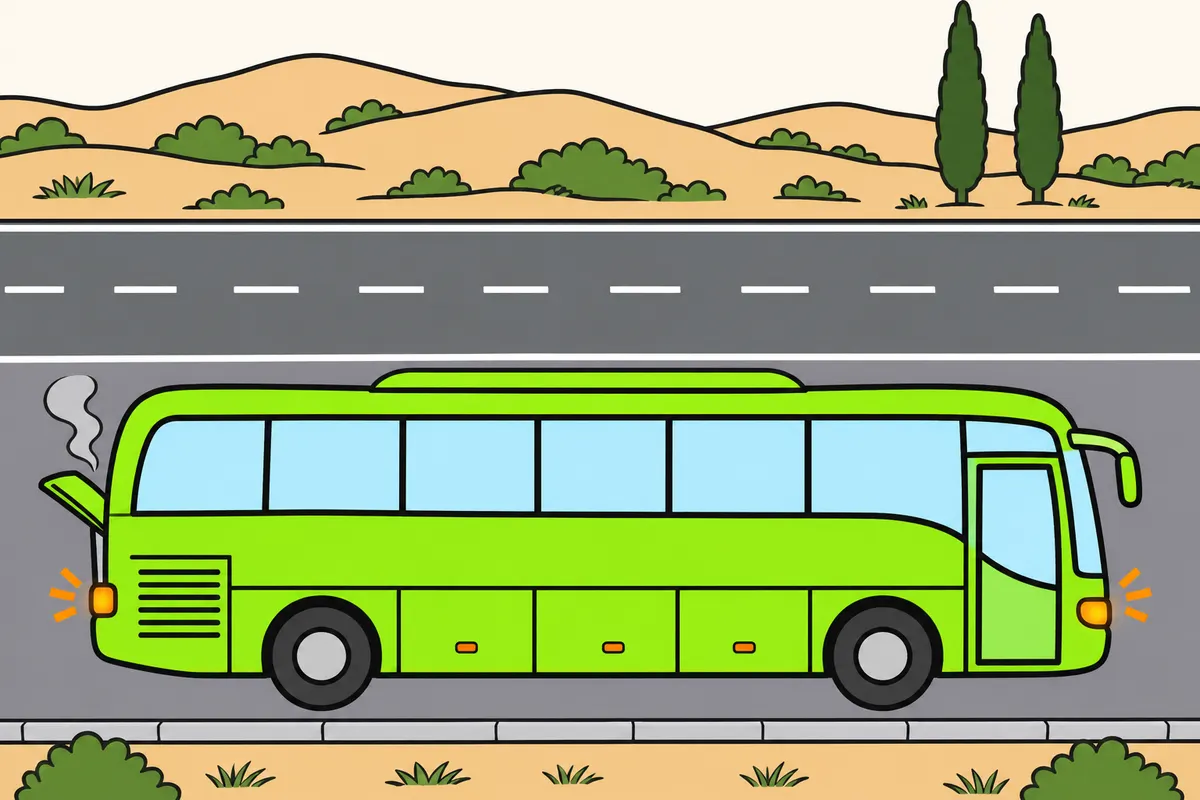
After a breakdown, warn others and move your bus out of danger when possible.
| Bus after a breakdown or accident | What you do |
|---|---|
| You can continue safely | Continue immediately. |
| You need assistance | Leave the traffic lanes and use the right hard shoulder towards the first exit. |
| You cannot reach the exit | Stop on the right hard shoulder or where you cause the least obstruction. |
| You cannot clear a level crossing or movable bridge | Immediately warn approaching train drivers and road users far enough in advance. |
Remember
- If you can continue safely, do so immediately.
- If you need assistance, use the right hard shoulder towards the first exit.
- If you cannot leave, stop where you cause the least obstruction.
- Leave at the first motorway exit if an emergency makes you abnormally slow.
- Use hazards if below minimum speed and at risk of a rear-end collision.
- On level crossings or movable bridges, evacuate and clear the crossing quickly.
Exam trap: Wrong: you apply the general emergency shoulder rule to every coach. Right: that rule requires a maximum authorised mass no greater than 3,500 kg. Moving off the road after a breakdown or accident is a separate rule.
Read the full explanation
- If a breakdown or accident causes your vehicle or its load to obstruct the carriageway, you must warn other road users and take the necessary steps to remove it as soon as possible. You must move it off the carriageway and position it in accordance with parking rules whenever feasible. [RGC, art. 130](https://www.boe.es/buscar/act.php?id=BOE-A-2003-23514#a130).
- If the damaged or broken-down bus can continue safely, you must continue immediately. If you need assistance, leave the traffic lanes as soon as possible and head for the first available exit using the right-hand arcén (hard shoulder); if you cannot, stop on that hard shoulder or where you cause the least obstruction. [RGC, art. 130](https://www.boe.es/buscar/act.php?id=BOE-A-2003-23514#a130).
- The rule in article 36 for vehicles travelling abnormally slowly because of an emergency requires a maximum authorised mass (MMA) of no more than 3,500 kg; you cannot treat it as general permission for a heavier coach. [RGC, art. 36](https://www.boe.es/buscar/act.php?id=BOE-A-2003-23514#a36).
- If an emergency makes you travel at an abnormally low speed on an autopista (motorway) or autovía (dual carriageway with motorway-type restrictions), you must leave at the first exit. If you cannot reach the minimum speed and there is a risk of a rear-end collision, use your hazard warning lights. [RGC, arts. 38 and 49](https://www.boe.es/buscar/act.php?id=BOE-A-2003-23514#a38).
- If circumstances beyond your control immobilise the bus on a level crossing, or luggage falls onto it, you must evacuate the occupants quickly and clear the crossing as soon as possible. If you cannot, you must immediately warn approaching train drivers and road users of the danger sufficiently far in advance. The same action applies on a movable bridge. [RGC, art. 97](https://www.boe.es/buscar/act.php?id=BOE-A-2003-23514#a97).
5The connected V-16 beacon on your bus
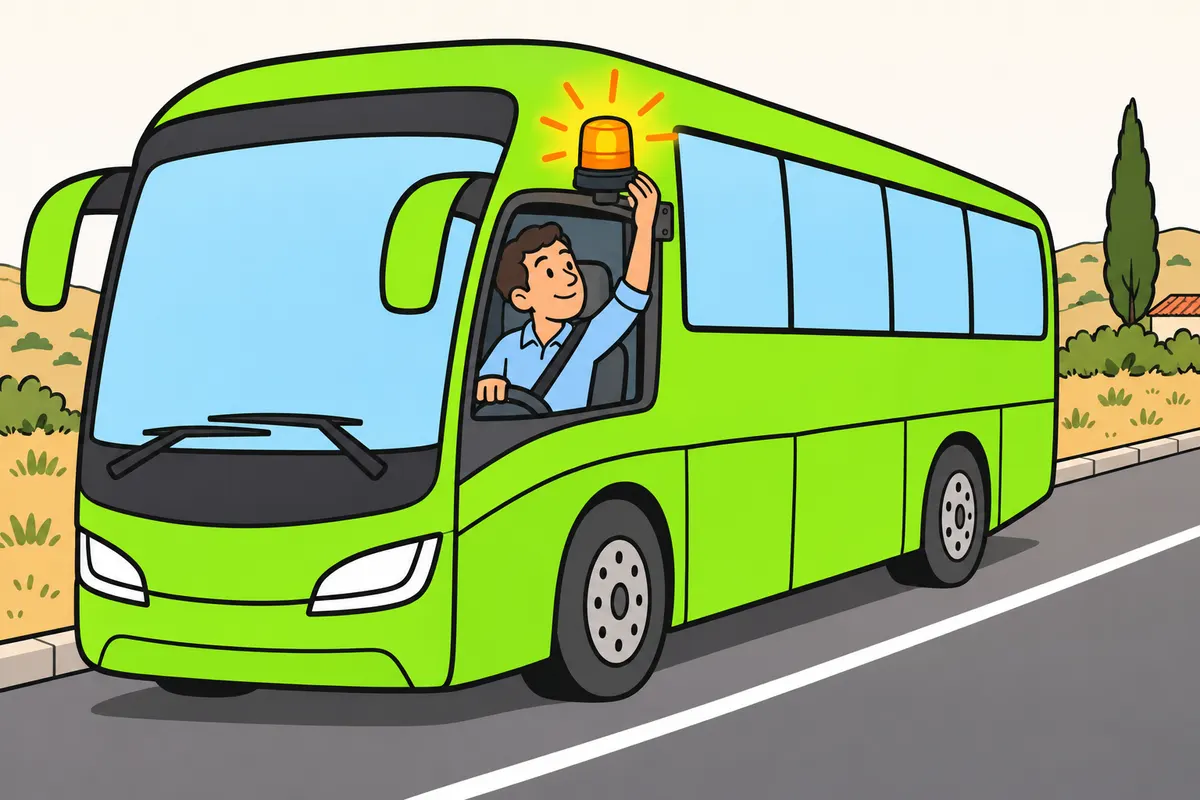
Carry a connected, certified beacon and place it without exposing yourself to traffic.
| Bus with bodywork extending above the cab | Where you place the V-16 |
|---|---|
| You can get out safely | You can place it at the rear. |
| You cannot get out safely | Place it at the highest accessible exterior point of the cab. |
| That point is out of reach | You can attach it to the driver's door or the side. |
Remember
- Carry a connected, certified V-16 on every bus registered in Spain.
- Use it when a breakdown or accident leaves your bus unable to move.
- Place it as high as possible, with visibility and safe access.
- See its features in “Bus lighting and signalling”, section “Connected V-16”.
- If the upper outside cab is unreachable, use the driver's door or side.
- Do not climb onto the roof or walk along the road to place it.
Exam trap: Wrong: you replace the connected V-16 with triangles or an unconnected beacon. Right: use the connected, certified beacon required on every bus registered in Spain.
Read the full explanation
- You must carry a connected, certified V-16 beacon in your bus registered in Spain and use it to give advance warning when immobilised by a breakdown or accident. This equipment is required on all buses, with no MMA threshold. [RGV (Reglamento General de Vehículos — General Vehicle Regulations), annexes XI and XII.2](https://www.boe.es/buscar/act.php?id=BOE-A-1999-1826#anxii) [DGT, V-16 devices](https://www.dgt.es/muevete-con-seguridad/tecnologia-e-innovacion-en-carretera/Dispositivos-de-presenalizacion-V16)
- The V-16 signals an immobilised vehicle or a load that has fallen onto the carriageway; its light and connectivity features are covered in “Bus lighting and signs”, section “Connected V-16 beacon”. [RGV, annex XI, V-16](https://www.boe.es/buscar/act.php?id=BOE-A-1999-1826#v-16).
- You must place it as high as possible to ensure maximum visibility. On a bus, you must plan for an accessible location and an attachment compatible with the bodywork; you must not climb onto the roof or expose yourself to traffic to reach an inaccessible location. [RGV, annex XI, V-16](https://www.boe.es/buscar/act.php?id=BOE-A-1999-1826#v-16). [DGT, placement on buses](https://www.dgt.es/muevete-con-seguridad/tecnologia-e-innovacion-en-carretera/Dispositivos-de-presenalizacion-V16).
- On a bus whose bodywork extends above the cab, you can place the V-16 at the rear if you can get out safely. If you cannot, you must place it at the highest accessible exterior point of the cab; if this is out of reach, you can attach it to the driver's door or the side. [DGT, placement on tall vehicles](https://www.dgt.es/muevete-con-seguridad/tecnologia-e-innovacion-en-carretera/Dispositivos-de-presenalizacion-V16/)
6Warning other road users does not mean requesting an ambulance
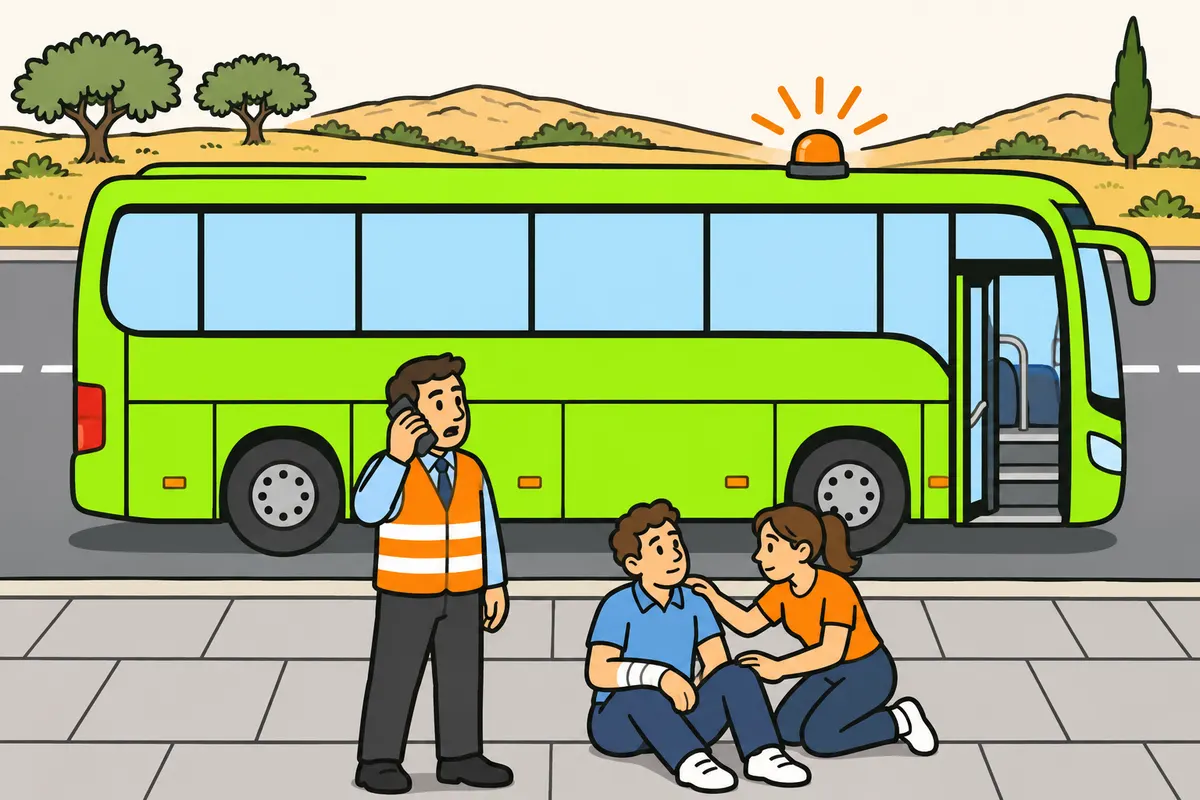
Your beacon warns of an obstruction, but you must call if there is an emergency.
| System or assistance | Purpose |
|---|---|
| V-16 | Warns others and sends your location; does not request medical assistance. |
| eCall, if your vehicle has it | Can call automatically after a serious collision. |
| Breakdown assistance | Helps with the breakdown; does not replace an emergency call. |
Remember
- Check your beacon's make and model on the DGT's official list.
- Check that your beacon is accessible and works.
- The V-16 sends its location to the traffic system.
- Call if anyone is injured, there is fire or another danger.
- Do not delay the emergency call while arranging repairs.
Exam trap: Wrong: you think activating your beacon requests an ambulance. Right: call 112 if anyone is injured, there is fire or another danger.
Read the full explanation
- Activating the V-16 sends its position to the national traffic and mobility access point. This communication warns of the incident; it is not a conversation with the emergency services and does not by itself report the passengers’ condition. If there are injuries, fire or another danger, you must call 112. [RGV, annex XI, V-16](https://www.boe.es/buscar/act.php?id=BOE-A-1999-1826#v-16); [DGT](https://www.dgt.es/muevete-con-seguridad/tecnologia-e-innovacion-en-carretera/Dispositivos-de-presenalizacion-V16).
- If the bus is immobilised without injuries or immediate danger, request the assistance you need; if there is an emergency, do not delay calling 112 while arranging repairs with the company. [RGC, art. 129](https://www.boe.es/buscar/act.php?id=BOE-A-2003-23514#a129).
- eCall can automatically call 112 when a vehicle equipped with it detects a serious collision. Do not assume that every bus has this system or leave unreported information about casualties and hazards. [DGT, What to do after a road traffic accident](https://www.dgt.es/export/sites/web-DGT/.galleries/downloads/conoce_la_dgt/que-hacemos/educacion-vial/jovenes/ESO_educacion_vial/ALUMNOS-U8-SABER-ACTUAR-EN-CASO-DE-ACCIDENTE.pdf).
7Lights while immobilised
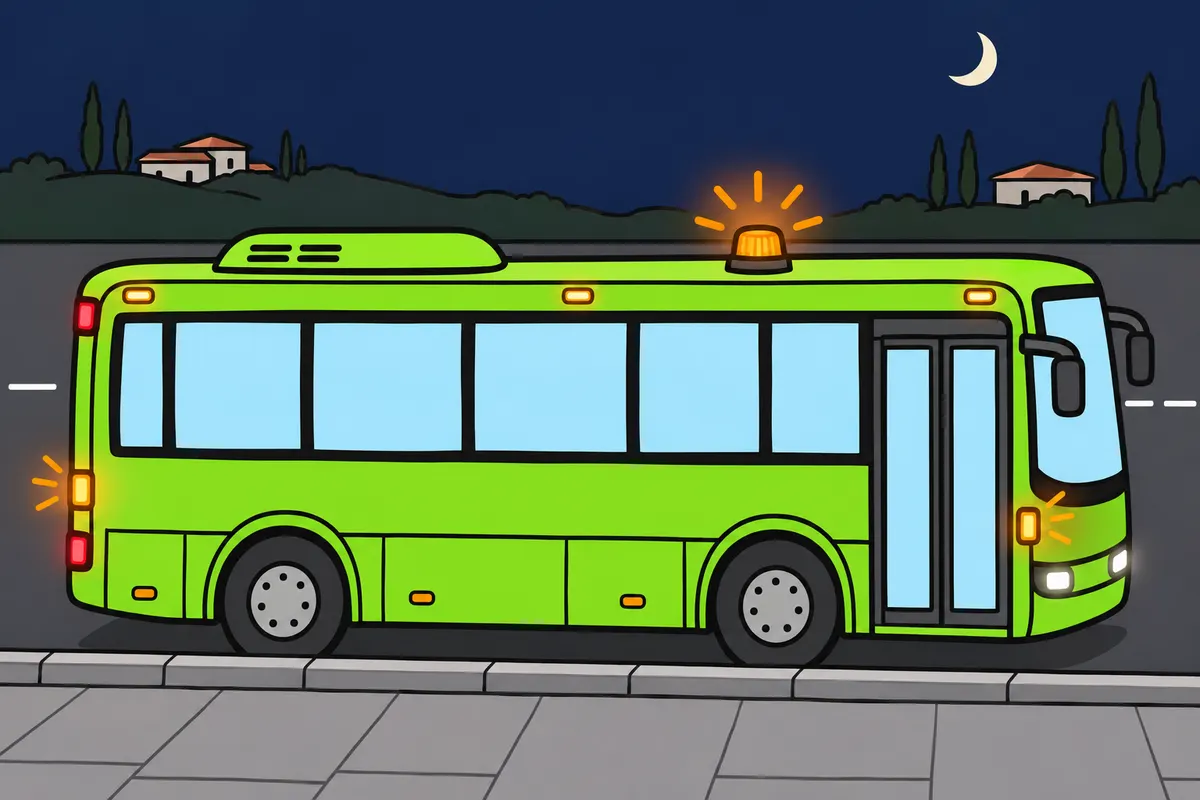
Keep the required lights on even when your beacon is working.
Remember
- Use hazard lights and activate the V-16 while the road is cleared.
- Keep the lighting required when your bus is immobilised, stopped or parked.
- See “Bus lighting and signalling”, section “An immobilised or parked bus”.
- If you occupy part of your lane, passing drivers need clearance and reduced speed.
Exam trap: Wrong: you turn off other lights because your beacon works. Right: keep the lights required for your situation on.
Read the full explanation
- Switch on the hazard warning lights and place and activate the V-16 while the road is being cleared. [RGC, art. 130.4](https://www.boe.es/buscar/act.php?id=BOE-A-2003-23514#a130).
- Keep the lighting required when immobilised, stopping or parking; the position lights, end-outline marker lamps and permitted alternatives in a travesía (through-road in a built-up area) are covered in “Bus lighting and signs”, section “Bus immobilised or parked”. [RGC, art. 105](https://www.boe.es/buscar/act.php?id=BOE-A-2003-23514#a105).
- If your bus is immobilised by a breakdown or accident and occupies all or part of a lane in your direction of travel, drivers passing it must leave at least 1.5 m of lateral clearance and travel at least 20 km/h below the road's speed limit. [RGC, arts. 88.1 and 130.4](https://www.boe.es/buscar/act.php?id=BOE-A-2003-23514#a88).
8Reflective vest and safe exit
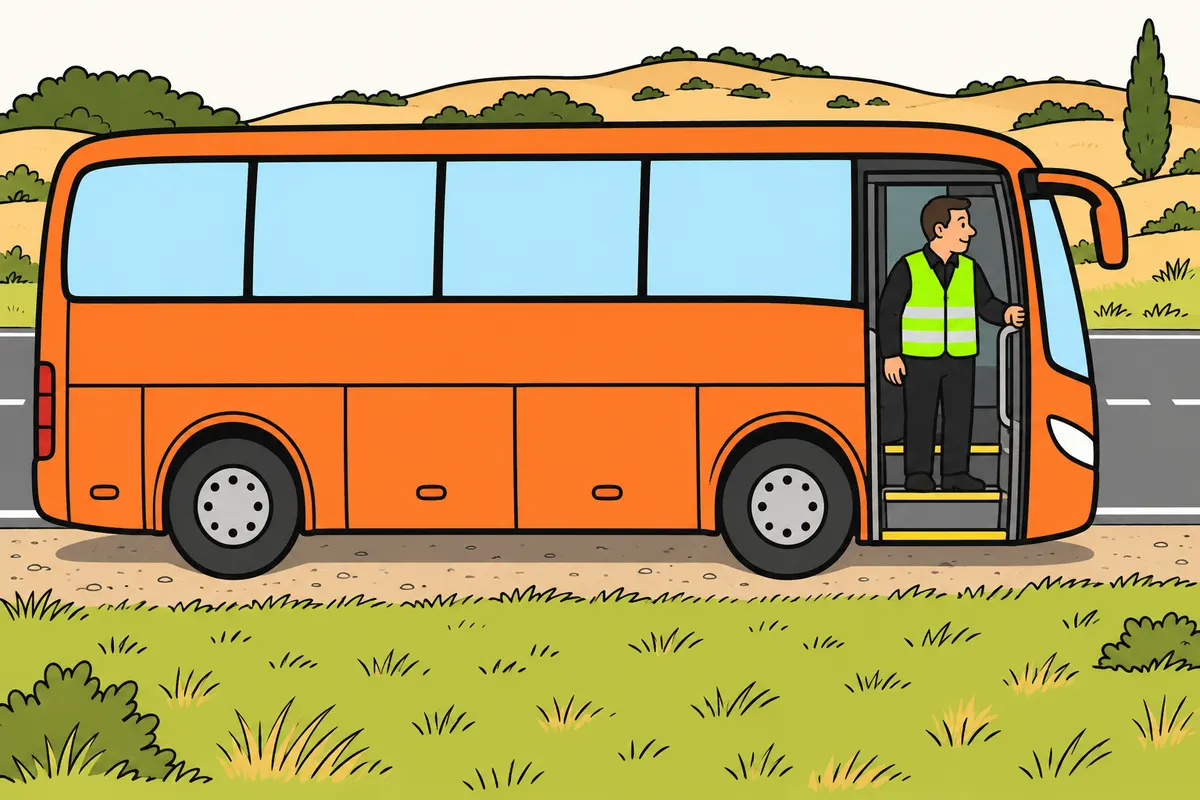
Put your vest on before leaving and check whether you can reach a safe place.
| Leaving your bus | What you must do |
|---|---|
| You can safely reach a place beyond the carriageway and shoulders | Leave on the side away from traffic. Do not walk or stay in lanes or on shoulders. |
| You cannot leave safely | Stay inside with your seat belt fastened. |
Remember
- Wear an approved reflective vest on an interurban road's carriageway or hard shoulder.
- You must wear it both day and night.
- Keep it within reach inside your bus.
- Your vest does not make staying on the hard shoulder safe.
Exam trap: Wrong: you make everyone leave when you activate the beacon. Right: first check that they can leave safely and reach a safe place beyond the carriageway and shoulders.
Read the full explanation
- You must wear an approved high-visibility reflective vest when you leave the bus and enter the carriageway or arcén (hard shoulder) of an interurban road. This duty applies by day and night and does not depend on the bus exceeding a particular MMA (maximum authorised mass). [RGC, art. 118](https://www.boe.es/buscar/act.php?id=BOE-A-2003-23514#a118).
- You must keep it accessible from inside the vehicle and put it on before getting out so that it protects you from the outset. [RGV, annex XII](https://www.boe.es/buscar/act.php?id=BOE-A-1999-1826#anxii) [DGT, emergency](https://www.dgt.es/muevete-con-seguridad/que-hacer-ante-un-accidente-de-trafico/)
- If there is a safe place beyond the road platform, occupants must leave on the side away from traffic without walking or remaining in traffic lanes or on hard shoulders. [RGC, art. 130](https://www.boe.es/buscar/act.php?id=BOE-A-2003-23514#a130).
- If conditions do not allow you to leave the vehicle safely, you must remain inside with your seat belt fastened. [RGC, art. 130](https://www.boe.es/buscar/act.php?id=BOE-A-2003-23514#a130)
9Keep passengers safe while waiting
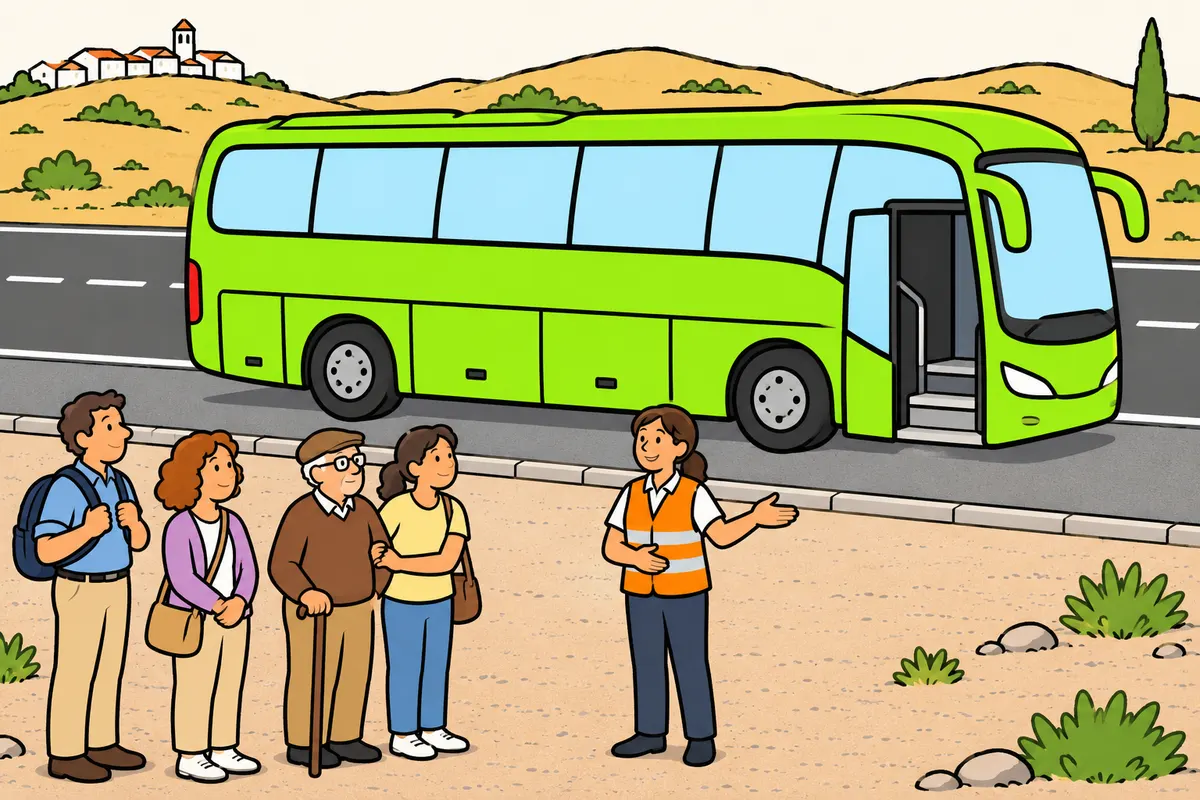
Guide your passengers to wait safely and keep access clear for emergency teams.
Remember
- Check where passengers will step before you open an exit.
- Tell emergency services if anyone needs help understanding instructions or moving.
- Check who needs help and tell emergency services.
- Prevent uninjured passengers from gathering around casualties.
- Keep access clear for firefighters and medical staff.
- Do not transfer passengers between buses in an open traffic lane.
Exam trap: Wrong: you assume an exit is safe because it faces away from traffic. Right: also check where passengers step and whether they can safely reach a place beyond the carriageway and shoulders.
Read the full explanation
- You must assess the risk from traffic before opening an exit. On a coach stopped on the right, having the door on the side away from traffic is not enough: you must check where people get off and whether they can move beyond the road platform without exposing themselves to danger. [RGC, art. 130](https://www.boe.es/buscar/act.php?id=BOE-A-2003-23514#a130).
- You must tell emergency services if any passengers need help understanding instructions or moving; directing the evacuation and helping passengers get out are covered in “Passenger safety and emergencies”. [DGT, Manual IX, unit 1](https://sede.dgt.gob.es/export/sites/dgt/.galleries/permisos-de-conducir/certificacion-aptitud-profesores-formacion-vial/2026/MANUAL-IX-Primeros-auxilios.pdf)
- You must keep access clear for firefighters and medical staff and prevent uninjured people from gathering around the injured. You can ask someone to help keep the group in the safe place without assigning tasks that expose them to traffic. [RGC, art. 129](https://www.boe.es/buscar/act.php?id=BOE-A-2003-23514#a129).
- You must not transfer passengers between buses in an open traffic lane. Evacuation procedures and interior equipment are covered in the “Passenger safety and emergencies” module. [RGC, art. 130](https://www.boe.es/buscar/act.php?id=BOE-A-2003-23514#a130).
10Call 112 with useful information
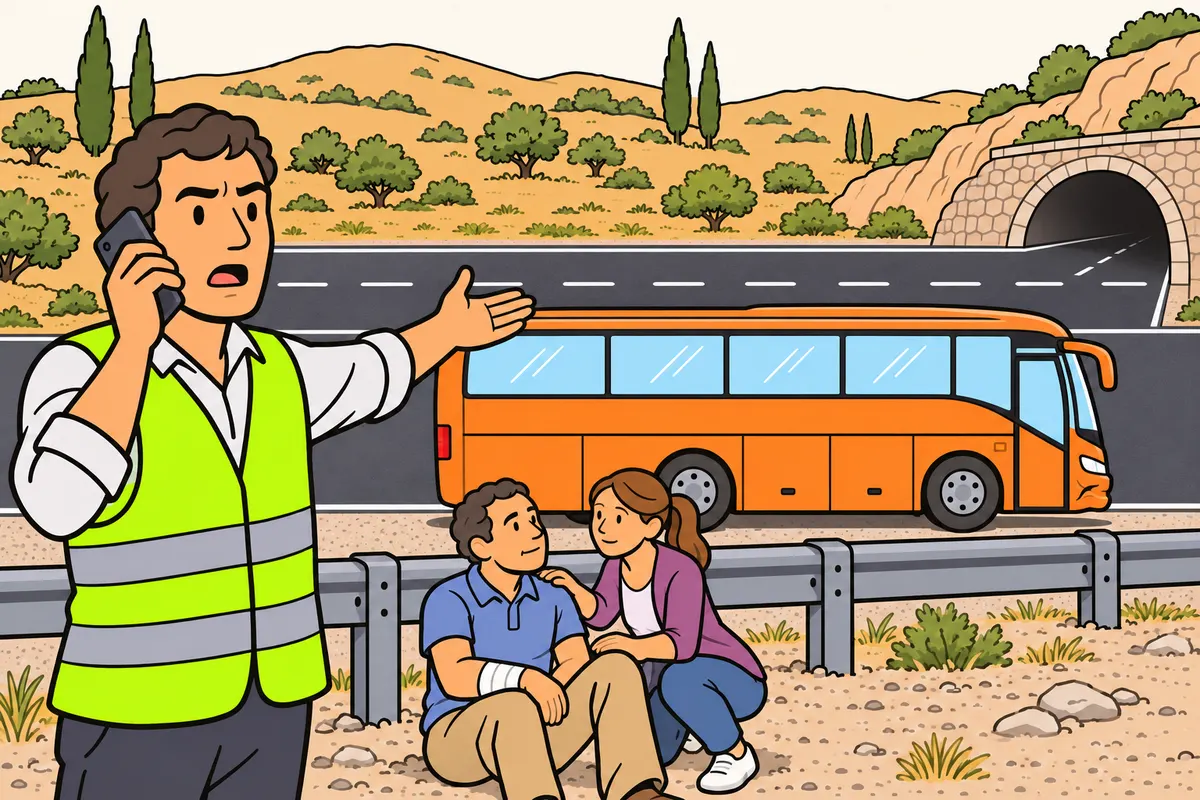
When you call for help, explain where you are before describing what happened.
Remember
- Call if there are casualties or an emergency.
- Give the road, direction, landmarks and kilometre marker if you know it.
- In a tunnel, give its name or details without putting yourself in danger.
- Mention the bus, casualties, trapped people, smoke or fire.
- Give your name and telephone number; follow instructions.
- Do not hang up until the operator tells you to.
Exam trap: Wrong: you delay calling to count everyone exactly. Right: call promptly and explain which details are estimates.
Read the full explanation
- You must call 112 for an accident involving casualties or an emergency and first explain where it is happening. Give the road, kilometre marker if known, direction of travel and visible landmarks; in a tunnel, add its name or identifying details you can see without exposing yourself to danger. [DGT, emergency notification](https://www.dgt.es/muevete-con-seguridad/que-hacer-ante-un-accidente-de-trafico/).
- You must explain that a bus or coach is involved, how many people may be affected and whether you can see anyone injured or trapped, smoke or fire. Distinguish what you have confirmed from estimates: do not delay the call to count every passenger precisely. [DGT, Manual IX, unit 1](https://sede.dgt.gob.es/export/sites/dgt/.galleries/permisos-de-conducir/certificacion-aptitud-profesores-formacion-vial/2026/MANUAL-IX-Primeros-auxilios.pdf).
- You must give your name and a contact telephone number, answer questions and follow the operator's instructions. Describe the signs you observe without attempting a diagnosis. [SUMMA 112, action in emergencies](https://www.comunidad.madrid/hospital/summa112/ciudadanos/debe-hacer-emergencia).
- You can ask someone else to call while you deal with a life-threatening condition, checking that the call is made. If a coordinated call is already under way, give new information to the person speaking rather than making multiple calls with no additional information. [DGT, Manual IX, units 1 and 3](https://sede.dgt.gob.es/export/sites/dgt/.galleries/permisos-de-conducir/certificacion-aptitud-profesores-formacion-vial/2026/MANUAL-IX-Primeros-auxilios.pdf)
- You can call 112 free of charge. You must not hang up until the operator tells you to. Keep communications available to report changes. [DGT, action after an accident](https://www.dgt.es/export/sites/web-DGT/.galleries/downloads/conoce_la_dgt/que-hacemos/educacion-vial/jovenes/ESO_educacion_vial/ALUMNOS-U8-SABER-ACTUAR-EN-CASO-DE-ACCIDENTE.pdf).
11Assess casualties
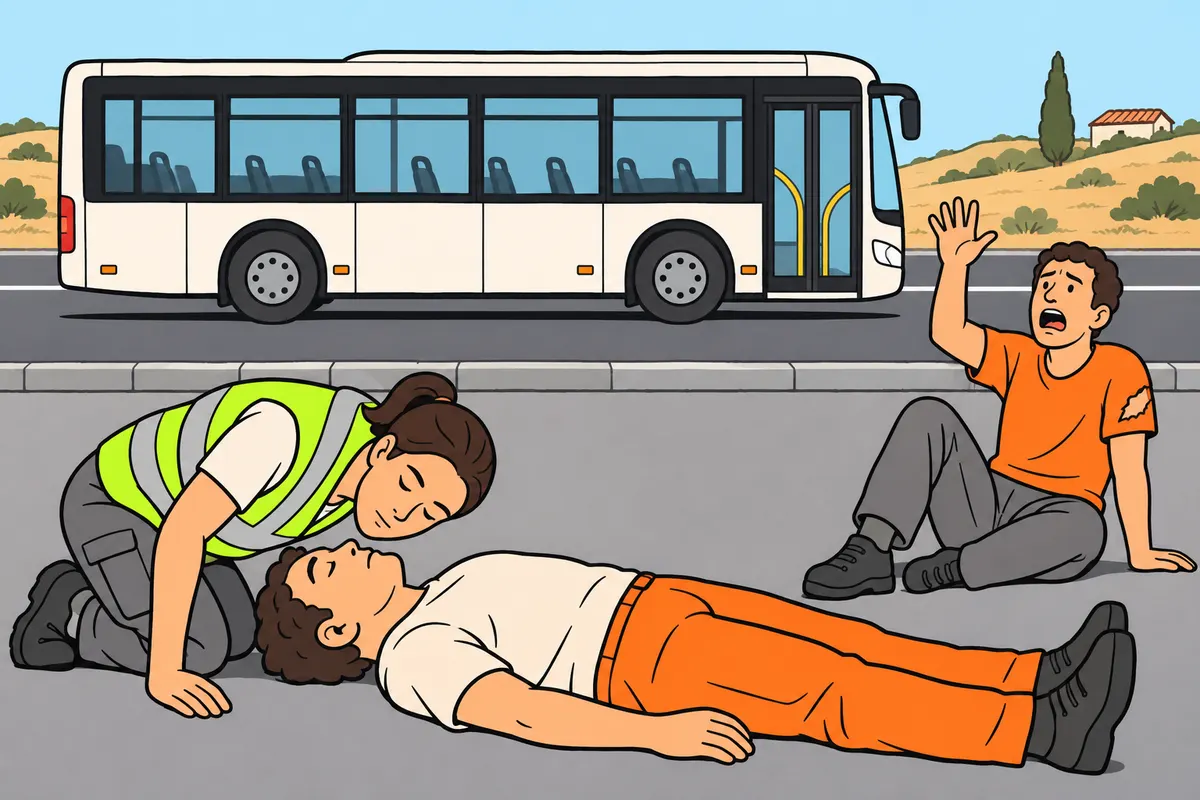
Check whether each casualty responds, breathes normally or is bleeding heavily.
Remember
- Speak to the casualty without shaking them or moving their neck.
- If you know they are unconscious, check their breathing.
- Do not mistake isolated gasps for normal breathing.
- If they are unresponsive and not breathing normally, call 112 and start resuscitation.
- Do not delay resuscitation looking for a pulse without training.
- Also control heavy bleeding and ask others to help.
Exam trap: Wrong: you treat whoever shouts loudest first. Right: assess threats to life, including in people who are silent.
Read the full explanation
- You must assess responsiveness and normal breathing and identify life-threatening bleeding. A silent, unresponsive person may need attention before someone who is shouting or has a more visible injury. [DGT, Manual IX, unit 3](https://sede.dgt.gob.es/export/sites/dgt/.galleries/permisos-de-conducir/certificacion-aptitud-profesores-formacion-vial/2026/MANUAL-IX-Primeros-auxilios.pdf).
- You must speak to the injured person to check whether they respond, avoiding shaking them or moving their neck. If you already know they are unconscious, move on to checking breathing. [SUMMA 112, initial assessment](https://www.comunidad.madrid/hospital/summa112/ciudadanos/debe-hacer-emergencia).
- You must check for normal breathing for no more than 10 seconds. Isolated gasps, gasping or agonal breathing do not count as normal breathing. If the person is unresponsive and not breathing normally, tell 112 and start resuscitation following their instructions. [DGT, Manual IX, unit 3](https://sede.dgt.gob.es/export/sites/dgt/.galleries/permisos-de-conducir/certificacion-aptitud-profesores-formacion-vial/2026/MANUAL-IX-Primeros-auxilios.pdf).
- You must not delay CPR by trying to find a pulse if you are not trained to assess it. Massive external bleeding also needs immediate control; ask for help and follow 112's instructions to deal with life-threatening conditions without imposing a rigid sequence that leaves one untreated. [DGT, Manual IX, units 3 and 4](https://sede.dgt.gob.es/export/sites/dgt/.galleries/permisos-de-conducir/certificacion-aptitud-profesores-formacion-vial/2026/MANUAL-IX-Primeros-auxilios.pdf).
12Unconsciousness and the airway
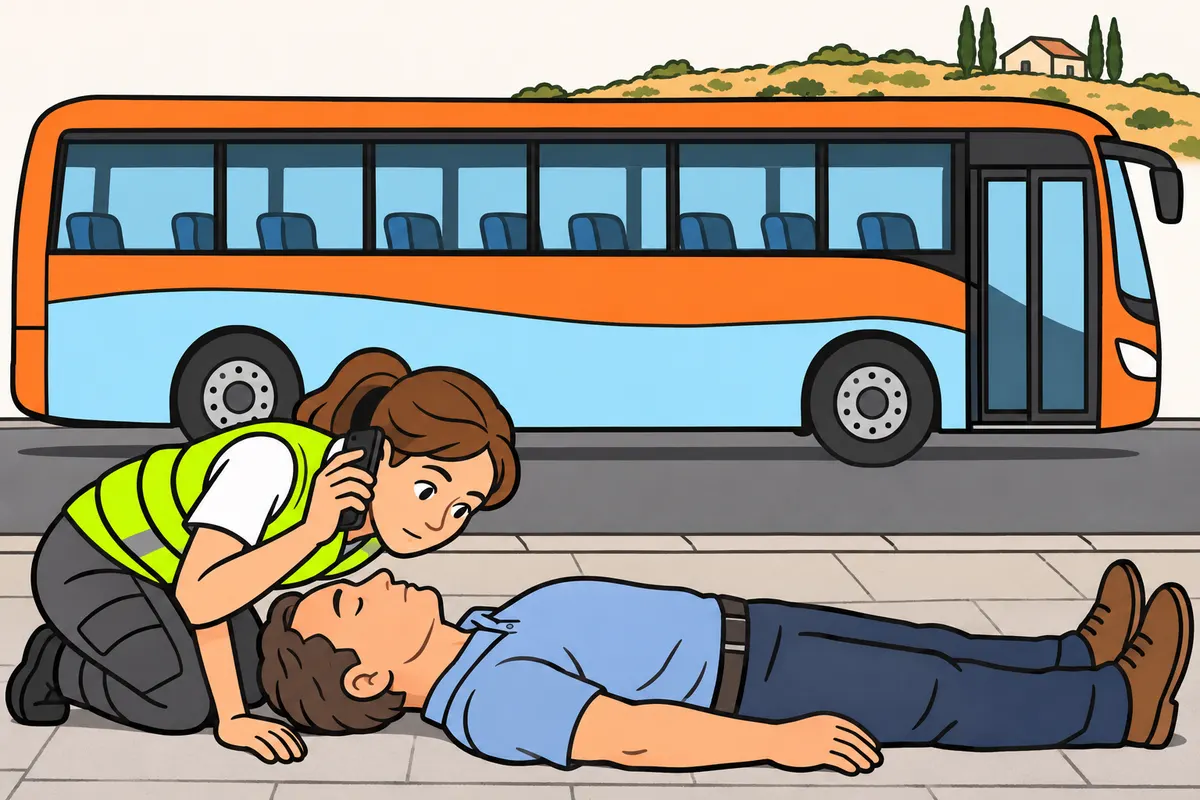
If a casualty is unconscious, monitor their breathing and keep their airway clear.
Remember
- Follow 112's instructions to help breathing while moving the neck as little as possible.
- Do not sit them up.
- Do not put fingers into their mouth without seeing what you are removing.
- If they breathe normally and remain safe, do not automatically turn them sideways.
- If they vomit or you cannot keep their airway clear, prevent suffocation.
- Monitor their breathing while you wait.
Exam trap: Wrong: you always turn an unconscious accident casualty onto their side. Right: consider possible injuries. If they vomit or their airway is threatened, follow 112's instructions and limit movement.
Read the full explanation
- If someone is unconscious, you must pay particular attention to whether they can breathe. Keeping the airway open takes priority, while minimising neck movement when you suspect trauma. You must follow 112's instructions on the technique appropriate to the situation. [DGT, Manual IX, units 3 and 4](https://sede.dgt.gob.es/export/sites/dgt/.galleries/permisos-de-conducir/certificacion-aptitud-profesores-formacion-vial/2026/MANUAL-IX-Primeros-auxilios.pdf).
- You must not sit an unconscious injured person up. You must not blindly put your fingers into their mouth either; you may push an object further in or injure them. Report any breathing difficulty and act within your training. [DGT, Manual IX, units 3 and 4](https://sede.dgt.gob.es/export/sites/dgt/.galleries/permisos-de-conducir/certificacion-aptitud-profesores-formacion-vial/2026/MANUAL-IX-Primeros-auxilios.pdf).
- If they breathe normally and remain safe, you must not automatically turn them onto their side without considering trauma. If they vomit or you cannot keep the airway clear, preventing suffocation takes priority; follow 112's instructions and limit movement, trying to keep the head, neck and trunk aligned. [DGT, Manual IX, units 4 and 6](https://sede.dgt.gob.es/export/sites/dgt/.galleries/permisos-de-conducir/certificacion-aptitud-profesores-formacion-vial/2026/MANUAL-IX-Primeros-auxilios.pdf).
- You must reassess breathing while you wait. A casualty breathing initially does not guarantee that they continue to do so; if normal breathing stops, you must report this and begin the appropriate action. [DGT, Manual IX, units 3 and 4](https://sede.dgt.gob.es/export/sites/dgt/.galleries/permisos-de-conducir/certificacion-aptitud-profesores-formacion-vial/2026/MANUAL-IX-Primeros-auxilios.pdf).
13Basic adult CPR
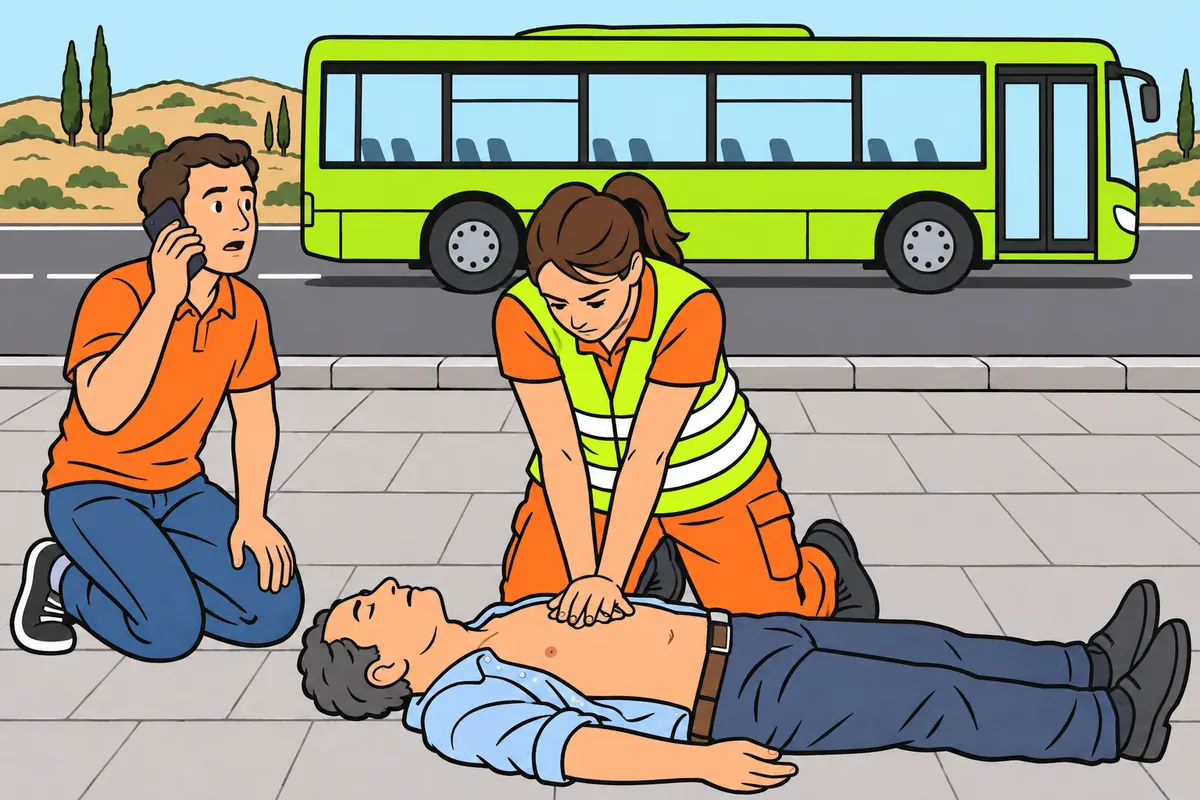
If an adult is unresponsive and not breathing normally, call and start resuscitation.
Remember
- Call 112; compress the centre of the chest on a firm surface.
- If trained and able, alternate compressions with rescue breaths.
- If you cannot give breaths, compress continuously following 112's instructions.
- Let the chest rise again and avoid interruptions.
- Ask someone to bring an available defibrillator.
- Continue until medical handover, recovery, physical inability to continue or danger prevents safe assistance.
Exam trap: Wrong: you stop because a long time has passed. Right: continue until medical staff take over, signs of life and normal breathing return, you are physically unable to continue, or danger prevents you from continuing safely.
Read the full explanation
- If the adult is unresponsive and not breathing normally, you must contact 112 and start compressions in the centre of the chest on a firm, safe surface. Ask someone to bring an available defibrillator without unnecessarily interrupting resuscitation. [SUMMA 112, cardiac arrest](https://www.comunidad.madrid/hospital/summa112/ciudadanos/debe-hacer-emergencia).
- If you are trained and able to give rescue breaths, you must alternate 30 compressions with 2 rescue breaths. If you cannot give rescue breaths, perform continuous compressions following 112's instructions. [DGT, Manual IX, unit 4](https://sede.dgt.gob.es/export/sites/dgt/.galleries/permisos-de-conducir/certificacion-aptitud-profesores-formacion-vial/2026/MANUAL-IX-Primeros-auxilios.pdf).
- You must compress at a rate of 100 to 120 per minute and allow the chest to recoil between compressions. The recommended depth for an adult is 5 to 6 cm; minimise interruptions. [DGT, Manual IX, unit 4](https://sede.dgt.gob.es/export/sites/dgt/.galleries/permisos-de-conducir/certificacion-aptitud-profesores-formacion-vial/2026/MANUAL-IX-Primeros-auxilios.pdf). [Servicio Murciano de Salud, compression quality](https://www.murciasalud.es/preevid/22544).
- You must continue until medical staff take over, the casualty shows signs of life and normal breathing, you are physically unable to continue or a danger arises that prevents you from continuing safely. Do not stop CPR solely because a seemingly long time has passed. [DGT, Manual IX, unit 4](https://sede.dgt.gob.es/export/sites/dgt/.galleries/permisos-de-conducir/certificacion-aptitud-profesores-formacion-vial/2026/MANUAL-IX-Primeros-auxilios.pdf).
14Use an available defibrillator
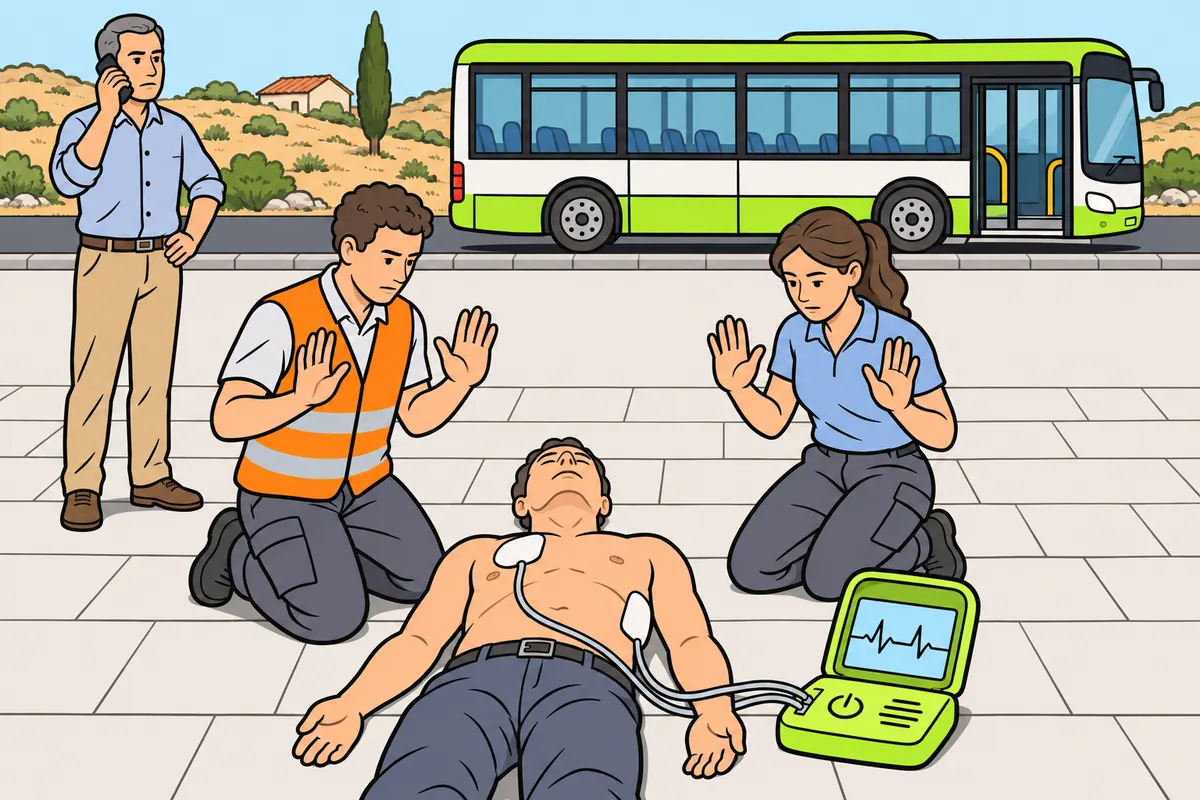
Switch on the defibrillator and follow its instructions while coordinating help.
Remember
- Place the pads on the bare chest as shown on the device.
- If possible, coordinate help to continue compressions while preparing the device.
- Do not touch the casualty during analysis or a shock.
- Check that nobody else is touching them.
- Restart compressions when the device tells you to.
Exam trap: Wrong: you stop helping when the device advises no shock. Right: follow its instructions and continue assistance.
Read the full explanation
- If you have a DEA (automated external defibrillator, AED) available, you must switch it on and follow its spoken or visual instructions. You do not need to decide for yourself whether a shock is appropriate: the device analyses the rhythm and tells you what to do. Ask for help and maintain coordination with 112. [DGT, Manual IX, unit 4](https://sede.dgt.gob.es/export/sites/dgt/.galleries/permisos-de-conducir/certificacion-aptitud-profesores-formacion-vial/2026/MANUAL-IX-Primeros-auxilios.pdf).
- You must place the pads as shown on the device on the bare chest, following the instructions. If another person can continue compressions during preparation, coordinate tasks to reduce the time without compressions. [DGT, Manual IX, unit 4](https://sede.dgt.gob.es/export/sites/dgt/.galleries/permisos-de-conducir/certificacion-aptitud-profesores-formacion-vial/2026/MANUAL-IX-Primeros-auxilios.pdf).
- You must not touch the casualty while the device analyses the rhythm or when it instructs you to deliver a shock. Check that nobody is touching them and resume compressions when the device tells you to. No shock being advised does not mean you should stop helping. [DGT, Manual IX, unit 4](https://sede.dgt.gob.es/export/sites/dgt/.galleries/permisos-de-conducir/certificacion-aptitud-profesores-formacion-vial/2026/MANUAL-IX-Primeros-auxilios.pdf).
15External bleeding: direct pressure
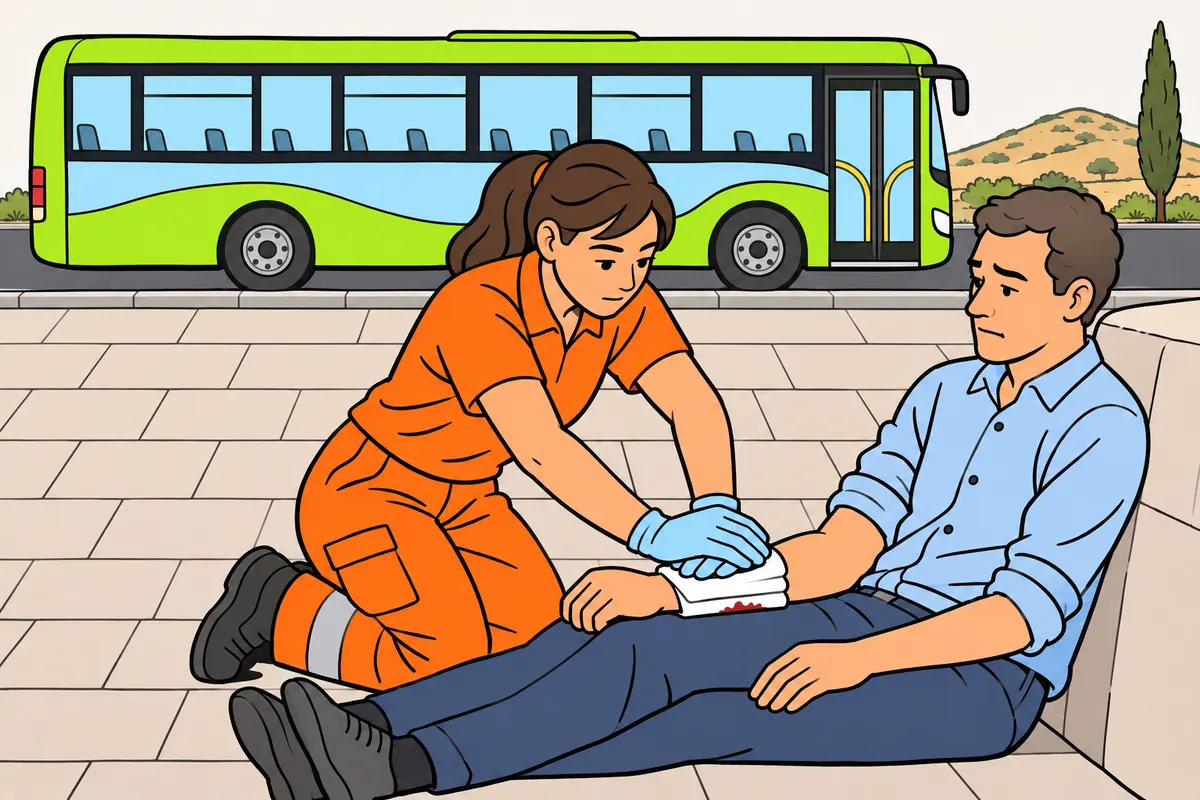
For heavy bleeding, press firmly and continuously on the wound.
| Wound | How you act |
|---|---|
| No embedded object | Apply firm, continuous pressure. |
| Embedded object | Protect it and control bleeding around it following 112's instructions. Do not press the object. |
Remember
- Protect yourself from blood; wear gloves if you have them.
- Press with gauze or clean clothing.
- If it becomes soaked, add material without removing the first dressing.
- Tell 112 if bleeding continues.
- Do not replace pressure with raising a leg or finding another artery.
- Do not remove an embedded object or push it further in.
Exam trap: Wrong: you remove soaked dressings to look at the wound. Right: add more material on top and maintain pressure.
Read the full explanation
- With heavy blood loss, you must protect yourself from contact and apply firm, sustained pressure to the wound using gauze or a clean item of clothing. If you have gloves, use them. Do not delay controlling serious bleeding while looking for a perfect first-aid kit. [DGT, Manual IX, unit 4](https://sede.dgt.gob.es/export/sites/dgt/.galleries/permisos-de-conducir/certificacion-aptitud-profesores-formacion-vial/2026/MANUAL-IX-Primeros-auxilios.pdf).
- If the material becomes soaked, you must add more on top while maintaining pressure, without repeatedly removing the first dressing to look. Removing it can make bleeding harder to control. Request help from 112 and report whether bleeding continues despite pressure. [DGT, Manual IX, unit 4](https://sede.dgt.gob.es/export/sites/dgt/.galleries/permisos-de-conducir/certificacion-aptitud-profesores-formacion-vial/2026/MANUAL-IX-Primeros-auxilios.pdf).
- You must not replace initial direct pressure with raising a leg or looking for an artery away from the wound. A bus casualty may have both a fracture and bleeding: moving the limb to raise it can cause further harm. [DGT, Manual IX, units 4 and 5](https://sede.dgt.gob.es/export/sites/dgt/.galleries/permisos-de-conducir/certificacion-aptitud-profesores-formacion-vial/2026/MANUAL-IX-Primeros-auxilios.pdf).
- If an object is embedded, you must not remove it or press it further in. Protect the area and control bleeding around it as instructed by 112. Removing the object and treating the injury are tasks for medical teams. [DGT, Manual IX, units 4 and 5](https://sede.dgt.gob.es/export/sites/dgt/.galleries/permisos-de-conducir/certificacion-aptitud-profesores-formacion-vial/2026/MANUAL-IX-Primeros-auxilios.pdf).
16Tourniquets: when to use them and what to avoid
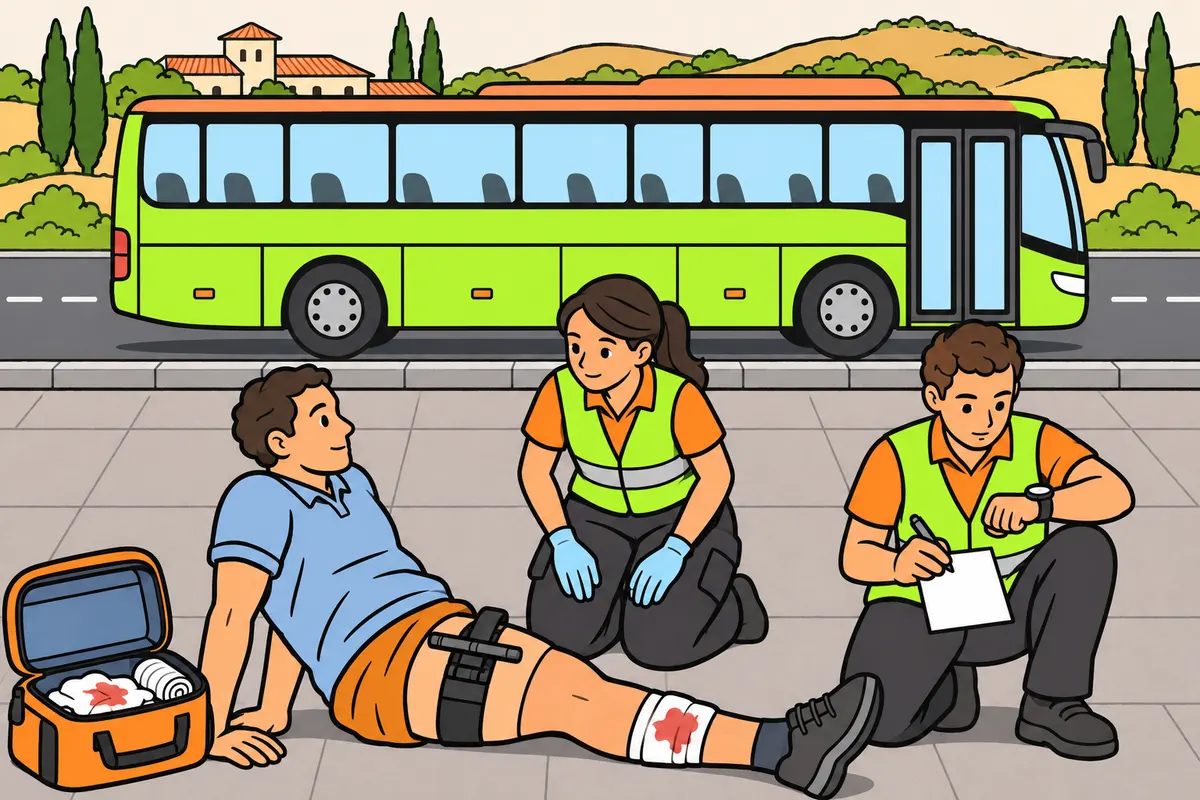
Use a tourniquet only when needed, following your training and emergency instructions.
Remember
- You may need one for life-threatening limb bleeding that direct pressure cannot control.
- If needed and you know how, place it above the wound towards the body.
- Avoid joints and follow the device's instructions.
- Do not improvise with wire or thin cord.
- Record the application time and tell medical staff.
- Do not loosen or remove it; leave removal to medical staff.
Exam trap: Wrong: you loosen the tourniquet while waiting. Right: do not loosen or remove it even if bleeding stops; report when you applied it.
Read the full explanation
- You may need a suitable tourniquet for life-threatening bleeding from an arm or leg that you cannot control with direct pressure. You must act according to your training and emergency services' instructions. [DGT, Manual IX, unit 4](https://sede.dgt.gob.es/export/sites/dgt/.galleries/permisos-de-conducir/certificacion-aptitud-profesores-formacion-vial/2026/MANUAL-IX-Primeros-auxilios.pdf).
- If you know how to use it and it is indicated, you must apply it above the wound towards the trunk, avoiding a joint and following the device's instructions. You must not improvise one with wire or thin cord or practise the technique on an uninjured passenger. [DGT, Manual IX, unit 4](https://sede.dgt.gob.es/export/sites/dgt/.galleries/permisos-de-conducir/certificacion-aptitud-profesores-formacion-vial/2026/MANUAL-IX-Primeros-auxilios.pdf).
- You must record and report the application time. You must not loosen it periodically or remove it because bleeding has stopped: removal is for medical staff. Continue monitoring the casualty and pass on the information when help takes over. [DGT, Manual IX, unit 4](https://sede.dgt.gob.es/export/sites/dgt/.galleries/permisos-de-conducir/certificacion-aptitud-profesores-formacion-vial/2026/MANUAL-IX-Primeros-auxilios.pdf).
17Internal bleeding and signs of shock
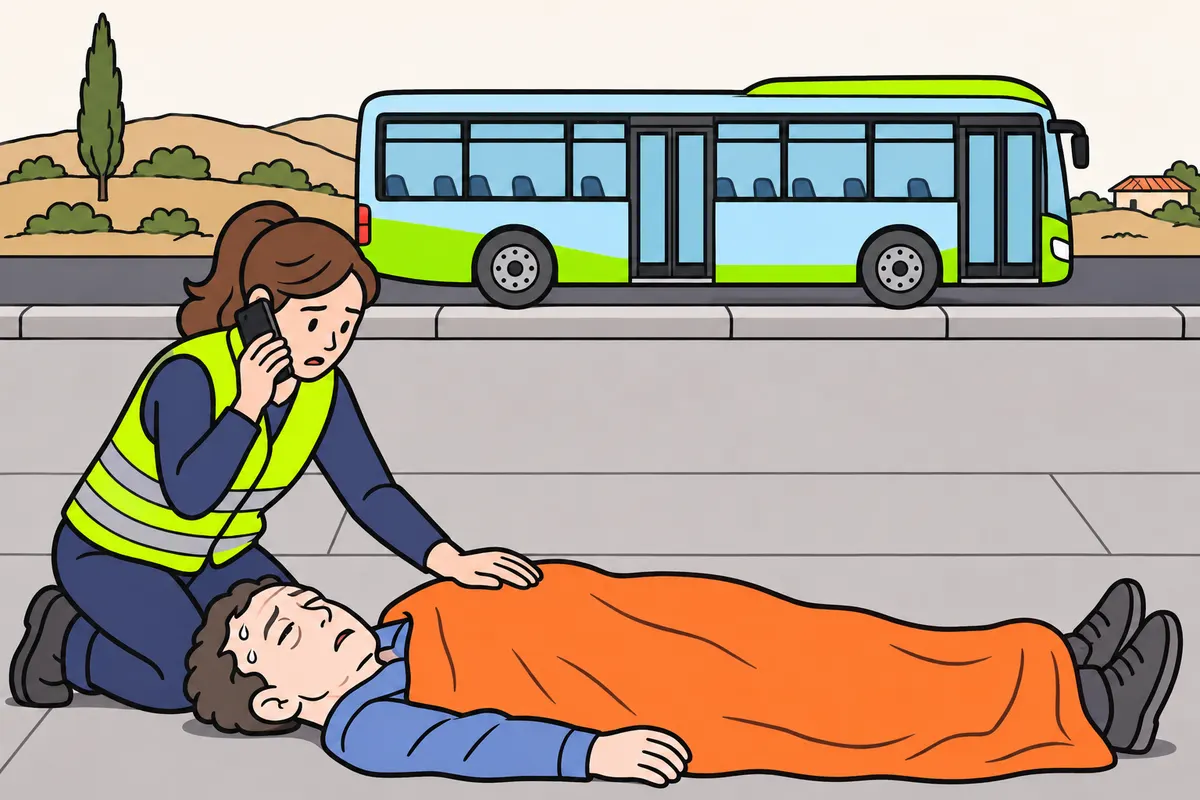
A casualty can be seriously injured even when you cannot see blood.
| Type of bleeding | What you need to know |
|---|---|
| Internal | Blood stays inside the body and may be invisible. |
| Through a natural opening | Blood leaves through a body opening. |
Remember
- Report pale, cold, sweaty skin, weakness or fast breathing.
- Also report changes in awareness.
- Do not wait to find a wound before calling for help.
- After head injuries, do not block blood or fluid draining from ears or nose.
- Do not automatically raise every casualty's legs.
- Avoid movement, protect them from cold and follow emergency instructions on positioning.
Exam trap: Wrong: you rule out serious injury because you see no blood. Right: internal bleeding is possible; report signs of worsening condition.
Read the full explanation
- With internal bleeding, blood remains inside the body and may not be visible; with bleeding through a natural opening, it leaves through a body opening. No visible blood does not rule out a serious injury after an impact. [DGT, Manual IX, units 4 and 5](https://sede.dgt.gob.es/export/sites/dgt/.galleries/permisos-de-conducir/certificacion-aptitud-profesores-formacion-vial/2026/MANUAL-IX-Primeros-auxilios.pdf).
- You must report pallor, cold and sweaty skin, weakness, altered consciousness or rapid breathing. These may warn of serious deterioration, including shock, but do not by themselves identify where the person is bleeding. Do not wait to find a wound before requesting help. [DGT, Manual IX, unit 4](https://sede.dgt.gob.es/export/sites/dgt/.galleries/permisos-de-conducir/certificacion-aptitud-profesores-formacion-vial/2026/MANUAL-IX-Primeros-auxilios.pdf).
- You must not plug blood or fluid draining from an ear or the nose after a head injury. Protect the area without blocking drainage and follow 112's instructions, especially if there is breathing difficulty. You must not routinely apply ordinary nosebleed treatment to this casualty. [DGT, Manual IX, unit 5](https://sede.dgt.gob.es/export/sites/dgt/.galleries/permisos-de-conducir/certificacion-aptitud-profesores-formacion-vial/2026/MANUAL-IX-Primeros-auxilios.pdf).
- You must not automatically raise every casualty's legs as an anti-shock position. They may have spinal, pelvic or limb injuries, or breathing difficulties. Avoid unnecessary movement, protect them from cold and follow emergency services' instructions on positioning. [DGT, Manual IX, units 4 and 5](https://sede.dgt.gob.es/export/sites/dgt/.galleries/permisos-de-conducir/certificacion-aptitud-profesores-formacion-vial/2026/MANUAL-IX-Primeros-auxilios.pdf).
18Fractures and suspected spinal injuries
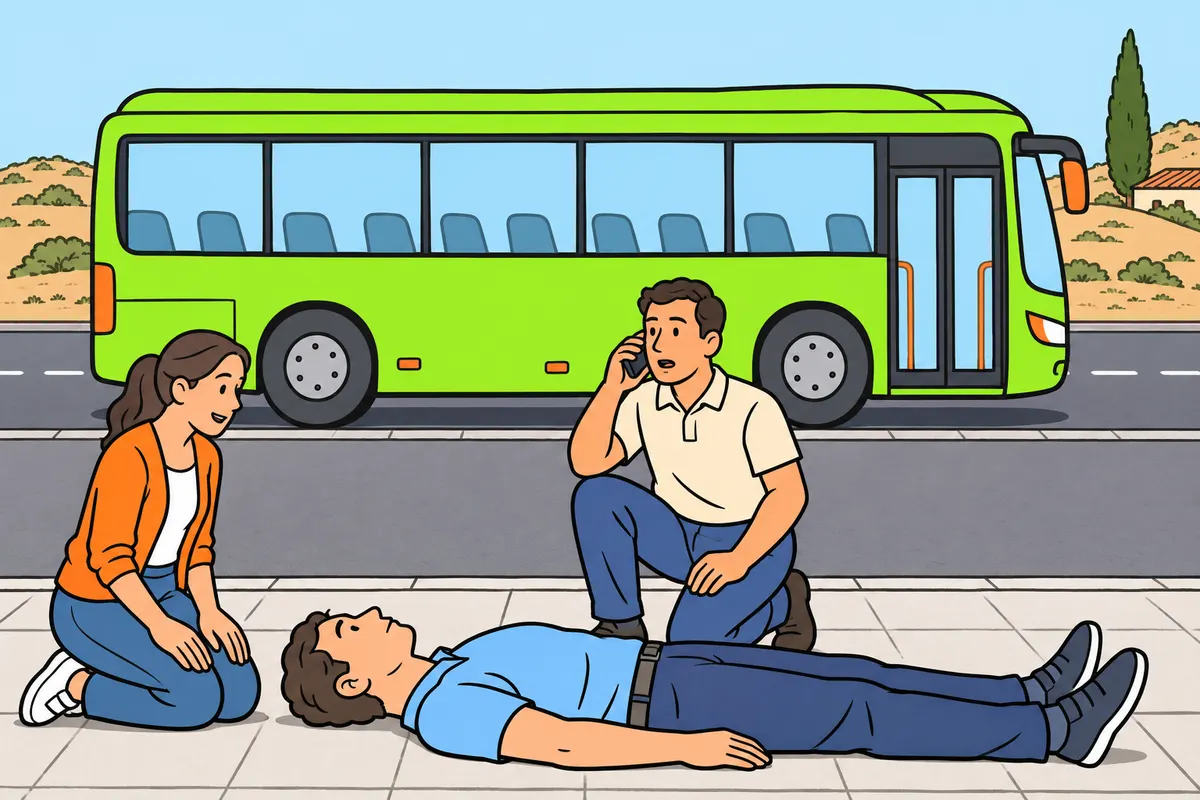
If you suspect broken bones or a spinal injury, avoid moving the casualty.
| Fracture | How you distinguish it |
|---|---|
| Open | The broken bone connects to the outside through a wound. |
| Closed | The skin remains intact; the injury can still be serious. |
Remember
- Do not make them walk or move the injury to check for broken bones.
- If you can support the limb without moving it, leave it as found.
- Do not massage or straighten bones.
- Cover an open fracture with clean material without pushing bone back in.
- If you suspect spinal injury, avoid moving the head, neck and body.
- For threatened breathing or immediate danger, minimise movement and follow 112's instructions.
Exam trap: Wrong: you only recognise an open fracture if bone sticks out. Right: a fracture is open if it connects to the outside through a wound.
Read the full explanation
- You must suspect a fracture if there is pain, deformity, swelling or loss of function after an impact. You must not make the passenger walk, move their leg or press the area to check for a break. A fracture can be accompanied by blood vessel damage and significant bleeding. [DGT, Manual IX, unit 5](https://sede.dgt.gob.es/export/sites/dgt/.galleries/permisos-de-conducir/certificacion-aptitud-profesores-formacion-vial/2026/MANUAL-IX-Primeros-auxilios.pdf).
- If you can help without moving or straightening the limb, you must support it gently in the position found. You must not massage it, realign bones or apply bandages that exert inappropriate pressure. Report the suspected fracture to 112 and wait for professional immobilisation. [DGT, Manual IX, unit 5](https://sede.dgt.gob.es/export/sites/dgt/.galleries/permisos-de-conducir/certificacion-aptitud-profesores-formacion-vial/2026/MANUAL-IX-Primeros-auxilios.pdf).
- An open fracture connects to the outside through a wound, even if the bone does not protrude. Cover it with clean material without pushing visible bone back in. A closed fracture leaves the skin intact but can also cause serious injuries. [DGT, Manual IX, unit 5](https://sede.dgt.gob.es/export/sites/dgt/.galleries/permisos-de-conducir/certificacion-aptitud-profesores-formacion-vial/2026/MANUAL-IX-Primeros-auxilios.pdf).
- If you suspect a spinal injury, you must avoid movement of the head, neck and trunk. You must not ask the person to turn their head to check for pain or lift them into a sitting position. The need to protect the airway or move them away from immediate danger requires the minimum necessary movement and following 112's instructions. [DGT, Manual IX, units 5 and 6](https://sede.dgt.gob.es/export/sites/dgt/.galleries/permisos-de-conducir/certificacion-aptitud-profesores-formacion-vial/2026/MANUAL-IX-Primeros-auxilios.pdf).
19Injured motorcyclist: leave the helmet on
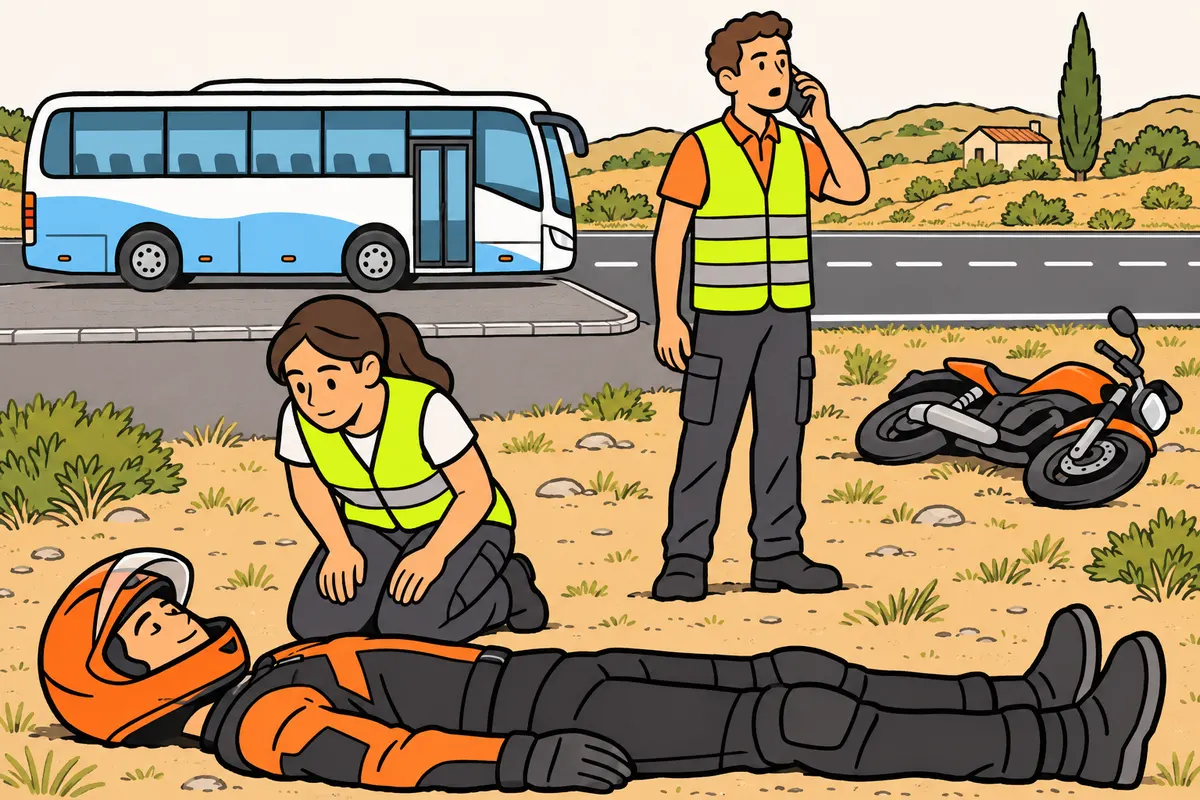
Leave the motorcyclist's helmet on unless it prevents necessary life-saving treatment.
Remember
- Check whether they respond and breathe; request assistance.
- Do not remove their helmet to cool them or see their face.
- Do not sit them up or make them stand or walk.
- They may have serious injuries even if they can speak.
- If the helmet prevents airway care or necessary resuscitation, follow 112's instructions.
- Removing it may require the correct technique and help.
Exam trap: Wrong: you always remove the helmet. Right: leave it on. If it prevents care for a threatened airway or necessary resuscitation, follow 112's instructions for correct removal.
Read the full explanation
- If you help a motorcyclist, you must not remove their helmet for convenience, to cool them down or to see their face better. Handling it may move an injured neck. [DGT, Manual IX, unit 5](https://sede.dgt.gob.es/export/sites/dgt/.galleries/permisos-de-conducir/certificacion-aptitud-profesores-formacion-vial/2026/MANUAL-IX-Primeros-auxilios.pdf).
- You must not sit them up, force them to stand or let them walk to prove they are well. A casualty who can speak may have serious injuries. Reassure them and explain that they must wait for medical assessment without unnecessary movement. [DGT, Manual IX, units 3 and 5](https://sede.dgt.gob.es/export/sites/dgt/.galleries/permisos-de-conducir/certificacion-aptitud-profesores-formacion-vial/2026/MANUAL-IX-Primeros-auxilios.pdf).
- If the helmet prevents you from managing a compromised airway or performing necessary resuscitation, you must follow 112's instructions: removal using the correct technique and assistance may be necessary. [DGT, Manual IX, unit 5](https://sede.dgt.gob.es/export/sites/dgt/.galleries/permisos-de-conducir/certificacion-aptitud-profesores-formacion-vial/2026/MANUAL-IX-Primeros-auxilios.pdf).
20Burns and smoke exposure
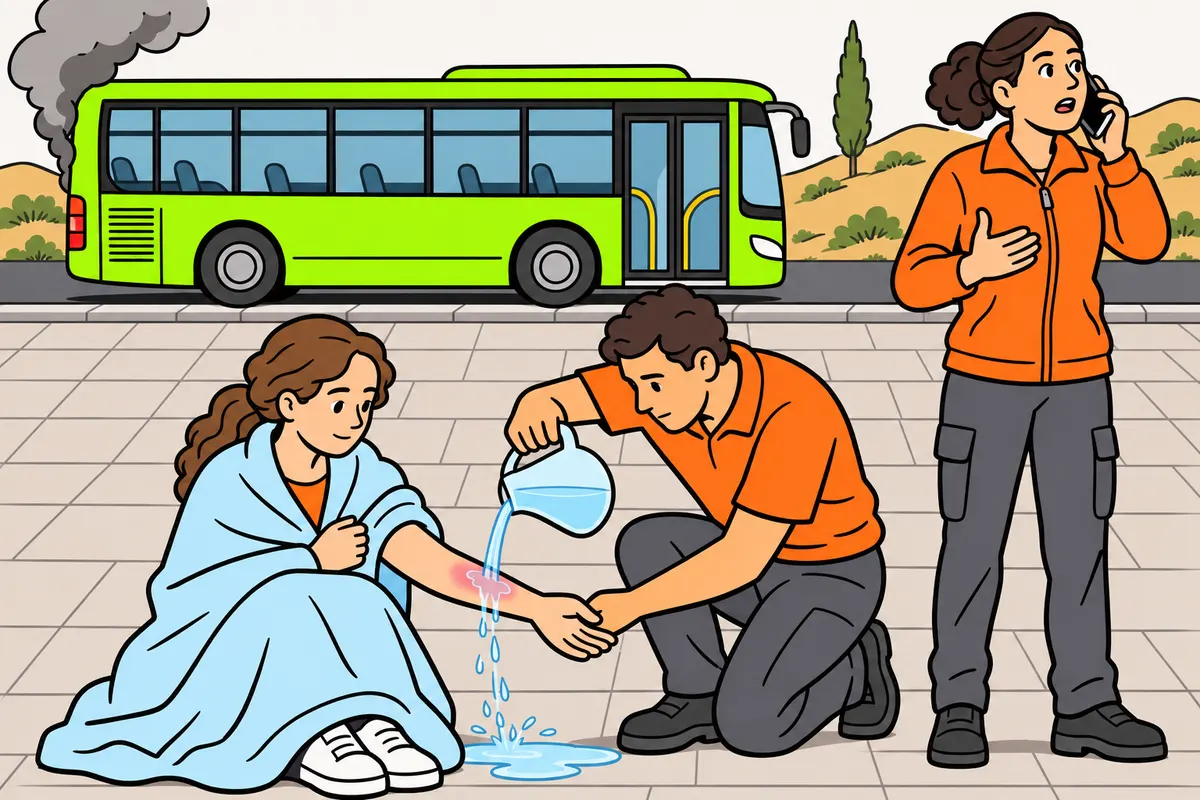
Cool burns with cool water and request help for smoke exposure or breathing difficulties.
Remember
- Move the casualty away from heat only if you can do so safely.
- Cool heat burns and protect the rest of the body from cold.
- Do not use ice, fats or home remedies.
- Do not pull off stuck clothing, burst blisters or apply ointment yourself.
- After cooling, cover loosely with clean material that does not stick.
- Request urgent help for facial burns, smoke inhalation or breathing difficulties.
Exam trap: Wrong: you dismiss smoke exposure because the visible burn is small. Right: request urgent help if they have inhaled smoke or have difficulty breathing.
Read the full explanation
- You must separate the casualty from the heat source only if you can do so without exposing yourself to danger. For a thermal burn, cool the area with cool water and protect the rest of the body from becoming cold. You must not apply ice, fats or home remedies to the injury. [DGT, Manual IX, unit 5](https://sede.dgt.gob.es/export/sites/dgt/.galleries/permisos-de-conducir/certificacion-aptitud-profesores-formacion-vial/2026/MANUAL-IX-Primeros-auxilios.pdf).
- You must not pull off clothing stuck to the burn, burst blisters or apply ointments on your own initiative. After cooling, protect the area with clean, non-stick material without tightening it. Tell 112 the apparent extent and affected areas. [DGT, Manual IX, unit 5](https://sede.dgt.gob.es/export/sites/dgt/.galleries/permisos-de-conducir/certificacion-aptitud-profesores-formacion-vial/2026/MANUAL-IX-Primeros-auxilios.pdf).
- If there are facial burns, smoke inhalation or breathing difficulties, you must request urgent help even if the visible injury looks small. [DGT, Manual IX, units 1 and 5](https://sede.dgt.gob.es/export/sites/dgt/.galleries/permisos-de-conducir/certificacion-aptitud-profesores-formacion-vial/2026/MANUAL-IX-Primeros-auxilios.pdf).
- While waiting, follow emergency services' instructions and monitor the burn casualty's consciousness and breathing. [DGT, Manual IX, units 4 and 5](https://sede.dgt.gob.es/export/sites/dgt/.galleries/permisos-de-conducir/certificacion-aptitud-profesores-formacion-vial/2026/MANUAL-IX-Primeros-auxilios.pdf).
21Choking in an adult passenger
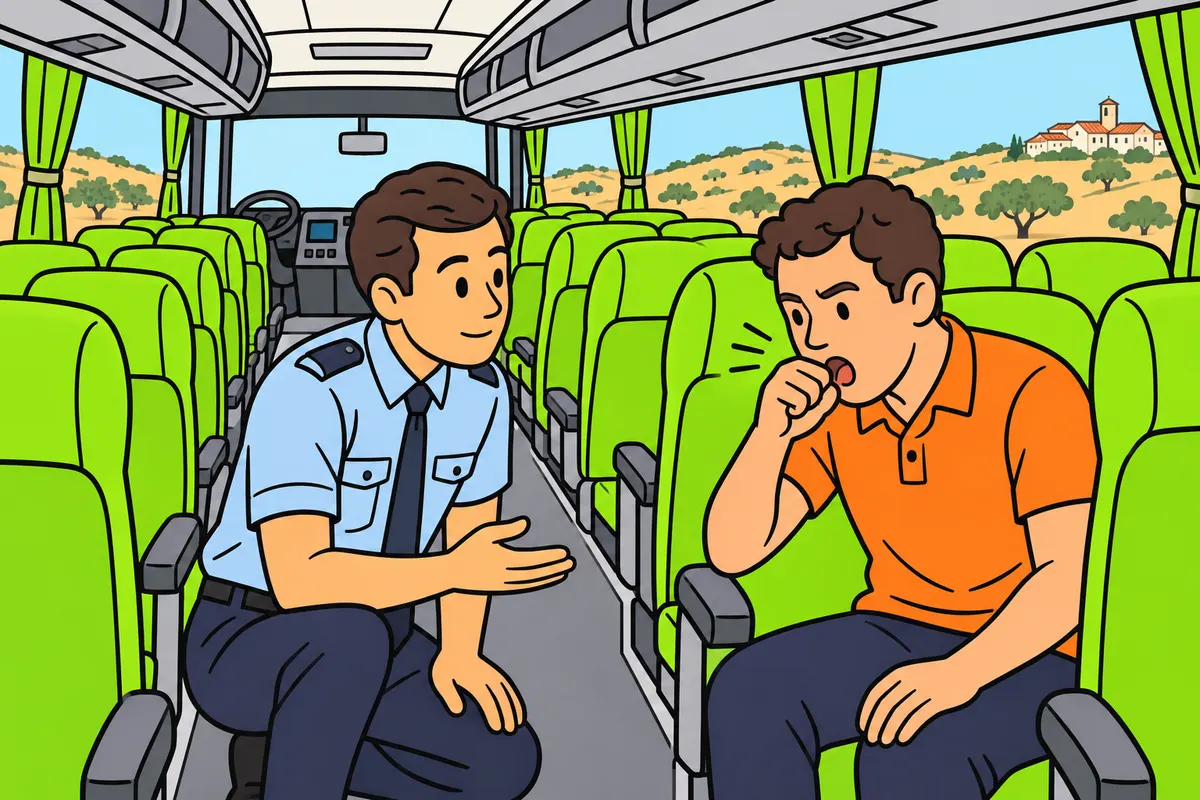
Choose your response according to whether the choking passenger can cough and breathe.
| Adult passenger's condition | What you must do |
|---|---|
| Conscious, coughing effectively, able to speak and breathe | Encourage coughing. Do not give back blows or artificial respiration. |
| Conscious, unable to speak, breathe or cough effectively | Give up to 5 blows between the shoulder blades. If unsuccessful, give up to 5 abdominal thrusts. Repeat as instructed. |
| Pregnant with a severely blocked airway | Do not give abdominal thrusts; follow 112's adapted instructions. |
Remember
- If they cough effectively, encourage coughing and monitor them.
- If they cannot speak, breathe or cough effectively, request urgent help from 112.
- Do not give back blows while their cough is effective.
- If they become unresponsive, follow emergency instructions and start resuscitation when appropriate.
- Do not give abdominal thrusts to a pregnant woman; follow adapted instructions.
Exam trap: Wrong: you give back blows while the passenger coughs effectively. Right: encourage coughing and monitor them; act according to the signs and 112's instructions.
Read the full explanation
- If the passenger is conscious and can speak, breathe and cough effectively, you must encourage them to keep coughing and monitor them. You must not give back blows while the cough is effective or attempt artificial respiration. Intervention depends on whether they can move air, not simply on whether they clutch their throat. [Generalitat Valenciana, choking](https://ses.san.gva.es/es/consells/-/asset_publisher/adb40qhtj8ev/content/atragantamiento-2).
- If they cannot speak, breathe or cough effectively, you must request urgent help from 112 and follow their instructions for a severe obstruction. For a conscious adult, the procedure includes up to 5 blows between the shoulder blades and, if unsuccessful, up to 5 abdominal thrusts, repeating as instructed. [Generalitat Valenciana, choking](https://ses.san.gva.es/es/consells/-/asset_publisher/adb40qhtj8ev/content/atragantamiento-2).
- If they become unresponsive, you must act immediately according to emergency services' instructions and begin resuscitation when appropriate. Do not use abdominal thrusts on a pregnant woman; follow the adaptations given by 112. [Generalitat Valenciana, choking](https://ses.san.gva.es/es/consells/-/asset_publisher/adb40qhtj8ev/content/atragantamiento-2).
22Help without making injuries worse
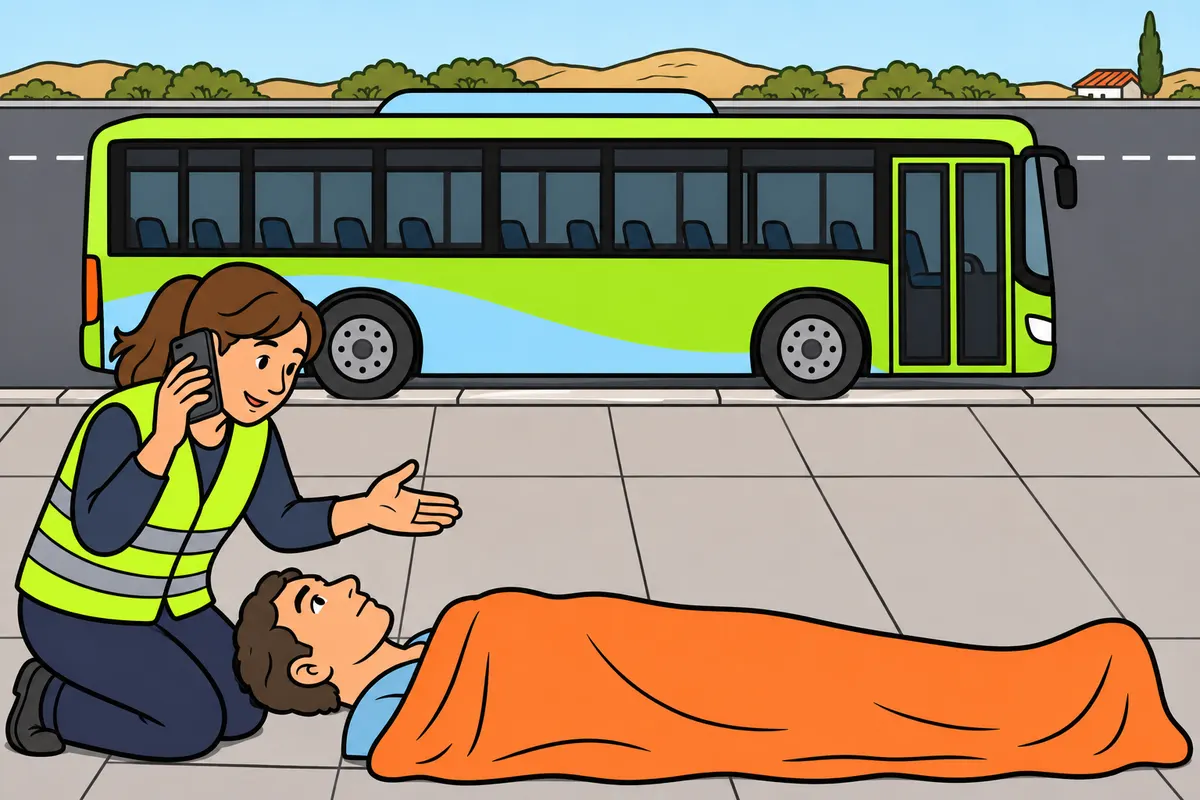
Stay with the casualty and avoid actions that could worsen their injuries.
Remember
- Reassure them and monitor responsiveness, breathing and bleeding.
- You can cover them without covering their face or making them too hot.
- Do not give food, drinks, alcohol or medicines yourself.
- Do not automatically remove casualties or rush them to hospital yourself.
- If immediate danger or life-saving treatment requires movement, move them as little as possible.
- Keep head, neck and body aligned without forcing; do not pull trapped limbs.
Exam trap: Wrong: you take the casualty to hospital because the ambulance is delayed. Right: normally leave transport to specialist teams. Moving someone away from immediate danger is a separate decision.
Read the full explanation
- Reassure the casualty and explain that help has been called. You can cover them with a blanket without covering their face and avoiding overheating. Tell 112 if their condition deteriorates. [DGT, Manual IX, units 3 and 4](https://sede.dgt.gob.es/export/sites/dgt/.galleries/permisos-de-conducir/certificacion-aptitud-profesores-formacion-vial/2026/MANUAL-IX-Primeros-auxilios.pdf).
- You must not offer food, drinks, alcohol or medicines on your own initiative. An accident casualty's needs must be assessed alongside possible injuries you do not yet know about. [DGT, Manual IX, unit 4](https://sede.dgt.gob.es/export/sites/dgt/.galleries/permisos-de-conducir/certificacion-aptitud-profesores-formacion-vial/2026/MANUAL-IX-Primeros-auxilios.pdf)
- You must not routinely extract injured people or take them to hospital in the bus for speed. Medical transport is generally the responsibility of specialist teams; moving someone away from immediate danger and transporting them to hospital are different decisions. [DGT, Manual IX, unit 6](https://sede.dgt.gob.es/export/sites/dgt/.galleries/permisos-de-conducir/certificacion-aptitud-profesores-formacion-vial/2026/MANUAL-IX-Primeros-auxilios.pdf).
- If movement is essential because of fire, a risk of being run over or a life-saving intervention, you must limit the distance moved and try to keep the head, neck and trunk aligned without forcing them. You must not pull a trapped person's arms or legs or improvise a rescue that requires professional equipment. [DGT, Manual IX, unit 6](https://sede.dgt.gob.es/export/sites/dgt/.galleries/permisos-de-conducir/certificacion-aptitud-profesores-formacion-vial/2026/MANUAL-IX-Primeros-auxilios.pdf).
23Bus fire
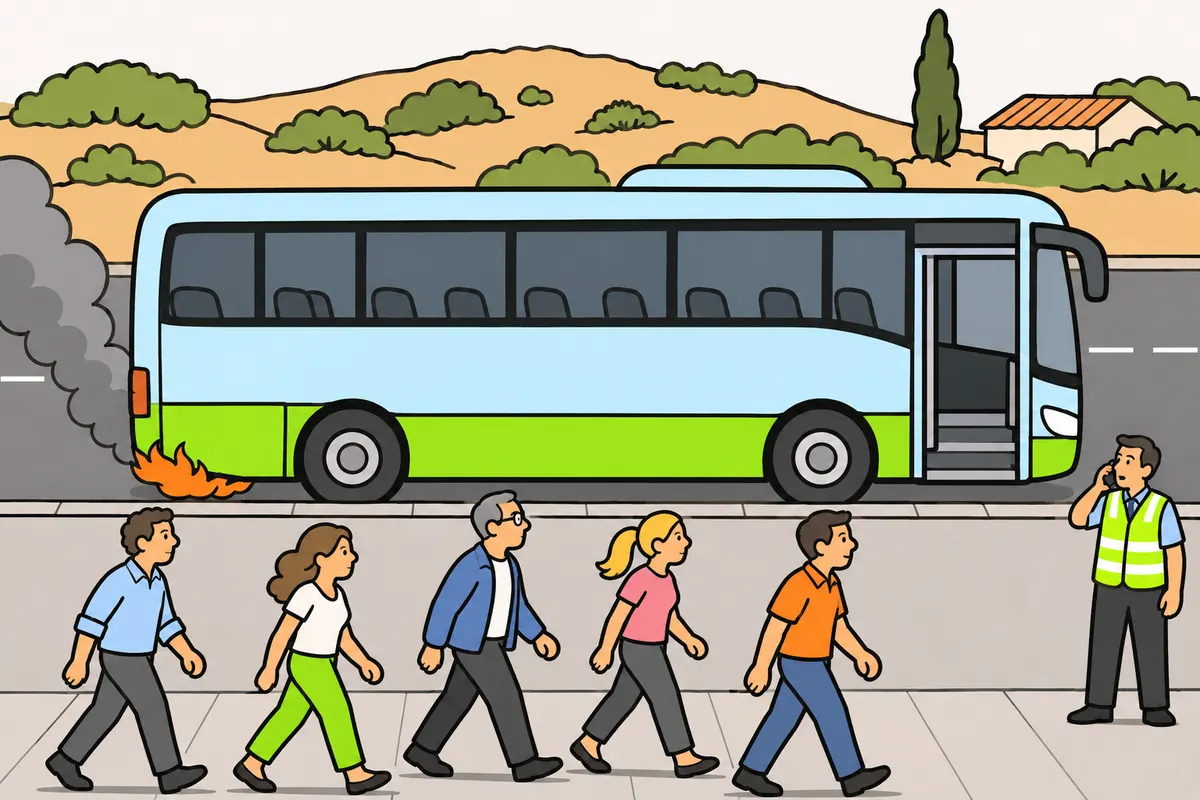
In a fire, protect people first and call emergency services.
Remember
- Stop in a controlled way, secure the bus and switch off the engine.
- Call 112 and say whether anyone remains inside or trapped.
- Tell firefighters where anyone remains inside or trapped.
- Carry suitable, approved firefighting equipment in working order.
- Only tackle a small, starting fire if trained and you have a safe escape.
- Do not suddenly open burning compartments or apply water indiscriminately.
Exam trap: Wrong: you try to save the bus before protecting passengers. Right: protect people and call first. Only tackle a fire just starting if you know how and keep a safe escape route.
Read the full explanation
- If you detect fire or smoke that threatens safety, you must stop the vehicle in a controlled way, secure it against movement, switch off the engine and call 112. People take priority. [DGT, Manual IX, unit 1](https://sede.dgt.gob.es/export/sites/dgt/.galleries/permisos-de-conducir/certificacion-aptitud-profesores-formacion-vial/2026/MANUAL-IX-Primeros-auxilios.pdf).
- You must tell firefighters whether anyone remains inside or is trapped and their approximate location; choosing exits and evacuating the interior in a fire are covered in “Passenger safety and emergencies”. [DGT, Manual IX, units 1 and 6](https://sede.dgt.gob.es/export/sites/dgt/.galleries/permisos-de-conducir/certificacion-aptitud-profesores-formacion-vial/2026/MANUAL-IX-Primeros-auxilios.pdf)
- You must carry suitable, approved firefighting equipment in working order on every bus. You must only try to tackle an incipient fire if you know how to use the equipment and maintain a safe escape route, without delaying the emergency call or passenger protection. [RGV, annex XII.2](https://www.boe.es/buscar/act.php?id=BOE-A-1999-1826#anxii)
- The required equipment and minimum fire extinguisher rating according to the number of seats are covered in “Passenger safety and emergencies”, in the section “Compulsory fire extinguisher and minimum fire rating”. [Order of 27 July 1999, section segundo.a](https://www.boe.es/buscar/act.php?id=BOE-A-1999-16887#segundo).
- You must not suddenly open a burning compartment or expose yourself to smoke to save the vehicle. You must not indiscriminately apply water to a fuel or electrical fire either. You must follow the equipment and emergency services' instructions; evacuation is covered in the “Passenger safety and emergencies” module. [DGT, Manual IX, unit 1](https://sede.dgt.gob.es/export/sites/dgt/.galleries/permisos-de-conducir/certificacion-aptitud-profesores-formacion-vial/2026/MANUAL-IX-Primeros-auxilios.pdf).
24Tunnel: breakdown, fire or traffic queue
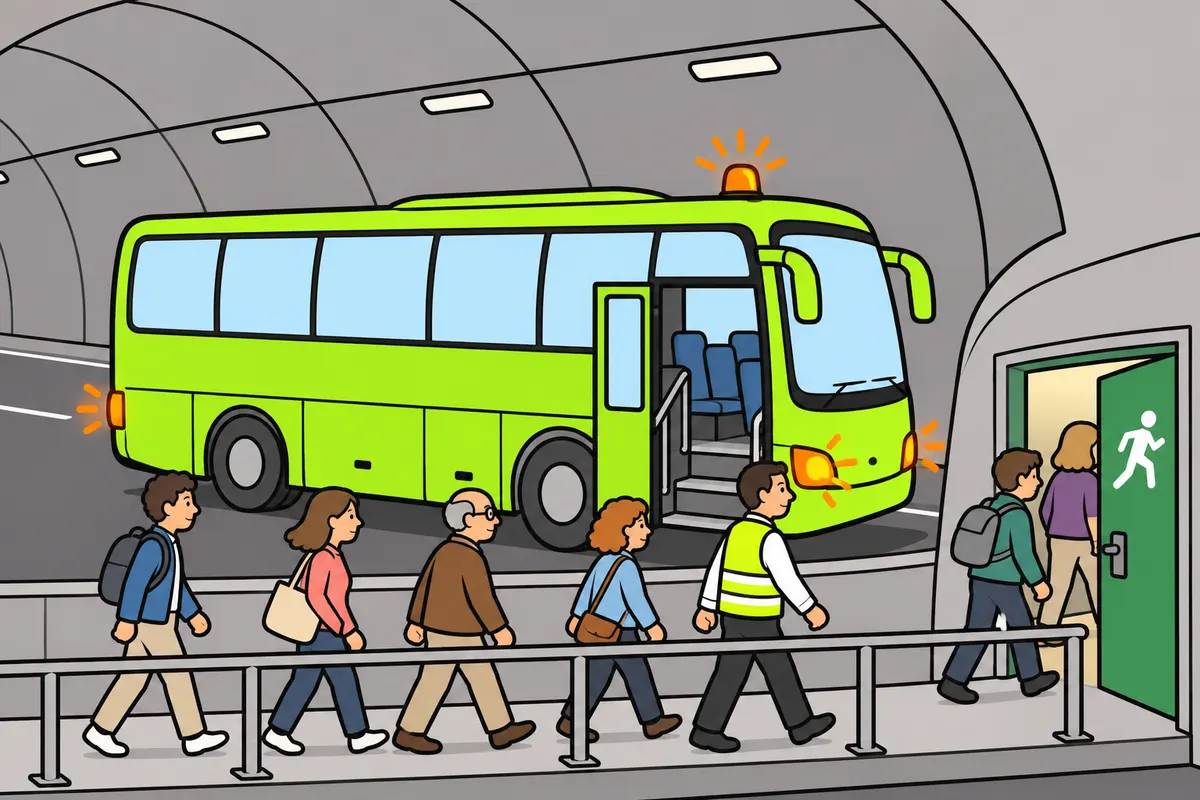
In a tunnel, distinguish an emergency from a traffic queue.
| Bus situation in a tunnel | What you must do |
|---|---|
| Breakdown leaves you unable to move | Keep the position lights and hazard warning lights on. Request help. Lead occupants to the nearest refuge or exit, using areas closed to traffic where available. |
| Fire | Move as far right as possible. Evacuate towards the nearest refuge or exit away from the fire. Use areas closed to traffic where available. |
| Traffic queue | Stay inside, switch off the engine and keep position lights on. Use hazards temporarily to warn approaching drivers. Leave as much space ahead as possible. |
| Compulsory stop longer than two minutes in a tunnel or enclosed place | Keep the engine off until you resume driving and keep the position lights on. |
Remember
- If your broken-down bus can continue safely, carry on to the exit.
- If unable to move, use an emergency area or the right-hand edge.
- Switch off the engine whenever you stop in a tunnel, even at the wheel.
- After more than two minutes, keep the engine off and position lights on.
- For fires, leave the key in the ignition and doors open.
- In queues, switch off immediately and stay inside with your passengers.
Exam trap: Wrong: you evacuate for a simple traffic queue. Right: stay inside. For an immobilising breakdown or fire, follow the refuge or exit procedure.
Read the full explanation
- If a breakdown allows you to continue safely, you must carry on to the exit of the tunnel or underpass; if you cannot, continue to a designated emergency area. If immobilised, position the bus in that area or as close as possible to the right-hand edge, switch off the engine and keep the position lights and hazard warning lights on. [RGC, art. 97](https://www.boe.es/buscar/act.php?id=BOE-A-2003-23514#a97).
- You must activate the advance-warning light device and request assistance without delay using the nearest SOS emergency telephone if available. Follow the instructions received. You must leave with the occupants towards the nearest refuge or exit, using areas closed to traffic where available. [RGC, art. 97](https://www.boe.es/buscar/act.php?id=BOE-A-2003-23514#a97).
- In a fire, you must move as far right as possible to leave room for emergency services, switch off the engine and leave the key in the ignition and the doors open. You must lead passengers to the nearest refuge or exit in the direction away from the fire, avoiding the carriageway where an area closed to traffic exists. [RGC, art. 97](https://www.boe.es/buscar/act.php?id=BOE-A-2003-23514#a97).
- If you are stationary because of a traffic queue, you must remain inside with the passengers. Switch off the engine, keep the position lights on and temporarily use the hazard warning lights to warn those approaching from behind; stop as far as possible from the vehicle ahead. [RGC, art. 97](https://www.boe.es/buscar/act.php?id=BOE-A-2003-23514#a97)
- You must always switch off the engine when you stop inside a tunnel or enclosed place, even if you remain at the wheel. If the compulsory stop lasts more than two minutes, you must keep it switched off until you resume driving and keep the position lights on. [RGC, art. 115.1-2](https://www.boe.es/buscar/act.php?id=BOE-A-2003-23514#a115).
25Give your details and remain when required
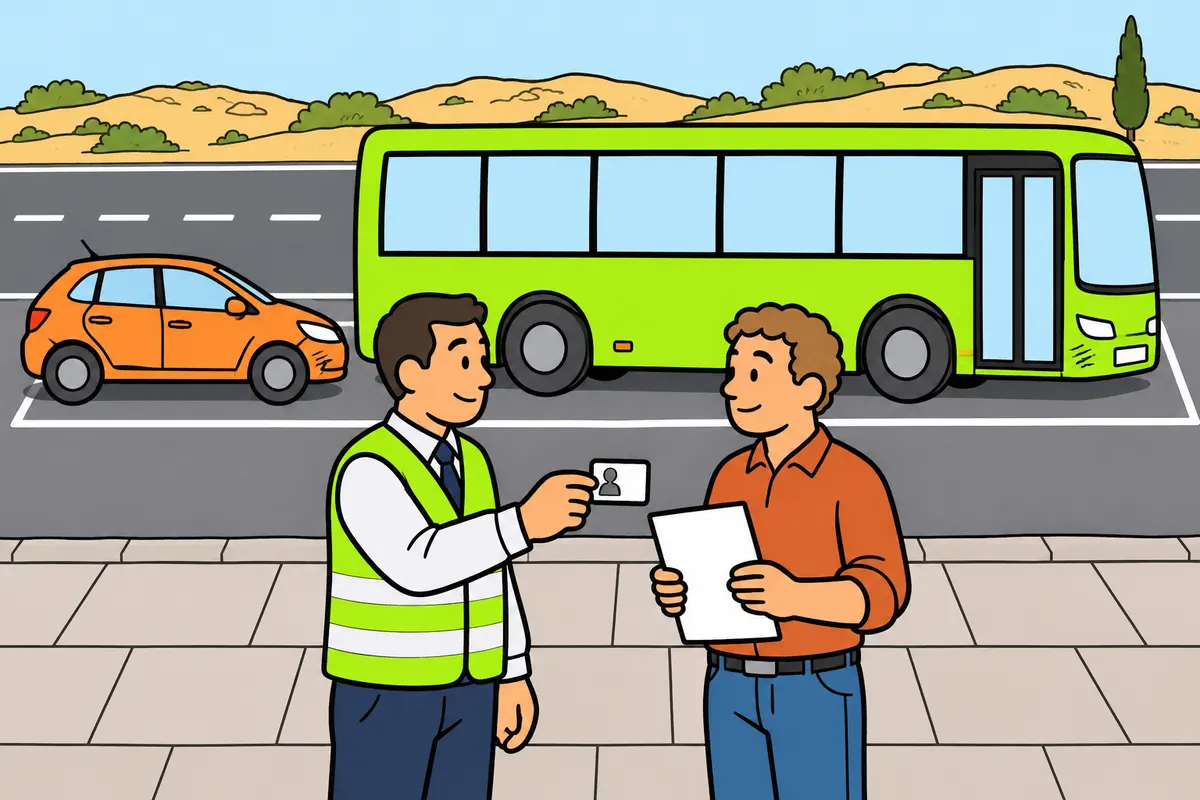
If involved, give your details and stay when the rules require it.
| Situation if you are involved | Your duty |
|---|---|
| Another person involved asks for your details | Give your identity and vehicle details. |
| Only property damage and an affected party is absent | Try to promptly give them your name and address, directly or through officers. |
| Apparent injuries or deaths | Notify authorities and stay or return until they arrive, unless authorised to leave, helping someone or needing medical attention yourself. |
| Clearly minor injuries | The exception also requires safety to be restored and nobody involved to request official intervention. |
Remember
- Give your identity and vehicle details to another person involved who asks.
- For property damage alone, try to promptly give absent parties your name and address.
- If anyone appears injured or dead, notify authorities and stay or return.
- You may leave with permission, to help someone or to receive medical attention.
- For clearly minor injuries, safety must be restored and nobody request official intervention.
- Complete the accident report in a safe place off the road.
Exam trap: Wrong: after causing an accident involving deaths or the injuries specified by criminal law, you leave because others are helping. Right: their help does not justify leaving; meet your duties to remain and assist.
Read the full explanation
- For exchanging identity and vehicle details, follow “Who must help”. If there is only property damage and an affected party is absent, you must try to tell them your name and address as soon as possible, directly or through police officers. [RGC, art. 129](https://www.boe.es/buscar/act.php?id=BOE-A-2003-23514#a129).
- If there appear to be injuries or deaths, you must notify the authorities and remain or return until they arrive, unless authorised to leave, you need to help someone or you need medical attention yourself. The exception for clearly minor injuries also requires safety to be restored and nobody involved to request official intervention. [RGC, art. 129](https://www.boe.es/buscar/act.php?id=BOE-A-2003-23514#a129).
- You must not complete the accident report on the road platform. You must do so in a safe place off the road. Deal with safety and casualties first, then complete the paperwork. [RGC, art. 130](https://www.boe.es/buscar/act.php?id=BOE-A-2003-23514#a130).
- The Código Penal (Criminal Code) penalises failure to assist a helpless person in clear and serious danger when you can help without risk, and failure to request assistance if you cannot intervene. Leaving after causing an accident involving deaths or injuries under articles 147.1, 149 and 150 is a separate criminal offence; you must not leave because you consider that someone else can help. [Código Penal, arts. 195 and 382 bis.1](https://www.boe.es/buscar/act.php?id=BOE-A-1995-25444#a3-2).
PAS after a bus accident
Coordinate passenger protection and initial assistance.
- Stop and secure the bus without creating another danger; check traffic, fire and people affected.
- Switch on hazard warning lights, the V-16 and the required lighting; put on your reflective vest before getting out.
- Assess whether there is a safe exit to a place beyond the road platform; give passengers instructions.
- Call 112 or delegate the call: location, bus, people affected, trapped people and hazards.
- Assess responsiveness, breathing and severe bleeding; help according to your training and 112’s instructions.
- Monitor changes and pass information to the professionals.
Unresponsive adult
Normal breathing determines your immediate response.
- Check safety and responsiveness without shaking the person or moving their neck.
- Contact 112 and check for normal breathing for no more than 10 seconds, following their instructions.
- If the person is not breathing normally or is only gasping, start CPR and ask for an AED.
- Perform 30 compressions and 2 rescue breaths if you are trained and able to give breaths; otherwise, give continuous compressions.
- Maintain 100–120 compressions per minute and follow the AED and 112 instructions.
- If the person breathes normally, monitor the airway and avoid unnecessary movement.
Initial control of severe bleeding
Apply pressure and request help without wasting time on secondary measures.
- Protect yourself from contact with blood and call 112.
- Apply direct pressure with gauze or clean material; do not remove embedded objects.
- Maintain pressure and add material on top if it becomes soaked.
- If life-threatening bleeding from a limb cannot be controlled, use a suitable tourniquet according to your training and 112’s instructions.
- Record the time, do not loosen or remove it, and tell medical staff what you have done.
Immobilised inside a tunnel
Distinguish an emergency from a traffic queue.
- If the breakdown allows you to drive safely, continue to the exit or, if this is not possible, an emergency area.
- If an emergency immobilises you, position the bus in a designated area or by the right-hand edge, switch off the engine and switch on the position lights and hazard warning lights.
- Activate the V-16 and request help using the SOS emergency telephone if available.
- Lead occupants to the nearest refuge or exit using areas closed to traffic where available.
- If there is a fire, leave the key in the ignition and the doors open, and evacuate away from the fire.
- If there is only a traffic queue, remain inside with passengers, switch off the engine and keep the position lights on, using the hazard warning lights temporarily to warn others.
Finished this module?
Mark it as read and you will see your progress on the theory list.