
Theory · C+E Licence - Articulated Truck · Module 7 of 13
Safe, well-distributed loads
You learn to distribute and secure the goods on your combination, control the risks of liquids, suspended loads and live animals, and prepare loading and unloading without compromising stability or dirtying the road.
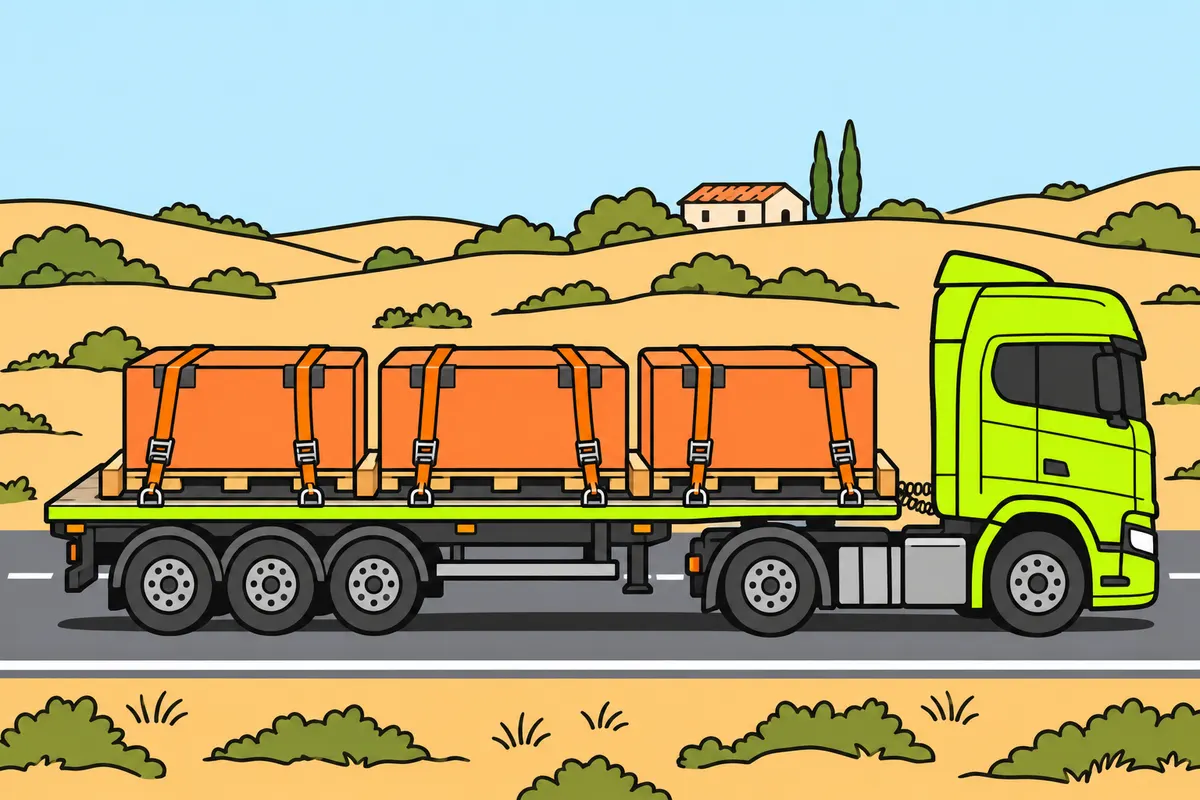
1A safe load throughout the combination
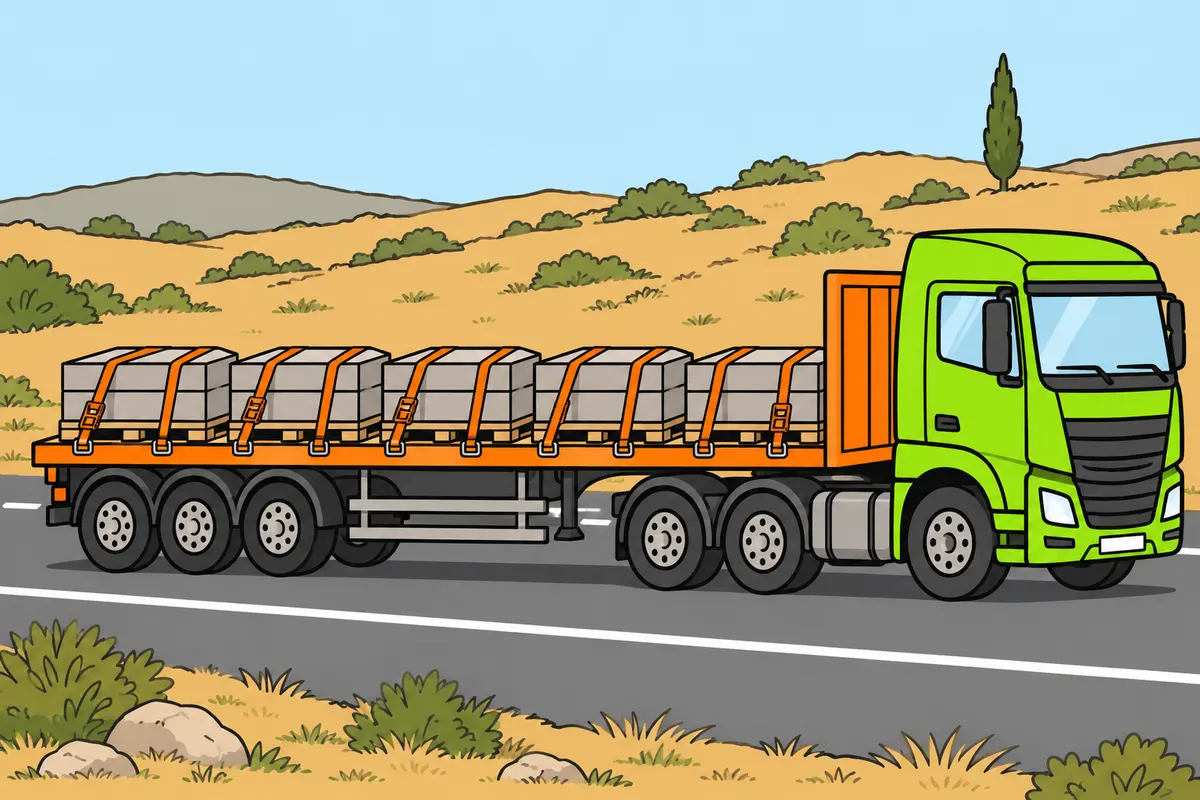
You must secure the load and its accessories throughout the vehicle combination.
Remember
- Secure your goods for moving off, braking and turning.
- Prevent your load from dragging, falling or moving dangerously.
- Avoid dust, noise and nuisance wherever you can.
- Keep lights, rear number plates and mandatory markings visible.
- Keep the V-6 sign visible where required, and leave your arm signals visible.
- Check chocks, bars and tarpaulins with doors and covers closed.
Exam trap: Wrong: your load is secure if it stays still when parked. Right: you must prevent movement when moving off, braking and turning.
Read the full explanation
- You must prepare the lorry and its trailer or semi-trailer as a system: the goods alter the balance of each unit and the forces transmitted through the coupling. A correctly positioned load must remain in place when you move off, brake and turn; remaining still while the vehicle is parked does not prove that it is secured.
- You must prevent the goods and their accessories from dragging, coming loose or moving dangerously, impairing stability or causing avoidable noise, dust and nuisance. This obligation also covers chocks, tarpaulins, bars and other items used to arrange or protect the load. [RGC, art. 14](https://www.boe.es/buscar/act.php?id=BOE-A-2003-23514#a14).
- You must keep the lights, the rear number plates of the towed and towing vehicles, and the compulsory markings visible, including the V-6 long-vehicle marking where applicable. The load and tarpaulin must not obscure your hand signals either. Check the final arrangement with the doors and cover closed. [RGC, art. 14.1.d](https://www.boe.es/buscar/act.php?id=BOE-A-2003-23514#a14). [RGV, annexes XI and XVIII](https://www.boe.es/buscar/act.php?id=BOE-A-1999-1826).
- Load safety and coupling safety each require their own checks; consult the mechanical sequence in «Safe coupling and uncoupling».
2Plan stowage before loading
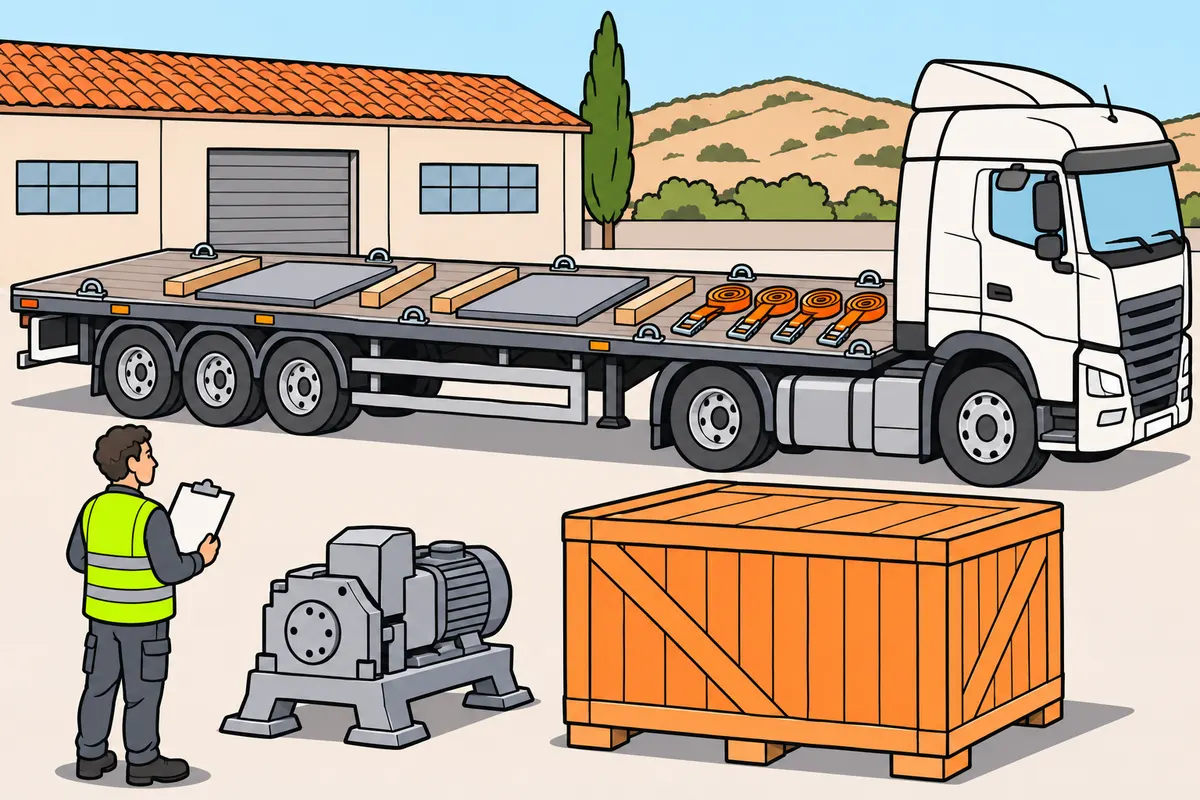
You must plan where each package goes and how to secure it before loading.
Remember
- Check each package’s weight, size, shape and fragility.
- Find its centre of gravity: the point where its weight is concentrated.
- Check the strength of the floor, supports and lashing points.
- Plan deliveries so your remaining load stays balanced and secure.
- Plan positioning, supports and lashings together.
Exam trap: Wrong: you can correct any loading mistake by adding straps. Right: you must also plan supports, gaps and weight distribution.
Read the full explanation
- You must know the mass, dimensions, shape and fragility of the packages before deciding where to place them. Also identify the centre of gravity when it does not coincide with the geometric centre, as with some machines. A bulky box can weigh less than a small piece of metal.
- You must check that the floor, supports and lashing points are suitable for the goods. A concentrated load can exceed the local strength of the floor even if the total mass is permissible. Allow for load-spreading plates or supports where the design of the platform and the load itself requires them.
- You must decide the loading order with deliveries in mind. The packages you remove first must not leave a dangerous load distribution or render the blocking of the remaining goods ineffective. Planning only the journey to the first recipient is insufficient if you then continue with part of the goods.
- You must choose positioning and restraint together: where each unit rests, which spaces remain empty and which items prevent movement. Annex III requires you to consider axle load distribution and the strength of the components used for securing; adding straps at the end does not correct every stowage error. [RD 563/2017, annex III](https://www.boe.es/buscar/act.php?id=BOE-A-2017-6512#ai-3).
3Keep the centre of gravity low and central
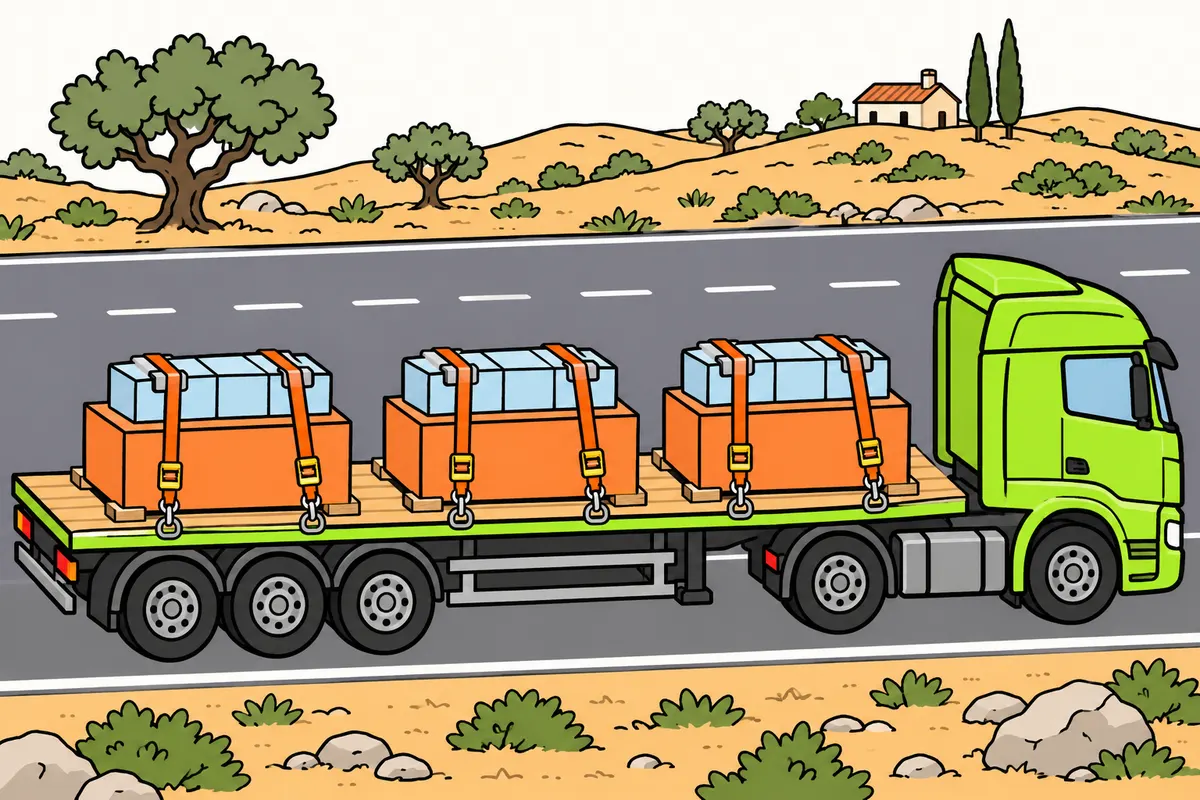
You must keep weight low and balanced between both sides to reduce overturning risks.
Remember
- Put heavy packages below light ones.
- Spread weight between both sides.
- High or off-centre loads can make you overturn sooner on bends and roundabouts.
- Check packaging strength and use stable bases when stacking.
- Prevent your goods from sliding and tipping.
Exam trap: Wrong: strong lashings make up for high or off-centre loads. Right: you must lower and balance the weight.
Read the full explanation
- You must place heavy items as low as possible: a high centre of gravity reduces the lateral acceleration the combination can withstand before overturning. On the same bend or roundabout, you can reach the rollover threshold at a lower speed than with that mass positioned lower down, even if the lashings prevent it from sliding. The load must preserve vehicle stability. [RGC, art. 14.1.b](https://www.boe.es/buscar/act.php?id=BOE-A-2003-23514#a14).
- You must balance the load between both sides: if the centre of gravity is offset to one side, the margin against overturning towards that side decreases. On bends and roundabouts, the combination of height and lateral offset increases the risk. A body kept level by the suspension does not prove that the load is evenly distributed.
- When stacking, you must respect the strength of the packaging and provide a stable base for the upper packages. As a stowage guideline, place heavy packages below light ones and avoid small or uneven supports. Crushed packaging can loosen the top-over lashing and allow the whole stack to move.
- You must prevent both sliding and overturning of the goods themselves. A tall machine can tip even when its base does not move across the floor; you need a system suited to its geometry. The requirement to prevent longitudinal and transverse tipping forms part of the load-securing principles. [RD 563/2017, annex III](https://www.boe.es/buscar/act.php?id=BOE-A-2017-6512#ai-3).
4Distribute mass between the axles
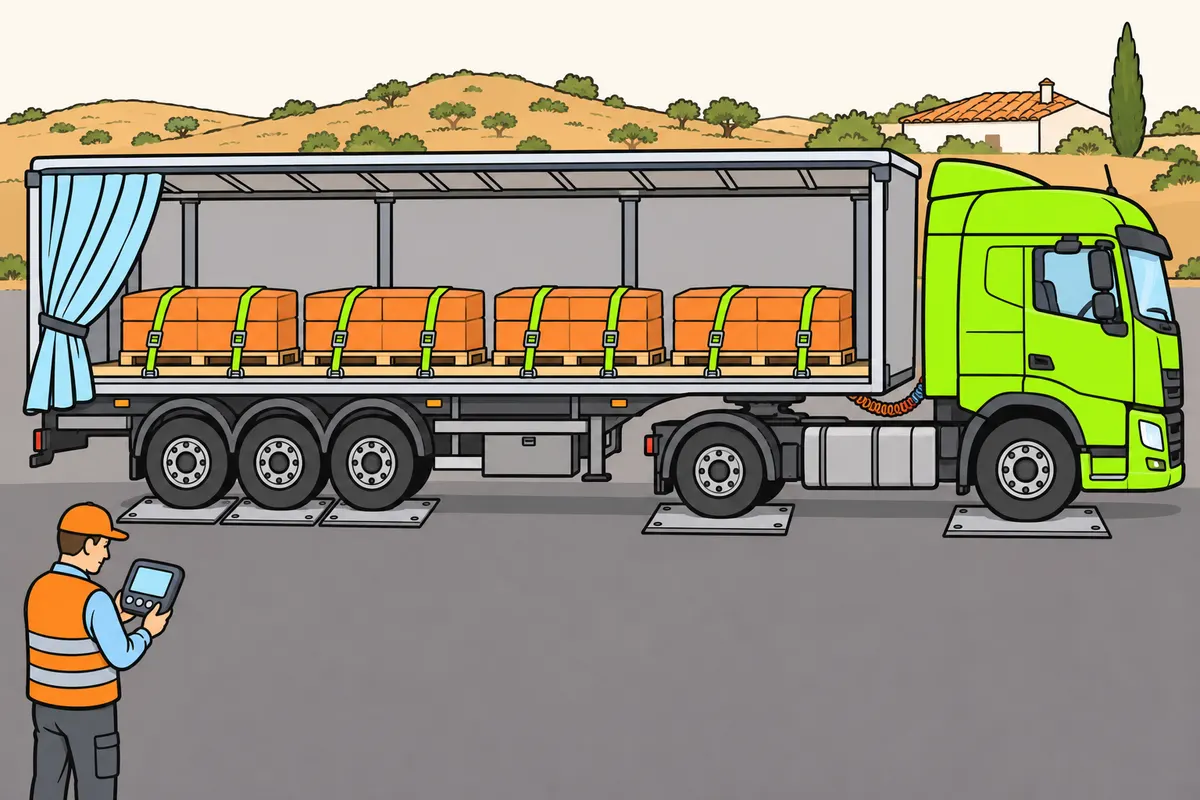
You must meet weight limits for the combination, each vehicle and each axle.
Remember
- Check maximum axle loads and the minimum loads needed.
- Use the manufacturer’s load distribution diagram when available.
- With semi-trailers, some weight passes through the coupling to your tractor unit.
- Do not assume centring your load gives correct axle loads.
- If unsure of distribution, weigh individual axles or axle groups before leaving.
- Recheck distribution when you change tractor units, towed vehicles or load positions.
Exam trap: Wrong: a legal total weight means no axle is overloaded. Right: you must check each axle or axle group.
Read the full explanation
- You must comply simultaneously with the authorised mass of the combination, each vehicle and each axle or axle group, together with the applicable technical limits. The total can be legal while an axle is overloaded. To choose the values for your configuration, consult «Maximum dimensions and masses». [RGV, annex IX](https://www.boe.es/buscar/act.php?id=BOE-A-1999-1826).
- You must use the manufacturer’s load distribution diagram when available. It shows where the centre of gravity of the goods may lie according to their mass. The geometric centre of the load body can be outside the permissible area shown in that diagram.
- With a semi-trailer, you must consider that part of the load is transmitted to the tractor unit through the kingpin and fifth wheel. Moving goods forwards or backwards changes the distribution between the tractor unit and the semi-trailer axles. Concentrating them against the headboard or at the rear end can overload different areas.
- You must maintain the necessary minimum axle loads as well as keeping within their maximums. A distribution that unloads the steering or driven axles too much impairs control and the ability to transmit forces to the ground. Annex III requires you to observe maximums and minimums within the MMA (maximum authorised mass). [RD 563/2017, annex III](https://www.boe.es/buscar/act.php?id=BOE-A-2017-6512#ai-3).
- If you do not know the actual distribution, you must check it by appropriately weighing individual axles or axle groups and correct the positioning before setting off. Weighing only the entire combination does not reveal every local overload. Reassess whenever you change the tractor unit, towed vehicle or load distribution.
5Divide the load without creating overloads
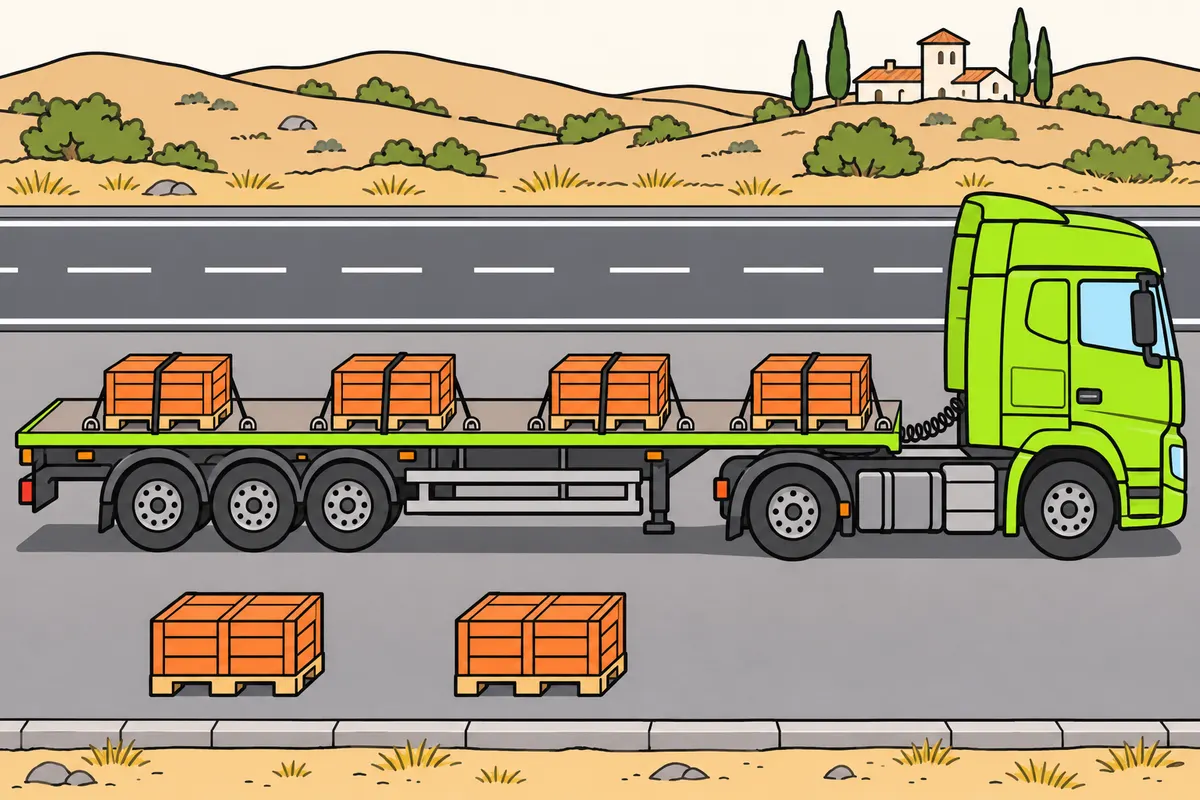
If your goods can be divided, distribute them according to each area’s capacity.
Remember
- Spread weight according to your lorry, trailer and support capacities.
- You do not need equal weights in each vehicle.
- Correct distribution without overloading other axles.
- Remove some goods if you cannot meet every limit.
Exam trap: Wrong: extra lashings let you carry more weight. Right: lashings only keep your load in position.
Read the full explanation
- If the goods are divisible, you must distribute the units between the usable areas and, in a road train, between the lorry and trailer, according to their capacities. Dividing the load does not necessarily mean allocating the same mass to each unit: capacities and distances between supports can differ.
- You must avoid resolving a total overload by piling goods over another axle that also becomes overloaded. Correcting the problem requires a plan that meets all limits simultaneously; sometimes you must remove part of the consignment. Lashing holds the load in place but does not increase the authorised capacity.
6Forces the securing system must withstand
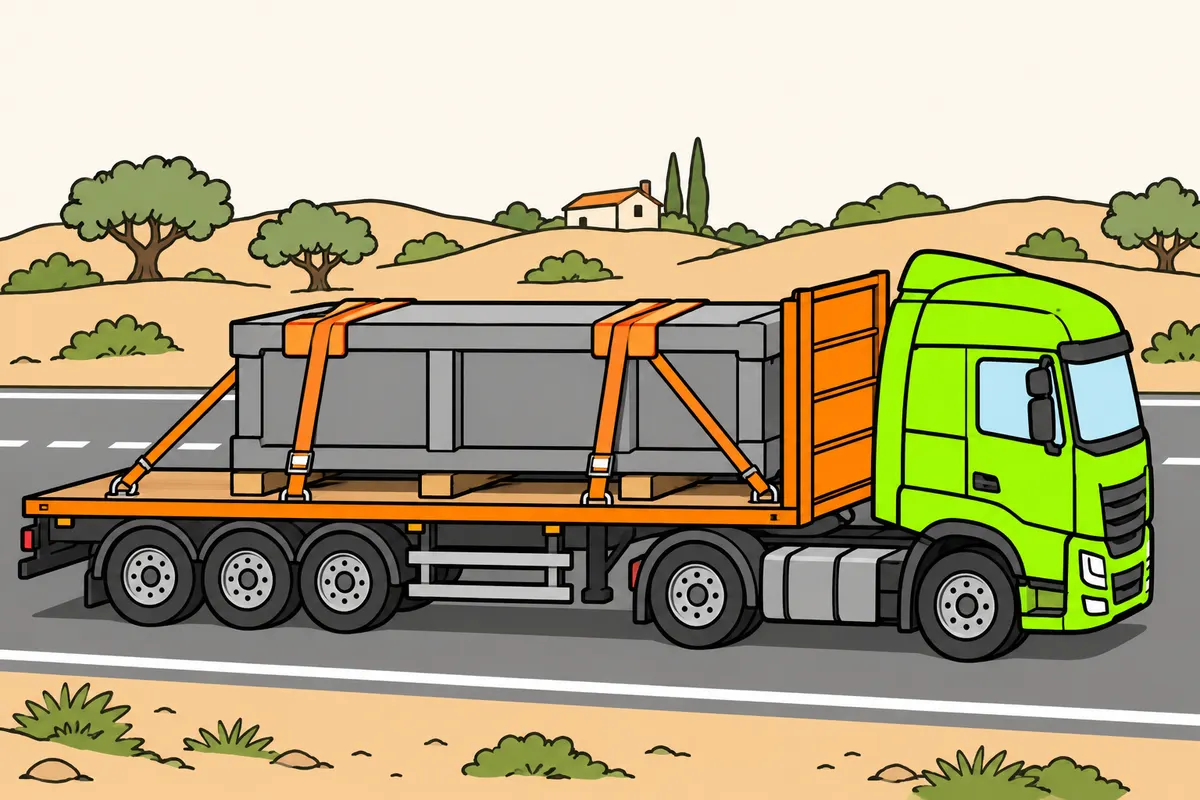
You must secure your load to withstand braking, turns and emergencies.
| Force direction | Factor applied to weight |
|---|---|
| Forwards | 0.8 |
| Towards each side | 0.5 |
| Rearwards | 0.5 |
Remember
- Calculate the required force by multiplying weight by each direction’s factor.
- Choose lashings for weight, friction, angles and overturning risks.
- Keep your load secure when moving off uphill too.
- Driving slowly does not replace proper securing.
Exam trap: Wrong: the factors show how much load you can leave loose. Right: they show the forces your securing system must withstand.
Read the full explanation
- You must anticipate that inertia makes the load tend to keep moving when you brake and tend to move sideways when you change direction. Preventing it from falling off while travelling straight ahead at a constant speed is not enough: the restraint must also work during demanding manoeuvres.
- The system must withstand a forward force equivalent to the weight of the load multiplied by 0.8, a force towards each side multiplied by 0.5 and a rearward force multiplied by 0.5. You must understand these factors as strength requirements for the securing system, without interpreting them as percentages of mass you can leave unsecured. [RD 563/2017, annex III](https://www.boe.es/buscar/act.php?id=BOE-A-2017-6512#ai-3).
- You must size the system for the full combination of forces, supports and resistance. There is no universal number of straps suitable for every pallet or machine. Mass, friction, angles and the possibility of overturning determine which equipment you need and how much.
- You must maintain restraint in emergencies and when moving off uphill too. An inspection can check that changes in position are minimal and that the load cannot leave its allocated space. The excuse of driving slowly does not replace this requirement. [RD 563/2017, art. 11](https://www.boe.es/buscar/act.php?id=BOE-A-2017-6512#a1-3).
7EN standards and choice of method
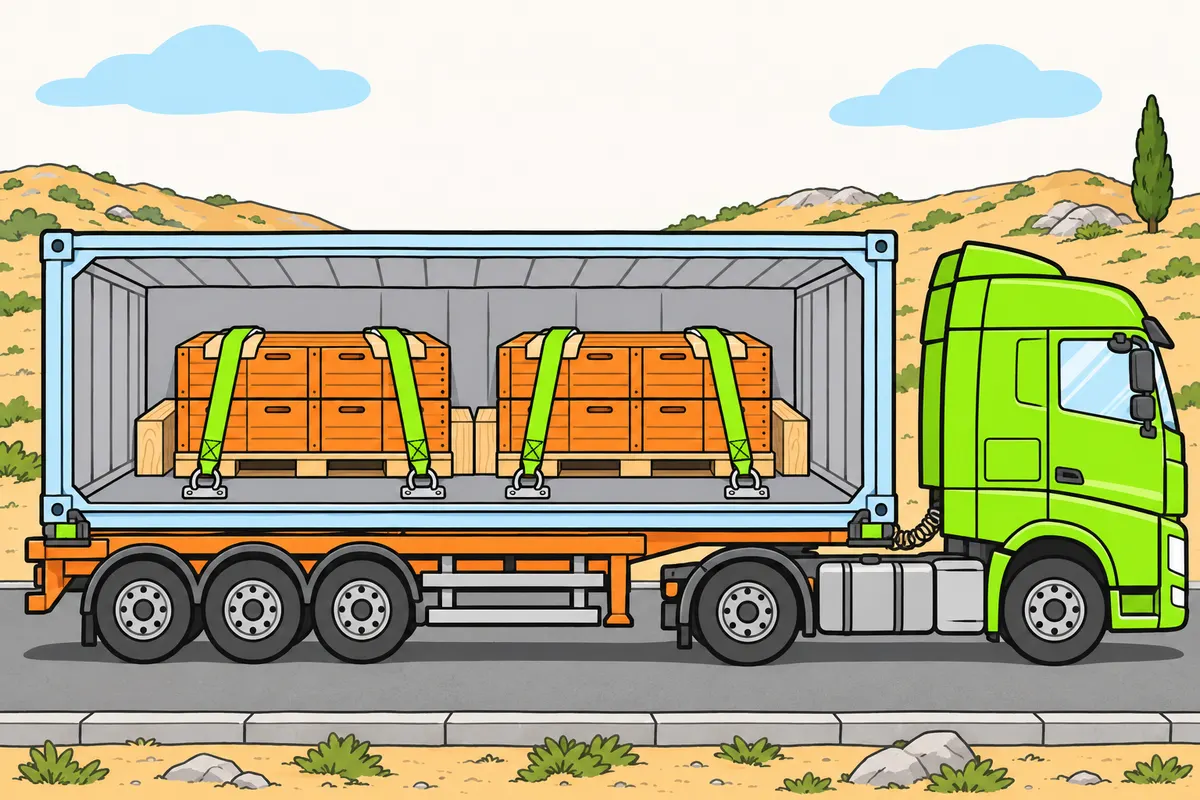
You must choose suitable standards, equipment and methods for securing your goods.
| Standard | What you must check |
|---|---|
| EN 12195-1 | Lashing force calculations |
| EN 12195-2 | Synthetic fibre straps |
| EN 12195-3 | Chains |
| EN 12195-4 | Steel wire ropes |
| EN 12640 | Lashing points |
| EN 12642 | Vehicle body strength |
Remember
- Check lashing calculations and support strength separately.
- You can combine locking, blocking, direct lashing and top-over lashing.
- Follow your securing plan and equipment instructions.
- Secure your container to the vehicle and the goods inside the container.
Exam trap: Wrong: a strong strap is enough even if its anchorage fails. Right: you must also check where you attach it.
Read the full explanation
- EN 12195-1 is the standard for calculating lashing forces cited in Annex III. Parts EN 12195-2, EN 12195-3 and EN 12195-4 cover synthetic fibre straps, chains and steel wire ropes respectively. Each securing device must be suitable for the load and its intended use. [RD 563/2017, Annex III](https://www.boe.es/buscar/act.php?id=BOE-A-2017-6512#ai-3).
- You must check lashing calculations separately from the strength of the structure that takes the forces they exert. The same annex cites EN 12640 for lashing points and EN 12642 for vehicle body strength. A strong strap is insufficient if you attach it to a component that cannot withstand the transmitted force. [RD 563/2017, Annex III](https://www.boe.es/buscar/act.php?id=BOE-A-2017-6512#ai-3).
- You can combine methods: locking, blocking, direct lashing and top-over lashing. You must choose a combination whose effectiveness you can justify for the specific goods. A container lock works differently from a strap that presses a pallet against the floor. [RD 563/2017, Annex III](https://www.boe.es/buscar/act.php?id=BOE-A-2017-6512#ai-3).
- You must follow the load securing plan and the equipment instructions, without improvising equivalent arrangements between systems. Securing a container to the platform does not prove that its contents are immobilised; you need to ensure restraint at every level, from the goods to the vehicle carrying them.
8Block movement with strong supports
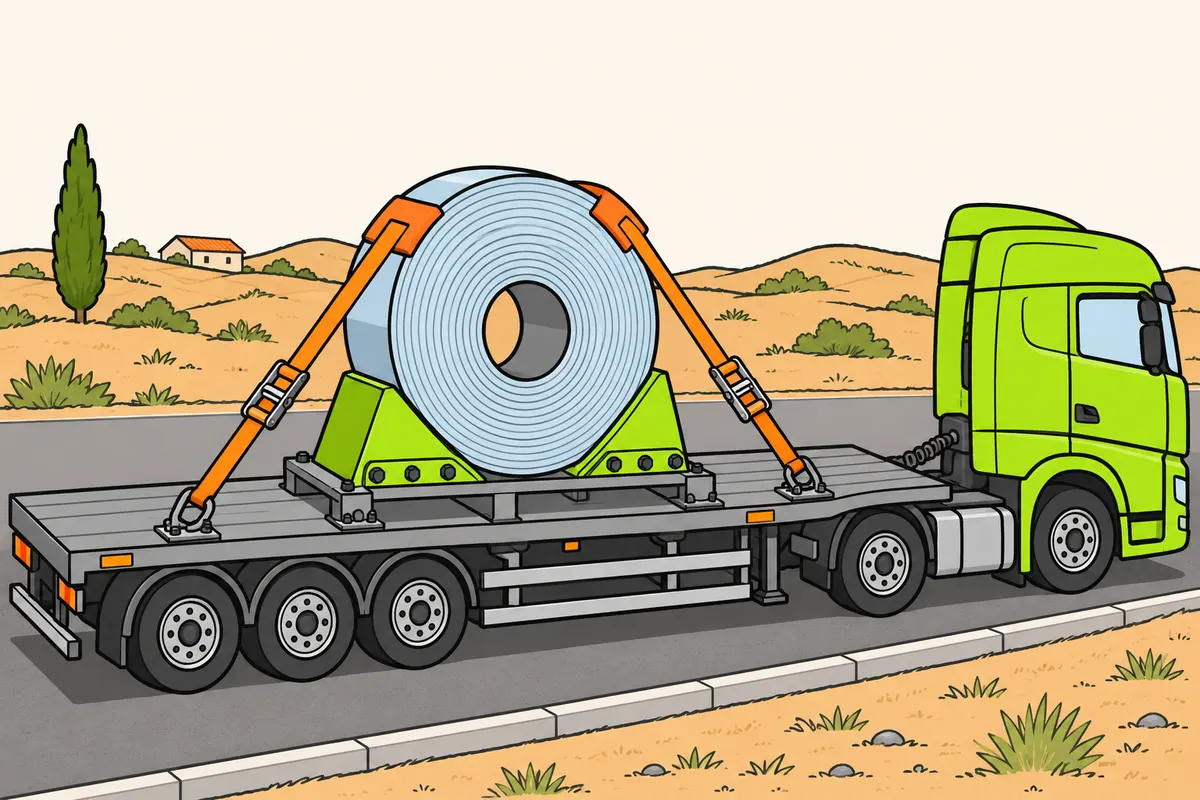
You must block your load with supports strong enough to withstand its forces.
Remember
- Use suitable stops, bars, spacers or wedges to prevent movement.
- Reduce gaps that let packages move and strike other objects.
- Check the certified strength of walls, doors and supports.
- For goods that can roll, secure chocks or cradles and use necessary lashings.
Exam trap: Wrong: any side curtain or door holds back your entire load. Right: you must check its strength for that load.
Read the full explanation
- When blocking a load, you must prevent its movement using strong components: headboards, spacers, bars, stanchions, chocks or suitable recesses. Position the goods and supports so that force passes to a structure capable of withstanding it, without relying on substantial movement first.
- You must reduce gaps that are incompatible with the blocking system. A gap allows a package to gain momentum before hitting the next package or the wall. Use void fillers suited to the expected forces; soft material used to protect surfaces does not automatically serve as a strong stop.
- You must check the forces for which the headboard, walls and doors are certified. Do not assume that every enclosed body restrains the entire load or that a side curtain works as a structural wall. Annex III requires you to take account of the strength of the components used for securing. [RD 563/2017, Annex III](https://www.boe.es/buscar/act.php?id=BOE-A-2017-6512#ai-3).
- For pipes, coils and other items that can roll, you must provide suitable cradles or chocks and secure them, together with the necessary lashings. A round item can roll even without sliding. Prevent the chocks from shifting and check that the support does not damage or deform the goods.
9Use friction in a controlled way
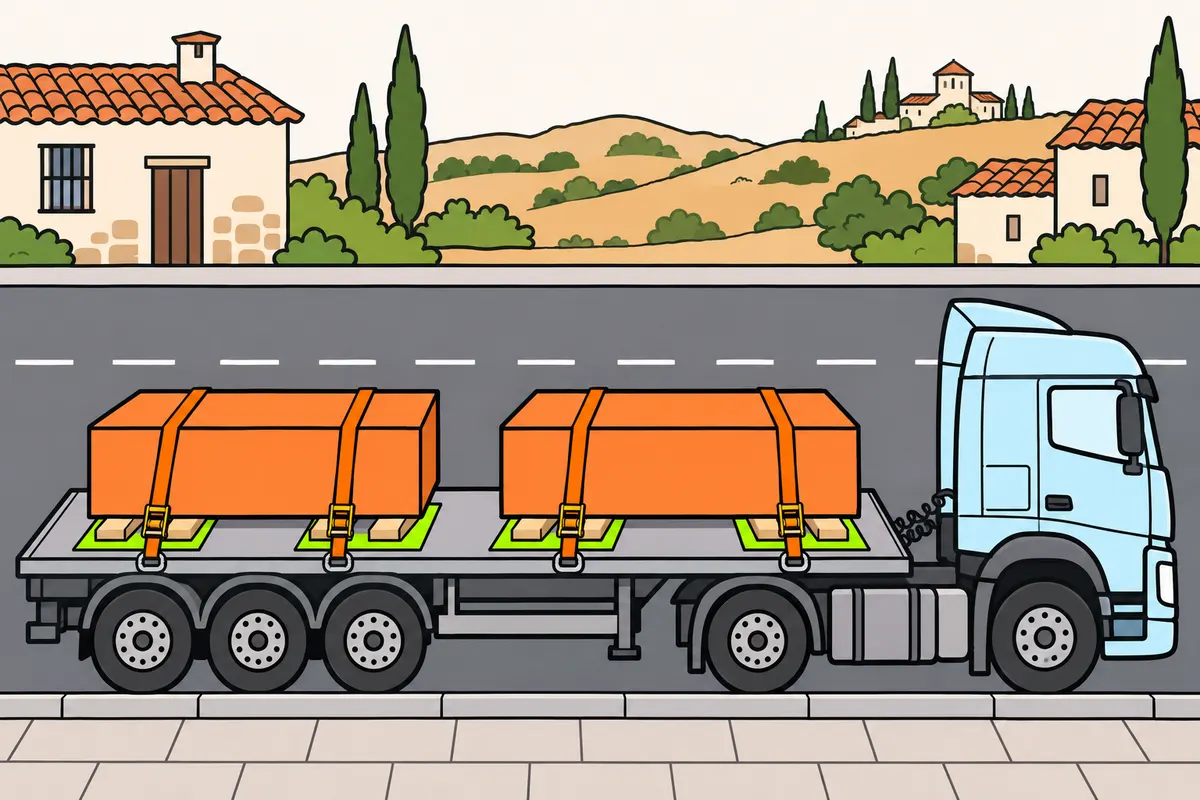
You must check grip between surfaces and also consider overturning risks.
Remember
- Check materials and their actual condition: water, oil and dust change grip.
- Place suitable anti-slip material under contact points and check its condition.
- Use a friction value you can justify when calculating lashings.
- Recheck calculations if contact between surfaces changes.
- Combine supports and lashings where needed to prevent sliding or overturning.
Exam trap: Wrong: your load cannot overturn if its base cannot slide. Right: you must also check its stability.
Read the full explanation
- With friction, you use the resistance to sliding between surfaces in contact. You must assess the materials and their actual condition: dust, oil, water or packaging remnants can affect grip. The weight of the goods alone does not guarantee that they remain stationary under braking.
- You can use suitable anti-slip material between the load and the floor or between layers, in accordance with the load securing plan. You must position it at the points of support and check its condition. You cannot assume that a damaged or incorrectly positioned mat, or one subjected to unsuitable pressure, is effective.
- You must use a justifiable coefficient of friction to calculate the lashings; do not choose one based on the appearance of the surface. Top-over lashing uses additional pressure to increase friction. If the actual contact between materials changes, you must review the calculation and the planned arrangement.
- Sliding and tipping are different risks. Increasing friction can prevent the base from moving, but a tall or narrow unit still needs stability against overturning. Assess both risks and combine anti-slip material with blocking or lashing where appropriate.
10Top-over lashing and direct lashing
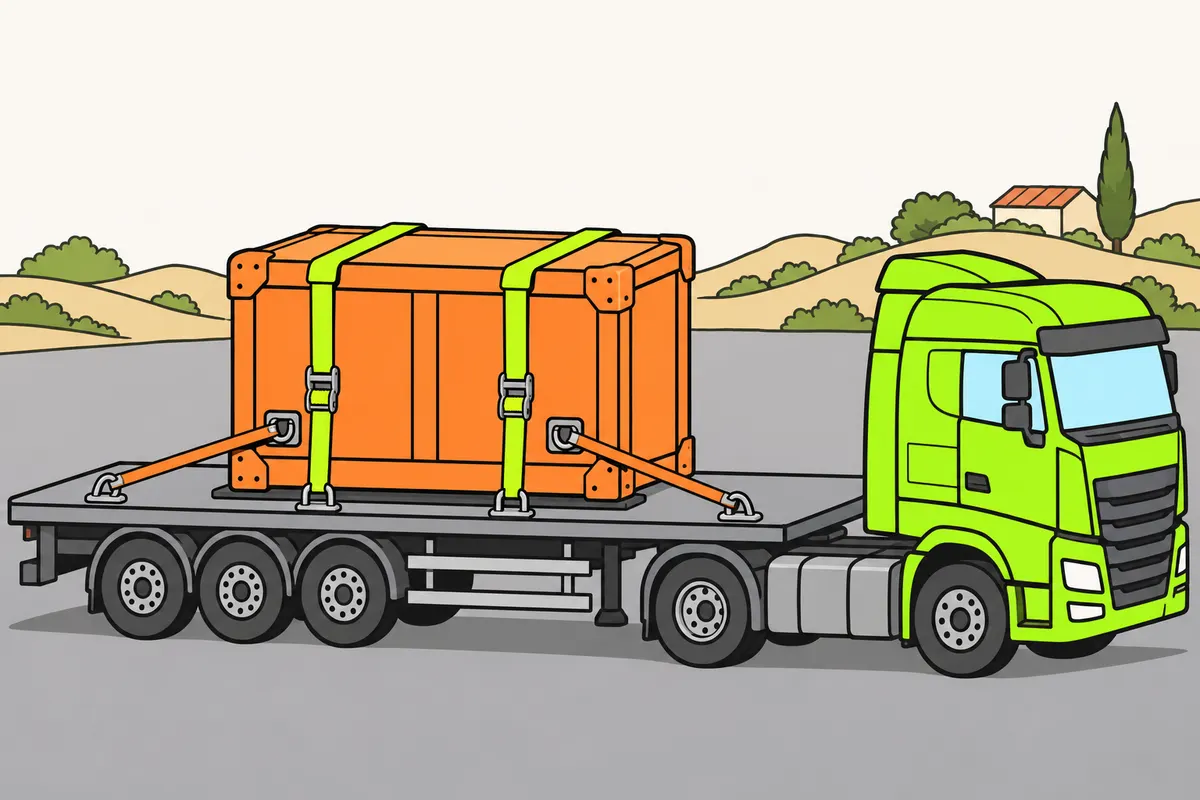
You must distinguish lashings that press your load down from lashings that directly resist movement.
| Type or marking | What you must remember |
|---|---|
| Top-over lashing | You press the load down to increase friction |
| Direct lashing | You connect load and vehicle to resist movement |
| LC | Lashing capacity |
| STF | Standard tension force |
Remember
- Follow the capacity, direction and angles specified in your plan.
- For top-over lashing, also check tension and packaging strength.
- Do not judge safety just by counting visible straps.
- Distinguish LC, lashing capacity, from STF, standard tension force.
Exam trap: Wrong: LC and STF mean the same thing. Right: you must distinguish lashing capacity from tension force.
Read the full explanation
- For top-over lashing, you must pass the securing device over the load and tension it towards the anchorage points to press the load against its support. Its main function is to increase friction. You need to consider the transmitted pre-tension, the angle and the strength of the packaging, as well as the number of lashings.
- For direct lashing, you must connect suitable points on the load to points on the vehicle so that the securing devices resist movement in the intended directions. Their effectiveness depends on their capacity and orientation. An arrangement that restrains forward movement may need additional measures to restrain sideways or rearward movement.
- You must read the equipment data: LC identifies the lashing capacity and STF the standard tension force. You cannot use these quantities interchangeably in calculations. A high lashing capacity does not mean that the tensioner applies that same force when you tighten it over a pallet.
- You must observe the angles specified in the lashing plan. A top-over lashing at too shallow an angle reduces the force component pressing the load against the floor; with direct lashing, the relevant factor is the part of the force that opposes movement. Do not replace a calculation with a count of the straps visible from outside.
11Look after straps, anchorage points and packaging
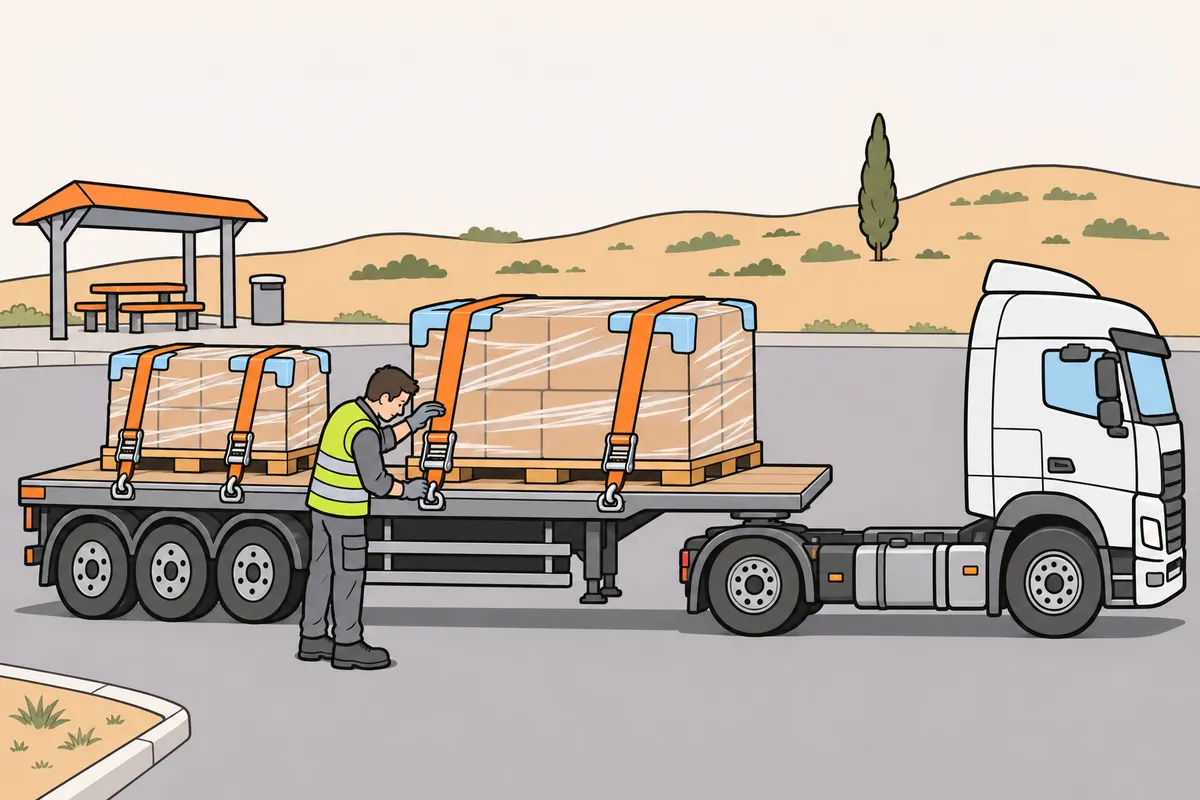
You must check lashings, anchorage points and packaging before use.
Remember
- Set aside damaged equipment or items whose identification cannot confirm their performance.
- Do not repair a cut strap with a knot.
- Protect straps from sharp edges and goods from damaging pressure.
- Attach hooks to suitable points and check their catches.
- Check connections between packages and secure the pallet to your vehicle.
Exam trap: Wrong: pallet film or banding secures it to your vehicle. Right: you must also secure the pallet to your vehicle.
Read the full explanation
- You must inspect straps, stitching, chains, wire ropes, hooks and tensioners before using them. Set aside damaged items or those whose identification does not allow you to verify their performance, and follow the manufacturer's criteria for withdrawing equipment from use. Do not deal with a cut by tying a knot or with deformed parts by making an improvised adjustment.
- You must protect lashing equipment from edges that could cut it and protect the goods from pressure where necessary. Edge protectors help distribute forces, but they must be compatible with the system. A protector must stay in place while you drive to perform its function.
- You must attach hooks to points designed to withstand the force, without resting a hook in an unstable position or forcing catches and ratchets. The strength of the securing assembly is limited by its components and their connections; you cannot determine it solely from the strap's label.
- Wrapping film or banding used to hold a pallet load together does not, on its own, secure it to the vehicle. Check both the connection between the packages and the connection of the complete unit to the floor. If the packaging breaks, packages can escape even if the pallet remains secured.
12Check the load during the transport operation
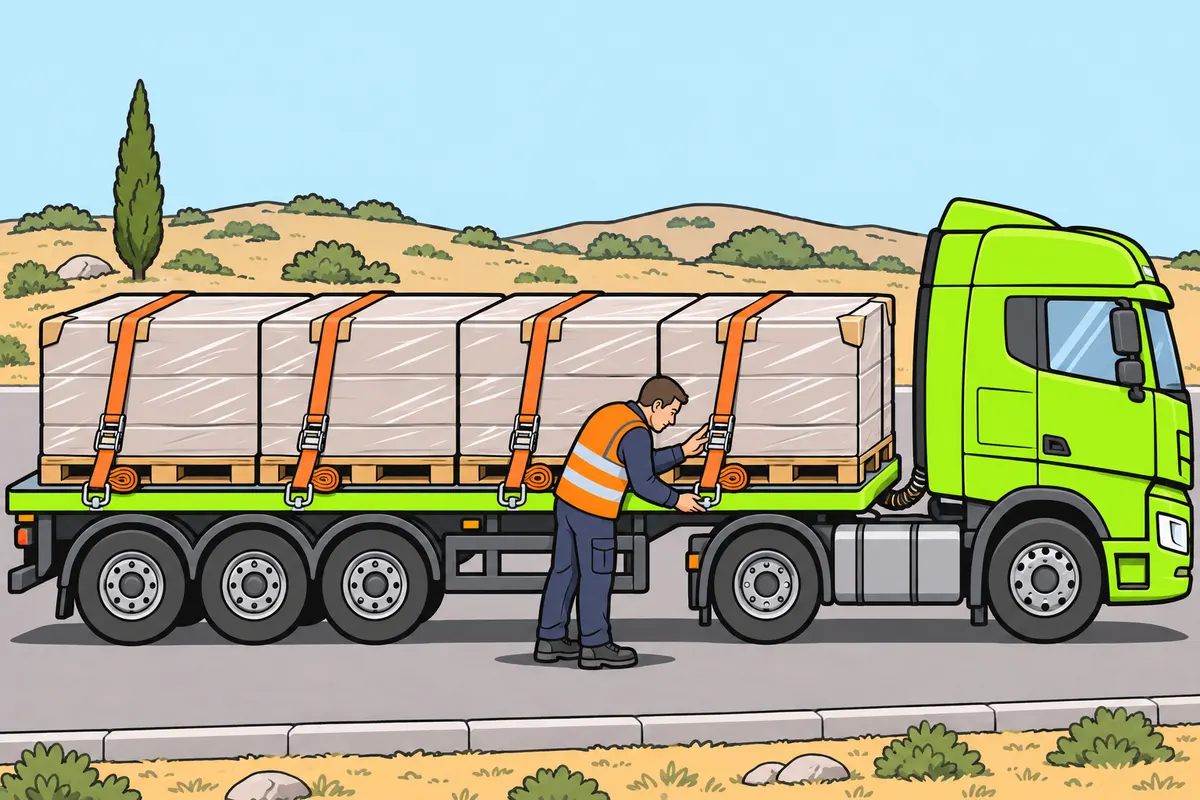
You must check your load before leaving and whenever transport could affect its securing.
Remember
- Check both units: supports, gaps, tensioners, doors and covers.
- Secure loose tools and strap ends.
- Recheck lashings once your load settles and at planned stops.
- After heavy braking or an incident, stop safely and check.
- Fix the cause of noises, tilting or loose tensioners before continuing.
Exam trap: Wrong: you must always recheck after a fixed distance. Right: adapt checks to your goods, equipment and plan.
Read the full explanation
- You must inspect the result before moving off: no dangerous gaps, stable supports, closed tensioners and loose strap ends stowed away. Check that there are no loose tools and that doors, tailgates and covers are secured. Your inspection must cover both units of the combination.
- As a safety measure, you must check the lashings again once the goods have settled and at suitable stops during the transport operation, in accordance with the transport plan. Some loads compress or vibrate and lose pre-tension. There is no single inspection interval in terms of distance that is valid for all goods and equipment.
- You must check the restraint after heavy braking, any movement you notice or an incident that may have affected the stowage, stopping in a safe place. If you detect leaning, an unusual noise or a loose tensioner, you must resolve the cause before continuing; tightening without inspecting can conceal a broken support.
- You must take a deficiency seriously even if the goods remain inside. Annex III distinguishes between securing that needs improvement, inadequate securing with a possibility of significant movement or overturning, and a direct danger to traffic or people. An inspection can assess tensions, calculations and certificates as well as visually examining the load. [RD 563/2017, Annex III](https://www.boe.es/buscar/act.php?id=BOE-A-2017-6512#ai-3).
13Partial deliveries and opening doors
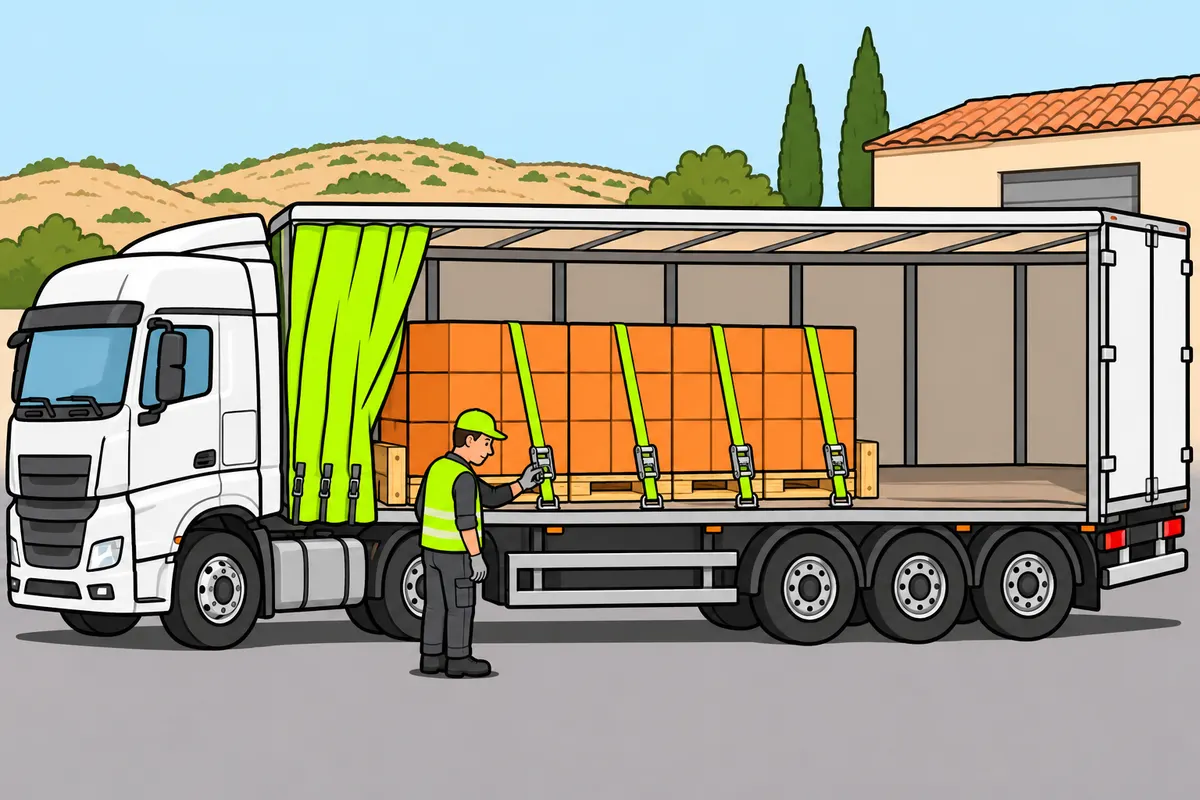
After unloading some goods, you must check balance and restore securing.
Remember
- Check weight distribution and gaps after removing packages.
- Replace necessary supports and lashings before continuing.
- Before opening doors, check whether goods could fall onto you.
- Stay outside the fall path and follow your equipment’s procedure.
- Do not use your body to hold a door under load pressure.
- With an uncoupled semi-trailer, check ground, supports and stability throughout the operation.
Exam trap: Wrong: carrying less weight always improves safety. Right: you must recheck distribution, supports and lashings after unloading.
Read the full explanation
- After removing packages, you must check the mass distribution and blocking again. You may leave a gap between units that previously supported one another or concentrate the remaining mass at one end. Driving with less weight does not guarantee safer distribution.
- You must restore any lashings and supports removed for unloading, following a plan suited to the remaining load. Also assess any packages moved temporarily to gain access to others.
- Before opening doors or releasing restraints, you must consider whether the goods are resting against them or have shifted. Stand clear of the path of any possible falling load and follow the equipment's safe procedure. Do not use your body to stop a door under pressure.
- If you leave a semi-trailer uncoupled for loading or unloading, you must check that its supports, the ground and the load distribution allow it to remain stable throughout the operation. Equipment entering it and changes in load position alter the forces involved. Checking the support forms part of the uncoupling procedure.
14Liquids and the surge effect
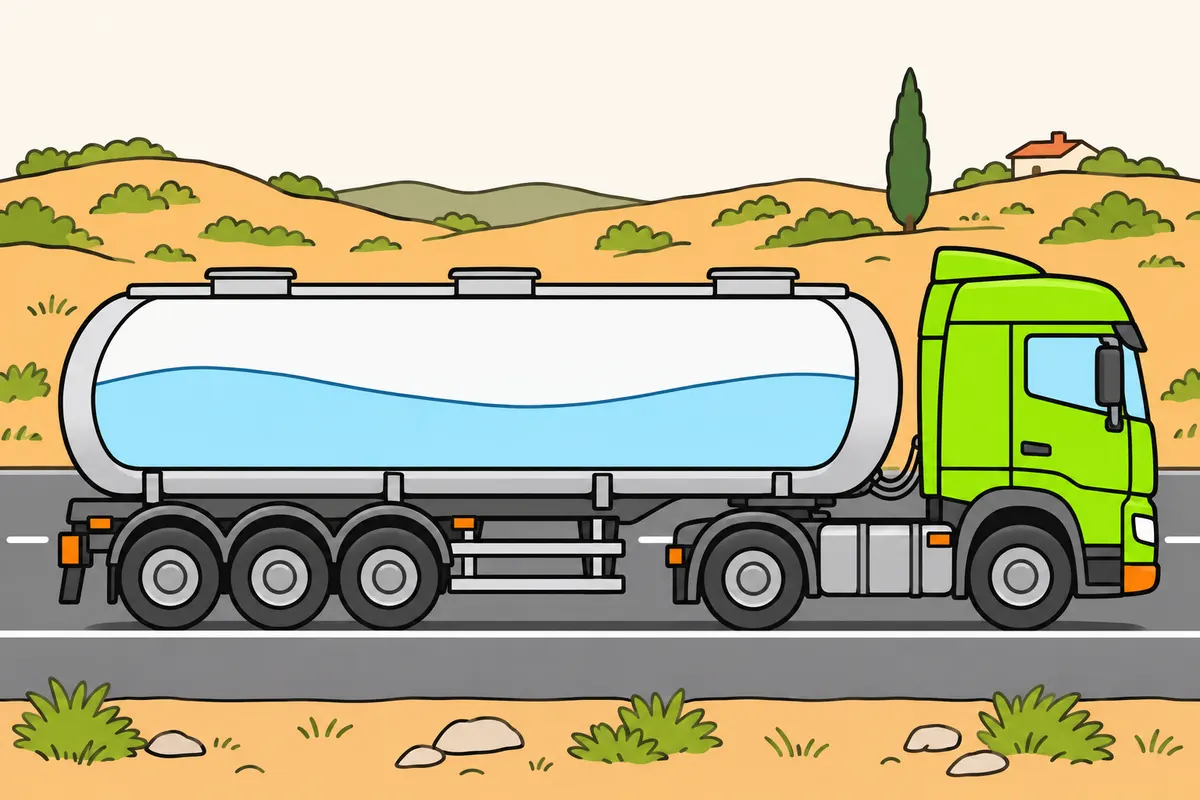
With liquids, you must expect internal forces that can upset your vehicle combination’s balance.
| Liquid load situation | What you must expect |
|---|---|
| Partly filled tank | Liquid has room to move |
| Compartments or baffles fitted | They can limit movement without removing every force |
Remember
- Plan braking, acceleration and turns so you can drive smoothly.
- With partly filled tanks, expect more room for liquid movement.
- Avoid sudden corrections: liquid can keep surging after your manoeuvre.
- Check how compartments affect your axle loads.
Exam trap: Wrong: baffles remove all forces from liquid movement. Right: they can limit movement, but you must still expect surging.
Read the full explanation
- When carrying liquid, you must anticipate internal movements that do not occur in a properly secured solid load. When you brake, accelerate or change direction, the liquid can move and exert forces on the tank. This movement changes the distribution of mass from moment to moment and makes it harder to keep the articulated vehicle stable.
- With a partially filled tank, you must pay particular attention to the space available for the liquid to move. Surging can continue after your initial control input and produce successive forces. You must not respond with abrupt corrections that cause further oscillations.
- You must know the tank's compartment layout and internal devices. Compartments and baffles can limit movement depending on their design, but they do not eliminate all forces or turn the tanker's contents into a rigid load. Distribution between compartments also affects axle loading.
- You must anticipate changes in speed and direction and keep your control inputs smooth, especially with a tall or partially loaded tanker. No single speed guarantees that you will avoid overturning on every bend. Detailed driving techniques are covered in «Driving techniques for heavy vehicle combinations».
15Control tanker filling and emptying
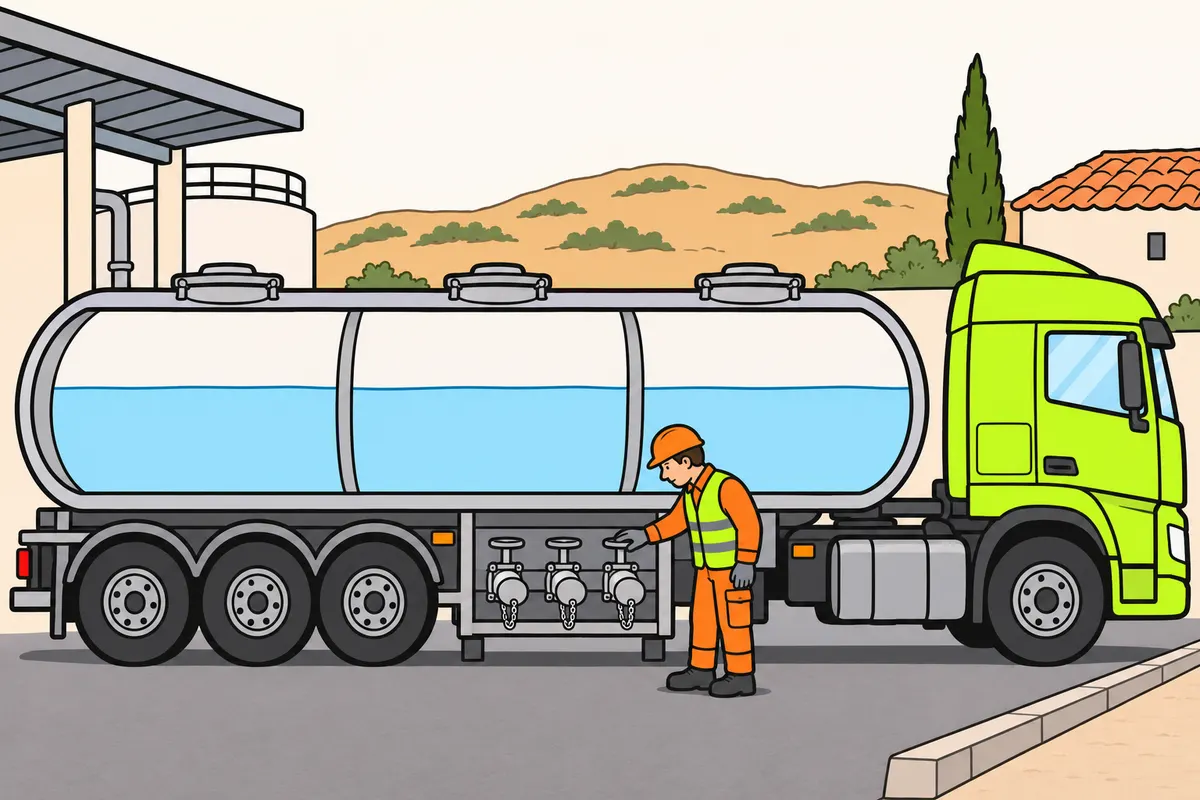
You must fill and empty tankers according to the product, equipment and weight distribution.
Remember
- Calculate quantities using capacity, density, temperature and permitted weight.
- Follow applicable filling limits and leave enough space for expansion.
- Plan the order for filling and emptying compartments.
- After partial unloading, check axle loads and movement of the remaining liquid.
- Before driving, check lids, valves, pipes, closures, leaks and external residue.
- If carrying dangerous goods, follow their specific rules too.
Exam trap: Wrong: fill to the brim to prevent surging. Right: follow the filling limits for your product and equipment, and respect permitted weight.
Read the full explanation
- You must determine the quantity to load using the product and tank data: usable capacity, density, temperature, filling limits and permissible mass. The same volume can represent different masses depending on the liquid.
- You must observe the filling level applicable to the product and equipment and allow the space needed for expansion. You must not fill to the brim as a solution to surging or apply a universal percentage to all tankers. If you carry dangerous goods, you must also comply with their specific regulations. [RGC, art. 14](https://www.boe.es/buscar/act.php?id=BOE-A-2003-23514#a14).
- You must plan the order in which compartments are filled or emptied to maintain safe distribution. After partial unloading, you must assess axle loads and the behaviour of the remaining liquid. One empty compartment and one loaded compartment do not automatically mean that a tanker is balanced.
- Before moving off again, you must check covers, valves, pipework and closures according to the equipment instructions, and verify that there are no leaks or external residues that could fall off. Details of the classification and handling of dangerous goods belong to their specific training; here you must master the common risks of movement and spillage.
16Choose the loading and unloading location
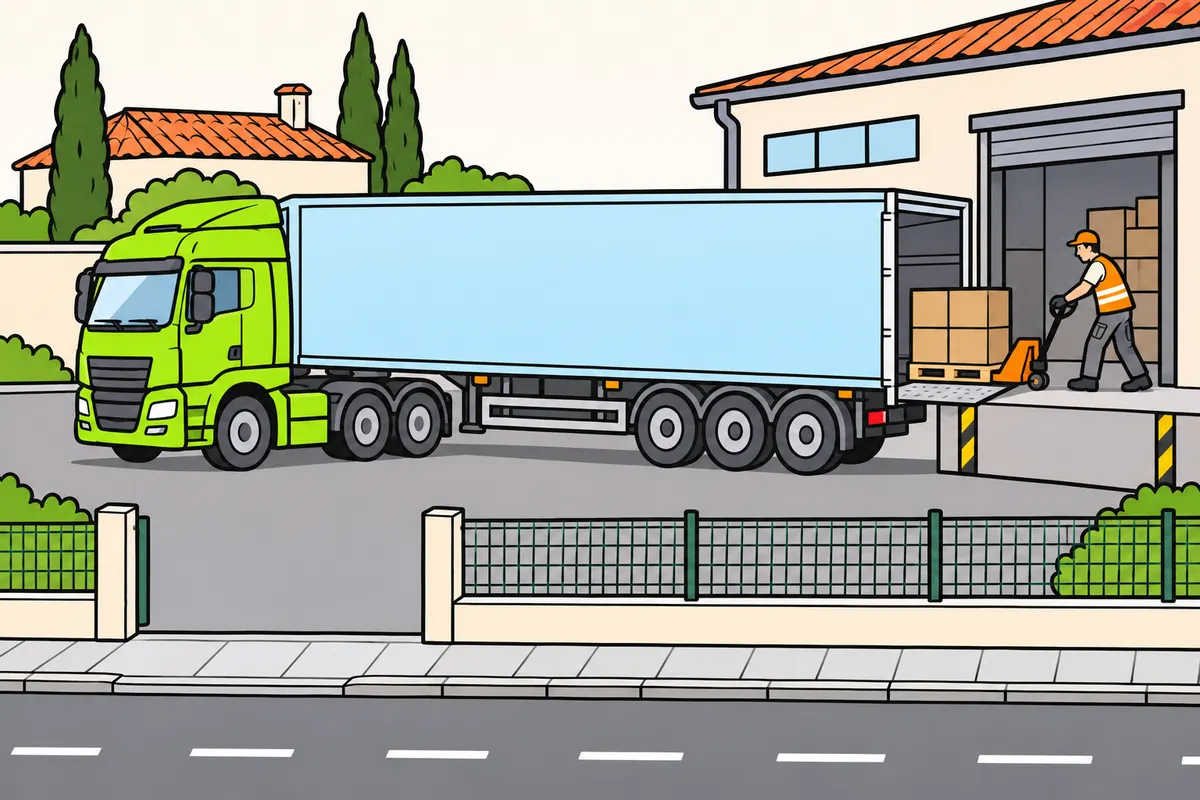
You must load and unload off the road unless using the road is unavoidable.
| Operation location | What you must do |
|---|---|
| Off the road | Load and unload here |
| On the road | Use only if unavoidable, without danger or serious disruption |
| Built-up area | Also follow council rules on times and places |
Remember
- On the road, do not cause danger or serious disruption to others.
- Follow stopping and parking rules.
- In built-up areas, also follow council rules on times and places.
- Where possible, work on the side nearest the carriageway edge.
- Provide enough equipment and help to finish quickly without unnecessary nuisance.
- Do not leave goods on the carriageway, hard shoulder or pedestrian areas.
Exam trap: Wrong: you can unload on the road if you are quick. Right: only if unavoidable, without danger or serious disruption, and following applicable rules.
Read the full explanation
- You must load and unload off the road. Only when it is unavoidable may you do so on the road, without causing danger or serious disruption to other road users. The convenience of stopping beside the customer does not make any point on the road a suitable location. [RGC, art. 16](https://www.boe.es/buscar/act.php?id=BOE-A-2003-23514#a16).
- If you exceptionally have to operate on the road, you must comply with stopping and parking rules. In built-up areas, you must also comply with municipal rules on times and locations. A designated loading and unloading bay does not remove its conditions of use or authorise you to occupy any nearby space. [RGC, art. 16](https://www.boe.es/buscar/act.php?id=BOE-A-2003-23514#a16).
- Where possible, you must carry out operations on the side of the vehicle closest to the edge of the carriageway. In right-hand traffic, this is usually the right-hand side; you must take account of the actual vehicle position and the authorised location, without entering the traffic area out of habit. [RGC, art. 16](https://www.boe.es/buscar/act.php?id=BOE-A-2003-23514#a16).
- You must have sufficient resources to carry out the operation as quickly as possible and avoid unnecessary noise and disturbance. You must not place goods on the carriageway, arcén (hard shoulder) or pedestrian areas. The fact that pallets are only to remain there for a moment does not allow you to use these areas for temporary storage. [RGC, art. 16](https://www.boe.es/buscar/act.php?id=BOE-A-2003-23514#a16).
17Prepare the loading bay and the operation
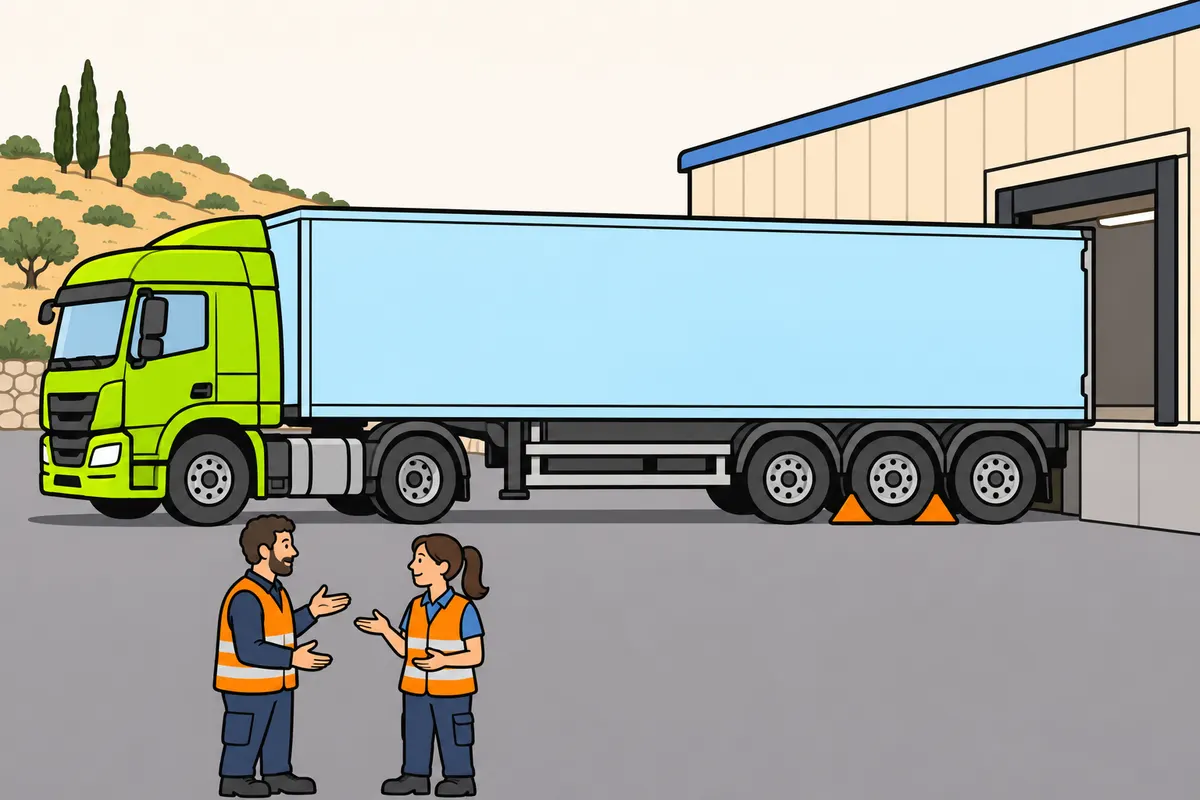
You must prepare the site and immobilise your combination before coordinating loading or unloading.
Remember
- Check ground, space and loading bay or ramp suitability for your combination.
- Immobilise your combination and coordinate the start with staff.
- Stay clear of suspended loads, trapping points and equipment manoeuvring areas.
- As a spotter, agree signals and stop the operation if communication fails.
- Before leaving, check equipment removal, closures, load security and a clear surrounding area.
Exam trap: Wrong: warehouse permission alone means you can leave. Right: you must also check your load, lights, accessories and surroundings.
Read the full explanation
- Before starting, you must check the ground's strength and levelness, the working space and the compatibility of the loading bay or ramp with the combination. Anticipate the movements of forklift trucks and people. A platform suitable for a different vehicle does not guarantee adequate capacity or geometry for yours.
- You must immobilise the combination and coordinate the start with the site's staff. As an operational guideline, use the devices provided to prevent accidental movement or departure while people or equipment are inside. Do not begin moving the vehicle until you receive confirmation that the area is clear.
- You must stay clear of the path of suspended loads, trapping points and equipment manoeuvring areas. If you act as a spotter, agree clear signals with the operator and stop the operation if communication is lost. Speed does not justify entering a danger area.
- Before leaving, you must confirm that ramps and equipment have been removed, doors and tailgates are closed and all remaining goods are secure. Also check that the surrounding area is clear. The warehouse's authorisation to leave does not replace your own check of the load, lights and accessories.
18Who may load and unload
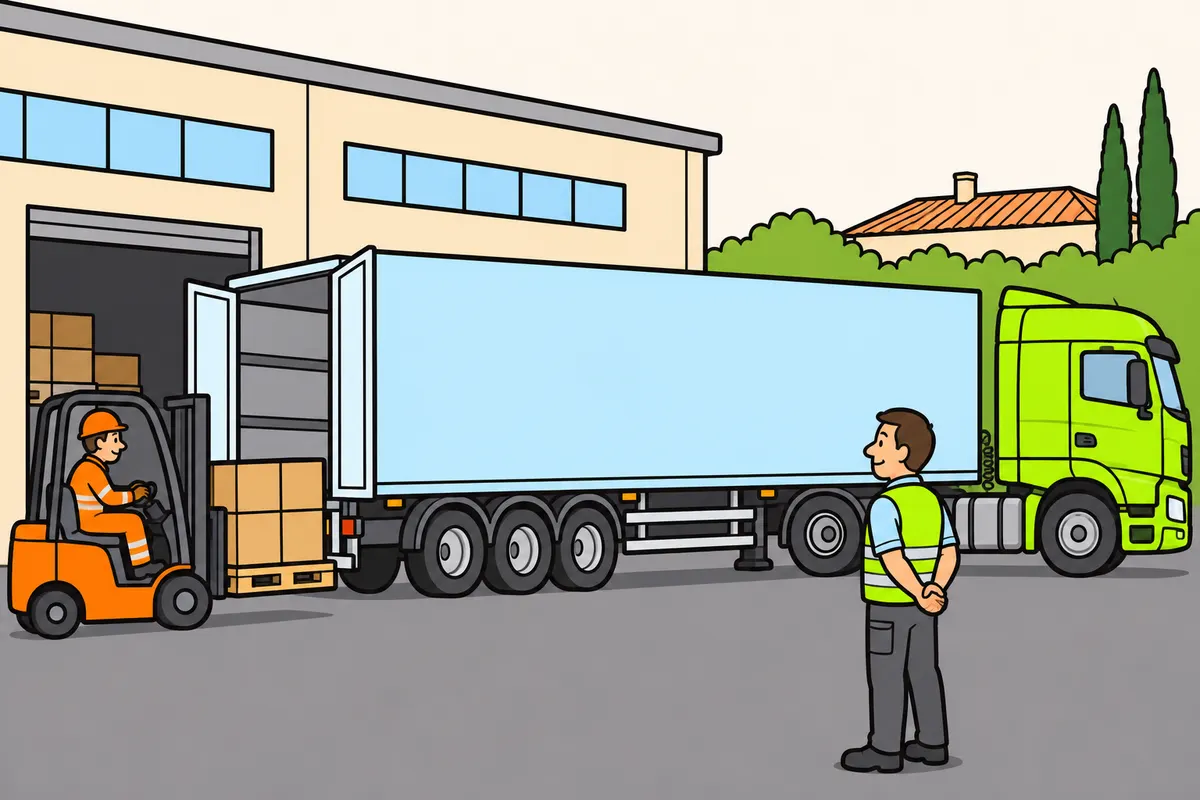
Above 7.5 tonnes maximum authorised mass, you need a legal exception to load or unload.
| Part-load freight: distribution centre and point of sale | Conditions for your participation |
|---|---|
| Unloading | Meet legal daily-rest or working-hours conditions; return to your usual operating centre or residence |
| Loading and unloading, including the reverse direction | Also require a loader–carrier contract lasting at least one year |
Remember
- In Spain, the ban also covers load carriers, packaging, containers and cages.
- Exceptions include removals, tankers, aggregates, tippers, car transporters and recovery vehicles.
- For live animals, check approved control posts and the legally allowed cases.
- For parcels, check there are few packages, easily handled by one person.
- For part-load freight, check legal rest or working-hours conditions and your return.
- Breaking the ban is a very serious transport infringement.
Exam trap: Wrong: a carrier’s agreement always lets you load. Right: in Spain, above 7.5 tonnes maximum authorised mass, you need a legal exception to participate.
Read the full explanation
- If you drive a goods vehicle with an MMA (maximum authorised mass) of more than 7.5 tonnes, you must not take part in loading or unloading goods, load carriers, packaging, containers or cages unless a legal exception applies. You must apply this rule to operations carried out in Spain, regardless of who asks you to help. [LOTT, thirteenth additional provision](https://www.boe.es/buscar/act.php?id=BOE-A-1987-17803).
- If you breach this prohibition, you commit a very serious transport offence: the company under whose direction you act and any consignor, sender, intermediary and consignee involved are presumed responsible. The offence is classified under the LOTT, separately from the RGC system of road traffic offences. [LOTT, art. 140.41](https://www.boe.es/buscar/act.php?id=BOE-A-1987-17803#a140).
- You must recognise the exceptions, which include removals and furniture storage, tankers, aggregates, tipping vehicles or vehicles with a crane or other built-in loading and unloading devices, car transporters and breakdown recovery vehicles. The exceptions also cover live animals at approved control posts and the specific cases provided for by law, as well as any established by regulations that guarantee the driver's safety. [LOTT, thirteenth additional provision](https://www.boe.es/buscar/act.php?id=BOE-A-1987-17803).
- You may take part in parcel delivery and similar services that collect or deliver a small number of packages easily handled by one person. Additional conditions apply to part-load freight between distribution centres and points of sale; you must understand part-load freight as freight requiring prior handling, consolidation, sorting or similar operations. [LOTT, thirteenth additional provision, point e)](https://www.boe.es/buscar/act.php?id=BOE-A-1987-17803).
- You may take part in unloading part-load freight between a distribution centre and the point of sale if the activity meets the legal conditions on daily rest or being carried out within your daily working hours and allows you to return to your usual operating centre or your home. To take part in both loading and unloading between these locations, including in the reverse direction, you must also meet the condition that the contract between the consignor and the carrier lasts at least one year. [LOTT, thirteenth additional provision, point e)](https://www.boe.es/buscar/act.php?id=BOE-A-1987-17803).
- You must distinguish the prohibition on driver participation from contractual obligations. As a rule, loading and unloading are the responsibility of the consignor and consignee; for the carrier to undertake them, a prior written agreement and a surcharge are required. Stowage and unstowage have their own allocation of responsibilities, with specific rules for small consignments. An agreement does not remove the prohibition on the driver. [Ley 15/2009 (Act 15/2009), art. 20](https://www.boe.es/buscar/act.php?id=BOE-A-2009-18004#a20).
19Load limits and marking
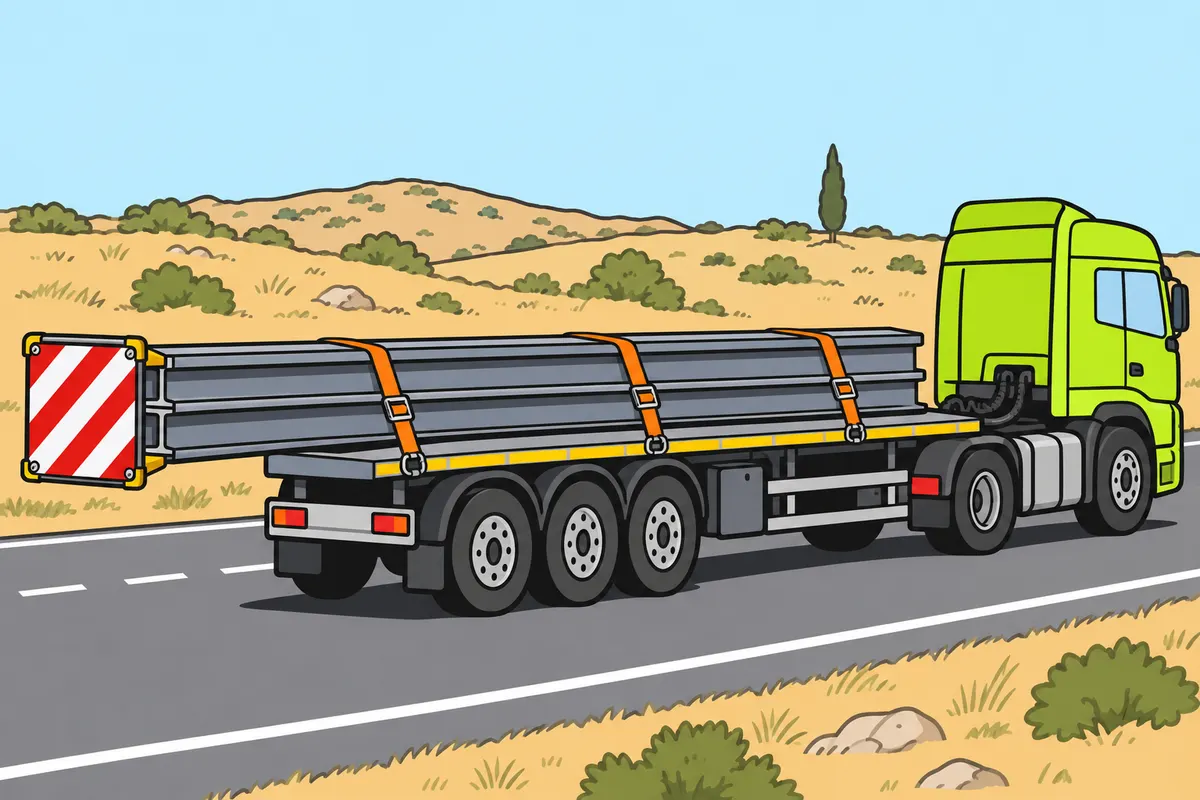
You must respect projection limits and protect and mark projecting loads for each case.
| Case on goods vehicles | Limit or marking you must follow |
|---|---|
| Items of indivisible length; vehicle exclusively for goods, over 5 m long | Up to 2 m at the front and 3 m at the rear |
| Items of indivisible length; vehicle exclusively for goods, 5 m long or less | Up to one third of the vehicle’s length at each end |
| Indivisible load whose smallest dimension exceeds the goods vehicle’s width | Up to 0.40 m on each side; total width no more than 2.55 m |
| Front projection: between sunset and sunrise or in significantly reduced visibility | Add a white light at the front |
| Rear projection: between sunset and sunrise or in significantly reduced visibility | Add a red light behind the projection marked with V-20 |
| Side projection over 0.40 m from the outer edge of the corresponding position light; at night or in significantly reduced visibility | Mark each lateral end: white light and reflector facing forwards; red light and reflector facing rearwards |
Remember
- As a general rule, keep your load within the vehicle’s outline.
- Protect projecting ends even within permitted dimensions.
- If indivisible loads unavoidably exceed maximum dimensions, you need additional authorisation to travel.
- Follow road restrictions and the conditions of your authorisation too.
- Place V-20 at any rear projection’s end, perpendicular to your vehicle’s length.
- For full-width rear projections, place two panels with stripes forming an inverted V.
Exam trap: Wrong: you measure every sideways distance from the vehicle’s side. Right: measure the permitted projection from the vehicle’s side. At night or in significantly reduced visibility, measure from the outer edge of the corresponding position light: over 0.40 m requires lights and reflectors at each lateral end.
Read the full explanation
- As a general rule, you must keep the load within the vehicle's footprint when viewed from above. On your goods vehicle combination, ordinary projections are permitted for indivisible loads under the following conditions; you must ensure safe stowage and preparation of the load. [RGC, art. 15.1](https://www.boe.es/buscar/act.php?id=BOE-A-2003-23514#a15).
- If you carry beams, poles, pipes or other items of indivisible length in a vehicle used exclusively for goods and over 5 m long, they may project up to 2 m at the front and 3 m at the rear. On vehicles 5 m long or shorter, the maximum is one third of the vehicle's length at each end, front and rear. You must apply the case that corresponds to the vehicle carrying the load. [RGC, art. 15.2.a](https://www.boe.es/buscar/act.php?id=BOE-A-2003-23514#a15).
- If the smallest dimension of an indivisible load exceeds the width of the goods vehicle, it may project up to 0.40 m on each side, provided the overall width does not exceed 2.55 m. [RGC, art. 15.2.b](https://www.boe.es/buscar/act.php?id=BOE-A-2003-23514#a15).
- You must also comply with the maximum overall dimensions of the vehicle and its load, and with road restrictions. If an indivisible load inevitably exceeds these limits, you need supplementary authorisation for the journey. See «Maximum dimensions and masses» for the limits for each configuration and the conditions for special transport. [RGC, art. 13](https://www.boe.es/buscar/act.php?id=BOE-A-2003-23514#a13).
- When the load projects beyond the vehicle, you must take the necessary precautions to prevent damage or danger and protect the projecting end to reduce the consequences of any scraping contact or collision. [RGC, art. 15.5](https://www.boe.es/buscar/act.php?id=BOE-A-2003-23514#a15).
- You must mark any rear projection with the V-20 panel, placed at the rear end of the load and kept perpendicular to the vehicle's longitudinal axis. If the lengthwise projection extends across the full rear width of the vehicle, you must place two panels transversely, one at each end of the projecting load or material, with their stripes forming an inverted V. [RGC, art. 15.6](https://www.boe.es/buscar/act.php?id=BOE-A-2003-23514#a15).
- Between sunset and sunrise, or in weather or environmental conditions that significantly reduce visibility, you must add a red light to a load projecting at the rear. If it projects at the front, you must mark that end with a white light in these conditions. [RGC, art. 15.6](https://www.boe.es/buscar/act.php?id=BOE-A-2003-23514#a15).
- If the load projects sideways and its end is more than 0.40 m from the outer edge of the front or rear position light, you must mark each projecting side end at night or in significantly reduced visibility: a white light and white reflector facing forwards; a red light and red reflector facing rearwards. You measure this distance from the corresponding position light, whereas you measure the limit for the sideways projection from the side of the vehicle. [RGC, art. 15.7](https://www.boe.es/buscar/act.php?id=BOE-A-2003-23514#a15).
- For special transport, you must apply the conditions in your authorisation for projections and their marking. Before setting off, check the position of the protective devices, panels and lights with the load fully secured; a panel fitted to a part that sways may lose its required orientation. [RGC, art. 15.8](https://www.boe.es/buscar/act.php?id=BOE-A-2003-23514#a15).
20Suspended loads and live animals
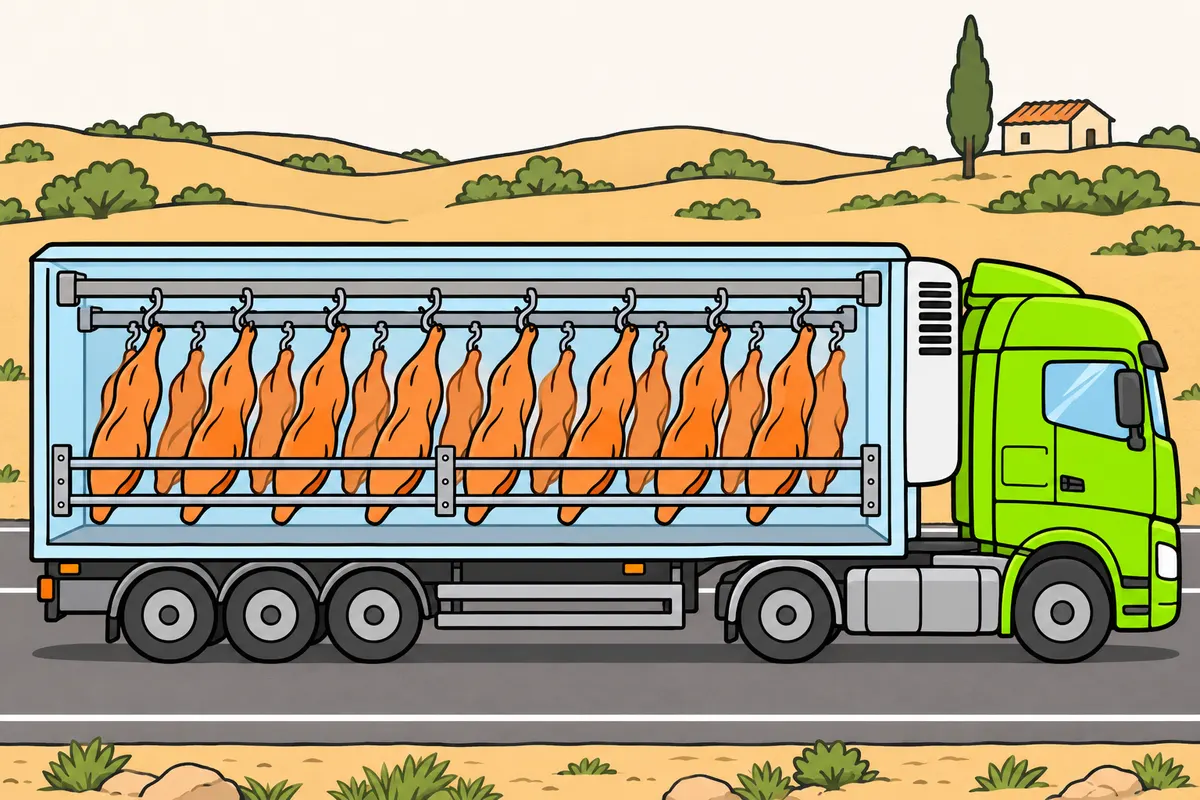
With suspended loads or live animals, you must expect balance to change while driving.
| Load you carry | Risk you must expect |
|---|---|
| Suspended goods | Swinging shifts the centre of gravity |
| Live animals | Movement changes weight distribution |
Remember
- For suspended goods, check rails, hooks, stops and restraints.
- Distribute goods between both sides and limit movement using the equipment provided.
- For animals, prepare suitable weight distribution and partitions.
- Plan braking and turns to avoid sudden movements.
- Follow specific animal protection rules too.
Exam trap: Wrong: treat animals and suspended loads as rigid, motionless goods. Right: you must expect movements that change weight distribution.
Read the full explanation
- With meat carcasses suspended from rails, you must allow for the load swinging when you brake or turn. The weight hangs from a high point and its swinging shifts the centre of gravity of the combination; you cannot treat it as rigid goods resting on the floor. Suspended loads are among the specific load hazards covered in your training. [RGCond, Annex V.B, 2.4.º.k and 2.6.º.b](https://www.boe.es/buscar/act.php?id=BOE-A-2009-9481).
- You must check the rails, hooks, stops and restraint devices in accordance with the equipment and loading plan. Distribute the carcasses between both sides and limit their movement using the equipment provided for that transport operation; securing the rail to the roof does not in itself prevent the suspended items from swinging.
- When you transport live animals, you must allow for their movements changing the distribution of mass while you drive. As with liquid surging, a moving load can shift its centre of gravity and exert forces on the vehicle, even if the combination is balanced when you set off. You must stow the load so that it remains stable. [RGC, art. 14.1.b](https://www.boe.es/buscar/act.php?id=BOE-A-2003-23514#a14).
- You must arrange the load distribution and vehicle partitions to suit the animals and the transport conditions. Anticipate braking and changes of direction to prevent sudden load movements; you must also comply with the separate legislation governing specific animal welfare requirements. [RGC, art. 14.3](https://www.boe.es/buscar/act.php?id=BOE-A-2003-23514#a14).
21Covers and bulk goods
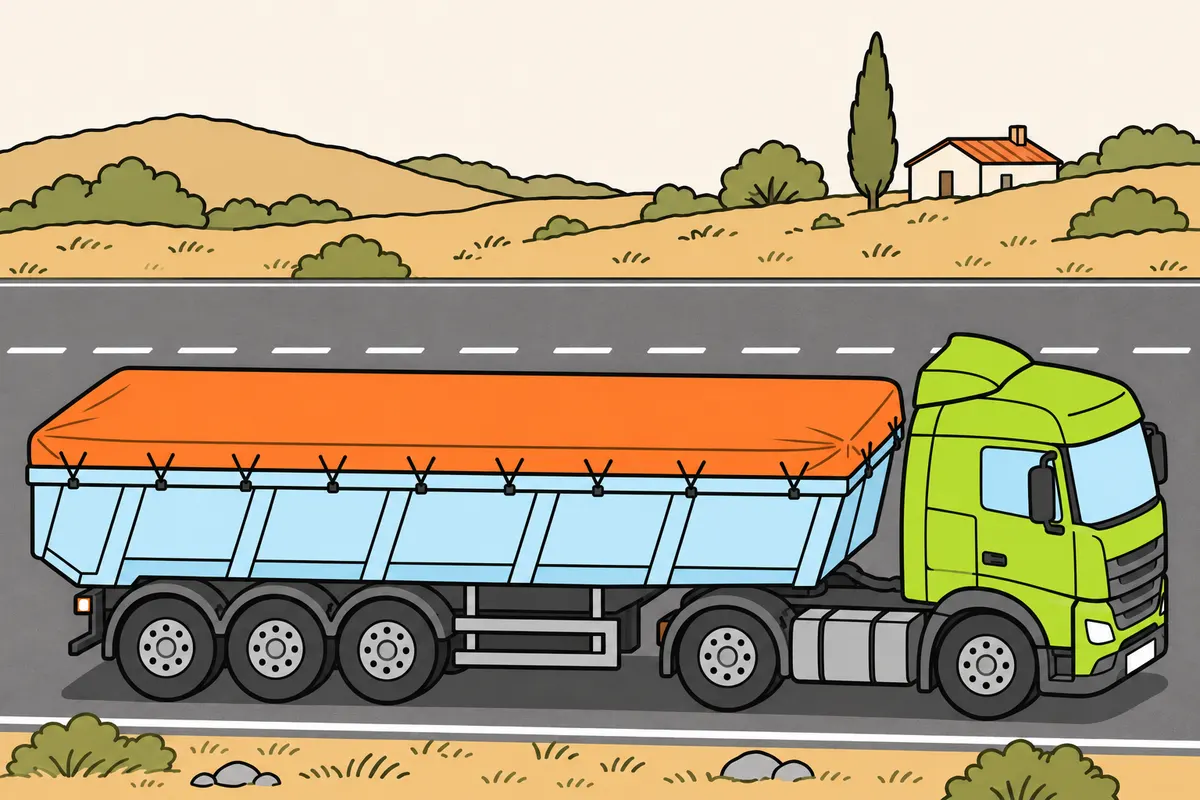
If your goods produce dust or could fall off, you must cover them completely and effectively.
Remember
- Check your cover stops dust and material escaping.
- Spread bulk goods without high heaps or excessive weight on any axle.
- Keep edges and the tailgate clear of material so they close properly.
- Secure your cover and gather ropes, tensioners and loose ends.
- Keep lights, signs and number plates visible.
- Before leaving, check for external residue and remove it in a suitable place.
Exam trap: Wrong: any tarpaulin meets the rule, even if material escapes. Right: if goods produce dust or could fall off, cover them completely and effectively.
Read the full explanation
- If you carry materials that produce dust or may fall off, you must cover them completely and effectively. You must assess the result, rather than simply whether a tarpaulin is present: a cover that is torn, open at one end or unable to contain the material does not fulfil this function. This obligation applies, for example, to sand, soil or debris liable to fall off. [RGC, art. 14](https://www.boe.es/buscar/act.php?id=BOE-A-2003-23514#a14).
- You must distribute bulk goods without heaps that unnecessarily raise the centre of gravity or concentrate mass on one axle. When preparing the load body, keep its edges and tailgate clear of material that prevents them from closing; a build-up in the joints can lead to spillage while you drive.
- You must secure the cover and gather up tensioners, ropes and loose ends so that they do not strike anything, drag or come loose. You must arrange protective accessories just as safely as the load itself. Check that they do not obscure lights, marking panels or the number plate. [RGC, art. 14](https://www.boe.es/buscar/act.php?id=BOE-A-2003-23514#a14).
- Before leaving a construction site, quarry or unloading point, you must check the tailgate, edges, platform and exterior components where loose debris may remain. As a preventive measure, remove it in a suitable place. Prevent an operation that appears complete from turning into a continuous spillage of material onto the road.
22Keep the road clean and safe
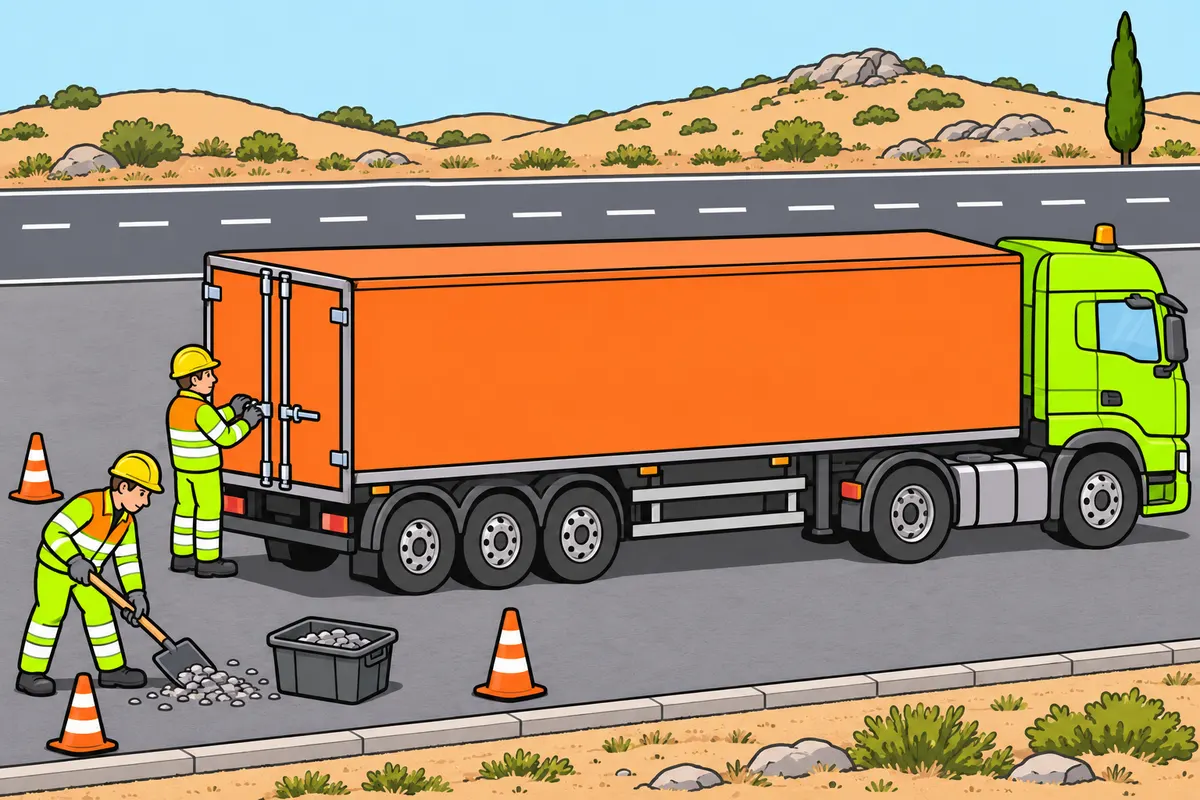
You must prevent material escaping and deal with any road danger you cause.
Remember
- Do not discard materials that obstruct traffic or damage the road.
- If you create an obstacle or danger, remove it promptly; warn others meanwhile.
- If material spills, stop safely and prevent more from escaping.
- Request suitable equipment and help to remove it.
- Do not spread slippery substances with water or push debris towards other users.
- Find and correct the cause before continuing your journey.
Exam trap: Wrong: you can continue after cleaning a spill without further checks. Right: you must also find and correct the cause of the loss.
Read the full explanation
- You must not throw, deposit or abandon materials that obstruct traffic, make it dangerous or damage the road. The risk includes both large items and aggregates, mud or liquids that affect grip. You must prevent this through your loading, fastening of closures and vehicle cleaning. [RGC, art. 4](https://www.boe.es/buscar/act.php?id=BOE-A-2003-23514#a4).
- If you create an obstruction or hazard, you must remove it as soon as possible and, in the meantime, take measures to make other road users aware of it and prevent it from obstructing traffic. [RGC, art. 5](https://www.boe.es/buscar/act.php?id=BOE-A-2003-23514#a5).
- In the event of a spill, you must stop the operation or stop driving safely, prevent further material from escaping and request suitable equipment to remove it. You must not improvise a solution by spreading a slippery substance with water or pushing debris into the path of other road users.
- You must check why the material came loose before resuming your journey: a faulty tailgate, an incorrectly secured cover, damaged packaging or insufficient restraint. Cleaning the affected area does not resolve the cause. For securing the scene when your vehicle is immobilised and alerting the emergency services, see «Responding to accidents and breakdowns».
Plan, distribute and secure
Prepare the goods and the combination before the first movement.
- Identify the mass, dimensions, centre of gravity and delivery order of the packages.
- Check the capacities of the vehicles, axles, floor and anchorage points.
- Distribute the load low down and evenly according to the loading plan.
- Eliminate dangerous movement through blocking, friction and calculated lashings.
- Check supports, equipment, fastenings, covers and the visibility of lights and plates.
- Check the distribution by weighing if you cannot substantiate it, and correct it before setting off.
Carry out partial unloading
The remaining goods must stay stable and restrained.
- Check that the location and the driver’s involvement comply with the applicable rules.
- Immobilise the combination and coordinate the operation with the staff responsible.
- Assess whether the load has shifted before opening doors or removing lashings.
- Remove the planned units without destabilising those remaining.
- Reassess axle load distribution and restore blocking and lashings.
- Close up, remove equipment and debris, and check your surroundings before moving off again.
Prepare a tanker for the road
Control mass, distribution and internal liquid movement.
- Identify the product, its density and the equipment’s filling conditions.
- Determine quantities and the order of operations according to compartments and mass limits.
- Carry out the operation with the combination immobilised and appropriate equipment.
- Check fastenings and valves and ensure there are no leaks or external residues.
- Assess the loading condition and anticipate surge in partially filled tanks.
- Reassess distribution and equipment securing after each delivery.
Assess a moving load
Distribution can change while you drive.
- Identify free liquid, suspended items or live animals.
- Assess the height of the centre of gravity and its possible lateral displacement.
- Check that compartments, restraints or partitions are suitable for the transport operation.
- Prepare to drive smoothly and anticipate events to limit surge, sway and movement.
Finished this module?
Mark it as read and you will see your progress on the theory list.