
Theory · LVA Licence - Agricultural Vehicle · Module 12 of 16
Loads, implements and agricultural traffic
You learn what you can transport with an agricultural vehicle combination and how to distribute and secure products, tools and implements. You prepare the transport position, masses, height, projections and their markings, and avoid leaving mud or materials on the road; references to other modules complete your decisions about driving on the road.
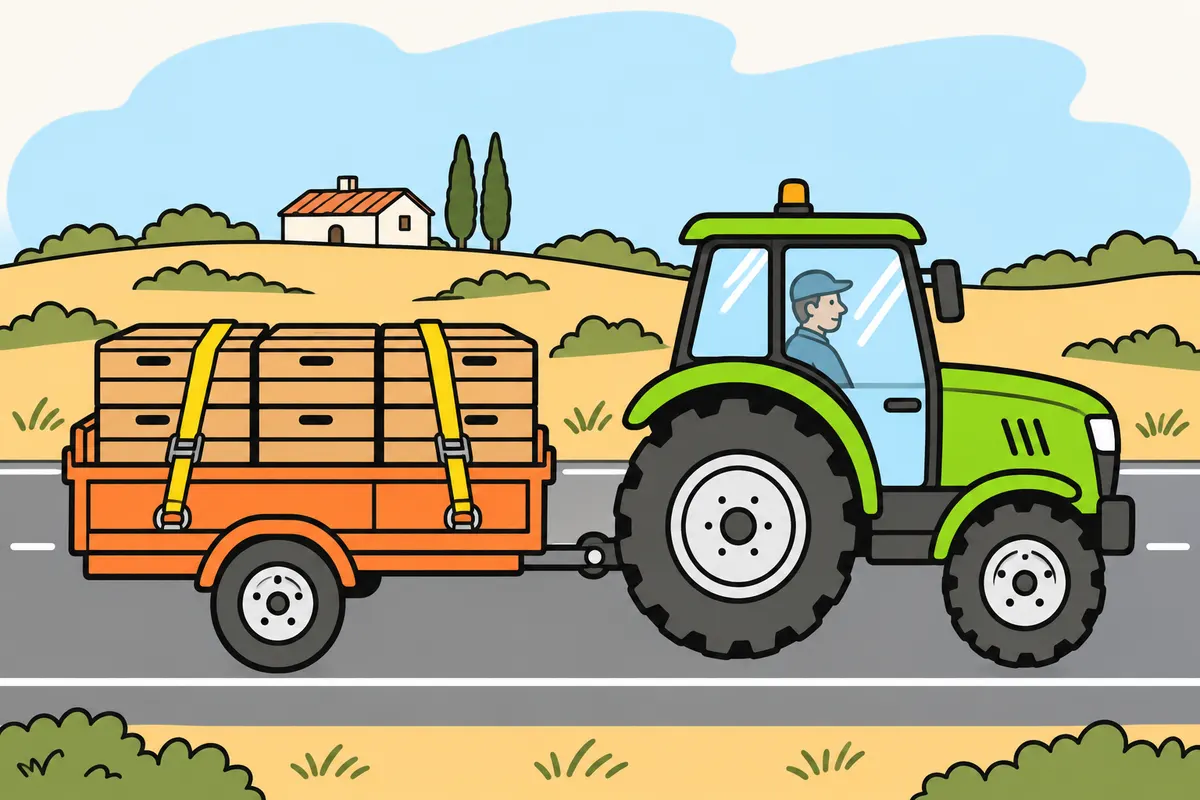
1Prepare the vehicle and route
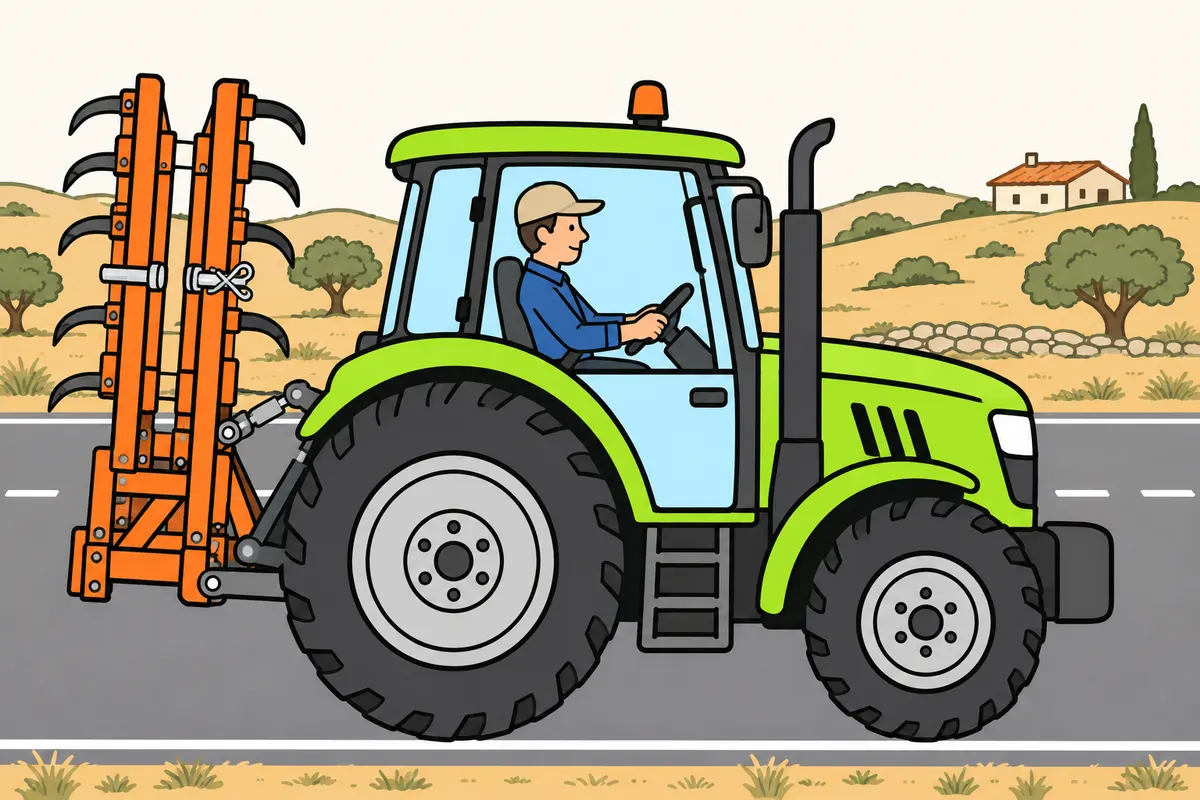
Prepare your route and secure the vehicle before setting off.
Remember
- Plan for the combination’s size, mass and low speed.
- Use an agricultural trailer for agricultural products.
- Carry passengers only in seats authorised on the ITV card.
- Check couplings, pins, locks, connections, lights and markings.
- Fold away folding implements and lock them as the manufacturer specifies.
- Use the carriageway for travel; do not plough or spray.
Exam trap: Wrong: carry agricultural products on the tractor. Right: transport them in the agricultural trailer.
Read the full explanation
- You can use the road to travel in a special vehicle, but not to carry out its work: you cannot plough or spray on the carriageway. The exceptions are road construction, repair or maintenance work within the roadworks area and vehicles specifically intended to tow vehicles that have been involved in accidents, have broken down or are incorrectly parked. [RGC, art. 71](https://www.boe.es/buscar/act.php?id=BOE-A-2003-23514#a71).
- An agricultural tractor is designed to carry or operate implements and tow machinery or trailers. Use an agricultural trailer to transport agricultural produce: it is defined as a special transport vehicle intended to be towed by agricultural vehicles, so carrying produce in it matches its design purpose. [RGV, Annex II](https://www.boe.es/buscar/act.php?id=BOE-A-1999-1826#anii).
- You can carry passengers only in the seats authorised on the tarjeta ITV (vehicle roadworthiness test card), never on mudguards, implements or in the agricultural trailer: see «The agricultural vehicle and its equipment», under «Driving position and seating places». [RGC, art. 9](https://www.boe.es/buscar/act.php?id=BOE-A-2003-23514#a9). [RGC, art. 10](https://www.boe.es/buscar/act.php?id=BOE-A-2003-23514#a10).
- Before setting off, plan your route according to the width, height, length, mass and slow speed of the vehicle and its combination. Check that you can pass through narrow sections and make the planned turns while complying with restrictions. [RGC, art. 13](https://www.boe.es/buscar/act.php?id=BOE-A-2003-23514#a13).
- Check the trailer coupling and the attachment of each implement: they must remain secure. Check pins, safety locks and connections, as well as the dimensions, lights and markings of the combination; check that the coupling is fully locked before putting it under tension. [RGC, art. 14](https://www.boe.es/buscar/act.php?id=BOE-A-2003-23514#a14).
- Before driving, fold away folding implements and place equipment in the transport position specified by the manufacturer; engage its locks and safety devices to prevent it from opening or lowering unintentionally during the journey. [RGC, art. 14](https://www.boe.es/buscar/act.php?id=BOE-A-2003-23514#a14). [DGT, Tractors, p. 42](https://www.dgt.es/export/sites/web-DGT/.galleries/downloads/conoce_la_dgt/que-hacemos/educacion-vial/adultos/no-formal/Tractores.pdf).
2Position and secure the load
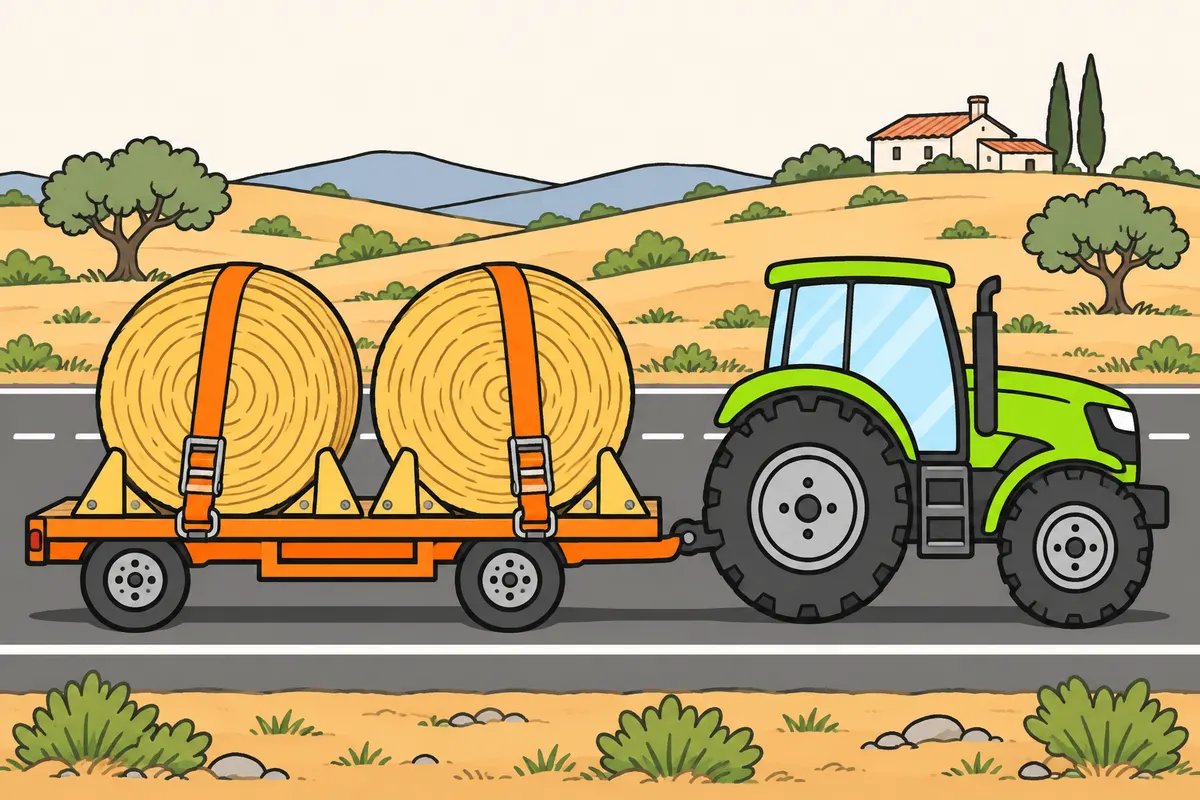
Distribute and secure your load to prevent falls, movement and overturning.
Remember
- Secure loads and carried implements against dangerous movement.
- Spread bales evenly and stack them as low as safely possible.
- Cover dusty or loose materials completely.
- Avoid preventable noise, dust and nuisance.
- If restraints slacken, stop somewhere safe and correct them.
- Chock and restrain straw rolls so they cannot roll.
Exam trap: Wrong: trust the weight of straw rolls. Right: chock and secure them against rolling.
Read the full explanation
- Arrange the load and its packing or protective accessories and secure them where necessary to prevent them from dragging, falling off wholly or partly, or shifting dangerously. Apply this precaution to any implements you transport as well. [RGC, art. 14](https://www.boe.es/buscar/act.php?id=BOE-A-2003-23514#a14).
- Distribute bales evenly and stack them as low as is compatible with safe transport: raising the load raises the centre of gravity and increases the risk of overturning, especially on bends or side slopes. [RGC, art. 14](https://www.boe.es/buscar/act.php?id=BOE-A-2003-23514#a14).
- You must not arrange the load in a way that compromises stability or causes avoidable noise, dust or other nuisance. If you transport materials that produce dust or could fall off, cover them completely and effectively. [RGC, art. 14](https://www.boe.es/buscar/act.php?id=BOE-A-2003-23514#a14).
- Check that lashings remain effective during braking, on bends and when changing course; if you notice movement or loosening, stop somewhere safe and correct the cause before continuing. [RGC, art. 14](https://www.boe.es/buscar/act.php?id=BOE-A-2003-23514#a14).
- Secure round straw bales against rolling and shifting with suitable supports and lashings; their cylindrical shape means you must prevent them from rolling during braking or turning, even if they are heavy. [RGC, art. 14](https://www.boe.es/buscar/act.php?id=BOE-A-2003-23514#a14).
3Respect weight limits and maintain visibility
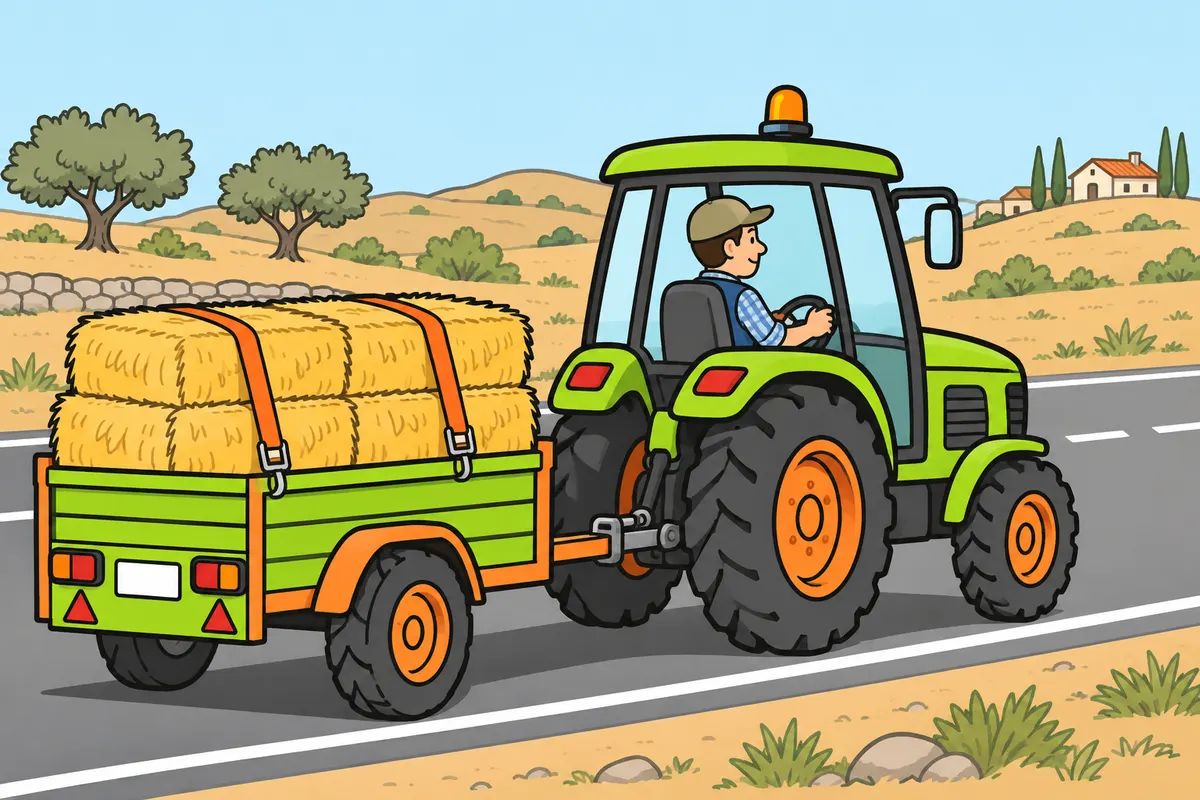
Respect permitted weights and keep your view and controls clear.
Remember
- Respect the maximum authorised mass of your vehicle, each axle and the combination.
- Check how much your tractor can tow and the road limits.
- Reduce an overweight load; slowing down does not correct overloading.
- Keep lights, plates, markings and hand signals visible.
- For indivisible loads exceeding limits, check supplementary authorisation, its conditions and driving entitlement.
- Count the weight of counterweights specified by the manufacturer.
Exam trap: Wrong: ballast lets you carry more. Right: ballast counts towards weight and does not increase authorised masses.
Read the full explanation
- Do not exceed the vehicle’s MMA (maximum authorised mass) or the limits for each axle, the combination or the road. Also check the tractor’s permitted maximum towable mass: being able to couple the trailer or fit the whole load into it does not show that you can transport it legally. You must comply with the manufacturer’s technical conditions and the limits applicable to the specific combination. [RGV, art. 14 and Annex IX](https://www.boe.es/buscar/act.php?id=BOE-A-1999-1826#a14).
- Overloading can impair stability, steering, control and braking. Adjust the amount you carry to comply with the authorised masses before setting off: reducing your speed does not correct excess mass. [RGV, art. 14](https://www.boe.es/buscar/act.php?id=BOE-A-1999-1826#a14).
- You must not let the load or implements obscure lights, light-signalling devices, compulsory plates or markings, or your hand signals. Check their visibility from outside before setting off. [RGC, art. 14](https://www.boe.es/buscar/act.php?id=BOE-A-2003-23514#a14).
- Maintain your freedom of movement, attention and control of the vehicle throughout the journey; adjust your driving position so that you can operate the controls without interference from the load or any objects you carry. [RGC, art. 18](https://www.boe.es/buscar/act.php?id=BOE-A-2003-23514#a18).
- If you need to transport an indivisible load that exceeds the regulatory limits, you need the appropriate supplementary road-use authorisation and must comply with its conditions. You cannot resolve this by distributing the excess between the axles or adding a panel: you must first check that the transport operation and your driving entitlement allow that journey. [RGC, art. 13](https://www.boe.es/buscar/act.php?id=BOE-A-2003-23514#a13).
- If you need ballast to balance an implement, use the counterweights and fastenings specified by the manufacturer and include their mass when checking the limits for the tractor and each axle; ballast does not increase the authorised masses. [RGV, art. 14](https://www.boe.es/buscar/act.php?id=BOE-A-1999-1826#a14).
4Width of the tractor and equipment
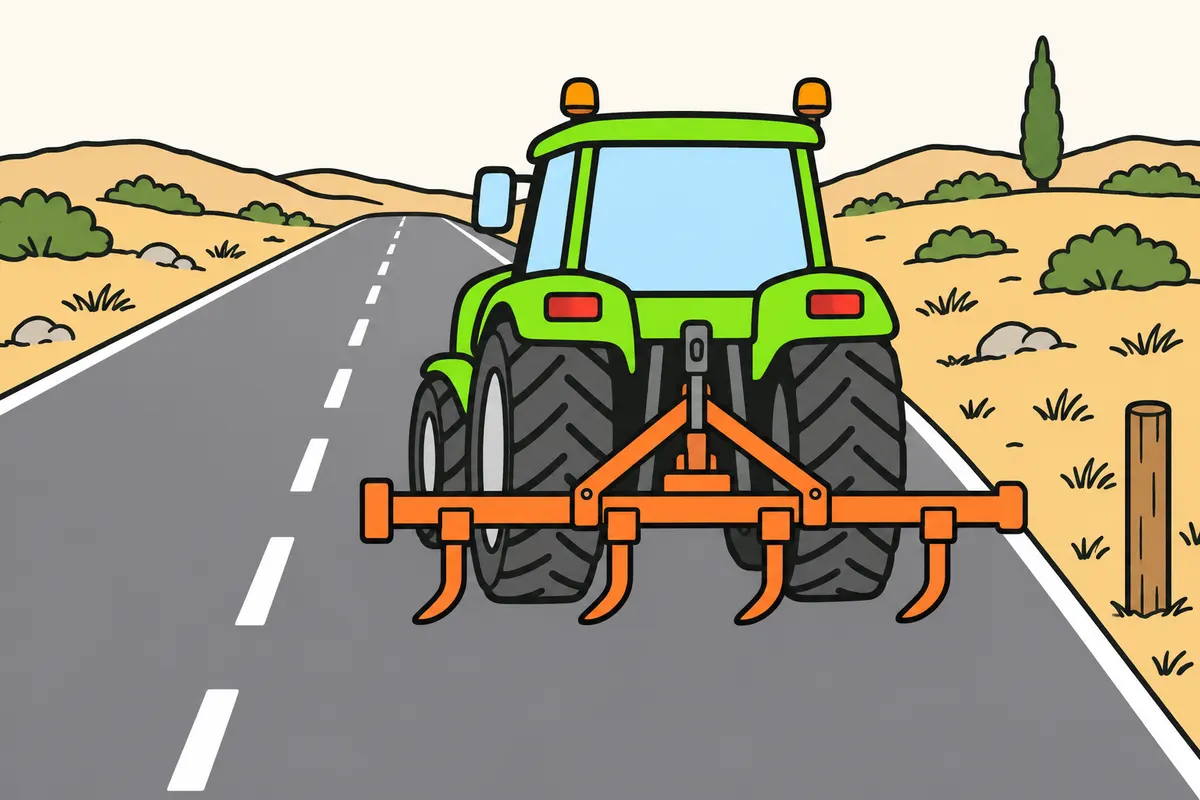
Calculate your equipment’s legal width and leave space for all its parts.
| Vehicle or equipment | Width calculation; ordinary maximum length where stated |
|---|---|
| Agricultural tractors, carriers, walking tractors, agricultural transporters and their trailers | Use stationary width, including the load. |
| Tools, implements and equipment mounted, fully mounted or semi-mounted on tractors or walking tractors | Start with stationary width. Deduct only the projection beyond the outer face of the right wheels, up to 0.50 m. |
| Agricultural machines | Subtract 0.50 m from stationary width. Do not subtract if folding or removable parts remain unfolded or attached. |
| Other machines | Use their actual stationary width. |
| Motor vehicle or trailer | Ordinary maximum length: 12.00 m. |
| Articulated vehicle: tractor with agricultural semi-trailer | Ordinary maximum length: 16.50 m. |
| Road train | Ordinary maximum length: 18.75 m. |
Remember
- For a combination, use the greatest calculated width; do not add widths.
- Measure clearance from the parts that project furthest.
- Check available height with the implement raised too.
- The legal deduction does not reduce the physical space you occupy.
- Measure with your load and implements in their transport position.
- You need category B above ordinary masses, dimensions or 45 km/h design speed.
Exam trap: Wrong: deduct a left-side implement projection. Right: deduct only the projection beyond the right wheels, up to 0.50 m.
Read the full explanation
- For agricultural tractors, carriers, walking tractors, agricultural transporters and their trailers, you must take the width for road use as the width of the stationary vehicle, including its load. For an agricultural combination, you must use the greatest of the individual widths calculated under the rules for each category, rather than adding the widths of the tractor and trailer. [RGV, Annex IX, section 3.3](https://www.boe.es/buscar/act.php?id=BOE-A-1999-1826#anix).
- For tools, implements and equipment mounted, fully mounted or semi-mounted on tractors or walking tractors, you must start with the width of the stationary equipment. You can deduct the distance it projects to the right beyond the outer face of the wheels on that side, up to a maximum deduction of 0.50 metres; you cannot deduct any projection on the left. [RGV, Annex IX, section 3.3.2](https://www.boe.es/buscar/act.php?id=BOE-A-1999-1826#anix).
- For agricultural machines, you must calculate the width for road use by subtracting 0.50 metres from the width of the stationary machine. This reduction does not apply when the machine has folding or removable parts which you have not folded away or removed. For other machines, you must use their actual stationary width. [RGV, Annex IX, sections 3.3.3 and 3.3.4](https://www.boe.es/buscar/act.php?id=BOE-A-1999-1826#anix).
- The regulatory width deduction does not reduce the physical space the equipment occupies. When passing posts, pedestrians or vehicles, calculate your clearance from the parts that project furthest and check the available height, including with the implement raised. [RGC, art. 13](https://www.boe.es/buscar/act.php?id=BOE-A-2003-23514#a13).
- The ordinary maximum width is 2.55 metres and the ordinary maximum height, including the load, is 4 metres. The ordinary maximum length is 12.00 metres for a motor vehicle or trailer, 16.50 metres for an articulated vehicle and 18.75 metres for a road train. A tractor with an agricultural semi-trailer forms an articulated vehicle, so you must assess it against the 16.50-metre limit. These length limits also count when determining whether the combination falls within the LVA entitlement explained in the next point. Measure the combination as prepared for road use, with implements in their transport position and the load in place; apply the regulatory calculation explained in this section to the agricultural width. [RGV, Annex IX](https://www.boe.es/buscar/act.php?id=BOE-A-1999-1826#anix).
- If your agricultural vehicle or combination exceeds the maximum masses or dimensions authorised for ordinary vehicles, or its maximum design speed exceeds 45 km/h, you need a category B driving licence. A supplementary road-use authorisation does not extend your LVA entitlement. [RGCond, art. 5.9](https://www.boe.es/buscar/act.php?id=BOE-A-2009-9481#a5).
5Tools and objects inside the cab
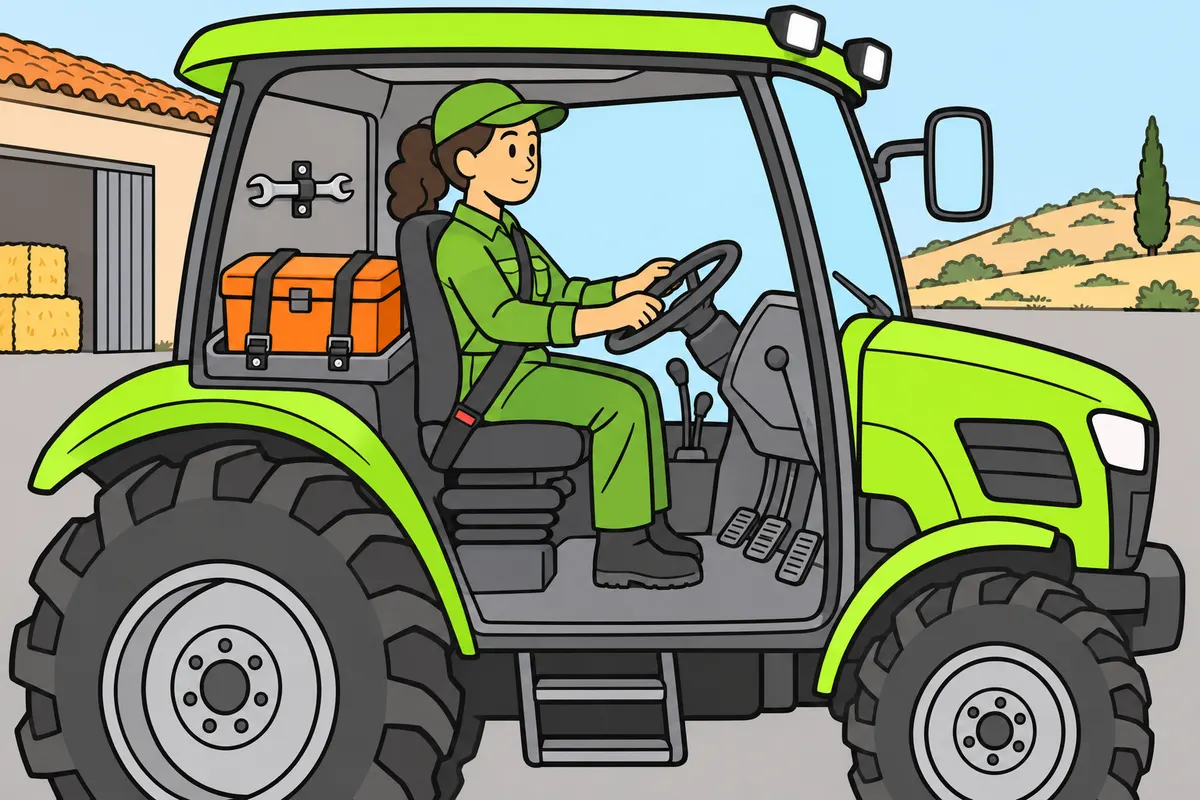
Secure objects inside your cab and keep the view you need.
Remember
- Secure tools and boxes away from pedals and controls.
- Clean windows and mirrors; adjust mirrors before setting off.
- If your load or implement blocks your view, correct its position.
Exam trap: Wrong: a helper replaces the view you need. Right: correct the position before driving.
Read the full explanation
- You must secure small tools and boxes inside the cab, away from the pedals and controls, so that they cannot move or interfere with driving. [RGC, art. 18](https://www.boe.es/buscar/act.php?id=BOE-A-2003-23514#a18).
- Keep windows and mirrors clean and adjust the rear-view mirrors before setting off to maintain the field of vision you need. [RGC, art. 18](https://www.boe.es/buscar/act.php?id=BOE-A-2003-23514#a18).
- If the load or an implement blocks the field of vision you need, correct its position before driving; help from another person during a specific manoeuvre does not replace the visibility you need during the journey. [RGC, art. 18](https://www.boe.es/buscar/act.php?id=BOE-A-2003-23514#a18).
6Load and unload away from traffic
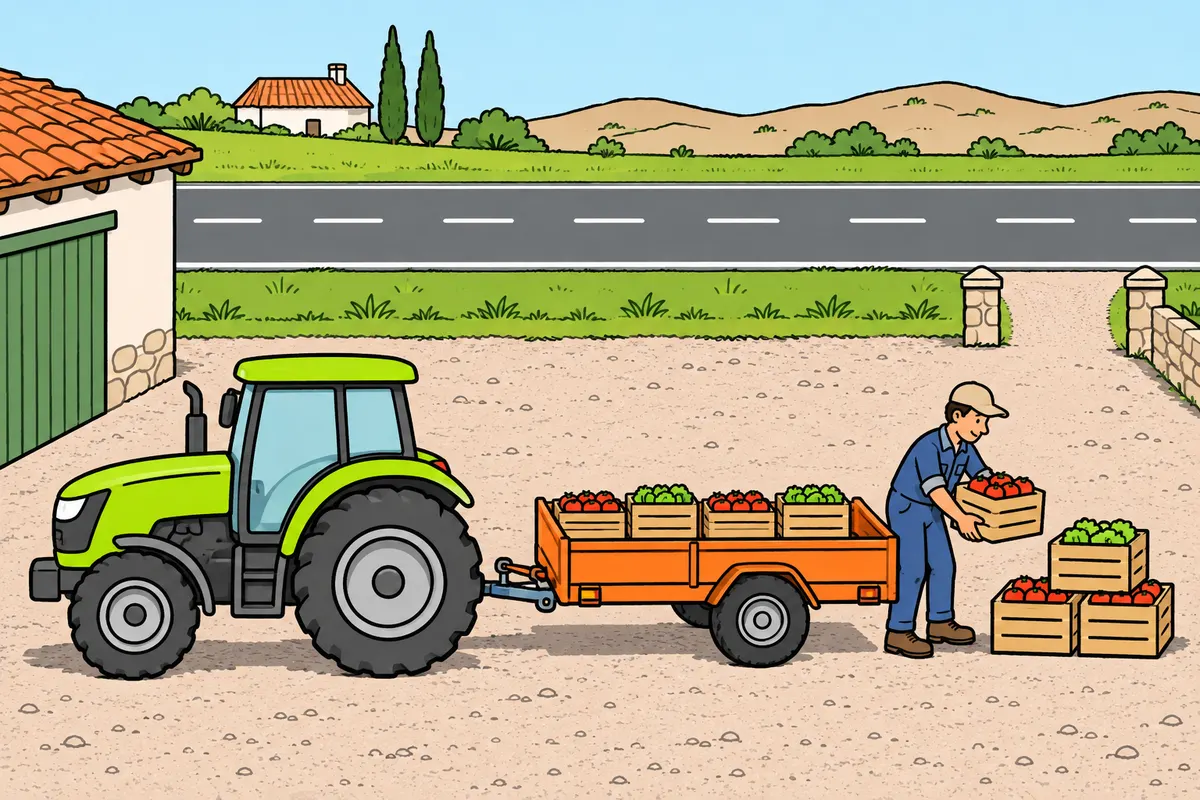
Load and unload off the road, and check your combination before continuing.
Remember
- Load and unload off the road unless using it is unavoidable.
- For this exception, avoid danger and serious disruption; follow stopping and parking rules.
- In built-up areas, also follow municipal rules on times and places.
- Work on the side nearest the carriageway edge when possible.
- Do not leave goods on carriageways, hard shoulders or pedestrian areas, even temporarily.
- Before driving, check restraints, distribution and covering; lower the body and secure catches.
Exam trap: Wrong: unload on the road for convenience. Right: do so only when unavoidable and meeting all conditions.
Read the full explanation
- You must load and unload off the road. You can use the exception allowing you to do so on the road only when it is unavoidable, and you must avoid danger and serious disruption: the convenience of bringing the tractor close to a pile of materials is not sufficient reason to block the road. [RGC, art. 16](https://www.boe.es/buscar/act.php?id=BOE-A-2003-23514#a16).
- If you exceptionally carry out the operation on the road, you must comply with stopping and parking rules and, in built-up areas, municipal requirements on times and places. Whenever possible, carry out the operation on the side of the vehicle nearest the edge of the carriageway to reduce exposure to traffic. [RGC, art. 16](https://www.boe.es/buscar/act.php?id=BOE-A-2003-23514#a16).
- You must have sufficient means to finish quickly and avoid unnecessary noise and nuisance. You cannot leave goods on the carriageway, the arcén (hard shoulder) or pedestrian areas while rearranging the trailer: this prohibition also covers placing them there temporarily during the operation. [RGC, art. 16](https://www.boe.es/buscar/act.php?id=BOE-A-2003-23514#a16).
- Before moving off again, you must close and secure the load body’s panels and check the distribution and covering of the load. If you have unloaded only part of it, check that what remains cannot shift; lashings that were suitable with the trailer full may need readjusting. [RGC, art. 14](https://www.boe.es/buscar/act.php?id=BOE-A-2003-23514#a14).
- With a tipping trailer, lower the body fully before driving and secure its catches and transport position in accordance with the manufacturer’s instructions; a raised body increases the height of the combination and impairs its stability. [RGC, art. 13](https://www.boe.es/buscar/act.php?id=BOE-A-2003-23514#a13). [RGC, art. 14](https://www.boe.es/buscar/act.php?id=BOE-A-2003-23514#a14).
7How far the load may project
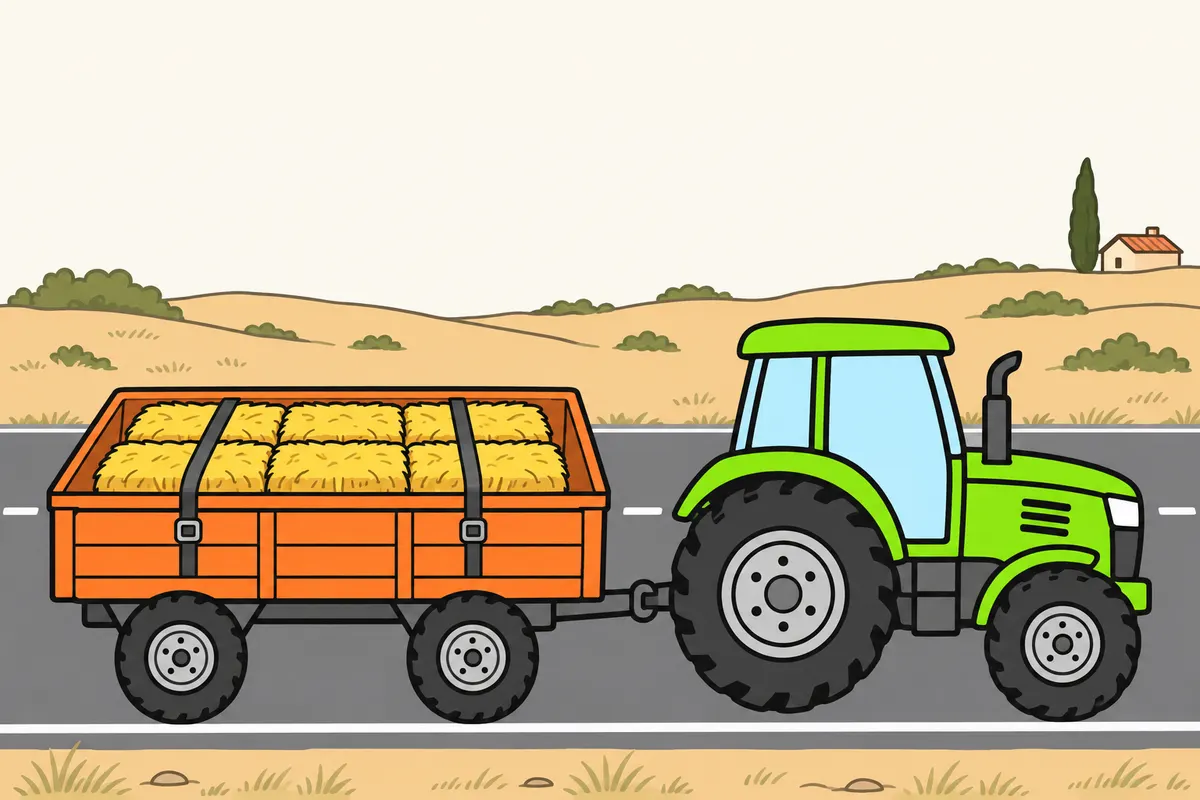
Your load may project only in permitted cases and under their conditions.
| Vehicles and load type | Condition | Permitted projection |
|---|---|---|
| Goods-only vehicles; load of indivisible length | Vehicle over 5 m long | Up to 2 m front and 3 m rear. |
| Goods-only vehicles; load of indivisible length | Vehicle 5 m long or less | Up to one third of vehicle length at each end. |
| Goods-only vehicles; indivisible load | The load’s smaller dimension exceeds vehicle width | Up to 0.40 m each side, without exceeding 2.55 m total width. |
| Vehicles not exclusively for goods | Except the specific rule for vehicles under 1 m wide | Rear: up to 10% of vehicle length; 15% if the load is indivisible. |
| Vehicles under 1 m wide | Specific rule | Up to 0.50 m each side of the longitudinal centre line; none front; up to 0.25 m rear. |
Remember
- As a general rule, keep your load within the vehicle’s outline.
- Check whether your agricultural trailer is intended exclusively for goods.
- Distinguish your carried load from an attached implement.
- Do not automatically apply goods-only vehicle rules to your tractor.
- For goods-only vehicles, keep divisible loads, such as separate bales, inside the outline.
- For other vehicles, you can apply the rear allowance to divisible loads.
Exam trap: Wrong: measure 0.50 m from the side of vehicles under 1 m wide. Right: measure from the longitudinal centre line.
Read the full explanation
- As a general rule, your load must not project beyond the outline of the vehicle when viewed from above. You may drive with a projecting load only if it falls within a regulatory exception and meets its conditions; marking it does not make excessive dimensions legal. Distinguish the load you carry from the dimensions and conditions of an attached implement. [RGC, art. 15](https://www.boe.es/buscar/act.php?id=BOE-A-2003-23514#a15).
- On vehicles intended exclusively for carrying goods, a load of indivisible length may project 2 metres at the front and 3 at the rear if the vehicle is more than 5 metres long; if it is 5 metres long or less, the load may project by one third of the vehicle’s length at each end. If the smaller dimension of an indivisible load exceeds the vehicle’s width, it may project up to 0.40 metres on each side without exceeding a total width of 2.55 metres. [RGC, art. 15](https://www.boe.es/buscar/act.php?id=BOE-A-2003-23514#a15).
- On vehicles not intended exclusively for carrying goods, your load may project at the rear by up to 10 % of the vehicle’s length, or 15 % if it is indivisible. On vehicles less than 1 metre wide, the specific rule applies: up to 0.50 metres on either side of the longitudinal axis, nothing at the front and up to 0.25 metres at the rear. [RGC, art. 15](https://www.boe.es/buscar/act.php?id=BOE-A-2003-23514#a15).
- To apply these limits to an agricultural trailer, identify whether it is intended exclusively for goods: if so, paragraph 2 applies and a divisible load remains within the vehicle’s outline when viewed from above. If it is not intended exclusively for goods, paragraph 3 applies, including its permitted rear projection for divisible loads. The definition of a special transport vehicle in Annex II does not expressly assign the trailer to either of these paragraphs; you must confirm the vehicle’s intended use before choosing an exception. Several separable bales constitute a divisible load. [RGC, art. 15](https://www.boe.es/buscar/act.php?id=BOE-A-2003-23514#a15). [RGV, Annex II](https://www.boe.es/buscar/act.php?id=BOE-A-1999-1826#anii).
8Panels and lights for projecting loads
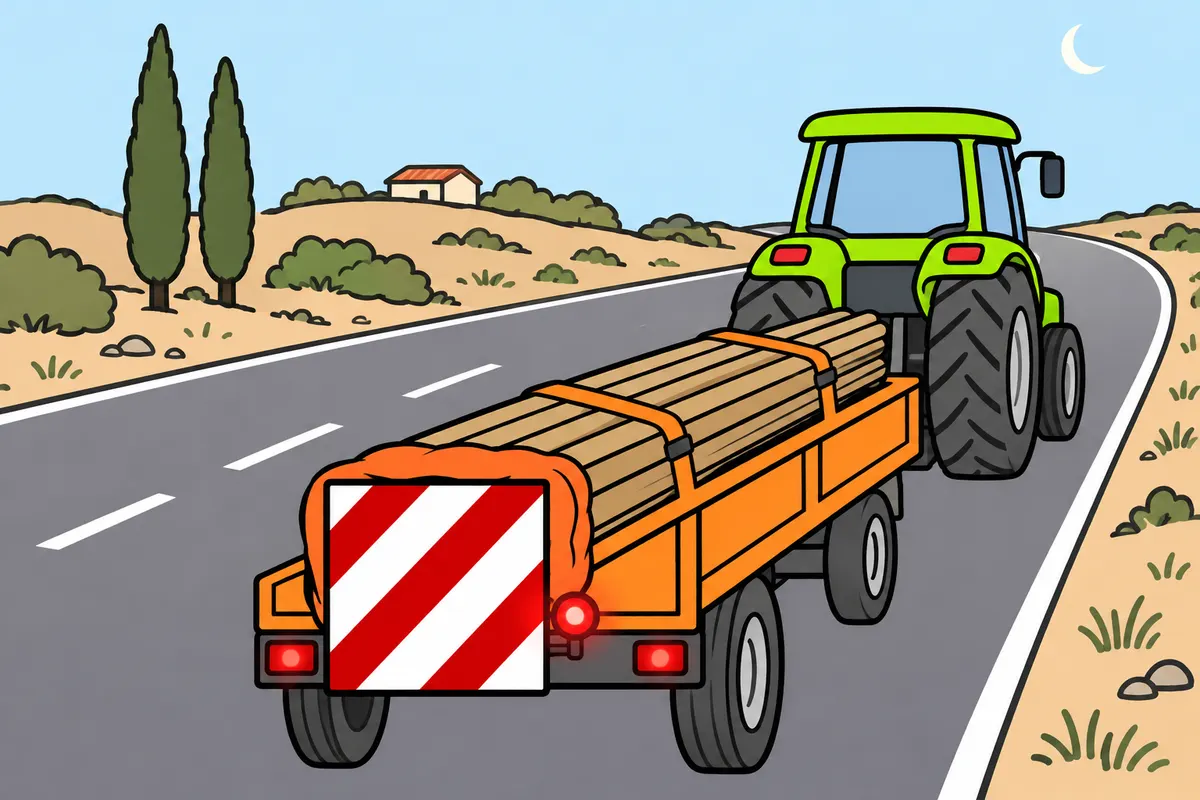
Protect and mark permitted projections with the required panels and lights.
| Permitted load projection | Lights between sunset and sunrise, or with significantly reduced visibility |
|---|---|
| Rear | Add a red light. |
| Front | Mark with a white light. |
| Side: end more than 0.40 m beyond the outer edge of front or rear position lights | Mark the ends with white lights and reflectors facing forwards, and red ones facing backwards. |
Remember
- Protect the ends of permitted projections.
- For general rear load projections, place V-20 perpendicular to the axis, at the end.
- Across the full rear width, use two end panels, forming an inverted V.
- Between sunset and sunrise, or with significantly reduced visibility, add lights.
- Check extra implement markings; keep them clean and visible.
- Distinguish distances measured from position lights from those measured from the vehicle.
Exam trap: Wrong: V-20 allows any excess. Right: marking does not legalise excessive projections or replace required lights.
Read the full explanation
- If you have a permitted projection, protect its end to reduce the consequences of scrapes or collisions and take the necessary precautions. A load projecting at the rear in the general transport cases must carry the V-20 panel with diagonal red and white stripes, perpendicular to the vehicle’s axis and at the rear end of the load. If it projects lengthways across the full rear width, use two panels, one at each end, forming an inverted V. [RGC, art. 15](https://www.boe.es/buscar/act.php?id=BOE-A-2003-23514#a15).
- Between sunset and sunrise, or when visibility is significantly reduced, add a red light to a load projecting at the rear; if it projects at the front, mark it with a white light. If a side projection extends more than 0.40 metres beyond the outer edge of the front or rear position lights, mark its ends in these conditions with a white light and reflector facing forwards and a red light and reflector facing backwards. [RGC, art. 15](https://www.boe.es/buscar/act.php?id=BOE-A-2003-23514#a15).
- For implements, check and use the additional markings and lights required for their configuration and dimensions, especially if they obstruct the view of those fitted to the tractor. Keep their surfaces free of mud and straw. [RGC, art. 15](https://www.boe.es/buscar/act.php?id=BOE-A-2003-23514#a15).
- The two references to 0.40 metres have different purposes: one limits certain side projections of indivisible loads and the other determines the additional lighting required according to the distance from the end of the load to the position lights. You do not measure them from the same point, and they do not serve the same purpose; complying with one does not remove the other requirement. [RGC, art. 15](https://www.boe.es/buscar/act.php?id=BOE-A-2003-23514#a15).
9Keep the road clean and remove hazards you cause
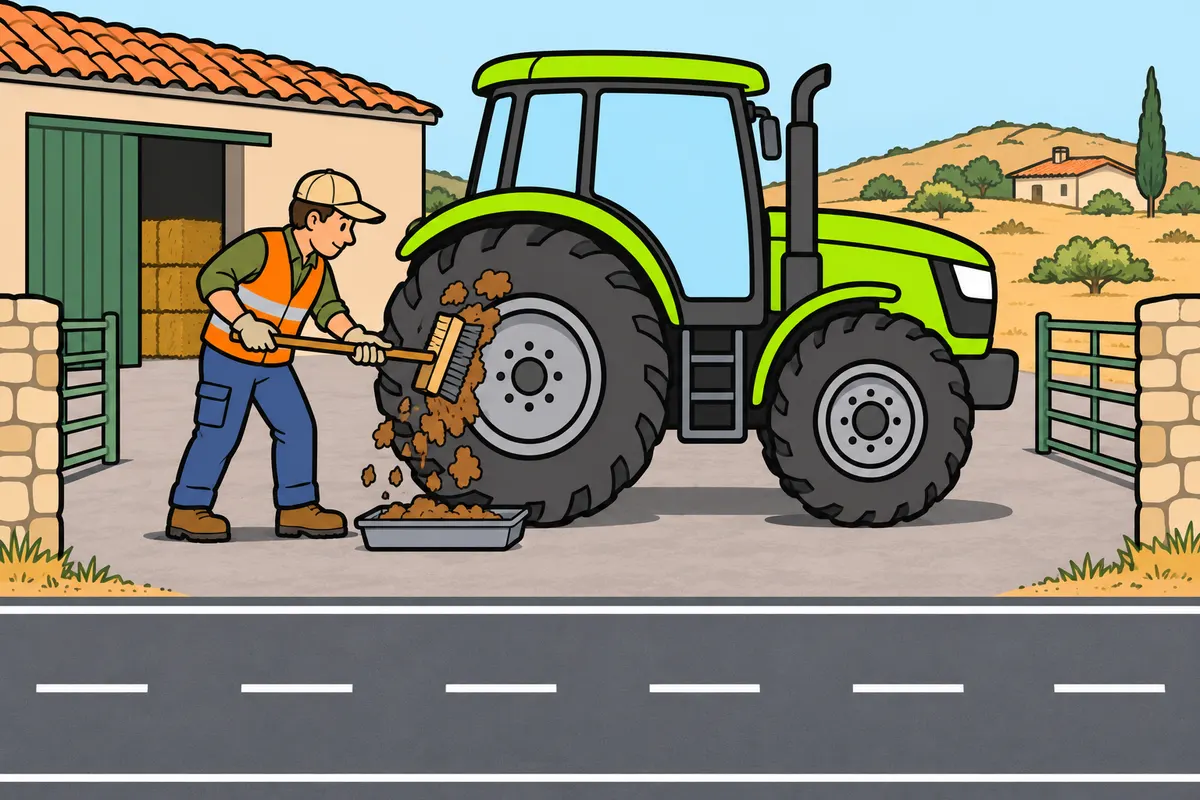
Keep mud and debris off the road, and remove hazards you cause.
Remember
- Before leaving fields, avoid carrying mud or debris onto the road.
- Do not shake earth onto the hard shoulder.
- Do not throw or leave materials that obstruct traffic or make it dangerous.
- Remove a hazard you cause as soon as possible.
- While removing it, mark it effectively by day and night.
Exam trap: Wrong: mark the mud and leave it. Right: if you caused the hazard, mark it while removing it as soon as possible.
Read the full explanation
- Before leaving a field or property, take care that your wheels, load and implements do not drag mud, soil or debris onto the road. These materials can reduce grip and cause other road users to lose control. Do not use the arcén (hard shoulder) to shed accumulated soil. [RGC, art. 4](https://www.boe.es/buscar/act.php?id=BOE-A-2003-23514#a4).
- Do not throw, deposit or leave materials that obstruct traffic or make it dangerous. If you cause an obstruction or hazard, you must remove it as soon as possible and, in the meantime, mark it effectively so that others can see it, by day and by night. [RGC, art. 5](https://www.boe.es/buscar/act.php?id=BOE-A-2003-23514#a5).
10Rules for driving the combination
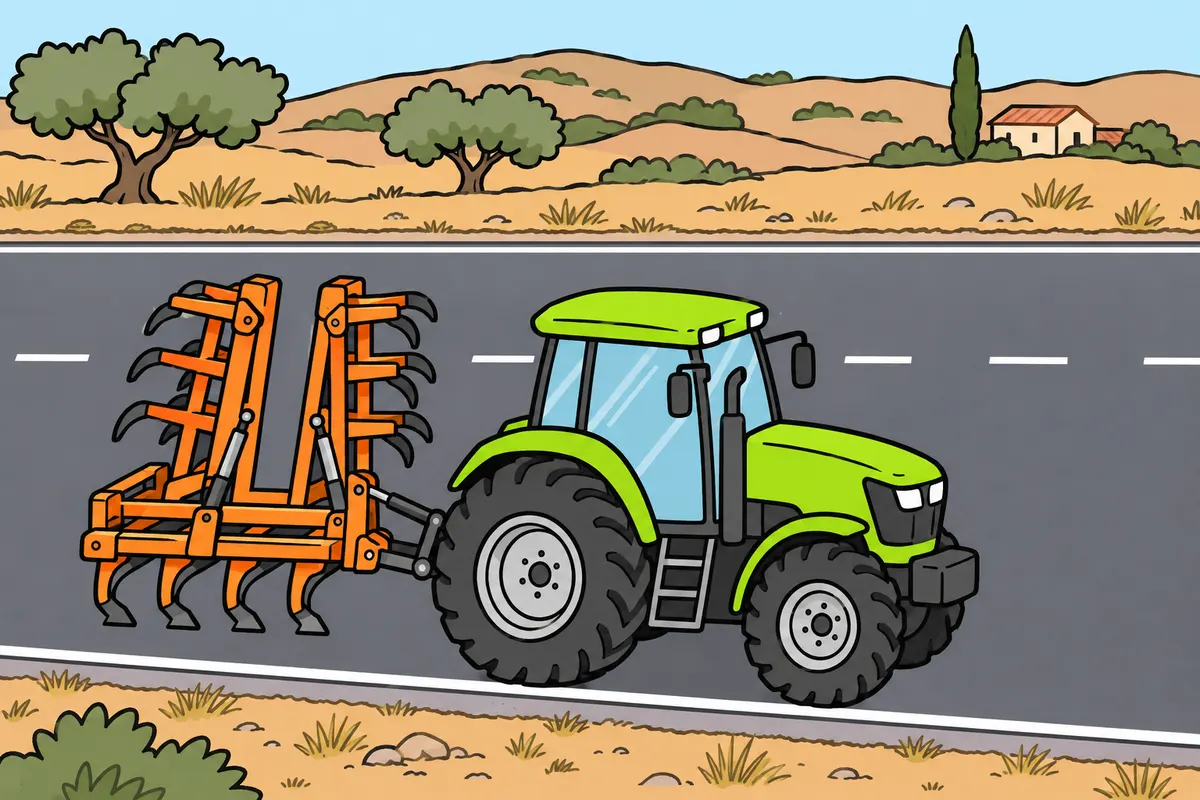
Apply rules to your whole combination and check that the road edge supports it.
Remember
- Road rules apply to the tractor, trailer and load together.
- See “Road use with agricultural vehicles” for hard shoulders, carriageways and lanes.
- See “Speed and distances for agricultural vehicles” for limits and separation.
- See “Manoeuvres with agricultural vehicles” for joining, turning, overtaking, reversing and parking.
- Before approaching the edge, check it supports your loaded trailer.
- Include your load’s actual width as well as your tractor’s width.
Exam trap: Wrong: choose without considering all your equipment. Right: consider its weight and the space it occupies.
Read the full explanation
- Apply the traffic rules to the whole combination, including the load: for the hard shoulder, carriageway and lanes, consult «Road use with agricultural vehicles»; for speed limits and separation distances, «Speed and distances for agricultural vehicles»; for joining traffic, turning, overtaking, reversing and parking, «Manoeuvres with agricultural vehicles». The following sections detail the risks of loaded equipment. [RGC, arts. 36, 48, 52 and 54](https://www.boe.es/buscar/act.php?id=BOE-A-2003-23514#a36).
- Before moving close to the edge, assess whether the ground can support the wheels of the loaded trailer: a narrow or soft hard shoulder can leave part of the combination unsupported. Base your decision on the actual width of the load, not just the tractor’s width. [RGC, art. 13](https://www.boe.es/buscar/act.php?id=BOE-A-2003-23514#a13).
11Observation, anticipation and use of the controls
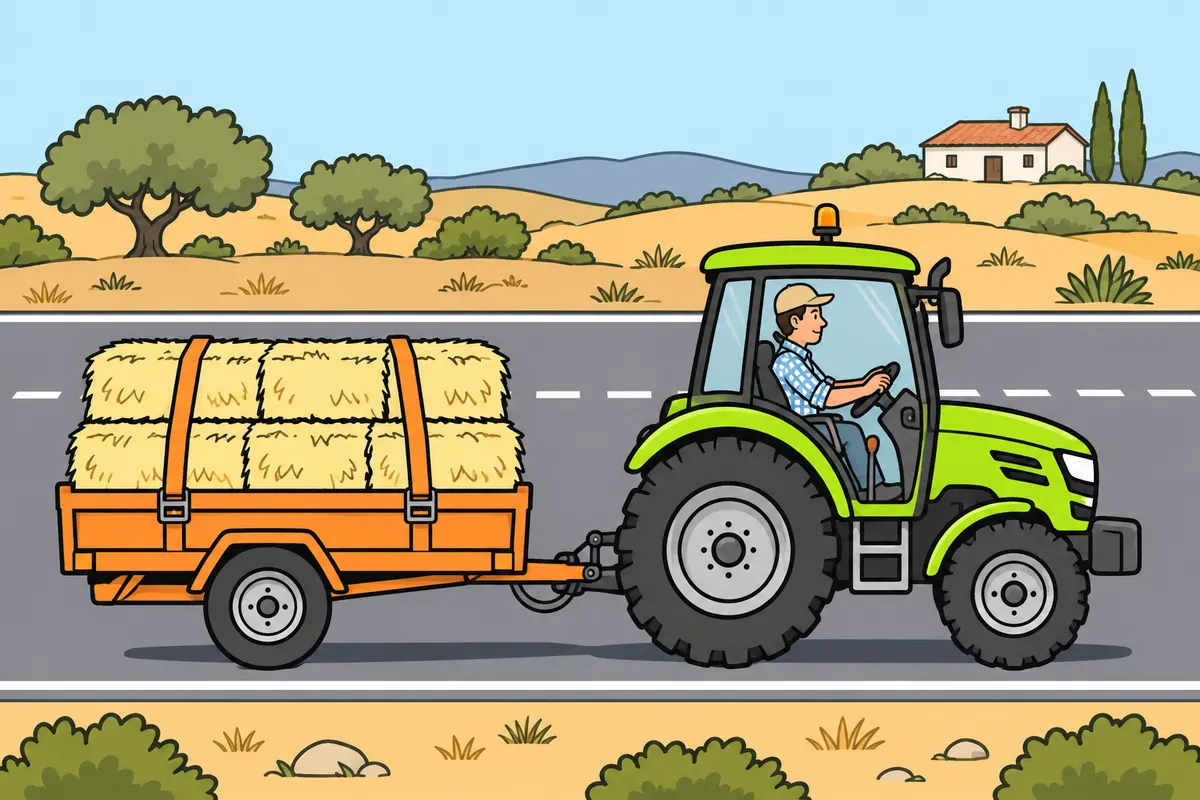
Watch your trailer and avoid sharp steering to correct its movement.
Remember
- Check the trailer in your mirrors.
- If it sways or tilts unexpectedly, review your driving; avoid sharp steering.
- Alternate watching your trailer with watching the road.
- If you need to investigate a noise, stop somewhere safe.
Exam trap: Wrong: correct a swaying trailer with a sharp steering move. Right: avoid adding to the load’s movement.
Read the full explanation
- Watch the trailer’s movements in your mirrors. If it sways or tilts unexpectedly, you need to review the driving conditions; avoid correcting it with a sudden steering movement that shifts the load even further. [RGC, art. 14](https://www.boe.es/buscar/act.php?id=BOE-A-2003-23514#a14).
- Alternate between watching the equipment and watching the road: when you notice a noise from the load bed, keep paying attention to those travelling ahead. If you need to investigate the source, find a safe place to stop and do so with the combination stationary. [RGC, art. 18](https://www.boe.es/buscar/act.php?id=BOE-A-2003-23514#a18).
12Adapt your speed to the space, road surface and wind
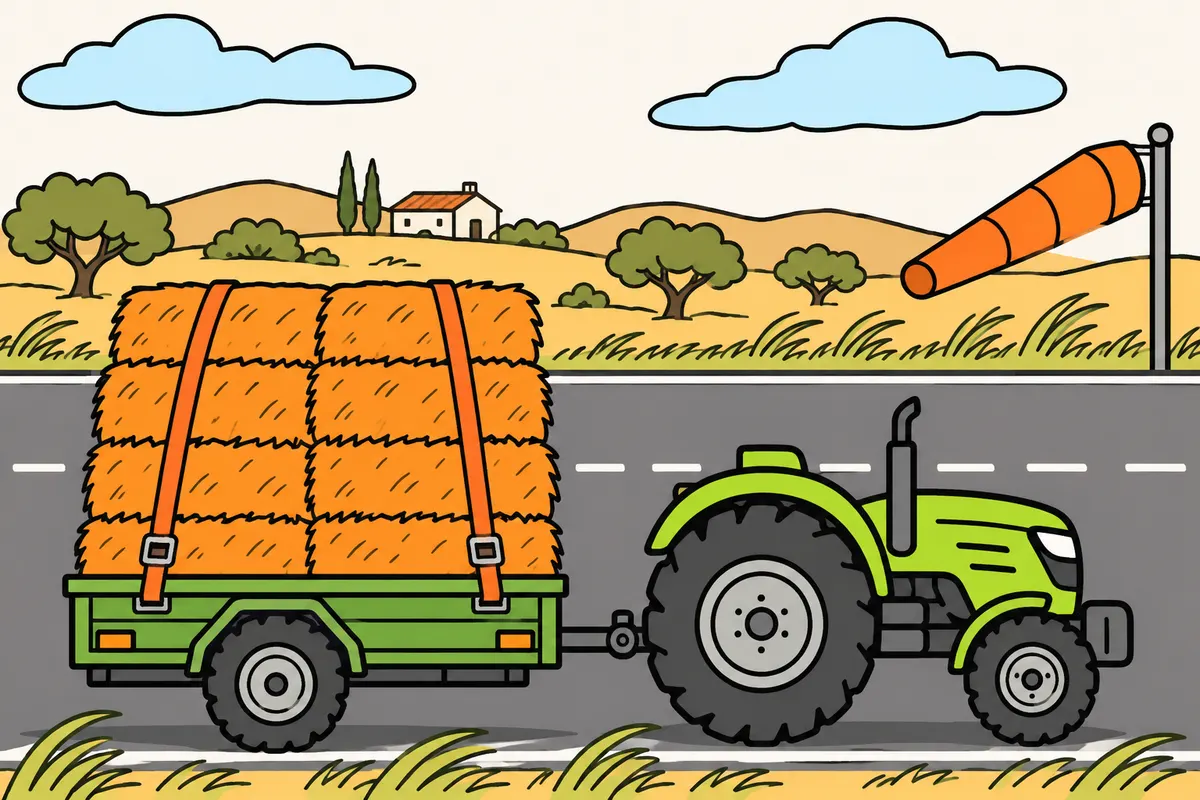
Adapt your driving to your load and the route conditions.
Remember
- Allow for your load’s height and crosswinds.
- Slow down when leaving shelter from trees or buildings.
- Leave room to correct your course smoothly in crosswinds.
- Slow before the trailer reaches ruts or potholes.
- Keep the speed adjustment until the last axle passes.
Exam trap: Wrong: ignore crosswinds with a high load. Right: adapt your driving to that exposure.
Read the full explanation
- A high stack of bales presents a surface to crosswinds. Reduce your speed as you leave an area sheltered by trees or buildings and leave enough room to correct your course smoothly. [RGC, art. 45](https://www.boe.es/buscar/act.php?id=BOE-A-2003-23514#a45).
- On a stretch with ruts or potholes, adjust your speed before the trailer wheels reach them. Your tractor may have passed the uneven surface while the load is still affected by it; maintain your adjusted speed until the last axle has passed. [RGC, art. 45](https://www.boe.es/buscar/act.php?id=BOE-A-2003-23514#a45).
13Lanes and permitted route
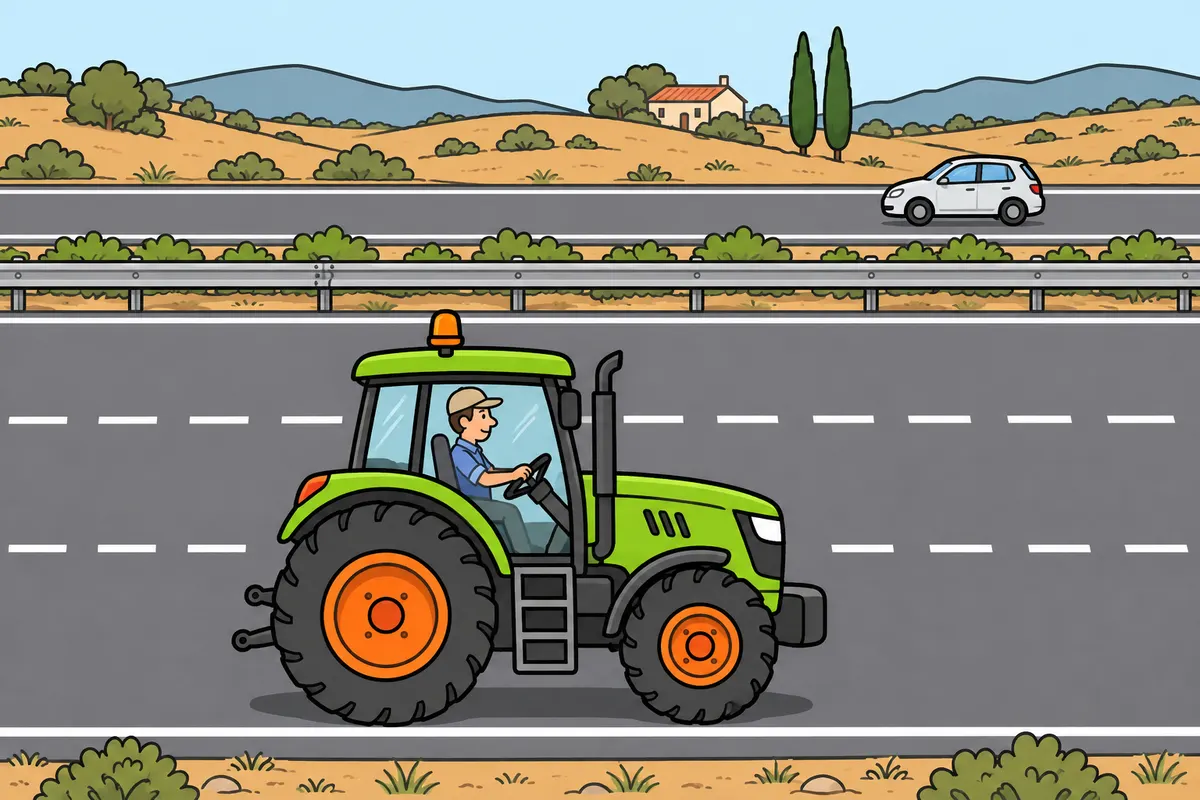
Outside built-up areas, your special vehicle’s weight limits which lanes you can use.
| Lanes in your direction, outside built-up areas | Special vehicle above 3,500 kg MMA |
|---|---|
| Two | Normally use the right lane. Use the other when traffic or road conditions advise it, without hindering traffic behind. |
| Three or more | Normally use the right lane. You may also use only the next lane under the same conditions. |
Remember
- Outside built-up areas, normally use the right lane with MMA above 3,500 kg.
- Use another permitted lane if traffic or road conditions advise, without hindering others behind.
- Allow space for the last part of your combination to fit inside the lane.
- Your move is incomplete while the trailer is still across the lane.
Exam trap: Wrong: use any lane outside built-up areas with a special vehicle above 3,500 kg MMA. Right: with three or more lanes in your direction, use only the right lane and the next one, when traffic or road conditions advise it and without hindering traffic behind.
Read the full explanation
- Outside built-up areas, when you drive a special vehicle with an MMA (maximum authorised mass) above 3,500 kg, you must normally use the right-hand lane. Where there are two lanes in your direction, you may use the other lane if traffic or road conditions make it advisable, without obstructing vehicles behind you. Where there are three or more lanes in your direction, you may only use the right-hand lane and the lane immediately next to it under those conditions. [RGC, art. 31](https://www.boe.es/buscar/act.php?id=BOE-A-2003-23514#a31).
- When choosing a lane, allow for the length needed to bring the last part of the combination fully into it. You have not finished joining the road with the tractor while the trailer is still across it. [RGC, art. 13](https://www.boe.es/buscar/act.php?id=BOE-A-2003-23514#a13).
14Limits you must apply to the route
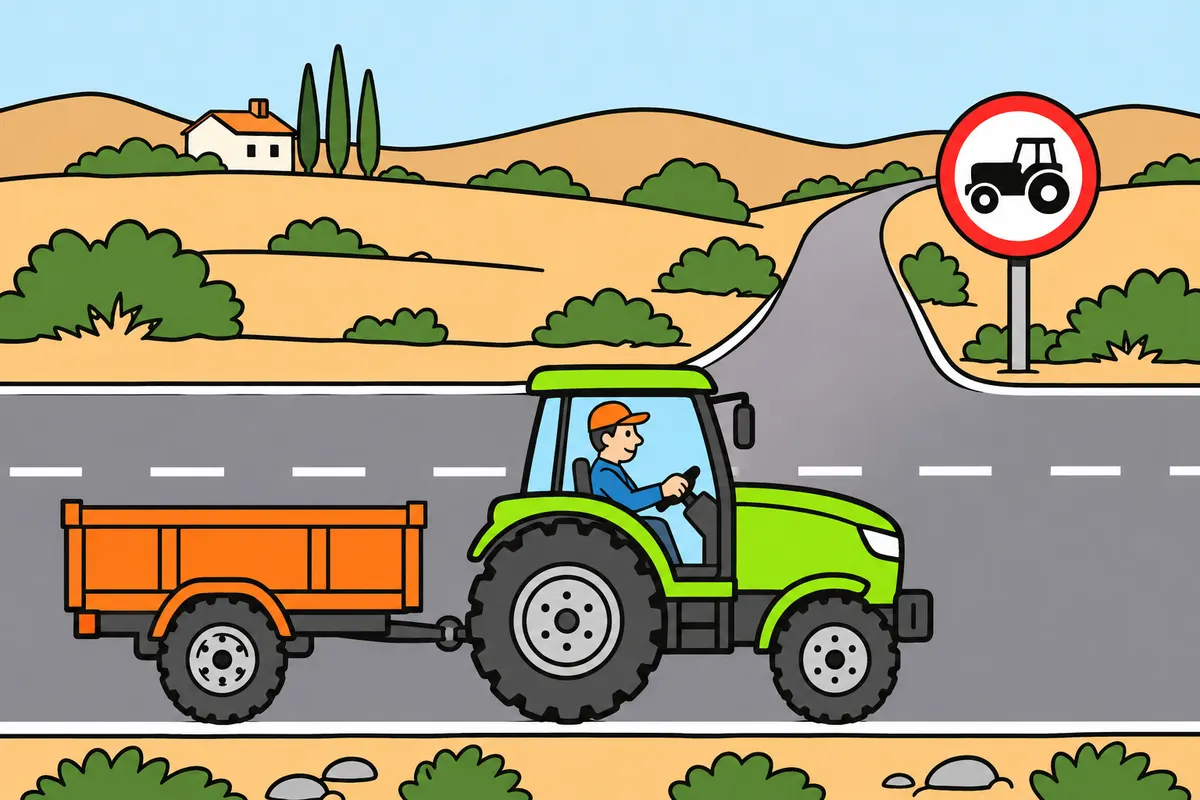
Apply your combination’s limits and the route restrictions.
Remember
- Respect your combination’s speed limits and the route restrictions.
- Check limits for your current setup, including your trailer.
- Identify weight, width and height restrictions affecting your load.
- If you change trailer or equipment, check the route again.
Exam trap: Wrong: ignore route restrictions. Right: apply them alongside your combination’s limits.
Read the full explanation
- You must apply the combination’s speed limits and the restrictions along the route. The applicable limit must match the configuration you are driving that day: adding a trailer changes the conditions that apply to the tractor on its own. [RGC, art. 48](https://www.boe.es/buscar/act.php?id=BOE-A-2003-23514#a48).
- Before your journey, identify any mass and clearance restrictions that affect the load. If you change the trailer or fit different equipment, reassess the route for that configuration; a route you use with the tractor alone may include a passage with insufficient clearance for the combination. [RGC, art. 13](https://www.boe.es/buscar/act.php?id=BOE-A-2003-23514#a13).
15Following distance and braking with a trailer
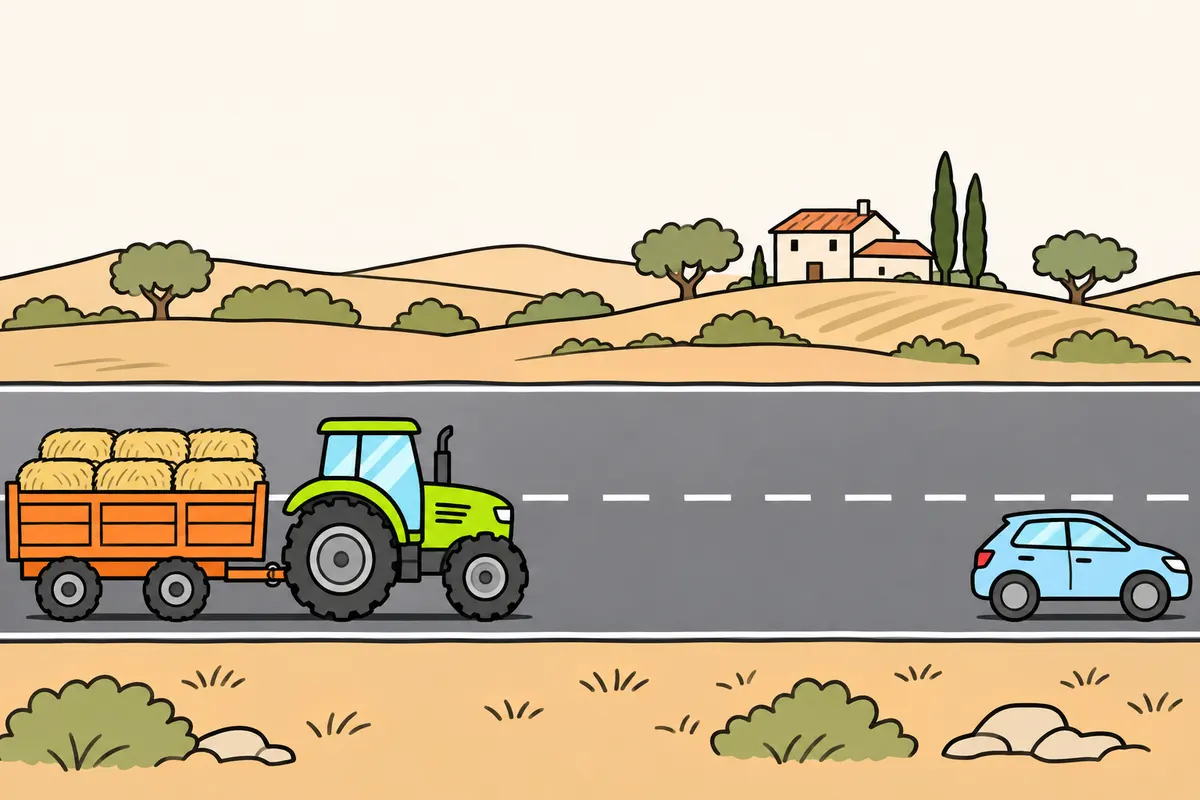
Leave enough room to stop the loaded combination safely.
Remember
- Leave enough space if the vehicle ahead brakes sharply.
- Allow for the grip and braking ability of the whole combination.
- If you can see further, watch traffic beyond the vehicle ahead.
- For queues, slow early and gradually to avoid sudden braking.
Exam trap: Wrong: calculate braking without your loaded trailer. Right: leave a suitable margin.
Read the full explanation
- With a loaded trailer, leave enough space to stop without hitting a vehicle that brakes suddenly ahead of you; assess the grip and braking capability of the combination. [RGC, art. 54](https://www.boe.es/buscar/act.php?id=BOE-A-2003-23514#a54).
- Anticipate queues by looking beyond the vehicle ahead whenever visibility allows. Start slowing down early and progressively so that you do not need to brake sharply with a loaded combination as you approach the back of a queue. [RGC, art. 45](https://www.boe.es/buscar/act.php?id=BOE-A-2003-23514#a45).
16Bends, braking and long descents
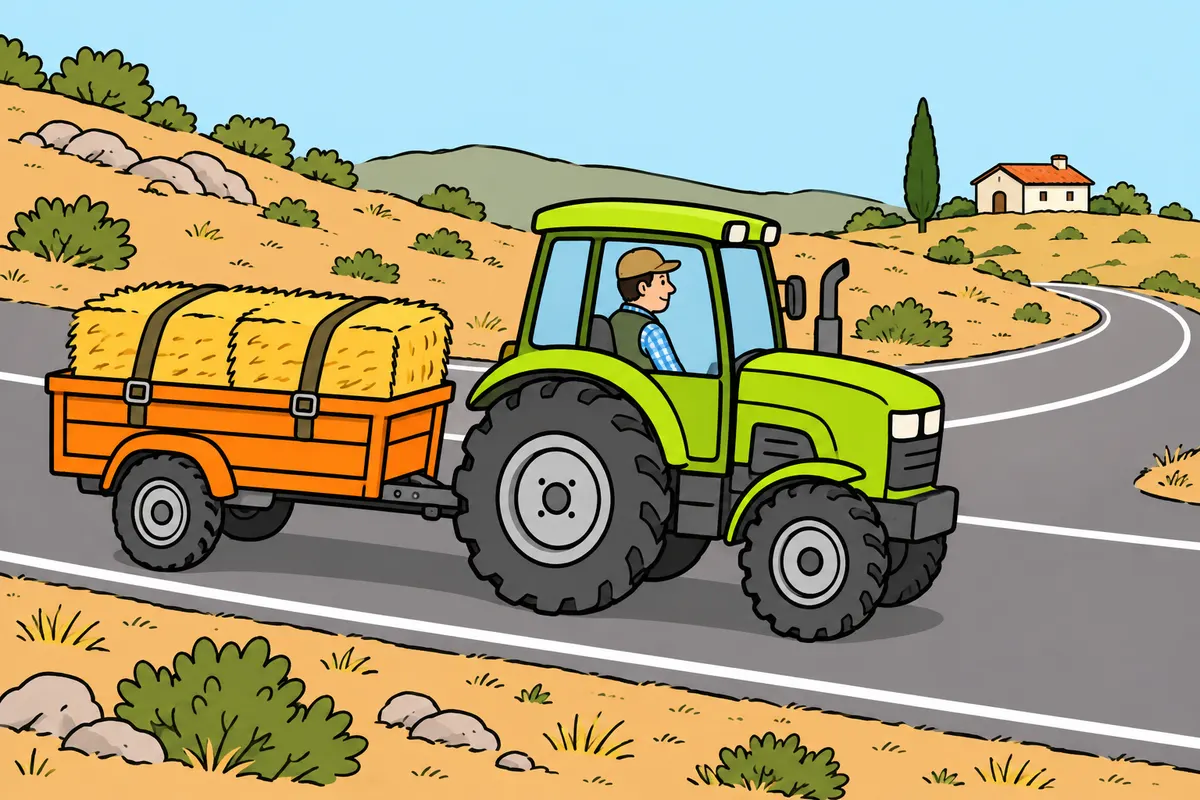
Slow before bends and control your loaded combination on descents.
Remember
- Slow down before entering bends.
- On descents, keep control of your loaded combination.
- Choose a suitable gear before starting the descent.
- Do not let the trailer push the tractor into continuous braking.
- Allow for reduced stability from high loads and trailer push on bends.
Exam trap: Wrong: enter a bend without slowing first. Right: slow down before entering.
Read the full explanation
- You must slow down before bends. A high load and the trailer’s pushing force reduce your margin of stability; enter the bend at a speed that allows you to follow its course without sudden corrections. [RGC, art. 45](https://www.boe.es/buscar/act.php?id=BOE-A-2003-23514#a45).
- Keep the loaded combination under control on descents. Select a suitable gear before starting the descent and prevent the trailer from pushing the tractor to the point where you have to brake continuously. [RGC, art. 45](https://www.boe.es/buscar/act.php?id=BOE-A-2003-23514#a45).
17Joining from a farm or from the roadside
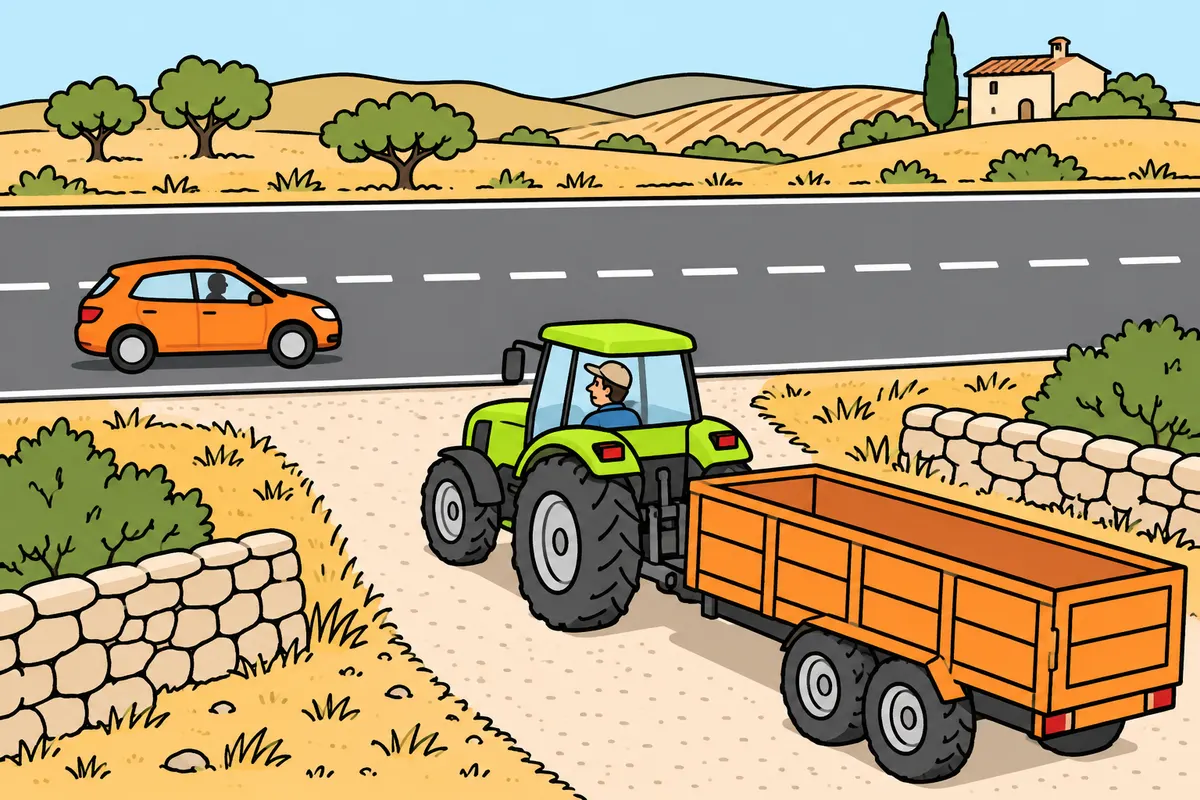
When leaving a farm, allow time for your whole combination to join.
Remember
- Allow time for the whole combination to join.
- Find a view both ways without putting your front implement in others’ path.
- If you need help seeing, agree the manoeuvre before moving.
- Cross the exit’s level change smoothly to avoid sudden tilting of your loaded trailer.
Exam trap: Wrong: allow joining time only for the tractor. Right: allow time for your whole combination.
Read the full explanation
- When leaving a farm, you must allow for the time the whole combination needs to join the road. From the exit, look for a position that gives you a view in both directions without the front implement intruding into the path of other road users. [RGC, art. 72](https://www.boe.es/buscar/act.php?id=BOE-A-2003-23514#a72).
- If you need help because visibility is limited, agree on the manoeuvre before moving the combination. Also assess the difference in level between the farm and the road: negotiate the transition smoothly to prevent the loaded trailer from tilting suddenly. [RGC, art. 45](https://www.boe.es/buscar/act.php?id=BOE-A-2003-23514#a45).
18Turns, junctions and implement sweep
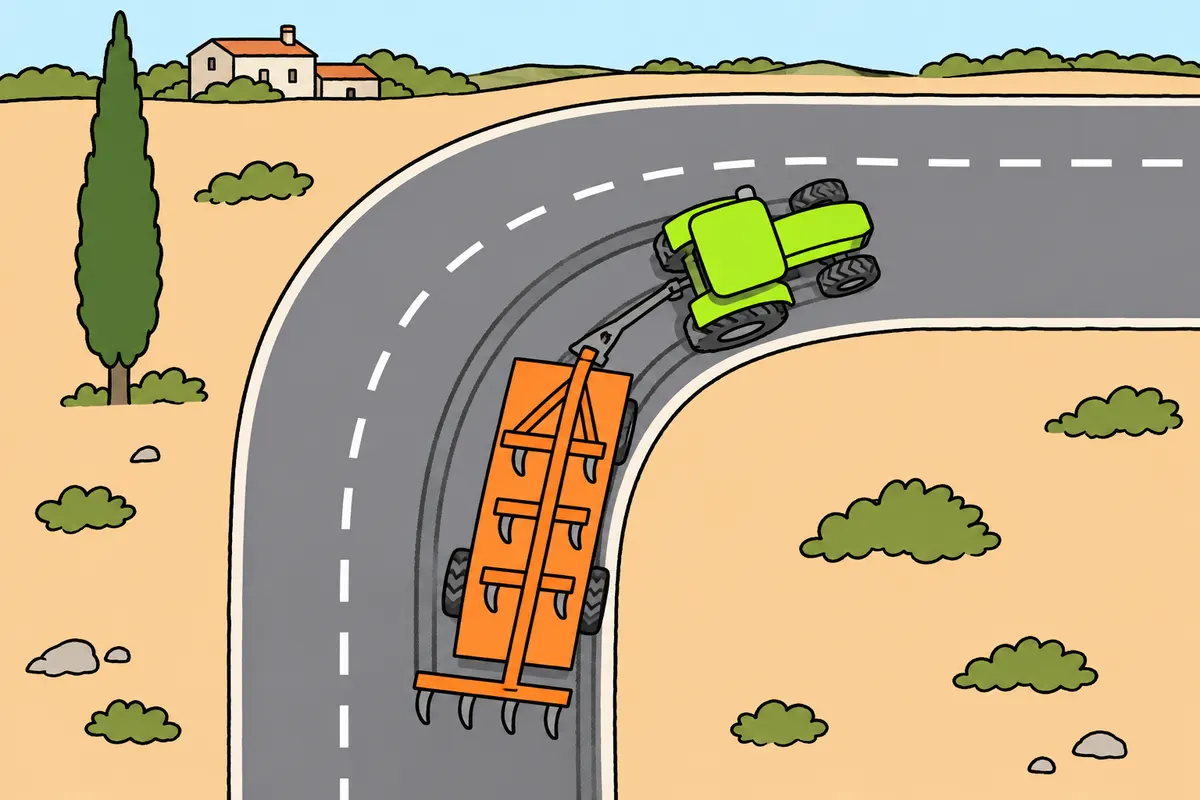
When turning, watch the paths of your trailer and implements.
Remember
- Watch your trailer’s path inside the turn.
- Watch the space your implements sweep outside the turn.
- Watch for people, posts and parked vehicles.
- Before entering a junction, check that your whole combination can leave it.
- If a queue would leave your trailer blocking it, wait even with priority.
Exam trap: Wrong: watch only the tractor’s path. Right: check both the trailer and implement sweep.
Read the full explanation
- The trailer may move close to the inside edge of a turn while the end of an implement sweeps outwards. Watch both areas, especially near people, posts and parked vehicles. [RGC, art. 13](https://www.boe.es/buscar/act.php?id=BOE-A-2003-23514#a13).
- Before entering a junction, check that you can clear it with the full length of the loaded combination. If a queue on the other side would leave the trailer across the junction, wait before entering even if you have priority. [RGC, art. 59](https://www.boe.es/buscar/act.php?id=BOE-A-2003-23514#a59).
19Overtaking is permitted: check that you can complete it
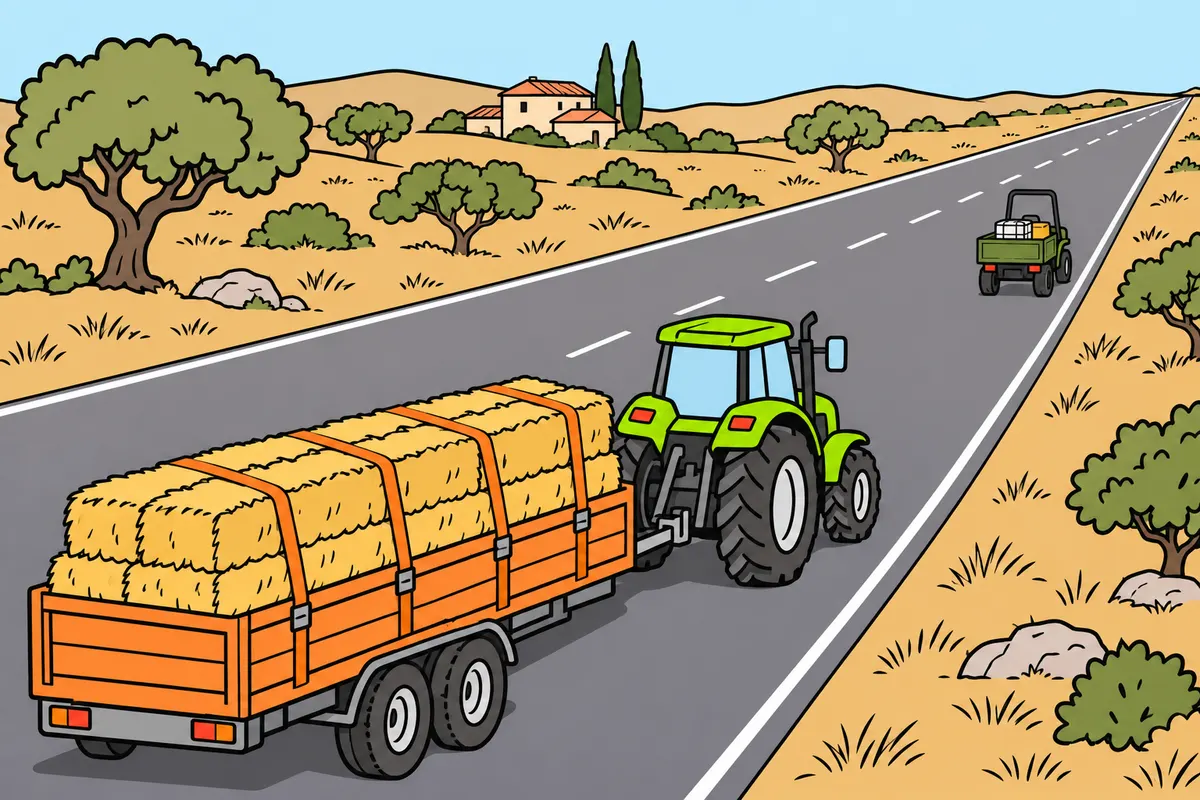
Wait until your trailer and load have passed before returning to your lane.
Remember
- Include your projecting rear load before returning to your lane.
- Even after your tractor passes, wait for your trailer to pass too.
- Before overtaking, calculate space using your loaded combination’s available acceleration.
- If the speed difference is small, allow more time to overtake.
Exam trap: Wrong: return when only your tractor has passed. Right: wait for your trailer and rear load.
Read the full explanation
- The load at the rear extends the length that must be clear of the other vehicle before you move back in. If your tractor has passed but your trailer is still alongside the other vehicle, you have not yet completed the overtaking manoeuvre. [RGC, art. 85](https://www.boe.es/buscar/act.php?id=BOE-A-2003-23514#a85).
- Before you start, calculate the distance you need to move ahead with the acceleration available from your laden combination. You need enough space to move back in with the rearmost part clear; a small difference in speed means you occupy the lane used for overtaking for longer. [RGC, art. 84](https://www.boe.es/buscar/act.php?id=BOE-A-2003-23514#a84).
20Overtaking vulnerable road users
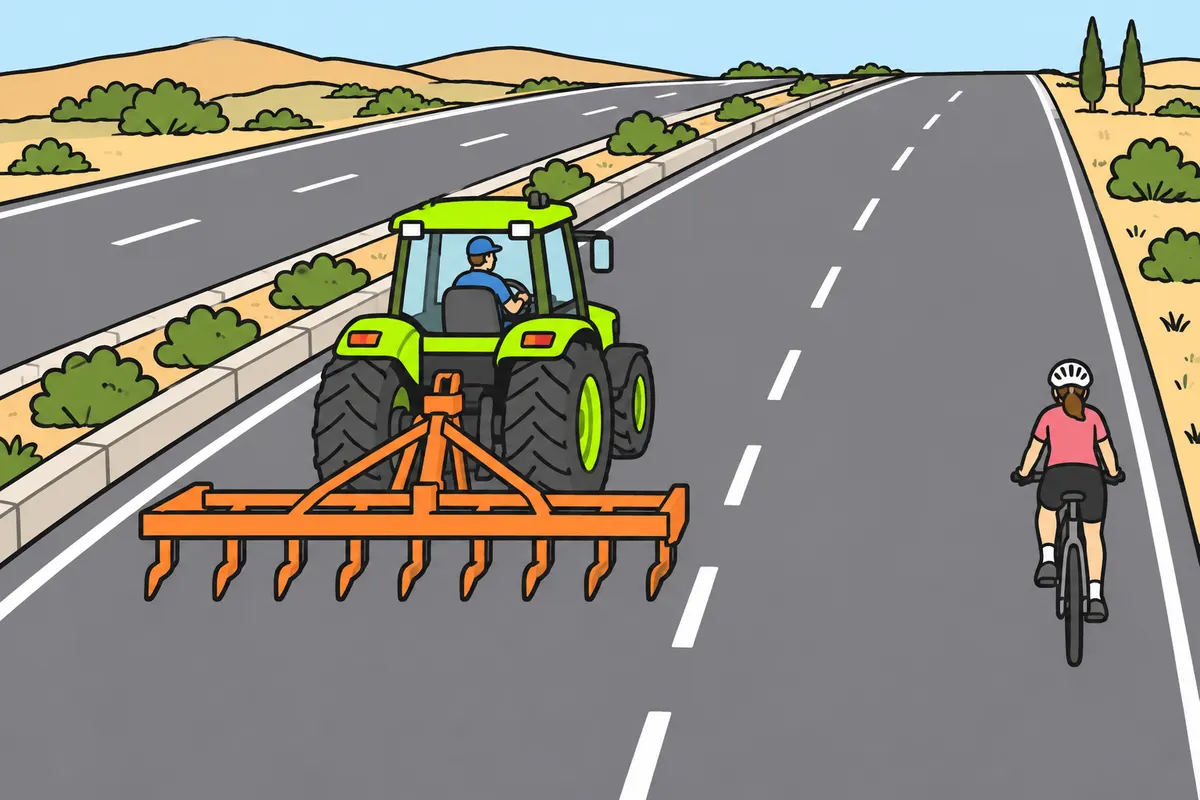
Measure clearance from your outermost part when passing vulnerable road users.
Remember
- Measure clearance from the furthest part of the load or implement.
- Allow for sideways movement while travelling.
- Keep the clearance until the whole load has passed a cyclist.
- Wait behind if you lack enough width to pass safely.
Exam trap: Wrong: measure from your tractor and ignore projections. Right: measure from the part projecting furthest.
Read the full explanation
- Measure your clearance from vulnerable road users from the furthest projecting point of your load or implement, allowing for the sideways movement of the equipment as you drive. [RGC, art. 85](https://www.boe.es/buscar/act.php?id=BOE-A-2003-23514#a85).
- When you pass a cyclist, maintain the clearance as the entire load passes, including its rearmost end. If the available width does not allow you to do this safely, wait behind; see «Manoeuvres with agricultural vehicles», under «Protect cyclists and other vulnerable road users», for the conditions for overtaking. [RGC, art. 85](https://www.boe.es/buscar/act.php?id=BOE-A-2003-23514#a85).
21When another vehicle overtakes you
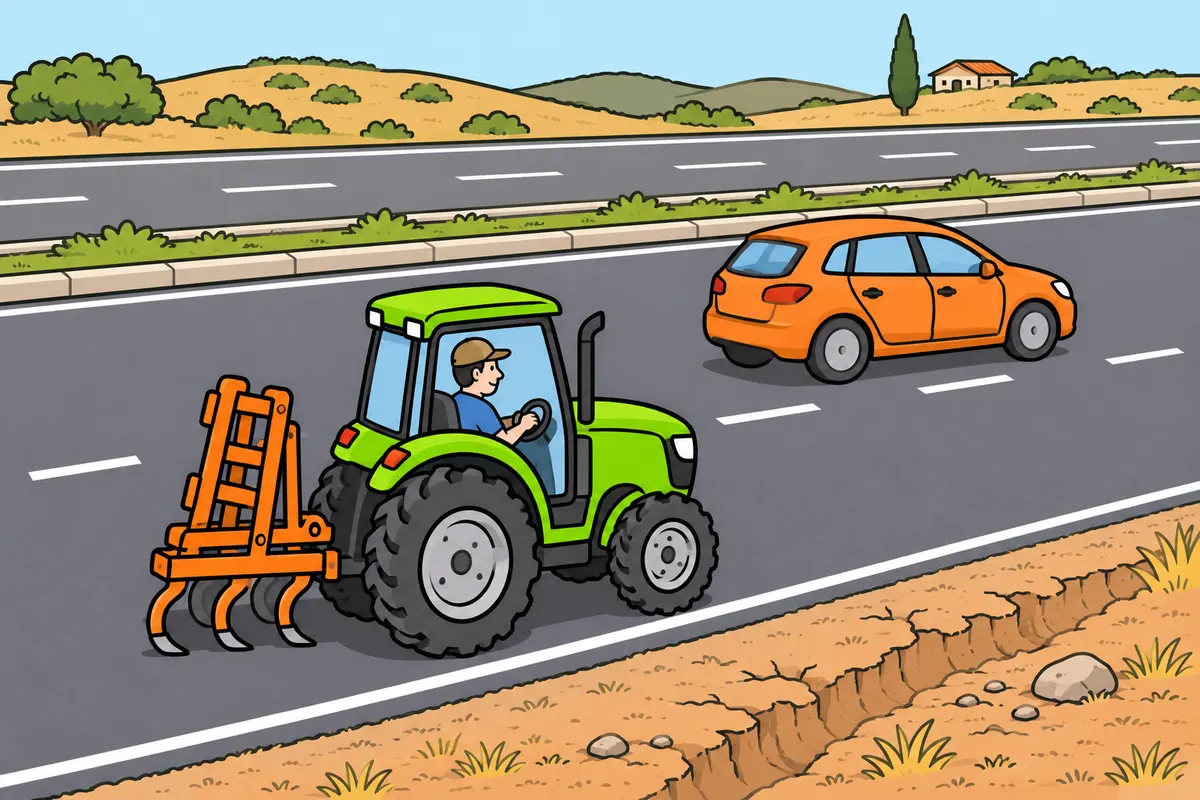
Keep a steady course while another vehicle passes the trailer.
Remember
- Keep a predictable course while the other vehicle passes your trailer.
- Avoid sudden moves that bring your load towards the overtaking vehicle.
- If it struggles to finish overtaking, slow when necessary to help it return.
- As you slow, control your trailer to prevent dangerous movement.
Exam trap: Wrong: swerve sharply around a pothole while being overtaken. Right: keep a predictable course.
Read the full explanation
- Keep a predictable course while the other vehicle passes alongside your trailer. A sudden movement to avoid a pothole can move your load towards it while it is still alongside you. [RGC, art. 86](https://www.boe.es/buscar/act.php?id=BOE-A-2003-23514#a86).
- If the overtaking vehicle has difficulty completing the manoeuvre, help it move back in by slowing down when necessary. Keep your trailer’s response under control as you slow down, so that your help does not cause a dangerous movement of the combination. [RGC, art. 86](https://www.boe.es/buscar/act.php?id=BOE-A-2003-23514#a86).
22Reversing: check that it is legal, then observe
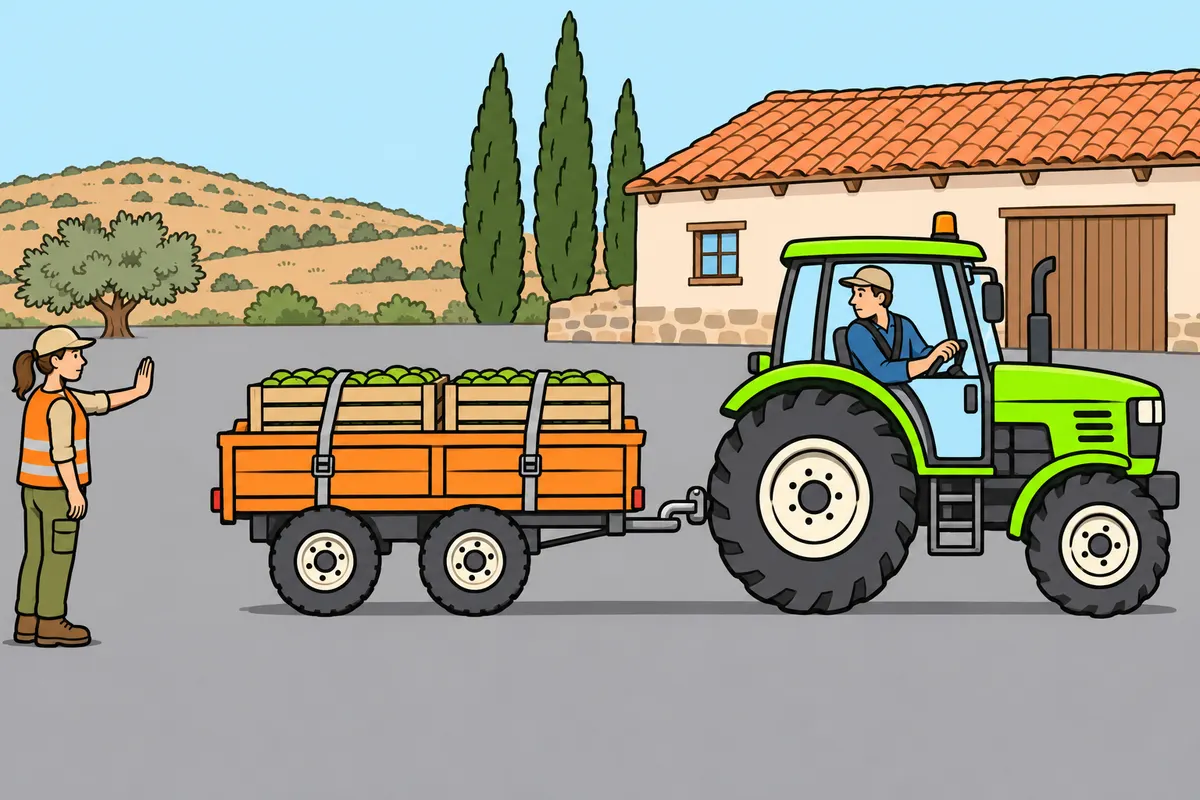
Before reversing, check that it is permitted and you have space.
Remember
- When reversing is permitted, check space for your trailer, load and implements.
- Ask for help if needed.
- Allow for how the tractor-trailer angle changes what you can see.
- Stop if you lose sight of clear space or your guide.
- Reverse slowly.
- Before moving again, check nobody is hidden behind your load.
Exam trap: Wrong: checking space is enough to reverse. Right: reversing must first be permitted.
Read the full explanation
- When reversing is permitted, you must check the space your trailer, load and implements occupy and ask for help if you need it. The angle between your tractor and trailer changes the area you can see as you reverse. [RGC, art. 81](https://www.boe.es/buscar/act.php?id=BOE-A-2003-23514#a81).
- Reverse slowly and stop the manoeuvre if you lose sight of the clear space or the person guiding you. A bulky load can hide someone approaching from behind: check that area again before you resume moving. [RGC, art. 81](https://www.boe.es/buscar/act.php?id=BOE-A-2003-23514#a81).
23Immobilise and park without accidental movement
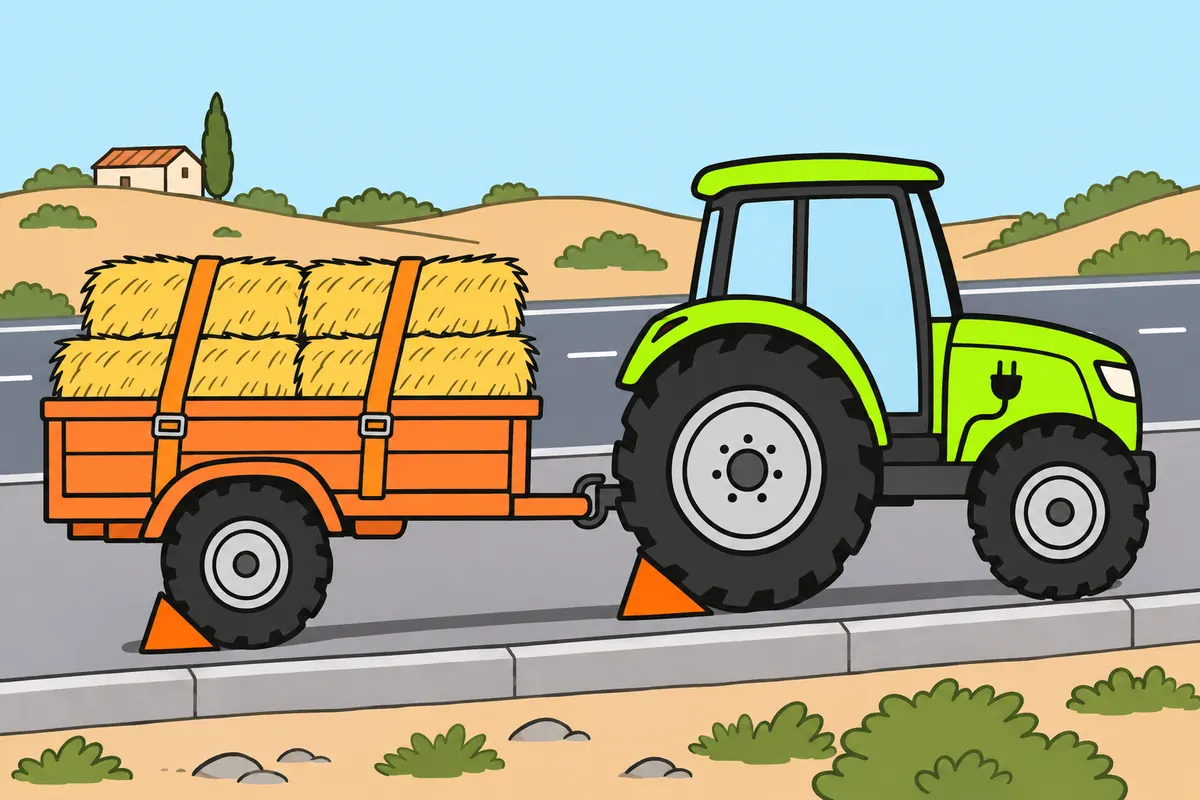
Secure the loaded combination against accidental movement.
Remember
- Prevent your loaded combination from moving accidentally.
- Lower raised equipment when leaving the driving position.
- Set controls and securing devices as the manufacturer specifies.
- Hydraulic pressure does not replace parking supports or locks.
- Choose ground that supports your tractor and trailer throughout the stop.
- On soft ground, a wheel can sink and tilt your combination despite braking.
Exam trap: Wrong: leave your combination unsecured against accidental movement. Right: secure it when immobilising it.
Read the full explanation
- You must secure your laden combination against accidental movement. When you leave the driving position, lower any raised equipment and leave the controls and securing devices in the safe position specified by the manufacturer. Hydraulic pressure does not replace the parking supports or locks provided. [RGC, art. 91](https://www.boe.es/buscar/act.php?id=BOE-A-2003-23514#a91).
- Choose a surface that keeps your tractor and trailer supported throughout the time they are immobilised. Take your load into account when assessing soft ground: a sinking wheel can tilt your combination even if the brake prevents it from rolling. [RGC, art. 91](https://www.boe.es/buscar/act.php?id=BOE-A-2003-23514#a91).
24Where you can immobilise the combination
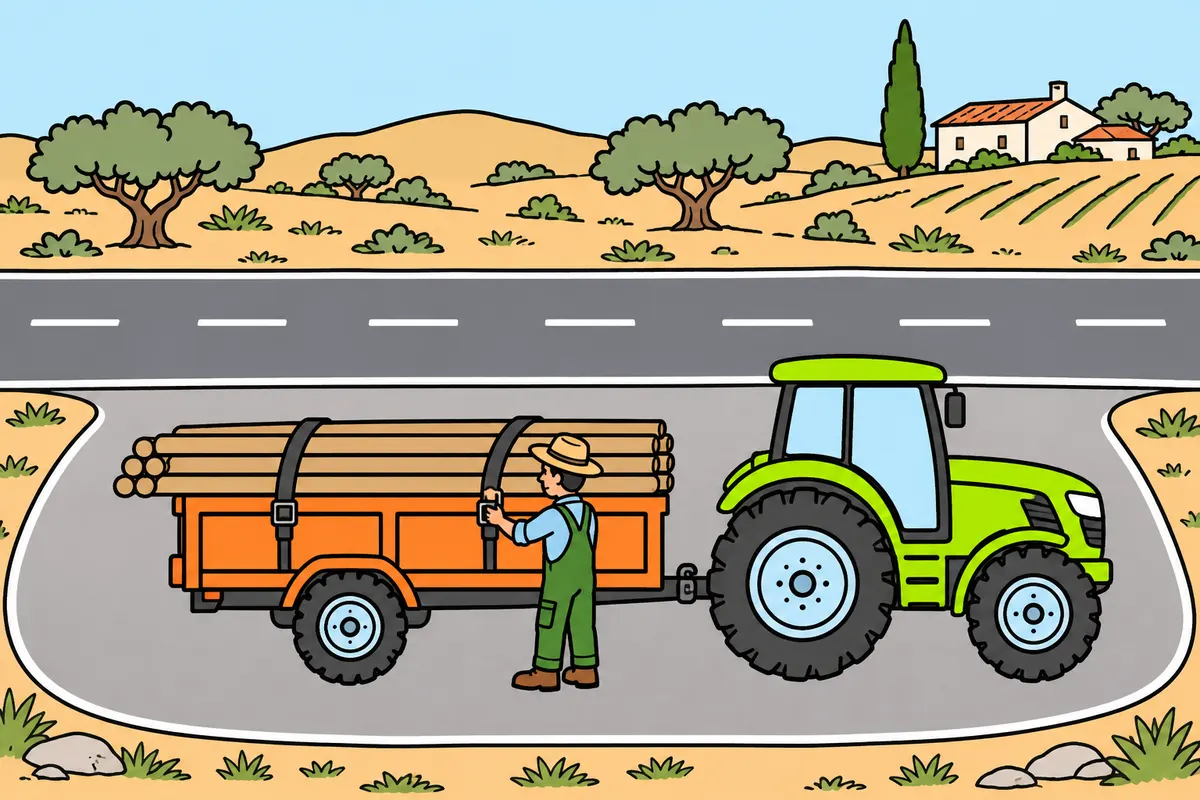
To adjust your load, find somewhere you can work protected from traffic.
Remember
- Leave room to work safely, protected from traffic.
- If traffic is beside the body, move somewhere safer before climbing up.
- Include projecting loads when choosing your location.
- Check that your load and implements do not block access or others’ passage.
Exam trap: Wrong: climb up beside moving traffic to adjust a strap. Right: find a protected place first.
Read the full explanation
- Leave enough space to work from a place protected from traffic. If your load bed is next to passing traffic, find another location before climbing up to tighten a strap or reposition a bale. [RGC, art. 91](https://www.boe.es/buscar/act.php?id=BOE-A-2003-23514#a91).
- When choosing the location, include any projecting parts of your load in the space you occupy. Check that the rearmost end and the implement do not obstruct an access point or other road users’ passage, even if your tractor’s wheels are outside their path. [RGC, art. 91](https://www.boe.es/buscar/act.php?id=BOE-A-2003-23514#a91).
25Breakdown or loss of load
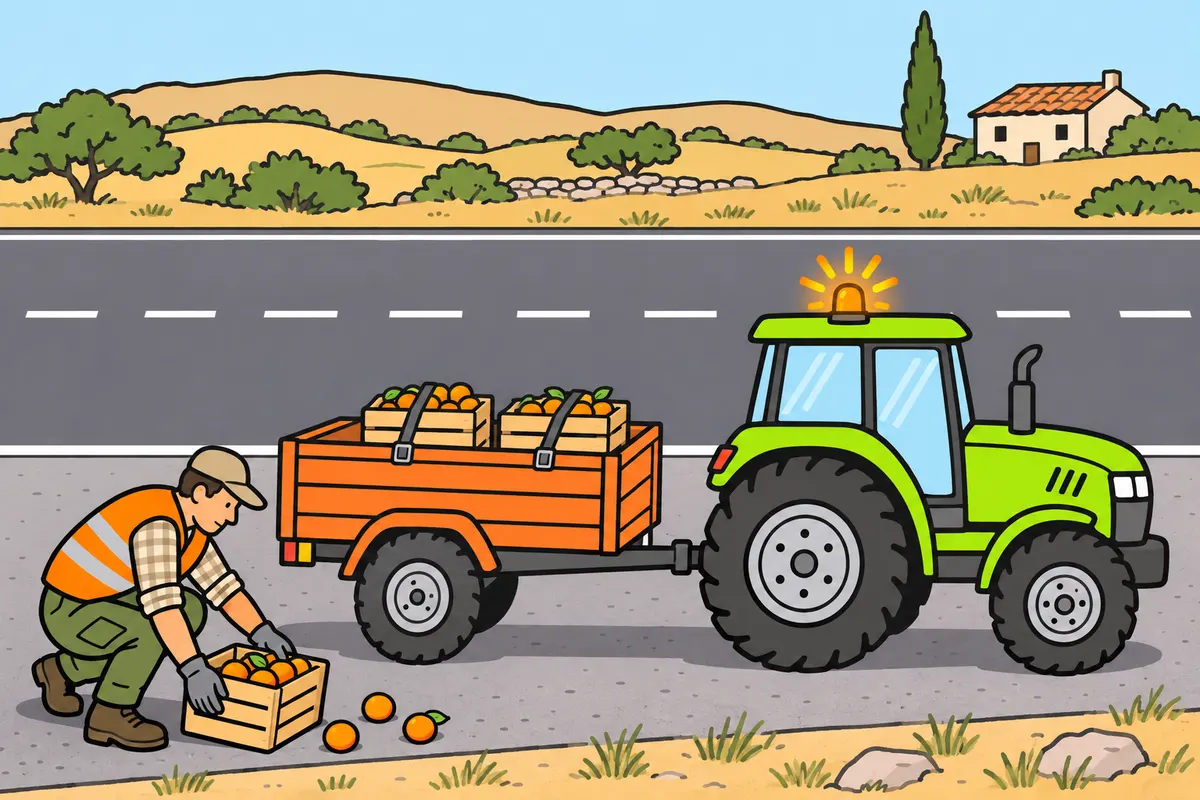
After a restraint breaks, check the securing points and secure your load before continuing.
Remember
- After a restraint breaks, check every other securing point.
- Continue only when you can keep the load stable and secure.
- For protecting and marking your stopped vehicle, see “Accidents and breakdowns: protect and assist”.
- If an anchorage is damaged, repair it before using it again.
Exam trap: Wrong: check only the broken restraint. Right: check the other securing points before continuing.
Read the full explanation
- After a lashing breaks, also check the other securing points: they may have been subjected to forces as the load shifted. If an anchorage is damaged, repair that damage too before using it again. Resume transport only when you can keep the load stable and secure. [RGC, art. 14](https://www.boe.es/buscar/act.php?id=BOE-A-2003-23514#a14).
- To protect the scene and warn others when your vehicle is immobilised because of a lost load, consult «Accidents and breakdowns: protect and assist», in the section «Fallen loads and vehicle recovery». [RGC, art. 130](https://www.boe.es/buscar/act.php?id=BOE-A-2003-23514#a130).
Before entering the road
Prepare the load and avoid bringing hazards from the farm onto the road.
- Check couplings, the transport position and the securing of the load and implements.
- Check masses, dimensions, visibility of lights and plates, and the necessary markings.
- Avoid dragging mud or debris onto the road.
- Look in both directions, signal and give way.
- Enter only when you have enough space and time to do so safely.
Prepare a loaded agricultural trailer
Prevent load movement and loss of stability before setting off.
- Distribute the load without exceeding authorised masses or raising it unnecessarily.
- Secure bales and round bales against movement with suitable supports and lashings.
- Lower the tipping body and secure its catches.
- Check projections, markings and the visibility of lights and plates.
If you leave mud or lose part of your load
You must warn of the hazard and remove it at the same time.
- Stop the vehicle in a safe place and prevent further losses.
- Take the necessary measures to warn others of the hazard effectively.
- Remove the obstruction as soon as possible without creating another risk; ask for help if you need it.
- Correct the securing arrangements or the cause of the debris before continuing.
Check what you know
Real questions from the bank on this topic. Pick an answer to see the explanation.
Finished this module?
Mark it as read and you will see your progress on the theory list.