
Theory · LVA Licence - Agricultural Vehicle · Module 11 of 16
Agricultural lighting and signalling
You learn to choose the lighting for your tractor and combination according to the road, visibility and manoeuvres, while avoiding dazzle. You distinguish the equipment required for each agricultural vehicle and the signs and plates you must recognise in the exam, including V-2, V-16 and trailer signs and plates.
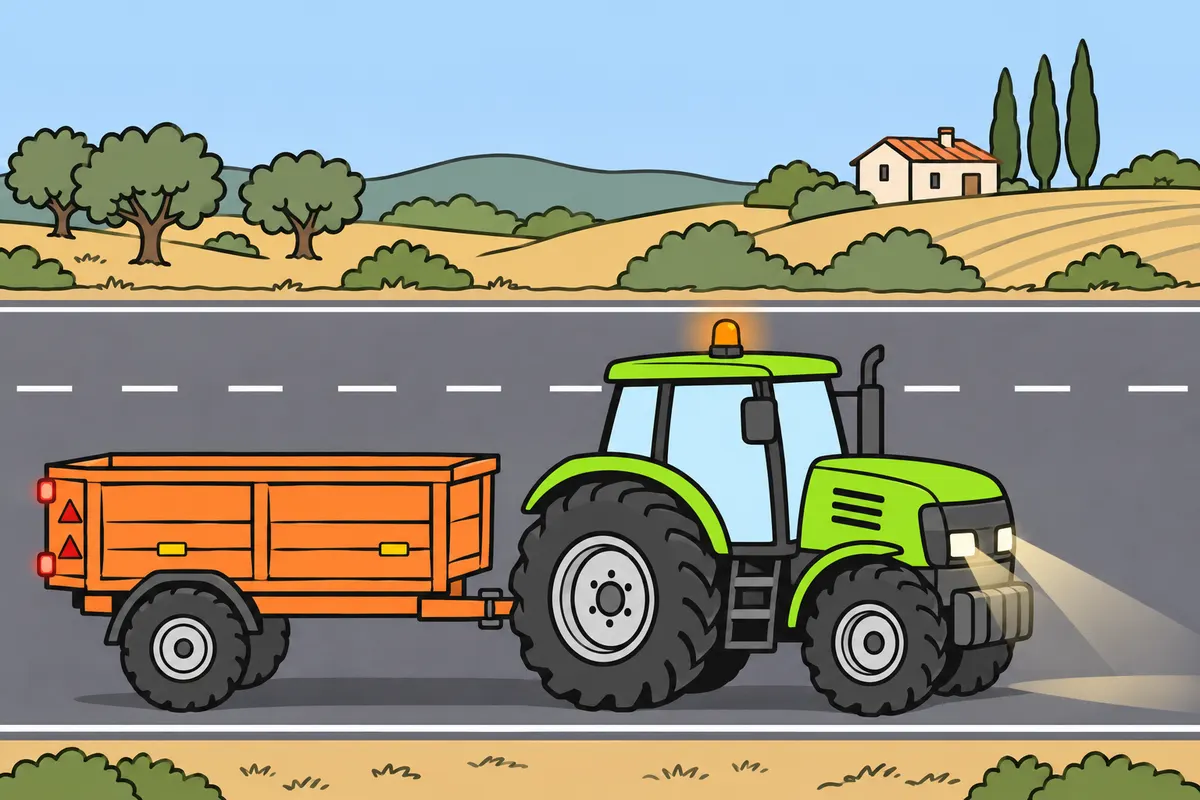
1See, be seen and warn
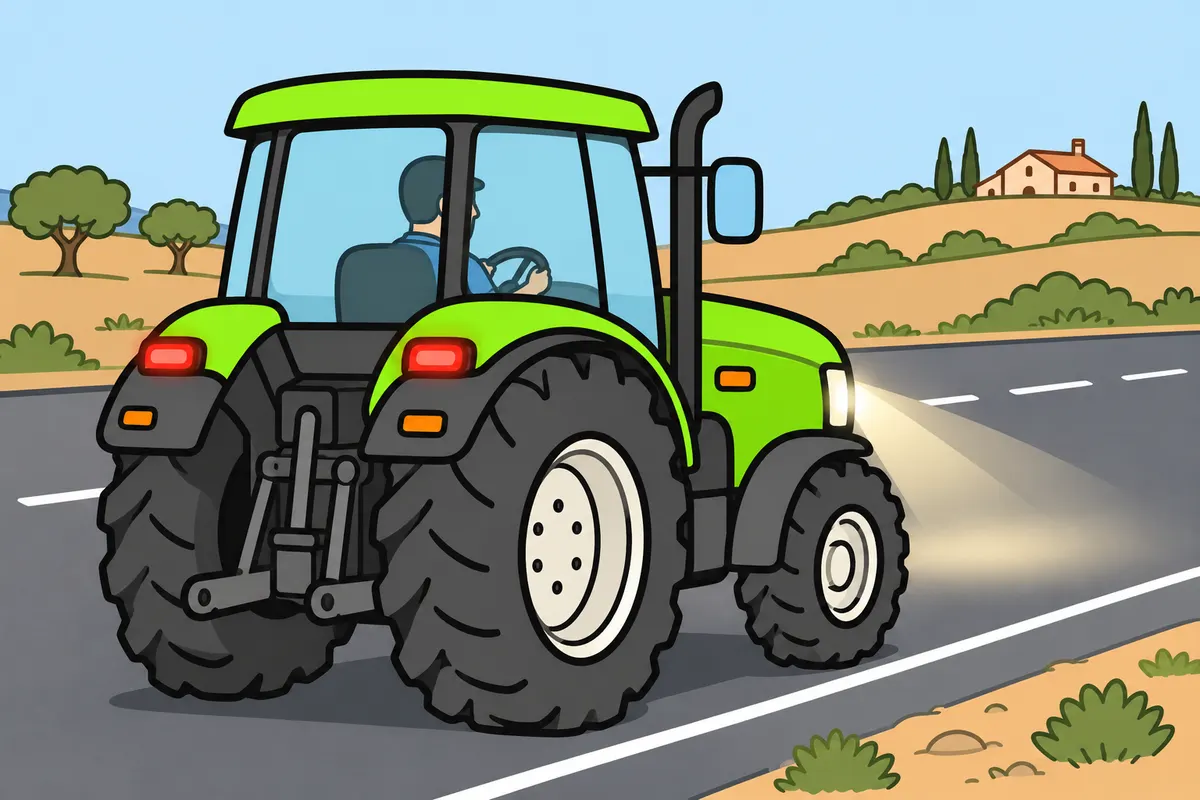
Use each light to see, make yourself visible or warn others.
| Lights | What you use them for |
|---|---|
| Dipped beam and main beam | Lighting ahead |
| Position lights | Showing presence and width |
| Indicators | Signalling sideways movement |
| Brake lights | Warning that you are braking |
Remember
- Distinguish lights that illuminate from lights that signal your actions.
- Check which lights your agricultural vehicle needs.
- Even when fitting main beam is optional, you must follow its rules.
Exam trap: Wrong: one light does everything. Right: use each device for its intended purpose.
Read the full explanation
- Lighting serves three purposes: illuminating the road, making your vehicle visible and communicating your actions. Dipped beam and main beam illuminate the road ahead; position lights show your presence and width; indicators and brake lights signal different actions. [RGV, Annex X](https://www.boe.es/buscar/act.php?id=BOE-A-1999-1826#anx).
- Fitting a light and using it are governed by different rules. You must apply the technical table for your vehicle's category and, during the journey, choose the lights according to the road and visibility. An optional light is also subject to its conditions of use and the duty to avoid dazzling others. [RGV, Annex X](https://www.boe.es/buscar/act.php?id=BOE-A-1999-1826#anx); [RGC, arts. 100-102](https://www.boe.es/buscar/act.php?id=BOE-A-2003-23514#a100).
- The required equipment depends on the specific category: tractor, self-propelled agricultural machine, walking tractor or agricultural trailer. The full lighting requirements for a passenger car do not apply to these vehicles. For machines and walking tractors, suitability for driving at night, through tunnels and in reduced visibility also matters. [RGV, art. 16](https://www.boe.es/buscar/act.php?id=BOE-A-1999-1826#a16).
- V codes identify vehicle signs, which are governed by Annex XI of the RGV. Headlamps, other lamps and reflectors are lighting or optical signalling devices; you must not assign them an upright road sign code. [RGC, art. 150](https://www.boe.es/buscar/act.php?id=BOE-A-2003-23514#a150); [RGV, Annex XI](https://www.boe.es/buscar/act.php?id=BOE-A-1999-1826#anxi).
2When you must switch on the lights
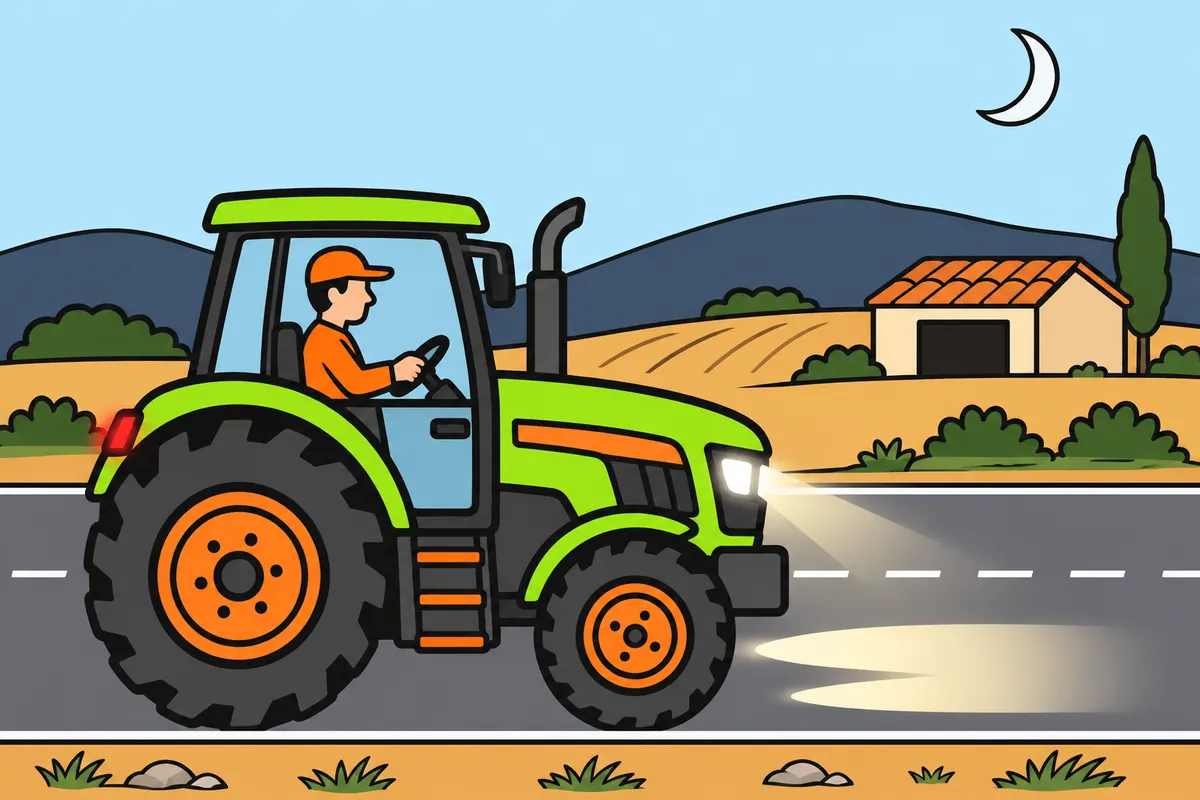
Switch on your lights at night, in tunnels and when visibility is significantly reduced.
Remember
- Keep your lights on from sunset to sunrise.
- Do this even on short journeys you know well.
- Enter tunnels, underpasses and sections marked as tunnels with your lights on.
- Use lights when fog, heavy rain, snow, smoke or dust significantly reduces visibility.
- With normal eyesight, failing either distance test means the road is insufficiently lit.
Exam trap: Wrong: every tunnel requires main beam. Right: choose according to lighting, speed and dazzling risk.
Read the full explanation
- You must keep the appropriate lights on between sunset and sunrise. This duty includes tractor journeys between the farm and the place where you keep it: a short journey or familiarity with the route does not exempt you. [RGC, art. 98](https://www.boe.es/buscar/act.php?id=BOE-A-2003-23514#a98).
- You must also switch them on during the day when driving through tunnels, underpasses and stretches covered by the tunnel sign. Your choice between dipped beam and main beam depends on the lighting, your speed and the risk of dazzling others. [RGC, arts. 98-102](https://www.boe.es/buscar/act.php?id=BOE-A-2003-23514#a98).
- You must use lights when fog, heavy rain, snowfall, smoke, dust or similar conditions significantly reduce visibility. In an agricultural setting, a dust cloud can trigger this duty even at midday when the sky outside it is clear. [RGC, art. 106](https://www.boe.es/buscar/act.php?id=BOE-A-2003-23514#a106).
- A road is insufficiently lit if, with normal eyesight, at any point on its carriageway you cannot read a number plate at 10 metres or distinguish a dark vehicle at 50 metres. Failure to meet either of these criteria is enough. [RGC, art. 100.3](https://www.boe.es/buscar/act.php?id=BOE-A-2003-23514#a100).
3Lights during the day
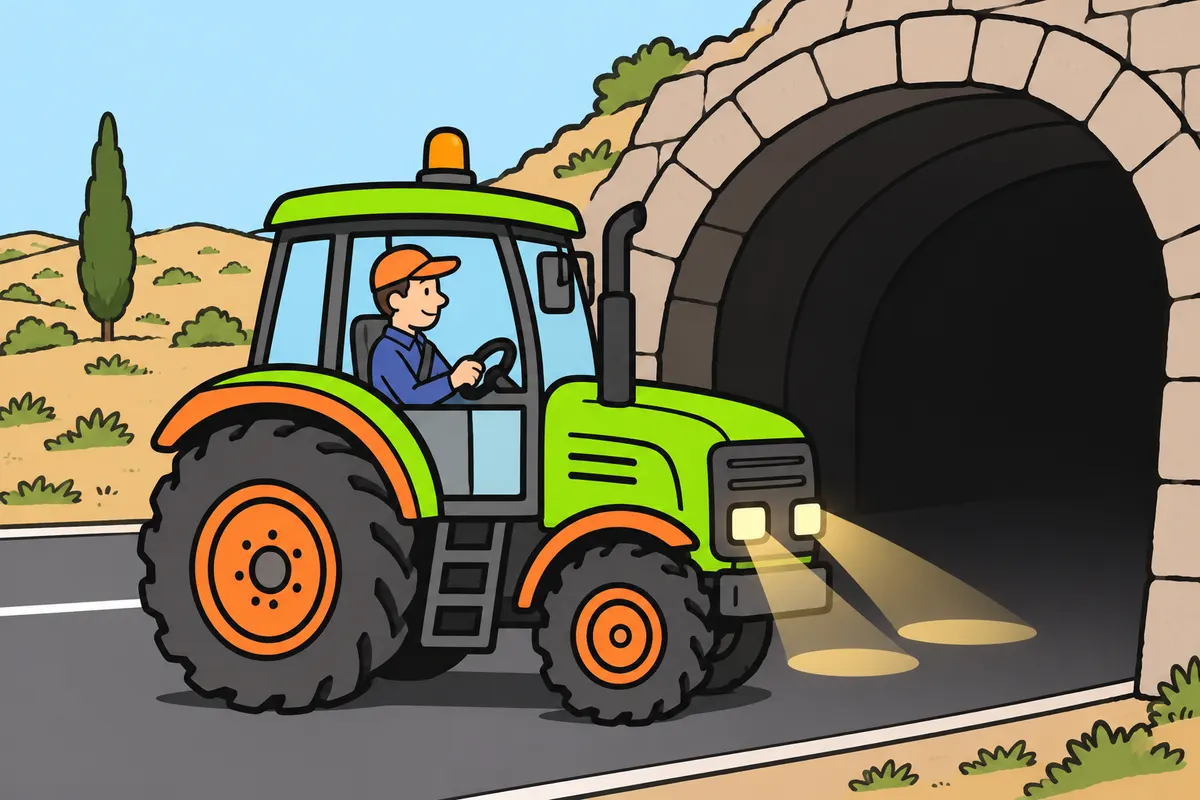
Use dipped beam during the day when your situation or agricultural combination requires it.
| Your agricultural vehicle’s situation | Dipped beam during the day |
|---|---|
| Tractor in good visibility | Not compulsory just because you drive a tractor |
| Permanently exceeds ordinary maximum masses or dimensions by design; group 2 | Not permitted with LVA; category B, dipped beam at all times and V-2 lights front and rear |
Remember
- With an LVA licence, you cannot drive group 2 agricultural vehicles.
- These vehicles permanently exceed ordinary maximum masses or dimensions by design.
- They need category B, dipped beam always and V-2 lights front and rear.
- Use dipped beam in reversible, temporary additional or temporarily reversed lanes.
- Enter those lanes only if your vehicle is allowed to use them.
- Check your rear lights and number plate light too.
Exam trap: Wrong: daytime running lights replace dipped beam in tunnels. Right: switch on dipped beam when required.
Read the full explanation
- In good visibility, driving an agricultural tractor does not in itself require you to use dipped beam during the day; you must switch it on in the circumstances specified by the regulations. Agricultural vehicles or combinations whose design means they permanently exceed the ordinary maximum masses or dimensions belong to group 2 of Annex III: they keep dipped beam on at all times and use V-2 devices marking their outline at the front and rear. You need a category B licence for these vehicles; you cannot drive them with LVA. [RGCond, arts. 5.9 and 6.1.b](https://www.boe.es/buscar/act.php?id=BOE-A-2009-9481#a5); [RGC, Annex III](https://www.boe.es/buscar/act.php?id=BOE-A-2003-23514#aniii).
- You must use at least dipped beam when driving in a reversible lane, a temporary additional lane or a lane opened to traffic travelling against the usual direction, where you are legally allowed to use it. The lighting requirement does not in itself authorise you to enter a lane reserved for other vehicle categories. [RGC, art. 104](https://www.boe.es/buscar/act.php?id=BOE-A-2003-23514#a104).
- If your vehicle has daytime running lights, you must distinguish their purpose of making it visible during the day from the lighting required in other circumstances. You cannot treat them as a substitute for the dipped beam required in a tunnel or for the full set of lights required at night. [RGC, arts. 98, 99 and 101](https://www.boe.es/buscar/act.php?id=BOE-A-2003-23514#a101).
- When conditions change, check the controls and dashboard lights to make sure you have selected the required lighting, including the rear position lights and number plate lighting. When entering an underpass or a dust cloud, select the appropriate lighting and check its controls. [RGC, arts. 99, 103 and 106](https://www.boe.es/buscar/act.php?id=BOE-A-2003-23514#a103).
4Front and rear position lights
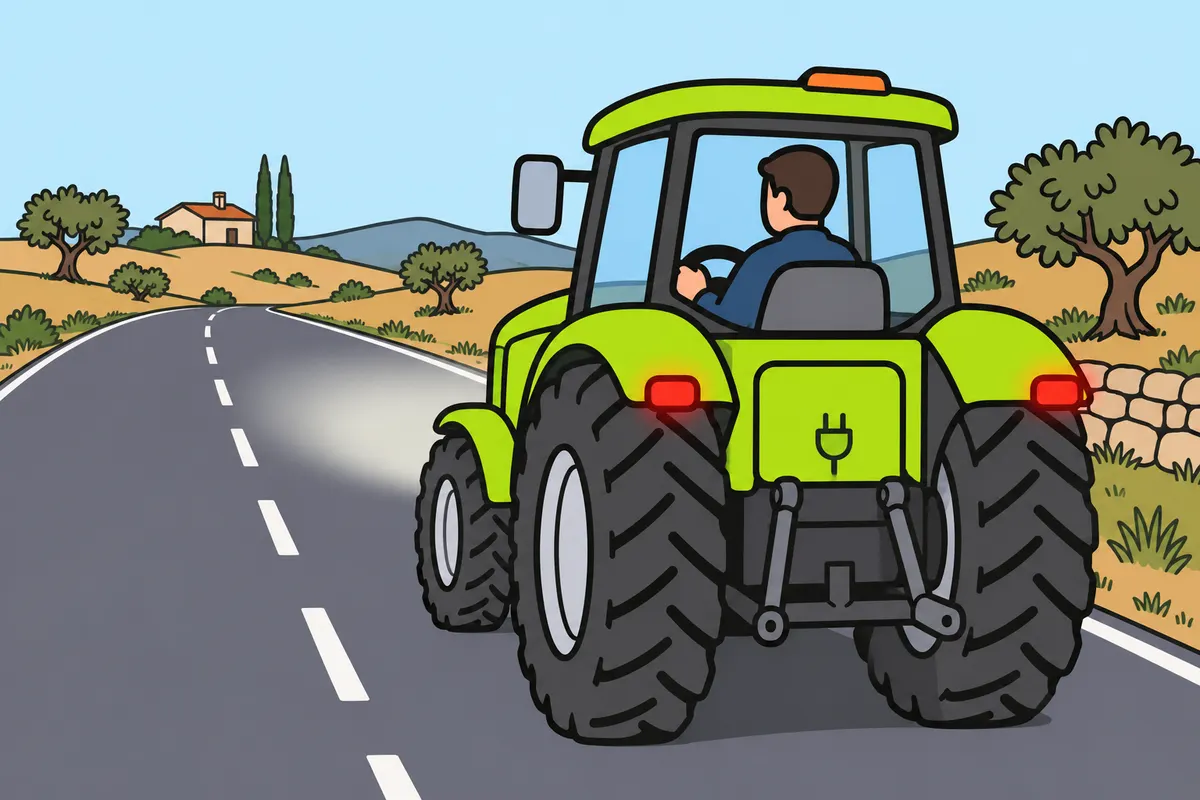
Position lights make your vehicle visible, but you need other lights when driving.
| Agricultural vehicle | Front position lights | Rear position lights |
|---|---|---|
| Tractor | White | Red |
| Self-propelled agricultural machine suitable for night use | White or selective yellow | Red |
Remember
- Use position lights at night, in tunnels and in underpasses.
- Also use them in sections marked as tunnels and in significantly reduced visibility.
- Add the lights you need for driving.
- Keep position lights on with dipped beam, main beam or front fog lights.
Exam trap: Wrong: you change any tractor’s position lights to yellow. Right: that option applies to the specified self-propelled agricultural machine.
Read the full explanation
- You use position lights to show your vehicle's presence and width; do not confuse this purpose with illuminating the carriageway to drive ahead. Your tractor has 2 or 4 white front lights and 2 red rear lights. The rear lights are at the outer edges. [RGV, Annex X](https://www.boe.es/buscar/act.php?id=BOE-A-1999-1826#anx).
- You must keep the position lights on at night, in tunnels, underpasses and stretches signposted as tunnels, and when visibility is significantly reduced. While driving, you must also use the appropriate driving lights. [RGC, arts. 99 and 101](https://www.boe.es/buscar/act.php?id=BOE-A-2003-23514#a99).
- You must keep the front position lights on when using dipped beam, main beam or front fog lights. The system must switch on the rear position lights automatically with the lights specified by the regulations, including dipped beam, main beam and fog lights. These connections prevent you from illuminating the road ahead while leaving the rear hidden. [RGV, art. 15.3](https://www.boe.es/buscar/act.php?id=BOE-A-1999-1826#a15).
- On a self-propelled agricultural machine suitable for night-time driving, you may find 2 red rear lights and 2 or 4 front lights, white or selective yellow as specified in its table. [RGV, Annex X](https://www.boe.es/buscar/act.php?id=BOE-A-1999-1826#anx).
5Dipped beam and agricultural headlamp height
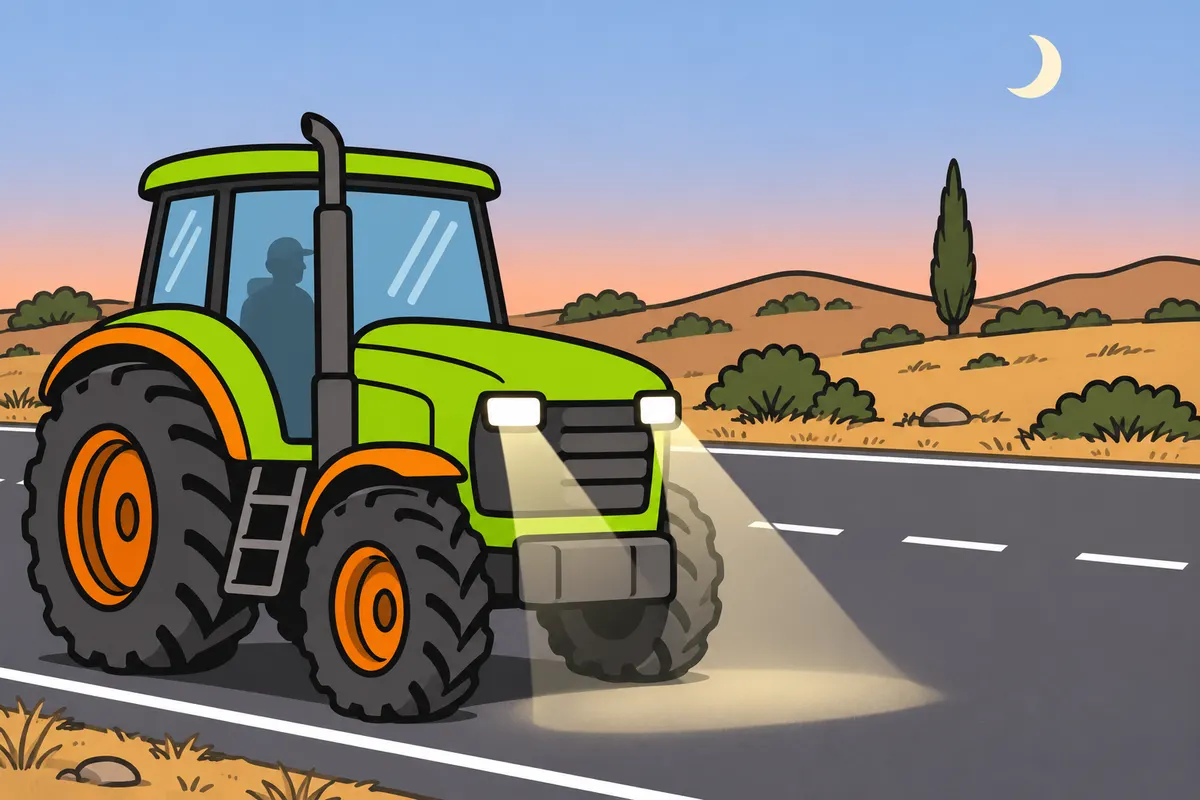
Use dipped beam to light the road ahead without dazzling others.
Remember
- Use dipped beam with position lights at night on sufficiently lit roads.
- In built-up areas, use dipped beam even with insufficient lighting.
- Use it in sufficiently lit tunnels, including during the day.
- On dark interurban roads, use dipped beam without main beam or to avoid dazzle.
- Also use dipped beam at up to 40 km/h when not using main beam.
- Agricultural dipped-beam headlamps above 1.20 m: limit the illuminated area to 25 m.
Exam trap: Wrong: all agricultural headlamps illuminate no further than 25 m. Right: this limit applies to dipped-beam headlamps fitted above 1.20 m.
Read the full explanation
- Dipped beam, or short-range lighting, lets you illuminate the road ahead without dazzling or inconveniencing others. Your agricultural tractor must have 2 white front lights at the outer edges. A high cab does not allow you to aim the beam at other drivers' eyes. [RGV, art. 16 and Annex X](https://www.boe.es/buscar/act.php?id=BOE-A-1999-1826#a16).
- You must use dipped beam with position lights at night on sufficiently lit roads, both in and outside built-up areas. You must also use it in built-up areas when lighting is insufficient, and in sufficiently lit tunnels at any time of day. [RGC, art. 101.1](https://www.boe.es/buscar/act.php?id=BOE-A-2003-23514#a101).
- On dark roads outside built-up areas, you must use dipped beam if you do not have main beam, if you could dazzle others, or if you are travelling at no more than 40 km/h and are not using main beam. You can therefore drive a tractor without main beam using dipped beam, provided you meet the other applicable requirements. [RGC, art. 101.2](https://www.boe.es/buscar/act.php?id=BOE-A-2003-23514#a101).
- On special agricultural vehicles, you may find dipped-beam headlamps more than 1.20 metres above the ground. In this case, they must be adjusted to illuminate an area extending no more than 25 metres ahead. [RGV, Annex X](https://www.boe.es/buscar/act.php?id=BOE-A-1999-1826#anx).
6Main beam and the 40 km/h threshold
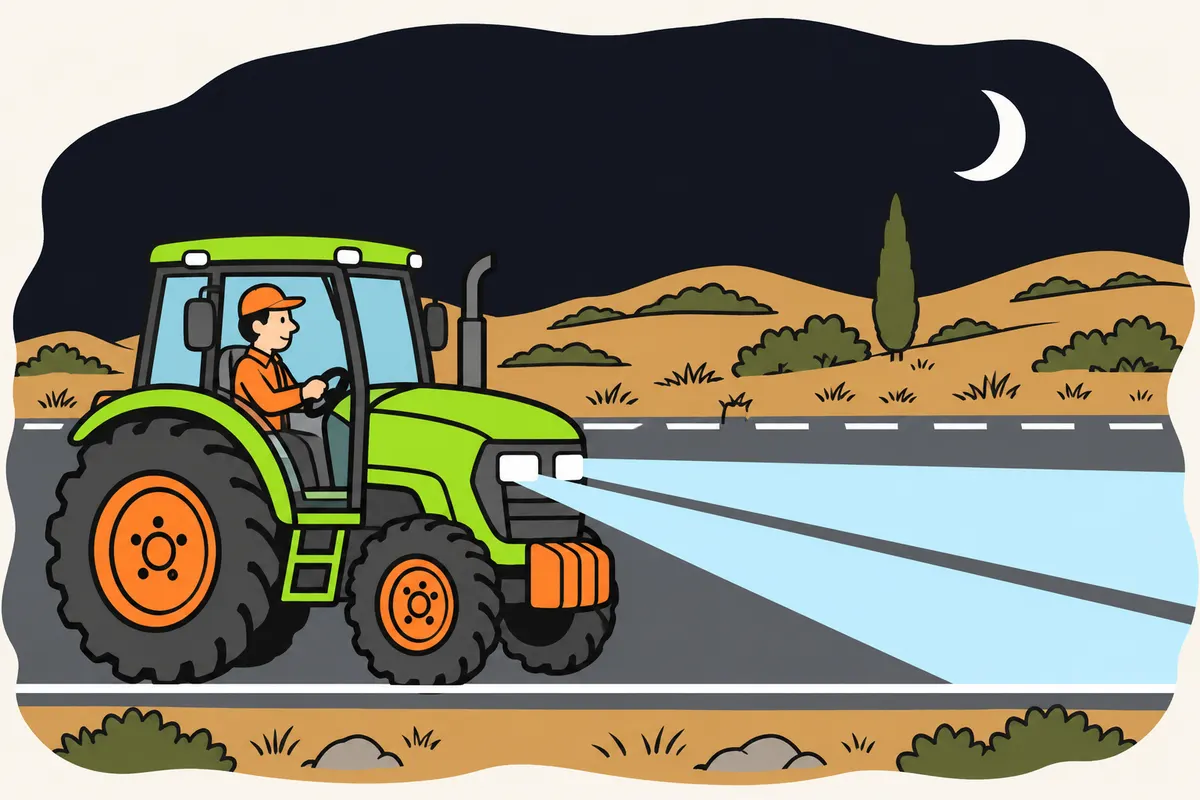
If fitted, use main beam according to your speed, darkness and the risk of dazzling others.
| Tractor with main beam fitted, travelling above 40 km/h | When you must use it without dazzling |
|---|---|
| Outside built-up areas, on insufficiently lit roads | At night, unless you must switch to dipped beam |
| Insufficiently lit tunnel or underpass | At any time, unless you must switch to dipped beam |
Remember
- Fitting main beam to your tractor is optional.
- Do not keep main beam on while stopped or parked.
- You may combine main beam and dipped beam, keeping position lights on.
- At lower speeds, you may use main beam if conditions allow.
- If you do not use main beam at those lower speeds, use dipped beam.
Exam trap: Wrong: exactly 40 km/h already requires main beam because of speed. Right: you must exceed that threshold and meet the other conditions.
Read the full explanation
- If your tractor has main beam, you must recognise its 2 or 4 white lights designed to illuminate a long distance ahead. Fitting them is optional under the agricultural tractor table. The rule requiring their use applies to vehicles fitted with them; it does not require you to fit main beam for every journey on dark roads. [RGV, Annex X](https://www.boe.es/buscar/act.php?id=BOE-A-1999-1826#anx); [RGC, art. 100](https://www.boe.es/buscar/act.php?id=BOE-A-2003-23514#a100).
- You must switch on main beam if your vehicle has it, you are travelling at more than 40 km/h at night outside a built-up area on an insufficiently lit road, and there is no requirement to switch to dipped beam. The rule also covers insufficiently lit tunnels and underpasses at any time of day. [RGC, art. 100.1](https://www.boe.es/buscar/act.php?id=BOE-A-2003-23514#a100).
- At exactly 40 km/h, your speed does not trigger this duty. At a lower speed, you may use main beam when conditions allow, but you must use dipped beam if you do not use main beam. This lighting threshold does not change the maximum speed applicable to your tractor or combination. [RGC, arts. 100 and 101](https://www.boe.es/buscar/act.php?id=BOE-A-2003-23514#a101).
- You may use main beam together with dipped beam, keeping the position lights on. You must not keep main beam on while stopped or parked. [RGC, art. 100.1 and 2](https://www.boe.es/buscar/act.php?id=BOE-A-2003-23514#a100); [RGV, art. 15.3](https://www.boe.es/buscar/act.php?id=BOE-A-1999-1826#a15).
7Avoid and deal with dazzle
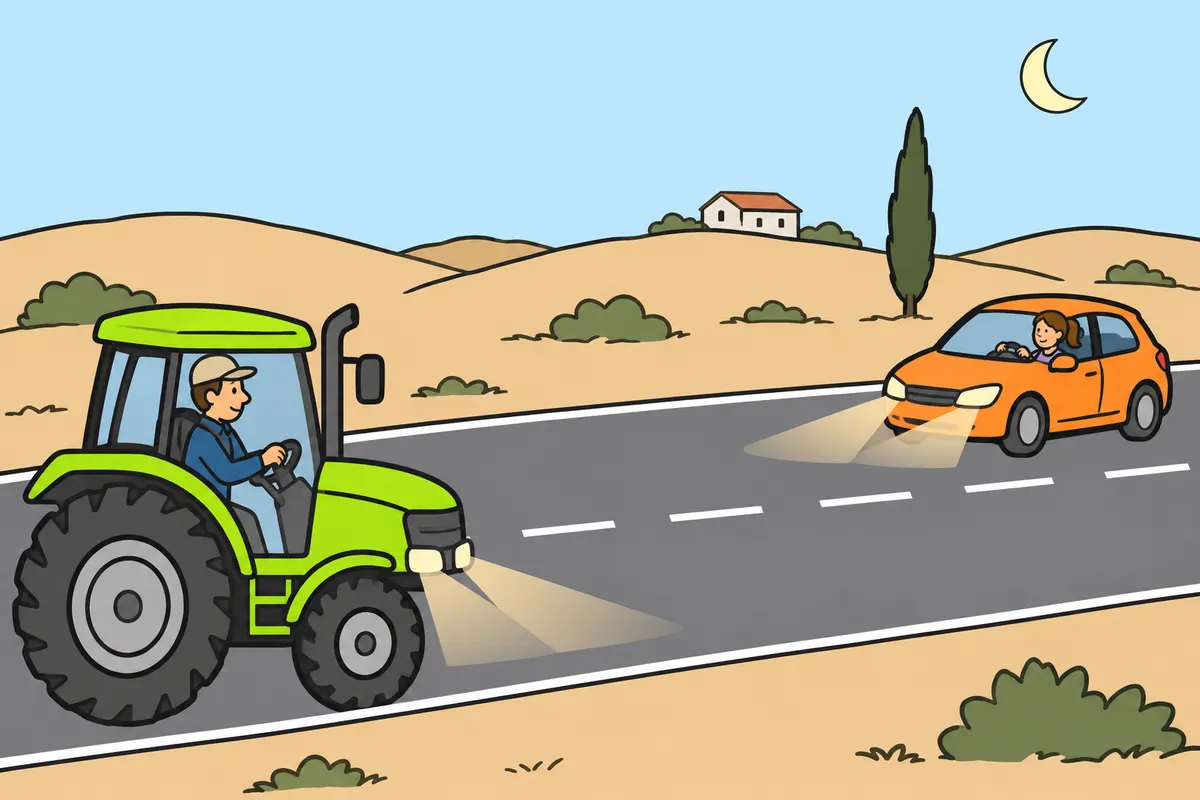
Switch to dipped beam as soon as you could dazzle someone.
Remember
- Avoid dazzling people on your road and other transport routes.
- Dip your headlights even if the oncoming driver does not.
- Watch for dazzling the driver ahead through their mirrors too.
- After passing the other vehicle, restore main beam only if conditions allow.
- If dazzled, slow down and stop if necessary.
Exam trap: Wrong: you wait for the other driver to dip their headlights. Right: switch to dipped beam as soon as you could dazzle someone.
Read the full explanation
- You must switch from main beam to dipped beam as soon as you see any possibility of dazzling someone. This duty applies to users of your road and of other routes; it does not depend on the other driver protesting or signalling. Anticipate approaching traffic, especially on bends and at the crests of hills. [RGC, art. 102.1](https://www.boe.es/buscar/act.php?id=BOE-A-2003-23514#a102).
- You must dip your headlights even if the oncoming driver keeps theirs on main beam. You may switch back to main beam after passing them, if the other conditions allow it. [RGC, art. 102.1](https://www.boe.es/buscar/act.php?id=BOE-A-2003-23514#a102).
- You must also avoid dazzling the driver of the vehicle ahead through their mirrors. The height of a tractor makes it especially important to check the beam alignment and switch to dipped beam whenever there is a possibility of dazzling the driver ahead. [RGC, art. 102.2](https://www.boe.es/buscar/act.php?id=BOE-A-2003-23514#a102).
- If you are dazzled, you must reduce your speed as much as necessary, even to a complete stop, to avoid colliding with vehicles or pedestrians travelling in the same direction as you. [RGC, art. 102.3](https://www.boe.es/buscar/act.php?id=BOE-A-2003-23514#a102).
8Front fog lamps
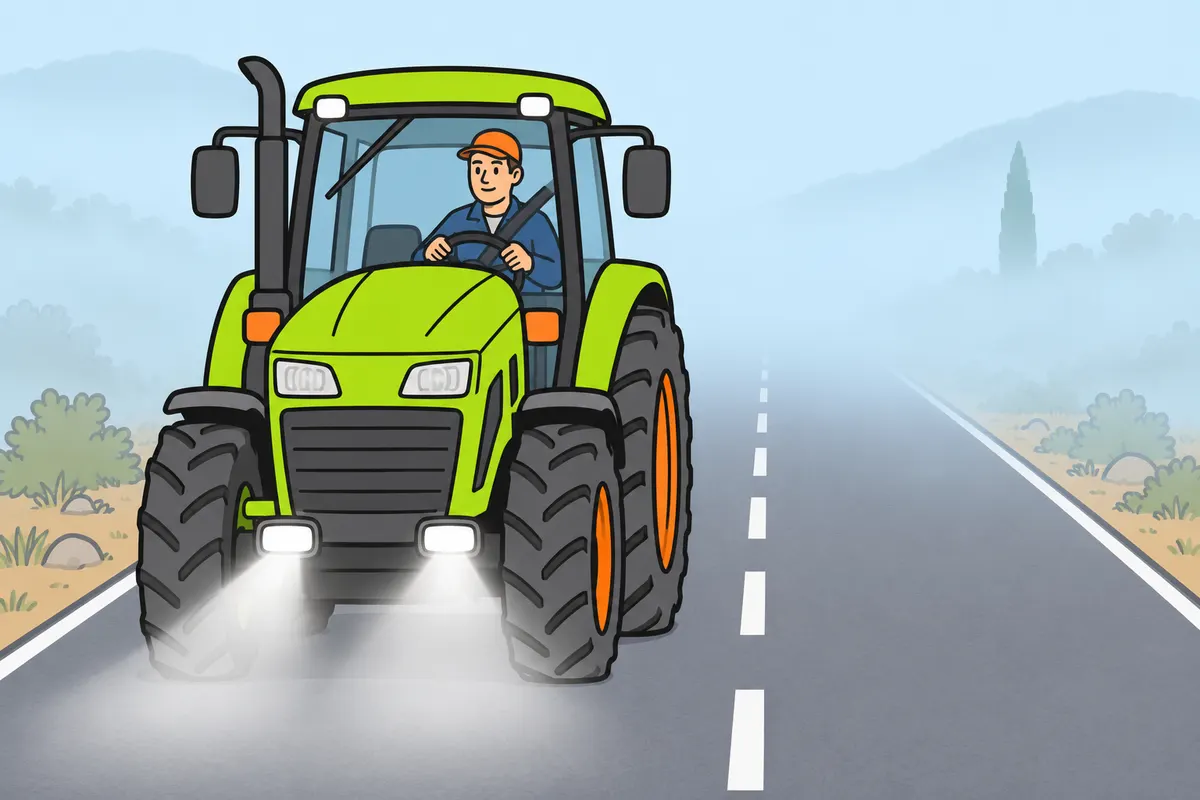
You may use front fog lights in reduced visibility or on certain winding stretches.
| Situation | Condition for using front fog lights |
|---|---|
| Bad weather, smoke or dust | Significantly reduced visibility |
| Narrow stretch with many bends | Carriageway at most 6.50 m wide and signs warning of closely spaced bends |
Remember
- You may fit white or selective yellow front fog lights.
- Use them when fog, heavy rain, snow, smoke or dust significantly reduces visibility.
- Without dipped or main beam, keep position lights and all other required lights on.
- Always avoid dazzling others.
Exam trap: Wrong: a narrow road is enough. Right: the winding-road exception requires a carriageway at most 6.50 m wide and signs warning of a series of closely spaced bends.
Read the full explanation
- You may fit 2 white or selective yellow front fog lamps to your agricultural tractor; fitting them is optional. If visibility is significantly reduced, you must use lighting: if you do not have front fog lamps, you must use the other appropriate lights. [RGV, annex X](https://www.boe.es/buscar/act.php?id=BOE-A-1999-1826#anx); [RGC, art. 106](https://www.boe.es/buscar/act.php?id=BOE-A-2003-23514#a106).
- You may use front fog lamps when fog, heavy rain, snow, smoke, dust or similar conditions significantly reduce visibility. You must assess the actual effect on what you can see; a wet road surface or a few drops of rain without a significant loss of visibility are not enough. [RGC, art. 106.1 and 2](https://www.boe.es/buscar/act.php?id=BOE-A-2003-23514#a106).
- You may use them without dipped beam or main beam, or together with either, in the authorised situations. You must keep the position lights and all other required lighting on. Being allowed to use main beam in certain circumstances does not remove your duty to avoid dazzling others; in fog, its reflection may make it harder for you to see. [RGC, art. 106.2](https://www.boe.es/buscar/act.php?id=BOE-A-2003-23514#a106); [RGV, art. 15.3](https://www.boe.es/buscar/act.php?id=BOE-A-1999-1826#a15).
- You may also switch them on on narrow stretches with many bends: the carriageway must be 6.50 metres wide or less and have signs warning of a series of bends close together. You must meet both conditions; a straight narrow road or an isolated bend is not enough for this exception to apply. [RGC, art. 106.2](https://www.boe.es/buscar/act.php?id=BOE-A-2003-23514#a106).
9Rear fog lamps
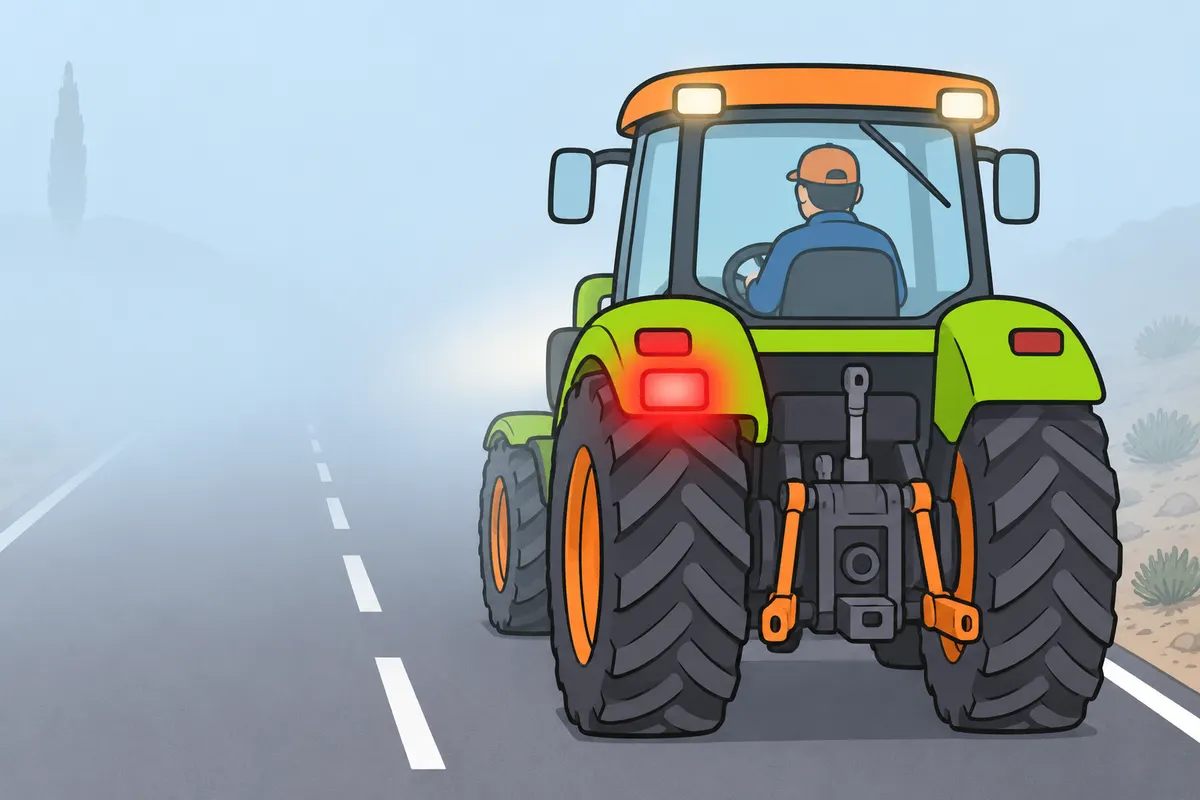
Use your rear fog light only in particularly adverse conditions.
| Agricultural vehicle | Optional rear fog lights |
|---|---|
| Tractor | 1 or 2 red lights |
| Self-propelled agricultural machine | 2 red lights |
| Agricultural trailer | Optional fitting |
Remember
- Use it in thick fog, very heavy rain or heavy snowfall.
- Also use it in dense clouds of smoke or dust.
- Switch it off when those conditions end.
- Keep dipped beam, main beam or front fog lights on to use it.
- If your tractor has only one, it must be on the left.
Exam trap: Wrong: you switch on the rear fog light in light fog. Right: use it only in particularly adverse conditions.
Read the full explanation
- A rear fog lamp is a red light that makes you more visible from behind in particularly unfavourable conditions. Fitting it to your tractor is optional: you may have 1 or 2; if you have one, it is on the left. For a self-propelled agricultural machine, the table provides for 2 optional lamps. [RGV, annex X](https://www.boe.es/buscar/act.php?id=BOE-A-1999-1826#anx).
- If you have rear fog lamps, you must use them only when conditions are particularly unfavourable: thick fog, very heavy rain, heavy snowfall or dense clouds of smoke or dust. [RGC, art. 106.2](https://www.boe.es/buscar/act.php?id=BOE-A-2003-23514#a106).
- A rear fog lamp does not replace the rear position lights or mean that you are braking. [RGV, annex X](https://www.boe.es/buscar/act.php?id=BOE-A-1999-1826#anx).
- You must have main beam, dipped beam or front fog lamps on before you can switch on the rear fog lamp. You may also find optional rear fog lamps on an agricultural trailer; you must not assume that it has the same lighting requirements as an ordinary trailer. [RGV, art. 15.3 and annex X](https://www.boe.es/buscar/act.php?id=BOE-A-1999-1826#a15).
10End-outline marker lamps: width and agricultural requirements
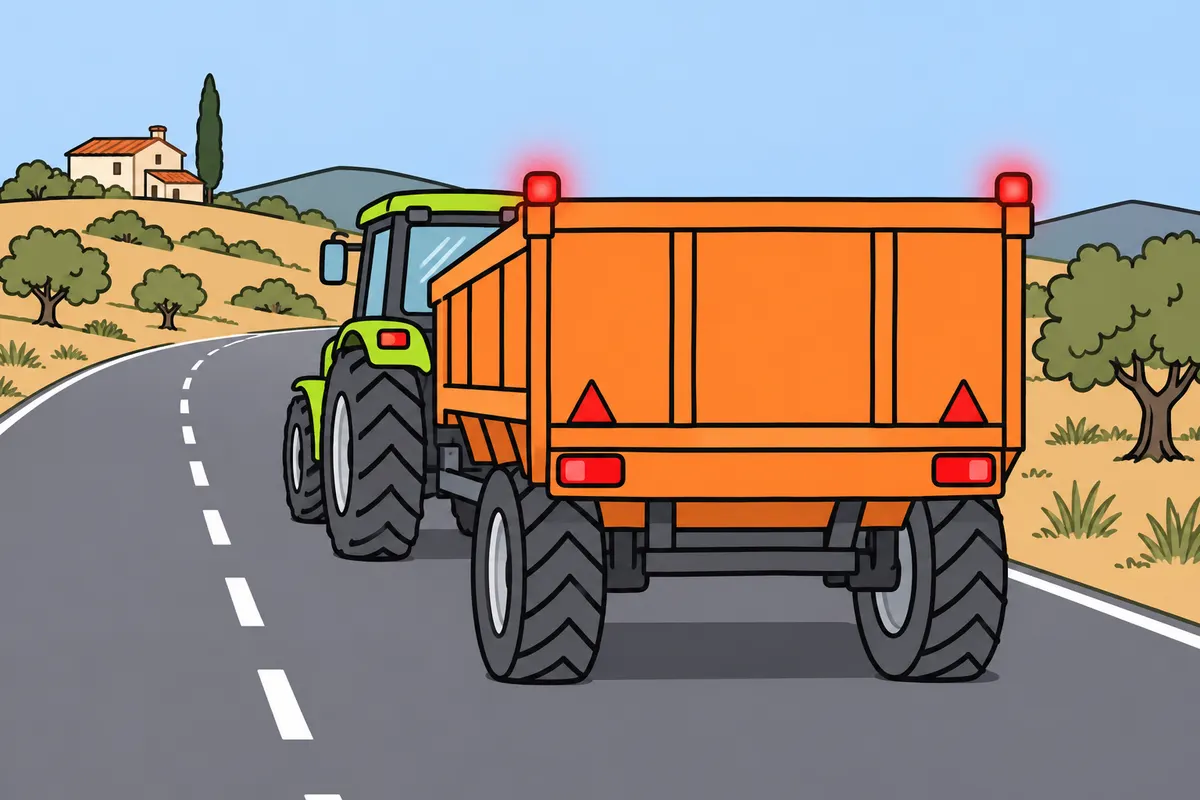
Distinguish when you must use end-outline marker lamps from when you may fit them.
| Agricultural vehicle | Fitting end-outline marker lamps by width |
|---|---|
| Tractor wider than 2.10 m | Optional under its equipment table |
| Tractor 2.10 m wide or less | Prohibited |
| Agricultural trailer wider than 2.10 m | Compulsory at front and rear |
Remember
- Over 2.10 m wide, use them whenever position lights are required.
- They are white at the front and red at the rear.
- On special agricultural vehicles, place them at the top of the widest part.
- Ordinary lights may replace them if correctly placed within 250 mm of outer edges.
Exam trap: Wrong: you apply the option for automobiles between 1.80 m and 2.10 m to tractors. Right: that option is for automobiles; fitting and using the lamps are different rules.
Read the full explanation
- End-outline marker lamps indicate the overall width and size of your vehicle. You have 2 white lamps at the front and 2 red lamps at the rear, close to the outer edges. When you drive in situations requiring position lights and your width exceeds 2.10 metres, article 99 also requires end-outline marker lamps. [RGC, art. 99](https://www.boe.es/buscar/act.php?id=BOE-A-2003-23514#a99); [RGV, annex X](https://www.boe.es/buscar/act.php?id=BOE-A-1999-1826#anx).
- The tractor installation table classifies end-outline marker lamps as optional if the width exceeds 2.10 metres. You must not fit them to a tractor with a width of 2.10 metres or less. [RGV, annex X](https://www.boe.es/buscar/act.php?id=BOE-A-1999-1826#anx).
- On a special agricultural vehicle, you may position end-outline marker lamps below the level of the ordinary lighting, but you must place them at the highest point of the widest part. You may use the ordinary lighting in their place if it meets that condition and is no more than 250 millimetres from the outer edges. [RGV, annex X](https://www.boe.es/buscar/act.php?id=BOE-A-1999-1826#anx).
- For an agricultural trailer, you must comply with the requirement to have front and rear end-outline marker lamps when its width exceeds 2.10 metres. You must consider the category and configuration of the combination, without assuming that the tractor’s end-outline marker lamps alone indicate the trailer’s outer edges. [RGV, art. 16.11 and annex X](https://www.boe.es/buscar/act.php?id=BOE-A-1999-1826#a16).
11Side marker lamps and reflectors
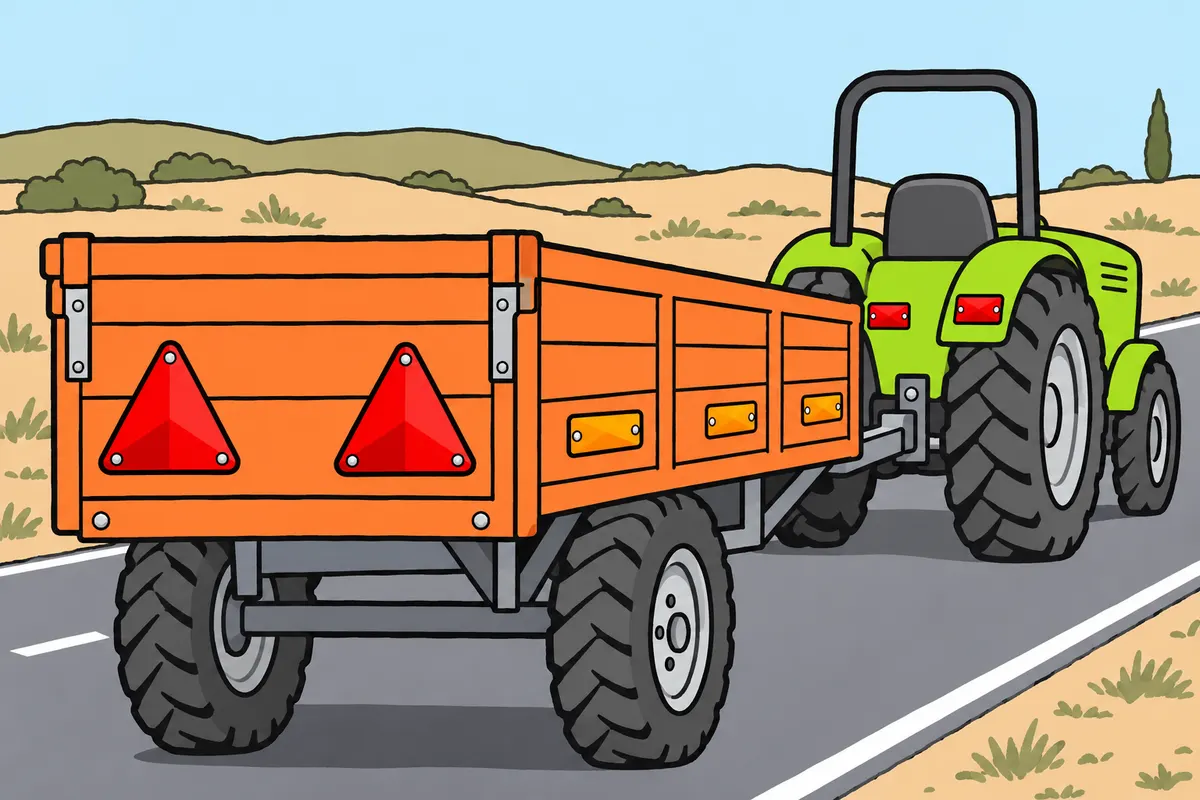
Distinguish side marker lamps from reflectors that return light received from outside.
| Agricultural vehicle | Front reflectors | Rear reflectors | Side reflectors |
|---|---|---|---|
| Tractor | Not detailed here | Red, non-triangular | Amber, optional according to length |
| Agricultural trailer | White, non-triangular | Red, triangular | Amber |
Remember
- A reflector needs an external light source to reflect light.
- Do not automatically apply other vehicle categories’ side marker lamp rules to your tractor.
- Check the agricultural equipment table and your vehicle’s type approval.
- On your trailer, recognise rear triangles with one point upwards.
Exam trap: Wrong: a reflective number plate is a reflector. Right: a number plate is not a reflector just because it reflects light.
Read the full explanation
- A side marker lamp emits light to indicate your presence from the side; a side reflector reflects light received from an external source. A reflector can work without an electrical connection, but it needs an external light source. [RGV, annex X](https://www.boe.es/buscar/act.php?id=BOE-A-1999-1826#anx).
- You must have 2 or 4 red non-triangular rear reflectors on your agricultural tractor. Its table allows optional amber side reflectors depending on its length. [RGV, annex X](https://www.boe.es/buscar/act.php?id=BOE-A-1999-1826#anx).
- On an agricultural trailer, you must recognise 2 white non-triangular front reflectors, 2 red triangular rear reflectors with one vertex pointing upwards, and amber side reflectors. Article 16 specifies this equipment for agricultural trailers; for towed machines, you must refer to their specific provisions according to their suitability for road use. [RGV, art. 16.11-13](https://www.boe.es/buscar/act.php?id=BOE-A-1999-1826#a16).
- You must not automatically apply to your tractor the rule requiring side marker lamps when the length exceeds 6 metres, which applies to other categories. You must consult the agricultural table and the type approval for your particular vehicle. Nor must you call a number plate or a regulatory sign a reflector merely because it is retroreflective. [RGV, art. 16 and annex X](https://www.boe.es/buscar/act.php?id=BOE-A-1999-1826#a16).
12Direction indicators
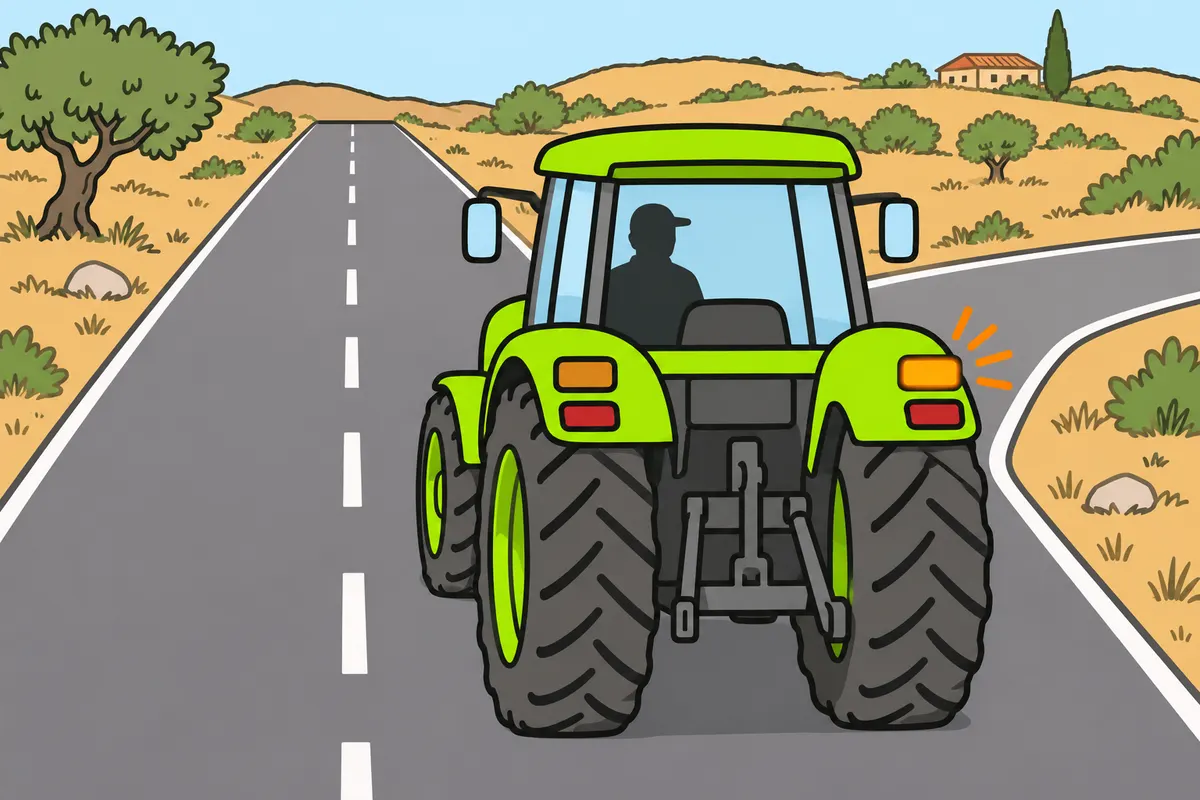
Indicate before moving sideways and switch your indicator off when you finish.
Remember
- Use amber indicators to show which way you are moving.
- Warn in good time and keep signalling throughout the manoeuvre.
- Switch the indicator off once you have adopted your new course.
- To stop or park, indicate towards your stopping side if you have an indicator.
- Check your trailer repeats the signal and your implements do not hide it.
Exam trap: Wrong: indicating gives you priority. Right: it only announces your manoeuvre; you must follow the rules for it.
Read the full explanation
- You must have an even number of amber direction indicators on your tractor, positioned at the outer edges. You must use them to warn of movement towards the corresponding side. They do not illuminate the carriageway or provide a general warning that you are travelling slowly. [RGV, annex X](https://www.boe.es/buscar/act.php?id=BOE-A-1999-1826#anx).
- You must signal a sideways movement sufficiently in advance and keep the indicator on throughout the manoeuvre. You must stop signalling once you have adopted your new course. If the control does not cancel automatically, you must switch it off yourself so that you do not signal a turn you are not going to make. [RGC, arts. 108 and 109](https://www.boe.es/buscar/act.php?id=BOE-A-2003-23514#a109).
- To stop or park, you must use the indicator on the side towards which you intend to stop, if you have one, as well as any required warning that you are slowing down. [RGC, art. 109.2.c](https://www.boe.es/buscar/act.php?id=BOE-A-2003-23514#a109).
- You must check that the trailer repeats the correct signal and that your implements do not obscure your signals. Signalling does not give you priority: when turning or joining traffic, you must follow the rules for those manoeuvres, explained in «Manoeuvres with agricultural vehicles». [RGV, art. 16.11](https://www.boe.es/buscar/act.php?id=BOE-A-1999-1826#a16); [RGC, arts. 14 and 109](https://www.boe.es/buscar/act.php?id=BOE-A-2003-23514#a14).
13Arm signals and headlight flashes
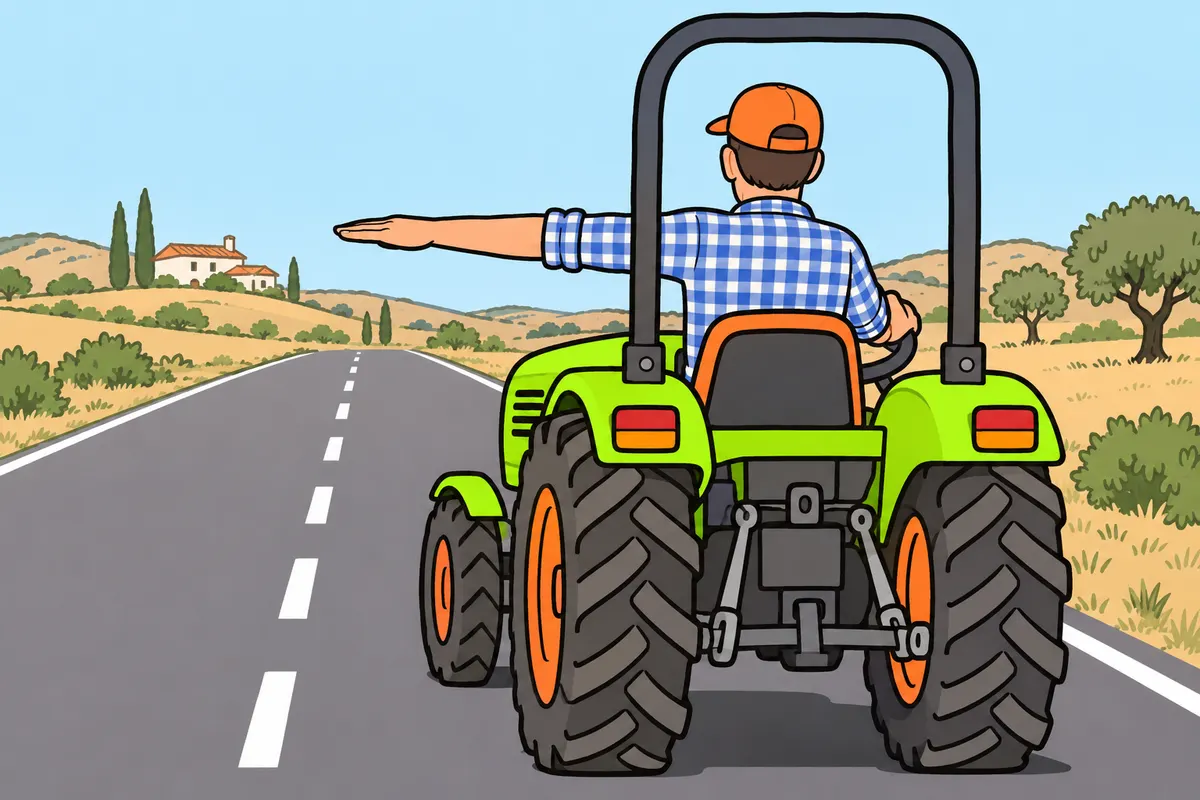
Use visible hand signals and brief flashes only in permitted situations.
Remember
- Others must be able to see your arm signal.
- A prescribed hand signal takes precedence over a conflicting light signal.
- See “Manoeuvres with agricultural vehicles” for hand signals.
- For flashes, see “Horn, headlight flashes and the special vehicle warning light” there.
Exam trap: Wrong: any hand movement overrides a light signal. Right: the hand signal must be prescribed and visible.
Read the full explanation
- You must make hand signals clearly visible; a valid arm signal takes precedence over a conflicting light signal. In a tractor with a cab, trailer or implements, you must consider whether others can see your arm. How to give hand signals is explained in «Manoeuvres with agricultural vehicles», in the section «How to signal each manoeuvre». [RGC, art. 108](https://www.boe.es/buscar/act.php?id=BOE-A-2003-23514#a108).
- The circumstances in which headlight flashes are authorised are explained in «Manoeuvres with agricultural vehicles», in the section «Horn, headlight flashes and the special vehicle warning light». [RGC, art. 109.3](https://www.boe.es/buscar/act.php?id=BOE-A-2003-23514#a109).
14Braking and reversing
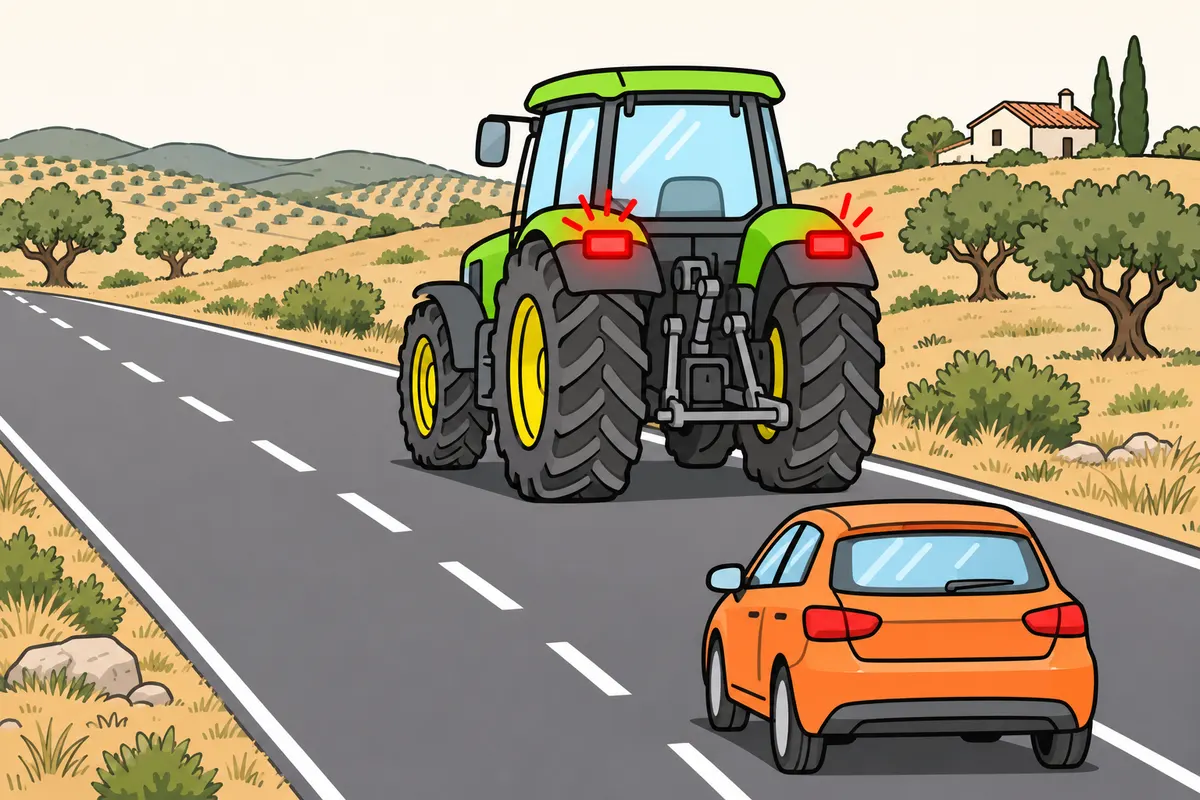
Distinguish brake lights from lights that announce reversing.
| Agricultural vehicle | Fitting brake lights |
|---|---|
| Tractor and self-propelled agricultural machine | Compulsory above 25 km/h maximum authorised speed; otherwise optional |
| Agricultural trailer | 2 optional lights |
Remember
- Red rear brake lights warn that you are applying the brake.
- When possible, announce substantial slowing with repeated brake-light signals or the prescribed hand signal.
- Use your reversing lights if fitted.
- They can warn others before you start reversing.
- Switching them on does not allow prohibited reversing.
Exam trap: Wrong: you decide from your current speed. Right: compulsory fitting of brake lights depends on maximum authorised speed.
Read the full explanation
- Brake lights are red and rear-facing: they warn those behind you that you are applying the service brake. For tractors, the table specifies 2, compulsory when the maximum authorised speed exceeds 25 km/h and optional for all others. The threshold refers to that maximum speed, not your speed at that moment. [RGV, art. 16.6 and Annex X](https://www.boe.es/buscar/act.php?id=BOE-A-1999-1826#a16).
- If you need to slow down considerably or come to a standstill, even because traffic requires it, you must warn others whenever possible by repeatedly operating the brake lights or giving the prescribed hand signal. [RGC, art. 109.2.c](https://www.boe.es/buscar/act.php?id=BOE-A-2003-23514#a109).
- For agricultural trailers, the general table provides for 2 optional brake lights. For self-propelled agricultural machines, the criterion of a maximum authorised speed above 25 km/h applies again. [RGV, art. 16 and Annex X](https://www.boe.es/buscar/act.php?id=BOE-A-1999-1826#a16).
- You may fit your tractor with 1 or 2 white reversing lights, which are optional in its table. They illuminate the area behind you and signal that you are reversing or about to reverse: they can give a warning before you start moving. If you have them, you must use them to signal the manoeuvre; switching them on does not authorise prohibited reversing. [RGV, Annex X](https://www.boe.es/buscar/act.php?id=BOE-A-1999-1826#anx); [RGC, art. 109.2.b](https://www.boe.es/buscar/act.php?id=BOE-A-2003-23514#a109).
15Hazard warning lights
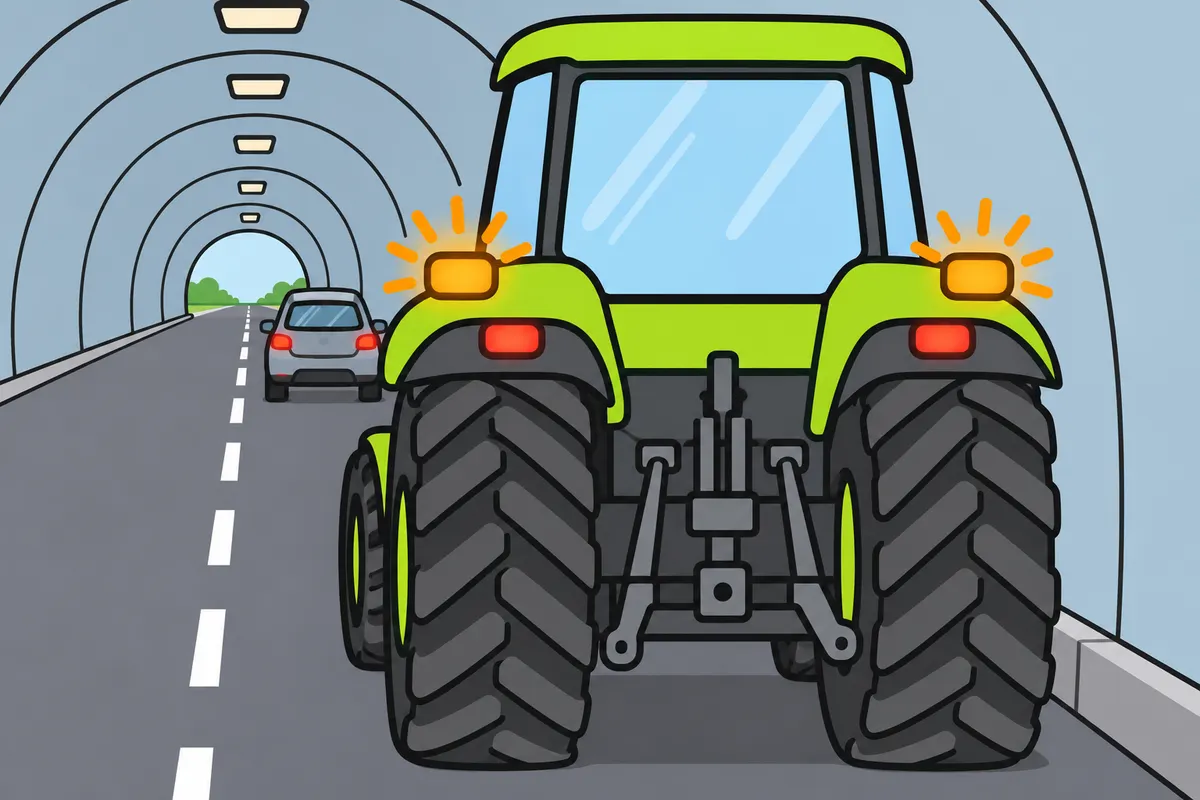
Use hazard warning lights to warn others of a temporary danger.
| If traffic stops you in a tunnel or underpass | What you do |
|---|---|
| Warn drivers behind | Use hazard warning lights temporarily and keep position lights on |
| When you stop | Switch off the engine, even if you stay at the wheel |
| Wait lasts more than 2 minutes | Keep the engine off and position lights on |
| You and your passengers | Stay inside the vehicle |
| Distance from the vehicle ahead | Stop as far away as possible |
Remember
- All your indicators flash together to warn of temporary danger.
- Your tractor must have hazard warning lights.
- If immobilised where visibility is significantly reduced, use them if fitted.
- Add position lights when required.
- If immobilised on a motorway or dual carriageway, use them if fitted.
- When stopped in a tunnel or closed place, always switch off the engine.
Exam trap: Wrong: you wait two minutes to switch off the engine in a tunnel. Right: switch it off as soon as you stop, even if you stay at the wheel; if the wait lasts more than two minutes, keep the engine off and position lights on.
Read the full explanation
- The hazard warning signal consists of all direction indicators flashing simultaneously to warn of a temporary hazard. Your agricultural tractor must be equipped with it. It is amber and uses the same lamps as the direction indicators; you must not confuse it with the elevated V-2 warning light. [RGV, art. 16.6 and Annex X](https://www.boe.es/buscar/act.php?id=BOE-A-1999-1826#a16).
- If your vehicle becomes immobilised on an autopista or autovía (motorways), or in a place or circumstances that significantly reduce visibility, you must signal your presence with the hazard warning lights, if fitted, and with the position lights when required. This general signalling rule does not authorise an LVA vehicle to enter autopistas or autovías. [RGC, art. 109.2.c](https://www.boe.es/buscar/act.php?id=BOE-A-2003-23514#a109).
- If traffic forces you to stop in a tunnel or underpass, switch on your hazard warning lights temporarily to warn those approaching from behind and keep the position lights on. You and your passengers must remain inside the vehicle; stop as far as possible from the vehicle ahead. In a tunnel or enclosed place, switch off the engine as soon as you stop, even if you remain at the wheel; if the wait lasts more than two minutes, keep the engine off and the position lights on. [RGC, art. 97.3](https://www.boe.es/buscar/act.php?id=BOE-A-2003-23514#a97); [RGC, art. 115.1 and 2](https://www.boe.es/buscar/act.php?id=BOE-A-2003-23514#a115).
16V-2: warning of the agricultural vehicle's presence
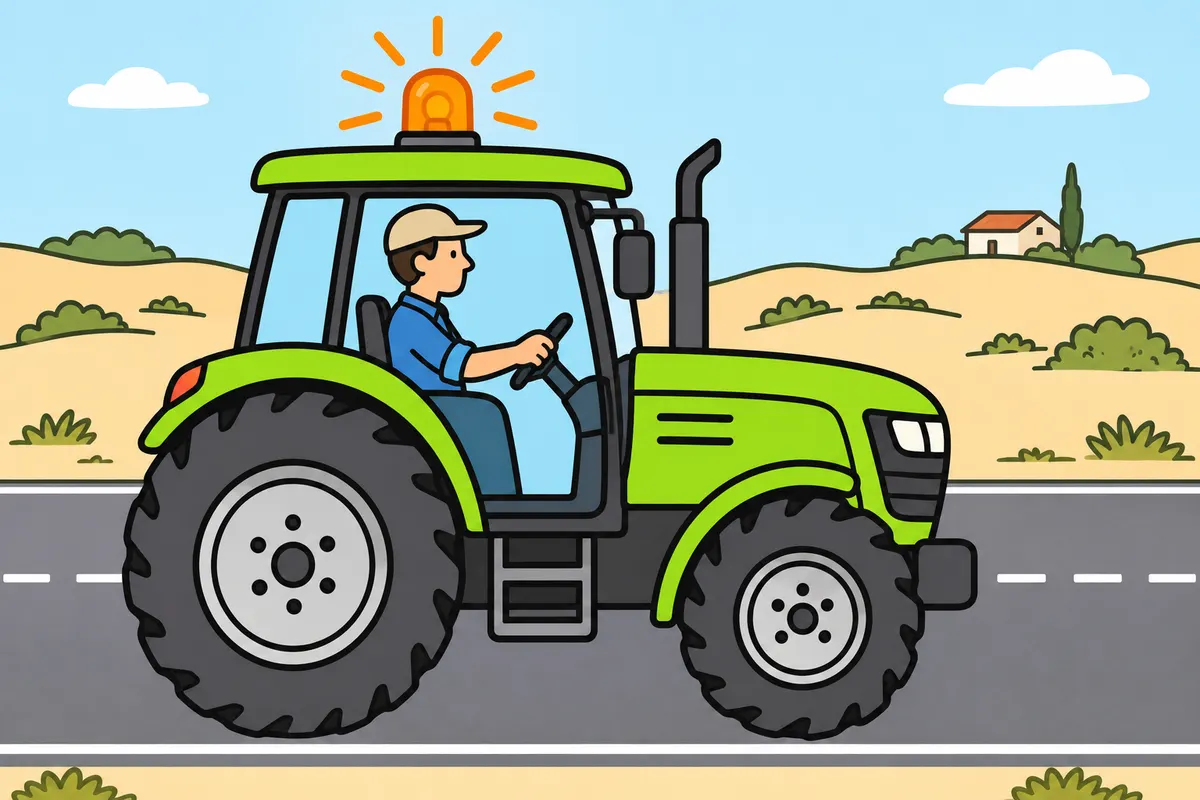
Use V-2 when driving your special vehicle without exceeding the stated speed threshold.
Remember
- On roads open to public use, use V-2 at no more than 40 km/h.
- Use it by day and night.
- Add the required lights at night, in tunnels or in reduced visibility.
- It does not give you priority.
- Check the cab or implement does not hide it.
- If V-2 fails, use dipped beam, hazard warning lights and other required lights.
Exam trap: Wrong: you do not use V-2 at exactly 40 km/h. Right: you must use it when driving your special vehicle at that speed on roads open to public use.
Read the full explanation
- You must use the V-2 warning light by day and by night when driving your special vehicle on roads open to public use at a speed not exceeding 40 km/h. Exactly 40 km/h is included. [RGC, arts. 71.3 and 113](https://www.boe.es/buscar/act.php?id=BOE-A-2003-23514#a71).
- The V-2 emits amber light and must be visible in all directions from 100 metres; you must check that the cab or implement does not obscure it. Installation is explained in «The agricultural vehicle and its equipment», in the section «V-2: characteristics and installation». [RGV, Annex XI, V-2](https://www.boe.es/buscar/act.php?id=BOE-A-1999-1826#v-2).
- You must use the V-2 to warn of your presence in the circumstances specified by the regulations, without claiming priority. Its regulations do not require administrative authorisation to install it as an additional or built-in component. You must not fit and use it on vehicles where the circumstances justifying that signal do not apply. [RGV, Annex XI, V-2](https://www.boe.es/buscar/act.php?id=BOE-A-1999-1826#v-2).
- If the V-2 fails, you must use dipped beam and the hazard warning lights while driving. This substitute warns of the special vehicle's presence and is additional to the lighting required by conditions along the route. [RGC, art. 71.3](https://www.boe.es/buscar/act.php?id=BOE-A-2003-23514#a71).
17Immobilised vehicles and parking
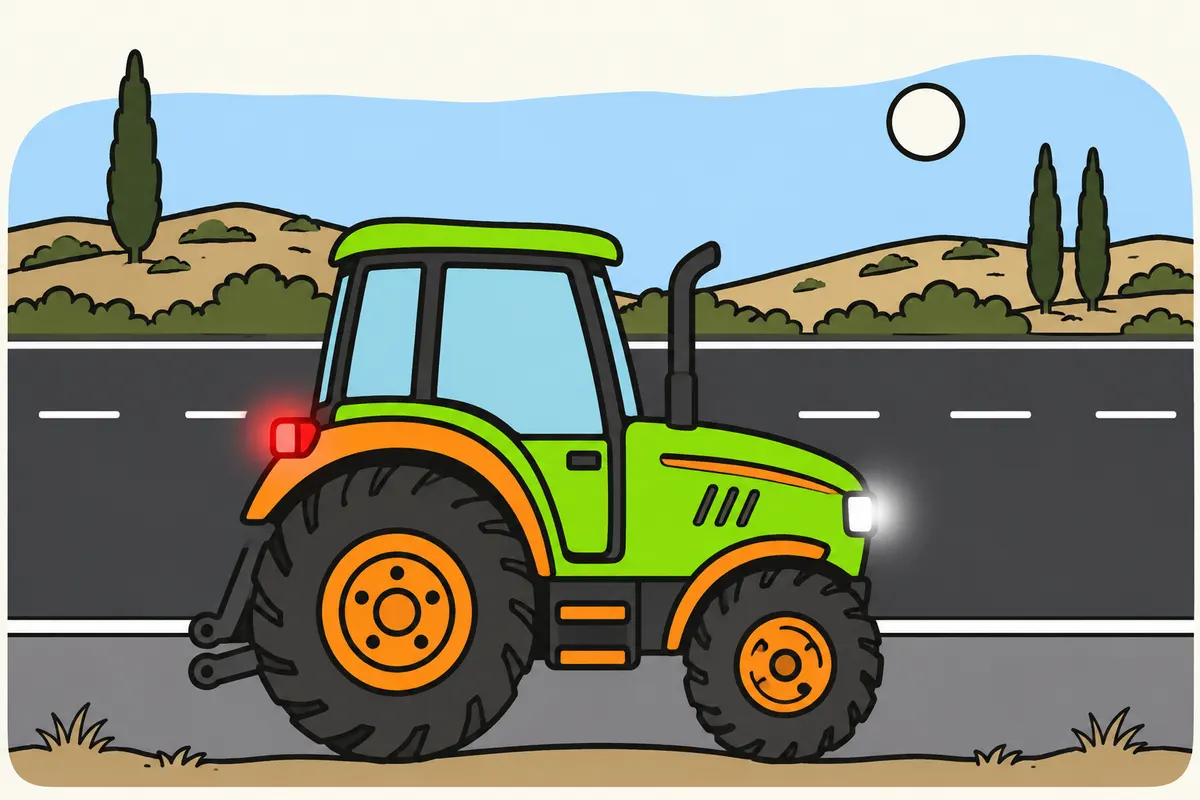
Keep your immobilised vehicle visible according to its location and the lighting.
| Location and situation | Lighting for your immobilised vehicle |
|---|---|
| Insufficiently lit through road at night, on carriageway or hard shoulder | Position lights |
| Same through road and conditions, parked parallel to the kerb | You may replace position lights with parking lights or carriageway-side position lights |
| Parked on an urban road other than a through road, sufficiently visible under the lighting | You may leave position lights off |
Remember
- At night or in significantly reduced visibility, keep position lights on when immobilised.
- This applies on the carriageway or hard shoulder.
- Add end-outline marker lamps when required.
- Do this even with the engine off.
- Do not use main beam while stopped or parked.
Exam trap: Wrong: you apply the urban exception to a breakdown on a dark road. Right: keep position lights on and end-outline marker lamps where required.
Read the full explanation
- If your vehicle becomes immobilised at night or in significantly reduced visibility on the carriageway or arcén (hard shoulder), you must keep the position lights and, where required, the end-outline marker lamps on. This obligation depends on the vehicle's situation, not on whether the engine is still running. [RGC, art. 105.1](https://www.boe.es/buscar/act.php?id=BOE-A-2003-23514#a105).
- On an inadequately lit stretch of road through a town, if you stop or park at night on the carriageway or hard shoulder, you must keep the position lights on. When parked parallel to the edge of the road, you may replace them with the parking lights or the two position lights on the side facing the carriageway. [RGC, art. 105.2](https://www.boe.es/buscar/act.php?id=BOE-A-2003-23514#a105).
- On an urban road that is not a stretch of road through a town, you may leave a vehicle parked without the position lights on if the lighting allows it to be seen clearly enough. [RGC, art. 105.3](https://www.boe.es/buscar/act.php?id=BOE-A-2003-23514#a105).
- Your tractor may have 2 or 4 optional parking lights, white at the front and red at the rear. You must use them only where permitted, without confusing them with work lights or main beam. [RGV, Annex X](https://www.boe.es/buscar/act.php?id=BOE-A-1999-1826#anx); [RGC, arts. 100 and 105](https://www.boe.es/buscar/act.php?id=BOE-A-2003-23514#a100).
18V-16 and the duty to warn of danger
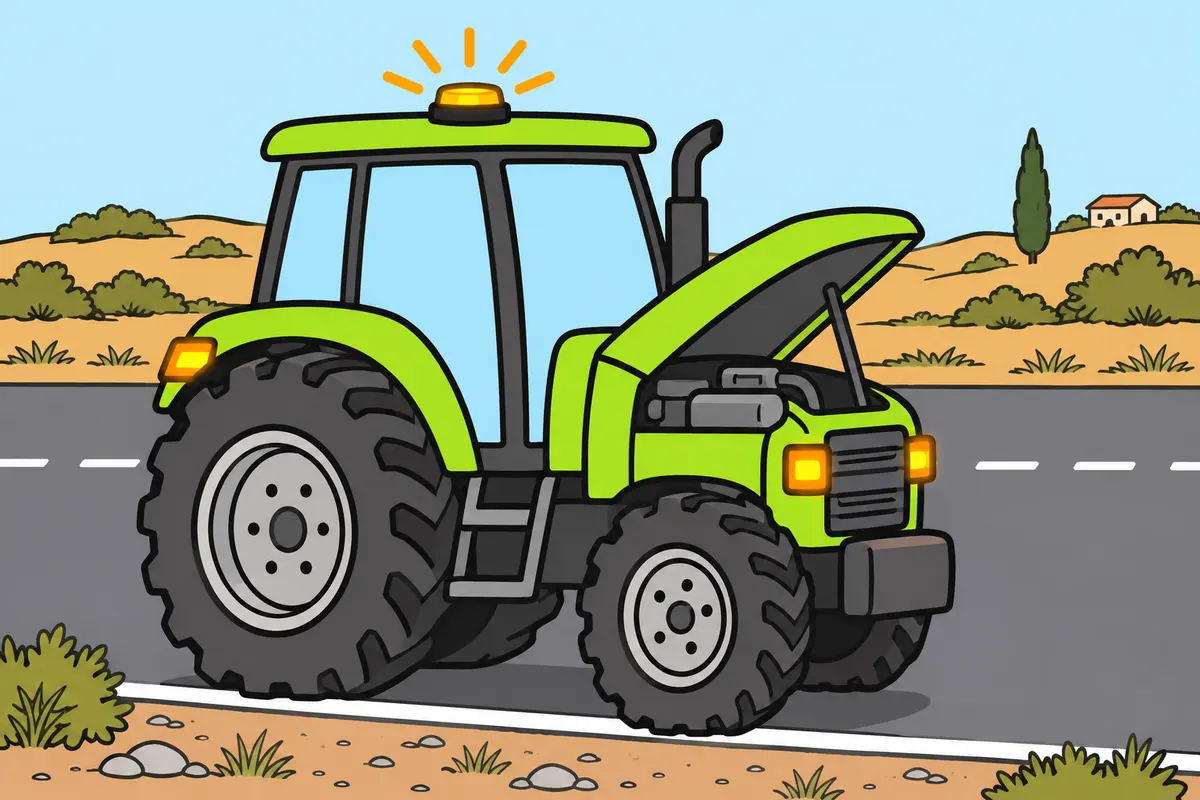
The V-16 warns others when your vehicle is dangerously immobilised.
| Sign or lights on your agricultural vehicle | Purpose and use |
|---|---|
| V-16 | Warns of immobilisation; see “Accidents and breakdowns: protect and assist” for equipment and use |
| V-2 | You must use it on roads open to public use at 40 km/h or less |
| Hazard warning lights, position lights and end-outline marker lamps | Keep them on when required while clearing the road |
Remember
- See “Accidents and breakdowns: protect and assist” for its equipment and use.
- There you can learn its requirements and how to position it.
- V-16 does not replace V-2 or hazard warning lights.
Exam trap: Wrong: you treat V-16 as a light for driving. Right: it warns of a dangerous immobilisation; see “Accidents and breakdowns: protect and assist” for its use.
Read the full explanation
- The V-16 signals that your vehicle is immobilised; it does not replace the V-2, which you must use when driving at 40 km/h or less on roads open to public use, or the hazard warning lights, position lights and end-outline marker lamps, which you must keep on when required while clearing the road. [RGC, art. 71.3](https://www.boe.es/buscar/act.php?id=BOE-A-2003-23514#a71); [RGC, art. 130.4](https://www.boe.es/buscar/act.php?id=BOE-A-2003-23514#a130).
- Carrying and using it in an agricultural vehicle, its requirements and its placement are explained in «Accidents and breakdowns: protect and assist», in the sections «The connected V-16 and agricultural vehicles» and «Position and maintain the beacon correctly». [RGC, art. 130.4](https://www.boe.es/buscar/act.php?id=BOE-A-2003-23514#a130); [RGV, Annex XI, V-16](https://www.boe.es/buscar/act.php?id=BOE-A-1999-1826#v-16).
19Equipment by category and vehicle signs
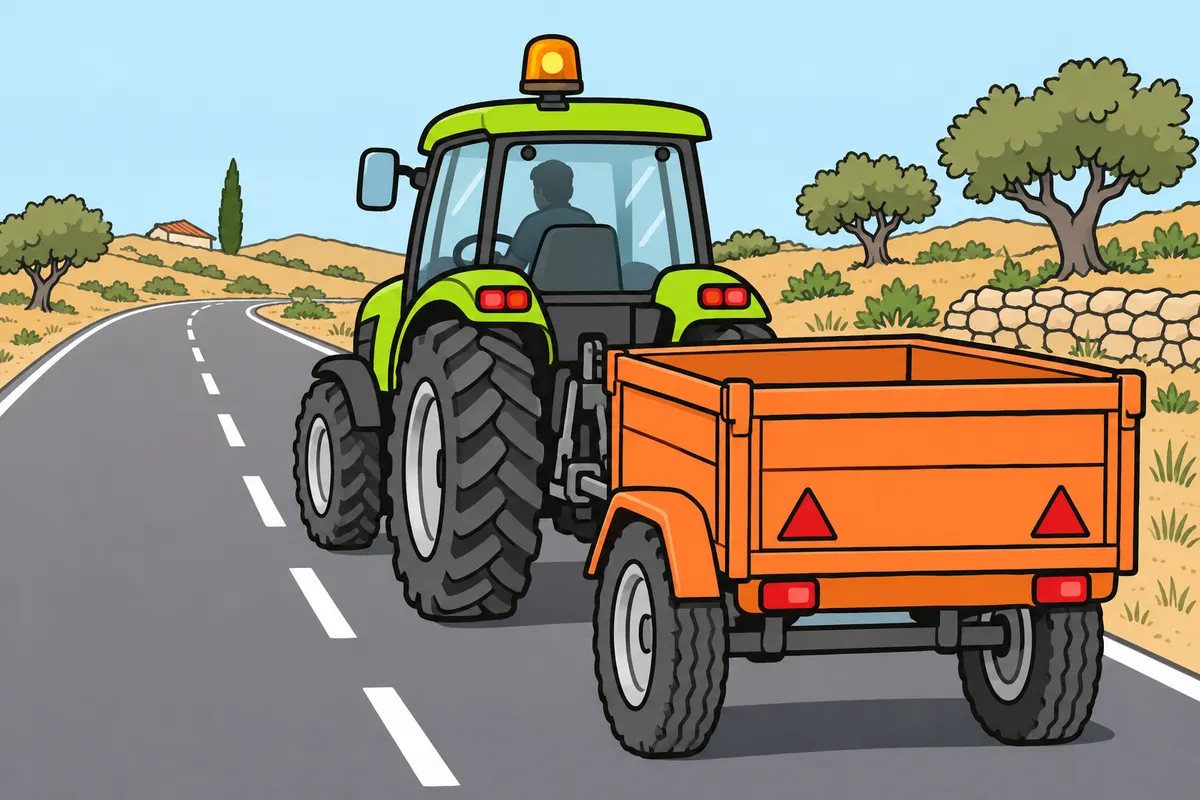
Check the equipment and road-use limits for each agricultural vehicle category.
| Agricultural vehicle plate | What you must recognise |
|---|---|
| V-4 | Required at the rear, always visible, on special vehicles and combinations containing a special vehicle |
| V-4: number | Speed you must not exceed |
| V-5 | Vehicle or combination designed for no more than 40 km/h |
| V-5: position | At the rear; optional when you must display V-4 |
Remember
- Compare your agricultural trailer’s width with your tractor’s width.
- Over 20 cm beyond the tractor on the greatest-overhang side, you need extra lights.
- These are front position lights.
- Respect the road-use limits of your machine or walking tractor.
- If unsuitable, avoid night driving, sections marked as tunnels and significantly reduced visibility.
- Check the plates in “The agricultural vehicle and its equipment”.
Exam trap: Wrong: V-5 means you are driving slowly now. Right: it identifies a design speed limit.
Read the full explanation
- The suitability of the machine or walking tractor determines its equipment and the routes you can take: if it is not suitable for use at night, on stretches signposted as tunnels or when visibility is significantly reduced, you must respect that restriction. Its minimum devices are those specified in the relevant paragraphs of article 16, even if the tractor has more extensive equipment. On an agricultural trailer, front position lights are compulsory if its width extends more than 20 centimetres beyond the tractor on the side with the greatest overhang. [RGV, art. 16.7-11](https://www.boe.es/buscar/act.php?id=BOE-A-1999-1826#a16).
- You must display the V-4 sign at the rear, visible at all times, on special vehicles and on combinations in which at least one vehicle is a special vehicle: its number indicates the speed you must not exceed. The V-5 sign identifies a vehicle or combination whose design prevents it from exceeding 40 km/h; you fit it at the rear, and it is optional when you must display V-4. One indicates a restriction and the other a design characteristic. See «The agricultural vehicle and its equipment», section «Speed plates and slow-moving vehicles». [RGV, annex XI, V-4 and V-5](https://www.boe.es/buscar/act.php?id=BOE-A-1999-1826#anxi).
20Number plate lighting
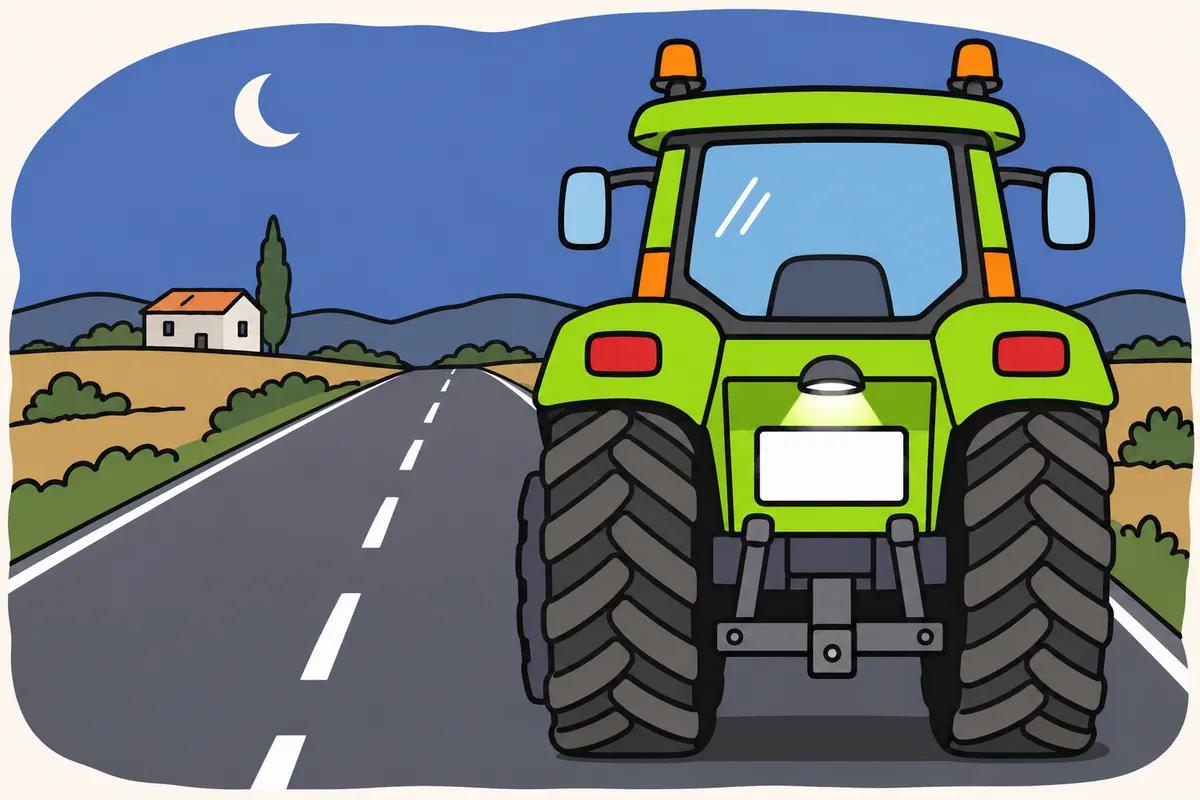
Keep your rear number plate lit and visible when required.
Remember
- Light your rear plate at night and in significantly reduced visibility.
- Also do this in the specified underpasses and tunnels.
- The plate light must be white.
- Keep mud, straw and tools from covering the plate.
- Check your trailer’s number plate light when coupling it.
- Working indicators do not prove the plate light has power.
Exam trap: Wrong: a reflective number plate needs no light. Right: reflectivity does not replace the required lighting.
Read the full explanation
- You must keep the rear number plate illuminated at night, in the indicated underpasses and tunnels, and when visibility is significantly reduced. The number plate light is white and must illuminate the area where the plate is fitted. The plate's reflectivity does not replace the required lighting or allow you to cover it with mud, straw or tools. [RGC, art. 103](https://www.boe.es/buscar/act.php?id=BOE-A-2003-23514#a103); [RGV, annex X](https://www.boe.es/buscar/act.php?id=BOE-A-1999-1826#anx).
- The number plate lighting has as many devices as necessary to illuminate the area where the plate is fitted. It forms part of the compulsory equipment on both the tractor and the agricultural trailer: when you couple the combination, also check the light for the trailer's rear number plate. A connection that operates the direction indicators may leave that light inoperative; check that it comes on with the corresponding lighting. [RGV, art. 16.6 and 11 and annex X](https://www.boe.es/buscar/act.php?id=BOE-A-1999-1826#a16).
21Work lights and marking projecting loads
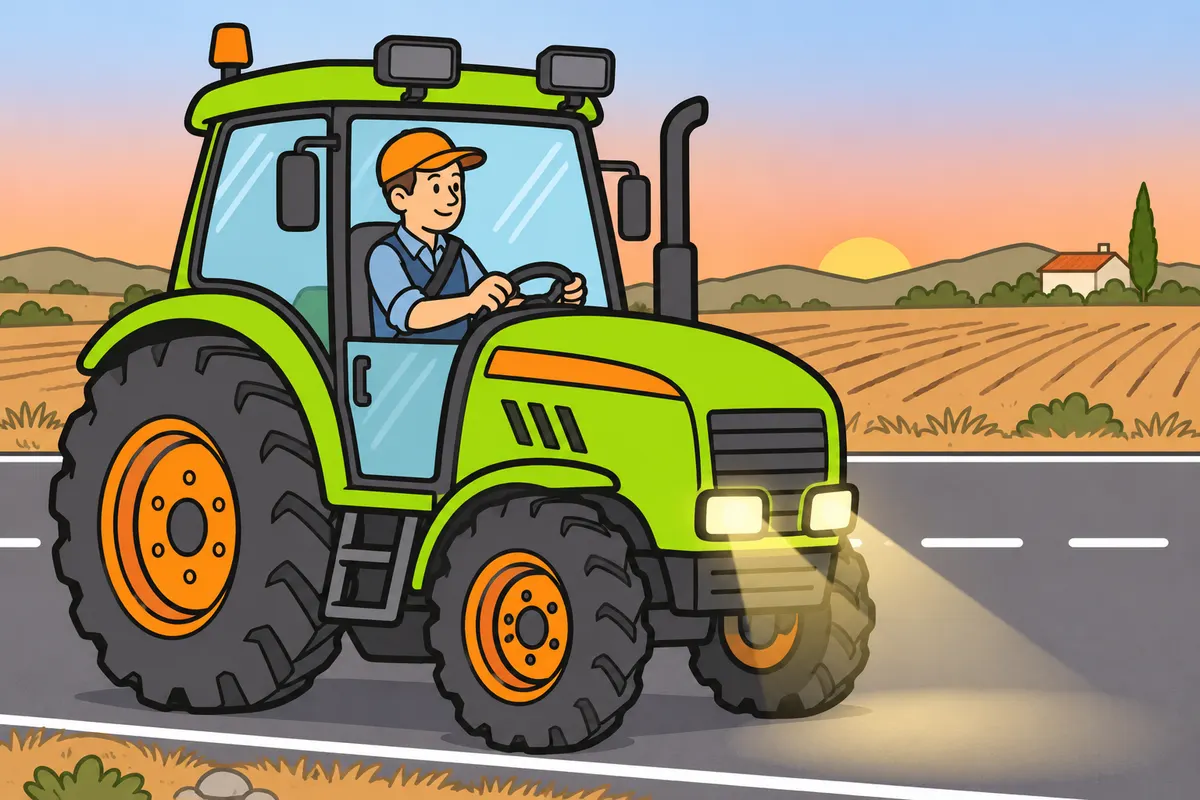
Use work lights for tasks and the required lights to travel safely.
| Load overhang at night or in significantly reduced visibility | How to mark it |
|---|---|
| Rear | Red light and required V-20 panels |
| Front | White light |
| Side extremity over 0.40 m from the outer edge of the front or rear position light | White light and reflector facing forwards; red light and reflector facing backwards |
Remember
- You may have optional white work lights and interior lighting.
- When changing from work to road travel, check which lights you use.
- Avoid dazzling others with work lights.
- At night or in significantly reduced visibility, add lights to projecting loads.
- Measure side overhang from the outer edge of the position light.
- See “Loads, implements and agricultural traffic” for projecting loads.
Exam trap: Wrong: V-20 makes any overhang legal. Right: it marks a rear load in required cases; you must still follow the overhang rules.
Read the full explanation
- You may find optional white work lights for illuminating a task, as well as optional interior lighting. Their function differs from that of dipped beam and main beam: you must use the road lighting when travelling and prevent work lights from dazzling other road users. When you switch from agricultural work to travelling, check that you use the lighting intended for road use. [RGV, annex X](https://www.boe.es/buscar/act.php?id=BOE-A-1999-1826#anx); [RGC, arts. 98-102](https://www.boe.es/buscar/act.php?id=BOE-A-2003-23514#a98).
- When you drive at night or with significantly reduced visibility, a load projecting at the rear requires a red light in addition to the required V-20 panels; if it projects at the front, you mark it with a white light. If a lateral extremity is more than 0.40 metres from the outer edge of the front or rear position light, you must mark each extremity with a white light and reflector facing forwards, and a red light and reflector facing backwards. Panel placement is explained in «Loads, implements and agricultural traffic», section «Panels and lights for projecting loads». [RGC, art. 15.6 and 7](https://www.boe.es/buscar/act.php?id=BOE-A-2003-23514#a15).
22Lighting checks and failures
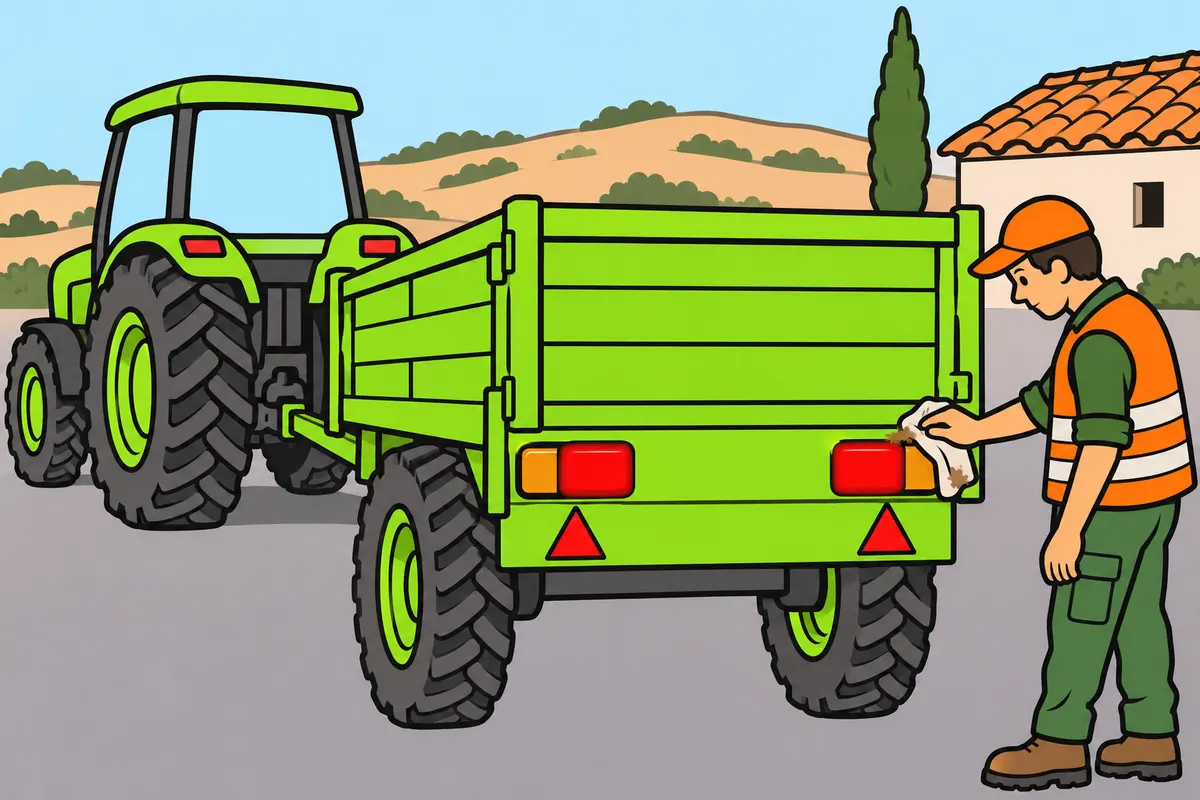
Check your lights and adjust your speed if a failure reduces their brightness.
Remember
- Before setting off, clean your lights and check your trailer’s lights too.
- Check that nothing hides your lights or signs.
- Keep the authorised colours, brightness and positions.
- Optional lights must meet technical requirements too.
- If an unrepairable failure during your journey reduces brightness, slow down.
- You must be able to stop within the illuminated area.
Exam trap: Wrong: knowing the road lets you keep your speed with less light. Right: slow down until you can stop within the illuminated area; if you must stop, give the required warnings.
Read the full explanation
- Before setting off, you must check that lights and signs are visible from the directions for which they are intended. Remove mud, dust and debris that obscure them and check that they work on the combination with its trailer. This check allows you to detect an obscured or disconnected lamp even if the control appears to work from the cab. [RGV, arts. 13 and 15](https://www.boe.es/buscar/act.php?id=BOE-A-1999-1826#a15); [RGC, art. 14](https://www.boe.es/buscar/act.php?id=BOE-A-2003-23514#a14).
- You must maintain matching colour and intensity and symmetrical positioning for paired devices with the same purpose. You must not add unauthorised lights, paint or reflectors. An optional light must also meet its technical requirements; optional does not mean you are free to fit any decorative light. [RGV, art. 15](https://www.boe.es/buscar/act.php?id=BOE-A-1999-1826#a15).
- If a fault that you cannot repair during the journey forces you to drive with lower-intensity lighting, you must reduce your speed so that you can stop within the illuminated area. [RGC, art. 107](https://www.boe.es/buscar/act.php?id=BOE-A-2003-23514#a107).
- If you must immobilise your vehicle because of the failure, switch on the position lights and end-outline marker lamps when applicable, use the hazard warning lights in the required circumstances, and warn others of the danger. The full procedure for dealing with a breakdown is explained in «Accidents and breakdowns: protect and assist». [RGC, arts. 105, 107, 109 and 130](https://www.boe.es/buscar/act.php?id=BOE-A-2003-23514#a130).
Choose your lights when setting off
Check the road conditions and the equipment on your agricultural vehicle.
- Identify whether it is night-time, visibility is reduced or you are about to enter a tunnel or underpass. You need a category B licence for group 2 combinations that exceed the ordinary limits.
- Switch on the position lights, number plate lighting and the required driving lights; add the end-outline marker lamps where applicable.
- Use dipped beam in built-up areas and avoid dazzling others; assess whether to use main beam according to your equipment, the lighting and the threshold of more than 40 km/h.
- In adverse weather, distinguish the conditions for using front fog lamps from the more demanding conditions for rear fog lamps.
- Check the V-2 for driving on public roads at speeds not exceeding 40 km/h, and check the trailer lights.
Signal a sideways movement
You must signal in good time, visibly and consistently with your intended path.
- Observe your surroundings and check that the trailer or implement does not obscure the indicators.
- Switch on the indicator on the side towards which you intend to move in good time.
- Carry out the manoeuvre only when you can do so in accordance with the applicable rules.
- Keep signalling throughout the sideways movement and cancel the signal once you follow your new path.
Warn others of an immobilisation in poor visibility
Combine the lights that show your presence with hazard warnings.
- Position your vehicle where it causes the least possible obstruction, if you can do so safely.
- Keep the position lights on and, where applicable, the end-outline marker lamps; switch on the hazard warning lights.
- Use a connected, certified V-16 as the regulatory warning device; place it as high as possible on the vehicle, ensuring maximum visibility.
- Do not replace these warnings with work lights or main beam; apply the vehicle removal and protection measures in «Accidents and breakdowns: protect and assist».
Finished this module?
Mark it as read and you will see your progress on the theory list.