
Theory · LVA Licence - Agricultural Vehicle · Module 10 of 16
Manoeuvres with agricultural vehicles
You learn to join traffic, change lanes, overtake, turn and reverse with an agricultural vehicle, taking its implements and trailers into account. You master the signals and conditions for stopping, parking and immobilising the combination safely, including the figures and exceptions that may appear in the LVA test.
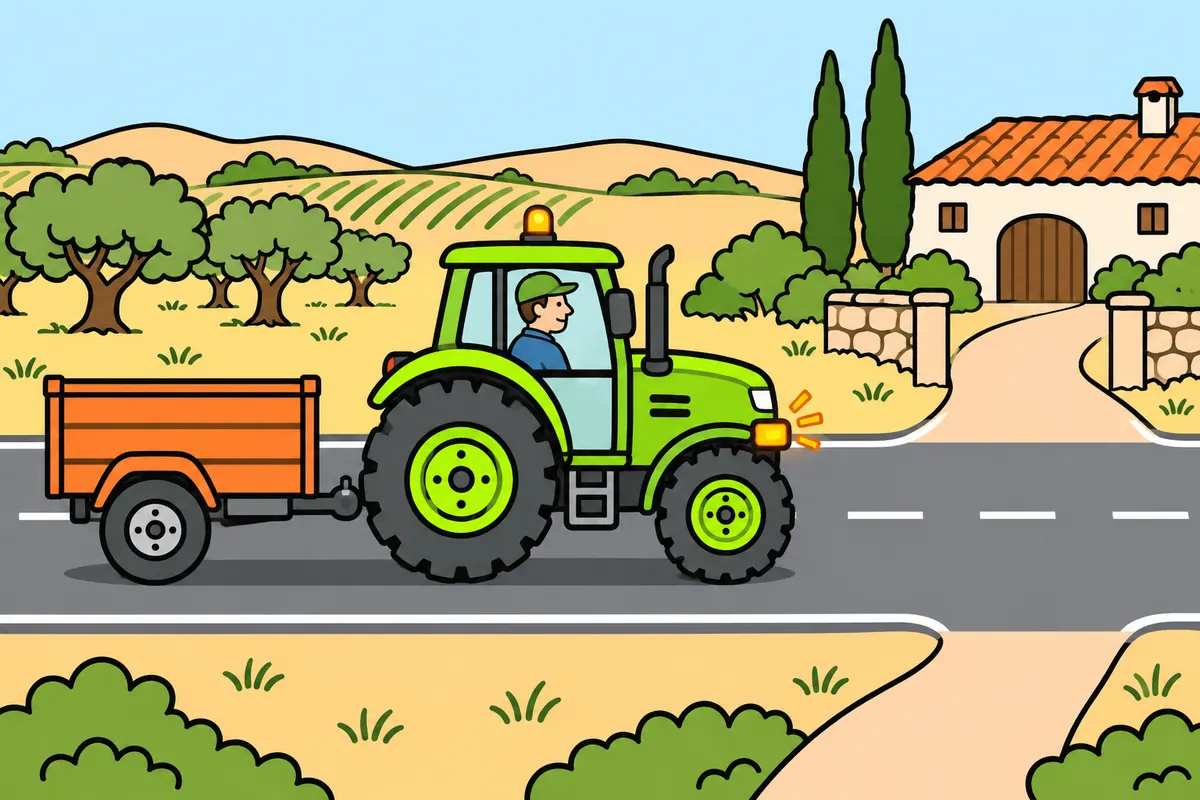
1Observe, signal and manoeuvre
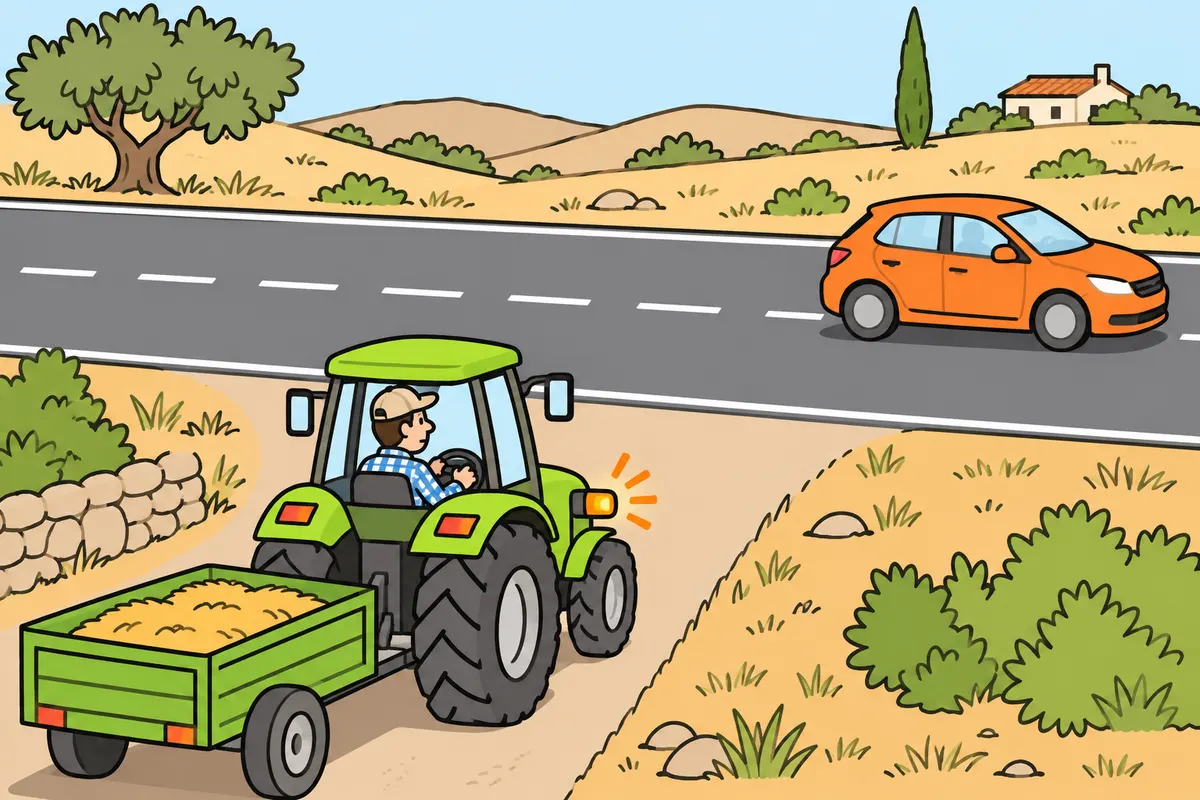
Observe, signal and move only when you can do so safely.
Remember
- Check your mirrors and look directly too.
- Check areas hidden by your trailer and implements.
- Allow space for your whole combination.
- Keep observing throughout your manoeuvre.
Exam trap: Wrong: your indicator gives you priority. Right: wait and respect those with priority.
Read the full explanation
- Before changing your vehicle’s course or position, observe, signal your intention and carry out the movement when it is safe. You can remember the sequence as M.S.M.: mirror, signal and manoeuvre; this study aid helps you apply the legal requirements. You must keep observing throughout the manoeuvre. [RGC, arts. 74 and 108](https://www.boe.es/buscar/act.php?id=BOE-A-2003-23514#a74).
- Combine your mirrors with direct observation and check areas hidden by the trailer or implements. Assess the space the whole combination needs, not just the tractor’s front wheels. If you cannot check that joining traffic or reversing is safe, use the assistance provided for those manoeuvres. [RGC, arts. 72 and 81](https://www.boe.es/buscar/act.php?id=BOE-A-2003-23514#a72).
- Your indicator communicates an intention and does not give you priority. You must wait if joining traffic or moving over forces anyone with priority to react abruptly; the tractor’s size or how long you have been waiting does not change this obligation. [Traffic Act, art. 26](https://www.boe.es/buscar/act.php?id=BOE-A-2015-11722#a26).
- Adapt your movement to the space available and avoid sudden manoeuvres that compromise control. If you cannot complete a turn safely, wait or choose another permitted option; needing more space means you must take extra care. [RGC, arts. 74 and 76](https://www.boe.es/buscar/act.php?id=BOE-A-2003-23514#a76).
2How to signal each manoeuvre
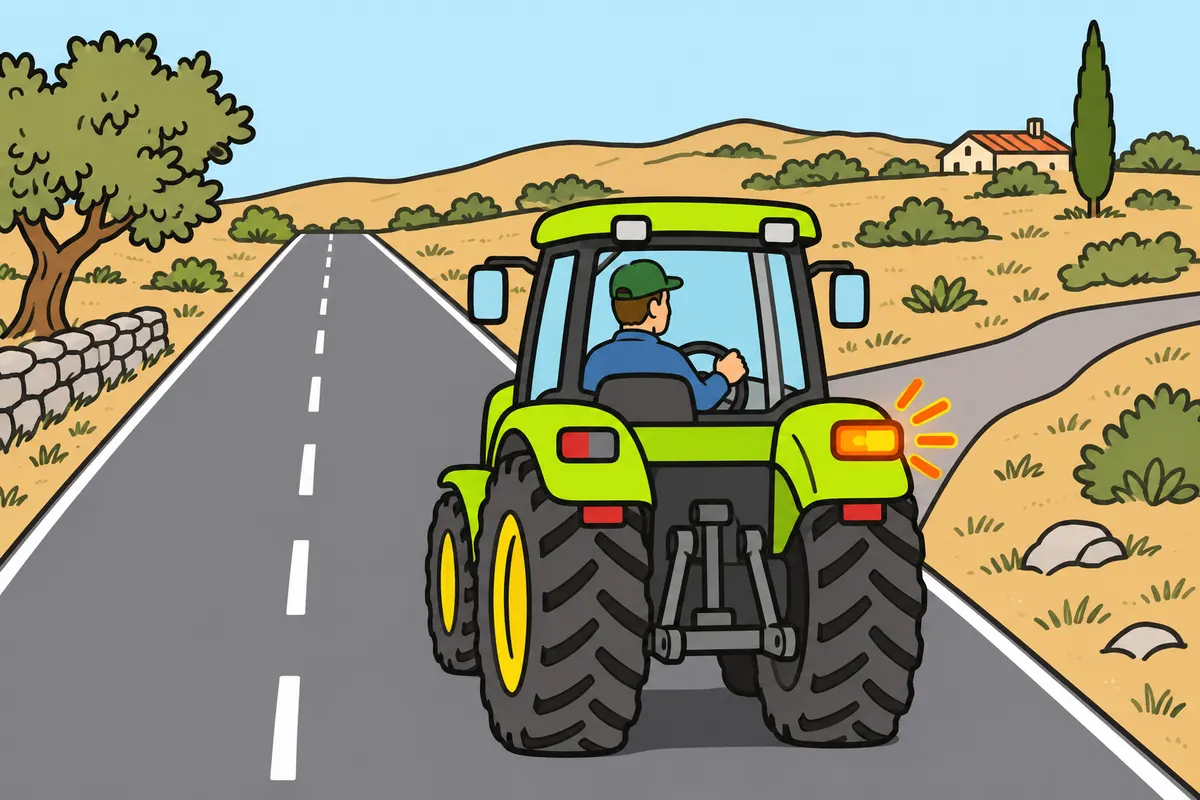
Signal each movement early and end the signal at the right time.
| Signal with your left arm | How to do it |
|---|---|
| Left | Horizontal, palm down |
| Right | Bent upwards, hand extended |
| Reversing without a reversing light | Horizontal, palm backwards |
| Slowing considerably or stopping | Short, quick movements up and down |
Remember
- Use your lights; if unavailable, signal correctly with your arm clearly visible.
- A correct, visible hand signal overrides a conflicting light signal.
- Cancel your sideways movement signal once you take your new course.
- Signal moving out and returning separately when overtaking.
- To stop, also use the indicator on your chosen side, if fitted.
Exam trap: Wrong: keep your indicator on throughout overtaking. Right: signal moving out and returning separately.
Read the full explanation
- Normally use your vehicle’s light signals or, if these are unavailable, your arm. A hand signal is only valid if others can see it and you make it correctly; under these conditions, it takes precedence over a conflicting light signal. Check that the implements do not hide your signal. [RGC, art. 108](https://www.boe.es/buscar/act.php?id=BOE-A-2003-23514#a108).
- Signal your movement in good time using the indicator on the side towards which you are moving. To signal left with your left arm, extend it horizontally with your palm facing down; to signal right, bend it upwards with your hand extended. [RGC, art. 109](https://www.boe.es/buscar/act.php?id=BOE-A-2003-23514#a109).
- Keep the light signal on until you finish the manoeuvre; when signalling a sideways movement, cancel it as soon as you have taken up your new course. When overtaking, signal moving out and returning separately: driving in another lane for a time does not require you to keep the indicator for moving out on. [RGC, art. 109](https://www.boe.es/buscar/act.php?id=BOE-A-2003-23514#a109).
- To reverse, use the reversing light if fitted; otherwise, extend your arm horizontally with your palm facing backwards. To signal that you are bringing the vehicle to a halt or reducing speed considerably, use the brake lights repeatedly whenever possible, or move your arm up and down with short, quick movements. [RGC, art. 109](https://www.boe.es/buscar/act.php?id=BOE-A-2003-23514#a109).
- If you intend to stop or park, also use the indicator on the side where you intend to do so, if fitted. Hazard warning lights warn of certain hazardous situations where a vehicle is immobilised; they do not replace the indicator for the manoeuvre or allow you to stop where it is prohibited. [RGC, arts. 94 and 109](https://www.boe.es/buscar/act.php?id=BOE-A-2003-23514#a109).
3Horn, headlight flashes and the special vehicle warning light
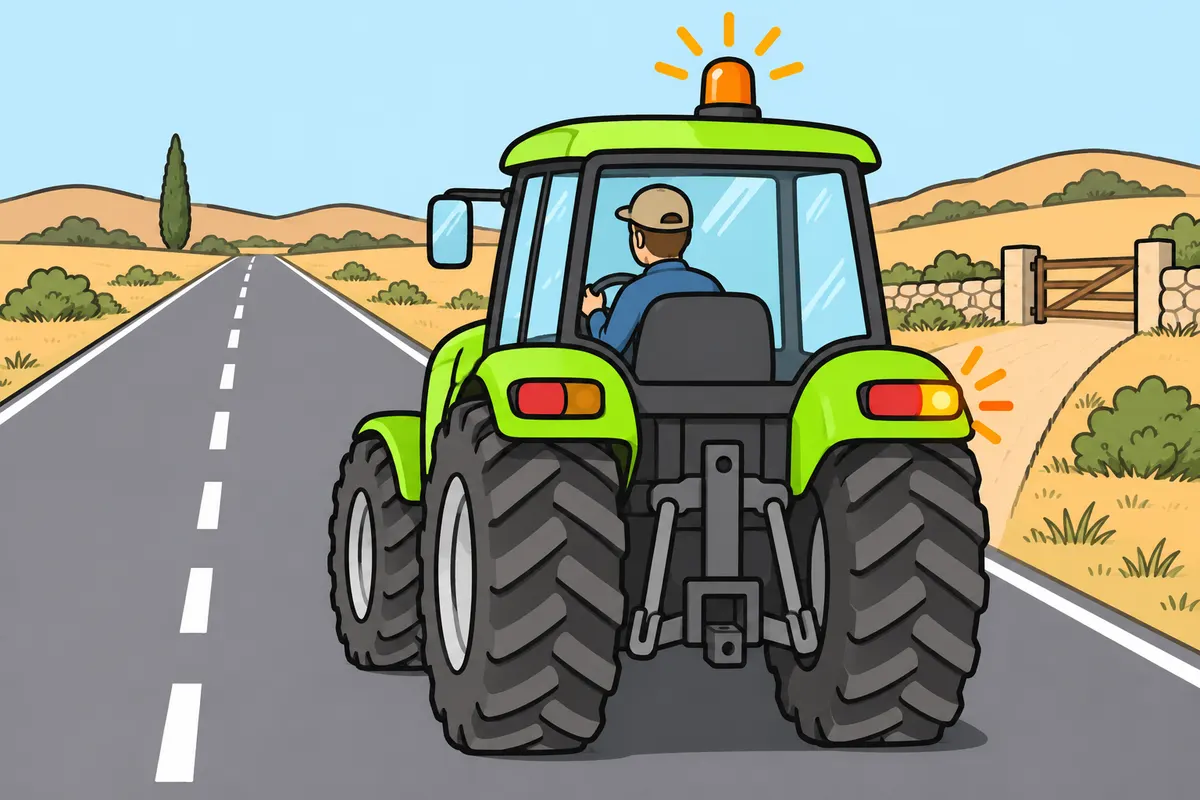
Use your horn and headlight flashes only for permitted warnings.
Remember
- You may use your horn to prevent an accident.
- Outside built-up areas, you may use it to warn that you will overtake.
- You may replace permitted sound warnings with brief flashes, without dazzling anyone.
- The V-2 shows your presence; signal turns and lane changes separately.
Exam trap: Wrong: use your horn to demand space when joining traffic. Right: give way and wait.
Read the full explanation
- You may use the horn to prevent a possible accident, especially on narrow roads with many bends, and outside built-up areas to warn of your intention to overtake. You must avoid unnecessary, excessive or harsh use. You must not sound it to demand that others let you join traffic. [RGC, art. 110](https://www.boe.es/buscar/act.php?id=BOE-A-2003-23514#a110).
- You may replace the audible warnings provided for in the regulations with brief flashes of dipped beam or main beam, even in built-up areas, without dazzling anyone. A flash does not order another driver to let you pass or remove the need to check visibility and space before overtaking. [RGC, art. 109.3](https://www.boe.es/buscar/act.php?id=BOE-A-2003-23514#a109).
- The V-2 warning light warns of the agricultural vehicle’s presence in accordance with its conditions of use; it does not in itself signal a turn or lane change, which you must signal specifically. Its use is explained in «Agricultural lighting and signalling». [RGC, art. 113](https://www.boe.es/buscar/act.php?id=BOE-A-2003-23514#a113).
4Joining traffic from a property or parking place
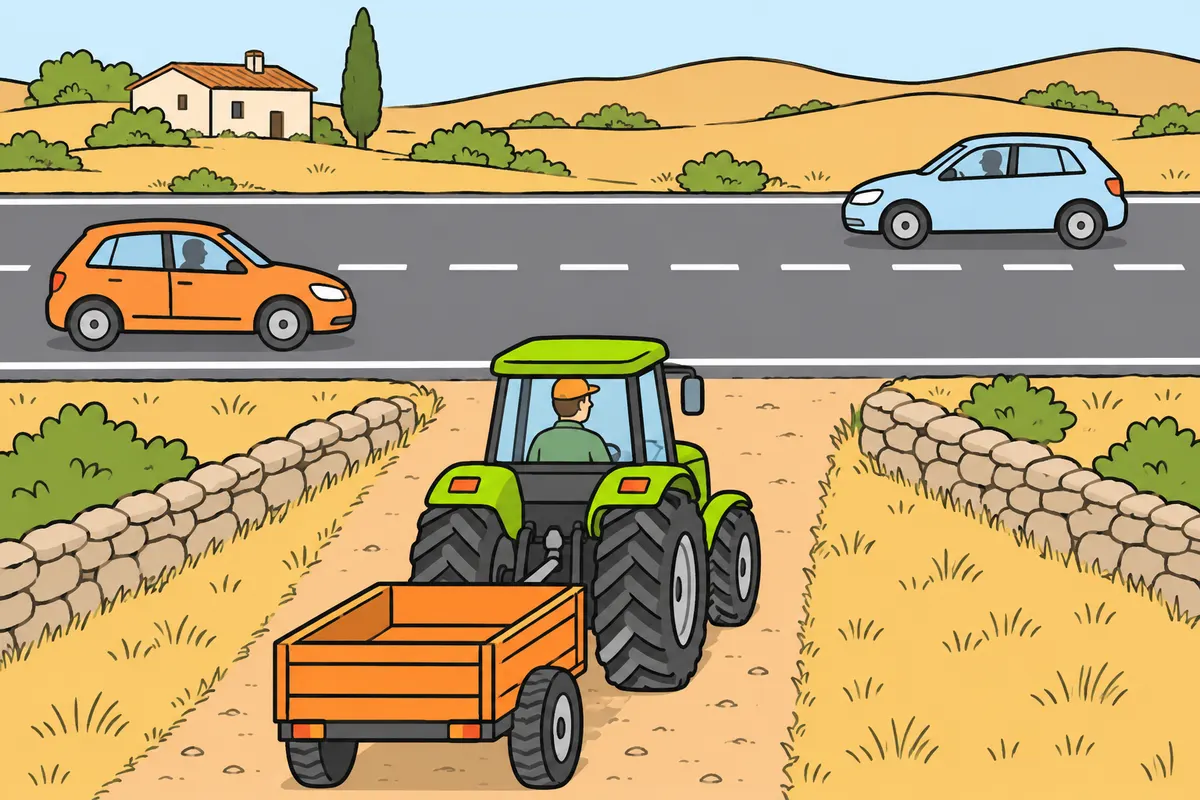
When joining traffic, give way and find space for your whole combination.
Remember
- Check other vehicles’ position, direction and speed.
- Leaving an exclusively private track, move slowly enough to stop immediately.
- Give way to vehicles travelling in both directions.
- Get help if you cannot check that joining is safe.
- Signal and allow space for your tractor and trailer.
Exam trap: Wrong: only check traffic travelling in the lane you enter. Right: give way in both directions.
Read the full explanation
- You join traffic when you move off after stopping or parking, or enter from an adjoining property, service area or access road. Before doing so, you must check the position, course and speed of other vehicles and give way to them. [RGC, art. 72](https://www.boe.es/buscar/act.php?id=BOE-A-2003-23514#a72).
- When leaving an exclusively private track to enter a public road, you must move at a speed that allows you to stop immediately. Give way to vehicles from both directions; entering only the right-hand lane with your tractor does not allow you to ignore vehicles approaching from the other direction. [RGC, art. 72.2](https://www.boe.es/buscar/act.php?id=BOE-A-2003-23514#a72).
- If vegetation, a wall or the implements prevent you from checking the entrance, follow another person’s instructions when necessary. Their help must allow you to join traffic safely; it does not authorise you to force traffic to stop by occupying the carriageway. [RGC, art. 72.1](https://www.boe.es/buscar/act.php?id=BOE-A-2003-23514#a72).
- Give a visual signal before joining traffic and choose a gap large enough for the whole combination. A trailer increases the space you must clear before you have fully joined the traffic; you must take this into account along with the speed at which others approach. [RGC, art. 72](https://www.boe.es/buscar/act.php?id=BOE-A-2003-23514#a72).
5Joining traffic and helping others to join
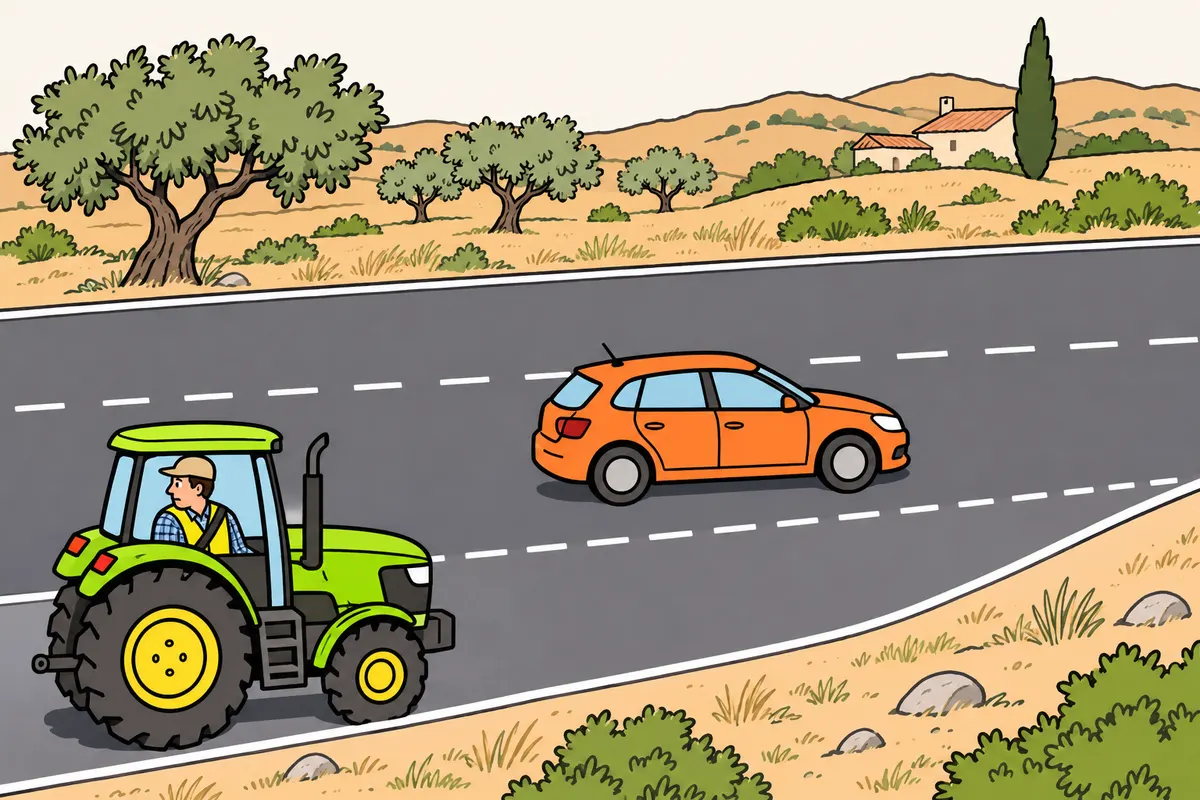
Give way when joining traffic and help others join when you can safely.
| Your situation | Your duty |
|---|---|
| You are joining | Check and give way |
| You are already in traffic | Help others join when you can safely |
Remember
- Observe from the start of the acceleration lane.
- If you need to stop, stop at the start.
- Then reach a suitable speed within your vehicle’s limits.
- Help others join without putting anyone in danger.
- In built-up areas, help buses leave signposted stops, even by stopping.
Exam trap: Wrong: joining from an acceleration lane gives you priority. Right: you must give way.
Read the full explanation
- If you use an acceleration lane on a road you are allowed to enter, check from the start of the lane whether you can join safely, even stopping there if necessary. Then accelerate to reach a suitable speed by the end, respecting your vehicle’s limits and acceleration capability. [RGC, art. 72.4](https://www.boe.es/buscar/act.php?id=BOE-A-2003-23514#a72).
- If you are already driving along the road, you must help others join traffic as far as possible. You may adjust your speed or change lanes when it is safe and permitted, respecting the priority of anyone already in that lane. Helping others join does not mean automatically giving priority to any vehicle whose indicator is on. [RGC, arts. 73 and 74](https://www.boe.es/buscar/act.php?id=BOE-A-2003-23514#a73).
- In built-up areas, you must help public transport vehicles pull out from marked stops by moving over if you can or slowing down, even stopping when necessary. The bus driver must also signal before pulling out and take the necessary precautions to avoid accidents. [RGC, art. 73](https://www.boe.es/buscar/act.php?id=BOE-A-2003-23514#a73).
6Lane changes and sideways movements
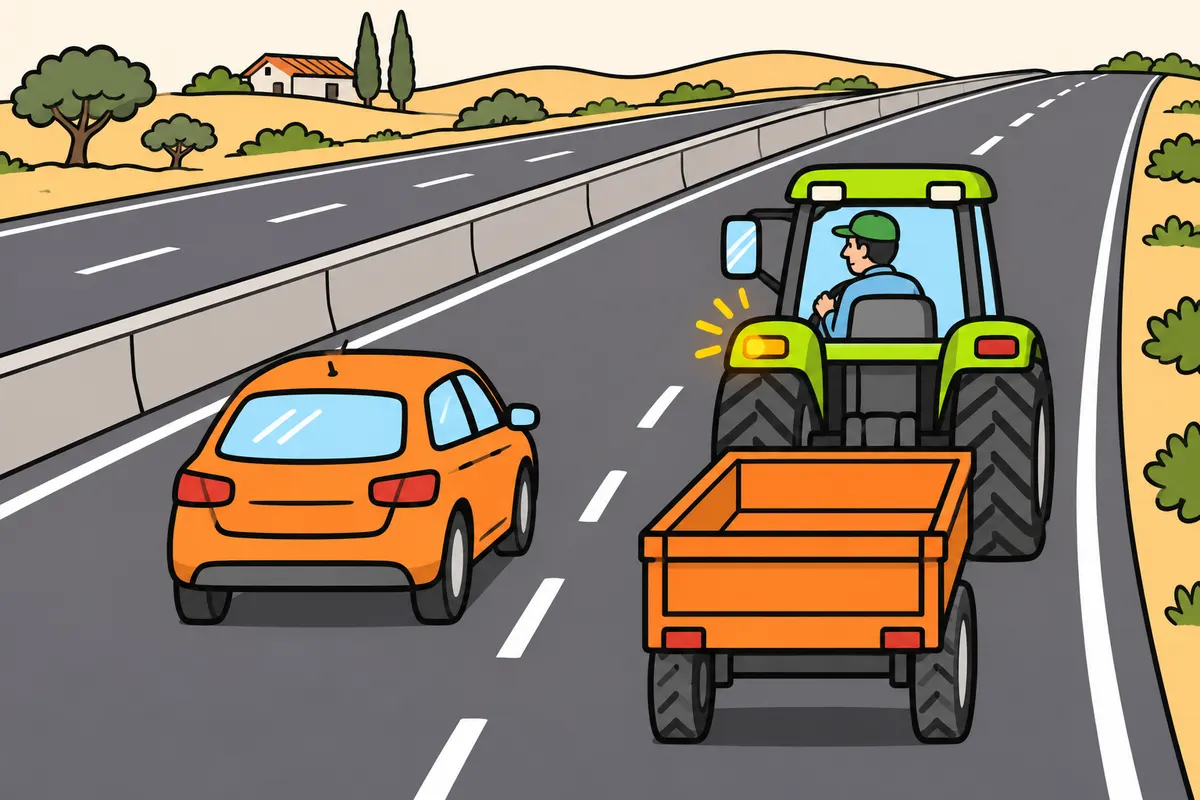
Before changing lanes, respect vehicles already travelling in your chosen lane.
Remember
- Check ahead and behind before moving sideways.
- Signal and move gradually.
- Allow for the width of your implements and trailer.
- Also signal a substantial sideways movement within your lane.
- Cancel your signal once you take your new course.
- Prepare for exits early; do not reverse if you miss one.
Exam trap: Wrong: seeing a gap beside your cab is enough. Right: also check vehicles approaching from behind.
Read the full explanation
- To move into another lane, you must respect the priority of vehicles already using it. Check ahead and behind to ensure there is room to move in without cutting them off; looking only at the gap beside the cab fails to take account of a vehicle approaching quickly from behind. [RGC, art. 74.2](https://www.boe.es/buscar/act.php?id=BOE-A-2003-23514#a74).
- Observe, signal and move over progressively, keeping control of the tractor and trailer. You must allow for the actual width, including the implements, and must not consider the change complete while any part of the combination still dangerously encroaches on your previous course. [RGC, arts. 74 and 109](https://www.boe.es/buscar/act.php?id=BOE-A-2003-23514#a74).
- You must also signal a significant sideways movement within the same lane. The signal refers to movement to one side; following a bend while keeping your place within the lane does not in itself amount to changing lanes. Cancel the signal once you have taken up your new course. [RGC, art. 109.2.a](https://www.boe.es/buscar/act.php?id=BOE-A-2003-23514#a109).
- If you need to move over to leave the road, take up the lane nearest the exit in good time and enter the deceleration lane as soon as possible, where there is one. Do not cross several lanes at the last moment or reverse to reach an exit you have passed. [RGC, arts. 77 and 80](https://www.boe.es/buscar/act.php?id=BOE-A-2003-23514#a77).
7Overtake on the permitted side
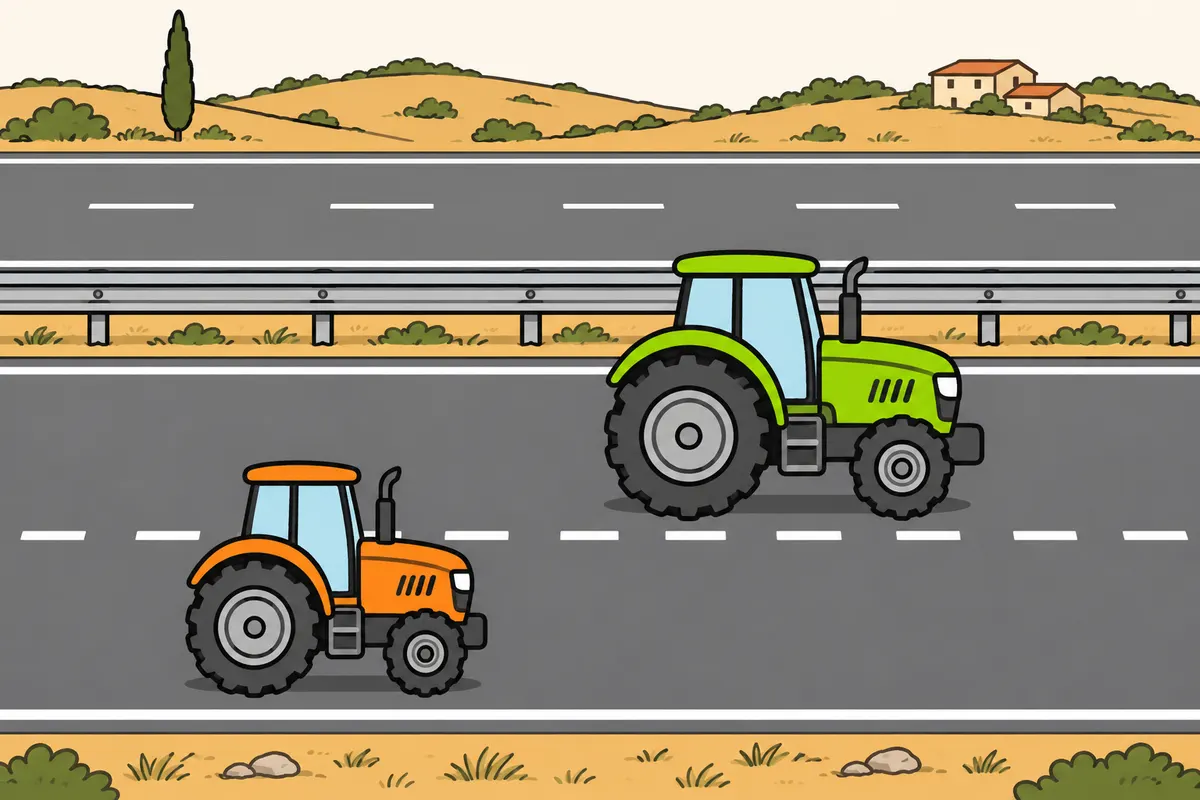
Overtake on the left, except where overtaking on the right is permitted.
| Situation | Where to pass |
|---|---|
| General rule | Left |
| Vehicle clearly signalling a left turn or stop on the left | On the right, with space and extra care |
| Tram travelling in the centre of a two-way road | On the right, with space and extra care |
| Built-up area with at least two lanes in your direction marked by longitudinal lines | Right, if you cause no danger |
Remember
- First check that overtaking is legal and safe.
- To pass on the right, you need space and extra care.
Exam trap: Wrong: several lanes allow overtaking on the right outside built-up areas. Right: that exception applies in built-up areas.
Read the full explanation
- As a general rule, you must overtake on the left. First check that the manoeuvre is permitted, then whether you can complete it safely. [RGC, arts. 82 and 87](https://www.boe.es/buscar/act.php?id=BOE-A-2003-23514#a82).
- With sufficient space and taking particular care, you must overtake on the right when the vehicle ahead clearly signals an intention to turn left or stop on that side. You also overtake on the right of a tram travelling along the centre of a two-way road. [RGC, art. 82.2](https://www.boe.es/buscar/act.php?id=BOE-A-2003-23514#a82).
- In built-up areas, you may overtake on the right if there are at least two lanes in the same direction marked by longitudinal road markings and you do not cause danger. [RGC, art. 82.3](https://www.boe.es/buscar/act.php?id=BOE-A-2003-23514#a82).
8Passing that does not count as overtaking
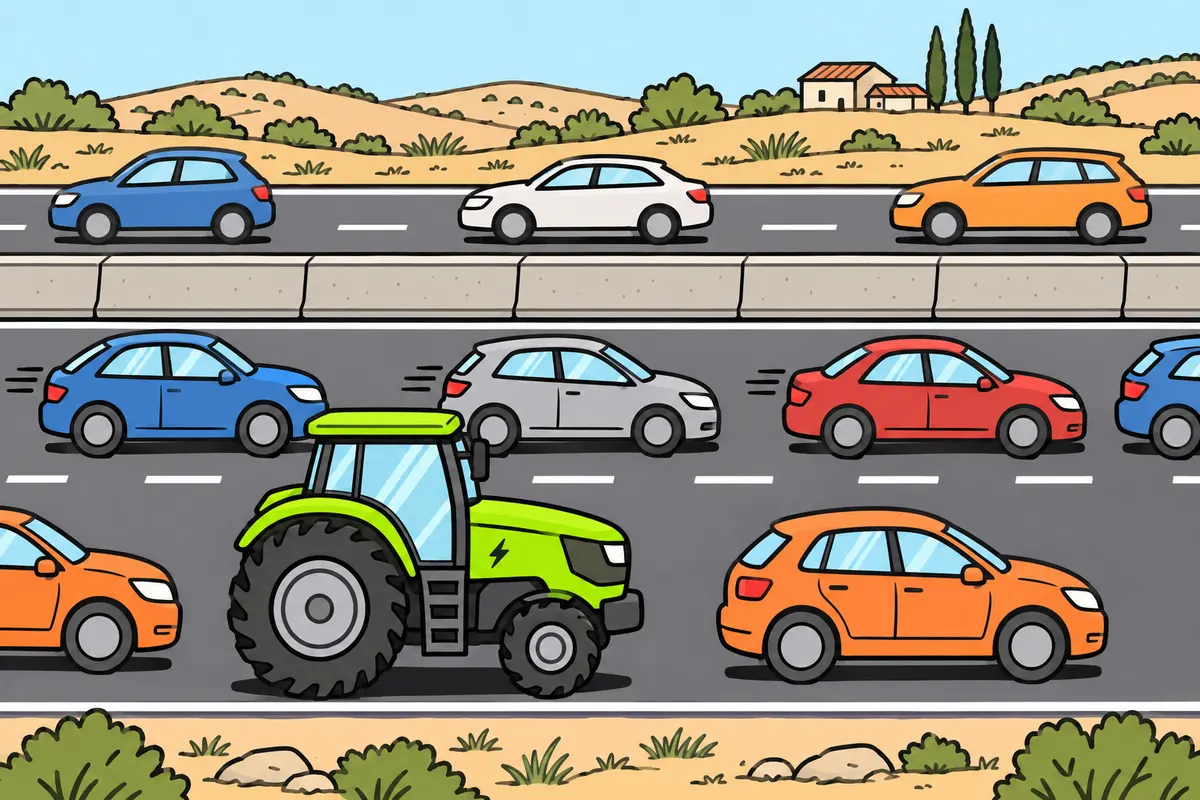
Distinguish overtaking from passing in queues or special lanes.
| Situation | Does moving ahead count as overtaking? |
|---|---|
| All lanes occupied; each queue follows the vehicle ahead | No, even if one queue moves faster |
| Between normal lanes and acceleration, deceleration or reserved lanes | No |
Remember
- In heavy traffic, do not change lanes to gain places.
- You may change lanes to turn, leave or take a direction.
- Do not use a reserved lane your tractor cannot enter.
- A vehicle stopped in a queue is not an obstacle to pass.
Exam trap: Wrong: pass a queue as if the vehicles had broken down. Right: wait behind.
Read the full explanation
- In heavy traffic, when all lanes are occupied and each queue moves according to the vehicle ahead, one queue moving faster than another does not count as overtaking. In this situation, you must not change lanes to gain places; you may do so to prepare for a turn, leave the road or take a particular direction. [RGC, art. 83.2](https://www.boe.es/buscar/act.php?id=BOE-A-2003-23514#a83).
- Travelling faster in an acceleration or deceleration lane than in the normal lanes, or vice versa, also does not count as overtaking. This also applies to lanes reserved for particular vehicles; this rule does not authorise you to use a lane your tractor is not allowed to enter. [RGC, art. 83.3](https://www.boe.es/buscar/act.php?id=BOE-A-2003-23514#a83).
- When passing an obstacle or an immobilised vehicle, you must apply the specific conditions for doing so and distinguish this from overtaking a moving vehicle. A car stopped in a queue is not an obstacle you may go around by invoking the exception for immobilised vehicles. [RGC, arts. 88 and 89](https://www.boe.es/buscar/act.php?id=BOE-A-2003-23514#a88).
9Prepare to complete the whole overtaking manoeuvre
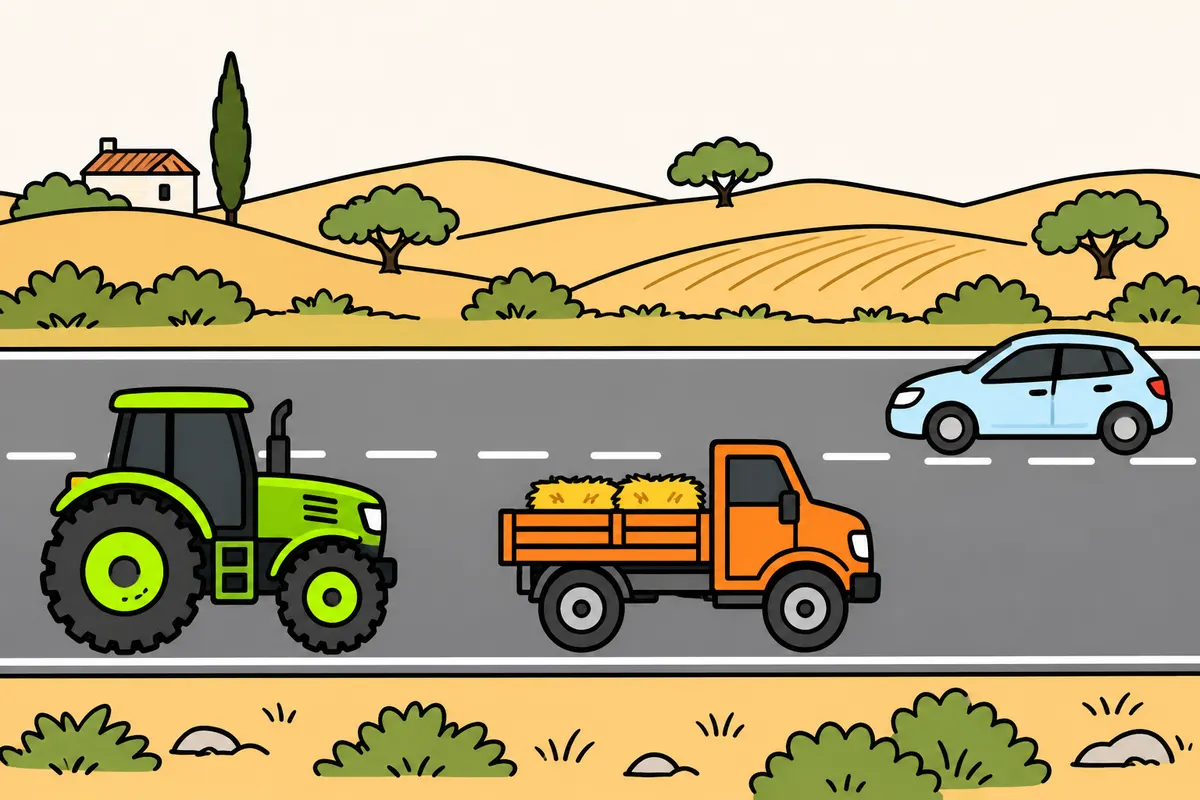
Prepare for the whole overtaking manoeuvre, including a safe return to your lane.
Remember
- Check space, visibility and the difference in speed.
- Look behind: another vehicle may have started overtaking you.
- Respect the vehicle ahead if it signals moving towards the same side.
- After waiting reasonably, warn before overtaking, if all other conditions allow.
- Do not overtake an overtaking vehicle if you need to enter the opposing direction.
- To pass several vehicles, ensure you can return without hindering anyone.
Exam trap: Wrong: start without allowing space to return. Right: check the whole route before moving out.
Read the full explanation
- Before pulling out, you must check that you have sufficient clear space, visibility and a speed difference that allows you to complete the manoeuvre. Assess both your own speed and that of oncoming vehicles, and identify a safe place to return to your lane. The small speed advantage of an agricultural vehicle may make overtaking impracticable. [RGC, arts. 84 and 85](https://www.boe.es/buscar/act.php?id=BOE-A-2003-23514#a84).
- Check that the vehicle ahead has not signalled an intention to move out to the same side: you must respect its priority. If a reasonable time passes without it doing so, you may overtake when the other conditions are met, first warning its driver with a legally permitted audible or light signal. There is no fixed waiting time in seconds here. [RGC, art. 84.2](https://www.boe.es/buscar/act.php?id=BOE-A-2003-23514#a84).
- Also look behind to make sure that no one has started to overtake you. You must not overtake a vehicle that is overtaking another if you need to enter the opposite side of the road to do so. The presence of a slow tractor does not allow several vehicles to join an overtaking manoeuvre without space to return. [RGC, art. 84](https://www.boe.es/buscar/act.php?id=BOE-A-2003-23514#a84).
- Do not overtake several vehicles unless you are sure that, if an oncoming vehicle appears, you can return to the right without impeding or endangering the vehicles you overtake. On a two-way carriageway with three lanes separated by broken lines, check that the centre lane is not occupied by another vehicle overtaking in the opposite direction. [RGC, art. 84.1](https://www.boe.es/buscar/act.php?id=BOE-A-2003-23514#a84).
10Carry out, complete or abandon an overtaking manoeuvre
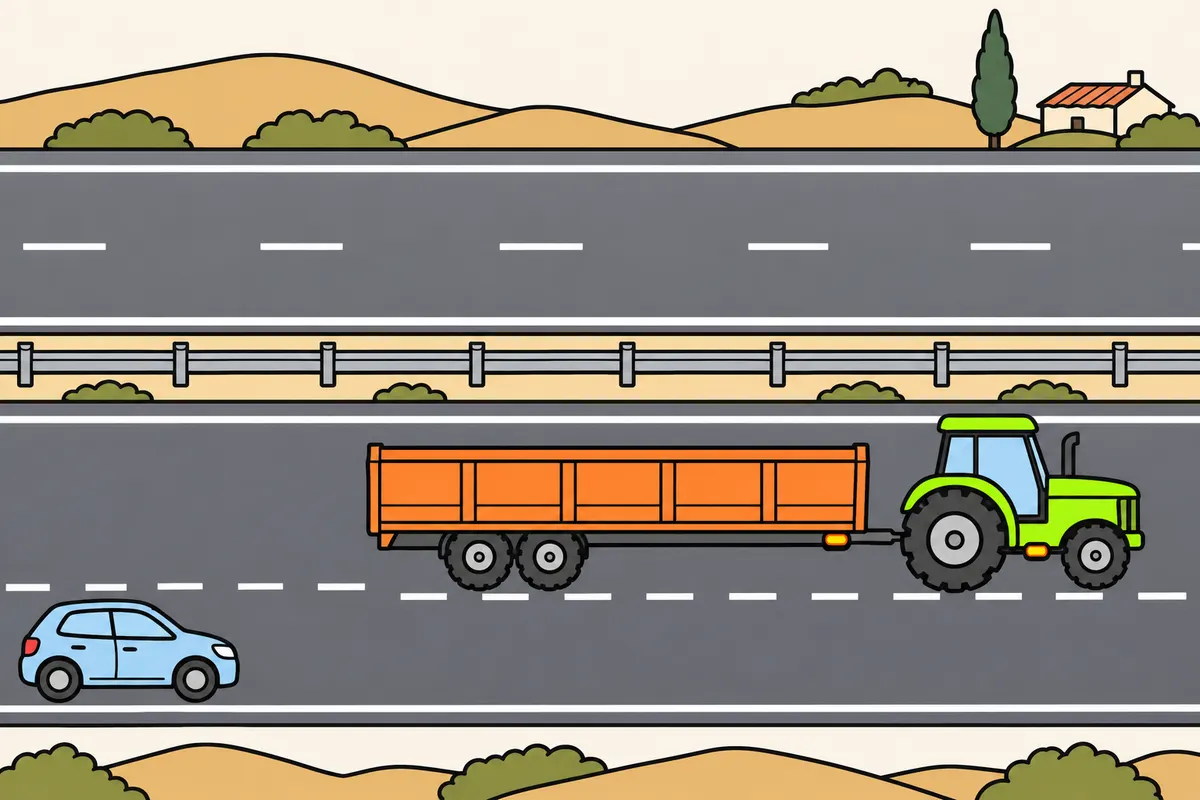
Overtake within your limits and return without cutting anyone off.
Remember
- Travel at a clearly higher speed, without exceeding your limits.
- Leave space from the parts that stick out furthest.
- Check that your trailer has also passed before returning.
- If danger appears, slow down and signal a safe return.
- Return gradually without forcing others to change speed or direction.
Exam trap: Wrong: exceed the limit to finish sooner. Right: wait if the legal speed difference is insufficient.
Read the full explanation
- Drive at a clearly higher speed than the vehicle you are overtaking and leave sufficient lateral clearance between the outermost parts of both vehicles. Overtaking does not allow you to exceed the applicable limits: if the permitted speed difference is insufficient, wait. You must assess the whole manoeuvre, not just the moment when your cab draws level. [RGC, art. 85](https://www.boe.es/buscar/act.php?id=BOE-A-2003-23514#a85); [Traffic Act, art. 21](https://www.boe.es/buscar/act.php?id=BOE-A-2015-11722#a21).
- If circumstances arise that make it difficult to finish safely, slow down promptly, signal your return and move back into your lane safely. [RGC, art. 85.2](https://www.boe.es/buscar/act.php?id=BOE-A-2003-23514#a85).
- When you finish, return as soon as possible, moving gradually and signalling, without forcing another road user to change speed or course. If you carry out successive overtaking manoeuvres on a carriageway with several lanes in your direction, you may remain in the lane you use only if you do not unduly obstruct faster vehicles approaching from behind. [RGC, arts. 83.1 and 85.3](https://www.boe.es/buscar/act.php?id=BOE-A-2003-23514#a85).
11Protect cyclists and other vulnerable road users
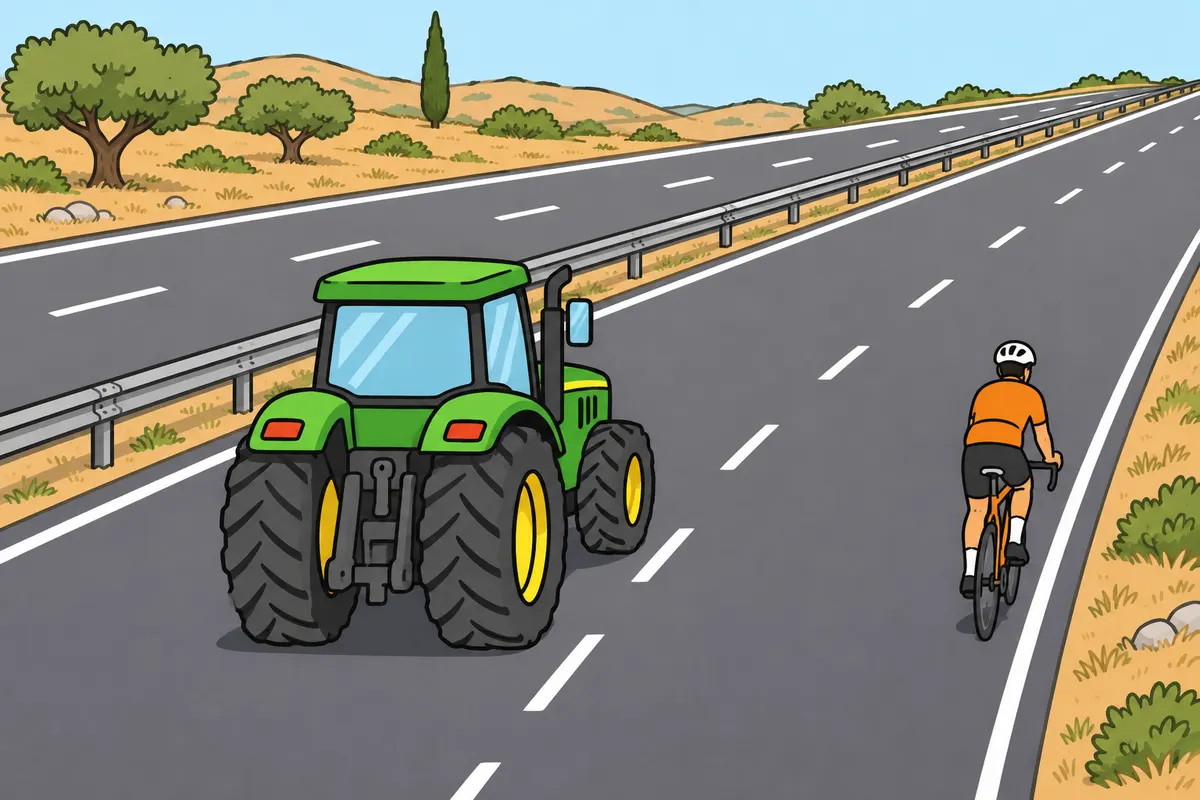
Leave space and slow down when overtaking vulnerable road users.
| Road users you overtake | Precautions |
|---|---|
| Pedestrians, animals, animal-drawn vehicles, mopeds, personal mobility vehicles and cyclists | Apply the stated clearance, lane use and speed reduction |
Remember
- Leave at least 1.5 m; use an adjacent or opposing lane partly or fully.
- If there is more than one lane in each direction, change lanes completely.
- Outside built-up areas, travel at least 20 km/h below the road’s limit.
- Apply the reduction before and during overtaking; also respect your own limit.
- Do not endanger or hinder oncoming cyclists.
- Treat a group of cyclists as one unit and leave room to pass safely.
Exam trap: Wrong: leaving 1.5 m is always enough. Right: change lanes completely where there are several lanes per direction.
Read the full explanation
- When overtaking pedestrians, animals, animal-drawn vehicles, mopeds, personal mobility vehicles or cyclists, you must leave at least 1.5 metres of lateral clearance and use part or all of the adjacent lane or the lane for oncoming traffic. [RGC, art. 85.4](https://www.boe.es/buscar/act.php?id=BOE-A-2003-23514#a85).
- If the carriageway has more than one lane in each direction, you must change lanes completely to overtake these road users. [RGC, art. 85.4](https://www.boe.es/buscar/act.php?id=BOE-A-2003-23514#a85).
- Outside built-up areas, before and during this overtaking manoeuvre, you must travel at least 20 km/h below the speed limit on the road. You also comply with the agricultural vehicle’s own speed limit and adapt your speed to the situation; this reduction does not allow you to travel faster than your permitted speed. [RGC, art. 85.4](https://www.boe.es/buscar/act.php?id=BOE-A-2003-23514#a85).
- Do not overtake if you endanger or obstruct oncoming road users, even if they are travelling on the arcén (hard shoulder). Wait if there is insufficient width or visibility to meet the conditions, without using the horn to force them to move aside. [RGC, art. 85.4](https://www.boe.es/buscar/act.php?id=BOE-A-2003-23514#a85); [Traffic Act, art. 35.4](https://www.boe.es/buscar/act.php?id=BOE-A-2015-11722#a35).
- Treat cyclists riding in a group as a single moving unit when applying these precautions. Plan the space you need to pass the group without endangering it, rather than starting a manoeuvre that forces you to cut in between its members because you run out of space. [RGC, art. 85.4](https://www.boe.es/buscar/act.php?id=BOE-A-2003-23514#a85).
12The special rule of 15 seconds or 200 metres
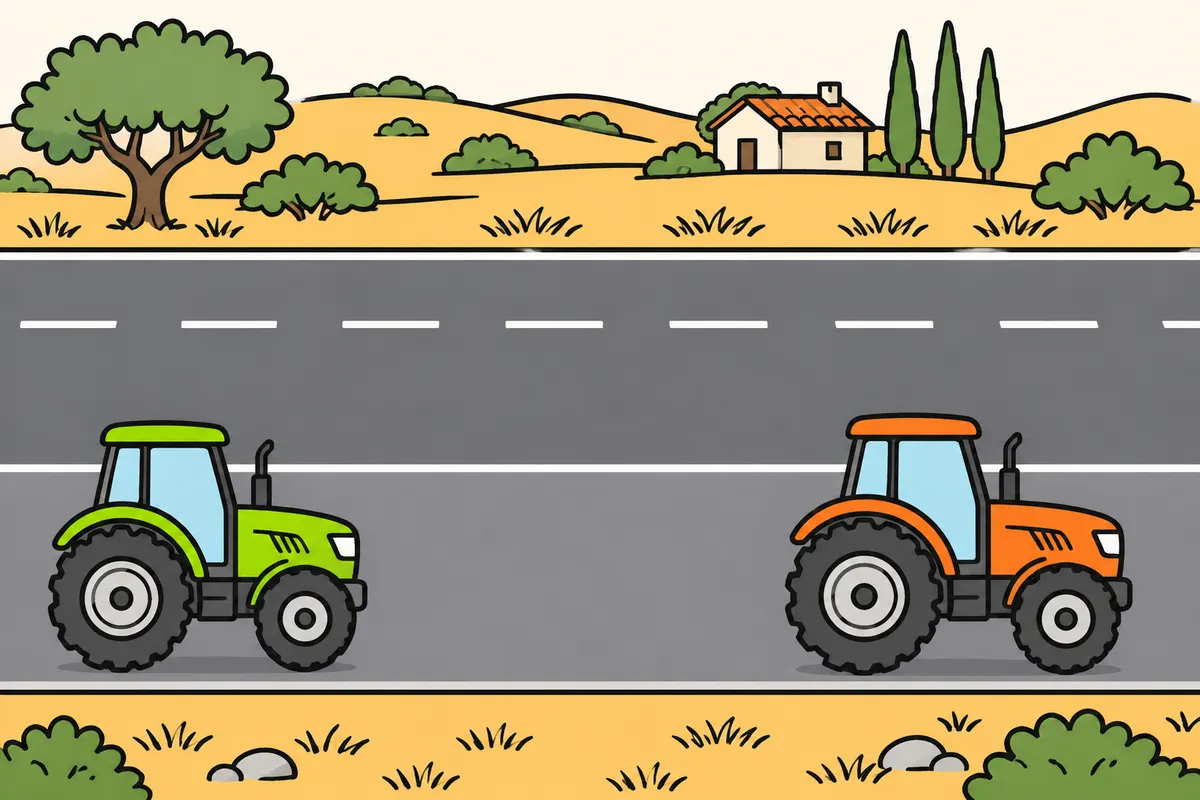
If this rule applies to you, do not overtake beyond either limit.
| Affected vehicles | Overtaking limit |
|---|---|
| Those in the first paragraph of article 36.1, except bicycles | Do not exceed 15 seconds or 200 metres travelling alongside |
Remember
- Check your MMA: your vehicle’s maximum authorised mass.
- Special vehicles up to 3,500 kg use the usable, sufficiently wide right shoulder.
- This applies if no road is specifically provided for your vehicle.
- If the shoulder is unsuitable, use only the essential part of the carriageway.
- Do not automatically apply this rule to every tractor.
Exam trap: Wrong: overtaking is prohibited only if you exceed both limits. Right: exceeding either limit is enough.
Read the full explanation
- If you drive a special vehicle with an MMA (maximum authorised mass) not exceeding 3,500 kg and there is no road specifically designated for it, you are among the vehicles required to use the right-hand hard shoulder when it is usable and wide enough. If it is not, you use only as much of the carriageway as necessary; “Road use with agricultural vehicles” explains this road positioning in detail. [RGC, art. 36.1](https://www.boe.es/buscar/act.php?id=BOE-A-2003-23514#a36).
- If you drive one of the vehicles listed in the first paragraph of article 36.1, except bicycles, you must not overtake another vehicle if travelling alongside it takes more than 15 seconds or covers more than 200 metres. [RGC, art. 36.5](https://www.boe.es/buscar/act.php?id=BOE-A-2003-23514#a36).
- This rule limits an overtaking manoeuvre that meets the other conditions; it does not authorise continuous travel side by side or allow you to overtake without visibility for a shorter time. You must not apply it indiscriminately to all tractors without checking their MMA and the circumstances referred to in the article. [RGC, art. 36](https://www.boe.es/buscar/act.php?id=BOE-A-2003-23514#a36).
13When another vehicle overtakes you
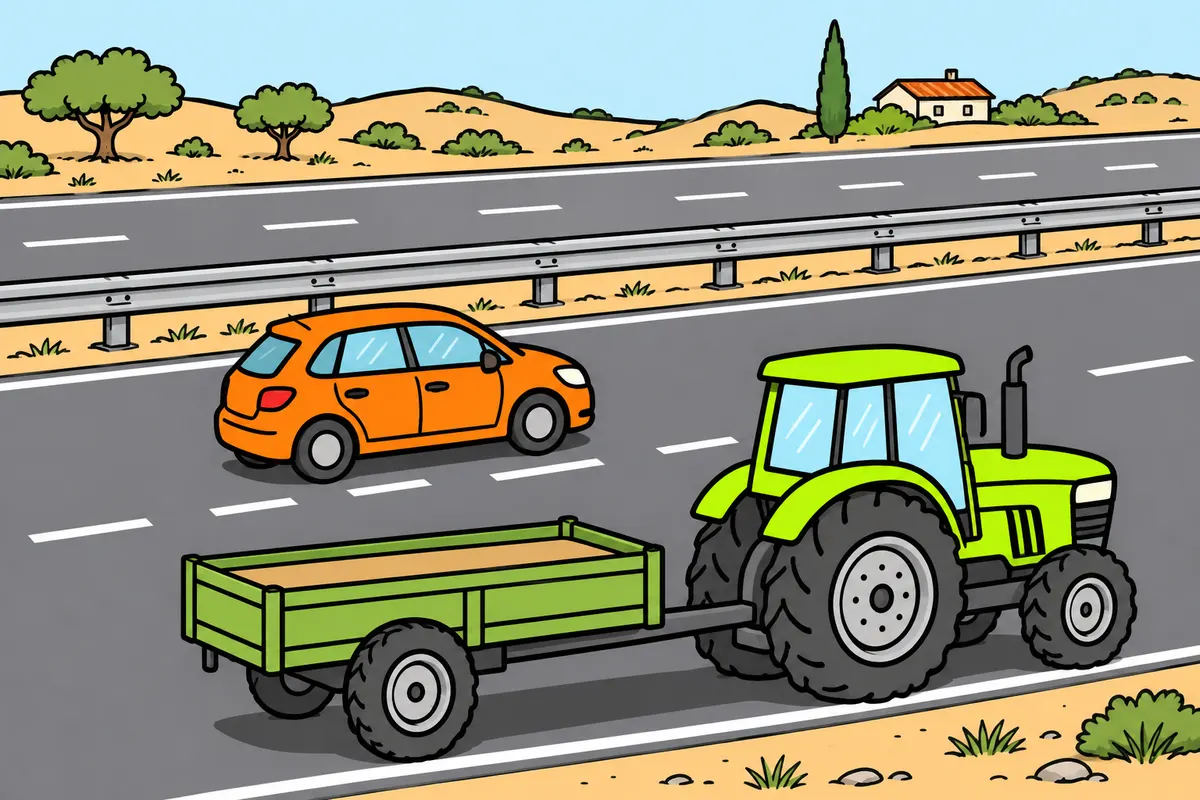
Help others overtake you without accelerating or creating new dangers.
Remember
- Keep close to the right edge without dangerous sideways movements.
- Do not increase speed or block overtaking.
- If danger appears, slow down to help resolve it safely.
- If they brake to return behind you, do not brake and hinder their return.
- If heavy, large or speed-limited, slow or move aside when overtaking is difficult.
- Only use a shoulder that can accommodate and support your combination.
Exam trap: Wrong: always brake when the other driver abandons overtaking. Right: let them return behind you safely.
Read the full explanation
- If you notice that another vehicle is about to overtake you, keep close to the right-hand edge of the carriageway without making dangerous sideways movements. If you have signalled a left turn or a stop on the left and are being overtaken on the right, keep close to the left without interfering with oncoming traffic. [RGC, art. 86.1](https://www.boe.es/buscar/act.php?id=BOE-A-2003-23514#a86).
- You must not increase your speed or make manoeuvres that prevent or hinder overtaking. If danger arises once overtaking has begun, you must slow down to help resolve the situation; watch what the other driver does and maintain a path that allows them to complete or abandon the manoeuvre safely. [RGC, art. 86.2](https://www.boe.es/buscar/act.php?id=BOE-A-2003-23514#a86).
- If you see the overtaking driver brake to abandon the manoeuvre and drop back behind you, you must not reduce your speed in a way that compromises safety. To help, you need to respond to their actual movements: braking at the same time as they do may prevent them from finding the gap they need behind your trailer. [RGC, art. 86.2](https://www.boe.es/buscar/act.php?id=BOE-A-2003-23514#a86).
- As the driver of a heavy or large vehicle, or one subject to a specific speed limit, you must slow down or move onto a usable arcén (hard shoulder) when oncoming traffic or the road's width or condition prevents others from overtaking you easily and safely. You must help others pass; do not enter a hard shoulder that cannot support or accommodate the combination. [RGC, art. 86.3](https://www.boe.es/buscar/act.php?id=BOE-A-2003-23514#a86).
- If you cannot keep fully to the right but overtaking is safe, you must indicate this to the approaching driver by extending your arm horizontally and moving it from back to front with the back of your hand facing backwards, or by using your right indicator when using your arm is unsuitable. This signal does not replace the overtaking driver's own checks. [RGC, art. 86.1](https://www.boe.es/buscar/act.php?id=BOE-A-2003-23514#a86).
14Places where you must not overtake
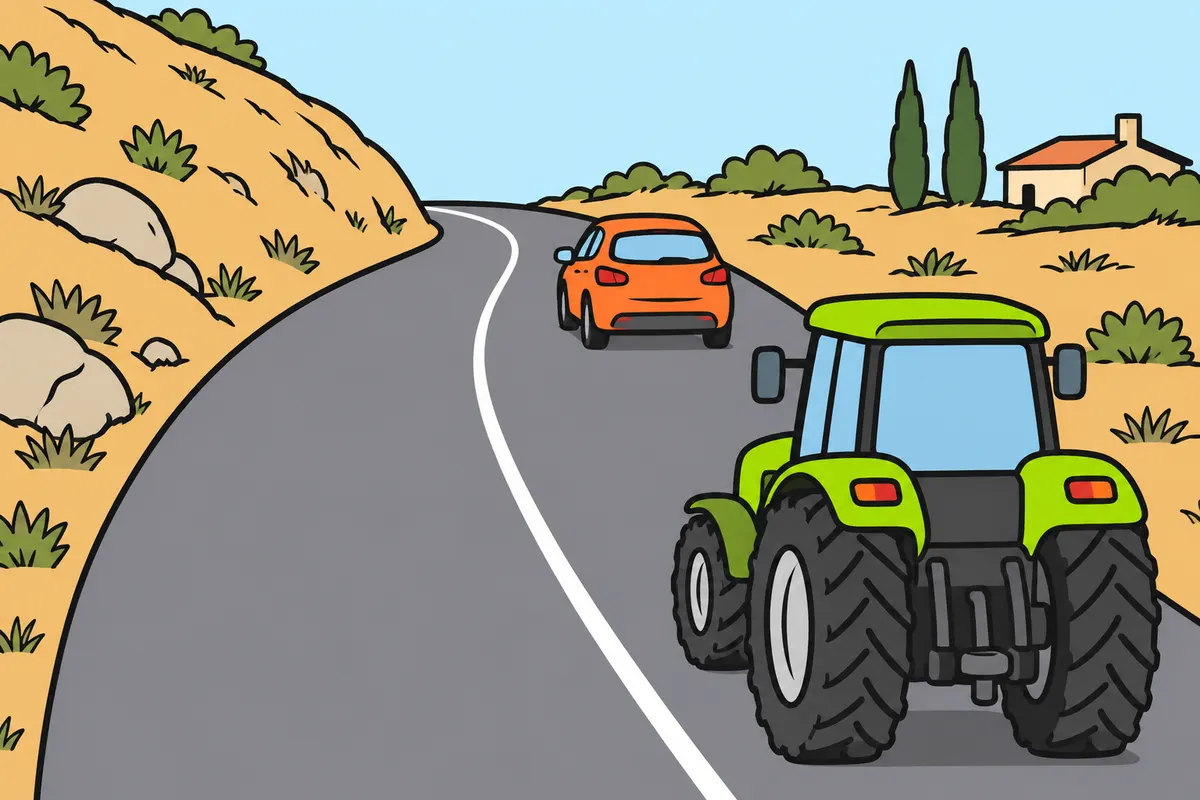
Do not overtake where prohibited or where you cannot check safety.
| Junction case | Condition |
|---|---|
| Roundabout | Overtaking is allowed if safe and other prohibitions are respected |
| You must overtake on the right | Overtaking is allowed if safe and other prohibitions are respected |
| Your carriageway has signposted priority | Overtaking is allowed if safe and other prohibitions are respected |
| You overtake two-wheeled vehicles | Overtaking is allowed if safe and other prohibitions are respected |
Remember
- With poor visibility, the exception requires separated directions, without entering the opposing side.
- Do not overtake at or near marked pedestrian crossings.
- Nor at cycle junctions or at or near level crossings.
- At junctions, check whether an exception applies and follow all other prohibitions.
- In tunnels and underpasses, do not overtake if your direction has one lane.
Exam trap: Wrong: several lanes in a tunnel guarantee you can overtake. Right: check signs and conditions.
Read the full explanation
- You must not overtake on bends or crests with restricted visibility, or anywhere you cannot see far enough to complete or abandon the manoeuvre. The exception requires the two directions of traffic to be clearly separated and overtaking to be possible without entering the opposite side; following another vehicle that blocks your view does not resolve the lack of visibility. [RGC, art. 87.1.a](https://www.boe.es/buscar/act.php?id=BOE-A-2003-23514#a87).
- You must not overtake at or near marked pedestrian crossings, junctions with cycle routes or level crossings. [RGC, art. 87.1.b](https://www.boe.es/buscar/act.php?id=BOE-A-2003-23514#a87).
- You must not overtake at or near junctions, except at roundabouts, when you must overtake on the right under article 82.2, when signs expressly give your carriageway priority, or when you overtake two-wheeled vehicles. Each exception also requires you to ensure safety and comply with the other prohibitions. [RGC, art. 87.1.c](https://www.boe.es/buscar/act.php?id=BOE-A-2003-23514#a87).
- You must not overtake in tunnels, underpasses or sections covered by the S-5 tunnel sign if there is only one lane in your direction. If there is more than one, you must still check the signs and all the conditions for the manoeuvre; having several lanes does not guarantee that overtaking is permitted. [RGC, art. 87.1.d](https://www.boe.es/buscar/act.php?id=BOE-A-2003-23514#a87).
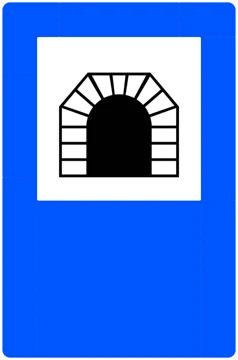 S-5
15Passing stationary vehicles and overtaking slow agricultural vehicles
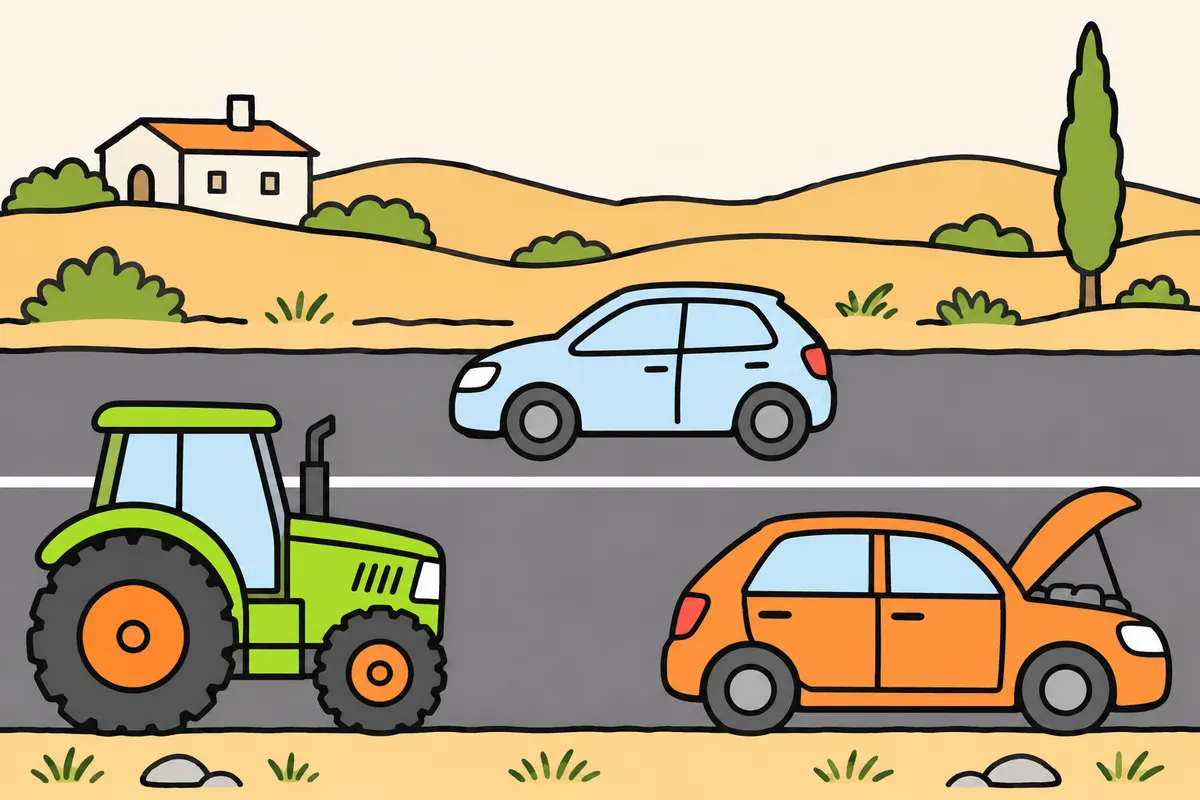
Pass obstacles and immobilised vehicles only when you can do so safely.
| Situation | Rule |
|---|---|
| Stopped for breakdown, accident, emergency, assistance, maintenance or traffic control | Apply the stated clearance and speed reduction if it occupies your lane |
| Agricultural vehicle or combination where overtaking is prohibited | Its speed must allow you to overtake safely |
| Traffic queue | Do not pass it as if the vehicles were immobilised |
Remember
- When passing those immobilised vehicles, leave at least 1.5 m.
- Also drive at least 20 km/h below the road limit.
- If they occupy your lane, you may pass safely where overtaking is prohibited.
- Enter the opposing side only after checking that it is safe.
- A traffic queue does not allow this exception.
Exam trap: Wrong: you may overtake any agricultural vehicle where overtaking is prohibited. Right: the exception requires a speed allowing safe overtaking.
Read the full explanation
- If a vehicle stopped because of a breakdown, accident, emergency, assistance, maintenance or traffic control occupies all or part of your lane, you must leave at least 1.5 metres of lateral clearance when passing it and travel at least 20 km/h below the road's speed limit. You may need to use the opposite lane, always checking that you create no danger. [RGC, art. 88.1](https://www.boe.es/buscar/act.php?id=BOE-A-2003-23514#a88).
- On a section where overtaking is prohibited, you may pass a stationary vehicle occupying your lane, even by entering the opposite side, if you can do so without danger. This exception excludes vehicles stopped by traffic conditions: you must stay behind a queue rather than treat it as a series of broken-down vehicles. [RGC, art. 88.2](https://www.boe.es/buscar/act.php?id=BOE-A-2003-23514#a88).
- Subject to those safety conditions, you may also overtake bicycles and other cycles, mopeds, personal mobility vehicles, pedestrians, animals, animal-drawn vehicles and special agricultural vehicles and their combinations in that situation, provided their speed allows you to do so without risk. As the tractor driver, you must understand that this exception may allow others to overtake you; it does not give you general permission to overtake any vehicle. [RGC, art. 88.2](https://www.boe.es/buscar/act.php?id=BOE-A-2003-23514#a88).
- If you encounter another obstacle that requires you to enter the opposite side, you may pass it after checking that there is no danger. You must also take this precaution where overtaking is permitted: if a vehicle is approaching and there is not enough space, wait. The urgency of clearing a narrow road does not remove the need for this check. [RGC, art. 89](https://www.boe.es/buscar/act.php?id=BOE-A-2003-23514#a89).
16Preparing to turn
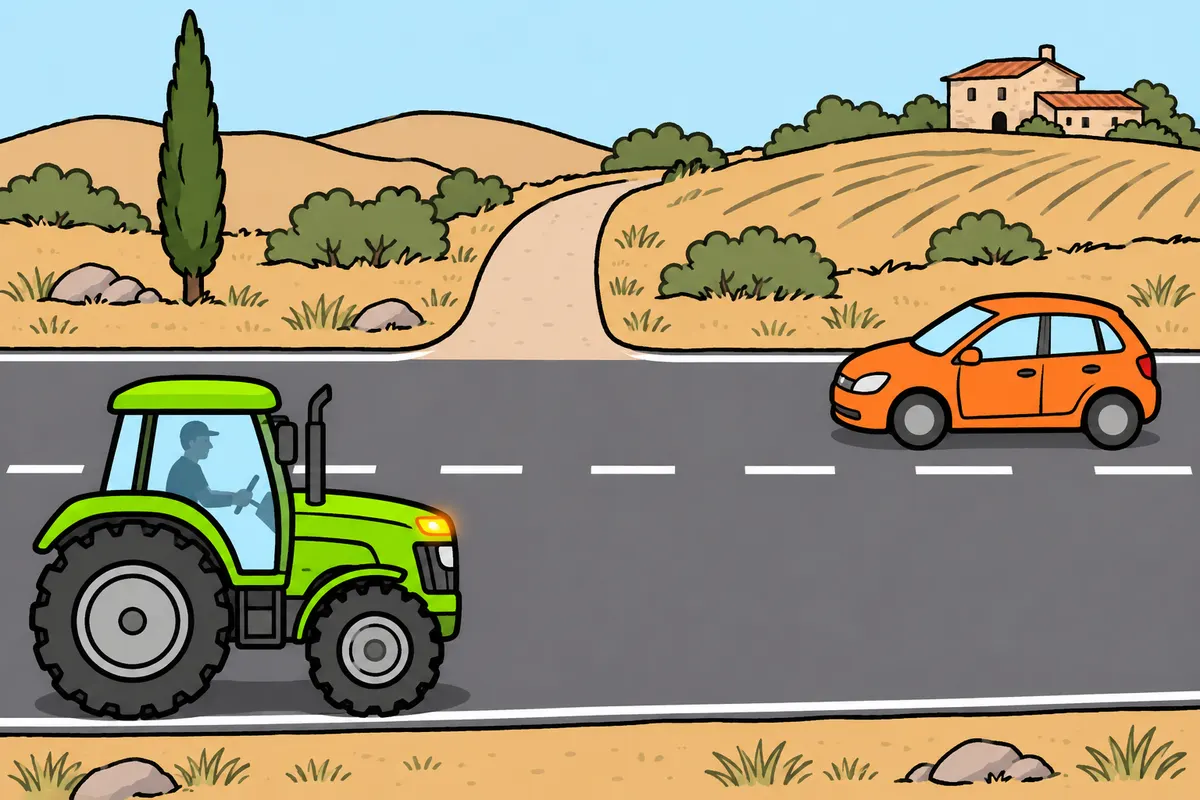
Before turning, check safety and give way to those with priority.
| When cyclists have priority | What you must do |
|---|---|
| You turn into another road and cyclists are nearby | Give way |
| They use a properly signposted cycle lane, cycle crossing or hard shoulder | Give way |
| They ride in a group and the first starts crossing or enters a roundabout | Give way to the group |
Remember
- Signal early and check oncoming traffic.
- Do not turn left without enough visibility.
- Look behind: do not cut off someone overtaking you.
- Follow signs and the route provided for turning.
- When entering another road, give way to pedestrians crossing it, even without marked crossings.
- When turning into another road, give way to nearby cyclists.
Exam trap: Wrong: when turning, give way to pedestrians only at marked crossings. Right: give way to pedestrians crossing the road you enter.
Read the full explanation
- You change direction when you turn to enter another road, take another carriageway or leave the one you are using. Before doing so, you must signal in advance and check that the distance and speed of oncoming traffic allow you to turn without danger; otherwise, you must not turn. [RGC, art. 74.1](https://www.boe.es/buscar/act.php?id=BOE-A-2003-23514#a74).
- You must not turn left if you lack sufficient visibility. As you approach a property entrance, also check traffic behind you before changing your road position: a vehicle may be overtaking you, and using your indicator does not allow you to cut across its path. [RGC, arts. 74 and 86](https://www.boe.es/buscar/act.php?id=BOE-A-2003-23514#a74).
- If there is a specific road layout or signing for the turn, you must follow it. Position the combination in advance, avoiding an improvised direct path that ignores a turning loop, a traffic island or the route laid out through the junction. [RGC, art. 75.1.a](https://www.boe.es/buscar/act.php?id=BOE-A-2003-23514#a75).
- When you turn into another road, you must let pedestrians crossing it pass, even if there is no marked crossing. You must give way to nearby cyclists if you turn right or left into another road; they also have priority when using a properly signed cycle lane, cycle crossing or hard shoulder, and when riding in a group whose first rider has begun crossing or entered a roundabout. [RGC, art. 65.1.b](https://www.boe.es/buscar/act.php?id=BOE-A-2003-23514#a65); [RGC, art. 64.2](https://www.boe.es/buscar/act.php?id=BOE-A-2003-23514#a64).
17Positioning and space for turning
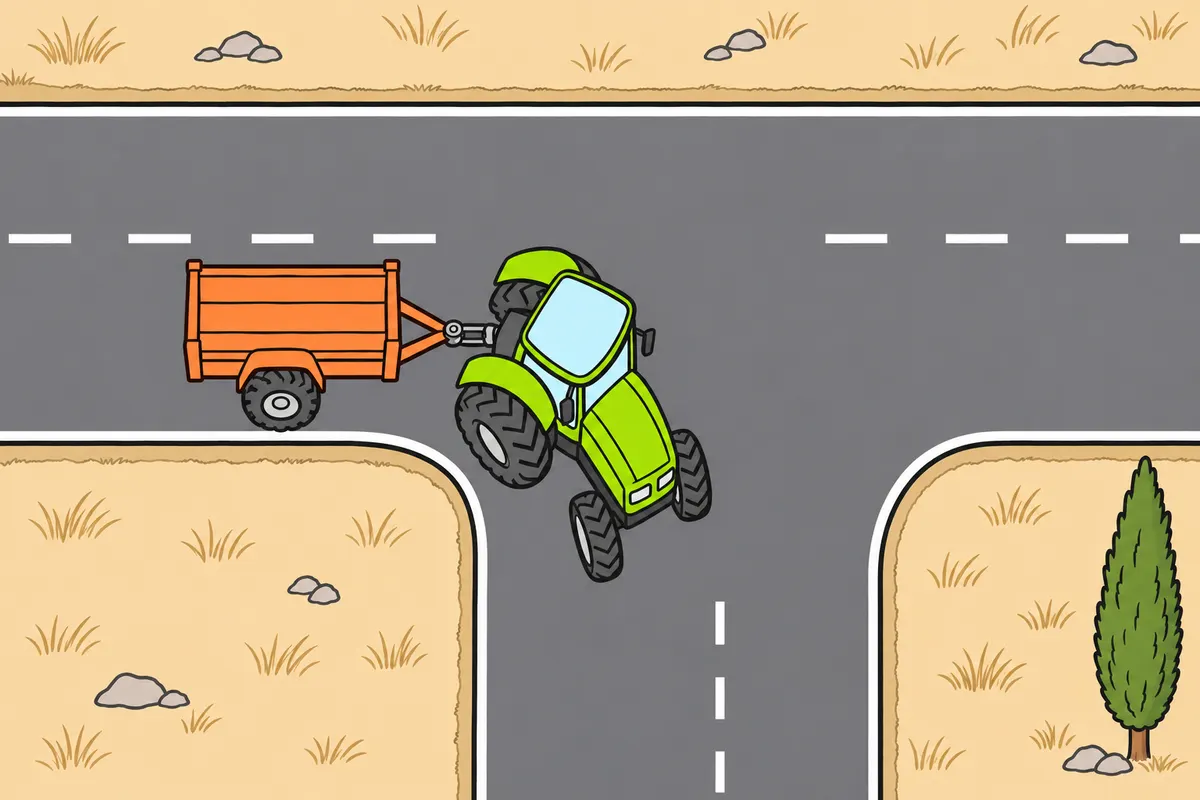
Position yourself for turning and allow space for your whole combination.
| Tractor turn | Position |
|---|---|
| Right | As close as possible to the right edge |
| Left on a one-way carriageway | Beside the left edge |
| Left on a two-way carriageway | Near the dividing line or centre, without entering the opposing side |
| Left on a two-way carriageway with three lanes marked by broken lines | In the centre lane |
Remember
- Take up your position early.
- Watch your rear wheels, trailer and projecting parts throughout the turn.
- If your size prevents normal positioning, take extra precautions to avoid danger.
- Observe and signal before taking a wider course.
- If you cannot avoid danger, wait or choose another permitted option.
Exam trap: Wrong: turn your tractor left from the right like a moped. Right: apply the general rules for tractors.
Read the full explanation
- To turn right, you must move as close as possible to the right-hand edge of the carriageway. Take up this road position in advance and complete the turn using as little space and time as safety allows, without trapping road users alongside the tractor. [RGC, art. 75](https://www.boe.es/buscar/act.php?id=BOE-A-2003-23514#a75).
- To turn left from a one-way carriageway, you must position yourself close to its left-hand edge. On a two-way carriageway, you must approach the line separating the directions of traffic, or the centre if there is no marking, staying on your own side without entering the opposite side while you wait. [RGC, art. 75.1.b](https://www.boe.es/buscar/act.php?id=BOE-A-2003-23514#a75).
- On a two-way carriageway with three lanes separated by broken lines, you must use the central lane to turn left. As you turn, keep the centre of the junction on your left unless its layout or signs specify another path. [RGC, art. 75](https://www.boe.es/buscar/act.php?id=BOE-A-2003-23514#a75).
- The requirement to begin certain left turns from the right on interurban roads applies to cycles and two-wheeled mopeds where there is no specially provided lane. You must not automatically apply it to your tractor because it is slow: for an agricultural vehicle, you follow the general rules and, where applicable, the exception justified by its dimensions. [RGC, art. 76](https://www.boe.es/buscar/act.php?id=BOE-A-2003-23514#a76).
- If the dimensions or other justified circumstances prevent you from strictly following the general positioning rules for turning, you must take the necessary precautions to avoid all danger. [RGC, art. 76.1](https://www.boe.es/buscar/act.php?id=BOE-A-2003-23514#a76).
- Before starting the turn, assess the space on the inside that the rear wheels and trailer occupy and the space on the outside that projecting parts may sweep through. You must monitor these areas throughout the manoeuvre; checking only that the cab clears a corner does not guarantee that the rest clears it. [RGC, arts. 74 and 76](https://www.boe.es/buscar/act.php?id=BOE-A-2003-23514#a76).
- If you need a wider path, check your surroundings and signal any necessary sideways movements before moving into that space. Do not swing out first and signal afterwards, or force pedestrians or vehicles to escape the swept area. If you cannot avoid the danger, wait or use another permitted alternative. [RGC, arts. 74, 76 and 109](https://www.boe.es/buscar/act.php?id=BOE-A-2003-23514#a76).
18Turning around safely
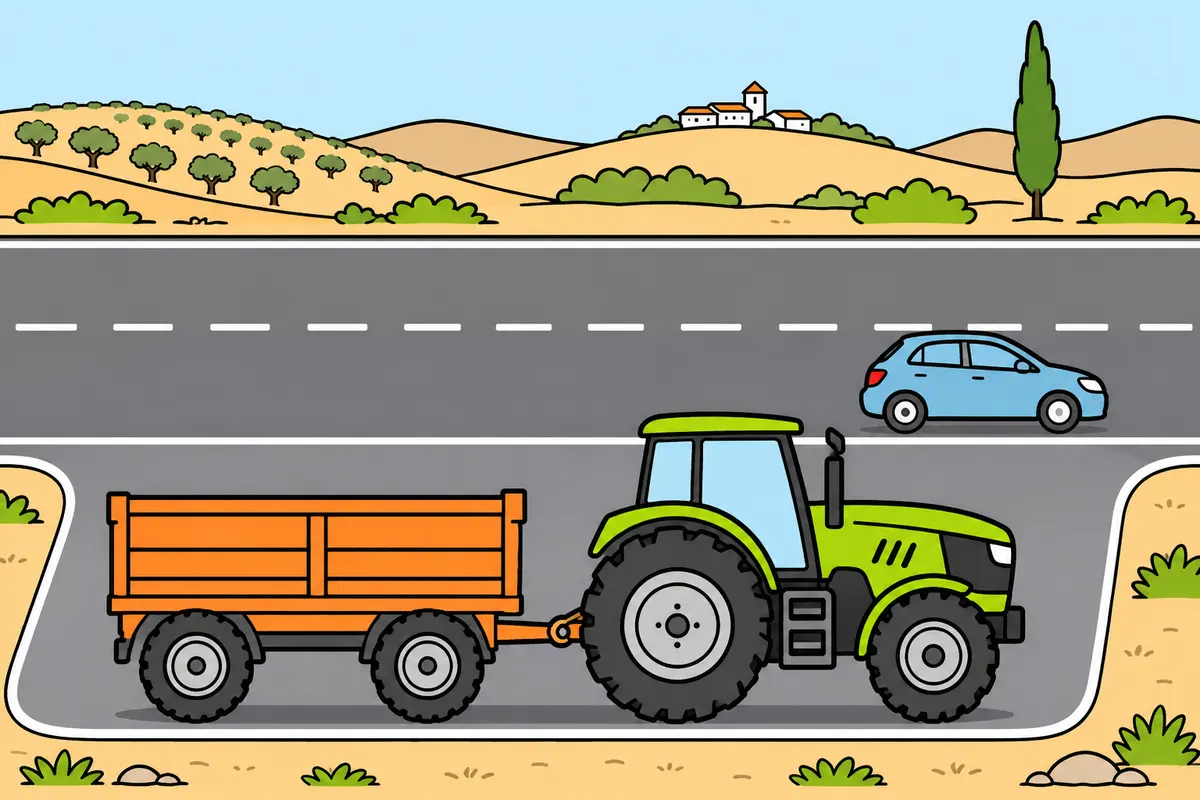
Turn around only where permitted and without blocking anyone.
Remember
- Choose a suitable place and signal early.
- Spend as little time as possible across the road.
- If you cannot turn around safely, wait.
- If you block traffic behind, leave to the right when possible.
- Do not turn around without visibility, at level crossings, in tunnels or underpasses.
- Nor on stretches signposted as tunnels.
Exam trap: Wrong: turn around wherever overtaking is prohibited. Right: you may do so there only if turning around is expressly authorised.
Read the full explanation
- Turning around means changing your direction of travel to continue along the same road in the opposite direction. You must choose a suitable place, signal well in advance and check that you do not endanger or obstruct other road users. You must spend as little time as possible positioned across the road. [RGC, art. 78](https://www.boe.es/buscar/act.php?id=BOE-A-2003-23514#a78).
- If you cannot complete the manoeuvre safely, you must not attempt it and must wait for a suitable opportunity. If waiting on the carriageway prevents traffic behind you from proceeding, you must leave it on the right where possible and wait off the carriageway; do not leave the combination across the road while deciding how to finish. [RGC, art. 78](https://www.boe.es/buscar/act.php?id=BOE-A-2003-23514#a78).
- You must not turn around where visibility prevents you from checking that it is safe, or at level crossings, in tunnels, underpasses or sections covered by the S-5 tunnel sign. You must also not turn around where overtaking is prohibited, unless turning around is expressly authorised. [RGC, art. 79](https://www.boe.es/buscar/act.php?id=BOE-A-2003-23514#a79).
- Plan the turn without using reversing as a routine solution when a place is too narrow. If your tractor and trailer do not fit in the chosen space, find another suitable place: you may reverse only within the specific exceptions governing it. [RGC, arts. 78 and 80](https://www.boe.es/buscar/act.php?id=BOE-A-2003-23514#a80).
19Reversing: limits and procedure
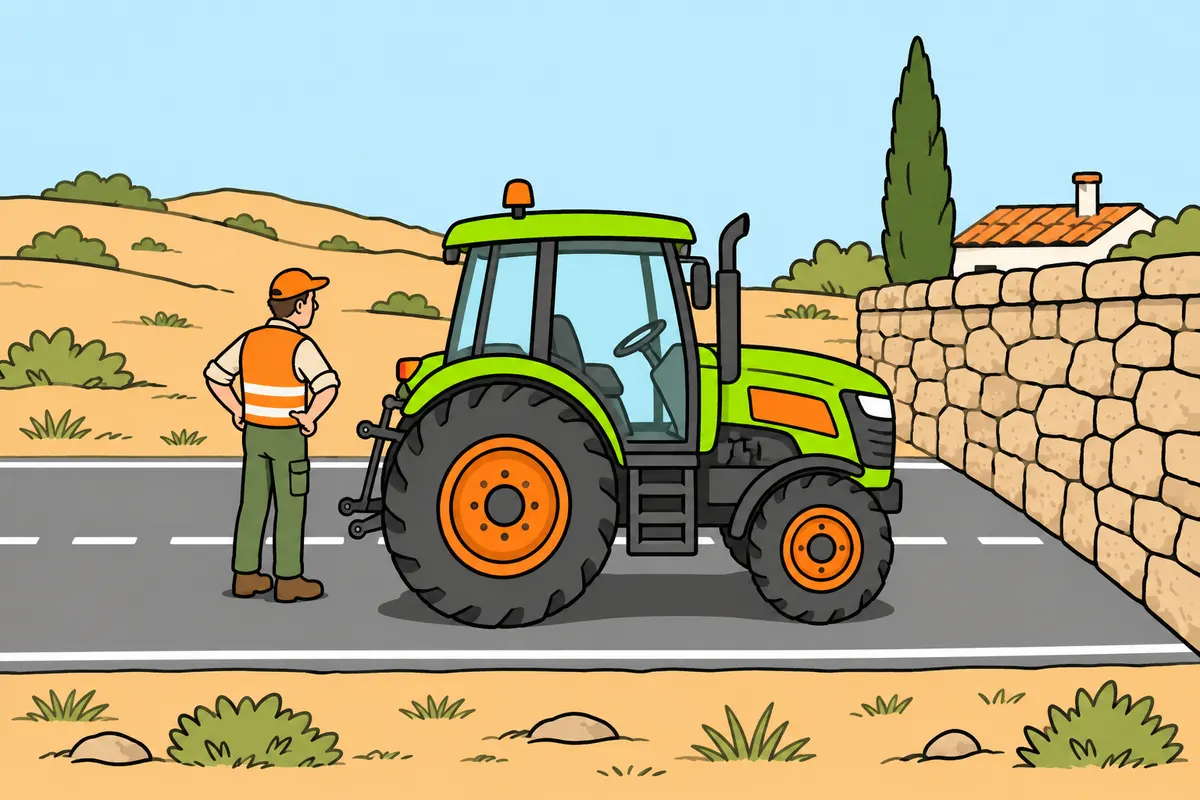
Reverse only in permitted cases, slowly and while watching continuously.
| Reversing case | Limit |
|---|---|
| You cannot go forwards, change direction or turn around | Only the essential, safe distance |
| As part of a brief stop, parking or joining traffic | Up to 15 metres; do not enter a junction |
Remember
- Check, signal and get help if you cannot see clearly.
- Always keep the distance to the minimum necessary.
- Do not reverse on motorways.
- Watch behind, beside you, your trailer and implements.
- Stop immediately for danger warnings or nearby people, animals or vehicles.
- Abandon the manoeuvre if needed to avoid danger.
Exam trap: Wrong: you may reverse 15 metres in any situation. Right: you need an exception; as an additional manoeuvre, you must also keep out of junctions.
Read the full explanation
- As a general rule, you must not reverse. You may do so when you cannot move forwards, turn or turn round, or to complete another manoeuvre that requires it. In both cases, you must reverse only the minimum distance necessary; you must not reverse simply because it is more convenient. [RGC, art. 80.1](https://www.boe.es/buscar/act.php?id=BOE-A-2003-23514#a80).
- When reversing to complete a stop, parking manoeuvre or move into traffic, you must not exceed 15 metres or enter a junction. This distance limit applies to those complementary manoeuvres: when you really cannot move forwards, turn or turn round, such as on a blocked road with no other possible exit, you must limit the distance to the minimum necessary. [RGC, art. 80.2](https://www.boe.es/buscar/act.php?id=BOE-A-2003-23514#a80).
- You must not reverse on autopistas or autovías (motorways). The reversing rule does not give you access to roads restricted to your vehicle or allow you to return to an exit you have passed; route selection and permitted roads are covered in «Road use with agricultural vehicles». [RGC, art. 80.3](https://www.boe.es/buscar/act.php?id=BOE-A-2003-23514#a80).
- Before reversing, signal and check that visibility, space and time allow you to do so safely. If you need to get out to look or follow another person’s directions, do so before starting to move. [RGC, art. 81.1](https://www.boe.es/buscar/act.php?id=BOE-A-2003-23514#a81).
- Reverse slowly and with the utmost care. Check the hidden area behind you, both sides, the trailer’s path and the sweep of the implements; help from another person does not relieve you of your duty to maintain control or stop the manoeuvre if you cannot check that it is safe. [RGC, art. 81](https://www.boe.es/buscar/act.php?id=BOE-A-2003-23514#a81).
- Stop as quickly as possible if you hear a warning of danger or notice a vehicle, person or animal nearby, and whenever safety requires it. [RGC, art. 81.3](https://www.boe.es/buscar/act.php?id=BOE-A-2003-23514#a81).
20Stopping and parking: definitions and location
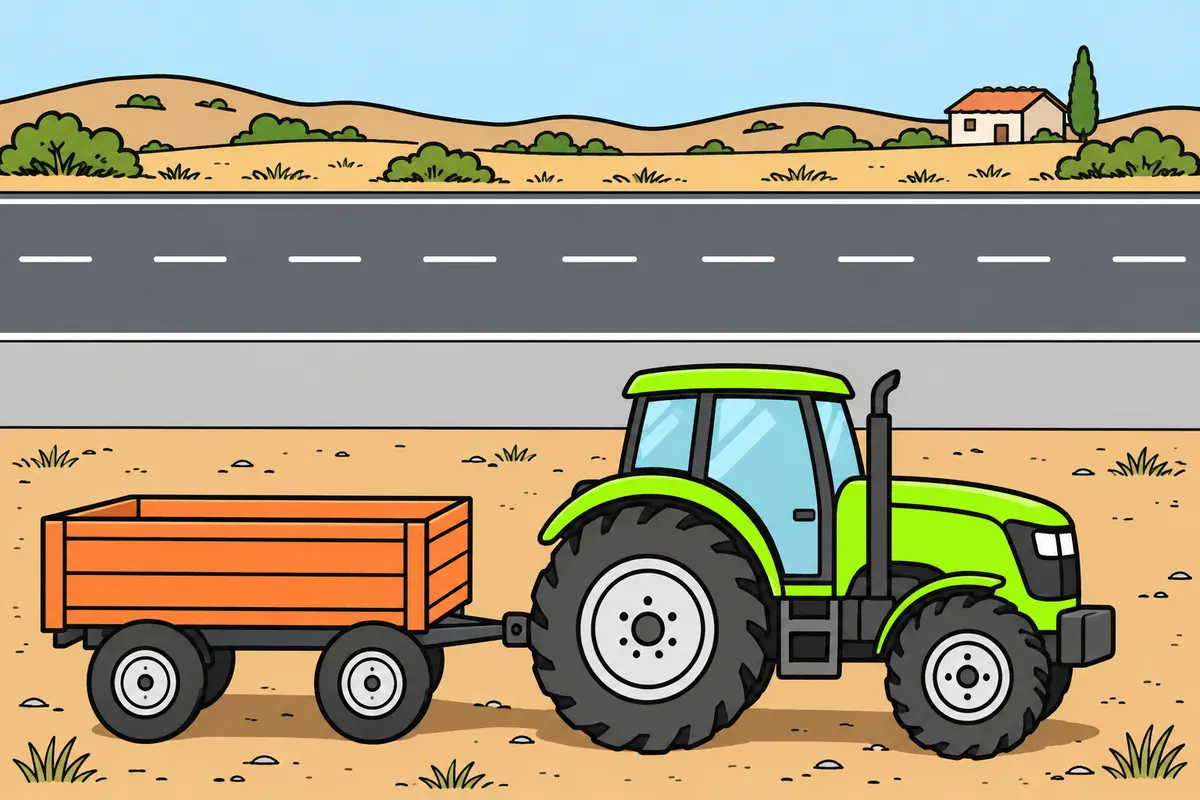
Identify why you are stopping and choose a permitted, safe place.
| Immobilisation | Meaning |
|---|---|
| Compulsory stop | Required by emergency, traffic or a rule |
| Brief stop | Voluntary, under 2 minutes, and you stay in the vehicle |
| Parking | Neither a compulsory stop nor a brief stop, even if you stay at the wheel |
Remember
- For a voluntary brief stop, stay in your vehicle for under 2 minutes.
- Outside built-up areas, stop off the carriageway, on the right.
- Keep the usable part of the hard shoulder clear.
- In built-up areas, keep right; on one-way roads you may choose the left.
- Obey signs and local rules.
- Usually, position yourself parallel to the edge without danger or obstruction.
Exam trap: Wrong: staying at the wheel always means a brief stop. Right: a voluntary halt lasting exactly 2 minutes is parking.
Read the full explanation
- If you come to a standstill because of an emergency, traffic conditions or to comply with a rule, this is a traffic stop. Waiting at traffic lights or in a queue does not become parking because it lasts several minutes. The reason for coming to a standstill is decisive. [Traffic Act, Annex I, definition 80](https://www.boe.es/buscar/act.php?id=BOE-A-2015-11722#ani).
- For a voluntary halt to count as stopping, it must last less than 2 minutes and you must not leave the vehicle. You must not call it stopping if you walk away to open a gate to a property or run an errand, even if you expect to take very little time. [Traffic Act, Annex I, definition 81](https://www.boe.es/buscar/act.php?id=BOE-A-2015-11722#ani).
- You are parking when your halt is neither a traffic stop nor stopping. This can apply even if you remain at the wheel; exactly 2 minutes does not meet the requirement for stopping to last less than 2 minutes. [Traffic Act, Annex I, definitions 81 and 82](https://www.boe.es/buscar/act.php?id=BOE-A-2015-11722#ani).
- On interurban roads, you must stop or park off the carriageway, on the right-hand side, keeping the usable part of the arcén (hard shoulder) clear. If an emergency prevents this positioning, you must apply the relevant rules for immobilised vehicles. [RGC, art. 90.1](https://www.boe.es/buscar/act.php?id=BOE-A-2003-23514#a90).
- On urban roads, if you stop or park on the carriageway or hard shoulder, you must keep close to the right-hand edge; on one-way roads you may also use the left-hand side. You must obey signs and the municipal stopping and parking regulations. [RGC, art. 90.2](https://www.boe.es/buscar/act.php?id=BOE-A-2003-23514#a90); [Traffic Act, art. 39.4](https://www.boe.es/buscar/act.php?id=BOE-A-2015-11722#a39).
- As a general rule, you must position the vehicle parallel to the edge of the carriageway, making the best use of the remaining space. The road’s characteristics or other circumstances may justify a different arrangement; follow the layout of the spaces and take account of your combination’s length and projections. [RGC, art. 92.1 and 2](https://www.boe.es/buscar/act.php?id=BOE-A-2003-23514#a92).
- You must not leave the vehicle in a position that creates a risk, obstructs traffic or allows it to move accidentally. Before stopping, assess whether you can secure the tractor and whether the area accommodates the entire trailer; hazard warning lights do not make a dangerous location safe. [RGC, art. 91.1](https://www.boe.es/buscar/act.php?id=BOE-A-2003-23514#a91).
21Places where you must not stop either
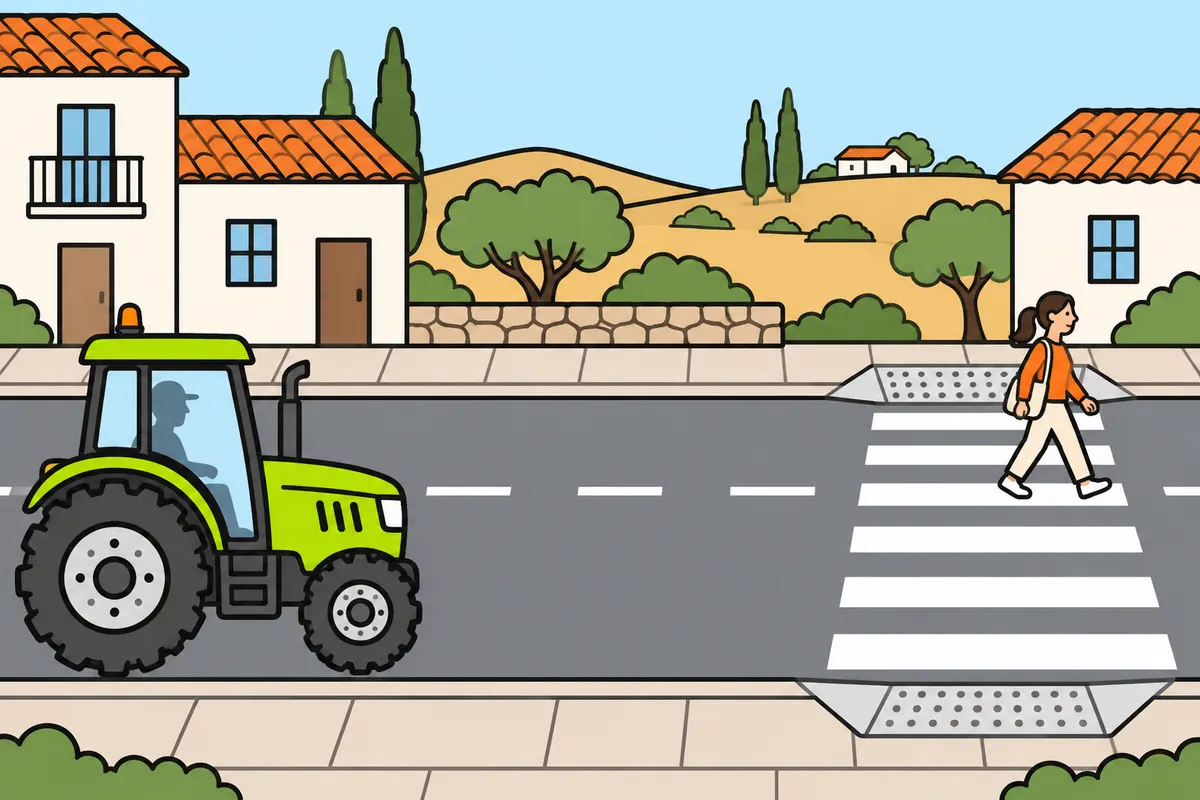
Do not stop where you could create danger or block areas that must stay clear.
Remember
- Do not stop at or near bends or crests with poor visibility.
- Nor in tunnels, underpasses or stretches signposted as tunnels.
- Keep pedestrian crossings, cycle crossings and level crossings clear.
- Do not occupy reserved areas without permission or public transport stops.
- Do not stop at or near junctions; do not hinder trams or hide signs.
- Keep islands, central reservations, separators, dropped kerbs and access points clear.
Exam trap: Wrong: a short wait allows you to stop somewhere prohibited. Right: the prohibition applies even if you stop briefly.
Read the full explanation
- Stopping prohibitions also apply to parking. You must not stop on or near bends or crests with restricted visibility, or in tunnels, underpasses or sections covered by the tunnel sign. You must not stop on level crossings, cycle crossings or pedestrian crossings either. Even a brief wait remains subject to these prohibitions. [RGC, art. 94.1](https://www.boe.es/buscar/act.php?id=BOE-A-2003-23514#a94).
- You must not stop in lanes or areas reserved exclusively for particular users or services, including public transport and cycle lanes, or in areas reserved exclusively for urban public transport stopping or parking. You must also keep marked spaces reserved for disabled people clear unless you are authorised to use them. [RGC, art. 94](https://www.boe.es/buscar/act.php?id=BOE-A-2003-23514#a94).
- You must not stop at or near junctions. You must not position your vehicle on tram rails or so close that you obstruct trams, hide signs or force others to manoeuvre to see them; an implement’s size can cause these obstructions even if the wheels remain outside the junction. [Traffic Act, art. 40.1](https://www.boe.es/buscar/act.php?id=BOE-A-2015-11722#a40).
- You must not occupy traffic islands, central reservations, separators or other traffic-channelling features, or obstruct dropped kerbs for pedestrians. In addition to the specific prohibitions at the location, you must avoid any positioning that endangers pedestrians, animals or vehicles, even if you only intend to remain stationary for a few seconds. [RGC, art. 91.2](https://www.boe.es/buscar/act.php?id=BOE-A-2003-23514#a91).
22Parking prohibitions and clear space
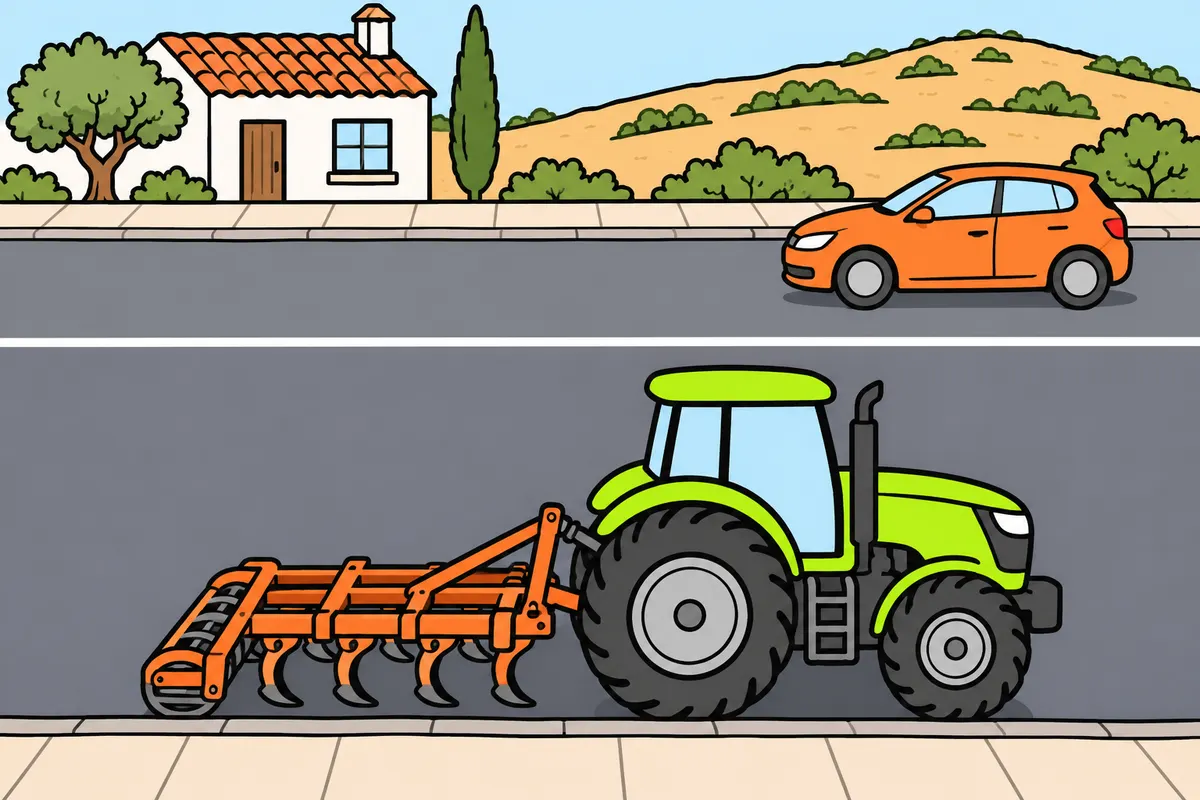
Park without blocking passage or occupying prohibited spaces.
| Prohibition | What it means |
|---|---|
| Brief stops prohibited | You cannot park either |
| Only parking prohibited | You may make a genuine safe brief stop without blocking access, movement or services |
Remember
- Do not park where brief stops are prohibited.
- Do not park in signed loading areas or entrances, second rows or pedestrian areas.
- Respect the permission and time limit for time-limited parking.
- Include your implements when calculating the space you leave clear.
- Do not block entrances, turns or other vehicles’ exits.
Exam trap: Wrong: leaving 3 metres is always enough. Right: other vehicles must also be able to pass.
Read the full explanation
- Specific parking prohibitions include the following: you must not park in marked loading and unloading areas, in front of correctly signed vehicle accesses, double-park, or park on pavements, promenades or other pedestrian areas. The tractor’s size does not allow you to occupy part of the pavement to leave more carriageway clear. [RGC, art. 94.2](https://www.boe.es/buscar/act.php?id=BOE-A-2003-23514#a94).
- In time-limited parking areas, you must have the required authorisation and comply with the time limit. A parking-only prohibition does not in itself prohibit a genuine stop, but the stop must be safe and must not block access, movements or services; do not treat double-parking as an unconditional option. [RGC, arts. 91 and 94](https://www.boe.es/buscar/act.php?id=BOE-A-2003-23514#a94).
- Positioning that leaves less than 3 metres between the vehicle and the opposite edge or a longitudinal marking that you must not cross is dangerous or obstructive. This also applies if other vehicles cannot pass even with that clearance. You must count the width occupied by the implements, not just the tyres. [RGC, art. 91.2.a](https://www.boe.es/buscar/act.php?id=BOE-A-2003-23514#a91).
- Do not prevent a correctly parked vehicle from pulling out, block access to premises for people or animals, block a vehicle access or prevent an authorised turn. Parking in the middle of the carriageway or in spaces reserved for emergency and safety services is also considered particularly obstructive. [RGC, art. 91.2](https://www.boe.es/buscar/act.php?id=BOE-A-2003-23514#a91).
23Secure the tractor before leaving your driving position
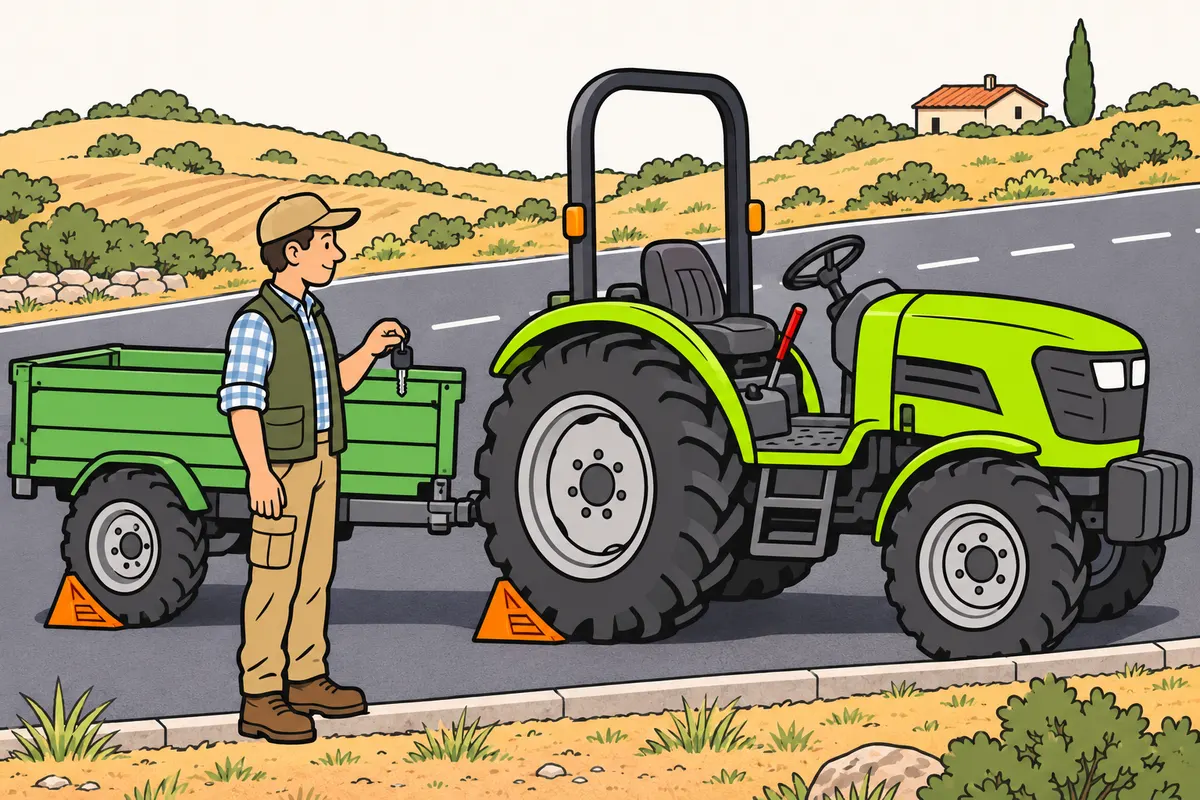
When leaving your driving position, secure your tractor so it cannot move.
| Slope: tractor with gearbox | Gear; wheel direction if against kerb |
|---|---|
| Uphill | First gear; wheels towards the centre of the carriageway |
| Downhill | Reverse gear; wheels outwards |
| Gearbox with parking position | Use that position where applicable |
Remember
- Stop the engine, switch off the ignition and apply the parking brake.
- If you walk away, prevent unauthorised use.
- On significant slopes, also chock vehicles above 3,500 kg and all combinations.
- Use proper chocks or rest a steered wheel against the kerb.
- Do not use stones; remove chocks from the road when setting off.
- Before opening a door or getting out, stop completely and check for danger.
Exam trap: Wrong: a light combination needs no chocks on a significant slope. Right: secure it with proper chocks or a steered wheel against the kerb, regardless of its MMA.
Read the full explanation
- When you have to leave your driving position, you must stop the engine, switch off the ignition and apply the parking brake. If you walk away, take precautions to prevent unauthorised use. Getting out just briefly to check the trailer does not allow you to leave the vehicle able to move. [RGC, arts. 91.1 and 92.3](https://www.boe.es/buscar/act.php?id=BOE-A-2003-23514#a92).
- If the vehicle has a gearbox, leave it in first gear when facing uphill and reverse gear when facing downhill, or in the parking position where applicable. [RGC, art. 92.3.c](https://www.boe.es/buscar/act.php?id=BOE-A-2003-23514#a92).
- If you stop or park on a significant gradient with a vehicle whose MMA (maximum authorised mass) exceeds 3,500 kg, or with a vehicle combination, you must also chock it properly. The requirement for a combination does not depend on exceeding that mass threshold; you must bear it in mind when towing an agricultural trailer. [RGC, art. 92.3.d](https://www.boe.es/buscar/act.php?id=BOE-A-2003-23514#a92).
- You may use purpose-made wheel chocks or rest a steered wheel against the kerb: turn the wheels towards the centre of the carriageway when facing uphill and away from it when facing downhill. Do not use stones or improvised objects, and remove the chocks from the road when you set off again. These measures are additional to the appropriate brake and gear settings. [RGC, art. 92.3.d](https://www.boe.es/buscar/act.php?id=BOE-A-2003-23514#a92).
- Wait until the vehicle is completely stationary before opening a door or getting out, and check that you do not endanger or obstruct anyone, especially cyclists. As a general rule, get in and out on the side nearest the edge of the road; getting out after a breakdown also requires the specific safety precautions. [RGC, art. 114](https://www.boe.es/buscar/act.php?id=BOE-A-2003-23514#a114).
24Immobilisation following a breakdown or accident
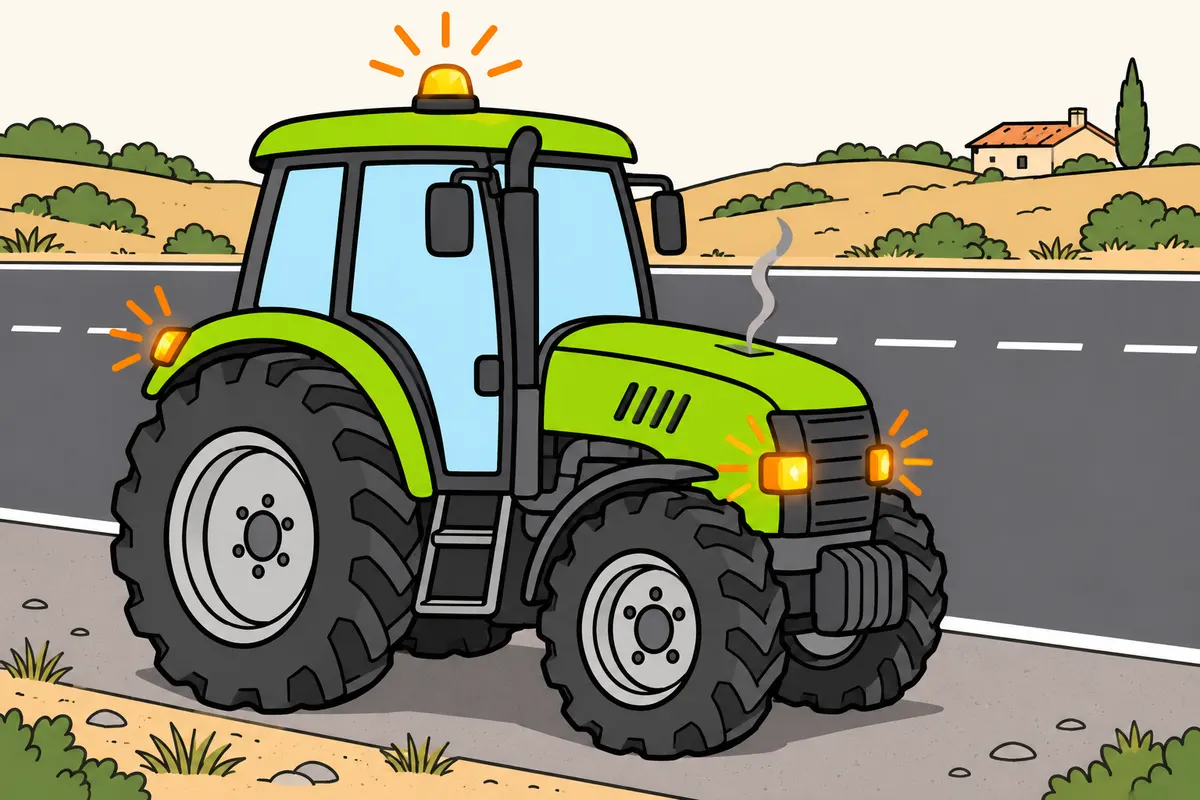
If a breakdown or accident creates danger, warn others and find safe protection.
| If you cannot continue | What to do |
|---|---|
| You can safely reach a place outside the road platform | Exit on the side away from traffic; do not stay on the carriageway or hard shoulder |
| You cannot get out safely | Stay inside with your seat belt fastened |
Remember
- Move your vehicle off the carriageway when you can safely.
- Use hazard warning lights if fitted.
- On the carriageway or shoulder, keep position lights on in darkness or poor visibility.
- In those conditions, also keep end-outline marker lamps on where required.
- Recognise the connected V-16 as the regulatory device for warning of danger.
- Agricultural vehicles need not carry one; if you carry one, you must use it.
Exam trap: Wrong: carrying a connected V-16 is optional, so using it is optional too. Right: if you carry one, you must use it in a hazardous immobilisation.
Read the full explanation
- If a breakdown or accident causes your vehicle or load to obstruct the carriageway, you must warn others of the danger and take steps to remove it as soon as possible. Move it off the carriageway and position it in accordance with the parking rules where feasible, without attempting to continue if the vehicle cannot be driven safely. [RGC, art. 130.1 and 2](https://www.boe.es/buscar/act.php?id=BOE-A-2003-23514#a130).
- While the road is being cleared, use your hazard warning lights if fitted. At night or in significantly reduced visibility, if the vehicle is immobilised on the carriageway or hard shoulder, keep the position lights on and, where required, the end-outline marker lamps. Lighting requirements are covered in «Agricultural lighting and signalling», section «Immobilised vehicles and parking». [RGC, arts. 105 and 130](https://www.boe.es/buscar/act.php?id=BOE-A-2003-23514#a105).
- The connected V-16 is the regulatory advance warning device. You are not required to carry one; if you carry one, you must use it. [RGV, Annex XII](https://www.boe.es/buscar/act.php?id=BOE-A-1999-1826#anxii); [RGC, art. 130.4](https://www.boe.es/buscar/act.php?id=BOE-A-2003-23514#a130). For positioning and maintenance, see «Accidents and breakdowns: protect and assist», section «Position and maintain the beacon correctly».
- If you cannot resume your journey, leave the vehicle only when there is a safe place off the roadway, exiting on the side away from traffic and without remaining on the carriageway or hard shoulder. If you cannot get out safely, remain in the cab with your seat belt fastened. «Accidents and breakdowns: protect and assist» covers protection and requesting help. [RGC, art. 130.3](https://www.boe.es/buscar/act.php?id=BOE-A-2003-23514#a130).
25Immobilisation ordered by the authorities and vehicle removal
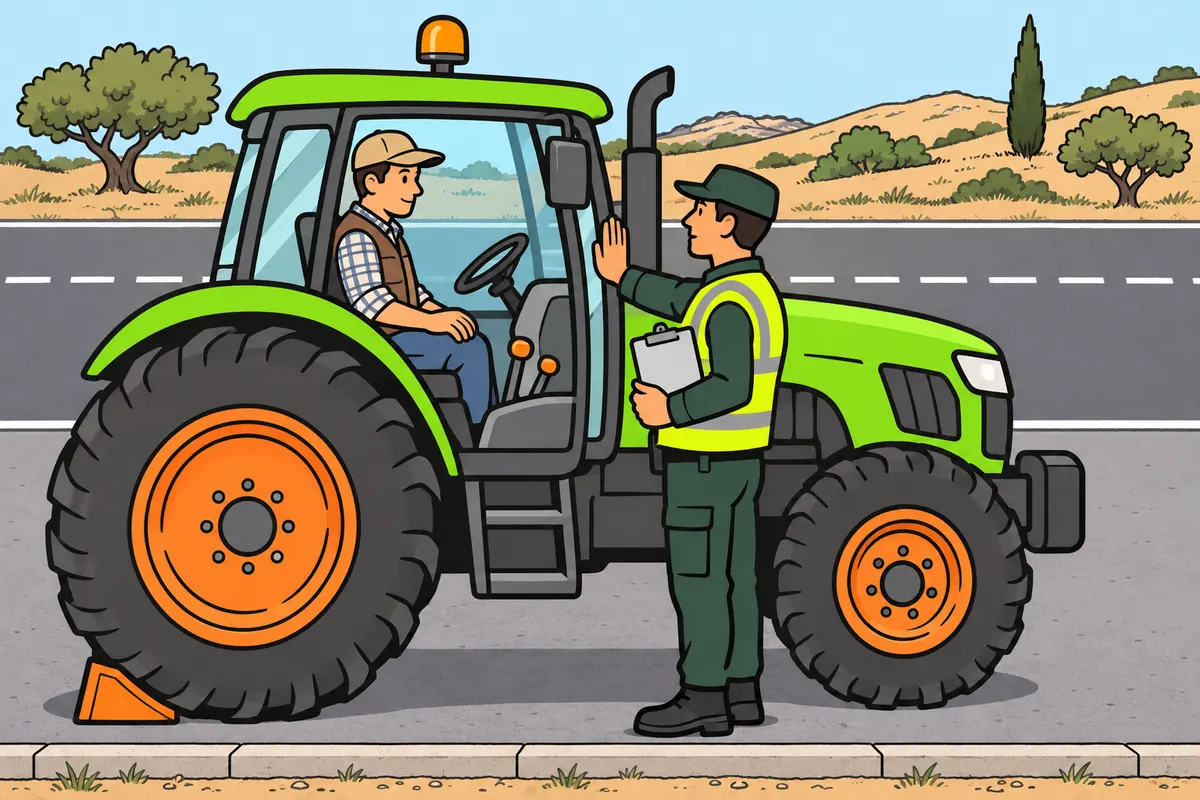
Obey ordered immobilisation and meet the conditions before driving again.
| Measure | Effect |
|---|---|
| Immobilisation | You cannot drive; this does not necessarily mean removal to a pound |
| Removal and impounding | Authorities take the vehicle away on legal grounds, such as danger or serious disruption |
Remember
- Officers may immobilise you for serious defects, missing insurance or breached road-use authorisation.
- They may also immobilise you for excessive gas, smoke or noise levels.
- Remove the cause and meet the required conditions.
- Where required, have checks at the designated workshop.
Exam trap: Wrong: decide for yourself to drive again. Right: meet the conditions for lifting the immobilisation.
Read the full explanation
- Traffic officers may immobilise your vehicle because of defects that create a particularly serious risk, lack of compulsory insurance or failure to comply with the authorisation to use the vehicle on the road, among other grounds provided for by law. You must not confuse this administrative measure with voluntarily stopping your tractor to carry out a manoeuvre. [Traffic Act, art. 104.1](https://www.boe.es/buscar/act.php?id=BOE-A-2015-11722#a104).
- Immobilisation may also apply if your vehicle exceeds the regulatory limits for gases, smoke or noise. You must meet the conditions for the measure to be lifted and eliminate its cause; in cases provided for by law, checks at the designated workshop may be required. You cannot decide on your own to resume driving. [Traffic Act, art. 104](https://www.boe.es/buscar/act.php?id=BOE-A-2015-11722#a104).
- The authorities may remove your vehicle and take it to a vehicle pound if it poses a danger, causes serious disruption or other grounds provided for by law apply. Parking that blocks traffic may result in this removal; you must distinguish it from immobilisation, which prevents you from driving without necessarily moving the vehicle to a pound. [Traffic Act, art. 105](https://www.boe.es/buscar/act.php?id=BOE-A-2015-11722#a105).
Joining traffic from a property
Choose a gap large enough for the entire agricultural vehicle and its trailer.
- Look in both directions and assess the position, path and speed of vehicles.
- Ask for help if you cannot check that it is safe yourself.
- Signal and give way; when leaving an exclusively private track, move at a speed that allows you to stop immediately.
- Join only when you can complete the manoeuvre without danger.
- Keep checking until the whole combination has joined traffic and cancel your signal when you finish moving across.
Deciding on and completing an overtaking manoeuvre
Check the entire route before pulling out.
- Check that the location and signs allow overtaking or that an applicable exception exists.
- Check ahead, behind and for oncoming traffic; leave space to move back in.
- Assess the speed difference, clearances and special speed reductions; apply the 15 seconds or 200 metres where applicable.
- Signal before pulling out and overtake within your limits, allowing a safety margin for the entire combination.
- If danger arises, slow down and abandon the manoeuvre safely; if you complete it, signal and move back in gradually without cutting anyone off.
Reversing when permitted
Keep the manoeuvre legal, observe and maintain control throughout.
- Identify the exception that allows you to reverse and limit the distance to the absolute minimum necessary.
- If reversing complements stopping, parking or joining traffic, do not exceed 15 metres or enter a junction.
- Check the area, getting out or using help if necessary, and signal the manoeuvre.
- Reverse slowly, watching the trailer, implements, people and animals.
- Stop immediately if you receive a warning or encounter a risk, and abandon the manoeuvre when necessary.
Parking a combination on a slope
Your vehicle must remain stationary when you leave your driving position.
- Choose a permitted location and position the entire combination without causing danger or obstruction.
- Signal and park; switch off the engine, switch off the ignition and apply the parking brake.
- Leave first gear engaged uphill, reverse gear downhill, or select the appropriate parking position.
- On a significant slope, add suitable wheel chocks or rest a steered wheel against the kerb, facing the direction required by the regulations.
- Prevent unauthorised use if you walk away and remove the chocks from the road before driving off.
Finished this module?
Mark it as read and you will see your progress on the theory list.