
Theory · LVA Licence - Agricultural Vehicle · Module 9 of 16
Speed and distances for agricultural vehicles
You learn to combine the limits specific to your agricultural vehicle with those of each road and to choose a safe speed according to the load, visibility and grip. You distinguish reaction, braking and stopping distances, and answer questions about safe following distances, the 50-metre rule and distances in tunnels.
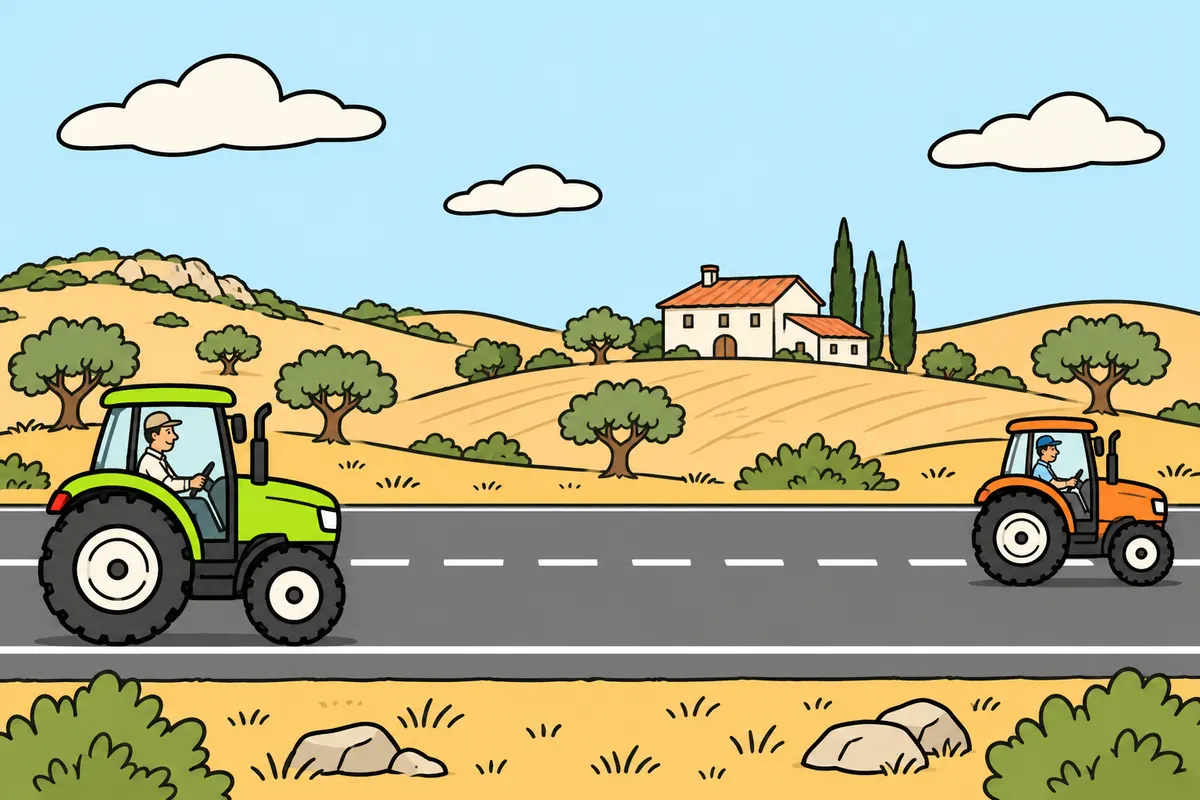
1Speed limits and safe speed
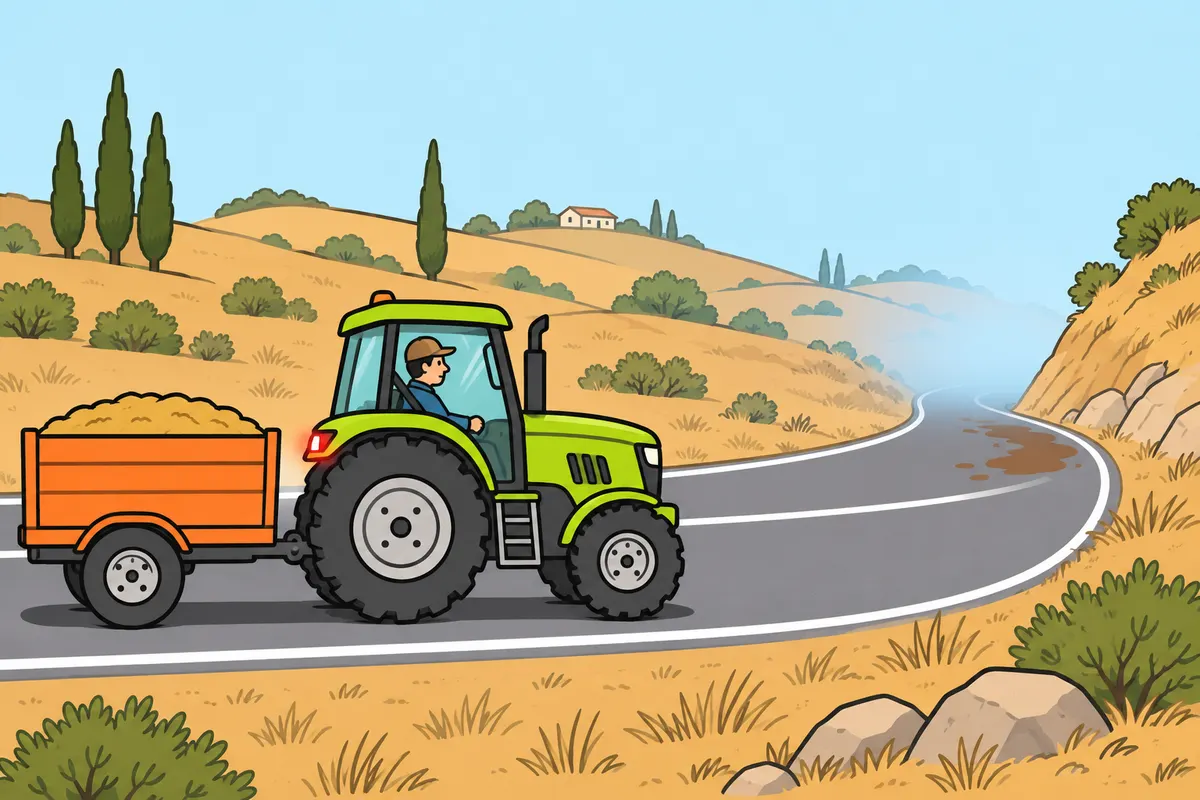
Adapt your speed so you can stop within the distance you can see.
Remember
- Do not exceed the applicable maximum speed.
- Slow down according to your condition, load, traffic and weather.
- Slow down before bends or places where you cannot see far.
- You must be able to stop before an obstacle.
Exam trap: Wrong: you are safe below the maximum. Right: adapt your speed to the conditions.
Read the full explanation
- The maximum speed is the upper limit; the minimum speed is the applicable lower limit. Your appropriate speed depends on the circumstances of your tractor and route. [DGT, Risk factors and values](https://www.dgt.es/export/sites/web-DGT/.galleries/downloads/conoce_la_dgt/que-hacemos/educacion-vial/jovenes/factores-riesgo/factores-y-valores-de-riesgo.pdf)
- Exceeding the applicable maximum is speeding. You can drive at an inappropriate speed without exceeding it: 25 km/h with a trailer on a muddy bend can be too fast to maintain control. [DGT, Risk factors and values](https://www.dgt.es/export/sites/web-DGT/.galleries/downloads/conoce_la_dgt/que-hacemos/educacion-vial/jovenes/factores-riesgo/factores-y-valores-de-riesgo.pdf)
- You must adapt your speed to your physical and mental condition, your vehicle and its load, the road, and the weather, environmental and traffic conditions. [RGC, art. 45](https://www.boe.es/buscar/act.php?id=BOE-A-2003-23514#a45)
- You must be able to stop within the distance you can see and before any obstacle that may appear. Slow down before a bend, fog or a crest that restricts your view. [RGC, art. 45](https://www.boe.es/buscar/act.php?id=BOE-A-2003-23514#a45)
2Agricultural speed limits of 25 and 40 km/h
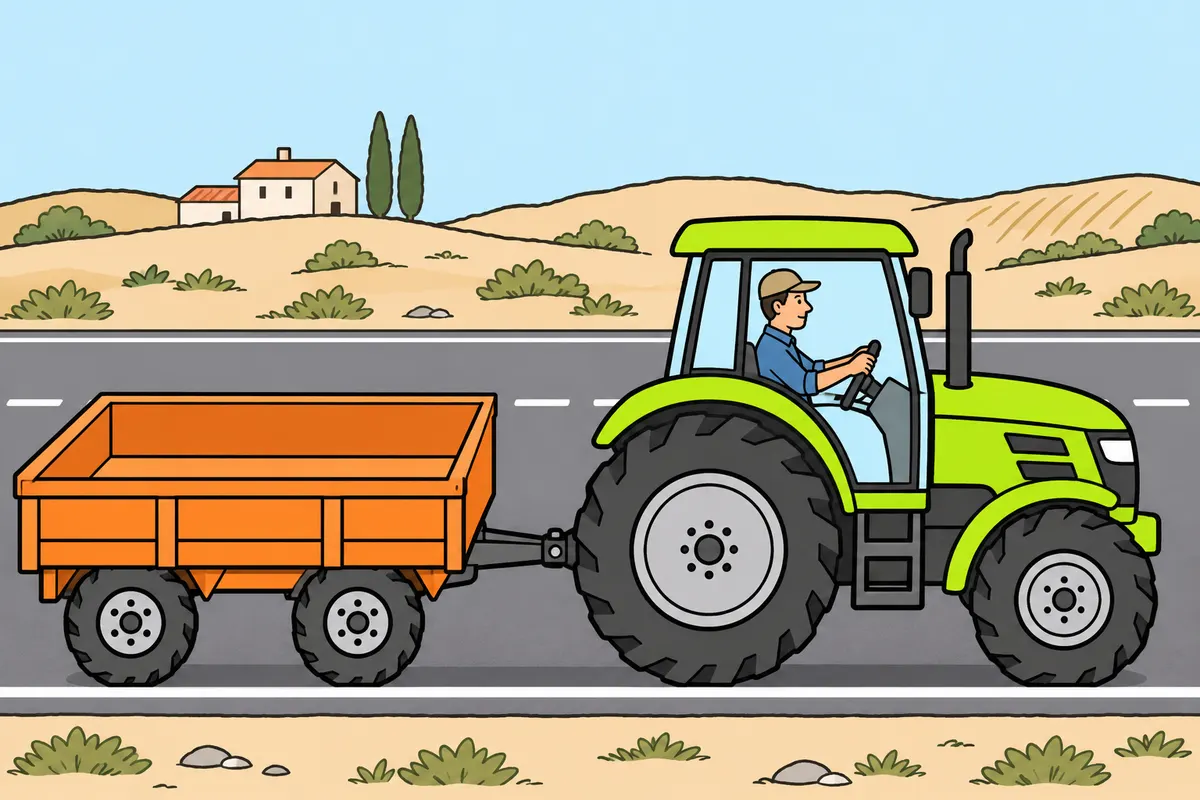
Outside built-up areas, your agricultural vehicle’s maximum speed depends on its features.
| Special vehicle outside built-up areas | General maximum |
|---|---|
| Without brake lights | 25 km/h |
| Towing a trailer | 25 km/h |
| Walking tractor | 25 km/h |
| Other special vehicles | 40 km/h |
Remember
- With a trailer, do not exceed 25 km/h, even when it is empty.
- Brake lights do not remove the trailer speed limit.
- Respect any lower limit for your vehicle or the road section.
- Do not use car speed limits.
Exam trap: Wrong: an empty trailer lets you drive at 40 km/h. Right: keep to 25 km/h.
Read the full explanation
- Outside built-up areas, the maximum is 25 km/h for special vehicles without brake lights, those towing a trailer, and walking tractors. Meeting just one of these conditions is enough. [RGC, art. 48.1.c](https://www.boe.es/buscar/act.php?id=BOE-A-2003-23514#a48)
- If you drive an agricultural tractor with a trailer, you must apply the 25 km/h limit even if the tractor has brake lights and can reach a higher speed. An empty trailer does not remove the limit: the regulatory condition refers to towing it, rather than to it carrying a particular load. [RGC, art. 48.1.c](https://www.boe.es/buscar/act.php?id=BOE-A-2003-23514#a48)
- For all other special vehicles, the general maximum outside built-up areas is 40 km/h. This is the answer you must apply to a tractor without a trailer, with brake lights and within the scope of LVA, subject to any lower limits for the vehicle or road section. [RGC, art. 48.1.c](https://www.boe.es/buscar/act.php?id=BOE-A-2003-23514#a48)
- The rules for special vehicles also cover combinations even if only one of their components is a special vehicle. The classification and configuration in which you drive determine which table applies to your tractor. [RGC, art. 48.1.c](https://www.boe.es/buscar/act.php?id=BOE-A-2003-23514#a48)
3Design speed and driving speed are different concepts
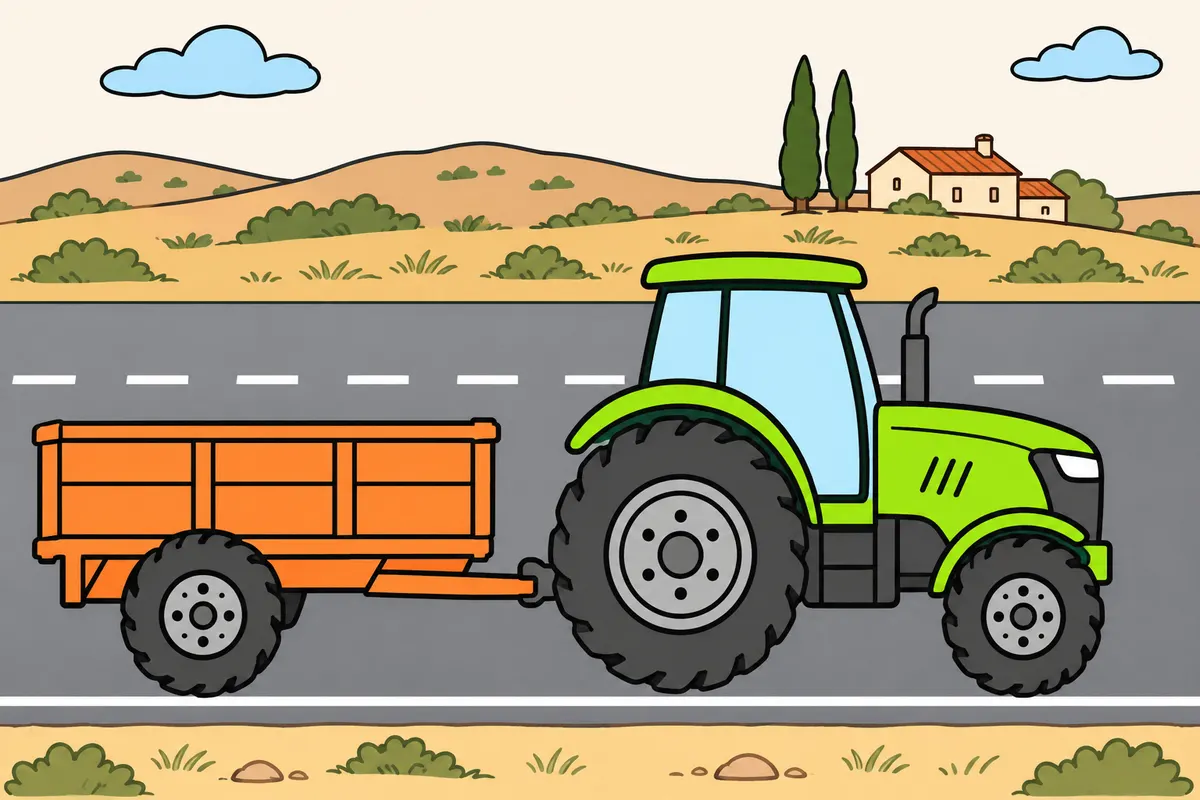
The speed your tractor can reach does not decide how fast you may drive.
| LVA tractor: 45 km/h design speed, with brake lights | General road maximum |
|---|---|
| Without a trailer | 40 km/h |
| With a trailer | 25 km/h |
Remember
- Do not confuse design speed with your driving speed limit.
- Also respect restrictions for your vehicle and its load.
- The 70 km/h exception does not apply to your LVA agricultural vehicle.
Exam trap: Wrong: you may drive at 45 km/h because your tractor can. Right: apply the relevant 25 or 40 km/h maximum.
Read the full explanation
- You must not treat the 45 km/h design speed that defines the scope of LVA as a general maximum driving speed. For the agricultural vehicle you drive, the usual answer for road speed is 25 or 40 km/h, depending on its characteristics. A vehicle capable of reaching a higher speed may be required to travel below it. [RGC, art. 48](https://www.boe.es/buscar/act.php?id=BOE-A-2003-23514#a48) [RGCond, art. 5.9](https://www.boe.es/buscar/act.php?id=BOE-A-2009-9481#a5)
- The 70 km/h exception for certain special vehicles requires them to be capable of exceeding 60 km/h on level ground according to their characteristics and to meet the regulatory conditions. It does not apply to a vehicle you drive with LVA alone, whose scope does not include design speeds above 45 km/h. [RGC, art. 48](https://www.boe.es/buscar/act.php?id=BOE-A-2003-23514#a48)
- For a tractor with a design speed of 45 km/h, without a trailer and with brake lights, the general maximum road speed is 40 km/h. If you attach a trailer, it falls into the 25 km/h category. [RGC, art. 48](https://www.boe.es/buscar/act.php?id=BOE-A-2003-23514#a48)
- You must obey any specific restrictions that apply to the authorised characteristics of your vehicle or its load. [RGC, art. 52](https://www.boe.es/buscar/act.php?id=BOE-A-2003-23514#a52)
4Roads, tracks and unpaved roads
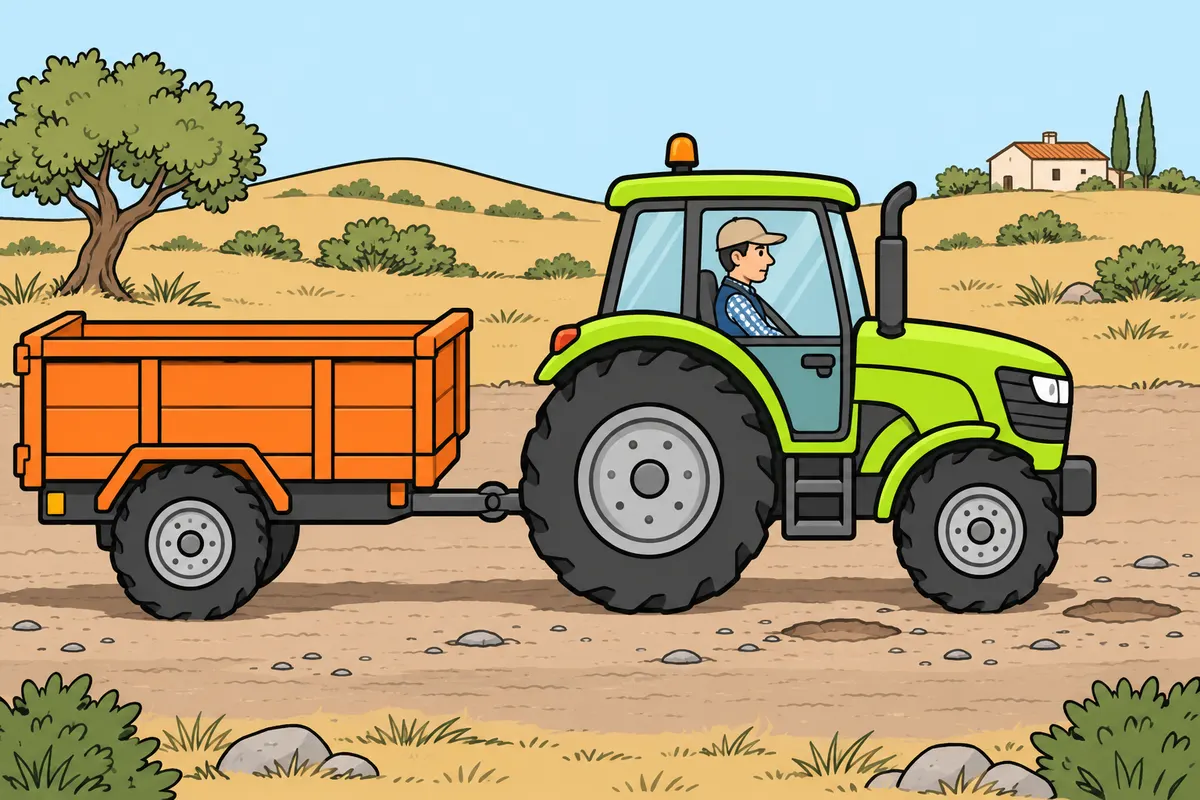
On unpaved roads, combine the road limit with your agricultural vehicle’s limit.
| Agricultural vehicle | Paved conventional road | Unpaved road |
|---|---|---|
| In the 40 km/h category | 40 km/h | 30 km/h |
| Towing a trailer or walking tractor | 25 km/h | 25 km/h |
Remember
- Check whether the track is paved and what signs it has.
- A wide hard shoulder does not raise your agricultural speed limit.
- Slow down further for stones, potholes, dust or mud.
Exam trap: Wrong: you may drive a walking tractor at 30 km/h on unpaved roads. Right: keep its 25 km/h maximum and any lower limit.
Read the full explanation
- On a paved conventional road, you must start from the agricultural maximum of 25 or 40 km/h. The width of the arcén (hard shoulder), the presence of several lanes or physical separation of opposing traffic do not allow you to adopt the maximum speeds for other categories. [RGC, art. 48](https://www.boe.es/buscar/act.php?id=BOE-A-2003-23514#a48)
- On unpaved roads, the maximum is 30 km/h, combined with any applicable lower limit. A tractor in the 40 km/h group is limited to 30 km/h; a tractor with a trailer or a walking tractor remains limited to 25 km/h. [RGC, art. 48](https://www.boe.es/buscar/act.php?id=BOE-A-2003-23514#a48)
- An unpaved road may require a speed well below its maximum because of stones, potholes, dust, mud or loss of grip. With implements or a load, pay particular attention in advance to uneven surfaces that could destabilise the combination. [RGC, art. 48](https://www.boe.es/buscar/act.php?id=BOE-A-2003-23514#a48)
- To answer a question about a track, check whether it is described as paved, whether there is a specific sign and whether you are towing a trailer. Do not decide solely on the word track: the surface and the configuration of the agricultural vehicle can change the applicable figure. [RGC, art. 48](https://www.boe.es/buscar/act.php?id=BOE-A-2003-23514#a48)
5Motorways: access is incompatible with LVA
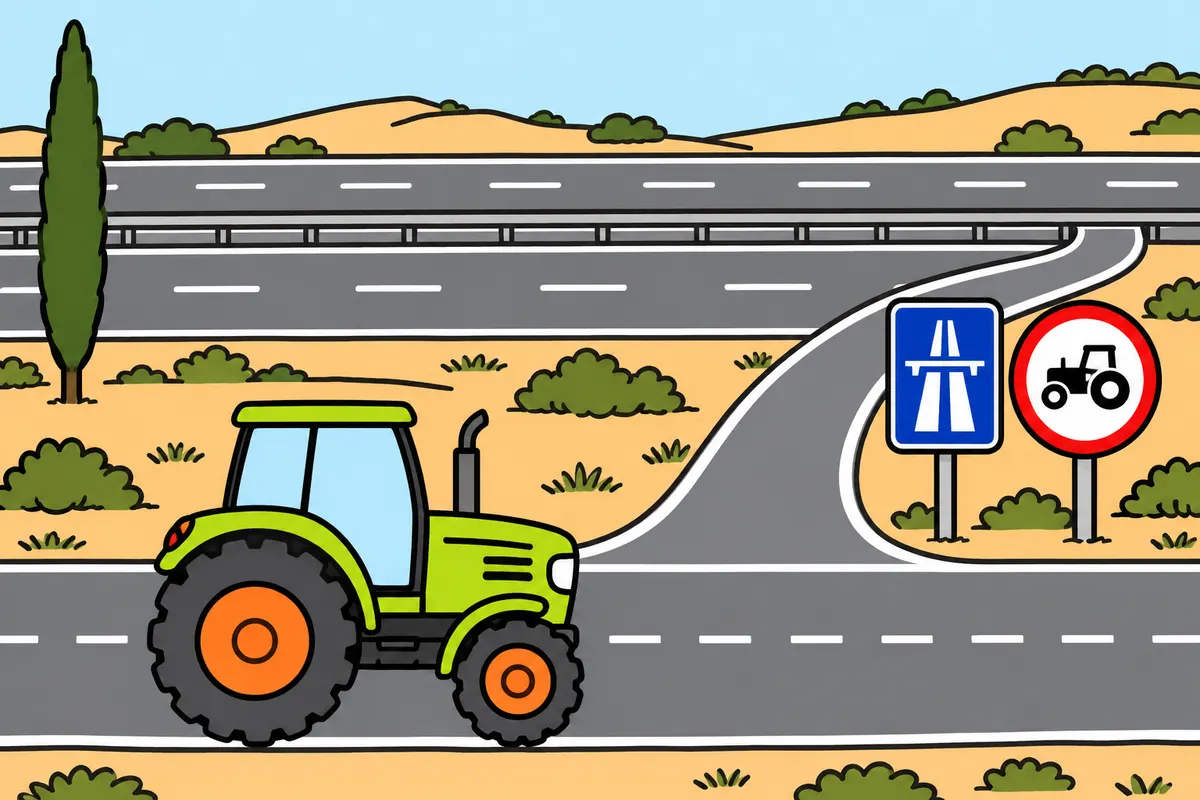
Do not enter autopistas or autovías with your LVA agricultural vehicle.
Remember
- Choose a route allowed for your vehicle and licence.
- The ban also applies within built-up areas.
- A wide hard shoulder does not let you enter.
- A downhill slope does not change your vehicle’s features.
Exam trap: Wrong: you may enter if a slope lets you accelerate. Right: your LVA agricultural vehicle does not meet the access conditions.
Read the full explanation
- You must not enter autopistas (motorways) or autovías (motorways) with an agricultural vehicle within the scope of LVA. For special vehicles within ordinary mass and dimension limits, access requires them to be capable of exceeding 60 km/h on level ground and to meet the regulatory conditions. Your vehicle within the scope of LVA does not meet that speed requirement. [RGC, art. 38](https://www.boe.es/buscar/act.php?id=BOE-A-2003-23514#a38)
- The access requirement refers to the characteristics of the vehicle. You do not meet it because a downhill gradient allows you to accelerate or because there is little traffic at that moment. Nor must you interpret a wide hard shoulder as an available route for your tractor along an autopista or autovía. [RGC, art. 38](https://www.boe.es/buscar/act.php?id=BOE-A-2003-23514#a38)
- The exceptional authorisation arrangements for special vehicles exceeding mass or dimension limits do not constitute general authorisation to drive with LVA. You must plan a route permitted for your vehicle and driving entitlement, rather than apply the general limits for these roads to your tractor. [RGC, art. 38](https://www.boe.es/buscar/act.php?id=BOE-A-2003-23514#a38)
- The effective ban on access for your vehicle also applies to sections of autopista or autovía within built-up areas. The existence of an urban speed limit for these roads does not give you the right to use them. The rules for choosing a route are explained in «Road use with agricultural vehicles». [RGC, art. 38](https://www.boe.es/buscar/act.php?id=BOE-A-2003-23514#a38)
6Urban roads: 20, 30 and 50 km/h
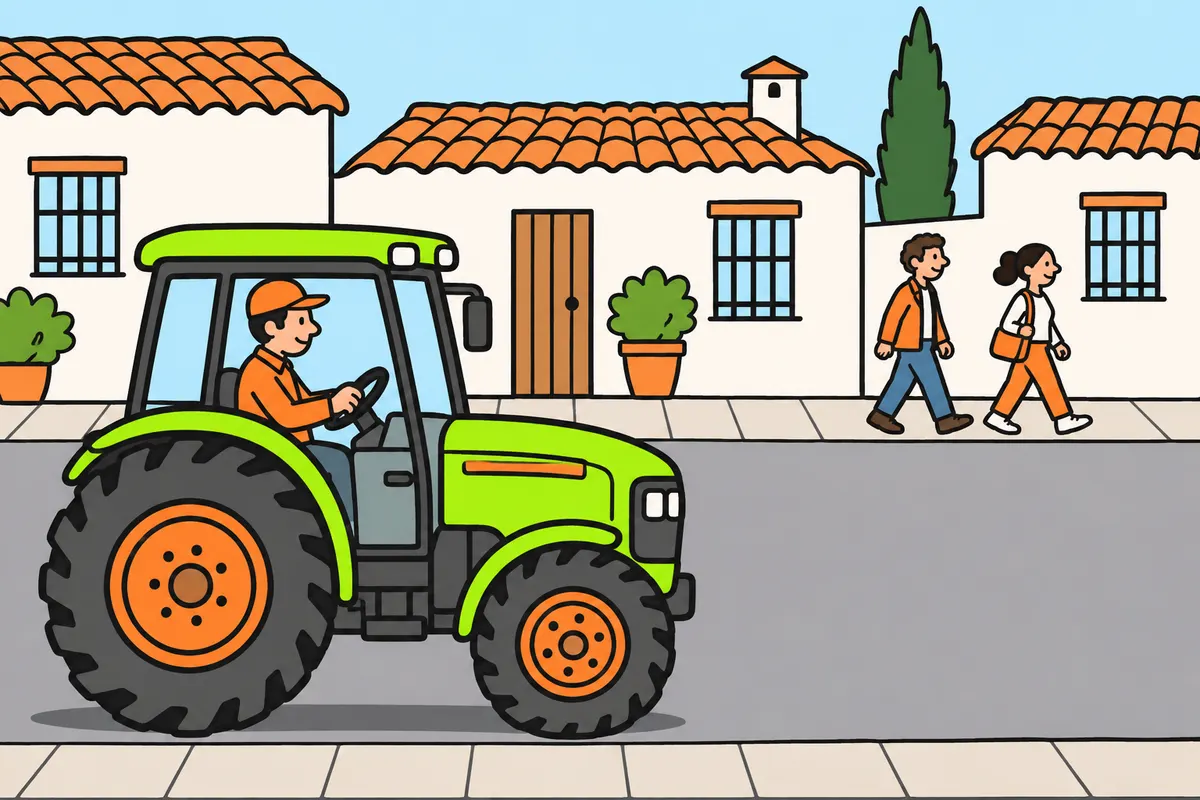
In towns, keep to the lower limit for the street or your agricultural vehicle.
| Urban street | General limit | Agricultural vehicle: 25 km/h category | Agricultural vehicle: 40 km/h category |
|---|---|---|---|
| Carriageway and pavement at the same level | 20 km/h | 20 km/h | 20 km/h |
| One lane in each direction | 30 km/h | 25 km/h | 30 km/h |
| Two or more lanes in each direction | 50 km/h | 25 km/h | 40 km/h |
Remember
- Do not count reserved lanes or lanes only for public transport.
- Respect any lower specific limit.
Exam trap: Wrong: count the bus lane to apply 50 km/h. Right: exclude reserved lanes when deciding the urban limit.
Read the full explanation
- On an urban road where the carriageway and pavement share a single level, the general limit is 20 km/h. You must obey this urban limit whether you drive a tractor on its own or with a trailer. [RGC, art. 50](https://www.boe.es/buscar/act.php?id=BOE-A-2003-23514#a50)
- On an urban road with a single lane in each direction, the general limit is 30 km/h. For your tractor in the 40 km/h group, this is the usual upper limit for the road; if you tow a trailer or belong to the 25 km/h group, you must keep to that lower maximum, which takes precedence because of the vehicle’s characteristics and is shown on its V-4 plate. [RGC, art. 50](https://www.boe.es/buscar/act.php?id=BOE-A-2003-23514#a50), [RGC, art. 52](https://www.boe.es/buscar/act.php?id=BOE-A-2003-23514#a52) and [RGV, Annex XI, V-4](https://www.boe.es/buscar/act.php?id=BOE-A-1999-1826#v-4)
- On an urban road with two or more lanes in each direction, the general limit is 50 km/h. Do not treat this as permission to drive your agricultural vehicle at that speed: you must combine it with its own maximum of 25 or 40 km/h and any applicable specific restrictions. [RGC, art. 50](https://www.boe.es/buscar/act.php?id=BOE-A-2003-23514#a50), [RGC, art. 52](https://www.boe.es/buscar/act.php?id=BOE-A-2003-23514#a52) and [RGV, Annex XI, V-4](https://www.boe.es/buscar/act.php?id=BOE-A-1999-1826#v-4)
- When counting the lanes that determine these limits, you must not include those reserved for certain users or those exclusively for public transport. A street with one general lane and one reserved bus lane in your direction does not become a 50 km/h road on that basis. [RGC, art. 50](https://www.boe.es/buscar/act.php?id=BOE-A-2003-23514#a50)
7Stretches of road through towns and municipal regulation
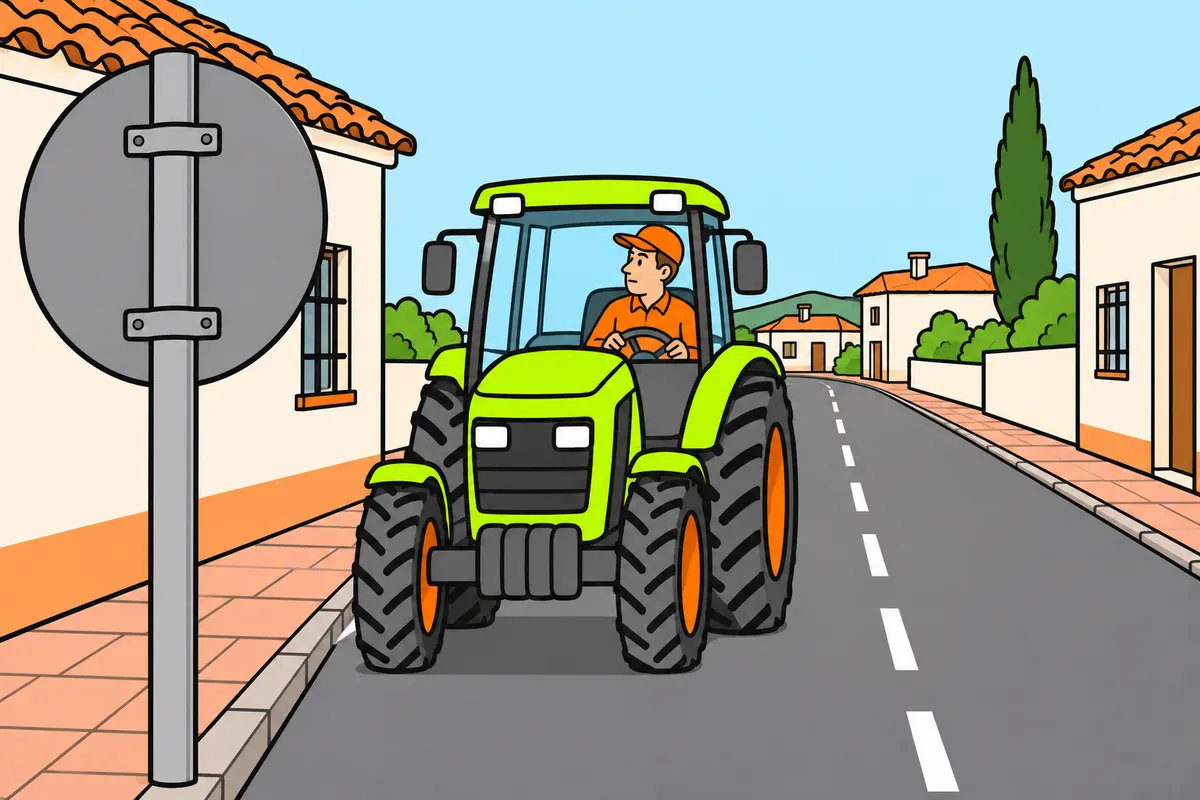
On through roads, keep your agricultural vehicle’s own maximum and obey the signs.
| Agricultural vehicle on a through road | Maximum without lower restrictions |
|---|---|
| In the 25 km/h category | 25 km/h |
| In the 40 km/h category | 40 km/h |
Remember
- Do not automatically treat through roads as urban streets with one lane each way.
- The council may lower urban limits with signs.
- Exceptionally, it may sign 50 km/h on streets with one lane each way.
- Lower through-road limits need council and road authority agreement, plus signs.
Exam trap: Wrong: the through-road limit lets you drive at 50 km/h. Right: keep your agricultural vehicle’s lower maximum.
Read the full explanation
- On a travesía (stretch of road through a town), the generic limit is 50 km/h for all types of vehicles, subject to the limits specific to your agricultural vehicle. You must therefore keep to 25 or 40 km/h where these apply to you, or a lower maximum if one is set. Do not automatically treat every stretch of road through a town as an urban street with one lane in each direction. [RGC, art. 50](https://www.boe.es/buscar/act.php?id=BOE-A-2003-23514#a50), [RGC, art. 52](https://www.boe.es/buscar/act.php?id=BOE-A-2003-23514#a52) and [RGV, Annex XI, V-4](https://www.boe.es/buscar/act.php?id=BOE-A-1999-1826#v-4)
- The municipal authority can lower urban speed limits using specific signs. Exceptionally, it can also raise the limit on an urban road with a single lane in each direction to 50 km/h, again using specific signs. You must read the signs on the stretch of road and continue to comply with the restrictions specific to your vehicle. [RGC, art. 50](https://www.boe.es/buscar/act.php?id=BOE-A-2003-23514#a50)
- The limit on a stretch of road through a town can be lowered by agreement between the municipal authority and the road authority, with specific signs. If you encounter a maximum of 20 km/h, you must comply with it even if your tractor is generally permitted to travel at 40 or 25 km/h. [RGC, art. 50](https://www.boe.es/buscar/act.php?id=BOE-A-2003-23514#a50)
8Signs and restrictions you must combine
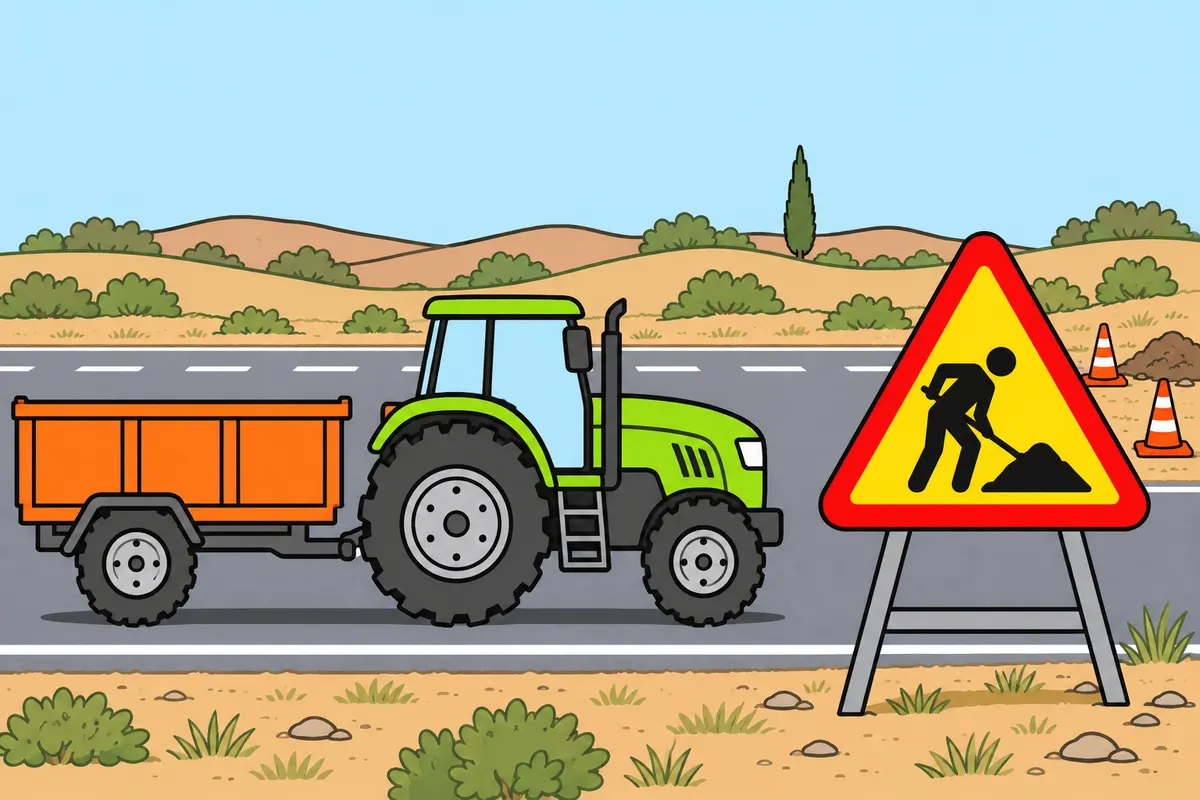
Combine signs with restrictions on your vehicle, load and driving entitlement.
| Tractor towing a trailer | Maximum without other lower restrictions |
|---|---|
| 60 km/h sign | 25 km/h |
| 20 km/h sign | 20 km/h |
Remember
- A sign does not remove a lower limit on your tractor.
- Keep V-4 at the rear, visible at all times.
- It is compulsory for special vehicles and combinations containing any special vehicle.
- V-5 is optional if V-4 is required and design speed cannot exceed 40 km/h.
- Also obey temporary, roadworks and variable signs.
Exam trap: Wrong: a 60 km/h sign lets you exceed your tractor’s maximum. Right: respect the lower applicable limit.
Read the full explanation
- You must observe specific speeds set by signs, personal restrictions on your driving entitlement and restrictions applicable to your vehicle or its load. A road sign does not override a lower limit for your tractor. [RGC, art. 52](https://www.boe.es/buscar/act.php?id=BOE-A-2003-23514#a52)
- If the road is signed at 60 km/h and you drive a tractor with a trailer, you must keep to the 25 km/h limit that applies to you. If it is signed at 20 km/h, you must comply with 20. [RGC, art. 52](https://www.boe.es/buscar/act.php?id=BOE-A-2003-23514#a52)
- You must display the V-4 “Speed limitation” sign at the rear, visible at all times: it is compulsory on special vehicles and combinations of these vehicles, even if only one component is a special vehicle. The V-5 “Slow-moving vehicle” sign is optional on vehicles required to display V-4 and is intended for vehicles whose design prevents them from exceeding 40 km/h. [RGC, art. 52.2](https://www.boe.es/buscar/act.php?id=BOE-A-2003-23514#a52) [RGV, Annex XI, V-4.2.b](https://www.boe.es/buscar/act.php?id=BOE-A-1999-1826#v-4) [RGV, Annex XI, V-5](https://www.boe.es/buscar/act.php?id=BOE-A-1999-1826#v-5)
- Temporary limits can also be imposed using temporary or variable signs. You must take them into account when choosing your speed, for example at roadworks or an incident. [RGC, art. 52](https://www.boe.es/buscar/act.php?id=BOE-A-2003-23514#a52) [RGC, art. 47](https://www.boe.es/buscar/act.php?id=BOE-A-2003-23514#a47)
9Minimum speed and the exception for special vehicles
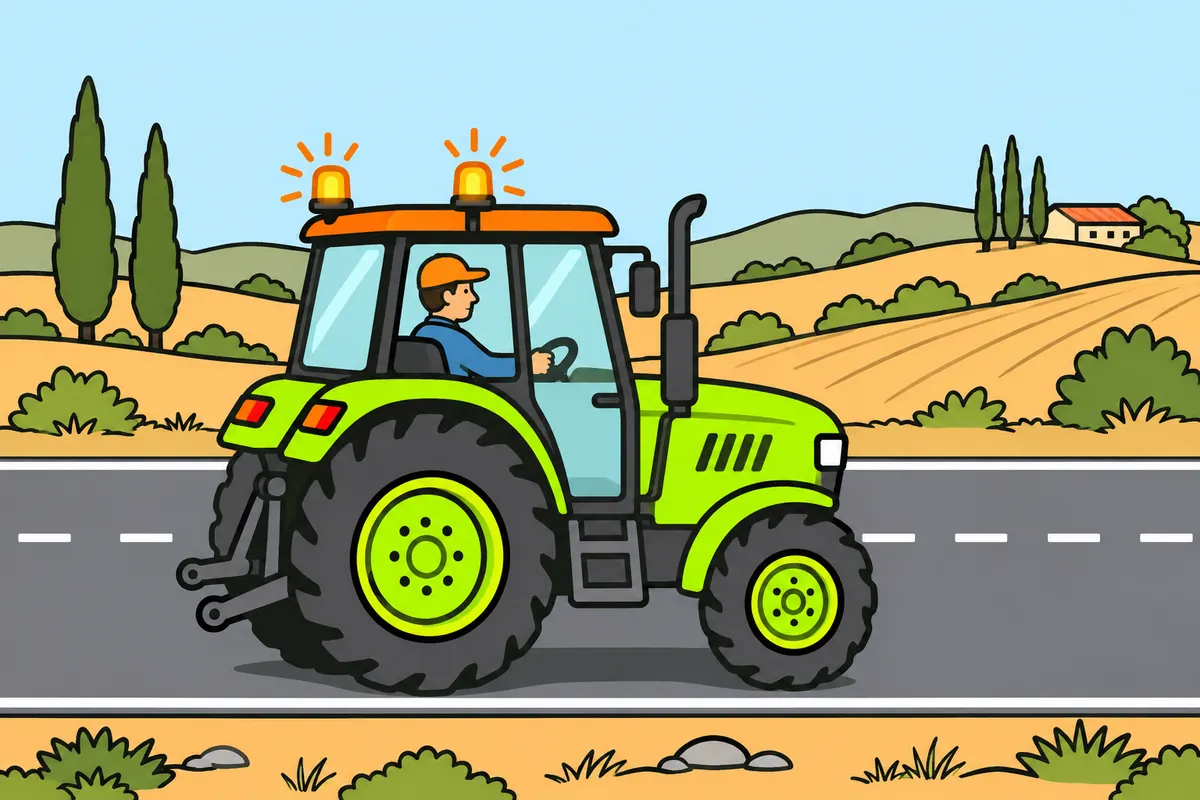
You may drive your special vehicle below the minimum speed.
Remember
- Do not obstruct others by driving too slowly without good reason.
- Outside motorways, the general minimum is half your category’s generic limit for that road.
- Use your category’s generic limit for that road, not any signed figure.
- Special vehicles have an exception to minimum speeds.
- Below the required minimum, use hazard lights if a rear-end collision is possible.
- Hazard lights do not let you enter a prohibited road.
Exam trap: Wrong: your tractor must always maintain half its maximum. Right: special vehicles may travel below minimum speeds.
Read the full explanation
- You must not obstruct the normal progress of another vehicle by driving at an abnormally low speed without justification. The minimum speed rule applies even when there are no other vehicles. [RGC, art. 49](https://www.boe.es/buscar/act.php?id=BOE-A-2003-23514#a49)
- On roads other than autopistas and autovías (motorways), the general reference is half the generic speed limit of your vehicle category on that road. Do not automatically calculate the minimum as half any figure shown on a sign: the rule refers to the applicable generic speed limit. [RGC, art. 49](https://www.boe.es/buscar/act.php?id=BOE-A-2003-23514#a49)
- You may drive your special agricultural vehicle below the minimum speed limits. [RGC, art. 49.2](https://www.boe.es/buscar/act.php?id=BOE-A-2003-23514#a49)
- You may also drive at a lower speed when traffic, your vehicle or the road prevents you from safely maintaining a speed above the minimum. If you cannot reach the required minimum and there is a risk of a rear-end collision, you must use your hazard warning lights while driving. Do not confuse this warning with permission to enter a road where you are prohibited. [RGC, art. 49](https://www.boe.es/buscar/act.php?id=BOE-A-2003-23514#a49)
10Slow down for people and animals
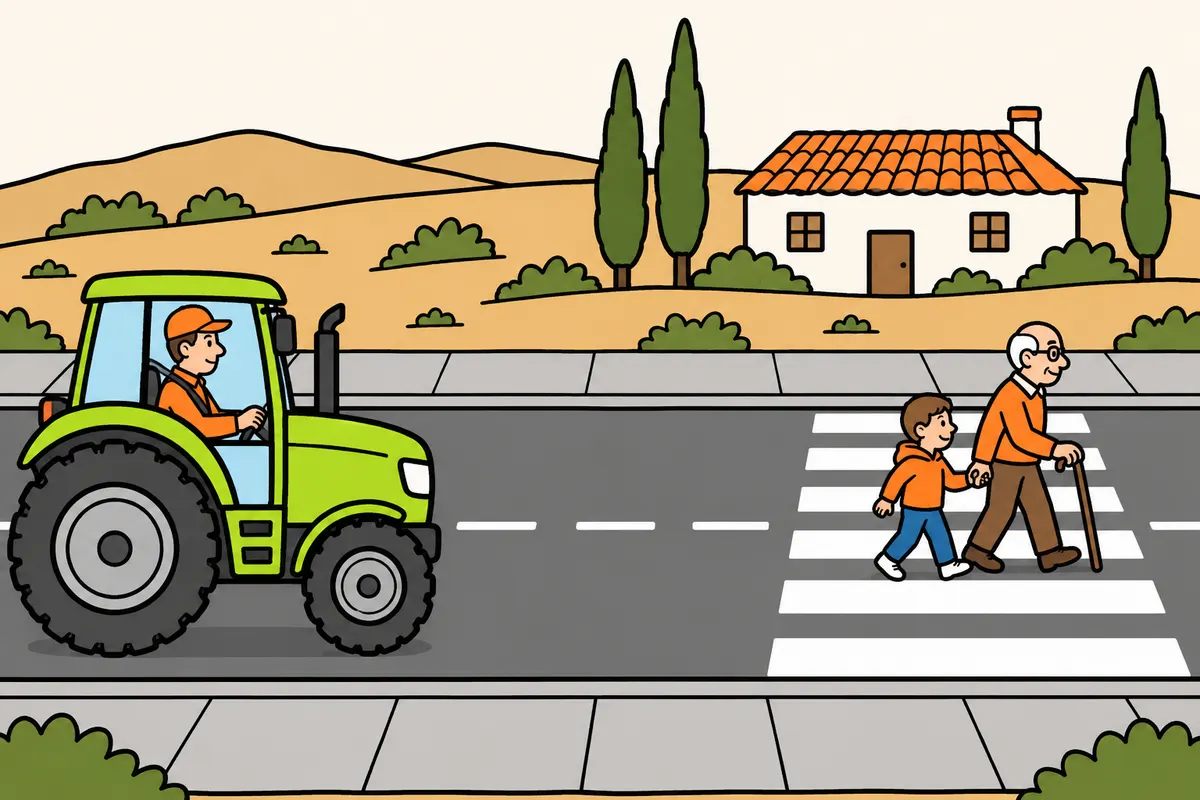
Slow down when people or animals may appear, and stop if necessary.
Remember
- Take special care around children, older people and people with difficulty moving.
- Slow down for pedestrians present or likely to enter your path.
- Slow down near cycles, cycle-route junctions, schools and markets.
- Slow down at pedestrian crossings without traffic lights or officers.
- Slow down for animals, buildings opening directly onto roads and stationary buses.
- Outside built-up areas, slow for vehicles stranded on the carriageway or assisting others.
Exam trap: Wrong: slow down only when a pedestrian is already ahead. Right: also slow down when you can foresee them entering your path.
Read the full explanation
- You must slow down and stop if necessary when pedestrians are in your path or you can reasonably foresee them stepping into it. Pay particular attention to children, older people, blind people and people with reduced mobility. The size of your tractor means you need to anticipate their movements well in advance. [RGC, art. 46](https://www.boe.es/buscar/act.php?id=BOE-A-2003-23514#a46)
- You must slow down when approaching cycles, junctions with cycle-only routes and the areas near these routes, and pedestrian crossings without traffic lights or traffic officers. You must also slow down when approaching markets, educational establishments and places where children may be present. [RGC, art. 46](https://www.boe.es/buscar/act.php?id=BOE-A-2003-23514#a46)
- You must slow down where animals are present or you can foresee them appearing, and on stretches with buildings that open directly onto the road you are using. In an agricultural setting, watch farm entrances and verges with vegetation; knowing the people who work there does not make all their movements predictable. [RGC, art. 46](https://www.boe.es/buscar/act.php?id=BOE-A-2003-23514#a46)
- When approaching a stopped bus, particularly a school bus, you must slow down. Outside built-up areas, you must also slow down for vehicles immobilised on the carriageway, roadside assistance vehicles on duty and cycles on the carriageway or arcén (hard shoulder). [RGC, art. 46](https://www.boe.es/buscar/act.php?id=BOE-A-2003-23514#a46)
11Junctions, narrow sections and visibility
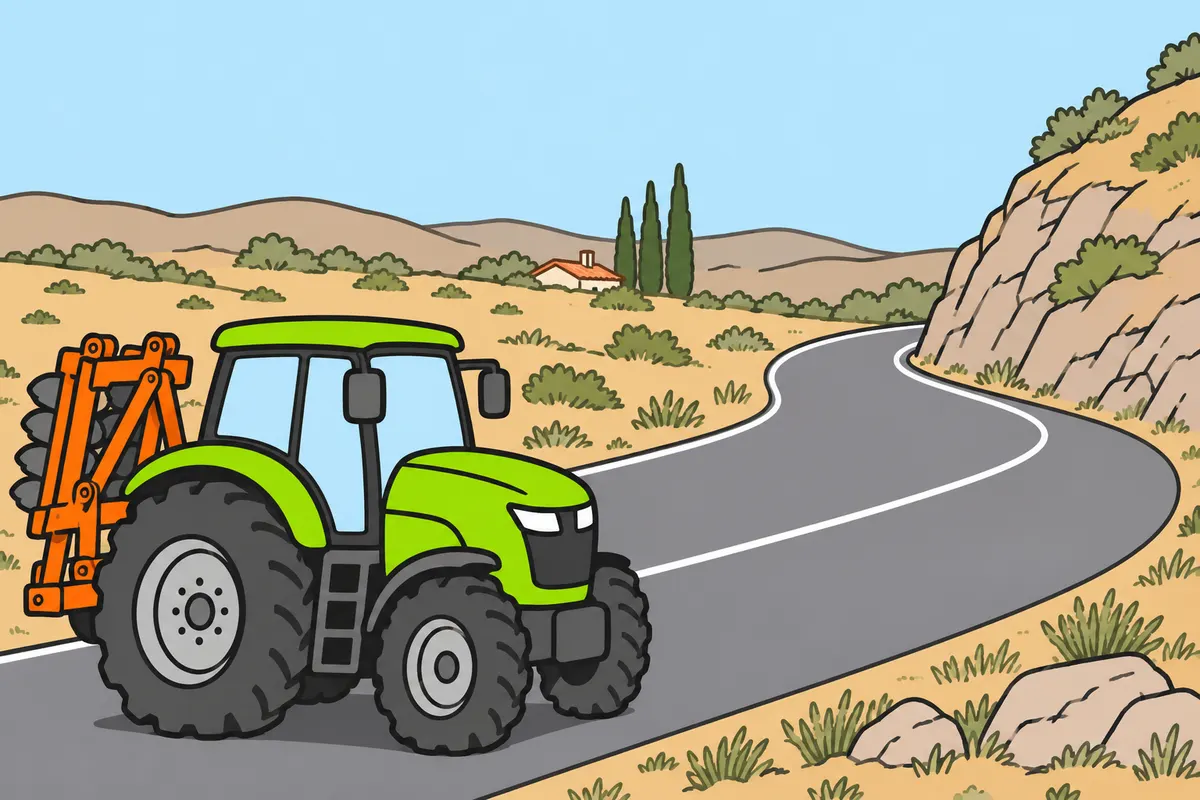
Slow down before junctions, narrow sections and places where you cannot see far.
Remember
- Slow down before roundabouts and junctions where you do not have priority.
- The junction maximum does not raise your agricultural vehicle’s limit.
- Stop if conditions require it.
- Slow when passing oncoming traffic if roads, vehicles or weather make passing difficult.
- Approach level crossings and movable bridges below the permitted maximum.
Exam trap: Wrong: a signed junction with almost no visibility allows 50 km/h. Right: keep your agricultural vehicle’s lower maximum; slow further or stop if necessary.
Read the full explanation
- You must slow down when approaching roundabouts and junctions where you do not have priority, places with restricted visibility and narrow sections. In your agricultural vehicle, you must assess both the space available to pass through and the space you need to stop the combination if another vehicle appears in the narrow section. [RGC, art. 46](https://www.boe.es/buscar/act.php?id=BOE-A-2003-23514#a46)
- At properly signed junctions with virtually no visibility, the rule sets a maximum of 50 km/h. This figure does not raise the 25 or 40 km/h limit for your vehicle or guarantee a safe speed: you must drive more slowly and stop when circumstances require it. [RGC, art. 46.1.h](https://www.boe.es/buscar/act.php?id=BOE-A-2003-23514#a46)
- When passing an oncoming vehicle, you must slow down if the road, the size of the vehicles or the weather makes it difficult to do so safely. If you drive a tractor with implements and meet a large vehicle on a tight bend, you need clearance both to the side and ahead; accelerating to reach the narrow passage first does not resolve the risk. [RGC, art. 46](https://www.boe.es/buscar/act.php?id=BOE-A-2003-23514#a46)
- When approaching level crossings or movable bridges, you must take extra care and reduce your speed below the maximum permitted. You must remain able to stop before the danger area if conditions require it. [RGC, art. 46](https://www.boe.es/buscar/act.php?id=BOE-A-2003-23514#a46) [RGC, art. 95](https://www.boe.es/buscar/act.php?id=BOE-A-2003-23514#a95)
12Rain, mud, ice and spray
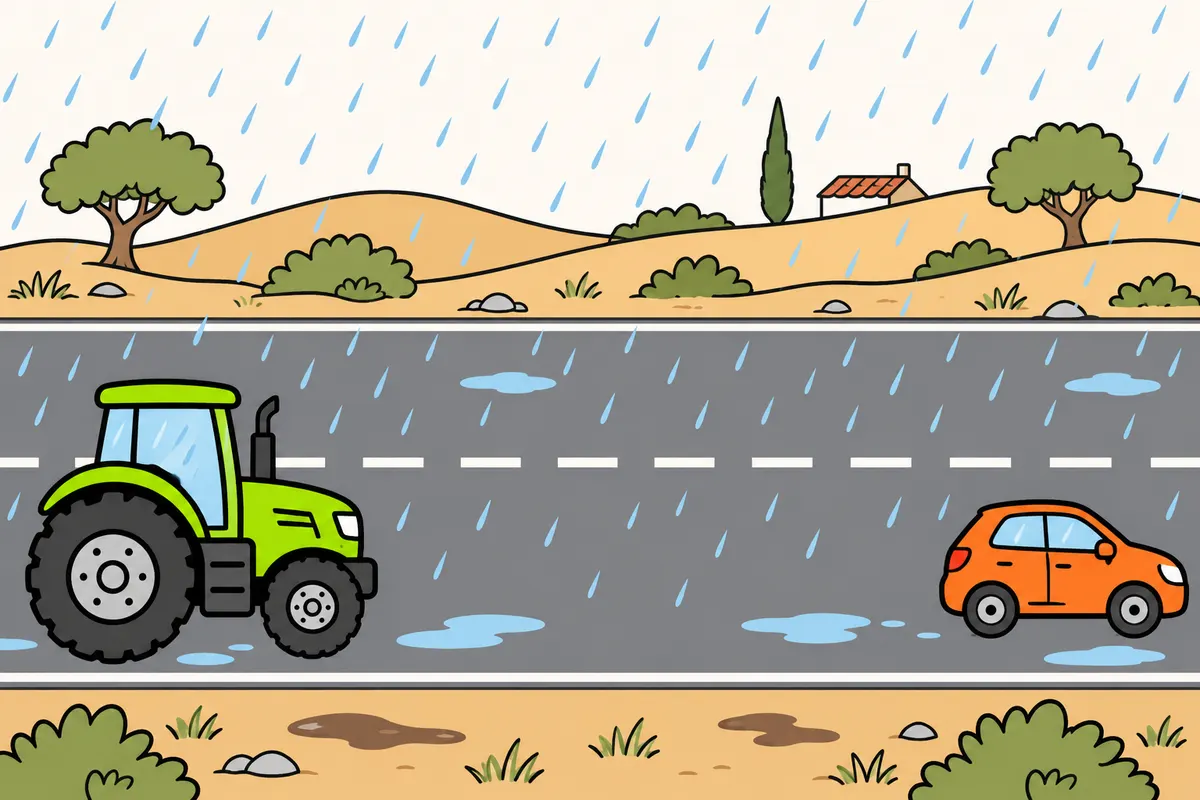
With poor visibility or a slippery surface, slow down and leave more space.
Remember
- Slow down if you could spray water, gravel or other material onto others.
- In dense fog, heavy rain, snow, dust or smoke, slow down; stop if needed.
- Slow down before reaching ice or slippery surfaces.
- Use controls smoothly; avoid sudden braking and turning together.
- In rain, increase your following distance according to available grip.
Exam trap: Wrong: large wheels guarantee good grip on every surface. Right: adapt your speed to the surface.
Read the full explanation
- You must slow down on slippery surfaces and when you could spray water, scatter gravel or throw other material onto others. In your agricultural vehicle, you must pay particular attention to mud and loose material when moving from your work area onto the road. Slowing down in advance helps you retain control of the combination. [RGC, art. 46](https://www.boe.es/buscar/act.php?id=BOE-A-2003-23514#a46)
- In thick fog, heavy rain, snowfall or clouds of dust or smoke, you must slow down and stop if necessary. Poor visibility and loss of grip are different problems that can occur together. You need a speed suited to the distance you can see and enough room to brake. [RGC, art. 46](https://www.boe.es/buscar/act.php?id=BOE-A-2003-23514#a46)
- If there is ice, wet patches or slippery road paint, you must adjust your speed before reaching them and use the controls smoothly. Avoid suddenly demanding both braking and turning from your tyres. Do not assume that your tractor’s large wheels respond in the same way on every surface. [RGC, art. 46](https://www.boe.es/buscar/act.php?id=BOE-A-2003-23514#a46)
- In rain, you must increase your following distance and slow down according to the available grip; there is no single safe speed for all tractors. [RGC, art. 46](https://www.boe.es/buscar/act.php?id=BOE-A-2003-23514#a46) [RGC, art. 54](https://www.boe.es/buscar/act.php?id=BOE-A-2003-23514#a54)
13Bends, descents and wind
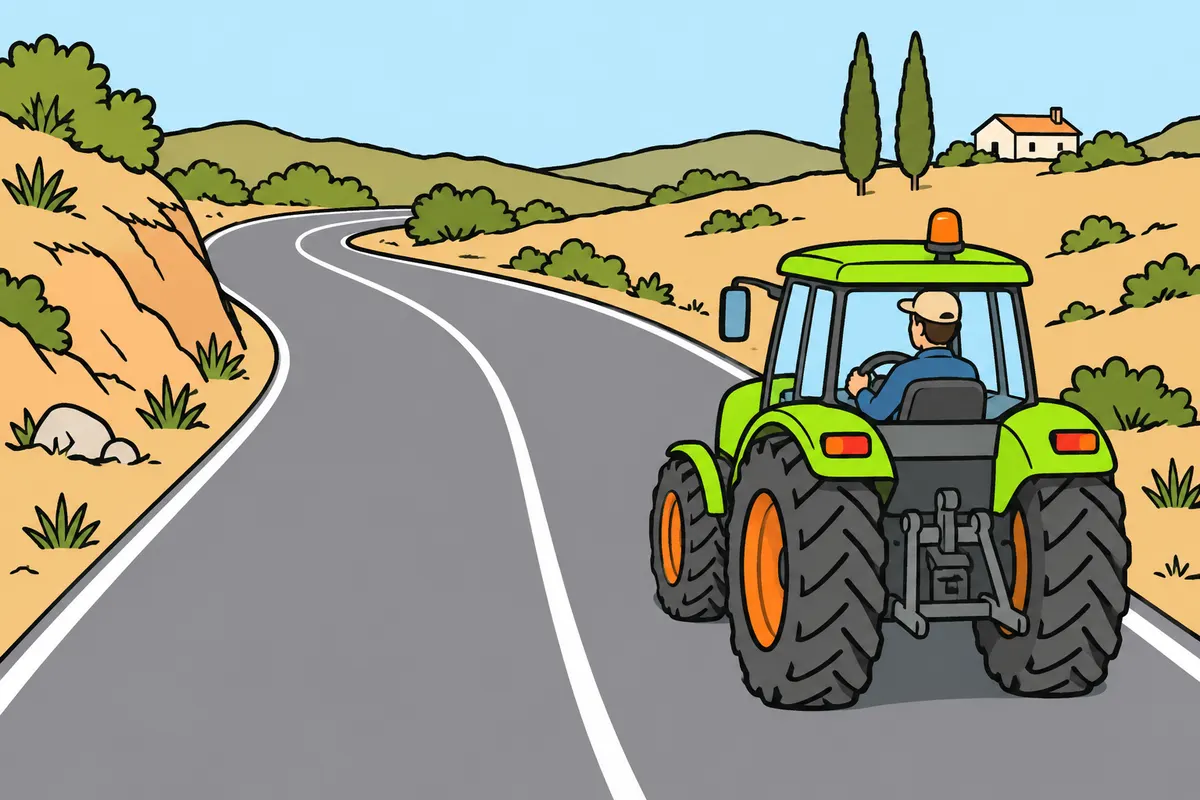
Slow down before bends and use engine braking to control descents.
Remember
- Slow before the bend according to its shape and the surface.
- On long descents, choose a gear that provides engine braking.
- Use the brake when necessary.
- Do not descend in neutral.
- Slow down in crosswinds if they make driving safely difficult.
- Consider your load’s weight and position when braking.
Exam trap: Wrong: descend in neutral to control your speed. Right: use a gear that provides engine braking.
Read the full explanation
- Before a bend, reduce your speed according to its radius and the road surface. Excessive speed can destabilise the tractor and cause you to lose your intended line. [DGT, Risk factors and values](https://www.dgt.es/export/sites/web-DGT/.galleries/downloads/conoce_la_dgt/que-hacemos/educacion-vial/jovenes/factores-riesgo/factores-y-valores-de-riesgo.pdf)
- On a long descent, select a gear that makes use of engine braking and use the service brake when necessary. Avoid going downhill in neutral: you lose engine braking. [DGT, efficient driving](https://www.dgt.es/muevete-con-seguridad/conviertete-en-un-buen-conductor/consejos-generales/conduccion-eficiente/)
- In a crosswind, you must reduce your speed if it makes driving safely difficult. [RGC, art. 45](https://www.boe.es/buscar/act.php?id=BOE-A-2003-23514#a45)
- The mass and positioning of the load affect your braking distance. The requirements for positioning the load are covered in «Loads, implements and agricultural traffic». [DGT, Risk factors and values](https://www.dgt.es/export/sites/web-DGT/.galleries/downloads/conoce_la_dgt/que-hacemos/educacion-vial/jovenes/factores-riesgo/factores-y-valores-de-riesgo.pdf)
14Slow down without causing a rear-end collision
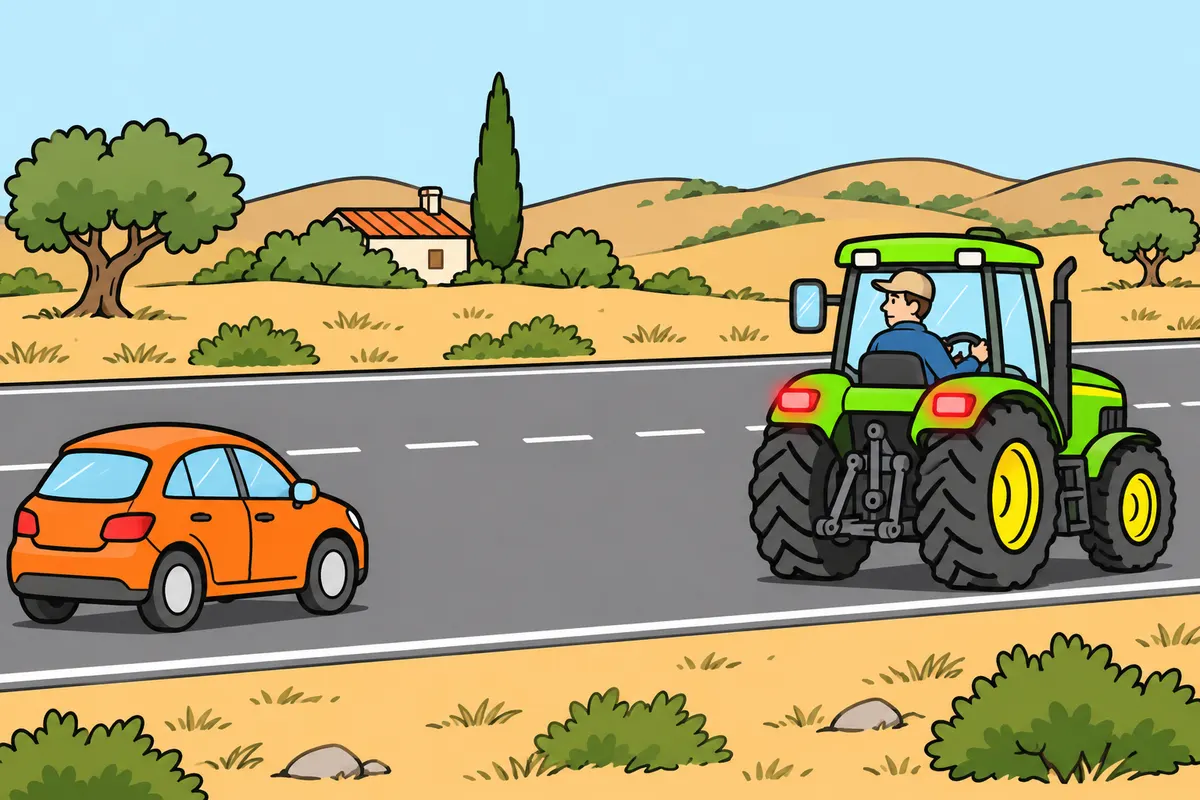
Before slowing considerably, check, warn others and brake without creating danger.
Remember
- Unless danger is imminent, check your mirrors before slowing considerably.
- Give advance warning using the prescribed signals.
- Avoid sudden slowing that could cause a collision.
- In imminent danger, do not delay necessary braking.
- Plan ahead for queues and leaving the road.
Exam trap: Wrong: you must never brake sharply. Right: act to avoid imminent danger; do not delay necessary braking.
Read the full explanation
- Except in imminent danger, before reducing your speed considerably, you must check that you can do so without putting other drivers at risk. Check your mirrors and plan ahead for the reduction in speed. The duty of the driver behind you to keep a safe distance does not allow you to brake unnecessarily harshly. [RGC, art. 53](https://www.boe.es/buscar/act.php?id=BOE-A-2003-23514#a53)
- You must give advance warning of a considerable reduction in speed using the prescribed signals, and slow down without braking so abruptly that you create a collision risk. A signal given when you have practically finished braking leaves little margin for the driver behind your tractor. [RGC, art. 53](https://www.boe.es/buscar/act.php?id=BOE-A-2003-23514#a53)
- In imminent danger, you must act to avoid it. Do not delay necessary braking to keep your driving smooth or save fuel. The exception in the article refers specifically to immediate danger; smooth driving is a preventive guideline, not an obligation to forgo an emergency response. [RGC, art. 53](https://www.boe.es/buscar/act.php?id=BOE-A-2003-23514#a53)
- To leave a road or approach a queue, start creating a margin in good time. If you are towing a trailer, consider how the whole combination responds and the traffic behind you. Manoeuvres and the signals you use for them are covered in «Manoeuvres with agricultural vehicles»; here, the aim is to avoid a sudden, unexpected loss of speed. [RGC, art. 53](https://www.boe.es/buscar/act.php?id=BOE-A-2003-23514#a53)
15Reaction, braking and stopping
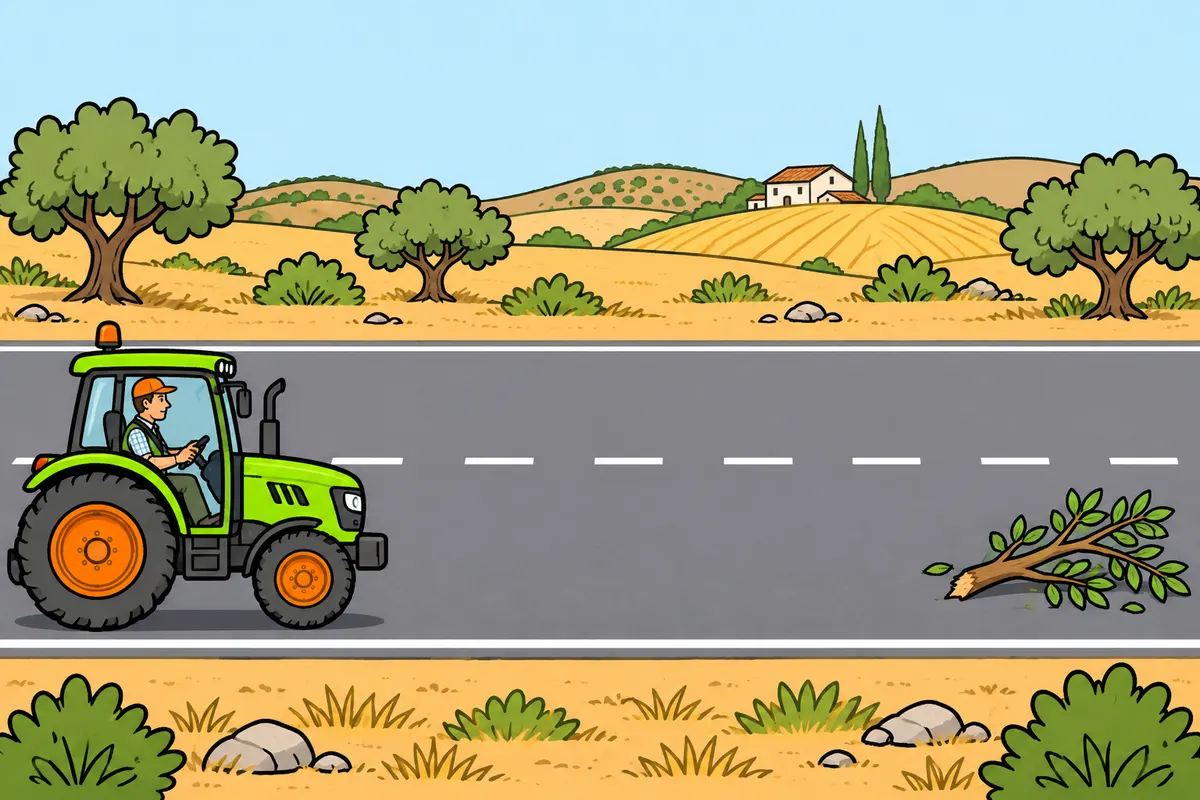
To stop, you need space both to react and to brake.
| Distance | From when you | Until you |
|---|---|---|
| Reaction | Notice the danger | Apply the brake |
| Braking | Apply the brake | Stop |
| Stopping | Notice the danger | Stop |
Remember
- Your stopping distance adds your reaction distance and braking distance.
- Compare the distance you can see with your whole stopping distance.
- Measure time in seconds and distance in metres.
Exam trap: Wrong: count only from pressing the brake. Right: stopping distance starts when you notice the danger.
Read the full explanation
- Your reaction distance is the distance you travel from the moment you perceive a hazard until you apply the brake. Your braking distance runs from that moment until your vehicle comes to a stop. [DGT, Risk factors and values](https://www.dgt.es/export/sites/web-DGT/.galleries/downloads/conoce_la_dgt/que-hacemos/educacion-vial/jovenes/factores-riesgo/factores-y-valores-de-riesgo.pdf)
- Your stopping distance is the sum of your reaction distance and braking distance. If you take time to press the brake after seeing an obstacle, the distance you travel during that time also counts. [DGT, Risk factors and values](https://www.dgt.es/export/sites/web-DGT/.galleries/downloads/conoce_la_dgt/que-hacemos/educacion-vial/jovenes/factores-riesgo/factores-y-valores-de-riesgo.pdf)
- Your reaction time is measured in seconds; your reaction distance is measured in metres. If you are asked for the distance from the moment you perceive a hazard until you stop, answer stopping distance. [DGT, Risk factors and values](https://www.dgt.es/export/sites/web-DGT/.galleries/downloads/conoce_la_dgt/que-hacemos/educacion-vial/jovenes/factores-riesgo/factores-y-valores-de-riesgo.pdf)
- You must compare the distance you can see ahead with your entire stopping distance, including your reaction distance. Counting only your braking distance leaves out part of the space you need to stop. [RGC, art. 45](https://www.boe.es/buscar/act.php?id=BOE-A-2003-23514#a45)
16What changes your reaction distance
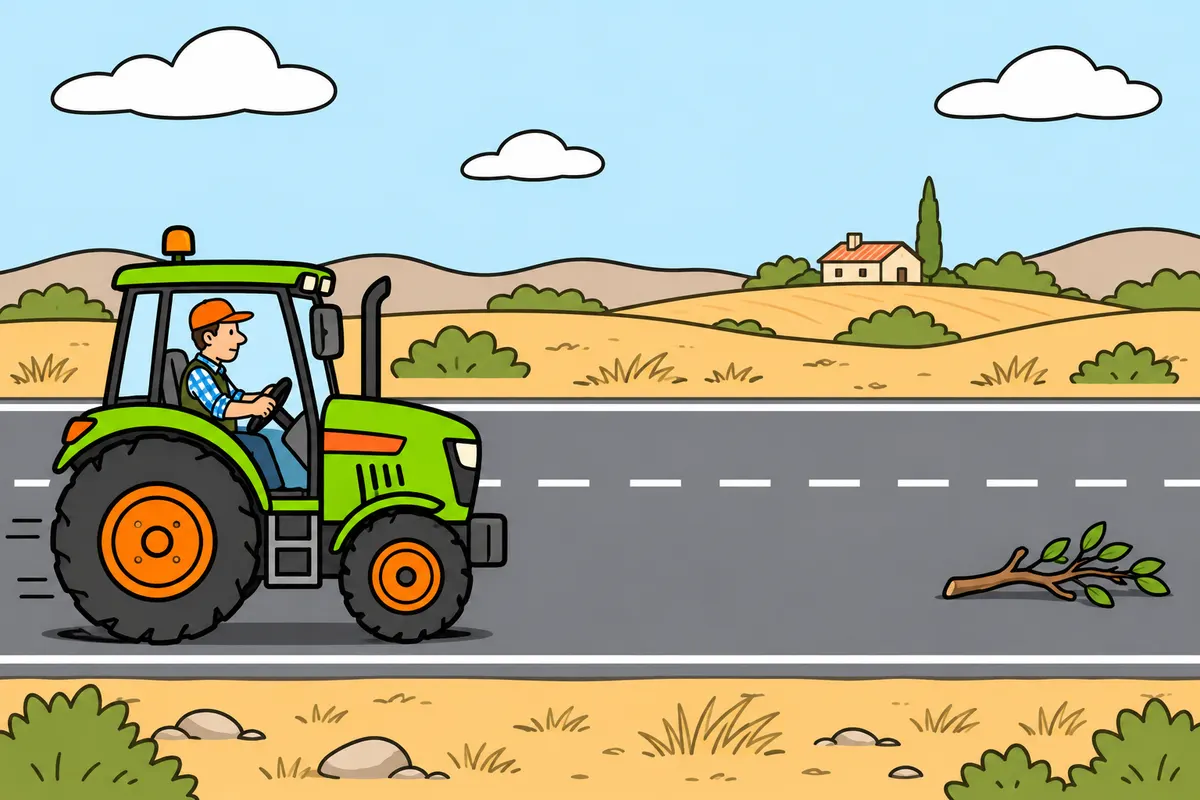
The faster you drive, the further you travel while reacting.
Remember
- With the same reaction time, you travel further at higher speeds.
- Tiredness and distractions can delay your response.
- Your physical and mental condition affects your reaction.
- Good brakes do not remove the distance travelled before using them.
- Do not assume your reaction time is always the same.
Exam trap: Wrong: good brakes remove reaction distance. Right: you travel some distance before applying them.
Read the full explanation
- For the same reaction time, the faster you drive, the more metres you travel before you start braking. [DGT, Risk factors and values](https://www.dgt.es/export/sites/web-DGT/.galleries/downloads/conoce_la_dgt/que-hacemos/educacion-vial/jovenes/factores-riesgo/factores-y-valores-de-riesgo.pdf)
- Tiredness, distractions and your physical or mental condition can delay your response. Your experience with the tractor is no substitute for paying attention. [DGT, Risk factors and values](https://www.dgt.es/export/sites/web-DGT/.galleries/downloads/conoce_la_dgt/que-hacemos/educacion-vial/jovenes/factores-riesgo/factores-y-valores-de-riesgo.pdf)
- An effective brake does not eliminate the metres you travel before applying it. The factors that impair your attention are covered in «Driver condition and fitness». [DGT, Risk factors and values](https://www.dgt.es/export/sites/web-DGT/.galleries/downloads/conoce_la_dgt/que-hacemos/educacion-vial/jovenes/factores-riesgo/factores-y-valores-de-riesgo.pdf)
17What changes your braking distance
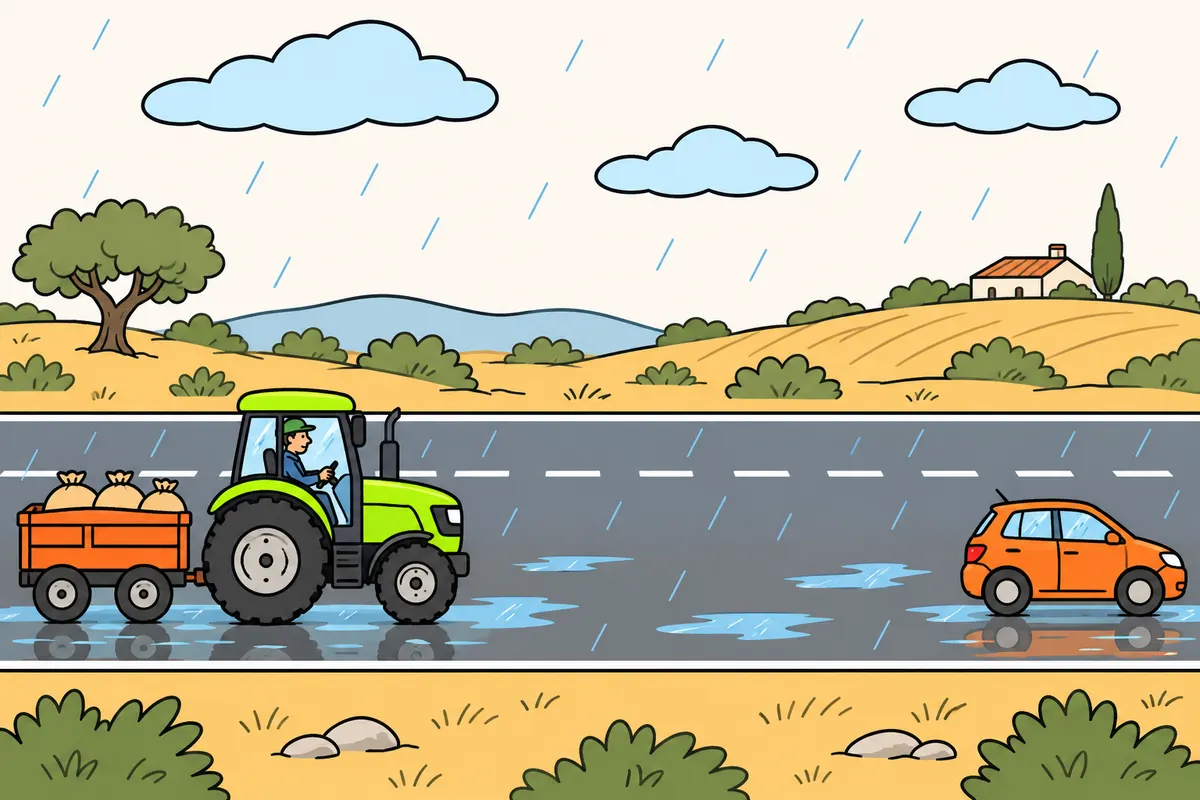
Your speed, load, vehicle and road surface change the space you need to brake.
| Condition | What you must remember |
|---|---|
| Load or trailer | Plan braking according to how the combination responds |
| Wet or slippery surface | You may need more space than when dry |
Remember
- Consider your brakes and tyres.
- With a load or trailer, plan braking according to how the combination responds.
- On wet or slippery surfaces, you may need more space than when dry.
- Increase your following distance before you need the brakes.
Exam trap: Wrong: more weight guarantees a shorter stop. Right: consider the load and how the combination responds.
Read the full explanation
- Your braking distance depends on your speed, mass and load, brakes, tyres and road conditions. You cannot assume the same distance for every tractor. [DGT, Risk factors and values](https://www.dgt.es/export/sites/web-DGT/.galleries/downloads/conoce_la_dgt/que-hacemos/educacion-vial/jovenes/factores-riesgo/factores-y-valores-de-riesgo.pdf)
- When carrying a load or towing a trailer, plan your braking ahead according to how the combination responds. The additional weight does not guarantee a shorter stopping distance. [DGT, Risk factors and values](https://www.dgt.es/export/sites/web-DGT/.galleries/downloads/conoce_la_dgt/que-hacemos/educacion-vial/jovenes/factores-riesgo/factores-y-valores-de-riesgo.pdf)
- On a wet or slippery surface, you may need more space to brake than on a dry surface. Increase your following distance before you need the brakes. [DGT, Risk factors and values](https://www.dgt.es/export/sites/web-DGT/.galleries/downloads/conoce_la_dgt/que-hacemos/educacion-vial/jovenes/factores-riesgo/factores-y-valores-de-riesgo.pdf)
18A safe following distance prevents rear-end collisions
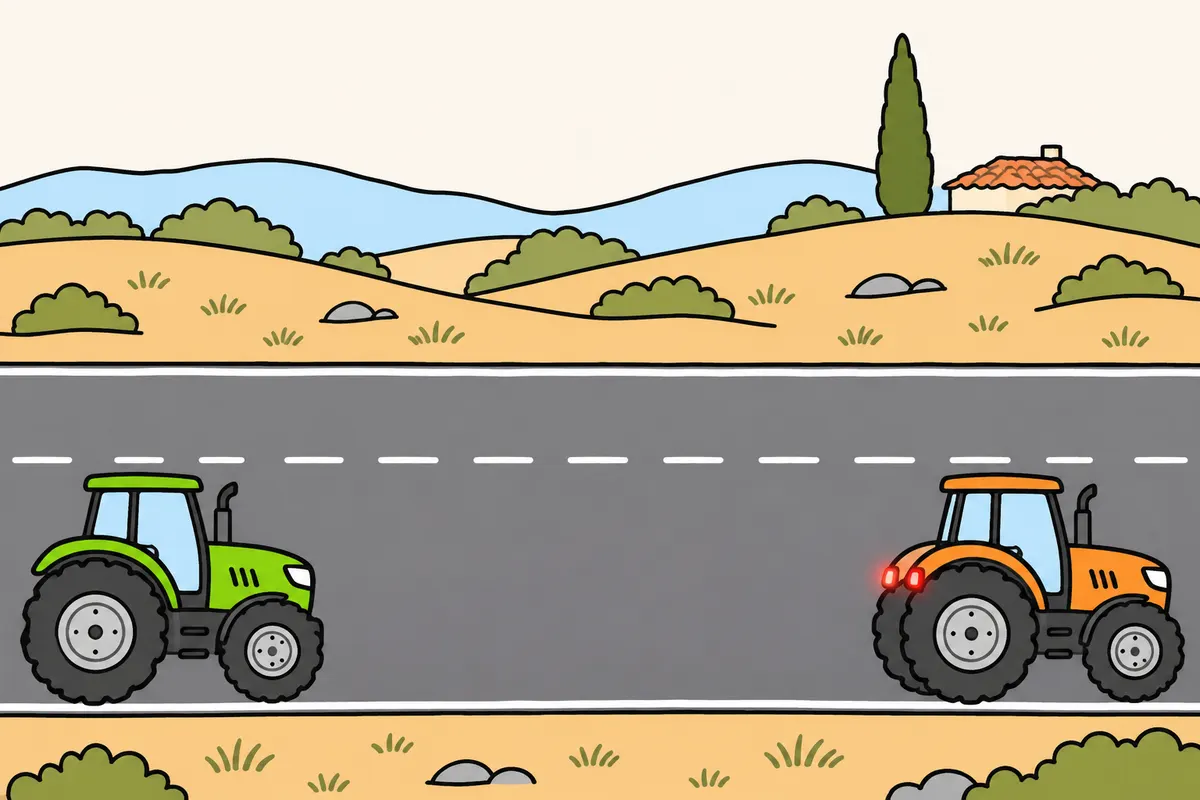
Leave enough space to stop safely if the vehicle ahead brakes suddenly.
Remember
- You need space to notice danger, react and brake.
- Increase the gap when speed rises or visibility worsens.
- Increase it if the road has less grip.
- Adjust it for your load, trailer and braking ability.
- If someone takes up your gap, restore it gradually.
- In towns, leave at least 5 m behind a cyclist in your lane.
Exam trap: Wrong: leaving only your braking distance is enough. Right: also leave space to notice danger and react.
Read the full explanation
- If you drive behind another vehicle, you must leave enough clear space to stop without colliding if it brakes sharply. You must pay particular attention to your speed, grip and braking. [RGC, art. 54](https://www.boe.es/buscar/act.php?id=BOE-A-2003-23514#a54)
- You must increase this margin when your speed rises, visibility worsens or grip decreases. When carrying a load, towing a trailer or experiencing a less effective braking response, you must also adjust it. [RGC, art. 54](https://www.boe.es/buscar/act.php?id=BOE-A-2003-23514#a54)
- Your safe following distance is not the same as your braking distance. It must allow you to detect a change in the vehicle ahead, react and brake without running into it. Seeing its brake lights come on does not eliminate the distance you travel before you start operating the controls. [RGC, art. 54](https://www.boe.es/buscar/act.php?id=BOE-A-2003-23514#a54)
- If another vehicle moves into your safety margin, you must restore it gradually. [RGC, art. 54](https://www.boe.es/buscar/act.php?id=BOE-A-2003-23514#a54)
- In urban areas, if you drive behind a cyclist travelling in the same lane as you, you must leave at least 5 metres of separation. This minimum following distance also applies when you drive your tractor. [RGC, art. 153.4](https://www.boe.es/buscar/act.php?id=BOE-A-2003-23514#a1-6)
19Leave space to make overtaking easier
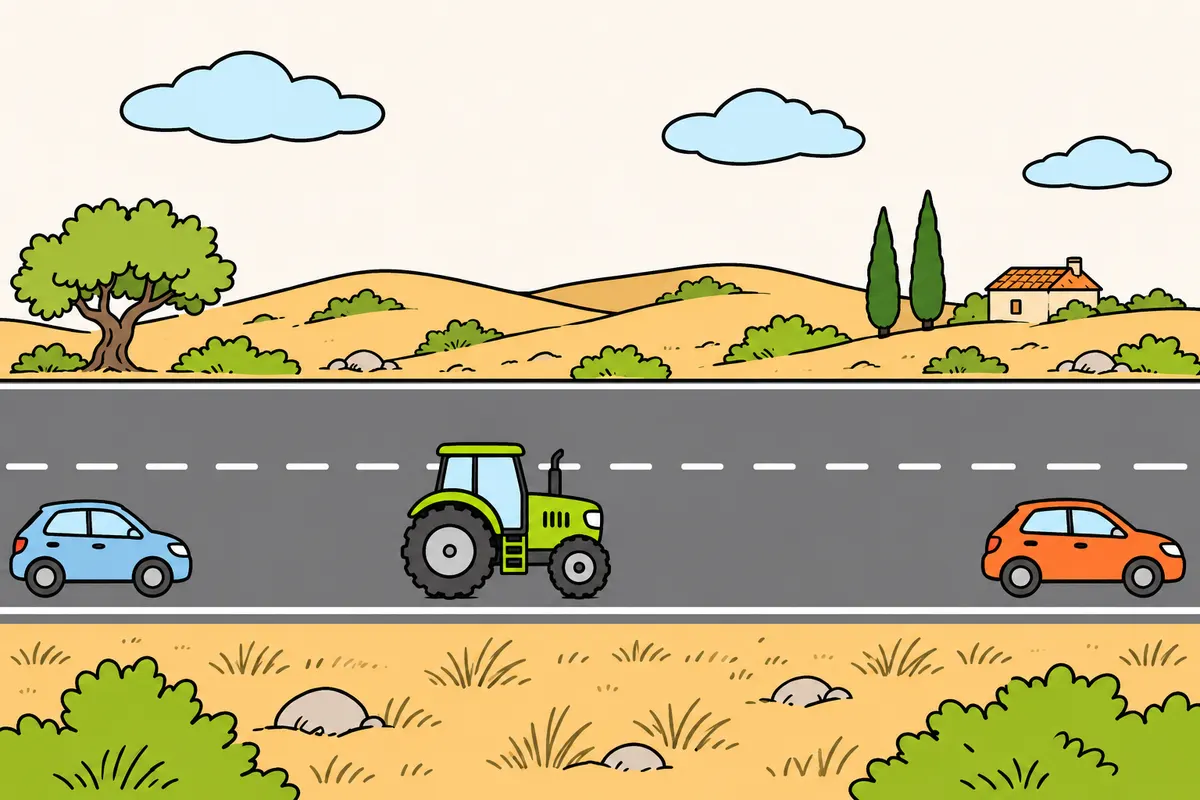
Also leave space for others to overtake you when required.
| Situation | Extra overtaking gap | Gap to prevent rear-end collisions |
|---|---|---|
| Within built-up areas | Not required | Keep it |
| Overtaking prohibited | Not required | Keep it |
| More than one lane in your direction | Not required | Keep it |
| Congestion preventing overtaking | Not required | Keep it |
Remember
- Unless you signal an intention to overtake, leave space to help others overtake.
- Always keep enough space to stop without a collision.
- Heavy traffic does not always mean congestion that prevents overtaking.
Exam trap: Wrong: you may follow closely where overtaking is impossible. Right: only the extra overtaking gap is waived; keep your gap to prevent rear-end collisions.
Read the full explanation
- In addition to leaving a margin to prevent rear-end collisions, if you follow another vehicle without signalling your intention to overtake, you must leave enough space for the driver behind you to overtake you safely. On a road with one lane in each direction, this gap allows them to complete the manoeuvre without having to pass an entire line of vehicles. [RGC, art. 54](https://www.boe.es/buscar/act.php?id=BOE-A-2003-23514#a54)
- This additional duty does not replace the basic duty to leave enough space to stop without a collision. You must meet both requirements whenever they apply. If the gap that allows another driver to return to their lane is insufficient for your own braking, you need to increase it until you also restore that safety margin. [RGC, art. 54](https://www.boe.es/buscar/act.php?id=BOE-A-2003-23514#a54)
- There are four exceptions to this additional separation requirement: in built-up areas, where overtaking is prohibited, where there is more than one lane in your direction, or when traffic is so congested that overtaking is not possible. [RGC, art. 54](https://www.boe.es/buscar/act.php?id=BOE-A-2003-23514#a54)
- What you must do when other vehicles need to overtake you is covered in «Manoeuvres with agricultural vehicles», in the section «When another vehicle overtakes you». [RGC, art. 86.3](https://www.boe.es/buscar/act.php?id=BOE-A-2003-23514#a86)
20When you must leave at least 50 metres
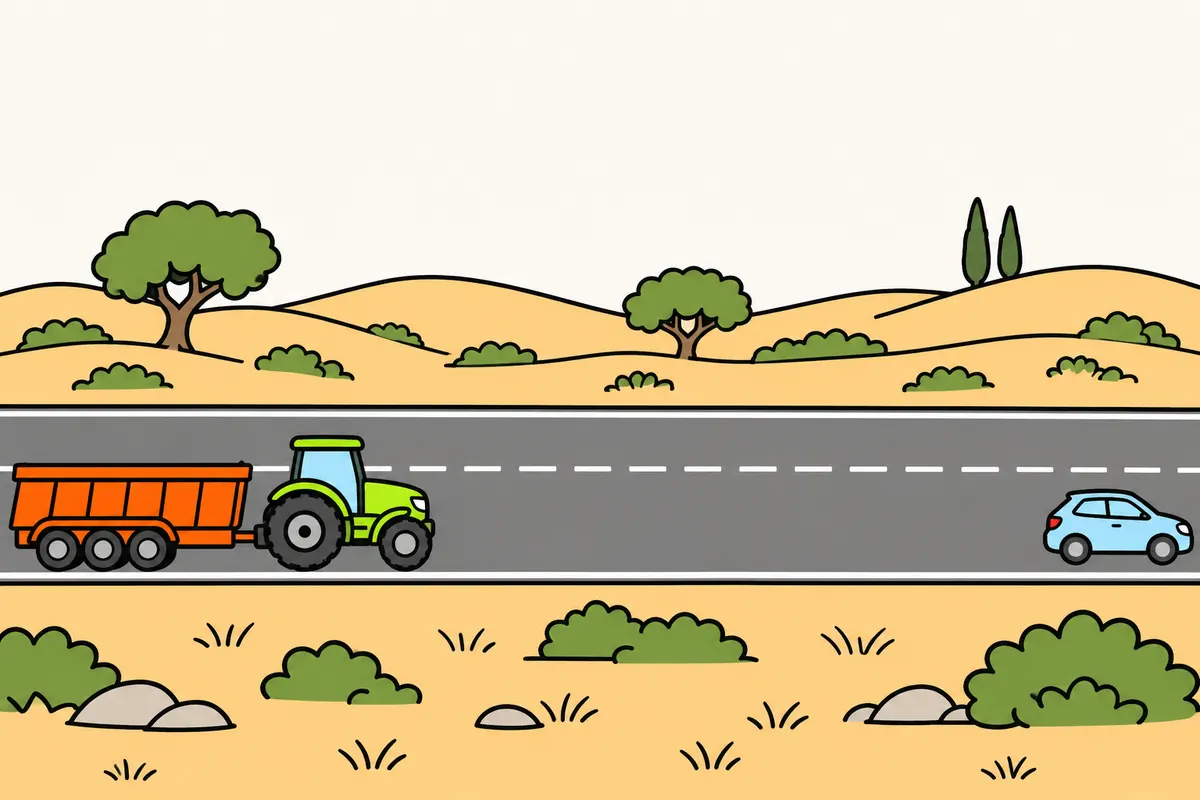
For the overtaking gap, exceeding either the mass or length threshold is enough.
| Agricultural vehicle criterion | Requires at least 50 m when applicable |
|---|---|
| MMA | Above 3,500 kg |
| Overall vehicle or combination length | Above 10 m |
Remember
- Apply this rule when you have not signalled an intention to overtake.
- It is not required within built-up areas or where overtaking is prohibited.
- Nor with several lanes in your direction, or congestion preventing overtaking.
- Use MMA, not the load carried on this journey.
- Measure the whole vehicle or combination’s length.
- Leave more space if necessary to prevent a rear-end collision.
Exam trap: Wrong: you must exceed both thresholds. Right: either is enough; exactly 3,500 kg or 10 m does not exceed that threshold. Apply the stated conditions and exceptions.
Read the full explanation
- To make overtaking easier, you must leave at least 50 metres if your vehicle has an MMA (maximum authorised mass) above 3,500 kg or if your vehicle or combination exceeds 10 metres in total length. Meeting either criterion is enough. Many agricultural combinations may qualify by mass, length or both. [RGC, art. 54](https://www.boe.es/buscar/act.php?id=BOE-A-2003-23514#a54)
- You must use the MMA, rather than the load you carry on that journey or the unladen mass. A vehicle with an MMA above 3,500 kg is not exempt because you drive it unladen. For length, consider the entire combination you are driving, rather than just the length of the tractor. [RGC, art. 54](https://www.boe.es/buscar/act.php?id=BOE-A-2003-23514#a54)
- The thresholds are strict: exactly 3,500 kg is not above 3,500, and exactly 10 metres is not more than 10. Even if you do not meet these criteria, you must maintain the basic following distance and the gap that allows others to overtake you whenever applicable. [RGC, art. 54](https://www.boe.es/buscar/act.php?id=BOE-A-2003-23514#a54)
- You must apply the same conditions and exceptions as for the additional separation requirement: you have not signalled an intention to overtake, and you are outside built-up areas, overtaking is not prohibited, there is only one lane in your direction, and congestion does not prevent overtaking. If grip or speed means you need more than 50 metres to avoid a rear-end collision, you must leave more. [RGC, art. 54](https://www.boe.es/buscar/act.php?id=BOE-A-2003-23514#a54)
21Tunnels: 100 metres or four seconds
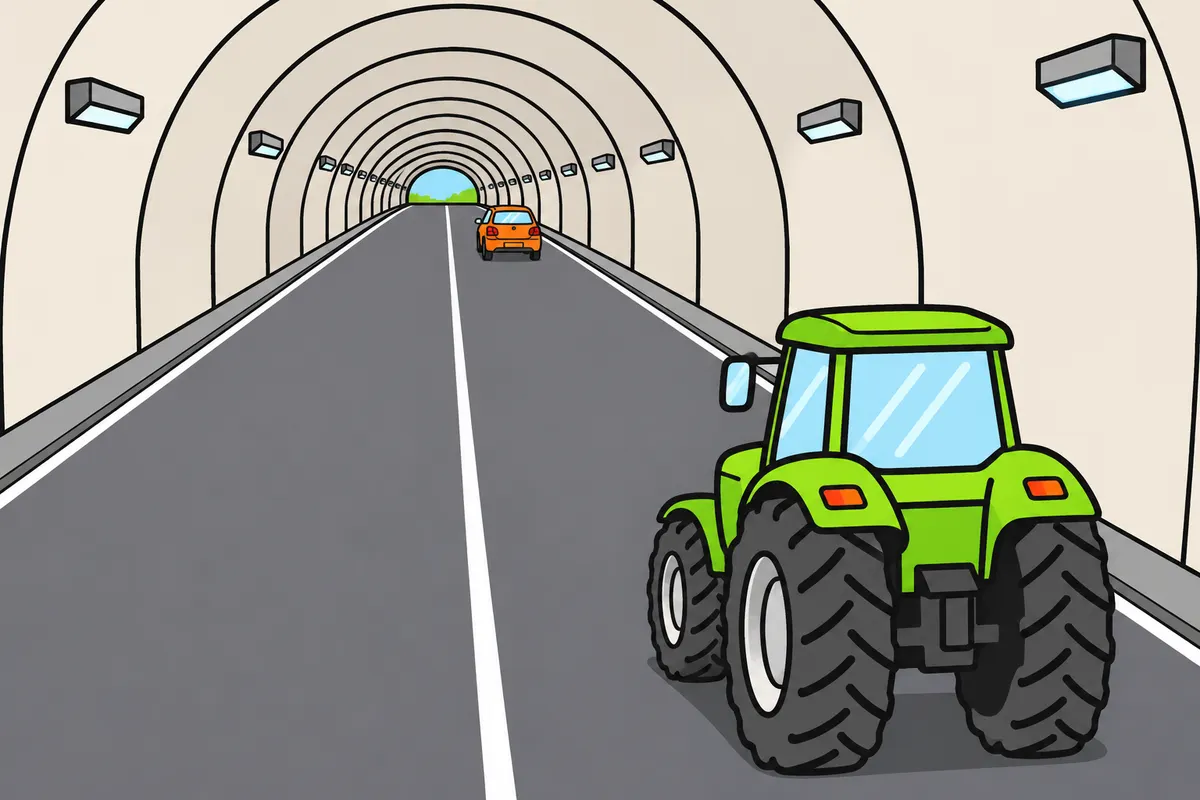
In tunnels and underpasses, keep the specific gap when you do not intend to overtake.
Remember
- Without intending to overtake, leave at least 100 m or four seconds.
- This rule also applies in underpasses.
- It does not depend on the tunnel’s length or darkness.
- Count the time gap using a fixed point along your route.
- If your gap is too small, increase it gradually.
Exam trap: Wrong: four seconds is every driver’s reaction time. Right: here it is a minimum following interval, as an alternative to 100 m.
Read the full explanation
- In tunnels and underpasses, if you do not intend to overtake, you must keep at least 100 metres or a minimum time gap of four seconds behind the vehicle ahead. This specific rule also applies to your agricultural vehicle whenever you are allowed to drive it on that road. Do not confuse it with the 50-metre gap to make overtaking easier. [RGC, art. 95.6](https://www.boe.es/buscar/act.php?id=BOE-A-2003-23514#a95)
- The regulation gives a distance or a time gap as a reference. You must not answer that four seconds is a universal reaction time for all drivers. [RGC, art. 95.6](https://www.boe.es/buscar/act.php?id=BOE-A-2003-23514#a95)
- To check the gap, you can choose a fixed point and count from when the vehicle ahead passes it until you reach it. If the time gap is insufficient, increase the distance gradually. [RGC, art. 95.6](https://www.boe.es/buscar/act.php?id=BOE-A-2003-23514#a95)
- The requirement also applies to underpasses; it does not depend on the tunnel being long or dark. You must also obey its signs and messages. Lighting is covered in «Agricultural lighting and signalling», and lane use in «Road use with agricultural vehicles». [RGC, art. 95.6](https://www.boe.es/buscar/act.php?id=BOE-A-2003-23514#a95)
22Tunnels with agricultural vehicles above 3,500 kg
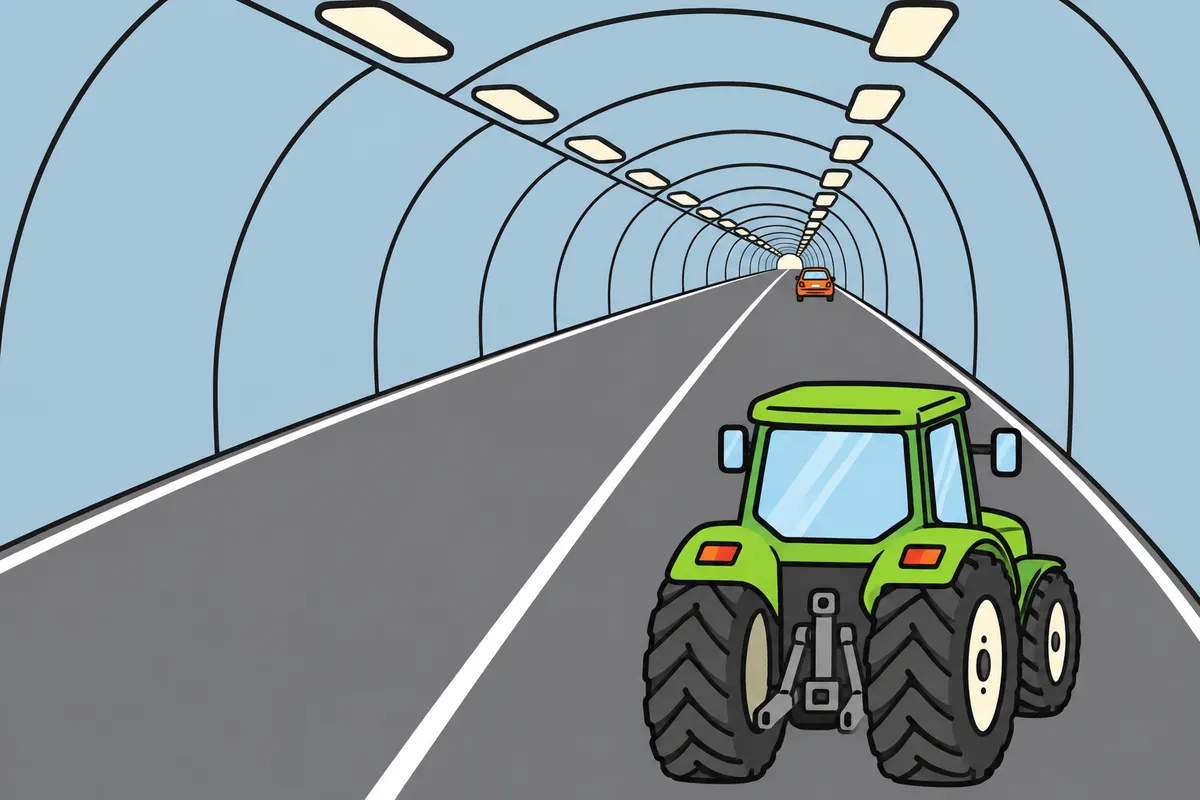
If your agricultural vehicle exceeds the stated MMA, leave more space in tunnels.
| Agricultural vehicle’s MMA; no intention to overtake | Minimum in tunnels and underpasses |
|---|---|
| Above 3,500 kg | 150 m or six seconds |
| Exactly 3,500 kg | 100 m or four seconds |
Remember
- Check MMA in your documents, even when driving unloaded.
- In tunnels and underpasses, apply this gap when you do not intend to overtake.
- Several lanes or an overtaking ban do not remove this distance requirement.
Exam trap: Wrong: use the larger tunnel gap because your vehicle is longer than 10 m. Right: it depends on MMA above 3,500 kg, even when unloaded, and applies when you do not intend to overtake.
Read the full explanation
- If your vehicle’s MMA exceeds 3,500 kg, you must keep at least 150 metres or a minimum time gap of six seconds in tunnels and underpasses when you do not intend to overtake. Use the MMA shown in the vehicle documents to determine whether you exceed the threshold. [RGC, art. 95.6](https://www.boe.es/buscar/act.php?id=BOE-A-2003-23514#a95)
- If you drive a tractor with an MMA of 4,000 kg, this requirement applies even when it is unladen. Exactly 3,500 kg does not exceed the threshold. The total length of your combination is not the criterion that triggers the increased tunnel separation requirement. [RGC, art. 95.6](https://www.boe.es/buscar/act.php?id=BOE-A-2003-23514#a95)
- The increased tunnel separation requirement still applies if there are several lanes in your direction or if overtaking is not possible. These circumstances are among the exceptions to the additional gap required by article 54; they do not remove the specific distance requirements of article 95. [RGC, art. 95.6](https://www.boe.es/buscar/act.php?id=BOE-A-2003-23514#a95)
23Instructions, overtaking and queues in tunnels
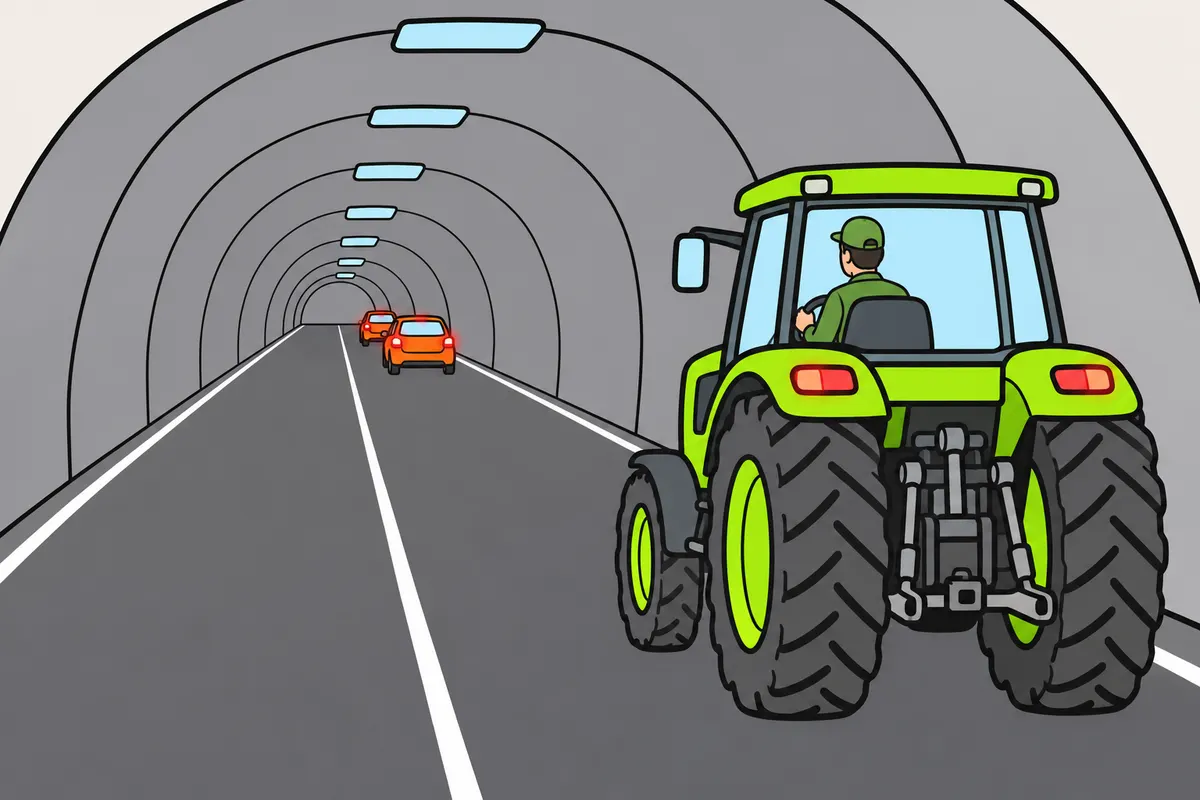
In tunnels, obey instructions and overtake only when allowed.
| Tunnel or underpass | Overtaking |
|---|---|
| Only one lane in your direction | Do not overtake |
| Two-way, with several lanes in your direction | Only if allowed and without entering opposing direction |
Remember
- Obey the tunnel traffic lights, signs and loudspeaker instructions.
- With one lane in your direction, do not overtake.
- In two-way tunnels with several lanes in your direction, overtake only when allowed.
- Never enter the opposing direction to overtake.
Exam trap: Wrong: you may overtake in a two-way tunnel by entering the opposing direction. Right: with one lane in your direction, do not overtake; with several, overtake only when allowed and without entering opposing traffic.
Read the full explanation
- You must obey the tunnel’s traffic lights and variable message signs, and follow any instructions you receive over the public address system or by any other means. [RGC, art. 95.7](https://www.boe.es/buscar/act.php?id=BOE-A-2003-23514#a95)
- You must not overtake in tunnels or underpasses with only one lane in your direction. In two-way tunnels and underpasses with several lanes in your direction, you may overtake without entering the opposite direction when the manoeuvre is permitted. [RGC, art. 87.1](https://www.boe.es/buscar/act.php?id=BOE-A-2003-23514#a87) [RGC, art. 95.6](https://www.boe.es/buscar/act.php?id=BOE-A-2003-23514#a95)
- If queuing traffic brings you to a standstill in a tunnel, the actions you must take are explained in «Accidents and breakdowns: protect and assist», in the section «Breakdown, fire and queuing in a tunnel». [RGC, art. 97.3](https://www.boe.es/buscar/act.php?id=BOE-A-2003-23514#a97)
24Apply speed and distance rules together
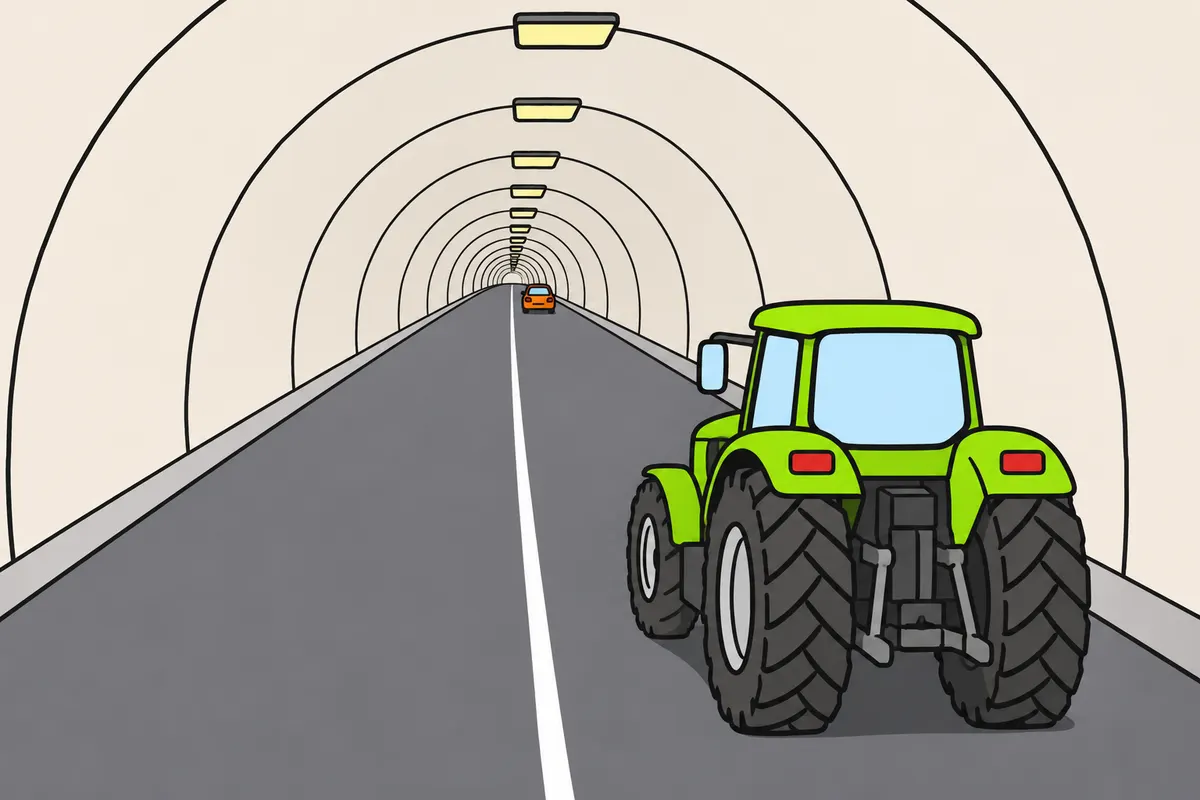
Solve each case by combining the lowest speed limit with the required gap.
| Agricultural vehicle example | What you must apply |
|---|---|
| Trailer on a street with one lane each way | 25 km/h, below the street’s 30 km/h |
| Tractor: MMA 4,000 kg, length 8 metres | 50 m to help overtaking, when applicable |
| That tractor in a tunnel, with no intention to overtake | 150 m or six seconds |
Remember
- With a trailer, keep 25 km/h on streets with one lane each way.
- MMA alone can require more space, even with a short tractor.
- In tunnels, leave the stated gap when you do not intend to overtake.
Exam trap: Wrong: a tractor with MMA 4,000 kg and length 8 metres is excluded because it is short. Right: MMA alone is enough; leave 50 m when applicable, and in tunnels without intending to overtake, 150 m or six seconds.
Read the full explanation
- When towing a trailer on an urban road with one lane in each direction, you must apply a limit of 25 km/h: the limit for your combination is lower than the road’s general limit of 30 km/h. [RGC, art. 48](https://www.boe.es/buscar/act.php?id=BOE-A-2003-23514#a48), [RGC, art. 50](https://www.boe.es/buscar/act.php?id=BOE-A-2003-23514#a50), [RGC, art. 52](https://www.boe.es/buscar/act.php?id=BOE-A-2003-23514#a52) and [RGV, Annex XI, V-4](https://www.boe.es/buscar/act.php?id=BOE-A-1999-1826#v-4)
- If your tractor has an MMA of 4,000 kg and is 8 metres long, you must leave at least 50 metres to make overtaking easier whenever applicable; in tunnels, when you do not intend to overtake, you must leave at least 150 metres or six seconds. The MMA alone is enough for both requirements to apply, even if you do not exceed 10 metres. [RGC, art. 54](https://www.boe.es/buscar/act.php?id=BOE-A-2003-23514#a54) [RGC, art. 95](https://www.boe.es/buscar/act.php?id=BOE-A-2003-23514#a95)
Choose your agricultural vehicle’s speed
Combine the vehicle, road and actual conditions.
- Check whether you are towing a trailer, have no brake lights or are driving a walking tractor: the 25 km/h group applies; for other LVA agricultural vehicles, the 40 group applies.
- Identify the road: paved, unpaved, urban or a stretch of road through a town; exclude autopistas and autovías (motorways) from your LVA route.
- Apply signs and specific restrictions together with the vehicle’s own maximum speed.
- Slow down further if visibility, grip, load, stability or traffic requires it.
- Check that you can stop within the distance you can see and maintain the necessary following distance.
Choose the appropriate following distance
Distinguish between space to prevent rear-end collisions, space for overtaking and distances in tunnels.
- Always leave enough space to stop if the vehicle ahead brakes suddenly.
- Outside tunnels, check whether you need to leave a gap so that others can overtake you.
- If this applies and your MMA (maximum authorised mass) exceeds 3,500 kg or your total length exceeds 10 m, leave at least 50 m; increase this if your safety requires it.
- In tunnels or underpasses, if you do not intend to overtake, leave 100 m or four seconds.
- If your MMA exceeds 3,500 kg, leave 150 m or six seconds in the tunnel.
- Gradually restore the gap if another vehicle moves into it.
Anticipate a reduction in speed
Avoid surprising the driver behind you.
- Identify the bend, queue, narrow section or loss of visibility in good time.
- Observe the traffic behind you and check that you can slow down safely.
- Warn others of a substantial reduction in speed using the prescribed signals.
- Slow down gradually and maintain control of the combination.
- If danger is imminent, act immediately to avoid it.
Finished this module?
Mark it as read and you will see your progress on the theory list.