
Theory · LVA Licence - Agricultural Vehicle · Module 8 of 16
Priority of passage
You learn to decide who goes first at junctions, roundabouts, narrow sections and level crossings, and to respect pedestrians, cyclists and emergency vehicles. You practise the cases that change the answer in the LVA test, especially the difference between a tractor on its own and a combination with a trailer, and priority on gradients.
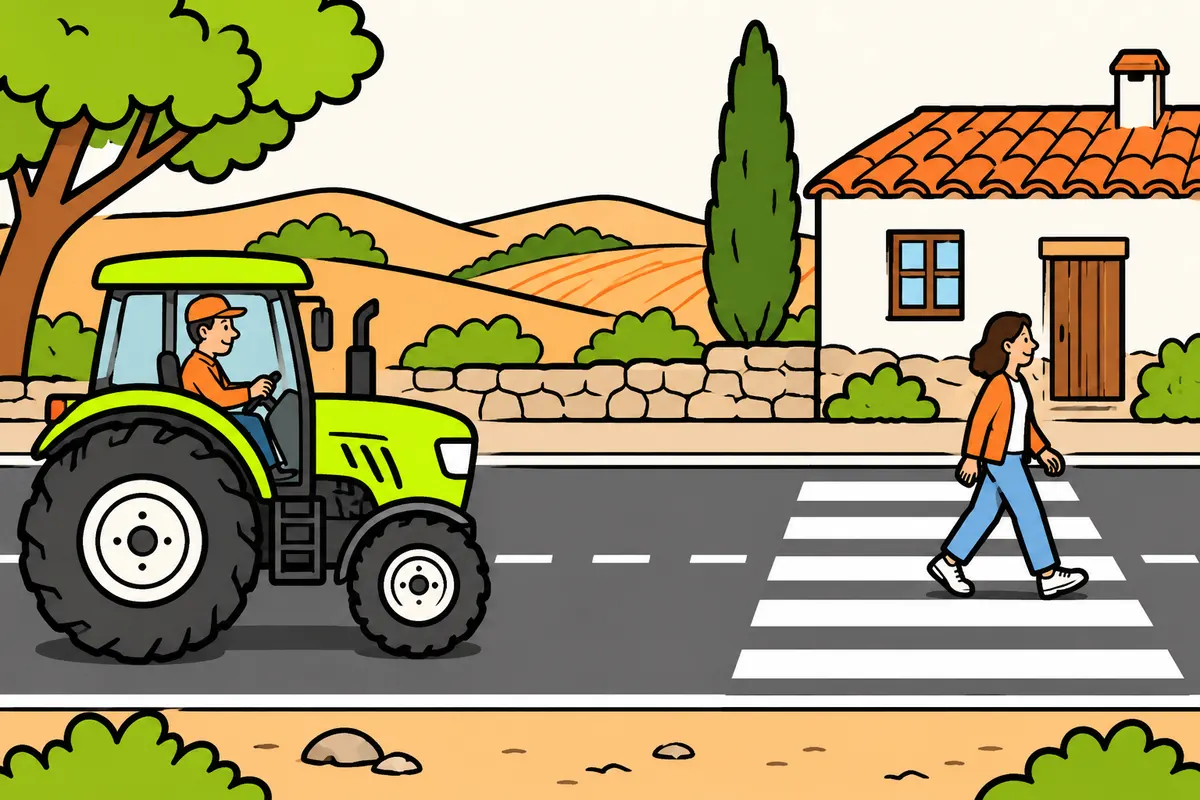
1Give way clearly
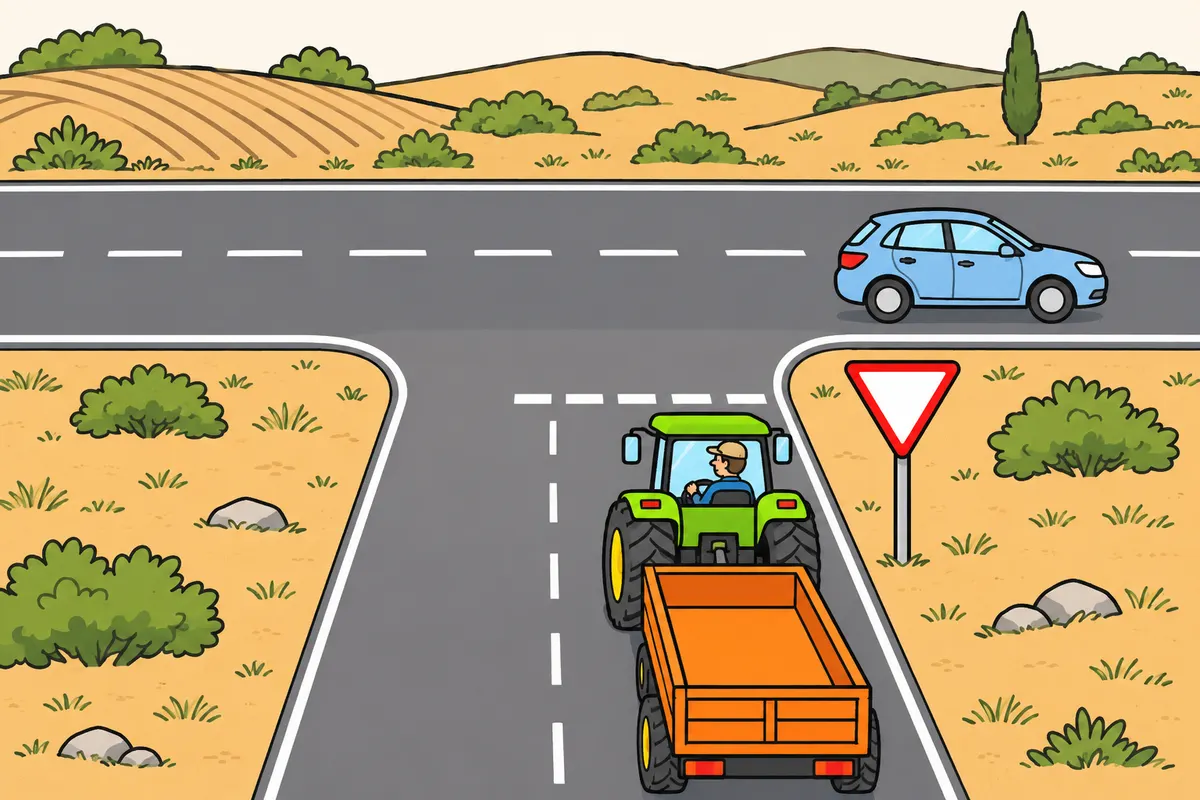
Give way without forcing anyone with priority to change speed or direction suddenly.
Remember
- Slow down early to show you will give way.
- Do not force anyone with priority to brake or swerve suddenly.
- Allow space for your trailer and implements.
- Wait if you cannot check that you can pass safely.
Exam trap: Wrong: giving way always means stopping. Right: you may continue if stopping is not compulsory and you let others pass safely.
Read the full explanation
- You must establish who has priority before entering the area where paths cross. Giving way means you must not start, continue or resume moving if this forces anyone with priority to change speed or direction abruptly; merely avoiding a collision by a few centimetres is not enough. [RGC, art. 58](https://www.boe.es/buscar/act.php?id=BOE-A-2003-23514#a58).
- You must show in advance through your driving that you intend to give way, especially by reducing your speed progressively. With a tractor and trailer, start making your decision early: approaching too quickly may make the other driver doubt whether you really intend to let them pass. [RGC, art. 58](https://www.boe.es/buscar/act.php?id=BOE-A-2003-23514#a58).
- You can give way without stopping if the traffic controls do not require a stop and there is enough space for the other road user to pass safely. If you cannot confirm this, you must wait. The distinction from a compulsory stop is applied in «Give way and STOP». [RGC, art. 58](https://www.boe.es/buscar/act.php?id=BOE-A-2003-23514#a58).
- Before proceeding, you must take account of your entire vehicle or combination, including the trailer and implements. In practice, a gap that allows a short vehicle to enter may be too small for you to clear the junction with an agricultural combination; avoid forcing the vehicle with priority to brake because the rear of your combination is still in its path. [RGC, art. 58](https://www.boe.es/buscar/act.php?id=BOE-A-2003-23514#a58).
2Which instruction takes precedence
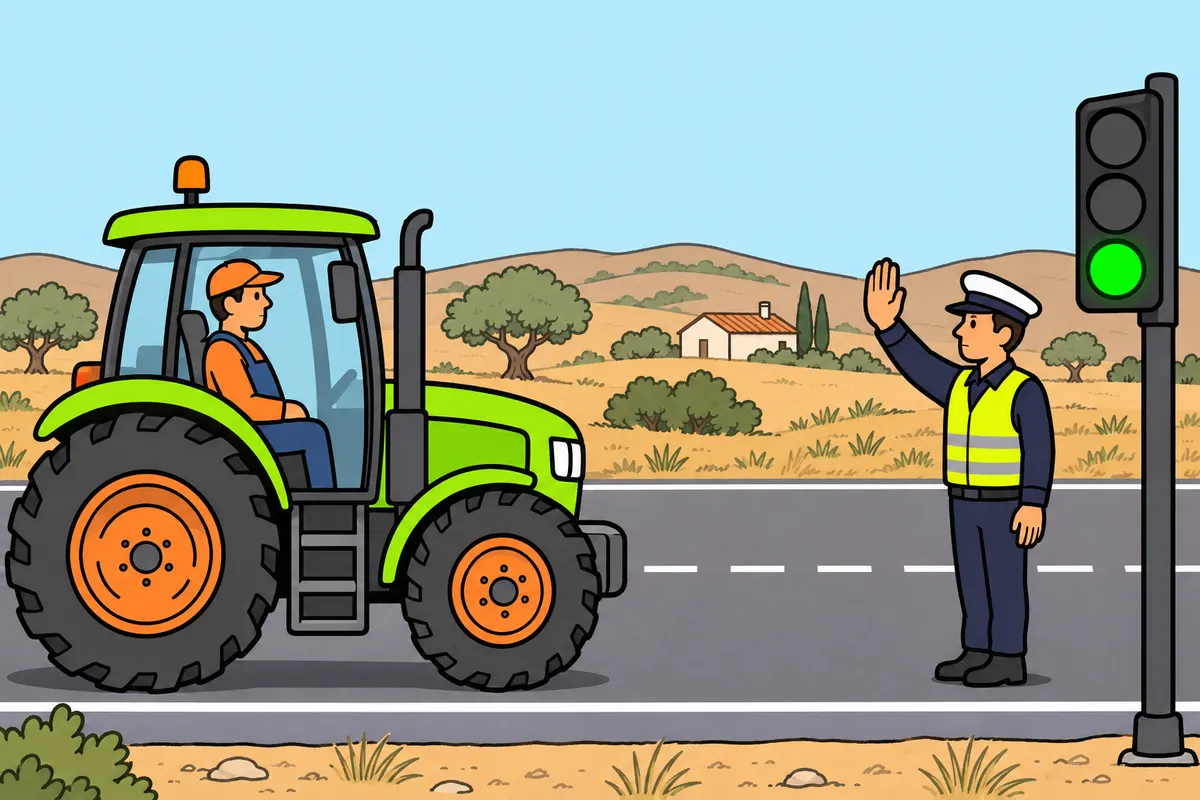
Obey the highest-ranking instruction when instructions conflict.
Remember
- Apply the hierarchy of signals to decide who proceeds.
- See “Which signal you must obey” in “Signs and their hierarchy”.
Exam trap: Wrong: decide who proceeds without checking which signal takes precedence. Right: apply the hierarchy and the rule for conflicting instructions.
Read the full explanation
- To establish who can proceed, apply the hierarchy and the rule for resolving conflicting instructions explained in «Signs and their hierarchy», in the section «Which signal you must obey». [RGC, art. 133](https://www.boe.es/buscar/act.php?id=BOE-A-2003-23514#a133).
3Officers’ signals
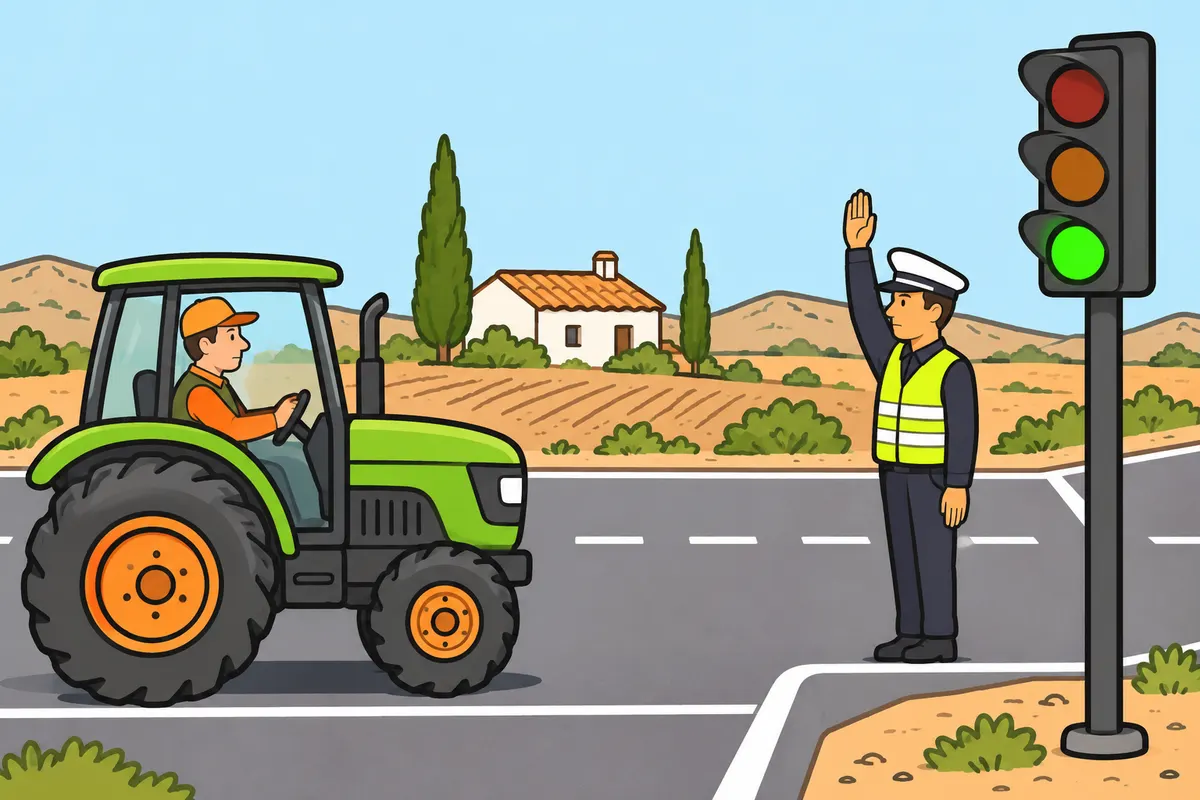
Obey the officer controlling the junction.
Remember
- Follow their orders even if another sign lets you pass.
Exam trap: Wrong: your priority lets you ignore the officer. Right: their orders decide who passes.
Read the full explanation
- If an officer controls the junction, you must follow their instructions to establish who can proceed, even if another sign or the general rules give you priority. Their gestures, lights and whistle signals are explained in «LVA licence, tests and obeying signs», in the sections «Officer with an arm raised or horizontal» and «Light, whistle and instruction to slow down». [RGC, art. 133](https://www.boe.es/buscar/act.php?id=BOE-A-2003-23514#a133).
4Give way and STOP
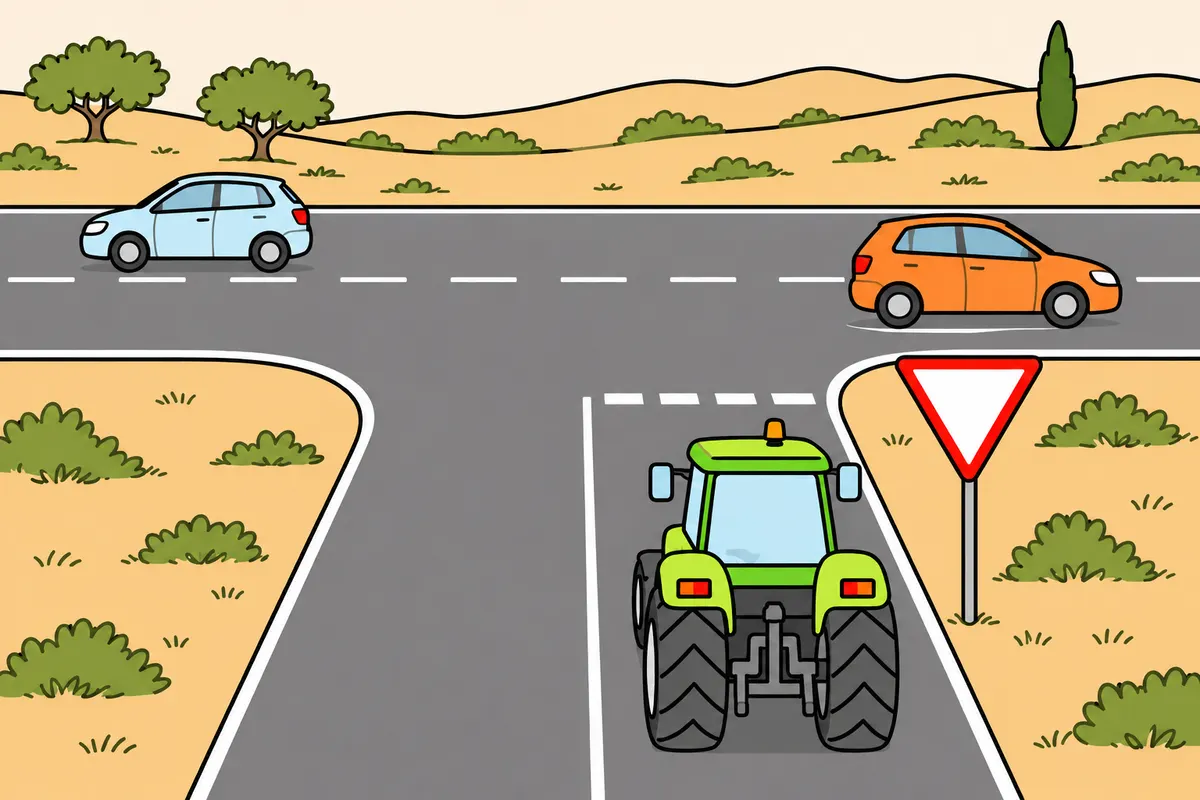
At STOP, stop completely and then give way.
| Sign | What you must do |
|---|---|
| R-1: Give way | Give way; stop if necessary |
| R-2: STOP | Always stop and give way |
Remember
- Give way to vehicles on the priority road, from either direction.
- At STOP, stop even if you see no vehicles.
- Stop before the line; without one, stop immediately before the junction.
- If you cannot see there, stop again where you can see safely.
- Stopping in the queue does not replace stopping at the required place.
Exam trap: Wrong: passing STOP very slowly is enough. Right: you must stop completely.
Read the full explanation
- At R-1, Give way, you must give way to vehicles on the priority road, whichever side they approach from, and stop if necessary to give way. At R-2, Compulsory stop or STOP, you must always stop and give way to them. [RGC, art. 56.5](https://www.boe.es/buscar/act.php?id=BOE-A-2003-23514#a56).
- You must stop before the relevant stop line or, if there is none, immediately before the junction. If, exceptionally, you do not have sufficient visibility from that point, you must stop again where you can observe without endangering anyone. You must make both stops when these circumstances apply. [RGC, art. 56](https://www.boe.es/buscar/act.php?id=BOE-A-2003-23514#a56). [Catalogue, R-2 and stop markings](https://www.boe.es/buscar/doc.php?id=BOE-A-2025-12199).
- If you wait behind another vehicle at a STOP sign, you must not consider the compulsory stop completed merely because you have stopped in the queue. When you reach the required stopping point, you must make your own stop and check for yourself that you can proceed; the vehicle ahead may hide a bicycle or an approaching vehicle from view. [RGC, art. 56](https://www.boe.es/buscar/act.php?id=BOE-A-2003-23514#a56). [Catalogue, R-2 and stop markings](https://www.boe.es/buscar/doc.php?id=BOE-A-2025-12199).
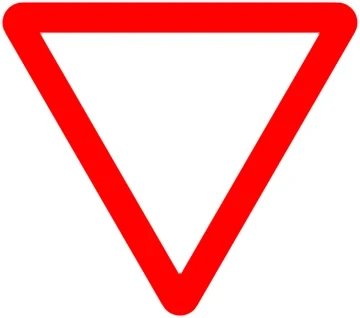 R-1
 R-2
5Traffic lights and permission to proceed
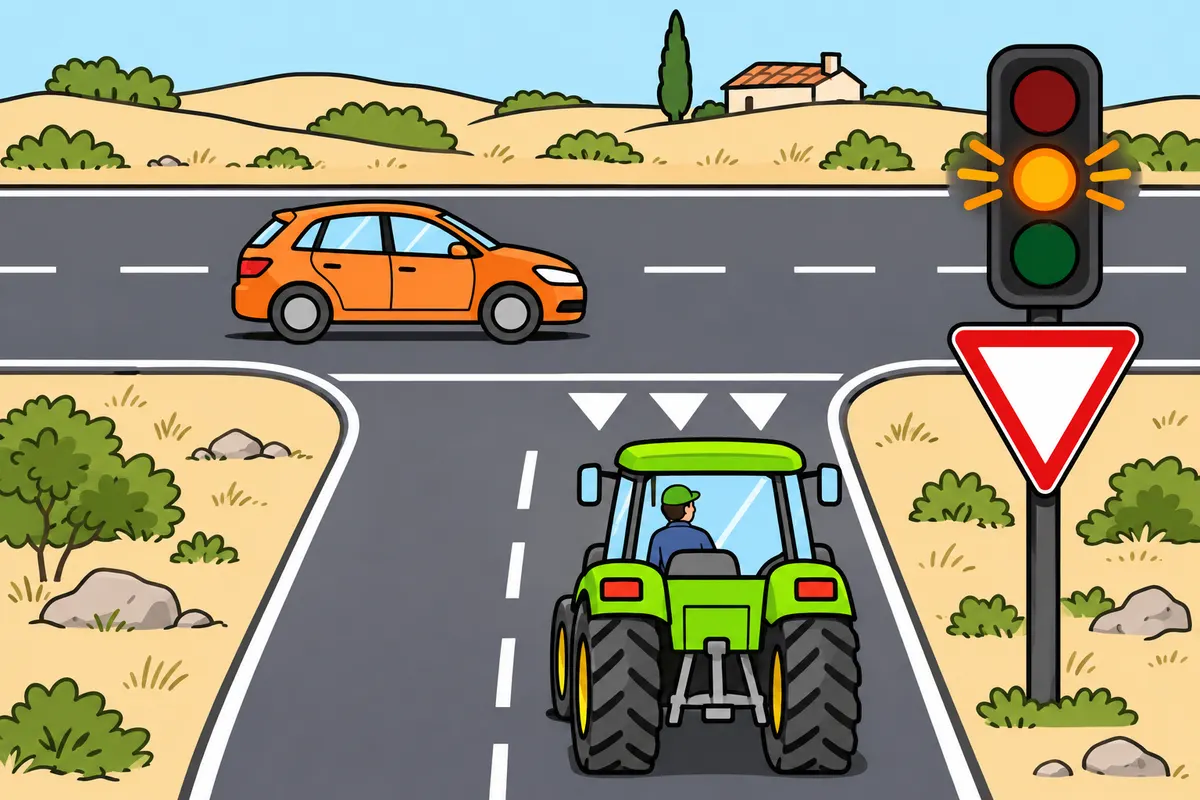
Check what each light allows and whom you must give way to.
| Light | What you must do |
|---|---|
| Flashing amber | Give way where required and obey any applicable STOP |
| Steady green | You may proceed with priority, without blocking |
| Green arrow on a black circular background | Give way to vehicles in the lane you enter; do not endanger anyone crossing |
| Downward green arrow | You may use the lane; obey priority rules |
Remember
- At flashing amber, also obey any STOP sign that applies.
- At steady green, keep the junction clear.
- When turning, respect pedestrians’ and cyclists’ priority where it applies.
Exam trap: Wrong: every green arrow gives you priority. Right: distinguish which arrow you follow.
Read the full explanation
- At a flashing amber light, you must give way when required and obey any STOP sign that applies. [Catalogue, traffic lights, section 4.2.d](https://www.boe.es/buscar/doc.php?id=BOE-A-2025-12199).
- At a steady green light, you can proceed with priority, but you must keep the junction clear and respect pedestrians’ and cyclists’ priority when turning, in the situations described in their sections. [RGC, annex I, section 4.2.e](https://www.boe.es/buscar/act.php?id=BOE-A-2003-23514#A4).
- If you follow a green arrow on a circular black background, you must give way to vehicles in the lane you are joining and avoid endangering anyone crossing. [Catalogue, traffic lights, section 4.2.g](https://www.boe.es/buscar/doc.php?id=BOE-A-2025-12199).
- A downward green arrow allows you to use the lane; you must obey the applicable signs, signals and priority rules. The full meaning of the lights and arrows is covered in «Signs and their hierarchy». [Catalogue, traffic lights, section 4.3.b](https://www.boe.es/buscar/doc.php?id=BOE-A-2025-12199).
6Unsigned junctions
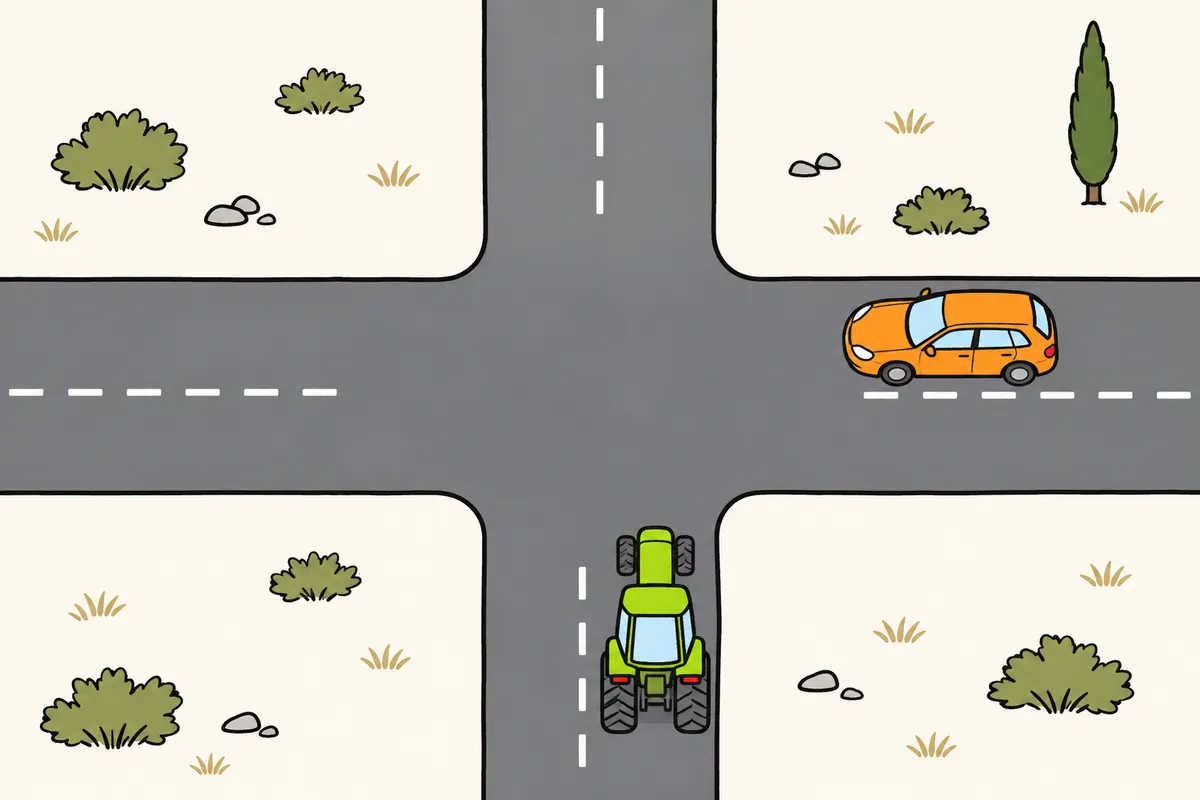
Without signs, give way to your right unless a stated exception applies.
| Case without priority signs | Who goes first |
|---|---|
| Paved road meeting an unpaved road | Traffic on the paved road |
| Vehicle on rails meeting other road users | The vehicle on rails |
| Entering a roundabout | Traffic already on it |
| Joining an autopista or autovía | Traffic already on it |
Remember
- Do not decide priority by a road’s width or good condition.
- Do not confuse damaged paving with an unpaved road.
- Do not enter autopistas or autovías with your LVA agricultural vehicle.
Exam trap: Wrong: coming from the right on dirt gives you priority. Right: give way to traffic on the paved road.
Read the full explanation
- If no sign or signal controls priority, you must give way to vehicles approaching from your right, subject to the exceptions in the regulations. Greater width, better maintenance or the appearance of a main road do not in themselves give priority; you must look for the features that the rule actually recognises. [RGC, art. 57](https://www.boe.es/buscar/act.php?id=BOE-A-2003-23514#a57).
- A vehicle travelling on a paved road has priority over one approaching from an unpaved road. If you approach a paved road along a dirt track in your tractor, you must give way even if you are on the other driver's right. Do not confuse a damaged paved surface with an unpaved road. [RGC, art. 57](https://www.boe.es/buscar/act.php?id=BOE-A-2003-23514#a57).
- Vehicles running on rails have priority over other road users in this situation. A tram has this priority even if it approaches from your left. If a sign, signal or officer controls the situation, you must follow that instruction. [RGC, art. 57](https://www.boe.es/buscar/act.php?id=BOE-A-2003-23514#a57).
- The other exceptions are that traffic already on a roundabout has priority over traffic entering it, and traffic on an autopista (motorway) or autovía (dual carriageway with motorway restrictions) has priority over traffic joining it. You cannot enter autopistas or autovías with your LVA agricultural vehicle; you therefore cannot claim this priority as a driver travelling on them. Permitted roads are covered in «Road use with agricultural vehicles». [RGC, art. 57](https://www.boe.es/buscar/act.php?id=BOE-A-2003-23514#a57). [RGC, art. 38](https://www.boe.es/buscar/act.php?id=BOE-A-2003-23514#a38).
7Leaving a property and turning
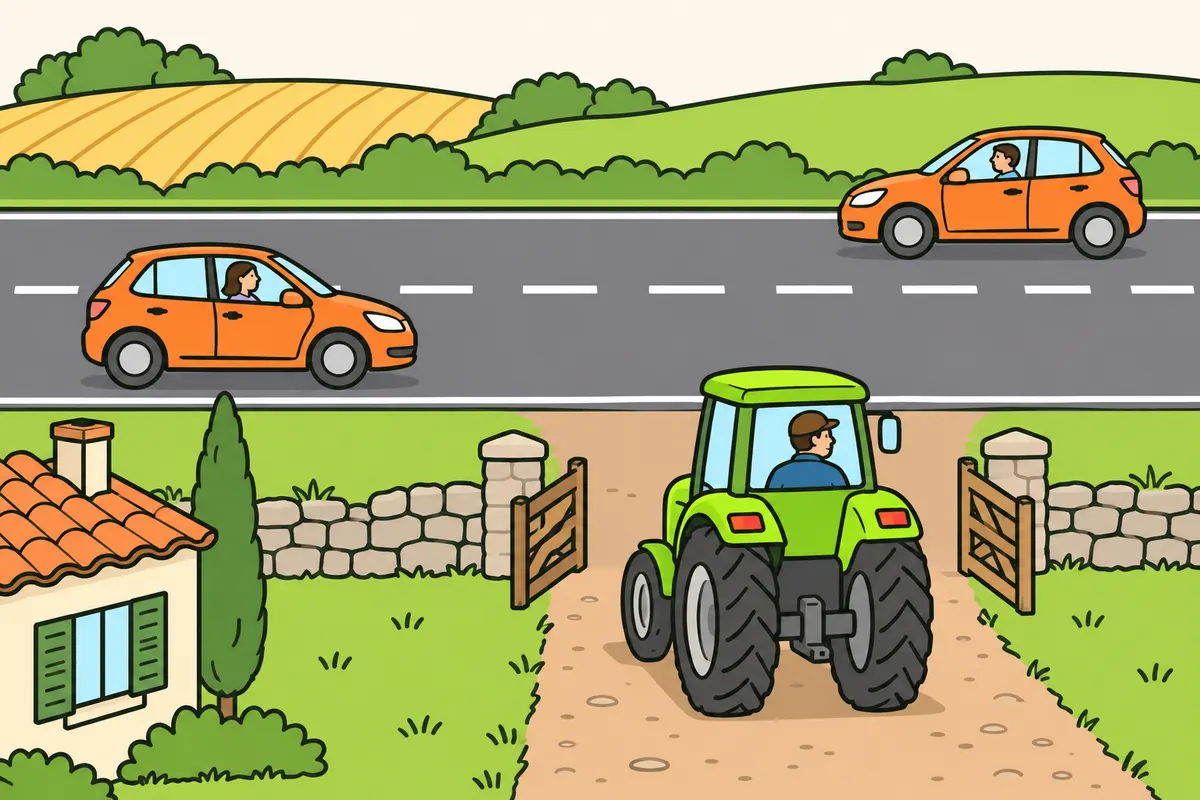
When leaving a property, give way to traffic on the road.
| Situation | What you must check |
|---|---|
| Junction between roads | Signs and priority exceptions |
| Leaving a property | You must give way when joining |
Remember
- Also give way when joining from the road edge or after parking.
- From an exclusively private track, give way in both directions.
- Leave slowly enough to stop immediately.
- Ask for help if you need it to check safety.
- Use your indicator, but remember it gives you no priority.
Exam trap: Wrong: leaving a private track from the right means you go first. Right: you must give way.
Read the full explanation
- When joining the road from an adjoining property, from the edge of the road or after being parked, you must give way to vehicles travelling on it. You must assess their position, path and speed, and signal that you are joining using the compulsory signals. Your indicator communicates your intention, but does not oblige others to give you priority. [RGC, art. 72](https://www.boe.es/buscar/act.php?id=BOE-A-2003-23514#a72).
- If you enter a public road from an exclusively private track, you must do so at a speed that allows you to stop immediately and give way to road users travelling in both directions. You must not automatically apply the priority-to-the-right rule: the determining factor is that you are leaving that private track. [RGC, art. 72](https://www.boe.es/buscar/act.php?id=BOE-A-2003-23514#a72).
- If you cannot check safety yourself, you must seek another person's help when necessary. At a farm exit, a wall, vegetation or implements may obstruct your view; you must not move forwards so far that you force someone travelling on the road to brake sharply. [RGC, art. 72](https://www.boe.es/buscar/act.php?id=BOE-A-2003-23514#a72).
- As a practical guide, distinguish a junction between roads from joining the road from a property. At a junction, you must identify signs and exceptions to priority rules; when joining from a property, you must give way. The tractor's slow speed or size does not change this obligation or replace the need to check traffic. [RGC, art. 72](https://www.boe.es/buscar/act.php?id=BOE-A-2003-23514#a72).
8Roundabouts: entering, lanes and leaving
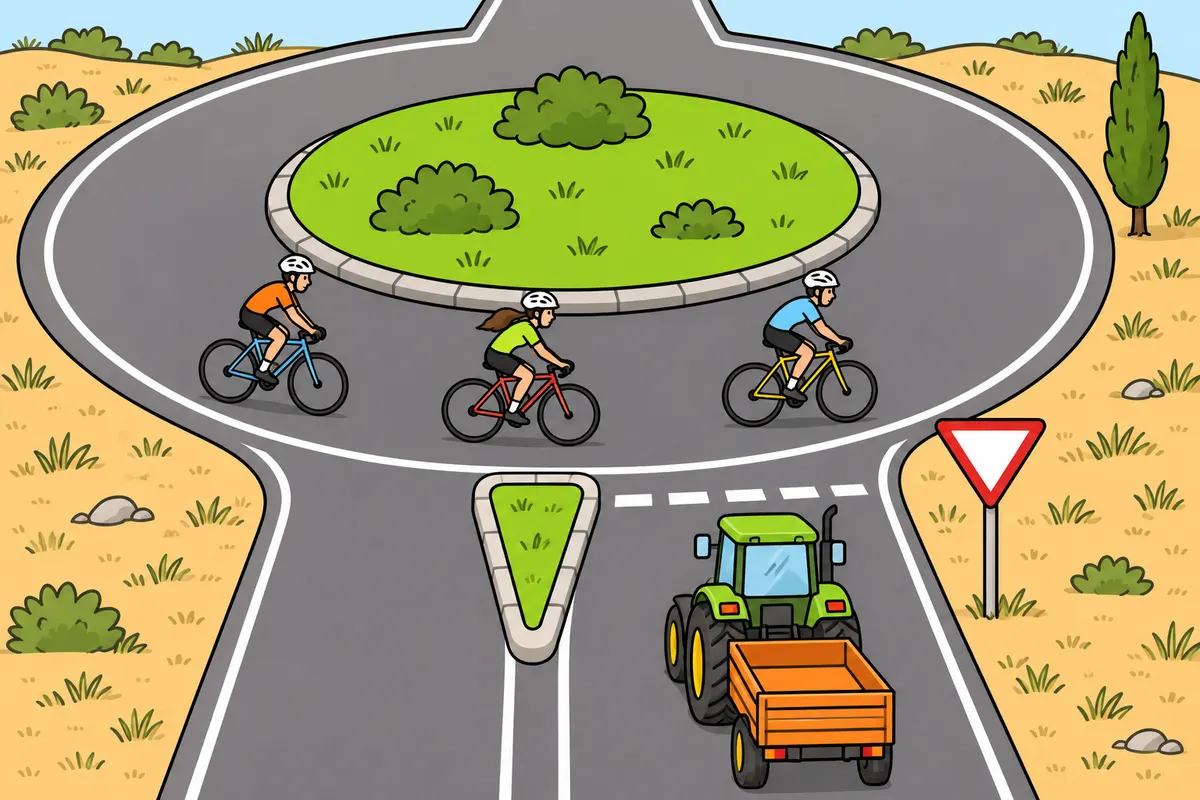
Entering a roundabout, give way to traffic inside unless the controls say otherwise.
| Type of roundabout | Priority rule |
|---|---|
| Ordinary circular carriageway | When entering, give way to traffic inside unless controls say otherwise |
| Split: a road runs through the centre | Check signs; without controls or another exception, apply priority to the right |
Remember
- Look for bicycles before entering.
- See “Priority when changing your path” for priority between lanes.
- Before moving, check for hidden bicycles and make sure you can see the entrance.
- Go around with the centre on your left.
- Allow space for your whole agricultural combination.
Exam trap: Wrong: turning traffic always has priority at a split roundabout. Right: check signs; without controls or another exception, give way to the right.
Read the full explanation
- When entering a roundabout, you must give way to road users already travelling on its circular carriageway, unless the applicable traffic controls require otherwise. You must observe all vehicles whose path your entry may affect, including bicycles. Approaching from their right does not give you priority over those already on the roundabout. [RGC, art. 57](https://www.boe.es/buscar/act.php?id=BOE-A-2003-23514#a57).
- As a practical application for your tractor, before entering, calculate the space the whole combination needs to follow the curve. The implement and trailer may follow a different path from the cab. Priority between lanes is covered in «Priority when changing your path». [RGC, art. 74](https://www.boe.es/buscar/act.php?id=BOE-A-2003-23514#a74).
- As a practical precaution while waiting at the roundabout, look out for bicycles that may be hidden behind another vehicle or a feature of the surroundings. Before moving your tractor, confirm that you can see the entrance and the nearby path of traffic; for groups, the situation described in «Cyclists: three key situations» applies. [RGC, art. 64](https://www.boe.es/buscar/act.php?id=BOE-A-2003-23514#a64).
- According to DGT guidance, a split roundabout has a road running through its central area and is treated as a junction: you must follow the signs at each crossing and, where there are no traffic controls or other applicable exceptions, give way to your right. Its circular outer shape alone does not give priority to those turning. [DGT, unsigned split roundabouts](https://revista.dgt.es/es/multimedia/infografia/2014/1008-Infografia-glorietas-partidas.shtml).
- You must drive around the roundabout keeping its centre on your left, including when you intend to return along the road you arrived on. As a practical application, plan the full route and avoid cutting through the centre or changing your path to save space; you must respect the prescribed direction of travel. [RGC, art. 43](https://www.boe.es/buscar/act.php?id=BOE-A-2003-23514#a43).
9Priority when changing your path
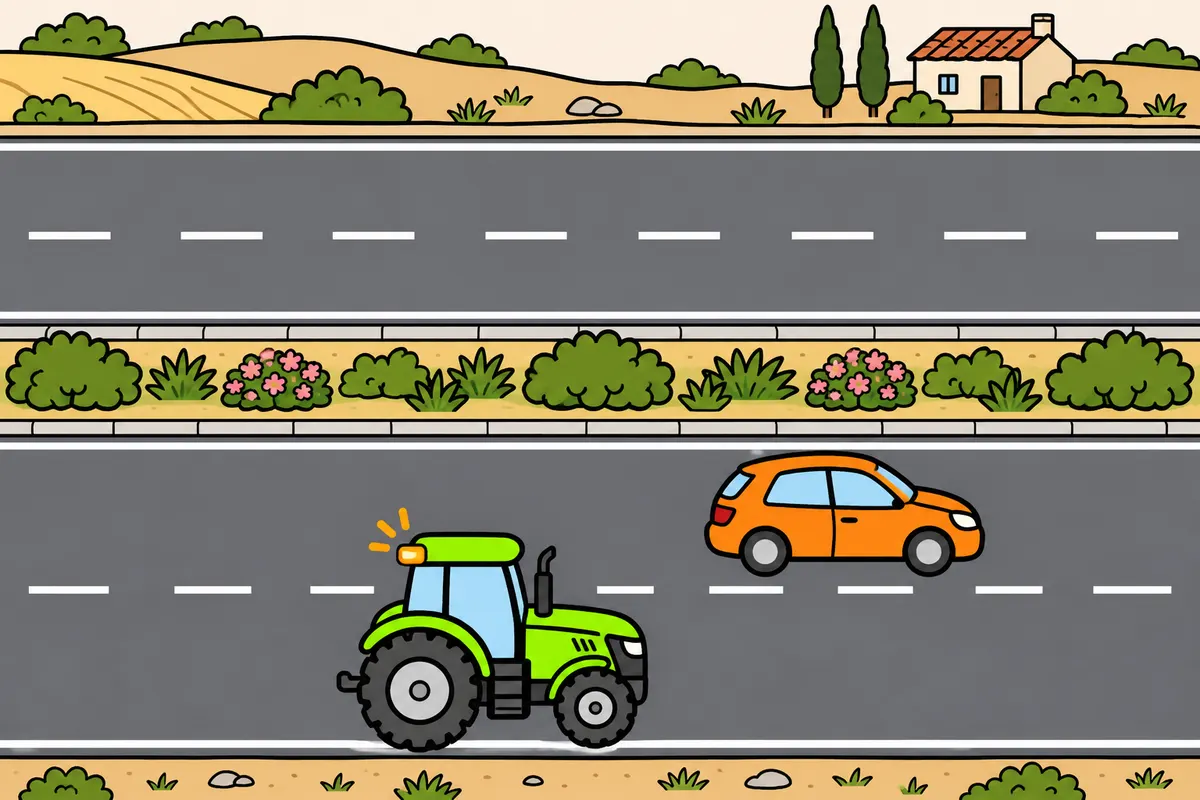
When changing your path, respect those already using the space you need.
Remember
- When changing lanes, give way to traffic already in that lane.
- To leave a roundabout, respect traffic in the outer lane.
- If you cannot move over safely, continue around and prepare another exit.
- Before turning left, check the distance and speed of oncoming traffic.
- Do not turn left without enough visibility.
- Signal early and watch the path of your trailer and implements.
Exam trap: Wrong: you may cross the outer lane because you need to leave. Right: respect traffic using it.
Read the full explanation
- When changing lanes, you must respect the priority of anyone travelling in the lane you intend to enter. On a roundabout, this also applies to you when driving in an inner lane: wanting to leave does not allow you to cross the outer lane in front of another vehicle. You must wait for a safe opportunity to move across. [RGC, art. 74](https://www.boe.es/buscar/act.php?id=BOE-A-2003-23514#a74).
- To leave an ordinary roundabout, you must prepare your turn from the appropriate lane and respect the priority of those in the outer lane; if you cannot position yourself safely, continue around and prepare for another opportunity. The specific manoeuvre is covered in «Manoeuvres with agricultural vehicles». [RGC, art. 74](https://www.boe.es/buscar/act.php?id=BOE-A-2003-23514#a74).
- Before turning left, you must check that the distance and speed of oncoming road users allow you to do so safely; you must refrain from turning if you do not have sufficient visibility. [RGC, art. 74](https://www.boe.es/buscar/act.php?id=BOE-A-2003-23514#a74).
- You must signal your turn in good time and also check your immediate surroundings. As a practical application for your tractor, observe the area swept by the implements and trailer: a manoeuvre you have signalled may still affect a road user with priority. Signalling and having enough space are separate checks. [RGC, art. 74](https://www.boe.es/buscar/act.php?id=BOE-A-2003-23514#a74).
10Keep junctions and crossings clear
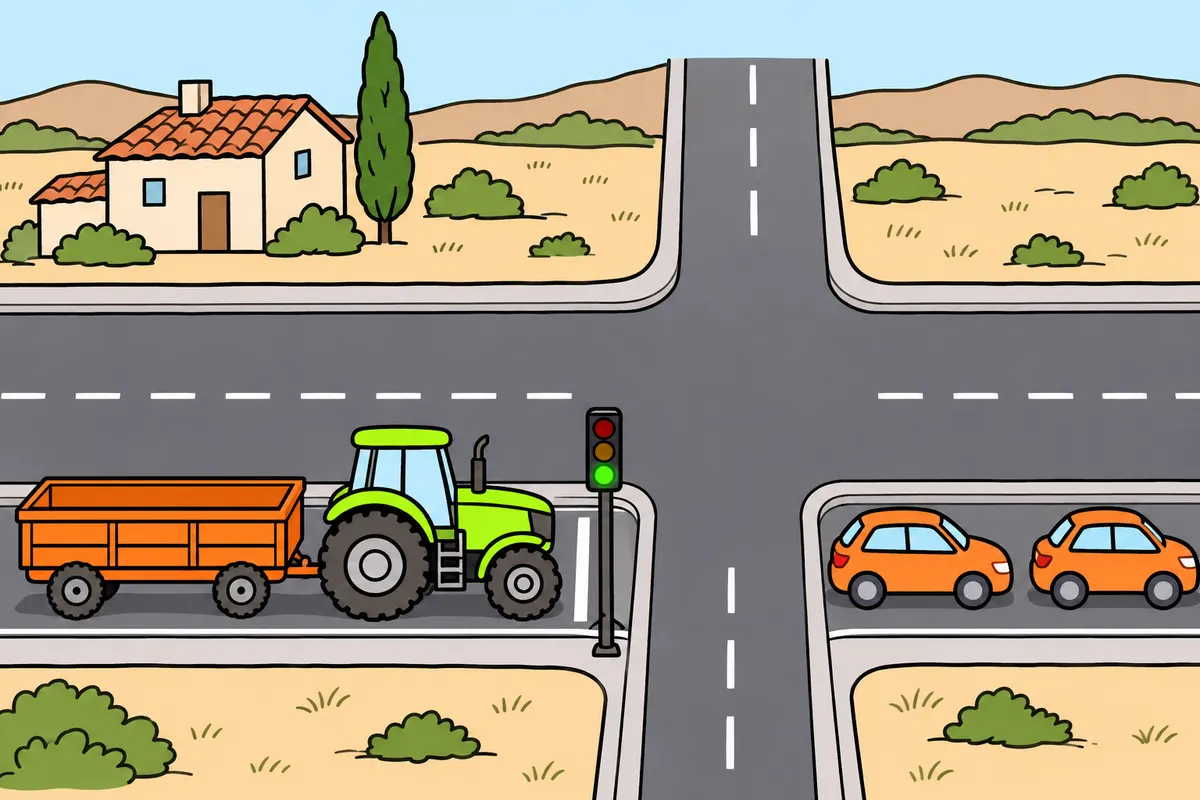
Wait outside if you would block a junction or crossing.
Remember
- Do not enter with priority if you would block crossing traffic.
- Keep pedestrian and cycle crossings clear.
- Allow space for your tractor, trailer and projecting parts.
- Green does not let you block the junction.
Exam trap: Wrong: if blocked inside a signal-controlled junction, wait for green. Right: clear it without waiting for permission, if you can avoid hindering traffic allowed to proceed.
Read the full explanation
- Even if you have priority, you must wait outside a junction if you foresee that you will stop inside it and prevent or obstruct crossing traffic. [RGC, art. 59](https://www.boe.es/buscar/act.php?id=BOE-A-2003-23514#a59).
- The same obligation applies to pedestrian and cycle crossings. If a queue prevents you from keeping them clear, you must stop before entering them. [RGC, art. 59](https://www.boe.es/buscar/act.php?id=BOE-A-2003-23514#a59).
- As a practical precaution, assess the space beyond the junction using the full length of the combination. Having enough space for the cab does not guarantee that you can keep the junction clear: you must account for the trailer and any projecting part. You may exercise your priority only without causing the blockage covered by the rule. [RGC, art. 59](https://www.boe.es/buscar/act.php?id=BOE-A-2003-23514#a59).
- If you are already stopped inside a traffic-light-controlled junction and are obstructing traffic, you must clear it without waiting for permission to proceed in your direction, provided you can do so without hindering those whose signal allows them to proceed. [RGC, art. 59](https://www.boe.es/buscar/act.php?id=BOE-A-2003-23514#a59).
11Narrow sections and roadworks
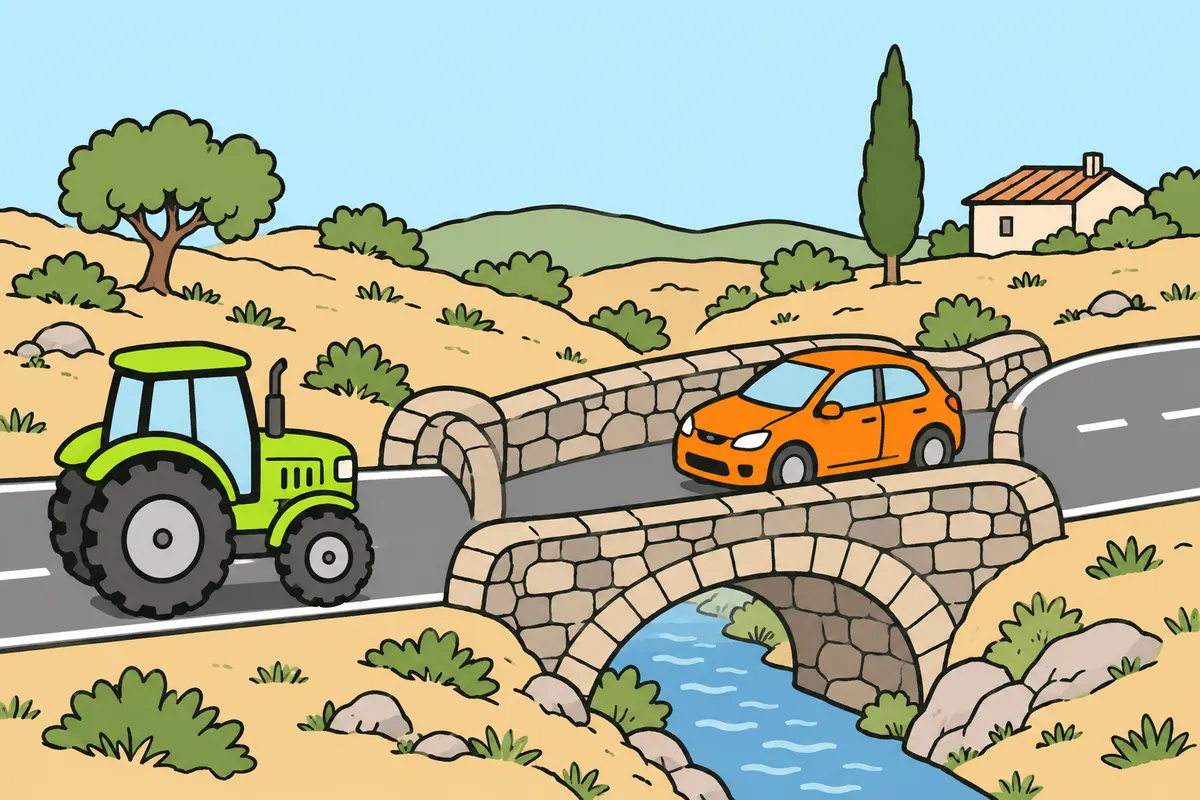
At a narrow section, check signs before deciding who passes.
| Narrow section without specific signs | How you decide |
|---|---|
| You know who entered first | That vehicle goes first |
| You are unsure who entered first | Apply the order based on manoeuvring difficulty |
Remember
- Without specific signs, let the vehicle that entered first pass.
- If unsure who entered first, use the order based on manoeuvring difficulty.
- At roadworks, follow the route and staff instructions.
- Wait behind the queue, close to the right-hand edge.
- Do not overtake the queue with your tractor.
Exam trap: Wrong: the largest vehicle always goes first. Right: check controls and who entered first.
Read the full explanation
- The rules for narrow sections determine how you pass vehicles coming in the opposite direction when passing each other is impossible or very difficult. You must first check the traffic controls for the section and the actual space your vehicle needs. [RGC, art. 60](https://www.boe.es/buscar/act.php?id=BOE-A-2003-23514#a60).
- If there are no specific signs, whoever enters first has priority. If you are unsure who entered first, you must apply the statutory order based on difficulty of manoeuvring in article 62. [RGC, art. 60](https://www.boe.es/buscar/act.php?id=BOE-A-2003-23514#a60).
- At roadworks, you must follow the designated route and the instructions of the personnel controlling traffic. If another vehicle is waiting ahead of you in the same direction, you must position yourself behind it, as close as possible to the right-hand edge, and proceed in turn behind it. [RGC, art. 60](https://www.boe.es/buscar/act.php?id=BOE-A-2003-23514#a60).
- You must obey the personnel assigned to control traffic in these situations. Priority vehicles on urgent duty may pass through the area under repair whenever this is possible without danger or damage to the works; your agricultural activity does not give you that entitlement or allow you to ignore an instruction to stop. [RGC, art. 60](https://www.boe.es/buscar/act.php?id=BOE-A-2003-23514#a60).
12Narrow bridges and controlled passage
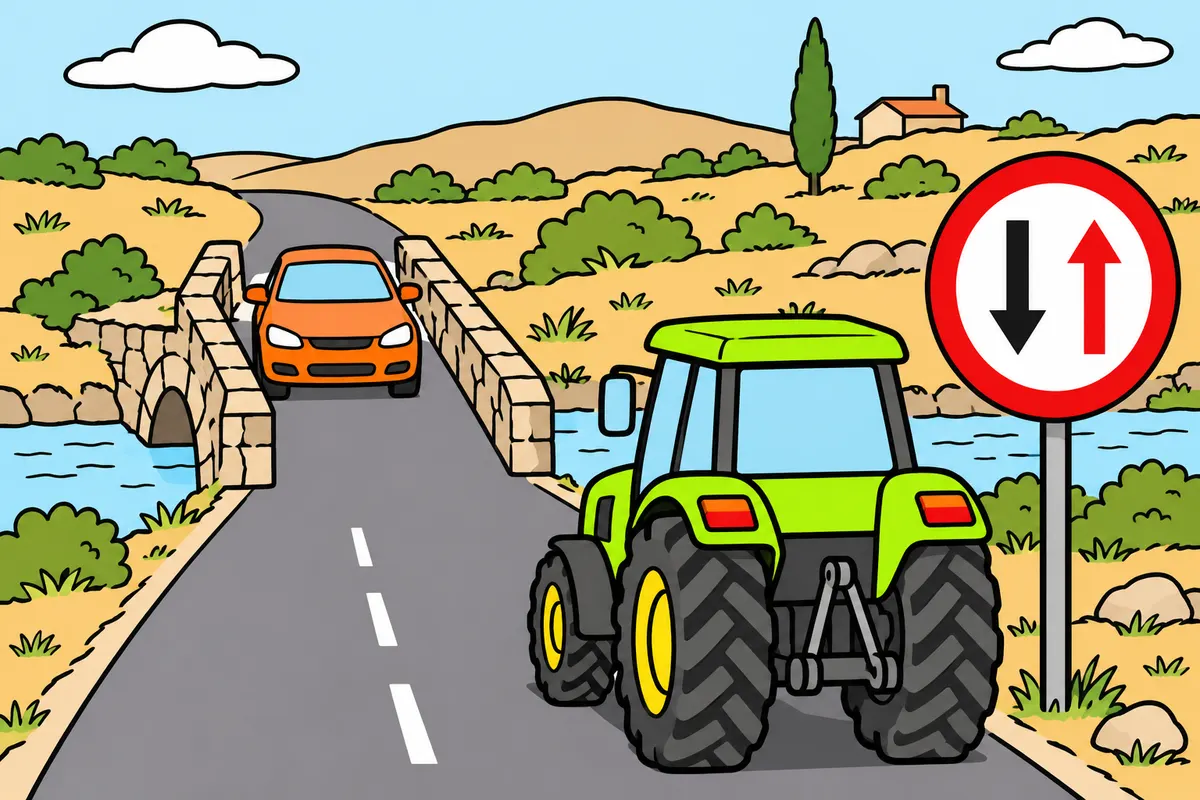
On narrow bridges, obey signs and the specific passage rule.
| Sign or case on a narrow bridge | What you must do |
|---|---|
| R-5 | Give way to oncoming traffic |
| R-6 | You have priority over oncoming traffic |
| Meeting inside; your entrance had priority-to-oncoming-traffic or give-way signs | Reverse to let the other vehicle pass |
| Vehicles needing special authorisation; carriageway narrower than 6 m | They cannot pass each other: each needs at least 3 m |
Remember
- Without signs, apply the order between vehicle types.
- Do not replace signs with your tractor’s manoeuvring difficulty.
Exam trap: Wrong: every tractor is banned from narrow bridges. Right: the stated limit concerns vehicles needing special authorisation passing each other.
Read the full explanation
- On a bridge or other crossing structure where two vehicles cannot pass each other, you must follow the signs establishing priority. R-5, Priority for oncoming traffic, prohibits you from entering if you would force oncoming road users to stop; R-6, Priority over oncoming traffic, indicates that you have priority over them. [RGC, art. 61](https://www.boe.es/buscar/act.php?id=BOE-A-2003-23514#a61). [Catalogue, signs R-5 and R-6](https://www.boe.es/buscar/doc.php?id=BOE-A-2025-12199).
- If you meet another vehicle on a bridge where you cannot pass each other, and there is an R-5 or R-1 sign at your end, you must reverse to let it pass. The end from which you entered determines this obligation, even if your tractor is more difficult to manoeuvre. [RGC, art. 61](https://www.boe.es/buscar/act.php?id=BOE-A-2003-23514#a61).
- In the absence of signs, article 61 refers to the order between vehicle types in article 62. You must know this specific bridge rule and distinguish it from the rule giving priority to the first vehicle to enter an ordinary narrow section; in a test, the type of location and the presence of signs determine how you resolve the encounter. [RGC, art. 61](https://www.boe.es/buscar/act.php?id=BOE-A-2003-23514#a61).
- Vehicles that need special authorisation to use the road must not pass each other on a bridge with a carriageway less than 6 metres wide: at least 3 metres must be available for each vehicle. You must not interpret these figures as a general prohibition on any tractor crossing any narrow bridge. [RGC, art. 61](https://www.boe.es/buscar/act.php?id=BOE-A-2003-23514#a61).
 R-5
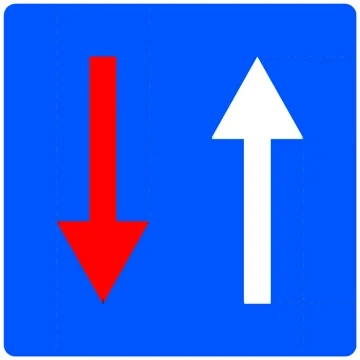 R-6
13Order of passage and the tractor’s place in it
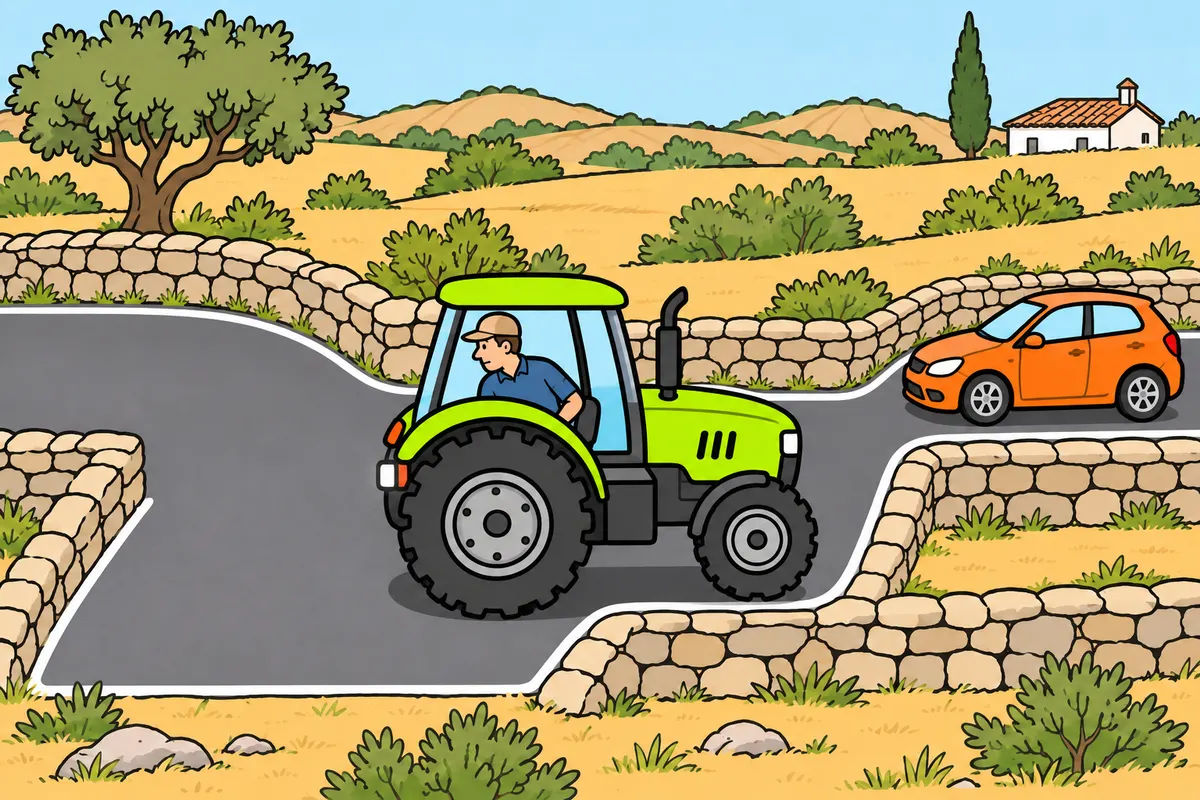
Classify your tractor by its limits and whether you tow a trailer.
| Order for deciding who reverses | Vehicles with priority, from top to bottom |
|---|---|
| First | Special vehicles and special transport exceeding ordinary mass or dimension limits |
| Next | Combinations, except passenger cars towing trailers up to 750 kg maximum authorised mass |
| Next | Animal-drawn vehicles |
| Next | Passenger cars towing trailers up to 750 kg maximum authorised mass, and motor caravans |
| Next | Collective passenger transport |
| Next | Lorries, tractor units and vans |
| Next | Passenger cars and car-derived vehicles |
| Next | Special vehicles within ordinary limits, including tractors alone; quadricycles and light quadricycles |
| Next | Three-wheeled vehicles, motorcycles with sidecars and three-wheeled mopeds |
| Last | Motorcycles, two-wheeled mopeds and bicycles |
Remember
- Do not claim priority simply because your tractor is agricultural.
- With a trailer, classify the combination, not just the tractor.
- Use this list only when it applies to deciding who reverses.
- For equal types or unlisted cases, whoever must reverse further goes first.
- If tied, compare greater width, length or maximum authorised mass.
- Do not confuse maximum authorised mass with today’s load.
Exam trap: Wrong: your ordinary tractor alone goes before a passenger car. Right: give way and reverse if necessary; with a trailer, classify the combination.
Read the full explanation
- You must learn the statutory order of priority for deciding which vehicle reverses. First come special vehicles and special transport operations that exceed the masses or dimensions permitted for ordinary vehicles. The word agricultural or the presence of a warning light is not enough to place a tractor in this first group. [RGC, art. 62](https://www.boe.es/buscar/act.php?id=BOE-A-2003-23514#a62).
- Second come vehicle combinations, except cars towing trailers with an MMA (maximum authorised mass) of up to 750 kg. You must therefore classify a tractor with a trailer as a combination unless it belongs to the first group because it exceeds the permitted masses or dimensions. [RGC, art. 62](https://www.boe.es/buscar/act.php?id=BOE-A-2003-23514#a62).
- Third come animal-drawn vehicles. Fourth come cars towing trailers with a maximum authorised mass of up to 750 kg and motor caravans. You must include exactly 750 kg: the rule uses an inclusive limit and refers to MMA, not the actual load. [RGC, art. 62](https://www.boe.es/buscar/act.php?id=BOE-A-2003-23514#a62).
- Fifth come vehicles intended for collective passenger transport; sixth come lorries, tractor units and vans. When you need to apply this list, a bus has priority over a lorry. You must not apply this order at an ordinary junction or give it precedence over an officer’s instruction. [RGC, art. 62](https://www.boe.es/buscar/act.php?id=BOE-A-2003-23514#a62).
- Seventh come cars and car-derived vehicles. Eighth come special vehicles that do not exceed the statutory masses or dimensions, quadricycles and light quadricycles. You must place your tractor without a trailer in this group when it is within the ordinary limits, even if it looks larger than a car. [RGC, art. 62](https://www.boe.es/buscar/act.php?id=BOE-A-2003-23514#a62).
- Ninth come three-wheeled vehicles, motorcycles with sidecars and three-wheeled mopeds. Tenth come motorcycles, two-wheeled mopeds and bicycles. You must keep this order: the statutory assessment of difficulty is not based solely on which vehicle looks more vulnerable. [RGC, art. 62](https://www.boe.es/buscar/act.php?id=BOE-A-2003-23514#a62).
- If you apply the list to a tractor of ordinary dimensions without a trailer and a car, you must give way in the tractor and reverse when necessary. Compared with a two-wheeled motorcycle, the same tractor belongs to a group with higher priority. If you are towing a trailer, you must classify the combination again before answering. [RGC, art. 62](https://www.boe.es/buscar/act.php?id=BOE-A-2003-23514#a62).
- Between vehicles of the same type, or in cases not listed, the vehicle that would need to reverse the greater distance has priority. If the distances are equal, you must consider the greater width, length or maximum authorised mass. [RGC, art. 62](https://www.boe.es/buscar/act.php?id=BOE-A-2003-23514#a62).
14Steep gradients: who reverses
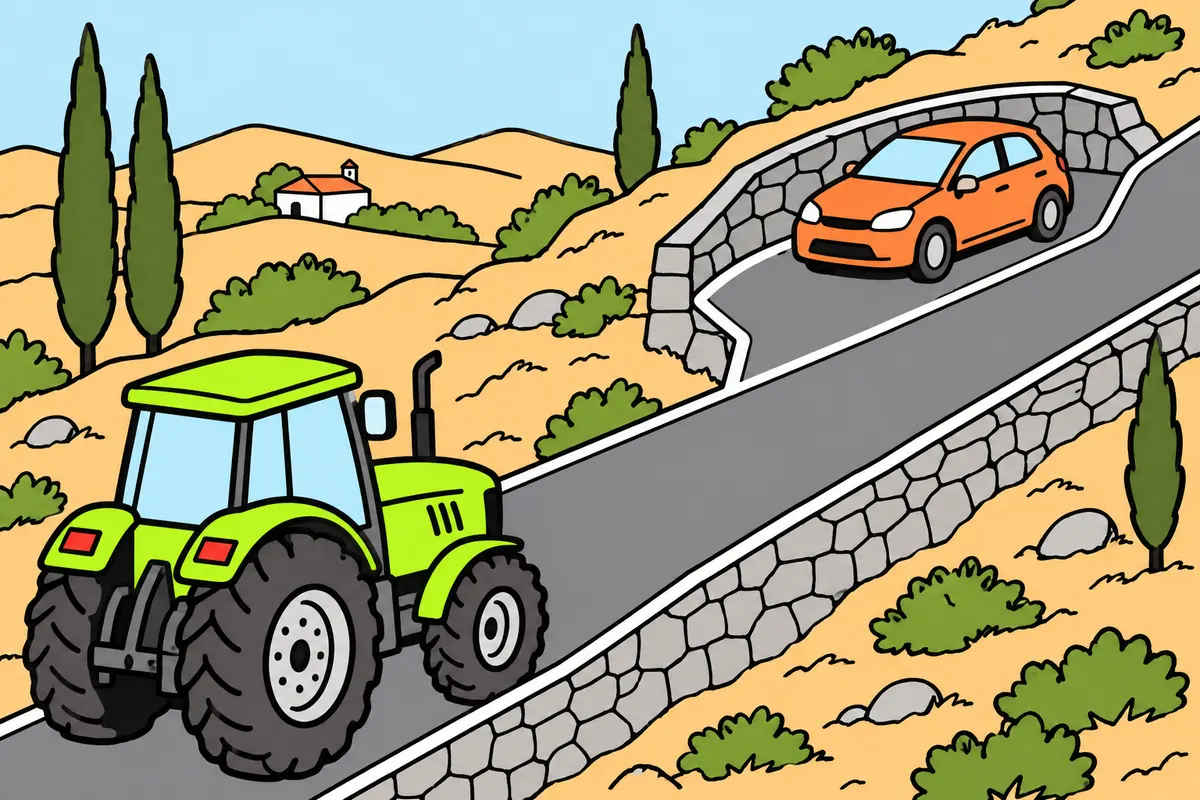
On steep, narrow sections, normally let the uphill vehicle pass.
| Narrow encounter on a steep gradient | How you decide |
|---|---|
| General rule | Uphill traffic goes first |
| Uphill vehicle can reach a designated lay-by first | Use that option to resolve the encounter |
| Unsure of gradient or distance to lay-by | Apply the order between vehicle types |
Remember
- A steep gradient starts at 7 %, including that value.
- Apply this rule only where passing is impossible or very difficult.
- Normally, when travelling downhill, give way and reverse if necessary.
- Do not use an unsafe ditch as a lay-by.
Exam trap: Wrong: any hill gives uphill traffic priority. Right: it must be steep and narrow; also check the lay-by.
Read the full explanation
- A stretch of road is considered steep when its gradient reaches at least 7 %. You must include exactly 7 %, rather than require it to exceed that figure. This priority rule only determines who gives way when the road is also so narrow that passing each other is impossible or very difficult. [RGC, art. 63](https://www.boe.es/buscar/act.php?id=BOE-A-2003-23514#a63).
- On this stretch, the vehicle travelling uphill has priority. As a rule, therefore, you must let it pass if you are travelling downhill, reversing if necessary. You must apply this special priority even if the vehicle travelling uphill comes later in the general list in article 62. [RGC, art. 63](https://www.boe.es/buscar/act.php?id=BOE-A-2003-23514#a63).
- The exception applies when the vehicle travelling uphill can reach a designated lay-by first. In that case, you must use this option to allow the vehicles to pass each other. You must not interpret this exception as an obligation to find any ditch, soft ground or unsafe entrance into which to move the tractor. [RGC, art. 63](https://www.boe.es/buscar/act.php?id=BOE-A-2003-23514#a63).
- If you are unsure about the gradient or the distance to the lay-by, you must use the order in article 62. To answer the test question, check the signs, narrowness, gradient percentage and lay-by before deciding who reverses; the mere presence of a slope does not automatically give priority to the vehicle travelling uphill. [RGC, art. 63](https://www.boe.es/buscar/act.php?id=BOE-A-2003-23514#a63).
15Level crossings and movable bridges
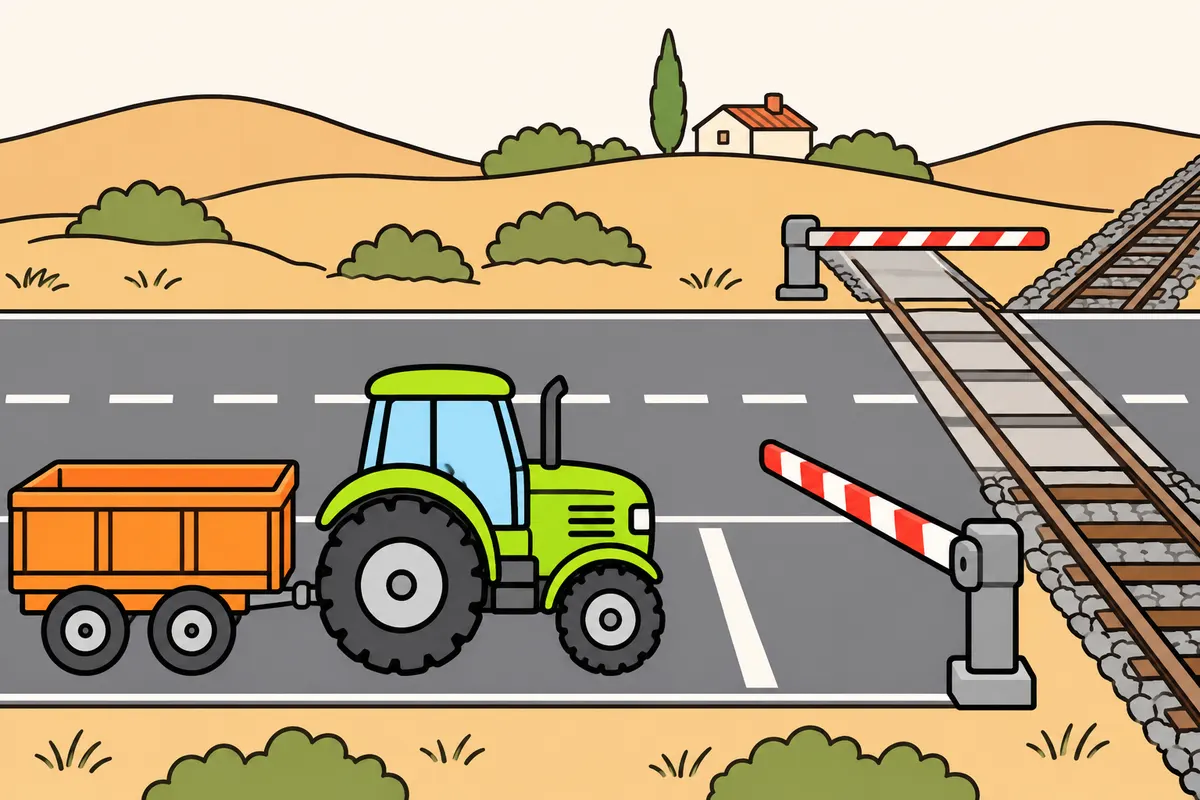
Approach slowly and cross only if you can leave the whole crossing clear.
Remember
- Reduce your speed below the maximum permitted.
- If the crossing is closed, wait in your lane behind those who arrived first.
- Before crossing rails, check that you will not become blocked.
- Cross without delay and include your trailer.
- At movable bridges, wait for a clear route and signals allowing passage.
Exam trap: Wrong: you may enter if only your tractor fits beyond the crossing. Right: you need exit space for the whole combination.
Read the full explanation
- When approaching a level crossing or a movable bridge, you must take extra care and reduce your speed below the maximum permitted. As a practical precaution, consider the tractor’s slow speed and the time needed for the entire combination to cross. [RGC, art. 95](https://www.boe.es/buscar/act.php?id=BOE-A-2003-23514#a95).
- While waiting at a closed level crossing or movable bridge, you must stay in your lane, behind those who arrived first. This keeps the queue in order and leaves space for vehicles travelling in the opposite direction. The conditions relating to barriers and traffic lights are explained in «Barriers and unprotected crossings». [RGC, art. 95](https://www.boe.es/buscar/act.php?id=BOE-A-2003-23514#a95).
- You must cross the railway line without delay and only after checking that there is no risk of becoming immobilised on the crossing. Even if the signal allows you to proceed, you must wait if traffic on the other side leaves insufficient space for the trailer to clear the crossing too. You must assess the entire combination, not just the tractor. [RGC, art. 95](https://www.boe.es/buscar/act.php?id=BOE-A-2003-23514#a95).
- At a movable bridge, you must obey the controls governing its opening and closing and wait until the way is clear. You must not confuse its operation with that of a narrow fixed bridge: at a movable bridge, you must also check that the structure allows traffic to cross and that the signals authorise entry. [RGC, art. 95](https://www.boe.es/buscar/act.php?id=BOE-A-2003-23514#a95).
16Barriers and unprotected crossings
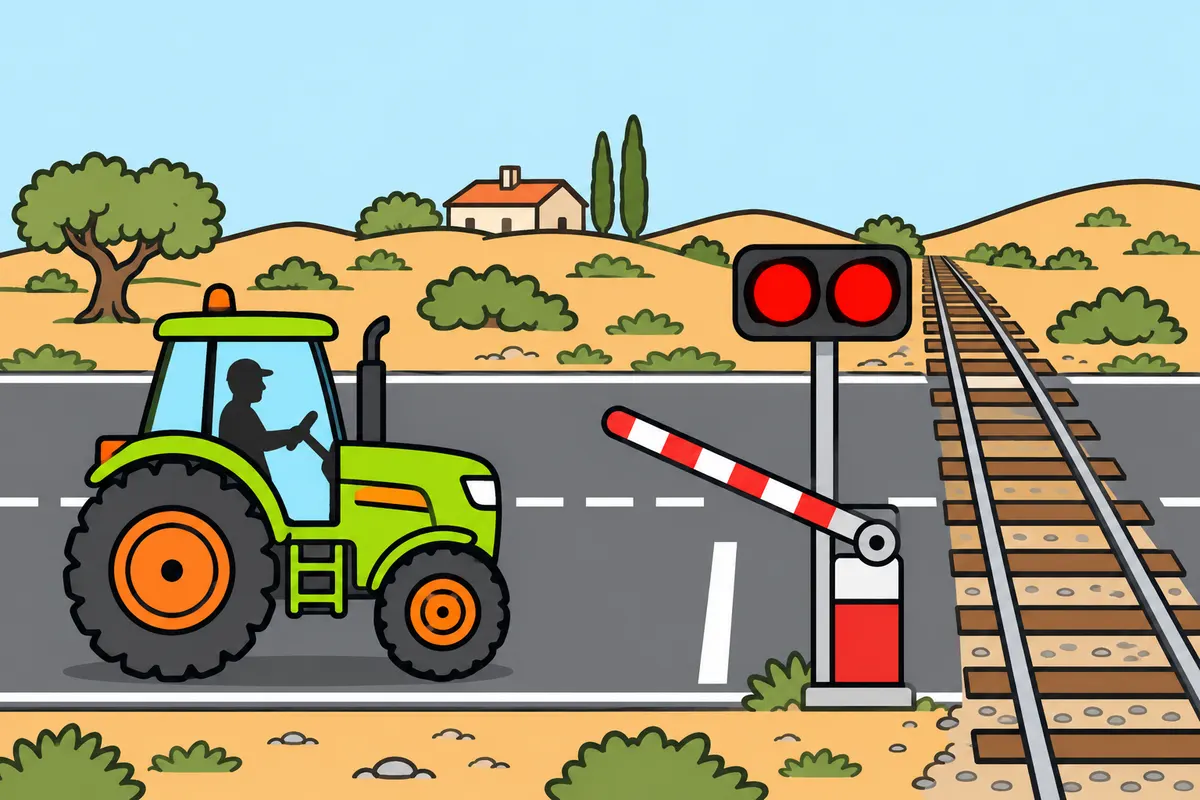
Do not cross while barriers move or traffic lights prohibit passage.
| Level crossing condition | What you must do |
|---|---|
| Barriers blocking the road or moving | Do not enter |
| Light ordering you to stop, even with barriers raised | Stop |
| No barriers, half-barriers or traffic lights | Check that no vehicle on rails is approaching |
Remember
- Wait while barriers are rising too.
- Cross only when the way is clear and the lights allow you.
- Check both directions and space to clear your whole combination.
- If you cannot confirm you can cross safely, wait.
Exam trap: Wrong: raised barriers let you ignore red. Right: red requires you to stop.
Read the full explanation
- You must not enter a level crossing if the barriers or half-barriers block the road or are moving, whether lowering or rising. [RGC, art. 96](https://www.boe.es/buscar/act.php?id=BOE-A-2003-23514#a96).
- You must not enter if the level crossing traffic light tells you to stop either, even if the barriers are raised. You must check all applicable signals and not rely on just one of them. Flashing red lights at these crossings temporarily prohibit vehicles from passing. [RGC, art. 96](https://www.boe.es/buscar/act.php?id=BOE-A-2003-23514#a96).
- If the crossing has no barriers, half-barriers or traffic lights, you must make sure that no rail vehicle is approaching before you cross. The absence of these devices does not give the tractor priority or allow you to cross in the expectation that the train will warn you in time. [RGC, art. 96](https://www.boe.es/buscar/act.php?id=BOE-A-2003-23514#a96).
- As an observation technique, check both directions and the available exit before starting to cross. If visibility or space does not allow you to confirm that you can cross safely, you must wait. Your decision must take account of the entire combination, rather than merely whether the cab has cleared the rails. [RGC, art. 96](https://www.boe.es/buscar/act.php?id=BOE-A-2003-23514#a96).
17Blocked on rails or a movable bridge
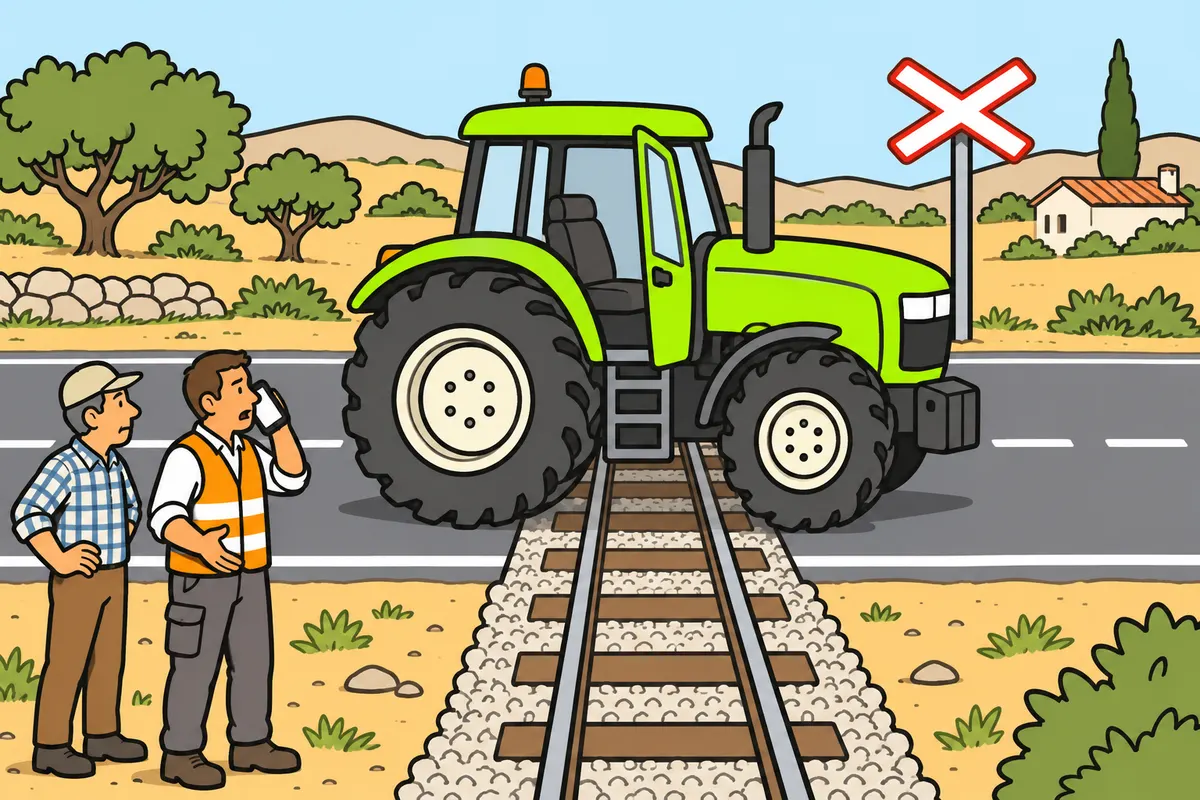
If you block rails or a movable bridge, evacuate, try to clear it and warn others.
Remember
- If you are forced to stop, get everyone out quickly.
- Try to clear the crossing as soon as possible.
- Act too if part of your load falls onto the crossing.
- If you cannot clear it, immediately warn approaching train drivers and other drivers.
- Do the same for a stopped vehicle or fallen load on a movable bridge.
Exam trap: Wrong: you only warn cars while the rails remain blocked. Right: also warn train drivers sufficiently far in advance.
Read the full explanation
- If circumstances beyond your control cause your vehicle to stop on a level crossing, you must take steps to get its occupants out quickly and clear the crossing as soon as possible. [RGC, art. 97](https://www.boe.es/buscar/act.php?id=BOE-A-2003-23514#a97).
- You have the same obligation if part of your load falls onto the crossing. You must treat it as an obstacle that may prevent rail traffic from passing, even if the tractor has cleared the crossing. [RGC, art. 97](https://www.boe.es/buscar/act.php?id=BOE-A-2003-23514#a97).
- If you cannot clear the crossing, you must immediately take every measure available to you to give both train drivers and other approaching drivers sufficient advance warning of the danger. [RGC, art. 97](https://www.boe.es/buscar/act.php?id=BOE-A-2003-23514#a97).
- You must act in the same way if your vehicle becomes immobilised or your load falls onto a movable bridge. The general procedure for alerting others and providing assistance is covered in «Accidents and breakdowns: protect and assist»; here, you must remember the specific need to evacuate occupants, try to clear the crossing or bridge and urgently warn others that it is blocked. [RGC, art. 97](https://www.boe.es/buscar/act.php?id=BOE-A-2003-23514#a97).
18Pedestrian priority
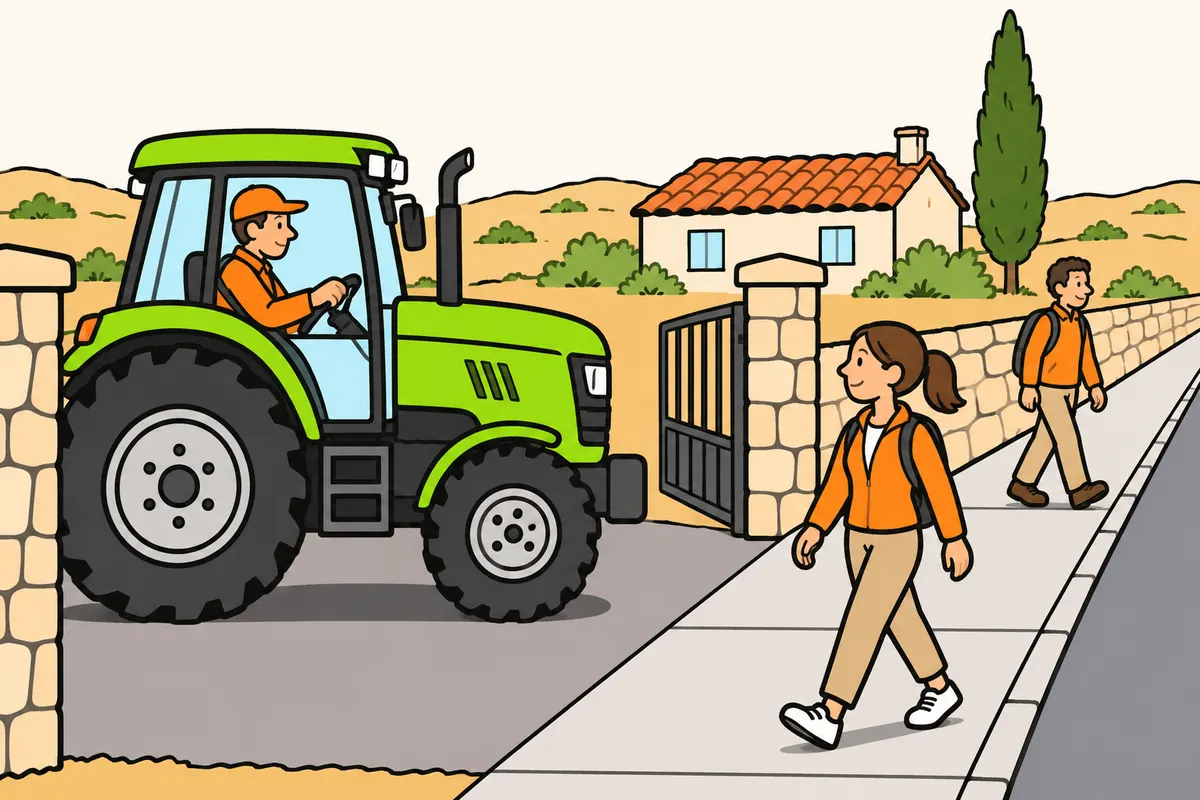
Give way to pedestrians where they have priority.
| Situation | Whom you must give way to |
|---|---|
| Crossing a pavement or pedestrian area at a designated vehicle access | Pedestrians using it |
| Turning into another road | Pedestrians crossing it, even without a crossing |
| Crossing a hard shoulder | Pedestrians using it because no pedestrian area is available |
Remember
- Obey controls at crossings and in pedestrian areas.
- Do not cut across pedestrians with your trailer or implements.
- Check the places your tractor hides from view.
Exam trap: Wrong: when turning, you only give way at painted crossings. Right: give way to pedestrians crossing the road you enter.
Read the full explanation
- You must let pedestrians pass at properly signed crossings, on pavements and in other pedestrian areas, following the applicable rules. If you drive the tractor across a pavement to enter or leave a farm, you must give way to people walking along it: vehicle access does not remove their priority. [RGC, art. 65](https://www.boe.es/buscar/act.php?id=BOE-A-2003-23514#a65).
- If you turn into another road and pedestrians are crossing it, you must give way even if there is no designated crossing. [RGC, art. 65](https://www.boe.es/buscar/act.php?id=BOE-A-2003-23514#a65).
- If you cross an arcén (hard shoulder) used by pedestrians who have no pedestrian area available, you must let them pass. This situation is particularly relevant at rural access points. [RGC, art. 65](https://www.boe.es/buscar/act.php?id=BOE-A-2003-23514#a65).
- When you cross a pedestrian area at a place authorised for vehicle access, you must respect pedestrians using it. As a practical precaution, also check the areas hidden by your own vehicle and wait until you can complete the crossing without blocking their path; the height of the cab does not guarantee that you can see the whole area around you. [RGC, art. 65](https://www.boe.es/buscar/act.php?id=BOE-A-2003-23514#a65).
19Stops and groups of pedestrians
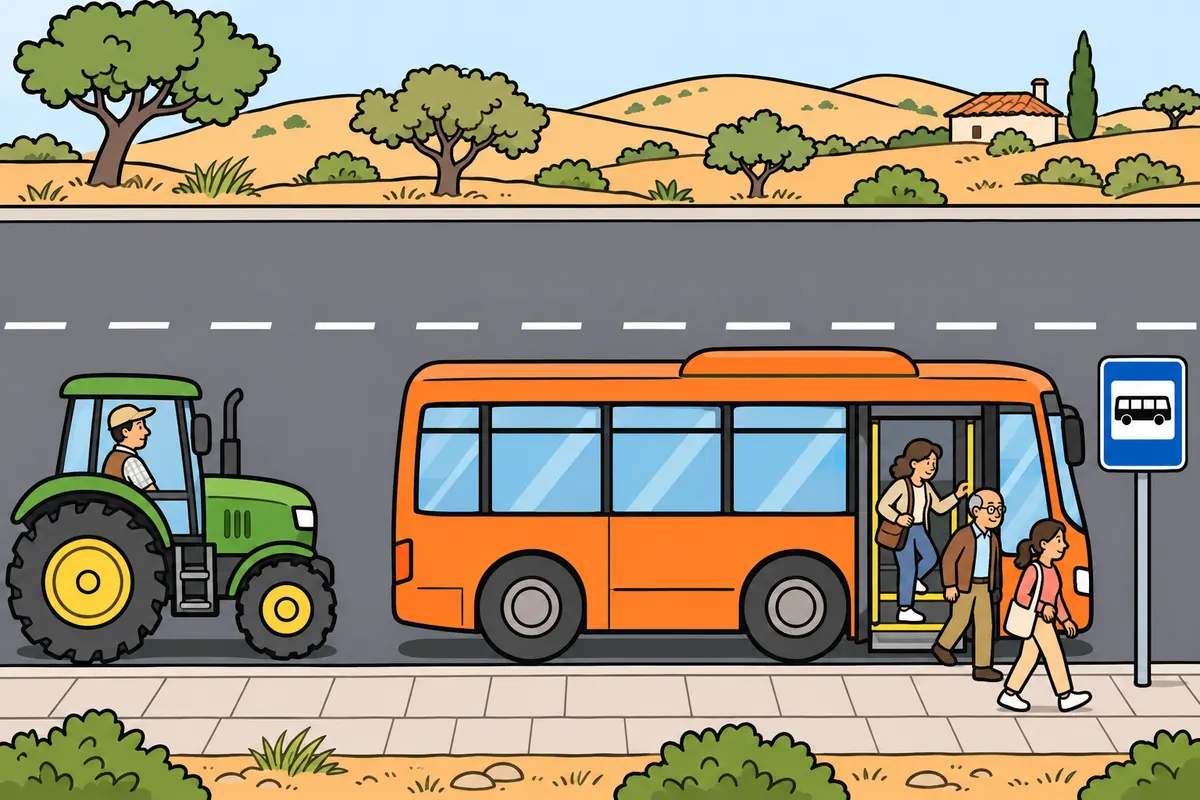
Respect passengers’ protected route and let organised groups of pedestrians pass.
Remember
- At signed stops, watch people boarding or leaving public transport.
- Give way between that vehicle and the nearest pedestrian area or refuge.
- You do not need a painted crossing to give way on that route.
- Let military units on foot, school columns and organised processions pass.
- Look for people the bus may hide.
Exam trap: Wrong: passengers’ priority applies to every bus manoeuvre. Right: this rule protects people on that route.
Read the full explanation
- You must give way to people who are about to board or have alighted from public transport at a marked stop and are between that vehicle and the nearest pedestrian area or refuge. This route is protected even if there is no painted pedestrian crossing. [RGC, art. 65](https://www.boe.es/buscar/act.php?id=BOE-A-2003-23514#a65).
- You must let military units on foot, school groups walking in line and organised processions pass. In the exam, a school group walking in line is an explicit case of priority; you must not treat it like any informal group of people choosing to cross away from a crossing. [RGC, art. 65](https://www.boe.es/buscar/act.php?id=BOE-A-2003-23514#a65).
- As a practical precaution when approaching a stop, look out for people who may be hidden by the bus. From the height of your seat, its front may hide someone nearby from view. You must be able to fulfil your duty to give way when they are on the protected route. [RGC, art. 65](https://www.boe.es/buscar/act.php?id=BOE-A-2003-23514#a65).
- The rules for helping a bus pull out from a marked stop are explained in «Manoeuvres with agricultural vehicles», in the section «Joining traffic and helping others to join». When dealing with this situation in your tractor, identify whether the path you are about to cross is that of a pedestrian or the bus itself: different conditions apply to each situation. [RGC, art. 65](https://www.boe.es/buscar/act.php?id=BOE-A-2003-23514#a65).
20Cyclists: three key situations
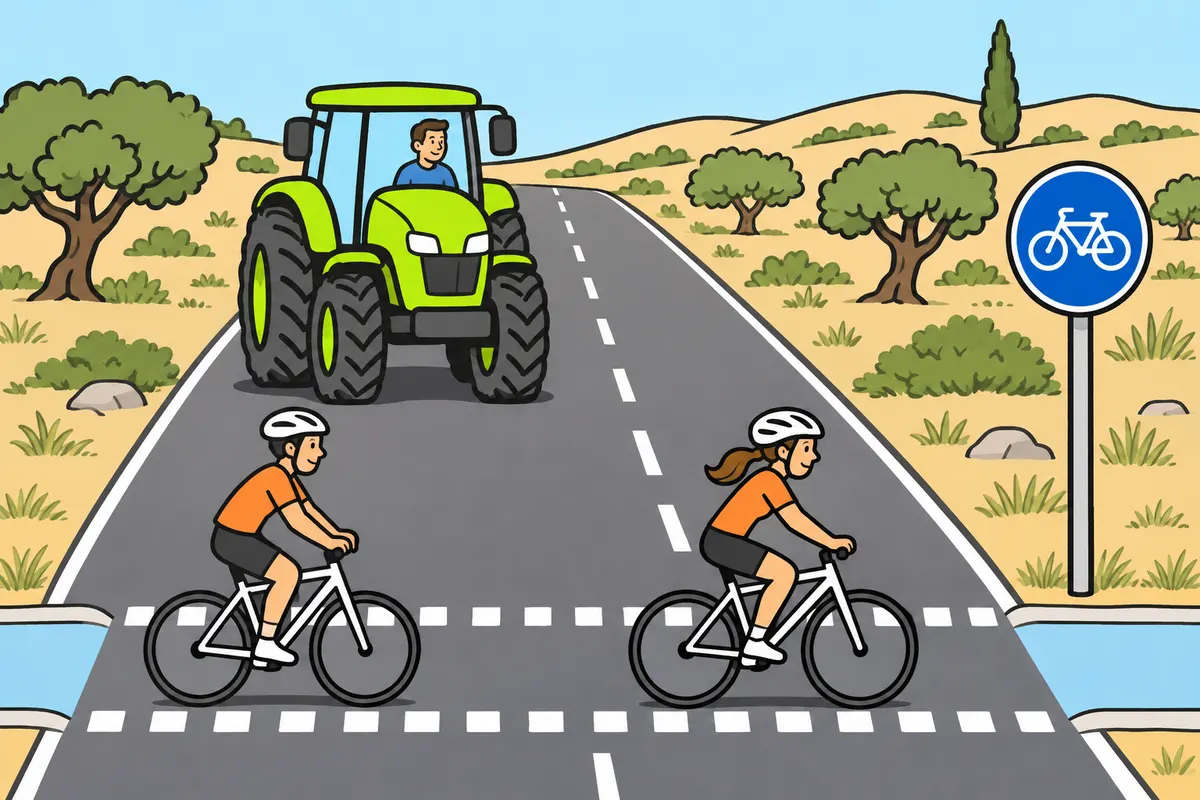
Recognise when you must give way to cyclists and keep their groups together.
| Situation | What you must do |
|---|---|
| Crossing a properly signed cycle lane, cycle crossing or hard shoulder | Give way to cyclists using it |
| Turning into another road with a cyclist nearby | Respect their priority |
| Group whose first cyclist has begun crossing or entered the roundabout | Let the whole group pass |
Remember
- Before crossing their path, check the tractor’s right-hand side too.
- Check that your trailer does not block a bicycle’s path.
- Outside these special cases, apply general priority rules.
Exam trap: Wrong: only the first cyclist in a group goes first. Right: if they have begun crossing or entered the roundabout, respect the whole group’s priority.
Read the full explanation
- You must give way to cyclists travelling along a properly signed cycle lane, cycle crossing or arcén (hard shoulder) when your path crosses theirs. You must check these areas before crossing them with your tractor; riding outside the normal traffic lane does not remove their priority. [RGC, art. 64](https://www.boe.es/buscar/act.php?id=BOE-A-2003-23514#a64).
- If you turn right or left to enter another road and a cyclist is nearby, you must respect their priority. As a practical precaution, pay particular attention to any bicycle travelling alongside you on your right: you must not cut off its path with the trailer after the cab has passed. [RGC, art. 64](https://www.boe.es/buscar/act.php?id=BOE-A-2003-23514#a64).
- If cyclists are riding in a group and the first has already begun crossing or entered a roundabout, you must respect the priority of the whole group. [RGC, art. 64](https://www.boe.es/buscar/act.php?id=BOE-A-2003-23514#a64).
- In all other cases, you must apply the general rules of priority between vehicles. A bicycle may have priority because it approaches from your right at an unsigned junction; it does not have universal priority everywhere. The answer depends on the specific situation and the applicable signs and signals. [RGC, art. 64](https://www.boe.es/buscar/act.php?id=BOE-A-2003-23514#a64).
21Animals on rural routes
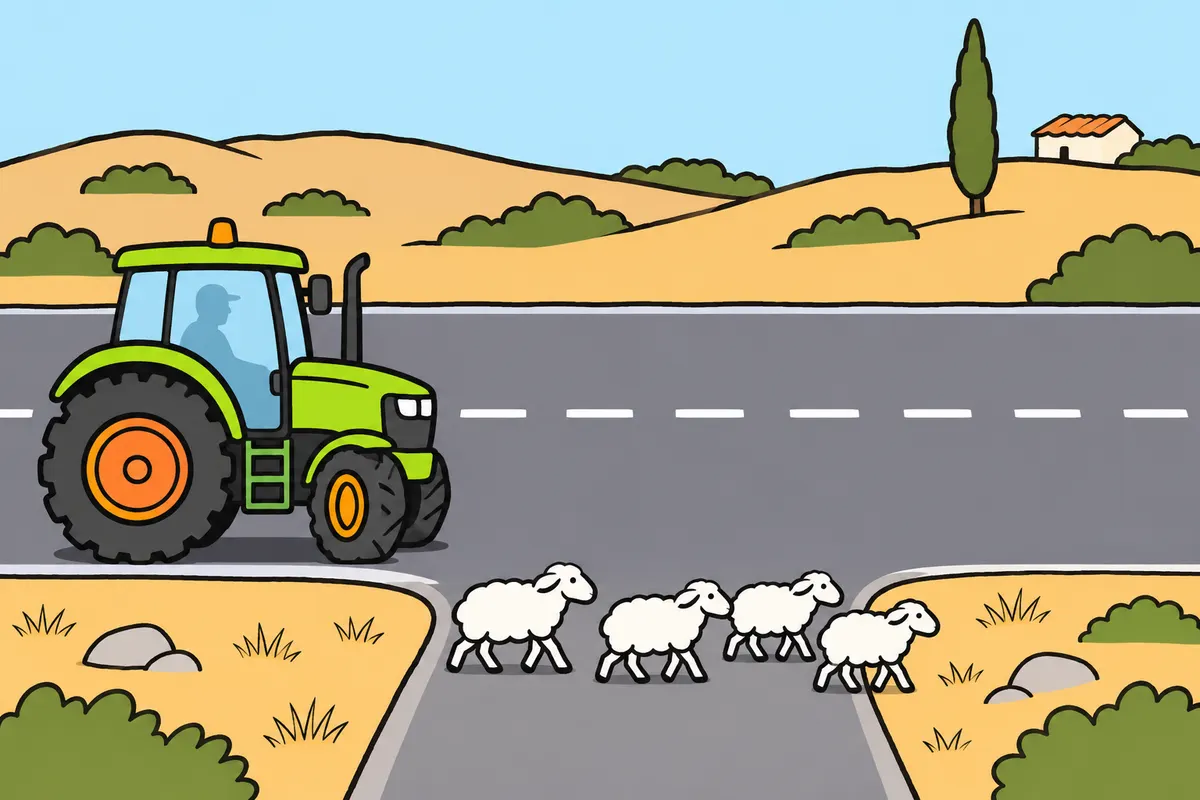
Give way to animals in the stated cases and avoid endangering them.
| Encounter with animals | What you must do |
|---|---|
| Properly signed livestock route | Give way to animals |
| Turning into a road that animals are crossing | Give way even without a prepared crossing |
| Crossing a hard shoulder used by animals with no livestock route available | Give way |
| Outside the stated exceptions | You have priority as a vehicle; drive carefully |
Remember
- Recognise a livestock route by the domestic-animal sign and “cañada” panel.
- Also check the accompanying speed restriction.
- Priority does not let you force your way through dangerously.
Exam trap: Wrong: any animal warning means a livestock route with priority. Right: recognise a properly signed livestock route.
Read the full explanation
- You must give way to animals on properly signed cañadas (livestock routes). A cañada is identified by the domestic animals crossing warning sign with a «cañada» panel below it, together with the corresponding speed limit signs. You must not confuse a general animal warning with a signed cañada. [RGC, art. 66](https://www.boe.es/buscar/act.php?id=BOE-A-2003-23514#a66).
- If you turn into another road and animals are crossing it, you must let them pass even if there is no specially prepared crossing. You must check the entrance in advance; driving an agricultural vehicle or working on that farm does not give you priority over those animals. [RGC, art. 66](https://www.boe.es/buscar/act.php?id=BOE-A-2003-23514#a66).
- If you cross a hard shoulder along which animals are travelling because they have no cañada available, you must give way to them. This priority protects the herd using the hard shoulder; the order based on difficulty of manoeuvring applies to encounters between vehicles. [RGC, art. 66](https://www.boe.es/buscar/act.php?id=BOE-A-2003-23514#a66).
- Outside the exceptions set out in the regulations, vehicles have priority over animals when their paths cross on the carriageway or hard shoulder. You must always drive cautiously: having priority does not allow you to proceed dangerously or use the tractor's size to force your way through. [RGC, art. 66](https://www.boe.es/buscar/act.php?id=BOE-A-2003-23514#a66).
22Priority vehicles on urgent duty
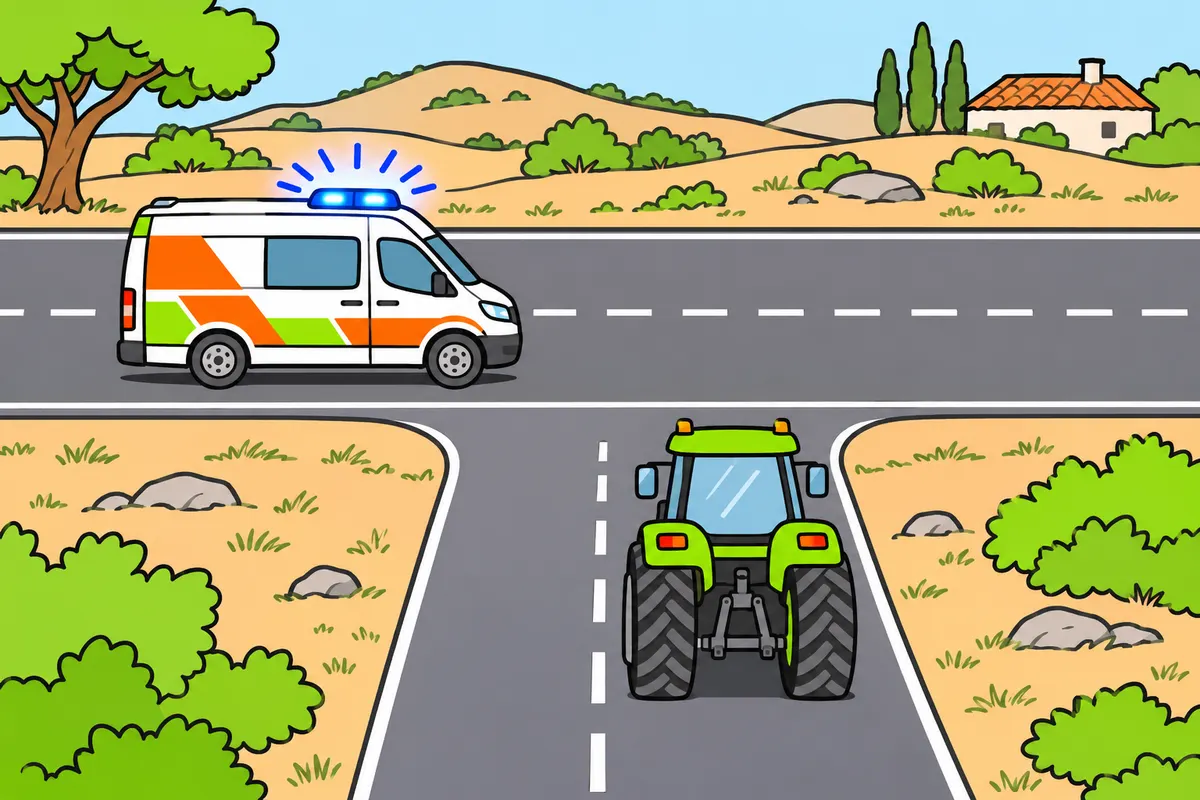
Recognise urgent duty and the required warning signals of priority vehicles.
| Warning from a priority vehicle on urgent duty | Signals you may find |
|---|---|
| Usual case | Special light and audible signals together |
| Omitting the audible signal does not endanger others | Light signal only |
Remember
- Do not assume an ambulance is on urgent duty because of its appearance.
- Recognise police, fire, civil protection, rescue and medical assistance services.
- They must be on urgent duty and signal their presence as required.
- Even on urgent duty, their drivers must always obey officers.
- Do not copy their exceptional manoeuvres with your tractor.
Exam trap: Wrong: without a siren they never have priority. Right: they may use only lights when omitting the audible signal causes no danger.
Read the full explanation
- Police, fire, civil protection, rescue and healthcare vehicles, whether public or private, have priority status when on urgent duty and signalling their presence as required by the regulations. An ambulance does not have this status simply because of its appearance or because it belongs to a healthcare service. [RGC, art. 68](https://www.boe.es/buscar/act.php?id=BOE-A-2003-23514#a68).
- Their presence is normally signalled by a warning light and a special audible warning used simultaneously. When omitting the audible warning poses no danger to others, they must use only the warning light. An ambulance on urgent duty with its warning light on may therefore retain priority even if you do not hear a siren. [RGC, art. 68](https://www.boe.es/buscar/act.php?id=BOE-A-2003-23514#a68).
- Drivers of priority vehicles may use the exceptional provisions under their own responsibility and without endangering anyone, but must always obey officers' orders and signals. As the tractor driver, you may receive an officer's order to stop to keep the route clear for the vehicle on urgent duty. [RGC, art. 68](https://www.boe.es/buscar/act.php?id=BOE-A-2003-23514#a68).
- Exceptional powers concerning speed, signs and signals or certain manoeuvres belong to the priority vehicle under the conditions laid down by law. You must not copy these actions in your tractor to follow it or use its passage to cross behind it without checking your own priority; you must carry out your manoeuvre according to the rules that apply to you. [RGC, art. 68](https://www.boe.es/buscar/act.php?id=BOE-A-2003-23514#a68).
23How to help in an emergency
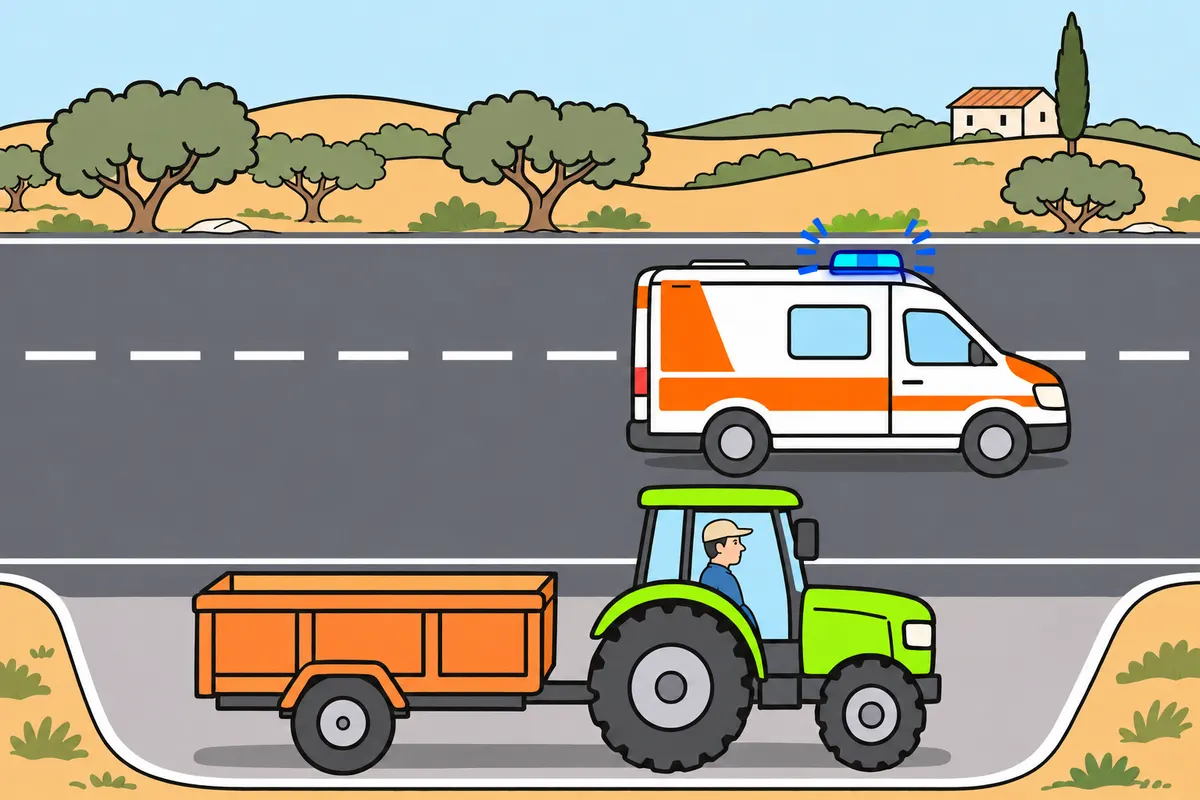
Help emergency vehicles pass with safe, predictable movements.
Remember
- Normally, move to the right and stop if necessary.
- Check that your trailer also leaves enough space.
- Do not brake suddenly where you could block the emergency vehicle.
- Follow officers’ instructions.
- See “Signs and their hierarchy” for police instructions.
- Before moving again, check traffic and possible emergency vehicles.
Exam trap: Wrong: a siren lets you ignore any sign on your own initiative. Right: help safely and obey officers.
Read the full explanation
- As soon as you notice a priority vehicle's warning signals, you must help it pass by taking measures appropriate to the circumstances, normally moving to the right or stopping if necessary. You must check that there is room for the whole combination; a sudden movement of the tractor may leave the trailer blocking the route you are trying to clear. Article 69 also refers to the emergency lane under article 32 on autopistas and autovías (motorways), roads you cannot enter with your LVA vehicle. [RGC, arts. 69, 32 and 38](https://www.boe.es/buscar/act.php?id=BOE-A-2003-23514#a69).
- As a practical technique, choose a safe place in advance and make predictable movements. You must not brake suddenly at a narrow section if doing so blocks the ambulance's passage. You must act according to the location and follow any instructions officers give you. [RGC, art. 69](https://www.boe.es/buscar/act.php?id=BOE-A-2003-23514#a69).
- If you receive an order to stop from a police vehicle, you must obey it as explained in «Signs and their hierarchy», in the section «Orders from police vehicles». [RGC, art. 69](https://www.boe.es/buscar/act.php?id=BOE-A-2003-23514#a69).
- As a practical precaution, after letting the vehicle on urgent duty pass, check the traffic again before moving off in your tractor. Another emergency vehicle may be approaching and other road users may be returning to their original paths; the trailer needs room to move off again without blocking that route. [RGC, art. 69](https://www.boe.es/buscar/act.php?id=BOE-A-2003-23514#a69).
24An emergency involving a non-priority vehicle
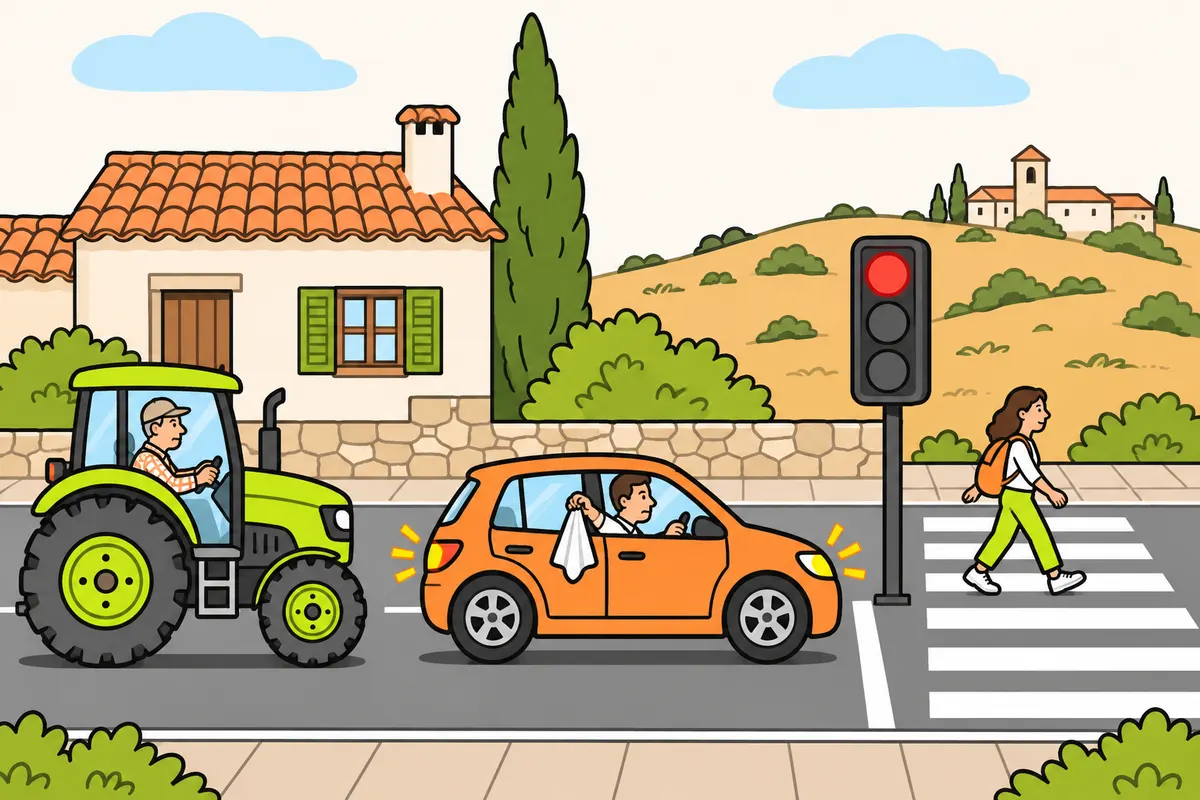
Help a private emergency vehicle, but remember its driver must obey the rules.
| Warning from a private vehicle in an exceptional emergency | How you signal the situation |
|---|---|
| Sound | Use your horn intermittently |
| Visual | Use hazard lights if fitted, or a handkerchief or similar method |
Remember
- This exception requires particularly serious circumstances and no other means available.
- Being late does not turn your tractor into an emergency vehicle.
- Help it proceed as circumstances allow.
- If driving that vehicle, obey the rules, especially at junctions.
- Officers may ask you to justify the serious circumstances.
Exam trap: Wrong: a handkerchief lets you cross a red light. Right: the private driver must obey traffic rules.
Read the full explanation
- You may encounter a private vehicle which, because of particularly serious circumstances and with no other means available, is carrying out a service normally reserved for priority vehicles. Being late for agricultural work is an everyday reason for hurrying and does not fall within this exceptional situation. [RGC, art. 70](https://www.boe.es/buscar/act.php?id=BOE-A-2003-23514#a70).
- To signal this situation, the driver sounds the horn intermittently and uses the hazard warning lights if fitted, or a handkerchief or similar means. You must help the vehicle proceed as circumstances allow, but these warnings do not give it the exceptional powers of an ambulance with priority status. [RGC, art. 70](https://www.boe.es/buscar/act.php?id=BOE-A-2003-23514#a70).
- The driver of the non-priority vehicle must obey traffic rules, especially at junctions. Although others must help the vehicle pass, the driver cannot assume that a handkerchief authorises them to go through a red light or demand absolute priority over pedestrians. [RGC, art. 70](https://www.boe.es/buscar/act.php?id=BOE-A-2003-23514#a70).
- Officers may at any time require the driver to justify the particularly serious circumstances. If you are in this situation, your justification must reflect the actual seriousness of the circumstances as well as the impossibility of using any other means. [RGC, art. 70](https://www.boe.es/buscar/act.php?id=BOE-A-2003-23514#a70).
25Agricultural warnings and assistance services
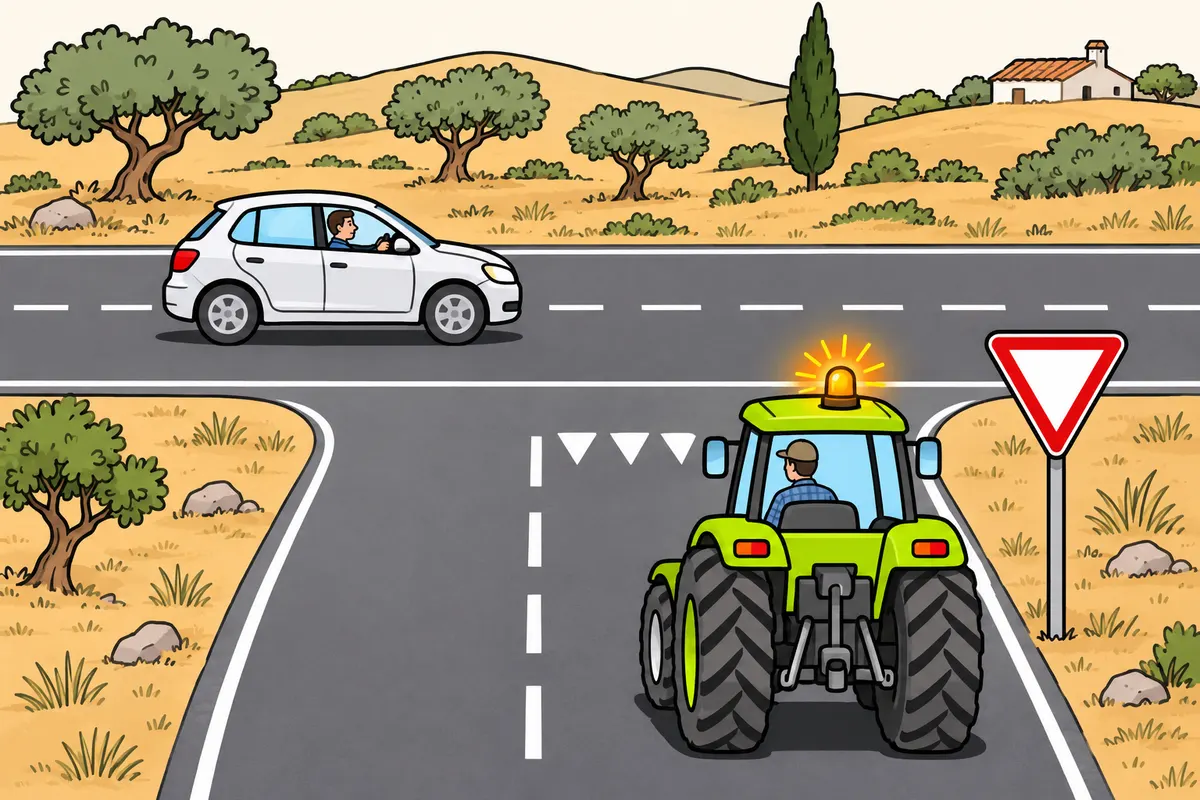
Your agricultural warning light gives you no priority.
| Vehicle or activity | What you must distinguish |
|---|---|
| Tractor with V-2 | Warns of its presence; has no general priority |
| Road construction, repair or maintenance work | Specific rules within the work area, with precautions and controlled traffic |
| Recovery, assistance or maintenance vehicle | Its role does not automatically make it a priority vehicle on urgent duty |
Remember
- With V-2, follow the priority rules that apply.
- Carrying tools or travelling to a field gives you no special powers.
- V-2 on recovery and roadwork vehicles warns others of their presence.
- That signal does not make them priority vehicles.
Exam trap: Wrong: your tractor with V-2 has an urgent ambulance’s powers. Right: the signal warns others but gives you no general priority.
Read the full explanation
- Your status as a special vehicle and your use of the V-2 warning signal do not give you general priority at junctions, roundabouts or narrow sections. You must follow the traffic controls and the priority rule that applies to the situation. [RGC, art. 67](https://www.boe.es/buscar/act.php?id=BOE-A-2003-23514#a67). [RGC, art. 68](https://www.boe.es/buscar/act.php?id=BOE-A-2003-23514#a68).
- If you drive a vehicle working on road construction, repair or maintenance, specific rules apply within the work area, with the necessary precautions and traffic suitably controlled. You must not assume that these rules apply to your tractor simply because you are driving to a field or carrying agricultural tools. [RGC, art. 71](https://www.boe.es/buscar/act.php?id=BOE-A-2003-23514#a71).
- If you drive a roadside assistance vehicle or a vehicle used for works or services, you use the V-2 warning signal to warn others of your presence. You must interpret this light as a warning of the vehicle’s presence and activity; the classification of priority vehicles on urgent duty is explained in «Priority vehicles on urgent duty». The use of the agricultural warning signal is covered in «The agricultural vehicle and its equipment», in the section «V-2: when you must use it». [RGC, art. 113](https://www.boe.es/buscar/act.php?id=BOE-A-2003-23514#a113).
Deal with a junction
You must decide before entering the space where paths cross.
- Identify traffic officers, temporary traffic controls, traffic lights, upright signs and road markings; apply their hierarchy.
- If there are no controls, check the exceptions and priority from the right.
- Check for pedestrians and cyclists, including those affected by your turn.
- If you must give way, slow down progressively and stop when required; at STOP, make the required stop.
- Check that you can proceed without forcing the road user with priority to change speed or direction abruptly and without blocking the exit with the trailer.
Decide who reverses
You must identify the location before comparing the vehicles.
- Check whether an instruction or sign determines who goes first, and obey it.
- If it is a narrow section with a steep gradient, apply priority for uphill traffic and the exception involving a lay-by.
- On an ordinary unsigned narrow section, check who entered first; if in doubt, apply article 62.
- On an unsigned bridge, follow the reference in article 61 to the order in article 62.
- Classify the tractor: exceeding mass or dimension limits, a combination with a trailer, or a special vehicle on its own within ordinary limits.
- If the vehicles are of the same type, compare the reversing distance and, if equal, width, length or MMA (maximum authorised mass).
Cross rails or a movable bridge
You must have permission to proceed and enough space to clear the crossing completely.
- Slow down below the maximum permitted speed and observe signs, barriers and traffic.
- Wait if the crossing is closed, the barriers are moving or a signal prohibits you from proceeding.
- At an unprotected level crossing, make sure that no rail vehicle is approaching.
- Check that there is space on the other side for the whole combination and cross without delay.
- If you become blocked by circumstances beyond your control, evacuate the occupants, try to clear the crossing and, if you cannot, immediately warn anyone approaching.
Finished this module?
Mark it as read and you will see your progress on the theory list.