
Theory · C Licence - Truck · Module 10 of 18
Lorry dimensions and masses
You learn to distinguish actual, authorised and technically permissible masses and apply the maximum limits for lorries, their axles and goods vehicle combinations. You answer questions on dimensions, overhangs, turning circles, special transport operations and access restriction signs, always checking the conditions of each exception. You learn which vehicles must have a speed limiter, its settings, exemptions and checks.
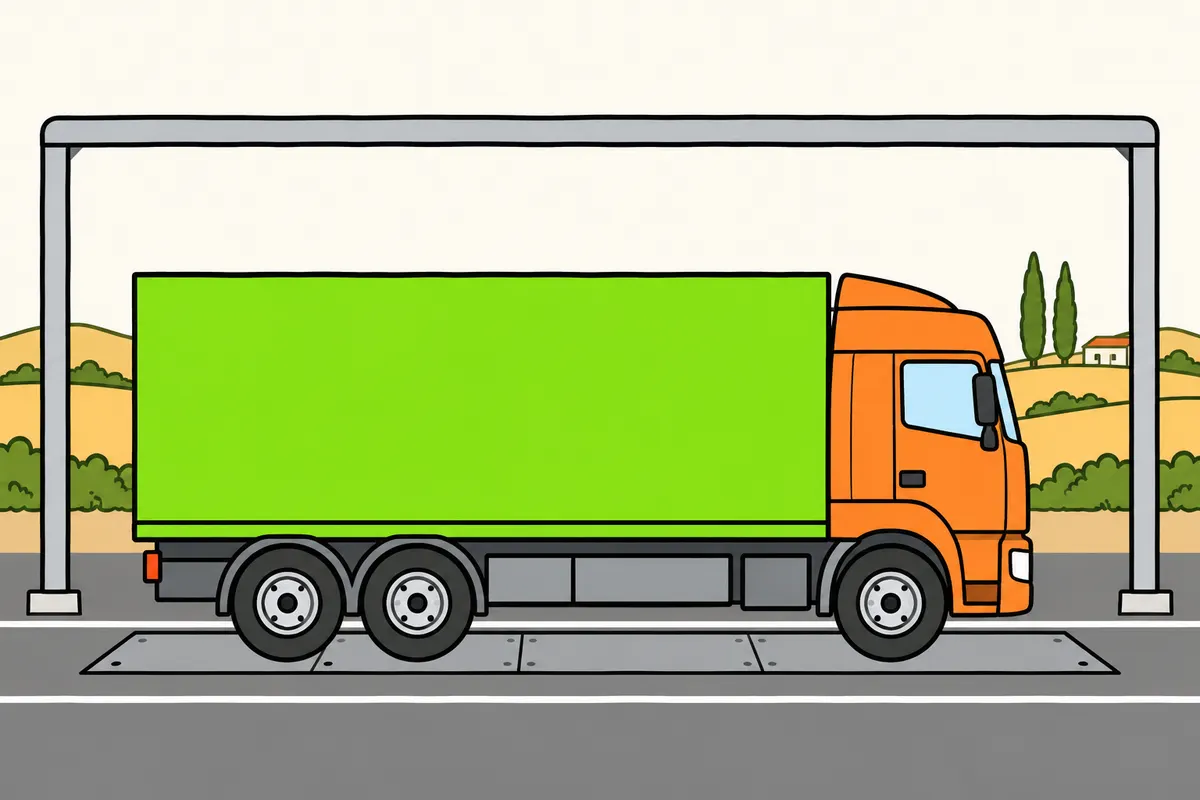
1Which mass you are calculating
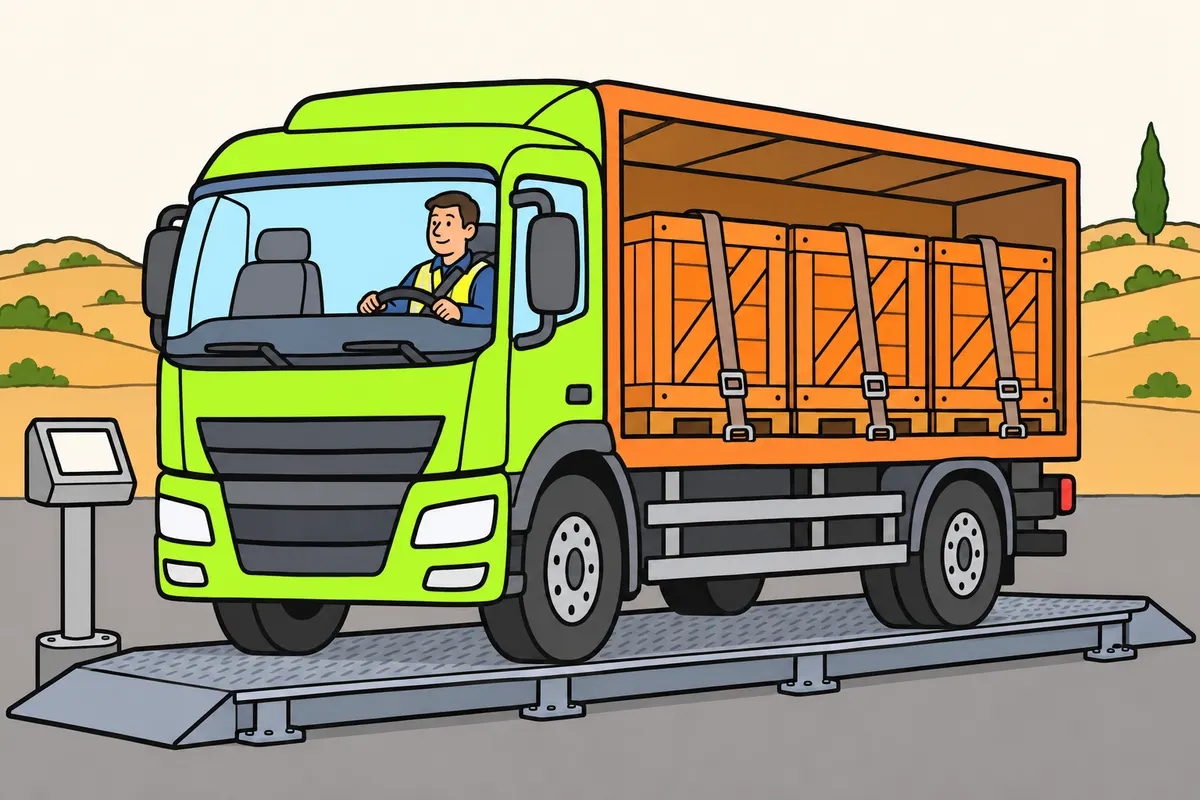
Distinguish your lorry’s mass by what you include in the calculation.
| Mass | What you count |
|---|---|
| Tare | Equipped lorry without people or goods |
| Laden | Actual lorry, people and goods |
| In running order | Tare plus a standard driver of 75 kg |
Remember
- For tare mass, count your equipped lorry without people or goods.
- For laden mass, count everything, including everyone on board.
- For actual mass, use your driver’s actual weight.
Exam trap: Wrong: count only goods. Right: include your lorry and everyone on board.
Read the full explanation
- The tare mass includes the authorised fixed equipment and full supplies of water, fuel, lubricants, spare parts, tools and necessary accessories, but excludes service personnel, passengers and goods. This means that a lorry with no goods but with a driver does not have exactly its tare mass. [RGV, Annex IX](https://www.boe.es/buscar/act.php?id=BOE-A-1999-1826#anix).
- The laden mass is the actual mass of the vehicle and everything it carries at that moment, including the people on board. To answer a question involving a weighbridge, you must count the lorry, the goods, the driver and the other occupants actually present; do not use only the weight shown on the delivery note for the goods. [RGV, Annex IX](https://www.boe.es/buscar/act.php?id=BOE-A-1999-1826#anix).
- For your lorry, the mass in running order is the tare mass plus a standard driver mass of 75 kg. This figure serves this technical definition: you must not use it instead of a person’s actual mass when the question asks you to calculate the actual laden mass. [RGV, Annex IX](https://www.boe.es/buscar/act.php?id=BOE-A-1999-1826#anix).
- You must use units without confusing them: one tonne equals 1,000 kg. If a sign shows 5.5 t, you compare it with 5,500 kg; if a table shows 26 t, this means 26,000 kg for the mass of the whole vehicle in the relevant case, not additional tonnes of goods. [RGV, Annex IX](https://www.boe.es/buscar/act.php?id=BOE-A-1999-1826#anix).
2MMA, technical limits and available load capacity
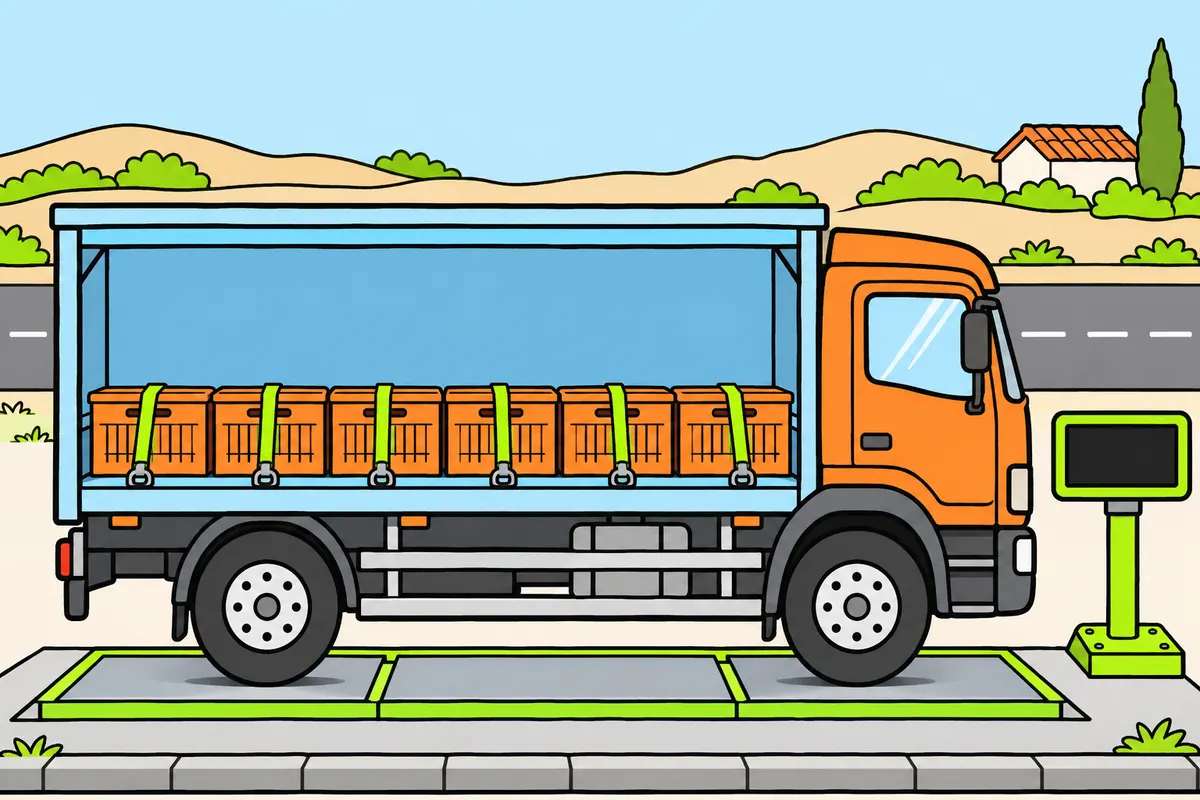
Respect all your vehicle’s mass limits together.
| Limit | What you check |
|---|---|
| MMA | Maximum authorised mass for road use |
| Technical maximum | Maximum set by the manufacturer |
Remember
- MMA means the maximum authorised mass for driving with a load.
- Also respect the manufacturer’s technical maximum.
- After subtracting tare from MMA, allow for people and other items.
- Check total mass, each axle and each axle group.
- Avoid counting weight transferred to your tractor unit twice.
- Even with spare total capacity, check the axles before adding a package.
Exam trap: Wrong: meeting MMA is enough. Right: also check axles, axle groups and technical limits.
Read the full explanation
- The MMA (maximum authorised mass) is the maximum mass permitted when you use the laden vehicle on public roads. The technically permissible maximum mass depends on its construction and is specified by the manufacturer. You must respect both limits: a general figure in the table does not allow you to ignore a lower technical or authorised limit for the particular lorry. [RGV, Annex IX](https://www.boe.es/buscar/act.php?id=BOE-A-1999-1826#anix).
- The difference between MMA and tare mass gives you a theoretical capacity that must also accommodate people and any items not included in the tare mass. If the MMA is 18,000 kg and the tare mass is 8,000 kg, the 10,000 kg difference is not entirely available for goods when you must add the driver or other masses present. [RGV, Annex IX](https://www.boe.es/buscar/act.php?id=BOE-A-1999-1826#anix).
- You must check the total mass, axle masses and axle group masses at the same time. You can have a total below the MMA and overload the rear axle by placing too much weight at the back. You can also stay within the limit for each individual axle and exceed the maximum for the group or the whole vehicle. [RGV, Annex IX](https://www.boe.es/buscar/act.php?id=BOE-A-1999-1826#anix).
- For a vehicle combination, you must distinguish between its maximum authorised mass and its technically permissible maximum mass. The vertical load transferred by the semi-trailer to the tractor unit affects its axles and the coupling; you must not add figures from documents without checking what mass each represents, and you must avoid counting this transferred load twice. [RGV, Annex IX](https://www.boe.es/buscar/act.php?id=BOE-A-1999-1826#anix).
- Example of available capacity: if your lorry has a documented MMA of 18,000 kg and the weighbridge reads 17,600 kg, you have 400 kg remaining before reaching that total limit. To accept another package, you must also know the remaining capacity of the axles that receive its mass. If the rear axle is at its maximum, the 400 kg of remaining total capacity does not justify adding the package over the area it supports; you must resolve the load distribution and check the resulting masses again. [RGV, Annex IX](https://www.boe.es/buscar/act.php?id=BOE-A-1999-1826#anix).
3Identify the axles and their functions
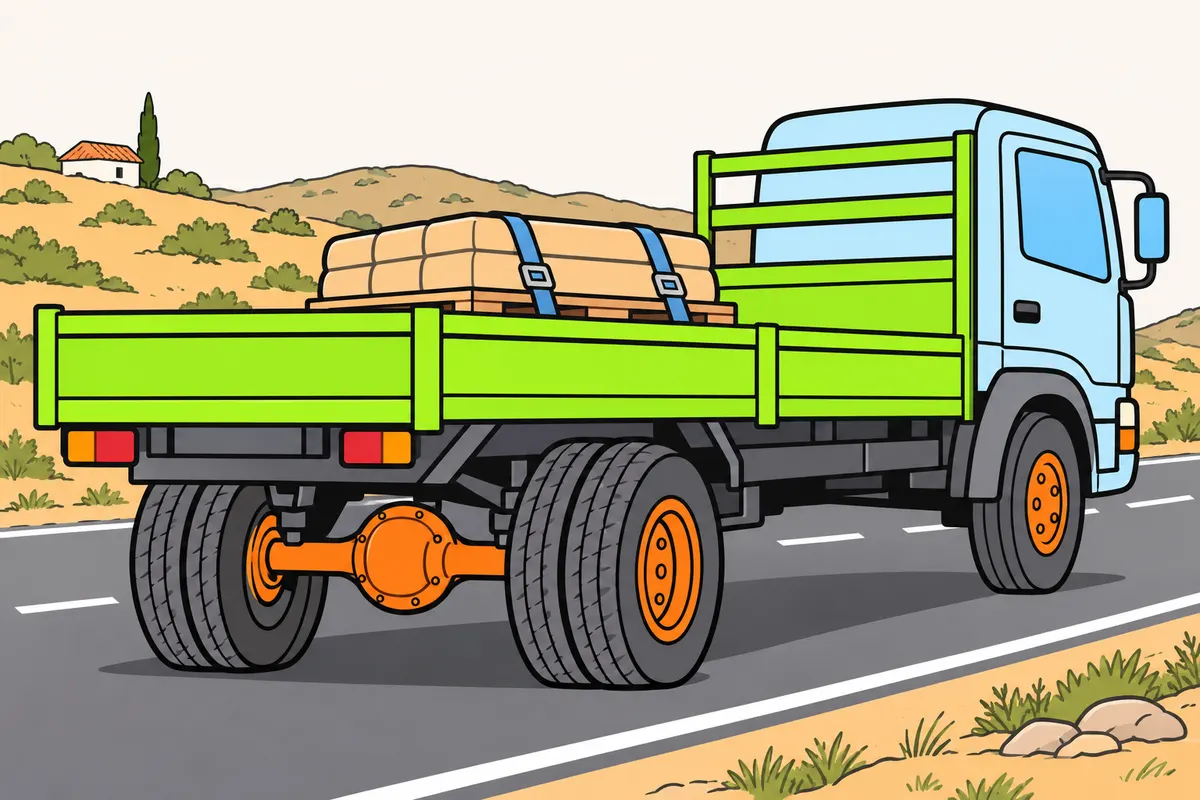
Identify your axles and their spacing before choosing a mass limit.
| Type | What you distinguish |
|---|---|
| Driving | Provides the force to move |
| Steering | Steers your vehicle |
| Tandem | Group of two axles |
| Triaxle | Group of three axles |
| Retractable | You can raise or lower it |
| Loadable | You change its load without raising it |
Remember
- Count the load through all wheels on the same axle.
- Twin wheels do not increase your axle’s limit.
- Check axle spacing and vehicle type.
- After raising an axle, check the load on those still touching the ground.
Exam trap: Wrong: more tyres allow more axle mass. Right: respect the axle limit.
Read the full explanation
- The axle mass is the mass transmitted to the ground through all the wheels attached to that axle. If it has twin wheels, you add the mass transmitted through all of them: you do not multiply the axle limit by the number of tyres. You must distinguish the driving function from the steering function, although an axle can perform both. [RGV, Annex IX](https://www.boe.es/buscar/act.php?id=BOE-A-1999-1826#anix).
- An axle group consists of the axles that form part of a bogie. A group of two axles is called a tandem and a group of three a triaxle tandem; by convention, a single axle is also considered a group. [RGV, Annex IX](https://www.boe.es/buscar/act.php?id=BOE-A-1999-1826#anix).
- You must read the spacing d between the axles to choose the correct row in the table. A lorry tandem and a trailer tandem can have different limits with identical spacing. Counting four wheels or visually identifying two nearby axles is not enough to assign them an authorised mass. [RGV, Annex IX](https://www.boe.es/buscar/act.php?id=BOE-A-1999-1826#anix).
- A retractable axle can be raised or lowered; with a load-relieving axle, you vary the load without lifting it. These devices allow you to adapt the distribution to the intended conditions, but they do not give you general authorisation to overload. You must check the limits for the axles that remain on the ground and the actual configuration used on the road. [RGV, Annex IX](https://www.boe.es/buscar/act.php?id=BOE-A-1999-1826#anix).
4Single axles and minimum load on driven axles
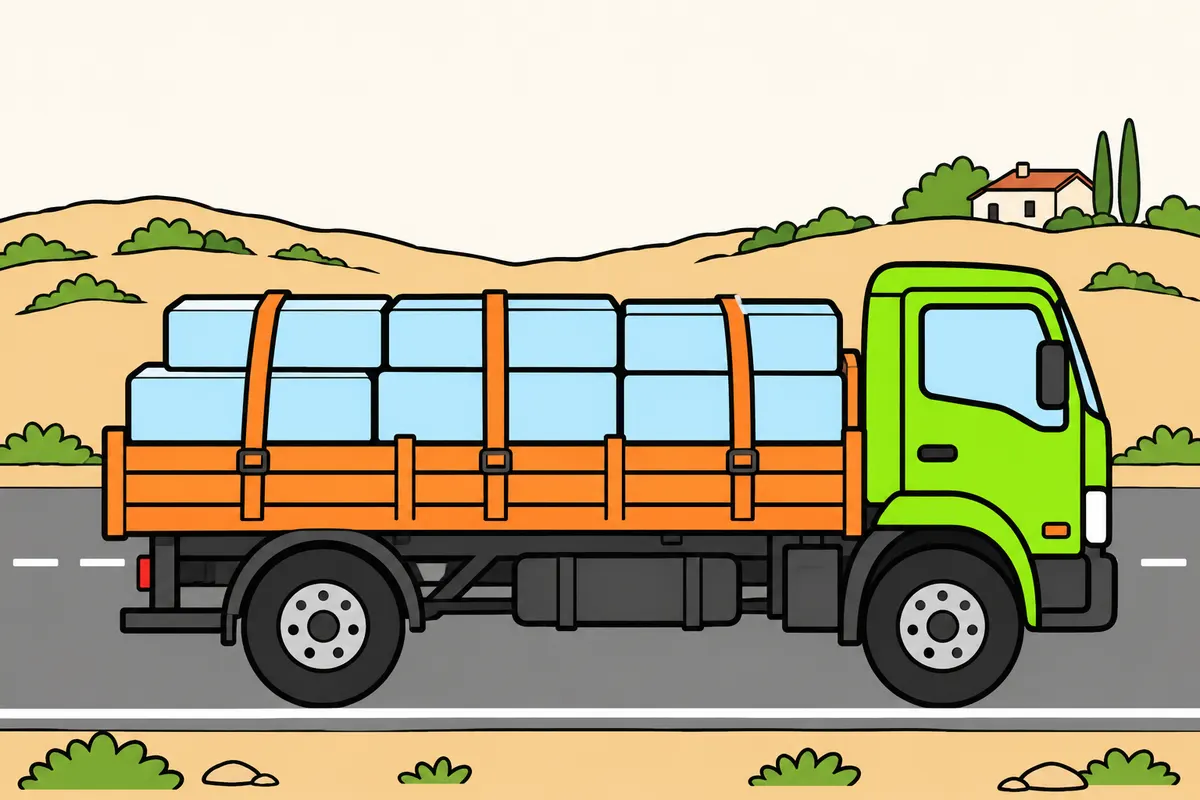
Distribute weight within axle limits while keeping enough weight on your driving axles.
| Lorry single axle | General maximum |
|---|---|
| Driving | 12 t |
| Non-driving | 10 t |
Remember
- Calculate driving axle load from total actual mass, including your vehicle and people.
- For an ordinary two-axle rigid lorry, respect the 18 t maximum.
- Respect your tyres’ safe load limits.
- Distinguish pressure on the road from tyre inflation pressure.
- For European Modular System combinations and roundwood, check the minimum load exception.
- The exception requires enough driving axle load to start on 8 % gradients.
Exam trap: Wrong: adding axle limits allows 22 t. Right: also respect your lorry’s total maximum.
Read the full explanation
- For a lorry, the general maximum for a single driven axle is 12 t and for a single non-driven axle it is 10 t. You must also apply their technical limits and those of the whole vehicle. You must not use the specific bus rows for a category C lorry. [RGV, Annex IX](https://www.boe.es/buscar/act.php?id=BOE-A-1999-1826#anix).
- You cannot turn these maximum figures into an MMA of 22 t for any two-axle lorry. Although a driven axle allows 12 t and a non-driven axle 10 t, an ordinary two-axle rigid lorry has a general maximum of 18 t. You must comply with the limits together; one does not replace another. [RGV, Annex IX](https://www.boe.es/buscar/act.php?id=BOE-A-1999-1826#anix).
- As a general rule, the driven axle or axles must carry at least 25 % of the total laden mass of the vehicle or combination. For an actual mass of 20 t, this minimum is 5 t on the driven axles. You must calculate it using the total laden mass, not just the goods. [RGV, Annex IX](https://www.boe.es/buscar/act.php?id=BOE-A-1999-1826#anix).
- For European Modular System combinations or combinations carrying round timber, a proportion below 25 % may be permitted, provided they have sufficient mass on the driven axles to start moving on gradients of 8 %. You must not extend this exception to ordinary transport of any goods simply because you have many axles. [RGV, Annex IX](https://www.boe.es/buscar/act.php?id=BOE-A-1999-1826#anix).
- You must also not drive if the tyres carry loads above their safety limits or if the pressure on the road surface exceeds 9 kg/cm² of gross contact area. This last figure is not the inflation pressure you must put in the tyres: these are different quantities. [RGV, Annex IX](https://www.boe.es/buscar/act.php?id=BOE-A-1999-1826#anix).
5Motor vehicle tandem axles
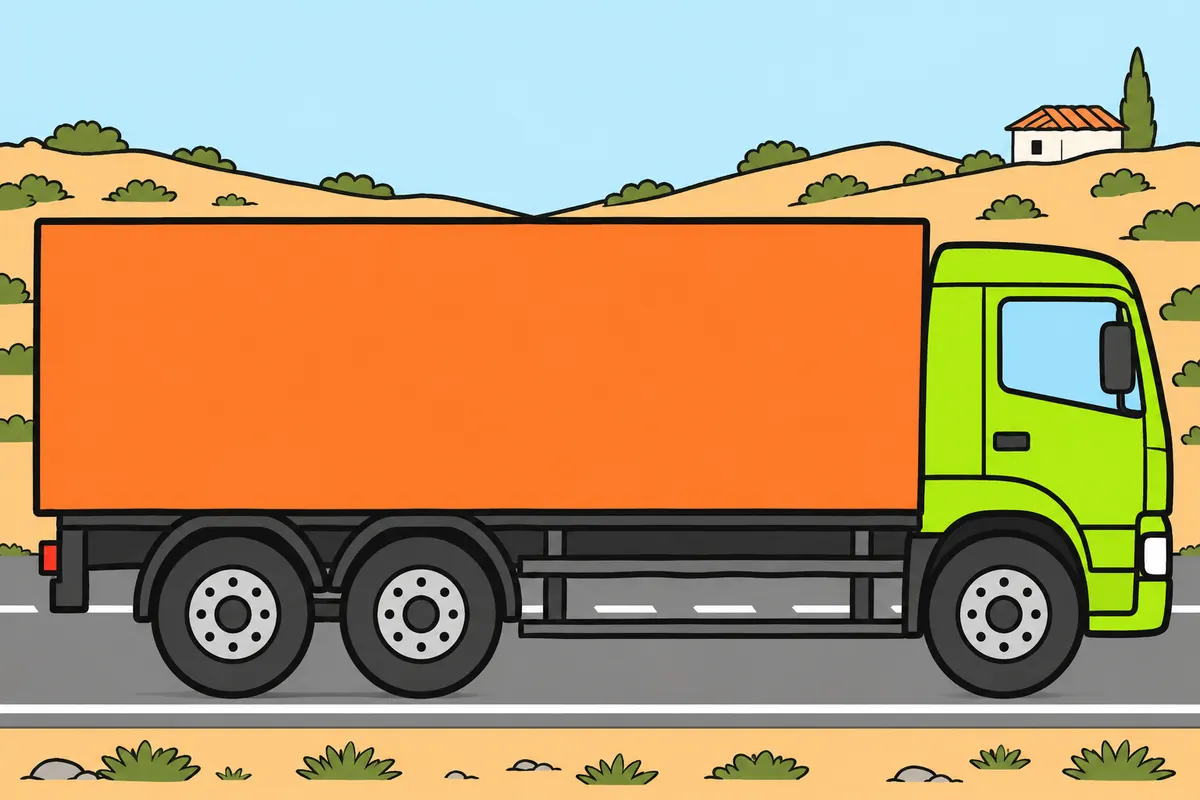
Choose your tandem limit using axle spacing and technical conditions.
| Motor vehicle tandem spacing d | Maximum |
|---|---|
| Below 1.00 m | 12 t |
| 1.00 m to below 1.30 m | 16 t |
| 1.30 m to below 1.80 m | 18 t; 19 t with the stated conditions |
Remember
- The letter d means the distance between axles.
- For 19 t, check spacing and the driving axle conditions.
- Your driving axle needs twin tyres and air suspension or recognised equivalent.
- Alternatively, each driving axle needs twin tyres and a maximum of 9.5 t.
- Air suspension supplies at least 75 % of the spring effect.
- With d = 1.30 m exactly, use the range starting at that figure.
Exam trap: Wrong: any air suspension allows 19 t. Right: check spacing and all driving axle conditions.
Read the full explanation
- For a tandem on your lorry, if d is less than 1.00 m, the group maximum is 12 t. When 1.00 m ≤ d < 1.30 m, the maximum is 16 t. You must include exactly 1.00 m in the second interval; do not treat it as a spacing of less than one metre. [RGV, Annex IX](https://www.boe.es/buscar/act.php?id=BOE-A-1999-1826#anix).
- When 1.30 m ≤ d < 1.80 m, the ordinary tandem maximum is 18 t. Thus, 1.20 m or 1.25 m gives you 16 t, while 1.50 m gives you 18 t, unless the case meets the additional conditions that allow 19 t. [RGV, Annex IX](https://www.boe.es/buscar/act.php?id=BOE-A-1999-1826#anix).
- Within this interval from 1.30 m to less than 1.80 m, you can apply 19 t if the driven axle has twin tyres and air suspension or a recognised equivalent. This is also permitted if each driven axle has twin tyres and the maximum mass of each does not exceed 9.5 t. [RGV, Annex IX](https://www.boe.es/buscar/act.php?id=BOE-A-1999-1826#anix).
- The suspension and tyres required for 19 t must be fitted to the axles specified in the table. For these purposes, suspension is pneumatic when at least 75 % of its spring effect comes from a pneumatic device; equivalence must be recognised under the regulations. [RGV, Annex IX](https://www.boe.es/buscar/act.php?id=BOE-A-1999-1826#anix).
- With d = 1.30 m exactly, you apply the row for 1.30 m to less than 1.80 m; if the spacing is given in centimetres (130 cm), convert it first. [RGV, Annex IX](https://www.boe.es/buscar/act.php?id=BOE-A-1999-1826#anix).
6Tandem and triaxle groups on towed vehicles
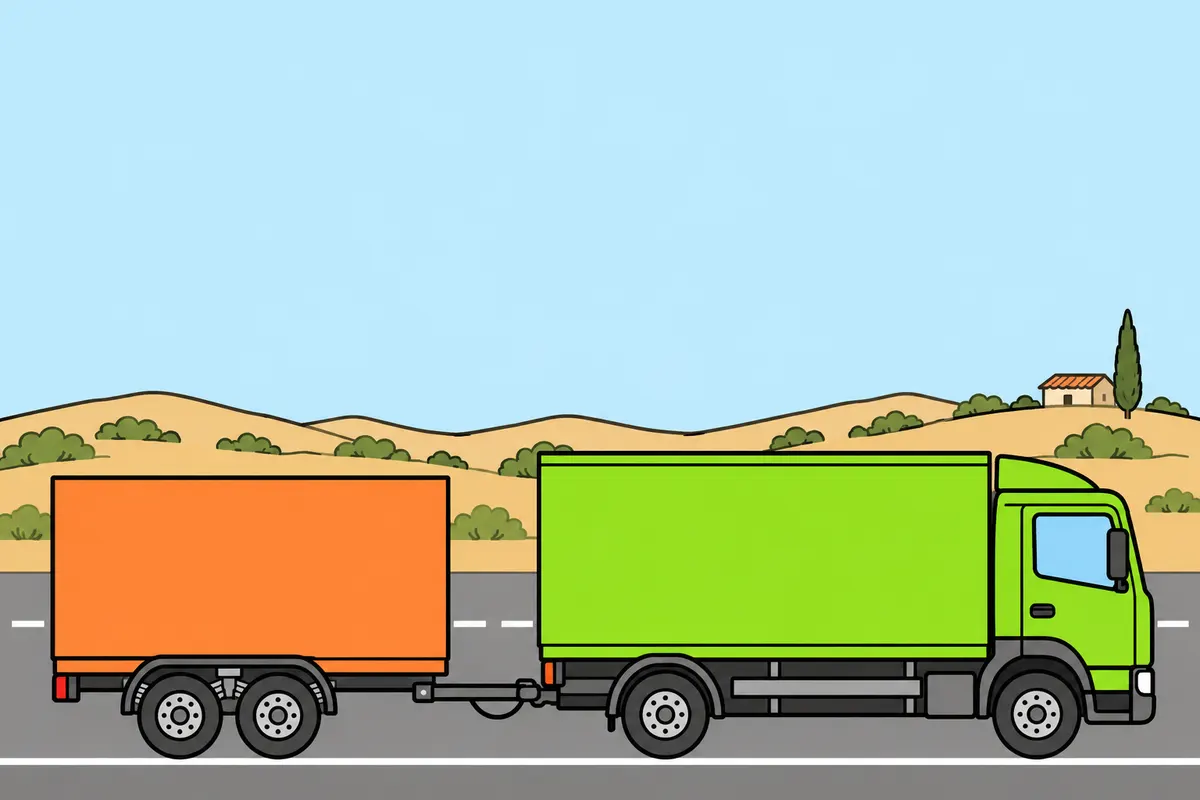
Use the correct limits for your trailer’s axle groups.
| Trailer or semi-trailer group and spacing d | Maximum |
|---|---|
| Tandem: below 1.00 m | 11 t |
| Tandem: 1.00 m to below 1.30 m | 16 t |
| Tandem: 1.30 m to below 1.80 m | 18 t; 20 t with the stated exception |
| Tandem: 1.80 m or more | 20 t |
| Triaxle: up to and including 1.30 m | 21 t |
| Triaxle: above 1.30 m up to and including 1.40 m | 27 t |
Remember
- Use the trailer table for your trailer’s axle groups.
- Exactly 1.80 m allows 20 t for a trailer tandem.
- Exactly 1.30 m means 21 t for a trailer triaxle group.
- The exception requires a semi-trailer with reinforced tipping body for construction, works or mining.
Exam trap: Wrong: any tipping body qualifies. Right: check its construction and intended use.
Read the full explanation
- For a trailer or semi-trailer tandem, d < 1.00 m corresponds to 11 t; with 1.00 m ≤ d < 1.30 m, it corresponds to 16 t. You must remember the initial difference compared with the lorry: the towed group with spacing below one metre allows 11 t, compared with 12 t for the motor vehicle. [RGV, Annex IX](https://www.boe.es/buscar/act.php?id=BOE-A-1999-1826#anix).
- With 1.30 m ≤ d < 1.80 m, the ordinary maximum for a towed tandem is 18 t. With d ≥ 1.80 m, it is 20 t. Exactly 1.80 m belongs in the 20 t row for this group; do not confuse this threshold with a strictly greater spacing condition that appears in another row for total masses. [RGV, Annex IX](https://www.boe.es/buscar/act.php?id=BOE-A-1999-1826#anix).
- Within the interval from 1.30 m to less than 1.80 m, there is a 20 t exception for semi-trailers with a reinforced tipping body intended specifically for construction, works or mining. The exception requires both the reinforced body and that specific use; you can apply it only if the semi-trailer meets both conditions. [RGV, Annex IX](https://www.boe.es/buscar/act.php?id=BOE-A-1999-1826#anix).
- For a trailer or semi-trailer triaxle tandem, the table allows 21 t with d ≤ 1.30 m and 27 t with 1.30 m < d ≤ 1.40 m. You must retain the interval boundaries: exactly 1.30 m corresponds to 21 t and exactly 1.40 m is included in the 27 t interval. [RGV, Annex IX](https://www.boe.es/buscar/act.php?id=BOE-A-1999-1826#anix).
7Total mass of a rigid lorry
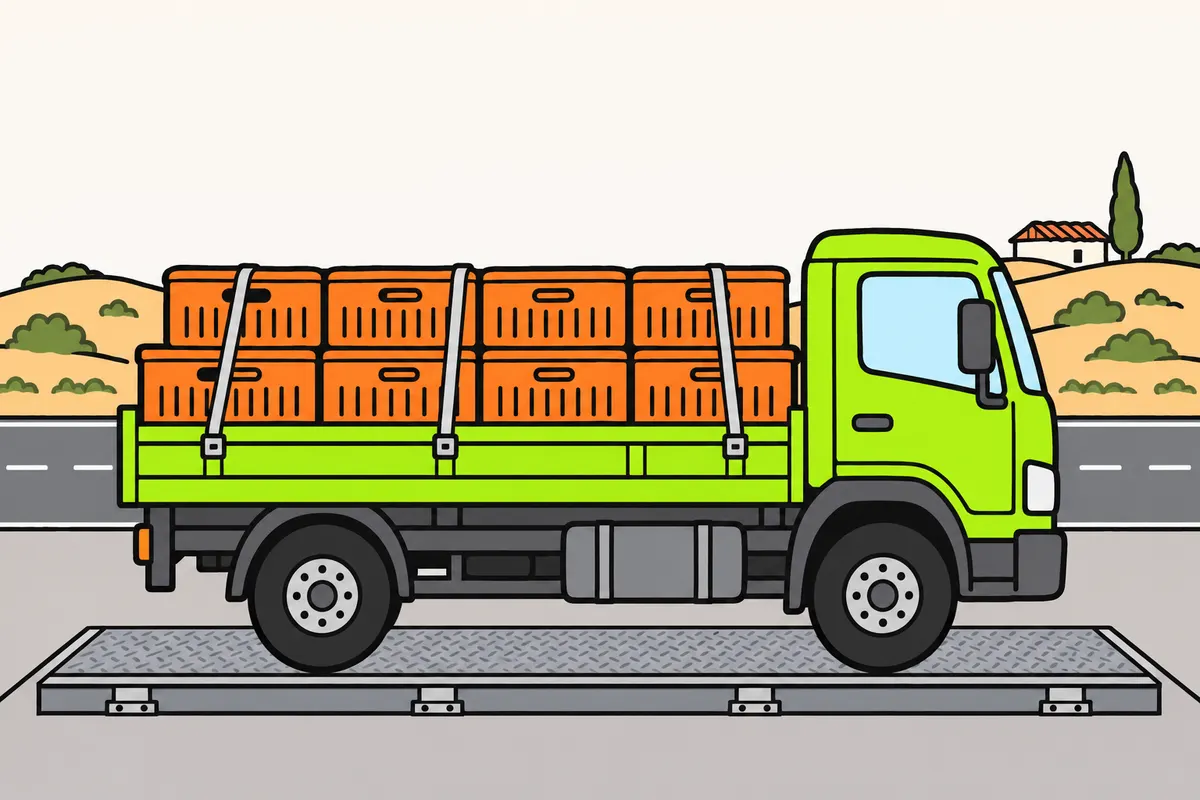
Check axles and technical conditions before choosing your total mass limit.
| Rigid lorry | General maximum |
|---|---|
| Two axles | 18 t |
| Three axles | 25 t; 26 t with the stated conditions |
| Four axles, two steering axles and stated technical conditions | 32 t |
| Other four-axle rigid lorries | 31 t |
Remember
- Include your vehicle, people and goods within the maximum.
- For 26 t: driving axle with twin tyres and air suspension or recognised equivalent.
- Alternatively, each driving axle needs twin tyres and a maximum of 9.5 t.
- For 32 t, you need two steering axles and either stated technical option.
- Also check each axle and axle group.
Exam trap: Wrong: four axles always allow 32 t. Right: check steering axles and the stated technical conditions.
Read the full explanation
- As general maximum limits without special increases, you must remember 18 t for a two-axle lorry and 25 t for a three-axle lorry. These masses include the vehicle, people and goods; they do not mean you can load 18 or 25 tonnes of goods on top of the unladen mass. [RGV, Annex IX](https://www.boe.es/buscar/act.php?id=BOE-A-1999-1826#anix).
- A three-axle lorry can reach 26 t when its driving axle has twin tyres and air suspension or a recognised equivalent. It can also reach this mass when each driving axle has twin tyres and the maximum mass on each does not exceed 9.5 t. You must check the condition stated in the question before choosing between 25 and 26 t. [RGV, Annex IX](https://www.boe.es/buscar/act.php?id=BOE-A-1999-1826#anix).
- A four-axle rigid lorry with two steering axles can reach 32 t if it meets the conditions of twin tyres and air suspension or an equivalent on the driving axle, or twin tyres on each driving axle and a maximum of 9.5 t on each. For other four-axle rigid lorries, the general maximum is 31 t. [RGV, Annex IX](https://www.boe.es/buscar/act.php?id=BOE-A-1999-1826#anix).
- If the question only says ‘four axles’, you must not assume that the conditions for 32 t are met. Similarly, three axles do not automatically mean 26 t. First you identify the vehicle and its technical conditions; then you apply the total mass row and also check the maximum limits for each axle and axle group. [RGV, Annex IX](https://www.boe.es/buscar/act.php?id=BOE-A-1999-1826#anix).
8Trailers and four-axle articulated vehicles
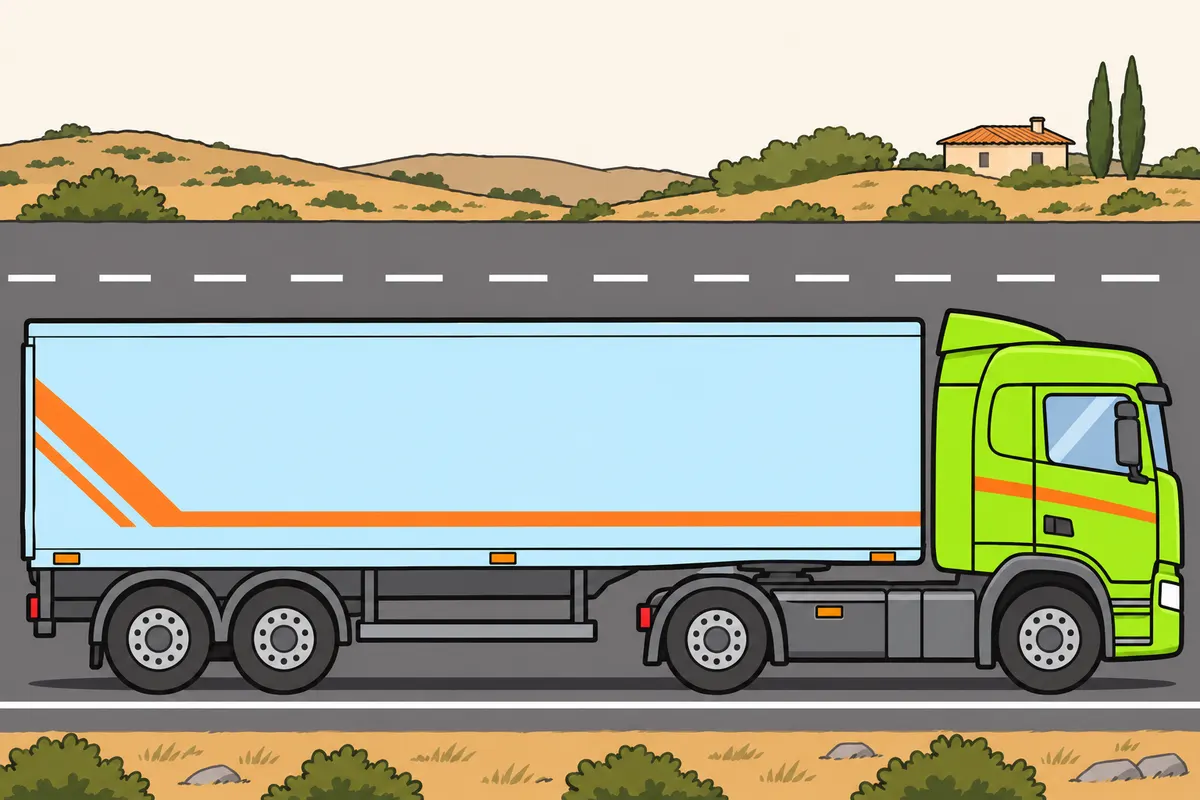
With category C, check your permitted trailer and coupling limits.
| Trailer case | Limit to check |
|---|---|
| With category C | Up to 750 kg MMA |
| Centre-axle trailer with uniform load: vertical coupling load | Lower of 10 % of trailer maximum mass or 1,000 kg |
Remember
- You need C+E for the heavy combinations described here.
- Check towable mass and coupling compatibility in your vehicle documents.
- Uniformly loaded centre-axle trailer: coupling maximum is the lower: 10 % or 1,000 kg.
- Count this coupling load towards your towing vehicle’s MMA and rear axle loads.
Exam trap: Wrong: a light trailer is enough. Right: also check towable mass and coupling compatibility.
Read the full explanation
- With a category C licence, you can tow a trailer with an MMA (maximum authorised mass) of up to 750 kg; to drive the articulated vehicles, road trains and heavy European Modular System combinations explained below, you need C+E. [RGCond, art. 4](https://www.boe.es/buscar/act.php?id=BOE-A-2009-9481#a4).
- The masses and dimensions of heavy trailers and articulated vehicles appear for comparison in the table in the next section; they fall within the scope of C+E. For your lorry with a light trailer, you must check the authorised towable mass and coupling compatibility in the vehicle documents. [RGV, Annex IX](https://www.boe.es/buscar/act.php?id=BOE-A-1999-1826#anix).
- On a centre-axle trailer with a uniformly distributed load, the vertical load on the coupling must not exceed the lower of these values: 10 % of the trailer's maximum mass or 1,000 kg. You must include this load when determining the MMA of the towing vehicle and its rear axles. [RGV, Annex IX, section 4.2](https://www.boe.es/buscar/act.php?id=BOE-A-1999-1826#anix).
9Articulated vehicles and road trains
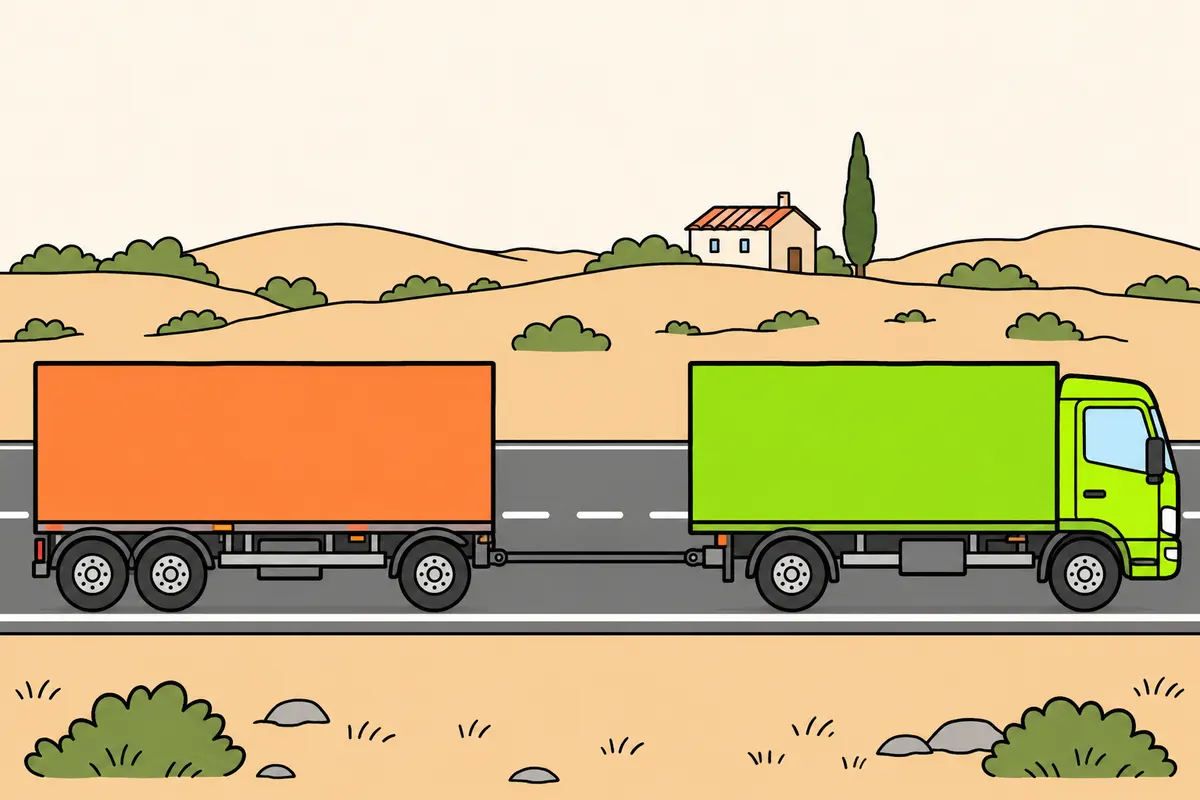
Identify your combination type and how its axles are shared between units.
| C+E reference: combination or case | Maximum or condition |
|---|---|
| Articulated: motor vehicle with two or more; semi-trailer with three or more | 44 t |
| Articulated: three-axle motor vehicle and two-axle semi-trailer | 44 t |
| Road train: two-axle lorry and two-axle trailer | 36 t |
| Road train: two-axle lorry and three-axle trailer | 42 t |
| Road train: three-axle lorry and two- or three-axle trailer | 44 t |
| Two- / three-axle trailer | 18 / 24 t; maximum length: 12 m |
| Two-axle tractor unit and two-axle semi-trailer | 36 t generally; 38 t only in the specific cases in the regulatory table |
| Ordinary articulated vehicle | 16.50 m; kingpin to rear: 12 m; kingpin to any front point: 2.04 m horizontally |
| Ordinary road train | See the measurements in “Road train length”. |
| Laden car-transporter road train | Up to 20.55 m with authorised rear overhang or support and regulatory conditions |
| Road train: lorry’s last axle to trailer’s first axle | At least 3 m |
| Intermodal combinations marked with an asterisk | Up to 2 t extra |
| Intermodal: 45-foot containers or swap bodies | 15 cm extra in the indicated lengths |
| Articulated vehicles carrying indivisible longitudinal items | 150 cm extra when only length is exceeded |
| European Modular System | Up to 72 t and 32 m; turning radii up to 14.50 m outside, 6.50 m inside |
| Continuous braking; N2 or N3 towing vehicle | Up to 1.5 times towing vehicle MMA; also respect technical and coupling limits |
Remember
- Distinguish your articulated vehicle from a road train.
- Count each unit’s axles, as well as the total.
- For road trains, measure between the lorry’s last axle and trailer’s first axle.
- These C+E references do not extend what you can drive with category C.
Exam trap: Wrong: allow 44 t for a two-plus-three road train. Right: its maximum is 42 t.
Read the full explanation
- This table brings together reference figures for heavy vehicle combinations so you can compare them with the rigid lorry you drive with category C; it does not extend your licence entitlement. The figures are regulatory maxima subject to the conditions in the relevant row and the technical limits of each unit. [RGV, Annex IX](https://www.boe.es/buscar/act.php?id=BOE-A-1999-1826#anix). | C+E reference | Mass or dimension for comparison | | --- | --- | | Two-axle / three-axle trailer | 18 / 24 t; maximum trailer length: 12 m | | Four-axle articulated vehicle, two-axle tractor unit and two-axle semi-trailer | 36 t as the general reference; 38 t only in the specific cases in table 2 | | Articulated vehicle with a motor vehicle with two or more axles and a semi-trailer with three or more | 44 t | | Articulated vehicle with a three-axle motor vehicle and a two-axle semi-trailer | 44 t | | Road train with two axles on each unit | 36 t | | Road train with a two-axle lorry and a three-axle trailer | 42 t | | Road train with a three-axle lorry and a two-axle or three-axle trailer | 44 t | | Standard articulated vehicle length | 16.50 m; from the kingpin to the rear end of the semi-trailer: 12 m; from the kingpin to any point at the front: 2.04 m horizontally | | Standard road train length | Measurements and example in ‘Road train length’ | | Loaded vehicle transporter road train | Up to 20.55 m with an authorised rear overhang or support and the conditions in note (2) of table 3 | | Separation between road train units | At least 3 m between the last axle of the motor vehicle and the first axle of the trailer | | Intermodal transport | Up to 2 t extra for combinations marked with an asterisk; 15 cm extra for the lengths indicated for 45-foot containers or swap bodies | | Indivisible longitudinal items | Note (5) in the articulated vehicle row allows an extra 150 cm when only the length limit is exceeded | | European Modular System configuration | Up to 72 t and 32 m; turning radii of up to 14.50 m outer and 6.50 m inner | | Towable mass for N2/N3 vehicles with a trailer with continuous braking | At most, 1.5 times the MMA of the towing vehicle, subject to the technical limits of the vehicle and coupling (Annex IX, sections 4.1.1 and 4.1.2.3) |
10Increases for technology and intermodal transport
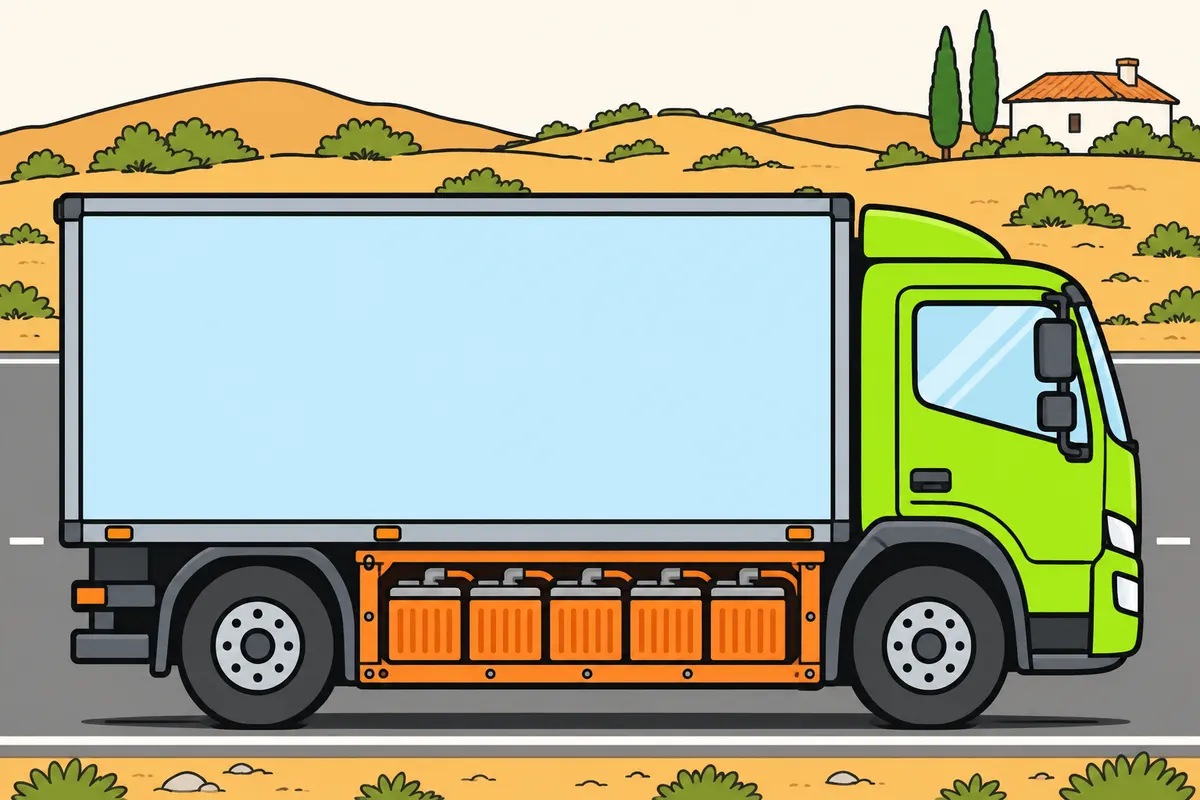
Apply mass increases only when your vehicle meets the conditions.
| Case | Increase in qualifying table rows |
|---|---|
| Alternative fuel | Up to 1 t for extra technology weight |
| Zero emissions | Up to 2 t for extra technology weight |
| Vehicles intended for urban services | Up to 1 t on top of those increases |
Remember
- Check that the relevant table row allows your increase.
- Technology increases cover the technology’s extra weight.
- Vehicles intended for urban services may add up to 1 t under stated conditions.
- Keep within technical and axle limits.
Exam trap: Wrong: automatically add extra goods. Right: check the reason and conditions for the increase.
Read the full explanation
- In the rows marked with the relevant note, you can increase the MMA by the additional weight required for alternative-fuel technology, up to 1 t, or for zero-emission technology, up to 2 t. The increase corresponds to the weight of that technology: you must not treat it as a fixed amount of extra goods for any lorry. [RGV, Annex IX](https://www.boe.es/buscar/act.php?id=BOE-A-1999-1826#anix).
- For vehicles intended for services in urban environments, up to 1 t extra is allowed on top of these increases, without exceeding the technically permissible maximum mass or the maximum axle masses. You must check all the conditions of the case; an occasional delivery within a town does not in itself justify applying any increase to a vehicle. [RGV, Annex IX](https://www.boe.es/buscar/act.php?id=BOE-A-1999-1826#anix).
11Roundwood: specific masses
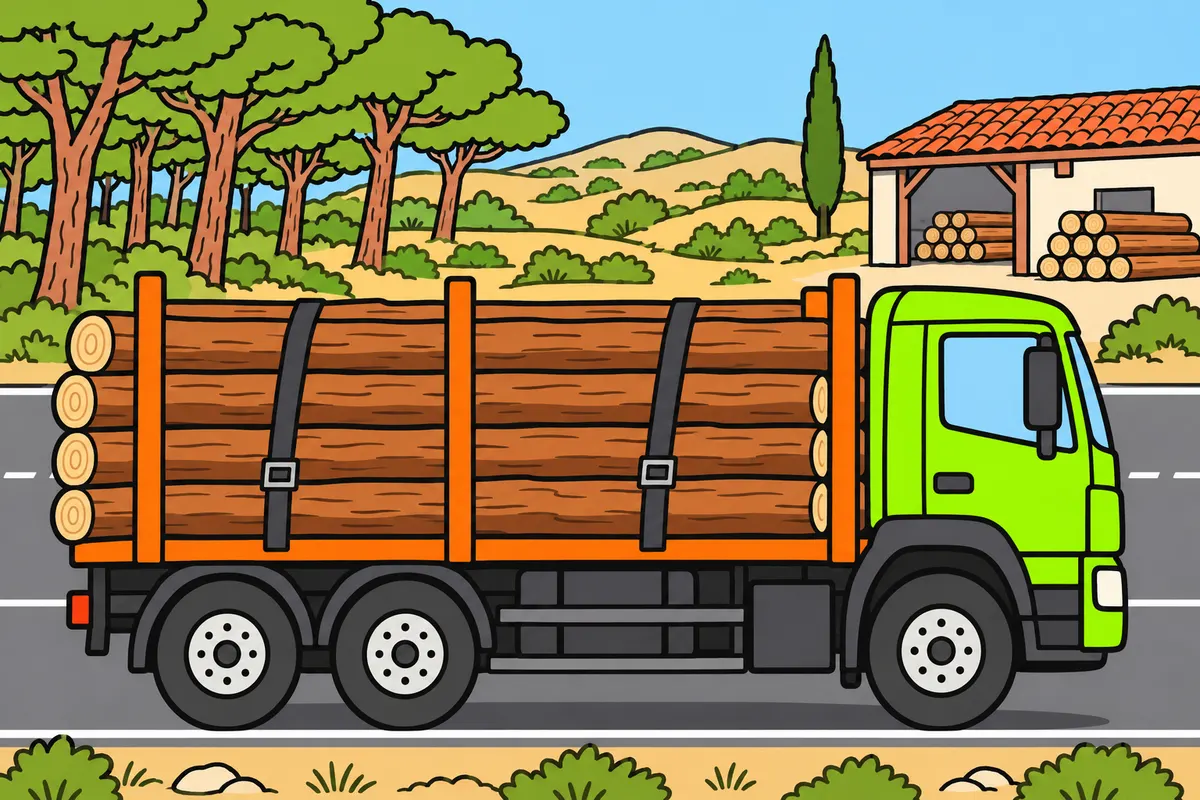
For roundwood, check your vehicle and route before using special mass limits.
| Rigid lorry carrying roundwood on qualifying routes | Specific mass |
|---|---|
| Three axles | 32 t |
| Other specified four-axle rigid lorries | 42 t |
Remember
- Roundwood includes logs without crowns or branches, and cut branches.
- Do not include bark, woodchips or sawdust in this category.
- Check your predetermined route between adjoining provinces.
- Alternatively, use the limited route from forest to the nearest forestry industry facility.
- Always respect technical and axle limits.
Exam trap: Wrong: apply these masses to any wood product. Right: check load, vehicle and route.
Read the full explanation
- Roundwood includes felled logs with their crowns and branches removed, and cut branches; it excludes bark, woodchips and sawdust. For rigid lorries, the specific rows allow 32 t for three-axle rigid lorries and 42 t for the other four-axle rigid lorries indicated, on predetermined routes between neighbouring provinces or routes of up to 150 km between the forest and the nearest forestry processing facility. You must respect the technical and axle limits. [RGV, Annex IX](https://www.boe.es/buscar/act.php?id=BOE-A-1999-1826#anix).
12Maximum lorry width
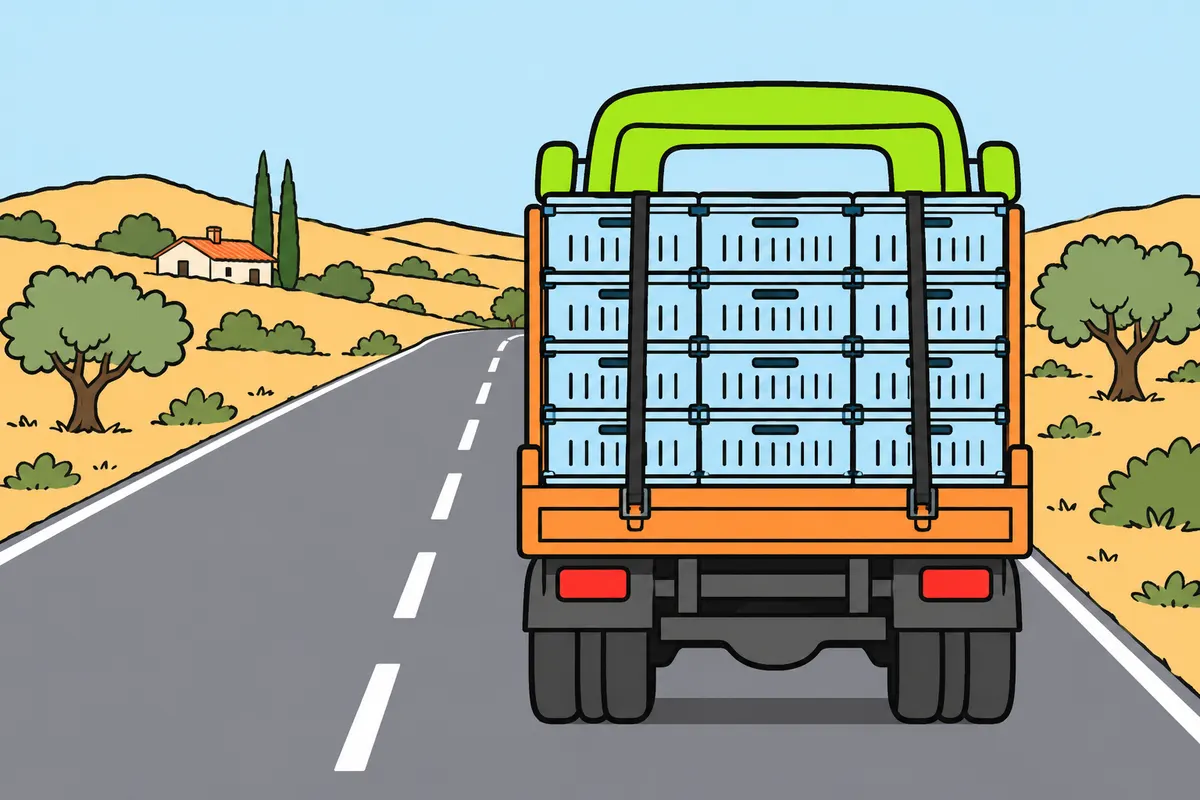
Measure your laden lorry’s width and respect route signs.
| Lorry body or case | Maximum width |
|---|---|
| General lorry, including load | 2.55 m |
| Temperature-controlled body; each sidewall at least 45 mm thick, including insulation | 2.60 m |
Remember
- Include your load when measuring width.
- For 2.60 m, check temperature-controlled goods and sufficient sidewall thickness, including insulation.
- Respect stricter local signs.
- Do not invent width allowances for accessories.
- A sideways load projection does not increase your general maximum to 2.60 m.
Exam trap: Wrong: any refrigeration equipment allows 2.60 m. Right: check the temperature-controlled body and both sidewalls.
Read the full explanation
- The general maximum width is 2.55 m, including the load. You must compare it with the actual width of your loaded vehicle and the restrictions on your route. The fact that a lorry can legally be 2.55 m wide does not allow you to enter a street where a sign imposes a maximum of 2.50 m. [RGV, Annex IX](https://www.boe.es/buscar/act.php?id=BOE-A-1999-1826#anix).
- The width of 2.60 m applies to fixed or demountable superstructures on vehicles equipped to carry goods at controlled temperatures, with a minimum thickness of 45 mm in each side wall, including insulation. You must check both conditions; simply calling the vehicle refrigerated or adding refrigeration equipment is not enough. [RGV, Annex IX](https://www.boe.es/buscar/act.php?id=BOE-A-1999-1826#anix).
- You must distinguish this bodywork exception from the rules on the side projection of an indivisible load. The option for a load to project beyond the sides of a lorry is subject to an overall width of 2.55 m under article 15 of the RGC; it does not turn an ordinary flatbed into a 2.60 m vehicle equipped for temperature-controlled transport. [RGV, Annex IX](https://www.boe.es/buscar/act.php?id=BOE-A-1999-1826#anix).
- You measure authorised dimensions in accordance with the type-approval regulations applicable to the category. You must use the technical data and the actual measurement of the load without inventing allowances for accessories. The 2.60 m exception for buses specially equipped to carry prisoners is also not an exception that applies to your goods lorry. [RGV, Annex IX](https://www.boe.es/buscar/act.php?id=BOE-A-1999-1826#anix).
13General height and 4.50 m exceptions
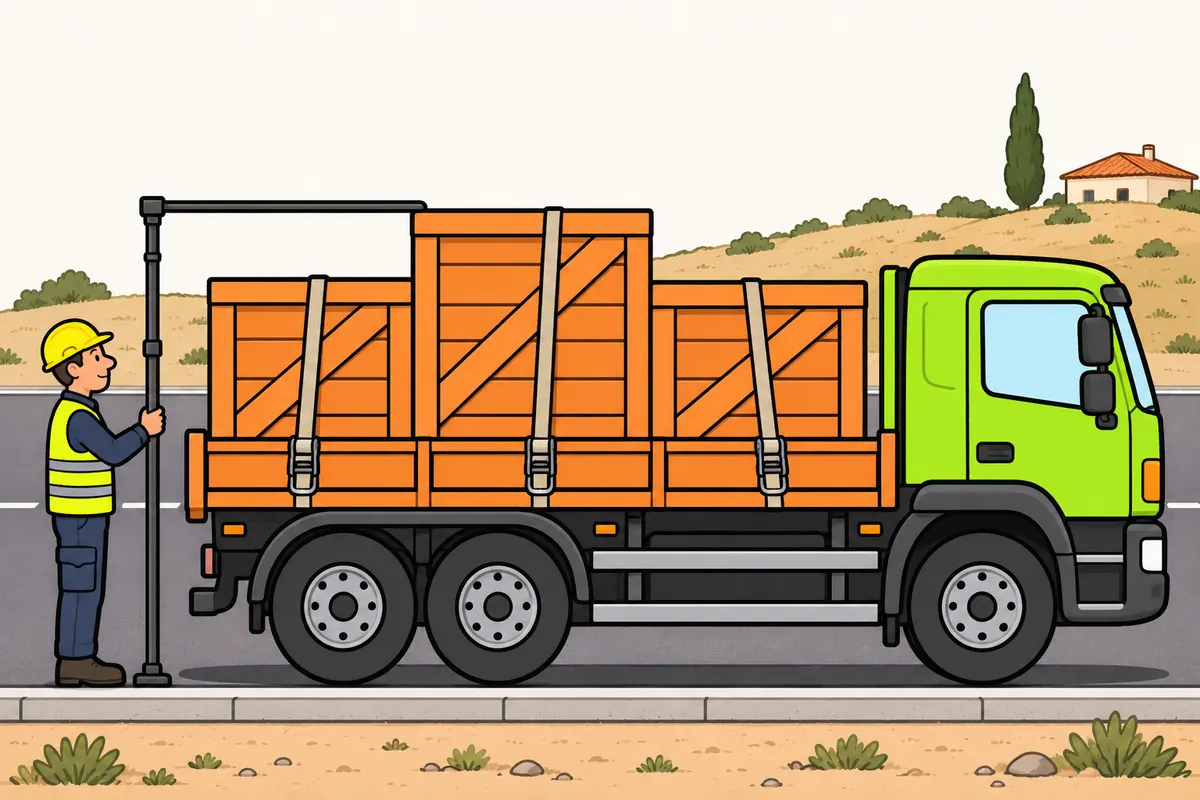
Measure your loaded height and check whether an exception applies.
| Vehicle or qualifying case, including load | Maximum height |
|---|---|
| General | 4 m |
| Specialised vehicle transporters | 4.50 m |
| Recovery vehicles with cranes for broken-down or accident-damaged vehicles | 4.50 m |
| Lorries or articulated vehicles: enclosed containers approved for combined, intermodal or ULD air transport | 4.50 m |
| Variable-height lorries or articulated vehicles: live animals, straw bales or fodder | 4.50 m |
| Supplier deliveries to industry on predetermined routes shorter than 50 km | 4.50 m |
Remember
- Measure from the ground to your highest point.
- A loading crane alone does not qualify you for the exception.
- For animals, straw or fodder, check that your vehicle has variable height.
- For supplier deliveries to industry, your predetermined route must be shorter than 50 km.
- Check bridges, overhead cables and signs throughout your route.
Exam trap: Wrong: any straw load allows 4.50 m. Right: your lorry or articulated vehicle must also have variable height.
Read the full explanation
- The general maximum height is 4 m, including the load. You must measure from the ground to the highest point of the configuration used on the road. If the vehicle and its load reach 4.10 m, you need to qualify for an exception or hold the appropriate authorisation; an empty load body measuring less than four metres is not enough. [RGV, Annex IX](https://www.boe.es/buscar/act.php?id=BOE-A-1999-1826#anix).
- A maximum height of 4.50 m applies to vehicle transporters, both lorries and combinations specialised in carrying vehicles, and to recovery vehicles intended to remove vehicles involved in accidents or breakdowns. To use the exception, your lorry must be specialised in carrying vehicles or intended to recover them following an accident or breakdown, as applicable. [RGV, Annex IX](https://www.boe.es/buscar/act.php?id=BOE-A-1999-1826#anix).
- The table provides for 4.50 m for lorries or articulated vehicles carrying enclosed containers approved for combined, intermodal or ULD-type air transport. It also covers variable-height lorries or articulated vehicles carrying live animals, straw bales and fodder. You must remember the reference to variable height in this last case. [RGV, Annex IX](https://www.boe.es/buscar/act.php?id=BOE-A-1999-1826#anix).
- The 4.50 m cases include deliveries from suppliers to industrial premises on predetermined routes of less than 50 km. Exactly 50 km does not meet the requirement of ‘less than’. In all these cases, you must check height clearances, bridges, overhead installations and local signs: the height permitted for your vehicle does not guarantee clearance along the entire route. [RGV, Annex IX](https://www.boe.es/buscar/act.php?id=BOE-A-1999-1826#anix).
14Length of rigid lorries, trailers and articulated vehicles
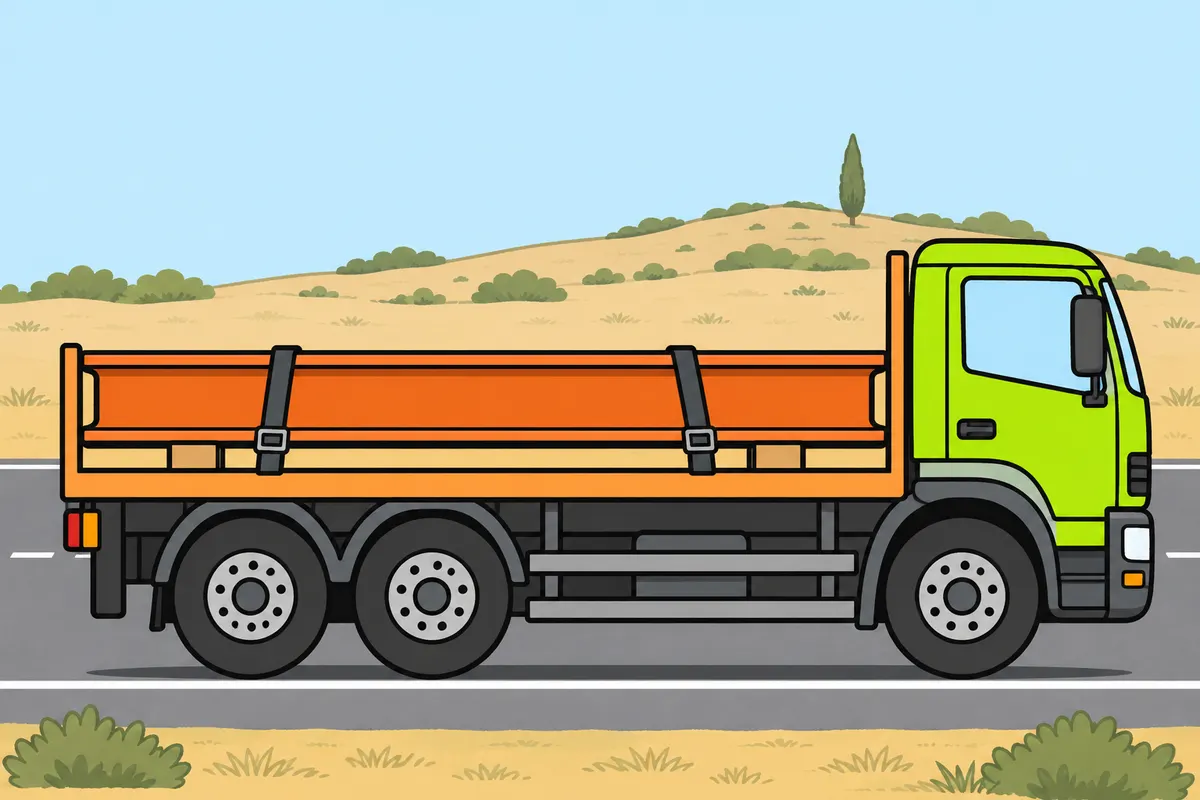
Check your laden lorry’s total length and how far its load projects.
Remember
- Include your load when measuring total length.
- More axles do not allow you a longer rigid lorry.
- With a beam, find the actual ends of your loaded vehicle.
- Do not add the full beam and body lengths when they overlap.
- Check load projection and total length separately.
Exam trap: Wrong: meeting projection limits is enough. Right: also check the laden vehicle’s total length.
Read the full explanation
- The general maximum for a rigid lorry is 12 m, including the load. You must apply this value even if it has three or four axles: the number of axles can change the maximum mass, but does not in itself allow greater length. [RGV, Annex IX](https://www.boe.es/buscar/act.php?id=BOE-A-1999-1826#anix).
- To measure a vehicle carrying a beam, you must locate the foremost and rearmost points of the loaded vehicle. If the beam and the load body overlap, you do not add their full lengths together. You must check separately how far the load projects and the overall length of the loaded vehicle, as these are different limits. [RGV, Annex IX](https://www.boe.es/buscar/act.php?id=BOE-A-1999-1826#anix).
15Road train length
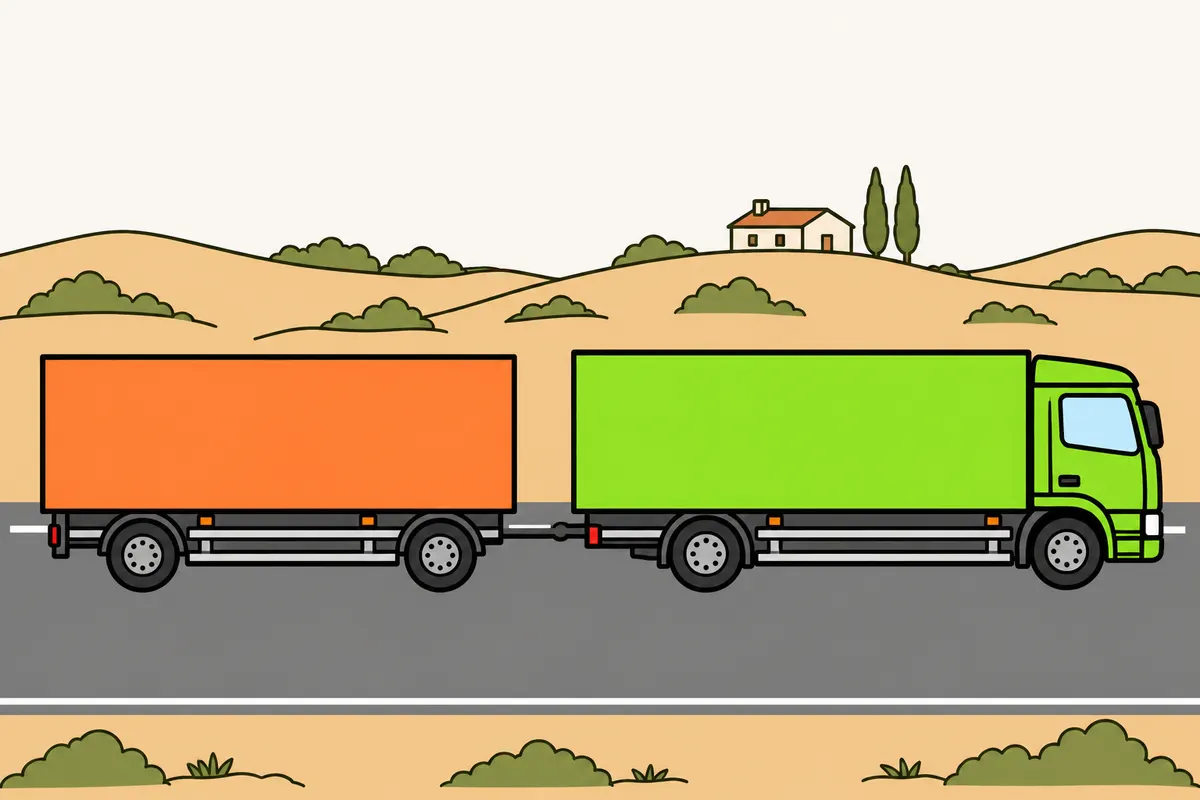
Measure your road train’s length with its load and gaps between units.
| Laden road train measurement | Ordinary maximum |
|---|---|
| Total length, including cab and gap between units | 18.75 m |
| Foremost loading point behind cab to rearmost trailer point | 16.40 m |
| That distance minus the gap between lorry and trailer | 15.65 m |
Remember
- Include your load in total length.
- Include the gaps between your lorry and trailer.
- Total length includes your cab.
- Measure from the loading area behind your cab to your trailer’s rear end.
- Measure parallel to your road train’s length.
- Subtract the gap between units to check the limit without the gap.
Exam trap: Wrong: meeting 18.75 m is enough. Right: also check loading areas with and without the gap.
Read the full explanation
- For a road train, you must measure the overall length of the loaded lorry and trailer, including the gap between the two units: the ordinary maximum is 18.75 m. This measurement includes the cab; the following two distances also apply to the loading areas. [RGV, Annex IX, table 3](https://www.boe.es/buscar/act.php?id=BOE-A-1999-1826#anix).
- The distance between the foremost outer point of the loading area behind the cab and the rearmost point of the trailer must not exceed 16.40 m, measured parallel to the longitudinal axis. If you subtract the gap between the rear of the lorry and the front of the trailer from this distance, the maximum result is 15.65 m. [RGV, Annex IX, table 3](https://www.boe.es/buscar/act.php?id=BOE-A-1999-1826#anix).
- Example: a road train measures 18.75 m from end to end and 16.40 m between the specified extremities of the loading areas. With a gap of 0.80 m between the units, you calculate 16.40 − 0.80 = 15.60 m: it meets all three length checks. If the gap is 0.70 m and the other measurements stay the same, the result is 15.70 m and exceeds the maximum for the loading areas. You must check each measurement, even if the overall length is permitted. [RGV, Annex IX, table 3](https://www.boe.es/buscar/act.php?id=BOE-A-1999-1826#anix).
16Length exceptions and aerodynamics
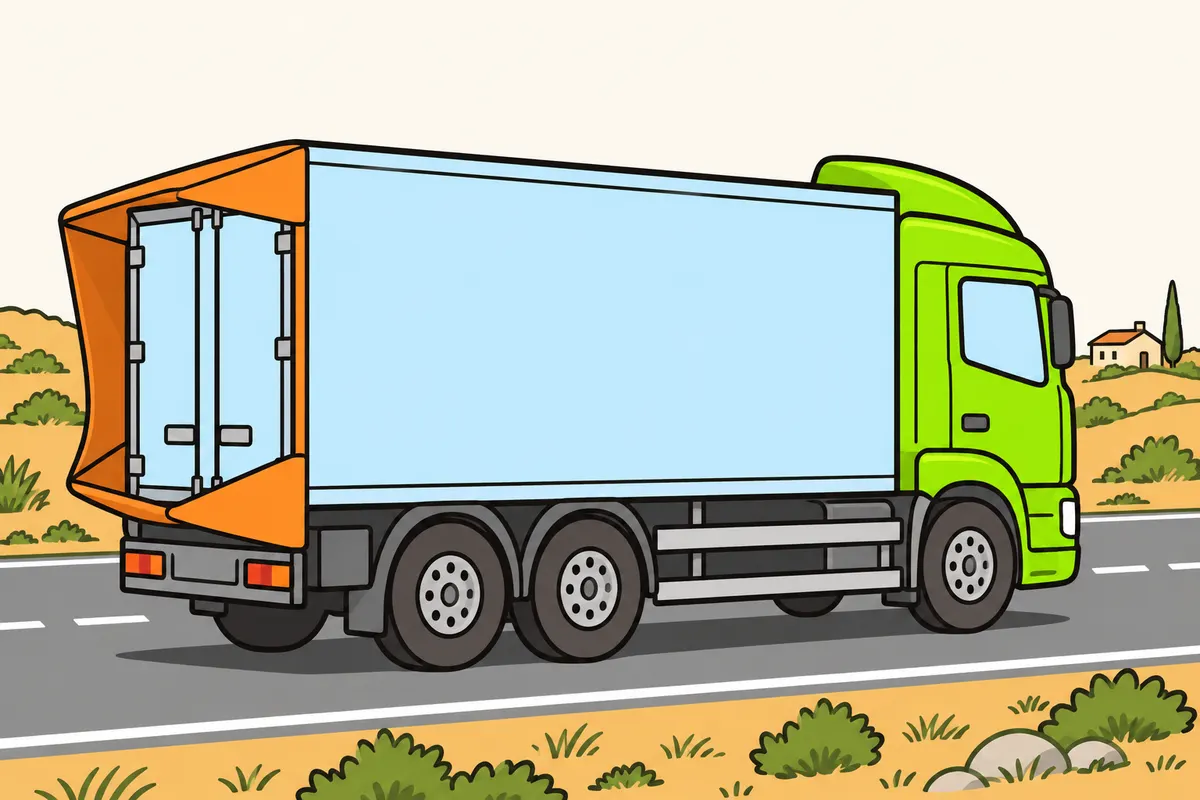
Use type-approved aerodynamic features without increasing your load capacity.
Remember
- Your aerodynamic cabs and devices must be type-approved.
- These aerodynamic features must not increase your load capacity.
- Fold, retract or remove rear devices if they endanger safety.
- Take special care where the speed limit is 50 km/h or lower.
- Consider areas where you may meet more vulnerable road users.
- Check intermodal transport compatibility and your length with devices folded.
Exam trap: Wrong: aerodynamic features allow more goods. Right: do not increase your load capacity.
Read the full explanation
- You may exceed the maximum length because of an approved cab that improves aerodynamics, energy efficiency and road safety, or because of approved rear aerodynamic devices. This additional length serves those improvements and must preserve the vehicle's load capacity. [RGV, Annex IX, section 7](https://www.boe.es/buscar/act.php?id=BOE-A-1999-1826#anix).
- If the devices endanger your safety or that of other road users, you must fold, retract or remove them. For example, when manoeuvring at an entrance where a device could strike a pedestrian, you must fold it away or remove it to eliminate that danger. [RGV, Annex IX, section 7](https://www.boe.es/buscar/act.php?id=BOE-A-1999-1826#anix).
- When using them on urban and interurban roads, you must take account of the particular characteristics of areas with a speed limit of 50 km/h or less and areas where you are more likely to encounter vulnerable road users. [RGV, Annex IX, section 7](https://www.boe.es/buscar/act.php?id=BOE-A-1999-1826#anix).
- Use of the devices must be compatible with intermodal transport operations. When folded or retracted, they may increase the maximum authorised length by no more than 20 cm; you must check the length in this position when preparing the operation. [RGV, Annex IX, section 7](https://www.boe.es/buscar/act.php?id=BOE-A-1999-1826#anix).
17Turning circle and outward swing
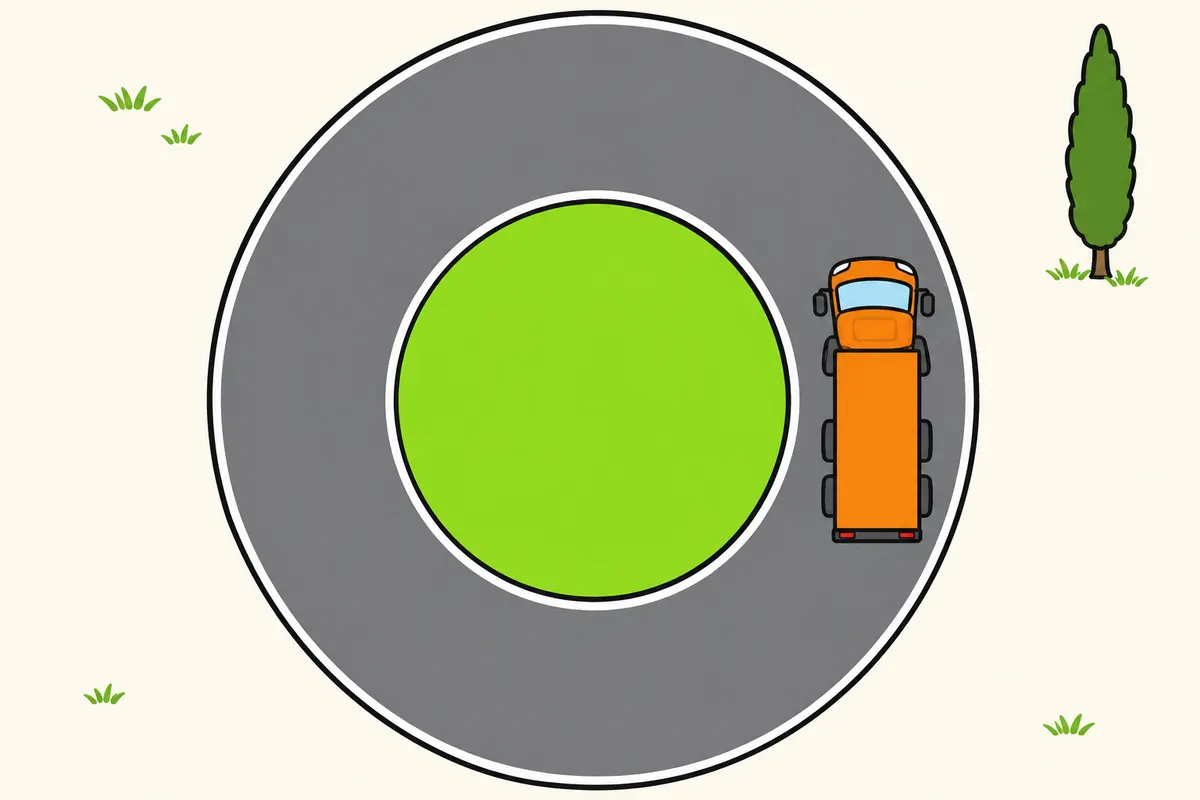
Check that your vehicle can turn within the required circles.
| Rigid goods vehicle configuration | Maximum outward swing |
|---|---|
| Axles not raised | 0.80 m |
| Category N with retractable or loadable axles raised | 1 m |
Remember
- Complete the full turn both ways without crossing the circle boundaries.
- The circle measurements are radii.
- With axles raised, check the outward swing limit for your configuration.
- Even after passing this test, check route space and obstacles.
Exam trap: Wrong: treat the measurements as diameters. Right: they are radii.
Read the full explanation
- The ordinary turning circle has an outer radius of 12.50 m and an inner radius of 5.30 m. Every motor vehicle and vehicle combination must be able to complete a full 360° circular path in either direction within the ring bounded by these concentric circles, without any extremity projecting outside it. [RGV, Annex IX](https://www.boe.es/buscar/act.php?id=BOE-A-1999-1826#anix).
- The 12.50 m and 5.30 m measurements are radii, not diameters or lorry lengths. The width of this ring is 7.20 m, the difference between the two radii. In an actual turn, you must also consider the available space: kerbs, obstacles and other road users are still there. [RGV, Annex IX](https://www.boe.es/buscar/act.php?id=BOE-A-1999-1826#anix).
- For a rigid goods vehicle, the annex also sets an outward swing limit of 0.80 m relative to the reference tangential vertical plane when entering the specified turn. With retractable or load-relieving axles raised, the applicable value for category N vehicles is 1 m; you must bear the axle position in mind. [RGV, Annex IX](https://www.boe.es/buscar/act.php?id=BOE-A-1999-1826#anix).
18European Modular System combinations
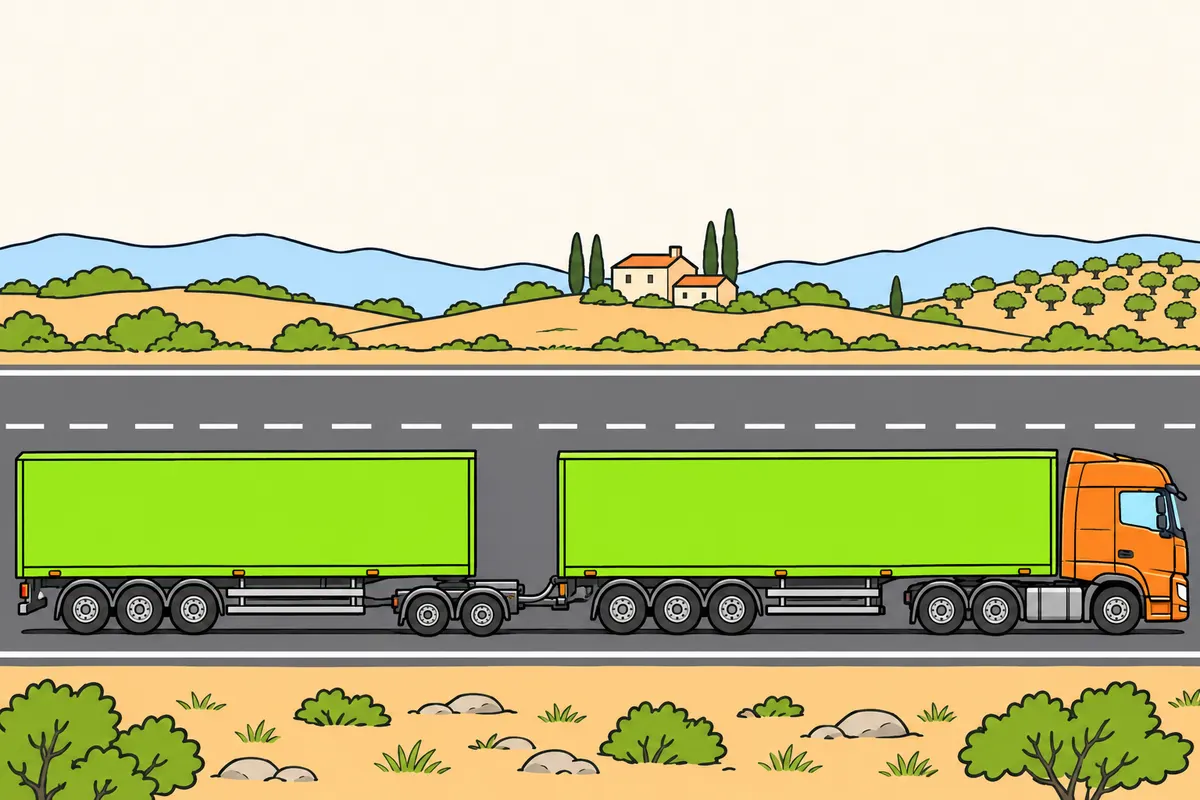
Check that your whole European Modular System route is approved and meets the requirements.
Remember
- Use the approved route network, including access roads at your origin and destination.
- Within this network, meeting requirements removes individual authorisation and prior journey notification requirements.
- Check driving-axle air suspension or equivalent, plus approved modules and couplings.
- Check blind-spot detectors or mirrors and the required safety systems.
- Keep your load within the outline of the vehicles carrying it.
- Do not carry dangerous goods requiring ADR hazard warning plates.
Exam trap: Wrong: correct dimensions allow any diversion. Right: check that your diversion also uses the approved network.
Read the full explanation
- You must drive a European Modular System combination on the network of routes designated by the competent traffic authority, following a binding report from the road authorities on their restrictions. You must check every stretch of the route, including access roads at the origin and destination. [RGV, Annex IX, section 6](https://www.boe.es/buscar/act.php?id=BOE-A-1999-1826#anix).
- On this network, you may drive without individual authorisation for the European Modular System configuration or prior notification of the journey, provided you meet the requirements applicable to the combination and the route. [RGV, Annex IX, section 6](https://www.boe.es/buscar/act.php?id=BOE-A-1999-1826#anix).
- Route example: you carry goods between two logistics centres using links and stretches of dual carriageway included in the approved network. If all access roads are also included and the combination meets its requirements, you may make the journey under these arrangements. If a diversion takes you along a stretch outside the network, you must find an approved route; meeting the combination's dimensional requirements does not authorise that diversion. For an excess outside these arrangements, you must apply the rule in ‘When you need special transport’. [RGV, Annex IX, section 6 and art. 14](https://www.boe.es/buscar/act.php?id=BOE-A-1999-1826#anix).
- The technical requirements include air suspension or equivalent on the driving axles, blind-spot mirrors or detectors, lane departure warning or lane-keeping assistance, automatic emergency braking and electronic stability control. You must use modules and couplings approved for the combination's configuration and mass. [Resolution of 21 October 2025, fourth section](https://www.boe.es/buscar/act.php?id=BOE-A-2025-21353#cu).
- The load must remain within the plan-view outline of the vehicles carrying it. In this configuration, you must not carry dangerous goods whose transport requires the regulatory hazard warning plates under ADR; for other dangerous goods, you must comply with ADR's own conditions and restrictions. [RGV, Annex IX, section 6](https://www.boe.es/buscar/act.php?id=BOE-A-1999-1826#anix).
19Indivisible loads and longitudinal projections
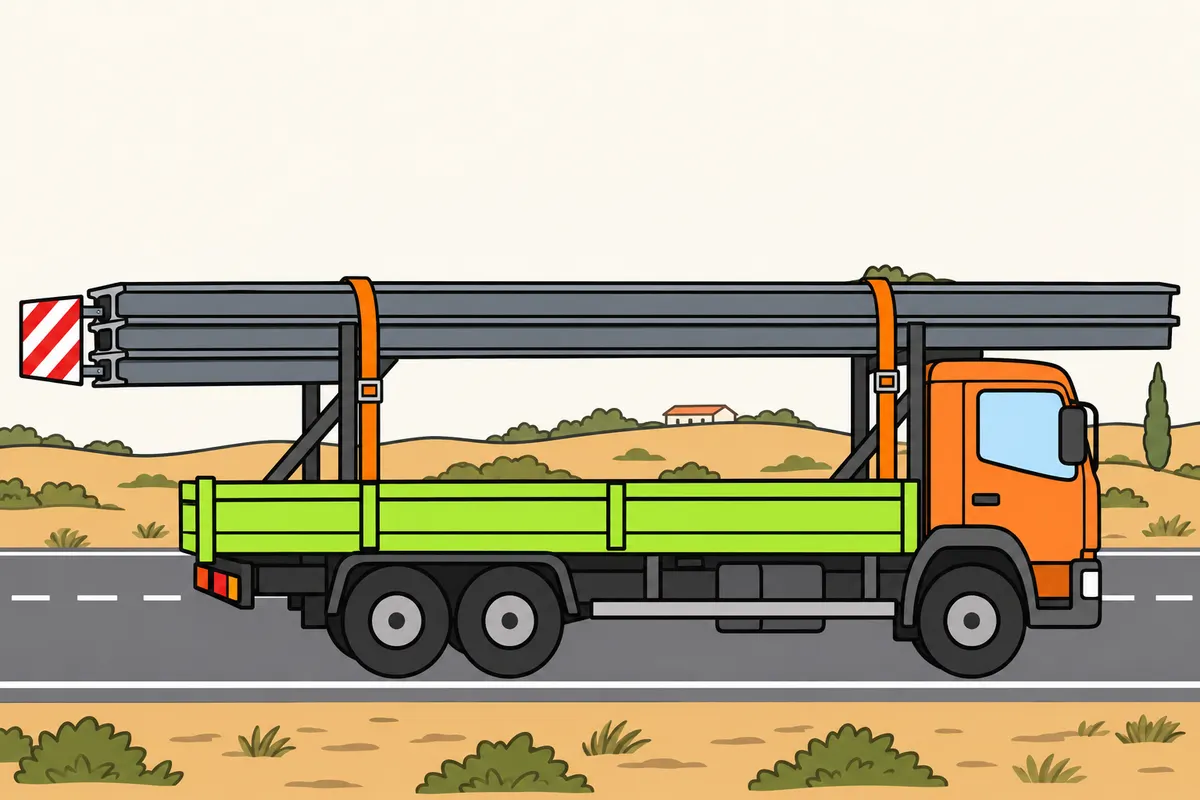
Check your indivisible load’s projections and total vehicle length together.
Remember
- Check projections and authorised overall dimensions separately.
- Meet both limits when carrying an indivisible load.
- Consult “Load stowage and safety”: “When a load can project”.
Exam trap: Wrong: add projection allowances to the maximum total length. Right: meet projection and total length limits together.
Read the full explanation
- Longitudinal projections of indivisible loads have their own limits, which you must meet alongside the authorised overall dimensions; see «Load stowage and safety», section «When a load can project». [RGC, art. 15](https://www.boe.es/buscar/act.php?id=BOE-A-2003-23514#a15).
20Side projections and protection
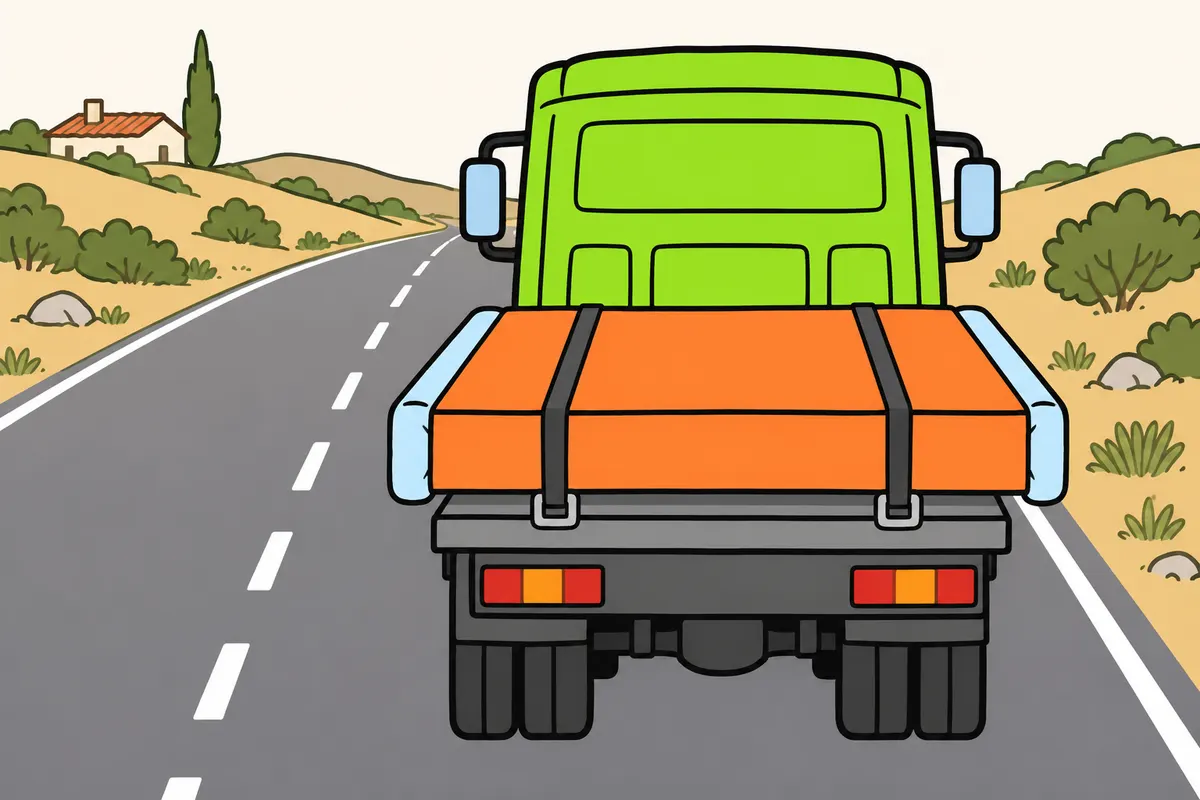
Keep your indivisible sideways load within both projection and total width limits.
Remember
- Meet both the side projection and total width limits.
- Protect projecting ends to prevent damage or danger.
- Consult “Side projections and overall dimensions” and “Protection and the V-20 panel”.
Exam trap: Wrong: meeting side projection limits is enough. Right: also respect overall width and protect ends.
Read the full explanation
- Any side projection must comply with both its own limit and the permitted overall width, with the projecting ends protected; see «Load stowage and safety», sections «Side projections and overall dimensions» and «Protection and the V-20 panel». [RGC, art. 15](https://www.boe.es/buscar/act.php?id=BOE-A-2003-23514#a15).
21Marking and lighting projecting loads
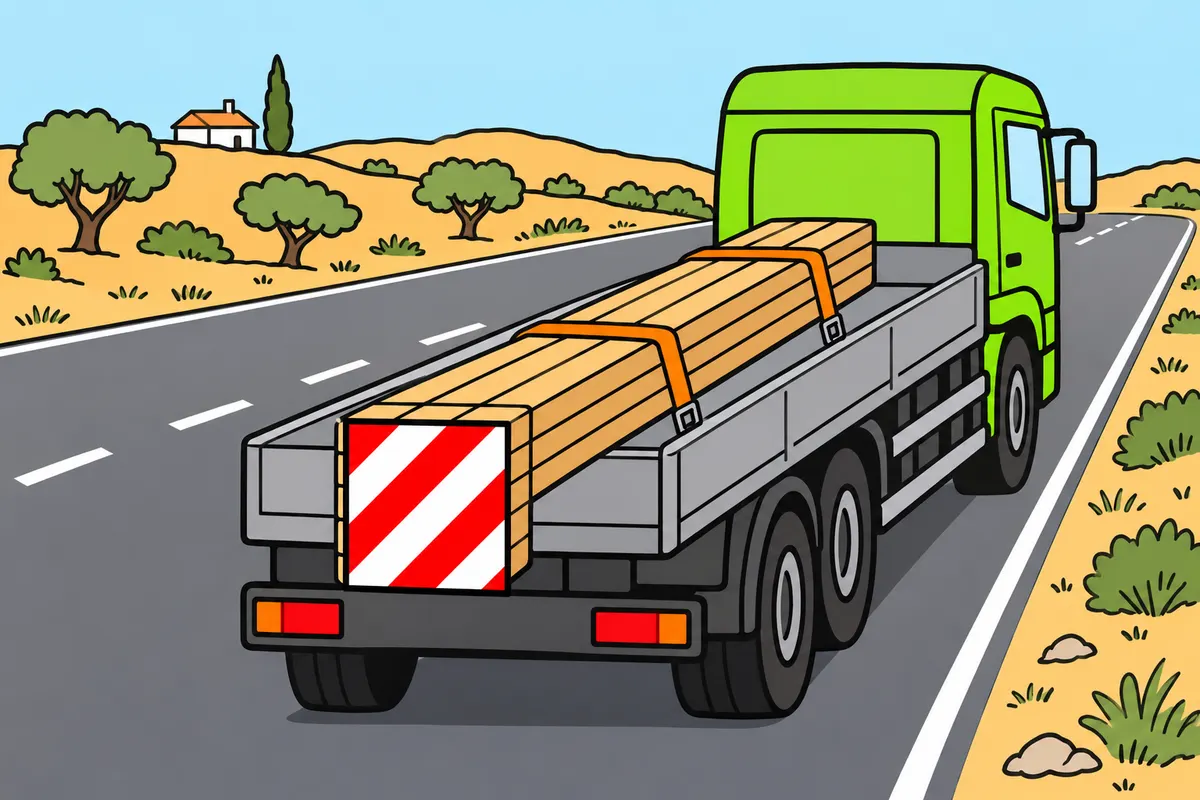
Mark your projecting load according to its position and visibility.
Remember
- Mark your projecting load according to its position and visibility.
- Use the appropriate panels and lighting.
- Consult “Load stowage and safety”: “Protection and the V-20 panel”.
- Also consult “Lighting for projecting loads”.
Exam trap: Wrong: mark every projection the same way. Right: check its position and visibility.
Read the full explanation
- A projecting load requires the panels and lighting appropriate to its location and visibility; see «Load stowage and safety», sections «Protection and the V-20 panel» and «Lighting for projecting loads». [RGC, art. 15](https://www.boe.es/buscar/act.php?id=BOE-A-2003-23514#a15).
22When you need special transport
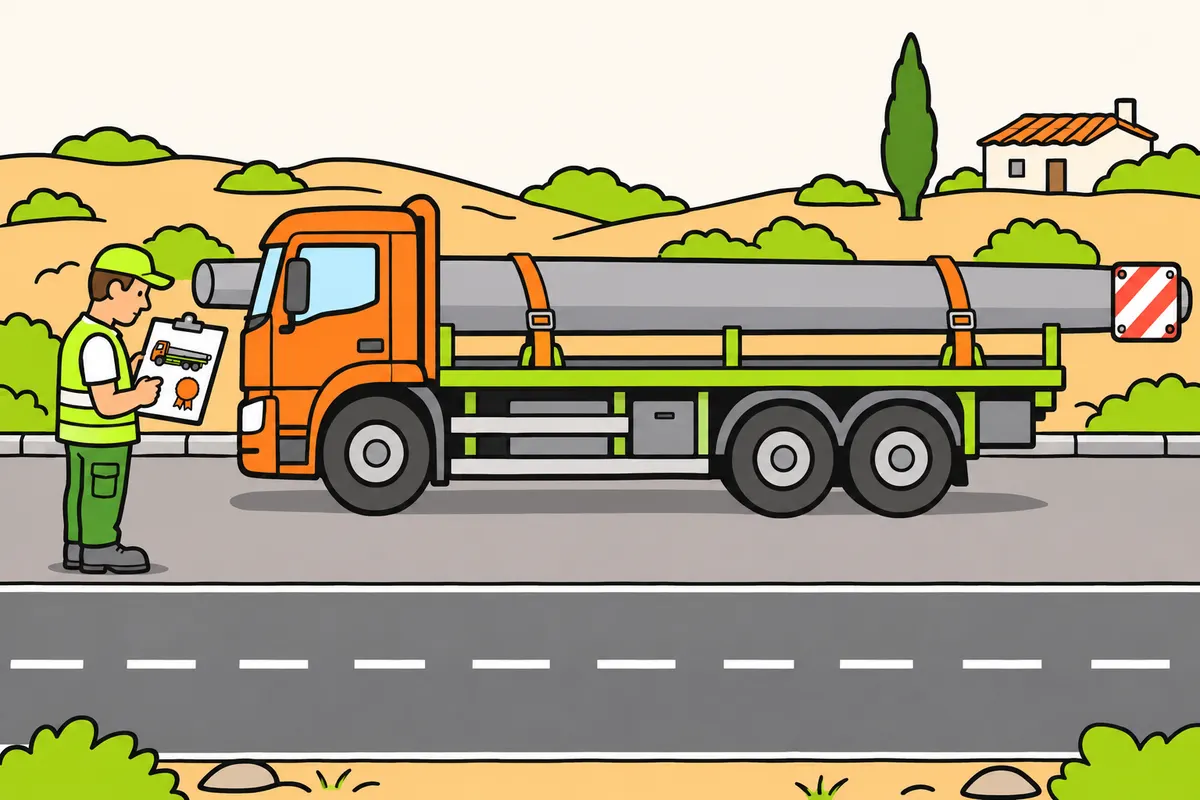
Obtain supplementary authorisation before setting off if you exceed limits without an applicable exception.
Remember
- You need authorisation for excess caused by technical characteristics or an indivisible load.
- Check that your authorisation has been granted before driving.
- Check your authorised vehicle, load, route and conditions.
- Split separable packages between journeys that meet the limits; do not request this authorisation.
- Plan a usable route and respect access restrictions.
- Follow the driving conditions in your authorisation.
Exam trap: Wrong: applying for authorisation allows you to drive. Right: wait until it is granted.
Read the full explanation
- If your vehicle's technical characteristics or an indivisible load cause you to exceed the applicable maximum limits and no exception applies, you must obtain the appropriate autorización complementaria de circulación (supplementary authorisation) before setting off. The traffic authority grants it after receiving a binding report from the road authority and checking the transport authorisation required by law. [RGV, art. 14; RGC, art. 13 and Annex III](https://www.boe.es/buscar/act.php?id=BOE-A-1999-1826#a14).
- A load is indivisible when dividing it for road transport entails unnecessary cost or risk of damage and, because of its mass or dimensions, it cannot be carried by a vehicle or combination that complies with all authorised maximum limits. Authorisation for an indivisible load requires these conditions to be met; a consignment of separable packages must comply with the limits by being split between permitted transport operations. [RGV, art. 14.2](https://www.boe.es/buscar/act.php?id=BOE-A-1999-1826#a14).
- The authorisation may be granted for a limited number of journeys or for a specified period. You must check the authorised vehicle, load, route and conditions; submitting an application or holding a goods transport authorisation does not mean that you have been granted the supplementary authorisation. [RGV, art. 14; RGC, art. 13 and Annex III](https://www.boe.es/buscar/act.php?id=BOE-A-1999-1826#a14).
- An 11 m rigid lorry carrying an indivisible pole that brings the overall loaded length to 14.50 m exceeds the ordinary maximum of 12 m. You must check the appropriate supplementary authorisation, even if the front and rear projections each comply with Article 15. This check prevents you from confusing how far the load projects with the overall length of the loaded vehicle. [RGV, art. 14; RGC, art. 13 and Annex III](https://www.boe.es/buscar/act.php?id=BOE-A-1999-1826#a14).
- You must plan a physically viable route and comply with access restrictions. The road-use conditions set out in the authorisation take precedence over the general conditions that apply, as provided in Annex III. You must obey signs, traffic restrictions and traffic officers' instructions. [RGV, art. 14; RGC, art. 13 and Annex III](https://www.boe.es/buscar/act.php?id=BOE-A-1999-1826#a14).
23Conditions for special transport
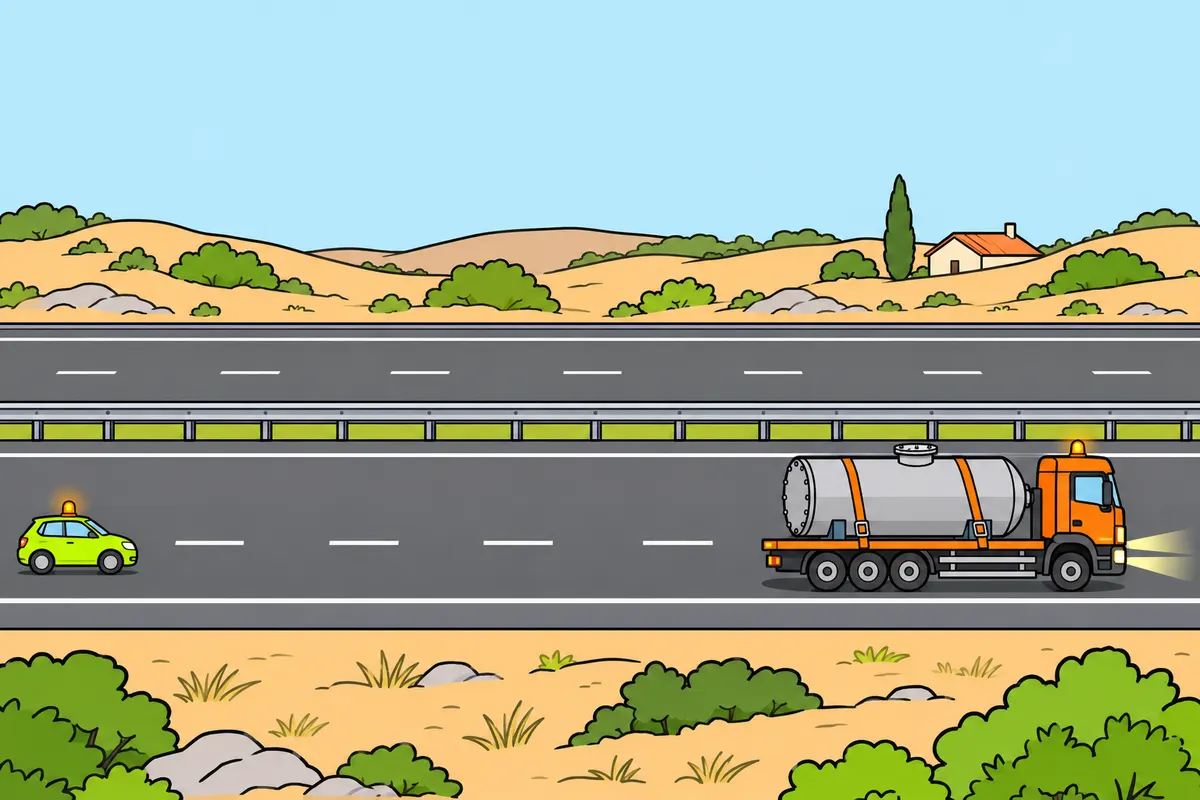
For abnormal loads, follow your authorisation’s conditions and prepare your route.
| Indivisible abnormal load authorisation | Maximum speed | Night travel | Each journey: holder notifies departure-province traffic officers and designated road authority services | Above 5 m wide: holder notifies those same recipients |
|---|---|---|---|---|
| Generic | 70 km/h | Allowed subject to other conditions | — | At least 72 hours before; departure place, date and time; registration numbers; authorisation copy |
| Specific | 60 km/h | Allowed subject to other conditions | Previous day; departure place, date and time; authorisation copy | At least 72 hours before; departure place, date and time; registration numbers; authorisation copy |
| Exceptional | Specified speed, no more than 60 km/h | Only with explicit permission in the authorisation | Previous day; departure place, date and time; authorisation copy | At least 72 hours before; departure place, date and time; registration numbers; authorisation copy |
Remember
- Keep dipped headlights on; stop and park off the carriageway and hard shoulder.
- When dimensions require an escort, keep it behind on motorways, at least 50 m.
- On other roads, keep it ahead.
- On conventional roads, add another behind below half the road’s general speed limit.
- Above 5 m wide, arrange traffic officers and give at least 72 hours’ notice.
- Stop travelling and leave the road platform in dangerous weather or insufficient visibility.
Exam trap: Wrong: the authorisation’s speed is always enough. Right: obey any stricter speed on your vehicle’s ITV card.
Read the full explanation
- Under the Annex III rules, you must keep at least 50 m behind the vehicle ahead, help other vehicles overtake, and stop and park off both the carriageway and the arcén (hard shoulder). You must keep dipped beam on at all times and comply with the applicable special marking and signalling requirements. These conditions apply to special transport; they do not, by themselves, define the rules for every journey by a heavy lorry. [RGC, Annex III, section 1.ª and group 1](https://www.boe.es/buscar/act.php?id=BOE-A-2003-23514#aniii).
- For special transport of an indivisible load, you need an escort vehicle on grounds of dimensions when you exceed 3 m in width or 20.55 m in length. It must travel behind you, at least 50 m away, on motorways and dual carriageways, and ahead of you on other roads. On conventional roads, you also need another escort vehicle behind you if you travel at less than half the road's generic speed limit. [RGC, Annex III, section 1.ª and group 1](https://www.boe.es/buscar/act.php?id=BOE-A-2003-23514#aniii).
- If you exceed 5 m in width, you need an escort by traffic officers, and the authorisation holder must notify them at least 72 hours in advance. With a specific or exceptional authorisation, the holder must also notify each journey on the previous day. Both notifications go to the traffic officers in the province of departure and to the services designated by the road authority, stating the place, date and time of departure and enclosing a copy of the authorisation; the 72-hour notification includes the registration numbers. [RGC, Annex III, section 1.ª, paragraph 8 and group 1, paragraph 6](https://www.boe.es/buscar/act.php?id=BOE-A-2003-23514#aniii).
- You must stop travelling and leave the carriageway and hard shoulders if weather conditions are dangerous or you do not have at least 150 m of visibility both ahead and behind. Before each journey, the authorisation holder must make sure there are no obstacles, including by checking the route in advance where necessary; on urban roads, you must follow the route specified by the municipal authority. [RGC, Annex III, section 1.ª and group 1](https://www.boe.es/buscar/act.php?id=BOE-A-2003-23514#aniii).
- For the special transport group covering indivisible loads, the maximum speed is 70 km/h with a generic authorisation and 60 km/h with a specific authorisation; with an exceptional authorisation, the specified speed applies, up to a maximum of 60 km/h. Any stricter limits on the tarjeta ITV (vehicle roadworthiness test card) take precedence. Night driving with an exceptional authorisation requires express permission in that authorisation; with a generic or specific authorisation, you may drive by day and night subject to the other conditions. [RGC, Annex III, section 1.ª and group 1](https://www.boe.es/buscar/act.php?id=BOE-A-2003-23514#aniii).
24Signs limiting mass
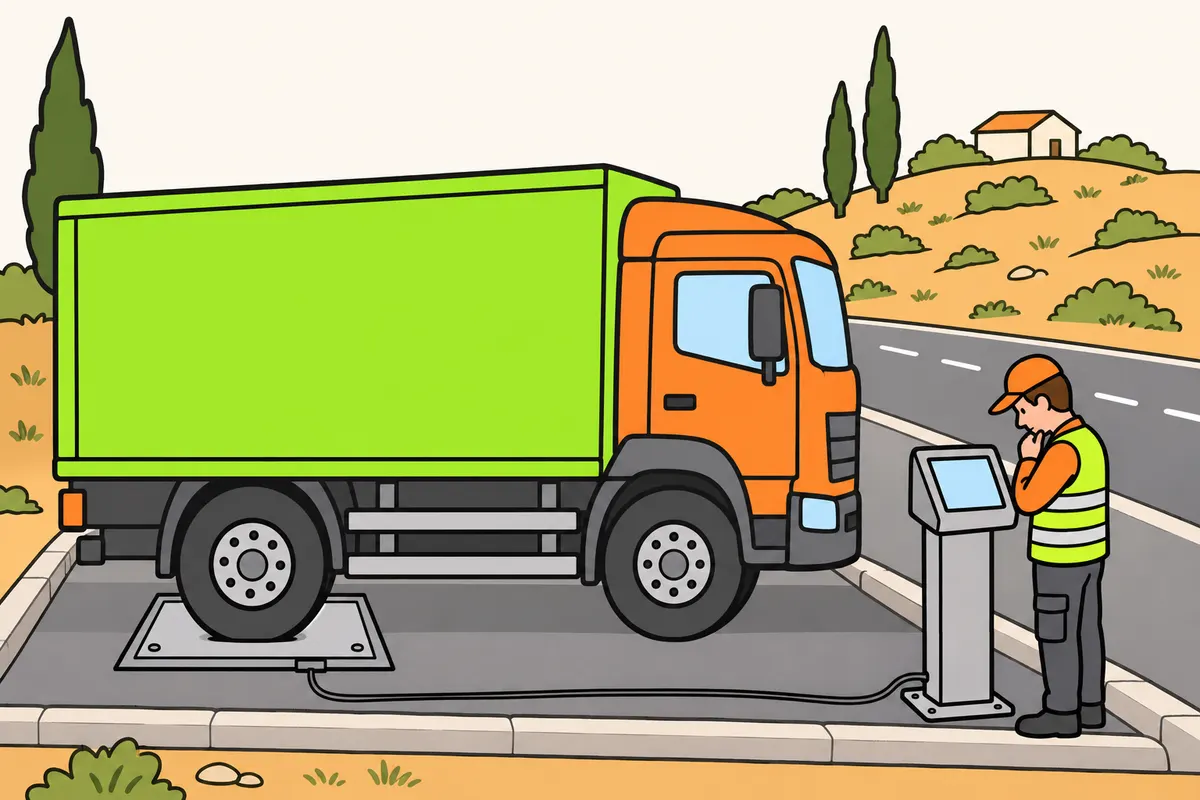
Check whether each mass sign uses your actual weight or MMA.
| Sign: vehicles; R-107 only goods vehicles | What you compare |
|---|---|
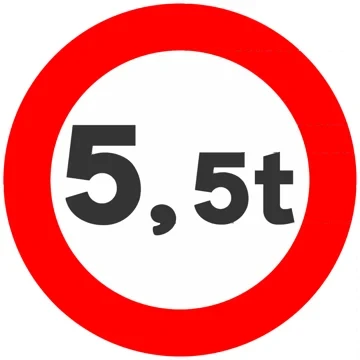
| R-201 | Actual total laden mass |
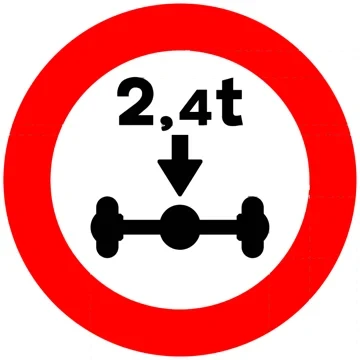
| R-202 | Actual mass through each axle |
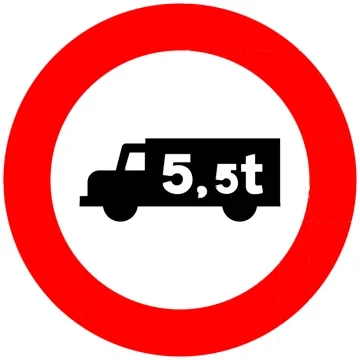
| R-107 | Goods vehicle’s MMA |
Remember
- For R-201, compare your whole vehicle’s actual laden mass.
- For R-202, check each axle’s actual load.
- For R-107, compare your goods vehicle’s MMA.
- Driving empty does not remove a ban based on MMA.
Exam trap: Wrong: use average axle mass for R-202. Right: check each axle separately.
Read the full explanation
- R-201, Mass limit, prohibits you from proceeding if your laden mass exceeds the tonnage shown. You must compare it with the actual mass for the journey, including people and goods. With a sign showing 5.5 t, an actual mass of 5,400 kg does not exceed that threshold, although you must comply with all other limits. [RD 465/2025, catalogue, R-107 and R-201/R-202](https://www.boe.es/buscar/doc.php?id=BOE-A-2025-12199).
- R-202, Axle mass limit, prohibits you from proceeding if the mass transmitted by all the wheels on any one axle exceeds the value shown. You must know which axle carries the greatest load: dividing the total mass by the number of axles can hide an actual overload and does not demonstrate compliance with the sign. [RD 465/2025, catalogue, R-107 and R-201/R-202](https://www.boe.es/buscar/doc.php?id=BOE-A-2025-12199).
- At an R-202 sign showing 8 t, you cannot proceed in a lorry with 7 t on one axle and 9 t on another. The average is 8 t, but one axle exceeds the figure shown. You must distinguish this restriction from R-201, which compares the total laden mass, and from the general maximum limits for the vehicle itself. [RD 465/2025, catalogue, R-107 and R-201/R-202](https://www.boe.es/buscar/doc.php?id=BOE-A-2025-12199).
- R-107 uses the goods vehicle's MMA (maximum authorised mass), rather than its actual mass. Comparing it with R-201, if you drive a lorry with an MMA of 18 t and an actual mass of 9 t, an R-107 sign showing 10 t prohibits you from proceeding, but those 9 t do not exceed an R-201 limit of 10 t. Driving empty does not remove a prohibition based on MMA either. [RD 465/2025, catalogue, R-107 and R-201/R-202](https://www.boe.es/buscar/doc.php?id=BOE-A-2025-12199).
 R-201
 R-107
 R-202
25Length, width and height signs
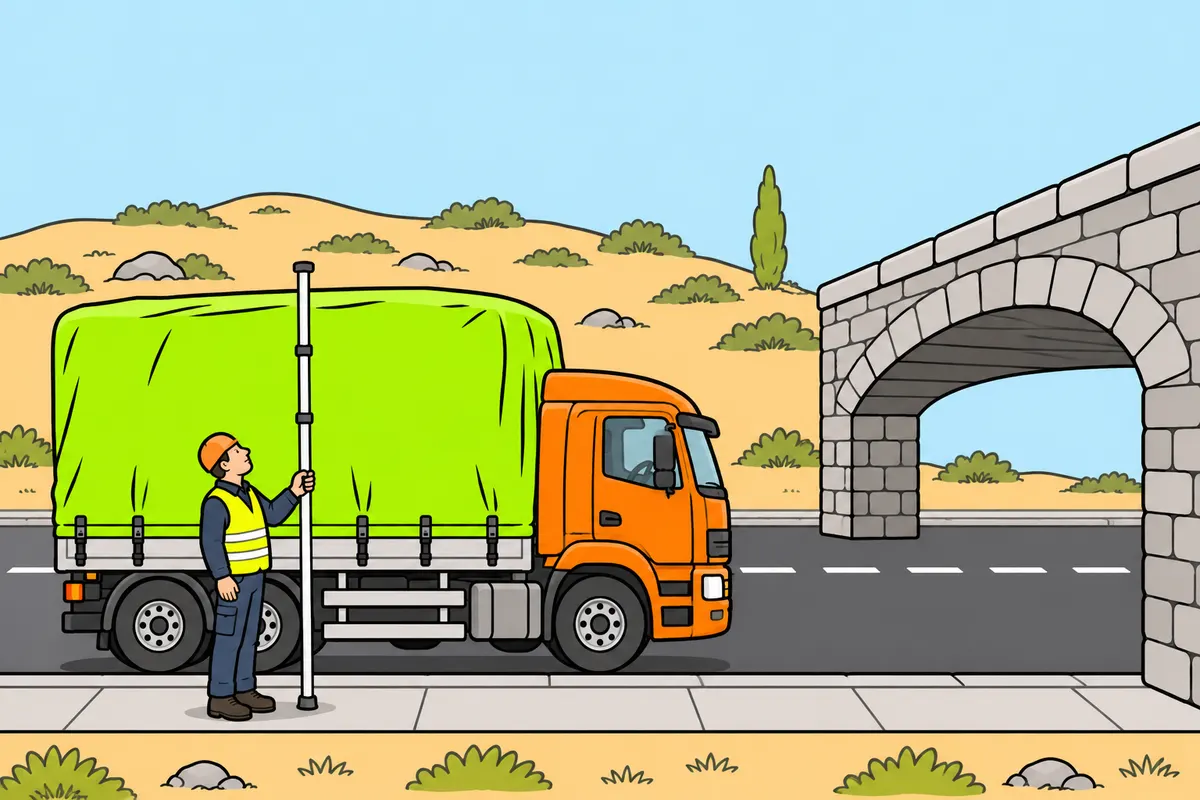
Compare signs with your vehicle’s actual dimensions, including its load.
| Sign | What you measure including load |
|---|---|
| R-203 | Total vehicle or combination length |
| R-204 | Maximum width |
| R-205 | Height to the highest point |
Remember
- Include your load when measuring length, width and height.
- You must not pass if you exceed the sign’s figure.
- Matching the figure means you do not exceed it; still check passage is safe.
- Respect local restrictions even when you meet general limits.
- Check dimensions, total mass and axle masses together.
Exam trap: Wrong: meeting general limits allows you to ignore the sign. Right: also respect local restrictions.
Read the full explanation
- R-203, Length restriction, applies to the vehicle or combination including its load. You must compare the overall length, not just the load body or the towing vehicle. At a 10 m sign, you must not proceed with a loaded lorry measuring 10.20 m, even if its unladen length is shorter. [RD 465/2025, catalogue, R-203 to R-205](https://www.boe.es/buscar/doc.php?id=BOE-A-2025-12199).
- R-204, Width restriction, refers to the maximum width including the load. At a 2 m sign, you must not proceed if you exceed that figure; at a 2.50 m sign, you cannot proceed with your 2.55 m lorry either, even if it complies with the general maximum. You must check route restrictions when planning and when you reach each access point. [RD 465/2025, catalogue, R-203 to R-205](https://www.boe.es/buscar/doc.php?id=BOE-A-2025-12199).
- R-205, Height restriction, includes the load. At a 3.50 m sign, you cannot proceed with a height of 3.60 m even if your lorry is below 4 m; an exception allowing a vehicle height of 4.50 m does not allow you to enter where a 4 m restriction applies either. You must compare your actual height in road-going condition, including any components that determine the highest point. [RD 465/2025, catalogue, R-203 to R-205](https://www.boe.es/buscar/doc.php?id=BOE-A-2025-12199).
- These signs prohibit you from exceeding the figure shown: matching it does not mean exceeding it. Even so, you must make sure you know the actual measurement and can proceed safely; a theoretical match does not correct a measurement error or remove obstacles. You must comply with the mass, axle and all dimension restrictions at the same time. [RD 465/2025, catalogue, R-203 to R-205](https://www.boe.es/buscar/doc.php?id=BOE-A-2025-12199).
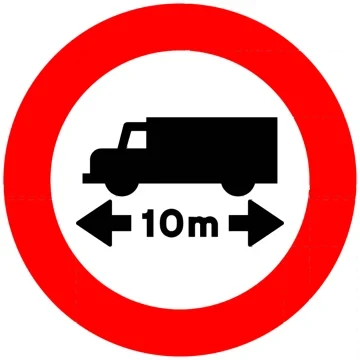 R-203
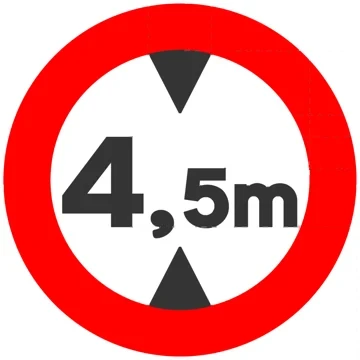 R-205
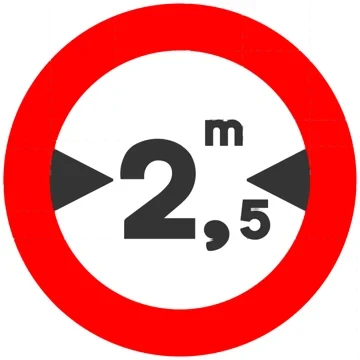 R-204
26Speed limiters
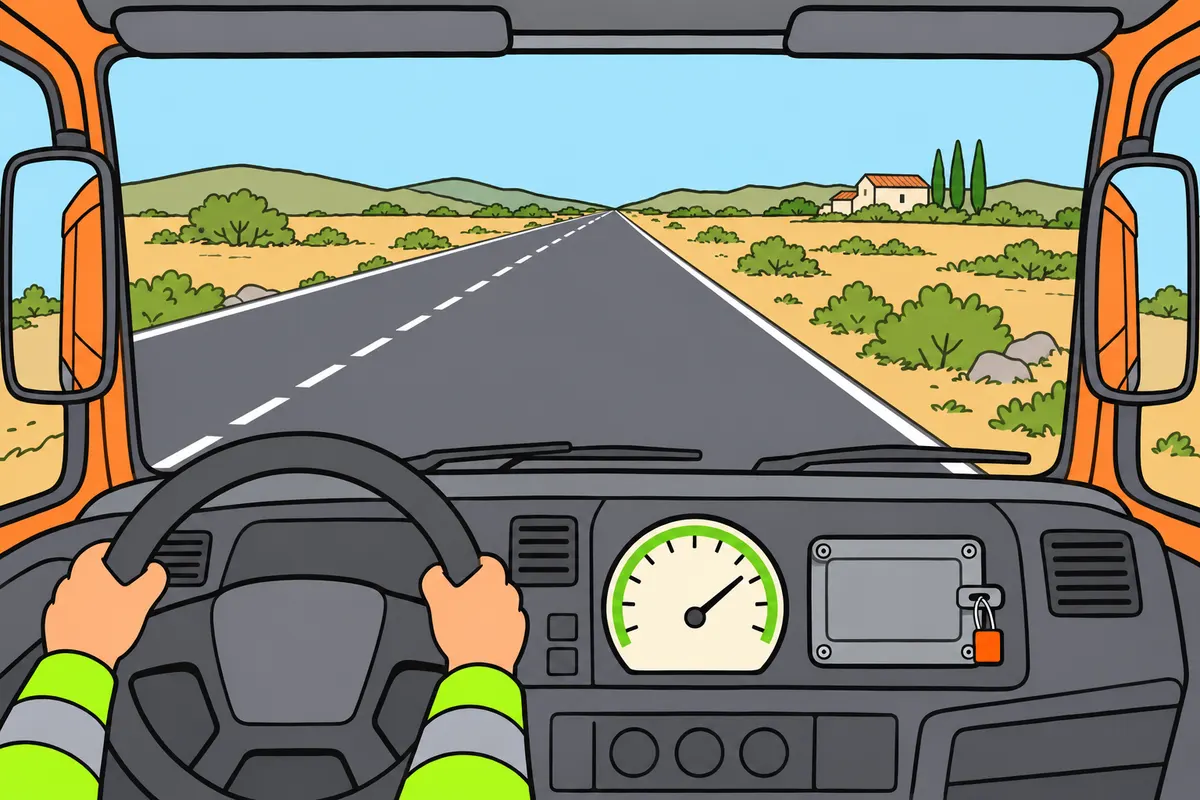
Keep your limiter working and always respect the speed allowed on each road.
| Vehicle or exemption: regime covers at least four wheels, design speed above 25 km/h | Requirement or setting |
|---|---|
| N3 registered from 1 January 1988 | Required: 90 km/h |
| N2 registered from 1 January 2005 | Required: 90 km/h |
| Euro 3 N2 registered between 1 October 2001 and 1 January 2005 | Required: 90 km/h |
| M2 and M3 subject to the requirement | 100 km/h |
| Armed Forces, law enforcement, civil protection, fire and other emergency services | Exempt |
| Design prevents exceeding the corresponding setting | Exempt |
| Scientific road tests | Exempt |
| Exclusive use for urban public services | Exempt |
Remember
- Check category, registration date and exemptions to see whether your lorry needs a limiter.
- Have an authorised workshop or organisation install and check your type-approved device.
- If it fails or loses a seal, take it for a check.
- Read the workshop, date and setting on your installation plate.
- Helping tamper with your limiter is a very serious offence: you lose 6 points.
- An urban delivery does not mean exclusive use for urban public services.
Exam trap: Wrong: the setting always allows that speed. Right: obey the road limit and adapt to conditions.
Read the full explanation
- The speed limiter rules cover M2, M3, N2 and N3 vehicles with at least four wheels and a design speed above 25 km/h. For your lorry, the relevant categories are N2 and N3. [RD 1417/2005, art. 2](https://www.boe.es/buscar/act.php?id=BOE-A-2005-19990#a2).
- If you drive an N2 or N3 lorry subject to the requirement, its limiter must prevent you from exceeding 90 km/h; for M2 and M3 vehicles, the setting is 100 km/h. [RD 1417/2005, arts. 3 and 4](https://www.boe.es/buscar/act.php?id=BOE-A-2005-19990#a3).
- Article 5 of RD 1417/2005 defines which registration dates bring your vehicle within the requirement: N3 vehicles registered on or after 1 January 1988; N2 vehicles registered on or after 1 January 2005; and N2 Euro 3 vehicles registered between 1 October 2001 and 1 January 2005. [RD 1417/2005, art. 5](https://www.boe.es/buscar/act.php?id=BOE-A-2005-19990#a5).
- Your vehicle is exempt if it is used by the Armed Forces, law enforcement agencies, civil protection, fire services or other emergency services; exemptions also cover vehicles whose design speed does not exceed the relevant setting, vehicles used for scientific road tests and vehicles used only for urban public services. [RD 1417/2005, art. 7](https://www.boe.es/buscar/act.php?id=BOE-A-2005-19990#a7).
- You must have a type-approved device installed and checked by an authorised organisation or workshop. [RD 1417/2005, arts. 6 and 8](https://www.boe.es/buscar/act.php?id=BOE-A-2005-19990#a8).
- Your limiter must work and retain its seals; if it fails or a seal is broken or removed, you must take it for inspection. [RD 1417/2005, art. 8](https://www.boe.es/buscar/act.php?id=BOE-A-2005-19990#a8).
- The installation plate identifies the workshop, the date and the setting «v = ... km/h»; you must keep it in place without removing it or breaking its seals. [RD 1417/2005, art. 8.1 and annex, section 5](https://www.boe.es/buscar/act.php?id=BOE-A-2005-19990#a8).
- The limiter setting does not authorise you to drive at that speed: you must obey the applicable limit and adapt your driving to the circumstances. See «Speed and safe following distances». [Traffic Act, art. 21](https://www.boe.es/buscar/act.php?id=BOE-A-2015-11722#a21).
- If you take part in, or provide the assistance necessary for, installing or activating components that alter the normal operation of the tachograph or speed limiter, you commit a very serious offence (art. 77.m) and lose 6 points. [Traffic Act, art. 77.m and annex II.7](https://www.boe.es/buscar/act.php?id=BOE-A-2015-11722#anii).
Check masses before your journey
You must satisfy every check: meeting the total MMA (maximum authorised mass) limit alone is not enough.
- Identify the tare mass, MMA and technically permissible maximum limits for the vehicle and, where applicable, the combination in their documents.
- Calculate or weigh the actual mass including the driver, goods and all other items present.
- Select the total mass row according to the vehicle units, axles and technical conditions; check whether any exception applies to the operation.
- Check each axle and axle group according to its spacing and equipment, as well as the minimum load on the driving axles.
- Compare the results with the documents and the signs along your route; adjust the load or route if you exceed any limit.
Check a projecting load
You must distinguish the permitted overhang from the authorised overall dimensions.
- Identify whether the load is indivisible and whether the vehicle is intended exclusively for carrying goods.
- Measure the vehicle and apply the corresponding overhang limit: over 5 m or up to and including 5 m.
- Measure the overall laden length, width and height; check the exceptions that actually apply.
- If you exceed an applicable maximum, obtain the appropriate supplementary authorisation before setting off.
- Protect the ends and fit panels and lights where required; check the restrictions along your route.
Answer an access restriction question
You must compare the figure with the quantity specified by the sign.
- Identify whether the sign limits laden mass, axle mass, length, width or height.
- For R-201, use the actual mass; for R-202, check each axle; for R-203 to R-205, include the load.
- Convert tonnes to kilograms if the figures use different units.
- Check whether you exceed the figure, without confusing equality with excess.
- Check the other restrictions: complying with one sign does not establish that you can use the whole route.
Finished this module?
Mark it as read and you will see your progress on the theory list.