
Theory · AM Licence - Moped · Module 9 of 18
Using the road with a moped
You learn how to choose where to ride a moped or drive a light quadricycle, when you must use the arcén (hard shoulder) and which roads and lanes you are prohibited from using. You can interpret markings, traffic directions and special lanes and answer questions about tunnels without applying passenger-car rules to your AM vehicle.
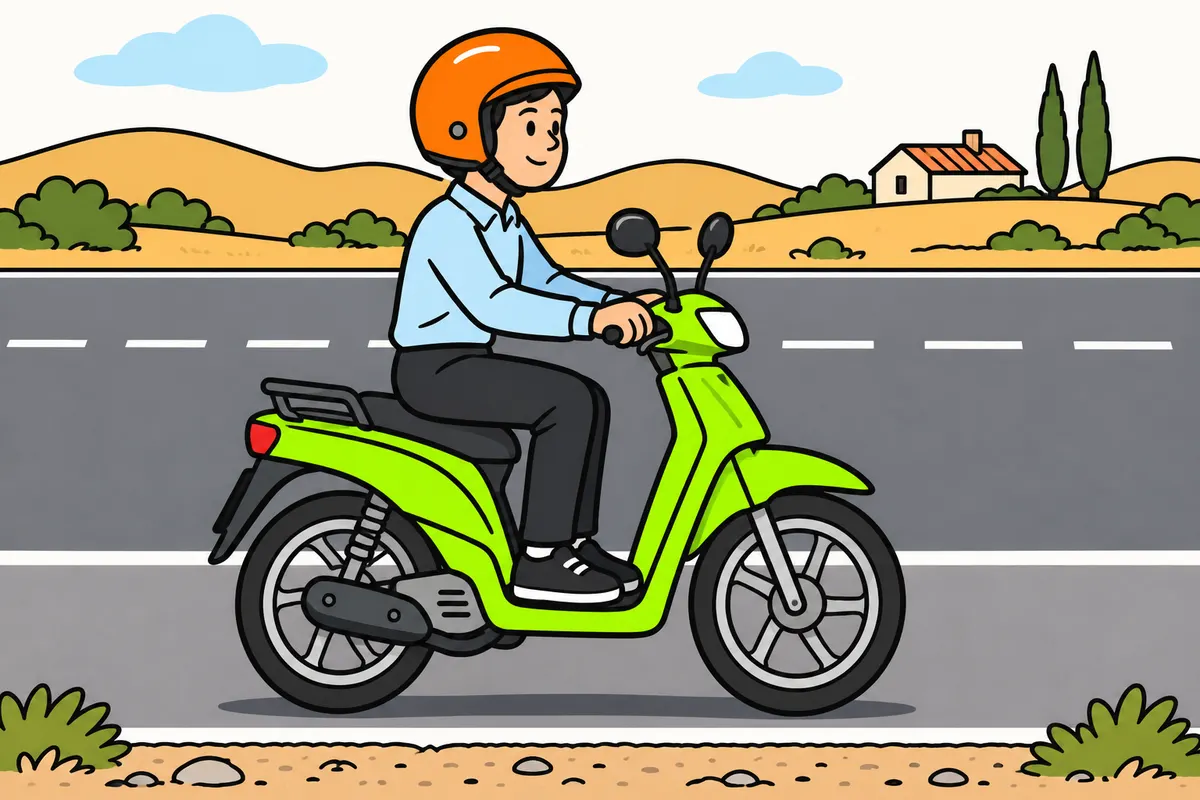
1Identify the space you can use
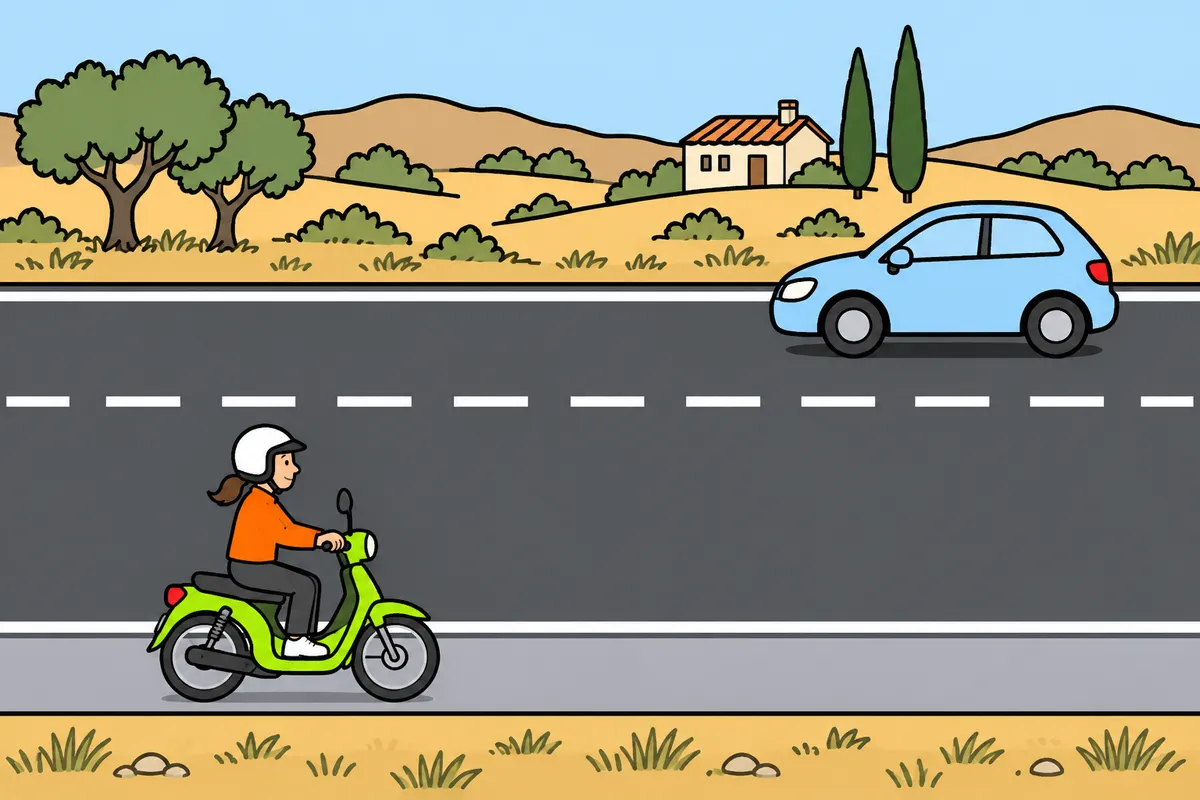
Identify road spaces before choosing where to travel.
| Space | What you must distinguish |
|---|---|
| Carriageway | Space intended for traffic |
| Lane | Part of the carriageway |
| Hard shoulder | Strip beside the carriageway; not another ordinary lane |
Remember
- Distinguish the carriageway, its lanes and the hard shoulder.
- Check traffic directions and separations between carriageways.
- With a light quadricycle, follow moped rules.
- Check prohibitions and reservations before entering.
Exam trap: Wrong: your light quadricycle is a passenger car. Right: you must follow moped rules.
Read the full explanation
- The carriageway, its lanes and the hard shoulder are different spaces that determine your road position. The carriageway is intended for traffic, and the hard shoulder is the adjoining longitudinal strip that certain users must use. Being part of the same road platform does not make the hard shoulder another ordinary lane. [LTSV, annex I](https://www.boe.es/buscar/act.php?id=BOE-A-2015-11722#ani)
- With AM, you must apply the rules for the vehicle you drive. A two-wheeled moped and a light quadricycle have different widths, but both are subject to moped rules. A light quadricycle's bodywork does not make it a passenger car. [LTSV, annex I](https://www.boe.es/buscar/act.php?id=BOE-A-2015-11722#ani)
- Do not confuse a road with two carriageways with a carriageway with two lanes. First identify the separation between carriageways; then identify the permitted traffic directions and the lanes on each one. This prevents you from mistaking the opposing carriageway for a lane available to you. [LTSV, annex I](https://www.boe.es/buscar/act.php?id=BOE-A-2015-11722#ani)
- You may encounter streets, travesías (through roads in built-up areas), conventional roads and tracks open to traffic. The name of the space does not in itself guarantee access: you must also check prohibitions and reservations. A cycle route is intended for specific users, even if it is physically wide enough for your moped. [LTSV, annex I](https://www.boe.es/buscar/act.php?id=BOE-A-2015-11722#ani)
2Keep to the right
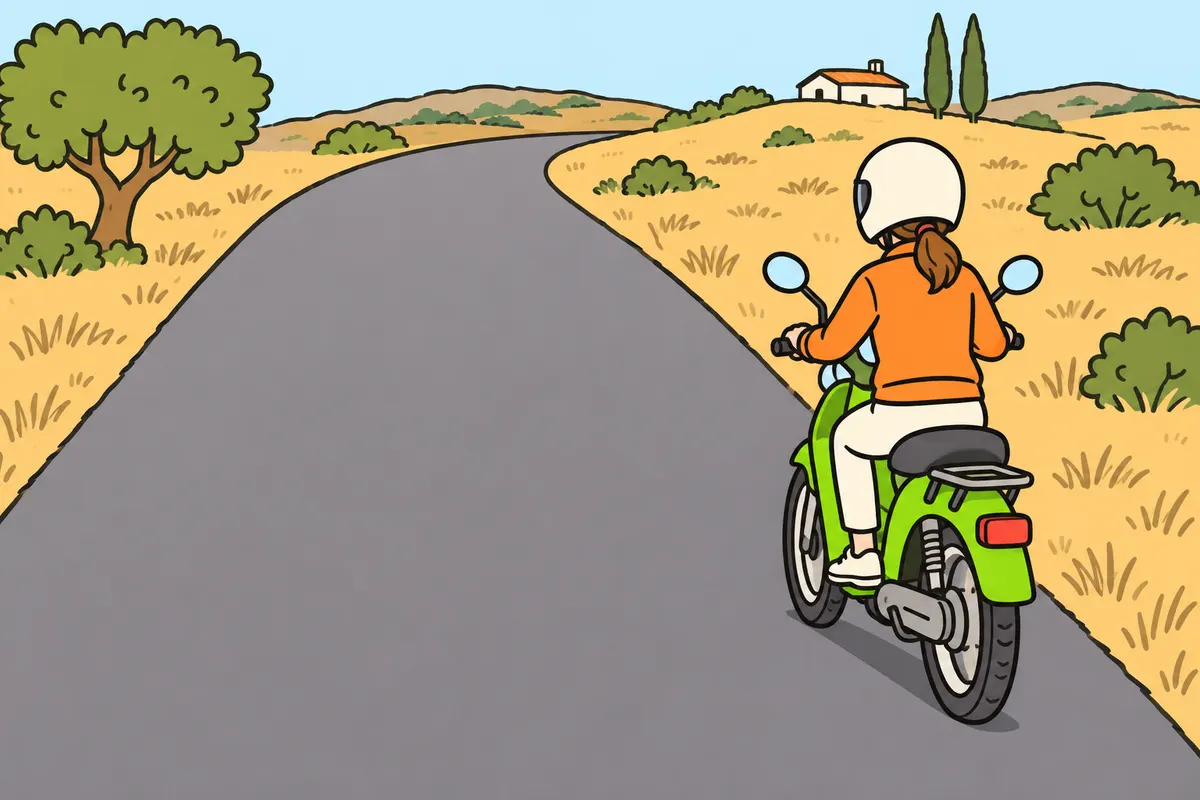
Keep to the right and leave room to drive safely.
Remember
- Keep close to the right edge without brushing obstacles.
- Leave room at your side to pass oncoming vehicles safely.
- Keep right even when you see no oncoming vehicles.
- With poor visibility on bends or hill crests, keep the oncoming side clear.
- Use the right-hand hard shoulder when required, if passable and wide enough.
Exam trap: Wrong: without a centre line, you can use the middle. Right: you must keep right safely.
Read the full explanation
- You must keep to the right and as close to the edge as is safely possible. Keep enough lateral clearance to pass oncoming vehicles safely. This obligation also applies on a narrow road without a centre line and when nobody appears to be approaching. [RGC, art. 29](https://www.boe.es/buscar/act.php?id=BOE-A-2003-23514#a29)
- On bends and at the crests of hills with restricted visibility, you must leave the half intended for oncoming traffic clear, even if it is not marked. [RGC, art. 29](https://www.boe.es/buscar/act.php?id=BOE-A-2003-23514#a29)
- Keeping close to the edge does not mean brushing against a kerb, barrier or obstacle. You must keep the clearance you need to control the vehicle. If you are required to use the hard shoulder, you must combine this general rule with the specific obligation to use the right-hand hard shoulder when it is passable and wide enough. [RGC, art. 29](https://www.boe.es/buscar/act.php?id=BOE-A-2003-23514#a29)
3The right-hand hard shoulder is your usual place
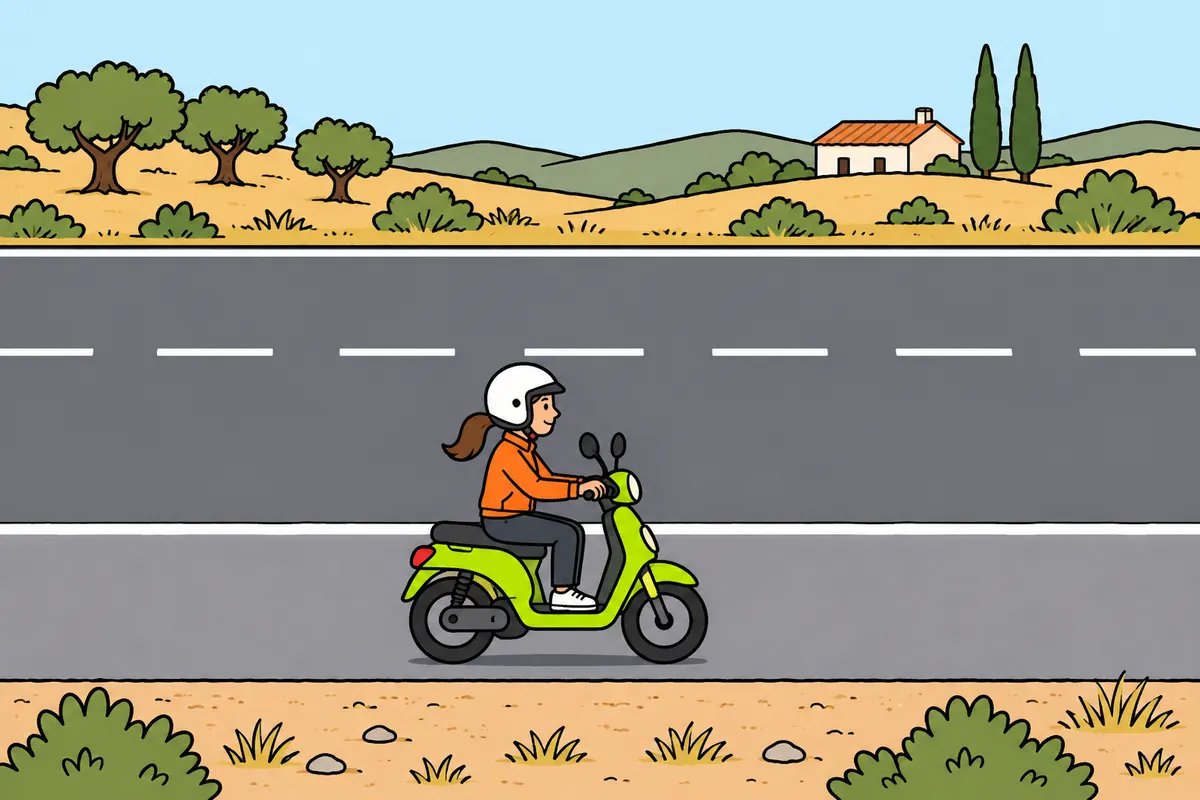
Use the passable, wide-enough right-hand hard shoulder unless there is space specifically for your vehicle.
| Case for your moped | Where you must travel |
|---|---|
| No specific space; right-hand hard shoulder passable and wide enough | Right-hand hard shoulder |
| Hard shoulder absent, impassable or too narrow | Only the necessary carriageway space, on the right |
Remember
- Use a road or part specifically intended for your vehicle if provided.
- Otherwise, use the right-hand hard shoulder if passable and wide enough.
- Check the width for your vehicle.
- Without a suitable hard shoulder, use only the carriageway space you need.
- Keep right with enough safety clearance.
Exam trap: Wrong: you choose the hard shoulder only in congestion. Right: you must use it if passable and wide enough, with no space specifically for your vehicle.
Read the full explanation
- If there is no road or part of the road specifically intended for your vehicle, you must use the right-hand hard shoulder when it is passable and wide enough. This is an obligation for mopeds, not an option reserved for busy traffic or a measure required only after a breakdown. [RGC, art. 36](https://www.boe.es/buscar/act.php?id=BOE-A-2003-23514#a36)
- You must check both conditions: that you can travel along the hard shoulder and that it is wide enough for your vehicle. A hard shoulder may be suitable for a two-wheeled moped but too narrow for a light quadricycle. Your assessment depends on its actual condition and the particular vehicle. [RGC, art. 36](https://www.boe.es/buscar/act.php?id=BOE-A-2003-23514#a36)
- If there is no hard shoulder, or it is not passable or wide enough, you must use only as much of the carriageway as necessary. Keep to the right-hand side with the necessary safety clearance. The absence of a hard shoulder does not in itself prohibit you from using a conventional road. [RGC, art. 36](https://www.boe.es/buscar/act.php?id=BOE-A-2003-23514#a36)
4Usable hard shoulders and obstacles
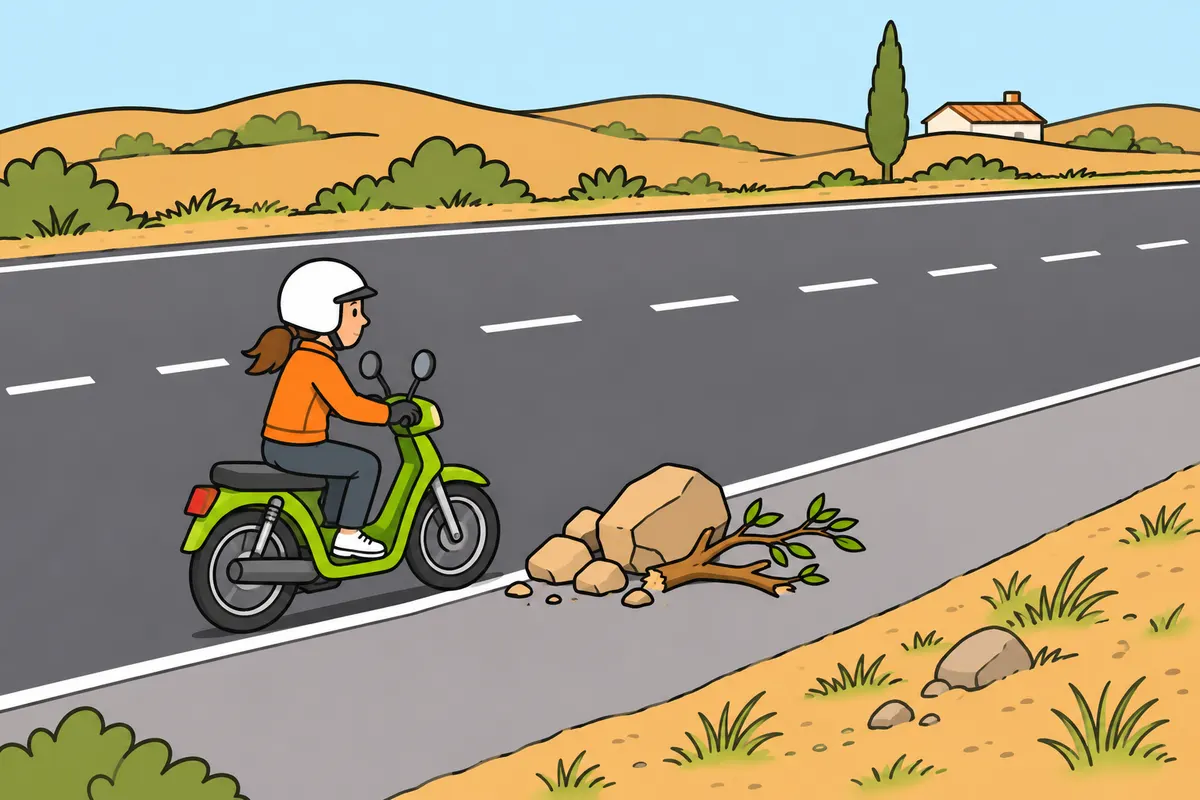
If the hard shoulder is blocked, use only necessary carriageway space and return when possible.
| Hard shoulder condition for your vehicle | What you must check |
|---|---|
| Wide but obstructed | It may be impassable |
| Clear but narrow | It may not be wide enough |
Remember
- Check that the hard shoulder is clear and wide enough.
- At an obstacle, use only the carriageway space needed to pass safely.
- Return when the hard shoulder is passable and wide enough.
- Check your surroundings and avoid sudden movements.
- Do not use bicycle exceptions for long, winding descents.
Exam trap: Wrong: after an obstacle, you can stay far from the edge. Right: return safely when the hard shoulder is passable and wide enough.
Read the full explanation
- If you encounter an obstacle that prevents you from using the hard shoulder, occupy only as much of the carriageway as necessary to continue safely. Do not treat this isolated problem as permission to travel far from the right-hand edge for the entire journey. [RGC, art. 36](https://www.boe.es/buscar/act.php?id=BOE-A-2003-23514#a36)
- A wide hard shoulder covered in obstacles may be impassable; a clear one may be too narrow. If either condition is not met, use only as much of the carriageway as necessary. [RGC, art. 36.1](https://www.boe.es/buscar/act.php?id=BOE-A-2003-23514#a36)
- When the reason preventing you from using the hard shoulder disappears and it is passable and wide enough again, you must return to your required road position. Check your surroundings as you do so and avoid sudden movements: the duty to use it does not require a dangerous manoeuvre. [RGC, art. 36](https://www.boe.es/buscar/act.php?id=BOE-A-2003-23514#a36)
- The permission for bicycles to occupy part of the carriageway on certain long, winding descents is specific to them. You cannot claim this exception because you ride a two-wheeled moped: you must follow the rule on using a suitable hard shoulder. [RGC, art. 36](https://www.boe.es/buscar/act.php?id=BOE-A-2003-23514#a36)
5Single file and overtaking between hard shoulder users
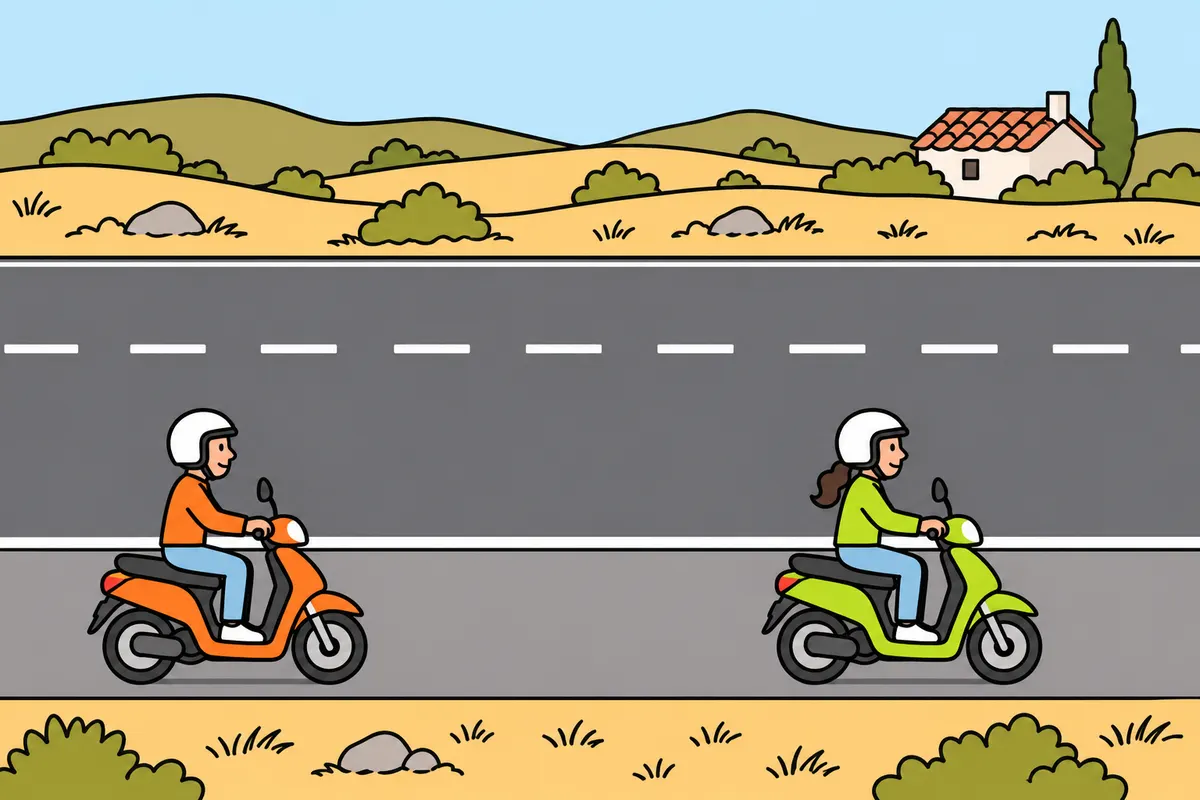
Travel in single file and meet both limits when overtaking other hard shoulder users.
Remember
- Do not travel continuously alongside another moped.
- Travel in single file even on a wide, empty hard shoulder.
- When overtaking between hard shoulder users, meet both limits together.
- Check visibility, space and speed before overtaking.
- Do not prolong overtaking because a tractor driver signals you to pass.
Exam trap: Wrong: meeting either 15 seconds or 200 metres is enough. Right: during that overtaking, you must meet both limits while alongside.
Read the full explanation
- You must not travel continuously alongside another moped. You must travel in single file, even if the hard shoulder is wide, there is hardly any traffic or both vehicles fit without entering the carriageway. The exception allowing bicycles to ride two abreast does not extend to mopeds. [RGC, art. 36](https://www.boe.es/buscar/act.php?id=BOE-A-2003-23514#a36)
- Travelling alongside another vehicle during permitted overtaking has its own limits. In the circumstances covered by article 36.5, you must not overtake if travelling alongside takes more than 15 seconds or covers more than 200 metres. [RGC, art. 36](https://www.boe.es/buscar/act.php?id=BOE-A-2003-23514#a36)
- Both limits apply simultaneously: you must be able to complete the manoeuvre within both. Before starting, assess the speed difference, the length of the vehicle you are overtaking and the space you need to return to your road position without forcing others to brake. [RGC, art. 36.5](https://www.boe.es/buscar/act.php?id=BOE-A-2003-23514#a36)
- If you overtake a tractor using the hard shoulder, you cannot justify travelling alongside it for a prolonged period because its driver signals you to pass. Their help does not change the overtaking limits or replace your checks of the available space, visibility and other conditions. [RGC, art. 36](https://www.boe.es/buscar/act.php?id=BOE-A-2003-23514#a36)
6Share the hard shoulder without confusing vehicle categories
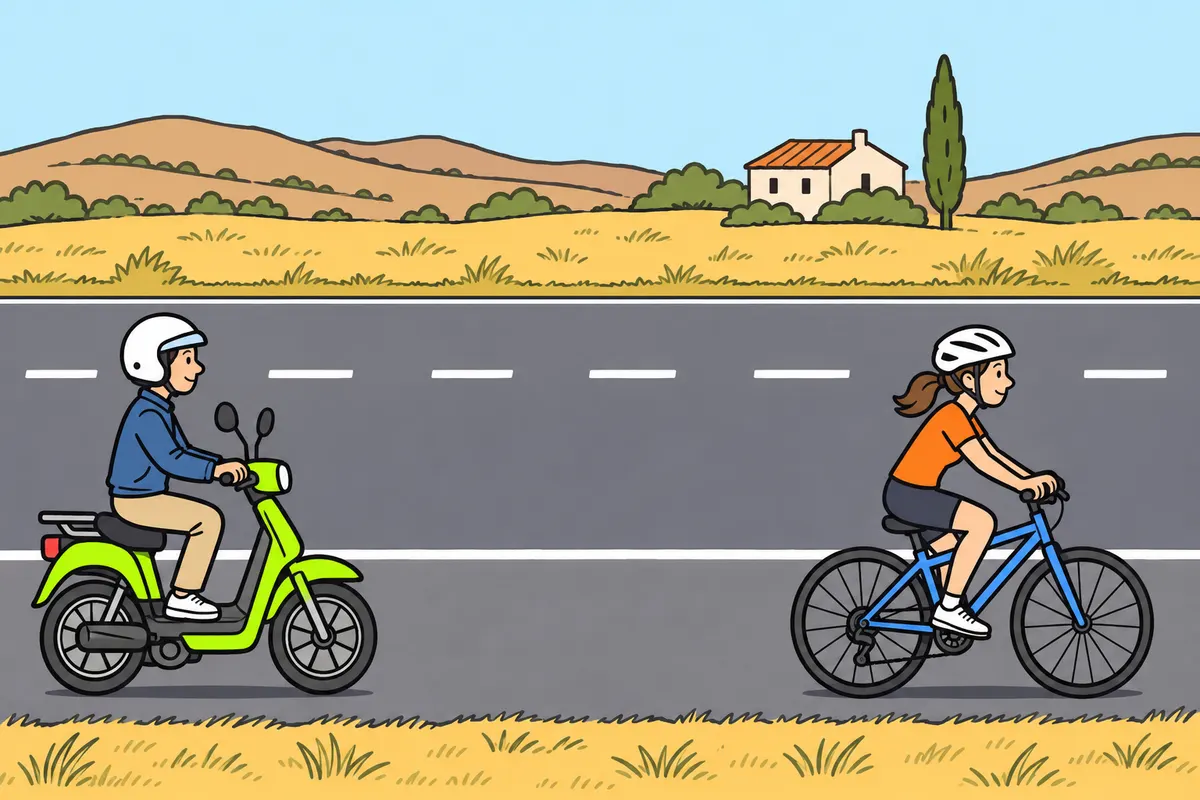
Share the hard shoulder and distinguish each vehicle’s rules.
| Vehicle or case | Hard shoulder rule |
|---|---|
| Special vehicles up to 3,500 kg maximum authorised mass | Must use it if passable and wide enough, with no space specifically for them |
| Vehicles up to 3,500 kg: emergency, abnormally low speed and serious traffic disruption | Must use a suitable hard shoulder |
| Motorcycles: exceptional authorised, signposted use, with traffic lanes stopped by congestion | Maximum 30 km/h, single file, protecting users required to use it |
Remember
- Expect cycles, animal-drawn vehicles and vehicles for people with reduced mobility.
- You may also encounter special vehicles required to use the hard shoulder.
- Your moped needs no emergency for its hard shoulder obligation to apply.
- Motorcycles need exceptional authorised, signposted use, with traffic lanes stopped by congestion.
- During that use, they must travel single file and protect required users.
Exam trap: Wrong: you need an emergency to use the hard shoulder. Right: your moped has its own obligation to use it.
Read the full explanation
- On the hard shoulder, you may encounter cycles, animal-drawn vehicles, vehicles for people with reduced mobility and certain special vehicles. It is not exclusively for mopeds. You must anticipate users of different sizes and speeds when choosing your path. [RGC, art. 36](https://www.boe.es/buscar/act.php?id=BOE-A-2003-23514#a36)
- Special vehicles with a maximum authorised mass (MMA) not exceeding 3,500 kg must also use the right-hand hard shoulder when it is passable and wide enough and there is no road or part of the road specifically intended for them. You may encounter them while using the hard shoulder with your moped. [RGC, art. 36.1](https://www.boe.es/buscar/act.php?id=BOE-A-2003-23514#a36)
- Vehicles with an MMA not exceeding 3,500 kg which, because of an emergency, travel at an abnormally low speed and seriously disrupt traffic must also use a suitable hard shoulder. Your moped has its own obligation to use it: you do not need to experience that emergency for it to apply. [RGC, art. 36](https://www.boe.es/buscar/act.php?id=BOE-A-2003-23514#a36)
- You may encounter motorcycles on hard shoulders where exceptional use is authorised and signposted when congestion brings traffic in the lanes to a standstill. They must observe 30 km/h, travel in single file and protect users required to use the hard shoulder; this specific authorisation does not replace the ordinary rule for your moped. [RGC, art. 36](https://www.boe.es/buscar/act.php?id=BOE-A-2003-23514#a36)
7Streets with several lanes
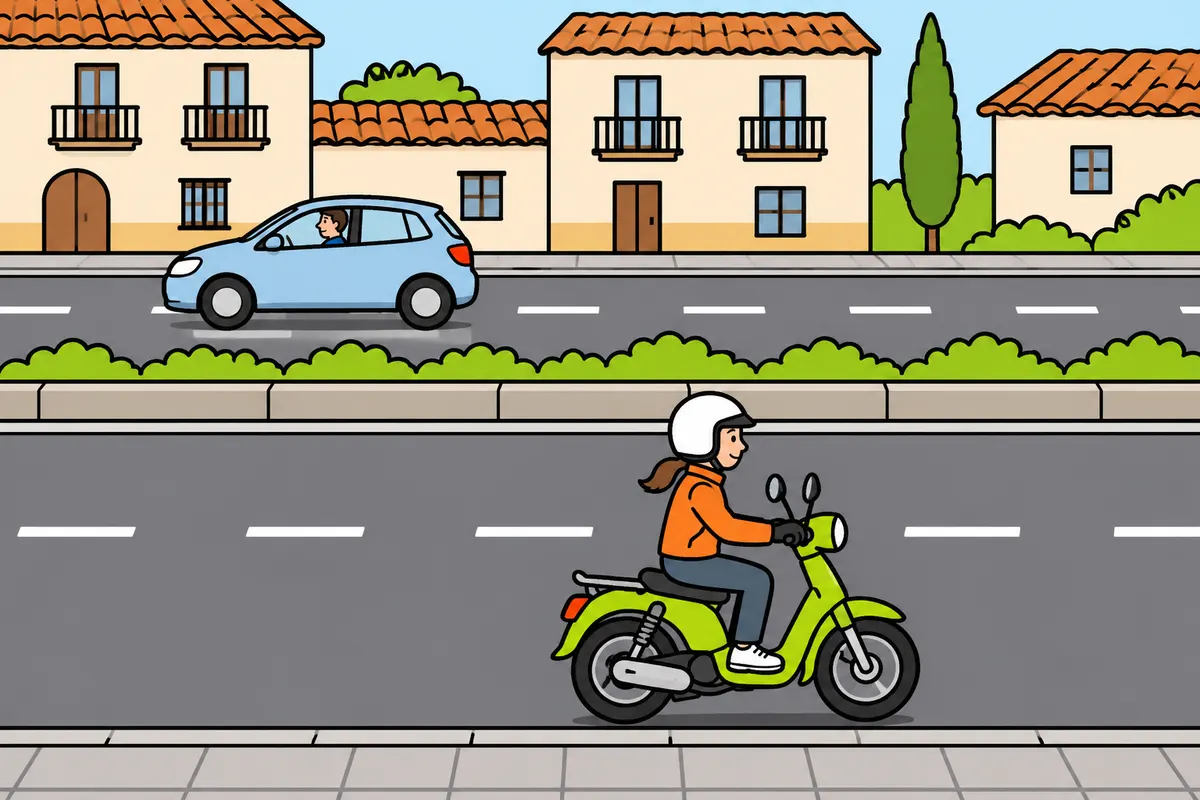
In town, keep right and respect reserved lanes.
Remember
- Use the hard shoulder when required.
- Do not choose the left lane for convenience.
- You may move across for a permitted manoeuvre or to follow signs.
- Without painted lines, you must still keep right.
- Do not enter a lane reserved for other users.
Exam trap: Wrong: you choose any lane according to your destination. Right: that rule for automóviles and special vehicles does not extend to your moped.
Read the full explanation
- In built-up areas, you must keep to the right and comply with the obligation to use the hard shoulder where one exists. The rule allowing you to choose the lane best suited to your destination applies to motor vehicles in the legal category automóvil and special vehicles: you must not extend it to your moped or light quadricycle. [RGC, art. 29](https://www.boe.es/buscar/act.php?id=BOE-A-2003-23514#a29); [RGC, art. 33](https://www.boe.es/buscar/act.php?id=BOE-A-2003-23514#a33); [RGC, art. 36](https://www.boe.es/buscar/act.php?id=BOE-A-2003-23514#a36)
- If a street has several marked lanes in the same direction, you cannot choose the left-hand lane simply because it is more convenient later. You may need to move across to perform a permitted manoeuvre or follow the signs on that stretch. [RGC, art. 29](https://www.boe.es/buscar/act.php?id=BOE-A-2003-23514#a29); [RGC, art. 33](https://www.boe.es/buscar/act.php?id=BOE-A-2003-23514#a33)
- A street without lane markings does not allow you to occupy any part of it. You must keep to the right and maintain the necessary clearance. The absence of paint does not make a two-way street one-way either. [RGC, art. 29](https://www.boe.es/buscar/act.php?id=BOE-A-2003-23514#a29)
- When a lane is reserved for buses or other users, you must respect that reservation and use the appropriate permitted part of the road. You cannot enter it merely to appear to comply with the rule to keep right: first check which spaces your vehicle is allowed to use. [RGC, art. 35](https://www.boe.es/buscar/act.php?id=BOE-A-2003-23514#a35)
8Roads with one or more lanes in each direction
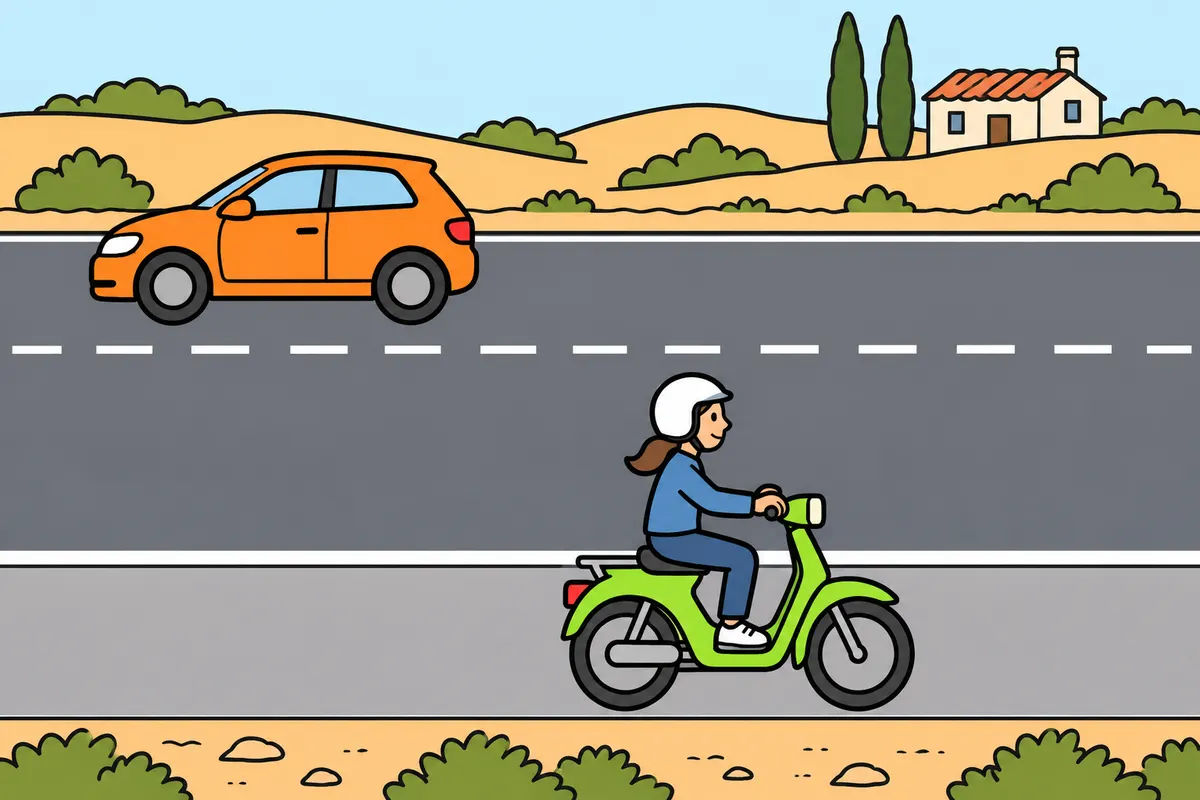
Several lanes do not remove your duty to use a suitable hard shoulder.
| Lane on a three-lane, two-way carriageway with broken lines | Use |
|---|---|
| Centre | Overtaking or preparing to turn left; not normal travel |
| Furthest to your left | Oncoming traffic |
Remember
- Without specific space, use the right-hand hard shoulder if passable and wide enough.
- Do not routinely use the oncoming lane.
- Do not count reserved lanes as ordinary lanes.
- With three total lanes, two-way traffic and broken lines, identify the centre lane.
Exam trap: Wrong: several lanes let you ignore the hard shoulder. Right: it remains compulsory if passable and wide enough, with no space specifically for you.
Read the full explanation
- On a two-way carriageway with one lane in each direction, you must use the right-hand part assigned to you, using the hard shoulder if it is passable and wide enough and there is no part specifically intended for your vehicle. You must not move into the opposing lane to follow a more comfortable path during normal travel. [RGC, art. 29](https://www.boe.es/buscar/act.php?id=BOE-A-2003-23514#a29); [RGC, art. 36](https://www.boe.es/buscar/act.php?id=BOE-A-2003-23514#a36)
- If there are several lanes in your direction, their existence does not remove your obligation to use a passable hard shoulder that is wide enough. Do not automatically apply the passenger-car rule allowing the use of other lanes when traffic or road conditions warrant it to a moped. [RGC, art. 36](https://www.boe.es/buscar/act.php?id=BOE-A-2003-23514#a36)
- On a two-way carriageway with three lanes in total separated by broken lines, the centre lane is for overtaking and preparing to turn left. It is not a lane for normal travel and does not permanently belong to whoever reaches it first; the lane furthest to your left is for oncoming traffic. [RGC, art. 30](https://www.boe.es/buscar/act.php?id=BOE-A-2003-23514#a30); [RGC, art. 36](https://www.boe.es/buscar/act.php?id=BOE-A-2003-23514#a36)
- When counting lanes to interpret lane-use rules, you must exclude those reserved for particular vehicles or manoeuvres. A bus lane or a turning-only lane does not count in the same way as an ordinary lane; check its signs and markings before deciding how many lanes are available to you. [RGC, art. 34](https://www.boe.es/buscar/act.php?id=BOE-A-2003-23514#a34)
9One-way and two-way traffic
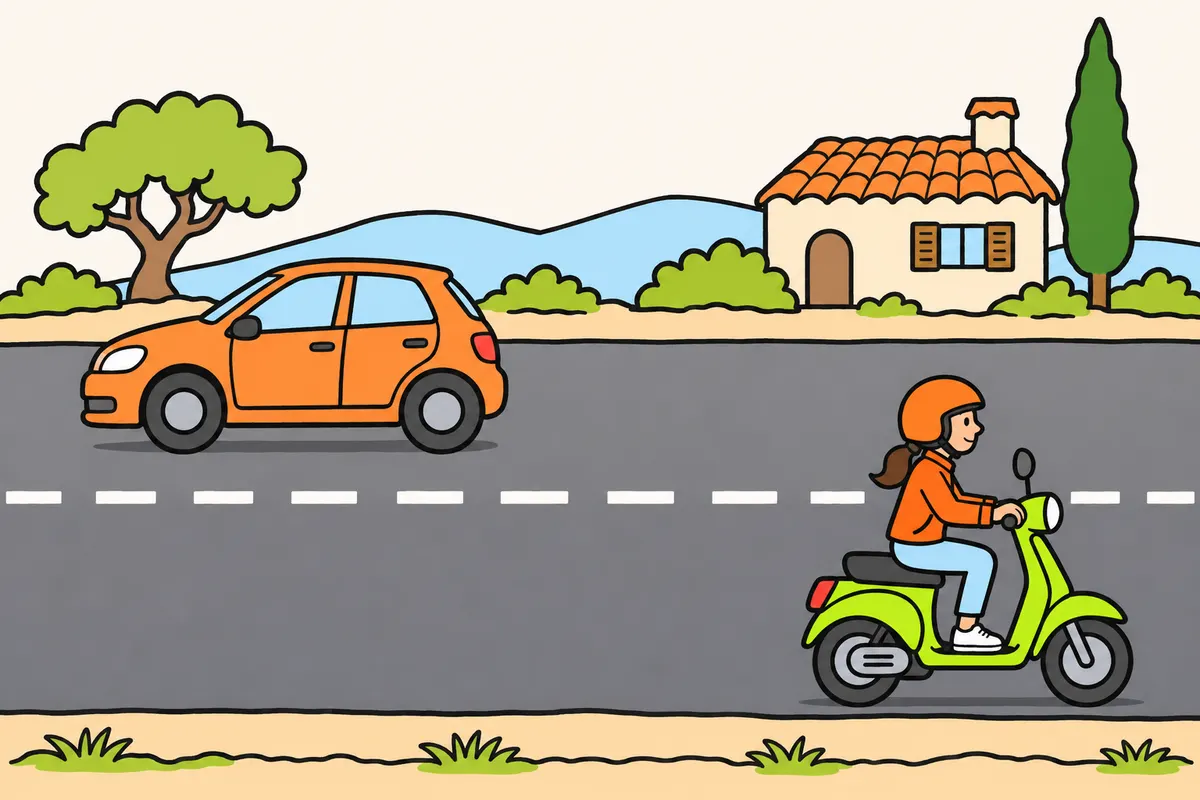
Check the permitted direction and respect traffic already in the lane.
| Road | What you must do |
|---|---|
| One-way | Travel in the authorised direction; respect keeping right, reservations and arrows |
| Two-way | Identify and keep clear the part for oncoming traffic |
Remember
- Check arrows, signs, vehicles and separation of traffic directions.
- Do not judge traffic direction from a parked vehicle.
- A broken line does not guarantee all lanes run in the same direction.
- When changing lanes, signal and give way to traffic already there.
Exam trap: Wrong: on a one-way road, you have priority when changing lanes. Right: give way to traffic in the destination lane.
Read the full explanation
- On a one-way road, you can only travel in the authorised direction. Having no oncoming traffic does not allow you to use any lane without considering your vehicle, reservations and painted arrows. The moped's obligation to keep right remains relevant. [RGC, art. 29](https://www.boe.es/buscar/act.php?id=BOE-A-2003-23514#a29); [RGC, art. 35](https://www.boe.es/buscar/act.php?id=BOE-A-2003-23514#a35); [RGC, annex I](https://www.boe.es/buscar/act.php?id=BOE-A-2003-23514#ani)
- On a two-way road, you must identify which part belongs to oncoming traffic, with or without centre markings. Do not infer the traffic direction from the orientation of a single parked vehicle: check the signs and the actual carriageway layout. [RGC, art. 29](https://www.boe.es/buscar/act.php?id=BOE-A-2003-23514#a29)
- Broken lines separate lanes, but do not in themselves mean that all lanes run in the same direction. Read the arrows, signs and separation of traffic directions together. [RGC, annex I](https://www.boe.es/buscar/act.php?id=BOE-A-2003-23514#ani)
- If you need to change lanes for an authorised movement, you must give way to traffic already in the destination lane and signal your movement. A one-way street does not give you priority over other vehicles travelling along it. [RGC, art. 74](https://www.boe.es/buscar/act.php?id=BOE-A-2003-23514#a74); [RGC, art. 109](https://www.boe.es/buscar/act.php?id=BOE-A-2003-23514#a109)
10Separate carriageways and traffic islands
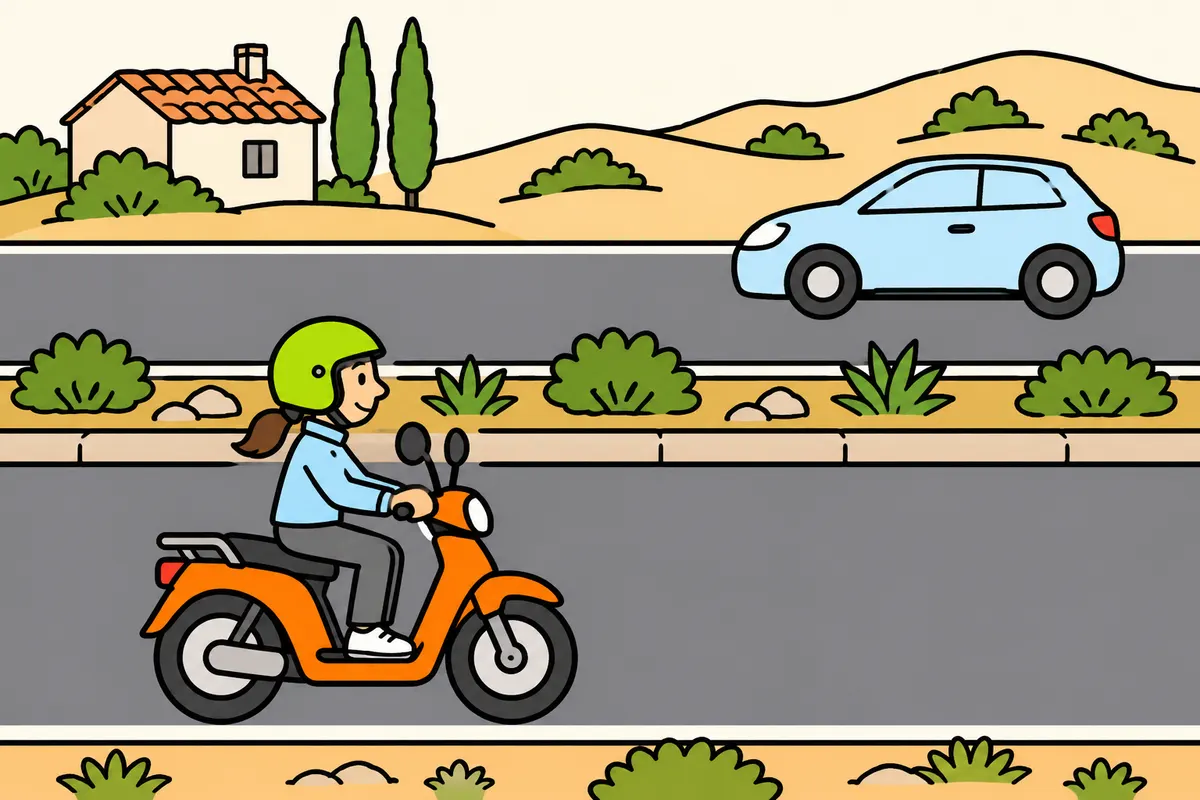
Choose the correct carriageway and pass islands according to traffic direction and signs.
| Island situation | Where you may pass |
|---|---|
| General rule | On the right |
| One-way road or part intended for one direction only | On either side, respecting signs and reservations |
Remember
- With separate carriageways, use the one on your right in your direction.
- With three carriageways, check signs before entering the centre one.
- At a roundabout, keep the centre on your left.
- Do not cross the central island to shorten your route.
Exam trap: Wrong: you must always pass islands on the right. Right: on one-way roads or parts intended for one direction only, you may pass either side, respecting signs and reservations.
Read the full explanation
- When a road is divided lengthways into two carriageways by a central reservation or separator, you must use the one on your right in your direction of travel. The other carriageway's physical proximity does not make it an alternative for avoiding congestion or shortening your route. [RGC, art. 44](https://www.boe.es/buscar/act.php?id=BOE-A-2003-23514#a44)
- If there are three carriageways, the central one may be one-way or two-way, permanently or temporarily, according to the signs. The outer carriageways are intended for one-way traffic, unless the authority signs a different arrangement. You must not enter the central carriageway without checking its traffic arrangements. [RGC, art. 44](https://www.boe.es/buscar/act.php?id=BOE-A-2003-23514#a44)
- As a general rule, you must pass to the right of refuges, traffic islands or guiding devices. If they are on a one-way road or within the part intended for one direction only, you may pass on either side, respecting signs and reservations. [RGC, art. 43](https://www.boe.es/buscar/act.php?id=BOE-A-2003-23514#a43)
- At a roundabout, you must go around the centre keeping it on your left. Priority and preparation for leaving are covered in the Right of way and Moped manoeuvres modules. [RGC, art. 43](https://www.boe.es/buscar/act.php?id=BOE-A-2003-23514#a43)
11Autopistas and autovías: access prohibited
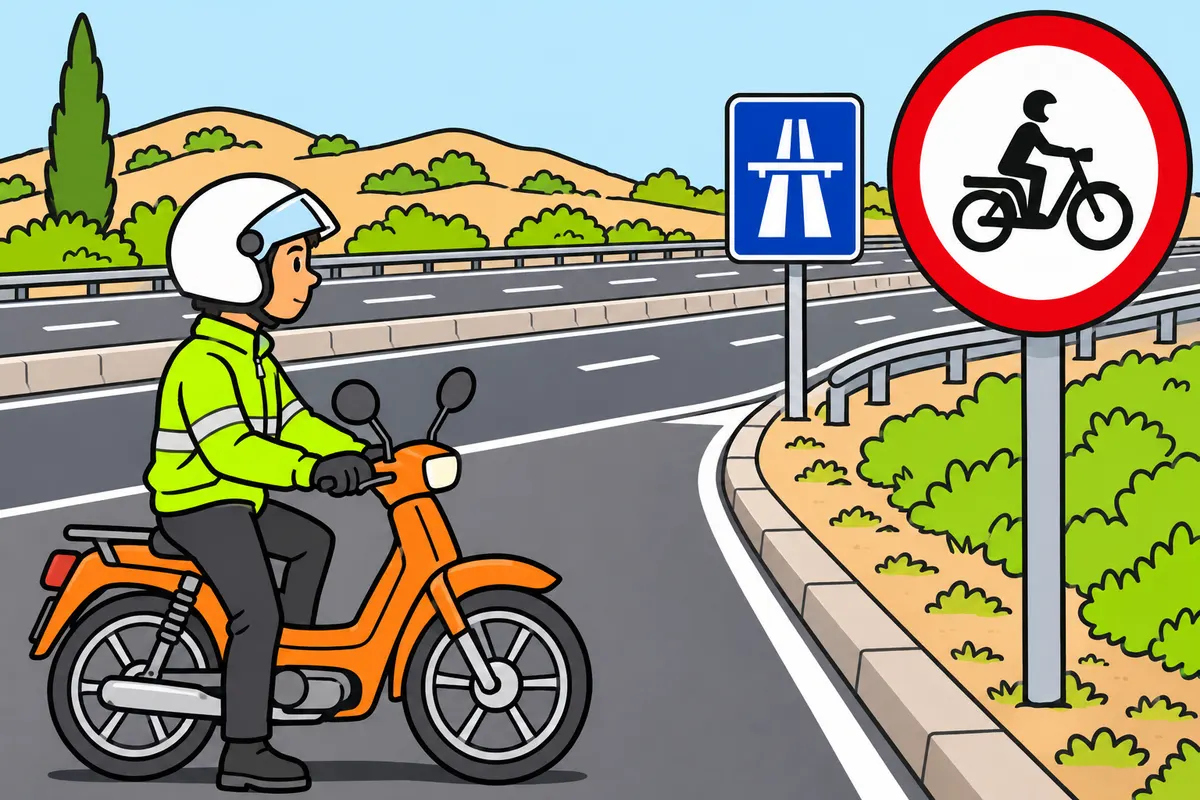
With your moped or light quadricycle, do not enter autopistas or autovías.
| Vehicle | Access to autopistas and autovías |
|---|---|
| Moped or light quadricycle | Prohibited, including the hard shoulder |
| Vehicle for people with reduced mobility | Prohibited |
Remember
- Do not enter using the hard shoulder either.
- The ban also applies within built-up areas.
- Little traffic or a short journey makes no difference.
- Do not use the exception for certain bicycles to enter with your moped.
- An enclosed light quadricycle is also banned.
Exam trap: Wrong: you may enter an autovía using the hard shoulder. Right: your moped is banned, including the hard shoulder and stretches within built-up areas.
Read the full explanation
- You must not use autopistas (motorways) or autovías (dual carriageway motorways) with a moped. The prohibition includes their hard shoulders and stretches within built-up areas. It does not depend on tolls, traffic volume or the distance you intend to travel. [RGC, art. 38](https://www.boe.es/buscar/act.php?id=BOE-A-2003-23514#a38)
- A light quadricycle is also excluded because it is classed as a moped. Enclosed bodywork, wearing a seat belt or resembling a small car does not authorise access. You must plan a route using roads open to this category. [RGC, art. 38](https://www.boe.es/buscar/act.php?id=BOE-A-2003-23514#a38)
- The exception allowing cyclists over 14 years old to use the hard shoulder of certain autovías does not apply to mopeds. You cannot enter because you are older, wear a helmet or undertake to remain on the hard shoulder throughout. [RGC, art. 38](https://www.boe.es/buscar/act.php?id=BOE-A-2003-23514#a38)
- The prohibition also covers vehicles for people with reduced mobility. [RGC, art. 38.1](https://www.boe.es/buscar/act.php?id=BOE-A-2003-23514#a38)
12Roads reserved for motor vehicles and alternative routes
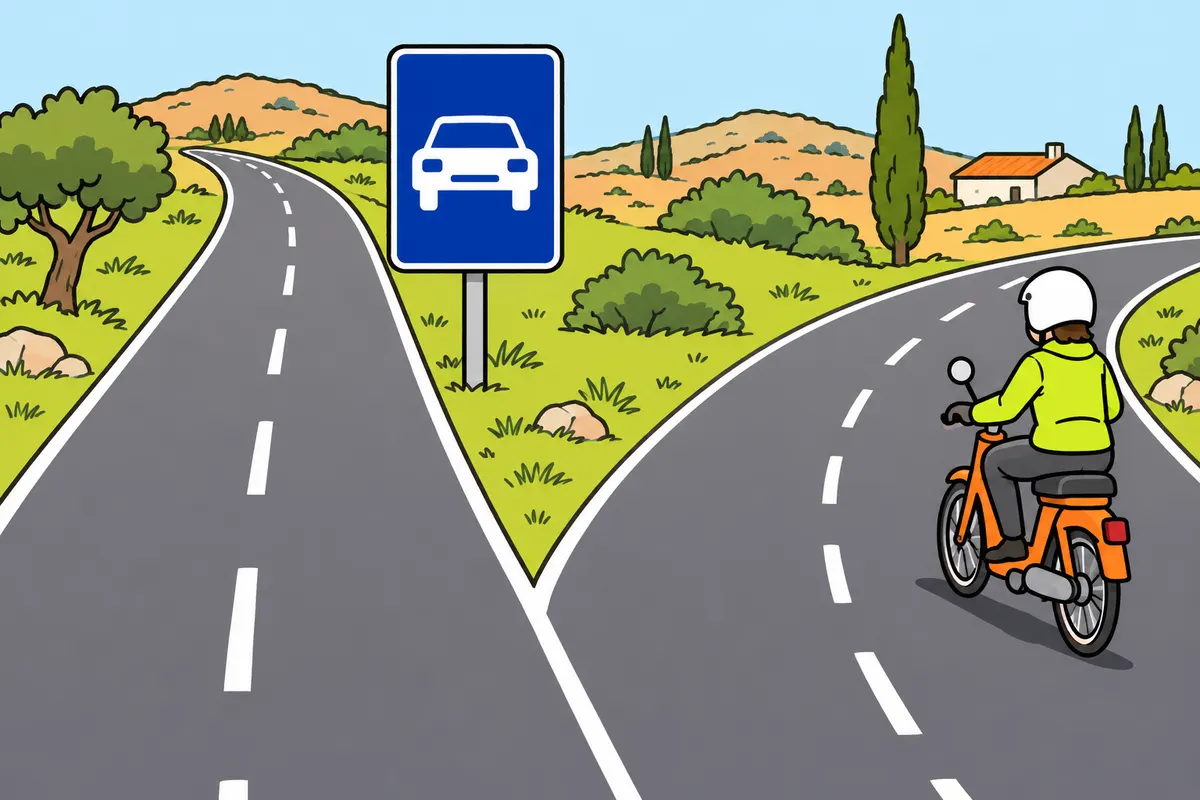
Check that the road allows mopeds and prepare an alternative route.
| Road type | Access with your moped |
|---|---|
| Reserved exclusively for automóviles | Prohibited |
| Conventional road or track open to traffic | Permitted if no applicable restrictions exist |
| Service road | Check it is open, connects to your destination and permits your vehicle |
Remember
- Do not enter roads reserved exclusively for automóviles.
- S-3 marks a road reserved for automóviles; S-4 marks its end.
- Your light quadricycle remains a moped even with bodywork.
- Check each entrance and its restrictions.
- Before using a service road, check it is open, connects and permits your vehicle.
Exam trap: Wrong: any vehicle with an engine may use roads reserved for automóviles. Right: your moped and light quadricycle cannot.
Read the full explanation
- You must not use a road reserved exclusively for automóviles (motor vehicles excluding categories such as mopeds) with your moped. Sign S-3 identifies this restriction and S-4 its end. A conventional road has different rules: having only one carriageway does not guarantee access. [LTSV, annex I](https://www.boe.es/buscar/act.php?id=BOE-A-2015-11722#ani)
- A moped is not legally classed as an automóvil; a light quadricycle retains its category even if it has a passenger compartment. You therefore cannot interpret the car silhouette on a reservation sign as permission for any vehicle with an engine. [LTSV, annex I](https://www.boe.es/buscar/act.php?id=BOE-A-2015-11722#ani)
- You may use a conventional road or a track open to traffic provided no applicable restriction exists. You must check the signs at each entrance and arrange an alternative if your planned route leads to a road prohibited for your vehicle. [LTSV, annex I](https://www.boe.es/buscar/act.php?id=BOE-A-2015-11722#ani)
- A service road may provide an alternative route, but you must check that it is open, connects to your destination and permits your vehicle. Do not confuse it with the hard shoulder or a lane of the motorway alongside it. [LTSV, annex I](https://www.boe.es/buscar/act.php?id=BOE-A-2015-11722#ani)
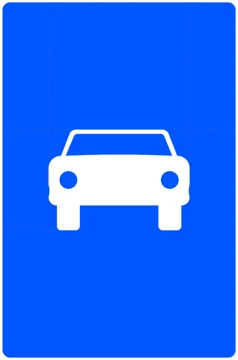 S-3
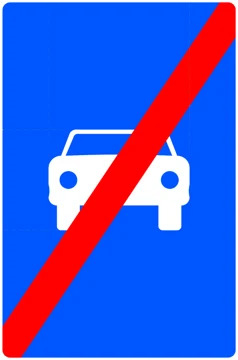 S-4
13Pavements and cycle routes
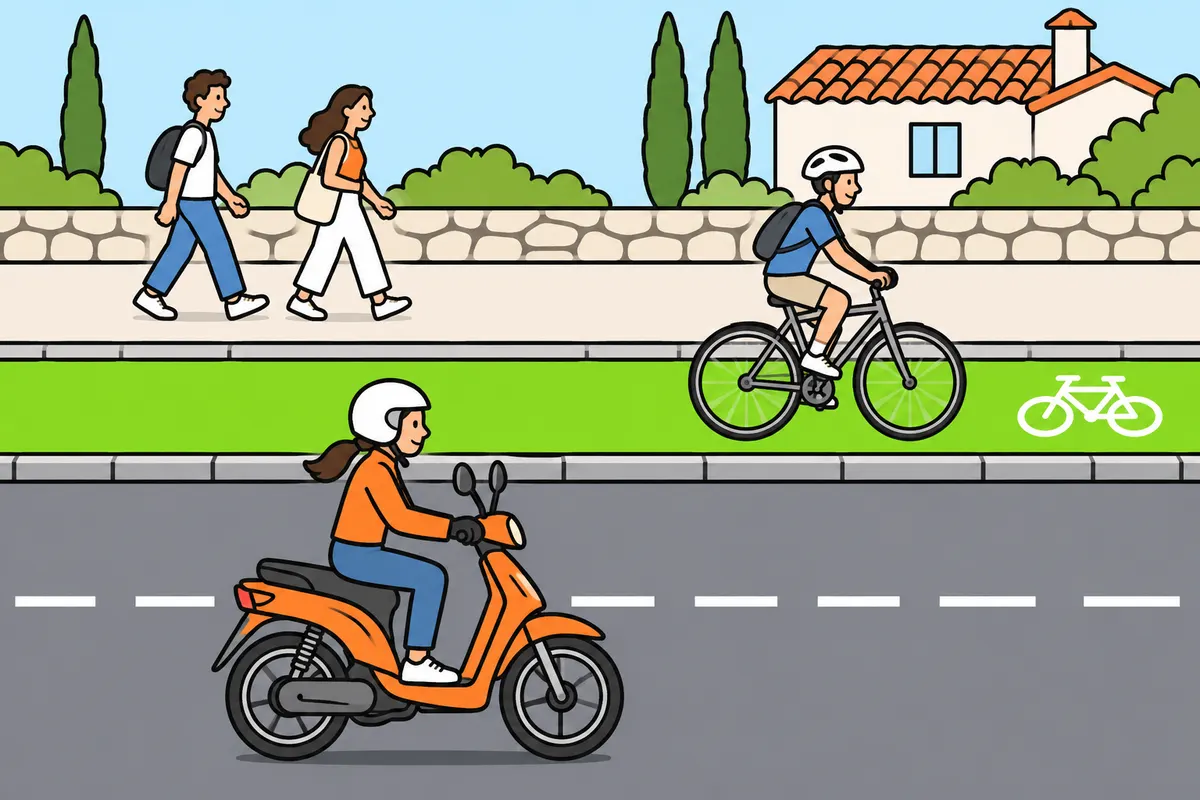
Do not ride on pavements or confuse your moped with a bicycle.
| Space | Use with your moped |
|---|---|
| Pavement | You must not ride on it |
| Cycle lane or cycle track | You need official authorisation and the corresponding signs |
| Shared pedestrian and cycle path | You cannot enter as though riding a bicycle |
Remember
- Do not ride on the pavement, even very slowly.
- To use cycle routes, you need official authorisation and the corresponding signs.
- Shared pedestrian and cycle paths are intended for pedestrians and cycles.
- If you push your two-wheeled moped on foot, you are considered a pedestrian.
Exam trap: Wrong: you may ride on the pavement slowly. Right: riding is prohibited; pushing a two-wheeled moped on foot makes you a pedestrian.
Read the full explanation
- You must not ride your moped on the pavement to avoid a traffic jam, reach an entrance or travel alongside the carriageway. It is reserved for pedestrians. The prohibition does not depend on you travelling very slowly or the engine idling. [RGC, art. 152](https://www.boe.es/buscar/act.php?id=BOE-A-2003-23514#a1-5); [LTSV, annex I](https://www.boe.es/buscar/act.php?id=BOE-A-2015-11722#ani)
- A cycle lane or cycle track is not open to mopeds merely because they have two wheels. You must check its intended users: other vehicles may use cycle routes only with authorisation from the competent authority and the corresponding signs. [LTSV, annex I](https://www.boe.es/buscar/act.php?id=BOE-A-2015-11722#ani); [RGC, annex I](https://www.boe.es/buscar/act.php?id=BOE-A-2003-23514#ani)
- A shared pedestrian and cycle path does not allow you to enter with a moped as though it were a bicycle either. This space is intended for pedestrians and cycles, categories different from your vehicle's. [LTSV, annex I](https://www.boe.es/buscar/act.php?id=BOE-A-2015-11722#ani); [RGC, annex I](https://www.boe.es/buscar/act.php?id=BOE-A-2003-23514#ani)
- If you dismount and push a two-wheeled moped, you are considered a pedestrian. This differs from riding it. The specific rules for travelling on foot and using the hard shoulder or carriageway are covered in the Pedestrians and vulnerable road users module. [LTSV, annex I](https://www.boe.es/buscar/act.php?id=BOE-A-2015-11722#ani)
14Reserved lanes and VAO lanes
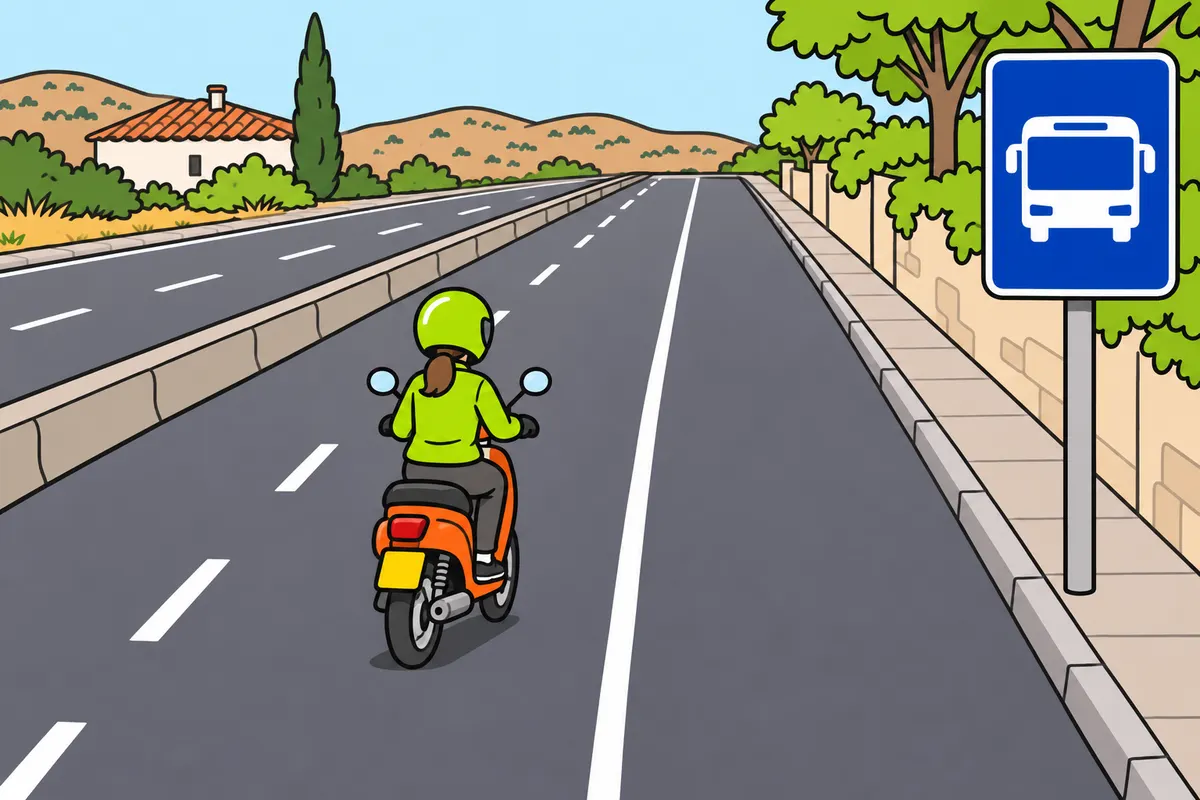
Respect lane reservations even when lanes are empty or you carry a passenger.
| Reserved lane | Use with your moped |
|---|---|
| Bus or bus-taxi | No normal travel unless the reservation includes you |
| VAO | No ordinary use, even with a passenger |
Remember
- Check permitted vehicles, times and manoeuvres.
- Do not use a reserved lane unless its rules include your moped.
- Do not cross the solid line separating a bus lane.
- A broken separating line only allows crossing for a permitted manoeuvre.
- Follow exceptions set by the authority for VAO lane use.
Exam trap: Wrong: carrying a passenger lets you use the VAO lane. Right: ordinary use is prohibited; follow exceptional authorisation, recommendations or orders from the authority for safety or traffic flow.
Read the full explanation
- You must respect lane reservations by vehicle class, time or manoeuvre. An empty reserved lane is not available to your moped unless its rules include you. The obligation to keep right does not authorise you to use a lane reserved for other users. [RGC, art. 35](https://www.boe.es/buscar/act.php?id=BOE-A-2003-23514#a35); [RGC, annex I, catalogue of signs and road markings](https://www.boe.es/buscar/act.php?id=BOE-A-2003-23514#ani)
- You must not use a bus or bus-taxi lane for normal travel if the reservation does not include mopeds. Distinguish this travel from a specific manoeuvre permitted across a stretch with a broken separating line; a solid separating line prohibits crossing it. [RGC, art. 35](https://www.boe.es/buscar/act.php?id=BOE-A-2003-23514#a35); [RGC, annex I, catalogue of signs and road markings](https://www.boe.es/buscar/act.php?id=BOE-A-2003-23514#ani)
- You cannot ordinarily use a VAO (high-occupancy vehicle) lane with a moped, even if you carry a passenger. The classes admitted under the general rule are motorcycles, passenger cars and vehículos mixtos adaptables (adaptable mixed-use vehicles), subject to their conditions. Your moped does not become a motorcycle because it carries two people. [RGC, art. 35](https://www.boe.es/buscar/act.php?id=BOE-A-2003-23514#a35); [RGC, annex I, catalogue of signs and road markings](https://www.boe.es/buscar/act.php?id=BOE-A-2003-23514#ani)
- The competent authority may exceptionally permit, recommend or order other vehicles to use the VAO lane for safety or traffic flow. You must follow the actual arrangements, without inventing an exception based on the number of seats, bodywork or the personal urgency of your journey. [RGC, art. 35](https://www.boe.es/buscar/act.php?id=BOE-A-2003-23514#a35); [RGC, annex I, catalogue of signs and road markings](https://www.boe.es/buscar/act.php?id=BOE-A-2003-23514#ani)
15Reversible lanes
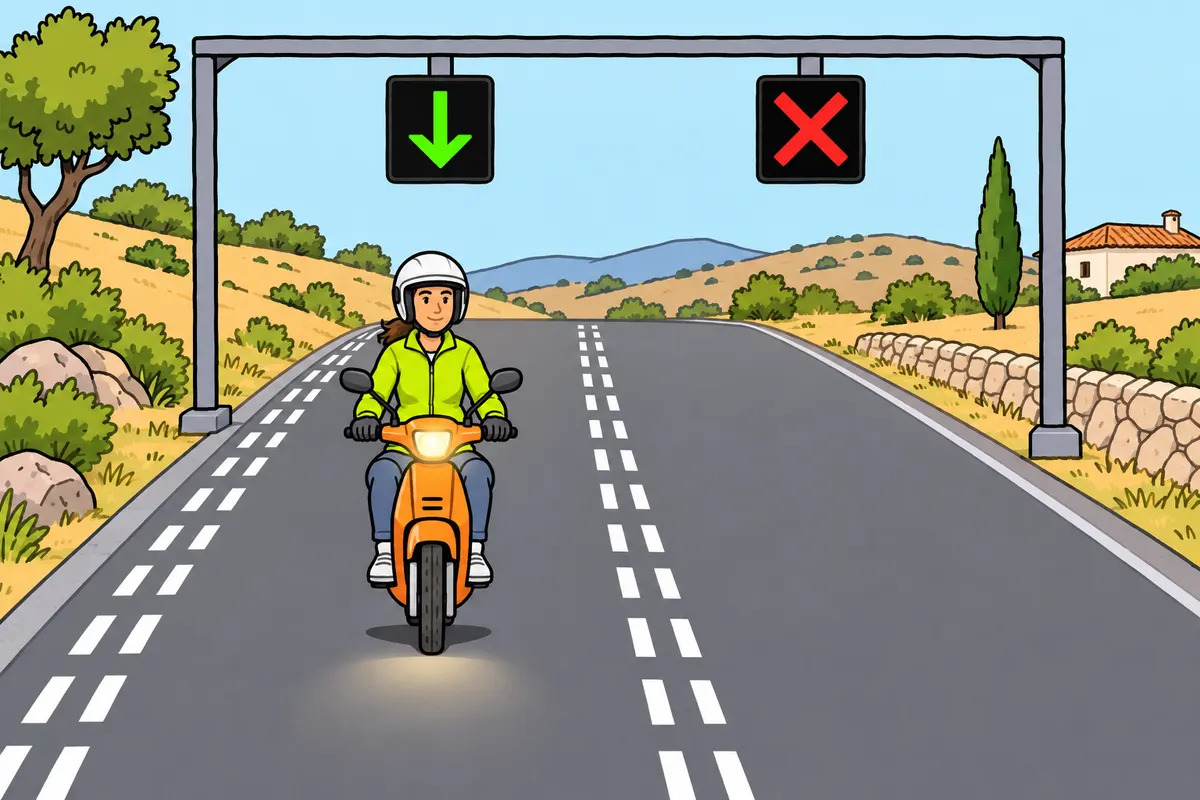
Use a reversible lane only if open and permitted, always with dipped beam.
Remember
- Recognise double broken lines on both sides.
- Check that the lane is open in your direction.
- Check that both the road and lane allow your vehicle.
- Keep at least dipped beam on, day and night.
- Check the lane signal before entering and throughout your journey.
Exam trap: Wrong: a green arrow allows any vehicle to enter. Right: you enter only if the road and lane allow your vehicle, following all other rules.
Read the full explanation
- You recognise a reversible lane by the double broken lines marking both sides. Its traffic direction may be controlled in either direction by lane signals or other means. Do not confuse it with a shared centre lane for overtaking. [RGC, art. 40](https://www.boe.es/buscar/act.php?id=BOE-A-2003-23514#a40)
- You may only use it when it is open in your direction and its rules and the road allow your vehicle. Being reversible does not remove the obligation to keep right or make a road prohibited for mopeds accessible. [RGC, art. 40](https://www.boe.es/buscar/act.php?id=BOE-A-2003-23514#a40)
- If you use an authorised reversible lane, you must keep at least your dipped beam on, both day and night; see the Moped lights and signals module, Special lanes and lighting section. [RGC, art. 40.1](https://www.boe.es/buscar/act.php?id=BOE-A-2003-23514#a40)
- You must observe the signal controlling the lane before entering and while travelling in it. A green opening arrow does not authorise you to ignore other restrictions. Double broken lines mark a reversible lane; double solid lines have a different meaning. [RGC, art. 40](https://www.boe.es/buscar/act.php?id=BOE-A-2003-23514#a40)
16Traffic lights that open or close lanes
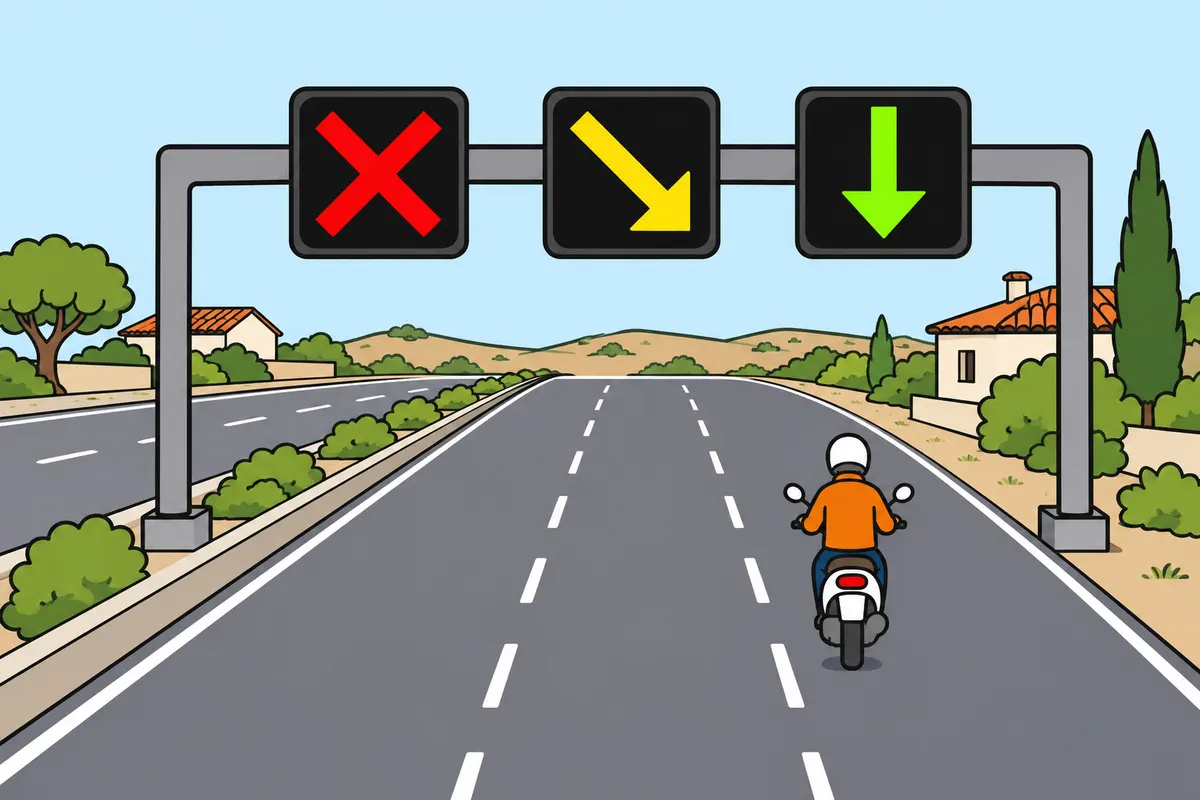
Check each lane signal and leave safely when required.
| Signal above your lane | What you must do |
|---|---|
| Red cross | Do not occupy the lane; if already there, leave as soon as safely possible. |
| Green downward arrow | You may use the lane if you follow other rules and reservations. |
| Steady or flashing white or yellow diagonal downward arrow | Your lane will close: move safely into the indicated lane. |
Remember
- With a red cross, do not enter; if already there, leave promptly and safely.
- With a diagonal arrow, prepare to move into the indicated lane.
- With a green arrow, still respect priorities, limits and reservations.
Exam trap: Wrong: the diagonal arrow lets you stay in that lane. Right: you must leave and move safely into the indicated lane.
Read the full explanation
- A red light in the shape of a cross prohibits you from occupying the indicated lane. If you are travelling in it, you must leave it as soon as possible, moving safely. [RGC, annex I, catalogue of signs and road markings](https://www.boe.es/buscar/act.php?id=BOE-A-2003-23514#ani)
- A green downward arrow allows you to use the indicated lane. You must continue to comply with priority rules, limits and user reservations. An open lane does not amount to general authorisation for any vehicle to enter. [RGC, annex I, catalogue of signs and road markings](https://www.boe.es/buscar/act.php?id=BOE-A-2003-23514#ani)
- A steady or flashing white or yellow diagonal downward arrow indicates that the lane is about to close and you must merge safely into the indicated lane. Do not wait until you reach the obstacle or red cross to prepare to move across. [RGC, annex I, catalogue of signs and road markings](https://www.boe.es/buscar/act.php?id=BOE-A-2003-23514#ani)
- If you see a red cross on the left, a diagonal right arrow over the centre lane and a green downward arrow over the right-hand lane, the right-hand lane is the open one you must move into where applicable. [RGC, annex I, catalogue of signs and road markings](https://www.boe.es/buscar/act.php?id=BOE-A-2003-23514#ani)
17Contraflow lanes
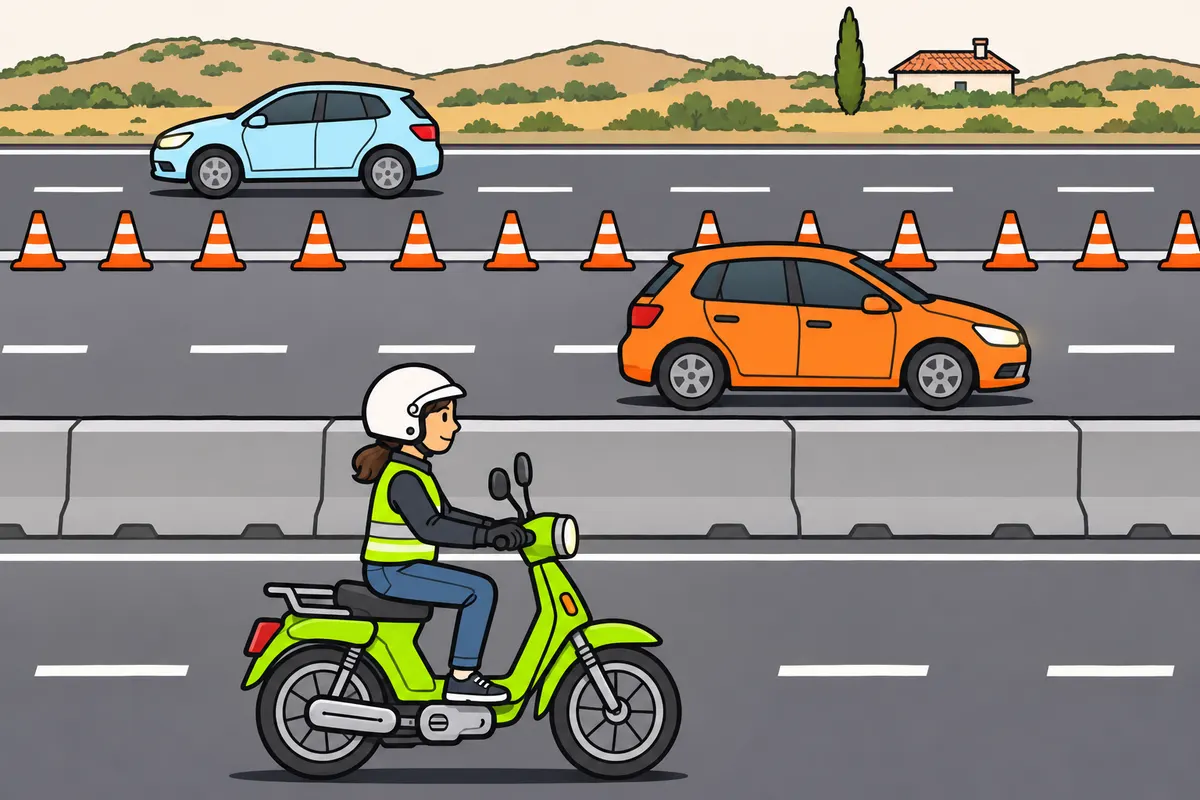
Distinguish contraflow lanes opened for traffic flow from those opened for roadworks.
| Reason for contraflow lane | Access with your moped or light quadricycle |
|---|---|
| Traffic flow | Prohibited; only motorcycles and passenger cars |
| Roadworks | Road permits your vehicle, no express ban, minimum compatible with 45 km/h |
Remember
- For traffic flow, you cannot enter with your moped or light quadricycle.
- For roadworks, check that the road allows your vehicle and no express ban applies.
- You need a set or signposted minimum compatible with your 45 km/h maximum.
- If allowed, keep at least dipped beam on, day and night.
- Do not cross the separation to overtake or return to normal lanes.
Exam trap: Wrong: for roadworks, switching on dipped beam is enough to enter. Right: you also need permitted road access, no express ban and a set or signposted minimum compatible with 45 km/h.
Read the full explanation
- When a contraflow lane is opened to improve traffic flow, only motorcycles and passenger cars may use it. You must not use it with a moped or a light quadricycle. Switching on dipped beam does not change this prohibition. [RGC, art. 41](https://www.boe.es/buscar/act.php?id=BOE-A-2003-23514#a41)
- You may use a contraflow lane opened because of roadworks if your vehicle is authorised on the road and there is no express prohibition, but the same maximum of 80 km/h and minimum of 60 apply, or lower limits established or signposted. With your moped, you may only use it if the indicated minimum is compatible with its maximum of 45 km/h. [RGC, art. 41](https://www.boe.es/buscar/act.php?id=BOE-A-2003-23514#a41); [RGC, art. 48](https://www.boe.es/buscar/act.php?id=BOE-A-2003-23514#a48)
- You must keep at least dipped beam on day and night both in the contraflow lane and in the adjacent lanes running in the normal direction; see the Moped lights and signals module, Special lanes and lighting section. [RGC, art. 41.1](https://www.boe.es/buscar/act.php?id=BOE-A-2003-23514#a41)
- You must not cross the separation to enter the lanes running in the normal direction or to overtake. You must follow the signed layout and avoid disturbing the delineators. Check an alternative route if the conditions on the stretch are incompatible with your vehicle. [RGC, art. 41](https://www.boe.es/buscar/act.php?id=BOE-A-2003-23514#a41)
18Temporary additional lane
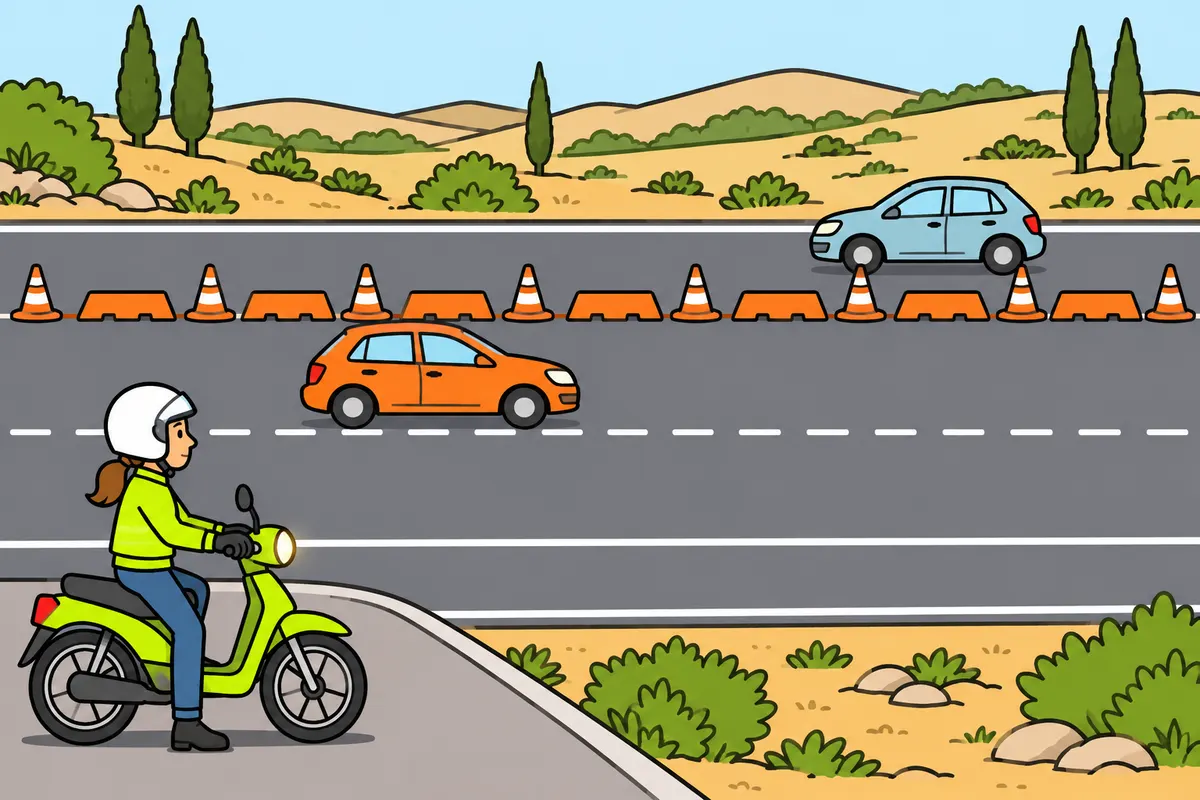
Check the permitted minimum before using a temporary additional lane that uses both hard shoulders.
Remember
- Identify the temporary layout using both hard shoulders.
- You cannot enter if the 60 km/h minimum remains.
- You need a lower set or signposted minimum compatible with 45 km/h.
- Also check that the road allows your vehicle.
- On the hard shoulders or additional lane, use dipped beam day and night.
- Do not confuse it with a permanent lane for slow vehicles.
Exam trap: Wrong: every additional lane allows your moped. Right: the road must permit it and the set or signposted minimum must be compatible with 45 km/h.
Read the full explanation
- A temporary additional lane is created on a two-way carriageway using the width of the road platform and both hard shoulders. The resulting layout provides two lanes in one direction and one in the other, with temporary signs and delineators changing the area used for traffic. [RGC, art. 42](https://www.boe.es/buscar/act.php?id=BOE-A-2003-23514#a42)
- You cannot use this arrangement with your moped if the minimum of 60 km/h remains in force: your maximum is 45 km/h. You may only use it if a lower minimum compatible with that maximum is established or signposted and the road permits your vehicle. [RGC, art. 42](https://www.boe.es/buscar/act.php?id=BOE-A-2003-23514#a42); [RGC, art. 48](https://www.boe.es/buscar/act.php?id=BOE-A-2003-23514#a48)
- If you travel on the hard shoulders or in the additional lane, you must keep at least dipped beam on day and night; see the Moped lights and signals module, Special lanes and lighting section. [RGC, art. 42.1](https://www.boe.es/buscar/act.php?id=BOE-A-2003-23514#a42)
- The use of both hard shoulders and the temporary allocation of traffic directions characterise this arrangement. A permanent lane for slow vehicles or an acceleration lane has a different purpose; the signs and delineators allow you to interpret the layout of the entire stretch. [RGC, art. 42](https://www.boe.es/buscar/act.php?id=BOE-A-2003-23514#a42)
19Roadworks, cones and closures
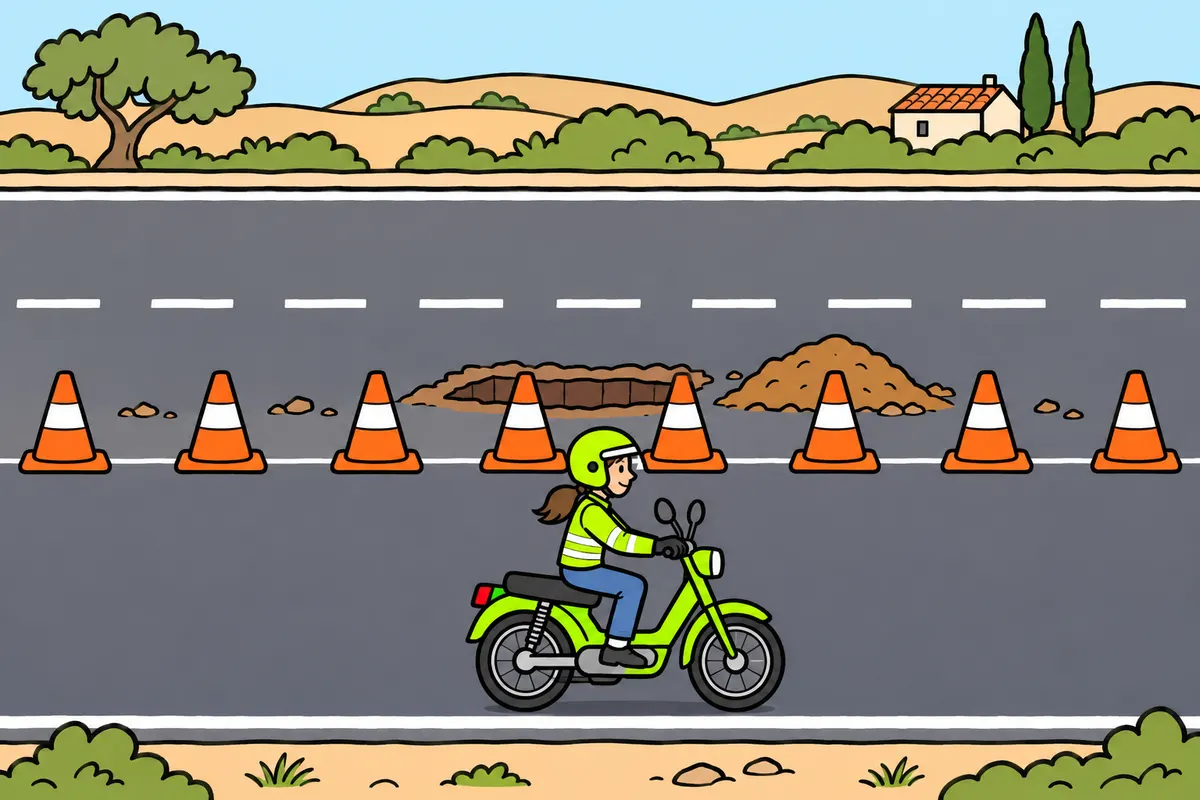
Follow roadworks arrangements and do not cross the line of cones.
| Roadworks markings | What you need to recognise |
|---|---|
| New markings organising the roadworks | They are yellow. |
| Existing markings that still apply | They may remain white. |
Remember
- Obey signposted changes of direction, closures and diversions.
- Do not cross the actual or imaginary line joining cones.
- Use an open lane only if the road and lane rules allow your vehicle.
- Do not move or knock over items guiding traffic.
- Follow officers’ instructions first.
- Check that the diversion allows your vehicle.
Exam trap: Wrong: you pass between cones because your moped fits. Right: you respect the actual or imaginary line joining them.
Read the full explanation
- You must follow special traffic arrangements established by the authority for safety, traffic flow or environmental reasons. They may change traffic directions, close parts of the road or impose routes. [RGC, art. 37](https://www.boe.es/buscar/act.php?id=BOE-A-2003-23514#a37)
- A row of cones marks an area you must not cross: you must respect the actual or imaginary line joining them. Your moped's size does not allow you to weave between them or enter a closed lane through a gap. [RGC, annex I](https://www.boe.es/buscar/act.php?id=BOE-A-2003-23514#ani)
- You may use an open lane marked by cones if the road and its rules permit your vehicle. You may follow the line of the cones while remaining in the space open to traffic. Do not move or knock over items to return to your usual path. [RGC, annex I](https://www.boe.es/buscar/act.php?id=BOE-A-2003-23514#ani); [RGC, art. 142](https://www.boe.es/buscar/act.php?id=BOE-A-2003-23514#a142)
- Officers' instructions take priority in controlling passage. At a diversion, you must check the authorised route and your vehicle's restrictions, without entering a motorway, pavement or reserved space on your own initiative to avoid the roadworks. [RGC, art. 133](https://www.boe.es/buscar/act.php?id=BOE-A-2003-23514#a133); [RGC, art. 37](https://www.boe.es/buscar/act.php?id=BOE-A-2003-23514#a37)
- Road markings are white except for the exceptions in the catalogue. New markings painted to organise a roadworks stretch are yellow; existing markings that remain applicable may stay white. You must follow the roadworks layout and not combine incompatible paths from the two sets of markings. [RGC, annex I](https://www.boe.es/buscar/act.php?id=BOE-A-2003-23514#ani)
20Solid and broken longitudinal lines
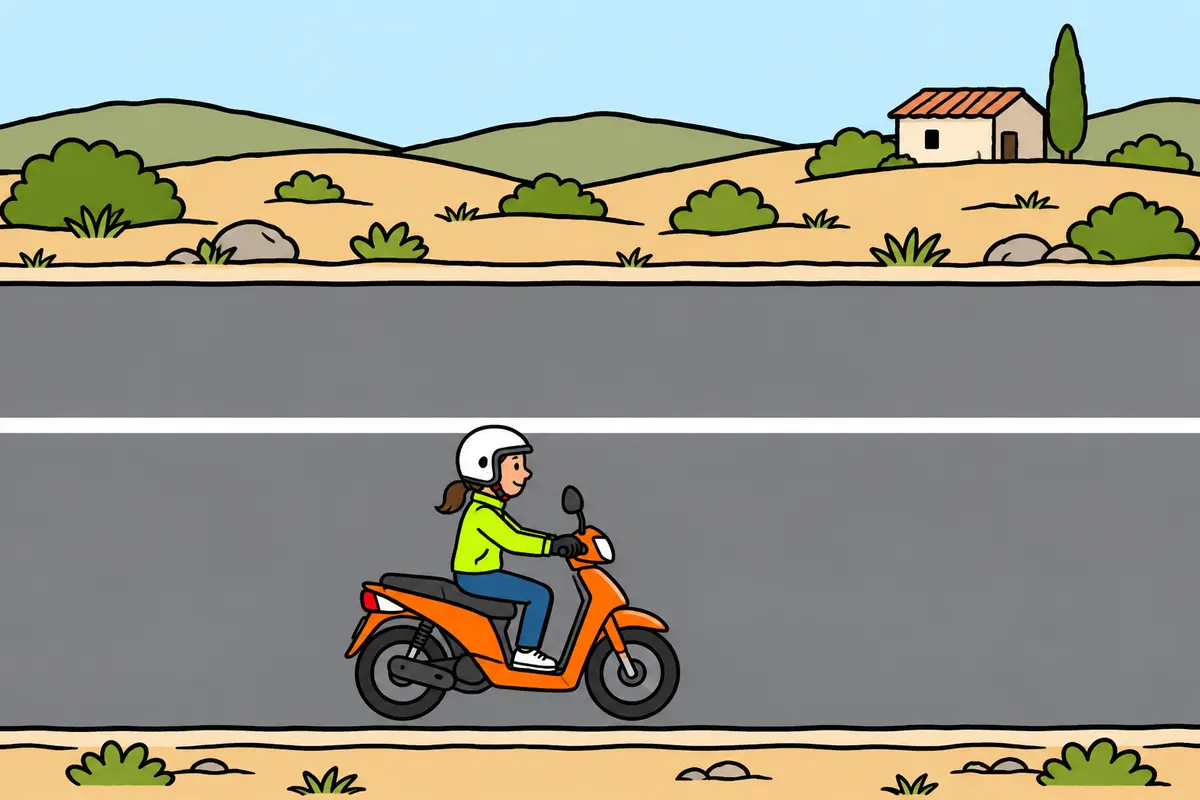
Read the line on your side before crossing it for a manoeuvre.
| Marking | What you must remember |
|---|---|
| Single or double solid line | Both have the same meaning |
| Solid line beside a broken line | Follow the line on your side |
| Warning broken line | May warn of a solid line ahead or a particularly dangerous stretch |
Remember
- Do not cross or drive on a solid line, except under specific legal exceptions.
- If it separates directions, do not drive to its left either.
- With a broken line, cross only for a legal, safe manoeuvre.
- Do not drive on broken lines unless width requires it and safety allows.
- Overtaking from the broken side, you may cross the solid line to return.
- You may return after completing or abandoning that overtaking.
Exam trap: Wrong: a broken line guarantees you can overtake. Right: you must also check the manoeuvre is legal and safe.
Read the full explanation
- A solid longitudinal marking prohibits crossing it or driving on it; if it separates traffic directions, you must not drive to its left either. Only specific regulatory exceptions allow you to cross it; light traffic does not in itself authorise a lane change. [RGC, annex I, catalogue of signs and road markings](https://www.boe.es/buscar/act.php?id=BOE-A-2003-23514#ani)
- A double solid line has the same meaning as a single solid line. The prohibition concerns the marking, not the space your vehicle physically occupies. [RGC, annex I, catalogue of signs and road markings](https://www.boe.es/buscar/act.php?id=BOE-A-2003-23514#ani)
- A broken line marks lanes and allows you to cross it when the manoeuvre is legal and safe. As a rule, you must not drive along it, except where lane width makes it necessary and safety permits. [RGC, annex I, catalogue of signs and road markings](https://www.boe.es/buscar/act.php?id=BOE-A-2003-23514#ani)
- If a solid line is alongside a broken line, you must follow the line on your side. When it separates traffic directions, if you start overtaking from the broken-line side, you may cross the solid line to return after completing or abandoning the manoeuvre. The marking does not remove the manoeuvre's other conditions. [RGC, annex I, catalogue of signs and road markings](https://www.boe.es/buscar/act.php?id=BOE-A-2003-23514#ani)
- A warning broken line may announce an approaching solid line or a particularly hazardous stretch. You must prepare to return to your road position if you are performing a permitted manoeuvre. Do not assume that every broken line in itself guarantees visibility or space for overtaking. [RGC, annex I](https://www.boe.es/buscar/act.php?id=BOE-A-2003-23514#ani)
21Edges, hatched markings and excluded areas
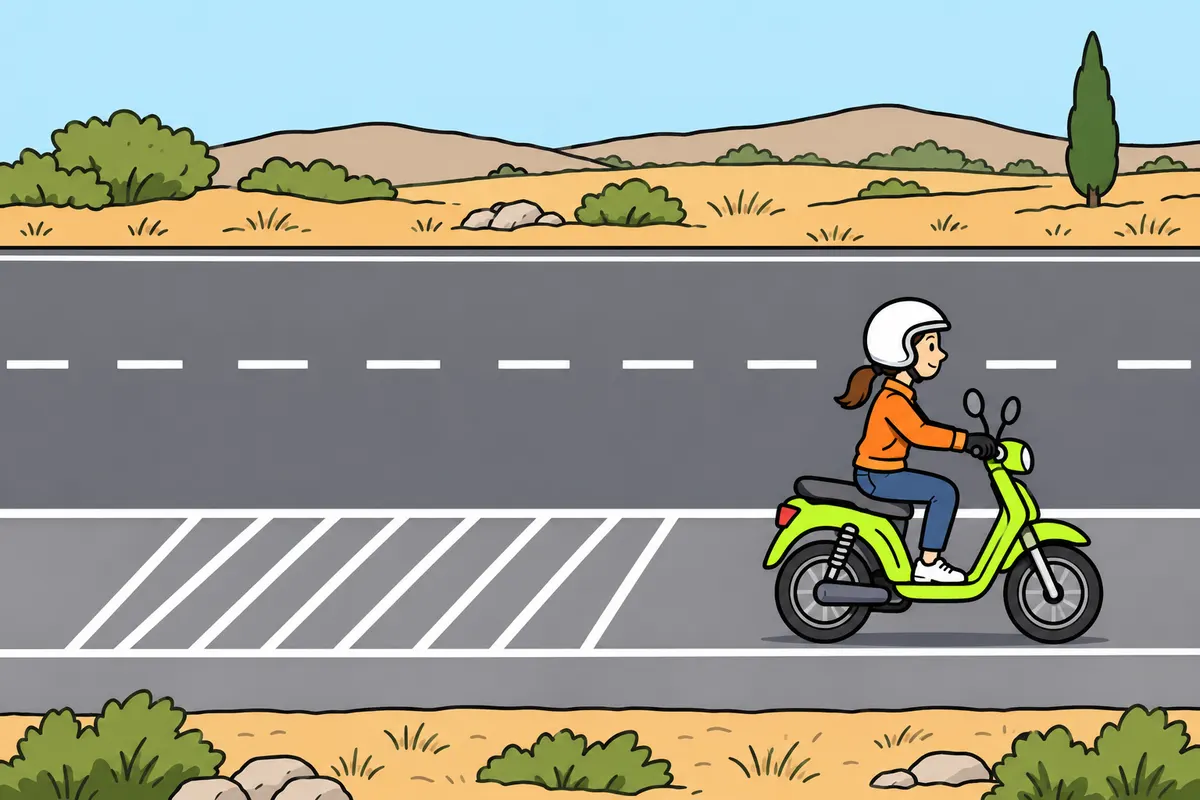
Distinguish edge lines, hatched markings and emergency areas.
| Marking | What you must understand |
|---|---|
| Edge line | Marks the carriageway edge; does not change hard shoulder rules |
| Hatching enclosed by a solid line | Do not enter, except as a required hard shoulder user |
| Red and white chequered marking | Start of an area for stopping a vehicle in an emergency |
Remember
- A solid edge line does not remove your duty to use suitable hard shoulders.
- For hatching enclosed by solid lines, the exception covers required hard shoulder users.
- Use that exception only to reach or follow your required hard shoulder.
- Respect restrictions on that stretch and other people’s safety.
- Do not park on hatching for convenience.
Exam trap: Wrong: you may use any hatching to rest. Right: the exception allows you to reach or follow your required hard shoulder, respecting restrictions and safety.
Read the full explanation
- Edge lines mark the limits of the carriageway. Whether they are solid or broken does not change the regulatory use of the hard shoulder: with your moped, you must use the right-hand one when it is passable and wide enough. Do not confuse an edge line with a solid centre line separating traffic directions. [RGC, annex I, catalogue of signs and road markings](https://www.boe.es/buscar/act.php?id=BOE-A-2003-23514#ani)
- Hatching consisting of parallel diagonal stripes enclosed by a solid line indicates an area that vehicles and animals must not enter, except for users required to travel on the hard shoulder. You must relate this exception to the road position required for your moped. [RGC, annex I, catalogue of signs and road markings](https://www.boe.es/buscar/act.php?id=BOE-A-2003-23514#ani)
- You may use this exception to enter or continue along the hard shoulder you must occupy; it does not make every hatched area a place to park, rest or wait for convenience. You must continue to respect the stretch's restrictions and other users' safety. [RGC, annex I, catalogue of signs and road markings](https://www.boe.es/buscar/act.php?id=BOE-A-2003-23514#ani)
- The red and white chequered marking at the entrance to an emergency escape lane marks the start of a space intended to stop a vehicle in an emergency. You must not use it to stop, park or travel for convenience; its purpose requires you to keep it available. [RGC, annex I](https://www.boe.es/buscar/act.php?id=BOE-A-2003-23514#ani)
22Arrows, reservations and transverse markings
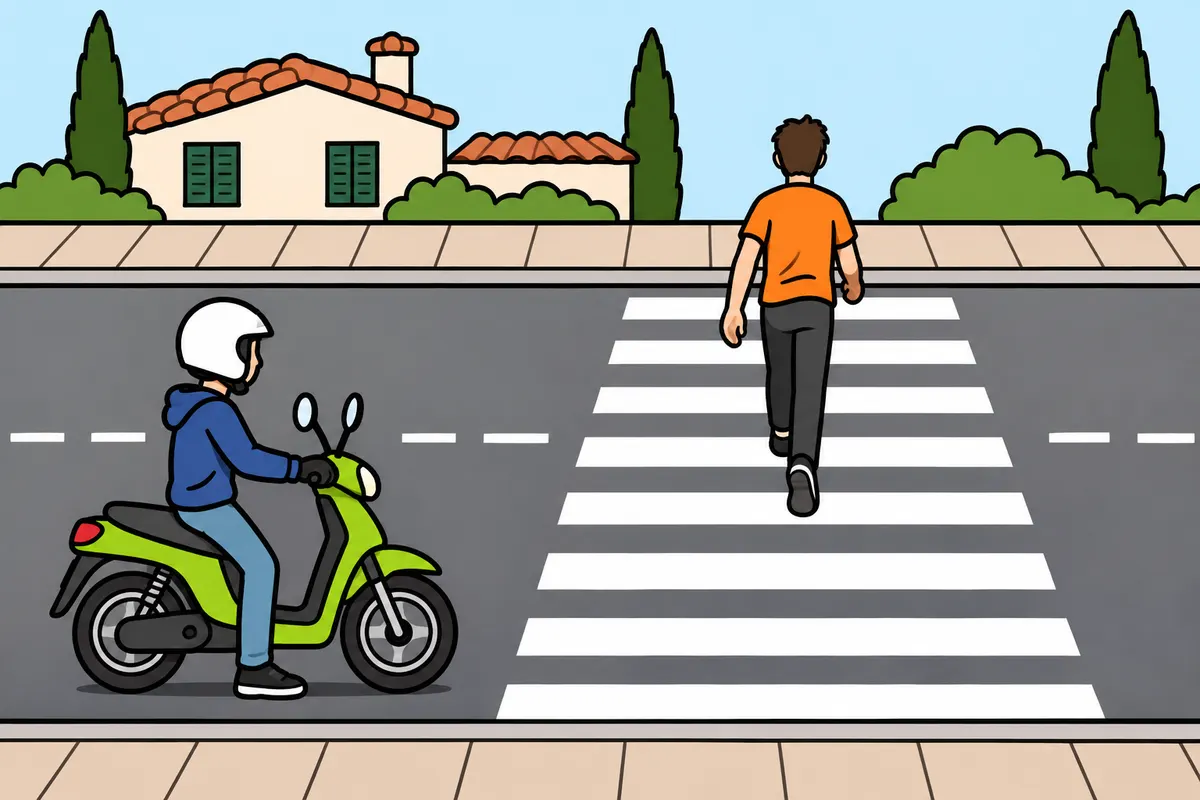
Follow arrow directions and distinguish stopping from giving way.
| Transverse marking or wording | What you must do |
|---|---|
| Stop line | Stop there when the corresponding sign requires it |
| Painted STOP | Stop |
| Give-way triangle | Give way; stop if necessary |
Remember
- Follow movements permitted or required by your lane’s arrows.
- If an arrow includes straight ahead, change lanes straight ahead only where lines allow.
- With a lane-ending arrow, prepare to leave the lane.
- With a return arrow, prepare to move back to your right.
- A painted bicycle does not give your moped permission to enter.
- Do not ride along pedestrian or cycle crossings lengthways.
Exam trap: Wrong: a stop line alone means STOP. Right: it shows where to stop when the sign requires it; a painted STOP does require stopping.
Read the full explanation
- Lane selection arrows indicate the movements permitted or required from that lane. If they point straight ahead and right, you must not turn left. Arrows that include straight ahead allow you to change lanes while continuing in that direction when longitudinal markings permit it. [RGC, annex I, catalogue of signs and road markings](https://www.boe.es/buscar/act.php?id=BOE-A-2003-23514#ani)
- Lane-end arrows warn you that you must leave the lane that ends. Return arrows announce the need to return to your right as you approach a prohibition on travelling to the left of the centre line. You must prepare to move with enough space and safety. [RGC, annex I, catalogue of signs and road markings](https://www.boe.es/buscar/act.php?id=BOE-A-2003-23514#ani)
- Reservation inscriptions and pictograms identify the users or vehicles entitled to use a space. A bicycle symbol does not in itself authorise a moped. You must also check the signs and the lane separation before entering. [RGC, annex I, catalogue of signs and road markings](https://www.boe.es/buscar/act.php?id=BOE-A-2003-23514#ani)
- A transverse stop line indicates where you must stop when the corresponding sign requires it; it does not in itself constitute an independent STOP requirement. A painted STOP requires you to stop, while the give-way triangle requires you to give way and stop if necessary. [RGC, annex I, catalogue of signs and road markings](https://www.boe.es/buscar/act.php?id=BOE-A-2003-23514#ani)
- A pedestrian crossing is usually identified by white stripes; at traffic-light-controlled crossings, you may also find two parallel broken transverse lines. A cycle crossing has its own broken transverse marking; you must interpret the signs and symbols together. Both cross the carriageway and require you to respect their intended users; they are not lanes you should follow lengthways with your moped. [RGC, annex I, catalogue of signs and road markings](https://www.boe.es/buscar/act.php?id=BOE-A-2003-23514#ani)
23Access and road position in tunnels
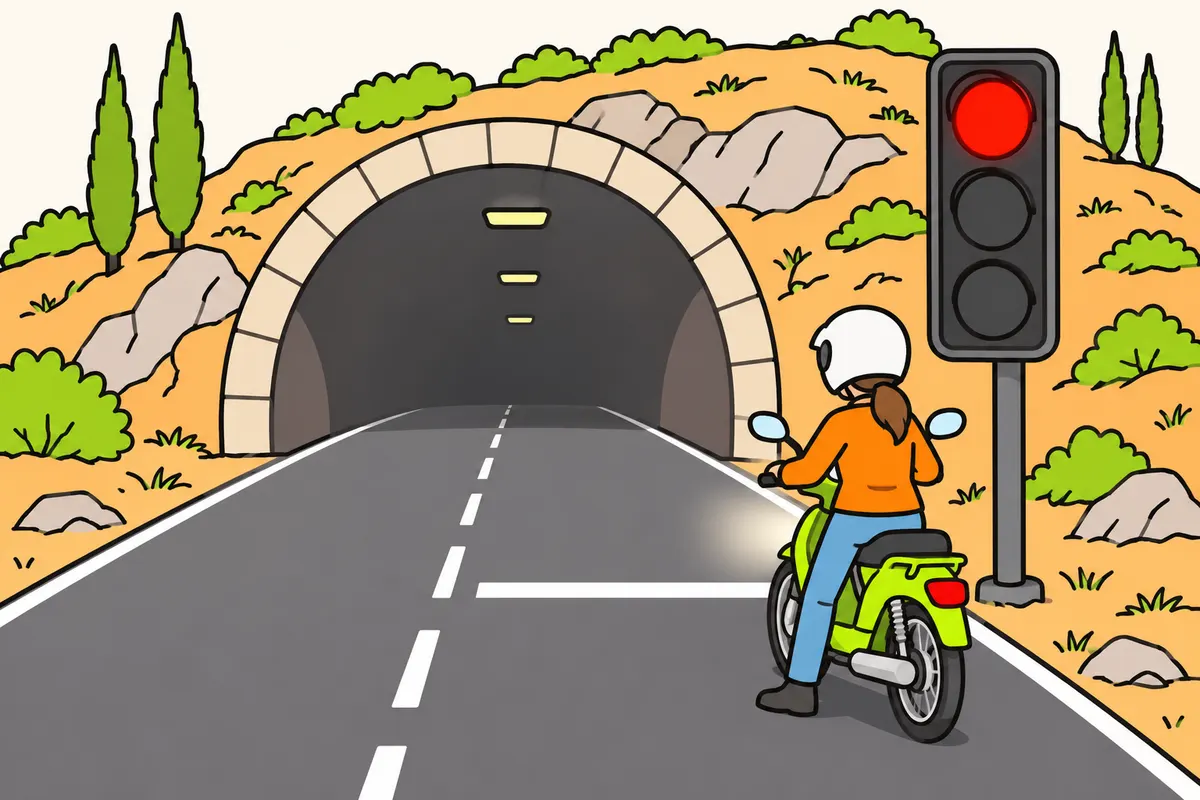
Enter a tunnel only if permitted and use the necessary lights.
| Place | Signposting |
|---|---|
| Tunnel | Signposted whatever its length |
| Underpass | Signposted when longer than 200 metres; short ones also have traffic rules |
Remember
- Check that the road and signs allow your moped.
- Do not enter an autopista tunnel.
- Do not enter if the entrance traffic light prohibits passage.
- Obey lane signals, message signs and public-address instructions.
- In tunnels and underpasses, use the appropriate lights even during the day.
Exam trap: Wrong: all tunnels are banned for your moped. Right: you may enter if the road and signs permit it and access is open.
Read the full explanation
- You may pass through a tunnel with your moped when the road and signs permit your vehicle. The specific prohibition on VMP (personal mobility vehicles) in certain tunnels must not automatically be applied to AM. A motorway tunnel remains inaccessible because of the road category. [RGC, art. 38](https://www.boe.es/buscar/act.php?id=BOE-A-2003-23514#a38)
- You must not enter if the traffic light at the entrance prohibits passage. You must also obey lane signals, variable message signs and public-address instructions. Other vehicles continuing or your ability to see the exit does not cancel a closure indication. [RGC, art. 96.3](https://www.boe.es/buscar/act.php?id=BOE-A-2003-23514#a96); [RGC, art. 95.7](https://www.boe.es/buscar/act.php?id=BOE-A-2003-23514#a95); [RGC, annex I](https://www.boe.es/buscar/act.php?id=BOE-A-2003-23514#ani)
- In tunnels and underpasses, you must switch on the appropriate lights even during the day; see how to choose them according to the lighting conditions in the Moped lights and signals module, Tunnels and underpasses section. [RGC, art. 100](https://www.boe.es/buscar/act.php?id=BOE-A-2003-23514#a100); [RGC, art. 101](https://www.boe.es/buscar/act.php?id=BOE-A-2003-23514#a101)
- You must know the difference in signing: tunnels of any length and underpasses longer than 200 metres are signposted. Do not assume a short underpass is exempt from its traffic rules because it does not reach that length. [RGC, art. 95.5](https://www.boe.es/buscar/act.php?id=BOE-A-2003-23514#a95)
24Travelling inside a tunnel
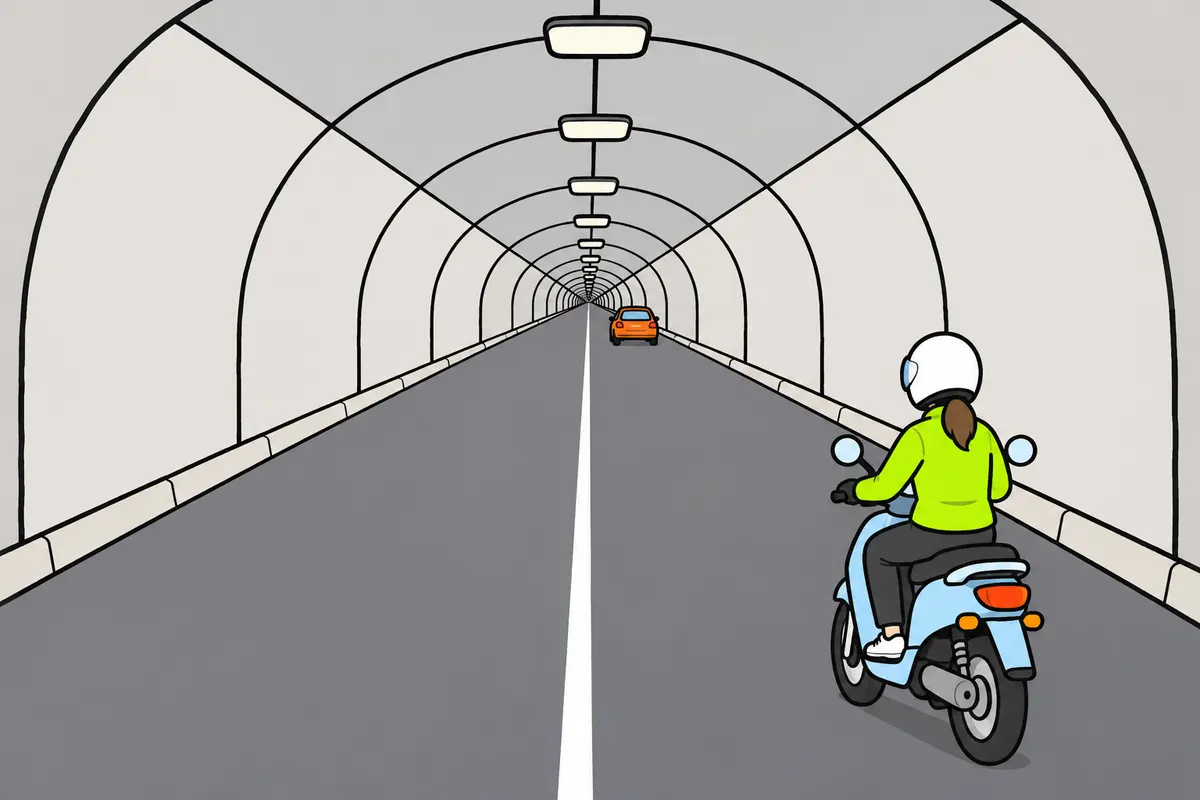
In tunnels, keep your distance and respect the special overtaking conditions.
| Tunnel, underpass or stretch with a Tunnel sign | Overtaking |
|---|---|
| Only one lane in your direction, including one-way traffic | Prohibited |
| Two-way traffic and more than one lane in your direction | Only without entering the oncoming direction |
Remember
- Keep your moped’s required road position and respect lanes and reservations.
- Do not overtake with only one lane in your direction, even in one-way tunnels.
- When not intending to overtake, leave at least 100 metres or four seconds.
- Do not stop or park voluntarily.
- Do not turn around or reverse.
- If traffic stops you, follow the specific instructions.
Exam trap: Wrong: you can always overtake in a one-way tunnel. Right: with only one lane in your direction, overtaking is prohibited; in two-way tunnels, you need more than one lane in your direction and must not enter the oncoming direction.
Read the full explanation
- You must maintain the road position required for your moped and respect signed lanes and reservations. Entering a tunnel does not authorise you to enter the opposing traffic direction or move onto the lines to increase clearance from the wall without assessing safety. [RGC, art. 29](https://www.boe.es/buscar/act.php?id=BOE-A-2003-23514#a29); [RGC, art. 36](https://www.boe.es/buscar/act.php?id=BOE-A-2003-23514#a36)
- In tunnels, underpasses and stretches covered by the “Tunnel” sign (S-5), you must not overtake if there is only one lane in your direction, even on a one-way road. In two-way tunnels and underpasses, you may only overtake if there is more than one lane in your direction and you do not enter the opposing direction. [RGC, art. 87.1.d](https://www.boe.es/buscar/act.php?id=BOE-A-2003-23514#a87); [RGC, art. 95.6](https://www.boe.es/buscar/act.php?id=BOE-A-2003-23514#a95)
- When you do not intend to overtake, you must keep at least 100 metres or a minimum interval of four seconds from the vehicle ahead. This also applies to mopeds; you must not reduce it because of their size. Distances and their adjustment are covered further in the Speed and safe following distances module. [RGC, art. 95.6](https://www.boe.es/buscar/act.php?id=BOE-A-2003-23514#a95)
- You must not stop or park voluntarily, turn around or reverse in a tunnel or underpass. Being brought to a standstill by traffic is a traffic stop and requires you to follow the specific instructions; you must not improvise an exit by reversing. [RGC, art. 95.6](https://www.boe.es/buscar/act.php?id=BOE-A-2003-23514#a95)
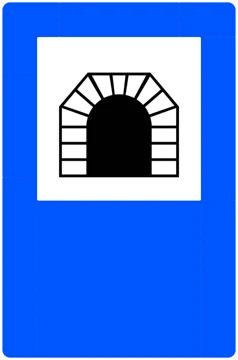 S-5
25Congestion and emergency areas in tunnels
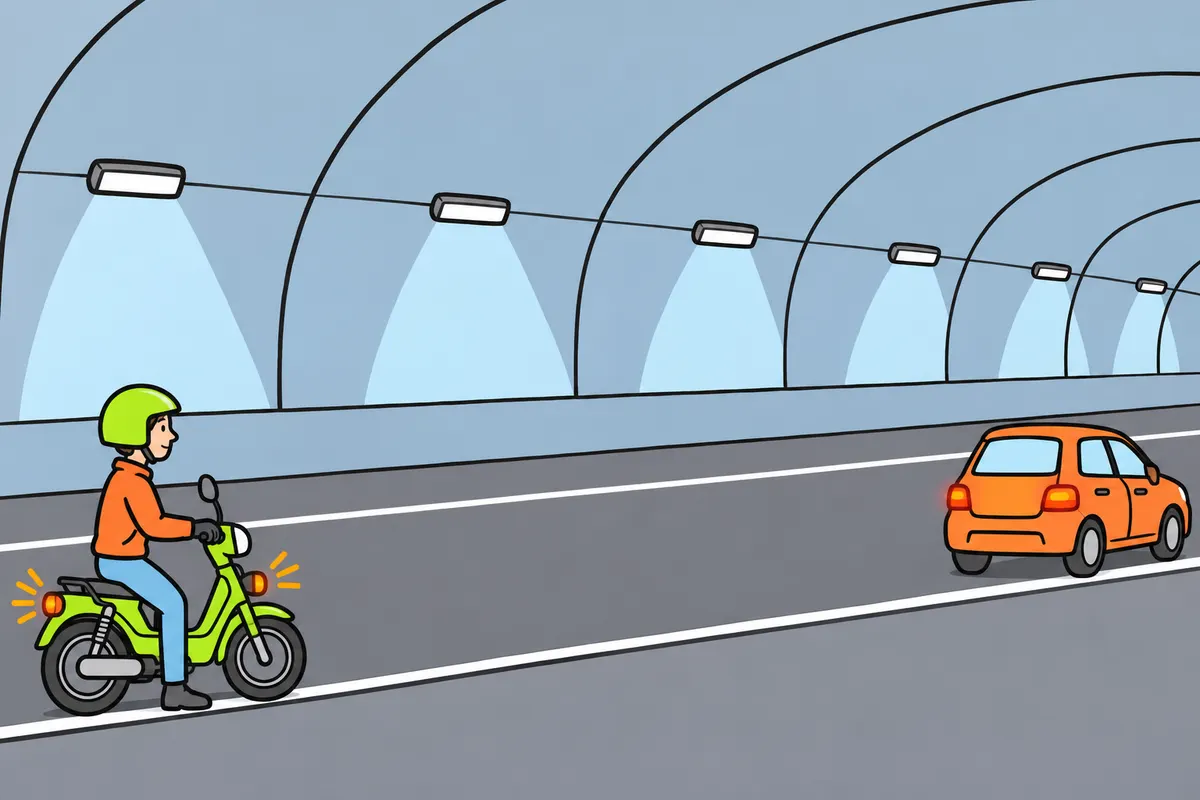
In tunnel congestion, switch off your engine and keep position lights on.
| Situation in a tunnel or underpass | What you must do |
|---|---|
| Fault that allows you to continue | Continue to the exit; if unreachable, seek an emergency area |
| Emergency immobilising your vehicle | Apply protection, warning and evacuation measures; follow instructions |
| Area reserved for emergencies | Do not use it to overtake congestion or stop for convenience |
Remember
- In tunnels or underpasses, switch off your engine and keep position lights on.
- Temporarily use hazard warning lights to warn traffic approaching from behind.
- Stop as far as possible from the vehicle ahead.
- While stopped because of traffic, stay beside your moped and follow instructions.
- After more than two minutes in tunnels or enclosed places, keep the engine off.
- Keep position lights on and the engine off until you move again.
Exam trap: Wrong: in tunnel congestion, you switch off the engine only after two minutes. Right: when traffic stops you, switch it off, keep position lights on and temporarily use hazard warning lights.
Read the full explanation
- If traffic conditions bring you to a standstill inside a tunnel or underpass, you must switch off the engine, keep the position lights on and temporarily switch on the hazard warning lights to warn those approaching from behind. You must stop as far as possible from the vehicle ahead. [RGC, art. 97.3](https://www.boe.es/buscar/act.php?id=BOE-A-2003-23514#a97); [RGC, art. 115.1](https://www.boe.es/buscar/act.php?id=BOE-A-2003-23514#a115)
- While stopped because of traffic, you must remain in the vehicle and passengers must not leave it. With a moped, stay beside it and follow the instructions given in the tunnel. If the stop in a tunnel or another enclosed place exceeds two minutes, you must keep the engine off until you resume travel and keep the position lights on. [RGC, art. 97.3](https://www.boe.es/buscar/act.php?id=BOE-A-2003-23514#a97); [RGC, art. 115.2](https://www.boe.es/buscar/act.php?id=BOE-A-2003-23514#a115)
- If a fault allows you to continue travelling, you must continue to the exit or, if you cannot reach it, to an area reserved for emergencies. These areas serve a safety purpose: they are not lanes for overtaking a queue or places for voluntary stops for convenience. [RGC, art. 97](https://www.boe.es/buscar/act.php?id=BOE-A-2003-23514#a97)
- In an emergency that immobilises your vehicle, you must apply the specific protection, warning and evacuation measures and follow the instructions you receive. The full procedure, including the advance warning devices appropriate to your vehicle, is covered in the Accidents, breakdowns and first aid module. [RGC, art. 97](https://www.boe.es/buscar/act.php?id=BOE-A-2003-23514#a97)
Choose between the hard shoulder and the carriageway
Decide your road position according to road reservations, your vehicle and the condition of the hard shoulder. [RGC, art. 36](https://www.boe.es/buscar/act.php?id=BOE-A-2003-23514#a36)
- Check that the road permits your moped and whether there is a part specifically intended for it.
- If there is no such part, identify the right-hand hard shoulder.
- Check whether it is passable and wide enough for the vehicle you drive.
- If it meets both conditions, use it in single file.
- If it does not exist or fails either condition, occupy only as much of the carriageway as necessary on the right.
- Return to the hard shoulder when it meets the conditions again, checking that moving across is safe.
Identify a special lane
The markings and the reason for opening the lane determine its access rules. [RGC, art. 40](https://www.boe.es/buscar/act.php?id=BOE-A-2003-23514#a40)
- Double broken lines on both sides: identify a reversible lane and check that it is open and you may use it.
- Contraflow lane opened to improve traffic flow: do not enter with your moped.
- Lane opened because of roadworks: check access for your vehicle and that the established or signposted minimum is compatible with its 45 km/h.
- Temporary additional lane using both hard shoulders: you may only use it with a lower established or signposted minimum compatible with your moped's 45 km/h.
- Obey traffic lights, delineators and required lighting; a green light does not remove vehicle restrictions.
Pass through a tunnel you are allowed to use
Prepare to enter and keep to your allotted space inside the tunnel. [RGC, art. 95](https://www.boe.es/buscar/act.php?id=BOE-A-2003-23514#a95)
- Check that the road permits mopeds and the entrance signals allow you through.
- Switch on the appropriate lights even during the day and observe lane signals.
- Maintain your required road position and, when you do not intend to overtake, at least 100 metres or four seconds.
- Do not enter the opposing traffic direction to overtake, stop voluntarily, reverse or turn around.
- If traffic brings you to a standstill, switch off the engine, keep the position lights on, warn others temporarily with hazard warning lights and remain in the vehicle.
- Follow the tunnel's signs and instructions; distinguish congestion from an emergency.
Finished this module?
Mark it as read and you will see your progress on the theory list.