
Theory · C Licence - Truck · Module 15 of 18
Lorry mechanics
You learn how the diesel engine and its fuel supply, lubrication and cooling circuits work, along with the transmission, suspension, steering, electrical system and starting system. You relate each component to its function and to signs of faults, following your lorry's specifications.
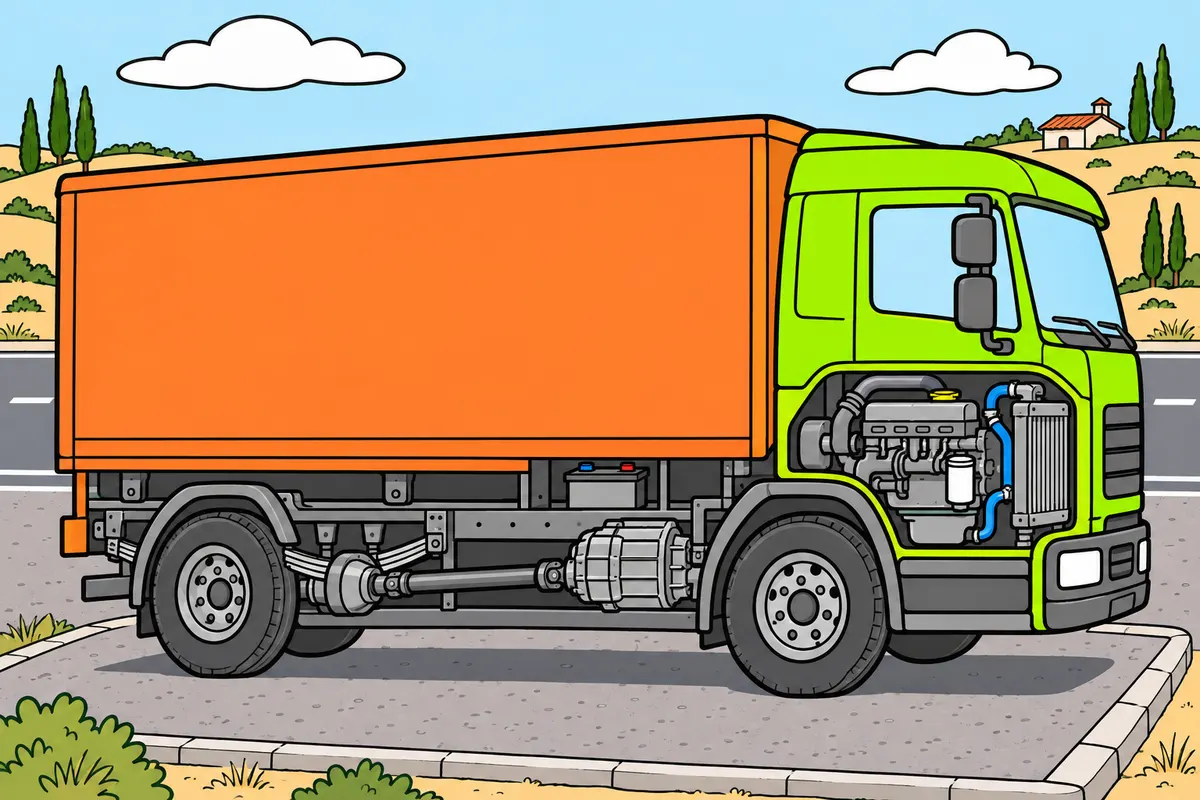
1Lorry systems and scope of the module
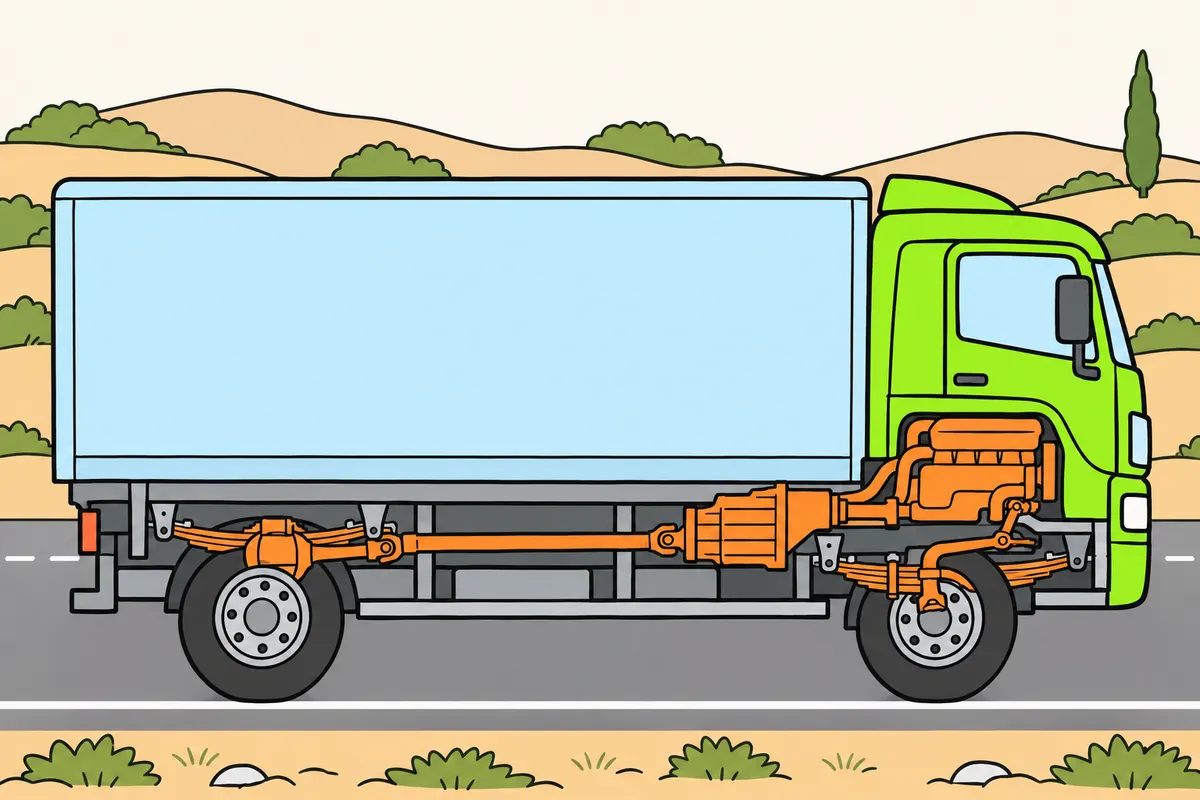
Link each lorry system to its job.
Remember
- Your engine produces movement; the transmission carries it to the driven wheels.
- Your steering turns the wheels.
- Your suspension helps keep the wheels touching the ground.
- Check fluids and maintenance intervals in your manual.
- Study inspections and minor repairs in “Lorry maintenance and checks”.
Exam trap: Wrong: a symptom identifies the faulty part. Right: you need to check the cause.
Read the full explanation
- The engine produces movement; the transmission carries it to the driven wheels, the steering turns the wheels and the suspension keeps them in contact with the ground. You can relate a symptom to these systems, although the symptom alone does not identify the faulty component.
- Check your manual for the layout and specifications of your lorry's systems; capacities, fluids and service intervals depend on the model and how you use it.
- You study pre-journey inspections, practical fault-finding and minor repairs in ‘Lorry maintenance and checks’.
2Diesel engine and operating cycle
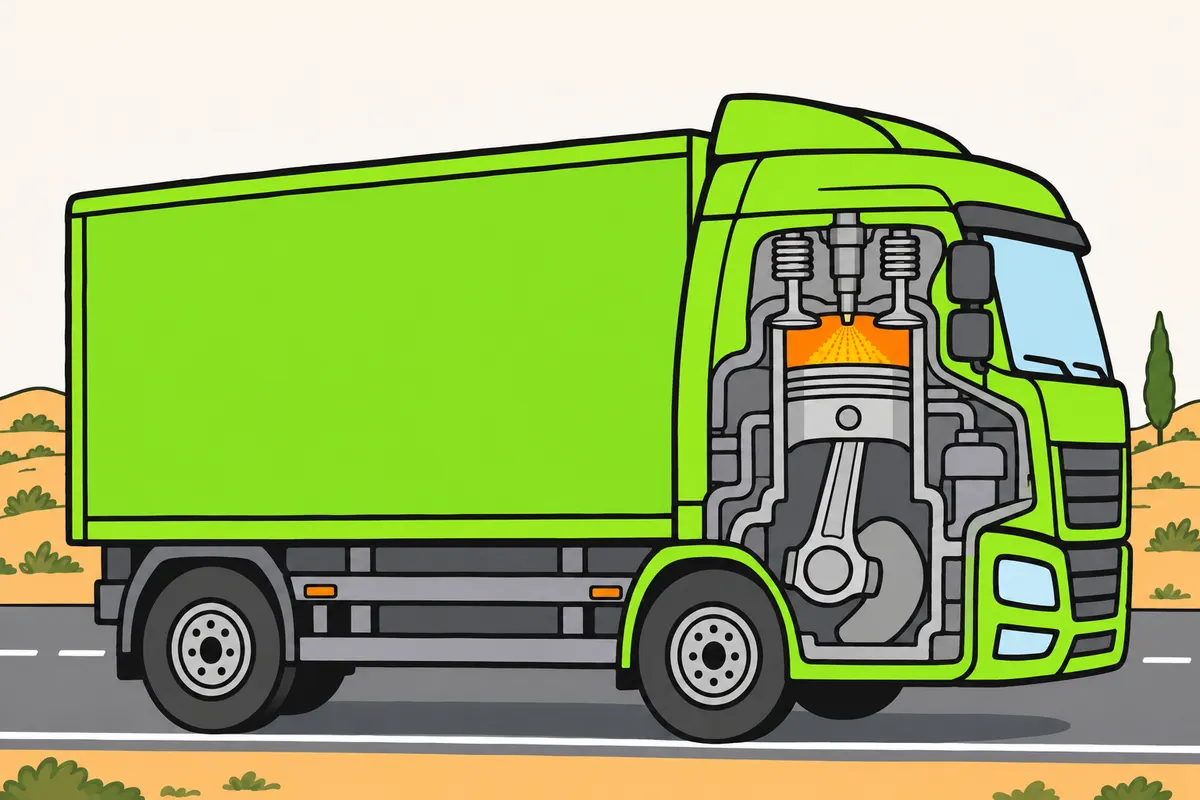
Recognise that diesel fuel ignites in air heated by compression.
| Case | Crankshaft movement |
|---|---|
| One piston stroke | Half a turn: 180 degrees |
| Four-stroke cycle | Two turns: 720 degrees |
Remember
- Remember the order: intake, compression, combustion and expansion, exhaust.
- During intake, air enters.
- The connecting rod links your piston to the crankshaft, which turns.
- Your flywheel smooths changes in rotational speed.
- Main bearings support your crankshaft and let it turn with little friction.
- If oil and coolant mix, correct the cause before using your engine again.
Exam trap: Wrong: four strokes means four cylinders. Right: these are the stages of the cycle.
Read the full explanation
- In a diesel engine, compression raises the air temperature and the injected fuel ignites in this hot air. This lets you distinguish compression ignition from the spark ignition of a petrol engine.
- In the four-stroke cycle, you identify intake, compression, combustion-expansion and exhaust. During intake, air enters the diesel engine; during compression, its volume decreases; during expansion, work is produced; and during exhaust, the gases are expelled.
- One stroke moves the piston between dead centres and corresponds to half a turn of the crankshaft, 180 degrees. The four-stroke cycle requires four strokes and two turns, 720 degrees. [DGT, Manual VIII, four-stroke cycle](https://sede.dgt.gob.es/export/sites/dgt/.galleries/permisos-de-conducir/certificacion-aptitud-profesores-formacion-vial/2026/MANUAL-VIII-Mecanica.pdf).
- The piston moves inside the cylinder; the connecting rod links this movement to the crankshaft, which produces rotation. The piston rings help provide a seal and control the oil. The flywheel smooths out variations in rotational speed.
- The main bearings support the crankshaft and, with lubrication, allow it to rotate with little friction.
- The cylinder head gasket seals the joint and keeps gases and fluid passages separate. Its openings must align with those in the engine; do not add holes or assume that the pistons pass through it. Damage to it can allow oil and coolant to mix, but diagnosis is necessary: a hose leaking externally does not connect the two circuits. You must remedy the contamination before continuing to use the engine.
3Valve timing and auxiliary belts
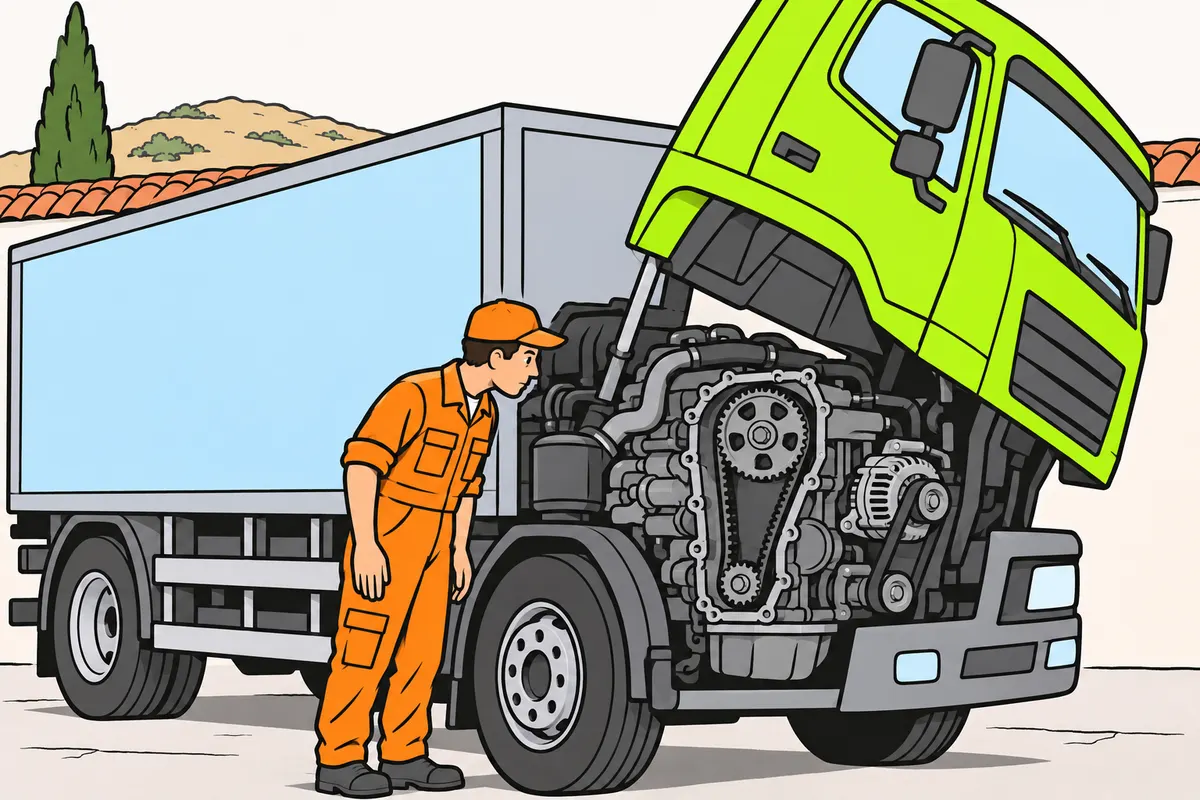
Distinguish valve timing from the belts that drive other parts.
| Part | Job |
|---|---|
| Valve timing system | Controls gases entering and leaving cylinders |
| Auxiliary belts | Drive the alternator, a pump or other parts |
Remember
- Valve timing coordinates your valves with piston movement.
- The camshaft operates your valves.
- Do not lubricate your toothed timing belt.
- A timing chain also needs the specified maintenance.
- Leave timing adjustment and tensioning to a workshop.
- Keep your hands away from belts while your engine runs.
Exam trap: Wrong: all belts do the same job. Right: distinguish valve timing from auxiliary drives.
Read the full explanation
- The valve timing system is the set of mechanisms that controls gases entering and leaving the cylinders. It must synchronise valve opening and closing with the crankshaft and piston positions.
- The camshaft controls the valves through the mechanism provided. In a conventional four-stroke engine, it must remain synchronised with the crankshaft; losing this synchronisation can cause irregular running or serious internal damage.
- A toothed belt maintains the timing through the engagement of its teeth; you must not grease it. Replace it according to the manufacturer's schedule.
- The valve timing system can use a toothed belt, a chain or gears. You must maintain each system according to the manufacturer's instructions: a chain does not mean that you can assume there is no wear, no tensioners or no need for lubrication. Tensioning and setting the timing are workshop tasks.
- Auxiliary belts can drive the alternator, a pump or other components. Check for cracks, fraying and noises without bringing your hands near them while the engine is running. An auxiliary belt and the timing belt have different functions, although both transmit movement.
4Fuel supply, injection and fuel
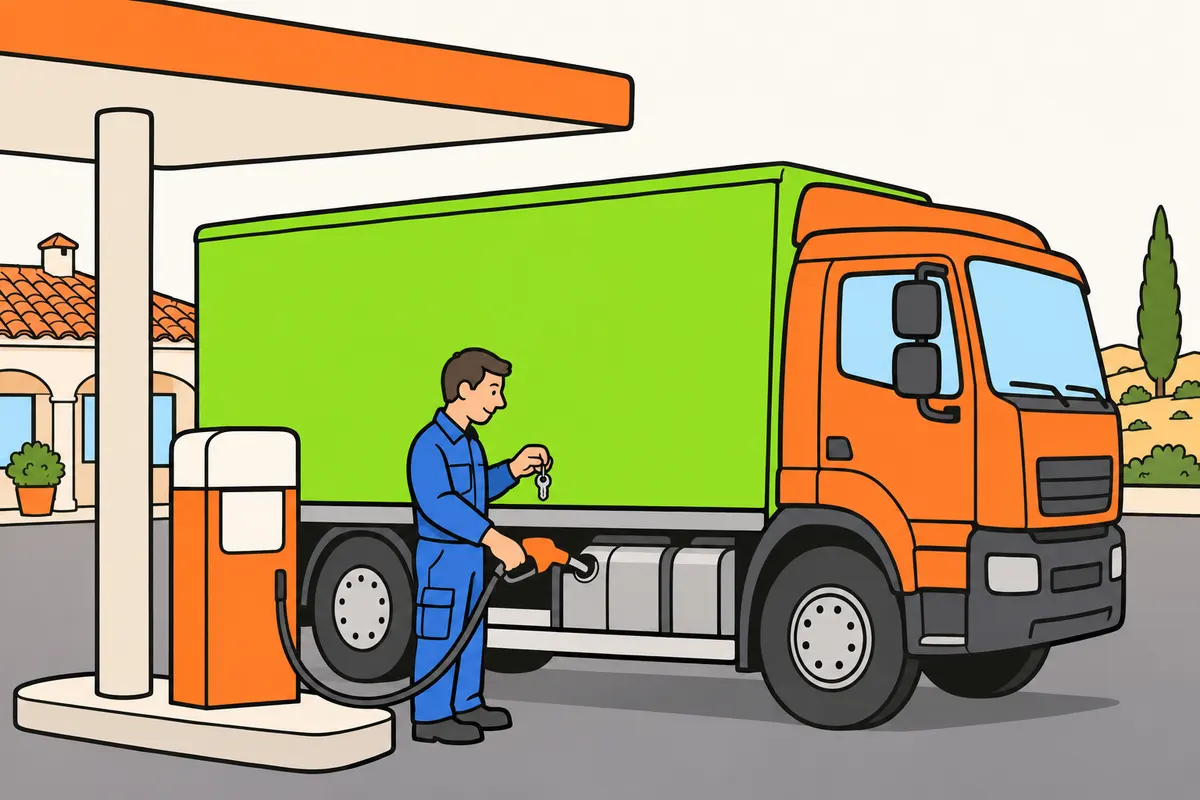
Use approved fuel and follow precautions when refuelling and starting.
| Injection system | What to remember |
|---|---|
| Conventional rack-controlled mechanical injection | The maximum-speed governor is part of the injection pump |
| Common rail | An accumulator holds fuel at high pressure; electronic control governs injection |
Remember
- Filters protect your injection system; injectors measure and spray diesel fuel.
- Do not loosen high-pressure pipes: fuel can pierce your skin.
- If you add the wrong fuel, do not start; call for help.
- When refuelling, switch off engine, lights, radio and phone; never smoke or light fires.
- Avoid revving or putting heavy loads on your cold engine.
- See stops in tunnels in “Accidents, breakdowns and first aid”.
Exam trap: Wrong: you can refuel with equipment switched on. Right: switch off your engine; fuel cannot be served with your lights, radio or mobile phone on. If you refuel without an attendant, you must switch them off.
Read the full explanation
- In the diesel fuel circuit, you distinguish the tank, low-pressure supply, filters, high-pressure generation and injectors. Filtration protects precision components; replace the filters and drain the water separator when the manufacturer specifies.
- The injectors meter and atomise the fuel at the right moment. In a common rail system, an accumulator holds fuel at high pressure and electronic control governs injection. Do not loosen pipes to check whether diesel is reaching them: a high-pressure jet can penetrate your skin.
- In conventional rack-controlled mechanical injection, the maximum-speed governor is part of the injection pump. You must not assume that this arrangement applies to every electronic injection system.
- Use the approved fuel and check the pump before refuelling. If you put in the wrong product, do not start the engine and seek assistance; diluting it with the correct fuel does not guarantee protection for the injection system. After replacing a filter, priming or bleeding air requires the specific procedure.
- You must switch off the engine to refuel. You cannot be served fuel with your lights, radio or mobile phone switched on; if you refuel yourself without an attendant, you must switch them off. [RGC, art. 115.3 and 115.4](https://www.boe.es/buscar/act.php?id=BOE-A-2003-23514#a115).
- You must not smoke or light a fire at a service station: these are safety prohibitions at the premises. [ITC MI-IP 04, section 10.7](https://www.boe.es/buscar/act.php?id=BOE-A-2017-9188).
- Start the engine according to the manual, without pressing the accelerator if the electronic management system does not require it. Avoid revving the engine without load and before switching it off. Do not place heavy loads on a cold engine or apply a fixed idling time to every vehicle: you must consider both the engine and the readiness of the other systems.
- When stopping in tunnels or enclosed places, apply article 115 as explained in ‘Accidents, breakdowns and first aid’, in the section ‘Breakdown, fire and traffic queues in tunnels’. [RGC, art. 115.1 and 115.2](https://www.boe.es/buscar/act.php?id=BOE-A-2003-23514#a115).
5Air intake, turbocharger and intercooler
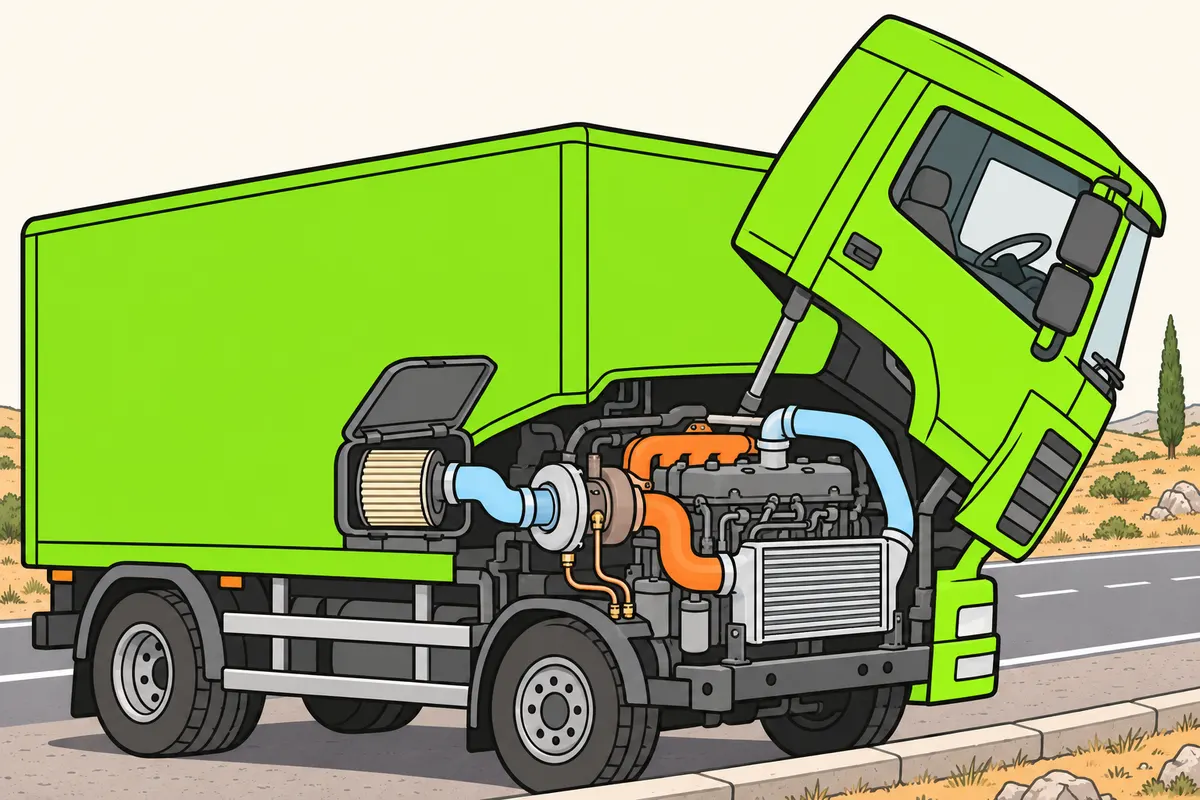
Recognise how the turbocharger and intercooler prepare air for your engine.
Remember
- Follow this route: filter, turbocharger compressor, intercooler, engine.
- Exhaust gases drive your turbocharger turbine.
- The compressor forces more air into your engine.
- The intercooler cools the compressed air.
- Use the specified engine oil to lubricate your turbocharger.
- Do not drive without your air filter to regain power.
Exam trap: Wrong: the intercooler lubricates your turbocharger. Right: it cools intake air.
Read the full explanation
- In a conventional turbocharging layout, follow the air from the filter to the turbocharger's compressor, then to the intercooler and finally to the engine. The filter traps particles before they reach the compressor.
- In the turbocharger, exhaust gases drive a turbine connected to the intake compressor. This feeds a greater mass of air into the engine.
- The intercooler is an air-to-air or air-to-water heat exchanger that cools the compressed intake air. As the compressed air cools, its density increases and cylinder filling improves.
- The bearings in a conventional turbocharger receive oil from the engine, which then returns to it. Use oil with the specified viscosity and approval, never gear oil or an oil chosen on the basis of turbocharger speed. Follow the manual's warm-up and shutdown procedures, without applying a universal one-minute idling period.
- A blocked air filter restricts the intake and can adversely affect combustion, performance and emissions. Maintain the filter according to its design and working environment; do not drive without it to regain power. An abnormal whistle, loss of power or smoke also requires you to check hoses and connections.
6Lubrication: oil, pump, filter and sump
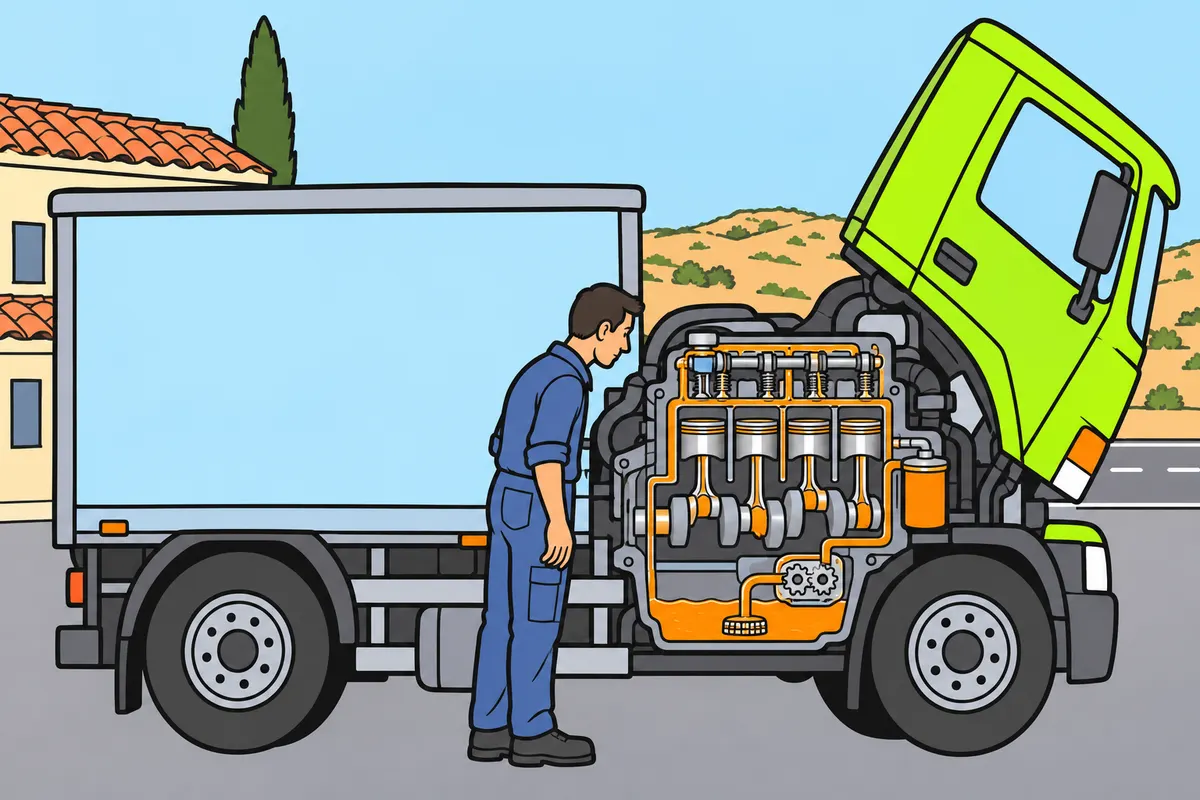
Look after your oil: it reduces wear and helps remove engine heat.
Remember
- The filter traps solid dirt.
- The pump circulates your oil.
- In a wet-sump system, your sump holds the oil.
- Do not exceed the maximum oil level.
- If the level rises without topping up, ask for a diagnosis.
- Change your oil and filter as the manufacturer specifies.
Exam trap: Wrong: adding oil solves every oil loss. Right: you must find its cause.
Read the full explanation
- Oil reduces friction and wear on moving parts and cylinder walls. It also carries heat away and helps limit thermal expansion.
- The filter traps solid impurities and reduces wear; it does not remove every contaminant or maintain pressure and temperature on its own. The pump circulates the oil and other devices regulate its pressure. Replace the oil and filter according to the manufacturer's instructions.
- The sump closes off and protects the bottom of the engine and, in a wet-sump system, holds the oil.
- An oil level above the maximum can also cause faults. If you notice emulsions, the level rises without you topping up, or consumption increases, seek a diagnosis: you may have contamination, fuel in the oil or other faults. Do not assume that you can remedy every oil loss by adding more oil.
- You study oil-level measurement and topping up in ‘Lorry maintenance and checks’.
7Oil pressure and lubricant selection
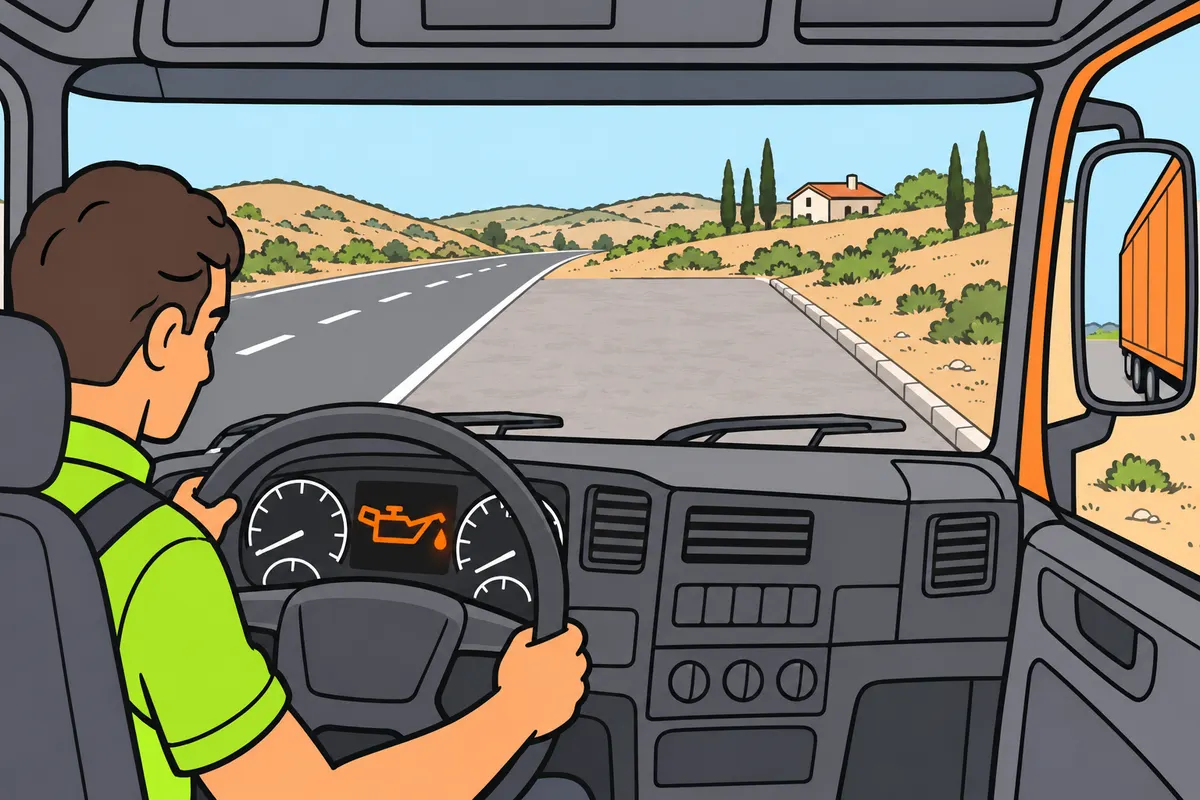
Check oil pressure and always choose the lubricant approved for your engine.
Remember
- Your pressure gauge shows pressure, not the amount of oil.
- If your pressure warning stays on or appears while driving, stop safely; follow instructions.
- Do not blame low pressure only on heat.
- In SAE 15W-40, the numbers show viscosity grades, not temperatures.
- A lower W grade means oil flows better when cold.
- Your gearbox and differential may need different oils.
Exam trap: Wrong: the oil pressure light going out means your engine is warm. Right: it indicates adequate pressure.
Read the full explanation
- The oil pressure gauge indicates the pressure of the oil in the circuit or pipes, not the quantity or level in the sump. Compare its reading with the manufacturer's values for the engine speed and temperature specified for the check.
- When you switch on the ignition, the oil pressure warning light may come on; when you start the engine, it must go out once the correct pressure is reached. It does not indicate that the engine has already reached its operating temperature. If it stays on or comes on while you are driving, stop safely and follow the manual.
- At the same engine speed and with other conditions unchanged, very hot oil becomes less viscous and may produce lower pressure. Low pressure may also result from an insufficient oil level, leaks, wear, incorrect viscosity or other faults: do not continue driving on the assumption that it is only due to heat.
- SAE 15W-40 is a multigrade oil: it meets the 15W grade at low temperatures and the 40 grade at high temperatures. These are viscosity grades, not temperatures, two separate oils or numbers you need to average. A lower W number corresponds to better flow properties when cold; oil usually becomes less viscous as it heats up. Always use a grade and approval specified for the engine.
- The manual gearbox and bevel final drive/differential assembly need their approved lubricants, commonly called valvulina (gear oil) in Spain. Viscosity, flow when cold and suitable additives matter, including extreme-pressure additives where required. Do not choose the thickest oil or one that causes acidification; these two assemblies may need different oils and do not automatically accept engine oil.
8Cooling: flow and regulation
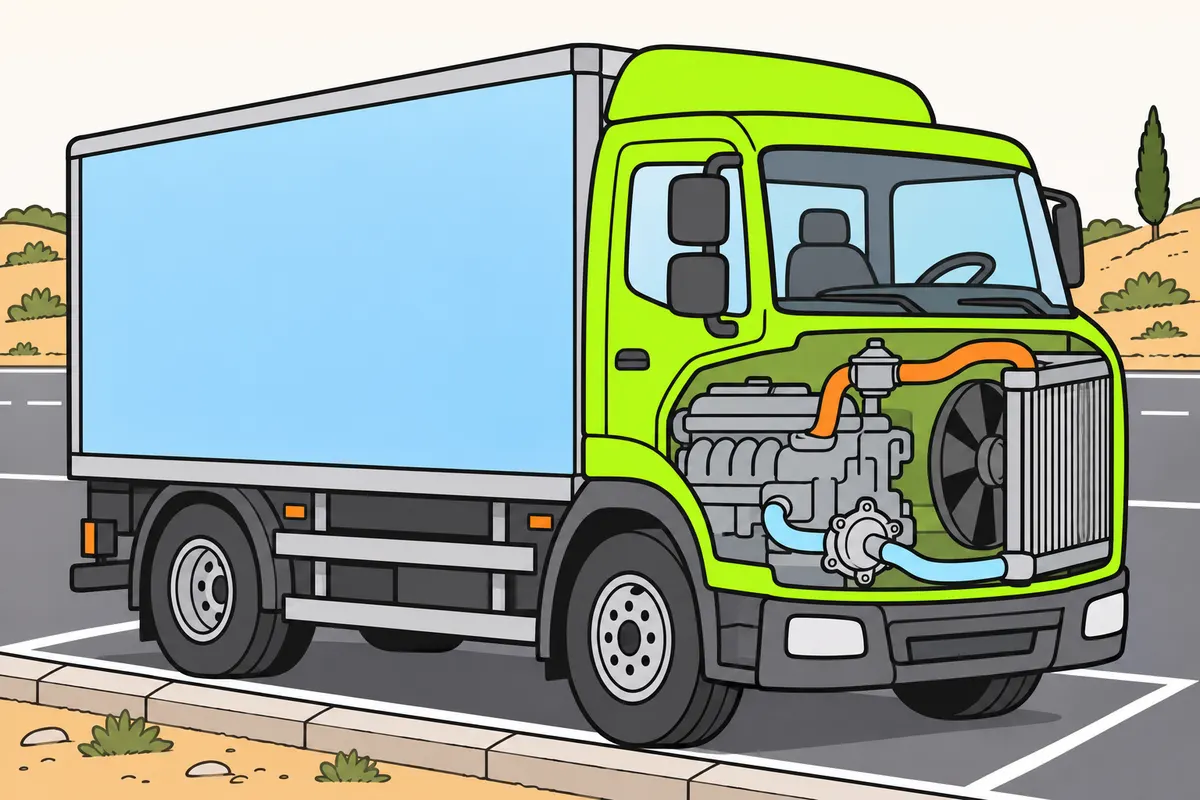
Distinguish the parts that control your engine temperature.
| Part | Job |
|---|---|
| Pump | Circulates coolant |
| Fan | Moves air through the radiator |
| Thermostat | Controls flow to the radiator |
| Temperature gauge | Shows temperature |
| Thermal switch | Switches a circuit when the specified condition is reached |
Remember
- Your radiator transfers heat from coolant to air.
- With a cold engine, the thermostat keeps coolant circulating internally (conventional bypass circuit).
- As your engine warms, the thermostat opens the route to the radiator.
- Check your manual for your engine’s normal temperature.
- A loose or broken pump belt can cause overheating, if your pump uses one.
- If temperature is excessive, stop safely and follow your manual.
Exam trap: Wrong: your fan moves coolant. Right: it moves air; your pump moves coolant.
Read the full explanation
- The radiator cools the coolant coming from the engine by transferring heat to the air during normal operation, not only when the engine overheats. The pump circulates liquid between the cooling passages and the radiator when the thermostat allows this flow.
- The thermostat regulates flow to the radiator. In a conventional circuit with an internal bypass, when the engine is cold it initially closes the main circuit to the radiator and allows internal circulation; this helps the engine warm up. When the correct temperature is reached, it opens the flow to the radiator.
- The thermostat is usually located at the cylinder head outlet towards the radiator, although this location is not universal. If it remains open, it may delay warm-up, reduce performance and increase fuel consumption; you must confirm the fault through diagnosis.
- The operating temperature depends on the engine. You must interpret the temperature gauge according to the manual and the instrument panel; coolant temperature is different from combustion gas temperature.
- The fan creates a flow of air through the radiator when needed, including when the vehicle is stationary. Its function is not to move the liquid: that is the pump's job.
- If the pump is driven by the crankshaft through a belt and pulley, a loose or broken belt may cause overheating. You must also consider leaks, blockages and the thermostat; not all pumps use this type of drive.
- The temperature gauge indicates temperature; the thermal switch switches a circuit when a specified condition is reached. If you have an oil temperature display, you must not confuse it with oil pressure either. An excessive temperature requires you to stop safely and follow the manual to prevent damage.
9Coolant and circuit protection
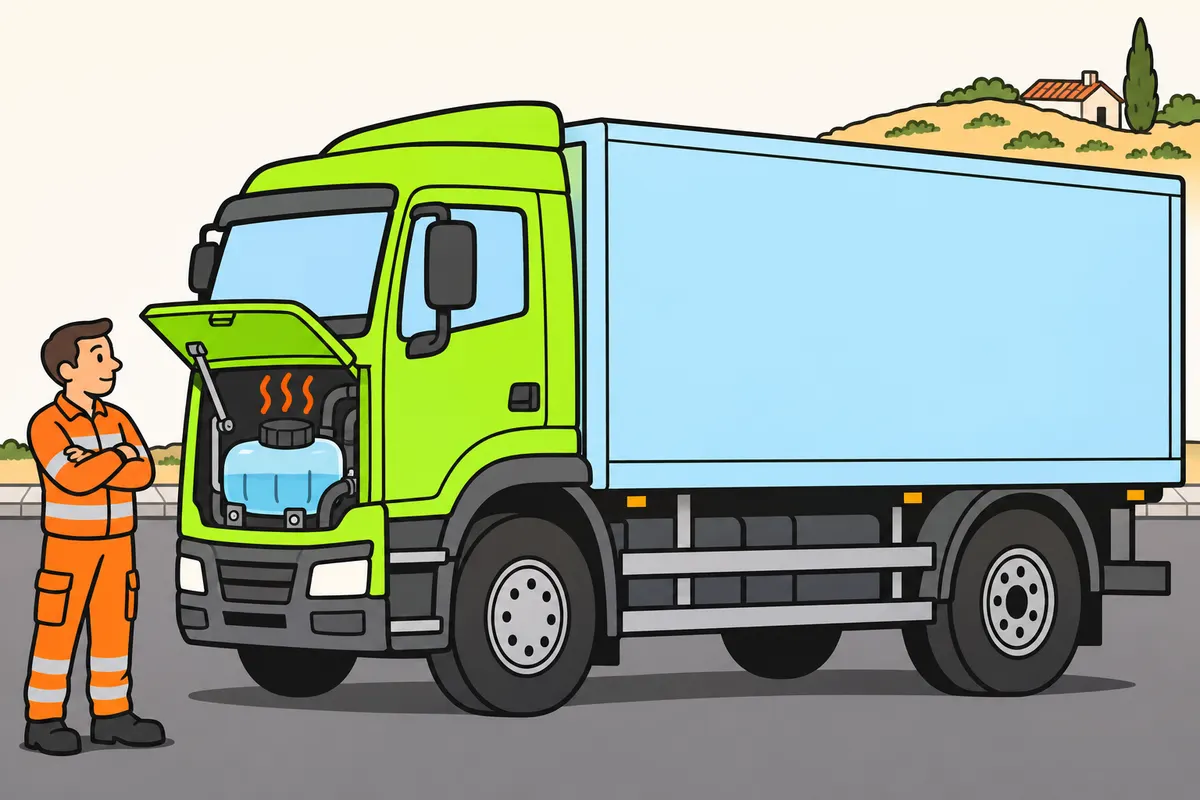
Use the specified coolant and never open your cooling circuit when hot and pressurised.
Remember
- Hot steam or liquid can burn you.
- Your coolant protects against freezing and corrosion.
- Follow the specified coolant type and concentration.
- Do not choose coolant by colour alone.
- Use the cap specified for your cooling circuit.
- Study level and leak checks in “Lorry maintenance and checks”.
Exam trap: Wrong: pressure prevents all boiling. Right: it raises the coolant’s boiling temperature.
Read the full explanation
- Never open a hot, pressurised circuit: steam or liquid can scald you. Pressure raises the boiling point of the same coolant, but does not prevent all boiling. Use the cap and fluid specified for the system.
- Coolant protects against freezing and corrosion and helps control temperature. You must follow the specified fluid requirements and concentration; colour alone does not prove compatibility.
- Checks of levels, hoses, leaks and protection against cold are covered in «Lorry maintenance and checks».
10Exhaust, emissions and interpreting smoke
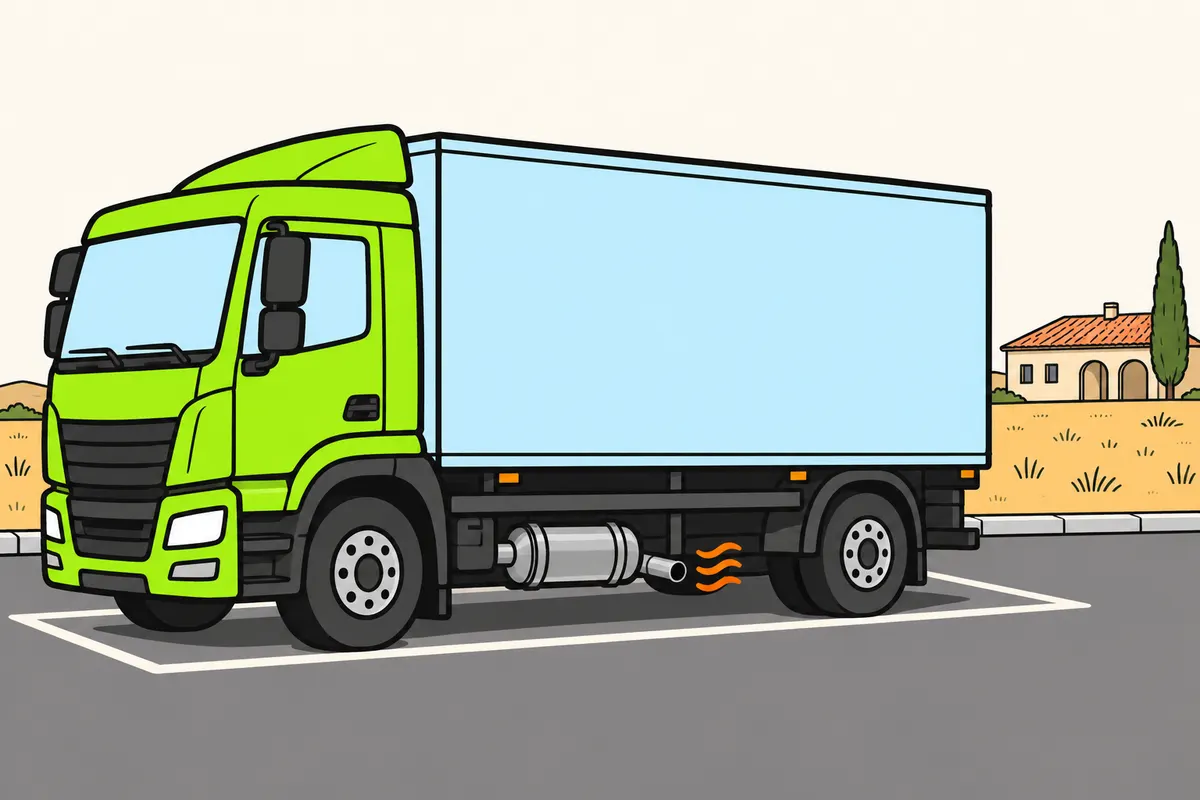
Treat unusual smoke as a warning that needs diagnosis.
| Smoke | Possible explanation |
|---|---|
| Persistent blue smoke with oil consumption | Burning oil |
| Abnormal black diesel smoke | Incomplete combustion: too little air or too much fuel |
| Temporary white smoke when cold | Condensation |
Remember
- Your catalytic converter reduces harmful substances; your silencer reduces noise.
- Study exhaust rules in “Defensive and efficient lorry driving”, section “Reducing transport noise”.
- Your exhaust can contain several gases, not just carbon dioxide.
- Do not mix AdBlue and diesel fuel.
- Follow regeneration warnings; keep materials that can burn away from your hot exhaust.
- Get emissions warnings diagnosed, even if your engine still has power.
Exam trap: Wrong: smoke colour identifies a faulty part. Right: you need a diagnosis.
Read the full explanation
- The catalytic converter transforms harmful substances in the exhaust to reduce emissions; in your diesel lorry, it forms part of the exhaust gas treatment system alongside the other devices fitted to the model.
- The silencer reduces exhaust noise. If it is broken, noise pollution increases. The rules on exhausts and silencers are covered in «Defensive and efficient lorry driving», section «Reducing transport noise». [RGC, art. 7.2](https://www.boe.es/buscar/act.php?id=BOE-A-2003-23514#a7).
- Complete combustion of the carbon in diesel fuel produces carbon dioxide, CO₂. Do not confuse it with carbon monoxide: actual exhaust gases may contain other gases and unburnt fuel, not just CO₂.
- Persistent bluish smoke and oil consumption may indicate oil burning due to piston ring or valve sealing problems. You need a diagnosis; you must not confuse this with temporary white condensation when cold or with diesel fuel consumption.
- Abnormal black diesel exhaust smoke may indicate soot from incomplete combustion: there is too little air or too much fuel for the air available. Check the filter, air intake and injection system; it does not prove that a particular part is faulty or that the engine compensates for the lack of air by injecting more diesel fuel.
- In lorries fitted with them, the particulate filter traps soot and needs to regenerate; the SCR system reduces nitrogen oxides using a specific reagent. Identify the AdBlue tank by its marking: the reagent and diesel fuel each go into their respective tanks. Follow the manufacturer's regeneration and reagent warnings without disabling the systems.
- Regeneration can raise the exhaust temperature considerably. Follow the parking instructions and keep combustible materials away from hot outlets. An emissions warning requires diagnosis even if the engine retains its power; smoke alone does not allow you to decide which part to replace.
11Transmission to the wheels
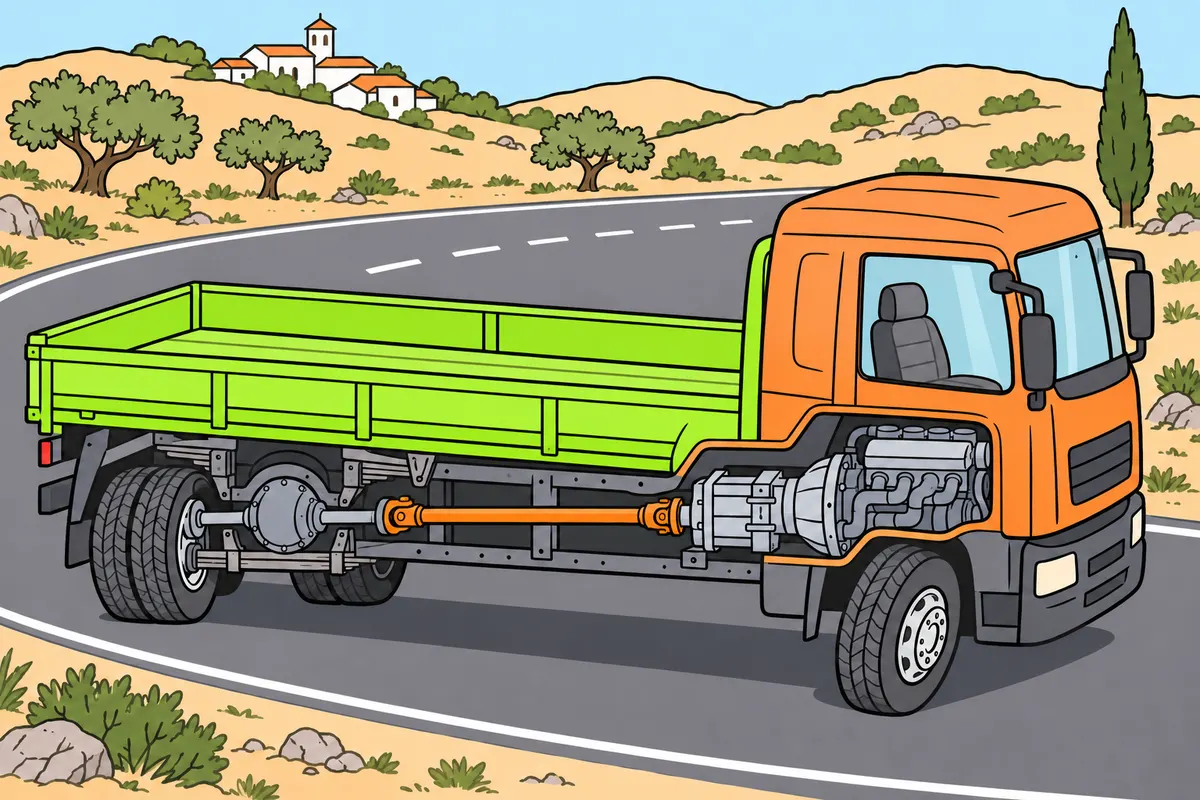
Follow movement from your engine to the driven wheels.
| Lorry layout | Transmission of movement |
|---|---|
| Front axle only steers; rear axle is driven | The half-shafts are on the driven rear axle |
| Several driven axles | Movement is distributed between them according to the design; check your manual |
Remember
- In a conventional rear-wheel-drive lorry, the propeller shaft carries movement towards the driven axle.
- Your half-shafts carry rotation from the differential to the driven wheels.
- Shaft joints transmit rotation even when the shaft angle changes.
- Your differential lets driven wheels sharing an axle turn at different speeds on bends.
- Use your differential lock only as your manual specifies.
- Do not go under your lorry without suitable supports.
Exam trap: Wrong: your differential selects gears. Right: it allows different speeds between driven wheels on the same axle.
Read the full explanation
- In a conventional rear-wheel-drive lorry, you can follow the path from the engine through the clutch, gearbox, propeller shaft, final drive, differential and half-shafts. The propeller shaft connects separate assemblies, and each component performs a function along this path.
- The half-shafts transmit rotation from the differential to the driven wheels. In a lorry with a front axle that only steers and a driven rear axle, they are in the driven rear axle. Steering and driving are different functions, although an axle can perform both in other designs.
- The propeller shaft joints allow rotation to be transmitted as the angle changes with suspension movement; sliding components compensate for changes in length. Vibrations, knocks when moving off or lubricant leaks require inspection. Do not go under the lorry without suitable means of support.
- The final drive adjusts rotational speed and torque for the wheels. The differential allows the driven wheels on the same axle to rotate at different speeds on a bend; it is not a gearbox for selecting gears. If a differential lock is fitted, use it only as instructed in the manual: locking it unnecessarily on a high-grip surface may damage the transmission.
- In a lorry with several driven axles, the transmission distributes drive between them according to its design; check its configuration and the available controls in the vehicle manual. [DGT, Manual VIII, transmission system](https://sede.dgt.gob.es/export/sites/dgt/.galleries/permisos-de-conducir/certificacion-aptitud-profesores-formacion-vial/2026/MANUAL-VIII-Mecanica.pdf).
12Clutch: engagement and wear
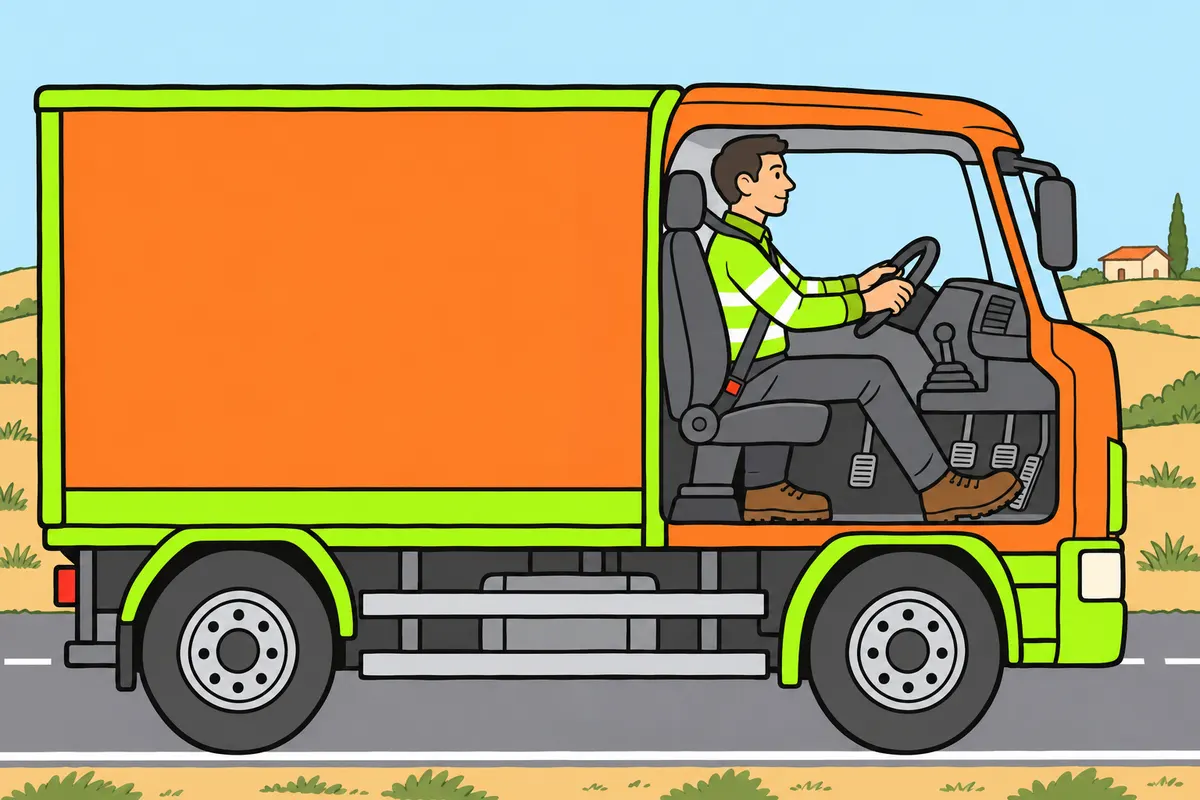
Use your clutch to connect or disconnect your engine and gearbox.
| Conventional clutch pedal or part | State or function |
|---|---|
| Released | Engaged: engine and gearbox connected |
| Pressed | Disengaged: engine and gearbox disconnected |
| Helical torsional damping springs in the disc | Smooth torsional variations; the diaphragm spring presses the disc against the flywheel |
Remember
- In a friction clutch, the disc presses against the flywheel.
- To drive your wheels, you need a gear engaged and a working transmission.
- Take your foot off the pedal when you do not need it.
- Do not hold your lorry on a slope by slipping the clutch.
- Rising engine speed without a matching increase in road speed may mean clutch slip.
- Use the specified fluid if your clutch control is hydraulic.
Exam trap: Wrong: a released pedal means disengaged. Right: with a conventional clutch, it means engaged.
Read the full explanation
- The clutch connects the engine to, or disconnects it from, the gearbox input. In a friction clutch, the pressure mechanism presses the clutch disc against the flywheel to transmit rotation.
- With a conventional clutch, releasing the pedal means the clutch is engaged, and pressing the pedal means it is disengaged. To drive the wheels, you also need a gear engaged and a working transmission; in neutral, engaging the clutch alone is not enough.
- Take your foot off the pedal when you do not need to operate it. Keeping pressure on it may cause partial operation, slipping or wear; do not habitually rest your hand on the gear lever. These habits reduce wear without guaranteeing freedom from faults.
- The hydraulic clutch control transmits force through a fluid; a leak may prevent the clutch from disengaging fully. You must use the manufacturer's specification, as not all circuits use the same fluid.
- In a clutch disc with coil springs for torsional damping, these springs smooth out torsional variations and the transmission of torque to the gearbox. Do not confuse them with the diaphragm spring that presses the disc against the flywheel.
- If engine speed rises and the lorry does not accelerate proportionally, the clutch may be slipping. If it is difficult to engage a gear with the pedal fully depressed, the clutch may not be disengaging properly. Do not hold the lorry on a slope by slipping the clutch disc: this generates heat and wear; use the systems provided to hold the vehicle stationary.
13Gearbox and gear selection
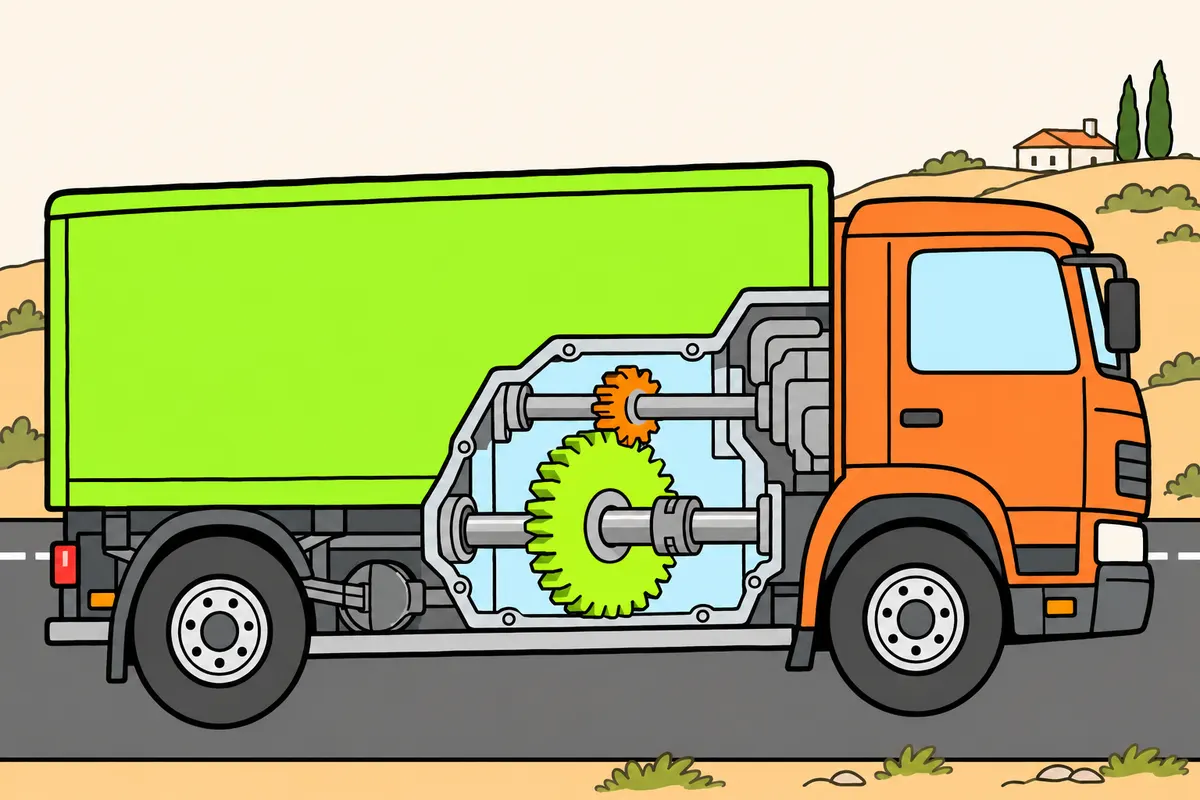
Choose gears to suit your lorry’s speed and the force needed.
| Gearbox | Double-declutching |
|---|---|
| Synchronised | You can change gear without it |
| Non-synchronised | You may need it, depending on the design |
Remember
- At the same engine speed, low gears increase driving force and reduce output speed.
- Neutral does not brake your lorry.
- Synchronisers match component speeds before a gear engages.
- If a gear crunches, do not force your lever; ask for a check.
- Your automated gearbox may have a clutch without a clutch pedal.
- Check your gearbox positions and limits before manoeuvring.
Exam trap: Wrong: a crunching gear proves synchroniser failure. Right: it can have other causes.
Read the full explanation
- The gearbox lets you adapt speed and pulling force to your lorry's needs. A low gear provides greater torque multiplication at the cost of a lower output speed for the same engine speed. Neutral interrupts torque transmission through an engaged gear; it is not a brake.
- Synchronisers match the speeds of components before a gear engages. With a synchronised gearbox, you can change gear without double-declutching; a non-synchronised gearbox may require this technique, depending on its design.
- In a synchronised manual gearbox, a gear that grates may indicate synchroniser wear, incomplete clutch disengagement or another fault. You must not force the gear lever or attribute every noise to a single component.
- An automated gearbox can operate the clutch and gears using actuators; it does not need a clutch pedal to use a mechanical clutch. Do not confuse it with either a torque-converter automatic gearbox or a dual-clutch gearbox. Identify its selector positions, warnings and limitations before manoeuvring.
- You study gear selection and engine speed for efficient driving in «Defensive and efficient lorry driving»; you study downhill driving using engine braking and retarders in «Lorry brakes and retarders».
14Braking systems
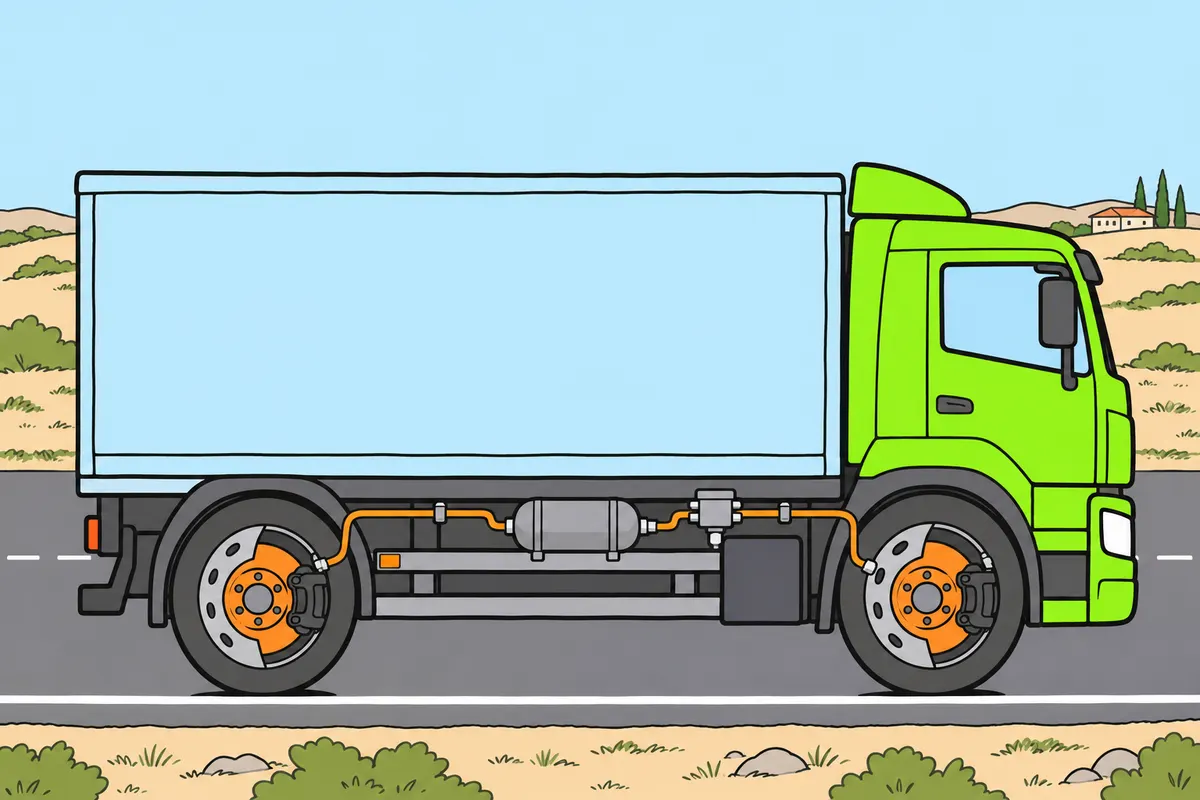
Study how your braking systems work in “Lorry brakes and retarders”.
Remember
- Your friction brakes turn movement into heat.
- Study friction brakes and their circuits in “Lorry brakes and retarders”.
- You also study ABS, EBS, engine braking and retarders there.
Exam trap: Wrong: you confuse engine braking with friction brakes. Right: distinguish them in “Lorry brakes and retarders”.
Read the full explanation
- Friction brakes convert the energy of motion into heat; their actuation system transmits your input to the wheel mechanisms. You study the operation of their hydraulic and pneumatic circuits, ABS, EBS, engine braking and retarders in «Lorry brakes and retarders».
15Suspension, leaf springs and levelling
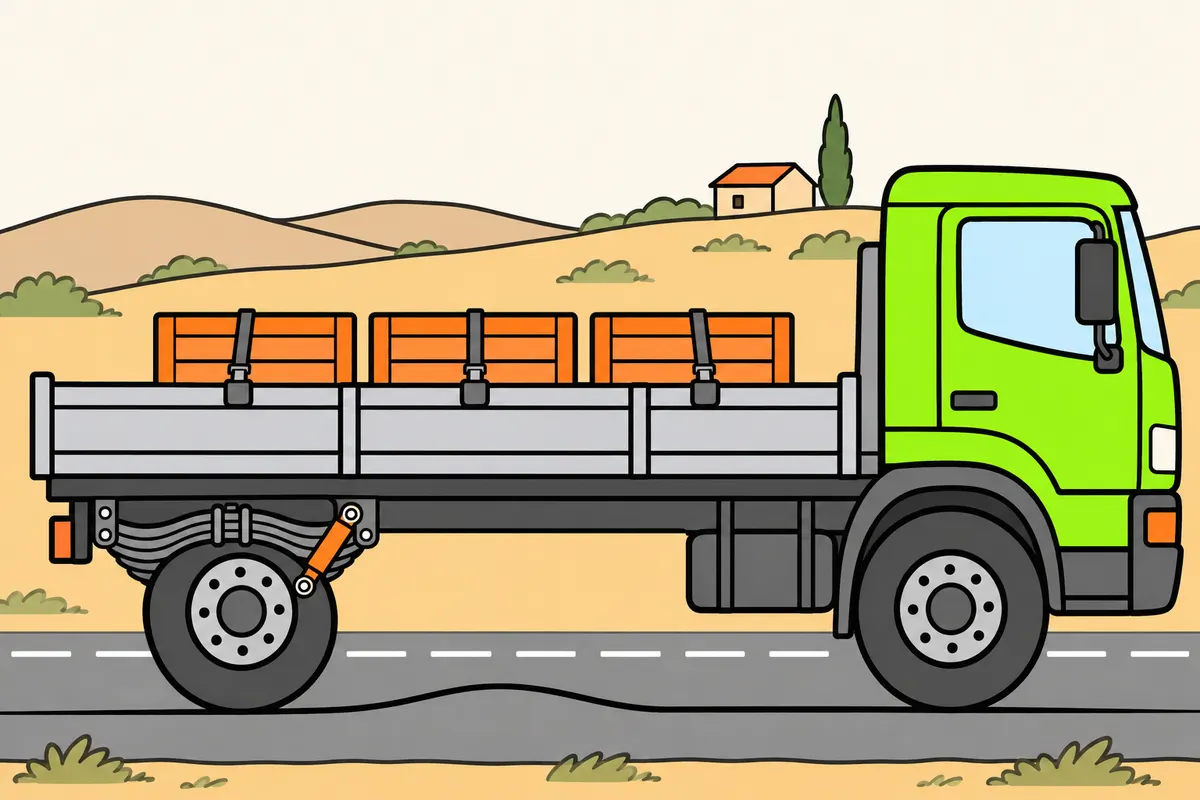
Look after your suspension to keep wheel contact and stability.
| Part | Job |
|---|---|
| Leaf springs and coil springs | Absorb movement |
| Dampers | Control bouncing |
Remember
- Your suspension absorbs road bumps between the axles and the body or frame.
- Worn dampers reduce stability and grip, and increase your braking distance.
- On flooded roads, worn dampers increase your risk of losing contact through aquaplaning.
- Have damaged parts checked and replaced.
- Air suspension with height control can adjust height as your load changes within limits.
- Follow your load limits and specified heights.
Exam trap: Wrong: levelling lets you overload your lorry. Right: respect its maximum authorised mass.
Read the full explanation
- The suspension is the assembly between the wheel axles and the body or chassis that absorbs road irregularities and helps you maintain comfort and control.
- Leaf springs and coil springs are elastic components that absorb movement; shock absorbers damp their oscillations. You can associate poor damping with poorer wheel contact, instability and increased wear on ball joints, arms, bearings and mountings.
- Deteriorated damping impairs stability, steering and grip, increases braking distance and, on a flooded carriageway, increases the risk of aquaplaning. Have deteriorated components checked and replaced. [DGT, Manual II, shock absorbers](https://sede.dgt.gob.es/export/sites/dgt/.galleries/permisos-de-conducir/certificacion-aptitud-profesores-formacion-vial/2024/Manual-II-Cuestiones-de-Seguridad-Vial-2024.pdf).
- With height-regulated air suspension, air adjustment automatically levels the body or chassis as the load changes within its limits. It does not guarantee a constant height if you overload the vehicle or a fault occurs, nor does it allow you to exceed the MMA (maximum authorised mass); observe the specified height settings for loading, unloading and driving.
- You study checks on leaf springs, fastenings, shock absorbers and air bellows in «Lorry maintenance and checks».
16Steering, alignment and balancing
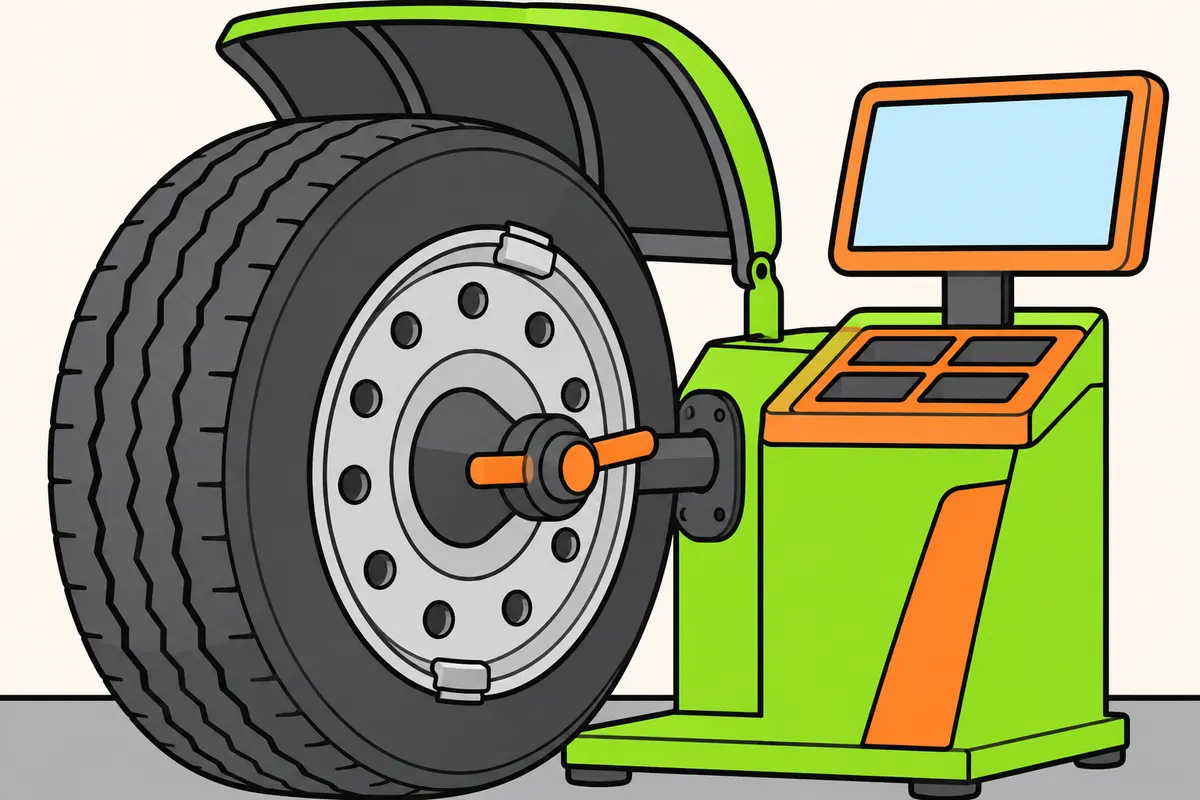
Ask for checks if your steering vibrates, feels heavy or pulls to one side.
| Steering work or part | What it corrects or does |
|---|---|
| Balancing | Weight distribution of the wheel and tyre |
| Alignment | Steering and suspension geometry |
| Castor and kingpin inclination in the steering geometry | Return the wheels to the straight-ahead position |
| Steering box | Transmits movement from your steering wheel to the wheels |
| Power steering | Reduces the effort you need to turn the wheels |
| Electrohydraulic power steering | Keeps the hydraulic circuit and its fluid reservoir |
| Fully electric power steering | Has no hydraulic circuit or fluid reservoir |
Remember
- Check your manual to identify your power steering system.
- Electrohydraulic steering still uses fluid; fully electric steering has no fluid reservoir.
- Vibration at certain speeds may come from unbalanced wheels.
- Do not release your steering wheel or speed up to test vibration.
- If your lorry pulls sideways without a road or wind cause, request checks.
- Hitting a kerb can damage your steering, wheel rim or tyre.
Exam trap: Wrong: holding your steering wheel harder repairs the fault. Right: have the cause checked.
Read the full explanation
- Hydraulic power steering uses a fluid circuit and a reservoir to help you steer; electrohydraulic power steering adds an electric motor and retains both, while fully electric power steering dispenses with them. Check your manual to find out which system your lorry has. [DGT, Manual VIII, power steering](https://sede.dgt.gob.es/export/sites/dgt/.galleries/permisos-de-conducir/certificacion-aptitud-profesores-formacion-vial/2026/MANUAL-VIII-Mecanica.pdf).
- If your steering wheel vibrates particularly at certain speeds on a good road surface, one possible cause is unbalanced wheels. Balancing corrects the mass distribution of the wheel and tyre assembly; alignment corrects the steering and suspension geometry.
- If your lorry feels unstable or persistently pulls to one side without a cause related to the road or wind, have the steering, alignment and tyres checked. Keep control of the steering wheel: do not let go of it to test the steering or increase your speed in an attempt to make the vibration disappear.
- Castor and the transverse inclination of the steering pivot, known as steering axis inclination, help the steered wheels tend to return to straight-ahead travel after a turn. You must associate this effect with steering geometry; the steering box transmits movement from the steering wheel to the road wheels at the ratio specified by its design. [DGT, Manual VIII, steering geometry](https://sede.dgt.gob.es/export/sites/dgt/.galleries/permisos-de-conducir/certificacion-aptitud-profesores-formacion-vial/2026/MANUAL-VIII-Mecanica.pdf).
- Power steering reduces the effort you need to turn the wheels through the assistance provided by the installed system. If it becomes heavy, unstable or noisy, have it checked.
- Steering play, imbalance and incorrect geometry are different faults. A knock against a kerb can damage a tyre, wheel rim or steering even if it looks minor from the outside. Have it checked if you notice excessive play, noises, uneven resistance or uneven wear; holding force on the steering wheel to compensate does not repair the cause.
17Wheels and tyres
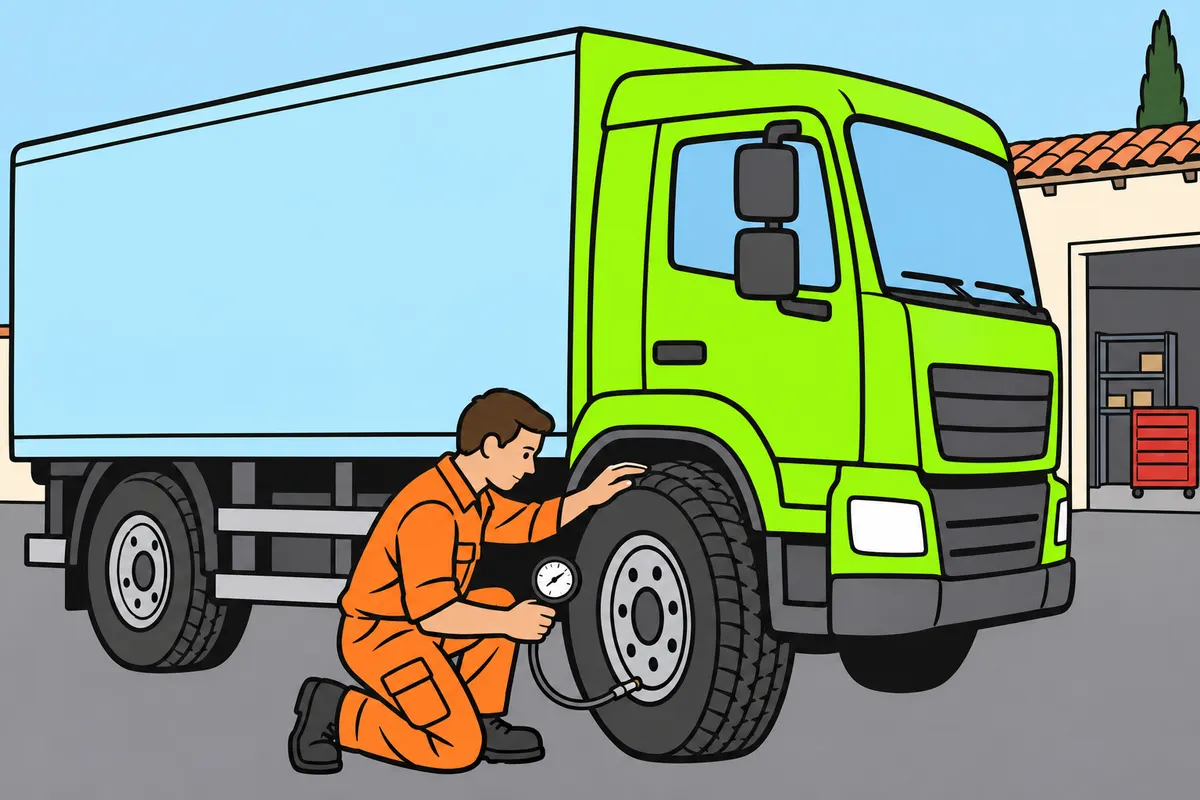
Study your lorry tyres in “Lorry maintenance and checks”.
Remember
- Your wheel rim supports the tyre.
- Your tyre carcass provides strength and flexibility.
- Your tread touches the road; its grooves channel water away.
- Look there for tyre construction and markings.
- Study your tyres’ load and speed ratings.
- Check that module for pressure, wear and conditions of use.
Exam trap: Wrong: you study only tyre pressure. Right: also study load, speed, wear and use.
Read the full explanation
- The wheel rim supports the tyre; the tyre's carcass provides strength and flexibility, and its tread maintains contact with the carriageway and channels water away through its grooves. You study lorry tyre markings, load and speed indices, pressure, wear and conditions of use in «Lorry maintenance and checks».
18Electricity, alternator and battery
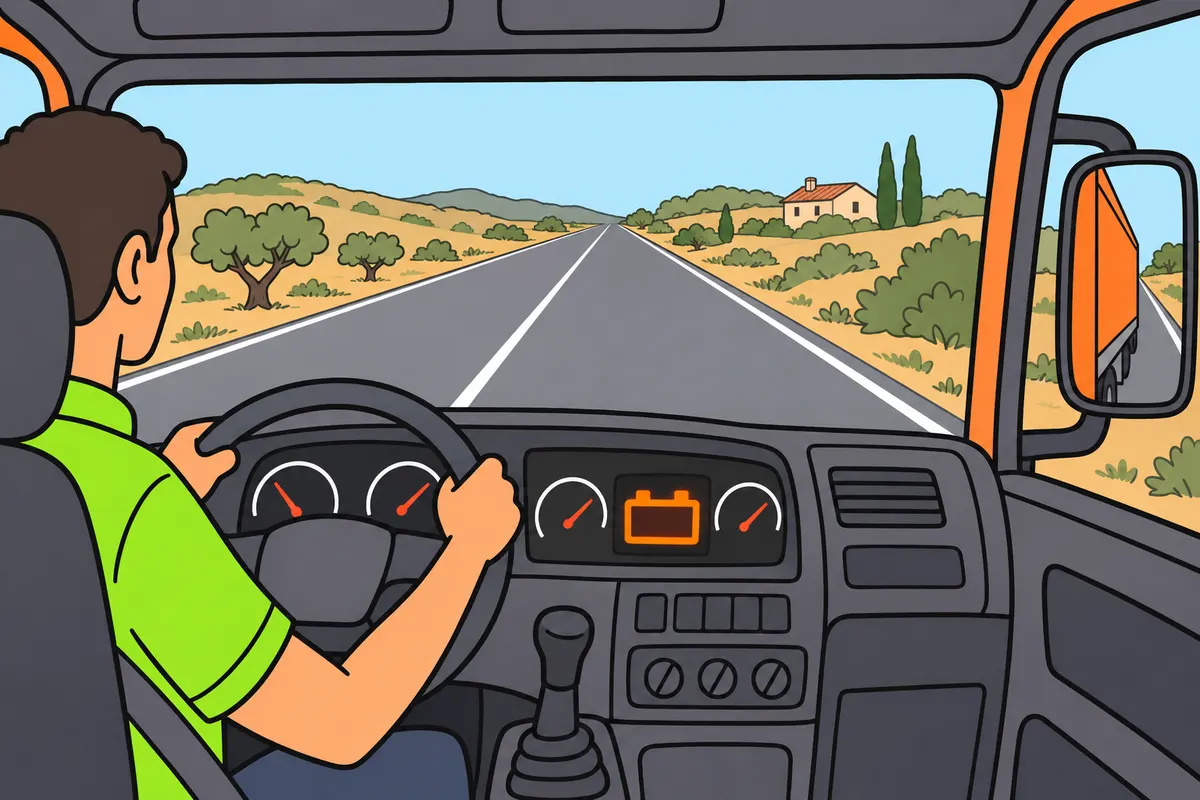
Distinguish energy stored in your battery from electricity generated by your alternator.
| Quantity | Unit |
|---|---|
| Voltage | Volts |
| Current | Amperes |
| Capacity | Ampere-hours |
Remember
- Your battery supplies energy for starting and electrical equipment.
- Your alternator generates electricity while your engine runs.
- Your regulator controls charging.
- If your charging warning appears while driving, follow your manual.
- Study battery care and connections in “Lorry maintenance and checks”.
- In a lead-acid battery, chemical reactions store and deliver electrical energy.
Exam trap: Wrong: your charging light going out proves your battery is full. Right: it does not guarantee this.
Read the full explanation
- The battery stores energy for starting and electrical equipment; the alternator generates electricity while the engine runs, and the regulator controls charging. You express voltage in volts, current in amperes and capacity in ampere-hours.
- The conventional charging warning light comes on when you switch on the ignition and goes out after you start the engine if the system detects no fault. If it comes on while you drive, it may indicate a fault in the alternator, regulator or wiring; when it is off, this does not certify that the battery is fully charged. You must interpret the warning according to the manual.
- In a lead-acid battery, chemical reactions allow electrical energy to be stored and delivered. The alternator replenishes the energy used when the system works correctly.
- You study battery connections, battery care and checks on terminals and vents in «Lorry maintenance and checks».
19Diesel starting system
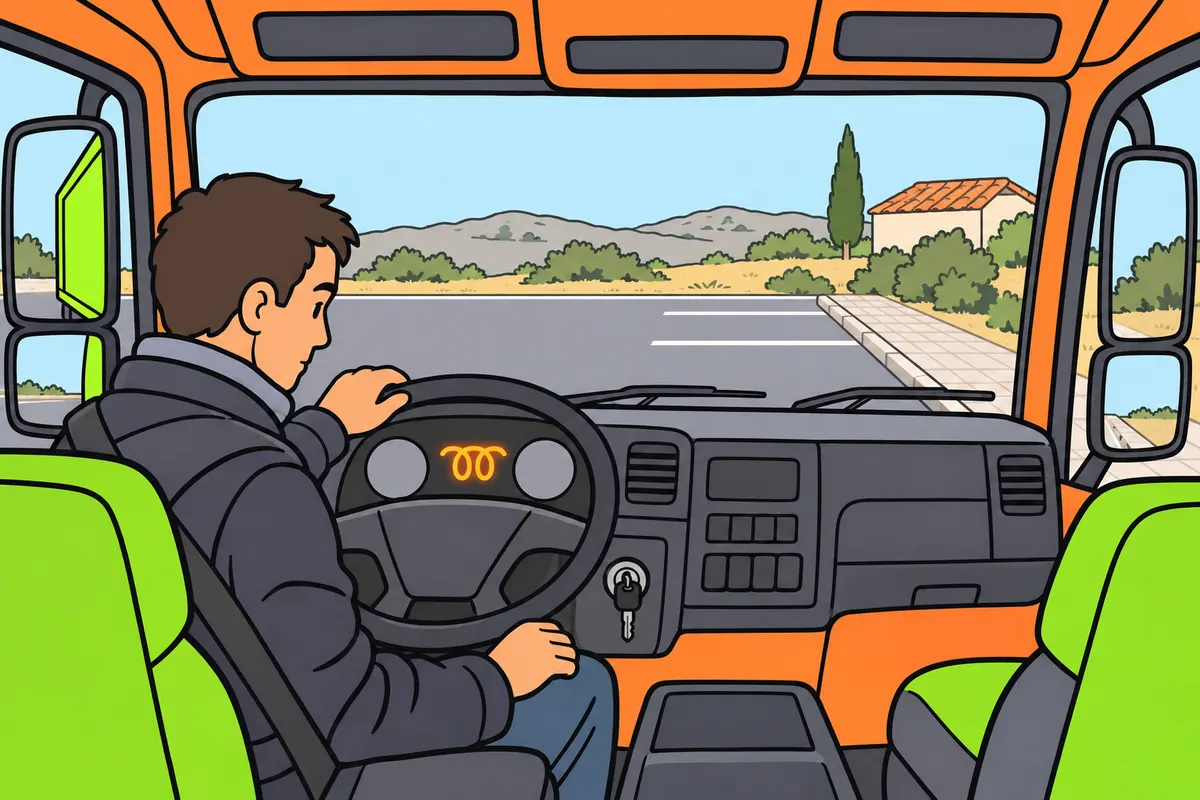
Start your diesel engine as your manual says and follow preheating warnings.
Remember
- Your starter motor uses battery energy to begin turning your engine.
- Its pinion engages with the flywheel ring gear.
- In a conventional system, the solenoid moves the pinion and powers your starter motor.
- Glow plugs provide heat, not a spark for each combustion event.
- Follow your manual’s limits on starting attempts and pauses.
- Stop operating your starter when your engine runs.
Exam trap: Wrong: a click without rotation proves your battery is flat. Right: your starter can also be faulty.
Read the full explanation
- The starter motor uses energy from the battery to start turning the internal combustion engine. Its pinion engages with the toothed ring gear on the flywheel; when the engine runs on its own, the mechanism disengages. This helps you understand its role in starting the crankshaft turning.
- In a conventional starting system, the solenoid or engagement relay moves the pinion and closes the contacts that supply power to the starter motor. The control circuit allows a high current in the power circuit to be controlled.
- Glow plugs help with cold starting in diesel engines fitted with them: they supply heat without producing a spark for each combustion event. You must follow the preheating indicator and the manufacturer's procedure; other engines use starting aids such as intake heaters.
- If you hear a click when you operate the starter but the engine does not turn, the solenoid may be operating without sufficient power reaching the starter motor, or the starter motor may be faulty. You must consider a discharged battery, poor connections and faults in the starter assembly itself; the click does not confirm a single cause.
- Do not operate the starter for prolonged periods: you can overheat the starter motor and discharge the battery. Follow the manual's instructions on the duration of attempts and the pauses between them; stop operating the starter when the engine starts. [DGT, starting precautions](https://revista.dgt.es/es/reportajes/2023/12DICIEMBRE/SUP_INVIERNO/1219-N268-INVIERNO-como-arrancar-coche-invierno.shtml).
20Electrical protection and instrument panel information
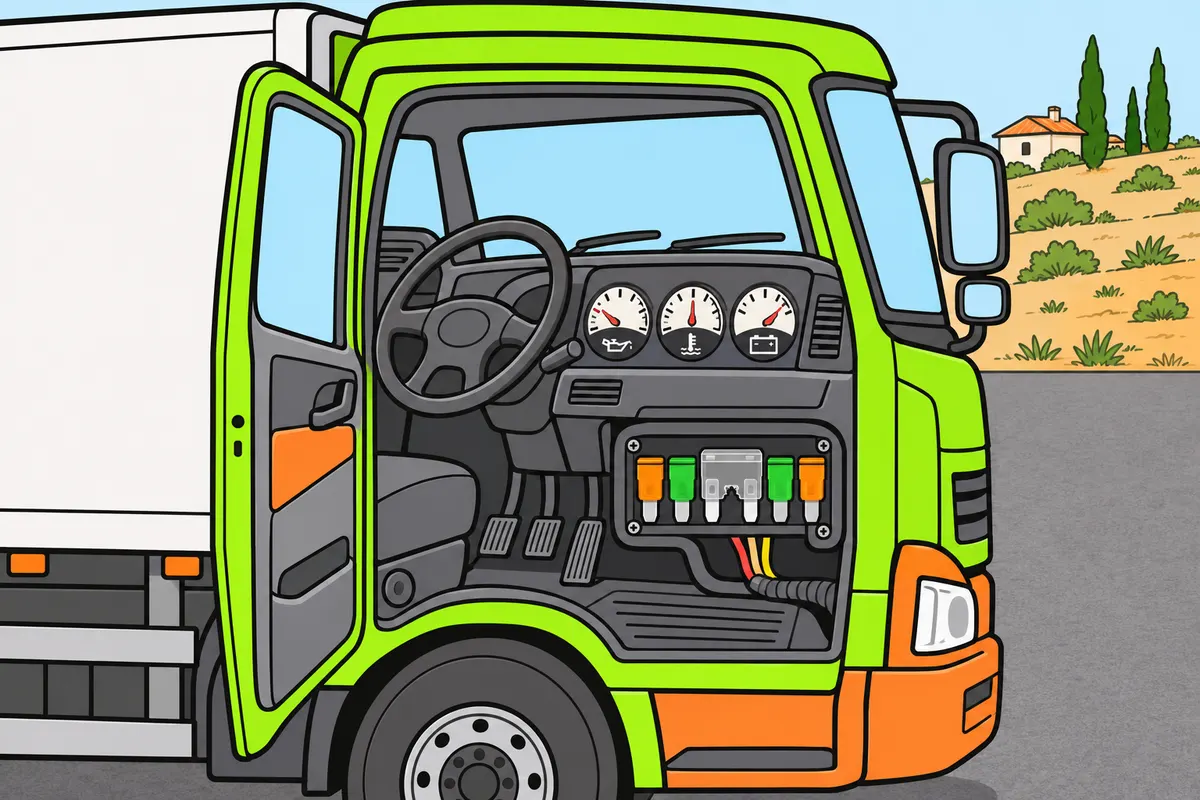
Distinguish fuse protection from the information on your instrument panel.
Remember
- Your fuse melts and breaks the circuit when excess current makes it act.
- It protects against the effects of overloads and short circuits.
- It does not prevent the fault from happening.
- Sensors and electronic control units produce warnings on your instrument panel.
- Distinguish pressure, temperature and electrical charging warnings.
- Study fuse replacement in “Lorry maintenance and checks”.
Exam trap: Wrong: your fuse continuously reduces current. Right: it breaks the circuit when it melts.
Read the full explanation
- A fuse blows in response to excessive current according to its current rating and operating time, breaking the circuit. It protects against the consequences of overloads and short circuits; it does not transform current, continuously reduce it or protect against every overvoltage. Nor does it prevent the fault from occurring.
- Sensors and electronic control units monitor operating parameters and generate warnings on the instrument panel. You may find pressure, temperature and electrical charging indicators: each gives information about a different quantity.
- You study warning light checks, fuse replacement and starting with an auxiliary power source in «Lorry maintenance and checks».
From fuel to wheel movement
You can trace the conversion of energy and the transmission of rotation.
- The fuel supply circuit delivers filtered diesel fuel to the injection system.
- The injector sprays fuel into the air heated by compression.
- Expansion drives the piston; the connecting rod transmits the movement to the crankshaft.
- The clutch connects the engine to the gearbox, which adjusts torque and rotational speed.
- The propeller shaft, final drive, differential and half-shafts transmit movement to the driven wheels.
How the engine starts turning
You can distinguish the electrical function of the starting system from diesel combustion.
- The battery supplies the circuit when it receives the start command.
- The solenoid engages the pinion with the ring gear and closes the high-current supply circuit.
- The starter motor turns the crankshaft.
- Compression and injection allow combustion to begin.
- The starting mechanism disengages when the engine runs on its own.
Check what you know
Real questions from the bank on this topic. Pick an answer to see the explanation.
Finished this module?
Mark it as read and you will see your progress on the theory list.