
Theory · C Licence - Truck · Module 12 of 18
Dangerous goods: ADR basics
You learn to recognise the classes of dangerous goods, interpret their signs and markings, and distinguish your category C licence from ADR authorisation. You can answer questions on documents, restrictions, tunnels and initial action in an incident without confusing these basics with the separate ADR course.
1What ADR regulates
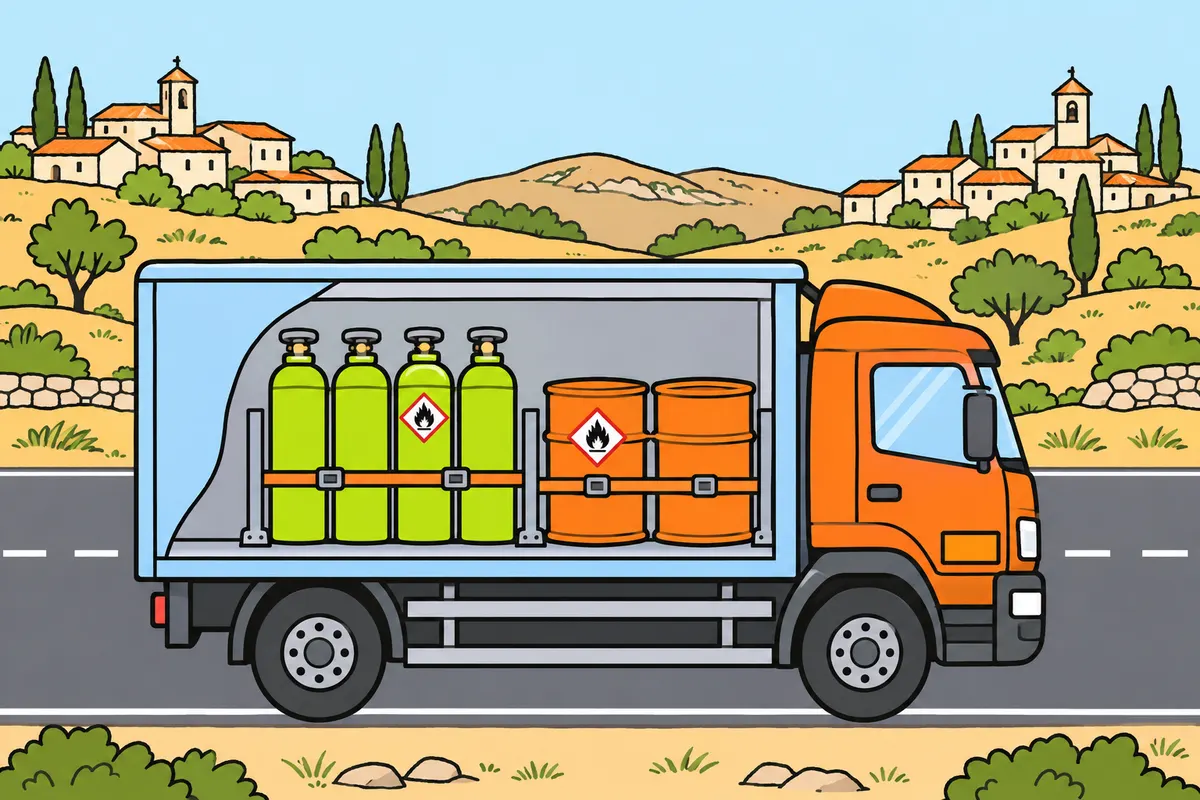
ADR sets the rules for carrying dangerous goods by road.
Remember
- ADR rules also apply to journeys within Spain.
- Dangerous goods can travel in tanks, cylinders, drums or packages.
- Annex A covers goods, packaging, documents and transport operations.
- Annex B covers crews, equipment and vehicles.
- ADR training and tests are separate from your category C test.
Exam trap: Wrong: your category C licence includes ADR authorisation. Right: you need separate ADR authorisation.
Read the full explanation
- ADR is the Agreement concerning the International Carriage of Dangerous Goods by Road. Its conditions also apply to transport carried out entirely within Spain, with the national provisions of Real Decreto 97/2014 (Royal Decree). A delivery between two Spanish towns may be subject to these rules even if you do not cross a border. [RD 97/2014, art. 2](https://www.boe.es/buscar/act.php?id=BOE-A-2014-2110#a2).
- Dangerous goods are substances or articles whose carriage by road is prohibited or authorised only under certain conditions. The danger does not depend on whether you drive a tanker: you may also carry gases in cylinders, products in drums or batteries in packages inside a box-bodied lorry. [RD 97/2014, art. 3](https://www.boe.es/buscar/act.php?id=BOE-A-2014-2110#a3).
- You must associate Annex A with classification, packaging, marking, documentation and transport operations. Annex B covers the crew, equipment, use, construction and approval of vehicles. The specific conditions depend on the goods and how you carry them. [ADR 2025, 1.1.1](https://www.boe.es/diario_boe/txt.php?id=BOE-A-2025-77&lang=es).
- This module prepares you for the basic concepts in the category C licence exam; the ADR course is separate and has its own training and tests. [RGCond, art. 25](https://www.boe.es/buscar/act.php?id=BOE-A-2009-9481#a25).
2Exemptions: check the specific transport operation
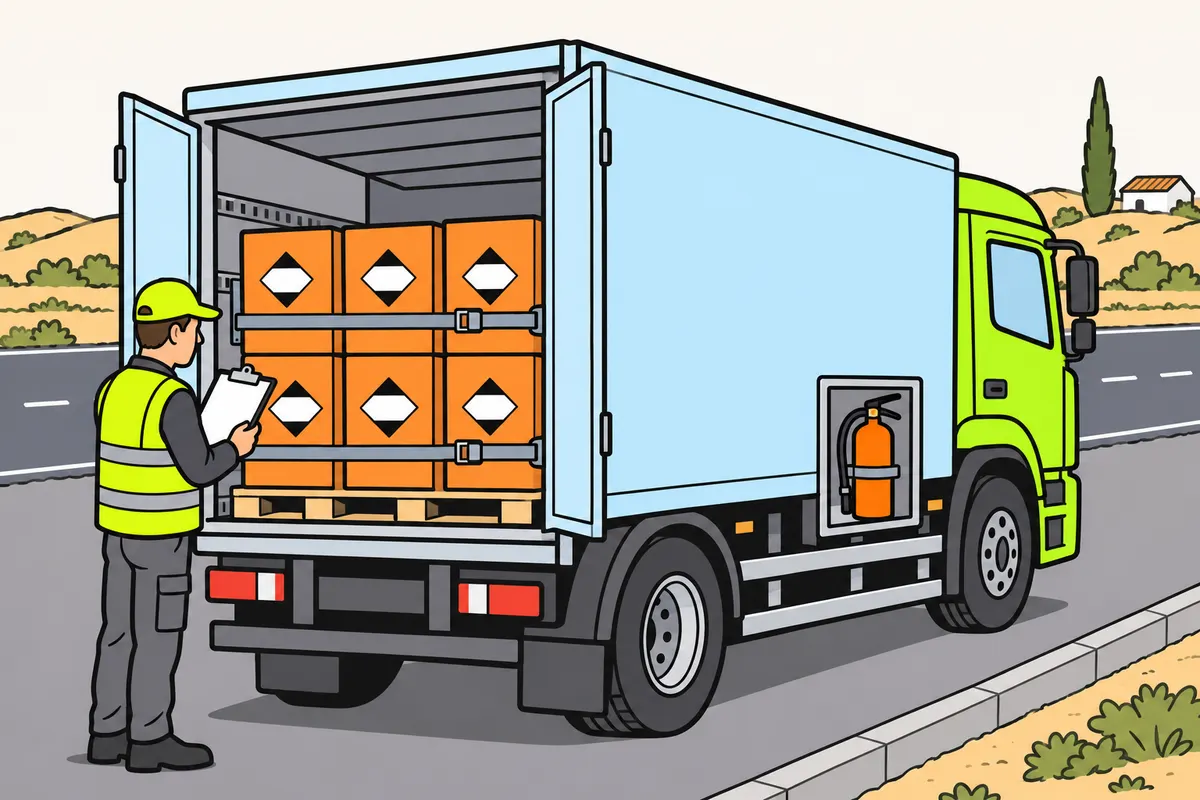
Check which duties still apply to your particular exemption.
| Packages under exemption 1.1.3.6 | What you must do |
|---|---|
| Orange plates, instructions in writing and ADR certificate | Not required under this exemption |
| Transport document | Carry it |
| Portable extinguisher | Carry it with the stated minimum capacity |
| Training, packages and safety | Meet the applicable conditions |
Remember
- Check the goods, quantity and conditions of the exemption.
- Do not use the lorry's maximum mass to calculate it.
- A partial exemption leaves some duties in force.
- Check the packaging and marks for limited quantities.
- Carry at least one powder extinguisher, or another suitable agent with equivalent capacity.
Exam trap: Wrong: an exemption removes every duty. Right: it may remove only some duties.
Read the full explanation
- You must check whether your consignment is subject to the general rules or qualifies for a specific exemption. ADR provides exemptions based on the nature of the transport operation, certain quantities and other circumstances. An exemption may affect only certain obligations: you must not automatically interpret it as meaning that no safety measures are required. [ADR 2025, 1.1.3](https://www.boe.es/diario_boe/txt.php?id=BOE-A-2025-77&lang=es).
- You calculate the exemption relating to quantities per transport unit according to the transport category and the quantities of the substances. There is no universal rule allowing you to carry any product without an ADR certificate below a single mass threshold. You must not confuse this calculation with the lorry's MMA (maximum authorised mass) either. [ADR 2025, 1.1.3.6](https://www.boe.es/diario_boe/txt.php?id=BOE-A-2025-77&lang=es).
- When you carry goods in packages under the exemption in subsection 1.1.3.6, orange plates, placards, instructions in writing and the driver's ADR certificate are not required. You must carry the transport document and at least one portable fire extinguisher with a minimum capacity of 2 kg of powder, or an equivalent capacity of another suitable extinguishing agent. The relevant training requirements and the conditions applicable to packages and transport safety still apply. [ADR 2025, 1.1.3.6.2 and 8.1.4.2](https://www.boe.es/diario_boe/txt.php?id=BOE-A-2025-77&lang=es).
- Limited quantities have their own rules for receptacles, packaging and marking. Their mark is neither a hazard class label nor an orange plate. For the exam, you must recognise that carrying dangerous goods does not always require identical markings; you study the professional calculation of exemptions in the ADR course. [ADR 2025, 3.4](https://www.boe.es/diario_boe/txt.php?id=BOE-A-2025-77&lang=es).
3Classes 1, 2 and 3
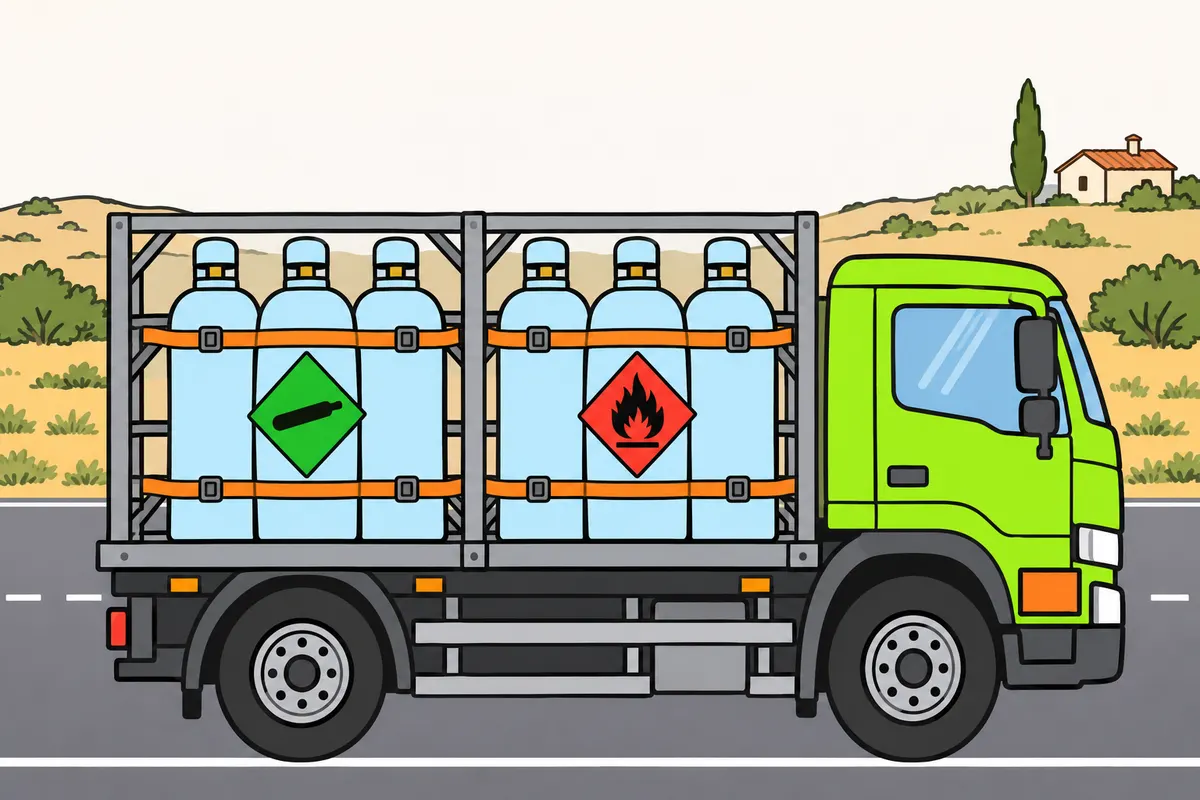
Recognise explosives, gases and flammable liquids by their class.
| Class | Goods |
|---|---|
| 1 | Explosive substances and articles |
| 2 | Gases |
| 3 | Flammable liquids |
Remember
- Read every hazard label.
- Do not assume every gas is flammable.
- Identify goods from their documents, not their smell or colour.
- A higher class number does not mean greater danger.
Exam trap: Wrong: every gas has a flame label. Right: check its actual label.
Read the full explanation
- You must associate class 1 with explosive substances and articles. The risks include explosion and, depending on the division, projections or fire. You cannot decide that an article falls outside ADR because it is a finished product: the classification also covers articles containing explosive substances. [ADR 2025, 2.1.1.1 and 2.2.1](https://www.boe.es/diario_boe/txt.php?id=BOE-A-2025-77&lang=es).
- Class 2 covers gases. You may encounter flammable gases, non-flammable, non-toxic gases, and toxic gases, identified by label models 2.1, 2.2 and 2.3. You must not assume that every gas cylinder carries a flame symbol: you must read its label and any subsidiary hazard labels. [ADR 2025, 2.2.2 and 5.2.2.2](https://www.boe.es/diario_boe/txt.php?id=BOE-A-2025-77&lang=es).
- Class 3 covers flammable liquids. You must anticipate that their vapours may cause a fire when they reach an ignition source. Petrol and diesel are common examples in road transport, but you must use the identification of the specific goods in the documents rather than judge them by smell or colour. [ADR 2025, 2.2.3 and Table A](https://www.boe.es/diario_boe/txt.php?id=BOE-A-2025-77&lang=es).
- The class and the specific hazard are different pieces of information: a gas may be flammable, toxic or present other additional risks. If you see several labels, you must consider all the hazards shown. A class number identifies a regulatory group; it does not express a universal scale on which a higher number means greater danger. [ADR 2025, 2.1 and 5.2.2](https://www.boe.es/diario_boe/txt.php?id=BOE-A-2025-77&lang=es).
4Classes 4.1, 4.2 and 4.3
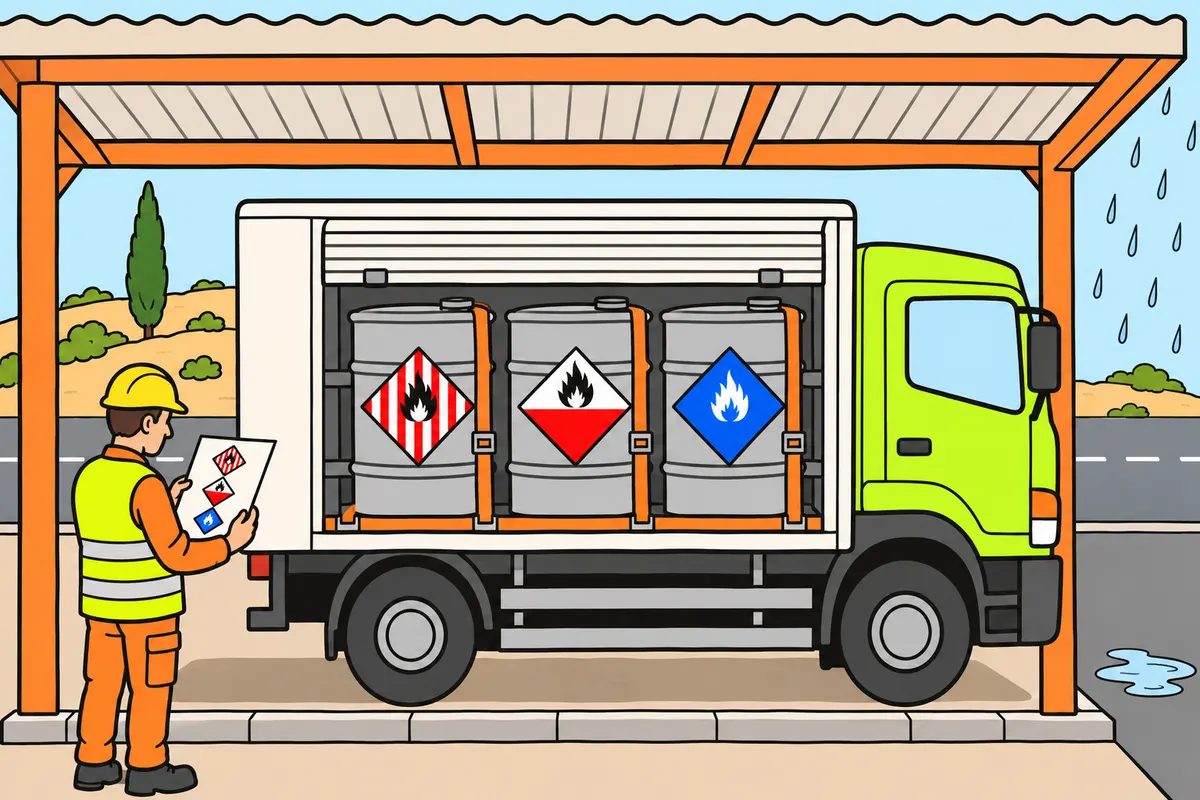
Distinguish flammable substances by how they can burn or react.
| Class | Label |
|---|---|
| 4.1 | Red and white vertical stripes; flame |
| 4.2 | White above, red below; flame |
| 4.3 | Blue background; flame |
Remember
- A solid can still burn.
- Do not open containers on your own initiative.
- Check the number at the bottom of the label.
- Follow the instructions in writing and leave response to specialists.
Exam trap: Wrong: water is suitable for every fire. Right: some goods react dangerously with water.
Read the full explanation
- In class 4.1, you must recognise flammable solids, self-reactive substances, polymerising substances and solid desensitised explosives. The term solid does not mean non-combustible. Friction, heat or the substance's own reaction may create risks that you cannot address by treating every package as ordinary cargo. [ADR 2025, 2.2.41](https://www.boe.es/diario_boe/txt.php?id=BOE-A-2025-77&lang=es).
- Class 4.2 covers substances liable to spontaneous combustion. You must associate it with pyrophoric substances and substances liable to self-heating. You do not need to see an external flame for danger to exist: opening or handling the receptacle on your own initiative may alter the product's safety conditions. [ADR 2025, 2.2.42](https://www.boe.es/diario_boe/txt.php?id=BOE-A-2025-77&lang=es).
- Class 4.3 identifies substances which, in contact with water, emit flammable gases. You must not consider water a universal remedy for a spill or fire. When you see this indication, follow the instructions in writing and leave decisions about the means of intervention to the specialist services. [ADR 2025, 2.2.43 and 5.4.3](https://www.boe.es/diario_boe/txt.php?id=BOE-A-2025-77&lang=es).
- To recognise the labels, associate 4.1 with red and white vertical stripes, 4.2 with a white upper half and a red lower half, and 4.3 with a blue background; all three include a flame. You must also check the number at the bottom, because the flame symbol appears in other groups of goods. [ADR 2025, 5.2.2.2.2](https://www.boe.es/diario_boe/txt.php?id=BOE-A-2025-77&lang=es).
5Classes 5 and 6
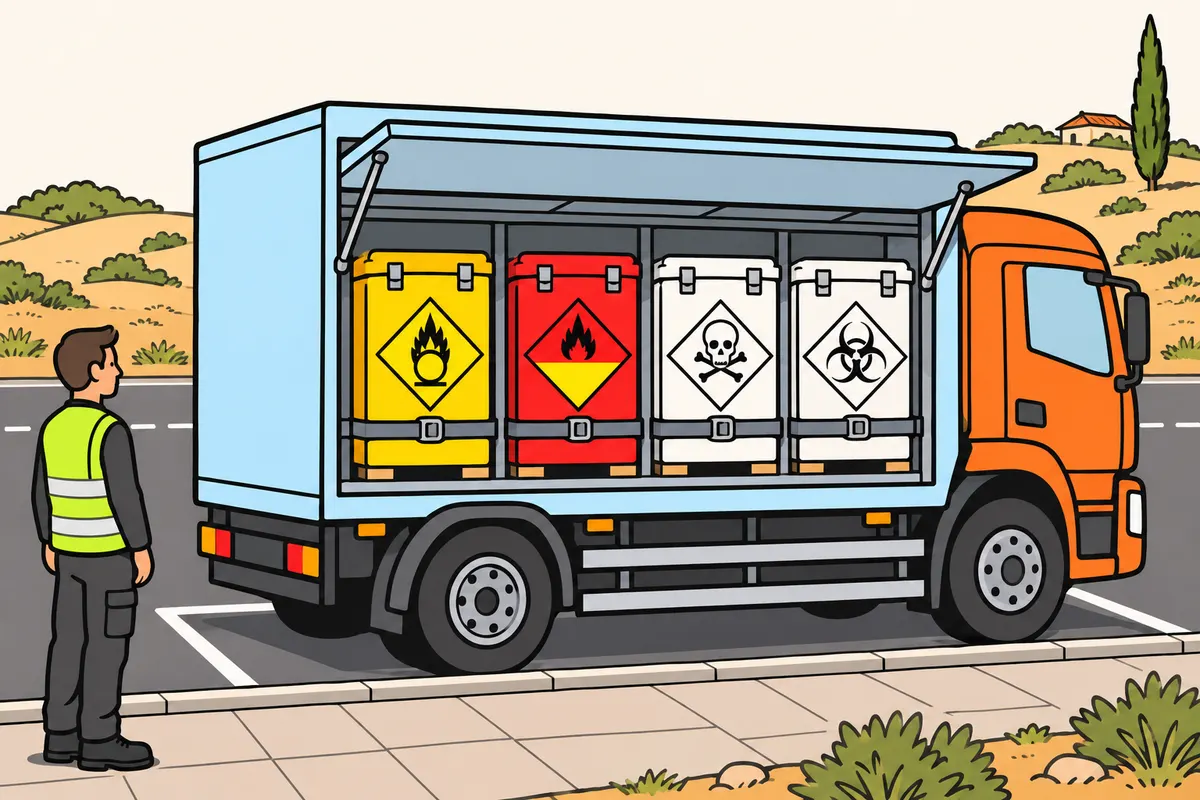
Recognise goods that feed fire, decompose, poison or spread infection.
| Class | What you recognise |
|---|---|
| 5.1 | Feeds fire; flame over a circle on a yellow background |
| 5.2 | Dangerous decomposition; red and yellow label |
| 6.1 | Toxicity; skull and crossbones on white |
| 6.2 | Infection; biohazard symbol |
Remember
- Avoid breathing in, swallowing or touching toxic goods.
- Do not approach a leak to smell it.
- Follow the temperature and packaging conditions for your goods.
Exam trap: Wrong: infectious and toxic goods use the same label. Right: their labels are different.
Read the full explanation
- Class 5.1 covers oxidising substances. They may promote or intensify the combustion of other substances; you must not confuse them with class 3 flammable liquids. You recognise their label by a flame over a circle, a yellow background and the number 5.1. The danger exists even if the product is not an ordinary fuel. [ADR 2025, 2.2.51 and 5.2.2.2](https://www.boe.es/diario_boe/txt.php?id=BOE-A-2025-77&lang=es).
- Class 5.2 covers organic peroxides, which may undergo dangerous decomposition. Their label combines a red upper half and a yellow lower half, with a flame and the number 5.2. You must comply with the transport conditions established for each product without improvising changes to temperature or packaging. [ADR 2025, 2.2.52 and 5.2.2.2](https://www.boe.es/diario_boe/txt.php?id=BOE-A-2025-77&lang=es).
- Class 6.1 covers toxic substances: you must avoid inhaling or swallowing them and avoid dangerous contact. The characteristic label shows a skull and crossbones on a white background. You must not approach a leak to smell it or consider a product safe because you cannot detect a smell from where you are. [ADR 2025, 2.2.61 and 5.2.2.2](https://www.boe.es/diario_boe/txt.php?id=BOE-A-2025-77&lang=es).
- Class 6.2 covers infectious substances and uses the biohazard symbol. Infection and chemical toxicity are identified by different labels. [ADR 2025, 2.2.62 and 5.2.2.2](https://www.boe.es/diario_boe/txt.php?id=BOE-A-2025-77&lang=es).
6Classes 7, 8 and 9
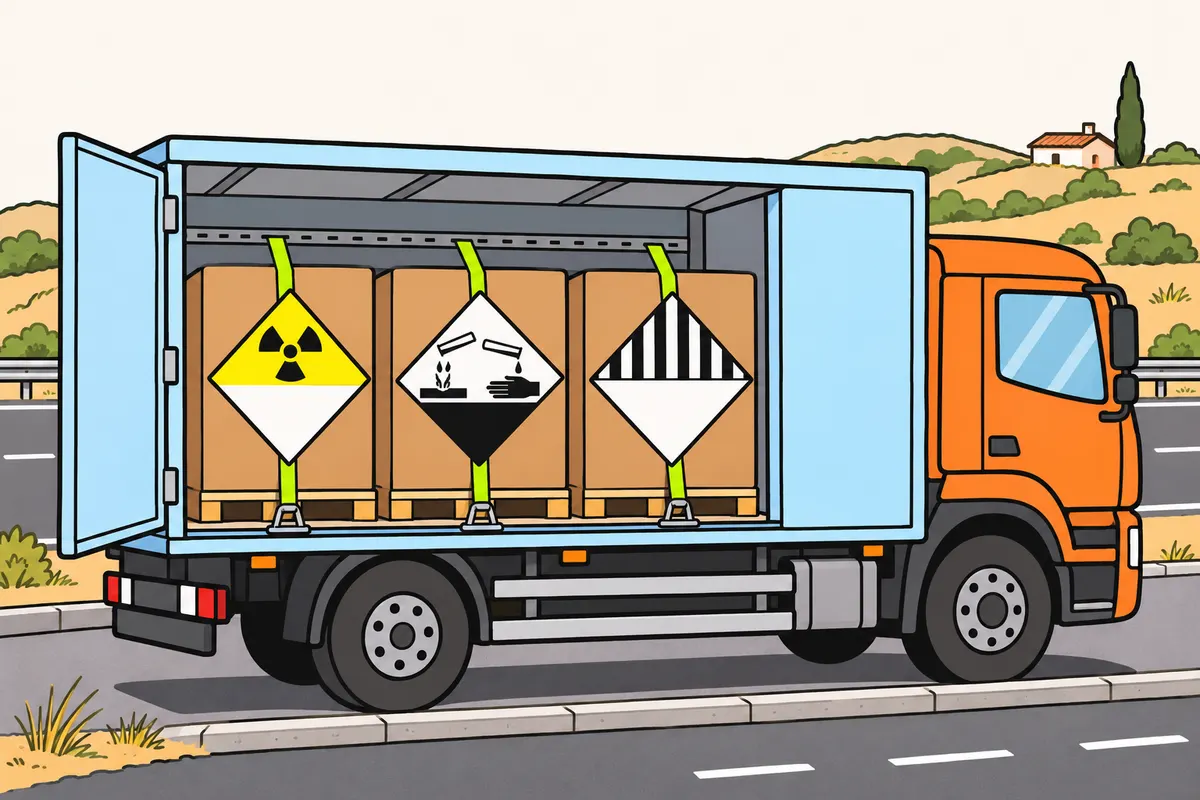
Recognise radioactive, corrosive and other dangerous goods without dismissing them.
| Class | Label |
|---|---|
| 7 | Radiation symbol |
| 8 | Liquid attacking a hand and metal; black below |
| 9 | Black vertical stripes above |
Remember
- Check the labels even if the package looks ordinary.
- Do not touch a corrosive spill or try to neutralise it.
- Review the subdivisions too: the complete list has thirteen classes.
Exam trap: Wrong: class 9 means little danger. Right: it still covers dangerous goods.
Read the full explanation
- Class 7 covers radioactive material. The radiation symbol identifies this hazard; you must consult the specific labels on the package for the regulatory information about its contents. [ADR 2025, 2.2.7 and 5.2.2.2](https://www.boe.es/diario_boe/txt.php?id=BOE-A-2025-77&lang=es).
- Class 8 covers corrosive substances. Its label shows a liquid attacking a hand and a metal, with a black lower half and the number 8. You must associate it with possible injuries and damage to materials, and avoid touching the spill or trying to neutralise it with another substance. [ADR 2025, 2.2.8 and 5.2.2.2](https://www.boe.es/diario_boe/txt.php?id=BOE-A-2025-77&lang=es).
- Class 9 groups together miscellaneous dangerous substances and articles presenting hazards covered by this class. It does not mean harmless cargo or a residual category with a lower risk. The label has black vertical stripes in its upper part; specific models exist for certain batteries, depending on the transport operation. [ADR 2025, 2.2.9 and 5.2.2.2](https://www.boe.es/diario_boe/txt.php?id=BOE-A-2025-77&lang=es).
- You must review the full series: 1, 2, 3, 4.1, 4.2, 4.3, 5.1, 5.2, 6.1, 6.2, 7, 8 and 9. The subdivisions explain why thirteen classes appear in this list. [ADR 2025, 2.1.1.1](https://www.boe.es/diario_boe/txt.php?id=BOE-A-2025-77&lang=es).
7Labels, placards and other marks
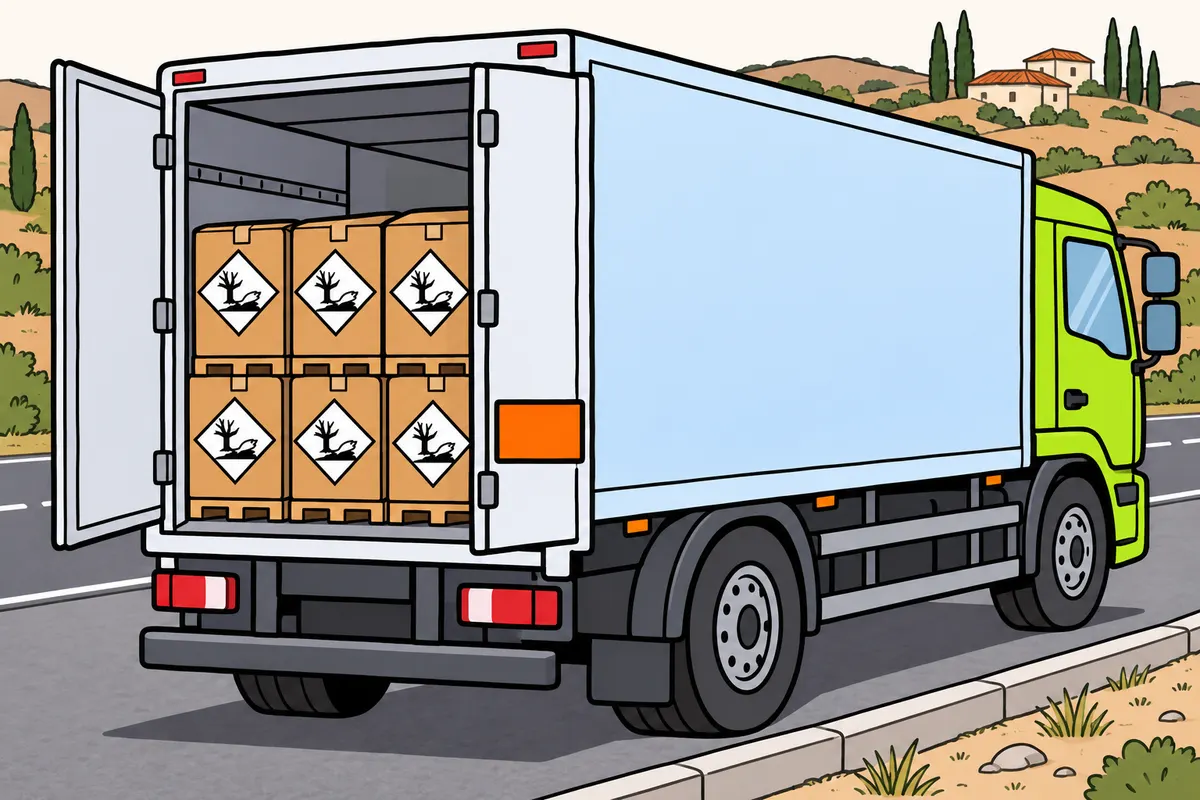
Know the difference between package labels, vehicle placards and other marks.
| Marking | Where or why |
|---|---|
| Label | Package hazards |
| Placard | Hazards visible on vehicles, tanks or containers |
| Tree and fish mark | Environmental danger |
Remember
- Read the symbol, colour and number together.
- Check any extra hazard labels too.
- Placard rules depend on how you carry the goods.
- The tree and fish mark warns of environmental danger.
Exam trap: Wrong: the orange plate replaces hazard labels. Right: each marking has its own job.
Read the full explanation
- Labels are placed on packages and placards, where required, on vehicles, tanks or containers. Labels allow you to recognise the hazards of the package; placards make these hazards visible on the means of transport. The orange plate serves a different purpose and does not replace either labels or placards. [ADR 2025, 5.2.2 and 5.3.1](https://www.boe.es/diario_boe/txt.php?id=BOE-A-2025-77&lang=es).
- Hazard labels are square, set on one corner. You must interpret the symbol, colour and number at the bottom together. The same goods may need a primary hazard label and subsidiary hazard labels: memorising only the most striking colour can lead you to overlook an additional toxic, corrosive or oxidising hazard. [ADR 2025, 5.2.2](https://www.boe.es/diario_boe/txt.php?id=BOE-A-2025-77&lang=es).
- You must not apply the same positioning requirements to all lorries. ADR distinguishes between carriage in packages, in tanks, in bulk and in containers, and includes specific rules for explosives and radioactive materials. On a lorry carrying packages of ordinary ADR goods, you cannot determine the external placard requirements simply from the presence of labels inside. [ADR 2025, 5.3.1](https://www.boe.es/diario_boe/txt.php?id=BOE-A-2025-77&lang=es).
- The environmentally hazardous substance mark, showing a tree and a fish, is different from a numbered class label. You may also find package orientation marks or limited quantity marks. You must observe each mark according to its purpose and must not use any one of these marks alone to identify the full range of hazards. [ADR 2025, 5.2.1 and 3.4](https://www.boe.es/diario_boe/txt.php?id=BOE-A-2025-77&lang=es).
8Orange plates: presence and positioning
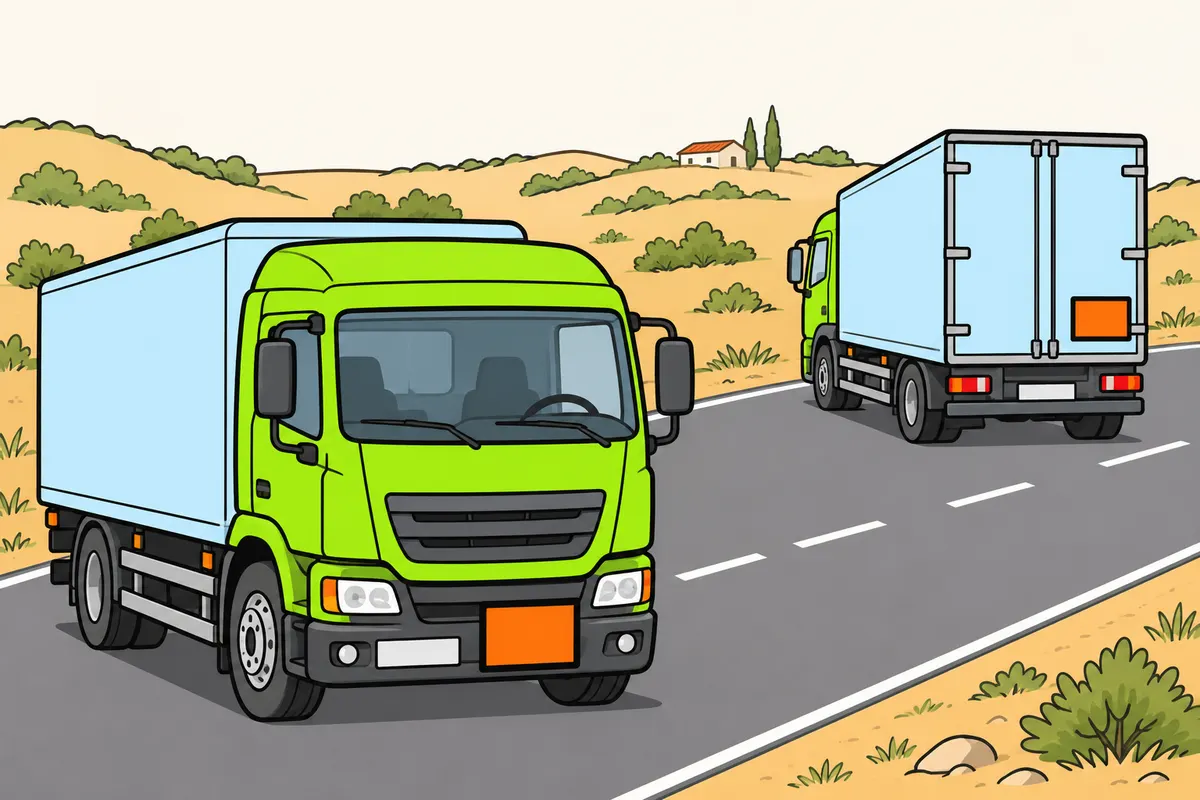
Show the required orange plates clearly and place them for your load.
| Case | Plates |
|---|---|
| Certain transport operations in packages | May use plates without numbers |
| Tanks and certain bulk transport operations | May need numbered side plates |
Remember
- When required, put one plate at the front and one at the rear, upright.
- Do not hide plates with goods, dirt or accessories.
- Use a smaller plate only when vehicle size or construction leaves too little space.
- Check whether your tank or bulk load needs numbered side plates.
Exam trap: Wrong: a plate without numbers is invalid. Right: it can be valid for some transport operations.
Read the full explanation
- When your transport operation requires orange plates, you must display the prescribed plates clearly: one at the front and one at the rear of the transport unit, in a vertical plane. These plates warn other road users and help guide the emergency services. [ADR 2025, 5.3.2.1.1](https://www.boe.es/diario_boe/txt.php?id=BOE-A-2025-77&lang=es).
- The standard orange plate is reflectorised, 40 cm base by 30 cm high, with a black border of 15 mm. ADR allows reduced dimensions when the size and construction of the vehicle leave too little room: the plates may be reduced to at least 30 cm by 12 cm with a 10 mm black border. You must not choose a small plate simply for convenience on a lorry. [ADR 2025, 5.3.2.2.1](https://www.boe.es/diario_boe/txt.php?id=BOE-A-2025-77&lang=es).
- You may find plates without numbers on transport operations that do not require a specific substance to be identified on them, such as certain operations involving packages. A blank plate remains a valid ADR sign where appropriate. [ADR 2025, 5.3.2.1](https://www.boe.es/diario_boe/txt.php?id=BOE-A-2025-77&lang=es).
- On tanks and certain bulk transport operations, numbered plates may be required on the sides, identifying the substance or compartment. If the conditions for carrying a single substance are met, numbered plates at the front and rear may allow you to dispense with the side plates specified in those provisions. Positioning depends on the actual configuration. [ADR 2025, 5.3.2.1.2 to 5.3.2.1.6](https://www.boe.es/diario_boe/txt.php?id=BOE-A-2025-77&lang=es).
9How to read a numbered plate
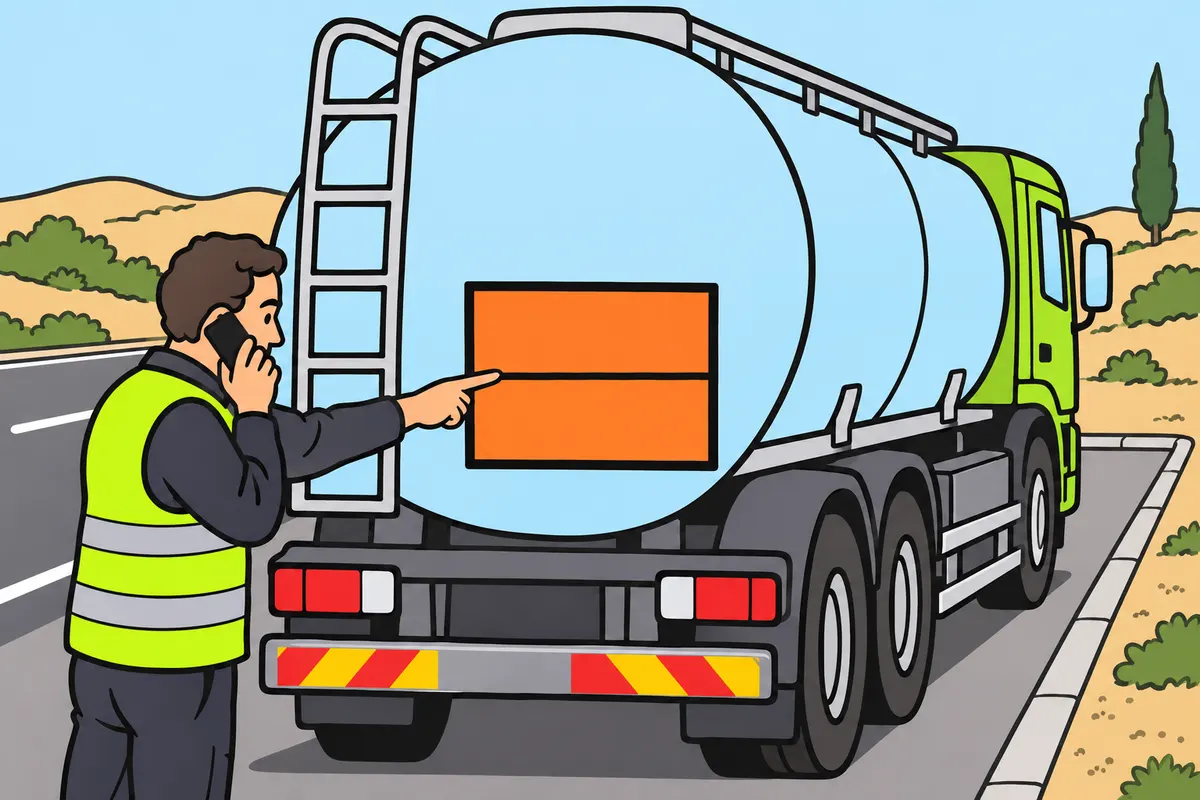
Read the hazard number above and the goods identification below.
| Part | Meaning |
|---|---|
| Top | Hazard identification |
| Bottom | Four-digit UN number |
| Initial X | Dangerous reaction with water |
Remember
- Tell emergency services both lines if you can do so safely.
- A repeated digit intensifies that hazard.
- Do not guess the meaning of every digit combination.
- Say the X too, if there is one.
- With an X, use water only with expert approval.
Exam trap: Wrong: the UN number gives the quantity. Right: it identifies the goods.
Read the full explanation
- On a numbered plate, you must read the hazard identification number at the top and the UN number of the goods at the bottom. The UN number has four digits; it does not indicate the quantity carried or the vehicle’s MMA (maximum authorised mass). You can relay both lines to the emergency services without trying to interpret them from memory. [ADR 2025, 5.3.2.2.3](https://www.boe.es/diario_boe/txt.php?id=BOE-A-2025-77&lang=es).
- For classes 2 to 9, the hazard identification number consists of two or three digits, preceded by an X where appropriate. This information serves a different purpose from the class number on the label. For class 1, the classification code serves the hazard identification function specified for these plates. [ADR 2025, 5.3.2.3.1](https://www.boe.es/diario_boe/txt.php?id=BOE-A-2025-77&lang=es).
- Repeating a digit indicates an intensification of the corresponding hazard; when one digit is sufficient to indicate the hazard, a zero is added. For example, 33 identifies a highly flammable liquid. Some combinations have a special meaning: you must not interpret every sequence of digits by intuitively adding hazards together. [ADR 2025, 5.3.2.3.1 and 5.3.2.3.2](https://www.boe.es/diario_boe/txt.php?id=BOE-A-2025-77&lang=es).
- The letter X before the hazard identification number indicates that the substance reacts dangerously with water. You must use water only with the approval of experts. If you relay the plate information, you must also mention the X: omitting it can conceal a crucial detail for choosing the response and protecting anyone approaching. [ADR 2025, 5.3.2.3.1](https://www.boe.es/diario_boe/txt.php?id=BOE-A-2025-77&lang=es).
10Empty vehicles and dangerous residues
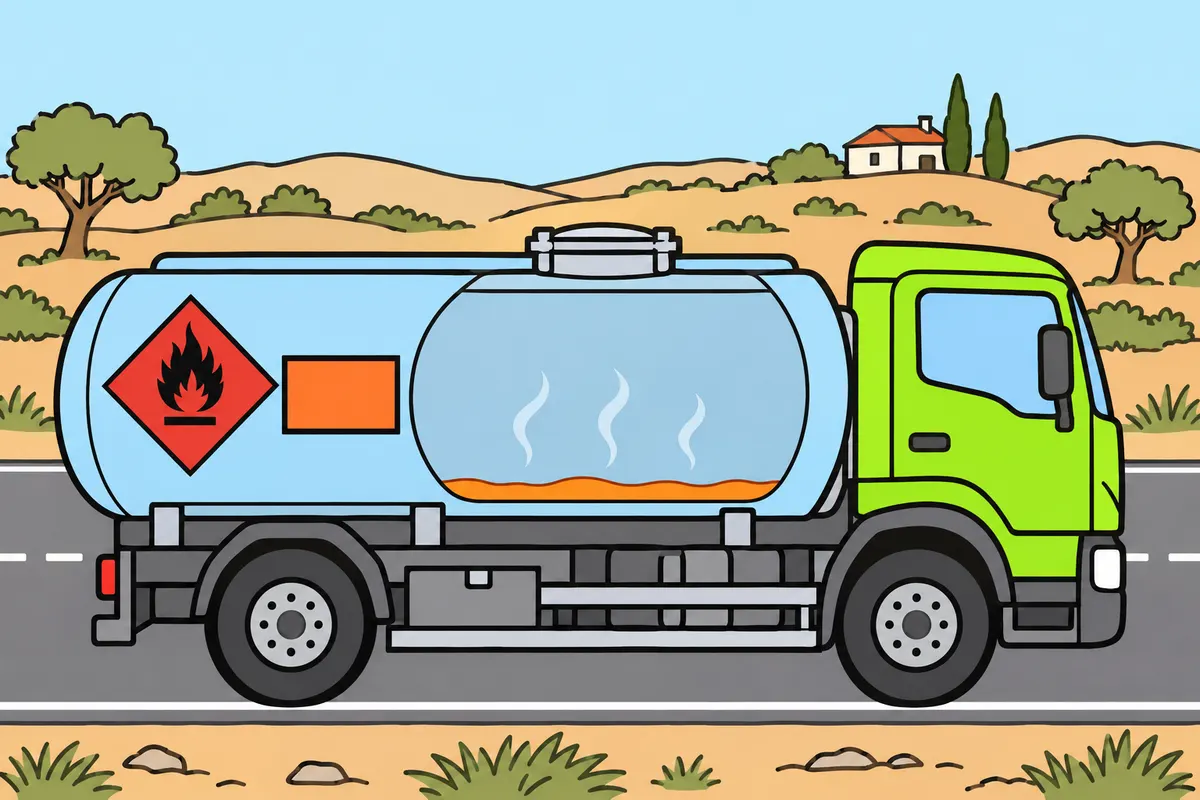
Keep required signs while dangerous residues or vapours remain.
| Situation | What you must remember |
|---|---|
| Empty, uncleaned tank | May retain hazards, document duties and markings |
| Lorry with all packages unloaded | Differs from a tank containing residues |
Remember
- Check whether your empty tank remains uncleaned, not degassed or not decontaminated.
- Carry documents suited to an empty, uncleaned tank journey.
- Remove or fully cover plates that do not match the goods or residues.
Exam trap: Wrong: unloading always lets you remove the plates. Right: first check for dangerous residues.
Read the full explanation
- You must retain the required markings on an empty tank that has not been cleaned, degassed or decontaminated. Requirements also apply to empty, uncleaned bulk vehicles and containers. Delivering the goods does not prove that the danger from residues or vapours has been eliminated. [ADR 2025, 5.3.2.1.7](https://www.boe.es/diario_boe/txt.php?id=BOE-A-2025-77&lang=es).
- After a tank is unloaded, if the prescribed cleaning has not been carried out, the vehicle is treated as though it is carrying the last goods loaded. You must carry documentation adapted to this situation, including the transport document for the empty tank where required. The unloading company must adapt the documents to the state of the transport operation. [RD 97/2014, art. 46](https://www.boe.es/buscar/act.php?id=BOE-A-2014-2110#a46).
- You must remove or cover plates that do not relate to the dangerous goods being carried or their residues. The covering must be complete and meet ADR conditions. [ADR 2025, 5.3.2.1.8](https://www.boe.es/diario_boe/txt.php?id=BOE-A-2025-77&lang=es).
- The term “empty” requires you to check which receptacle has been emptied and whether it remains contaminated. A lorry with a load body from which all packages have been unloaded is not in the same situation as a tank with residues inside. [ADR 2025, 5.3.1 and 5.3.2](https://www.boe.es/diario_boe/txt.php?id=BOE-A-2025-77&lang=es).
11When you need ADR authorisation
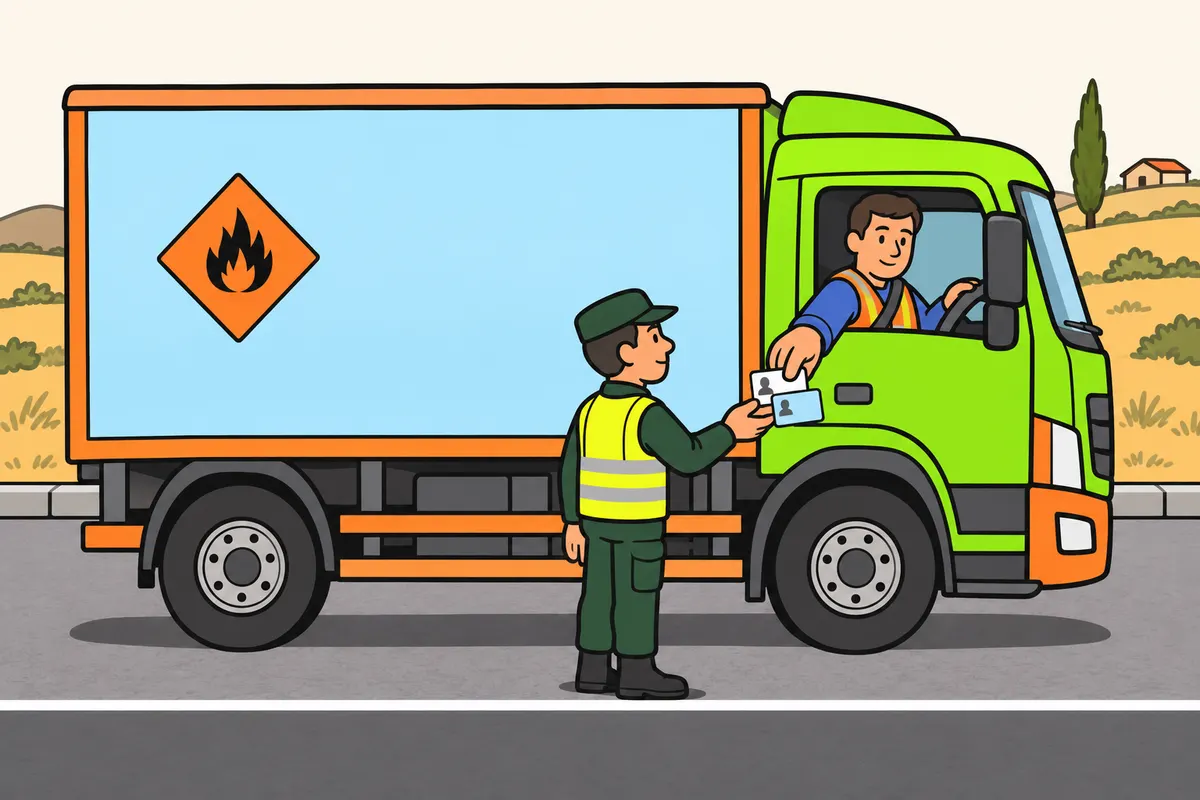
Check whether your operation needs ADR authorisation as well as your driving licence.
Remember
- Check exemptions before deciding if you need ADR authorisation.
- Carry it with the valid licence for your vehicle.
- You need a category B licence held for at least one year.
- Complete an approved basic course and pass the required tests.
- ADR authorisation, vehicle approval and CAP are different.
Exam trap: Wrong: ADR is needed only for heavy vehicles. Right: light vehicles may also require it.
Read the full explanation
- You must obtain the special authorisation when ADR requires it for the operation you intend to carry out. The requirement does not depend solely on exceeding 3,500 kg: it may also apply to the driver of a light vehicle. You must not answer that all dangerous goods always require a certificate without considering the applicable exemptions. [RGCond, art. 25](https://www.boe.es/buscar/act.php?id=BOE-A-2009-9481#a25).
- You must carry the special authorisation together with the valid ordinary driving licence for the vehicle and produce it when the authorities or their officers request it. You need the appropriate licence for your lorry; the ADR card certifies additional specific training and does not itself extend the range of vehicles you can drive. [RGCond, art. 25](https://www.boe.es/buscar/act.php?id=BOE-A-2009-9481#a25).
- To obtain it, you must hold at least a valid category B licence that you have held for a minimum of one year, complete the basic initial course at an authorised centre and pass the relevant tests. You must also meet the other administrative and physical and psychological fitness requirements. The required period of holding a licence refers to category B; you do not have to hold category C for a year. [RGCond, art. 26](https://www.boe.es/buscar/act.php?id=BOE-A-2009-9481#a26).
- The driver’s authorisation and the vehicle’s ADR approval certify different requirements. The former relates to your competence and the scope of your authorisation; the latter certifies vehicle conditions where ADR requires it. You must also distinguish these certificates from the CAP (Certificate of Professional Competence) professional qualification. [RGCond, art. 25; ADR 2025, 9.1.3](https://www.boe.es/buscar/act.php?id=BOE-A-2009-9481#a25).
12Basic authorisation, specialisations and validity
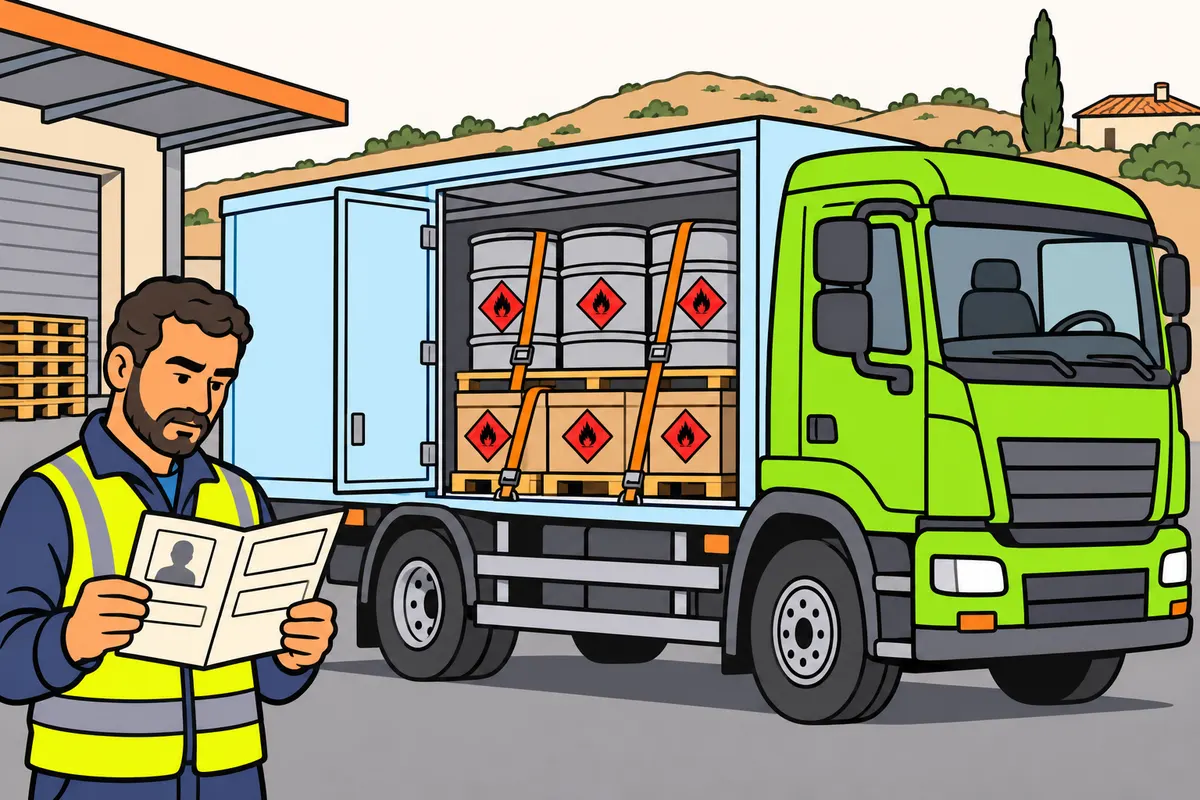
Check what your ADR authorisation covers and when it expires.
| Authorisation | Scope |
|---|---|
| Basic | Authorised non-tank transport, except where specialisation is required |
| Specialisations | Tanks, explosives and radioactive material |
Remember
- The basic course does not cover every type of transport.
- Take extra training and pass tests for extra specialisations.
- If you extend a valid authorisation, its expiry date stays the same.
- Do not use your category C renewal date to work out ADR validity.
- Complete renewal training and tests within twelve months before expiry: renewal starts at expiry.
- Complete them earlier: the new period starts when you pass the tests.
Exam trap: Wrong: renewing early always keeps the same expiry date. Right: it depends on when you pass the tests.
Read the full explanation
- With basic ADR authorisation, you can carry out transport operations within its scope in vehicles other than tank vehicles, except operations requiring specialisation in explosives or radioactive materials. You must check the authorised classes and types of carriage before accepting a job. [DGT, basic ADR authorisation](https://sede.dgt.gob.es/es/permisos-de-conducir/mercancias-peligrosas/autorizacion-basica-adr/).
- To extend your authorisation to the relevant specialisations, you must complete the specific training and pass the required tests. The specialisations are tanks, explosives and radioactive materials, each with a scope corresponding to its training. The specific scope of each specialisation is covered in the separate ADR course. [RGCond, art. 29](https://www.boe.es/buscar/act.php?id=BOE-A-2009-9481#a29).
- The special authorisation is valid for five years and can be renewed for further five-year periods if you meet the training and testing requirements. [RGCond, art. 28](https://www.boe.es/buscar/act.php?id=BOE-A-2009-9481#a28).
- If you complete the course and pass the renewal tests within the twelve months before expiry, the new period starts on the expiry date. If you do so earlier, it starts on the date you pass the tests. An extension of scope during the validity period retains the expiry date of the previous authorisation. [RGCond, arts. 28 and 29](https://www.boe.es/buscar/act.php?id=BOE-A-2009-9481).
13Specific documents on board
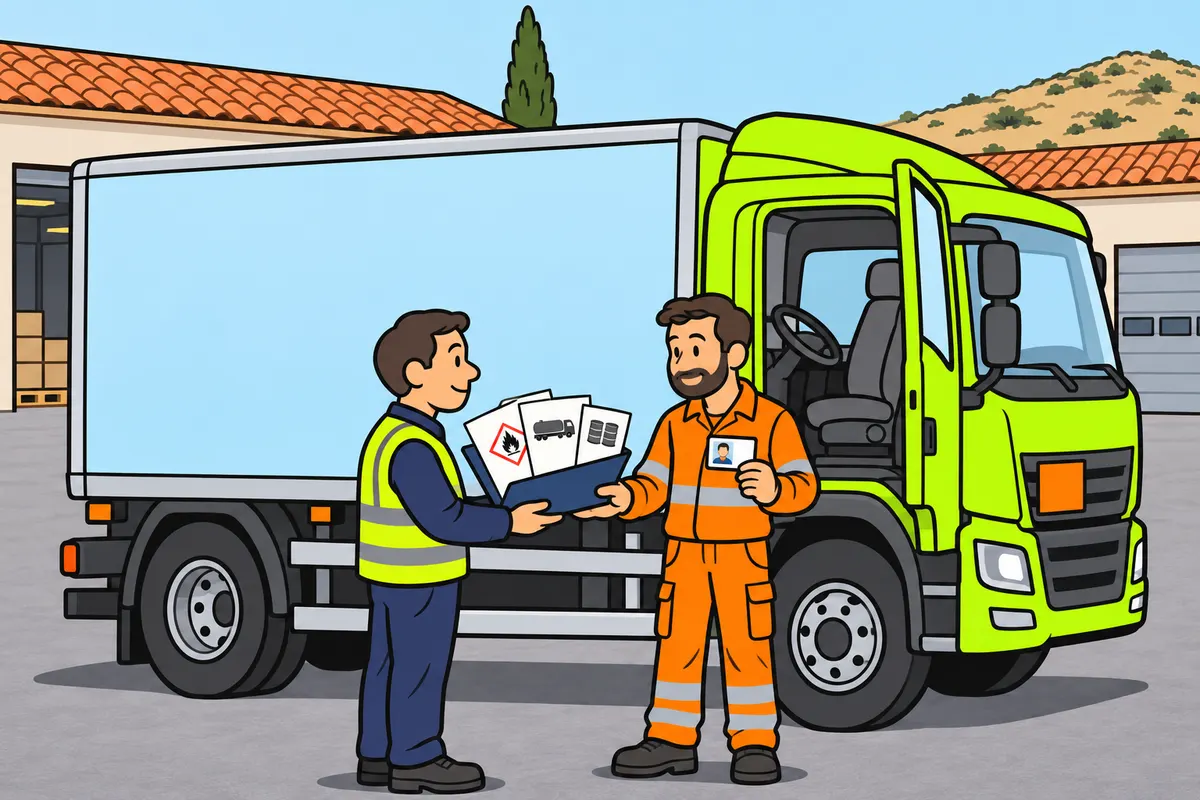
Carry the required documents for your goods, yourself and your vehicle.
| Document | What it proves |
|---|---|
| ADR transport document | Safety information about the goods |
| Contractual consignment note | Evidence of the contract |
| A single document | Can serve both purposes if it includes the required details |
Remember
- Check that the documents cover all your dangerous goods.
- Carry instructions in writing and photo identification when required.
- Carry driver and vehicle certificates when required.
- Get the ADR transport document before the journey starts.
- Ask for an explanation if you do not understand the goods.
Exam trap: Wrong: a sales invoice is enough. Right: carry the required transport documents.
Read the full explanation
- In addition to the usual documentation, you must carry in the cab the transport documents covering all the dangerous goods, the instructions in writing and photographic identification for each crew member, where these requirements apply. [ADR 2025, 8.1.2.1](https://www.boe.es/diario_boe/txt.php?id=BOE-A-2025-77&lang=es).
- Where ADR requires them, you must also carry your driver training certificate, the vehicle approval certificate and copies of competent authority approvals required for certain transport operations. Not every lorry carrying packages needs an ADR vehicle approval certificate: you must check the relevant regulatory requirements. [ADR 2025, 8.1.2.2](https://www.boe.es/diario_boe/txt.php?id=BOE-A-2025-77&lang=es).
- The consignor or, under express delegation, the loader must give you the ADR transport document before you start your journey; RD 97/2014 calls it the carta de porte; it is the ADR transport document, distinct from the contractual consignment note that proves the contract. Its purpose is to record the safety information required by ADR 5.4.1, although a single document can serve both purposes if it includes the required details. You must carry it and ask for clarification about the specific characteristics of the goods. Contractual documentation is covered in «Professional transport documentation», section «Consignment note and proof of the contract». [RD 97/2014, art. 35](https://www.boe.es/buscar/act.php?id=BOE-A-2014-2110#a35). [ADR 2025, 5.4.1](https://www.boe.es/diario_boe/txt.php?id=BOE-A-2025-77&lang=es).
14What the transport document identifies
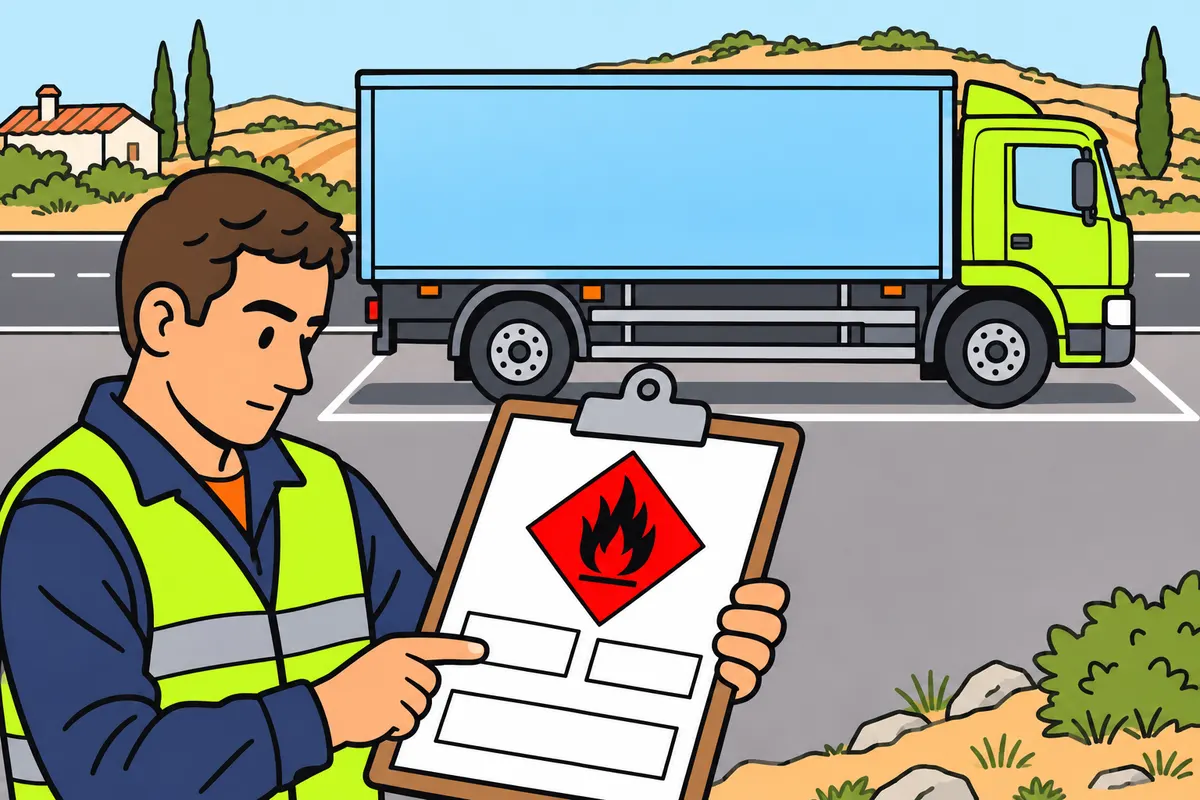
Use the transport document to identify the goods and plan your route.
Remember
- Look for UN and the UN number with the proper shipping name.
- Check class, packing group, quantities and packages where required.
- Check the consignor and consignee details.
- Check the tunnel code where required.
- Keep electronic document information available.
Exam trap: Wrong: the trade name alone is enough. Right: find the official goods identification.
Read the full explanation
- You must locate the UN number preceded by UN and the proper shipping name. The trade name alone may be insufficient. These details allow you to identify what you are carrying without relying on a container remaining visible or on remembering the name the customer used when booking the service. [ADR 2025, 5.4.1.1.1](https://www.boe.es/diario_boe/txt.php?id=BOE-A-2025-77&lang=es).
- The transport document records the class or label details, the packing group where assigned, and the applicable quantity and package details. Packing groups I, II and III, where they exist, indicate degrees of danger within their classification; they do not replace the UN number or the class. [ADR 2025, 2.1.1.3 and 5.4.1.1.1](https://www.boe.es/diario_boe/txt.php?id=BOE-A-2025-77&lang=es).
- The document must include the required details of the consignor and consignee. The tunnel restriction code is entered where applicable, with the exception provided for a known route that does not go through restricted tunnels. You must check this when planning your route, without waiting until you reach the entrance. [ADR 2025, 5.4.1.1.1](https://www.boe.es/diario_boe/txt.php?id=BOE-A-2025-77&lang=es).
- ADR allows electronic documentation with guarantees of availability and evidential value equivalent to those required. You must not assume that the information can be inaccessible during transport. The option of electronic documentation does not remove the specific obligation to have the instructions in writing in the prescribed form. [ADR 2025, 5.4.0 and 5.4.3](https://www.boe.es/diario_boe/txt.php?id=BOE-A-2025-77&lang=es).
15Instructions in writing for the crew
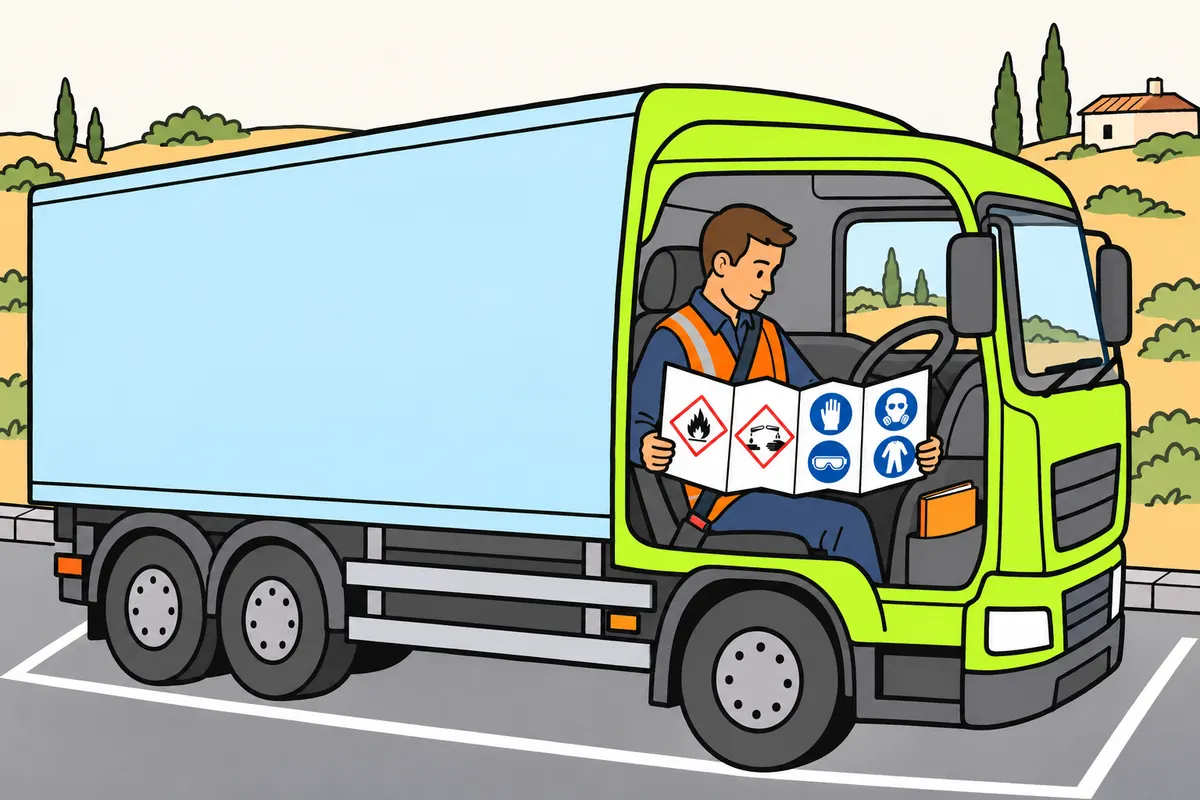
Read the instructions in writing before leaving and keep them within reach.
| Document | Purpose |
|---|---|
| Transport document | Identifies the substances |
| Instructions in writing | Guide initial action |
Remember
- Use the official form in a language you understand.
- Check the hazards and protective equipment for your load.
- Keep the instructions in the cab.
- Know where the transport document is.
- Ask about any goods you do not understand.
Exam trap: Wrong: carrying the instructions is enough. Right: understand them and know how to use them.
Read the full explanation
- You must carry the official model of instructions in writing where required. The carrier must have it on board in a language the crew members understand and ensure that they can apply it. [RD 97/2014, art. 35](https://www.boe.es/buscar/act.php?id=BOE-A-2014-2110#a35).
- The instructions in writing follow a four-page model covering general measures, hazards by label and protective equipment. You must consult them before setting off and relate them to the goods you are carrying. They are not an improvised information sheet for each customer, and knowing the company telephone number is no substitute for them. [ADR 2025, 5.4.3](https://www.boe.es/diario_boe/txt.php?id=BOE-A-2025-77&lang=es).
- You must keep them within reach in the cab and know where the transport documents are. In an emergency, the transport document identifies the substances and the instructions guide your initial actions. Both are useful only if you can find them and make them available without exposing yourself to the affected load. [ADR 2025, 5.4.3 and 8.1.2](https://www.boe.es/diario_boe/txt.php?id=BOE-A-2025-77&lang=es).
- You must know what applies to the labels on your load and ask the consignor, loader or intermediary for any necessary clarification. The company must ensure that you are informed, but you must also familiarise yourself with the specific characteristics of the substance. [RD 97/2014, art. 35](https://www.boe.es/buscar/act.php?id=BOE-A-2014-2110#a35).
16Prohibitions during transport
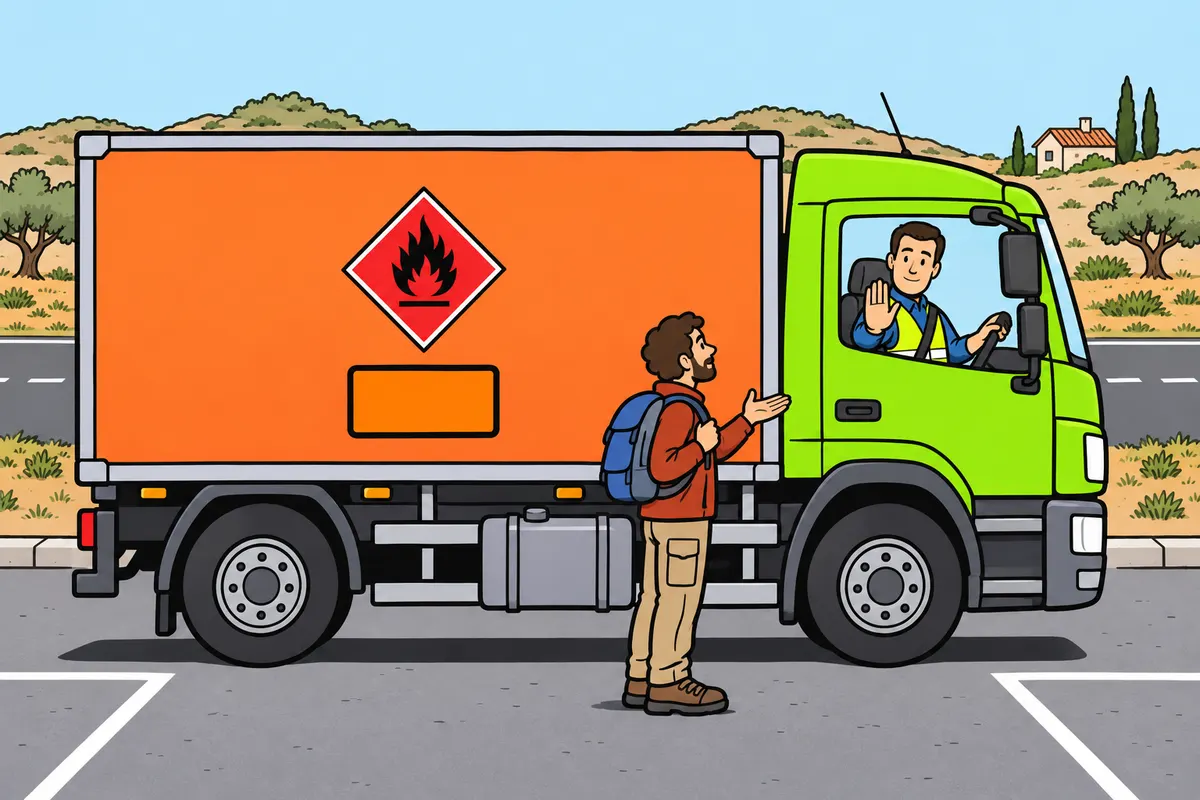
Keep unauthorised passengers, open packages and sparks away during transport.
| If your transport requires supervision | Where you may leave it |
|---|---|
| First choice | Supervised, or in a fully secure depot or factory |
| If unavailable: take security measures | Car park with an attendant told about your load and whereabouts |
| If that car park is also unavailable | Public or private car park where other vehicles cannot damage it |
| Only if neither car park is available | Suitable open space away from major roads and homes, without frequent public presence |
| Loaded MEMU | Supervised, or in a secure depot or factory |
| Empty, uncleaned MEMU | Exempt from this specific supervision duty |
Remember
- Under the general rule, do not carry passengers outside the crew.
- Do not open dangerous goods packages.
- Do not smoke during handling, in or near the vehicle.
- Do not use electronic cigarettes during these operations.
- Use portable lights that cannot make sparks.
- Check whether your goods and quantity require supervision, even under an exemption.
Exam trap: Wrong: an exemption always removes supervision duties. Right: supervision may remain compulsory depending on goods and quantity.
Read the full explanation
- Under the general rules, you must not carry passengers who are not crew members in transport units containing dangerous goods. Crew members perform duties related to the transport operation and must receive training appropriate to their tasks; if you carry personnel other than the driver, the company on whose behalf they act must provide documentary evidence of that training. [ADR 2025, 8.3.1 and 8.2.3](https://www.boe.es/diario_boe/txt.php?id=BOE-A-2025-77&lang=es). [RD 97/2014, art. 6](https://www.boe.es/buscar/act.php?id=BOE-A-2014-2110#a6).
- As a driver or accompanying crew member, you must not open packages containing dangerous goods. If you suspect an irregularity or a leak, you must report it and follow the safety procedure without exposing yourself. [ADR 2025, 8.3.3](https://www.boe.es/diario_boe/txt.php?id=BOE-A-2025-77&lang=es).
- During handling operations, you must not smoke inside or near the vehicles. This prohibition includes electronic cigarettes and similar devices. In an emergency, you must also avoid sources of ignition and must not activate electrical equipment that could create a hazard: the risk is not limited to a cigarette flame. [ADR 2025, 8.3.5 and 5.4.3](https://www.boe.es/diario_boe/txt.php?id=BOE-A-2025-77&lang=es).
- The portable lighting equipment you use must not have metal surfaces capable of producing sparks. You must use equipment appropriate to the transport operation and its conditions of use. [ADR 2025, 8.3.4](https://www.boe.es/diario_boe/txt.php?id=BOE-A-2025-77&lang=es).
- Where the substance and quantity carried trigger the supervision provisions in column (19) of table A —S1(6) or S14 to S24—, you must keep the vehicle supervised or park it unsupervised in a secure depot or factory premises. If these options are unavailable, take appropriate security measures and choose, in this order: a car park supervised by an attendant who is informed of the nature of the load and your whereabouts; failing that, a public or private car park where other vehicles cannot damage it; and, only if neither is available, a suitable open space away from major public roads and residential areas, where the public do not frequently walk or gather. This obligation may still apply under exemption 1.1.3.6. You must keep loaded mobile explosives manufacturing units (MEMU) supervised or parked in a secure depot or factory; empty, uncleaned units are exempt from this specific provision. [ADR 2025, 8.4.1, 8.4.2 and 1.1.3.6.2](https://www.boe.es/diario_boe/txt.php?id=BOE-A-2025-77&lang=es).
17Specific loading and unloading precautions
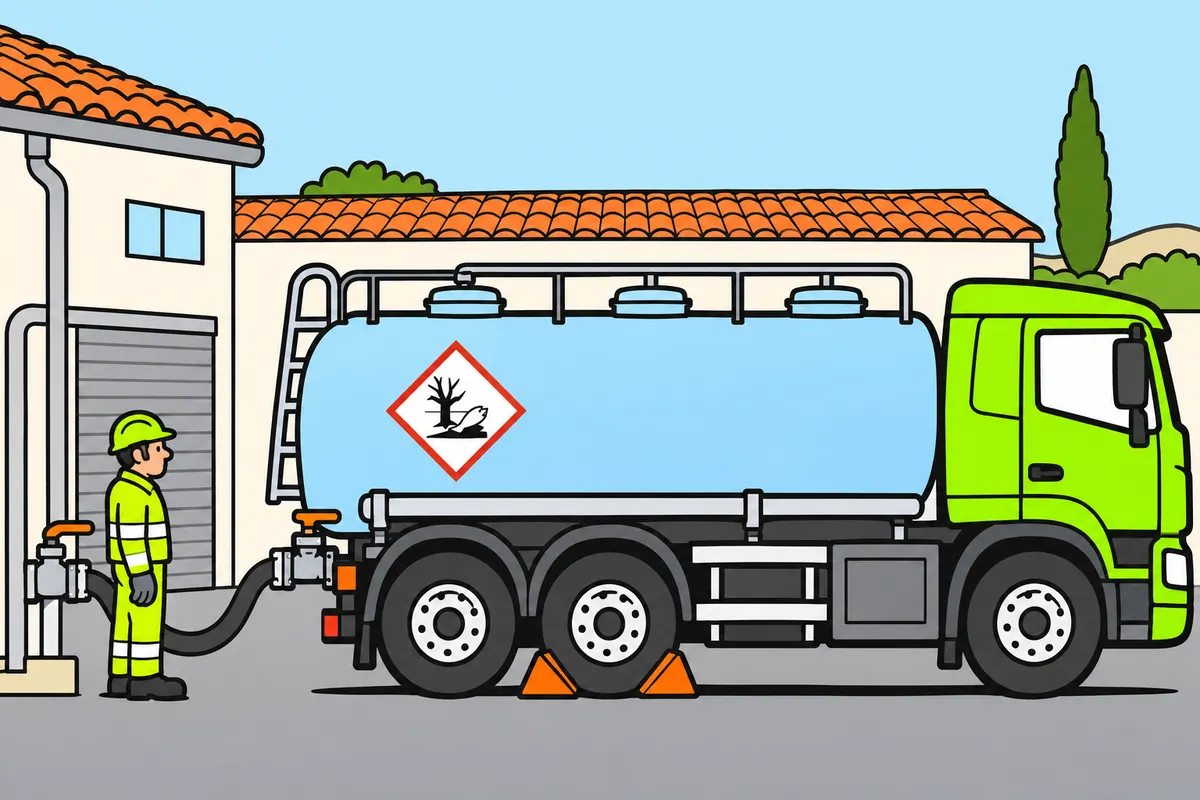
The unit must be immobilised; follow safety steps during loading or unloading.
Remember
- Show required certificates if the loader asks for them.
- Follow loader or unloader staff instructions; they supervise operations and keep outsiders away.
- Stop the engine, except for permitted equipment such as pumps.
- Apply the parking brake when you park the unit.
- Before leaving in a tank vehicle, check filling, emptying and safety equipment.
- Check that the loader or unloader removes outside residue from the operation.
Exam trap: Wrong: you may leave the engine running for convenience. Right: only stated exceptions are allowed.
Read the full explanation
- Before loading, you must present the ADR vehicle approval and your training certificate at the loader’s request where these are required. The loader must check the applicable requirements and cannot start loading if you fail to comply with the regulatory provisions on documentation, equipment or preliminary checks. [RD 97/2014, art. 36](https://www.boe.es/buscar/act.php?id=BOE-A-2014-2110#a36).
- The unit must be immobilised during loading and unloading. Personnel acting under the responsibility of the loader or unloader must continuously supervise operations, keep unauthorised people away and prevent work incompatible with safety in the vicinity. As the driver, you must follow their instructions, including those on personal protection and the site’s emergency systems. [RD 97/2014, art. 37.1](https://www.boe.es/buscar/act.php?id=BOE-A-2014-2110#a37).
- During loading or unloading, you must switch off the engine, subject to the regulatory exceptions relating to the operation of pumps or other mechanisms and to the applicable legislation. You must apply the parking brake when you park the unit and comply with the applicable immobilisation measures. [ADR 2025, 8.3.6 and 8.3.7](https://www.boe.es/diario_boe/txt.php?id=BOE-A-2025-77&lang=es).
- After completing an operation involving tanks, you must check the filling, emptying and safety components before moving off. The loader or unloader must remove any residues adhering to the outside during the operation. The general procedure for stowage and mass distribution is covered in «Load stowage and safety», sections «Blocking and immobilisation» and «Longitudinal distribution and axle loads»; here you must relate it to the risk of leaks and contamination. [RD 97/2014, art. 45](https://www.boe.es/buscar/act.php?id=BOE-A-2014-2110#a45).
18Routes and traffic restrictions
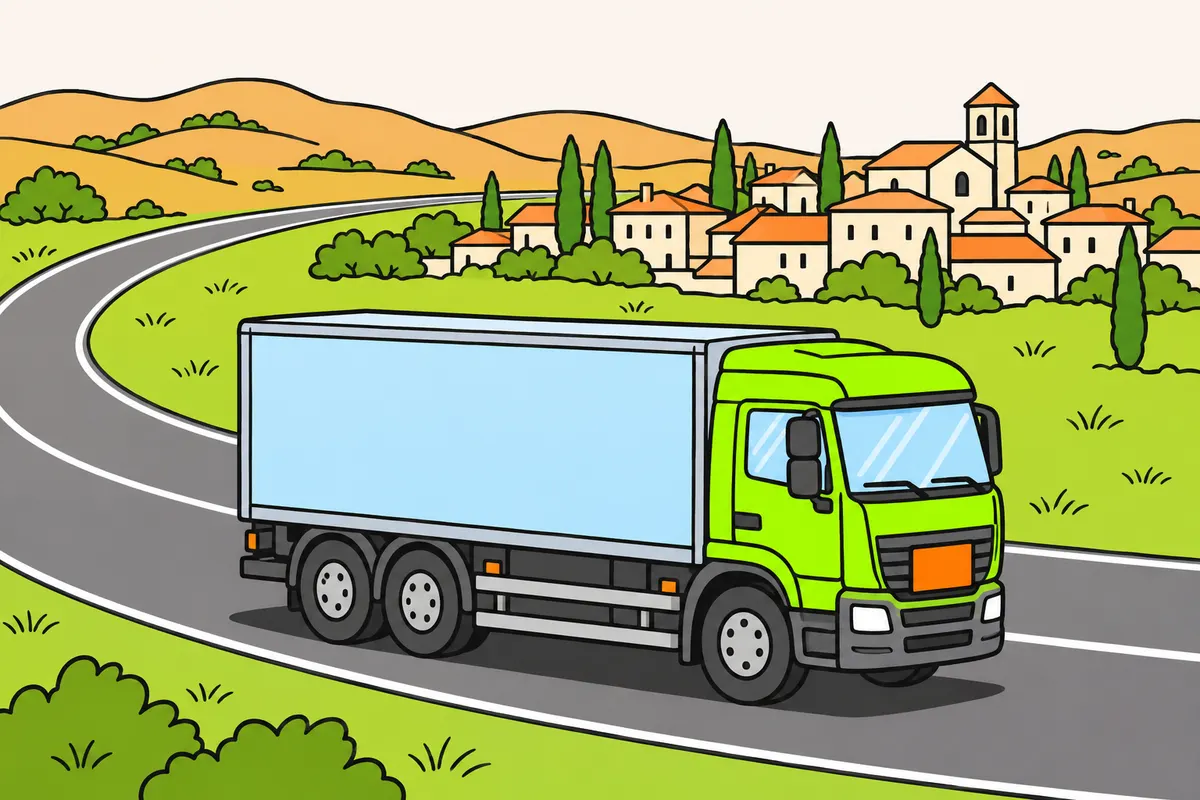
Plan your route and check restrictions that apply to your goods.
Remember
- Use the set routes for dangerous goods.
- Use the RIMP when your journey is subject to that rule.
- Use marked outer bypasses and the outermost one when required.
- For deliveries, limit travel on ordinary roads as the rules require.
- Check dates, times and restricted road sections.
Exam trap: Wrong: ADR authorisation lets you ignore traffic restrictions. Right: you must obey them.
Read the full explanation
- You must use the designated routes for dangerous goods. Where motorway, dual carriageway or other divided-carriageway routes serve the same journey, you must use them under the conditions in article 5. You must use the ring roads, bypasses or outer ring roads signposted for these vehicles, choosing the outermost route where required. [RD 97/2014, art. 5](https://www.boe.es/buscar/act.php?id=BOE-A-2014-2110#a5).
- The RIMP is the Red de Itinerarios para Mercancías Peligrosas (Dangerous Goods Route Network). For journeys subject to the DGT resolution of 2026, other than distribution and delivery journeys, you must use it if your origin and destination are on it; if they are outside it, you must access it via the specified connections to reduce the distance travelled on single-carriageway roads. [DGT Resolution of 14 January 2026, B.2.2](https://www.boe.es/buscar/act.php?id=BOE-A-2026-1255).
- You must also plan deliveries to final recipients using the most suitable route for safety and traffic flow, minimising the distance travelled on conventional roads before delivery and using outer ring roads. Access to the built-up area for loading or unloading must suit the delivery point and comply with the conditions of the applicable regulations. [DGT Resolution of 14 January 2026, B.2.2.a](https://www.boe.es/buscar/act.php?id=BOE-A-2026-1255).
- You must check the restrictions on dates, times and road sections imposed by the competent authority for your route, including regional or local restrictions. Exemptions and special permits have specific conditions. You must not memorise an identical prohibition for every public holiday or assume that your ADR authorisation allows you to ignore a traffic restriction. [RD 97/2014, art. 5](https://www.boe.es/buscar/act.php?id=BOE-A-2014-2110#a5).
19Signs for dangerous goods
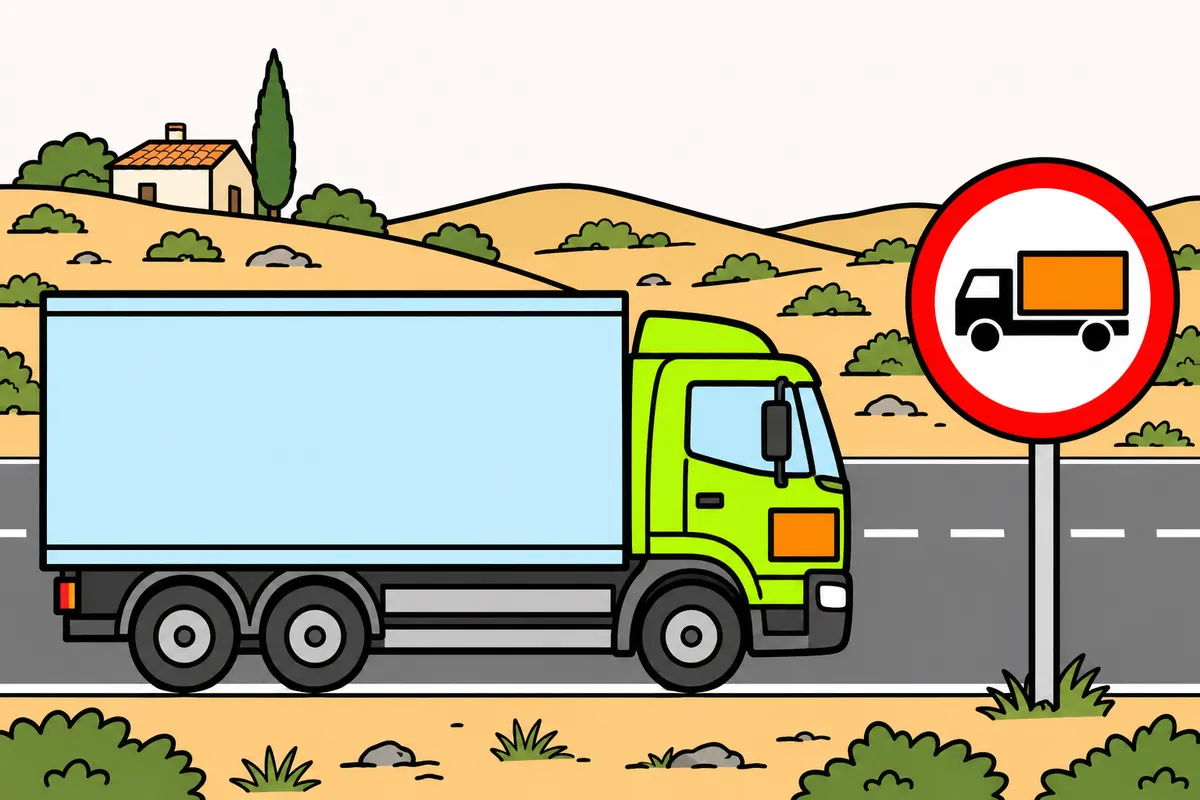
Tell apart signs that ban entry and signs that require a route.
| Sign | Meaning |
|---|---|
| R-108 | Entry ban: dangerous goods whose load requires orange plates |
| R-109 | Entry ban: explosive or highly flammable goods whose load requires orange plates |
| R-110 | Access restriction: water pollutants according to the quantity carried |
| R-414 | Compulsory carriageway: dangerous goods whose load requires orange plates |
| R-415 | Compulsory carriageway: water pollutants in the stated case |
| R-416 | Compulsory carriageway: explosive or flammable goods subject to their special regulations |
Remember
- Check whether a ban applies to your goods and required signs.
- Do not assume the bans apply only to tankers.
- A red border shows a ban; a blue disc shows a required route.
Exam trap: Wrong: these signs apply only to tankers. Right: check your load and each sign’s conditions.
Read the full explanation
- R-108 restricts access for dangerous goods and applies to you when your load requires orange plates. You study its full meaning in «Signs and their hierarchy for lorries». [RD 465/2025, Annex I catalogue](https://www.boe.es/buscar/doc.php?id=BOE-A-2025-12199).
- R-109 restricts access for explosive or highly flammable goods and applies to you when your load requires orange plates. You study its full meaning in «Signs and their hierarchy for lorries». [RD 465/2025, Annex I catalogue](https://www.boe.es/buscar/doc.php?id=BOE-A-2025-12199).
- R-110 restricts access for water-polluting products according to the quantity carried. You study its full meaning in «Signs and their hierarchy for lorries». [RD 465/2025, Annex I catalogue](https://www.boe.es/buscar/doc.php?id=BOE-A-2025-12199).
- R-414 indicates the compulsory carriageway for dangerous goods; you must relate its application to the requirement to mark your load with orange plates. R-415 indicates the compulsory carriageway for water-polluting products in the specified circumstances. R-416 indicates the compulsory carriageway for explosive or flammable goods subject to their special regulations. You study their full meaning in «Signs and their hierarchy for lorries». [RD 465/2025, Annex I catalogue](https://www.boe.es/buscar/doc.php?id=BOE-A-2025-12199).
 R-108
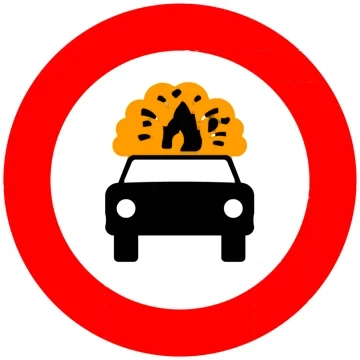 R-109
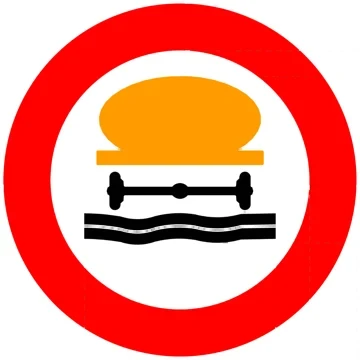 R-110
 R-414
 R-415
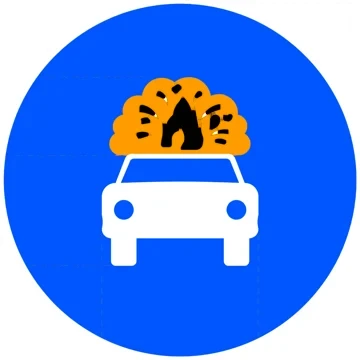 R-416
20Speed limits for lorries carrying dangerous goods
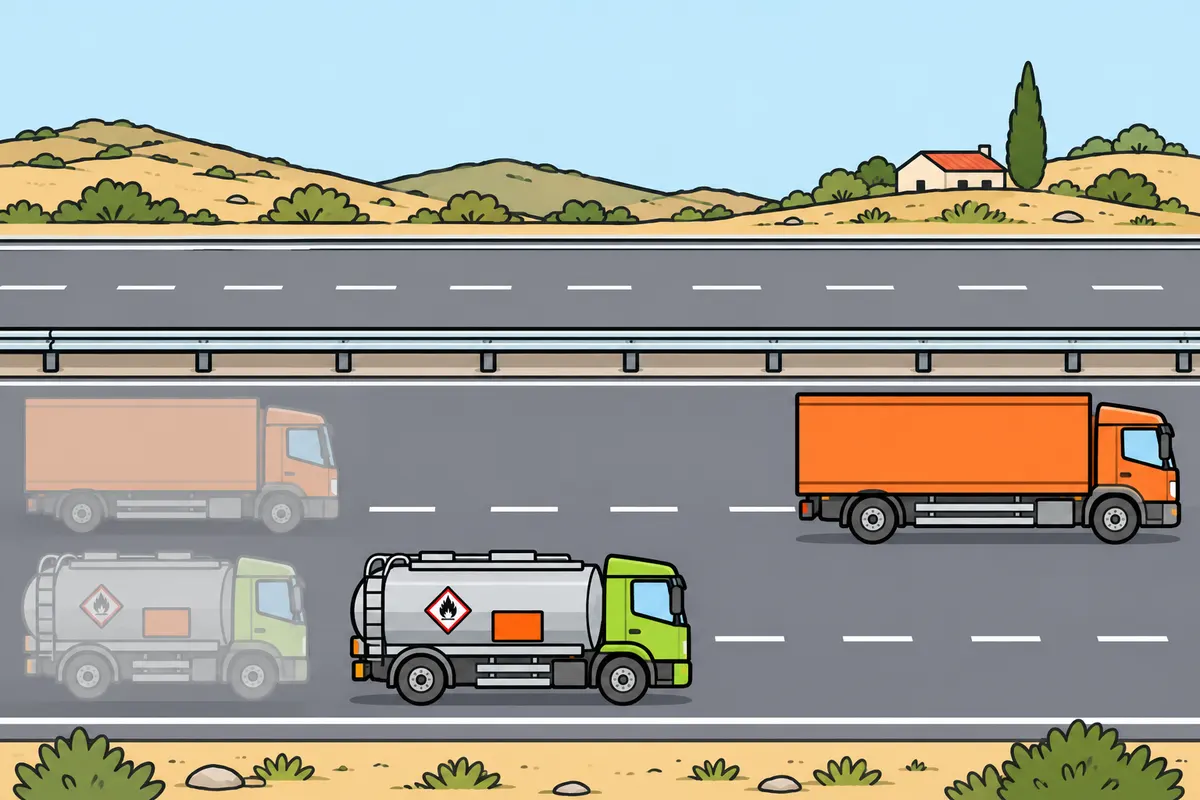
Follow the specific limits for your lorry when carrying dangerous goods.
Remember
- Check the limits in “Speed and safe following distances”.
Exam trap: Wrong: you can ignore special limits with dangerous goods. Right: follow the limits for your lorry.
Read the full explanation
- You must apply the specific limits for lorries carrying dangerous goods, explained in «Speed and safe following distances», in the section «Dangerous goods and other restrictions». [RGC, arts. 48.1.b and 50.4](https://www.boe.es/buscar/act.php?id=BOE-A-2003-23514#a48).
21The five tunnel categories
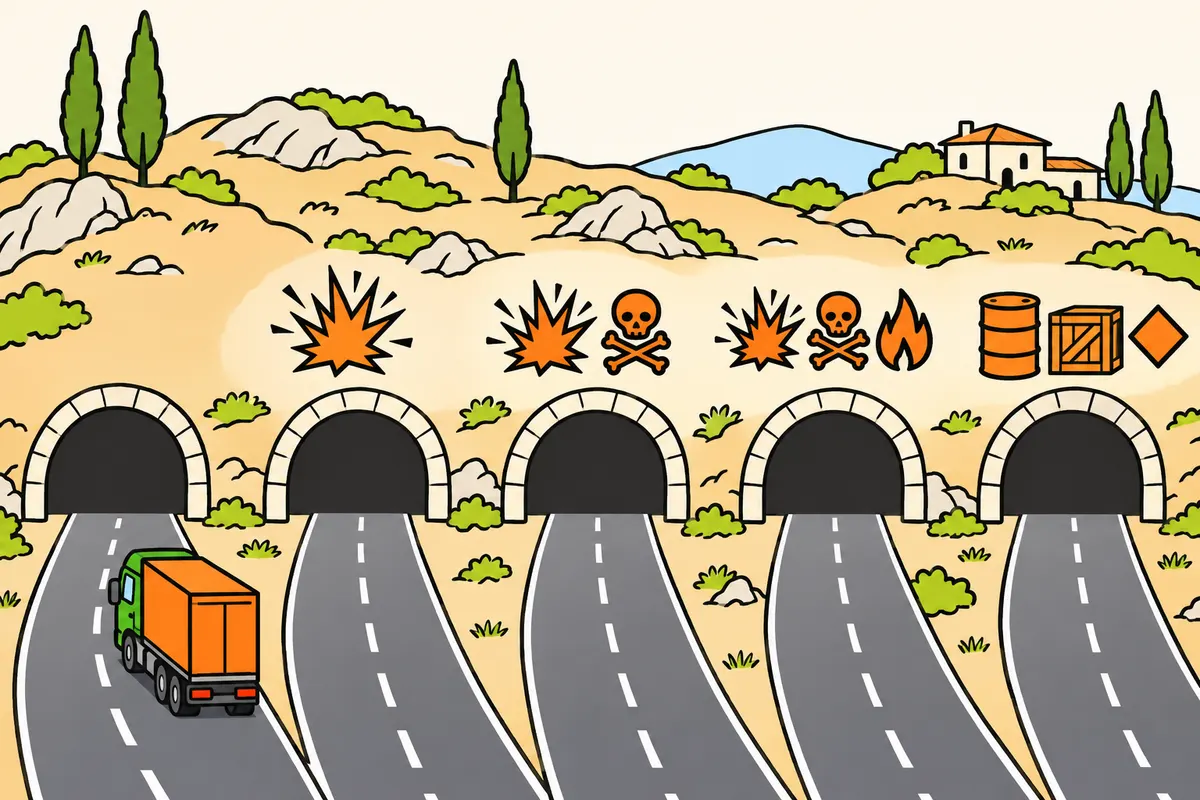
Check the tunnel category; restrictions grow from A to E.
| Category | Restrictions by risk |
|---|---|
| A | No restriction under this classification |
| B | Very large explosion |
| C | Also large explosion or large toxic release |
| D | Also large fire |
| E | Most restrictive, with exceptions |
Remember
- Tunnel categories are not driving licence categories.
- Check the category for the day and time you will pass.
- Remember the stated exceptions for category E.
Exam trap: Wrong: E bans every dangerous good without exception. Right: it has stated exceptions.
Read the full explanation
- Tunnels fall into five ADR categories: A, B, C, D and E. Category A imposes no restrictions under this classification; category B restricts goods capable of causing a very large explosion. [ADR 2025, 1.9.5.2](https://www.boe.es/diario_boe/txt.php?id=BOE-A-2025-77&lang=es).
- Category C adds a large explosion or a large release of toxic substances to the risks covered by B. Category D also includes a large fire. You must understand that restrictions increase in alphabetical order; simply checking whether the goods can explode is not enough. [ADR 2025, 1.9.5.2](https://www.boe.es/diario_boe/txt.php?id=BOE-A-2025-77&lang=es).
- Category E is the most restrictive: it restricts dangerous goods except those marked «(-)», subject to the specific provisions in ADR. It also applies to certain transport operations involving limited quantities. [ADR 2025, 1.9.5.2 and 8.6](https://www.boe.es/diario_boe/txt.php?id=BOE-A-2025-77&lang=es).
- The authority assigns the category taking account of the tunnel's characteristics, the risks and alternative routes; it may set different categories for different times or days. You must check the signs and the category applicable when you plan to use the tunnel. A transport authorisation or a category C licence does not replace this advance check. [ADR 2025, 1.9.5.1 and 1.9.5.3](https://www.boe.es/diario_boe/txt.php?id=BOE-A-2025-77&lang=es).
22Deciding whether you can drive through a tunnel
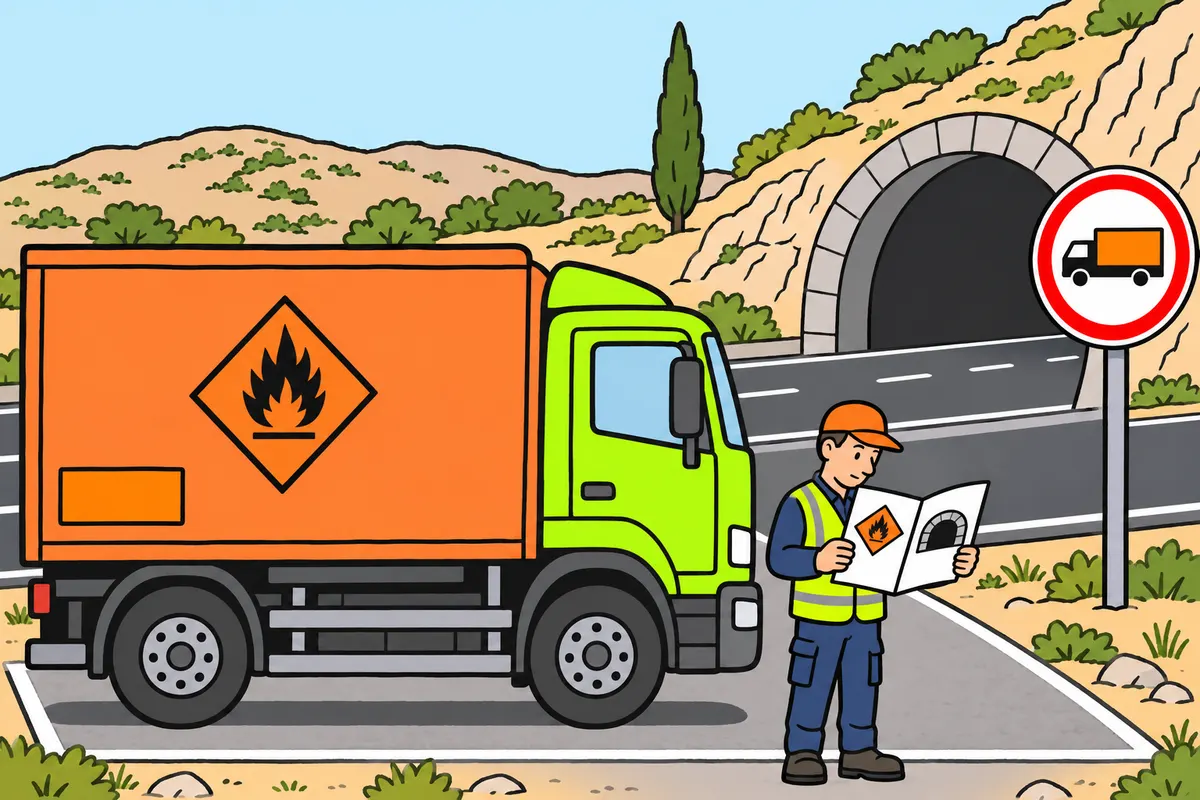
Compare your goods code with the tunnel category before entering.
| Code or case | Tunnels banned |
|---|---|
| B | B, C, D and E |
| C | C, D and E |
| D | D and E |
| E | E |
| D/E in a tank or in bulk | D and E |
| D/E in other transport | E |
Remember
- Check the code and the actual way you carry the goods.
- For different codes, follow the strictest applicable code, excluding exempt goods.
- Check separately whether you must display the limited quantity mark.
- If that mark is required, you cannot use category E tunnels.
- Under exemption 1.1.3, ADR tunnel restrictions apply only if that mark is required.
- Obey closures, signals and other bans too.
Exam trap: Wrong: without orange plates, you can use any tunnel. Right: check exemptions and required limited quantity marking.
Read the full explanation
- You must compare the tunnel category shown on the signs with the restriction code assigned to your goods. The prohibition sign has a supplementary plate bearing the letter B, C, D or E where applicable. Under the ADR system, the absence of this plate identifies category A; you must still obey other closures, traffic lights and prohibitions. [ADR 2025, 8.6.2](https://www.boe.es/diario_boe/txt.php?id=BOE-A-2025-77&lang=es).
- A single code B prohibits travel through tunnels B, C, D and E; C prohibits it through C, D and E; D through D and E; E through E. To decide whether you can use a tunnel, you need two pieces of information: the goods' code and the tunnel category. [ADR 2025, 8.6.4](https://www.boe.es/diario_boe/txt.php?id=BOE-A-2025-77&lang=es).
- Compound codes depend on the mode of carriage. With D/E, carriage in tanks or in bulk is prohibited through D and E; other carriage is prohibited through E. To reach a complete decision, you need the code and the actual mode of carriage. [ADR 2025, 8.6.4](https://www.boe.es/diario_boe/txt.php?id=BOE-A-2025-77&lang=es).
- If you carry goods with different codes, you must apply the most restrictive applicable code to the entire load, excluding goods exempt under 1.1.3, subject to the exception concerning limited quantity marking. If you carry goods under an exemption in 1.1.3, tunnel restrictions do not apply to you unless your transport unit must display the limited quantity mark; you must still obey closures, traffic lights and other prohibitions. A unit required to display this mark under 3.4.13, subject to the conditions in 3.4.14, is restricted from using category E tunnels. [ADR 2025, 8.6.3.2, 8.6.3.3 and 8.6.4](https://www.boe.es/diario_boe/txt.php?id=BOE-A-2025-77&lang=es).
23Equipment to protect you and limit damage
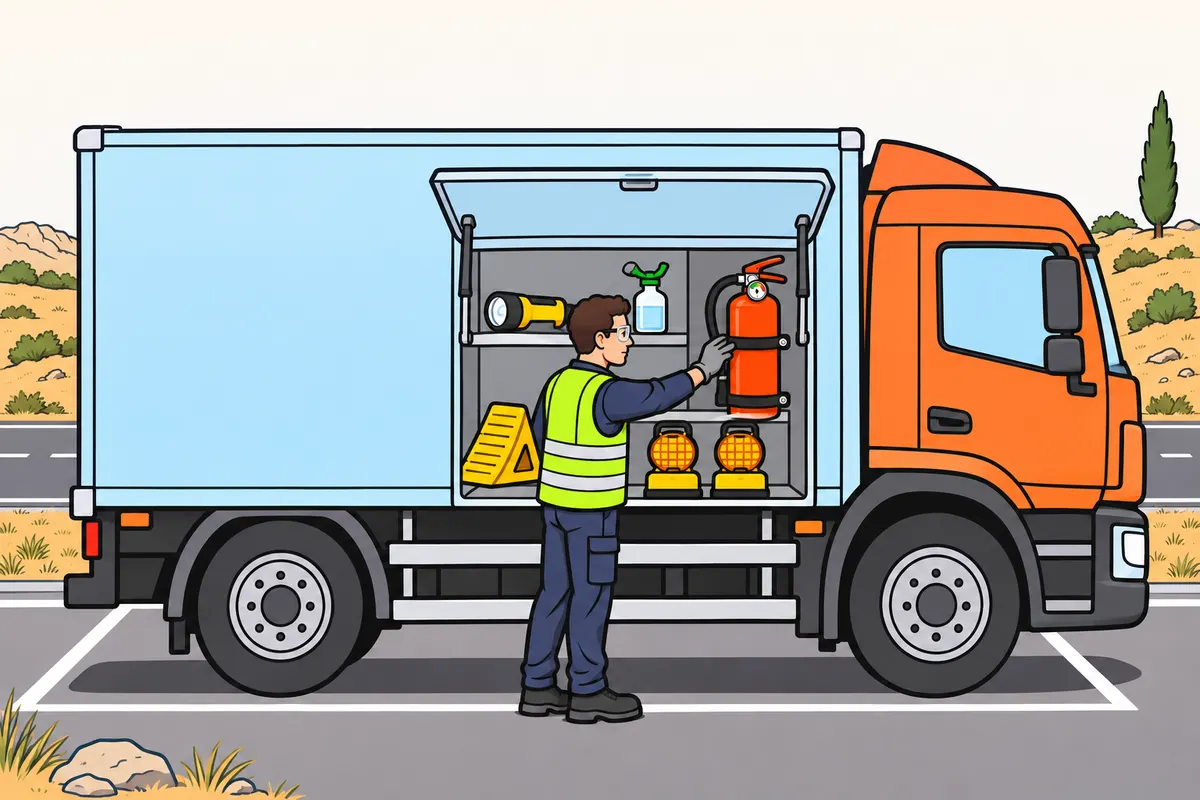
Check you have the required equipment and can reach it.
| Transport unit MMA: general ADR rules | Minimum total: powder or equivalent | Minimum capacities of included extinguishers |
|---|---|---|
| Up to and including 3.5 t | 4 kg | At least 2 kg for engine or cab; another at least 2 kg |
| Over 3.5 t, up to and including 7.5 t | 8 kg | At least 2 kg for engine or cab; another at least 6 kg |
| Over 7.5 t | 12 kg | At least 2 kg for engine or cab; another at least 6 kg |
| Packages under exemption 1.1.3.6 | See “Exemptions: check the specific transport operation” | Apply its specific equipment requirements |
Remember
- Carry a suitable wheel chock for each vehicle and required warning signs.
- Check whether you need eye rinse liquid.
- Each crew member needs a vest, suitable light, gloves and eye protection.
- Check any extra equipment required for your goods.
- Keep extinguishers reachable, protected and in good condition.
- Carry a certified connected V-16; use it when your immobilised lorry creates road danger.
Exam trap: Wrong: ADR warning signs replace the V-16. Right: they have different jobs.
Read the full explanation
- You must carry one suitable wheel chock per vehicle, two self-standing warning signs and eye-rinsing liquid; this liquid is not required for hazard labels 1, 1.4, 1.5, 1.6, 2.1, 2.2 and 2.3. Each crew member must have a fluorescent vest or fluorescent clothing, suitable portable lighting, gloves and eye protection. You must check that the required equipment is present and accessible. [ADR 2025, 8.1.5.2](https://www.boe.es/diario_boe/txt.php?id=BOE-A-2025-77&lang=es).
- Certain labels also require equipment such as an emergency escape mask, a shovel, a drain seal and a collecting container, subject to the exceptions specified in ADR. Its purpose is to enable the prescribed measures, not to authorise action for which you are unprepared. [ADR 2025, 8.1.5](https://www.boe.es/diario_boe/txt.php?id=BOE-A-2025-77&lang=es).
- Under the general rules, you must carry at least two portable fire extinguishers suitable for class A, B and C fires. The minimum capacity, in kg of powder or equivalent, depends on the maximum permissible mass of the transport unit: | Maximum permissible mass | Minimum total capacity | Minimum extinguishers within that total | | --- | --- | --- | | Up to and including 3.5 t | 4 kg | One of at least 2 kg for the engine or cab and another of at least 2 kg | | Over 3.5 t and up to and including 7.5 t | 8 kg | One of at least 2 kg for the engine or cab and another of at least 6 kg | | Over 7.5 t | 12 kg | One of at least 2 kg for the engine or cab and another of at least 6 kg | The extinguisher for the engine or cab is included in the stated total. For exemption 1.1.3.6, apply the equipment requirements explained in «Exemptions: check the specific transport operation». You must know how to use them and check their seals, inspections, condition, accessibility and protection from the weather. [ADR 2025, 8.1.4.1 to 8.1.4.5 and 8.3.2](https://www.boe.es/diario_boe/txt.php?id=BOE-A-2025-77&lang=es).
- You must carry a certified connected V-16 in your lorry and use it to warn other road users when your vehicle is immobilised on the road and creates a hazard. The two self-standing signs in the ADR equipment serve an additional specific purpose. [RGC, art. 130.4; RGV, Annexes XI and XII](https://www.boe.es/buscar/act.php?id=BOE-A-2003-23514#a130).
24Initial action in a leak or accident
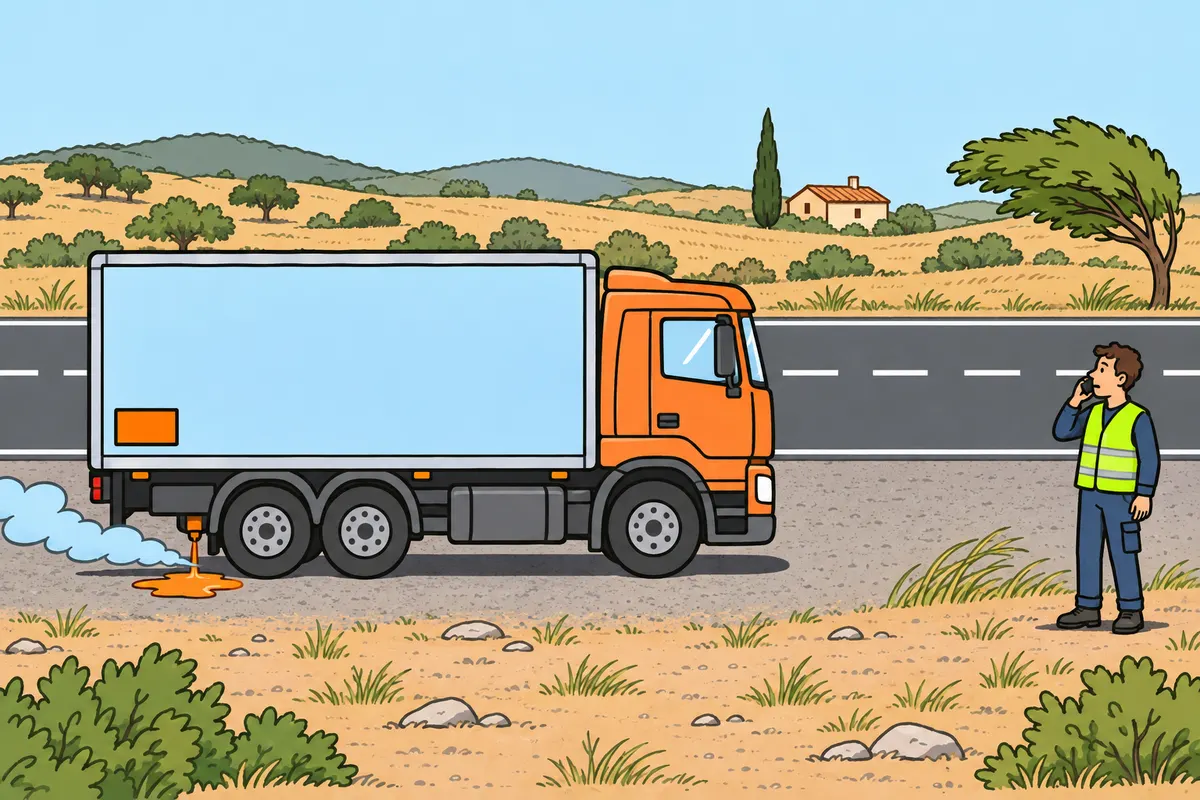
If you cannot continue, immediately follow instructions in writing, then urgently call emergency services.
Remember
- Then urgently call 112: give location, vehicle condition, incident and goods carried.
- Also report injuries, weather and other useful details.
- If safe, brake, stop engine and disconnect the battery using its switch, if fitted.
- Wear your vest; avoid ignition sources, spills and gases.
- Stay on the side the wind blows from.
- Protect drains only if safe; do not improvise repairs or neutralisation.
Exam trap: Wrong: go closer to recover belongings. Right: avoid exposure to a dangerous leak.
Read the full explanation
- If a breakdown or accident prevents you from continuing, you must immediately follow the instructions in writing and then urgently notify 112. Provide these six details: - Location. - Vehicle condition and details of the incident. - Dangerous goods carried. - Whether there are any casualties. - Weather conditions. - Other circumstances relevant to assessing the effects and the response. Where possible, also inform the carrier and the consignor. [RD 97/2014, art. 20.1-2; Basic Guideline of 2026, notification of accidents and incidents](https://www.boe.es/buscar/act.php?id=BOE-A-2014-2110#a20).
- When safe and practicable, you must apply the brake, switch off the engine and disconnect the battery using its isolator switch, if fitted. You must avoid sources of ignition and put on your high-visibility vest. Every action depends on safety: you must not approach a dangerous leak to reach a control or retrieve an object. [ADR 2025, 5.4.3.4](https://www.boe.es/diario_boe/txt.php?id=BOE-A-2025-77&lang=es).
- You must not step in or touch spilled substances, or breathe in gases, smoke, dust or vapours. You must move away and stay upwind so that the cloud does not reach you. Warn other people to move away and follow the emergency services' instructions. [ADR 2025, 5.4.3.4](https://www.boe.es/diario_boe/txt.php?id=BOE-A-2025-77&lang=es).
- You may use the equipment on board to prevent the spillage from reaching drains or the aquatic environment only when it is safe. You must avoid improvising neutralisation, transfers of substances or repairs. Protecting drains does not justify exposing yourself to an unknown substance or entering a contaminated area. [ADR 2025, 5.4.3.4](https://www.boe.es/diario_boe/txt.php?id=BOE-A-2025-77&lang=es).
25Fire and notifying the emergency services
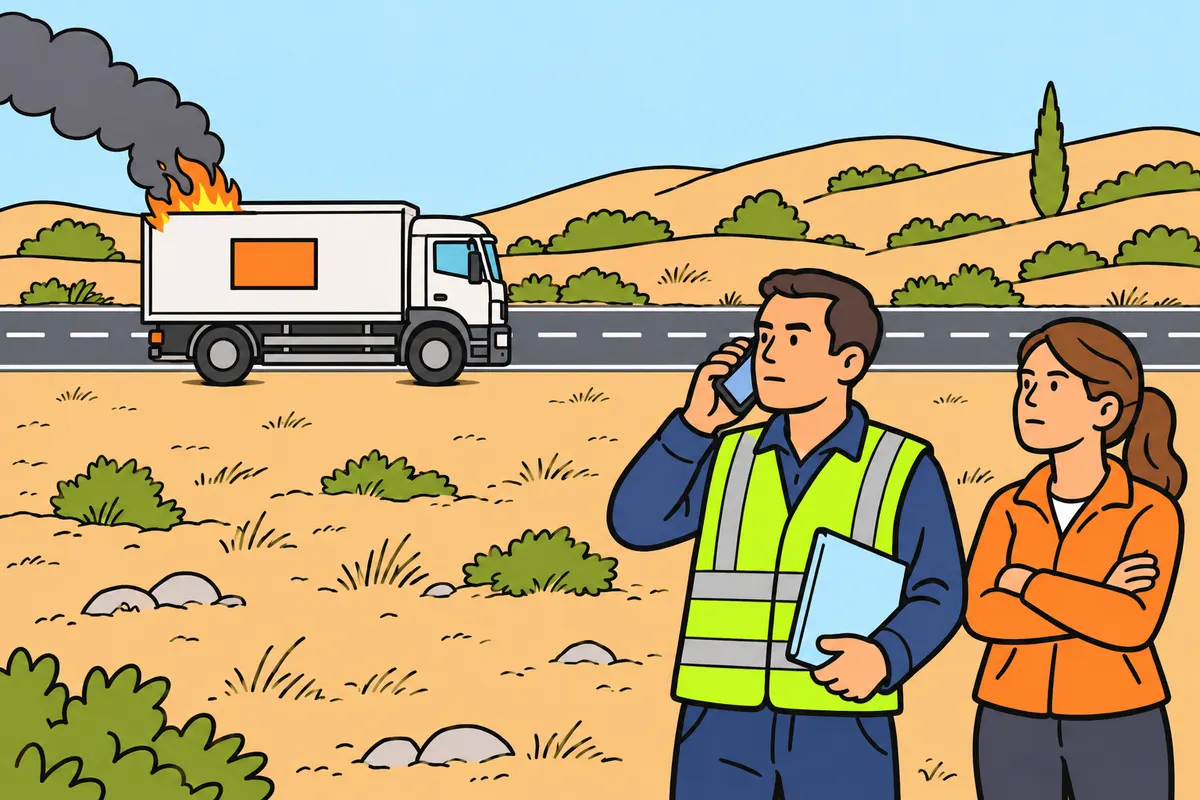
Move people away and call for help; do not fight a cargo fire.
| Fire location | What you may do |
|---|---|
| Small or starting fire in tyres, brakes or engine | Use extinguisher if safe |
| Cargo compartment | Do not tackle the fire |
Remember
- Use an extinguisher only on a small tyre, brake or engine fire, if safe.
- Give the UN number and hazard if available without approaching danger.
- Do not go closer to the plate to complete your call.
- Give documents to emergency services only if you can get them safely.
- In a tunnel, follow its instructions and marked evacuation route when needed.
- Do not reverse or turn around in a tunnel on your own.
Exam trap: Wrong: carrying extinguishers means you must fight a burning load. Right: leave that to specialists.
Read the full explanation
- If you can do so safely, you may use the fire extinguisher on a small or developing fire involving tyres, brakes or the engine compartment. You must not fight fires in load compartments. In a lorry carrying dangerous goods, your priority is to move people away and allow specialist responders to intervene. [ADR 2025, 5.4.3.4](https://www.boe.es/diario_boe/txt.php?id=BOE-A-2025-77&lang=es).
- When reporting details of the goods, you may provide the UN number and the hazard identification number if you can access them safely. You must not approach the plate to complete your report. [ADR 2025, 5.4.3.4](https://www.boe.es/diario_boe/txt.php?id=BOE-A-2025-77&lang=es).
- You must keep the transport document and transport details available for the emergency services, provided you do not put yourself at risk when retrieving them. The information you provide allows them to assess both the people affected and the risk to property, water, sewers and the surrounding environment. [RD 97/2014, art. 20](https://www.boe.es/buscar/act.php?id=BOE-A-2014-2110#a20).
- If the incident occurs in a tunnel, you must also follow its emergency procedure: raise the alarm using the available means, obey its instructions and use the signposted evacuation route when appropriate. You must not start reversing or make a U-turn on your own initiative to escape with the lorry. You can find the general procedure in «Accidents, breakdowns and first aid», in the section «Breakdown, fire and traffic queues in tunnels». [RGC, arts. 95 and 97](https://www.boe.es/buscar/act.php?id=BOE-A-2003-23514).
Check the transport operation before setting off
Check the goods, driver, vehicle and route together.
- Identify the substances and mode of transport in the documentation; check which exemptions actually apply.
- Check the scope and validity of your ADR authorisation when required, and the relevant vehicle documentation.
- Check packages, signs and markings, documents, instructions you can understand and accessible equipment.
- Plan the permitted route, traffic restrictions and tunnels; do not set off if any required condition is unmet.
Check whether you can drive through a tunnel
You need the load’s restriction code and the tunnel category.
- Find the restriction code for each type of goods and its mode of transport.
- Determine the restriction applicable to the whole load and check the relevant exemptions.
- Read the tunnel category and the signposted time restrictions.
- Compare both details; if entry is prohibited, use the authorised alternative route and obey traffic instructions.
Respond to an emergency involving the load
Follow the instructions in writing only when you can do so safely.
- Stop and secure the transport unit without increasing the danger; carry out shutdown and warning measures when safe.
- Avoid sources of ignition and contact with the product; move away from the spill and the cloud.
- Call 112 and report the location, goods, vehicle condition, casualties and relevant circumstances.
- Provide the documents without exposing yourself to danger; warn others and follow the emergency response instructions.
- Then notify the carrier and consignor of the incident when possible; do not fight a fire in the load compartment.
Finished this module?
Mark it as read and you will see your progress on the theory list.