
Theory · C Licence - Truck · Module 13 of 18
Safe lorry driving
You learn to observe from a high cab, monitor blind spots and anticipate the space your lorry sweeps through when turning and reversing. You practise choosing safety margins, using engine braking and retarders on descents, and responding to wind, poor visibility and immobilisation, distinguishing legal duties from technical recommendations for the exam.
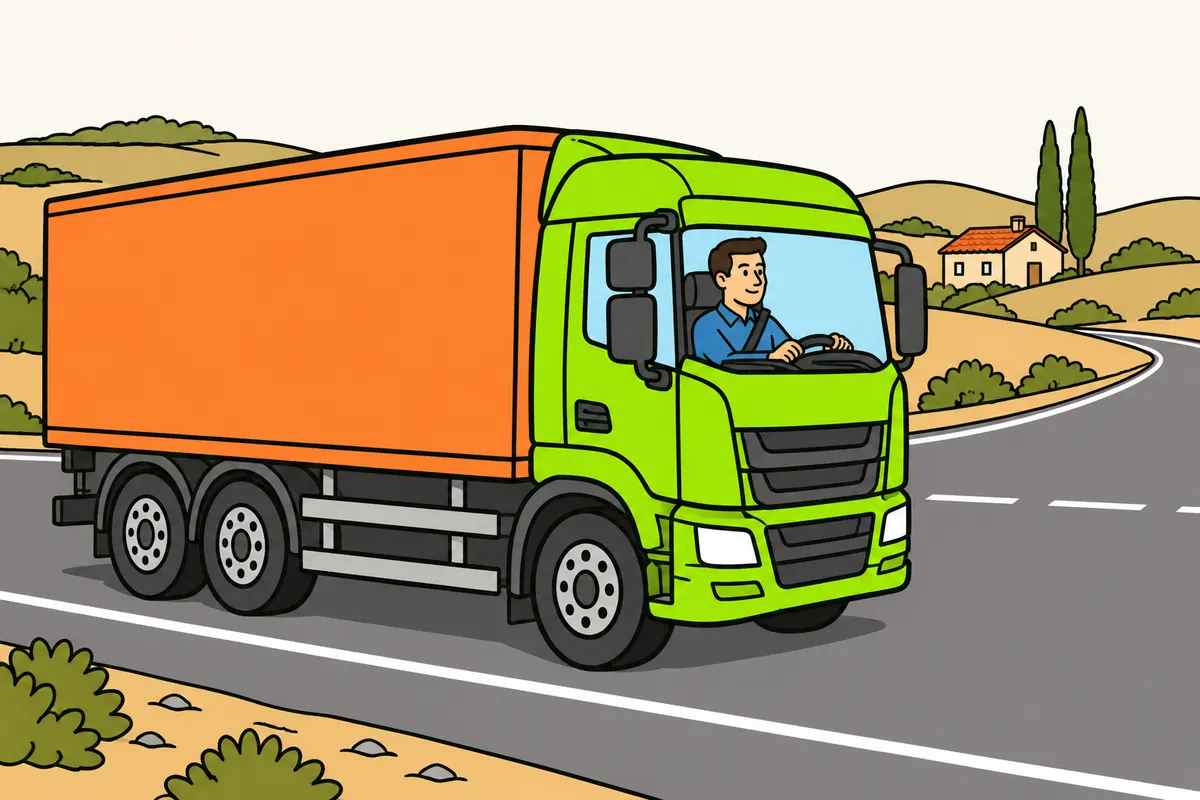
1Anticipate to maintain a safety margin
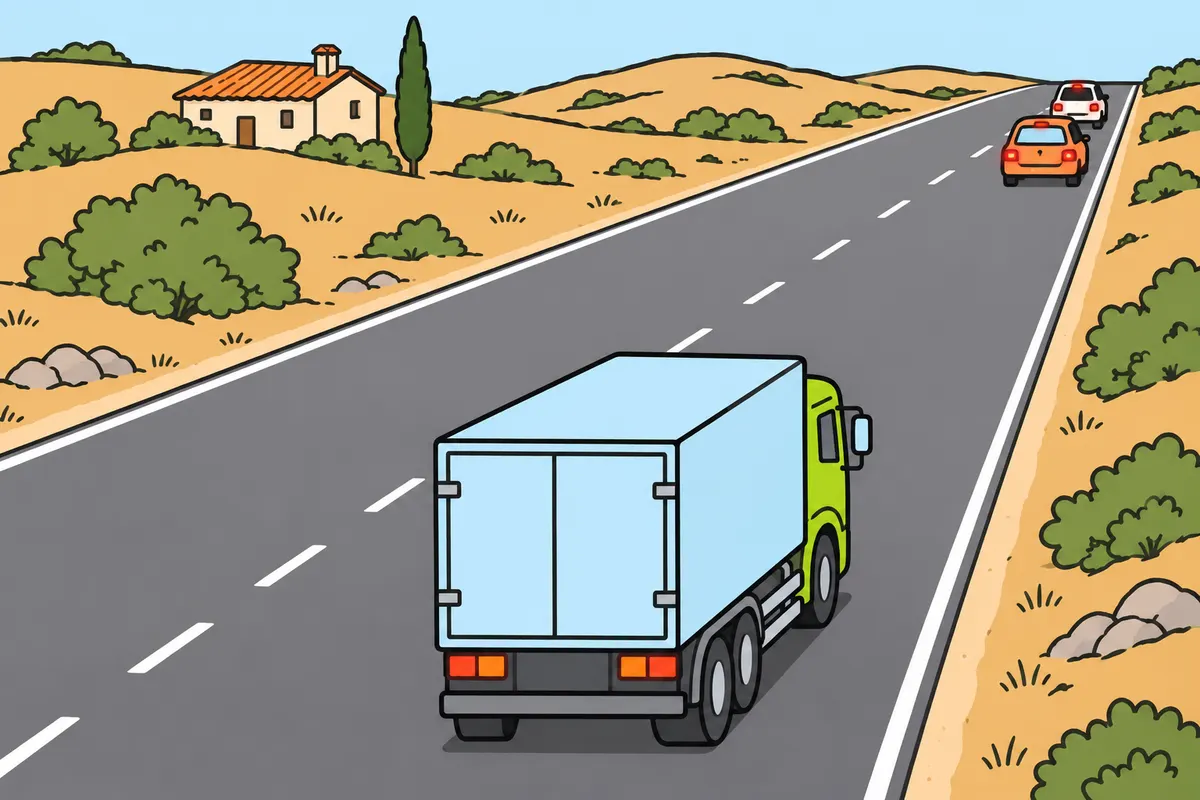
Look ahead and leave space to respond to danger.
Remember
- Check far ahead, nearby, both sides and your mirrors.
- Plan your entrance, turns and exit at your destination.
- Check that your lorry fits along the whole route.
- Adjust your speed to what you can see and handle.
Exam trap: Wrong: knowing the road removes danger. Right: always adapt your driving.
Read the full explanation
- Drive with awareness, anticipation and space: identify what is happening, anticipate how it develops and leave yourself room to respond. In a lorry, its length, cab height and response to the controls make it especially important to prepare your decisions in good time; knowing a road does not remove its risks.
- Shift your gaze between the distance, the area close to you, the sides and the mirrors with brief checks. Look for traffic queues, junctions, hidden pedestrians and vehicles that disappear from your mirrors.
- Plan your access all the way to your destination, including the yard, loading bay and exit. Check whether your dimensions allow you to enter, turn and leave without getting trapped; a route suitable for a car may require manoeuvres that your lorry cannot carry out.
- Keep control of your vehicle and adapt your driving to what you can actually see and deal with. Driving below the maximum limit does not guarantee a safe speed: a wet bend, a hidden junction or a nearby pedestrian may require you to slow down much more or stop. [RGC, arts. 17 and 45](https://www.boe.es/buscar/act.php?id=BOE-A-2003-23514#a17).
2Prepare your driving position and view
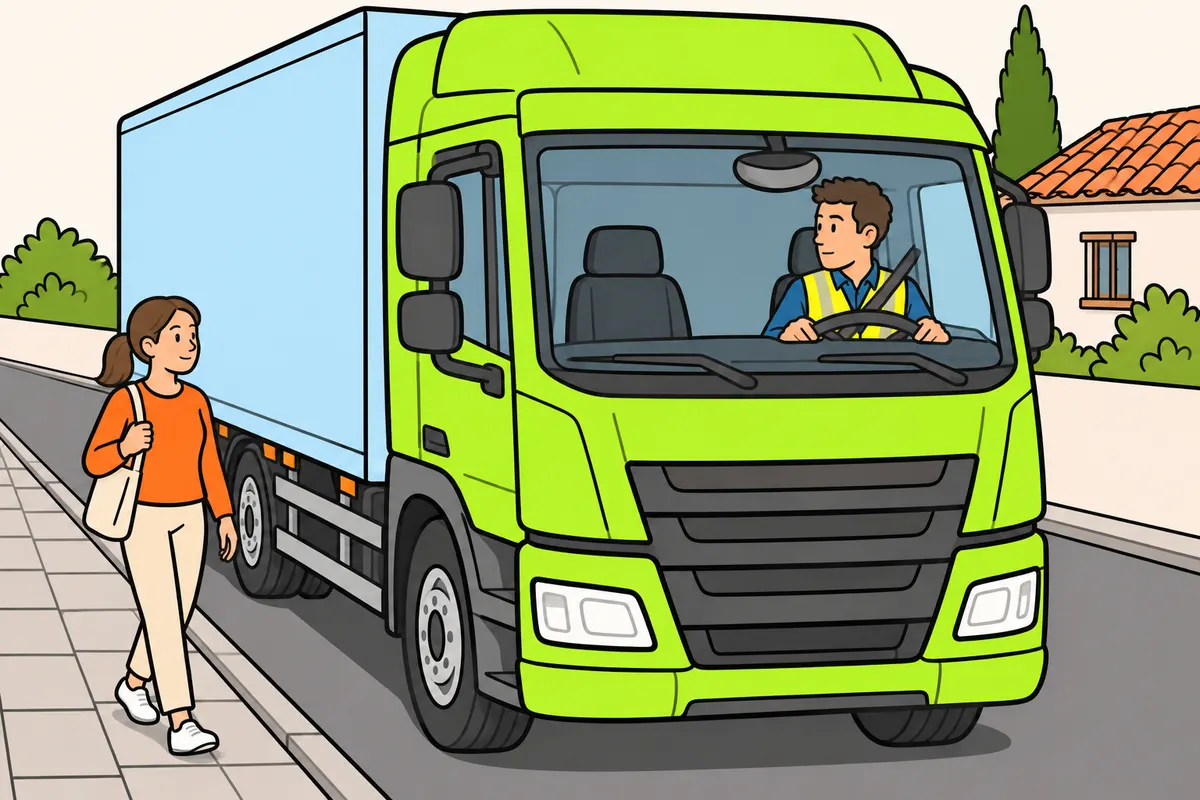
Adjust your driving position and check your view before moving off.
Remember
- Adjust your seat before your mirrors.
- Check your mirrors again if you move your seat.
- Keep windows, mirrors and cameras clean.
- Check wipers and washers before driving in rain.
- Look in front of the cab and along the right side.
- After waiting, check again before moving off.
Exam trap: Wrong: checking on arrival is enough. Right: check your surroundings again before leaving.
Read the full explanation
- Adjust your seat, steering wheel and supports so that you can operate the pedals without stretching or crouching excessively. Then adjust your mirrors from your normal driving position: if you change the seat position, check the fields of vision again.
- Check that your windscreen, windows, mirrors and cameras are clean and give you a clear view. Remove obstructions that hide the area in front or to the sides; a small object close to your eyes can hide a person some distance away. Misting and reflections also reduce useful visual information.
- Check your wiper blades and windscreen washers before a journey in rain. If the wipers do not clear the screen evenly, check for dirt, correct adjustment and the condition of the rubber blades; replace damaged blades.
- Before moving off, check your immediate surroundings, especially in front of the cab and along the right-hand side. Someone may approach while you are stationary. Check again after waiting and before moving off: a check made on arrival does not necessarily show your surroundings when you leave.
3What each class of mirror shows
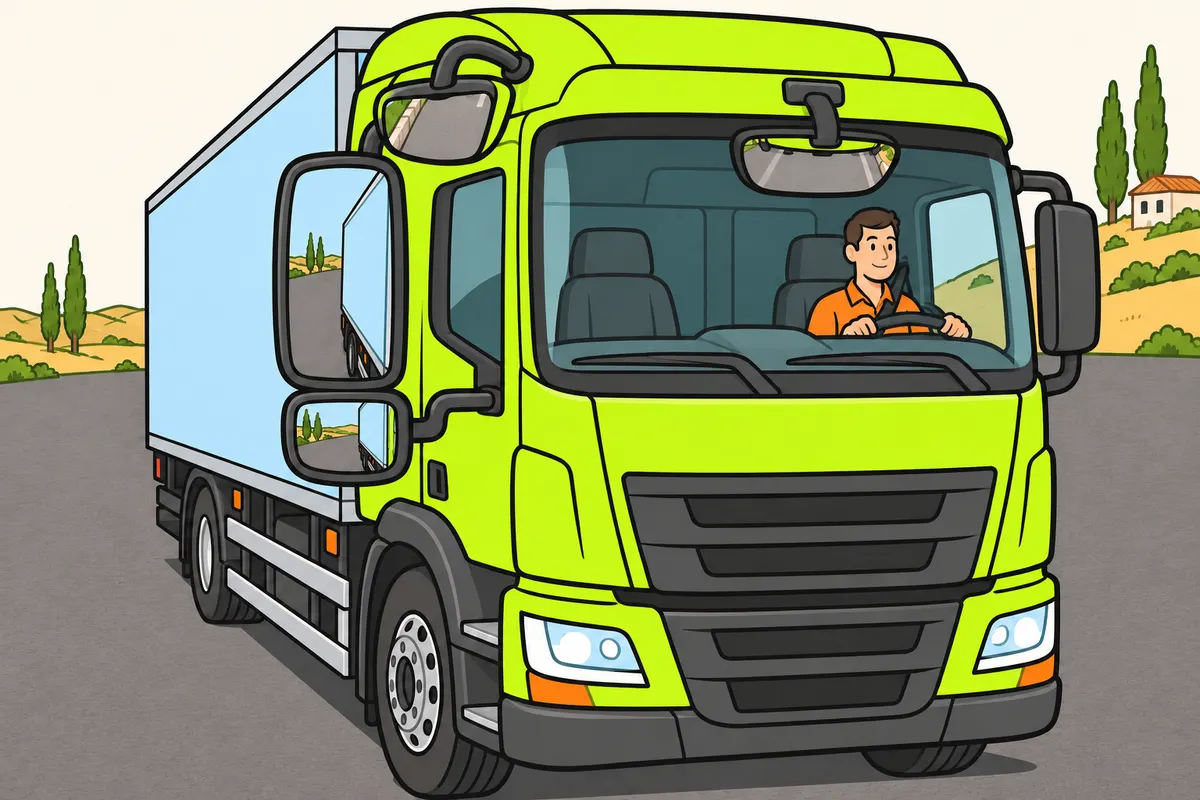
Know what each mirror shows and keep all the equipment your lorry requires.
| Mirror class | What it shows |
|---|---|
| II: main | Behind you |
| IV: wide-angle | More of the side and rear |
| V: close-proximity | Ground beside the cab |
| VI: front | Area in front of the cab |
Remember
- Keep the compulsory main exterior mirrors on both sides.
- Do not replace them with an interior mirror or any auxiliary camera.
- For N2 up to 7.5 t, non-convex Class II needs Class IV beside it.
- At full load, all Class V parts must exceed 2 m in every adjustment.
- If it fails this height rule, you must not fit it.
- Keep the equipment required by your lorry’s type approval.
Exam trap: Wrong: all lorries need the same mirrors. Right: N2 up to 7.5 t needs compulsory Class II mirrors; Classes IV and V are optional with conditions. A non-convex compulsory Class II needs Class IV on that side. N2 over 7.5 t and N3 need Classes II, IV and V, respecting the Class V height condition.
Read the full explanation
- Your lorry’s two main exterior mirrors let you look behind on both sides. The class I interior mirror is optional on N2 and N3 vehicles and does not replace the compulsory exterior mirrors. [RGV, Annex III](https://www.boe.es/buscar/act.php?id=BOE-A-1999-1826#aniii).
- Class II is the main mirror for M2, M3, N2 and N3 vehicles; class III is the main mirror for M1 and N1 vehicles. Class IV is the wide-angle mirror: it extends your view to the side and rear, but its image can make distances difficult to judge. [RGV, Annex III](https://www.boe.es/buscar/act.php?id=BOE-A-1999-1826#aniii).
- Class V is the close-proximity mirror, which shows the ground close to the side of the cab; class VI is the front mirror, which shows an area in front of it. Class VI comes under UNECE R46 type approval and does not appear in the RGV table: you must retain the equipment required by your lorry’s type approval. [UNECE Regulation 46, paragraph 2.1.1.13](https://www.boe.es/buscar/doc.php?id=DOUE-L-2010-81254).
- For conventional mirrors, apply these RGV equipment requirements: | Category and MMA (maximum authorised mass) | Class II | Class IV | Class V | Interior I | | --- | --- | --- | --- | --- | | N2 up to and including 7.5 t | Two compulsory: left and right | One optional, subject to the exception below | One optional, subject to height | One optional | | N2 over 7.5 t and N3 | Two compulsory: left and right | One compulsory | One compulsory, subject to height | One optional | On an N2 vehicle up to 7.5 t, if a compulsory class II mirror is not convex, you must also have a class IV mirror on the same side. The class V mirror, including its adjustment points and mountings, must be more than 2 m above the ground in every adjustment position with the vehicle at its full permissible load; if this condition is not met, fitting it is prohibited. [RGV, Annex III](https://www.boe.es/buscar/act.php?id=BOE-A-1999-1826#aniii).
- An auxiliary parking camera is not, by itself, equivalent to a type-approved indirect vision system that can replace mirrors. Check the type approval before modifying the equipment. [UNECE Regulation 46](https://www.boe.es/buscar/doc.php?id=DOUE-L-2010-81254).
4Blind spots and vulnerable road users
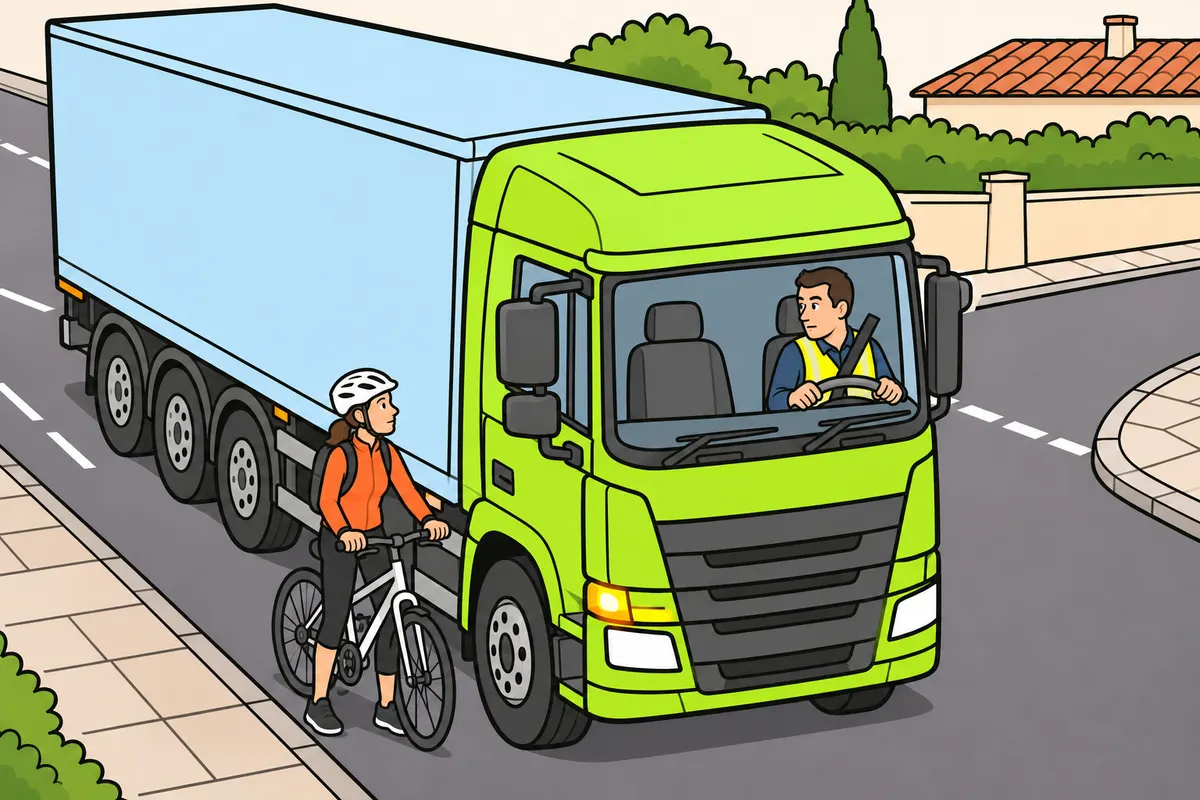
Check hidden areas before moving, especially when cyclists are nearby.
Remember
- Look for people in front, behind and beside your lorry.
- A cyclist missing from your mirror may still be beside you.
- Watch the gap beside the kerb when turning right.
- Use direct views, mirrors and cameras together.
- Stop if you cannot check that moving is safe.
Exam trap: Wrong: a high cab lets you see everything. Right: nearby areas can remain hidden.
Read the full explanation
- Look for hidden areas in front of the cab, beside its doors, along the sides and behind the load body. Your raised position improves some of your distant view, but can prevent you from seeing low objects and people nearby. No single mirror check guarantees that the entire area around your vehicle is clear.
- When a cyclist or motorcycle disappears from a mirror, do not assume they have left the area around you. They may still be alongside. Keep track of their last position and check the available fields of vision before moving; if you cannot rule out danger, wait.
- When turning right, pay particular attention to the space between your lorry and the kerb. A cyclist may move into this gap and be at risk from the rear wheels. Your indicator signals your intention, but does not replace a check or require anyone there to disappear.
- Combine direct vision, mirrors and driving aids without focusing on a screen for too long. Cameras may be dirty, affected by reflections, have areas without coverage or show an image that is difficult to interpret. If visibility is insufficient for a safe manoeuvre, stop and arrange a proper check before continuing.
5What your lorry hides from others
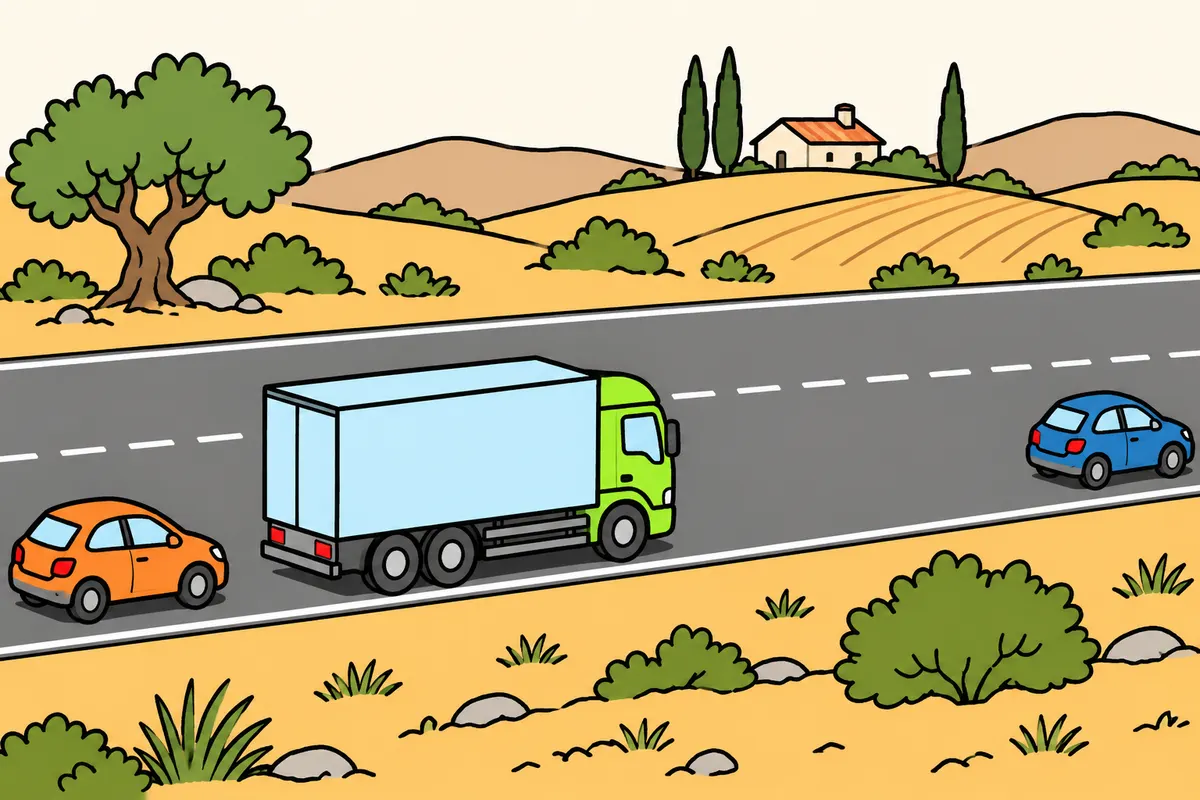
Remember that your lorry can hide people and vehicles from other drivers.
Remember
- Choose a permitted position that lets others see.
- Leave space ahead so you can brake gradually.
- If you cannot keep fully right, check whether others can overtake safely.
- If they can overtake safely, signal with your arm.
- If that signal is unsuitable, use your right indicator.
- For passing stationary vehicles, see “Manoeuvres with a lorry”.
Exam trap: Wrong: if you see the pedestrian, everyone does. Right: your lorry’s body can hide them.
Read the full explanation
- Your cab, load body and load can hide other road users from others even when you can see them. Near a pedestrian crossing or junction, a stationary lorry can hide a person from those approaching in another lane. Choose a lawful position that preserves other people’s visibility. [RGC, art. 91](https://www.boe.es/buscar/act.php?id=BOE-A-2003-23514#a91).
- If a car follows you very closely, its driver can barely see the road ahead of your load body. Keep a gap from the vehicle in front so that you can brake progressively and, where overtaking is permitted, anyone overtaking you has a safe gap to move into afterwards. [RGC, art. 54](https://www.boe.es/buscar/act.php?id=BOE-A-2003-23514#a54).
- An oncoming driver may not see a car starting to overtake from behind your lorry. If you cannot keep fully to the right and overtaking is safe, signal this by extending your arm horizontally and moving it repeatedly from back to front, with the back of your hand facing backwards; if you do not consider this signal appropriate, use your right indicator. Your signal does not replace the checks required of the overtaking driver. See “Your duties when being overtaken” in “Manoeuvres with a lorry”. [RGC, art. 86.1 and 3](https://www.boe.es/buscar/act.php?id=BOE-A-2003-23514#a86).
- A stationary vehicle’s load body can hide its occupants or workers from you; go past it under the conditions explained in “Manoeuvres with a lorry”, section “Passing stationary vehicles and obstacles”. [RGC, art. 88.1](https://www.boe.es/buscar/act.php?id=BOE-A-2003-23514#a88).
6Space to brake and observe
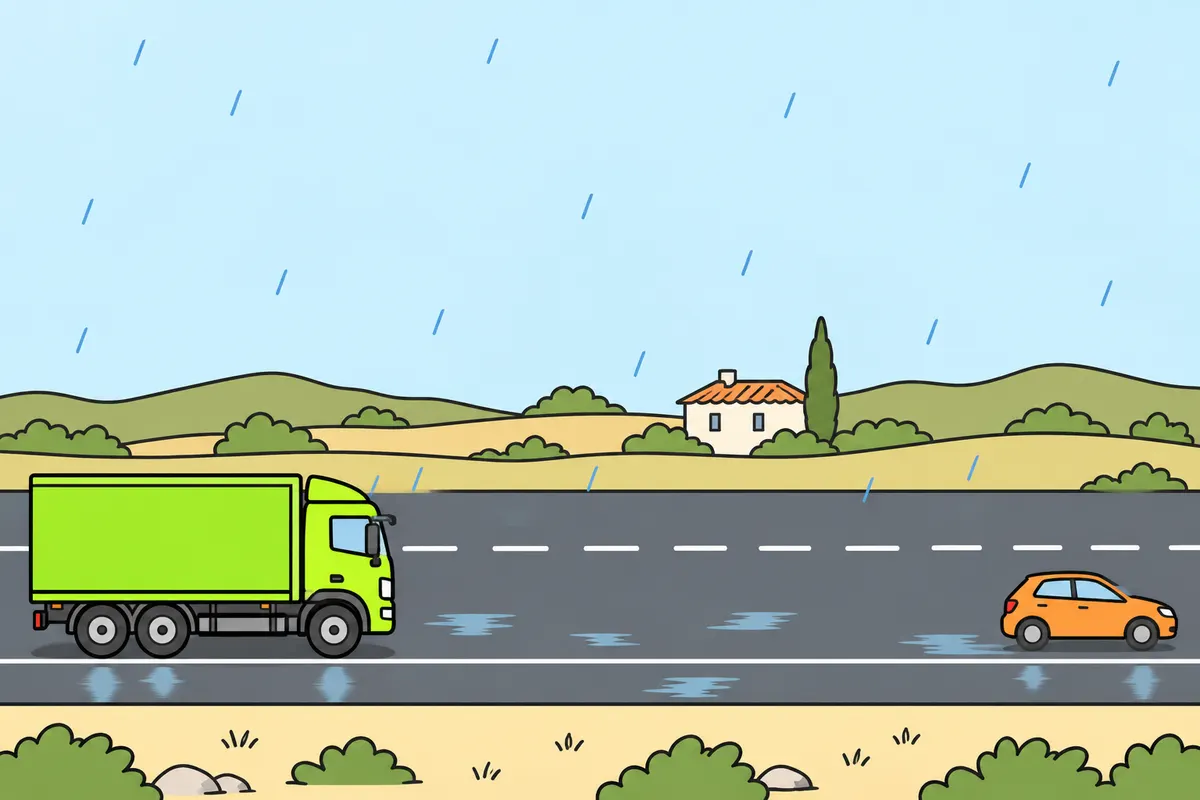
Leave braking space and keep the special gaps whenever their conditions apply.
Remember
- Increase your gap in rain or poor visibility.
- Leave enough space to brake if the vehicle ahead brakes suddenly.
- See “Speed and safe following distances” for the special gaps.
- If the lorry ahead hides traffic, increase your gap to see better.
Exam trap: Wrong: always add 50 m to braking space. Right: satisfy both requirements without adding them.
Read the full explanation
- Leave enough distance to avoid a rear-end collision if the vehicle in front brakes suddenly. Assess your actual speed, grip, load and brake response; large wheels do not guarantee that you stop sooner. Increase your margin in rain or reduced visibility, even when you do not intend to overtake. [RGC, art. 54](https://www.boe.es/buscar/act.php?id=BOE-A-2003-23514#a54).
- Apply the gap that helps others overtake your lorry as set out in “The lorry’s 50-metre gap” and “Exceptions to the additional gap” in “Speed and safe following distances”. [RGC, art. 54.2-3](https://www.boe.es/buscar/act.php?id=BOE-A-2003-23514#a54).
- Keep a view that lets you anticipate braking: if the load body of the vehicle in front hides changes in the traffic, increase the gap so that you can see without moving sideways blindly. Look for clues such as brake lights coming on in succession, vehicles joining the road or slowing traffic; avoid focusing all your attention on the bumper in front.
- In tunnels and underpasses, apply the specific gap for lorries explained in “Tunnels: 150 metres or six seconds” in “Speed and safe following distances”. [RGC, art. 95.6](https://www.boe.es/buscar/act.php?id=BOE-A-2003-23514#a95).
7Prepare every movement
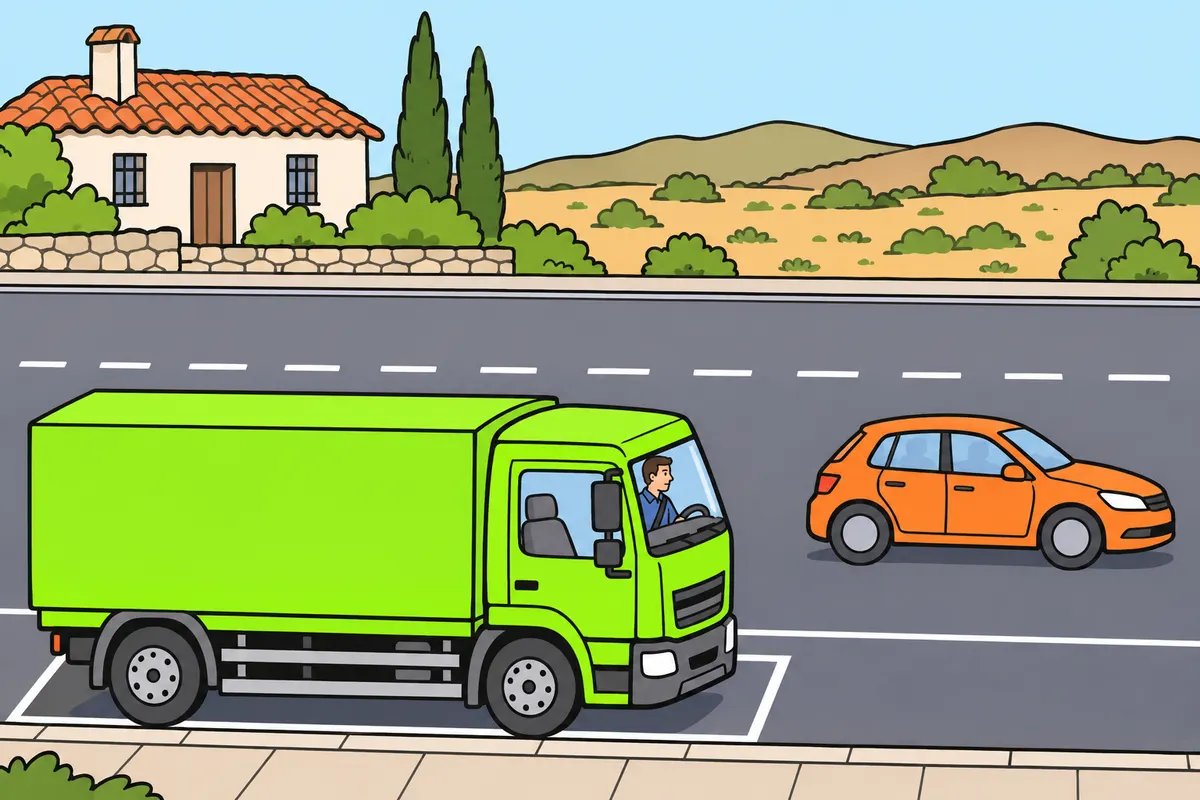
Check, leave space and signal before moving smoothly.
Remember
- Keep checking throughout your manoeuvre.
- Find a gap large enough for your whole lorry to join traffic.
- Respect traffic already in the lane you want to enter.
- Help others join traffic when you can do so safely.
- Before slowing considerably, check behind and warn others if possible.
Exam trap: Wrong: signalling gives you priority. Right: check and respect other road users.
Read the full explanation
- Observe, assess the space, signal and manoeuvre smoothly, keeping watch throughout the movement. Your surroundings can change between your first look and the start of the turn. [RGC, arts. 74 and 109](https://www.boe.es/buscar/act.php?id=BOE-A-2003-23514#a74).
- When moving off from a parking space or access point, check that you can join traffic safely and give way where required. A loaded lorry can accelerate slowly: you need a large enough gap to complete the manoeuvre, not just to get the cab in front of another vehicle. [RGC, art. 72](https://www.boe.es/buscar/act.php?id=BOE-A-2003-23514#a72).
- Respect the priority of traffic in the lane you intend to enter. Signalling and needing more space do not give you priority. If another road user tries to join traffic, help them to do so as far as possible without creating a risk. [RGC, arts. 74 and 73](https://www.boe.es/buscar/act.php?id=BOE-A-2003-23514#a74).
- Before slowing down considerably, also check behind you and give a warning whenever possible. Anticipating a traffic queue allows you to slow down progressively, reducing the risk of a rear-end collision and load movement. If danger is imminent, act as urgently as necessary to avoid it. [RGC, arts. 53 and 109](https://www.boe.es/buscar/act.php?id=BOE-A-2003-23514#a53).
8Understand your lorry’s swept path
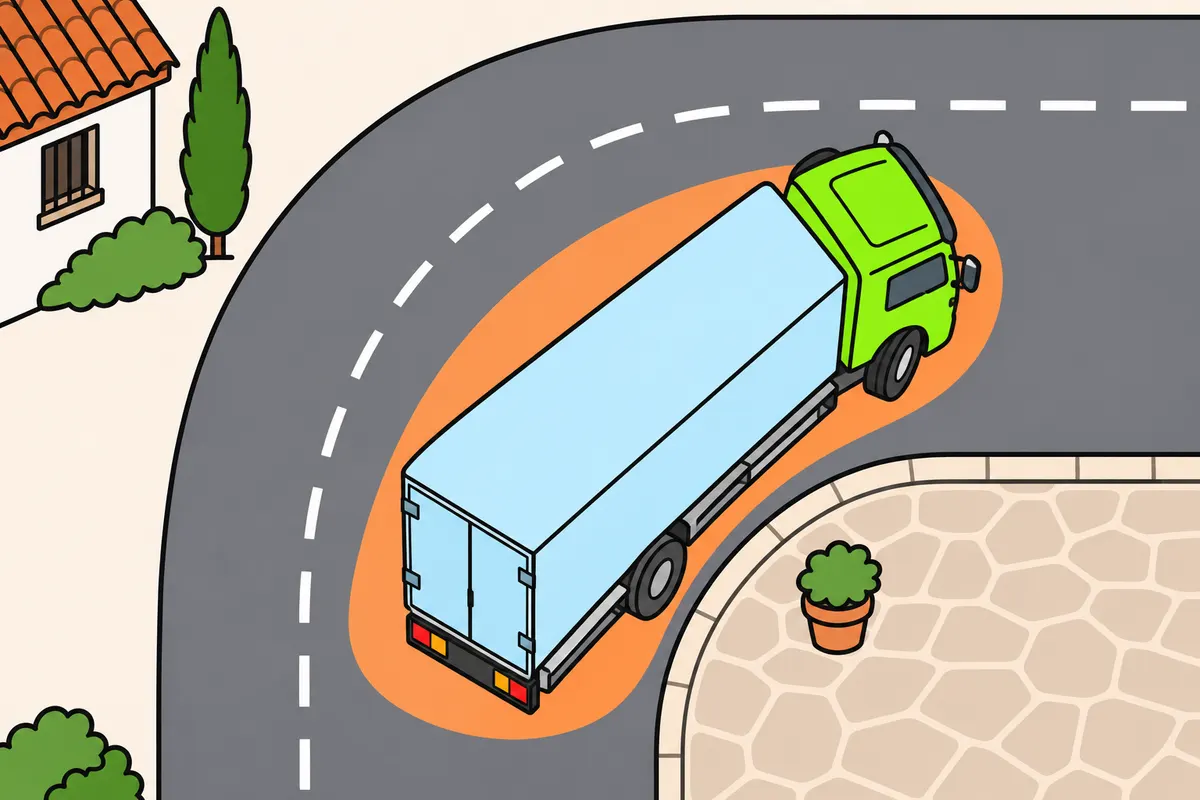
Allow space for your whole lorry throughout a turn.
| Part of a rigid lorry | During a turn |
|---|---|
| Rear wheels | Pass inside the front wheels’ path |
| Rear end | Can swing outwards |
Remember
- Do not follow only the cab’s path.
- Watch the rear part extending beyond the last axle.
- Check clearance above your mirrors, body and load too.
- Leave space inside and outside your turn.
- If you do not know the available space, stop before becoming trapped.
Exam trap: Wrong: if the cab fits, everything fits. Right: check wheels, body and rear end.
Read the full explanation
- Picture the whole area your lorry occupies during a turn, not just the line the cab follows. On a rigid lorry, the rear wheels follow a path further inwards than the front wheels. The tighter the turn, the further they can cut inwards.
- Watch the rear overhang: as you start a turn, the part behind the last axle can swing outwards. If you turn right alongside a vehicle on your left, the rear can move closer to it even as the cab moves away.
- Also consider the upper parts: mirrors, load body, refrigeration unit and authorised load. A corner can extend over a kerb and hit a sign, a shelter or a branch. Having room for the wheels does not mean you have all the height and width clearance the bodywork needs.
- Plan a path that leaves clearance on both the inside and the outside, and check it in your mirrors throughout the turn. No single distance from the kerb suits every wheelbase, overhang or corner. If you do not know how much space is available, stop before you get the vehicle wedged in.
9Turn right without trapping anyone
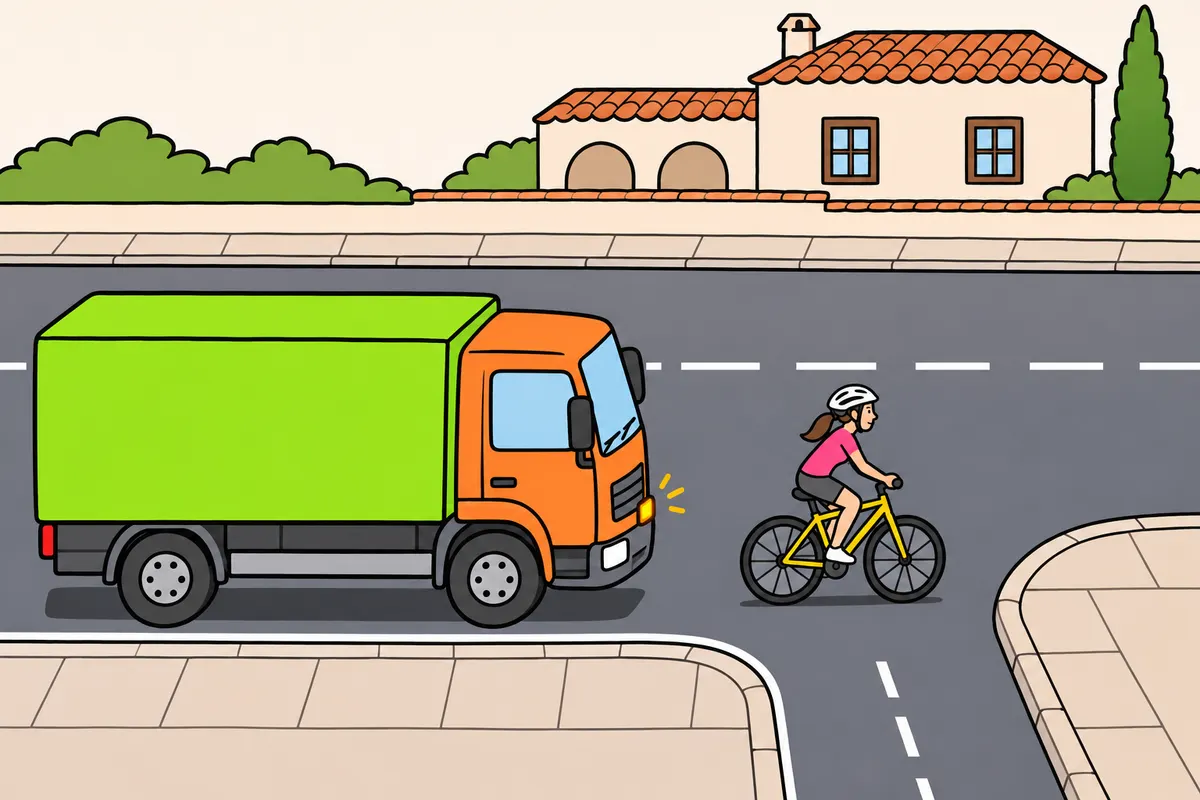
Turn slowly and check that nobody becomes trapped on your right.
Remember
- Slow before the corner and check the pedestrian crossing.
- Normally position yourself close to the right edge.
- If your size requires swinging out, check space and avoid danger.
- Respect traffic and signal before entering another lane.
- Watch your rear wheels and keep them off the pavement.
- Stop if anyone enters the danger area.
Exam trap: Wrong: your size lets you push others aside when turning. Right: respect their space.
Read the full explanation
- Slow down before the corner and check your right-hand side, the pedestrian crossing and the road you are turning into. Also check the outside of the swept path. With a high cab, someone can become hidden immediately in front of you while you wait, even if you saw that the crossing was clear as you approached.
- As a rule, you must position your vehicle close to the right-hand edge to turn right. If your vehicle’s dimensions prevent you from doing so, you must take the necessary precautions to avoid any danger; this exception does not allow you to swing out without looking or force other road users out of the way. [RGC, arts. 75 and 76](https://www.boe.es/buscar/act.php?id=BOE-A-2003-23514#a75).
- If you need to move sideways into another lane, check that it is available, respect the priority of traffic in it and signal the movement. Avoid an unplanned swing out that looks like a turn in the opposite direction and leaves a gap that cyclists or motorcyclists can enter. [RGC, arts. 74 and 109](https://www.boe.es/buscar/act.php?id=BOE-A-2003-23514#a74).
- Move slowly and make sure the rear axle clears the corner without mounting the pavement. Do not tighten your turn while a road user is still on your right. If someone enters the danger area, stop before they become trapped and move off again only after checking that you can do so safely.
10Left turns and narrow entrances
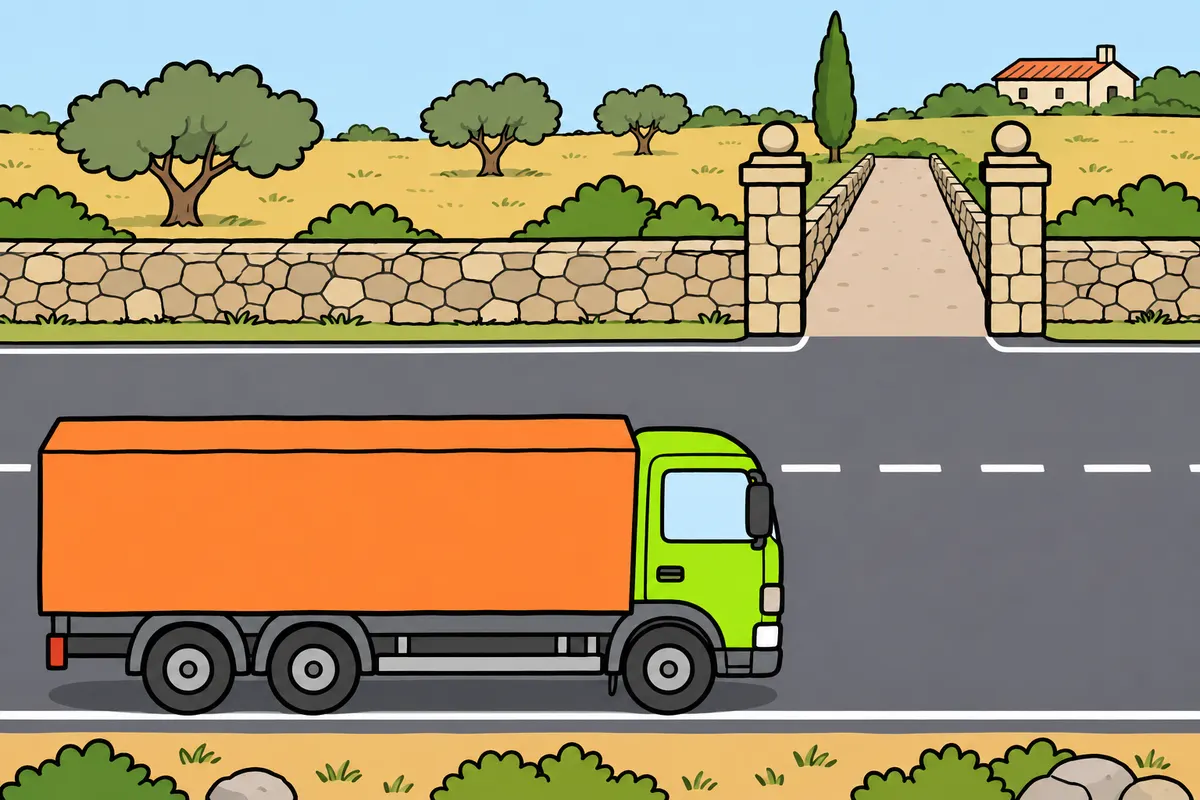
Check that your whole lorry can turn and fit without blocking traffic.
Remember
- Check the entrance width, height and slope.
- On two-way roads, approach the centre line without entering the opposing side beforehand.
- Do not turn if you cannot see enough to turn safely.
- Plan any special positioning and watch both ends of your lorry.
- Where possible, arrange access so you can leave forwards.
- Before reversing, check that it is permitted and safe.
Exam trap: Wrong: an entrance that admits the cab is enough. Right: check the body too.
Read the full explanation
- Check that your whole lorry can cross and fit into the road you are turning into without blocking traffic. An entrance may have room for the cab but not the load body. Also examine access gradients, kerbs and overhead obstacles before committing to the manoeuvre.
- To turn left on a two-way road, you must move close to the dividing line between the two directions without moving onto the opposite side in advance. If you do not have enough visibility to turn safely, do not turn. [RGC, arts. 74 and 75](https://www.boe.es/buscar/act.php?id=BOE-A-2003-23514#a74).
- When your dimensions require a special position, prepare the manoeuvre in advance and check both ends of the lorry. A sudden correction can give the cab enough space but cause a collision as the rear swings out, or bring the inside wheels too close to the edge. [RGC, art. 76](https://www.boe.es/buscar/act.php?id=BOE-A-2003-23514#a76).
- Where the site allows it, favour an access arrangement that makes it easier to leave forwards. If you need to reverse, first check that doing so is legal and safe.
11Roundabouts with a long vehicle
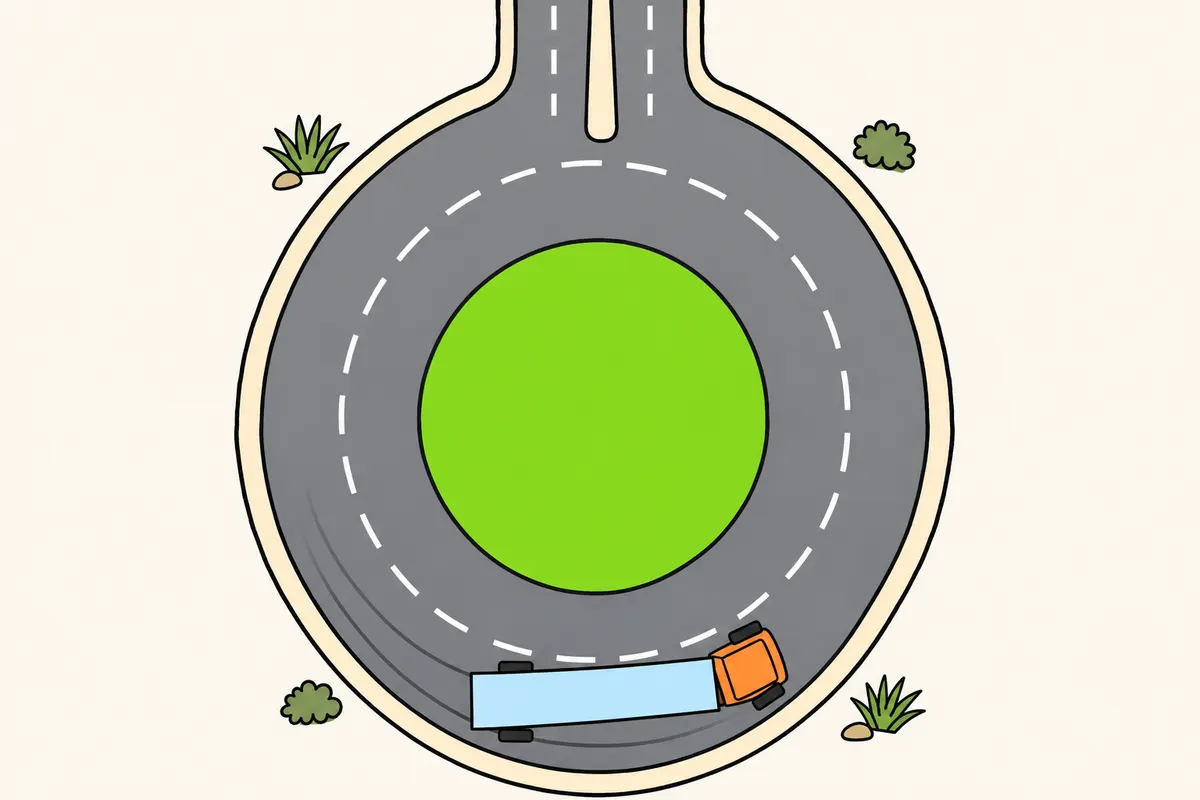
Drive slowly around roundabouts and respect the space of other vehicles.
Remember
- Slow before entering and plan the path of your whole lorry.
- Watch small vehicles beside you.
- Keep your cab far enough from the central island.
- Signal each lane change and respect traffic in that lane.
- Prepare your exit without cutting across another vehicle.
- If you cannot exit safely, continue along the permitted route.
Exam trap: Wrong: needing extra space gives you priority. Right: respect other lanes too.
Read the full explanation
- Slow down before entering and anticipate how the axles and overhang clear the island and the exits. A wide entrance can lead onto a narrow circulatory carriageway. Also watch for small vehicles that may come alongside you as you drive around the roundabout.
- On a small roundabout, you may need more lateral space because of your lorry’s dimensions. You must check that this space is available without assuming you have priority over other lanes: respect the priority of traffic in them and signal each actual sideways movement. [RGC, art. 74](https://www.boe.es/buscar/act.php?id=BOE-A-2003-23514#a74).
- Avoid bringing the cab too close to the island, as the rear axle cuts inwards. At the same time, check that the outside of your vehicle does not strike anyone travelling on your right. Keep a low, steady speed that allows you to observe without making abrupt corrections.
- Prepare to exit by moving safely into the appropriate lane according to the signs and road markings. Do not cut across another vehicle’s path from an inner lane. If you cannot exit safely, continue along the permitted route and prepare the manoeuvre again; pressure from those waiting behind does not justify rushing. [RGC, arts. 74 and 75](https://www.boe.es/buscar/act.php?id=BOE-A-2003-23514#a74).
12Reversing: limits and checks
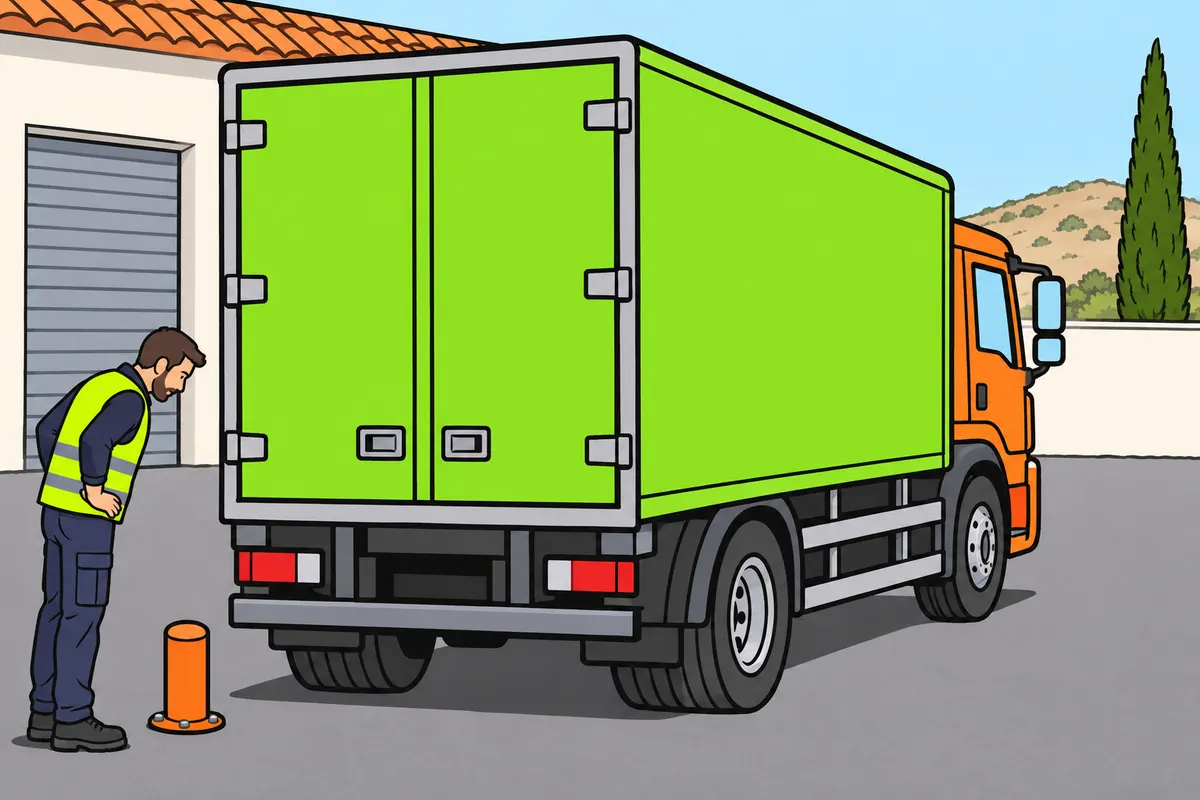
Reverse only when permitted and when you can check that it is safe.
Remember
- See “Manoeuvres with a lorry” for when you may reverse.
- Check behind and beside you; get out or seek guidance when needed.
- Check people, low obstacles, slopes and overhead clearance.
- Signal with your reversing light, if you have one.
- Without that light, hold your arm horizontally with your palm facing backwards.
- See “Manoeuvres with a lorry” for reversing precautions.
Exam trap: Wrong: a reversing light or alarm authorises reversing. Right: you must check safety.
Read the full explanation
- Before preparing to reverse your lorry, confirm that it is permitted in «When you may reverse», in «Manoeuvres with a lorry». [RGC, art. 80](https://www.boe.es/buscar/act.php?id=BOE-A-2003-23514#a80).
- Before reversing, check the space behind and to the sides, people, low obstacles, gradients and overhead clearance. You must get out or follow another person’s directions if you need to do so to make sure it is safe. A camera aimed at the centre may not show an obstacle at a corner. [RGC, art. 81](https://www.boe.es/buscar/act.php?id=BOE-A-2003-23514#a81).
- Signal the manoeuvre with the reversing light if you have one; otherwise, use your arm held horizontally with your palm facing backwards. The light signals your intention and can come on before you move; it does not establish that you have space or priority. [RGC, art. 109](https://www.boe.es/buscar/act.php?id=BOE-A-2003-23514#a109).
- Apply the precautions and the reasons for stopping or abandoning the reversing manoeuvre explained in «Reverse safely», in «Manoeuvres with a lorry». [RGC, art. 81](https://www.boe.es/buscar/act.php?id=BOE-A-2003-23514#a81).
13Coordinate with your banksman
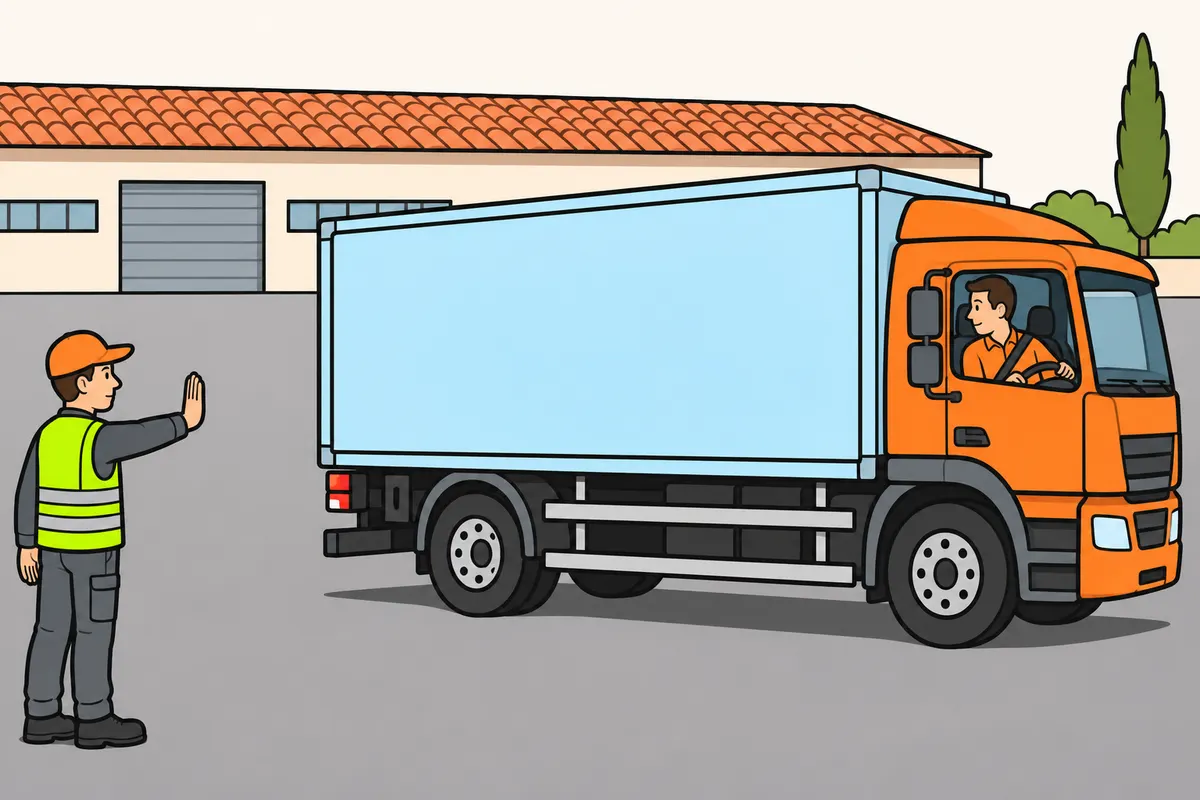
Agree signals with your banksman and stop if you lose communication.
Remember
- Agree your route and stop signal before starting.
- Choose a single person to give directions.
- Keep your banksman visible and outside your lorry’s path.
- Never let them stand between your lorry and an obstacle.
- Also watch the opposite side and the cab’s movement.
- Stop at any warning of danger, whoever gives it.
Exam trap: Wrong: continue after losing sight of your banksman. Right: stop until communication is restored.
Read the full explanation
- Before starting, you must agree who guides you, which route you take and which signal means stop. Use clear signals that you both understand. This coordination is a work precaution: it does not make your assistant a traffic officer or relieve you of checking that the manoeuvre is safe.
- Position your banksman where they can monitor the danger area and you can see them directly or in a mirror, keeping them outside the vehicle’s path and swept area. They must never stand between the lorry and a wall, loading bay or another vehicle to judge the gap while you move forwards.
- If you lose sight of your banksman or do not understand a signal, you must stop and restore clear communication before continuing. If you have several assistants, agree on a single person to give you instructions to avoid conflicting signals.
- Also watch the cab and the side opposite the one your assistant is watching. When you reverse while turning, the front swings sideways and can strike an obstacle. Stop at any warning of danger, even from another person; your banksman helps, but you remain in control of the vehicle. [RGC, art. 81](https://www.boe.es/buscar/act.php?id=BOE-A-2003-23514#a81).
14Approach a loading bay
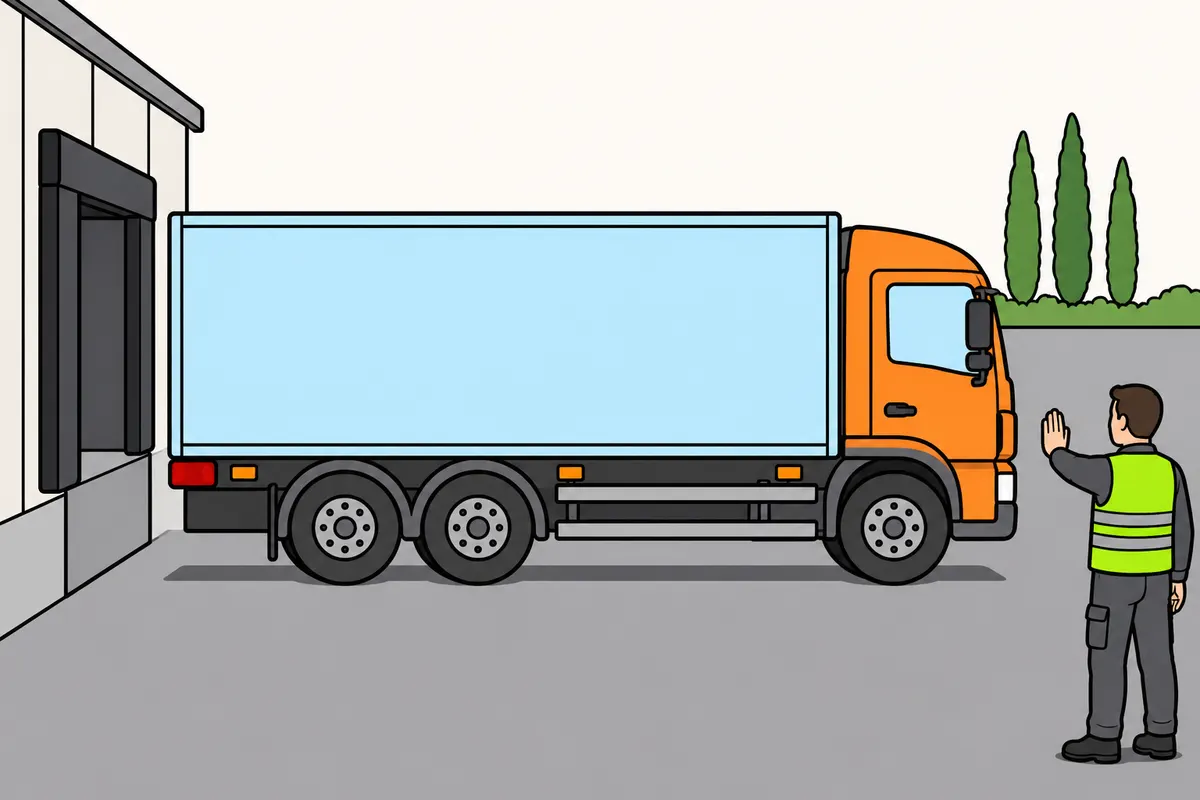
Approach the loading bay slowly and secure your lorry before work begins.
Remember
- Check the surface, slope, edges and overhead space.
- Check site rules and whether the bay can accommodate your lorry.
- Line up your lorry and check both sides as you approach.
- Stop if you lose reference points or people appear.
- Secure your lorry before getting out; check your surroundings again when returning.
- Do not leave while people, equipment or walkways remain connected to your lorry.
Exam trap: Wrong: ask your helper to measure the gap behind while you move. Right: keep them outside your path.
Read the full explanation
- Inspect the approach before lining up: the surface, gradient, edges, pedestrians, forklift trucks and overhead clearance. Check whether the loading bay can accommodate your lorry and whether there are restraint systems or site rules you must apply. An open door does not guarantee that the area is ready to receive you.
- Line up the vehicle using broad, planned movements where space allows, reducing the need for corrections as you approach. Keep your speed very low and check both sides; do not rely solely on a mark seen in one mirror. A gradient or uneven surface can change the alignment of the load body.
- Stop before making contact if you lose your reference points or people enter the area. Do not ask your assistant to go behind the vehicle to check the remaining gap. If you need to get out, secure the lorry first and check your surroundings again when you return to the cab.
- Once in position, apply the parking brake and the appropriate securing measures before allowing operations to begin. Coordinate clearly when staff can approach and when you intend to leave. Do not move off while workers, equipment or loading bridges are still connected to the vehicle.
15Bends, centre of gravity and rollover
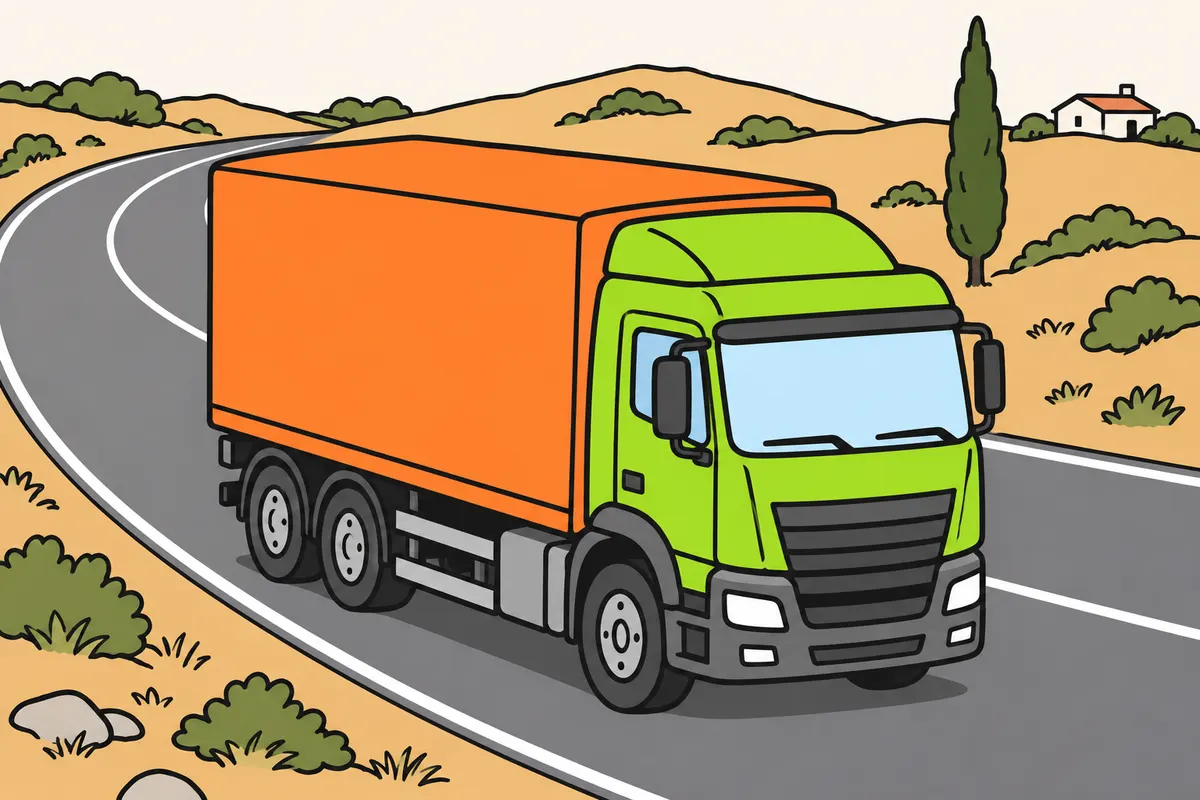
Slow before bends and drive smoothly to prevent overturning.
Remember
- Do most of your slowing before you start turning.
- Use your steering and pedals smoothly.
- With a high load, you can overturn before your wheels skid.
- Avoid swerving around obstacles or when returning from the hard shoulder.
- Anticipate moving liquid in a partly filled tanker.
Exam trap: Wrong: good grip prevents overturning. Right: slow for bends, especially with a high load.
Read the full explanation
- Enter bends at a speed that allows you to maintain your course and stability without abrupt manoeuvres. Do most of your slowing down before turning, and use the steering, brake and accelerator progressively.
- With a high load, you can overturn before the tyres skid. Reduce your speed for tight bends, adverse camber, edges and changes in level, even if the surface provides good grip.
- Avoid sudden steering movements to dodge small obstacles, mount a kerb or return from the arcén (hard shoulder). A violent correction can cause swaying and loss of stability. If you must change course, reduce the risk by anticipating and using controlled movements, keeping space from other road users.
- In a partially filled tanker, the liquid can continue moving after you brake or turn. You must anticipate further ahead and drive more smoothly, taking account of the fill level and compartments. Stowage and load distribution are covered in the “Load stowage and safety” module.
16Crosswinds and the wind-shielding effect
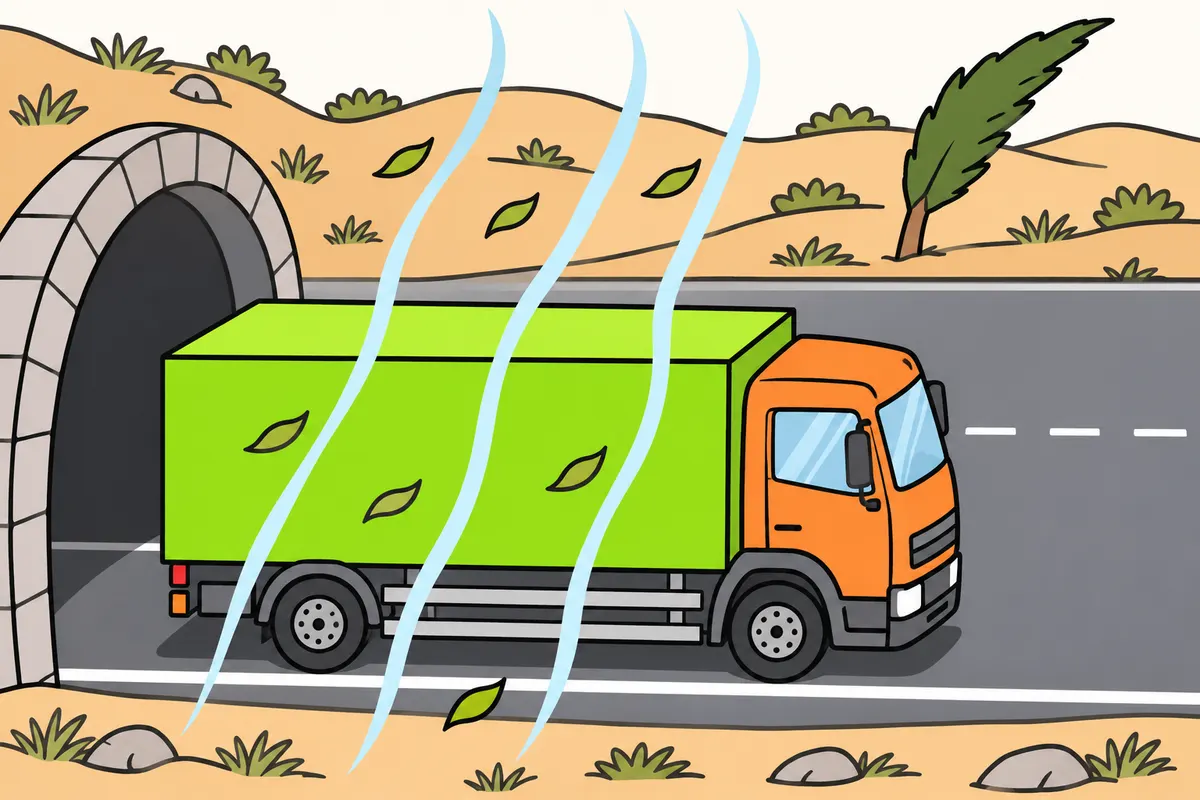
Slow down and anticipate gusts that could push your lorry sideways.
Remember
- Take extra care in wind with a high body or an empty lorry.
- Hold your steering wheel firmly and correct gently.
- Expect gusts when leaving tunnels or sheltered areas.
- Expect changes in wind pressure when passing large vehicles.
- If you cannot hold a safe path, find somewhere safe to stop.
- In gusts, increase your sideways gap from other road users.
Exam trap: Wrong: accelerating steadies you in crosswinds. Right: moderate your speed and correct gently.
Read the full explanation
- Expect greater exposure in a lorry with a tall load body or a large side area. An empty vehicle can also be very sensitive: carrying less mass does not guarantee stability in a gust.
- In crosswinds, reduce your speed, hold the steering wheel firmly and make gentle corrections. A suitable gear ratio can help you maintain responsiveness without straining the engine. If you cannot maintain your course with a safety margin, find a safe place to interrupt your journey and comply with restrictions imposed by the authorities.
- You can encounter a gust when leaving tunnels, crossing bridges or leaving the shelter of buildings and trees. You must also anticipate the wind-shielding effect when meeting or overtaking a large vehicle: your exposure to the wind changes, and its force can then return. [DGT, wind](https://www.dgt.es/comunicacion/noticias/conducir-con-el-viento-en-contra/).
- In gusty conditions, increase your lateral clearance; consult the overtaking rules in “Protecting cyclists and other vulnerable road users”, in the “Manoeuvres with a lorry” module.
17Control a long descent
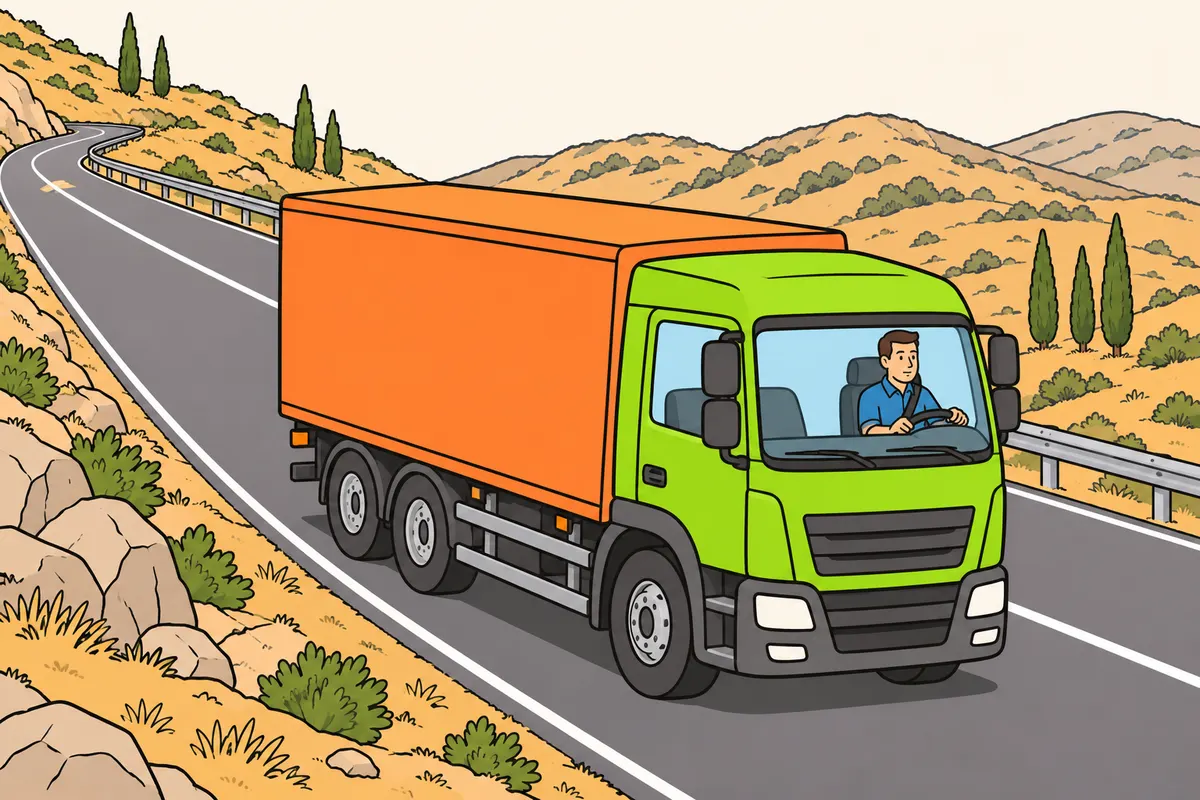
Prepare for descents and use suitable braking to control your lorry.
Remember
- Before descending, assess the slope, bends, load and grip.
- Choose a suitable speed and gear.
- Keep a gear engaged throughout the descent.
- Apply the engine brake or retarder progressively, following your manual.
- On slippery roads, adapt braking to the available grip.
- If brakes weaken or temperature warnings appear, seek a safe stop.
Exam trap: Wrong: descend in neutral. Right: keep a gear engaged and control your braking.
Read the full explanation
- Before descending, assess the gradient, bends, mass and grip; select a speed and gear that allow you to hold the lorry at a controlled speed within the permitted engine speed range. Keep a gear engaged and apply the engine brake or retarder progressively as instructed in the manual, supplementing it with the service brake when necessary.
- On slippery surfaces, adapt the braking effect to the available grip and the manufacturer’s instructions. If temperature warnings appear or braking effectiveness decreases, seek to stop safely. Retarder operation, brake heating and braking procedures are covered in the “Lorry brakes and retarders” module.
18Rain, spray and standing water
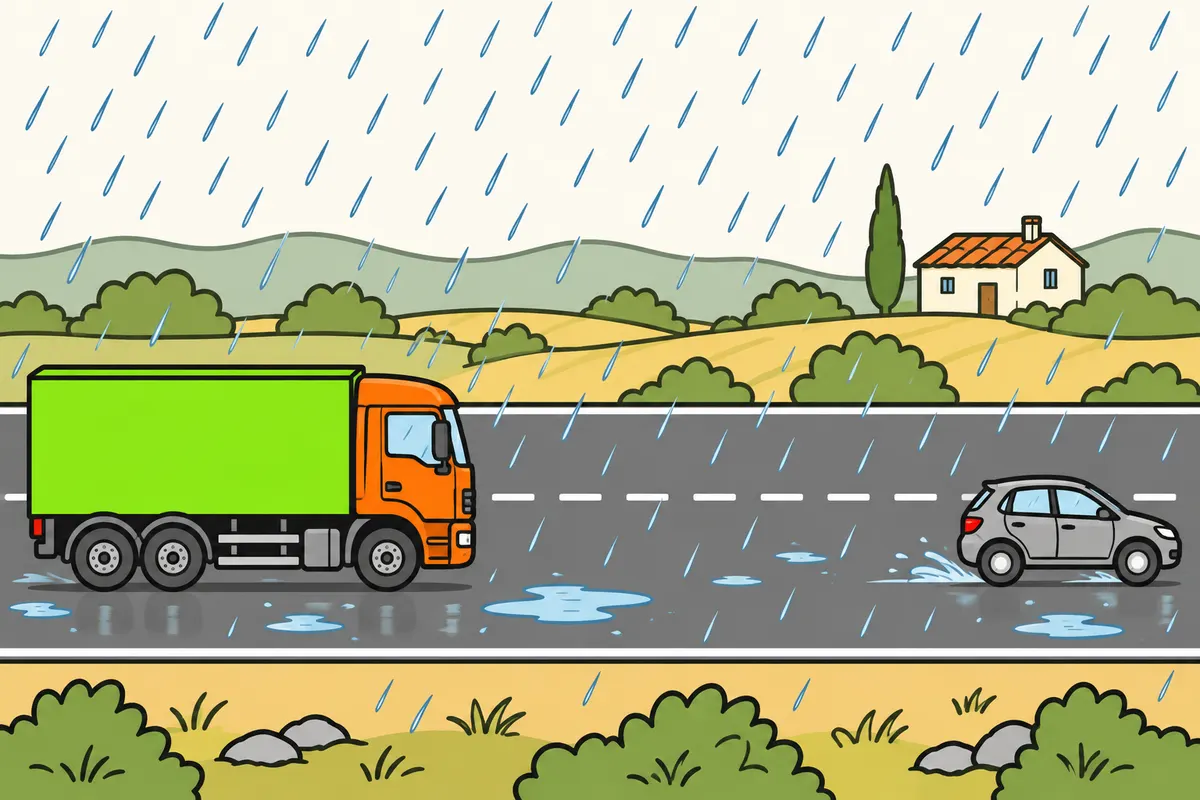
Slow in rain and avoid sudden movements if water lifts your tyres off the road.
Remember
- Slow and increase your gap when grip or visibility worsens.
- Take extra care with the first drops of rain.
- Keep windows clean and free from condensation.
- Slow before standing water; avoid spraying nearby road users.
- If you aquaplane, avoid harsh braking and sudden steering.
- Do not cross water with unknown depth, current or ground beneath.
Exam trap: Wrong: brake sharply to test brakes after a puddle. Right: check gently when safe.
Read the full explanation
- Reduce your speed and increase your following distance when water reduces grip or visibility. The first drops can mix with dirt and make the surface particularly slippery. Braking distance depends on the water, tyres, speed and road surface.
- In your lorry, spray from your own and other vehicles can hide bicycles, road markings and obstacles. You must keep your field of view clear and free from misting, and leave space to react when a curtain of spray clears. Avoid driving too close to road users who could be hit by your spray.
- Aquaplaning occurs when water prevents proper contact between the tyre and the road surface. You must prevent it by slowing down before areas of standing water and keeping your tyres in good condition. If it occurs, avoid harsh braking and sudden steering movements; gently reduce the demands you place on the vehicle until you regain contact and control.
- Do not drive through water if its depth, current or underlying surface is unknown. After driving through a safe puddle, check braking effectiveness when you can do so safely, applying the brakes gently as instructed in the manual. If normal response does not return, stop and call for assistance; a harsh test application of the brakes can create another hazard.
19Snow, ice and low-grip surfaces
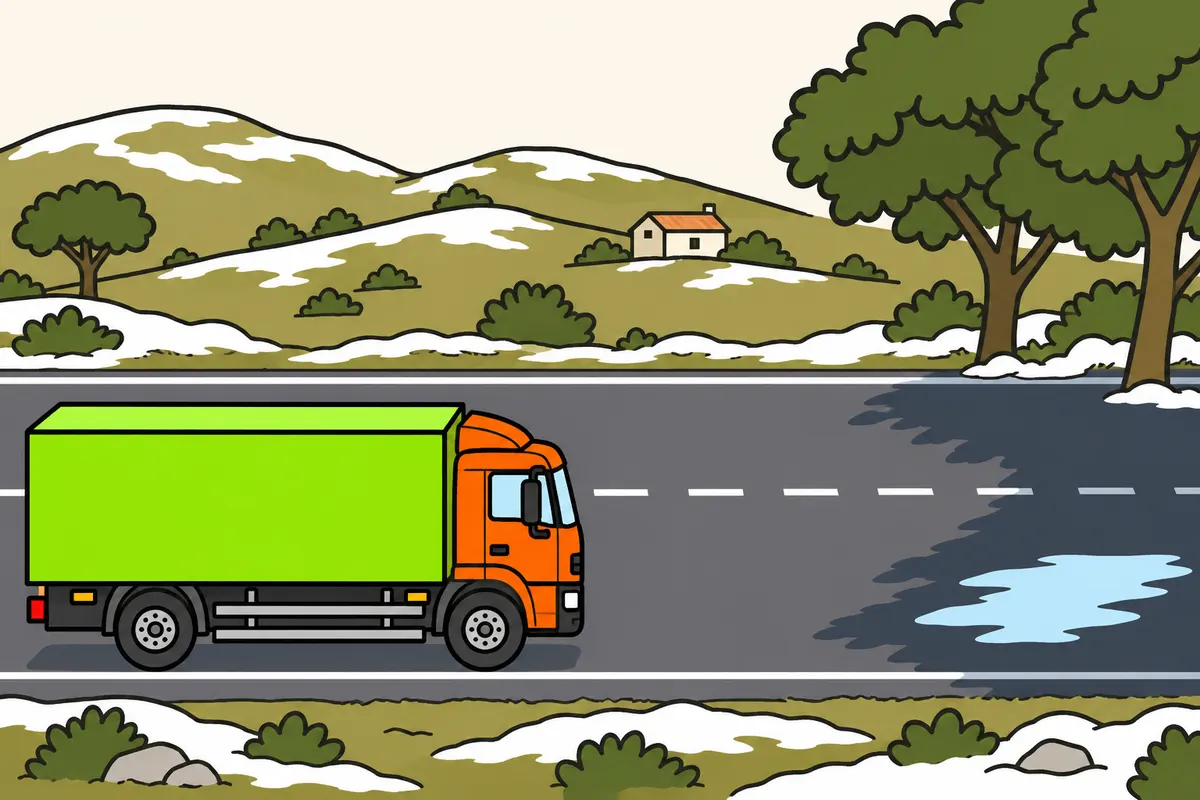
Expect ice and drive smoothly with plenty of space.
Remember
- Expect ice in shaded areas and on bridges.
- Slow before reaching a slippery surface.
- Use steering, accelerator and brakes gently.
- Choose a gear that lets you move without wheelspin.
- Obey lorry restrictions even with chains or suitable tyres.
- Find somewhere to wait without blocking snowploughs or other services.
Exam trap: Wrong: weight or ABS restores dry-road grip. Right: greatly increase your safety margin.
Read the full explanation
- Anticipate ice in shaded areas, on bridges and in places where water can freeze. A wet appearance does not guarantee grip. Slow down before entering and greatly increase your safety margin; neither the lorry's mass nor ABS restores the grip of a dry carriageway.
- On snow or ice, you must use the accelerator, steering and brakes smoothly and avoid sudden changes in the load on the axles. Select a suitable gear that allows you to move forward without wheelspin and do not strain the engine. If you need to stop, prepare the manoeuvre much further in advance.
- Check for restrictions specific to lorries and obey traffic officers and signs. Having chains or suitable tyres does not authorise you to continue when vehicles in your category are prohibited from proceeding. Plan somewhere to wait where you can pull aside without blocking snowploughs or other services.
- On ice, braking distance can increase greatly and by varying amounts. You also need to take care on wet road markings, metal covers or mud: avoid combining a tight turn with heavy braking or acceleration.
20Fog, smoke and appropriate lighting
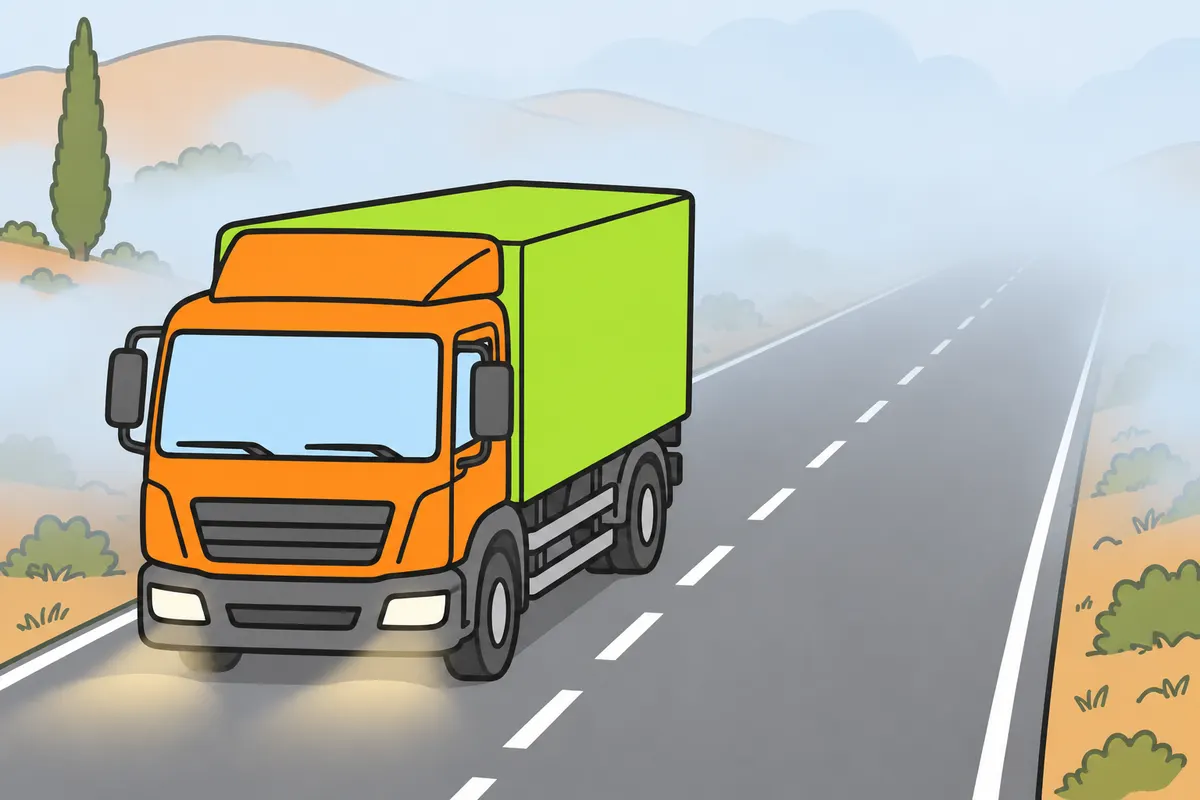
Adapt your speed and lights to what you can actually see.
| Light | When you may use it |
|---|---|
| Front fog lights | Significantly reduced visibility; not always compulsory |
| Front fog lights on bends | Carriageway 6.50 m or narrower, with signposted closely spaced bends |
| Rear fog lights | Thick fog, very heavy rain, heavy snowfall or dense smoke or dust |
Remember
- Drive slowly enough to stop within the distance you can see.
- Increase your gap; do not follow another vehicle’s lights closely.
- Use suitable lights in poor visibility, even by day.
- Do not drive with position lights alone.
- In fog, dipped headlights usually help more than main beam.
- Do not enter smoke or dust assuming the cloud is short.
Exam trap: Wrong: any rain permits rear fog lights. Right: reserve them for especially bad conditions.
Read the full explanation
- Adjust your speed so that you can stop within the distance you can see, and increase your following distance. Do not follow closely behind the lights of the vehicle ahead to find your way: you could follow it into an obstacle or run into it if it brakes. Use reference points in your lane without focusing all your attention on a single line.
- When visibility is significantly reduced, you must use the appropriate lights even during the day. You may use front fog lights, dipped beam or main beam under the permitted conditions; in fog, dipped beam is usually more useful than main beam because of reflected light. Position lights alone are not enough. [RGC, art. 106](https://www.boe.es/buscar/act.php?id=BOE-A-2003-23514#a106).
- Use rear fog lights only in thick fog, very heavy rain, heavy snow or dense clouds of smoke or dust. Front fog lights are not compulsory in every case: if your vehicle does not have them, use the appropriate permitted lights. Light snowfall does not automatically justify switching on the rear fog lights. [RGC, art. 106](https://www.boe.es/buscar/act.php?id=BOE-A-2003-23514#a106).
- You may also use front fog lights on carriageways 6.50 m wide or less where signs warn of a series of closely spaced bends. Outside the permitted circumstances, light rain without a significant reduction in visibility or driving along a stretch of road through a town does not authorise their use. In smoke or dust, do not enter assuming that the cloud only extends a short distance. [RGC, art. 106](https://www.boe.es/buscar/act.php?id=BOE-A-2003-23514#a106).
21Night driving and dazzle
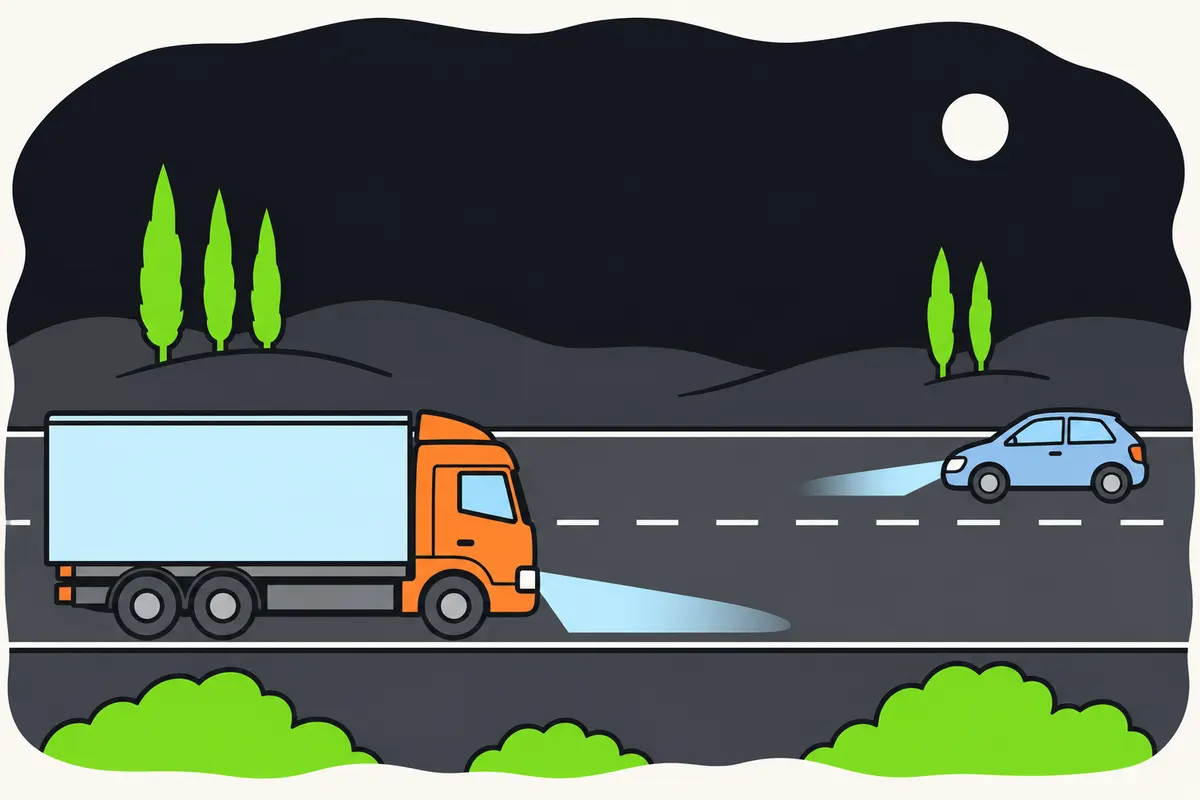
Drive within your illuminated view and dip your headlights whenever you could dazzle others.
| Main beam required above 40 km/h | Conditions |
|---|---|
| Outside built-up areas, at night | Insufficient lighting; without dazzling anyone |
| Tunnels, underpasses and S-5 stretches | Insufficient lighting, even by day; without dazzling anyone |
Remember
- At night on through-roads in built-up areas, use position lights and dipped headlights.
- Adjust your speed so you can stop within your lights’ reach.
- Switch from main beam to dipped headlights whenever you could dazzle anyone.
- Remember that you can dazzle drivers through their mirrors.
- If dazzled, slow down; stop if necessary.
- Keep windows clean and avoid strong reflections inside your cab.
Exam trap: Wrong: main beam is compulsory only at night. Right: also check insufficiently lit tunnels by day.
Read the full explanation
- Adjust your speed to the distance illuminated by your lights, taking into account the space you need to stop the lorry. A familiar road can contain an unlit vehicle, a pedestrian or a fallen load. Your eye height does not remove the difficulty of spotting dark obstacles at ground level.
- At night, you must use position lights and dipped beam on stretches of road through towns. Outside built-up areas, between sunset and sunrise, use main beam at more than 40 km/h if the road is insufficiently lit. You must also use it at any time of day, at more than 40 km/h, in insufficiently lit tunnels, underpasses and sections marked with S-5. Switch to dipped beam whenever you could dazzle anyone, including pedestrians and drivers through their mirrors. See the other circumstances in the «Lorry lights and signals» module. [RGC, arts. 100, 101 and 102](https://www.boe.es/buscar/act.php?id=BOE-A-2003-23514#a100).
- If you are dazzled, you must slow down as much as necessary, even stopping, to avoid hitting people or vehicles. Keep track of the edge of the road and your course while continuing to watch the road ahead. [RGC, art. 102](https://www.boe.es/buscar/act.php?id=BOE-A-2003-23514#a102).
- Avoid strong reflections inside the cab and keep the windows clean. If a fault reduces the lighting available, adjust your speed to the area actually illuminated and find a safe place to deal with it. [RGC, art. 107](https://www.boe.es/buscar/act.php?id=BOE-A-2003-23514#a107).
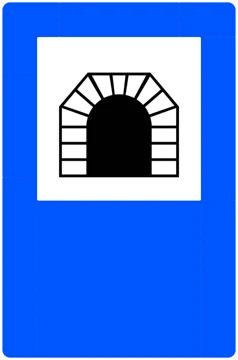 S-5
22Choose and make a safe stop
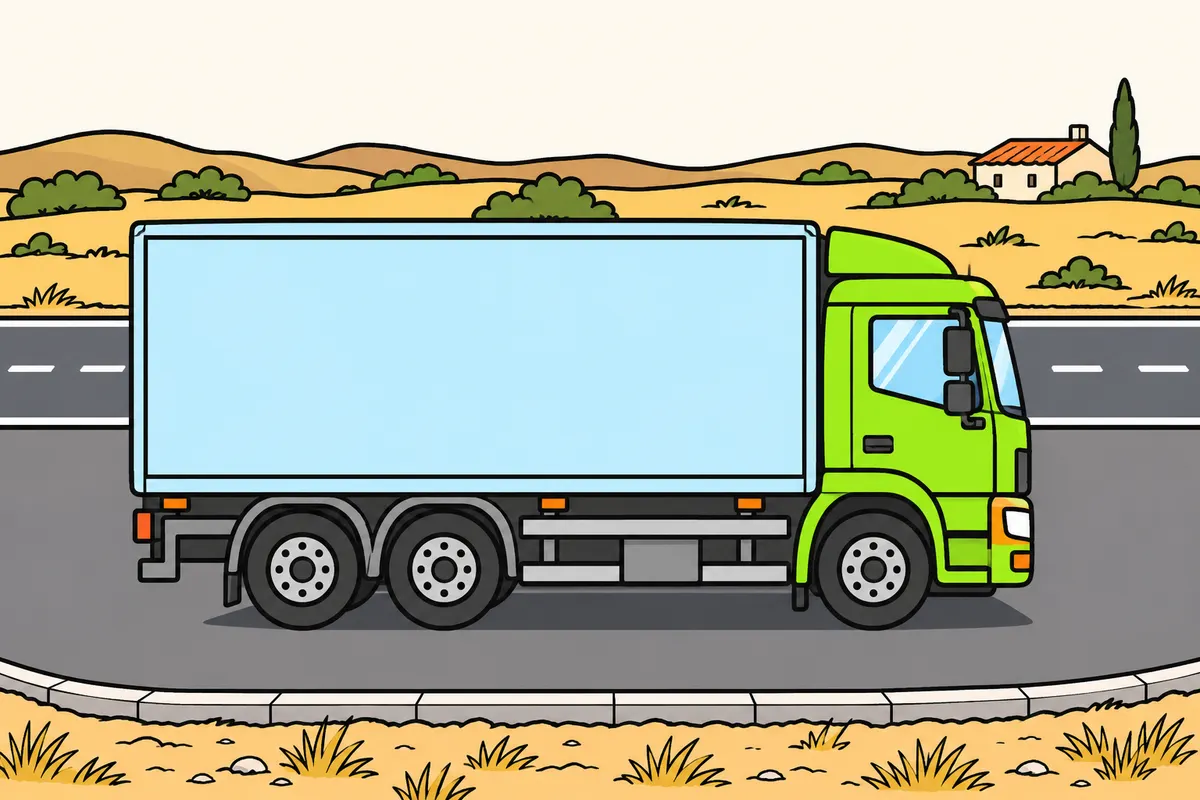
Choose a permitted place with firm ground where you can stop and leave safely.
Remember
- Check ground strength, slope and edges.
- Allow room for your whole lorry and for leaving again.
- Signal early and slow gradually.
- Watch pedestrians and cyclists beside your lorry.
- Allow for your rear end swinging out too.
Exam trap: Wrong: a hard shoulder supporting a car will support your lorry. Right: check the ground.
Read the full explanation
- Look ahead for a permitted place that can support the lorry and allows you to stop completely, get out and rejoin traffic safely. Assess the ground's load-bearing capacity, the gradient, soft edges and the space needed for the bodywork. An arcén (hard shoulder) that supports a car does not necessarily support your loaded axle.
- As you approach your stopping place, signal in good time, slow down progressively and watch for cyclists and pedestrians alongside you. Also allow for the sweep of the overhang and the space you need to pull out. [RGC, art. 109](https://www.boe.es/buscar/act.php?id=BOE-A-2003-23514#a109).
- You study permitted locations, prohibitions and signs for stopping and parking in the «Manoeuvres with a lorry» module.
23Secure your lorry on a gradient
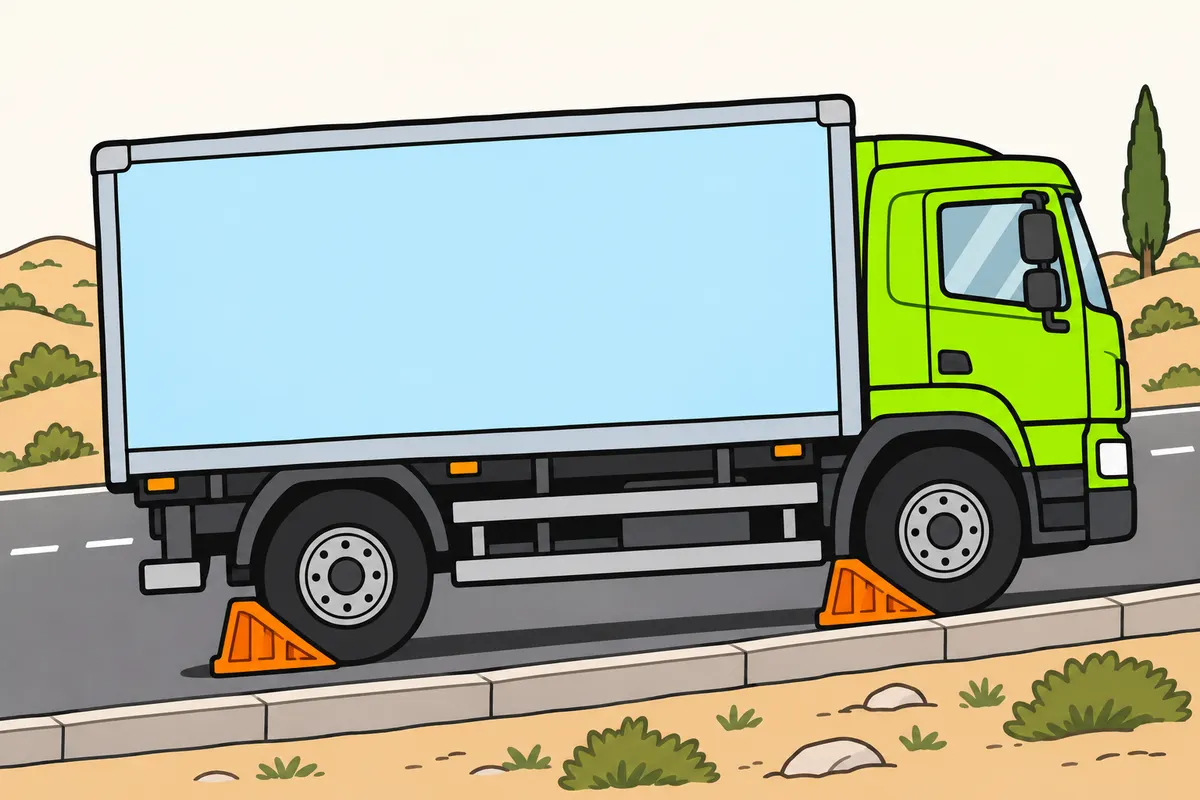
Before getting out on a gradient, check that your parking brake holds your lorry stationary.
| How you hold your lorry | What to remember |
|---|---|
| Parking brake | Holds your lorry stationary uphill and downhill without you at the controls. |
| Service brake pedal | Needs you to operate it. |
| Gear engaged | Does not replace your parking brake. |
Remember
- Check your parking brake from your seat, with your current load.
- Follow the manufacturer’s procedure.
- During the check, make sure you can still use the brake pedal.
- If your lorry moves, control it and fix the fault before getting out.
- You can also find a safe location before getting out.
- See “Secure your lorry on a gradient” in “Manoeuvres with a lorry”.
Exam trap: Wrong: get out without checking that your parking brake holds your lorry. Right: check from your seat, with your current load, following the manufacturer’s procedure. If your lorry moves, control it and fix the fault or find a safe location before getting out.
Read the full explanation
- Before leaving the cab on a gradient, check from your driving seat that the parking brake holds the lorry stationary with the load you are carrying. Follow the manufacturer's procedure and keep the service brake available to use during the check. If the vehicle starts to move, keep it under control and resolve the fault or find a safe location before getting out. [RGV, Annex VIII, section 1.2.3](https://www.boe.es/buscar/act.php?id=BOE-A-1999-1826#anviii).
- The parking brake maintains the braking force mechanically and is designed to hold the vehicle both uphill and downhill without you remaining at the controls. The service brake pedal requires your intervention; leaving a gear engaged does not replace applying the parking brake either. [RGV, Annex VIII, section 1.2.3](https://www.boe.es/buscar/act.php?id=BOE-A-1999-1826#anviii); [RGC, art. 92.3](https://www.boe.es/buscar/act.php?id=BOE-A-2003-23514#a92).
- Also follow the legally required steps for securing the vehicle and the additional measures for a significant gradient explained in «Secure your lorry on a gradient» in the «Manoeuvres with a lorry» module. [RGC, art. 92.3](https://www.boe.es/buscar/act.php?id=BOE-A-2003-23514#a92).
24Breakdowns and V-16 warning signals
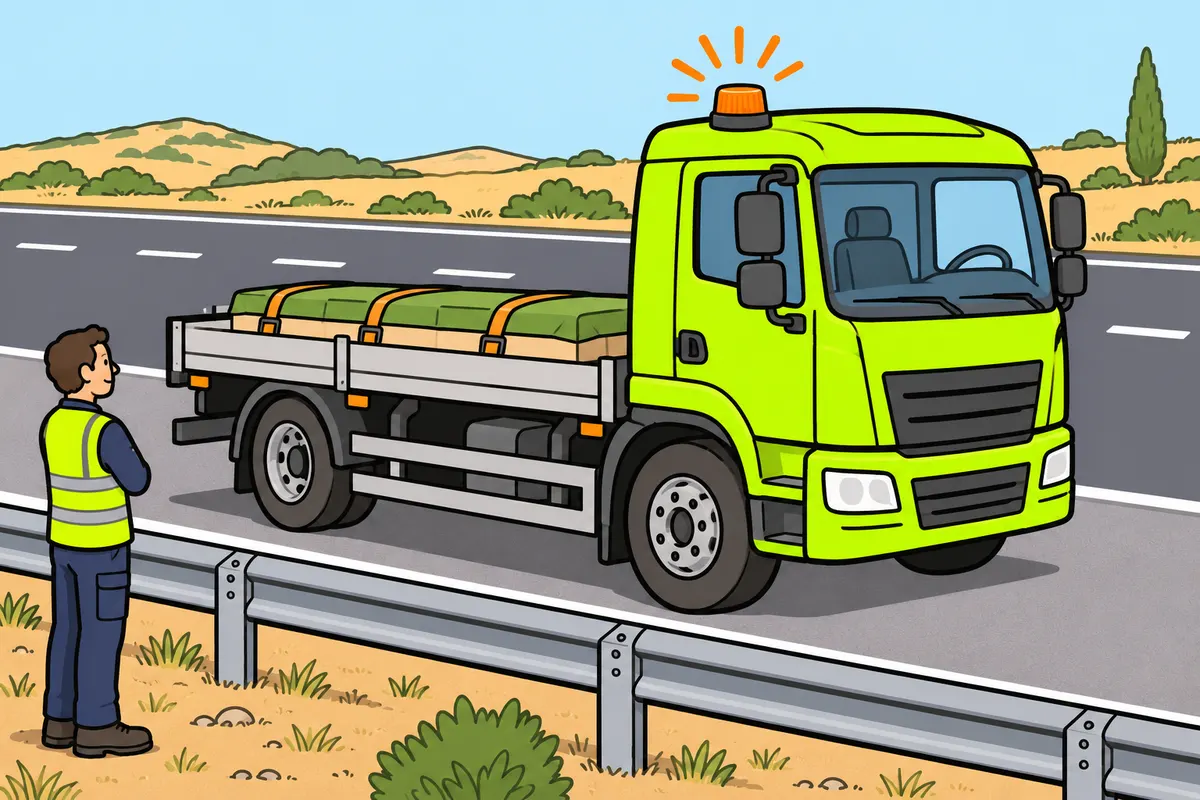
Move your lorry aside if safe and warn others without exposing yourself to traffic.
Remember
- See “Accidents, breakdowns and first aid” for how to move your lorry aside.
- See that module for V-16 features and safe positioning.
- Also check how to protect occupants and when to wear your reflective vest.
- With a damaged wheel, check where your body and axle will rest.
- Avoid soft edges that could give way under your loaded wheel.
- Tell breakdown assistance your location, the affected axle and whether you carry a load.
Exam trap: Wrong: moving the cab out of the lane is enough. Right: also check the rear corner and support beneath the axle.
Read the full explanation
- In a breakdown, decide how to move the lorry aside by following «Move the lorry aside and secure it» in «Accidents, breakdowns and first aid». [RGC, art. 130.2](https://www.boe.es/buscar/act.php?id=BOE-A-2003-23514#a130).
- See the specifications of the lorry's regulatory warning beacon in «Connected and certified V-16» in the «Accidents, breakdowns and first aid» module.
- See how to position the V-16 on your lorry in «Position the beacon without putting yourself at risk» in the «Accidents, breakdowns and first aid» module.
- Decide how to protect the occupants and when to use the high-visibility vest by following «Decide where to wait» and «Put on your high-visibility vest before getting out» in «Accidents, breakdowns and first aid». [RGC, art. 130.3](https://www.boe.es/buscar/act.php?id=BOE-A-2003-23514#a130); [RGC, art. 118.4](https://www.boe.es/buscar/act.php?id=BOE-A-2003-23514#a118).
- When assessing where to immobilise a lorry with a damaged wheel, take into account the full width of the load body and the support beneath the axle: a position where the cab is clear of the lane can still leave the rear corner in traffic. Avoid moving towards a soft edge that could give way under the loaded wheel; tell the breakdown assistance service the vehicle's location, which axle is affected and whether you are carrying a load so that it can prepare for an appropriate recovery.
25Stopping inside a tunnel
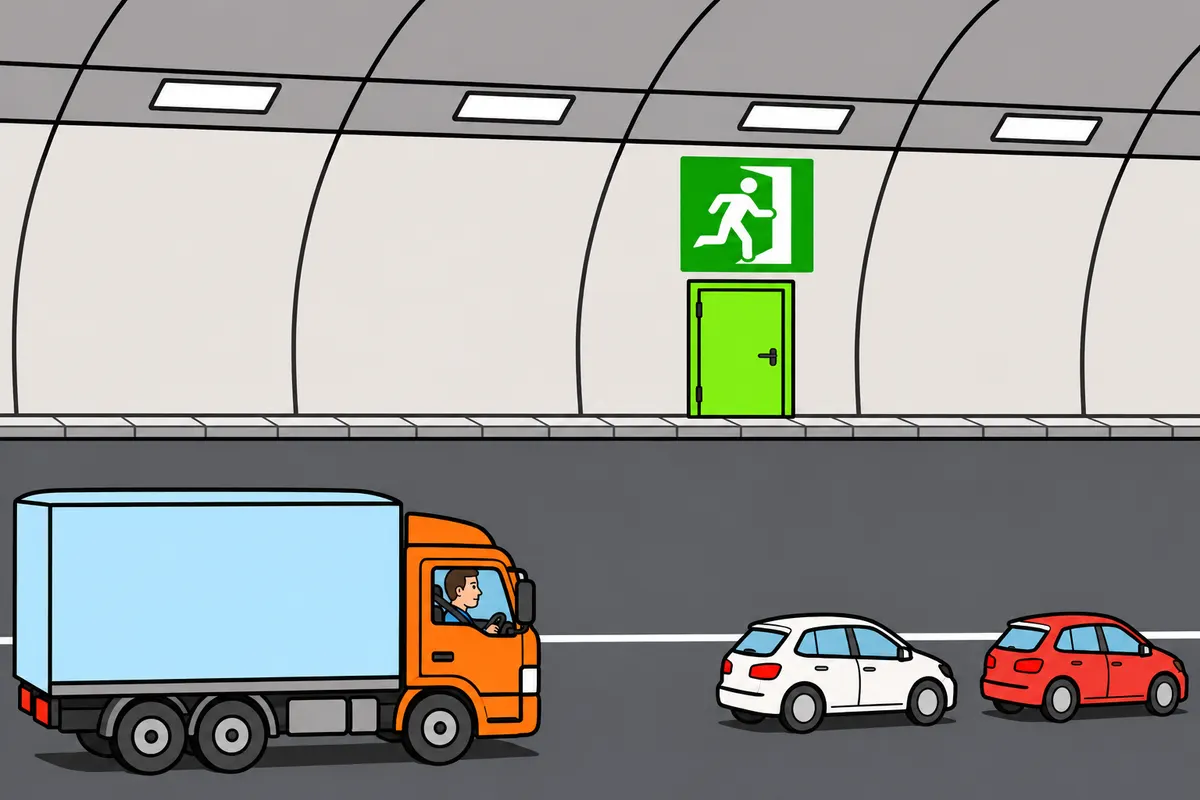
Before stopping in a tunnel, locate emergency areas and exits.
Remember
- Check the information panels before reaching a queue.
- Locate emergency areas and signposted exits.
- Your lorry’s body and other vehicles may hide exits once you stop.
- See “Accidents, breakdowns and first aid” for what to do.
Exam trap: Wrong: wait until vehicles surround you before looking for exits. Right: locate them before reaching the queue.
Read the full explanation
- Before you reach a traffic queue in a tunnel, check the information panels and locate the emergency areas and signposted exits; your lorry's length and load body can make them difficult to see once you are between other vehicles.
- Consult the separate procedures for traffic queues, breakdowns and fires in «Breakdown, fire and traffic queues in tunnels», in the «Accidents, breakdowns and first aid» module. [RGC, art. 97.3](https://www.boe.es/buscar/act.php?id=BOE-A-2003-23514#a97).
26Immobilisation on a level crossing
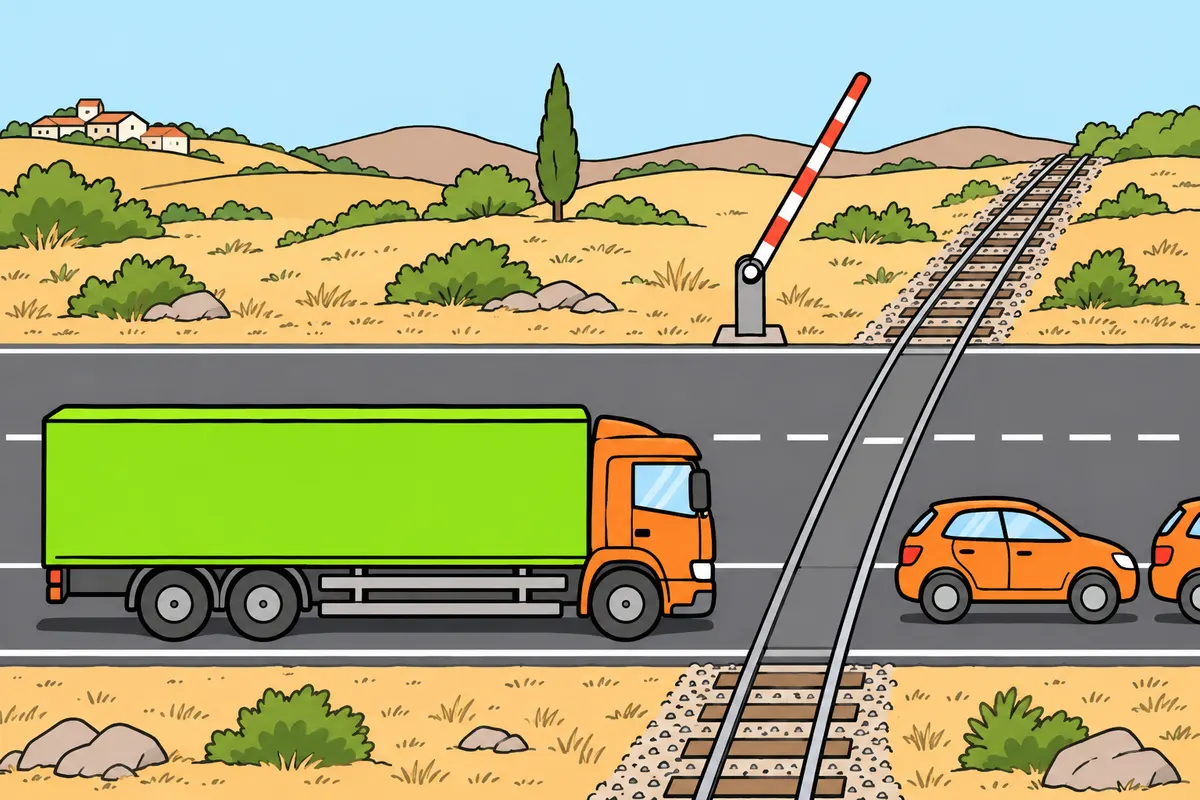
Enter only if you can clear the whole crossing, and evacuate if blocked.
Remember
- Before entering, check that your whole lorry can clear the crossing.
- Evacuate occupants quickly if circumstances beyond your control leave you stopped.
- Clear the crossing quickly, including any fallen load.
- If you cannot clear it, warn approaching train drivers and road drivers immediately.
- Take the same action on a movable bridge.
Exam trap: Wrong: wait beside your blocked lorry. Right: evacuate; warn of danger if you cannot clear the crossing.
Read the full explanation
- Before you enter a level crossing with a long or slow lorry, make sure you can clear the entire crossing: you must check that traffic or other circumstances do not force you to stop on it. [RGC, art. 95](https://www.boe.es/buscar/act.php?id=BOE-A-2003-23514#a95).
- If your lorry is brought to a standstill by circumstances beyond your control or its load falls onto the crossing, you must evacuate the occupants quickly and clear the crossing as soon as possible. If you cannot clear it, immediately take whatever measures you can to give approaching train drivers and road drivers sufficient advance warning. You must take the same action on a movable bridge in these circumstances. [RGC, art. 97](https://www.boe.es/buscar/act.php?id=BOE-A-2003-23514#a97).
Turning while monitoring the entire swept path
Check clearance on the inside, outside and above before and during the turn.
- Slow down before the turn and check the road you are entering, pedestrians and both sides.
- Anticipate the rear wheels cutting in and the overhang swinging outwards.
- Signal and use only the space you can occupy while respecting priority rules.
- Turn slowly, alternating between the view ahead and your mirrors.
- Stop if a road user enters the danger zone or you are no longer certain you have enough space.
Reversing with a banksman
Make sure the manoeuvre is permitted and maintain continuous communication.
- Confirm that reversing is permitted and determine the minimum distance you need to reverse.
- Inspect your surroundings and agree on the route and signals with someone positioned outside the swept path.
- Check that you can see the banksman, give warning of the manoeuvre and reverse slowly.
- Watch both sides and the front swinging out sideways, as well as the rear.
- Stop if you lose sight of your helper, receive unclear signals or encounter any danger.
- When you finish, secure the lorry before allowing workers to approach.
Immobilising and protecting your lorry
Secure the vehicle and protect its occupants according to the location and cause.
- Find a safe place where stopping is permitted; if you break down, move the lorry as far out of the way as possible without making the fault worse.
- Apply the parking brake, select the appropriate gear or transmission position and use additional securing measures on a significant gradient.
- If you break down, switch on the hazard warning lights and the connected V-16; keep the position lights and end-outline marker lamps on where required.
- Place the beacon in an accessible, visible position outside the vehicle without exposing yourself to traffic.
- Assess whether to leave for a safe place off the road platform or remain inside with your seat belt fastened if getting out is dangerous.
- In a tunnel, distinguish between a traffic queue, a breakdown and a fire, and follow the specific procedure.
- If you block a level crossing, evacuate, try to clear it and, if you cannot, warn train drivers and road drivers immediately.
Check what you know
Real questions from the bank on this topic. Pick an answer to see the explanation.
Finished this module?
Mark it as read and you will see your progress on the theory list.