Step 1. The big picture
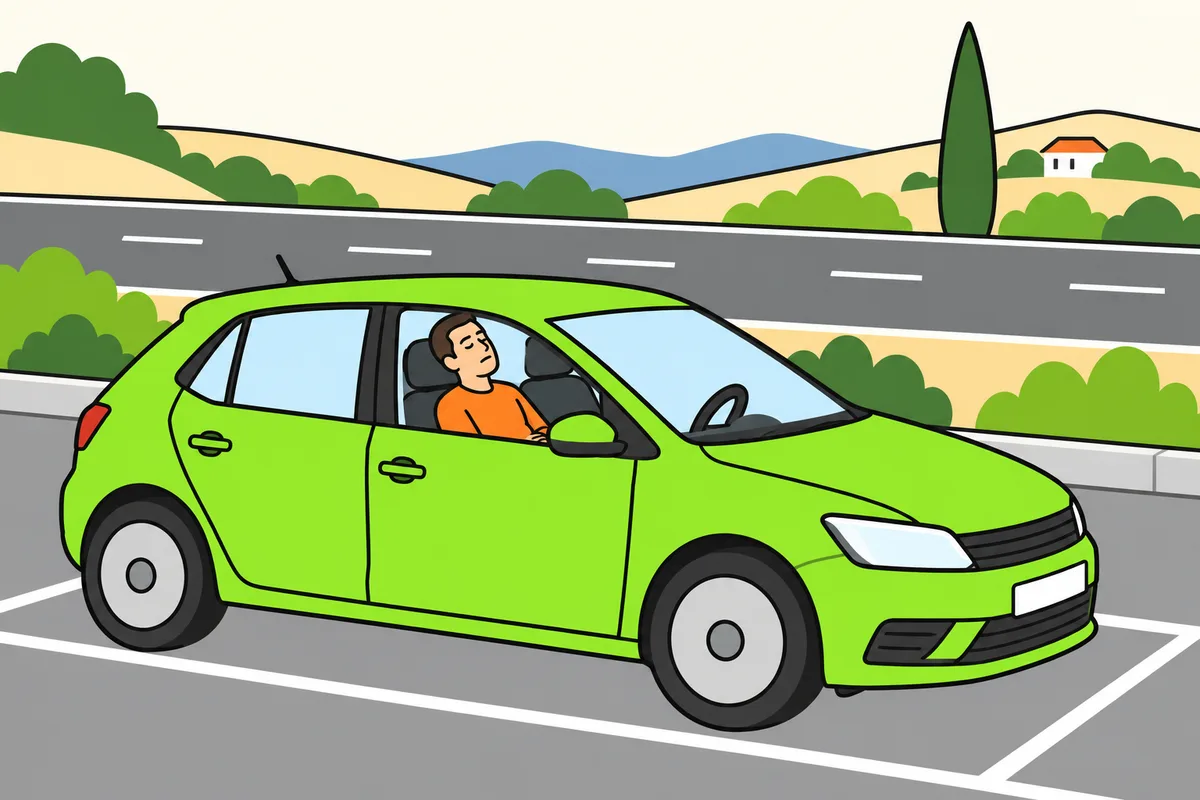
In one sentence…
Risk factors are studied as a real cause of error: alcohol, drugs, speed, distraction, fatigue, adverse weather and overconfidence. In passenger cars on roads open to general traffic their effects tend to multiply, which is why the exam insists on anticipating and correcting before you lose control.
Step 2. The syllabus
2.1Alcohol and drugs
The law does not only penalise obvious intoxication: it also penalises exceeding the legal limits or driving with drugs present in your system.
- Novice drivers during their first two years, and certain professional transport drivers, have stricter alcohol limits than everyone else.
- Alcohol reduces attention, reflexes, vision and judgement even if the driver feels capable. In the exam, that false sense of security is often part of the trap.
- With drugs, don't focus the answer only on visible symptoms. Their presence in the body and the resulting impairment of ability make driving a punishable risk.
2.2Medication and psychophysical state
Medication that reduces reflexes, vision or attention requires reading the leaflet, avoiding driving where appropriate, and never offsetting the risk with overconfidence.
- Not all medicines affect you the same way, but the driver must check the warnings and act with caution. Responsibility does not disappear just because the treatment is legal.
- In exam questions, the correct option is usually to seek advice, read the instructions and not drive if there are effects that compromise control or alertness.
- Psychophysical state includes fatigue, illness, intense emotions and lack of rest. If they affect your attention, you must reduce risk or postpone the journey.
2.3Distraction at the wheel
Holding your phone, programming the sat nav while moving, or looking away from the road for a few seconds is enough to cover many metres blind.
- Distraction isn't always technological. Intense conversations, searching for objects, eating, smoking or looking at an incident also take your mind and eyes off driving.
- The exam often presents small distractions because they seem normal. The safe answer is to prepare before setting off and to stop if you need to handle something.
- A repeated distraction becomes a dangerous habit. If you don't see something in time, you can't apply priority, distance or signs, even if you know the rule.
2.4Speed and distance
Incorrect speed is not only exceeding the limit: it is also driving within the limit but without adapting your speed to rain, traffic, visibility or grip.
- Safe distance must allow you to stop without a collision, and it increases if the vehicle is heavy, articulated, two-wheeled, or driving in unfavourable conditions.
- The higher the speed, the less time to interpret signs and the more space you need to stop. That's why the DGT links speed, attention and distance in many questions.
- Don't use the vehicle in front as a fixed reference point to hug. Keeping a margin lets you spot braking, obstacles and other road users' mistakes without a sharp reaction.
2.5Fatigue and drowsiness
Drowsiness reduces alertness, lengthens reaction time and increases the chance of running off the road, rear-end collisions and lapses of concentration on monotonous routes.
- Warning signs are usually yawning, frequent blinking, involuntary changes in speed, difficulty remembering the last few kilometres and the need to correct your course.
- The only safe response to fatigue is to stop, rest and continue only once your control abilities have fully recovered.
- Opening the window, turning up the music or relying on habit does not fix drowsiness. In the exam, these apparent solutions are usually incorrect.
2.6Adverse weather
With rain, fog, ice, wind or glare, you must reduce speed, increase distance, smooth out your manoeuvres and use the correct lights from the first sign of risk.
- Weather changes grip and visibility at the same time. The risk isn't fixed just by turning on lights if you keep an inadequate speed or distance.
- Crosswind, a wet road surface or poor visibility require you to anticipate unexpected movements from other road users and avoid sharp turns, braking or acceleration.
- When the question mentions unfavourable conditions, look for answers that stack up caution: more margin, less abruptness, better visibility and constant attention.
2.7Preventive management
Risk perception improves when you anticipate junctions, pedestrians, vulnerable road users, merging traffic, school zones, roadworks and changes in grip before you reach them.
- Overconfidence appears when you mistake experience for invulnerability. Knowing how to drive does not cancel out alcohol, fatigue, phones, speed or bad weather.
- Before every journey, check whether you're fit to drive and whether the road demands more margin. This decision is also part of safe driving.
- In the B theory test, with 30 questions and a maximum of 3 errors, these topics pay off because they repeat in different scenes with the same preventive principle.
2.8Alcohol limits and boundaries
For most drivers, including an ordinary driver of a goods vehicle up to 3,500 kg, the legal threshold is 0.25 mg/l in exhaled air or 0.5 g/l in blood. During the first two years after obtaining the licence, it is 0.15 mg/l or 0.3 g/l.
- The lower threshold also applies to goods vehicles over 3,500 kg and to the listed passenger, public-service, school/children, dangerous-goods, emergency and special-transport services. The vehicle or service facts in the question matter.
- These are legal thresholds, not a safe alcohol allowance, and they are not calculated from drink units. Do not use a drink-to-BAC calculator to decide to drive: the safe decision is zero alcohol.
Step 3. Key points
If you only have a minute before the exam, revise this.
- 1.Identify risks that affect attention, vision or reaction time.
- 2.Don't drive under the influence of alcohol, drugs or incompatible medication.
- 3.Adapt speed and distance to your physical state, the road and grip.
- 4.Set up your phone, sat nav and belongings before setting off.
- 5.Stop at the first signs of drowsiness or fatigue.
- 6.Increase your margin in rain, fog, ice, wind or glare.
- 7.Don't normalise small, repeated distractions.
- 8.Question overconfidence even if you have experience.
Step 4. Exam traps
Mistakes the DGT uses again and again on this topic.
- Thinking that as long as you don't exceed the speed limit, you're always driving correctly.
- Reducing risk to alcohol alone and forgetting medication, fatigue or distraction.
- Believing experience removes the need to adapt distance and speed.
- Accepting false solutions against drowsiness, such as music, air or willpower.
- Handling the sat nav while moving because it seems like a brief action.
- Ignoring that unfavourable conditions require combining several preventive measures.
Step 5. Quick check
Four real exam questions on what you have just read.
What is the time that elapses from the recognition of a hazard to the start of the reaction called?
Step 6. Frequently asked questions about factors that impair driving ability
- As a usual guide, when does blood alcohol concentration tend to reach its maximum after drinking?
- From 30 to 90 minutes after consuming the alcoholic drink. It usually peaks between 30 and 90 minutes after drinking. This describes absorption and blood alcohol concentration, not the driver’s reaction time or a period when drinking is harmless. Timing varies with factors including amount, drinking rate and food. Effects may begin before the peak and persist afterwards; feeling recovered or waiting a fixed interval does not guarantee fitness to drive. The safe choice is not to drink if you will drive.See full question
- How does cannabis affect driving?
- It increases drowsiness. Cannabis has a serious effect on altering perception, with distortion in space-time sensations and attenuation of attention and self-control, causing an increase in the driver's reaction time and drowsiness. It will also decrease their level of attention and concentration.See full question
- A tired driver...
- reacts later to any danger. Fatigue reduces attention and increases reaction time, so a driver may take longer to detect a hazard and respond. It also promotes distraction; it does not improve caution or guarantee timely reactions. If symptoms occur, stop somewhere permitted and safe and rest; do not resume while they persist. If you are sleepy, you need sleep: music, open windows or coffee do not replace needed sleep.See full question
- Can a respiratory allergy reduce the ability to maintain concentration in traffic?
- Yes. Among the various negative symptoms affecting the driving of a driver with allergies, their ability to maintain concentration in traffic and on the road decreases when symptoms such as sneezing, drowsiness, or a reduced ability to react appear.See full question
- What effect may a cold, or some medicines used to relieve it, have on driving?
- It may impair concentration and cause drowsiness. Cold symptoms may make concentration harder, and some treatments may cause drowsiness. Effects vary with the person and medicine; every cold does not require treatment by a specialist before driving. Read the leaflet and consult a healthcare professional, and do not drive if symptoms or treatment impair your ability.See full question