Requirements and minimum age for the B+E license
The B+E license is designed for car with a heavy trailer or caravan and has a minimum age of 18 years. Before enrolling, confirm that this is the category you actually need, because many mistakes start with preparing for a license that does not cover the real vehicle you want to drive.
Beyond age, you must pass the medical check at an authorized center, prepare the relevant theory, and pass the practical part. If the license requires a valid B license or family consent because you are underage, sort that out before paying enrolment so your application is not blocked.
Keep a copy of the requirements that apply to you and review them before booking the exam. It sounds administrative, but it can prevent losing weeks because of an expired certificate, pending authorization, or the wrong category choice.
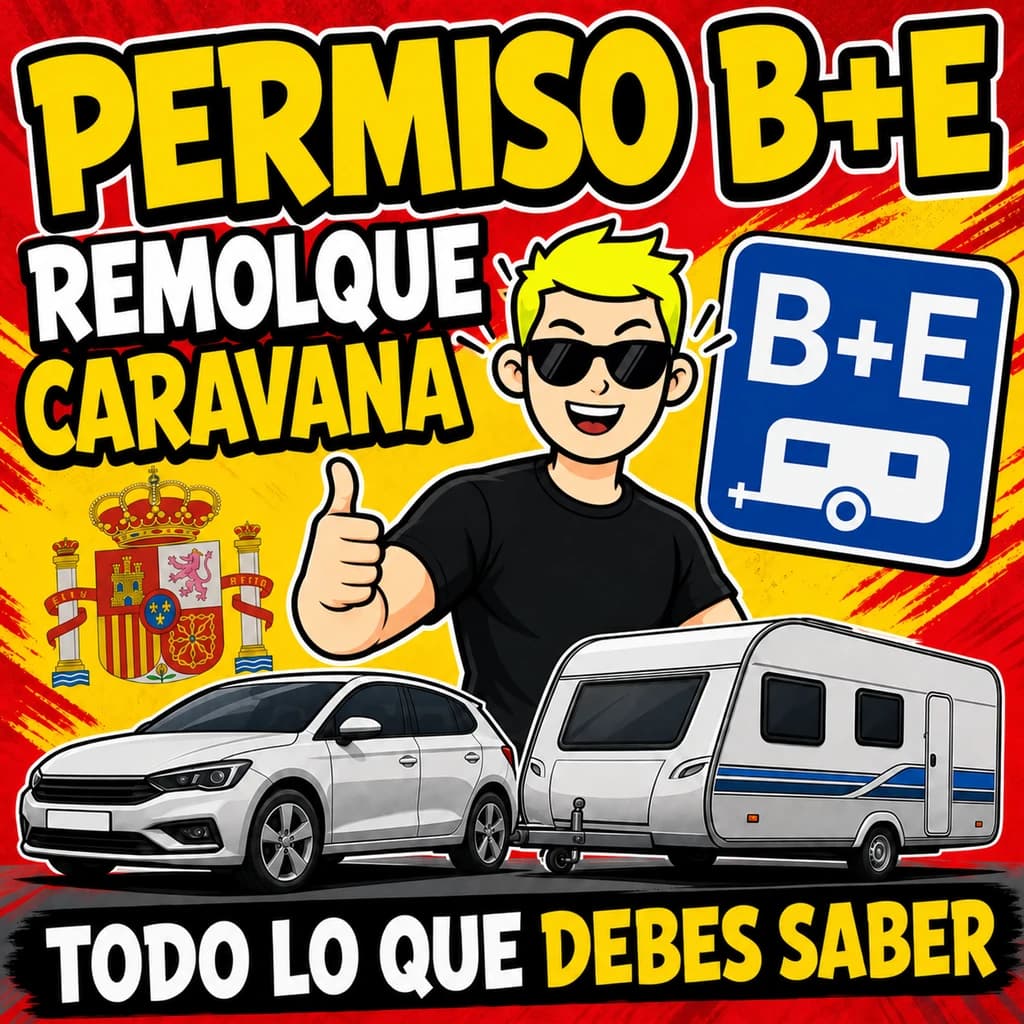
What vehicles you can drive with B+E
The main authorization covers a B-category towing vehicle with a trailer or semi-trailer up to 3,500 kg MAM. In practical terms, the license works when the vehicle fits those technical limits, not simply when the commercial name sounds right.
It may also include combinations that may exceed 4,250 kg total MAM and non-light trailers or semi-trailers within B+E limits. Always check the vehicle documents, MAM, power, or vehicle type when there is any doubt, because the license applies by category and limits, not by intuition.
When comparing vehicles, look at the technical data and not only at everyday use. Two similar vehicles may require different licenses because of weight, power, seats, trailer, or professional purpose.
What this license does not cover
The B+E license does not cover C trucks, C+E combinations, D buses, or any trailer or weight beyond the vehicle documents and category limits. This matters because many license searches mix similar vehicles, trailers, passengers, or professional uses.
If your case is close to the limit, do not improvise: take the vehicle documents to the driving school or check with DGT before driving. Studying that difference also helps in the exam, because questions often use scenarios with weights, seats, power, or road type.
This limit also protects you from penalties and from buying incomplete training. If you know from the start what is outside the license, you can decide whether you need another permit now or whether this one is enough for your immediate goal.
How the theory and practical exams work
Theory preparation is organized around the B+E specific theory test on combinations: 20 questions, a maximum of 2 mistakes, and 20 minutes. Study the rule first and then take full tests; that way you do not turn learning into memorising isolated answers without understanding the traffic situation.
The practical part consists of a practical manoeuvring test with the combination, including coupling, uncoupling, reversing, path control, and safety while braking or turning. During lessons, ask for specific corrections: observation, road position, anticipation, braking, use of controls, and safety before each manoeuvre. That list is more useful than only counting how many lessons you have taken.
For theory, work by topic blocks and finish with full mock exams. For practice, ask to rehearse situations that resemble the test: starts, merging, turns, direction changes, stops, manoeuvres, and awareness of the surroundings.
Estimated costs and how to compare driving schools
The price depends on trailer type, availability of the combination, manoeuvre practice, and school management. Budget for the medical test where applicable, fees, and lessons; one practical lesson may be around EUR 30-50 as a general reference, but the number of sessions varies a lot.
To compare properly, ask for a breakdown: enrolment, materials, administration, fees, medical test, lesson price, real lesson duration, vehicle use for the exam, and renewal or retake costs. The cheapest option at the start may not be cheapest if it hides items or if lessons are shorter.
Also write down what each payment includes and what happens if you fail. Knowing the price of a new fee, another lesson, exam vehicle use, or file renewal lets you estimate the real cost without surprises.
Common mistakes and first-attempt study tips
The most dangerous mistake is looking only at trailer weight and ignoring the full combination, MAM, towbar, load, and vehicle documents. Many learners also struggle when reversing: the trailer turns opposite to the steering wheel and requires small movements.
A reasonable plan is to alternate theory, tests, and mistake review from the first week. When you miss a question, write down the exact reason: you did not know the rule, read too fast, confused a sign, or missed the key detail. That review prevents repeated mistakes on the official day.
Before taking the exam, review your latest mistakes and look for patterns. If most come from reading too fast, train calm reading; if they come from one rule, return to the theory; if they come from practice, ask for one lesson focused only on that manoeuvre.
When do I need B+E instead of only B?
You need it when the B vehicle and trailer combination no longer fits within B limits. B+E covers a trailer or semi-trailer up to 3,500 kg MAM with a B-category towing vehicle.
What should I check before driving with a trailer?
Check towbar compatibility, electrical cables, parking brake, rear trailer lights, safety chains or cables, and load distribution. On a slope, use wheel chocks when uncoupling.
Why does driving change so much?
Because the additional weight increases stopping distance, reduces stability under abrupt movements, and can cause a jackknife effect if you brake hard in a bend. Anticipation matters more than correcting late.
Also practise the pre-drive check as a fixed routine, not something you do only on exam day. With a trailer, a disconnected light or poorly placed load can turn a simple trip into a real risk.