Requirements and minimum age for D+E
The D+E License - Bus with Trailer belongs to the passenger-transport license family. To start, you need to hold the relevant previous license: holding a valid D license. The configured minimum age for this category is 24, and you must pass a medical examination suitable for the type of driving you will do.
These licenses carry more responsibility than driving a car, because the exam is aimed at passenger safety, accessibility, evacuation, documentation, and smooth driving. If your goal is work, also check the professional requirements that may apply before choosing a driving school or schedule.
What vehicles you can drive
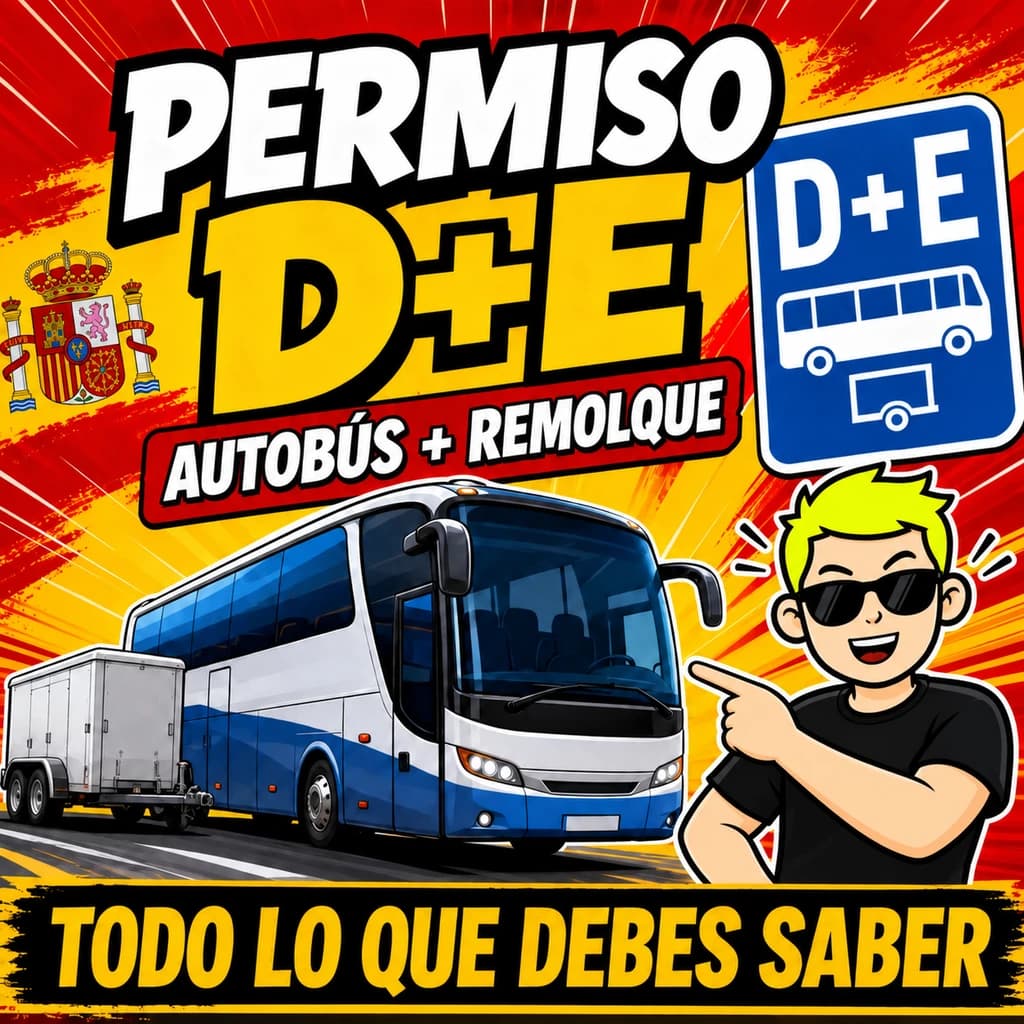
D+E authorizes a D bus with a trailer over 750 kg MAM. This is the short answer to "what can I drive with D+E", but read it carefully because passenger count, length, trailer mass, and the base license change the category.
It is the trailer extension for category D, designed for passenger combinations where the towing vehicle is a D-category bus. In passenger transport, vehicle size alone is not enough. A minibus, a bus, and a combination with a trailer may all look professional, but each one can require a different entitlement. Always check seats, length, and trailer mass before enrolling.
What this license does not authorize
The D+E trailer cannot be used for passenger transport, and the license does not replace C+E for goods transport. This limitation matters because it prevents using a passenger license for a combination that does not fit, or for a trailer intended to carry passengers. When a trailer appears in these categories, it does not turn the combination into a free extension of passenger capacity.
Also, do not confuse the driving license with every obligation of a professional service. Passenger transport may involve CPC, tachograph duties, driving and rest times, attention to people with reduced mobility, and service-specific rules.
How the theory and practical exams work
Theory preparation focuses on the specific test for passenger combinations with trailers. The preparation reference uses 20 specific questions, a maximum of 2 errors, and 20 minutes. Common topics include passenger safety, accessibility, driver responsibility, driving and rest times where applicable, and passenger-transport rules.
The practical test is taken with a D-category bus and trailer combination. In the practical test, stable, anticipatory, and comfortable driving for occupants matters. Practise progressive braking, wide turns, observation at stops, correct mirror use, and space management, especially if the vehicle is long or tows a trailer.
When preparing for the exam, connect each question to a real situation: passengers boarding and leaving, visibility at stops, behaviour in curves, and reaction to an emergency. This way of studying helps more than memorising isolated answers, because the examiner is looking for safe-driving judgement.
Indicative costs and budgeting
The cost depends on province, driving school, current fees, vehicle used, and the number of lessons needed. As an allowed reference, the medical test is usually around 35-60 EUR and a general practical lesson may be around 30-50 EUR, although passenger or trailer categories may have different prices depending on the school.
Ask for a separated budget: enrolment, material, medical certificate, exam fees, practical lessons, and possible renewals. Also ask whether the price changes for a minibus, bus, or trailer combination, and whether lessons include real traffic or only manoeuvre preparation.
Common mistakes and tips to pass
Many failures come from studying isolated questions without understanding the logic of carrying people. In D+E, the priority is anticipating risks to passengers: falls, harsh braking, evacuation, accessibility, doors, stops, and the behaviour of the loaded vehicle.
During practice, avoid driving as if you were alone. Smoothness matters: accelerate, turn, and brake with seated or standing passengers in mind depending on the service. After each lesson, ask for specific correction on observation, lane position, distance, and control of the vehicle's size.
A good routine is to alternate theory and practice: first study the topic, then look for it during the lesson, and finally correct the test with real examples. That turns the license from a list of rules into concrete decisions behind the wheel.
Do I need another license first?
Yes. For this category, the stated previous license is holding a valid D license. If you do not hold it validly, the process should not start with D+E; first regularise or obtain the base license required by the category.
If you come from another professional license or have an older situation, confirm your case with the driving school or DGT. Exemptions or equivalences should not be assumed from work experience or from having driven similar vehicles.
How many questions are on the specific exam?
The reference for this category is 20 questions, a maximum of 2 errors, and 20 minutes. The content is not limited to signs: it includes passenger safety, accessibility, responsibilities, documentation, and vehicle behaviour.
Use timed mock exams once you control the base topics. If you keep failing passenger, tachograph, rest-time, or trailer questions, isolate that block and study it before repeating another full test.
Can I use it to work carrying passengers?
For professional passenger transport, check CPC, tachograph duties, driving and rest times, and continuing training where applicable. The license authorizes driving within its category, but professional work may require more elements. In passenger transport, CPC and continuing training may be relevant depending on the service and applicable rules.
Before accepting an offer, check what vehicle you will use, how many seats it has, whether it tows a trailer over 750 kg, and what documents the company asks for. That check avoids preparing a license that falls short for the real job.