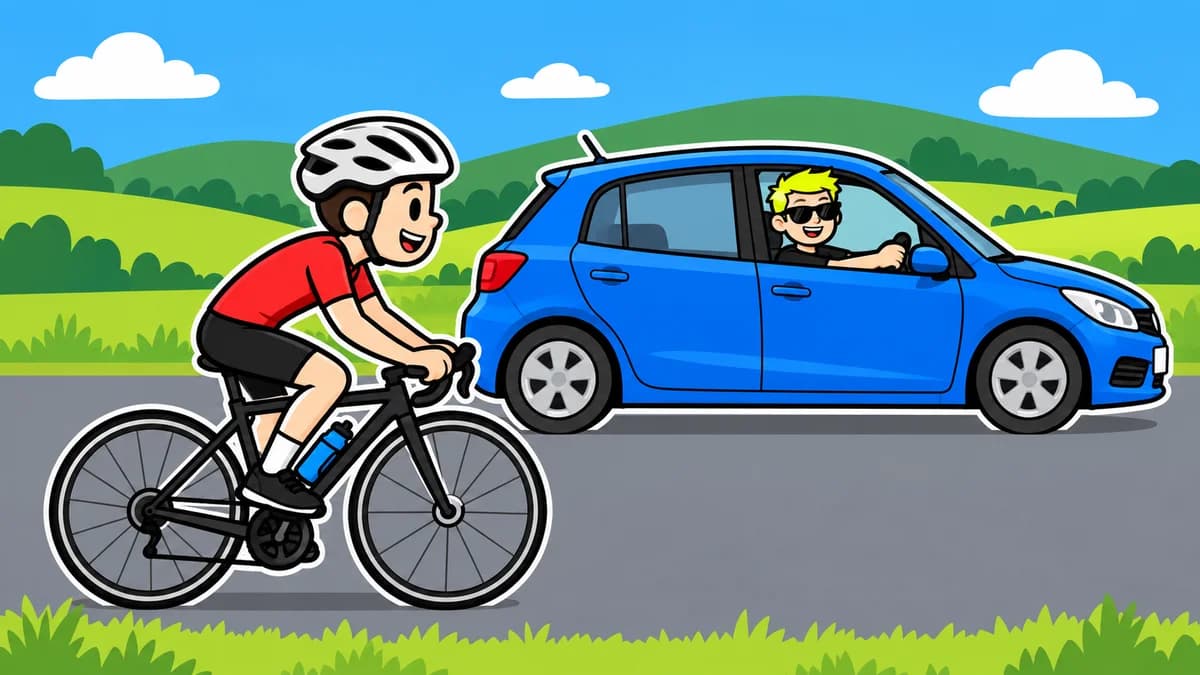
Which side to overtake on
- As a general rule, overtake on the left. (art. 82.1)
- Exceptionally, with enough space, you may overtake on the right if the vehicle ahead clearly signals a left turn or a stop on that side, or when passing a tram running in the centre of a two-way road. (art. 82.2)
- Inside built-up areas, on carriageways with at least two lanes in the same direction marked by longitudinal lines, you may overtake on the right if it is safe. (art. 82.3)
- With two or more lanes in your direction, you may stay in the overtaking lane for another overtake if you do not hinder faster vehicles behind. (art. 83)
- In dense traffic filling all lanes, one lane moving faster than another is not overtaking, and you must not change lane to overtake. Faster progress in acceleration, deceleration or reserved lanes is not overtaking either. (art. 83)
Before and during the overtake
- Signal every overtake involving a lateral move in advance and check that the lane is clear for enough distance to avoid endangering or hindering oncoming traffic. (arts. 84 y 109)
- Do not overtake several vehicles unless you are sure you can return to your lane. On two-way roads with three lanes and broken lines, only overtake if oncoming drivers are not using the centre lane. (art. 84)
- Respect the vehicle ahead that has already signalled the same move: after a prudent time you may overtake, warning with the horn or lights. Never overtake a vehicle that is already overtaking if doing so means entering the opposite side of the road. (art. 84)
- Check that nobody behind has started to overtake you and that you have room to return to your lane. (art. 84)
- During the manoeuvre, travel at a clearly higher speed than the vehicle being overtaken and leave enough lateral space. If a risk arises, slow down, return to your lane and signal. (art. 85)
- Return to your lane as soon as possible, gradually and with a signal. (art. 85)
- When overtaking pedestrians, animals, animal-drawn vehicles, mopeds, personal mobility vehicles or cyclists, occupy part or all of the adjacent or opposite lane and leave at least 1.5 metres. With more than one lane per direction, change lane completely. Do not endanger or hinder oncoming traffic, even on the hard shoulder. Outside built-up areas, reduce speed to at least 20 km/h below the road limit before and during the overtake. (art. 85.4)
Where overtaking is banned
- On bends and crests with reduced visibility and anywhere visibility is insufficient, unless the directions are clearly separated and you do not enter the opposite side. Overtaking behind a vehicle that is overtaking is also banned if its size blocks your view. (art. 87.1.a)
- At marked pedestrian crossings, junctions with cycle lanes and level crossings, and near them. (art. 87.1.b)
- At junctions and near them, with the four exceptions listed below. (art. 87.1.c)
- In tunnels, underpasses and stretches marked with the ‘Tunnel’ sign (S-5) where there is only one lane in your direction. (art. 87.1.d)
Exceptions at junctions
- At roundabouts. (art. 87.1.c.1º)
- When overtaking on the right is permitted by art. 82.2. (art. 87.1.c.2º)
- When your road has priority at the junction and a sign says so. (art. 87.1.c.3º)
- When overtaking two-wheeled vehicles. (art. 87.1.c.4º)
Can you overtake on a roundabout?
The junction overtaking ban in art. 87.1.c does not apply to roundabouts (art. 87.1.c.1º). The general duties in arts. 84–85 and any road markings or signs still apply. RGC
Overtaking cyclists
When overtaking pedestrians, animals, animal-drawn vehicles, mopeds, personal mobility vehicles or cyclists, occupy part or all of the adjacent or opposite lane and leave at least 1.5 metres. With more than one lane per direction, change lane completely. Do not endanger or hinder oncoming traffic, even on the hard shoulder. Outside built-up areas, reduce speed to at least 20 km/h below the road limit before and during the overtake. (art. 85.4)
- When passing a vehicle stopped for a breakdown, accident, emergency, maintenance or traffic duties that occupies your lane, leave at least 1.5 metres, even when using the opposite side, and reduce speed to at least 20 km/h below the limit. (art. 88.1)
- Where overtaking is banned, you may pass an immobilised vehicle unless it is stopped because of traffic conditions. With the same care, you may pass cyclists, mopeds, personal mobility vehicles, pedestrians, animals, animal-drawn vehicles and agricultural special vehicles when their speed allows you to do so without risk. (art. 88.2)
When you are being overtaken
- Keep to the right edge, or the left edge when turning left or stopping on that side. Do not speed up or obstruct the overtake. (art. 86)
- Slow down if danger arises, unless the overtaking driver clearly gives up. Heavy, large or speed-restricted vehicles must slow down or move onto a usable hard shoulder to let others pass. (art. 86)
Fines and points
- Overtaking offences are serious: a fine of EUR 200. (Ley de Tráfico, arts. 76.c, 80.1)
- 4 points for overtaking while endangering or hindering oncoming traffic, or where visibility is reduced. (Ley de Tráfico, anexo II.11)
- 6 points for overtaking while endangering or hindering cyclists, or without leaving the minimum 1.5-metre gap. (Ley de Tráfico, anexo II.12)
The former +20 km/h overtaking allowance in art. 51 no longer exists since 21 March 2022 (repealed by Ley 18/2021). (art. 51 (derogado / repealed))
Frequently asked questions
- Can you overtake on the right in Spain?
- As a general rule, overtake on the left. (art. 82.1) Exceptionally, with enough space, you may overtake on the right if the vehicle ahead clearly signals a left turn or a stop on that side, or when passing a tram running in the centre of a two-way road. (art. 82.2) Inside built-up areas, on carriageways with at least two lanes in the same direction marked by longitudinal lines, you may overtake on the right if it is safe. (art. 82.3)
- Can you overtake on a roundabout?
- The junction overtaking ban in art. 87.1.c does not apply to roundabouts (art. 87.1.c.1º). The general duties in arts. 84–85 and any road markings or signs still apply.
- Can you overtake at a level crossing?
- Overtaking is banned at marked pedestrian crossings, junctions with cycle lanes and level crossings, and near them. (art. 87.1.b)
- How much space must you leave when overtaking a cyclist?
- When overtaking pedestrians, animals, animal-drawn vehicles, mopeds, personal mobility vehicles or cyclists, occupy part or all of the adjacent or opposite lane and leave at least 1.5 metres. With more than one lane per direction, change lane completely. Do not endanger or hinder oncoming traffic, even on the hard shoulder. Outside built-up areas, reduce speed to at least 20 km/h below the road limit before and during the overtake. (art. 85.4) Where overtaking is banned, you may pass an immobilised vehicle unless it is stopped because of traffic conditions. With the same care, you may pass cyclists, mopeds, personal mobility vehicles, pedestrians, animals, animal-drawn vehicles and agricultural special vehicles when their speed allows you to do so without risk. (art. 88.2)
- Can you overtake in a tunnel?
- Overtaking is banned in tunnels, underpasses and stretches marked with the ‘Tunnel’ sign (S-5) where there is only one lane in your direction. (art. 87.1.d)
- How many points do you lose for dangerous overtaking?
- 4 points for overtaking while endangering or hindering oncoming traffic, or where visibility is reduced. (Ley de Tráfico, anexo II.11) 6 points for overtaking while endangering or hindering cyclists, or without leaving the minimum 1.5-metre gap. (Ley de Tráfico, anexo II.12)
Practise what you just read
Ten DGT exam questions, free and with no sign-up: you will see where you slip and what to review.
Also worth reviewing