Step 1. The big picture
In one sentence…
Study the rules specific to the A1 licence: limits on the authorised vehicle, requirements for carrying a passenger and load, and safety rules specific to motorcycles on urban and interurban roads. Knowing what you can ride and under what conditions avoids many exam mistakes.
Step 2. The syllabus
2.1What the A1 licence authorises
The A1 licence authorises motorcycles up to 125 cc and 11 kW (15 hp) of power, with a maximum power-to-weight ratio of 0.1 kW/kg, plus motor tricycles up to 15 kW.
- You must know the technical limits of engine size, power and power-to-weight ratio that define your class, because these are the reference the exam uses to decide whether a vehicle is authorised.
- Excess power or an unauthorised modification makes riding unauthorised even if the vehicle looks similar to one you can legally ride.
- Equivalences or upgrades between licences don't remove the need to respect the exact category of the vehicle you're riding at any given time.
2.2Age and access to the licence
The minimum age for the A1 licence is 16, and if you're under 18 you need your parents' or guardians' consent to obtain it.
- After two years' experience with the A1 you can move up to the A2 licence by taking the corresponding practical test, a detail the exam often asks about.
- Knowing the access requirements helps you avoid confusing what your licence authorises with what higher classes authorise.
2.3Road and passenger rules for A1 riders
The A1 licence does not impose an under-18 ban on motorways or dual carriageways; a motorcycle may use those roads when the general road and vehicle rules allow it.
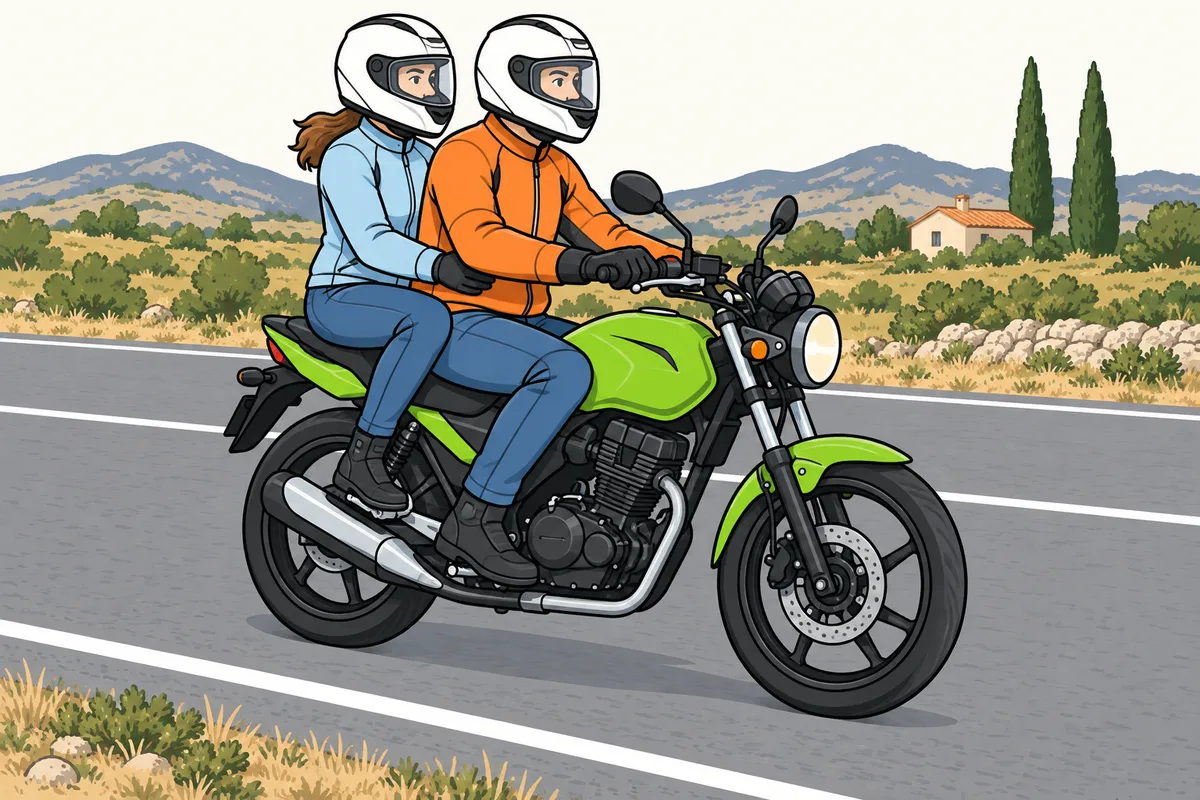
- The A1 licence does not generally prohibit carrying a passenger because the rider is under 18. A passenger may travel when the motorcycle is authorised for it and the general age, seating and helmet requirements are met.
- Check that the motorcycle is approved for passenger transport and that the passenger age, seating and helmet requirements are met.
2.4Passengers, load and conditions of use
A passenger may only travel when the vehicle is fitted for it and the conditions for the seat, footrests and approved helmet are met.
- A motorcycle with a sidecar remains a motorcycle for category purposes: apply the A1 technical limits and check that the registration permits passenger transport.
- Load must be well secured and within the authorised overhang; a motorcycle is not a vehicle designed to carry weight however you like.
- A badly distributed load alters balance and braking, so securing it correctly is both a legal matter and a matter of real safety.
2.5Rules applied to safety
The law requires permanent control of the vehicle and maximum caution towards vulnerable road users; on a motorcycle, any abrupt or poorly anticipated manoeuvre is punished sooner.
- In town, correct positioning in the lane and reading junctions and opening doors early are part of the rules applied to safety.
- Access limits, speed and signage specific to certain stretches must be respected with special rigour when you're riding on two wheels.
2.6Riding on the open road
On the open road, knowing the speed limit isn't enough: you must adapt your pace, line and distance to visibility, the road surface and your real braking ability.
- Keeping a visible position in the lane and an adequate distance gives you margin to react to what other drivers do.
- The rules make more sense when you link them to the specific safe conduct expected of you on each type of road.
2.7How the rules come up in the exam
The specific motorcycle test includes questions on the rules applied to motorcycles, within an exam of 20 questions with a maximum of 2 errors and around 20 minutes.
- Many questions pit what your licence authorises against what a higher class authorises, aiming to get you to confuse the two.
- When in doubt, go back to the technical limits of your category and the age, passenger and road restrictions, which are the basis of almost every answer.
Step 3. Key points
If you only have a minute before the exam, revise this.
- 1.Link the licence, power and motorcycle category authorised under the A1.
- 2.Remember the limits of 125 cc, 11 kW and a 0.1 kW/kg power-to-weight ratio.
- 3.Keep in mind the minimum age of 16 and the consent needed if you're a minor.
- 4.Apply the general motorway, dual carriageway and passenger rules to an A1 motorcycle; the A1 licence itself does not add an under-18 ban.
- 5.Know when a passenger may travel and under what conditions.
- 6.Keep load and overhang within what's authorised.
Step 4. Exam traps
Mistakes the DGT uses again and again on this topic.
- Confusing equivalences between licences with a general authorisation for any motorcycle.
- Thinking a small, badly secured load doesn't affect legality or safety.
- Assuming any passenger is allowed without checking vehicle approval, passenger age, seating or helmet requirements.
- Assuming that being under 18 by itself prevents an A1 rider from using a motorway, dual carriageway or carrying an authorised passenger.
- Assuming a small excess of power still falls within the A1 category.
Step 5. Quick check
Four real exam questions on what you have just read.
Before an A1 or A2 practical test, the examiner requests the applicant’s required identification documents and the applicant does not present them. What happens under Annex VI of the General Driver Regulations?
Step 6. Frequently asked questions about motorcycle rules
- If a motorcycle carries a passenger, it must have:
- A proper seat and supports for the passenger. To carry a passenger, the motorcycle must be approved for passenger carriage and have a passenger seat behind the rider and lateral footrests. The passenger must sit astride with their feet on those rests; a decorative backrest does not replace the required equipment.See full question
- For the A2 licence, the authorized motorcycle must not exceed a power-to-weight ratio of:
- 0.2 kW/kg. The A2 licence authorises motorcycles with maximum power of 35 kW and maximum power-to-weight ratio of 0.2 kW/kg, not derived from a vehicle with more than twice their power. The A2 ratio limit is not 0.35 kW/kg.See full question
- If an exam center outside the provincial capital stops meeting the required conditions for the A1 and A2 licences:
- The tests move to the capital or another suitable center in the same province. Until the deficiencies are corrected, the tests will be held in the provincial capital or at another suitable center in the same province.See full question
- In an A1 or A2 motorcycle, the luggage or the passenger must not:
- Conceal lights, plates, or other essential elements. Load or luggage must not conceal essential signaling or identification elements of the vehicle.See full question
- You have effectively held category B for a full year, with no interruptions suspending that period. You now obtain A2. Must you start another year displaying the novice L plate because you obtained A2?
- No. No. V-13 is required during the first year of holding the first licence, subject to the legally specified suspensions of that period. Effectively having held another licence for at least one year means obtaining a different category does not restart the novice year. Merely having any earlier licence, even for only a few months, is not sufficient by itself.See full question