Step 1. The big picture
In one sentence…
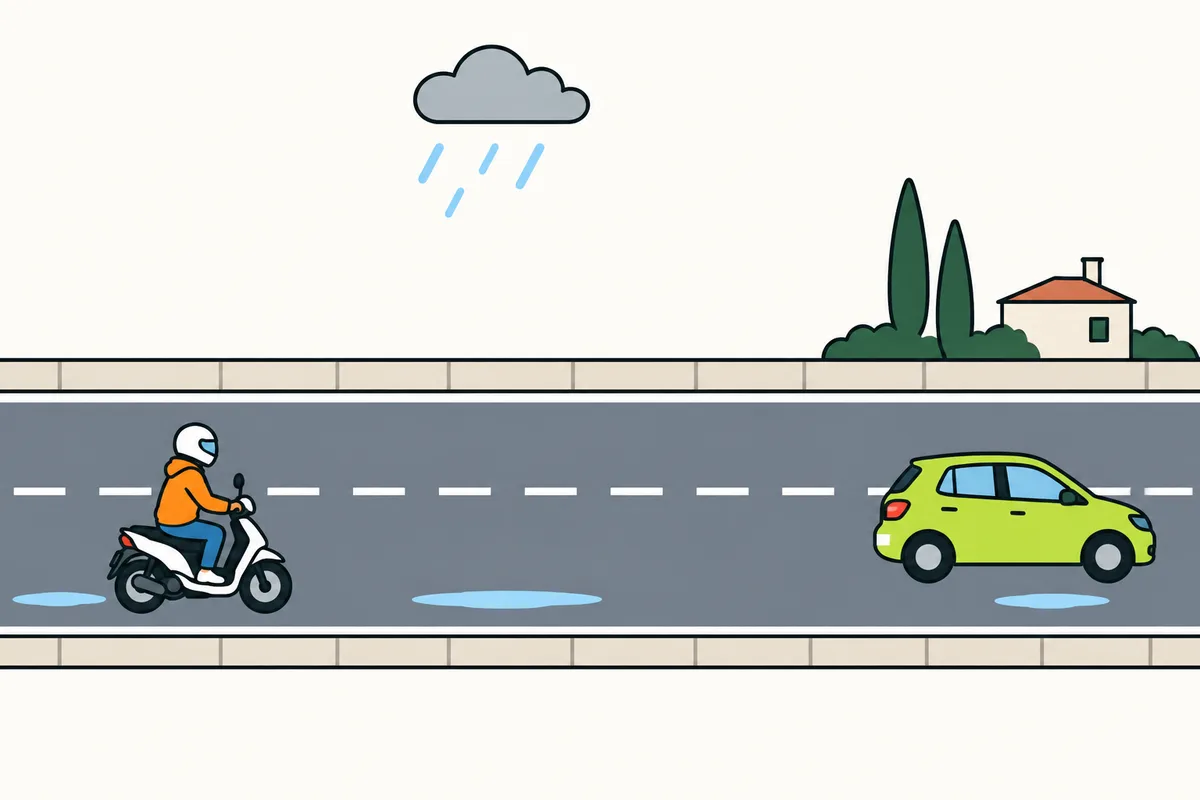
Risk factors are studied as a real cause of error: alcohol, drugs, speed, distraction, fatigue, adverse weather and overconfidence. On mopeds their effects tend to multiply because of the rider's lower stability and lower physical protection.
Step 2. The syllabus
2.1Alcohol, drugs and medication
The law does not only penalise obvious intoxication: it also penalises exceeding the legal limits or riding with drugs present in your system.
- Novice riders during their first years, and certain professional transport drivers, have stricter alcohol limits than everyone else.
- Medication that reduces reflexes, vision or attention requires reading the leaflet, avoiding riding where appropriate, and never offsetting the risk with overconfidence.
- Alcohol and drugs impair vision, balance and reaction time, three abilities a moped depends on completely.
2.2Adapted speed
Incorrect speed is not only exceeding the limit: it is also riding within the limit without adapting your speed to rain, traffic, visibility or grip.
- The higher the speed, the less time you have to perceive a risk, decide and act, and the distance you need to stop grows significantly.
- On a moped it's best to ride at a speed that lets you brake within the space you can see clear ahead of you.
- Adapting your speed to the surroundings is one of the most repeated answers in the exam for any risky situation.
2.3Distraction and attention
Holding your phone, programming the sat nav while moving, or looking away from the road for a few seconds is enough to cover many metres blind.
- Attention can't be shared without a cost: every distraction takes resources away from the main task, which is riding safely.
- On two wheels, a brief distraction is more serious because balance and trajectory require constant correction.
- Prepare your route, your phone and any adjustments before setting off, so you don't have to handle anything while riding.
2.4Safe distance
Safe distance must allow you to stop without a collision, and it increases if the vehicle is heavy, two-wheeled, or riding in unfavourable conditions.
- Riding too close to the vehicle in front reduces your field of vision and removes the margin you need to react to sudden braking.
- On a wet or slippery road surface, the distance must be increased because braking is less effective and grip decreases.
- Keeping space ahead gives you time and escape options, two things that on a moped matter more than agility.
2.5Fatigue, drowsiness and psychophysical state
Drowsiness reduces alertness, lengthens reaction time and increases the chance of running off the road, rear-end collisions and lapses of concentration on monotonous routes.
- Warning signs are usually yawning, frequent blinking, involuntary changes in speed and difficulty remembering the last few kilometres.
- The only safe response to fatigue is to stop, rest and continue only once your control abilities have fully recovered.
- Emotional state also has an influence: anger, being in a rush or anxiety worsen decisions while riding.
2.6Weather and grip
With rain, fog, ice, wind or glare, you must reduce speed, increase distance, smooth out your manoeuvres and use the correct lights.
- On a moped, rain, road markings and crosswind punish you more because there's less stability and less physical protection.
- Metal covers, loose gravel and painted pedestrian crossings become very slippery when wet.
- Anticipating the change in grip and avoiding braking or leaning over these surfaces prevents most falls.
2.7Preventive risk management
Risk perception improves when you anticipate junctions, pedestrians, vulnerable road users, merging traffic, school zones, roadworks and changes in grip.
- The false sense of control on short urban trips leads to underestimating the helmet, distance and speed.
- Many accidents result from several factors combining at once; reducing just one already improves your safety margin.
- Driving defensively means assuming someone else might make a mistake and always leaving space and time to correct.
Step 3. Key points
If you only have a minute before the exam, revise this.
- 1.Don't ride after consuming alcohol, drugs or medication that has an effect.
- 2.Adapt speed to the road, traffic, visibility and grip.
- 3.Remove any distraction before setting off.
- 4.Maintain and increase your safe distance according to conditions.
- 5.Stop at the first signs of drowsiness or fatigue.
- 6.Take extra care in rain, wind or on a slippery road surface.
- 7.Don't normalise small distractions or overconfidence.
Step 4. Exam traps
Mistakes the DGT uses again and again on this topic.
- Thinking that as long as you don't exceed the speed limit, you're always riding correctly.
- Reducing risk to alcohol alone and forgetting medication, fatigue or distraction.
- Believing experience removes the need to adapt distance and speed.
- Assuming a brief distraction is harmless on a two-wheeled vehicle.
- Believing short trips don't require you to be in full physical condition.
Step 5. Quick check
Four real exam questions on what you have just read.
What should you do if you are dazzled by the lights of another vehicle?
Step 6. Frequently asked questions about risk factors
- In an emergency stop on a two-wheeled moped without ABS, should you apply enough braking force to stop?
- Yes, but without locking the wheels. Yes, increase pressure in a controlled way to obtain the strongest braking grip permits without locking the wheels. There is no universal rule to leave the controls halfway: locking depends on force, grip and braking distribution. Use the controls according to the manual and retain control. ABS technique differs; do not apply advice for a non-ABS vehicle to every vehicle.See full question
- Alcohol causes the driver to experience:
- A false state of euphoria and confidence in oneself. Among the negative effects that alcohol causes in the driver of a moped, we find a reduction of the visual field, an increase in reaction time, and a false state of euphoria in the driver that makes them have excessive confidence in themselves.See full question
- To ride a moped on public roads in Spain, must it have valid compulsory civil-liability insurance?
- Yes. Yes. The moped must have compulsory civil-liability insurance to be ridden on public roads. Valid insurance is different from carrying a receipt: carrying the policy or proof of the latest payment is not compulsory, and officers can check insurance status. Do not confuse this cover with insurance paying for all damage to the rider or their own vehicle.See full question
- To combat the onset of fatigue or drowsiness, it is best to...
- Take frequent breaks. Prevent fatigue by taking frequent breaks somewhere safe and resting; you can use them to move and stretch. If drowsiness appears, a walk or fresh air is insufficient: stop to sleep or rest as needed and do not resume until fit to drive. Do not self-medicate with stimulants to prolong driving.See full question
- Which lighting must a light quadricycle have on when travelling at night on an inadequately lit urban road?
- Position lights and dipped beam. Position lights together with dipped-beam headlights. Article 101 requires dipped beam in built-up areas even when the road is inadequately lit. Main beam and dipped beam are not interchangeable for this urban driving.See full question