Step 1. The big picture
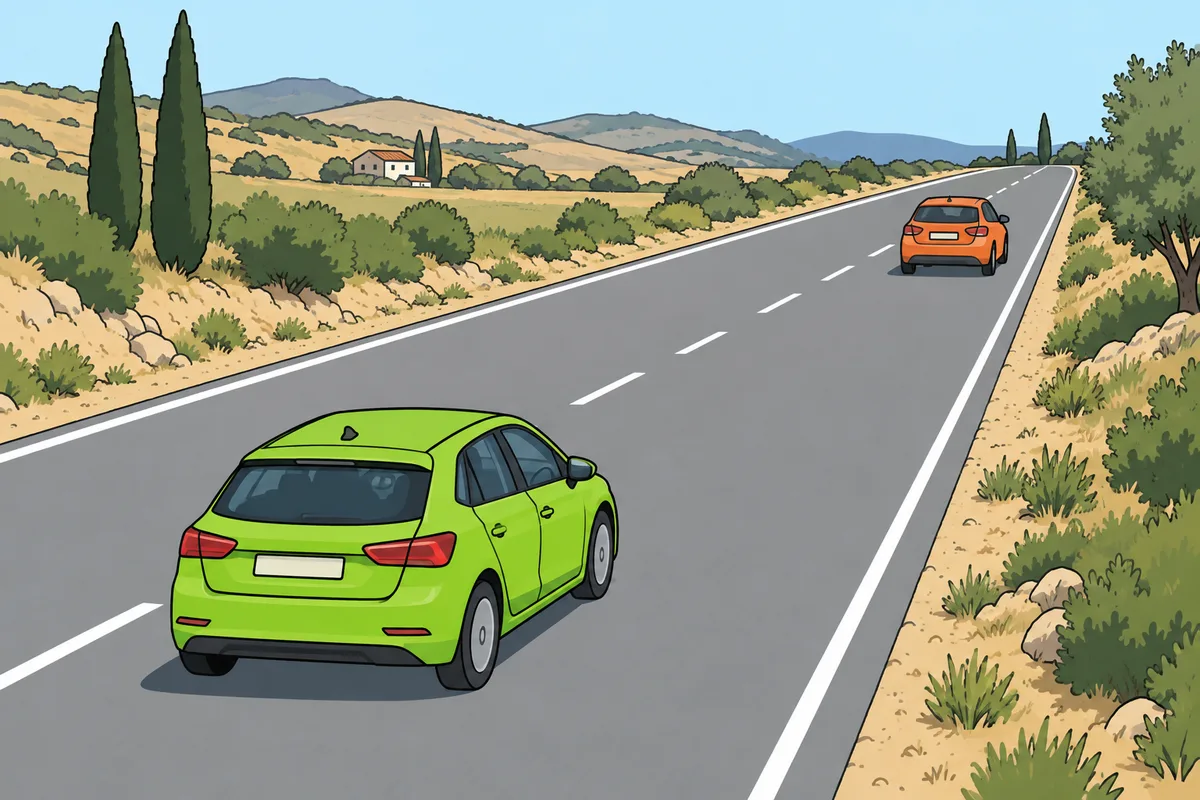
In one sentence…
Efficient, environmentally sound driving reduces fuel consumption, emissions, wear and risk. The DGT studies it as a way of driving better, not just as a financial saving, and it must always be compatible with safety and the rules in force.
Step 2. The syllabus
2.1Journey planning
Smooth driving starts before you set off: plan your route, avoid rush hour when possible and remove unnecessary weight from the vehicle.
- Planning doesn't mean always choosing the shortest route. It also means avoiding unnecessary stops, congested areas and improvised manoeuvres that increase fuel use and stress.
- Check whether you need to enter areas with environmental restrictions or local rules. If the question mentions specific signage, apply that information rather than habit.
- Preparing the trip avoids later distractions. Adjust the climate control, sat nav and load before you move off, so you don't sacrifice safety for supposed efficiency.
2.2Anticipation and smoothness
Anticipation avoids harsh braking and acceleration, which increase fuel consumption, reduce comfort and also worsen safety on the daily journey.
- Reading traffic several seconds ahead lets you use momentum safely, without turning efficiency into dangerously slow driving.
- Efficient driving watches traffic lights, tailbacks, gradients and crossings well ahead. This reduces sudden changes without surprising the vehicle behind you.
- In the exam, be wary of answers that suggest accelerating late and braking hard. Correct efficiency is usually smooth, predictable and respectful of distance.
2.3Correct use of the engine
With combustion engines, avoid unnecessary acceleration and select a gear suited to the engine's useful range, without forcing or labouring it.
- It's not about always driving in the highest gear. If the engine responds poorly or you lose your ability to react, the technique stops being safe.
- Avoiding prolonged idling, late braking and violent acceleration helps reduce noise, emissions and wear when the situation allows it.
- The DGT may ask about the relationship between efficient driving and safety. The correct answer must never compromise visibility, control or adaptation to traffic.
2.4Environmental maintenance
Keeping tyres at the correct pressure, and filters and the engine in good condition, reduces fuel consumption and improves braking, stability and overall response.
- Lack of maintenance harms both the environment and safety at the same time. A fault can increase fuel consumption, worsen control and cause avoidable breakdowns.
- Check the vehicle especially before demanding journeys. Tyres, lights, fluids and load all affect fuel consumption and response to the unexpected.
- The exam usually presents maintenance as a practical topic, not a workshop one. You need to know what to check and the consequence of driving with faulty parts.
2.5Climate control and accessories
Using climate control, a heated rear window or electrical accessories sensibly helps, but it must never compromise demisting, visibility or the minimum comfort needed to drive safely.
- If the windows mist up, the priority is to restore visibility. Saving energy or fuel never justifies driving without seeing properly.
- Roof loads, unnecessary items and poorly managed accessories can increase drag, noise and fuel consumption. Remove what you don't need when possible.
- In questions involving heat, cold or rain, choose the option that maintains attention and visibility. Environmental efficiency does not conflict with comfortable, safe driving.
2.6Efficiency compatible with safety
You should not seek savings at the cost of driving too slowly, tailgating other vehicles, or making manoeuvres that hinder traffic.
- The best efficient driving is that which is smooth, predictable and safe for all road users in every situation.
- Driving too close to save fuel is a bad practice: it reduces your reaction margin and turns any braking into a risk of a rear-end collision.
- If an answer pits saving fuel against safety, prioritise safety. Environmentally sound driving includes avoiding accidents, breakdowns and unpredictable behaviour.
2.7How the DGT asks about it
The DGT usually links the environment with fuel consumption, wear, noise, maintenance and anticipation. Don't expect questions only about emissions in the abstract.
- Many traps present an efficient technique taken to an extreme. If it creates danger, hinders traffic or reduces visibility, it stops being correct behaviour.
- Link each habit to its effect: smoothness reduces fuel consumption, maintenance improves safety, planning avoids tailbacks, and sensible climate control preserves visibility.
- In the B theory test, answer from a basis of everyday caution. The best option is usually the one that saves fuel without causing a nuisance, improvising or losing control.
Step 3. Key points
If you only have a minute before the exam, revise this.
- 1.Plan your journey and remove unnecessary weight.
- 2.Drive with smoothness, anticipation and sufficient distance.
- 3.Keep tyres and the vehicle in correct condition.
- 4.Use climate control and accessories without losing visibility or attention.
- 5.Avoid prolonged idling, late braking and violent acceleration.
- 6.Don't sacrifice safety to save fuel.
- 7.Link efficiency with less wear, noise, fuel consumption and emissions.
Step 4. Exam traps
Mistakes the DGT uses again and again on this topic.
- Confusing efficient driving with driving below the safe pace of the road.
- Forgetting that lack of maintenance worsens fuel consumption and safety at the same time.
- Saving on climate control even though the windows mist up or the driver loses minimum comfort.
- Thinking that driving right behind another vehicle can be an acceptable technique.
- Choosing the highest gear even though the engine ends up labouring or unresponsive.
- Separating the environment from road safety when the question links them.
Step 5. Quick check
Four real exam questions on what you have just read.
According to the maintenance advice published by the DGT magazine in July 2014, dirty spark plugs may increase fuel consumption by up to approximately…
Step 6. Frequently asked questions about economical driving and environmental conditions
- In general, does maintaining a high road speed increase fuel consumption?
- Yes, in general. Yes, in general. Greater aerodynamic resistance demands more energy. Actual consumption also depends on gear, gradient, load and conditions; it is incorrect to say every instantaneous speed increase raises consumption in all circumstances.See full question
- At the same road speed and otherwise equal conditions, which moderate longitudinal wind usually reduces aerodynamic resistance and favours lower fuel consumption?
- Wind blowing from behind. A tailwind slower than the vehicle reduces relative air speed compared with still air. This usually lowers aerodynamic resistance and the energy needed to maintain the same road speed. It does not mean it always pushes the vehicle or guarantee fixed savings: the engine, road, load and other conditions also matter. Do not increase speed to exploit it.See full question
- For more efficient driving, it is usually better to:
- Drive smoothly, anticipate events and keep a steady speed when safe. Drive smoothly and anticipate events, keeping speed as steady as traffic and safety allow. Avoid hard acceleration, hard braking and unnecessary engine revving. Efficiency never justifies maintaining an unsafe speed or failing to brake for a hazard.See full question
- If a stop is going to last unnecessarily long, from a fuel-consumption point of view it is usually advisable to:
- Avoid keeping the engine idling unnecessarily. Avoiding unnecessary idling helps reduce fuel consumption and polluting emissions.See full question
- In a conventional petrol car, which driving pattern tends to increase fuel use per kilometre compared with smooth travel at moderate speed?
- Urban traffic with frequent stops and acceleration. Urban stop-and-go driving with frequent starts and acceleration tends to increase fuel use per kilometre. Repeated acceleration and unnecessary use of low gears increase consumption; idling during stops also uses fuel without covering distance. Idling is not the mechanical cause of using low gears. This comparison does not mean every urban road uses more fuel than every interurban road: vehicle, speed, traffic, gradients and driving style all matter.See full question