Step 1. The big picture
In one sentence…
Core topic for licence B: general rules of circulation, priority, speed, road position, manoeuvres, essential documentation and the punishable conduct most often asked about in the exam. Study it as practical decisions: who goes first, where you position yourself, when you must give way and how you reduce risk.
Step 2. The syllabus
2.1Authorisations and documentation
With licence B you can drive passenger cars up to 3,500 kg and up to 8 passengers in addition to the driver. You must carry a valid authorisation and respect its conditions.
- The vehicle must be fit to circulate under the regulatory conditions. Knowing how to drive isn't enough: documentation, technical condition and the vehicle's limitations also count.
- The DGT requires you to understand risk and apply it in real traffic. That's why the exam mixes rules with traffic scenes, signs and vulnerable road users.
- If an authorisation, restriction or sign limits your driving, it takes precedence over what you would normally do. The correct answer is usually the most cautious and lawful one.
2.2Speed in built-up areas
In built-up areas, general limits of 20, 30 or 50 km/h apply depending on the road layout, unless a sign sets a different condition.
- Don't memorise these limits as an isolated list. The exam usually asks you to link speed to the type of street, the presence of pedestrians and visible signage.
- Driving below the limit can still be wrong if you obstruct traffic without cause. Driving within the limit can also be dangerous if the situation demands more caution.
- Near schools, crossings, stops or reduced visibility, the appropriate speed is the one that lets you stop without a sudden manoeuvre, not simply the maximum allowed.
2.3Speed, position and distance
On any road you must moderate your speed if visibility, grip, usable width or the predictability of the surroundings decreases.
- As a current study rule, cars generally have a 90 km/h maximum on conventional roads; a road may post up to 100 km/h only where the required physical separation exists. Read the sign and road type in the scene, and do not treat this as permission to overtake.
- The vehicle's normal position is on the right, using the lane suited to the intended manoeuvre and keeping enough distance to stop without a rear-end collision.
- Safe distance is not a single figure for every scene. Mentally increase the margin if there is rain, heavy traffic, load, a gradient or distractions around you.
- In questions about rear-end collisions, braking or merging, look for who needed more space. The DGT penalises the answer that normalises hugging the vehicle in front.
2.4Right of way
The general priority of the right gives way to signs, traffic lights, officers, roundabouts, regulated crossings and special cases set out in the rules.
- At an uncontrolled junction, apply right priority only after checking the exceptions: a vehicle on a paved road has priority over one arriving from an unpaved road, and a vehicle entering a roundabout gives way to traffic already circulating.
- At a railway crossing or when joining a motorway or other specially regulated road, the specific rule controls instead of an automatic right-priority answer.
- At roundabouts, priority belongs to whoever is already on it, but exiting requires positioning yourself in good time and not crossing lanes abruptly.
- Before answering a priority question, first locate the signage. Then look at each vehicle's trajectory and position, and whether any vulnerable road user needs special care.
- Giving way doesn't always mean stopping, but it does mean not forcing the other party to brake sharply or change their course to avoid you.
2.5Safe manoeuvres
Before changing lane, overtaking, turning, merging or stopping, you must observe, signal in good time and carry out the manoeuvre without creating danger.
- The indicator informs, but it does not grant priority. If signalling forces others to brake or swerve, the manoeuvre has not been done correctly.
- Merging and exiting require you to anticipate speed and gap. The common trap is believing that whoever is already driving must always make way for you to enter.
- When overtaking, turning or moving sideways, check mirrors and blind spots. The exam often includes motorcycles, bikes or vehicles that are partly hidden.
- Overtaking needs two separate decisions: it must be permitted by the marking and context, and it must be safe to complete without forcing another road user to brake or change course.
2.6High-impact offences
Driving while holding a phone, without a seatbelt, or under the influence of alcohol or drugs undermines safety and can mean losing points.
- The points-based licence normally starts with 12 points, while novice drivers or those getting their licence back start with 8.
- Novice drivers face specific conditions during their first years. In questions about alcohol, points or the L-plate, check whether the question mentions a novice.
- Punishable conduct doesn't stop being an offence because the journey is short or the road seems empty. The DGT asks a lot about these everyday false exceptions.
2.7Vulnerable road users
Cautious driving requires you to anticipate especially for pedestrians, cyclists, children, older people and people with reduced mobility in any shared environment.
- Even if you have formal priority, you must adapt speed and trajectory if a vulnerable road user could make a mistake or be hidden by other vehicles.
- In town, risks appear from pavements, crossings, stops, vehicle doors and shared lanes. The exam answer usually requires extra vigilance.
- Practise by identifying the most fragile road user in each scene. That reading helps you choose between moving on, giving way, stopping or slowing down.
Step 3. Key points
If you only have a minute before the exam, revise this.
- 1.Apply the built-up area limits of 20, 30 and 50 km/h depending on the type of street.
- 2.Check signs, traffic lights and officers before applying the priority-to-the-right rule.
- 3.Carry out manoeuvres only after observing, signalling and giving way when required.
- 4.Remember that the indicator does not grant priority.
- 5.Link safe distance to visibility, grip and traffic.
- 6.Identify conduct that can lead to losing points.
- 7.Treat pedestrians, cyclists and motorcyclists as high-risk road users.
- 8.Check whether the question mentions a novice driver or a recovered licence.
Step 4. Exam traps
Mistakes the DGT uses again and again on this topic.
- Confusing the general priority of the right with priority at roundabouts.
- Forgetting that the correct speed also depends on rain, visibility or traffic intensity.
- Thinking it's enough to signal even though the manoeuvre forces others to react.
- Applying a built-up area limit without checking the street layout or a different sign.
- Answering as if having priority removed the duty of caution towards vulnerable road users.
- Overlooking that novices and recovered licences start with fewer points.
Step 5. Quick check
Four real exam questions on what you have just read.
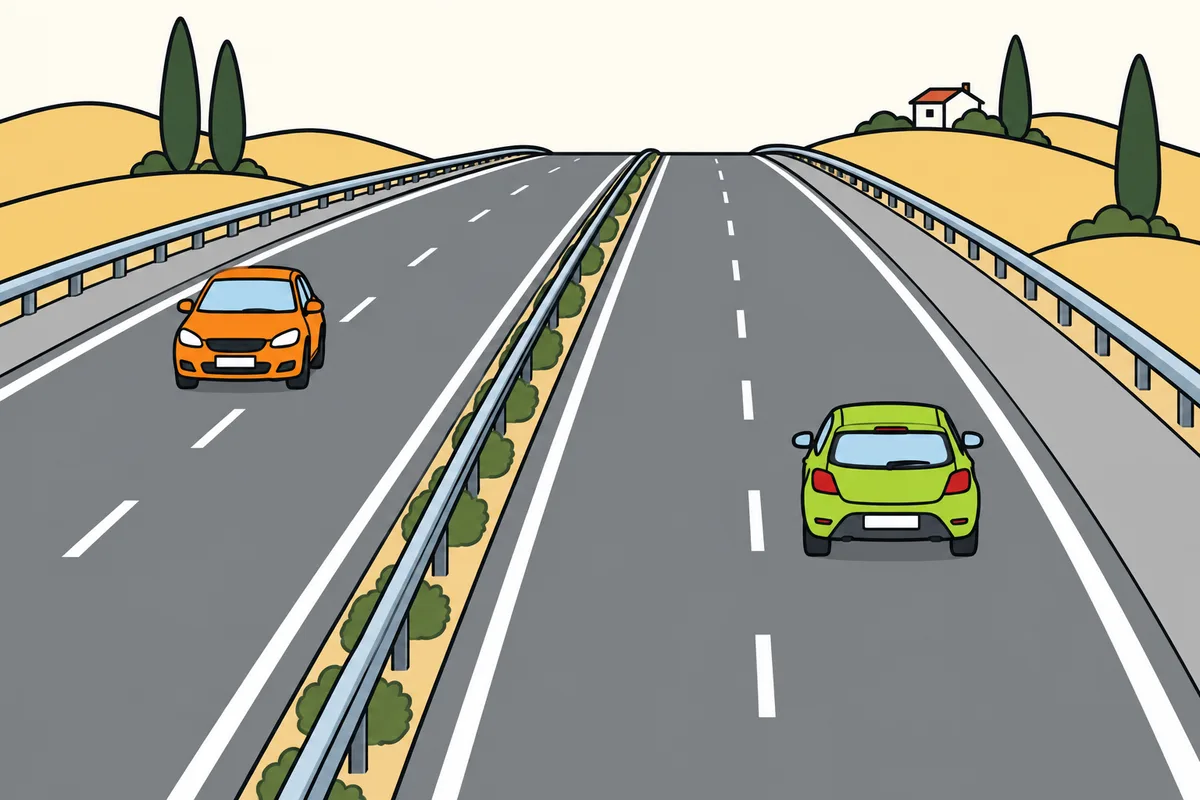
As a general rule, is overtaking allowed on Spanish autopistas and autovías?
Step 6. Frequently asked questions about driving on motorways and dual carriageways
- A taxi driver travels on a motorway without a medical-exemption certificate. Must they wear their seatbelt?
- Yes, with or without passengers. Yes, whether carrying passengers or travelling empty. Current rules require the seatbelt and no longer provide a general urban exemption for taxi drivers on duty: that exception was removed effective 1 October 2026. Article 119 retains certain exemptions, such as a certificate for serious medical reasons, which this question excludes. Do not confuse the driver’s rule with the urban taxi exception concerning child-restraint systems.See full question
- When driving a car normally on a motorway, may you use an opening in the central reservation to reverse your direction of travel?
- No, because it is prohibited. No. On motorways and dual carriageways, direction may be reversed only at designated locations. An open gap in the central reservation does not make it an authorised place for that manoeuvre. Use the designated exits and junctions and obey the signs.See full question
- A car travels on a motorway with no justified reason to reduce speed. Below which general threshold is speed considered abnormally low?
- 60 km/h. 60 km/h. Traffic, vehicle or road conditions can justify safely travelling below that speed; congestion does not require reaching 60 km/h or necessarily leaving the motorway. If an emergency forces abnormally slow travel, leave at the first exit. If the minimum cannot be reached and there is a risk of being hit from behind, use hazard lights.See full question
- A car travels on a motorway with no limit lower than 120 km/h, but there is heavy rain. Which statement is correct?
- Speed must be moderated and adapted to conditions even when within the limit. Speed must be moderated and adapted to grip, visibility and traffic, even far below 120 km/h. Staying within the numerical limit does not by itself fulfil the legal duty to use an appropriate speed (Articles 45 and 46). Maintaining 120 km/h in heavy rain cannot be described as always lawful or safe.See full question
- May you drive through a service area ignoring its signs and safety rules because it is a rest area?
- No, you must respect the applicable signs and rules. No. You may use authorised access routes and internal routes to reach facilities while respecting signs, other users and a safe speed. Service areas provide rest and other services such as fuel or food; they are not spaces for unrestricted driving. Access designs vary and are not all identical to an acceleration lane.See full question