Step 1. The big picture
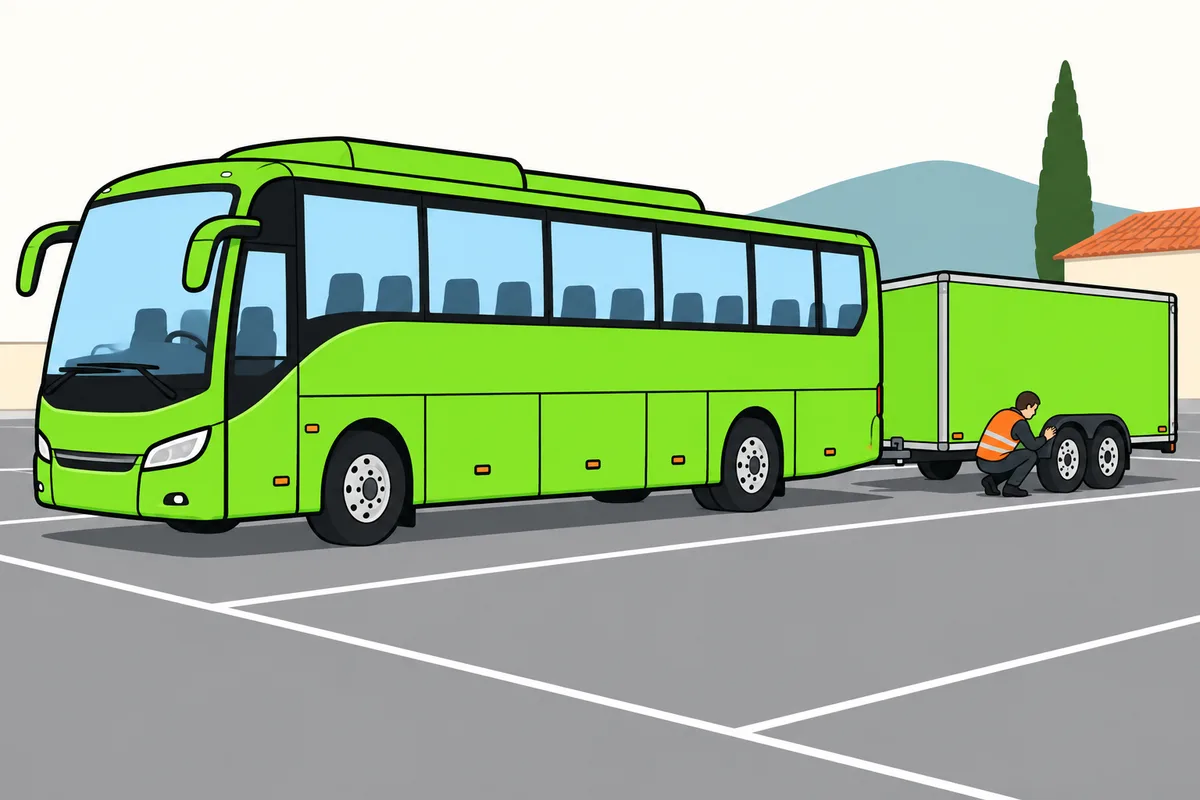
In one sentence…
Preventive maintenance of D+E combinations prevents breakdowns, improves braking and cornering, protects passengers and reduces exam mistakes. Study it as preparation for the service, not as a task unrelated to the driver.
Step 2. The syllabus
2.1Orderly prior check
Before driving a D-category bus with a trailer of more than 750 kg, follow a fixed check sequence. The exam tests whether you prepare the vehicle before driving.
- Start with the tyres, pressure, tread, uneven wear, lights, optical signalling and brakes. These are basic checks because they change the vehicle's real response.
- Do not save the check for long journeys. A short service with passengers also requires the vehicle and trailer to be in good condition.
- If the question mentions haste or reliance on previous checks, be wary. Safe conduct is to check before starting the service.
2.2Tyres and wear
The tyres connect the combination to the road, which is why pressure, tread and wear affect braking, steering and stability.
- Uneven wear is not a cosmetic detail. It can signal a problem that alters the trajectory, support or behaviour of the trailer.
- Also check the trailer's wheels. Looking only at the lead bus is a common and dangerous mistake in theory that carries over into practice.
- Link correct pressure and a reasonable load with less wear and lower fuel consumption. Efficient driving starts before you set off.
2.3Brakes, lights and signalling
The condition of the brakes affects stopping distance and stability. With passengers and a trailer, uneven braking compromises comfort, control and exterior safety.
- Lights and optical signalling announce braking, turning and presence. A poorly signalled combination is less predictable for other road users.
- On combination licences, the exam links brakes, lights, anchorings and trailer safety together. You must think of it as one complete system.
- If you find an essential defect, do not treat it as normal. Driving with a known defect can be unsafe and a reportable offence under the current regulation.
2.4Levels and the driving position
Check essential levels whenever the vehicle requires it: oil, coolant, brake fluid and windscreen washer fluid. All of these are part of safe preparation.
- Visibility is also part of practical maintenance. Seeing a hazard late forces you to correct with less margin in a long combination.
- Prepare the seat, mirrors, seatbelt, doors and basic checks of the general condition. The DGT values this preparation by the driver.
- Do not confuse maintenance with complex repair work. For the exam, identify prior checks, signs of a defect and prudent decisions.
2.5Trailer, fixings and load
On the D+E licence, the trailer exceeds 750 kg MAM according to the licence's description. Fixings, locks and connections are not checked superficially.
- Check the weight is balanced whenever there is a load. You do not need to invent figures: understand that balance affects stability and manoeuvrability.
- Remember that the trailer cannot be used to carry passengers. The licence authorises the combination, but it does not turn the trailer into space for passengers.
- Checking the trailer is inseparable from maintaining the lead vehicle. If one fails, the whole combination loses safety.
2.6Efficiency and breakdowns
Correct pressure, wheel alignment, filters in good condition and a reasonable load reduce fuel consumption and wear. Efficiency and safety usually go together.
- Poor maintenance alters cornering, braking or a slow manoeuvre and can ruin a driver's otherwise correct practice.
- If a breakdown occurs during the service, prioritise protecting passengers and other road users in line with the current regulation.
- Study each element by asking what would happen if it failed. This turns lists of parts into concrete exam consequences.
Step 3. Key points
If you only have a minute before the exam, revise this.
- 1.Always follow a prior check in the same order.
- 2.Check the tyres, pressure, tread and uneven wear.
- 3.Link the brakes and lights to stability and predictability.
- 4.Check essential levels whenever the vehicle requires it.
- 5.Check the trailer's fixings, locks and connections.
- 6.Check that the load is balanced and secure.
- 7.Do not drive with known defects in essential components.
Step 4. Exam traps
Mistakes the DGT uses again and again on this topic.
- Thinking maintenance means only the engine and forgetting wheels, brakes or lights.
- Checking the lead vehicle and not checking the towed element.
- Treating a faulty light as a nuisance rather than a loss of predictability.
- Believing that smooth driving makes up for a defect that should have been checked.
- Forgetting that the trailer cannot be used to carry passengers.
Step 5. Quick check
Four real exam questions on what you have just read.
In a bus with a trailer, a basic inspection should include:
Step 6. Frequently asked questions about mechanics and maintenance
- In a D1+E or D+E combination, passengers, load, and the trailer must be:
- Properly secured and without compromising safety. A correct arrangement of load, luggage, or passengers helps maintain safety and stability.See full question
- A steering fault in a D1+E or D+E combination:
- Seriously compromises safety. Steering is an essential control element, so a fault seriously compromises safety.See full question
- In a passenger combination with a trailer it is important to inspect:
- The trailer's tires and brakes. The trailer is part of the combination's safety, so its tires and brakes must be kept in good condition.See full question
- If a warning appears in a D1+E or D+E combination indicating a major fault, the correct action is to:
- Stop safely and check the fault. In the event of a major fault, you must act prudently and not continue as if nothing were wrong.See full question