Step 1. The big picture
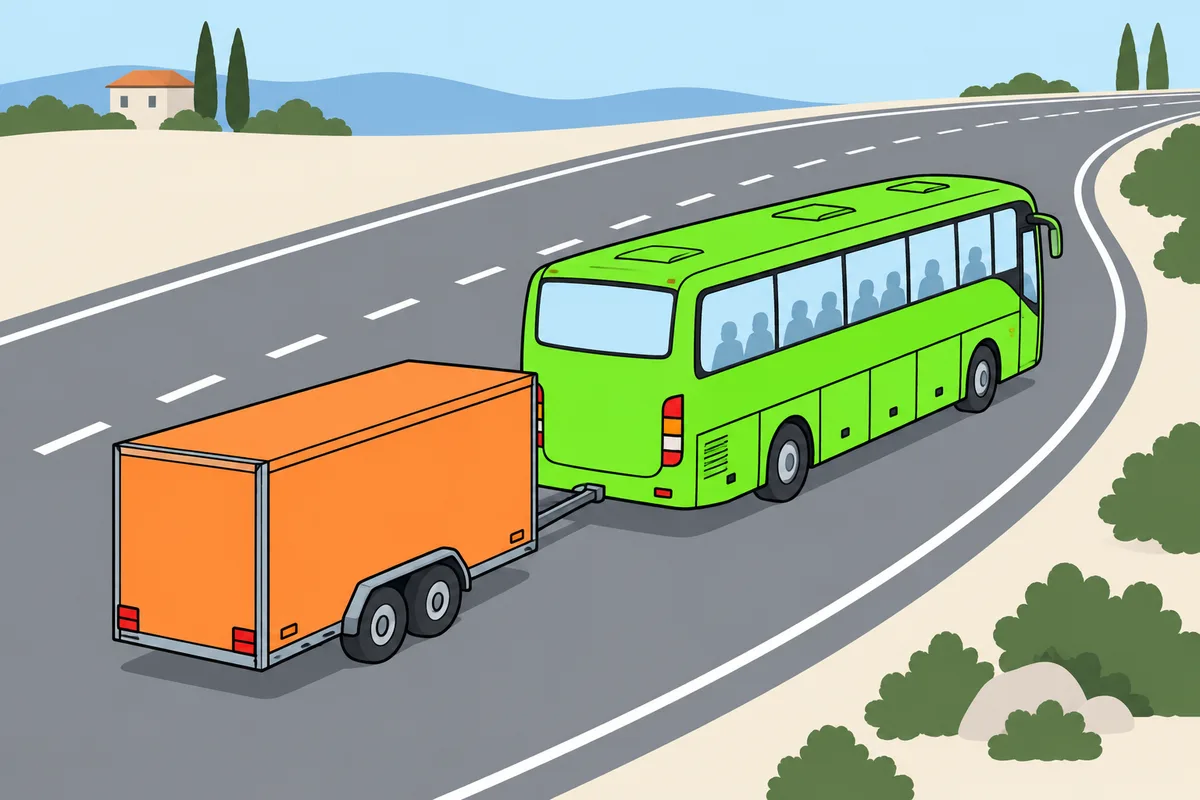
In one sentence…
Driving technique for D+E combinations combines trailer control and passenger protection: wide trajectories, clean braking and very-low-speed manoeuvres. The key is to anticipate rather than correct late.
Step 2. The syllabus
2.1Preparation before moving off
Before moving a D-category bus with a trailer of more than 750 kg, check the coupling, connections and general condition. Technique starts while stationary, with the combination ready to respond.
- Adjust your position, mirrors and observation to control both the lead vehicle and the trailer's tracking. Without reference points, there is no safe manoeuvre.
- Check that the surroundings allow you to pull away without surprising pedestrians, cyclists or other vehicles. The combination needs more time to complete movements.
- If the question asks what to do before setting off, look for checking and observing. Accelerating first and correcting afterwards is poor technique.
2.2Setting off, accelerating and braking
Pulling away must be progressive to avoid jerking, swaying and discomfort for passengers. Smoothness also stabilises the trailer.
- Braking must be prepared earlier than in a single vehicle. Waiting until the last moment reduces your margin and harms passengers.
- Use anticipation to avoid sudden changes of speed. The exam tests whether you link smoothness, stability and safety.
- If you need to brake hard due to a lack of foresight, analyse the earlier mistake: speed, distance, observation or reading the signs.
2.3Wide turns and tracking
Open the turn enough for the trailer to follow a safe trajectory, without entering dangerous areas or getting close to vulnerable road users.
- Watch the tracking throughout the whole turn. The rear can get close to kerbs or obstacles even when the front already looks well positioned.
- In urban areas, protect the sides and blind spots. The question may focus on the side risk, not the front.
- Do not start a turn if you cannot complete it safely. Stopping before compromising the combination avoids unsafe blockages.
2.4Roundabouts and joining traffic
At roundabouts, only enter when you have margin for the whole combination. Do not judge the gap as if you were driving a short vehicle.
- Stay predictable with your trajectory and signalling. Other road users must understand that the trailer needs more space.
- When joining traffic, give way to traffic in the lane you are joining where required and accelerate progressively.
- If the road, traffic or visibility does not allow you to join safely, wait. Haste is a common trap in combinations.
2.5Reversing with reference points
Reversing must be done at minimum speed, with clear reference points and small corrections. Over-correcting quickly breaks down the trajectory.
- If you lose sight of the critical area, stop and re-establish observation before continuing. Do not reverse into a space you do not control.
- Resetting the manoeuvre is preferable to persisting with large corrections. In the exam, this idea marks the safe answer.
- Practise cause and effect: a small turn, the trailer's reaction, a pause and a new correction. This avoids abrupt movements.
2.6Exam method
The specific D+E exam has 20 specific questions, a maximum of 2 errors and 20 minutes. Train quick but reasoned decisions, not just isolated definitions.
- Group cases by manoeuvre: setting off, turning, roundabout, joining traffic, braking and reversing. Then identify what changes because of the trailer.
- When in doubt, rule out the answer that reduces observation, forces the available space or ignores the passengers. The correct one preserves margin and control.
- Explain each action with a reason: stability, visibility, coupling, passengers or other road users. That reason helps you tell similar options apart.
Step 3. Key points
If you only have a minute before the exam, revise this.
- 1.Check the coupling, connections and surroundings before setting off.
- 2.Adjust your position and mirrors to control the vehicle and the trailer.
- 3.Accelerate and brake progressively to avoid swaying.
- 4.Widen your turns and watch the trailer's tracking.
- 5.Do not enter roundabouts or join traffic without enough margin.
- 6.Reverse at minimum speed with clear reference points.
- 7.Stop if you lose sight of the critical area.
Step 4. Exam traps
Mistakes the DGT uses again and again on this topic.
- Applying single-vehicle technique and forgetting the trailer's trajectory.
- Over-correcting while reversing instead of stopping and resetting.
- Judging a gap for joining traffic without counting the full length.
- Braking late and blaming the trailer instead of anticipating.
- Treating smoothness as comfort rather than passenger safety.
Step 5. Quick check
Four real exam questions on what you have just read.
If visibility is reduced while driving a D1+E or D+E combination, you must:
Step 6. Frequently asked questions about vehicle combination driving techniques
- In congestion, with a D1+E or D+E combination, keeping space from the vehicle ahead helps to:
- Have room to react and maneuver. In traffic jams it is still important to leave space to react and maneuver safely.See full question
- With a side wind and a D1+E or D+E combination, the prudent action is to:
- Reduce speed and keep firm control. A side wind can destabilize the vehicle, so speed should be reduced and control maintained.See full question
- If the road narrows or obstacles appear while driving a D1+E or D+E combination, the proper action is to:
- Reduce speed and increase caution. When available space decreases, speed should be adapted and maneuvers should be smooth.See full question
- Before reversing a D1+E or D+E combination, you must:
- Check the area behind and the immediate surroundings. Reversing requires carefully checking the area behind and the immediate surroundings.See full question
- When turning a D+E combination, you should remember that:
- You need more space and must open the turn properly. Combinations and long vehicles need more space to turn and require a well-planned path.See full question