Step 1. The big picture
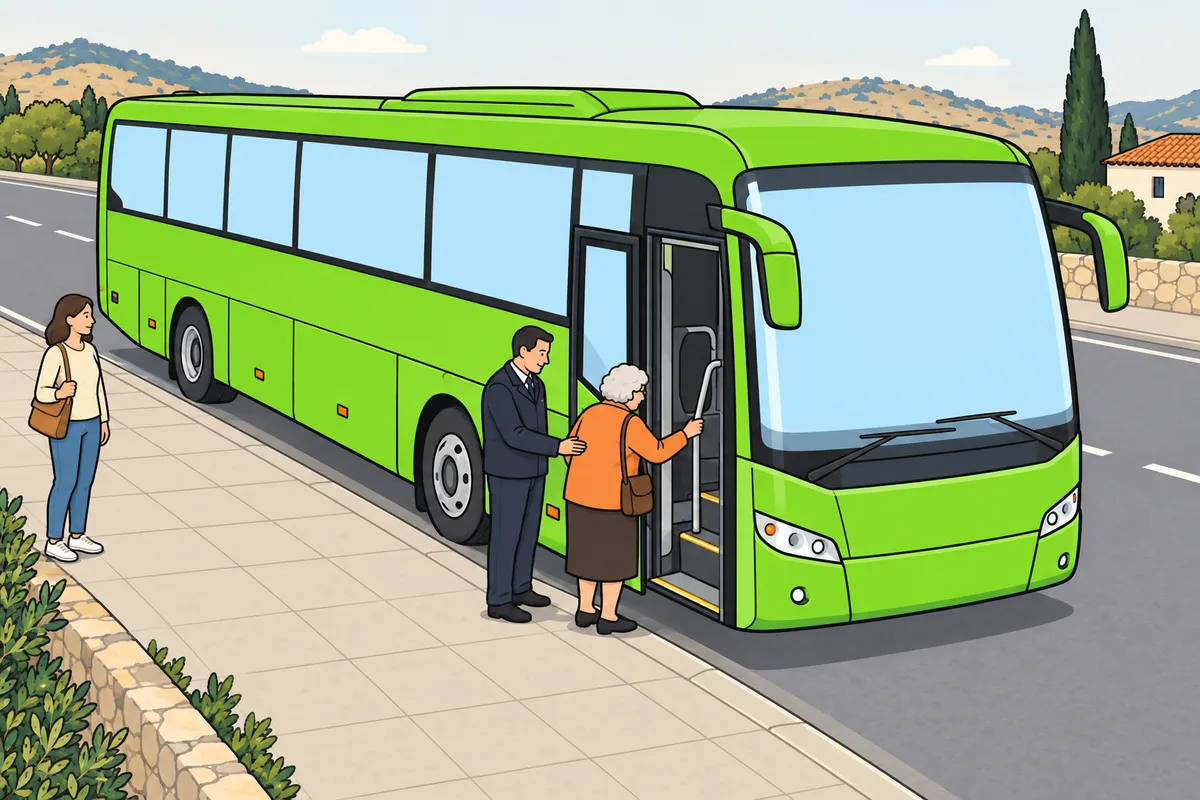
In one sentence…
Passenger transport requires technique, regulatory knowledge and safe treatment of passengers: access, luggage, information, attention to vulnerable groups and the correct response to incidents. On the D licence, driving is always studied together with the service received by the people being transported.
Step 2. The syllabus
2.1Passenger safety
Passengers must be able to board, alight and travel without avoidable risk arising from the driving or the management of the vehicle.
- The driver must anticipate how braking, turning, accelerating and stopping will affect people who may be seated, standing or moving about.
- Passenger safety begins before you set off: doors, exits, aisles, luggage and the stopping environment must all be under control.
- In the exam, many correct answers reduce interior risk even when they do not change the vehicle's outward path, throughout the passenger service.
2.2Access, alighting and stops
The stop must allow boarding and alighting without exposing passengers to traffic, kerbs, obstacles or unexpected movements of the vehicle.
- Before moving off again, check that no one is still boarding, alighting, crossing nearby or standing in a dangerous spot, throughout the passenger service.
- Clear information and stopping in a safe place are part of responsibly managing passenger transport, throughout the passenger service.
- Do not let pressure to keep to schedule become the deciding factor; if safety is lacking, you must wait or correct the situation, throughout the passenger service.
2.3Luggage, exits and interior space
The placement of luggage and objects must not block exits, aisles or functional areas of the bus, throughout the passenger service.
- A badly placed object can shift during braking, hinder an evacuation or cause falls and knocks inside the vehicle.
- The driver must detect interior risks before driving, not only react once the luggage has already shifted, throughout the passenger service.
- When the exam mentions objects or aisles, think about accessibility, evacuation, stability and passenger safety, throughout the passenger service.
2.4Especially vulnerable groups
Children, older people, users with reduced mobility and disoriented passengers need extra time and caution, throughout the passenger service.
- Safe professional driving does not speed up the process at the expense of the slowest or most vulnerable passenger, throughout the passenger service.
- With these groups, pulling away, braking or closing the doors abruptly can have consequences even if outside traffic seems under control.
- In exam questions, identify whether a vulnerable user appears, because this usually changes the margin of caution required, throughout the passenger service.
2.5Driving during the service
Smoothness in acceleration, braking and steering is part of safety, not a secondary matter of comfort, throughout the passenger service.
- Maintaining wide observation lets you anticipate incidents and avoid abrupt manoeuvres that affect passengers, throughout the passenger service.
- Professional driving avoids unnecessary hard braking, tight turns without control and late corrections near stops or junctions, throughout the passenger service.
- If an answer justifies an abrupt manoeuvre to save time, it usually ignores the specific responsibility of passenger transport, throughout the passenger service.
2.6Incidents and breakdowns
In the event of a breakdown or incident, prioritise protecting passengers, the visibility of the vehicle and coordination with emergency services if needed.
- The first decision must reduce risk to people: positioning the vehicle safely, informing passengers clearly and avoiding unnecessary exposure.
- Do not abandon passenger management to focus only on the mechanical breakdown; both are part of a safe service.
- The exam may present a minor incident to check whether you keep your priorities straight: people, visibility, order and communication, throughout the passenger service.
2.7How to prepare this topic
Study each situation from three angles: what the passenger needs, what risk the vehicle creates and what the driver must check.
- Link regulation and technique: doors, luggage, stops and smoothness are not separate topics when you are carrying people, throughout the passenger service.
- Practise spotting answers that are too mechanical, because they usually forget about information, safe treatment or vulnerable groups, throughout the passenger service.
- When in doubt, choose the option that protects people first and only then allows the service to continue in an orderly way.
Step 3. Key points
If you only have a minute before the exam, revise this.
- 1.Secure luggage, exits, aisles and interior safety before driving.
- 2.Pay extra attention to children, older people and people with reduced mobility.
- 3.Control boarding, alighting and the stopping environment before opening the doors or pulling away.
- 4.Drive smoothly to avoid falls, knocks and unsafe reactions.
- 5.Inform passengers clearly whenever an incident affects the service.
- 6.Manage breakdowns by protecting the people being transported first.
- 7.Link each exam answer to interior and exterior safety.
- 8.Rule out solutions that prioritise speed over the caution the service requires.
Step 4. Exam traps
Mistakes the DGT uses again and again on this topic.
- Reducing passenger transport to simply driving the vehicle.
- Forgetting that unnecessary hard braking is also a service-safety failure.
- Allowing luggage that blocks exits or aisles because it looks well secured.
- Pulling away without checking that boarding and alighting have finished safely.
- Treating vulnerable passengers the same as any other user without an extra margin.
- Focusing on the breakdown and forgetting information, visibility and passenger protection.
Step 5. Quick check
Four real exam questions on what you have just read.
A blind person travels with a guide dog recognised as an assistance dog and meets the required hygiene, health and safety conditions. May the person board a public bus with the dog?
Step 6. Frequently asked questions about passenger transport
- For special regular public school transport covered by Article 1(a) of Royal Decree 443/2001, who gives prior notice of the stops to the competent traffic-regulation authority?
- The authority that grants the transport authorisation. The authority that is to grant the transport authorisation, under Article 10.1. The traffic authority may propose changes; notice precedes the grant. This concerns that special regular public service, not every private or occasional service carrying schoolchildren.See full question
- On a motorway outside a built-up area, under normal conditions, what is the minimum speed at which a bus equipped with seatbelts and not used for the transport of minors must travel?
- 60 kilometres per hour. 60 km/h, as the general motorway or dual-carriageway rule under the stated normal conditions. It is not calculated here as half of the bus’s 100 km/h maximum. Article 49 permits lower speeds when traffic, vehicle or road conditions prevent maintaining the minimum safely, as well as other regulated cases. Do not accelerate to 60 km/h when doing so is unsafe.See full question
- If you are driving a bus and carrying out a discretionary public passenger transport service where at least three-quarters of the passengers are under 16 years old, you must know that the accompanying person...
- is always mandatory. The presence of an accompanying person is mandatory, among other cases, when it is a discretionary passenger transport service in which three-quarters of the passengers are under 16 years old.See full question
- If you are driving a bus carrying out discretionary public passenger transport, where at least three-quarters of the passengers are under 16 years old, you must know that the accompanying person:
- It is always mandatory. An accompanying person is required for the described discretionary public bus service with at least three-quarters of passengers under 16. This must be a suitable accredited adult other than the driver who knows the safety mechanisms and looks after the minors. In addition, for any Article 1 service operated by bus, Article 8 requires an accompanying person when at least 50% of all passengers are under 12; the percentage is not calculated only among students.See full question
- Driving a D1 or D bus with poorly adjusted mirrors:
- Reduces visibility of the surroundings. Poorly adjusted mirrors reduce the information available about the surroundings of the vehicle.See full question
Official sources
- BOE - Traffic, Motor Vehicle Circulation and Road Safety Act (Ley sobre Tráfico, Circulación de Vehículos a Motor y Seguridad Vial) (RDL 6/2015)
- BOE - General Traffic Regulations (Reglamento General de Circulación) (RD 1428/2003)
- BOE - General Vehicle Regulations (Reglamento General de Vehículos) (RD 2822/1998)