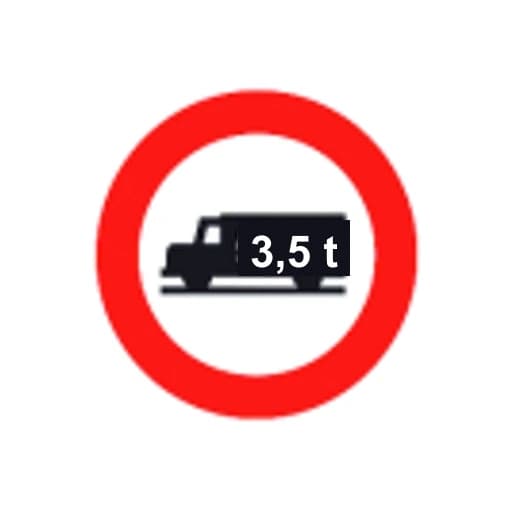
Correct answer
No, because it prohibits entry for lorries and vans even if they are travelling empty.
Vertical sign R-107 establishes the prohibition of entry for vehicles intended for the transport of goods (lorries and vans) with a maximum authorised mass greater than that indicated. It also prohibits access for those goods transport vehicles that are travelling empty.
Practice more C licence questions
A self-check with exam-style questions on Traffic signs. Free, no signup.
All options
Yes, because the vehicle is not carrying a load.
No, because it prohibits entry for lorries and vans even if they are travelling empty.
Yes, because it prohibits entry for lorries, but not for vans.
Editorial status: editorially approved. This status does not certify legal review. Report a correction
Keep studying
DGT test in English: free practice
Exam-style questions in English, no signup. You can also sit the official exam in English.
All Spanish traffic signs and their meanings
Full DGT catalogue: warning, regulatory and information signs.
Sign R-107: no entry for vehicles intended for carrying goods with a maximum authorised mass greater than the one indicated
What this sign means, its category and its shape.
Related questions
- Can delineation signs also indicate obstacles on a road?
- If a traffic officer raises an arm vertically and we cannot stop our vehicle safely…
- Without a supplementary panel indicating another distance, a regulatory sign’s obligations, restrictions or prohibitions begin to apply from…
- Without a supplementary panel indicating another distance, a regulatory sign’s obligations, restrictions or prohibitions begin to apply from…
- The driver of a lorry with a maximum authorised mass (MAM) exceeding 3,500 kg who is about to overtake must...
- If the width of the lorry you are driving exceeds 2.10 metres, you must know that the width indicator lights are...