Correct answer
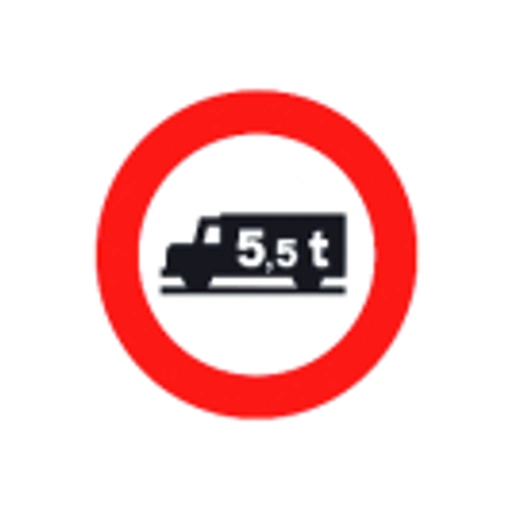
Prohibits access to vehicles used for the transport of goods with an MAM of more than 5.5 tonnes.
The R-107 prohibition sign shown in the image prohibits access to vehicles used for the transport of goods with a maximum authorised mass (MAM) exceeding the value indicated on the sign, which in this case is more than 5.5 tonnes. This means that trucks and vans whose MAM exceeds this limit are not permitted to pass beyond this sign, even if travelling empty. It is a traffic control measure aimed at regulating vehicle flow and ensuring road safety.
Practice more B licence questions
A 3-minute quick test with exam-style questions. Free, no signup.
All options
Allows access to vehicles of more than 5.5 tonnes used for the transport of goods, when travelling empty.
Prohibits access to all types of vehicle with an MAM of more than 5.5 tonnes.
Prohibits access to vehicles used for the transport of goods with an MAM of more than 5.5 tonnes.
Editorial status: editorially approved. This status does not certify legal review. Report a correction
Keep studying
DGT test in English: free practice
Exam-style questions in English, no signup. You can also sit the official exam in English.
All Spanish traffic signs and their meanings
Full DGT catalogue: warning, regulatory and information signs.
Sign R-107: no entry for vehicles intended for carrying goods with a maximum authorised mass greater than the one indicated
What this sign means, its category and its shape.
Related questions
- On a vehicle over five metres long used exclusively for goods transport, how far may an indivisible-length load project at most, subject to loading and safety conditions?
- A vertical R-2 STOP sign applies to your lane. Must you stop if no higher-priority instruction contradicts it?
- Your passenger car becomes immobilised by a breakdown on a dual carriageway and has hazard warning lights. Which light signal must you activate to immediately warn of its presence?
- A special vehicle travels on a public road at no more than 40 km/h and its V-2 beacon works. When must it use the beacon while travelling?
- Under the rules effective from 1 October 2026, may mopeds ride two abreast on the shoulder?
- A person with a disability travels at walking pace in a wheelchair, with or without a motor, on an ordinary road where pedestrian travel is permitted and no usable pedestrian area exists. May they use a usable shoulder or, if none exists, the carriageway?