Step 1. The big picture
In one sentence…
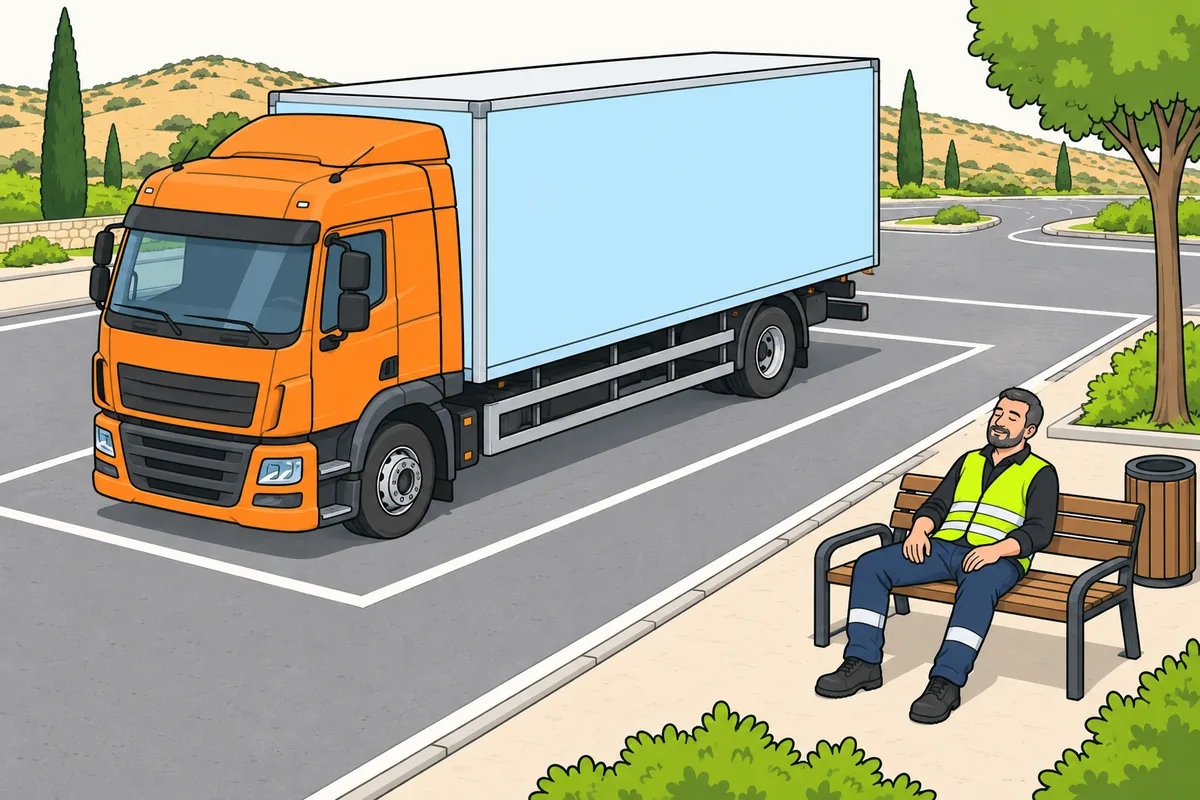
Driving and rest times are road-safety and labour regulations. For professional licences you must memorise the base limits of Regulation (EC) 561/2006 and understand their preventive logic, because the aim is to avoid fatigue and unsafe decisions.
What you'll cover
Step 2. The syllabus
2.1Maximum driving and breaks
After a driving period of 4 hours and 30 minutes you must take an uninterrupted break of at least 45 minutes, unless you start a rest period instead.
- That break can be split into 15 minutes followed by 30 minutes within the same driving period, keeping that exact order.
- Daily driving time is 9 hours, extendable to 10 hours only twice a week, when planning allows it.
- The key in the exam is to distinguish break, rest and accumulated driving; they're not interchangeable words even though they all reduce driver fatigue.
2.2Weekly and two-week limits
Weekly driving must not exceed 56 hours, and the accumulated total over two consecutive weeks must not exceed 90 hours.
- These limits don't replace the need for breaks and rest periods: they apply in addition and are checked together.
- It's not enough to add up allowed days; a week that seems correct can still fail when you check the combined two-week total.
- Practise cases as a calendar: day, week and two weeks are different windows that can make the same plan incorrect.
2.3Daily rest
The normal daily rest period is 11 hours, though it can be reduced to 9 hours within the margins the rule allows.
- Daily rest isn't the same as the 45-minute break; the break interrupts driving, the rest recovers from a working day.
- When a question uses the word reduce, read carefully whether it refers to daily rest, weekly rest or a split break.
- The rule exists to prevent chronic fatigue, not just to organise the driver's or the company's administrative schedule.
2.4Weekly rest
Within two consecutive weeks you must take at least two normal weekly rest periods, or one normal and one reduced rest period of at least 24 hours.
- The reduced weekly rest requires the corresponding compensation, so it isn't simply a free, permanent version of the normal rest.
- The question may hide the error in the second week: always review the full sequence before accepting a plan.
- If an answer ignores compensation for the reduced rest, treat it as suspect even if it respects other driving limits within the calendar.
2.5Tachograph and responsibility
The tachograph is used to monitor driving and rest times, but the driver must understand the rule, not just look at a record.
- These times affect road safety because fatigue reduces attention, anticipation and reaction capacity in goods vehicles.
- Responsibility doesn't disappear under schedule pressure; if a break or rest is due, the plan must adapt to the rule in force.
- In the exam, options that prioritise arriving earlier over respecting a break or rest usually contradict the rule's preventive purpose.
2.6Exam practice
In the C-specific test you have 20 questions, a maximum of 2 errors and 20 minutes; answer quickly, but always from the rule and the case described.
- First memorise the base figures: 4.5 h, 45 min, 15 + 30, 9 h, 10 h, 56 h, 90 h, 11 h and 24 h.
- Then practise with scenarios: identify whether the question is about continuous driving, daily, weekly or two-week driving, daily rest or weekly rest before calculating.
- If two answers have correct figures, choose the one that also respects compensation, the order of the split break and compatibility between the applicable limits.
Step 3. Key points
If you only have a minute before the exam, revise this.
- 1.Memorise 4.5 hours of driving and a 45-minute break.
- 2.Remember the break can be 15 minutes plus 30 minutes.
- 3.Distinguish daily driving from continuous driving.
- 4.Apply 9 daily hours and 10 only twice a week.
- 5.Check 56 weekly hours and 90 over two weeks.
- 6.Tell apart normal and reduced daily rest.
- 7.Review normal weekly rest, reduced rest and compensation.
- 8.Solve each scenario as a calendar, not as a loose list.
Step 4. Exam traps
Mistakes the DGT uses again and again on this topic.
- Confusing a break with daily rest.
- Adding up daily limits without respecting the weekly and two-week caps.
- Forgetting that reduced weekly rest requires compensation.
- Reversing the order of the 15-minute and 30-minute split break.
- Applying 10 daily hours as the general rule instead of a limited extension.
- Accepting a one-week plan without checking the two consecutive weeks.
Step 5. Quick check
Four real exam questions on what you have just read.
If you feel fatigued while driving a truck, the correct action is to:
Step 6. Frequently asked questions about driving and rest times
- In a lorry, where is the electric retarder fitted?
- In the transmission. It is installed in the drivetrain. In an electromagnetic retarder, the rotors turn with the transmission while the stator remains fixed; magnetic effects produce torque opposing rotation without service-brake friction. It is not fitted within the service-brake drums or discs. Depending on the design, it can be mounted in the propeller shaft with chassis support or on the gearbox or axle; not every model has the same mounting. It is an auxiliary brake and does not replace the service brake for every purpose.See full question
- If you are not in a suitable condition to drive a C1 or C truck, you must:
- Do not start the trip or interrupt it if necessary. Driving requires adequate physical and mental fitness, so it should not be started or continued if you are not fit.See full question
- In vehicles where it is required, the tachograph mainly records:
- Driving times, breaks, and rest periods. The tachograph records the driver’s activity periods, including driving, other work, availability and breaks or rest, as well as vehicle data such as speed and distance. These records allow compliance with driving and rest-time rules to be checked. It does not merely record fuel level or outside temperature.See full question
Official sources
Test what you've studied on driving and rest times
Exam-style questions on this topic, with an explanation after every answer.
Now, practise it
Test what you have read with exam-style questions and an explanation after each answer.
Related lessons
- C1Driving and rest times
Driving and rest times are road-safety and labour regulations. For professional licences you must memorise the base limits of Regulation (EC) 561/2006 and understand their preventive logic, because the goal is to avoid fatigue and unsafe decisions.
- DDriving and rest times
Driving and rest times for passenger transport are based on Regulation (EC) 561/2006. The aim is to limit driver fatigue and protect passengers and other road users; in the exam you must know both the figures and the purpose of each break or rest period.
- D1Driving and rest times
Driving and rest times for passenger transport are based on Regulation (EC) 561/2006. The aim is to limit driver fatigue and protect passengers and other road users; in the exam you must know both the figures and the purpose of each break or rest period.
- CSafe loading
Safe loading isn't just a logistics matter: incorrect stowage shifts the centre of gravity, lengthens braking distance and can cause a rollover or objects to fall onto the road. In the C licence - Truck, study it as a matter of safety, responsibility and anticipation.
- CMechanics and maintenance
Preventive maintenance of trucks and goods vehicles is part of road safety: it avoids breakdowns, reduces braking distance, improves stability and cuts down on errors in the exam and in real driving. In the C licence - Truck, basic checks are part of driving with anticipation.
- CGoods transport regulations
A C licence - Truck driver must master the goods-transport framework: authorised category, visibility, the vehicle's masses and dimensions, stowage, route and the prudence obligations of driving a heavy vehicle. This topic brings together licence, load, signs and daily responsibility.