Step 1. The big picture
In one sentence…
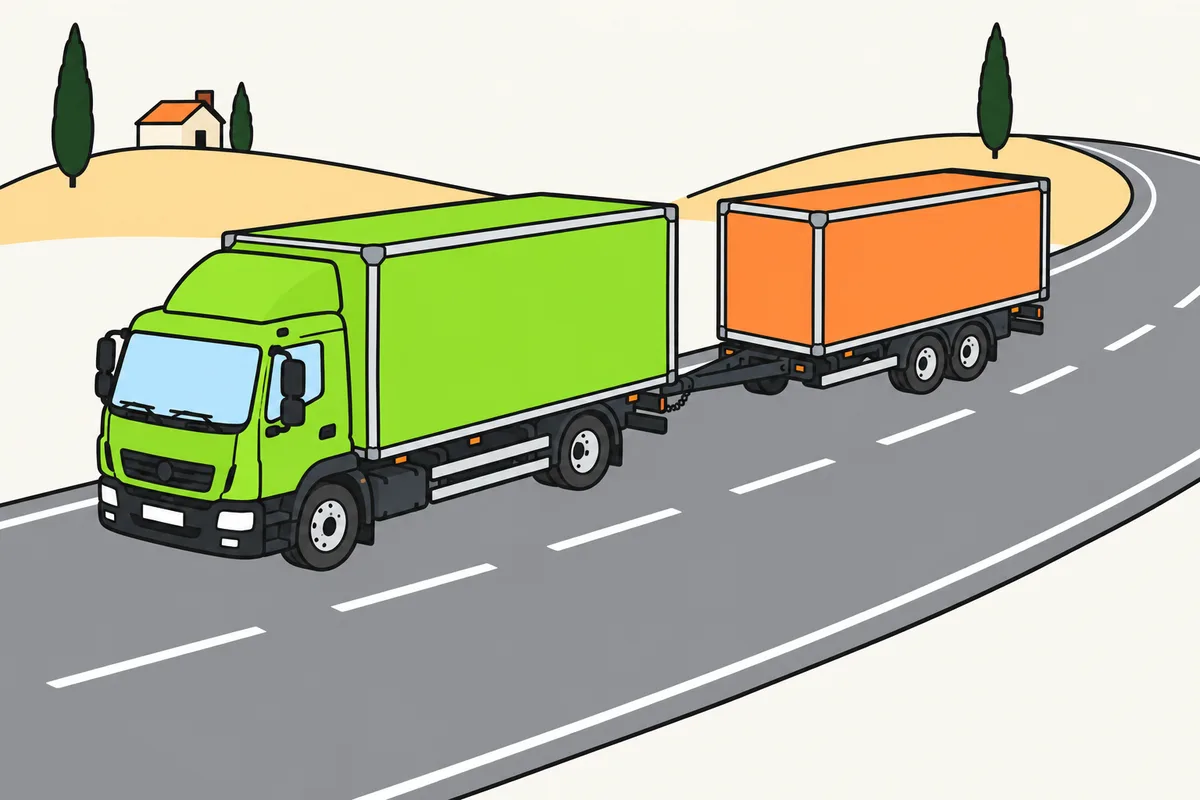
In C1+E you study articulated goods combinations or ones with a heavy trailer: correct authorisation, coupling, restrictions on mass and length, and dynamic behaviour more demanding than a rigid vehicle. The goal is to recognise when the rules, the road or the combination's configuration require greater caution and margin.
Step 2. The syllabus
2.1Scope of the licence
C1+E authorises category C1 vehicles with a trailer or semi-trailer, and combinations up to 12,000 kg, so you must clearly tell apart a rigid vehicle, a light combination, a heavy combination and an articulated configuration.
- The authorisation isn't just a label to study: it determines which vehicle you can drive, which trailer you can couple and which specific theory test you must pass.
- The DGT requires a specific theory test for goods combinations with a trailer, so the questions focus on risks specific to the combination.
- If the wording mixes several categories, go back to the licence and the trailer type before answering on unsafe intuition.
2.2Mass, length and route
The route can be constrained by height, mass, length, turning radius and local or road-specific restrictions, even when driving looks technically possible.
- Don't invent figures if the exam doesn't give them; identify whether the question asks you to respect the rule in force, a specific sign or a restriction on the road.
- On a long combination, length affects overtaking, joining traffic, narrow passages, parking and manoeuvres where another road user can be hidden.
- Mass affects braking and stability; that's why rules on combinations aren't simple administrative requirements, but safety rules.
2.3Documentation and legality
The documentation and the condition of the coupling are part of the legality of the service, not just driving technique.
- Before driving, you must know that the combination matches the available authorisation and that its main elements show no obvious defects.
- An exam answer that separates legality from safety is usually suspect, because a poorly authorised or poorly coupled combination creates real risk.
- When the question mentions plates, authorisation or the vehicle's condition, answer from the rule in force and the applicable official references.
2.4Dynamics of the combination
The longer and heavier the combination, the greater the turning radius, the longer the braking distance and the easier it is to lose stability with abrupt manoeuvres.
- Jack-knifing, swaying or oscillation requires a calm reaction: smooth out, correct without jerks and avoid violent braking that would worsen the problem.
- How the load is distributed between the towing vehicle and the towed unit has a decisive influence on grip, steerability and braking response.
- In the exam, if an option proposes sudden steering or hard braking in response to oscillation, it usually contradicts the idea of smoothness and progressive control.
2.5Driving and manoeuvres
Overtaking, joining traffic, descents and reversing manoeuvres require a greater margin than a rigid vehicle because of length and inertia.
- Having right of way doesn't remove the obligation of caution when a turn or manoeuvre could endanger vulnerable road users or small vehicles.
- At roundabouts, junctions and narrow accesses, think about the towed unit's sweep and the lateral position you need so as not to encroach on dangerous areas.
- The rule applies alongside technique: having priority or authorisation doesn't mean you can carry out a manoeuvre without enough space.
2.6Signs and restrictions
Restriction, prohibition or information signs can particularly affect combinations because of mass, height, length, gradient or vehicle type.
- If a sign contradicts the general rule, apply the signalling hierarchy and respect the specific restriction on that road.
- Local or temporary restrictions count too; roadworks, diversions or panels can change the safe and legal way to drive.
- In questions with signs, don't answer as if you were driving a car; always check whether the combination is included because of its characteristics.
2.7Exam strategy
The C1+E specific test has 20 questions, a maximum of 2 errors and 20 minutes, so it pays to recognise the risk being asked about quickly.
- Classify each question as authorisation, mass, length, coupling, load, signalling or dynamics; that classification usually eliminates absurd answers quickly and safely.
- When a specific figure is missing, don't invent one mentally; choose the option that refers to the rule, the sign or the safe condition.
- Practise comparing a rigid vehicle with a heavy combination, because many traps come from applying a single-truck intuition to the trailer.
Step 3. Key points
If you only have a minute before the exam, revise this.
- 1.Identify the exact scope of the C1+E licence before answering.
- 2.Tell apart a rigid vehicle, a heavy combination and an articulated one in each question.
- 3.Check documentation, authorisation and the coupling's condition as part of legality.
- 4.Link mass and length to braking, turning, overtaking and joining traffic.
- 5.Apply road signs and restrictions above general intuitions.
- 6.Increase your margin on descents, junctions, roundabouts and reversing manoeuvres.
- 7.Respond with smoothness and control when jack-knifing, swaying or oscillation appear.
Step 4. Exam traps
Mistakes the DGT uses again and again on this topic.
- Confusing a heavy combination with a rigid truck for manoeuvring and stability purposes.
- Believing the main risk is only engine power and not the combination's dynamics.
- Inventing a mass or length figure when the question only requires applying the rule in force.
- Forgetting that a sign or local restriction can constrain a route that is technically possible.
- Separating documentation and coupling as if they didn't affect real safety.
- Thinking having priority means you can turn without checking vulnerable road users or lateral space.
Step 5. Quick check
Four real exam questions on what you have just read.
An adult drives a goods lorry with a maximum authorised mass over 3,500 kg, towing a trailer with a maximum authorised mass of 1,000 kg. What maximum breath-alcohol concentration does Spain’s General Traffic Regulation specify?
Step 6. Frequently asked questions about regulations for heavy combinations
- For C+E to be issued, the applicant must already hold:
- A valid C licence. To issue a C+E licence, the applicant must hold a valid C licence. An AM or B licence alone does not replace that requirement: C is the base category to which the corresponding trailer or semi-trailer combination entitlement is added. Other licensing requirements must also be met; holding C does not automatically confer C+E.See full question
- The towing vehicle of a combination has a windscreen and has passed its periodic inspection. Where should its own V-19 inspection sticker be placed?
- In the upper right corner of the windscreen, inside. In the upper right corner of the windscreen, on its inside face. V-19 indicates that that vehicle passed its periodic inspection and when the next is due. A trailer or other vehicle without a windscreen displays its own sticker somewhere clearly visible. The towing vehicle’s sticker does not by itself establish the trailer’s inspection status.See full question
- Someone applying for the C+E licence is exempt from the specific knowledge test if they already hold:
- C1+E or D1+E. The regulation exempts someone from the C+E specific knowledge test if they already hold C1+E or D1+E.See full question
- Under the wording of Annex VI.A.2 of the General Driver Regulations, what minimum interval is specified between successive attempts after the third, except for a justified exceptional reduction?
- 15 days. Annex VI. A.2 specifies a minimum of fifteen days between successive attempts after the third. After two unsuccessful attempts, it specifies ten days between the second and third. The intervals run from the date of the unsuccessful test and may exceptionally be reduced for justified urgency. This question concerns the interval expressed in the regulation; the traffic authority determines the actual test date.See full question
- Under Annex VI.B.3 of the General Driver Regulations, what maximum percentage of errors is permitted in the C1+E or C+E specific knowledge test?
- 10% of the total number of questions. 10% of the total questions. If applying that percentage gives a decimal result, Annex VI. B.3 requires the next higher whole number. For example, a 20-question test allows at most 2 errors. This must not be confused with a supposed 20% limit.See full question
Official sources
Test what you've studied on regulations for heavy combinations
Exam-style questions on this topic, with an explanation after every answer.
Now, practise it
Test what you have read with exam-style questions and an explanation after each answer.
Related lessons
- B+ERegulations for combinations
In B+E you must study authorised masses, coupling, load distribution, the stability of the combination and specific signalling for driving with a trailer or semi-trailer within the framework allowed by this class. The key is always to think of the towing vehicle and trailer as a single unit that is longer, heavier and slower to react.
- C+ERegulations for heavy combinations
In C+E you study articulated goods combinations or ones with a heavy trailer: correct authorisation, coupling, restrictions on mass and length, and dynamic behaviour more demanding than a rigid vehicle. The goal is to recognise when the rules, the road or the combination's configuration require greater caution and margin.
- D+ERegulations for passenger combinations
D+E passenger combinations combine carrying people with the dynamic complexity of a heavy trailer. You must master the scope of the licence, the specific exam and the practical consequences of driving a D-category bus with a trailer of more than 750 kg.
- D1+ERegulations for passenger combinations
D1+E passenger combinations combine the transport of people with the dynamic complexity of a heavy trailer. You must master the scope of the licence, the specific exam and the practical consequences of driving a D1 minibus with a trailer of over 750 kg.
- C1+ESafety devices
In C1+E, the combination's safety devices aren't checked as a formality: they support braking, lighting, signalling, stability and control of the towed unit. Study every check by thinking about how a faulty connection, a support leg or a wheel can turn a normal manoeuvre into an unsafe situation.
- C1+EMechanics and maintenance
Preventive maintenance for C1+E is directly part of road safety: it avoids breakdowns, improves braking, preserves stability and reduces errors when preparing the vehicle. Study the whole combination, because it covers category C1 vehicles with a trailer or semi-trailer, and combinations up to 12,000 kg, and no defect in the towed unit is offset by a towing vehicle in good condition.