Requirements and minimum age for the LCM license
The LCM license is intended for vehicles for people with reduced mobility. The configured minimum age is 14, and the process includes a medical examination, a specific theory test, and a closed-circuit manoeuvring test.
It is not a general license for any small vehicle. Its purpose is to allow the driving of vehicles adapted or intended for reduced mobility, with a maximum speed limited by construction and clear circulation restrictions.
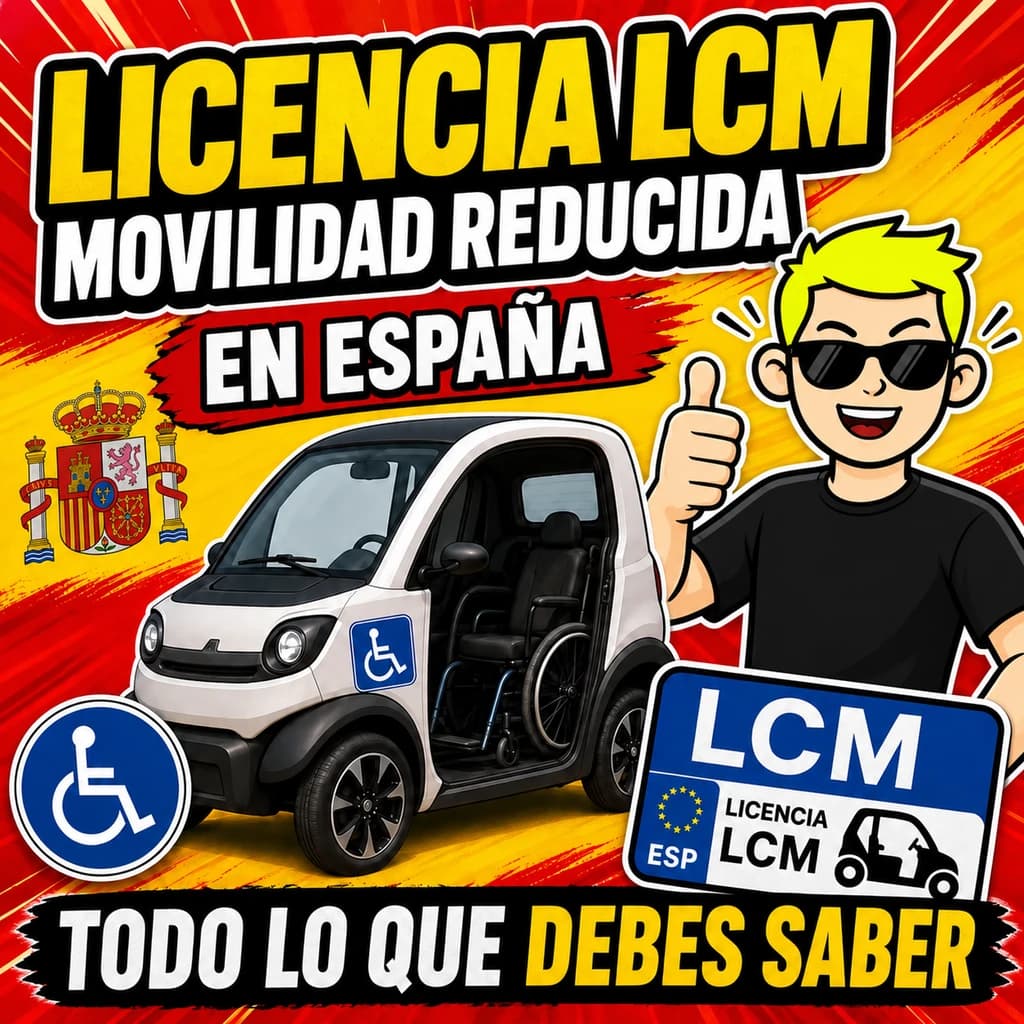
What vehicles you can drive with LCM
With LCM you can drive vehicles intended for people with reduced mobility. That is the central idea behind the search "what can I drive with LCM", but it must be read strictly: the vehicle must match that purpose.
If the vehicle is not intended for reduced mobility, or if its characteristics place it in another category, LCM does not make it authorized. Before starting the process, check the vehicle documents and ask the driving school or DGT if your case is unclear.
The important question is not whether the vehicle looks small, but whether it is intended for that specific function. If the intended use changes, or if the vehicle can perform like another category, ask for confirmation before driving.
Limits and circulation you must understand
The internal rules source states that these vehicles have a maximum speed limited by construction and cannot use motorways or dual carriageways. That is why preparation should not focus only on passing the test, but on understanding where you can drive safely.
Plan routes on suitable roads, increase anticipation at junctions, and avoid situations where the speed difference with other vehicles could create risk. LCM solves a specific mobility need, but it requires prudence and good reading of the surroundings.
When studying, pay attention to allowed and prohibited roads, because these are very practical questions. A correct answer is not only useful for passing: it also prevents you from planning a trip on a road where the vehicle should not be.
How the theory and manoeuvring tests work
The reference for the specific exam is 20 questions, a maximum of 2 errors, and 20 minutes. The content focuses on rules that apply to the license, signs, basic safety, coexistence with other users, and vehicle limits.
LCM also requires closed-circuit manoeuvres. Practise starting, stopping, trajectory control, turns, and observation. The objective is not speed, but showing stable and safe control of the vehicle in reduced spaces.
If the circuit test makes you nervous, divide practice into simple actions: look, start, hold the line, correct, and stop. Repeating that sequence reduces abrupt errors and lets you focus on the surroundings.
Indicative costs and preparation
The final cost depends on province, medical centre, driving school, and current fees. As an allowed reference, the medical test is usually around 35-60 EUR; for lessons or practice, ask the exact price because it can vary a lot depending on the available vehicle.
Ask for the budget divided into enrolment, material, medical examination, fees, lessons, and possible test repetition. If you need an adapted vehicle, confirm beforehand whether the driving school has one or how the practical test is organised.
Do not accept a global price unless you know what it includes. With such a specific license, a low headline price can become expensive if lessons, a suitable vehicle, or a second test booking are missing.
Common mistakes and tips to pass
A common mistake is treating LCM as a minor license with no real study. Even if the vehicle is specific, the exam requires signs, priorities, road restrictions, and manoeuvres. Review every error until you understand the rule behind it.
For manoeuvres, work on smoothness and precision. Look before moving, control low speed, and avoid correcting late. If the vehicle has adaptations, practise until the controls feel natural and you do not have to think through every action.
Before the exam, prepare a short list with allowed roads, prohibited roads, the signs you miss most often, and the manoeuvres you find difficult. Reviewing it before each session helps you arrive with consistent judgement, not only test memory.
Can LCM use a motorway or dual carriageway?
No. The license information states that LCM vehicles cannot use motorways or dual carriageways. This restriction is essential for planning trips and for answering exam questions about road types correctly.
If your usual route seems to depend on a high-capacity road, look for alternatives before buying or using the vehicle. Safety here depends both on the license and on choosing roads compatible with the vehicle characteristics.
How many questions are on the LCM exam?
The preparation reference uses 20 questions, a maximum of 2 errors, and 20 minutes. It is a specific test, not a copy of the B exam, so practise with LCM material rather than only general tests.
When you do mock exams, separate mistakes by topic: signs, priority, prohibited roads, manoeuvres, or safety. That classification tells you what to review before trying another full exam.
What should I check before enrolling?
Check that you meet the minimum age of 14, that you can obtain the medical certificate, and that the vehicle truly corresponds to reduced mobility. Also ask how the closed-circuit manoeuvring test is organised.
If your mobility need is very specific, do not wait until exam day to solve doubts. Take the vehicle information to the driving school and ask for a clear answer on license category, circulation limits, and practical preparation.