Requirements and minimum age for the LVA license
The LVA license allows you to drive self-propelled special agricultural vehicles and their combinations. The configured minimum age is 16, and the process includes a medical examination, a specific theory test, and closed-circuit manoeuvres.
It is closely linked to rural and agricultural use, but it should not be treated as a mere formality. Driving agricultural machinery requires understanding dimensions, speed, signalling, hard shoulders, lighting, and coexistence with faster vehicles.
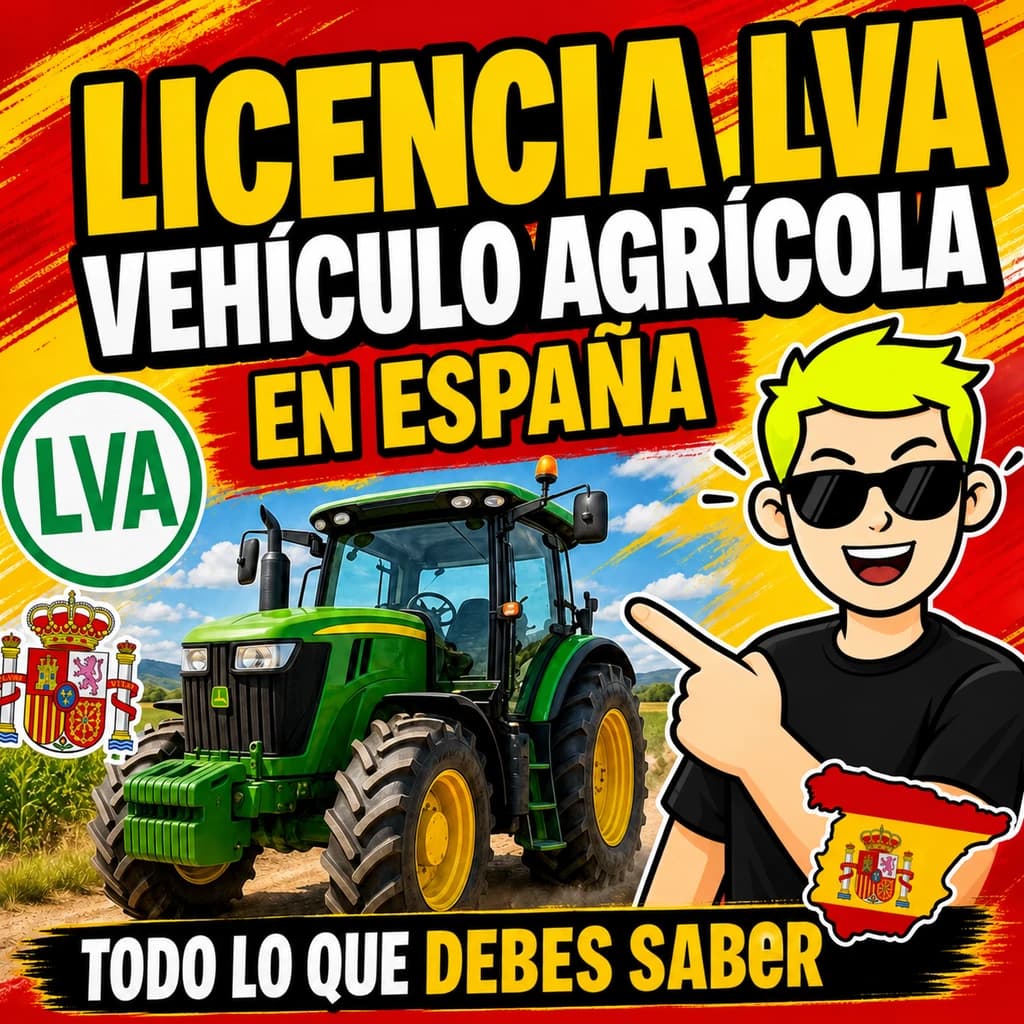
What vehicles you can drive with LVA
With LVA you can drive agricultural and forestry tractors, self-propelled agricultural machinery, and combinations with agricultural trailers. The vehicle reference summarises the category as agricultural vehicles within ordinary limits or up to 45 km/h by construction.
This license answers searches such as "what can I drive with LVA" or "vehicles allowed with LVA license". The key is that the vehicle is a special agricultural vehicle and respects the use limits of the license.
If the vehicle tows an agricultural trailer, check the whole combination and not only the tractor. The license applies to the vehicle and its combinations, so the dimensions, signalling, and speed of the combination also matter.
Agricultural circulation limits
The internal study rules state that these vehicles are prohibited from using motorways and dual carriageways. They also include special signalling, such as a V-20 panel and amber rotating light, and driving on the hard shoulder whenever possible.
On the road, the practical priority is to facilitate overtaking and reduce the risk created by the speed difference. At night or in low visibility, mandatory lighting and signalling are central to safety, not a secondary detail.
Agricultural traffic requires patience from everyone, but your part is to make coexistence easier. Keep a predictable path, signal early, and avoid joining a road if you cannot do so without forcing others to brake harshly.
How the theory and manoeuvring tests work
The exam reference uses 20 agricultural-vehicle specific questions, a maximum of 2 errors, and 20 minutes. The content focuses on traffic rules, signalling, road restrictions, safety, and basic use of agricultural vehicles.
LVA also requires a closed-circuit manoeuvring test. Practise low-speed control, turning, stopping, observation, and handling the combination where relevant. Precision matters more than speed.
On the closed circuit, get used to using visual references from the vehicle itself. Agricultural machinery may have overhangs, implements, or trailers that change the turn, so practise slowly until you know where the real limits are.
Indicative costs and preparation
The cost varies by province, driving school, available vehicle, current fees, and number of practice sessions. As an allowed reference, the medical test is usually around 35-60 EUR and a general practical lesson may be around 30-50 EUR, although you should ask for the specific price for agricultural machinery.
Before paying, ask what vehicle is used in training, where manoeuvres are practised, and whether the budget includes LVA-specific material. It is also worth clarifying what happens if you need to repeat the theory or circuit test.
If you already have access to machinery on a farm, ask whether that private practice really helps for the exam or whether you need sessions in test format. Useful experience is the kind that resembles what will be assessed.
Common mistakes and tips to pass
The typical mistake is overconfidence because the person has already used machinery on private land. The exam does not measure only informal experience: it requires circulation rules, signs, road prohibitions, lighting, and safe behaviour around faster traffic.
Study by blocks and practise manoeuvres until you control the size of the vehicle without invading spaces. In tests, pay attention to words such as motorway, dual carriageway, hard shoulder, special signalling, and 45 km/h, because they often separate a correct answer from a dangerous one.
Before the exam, summarise road limits, special signalling, lighting duties, and the manoeuvres that go worst on one sheet. That final review forces you to connect theory and practice, which is exactly what you need when driving agricultural machinery.
Can I use a motorway or dual carriageway with LVA?
No. The LVA study information states that use of motorways and dual carriageways is prohibited. This rule must be clear from the beginning because it affects routes, work, and safety.
If you need to move machinery between plots, plan compatible roads and tracks. Driving on a prohibited road is not fixed by carrying signalling; first, the road itself must be allowed for that type of vehicle.
How many questions are on the LVA exam?
The preparation reference uses 20 questions, a maximum of 2 errors, and 20 minutes. It is a specific agricultural-vehicle test, so general car tests are not enough.
When correcting mock exams, identify whether you fail speed limits, signalling, hard-shoulder circulation, lighting, or manoeuvres. That targeted review is more useful than repeating tests without understanding the reason for each error.
What should I check before enrolling?
Check that you are 16 or older, that you can obtain the medical certificate, and that the vehicle you want to drive really falls within LVA. If the agricultural combination has special characteristics, ask before starting the process.
Also check whether the driving school has a suitable vehicle and space for manoeuvres. Good LVA preparation is not limited to the test: it should help you drive safely on roads shared with much faster traffic.
If an answer depends on the exact vehicle, resolve it beforehand with documents, not intuition.