Step 1. The big picture
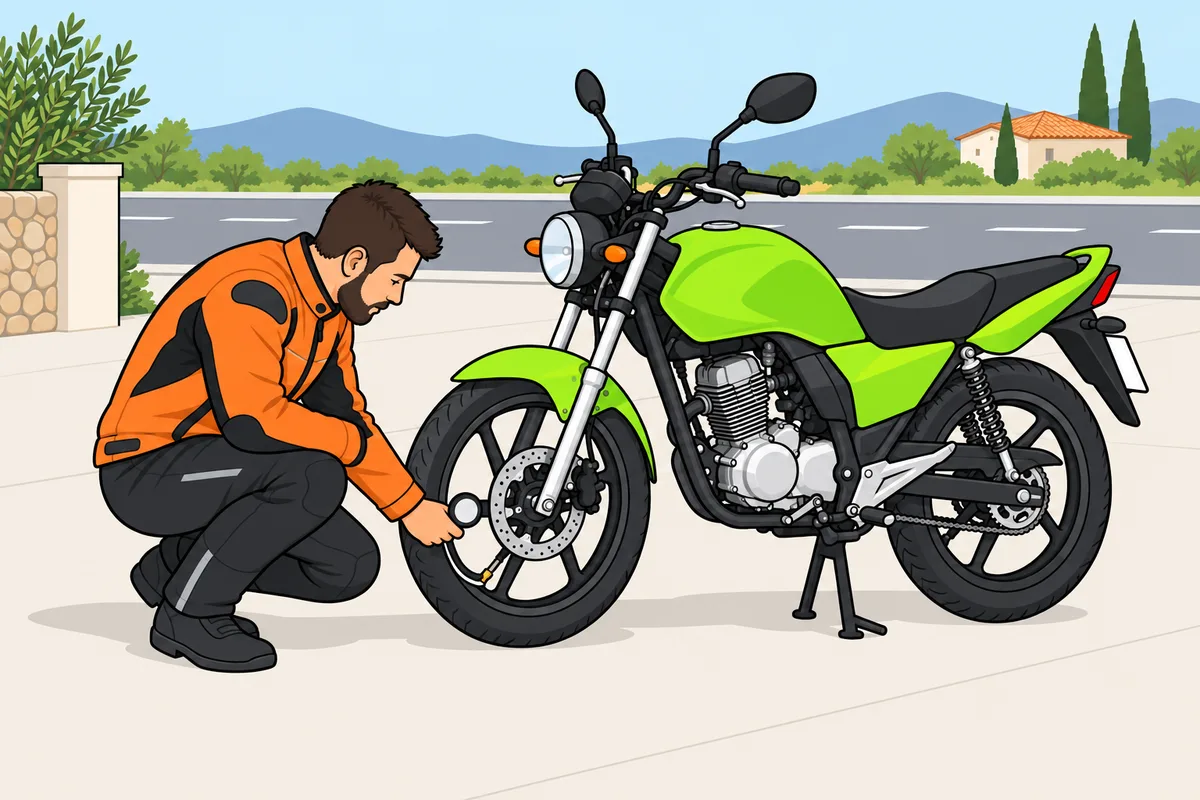
In one sentence…
Preventive motorcycle maintenance is part of road safety: it avoids breakdowns, reduces braking distance, improves stability and cuts down on errors both in the exam and in real riding. Study each check by its effect on riding, not as a mere workshop formality.
Step 2. The syllabus
2.1Checks before riding
Check tyres, pressure, tread, uneven wear, lights, optical signalling and brake condition before a demanding ride or a long trip.
- Check essential fluid levels when the vehicle requires it, such as oil, coolant and brake fluid, following the manufacturer's instructions.
- If the vehicle tows a trailer or carries a load, also check fastenings, fasteners, electrical connections and a balanced weight distribution.
- A quick, orderly check before setting off takes little time and avoids discovering a fault right when you're already riding and can't react calmly.
2.2Tyres, the only contact with the ground
Tyres are the motorcycle's only connection with the road surface, so their pressure and tread directly determine grip, braking and stability in bends.
- Incorrect pressure significantly changes handling, especially with a passenger, luggage or on a fast road, and speeds up uneven wear of the rubber.
- Worn tread loses grip in the wet and lengthens braking distance; checking wear in time is a safety measure, not just a way to save money.
2.3Brakes, lights and transmission
Brake condition determines your stopping distance, so any spongy feel, noise or loss of effectiveness must be checked before continuing to ride.
- Lights and optical signalling exist to help you see and be seen; a blown bulb on a motorcycle greatly reduces safety and is also grounds for a penalty.
- On a motorcycle, the secondary transmission where fitted, play in the controls, the condition of the chain or belt, and the absence of leaks or deformities all become especially important.
- The controls must respond precisely: a throttle that sticks or a lever with excessive play alter the fine control the motorcycle demands.
2.4Elements that matter most in the exam
The DGT requires the candidate to know how to prepare the vehicle for safe riding: adjusting the seat, mirrors, controls and basic checks of overall condition.
- For professional and combination licences, the exam values pre-ride checks of coupling, brakes, wheels, lights, fastenings and load security.
- A poorly maintained vehicle can alter its response when braking, cornering or manoeuvring slowly and ruin even the most skilled rider's correct technique.
- Knowing what to check and why is as much assessed as riding well: the exam links each check to its effect on safety.
2.5Maintenance and efficient riding
Correct pressure, alignment, filters in good condition and a reasonable load reduce fuel consumption and wear without reducing safety.
- Riding with a known fault isn't only unsafe; it can also be reportable if it affects essential elements of the vehicle such as brakes, lights or tyres.
- Consistent maintenance detects small faults before they turn into expensive breakdowns or dangerous situations while riding.
2.6Safety versus the workshop
Maintenance isn't just a workshop matter: every element checked has a direct consequence on the motorcycle's braking, stability and response.
- Focusing only on the engine and forgetting wheels, brakes, lights or fastenings is a typical mistake the exam uses to set traps.
- Understanding that a mechanical fault changes how the motorcycle rides helps you answer with judgement instead of memorising isolated lists of parts.
Step 3. Key points
If you only have a minute before the exam, revise this.
- 1.Know what to check before setting off and do it in an orderly way.
- 2.Check tyre pressure, tread and wear.
- 3.Link tyres, brakes and lights to real safety.
- 4.Check the chain or belt, play in the controls and the absence of leaks.
- 5.Don't ride with a known fault in an essential element.
- 6.Understand that a mechanical fault changes both riding and the exam.
Step 4. Exam traps
Mistakes the DGT uses again and again on this topic.
- Thinking maintenance is only a workshop matter and not a road safety one.
- Focusing on the engine and forgetting wheels, brakes, lights or fastenings.
- Believing incorrect pressure barely affects the motorcycle's handling.
- Assuming you can ride with a blown bulb without consequences.
- Ignoring that riding with a known essential fault can be reportable.
Step 5. Quick check
Four real exam questions on what you have just read.
When motorcyclists travel in large groups...
Step 6. Frequently asked questions about mechanics and maintenance
- In addition to using the required lighting, how should a motorcyclist respond in areas where other road users may move unexpectedly?
- Anticipate and prepare for other road users’ movements. Defensive riding requires observing the surroundings, anticipating other road users’ possible movements and adapting speed and distance to allow time to react. Required lighting helps visibility but does not replace anticipation; using lights as the only warning is insufficient.See full question
- In a petrol motorcycle with a conventional four-stroke engine, how is the engine lubricated?
- With engine oil in a lubrication system separate from the fuel. It requires engine oil in a lubrication system separate from the fuel. Do not add oil to the petrol as if preparing premix for a two-stroke engine. Oil reduces friction and wear and helps remove heat. Check the level and use the oil and service intervals specified by the manufacturer; running without lubrication can severely damage the engine.See full question
- During normal straight-line braking with good grip, which motorcycle brake usually provides most of the braking effort?
- The front brake system. The front brake usually provides most of the braking effort, while the rear brake helps keep the motorcycle balanced. Forward load transfer increases the load on the front wheel. Use both brakes progressively and according to conditions. This does not establish that every front brake pad wears out first: wear also depends on design, materials and use.See full question
- If you ride a motorcycle during the day on an urban road, must any light be switched on?
- Yes, the position lights and dipped-beam or low-beam headlights. Yes. During the day, motorcycles must use dipped-beam or low-beam headlights on any road, including urban roads, together with the corresponding position lighting. Position lights alone are insufficient, and the duty does not depend solely on the weather. Night-time lighting is also governed by road-illumination and dazzle rules; do not infer that dipped beam alone must always be used in every situation.See full question
- What braking system is most frequently used on the front wheel of a motorcycle?
- The disc brake. Currently, motorcycles usually use disc brakes on both wheels, and more frequently on the front wheel. These brakes are easily identifiable as the disc can be observed in the central part of the wheel. Disc brakes are more effective and safer than drum brakes.See full question