Step 1. The big picture
In one sentence…
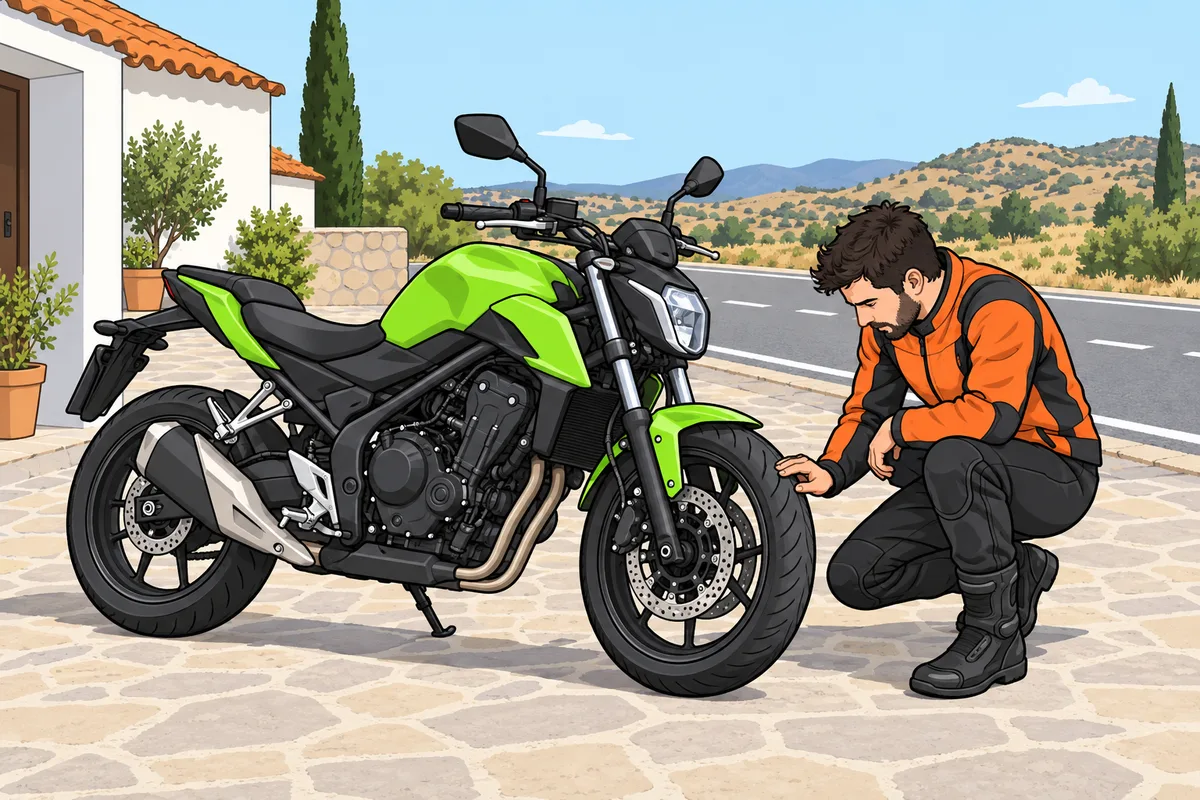
Preventive maintenance of motorcycles is part of road safety: it avoids breakdowns, reduces braking distance, improves stability and cuts down on errors in the exam and in real riding. Study each check for its effect on riding, not as a simple workshop formality.
Step 2. The syllabus
2.1Checks before setting off
Check tyres, pressure, tread, uneven wear, lights, optical signalling and brake condition before a demanding use or a long journey.
- Check essential levels when the vehicle requires it, such as oil, coolant and brake fluid, following the manufacturer's guidance.
- If the vehicle is towing a trailer or carrying a load, also check fastenings, catches, electrical connections and a balanced weight distribution.
- A quick, orderly check before setting off costs little time and prevents discovering a fault exactly when you're already riding and can't react calmly.
2.2Tyres, the only contact with the ground
Tyres are the motorcycle's only connection to the tarmac, so their pressure and tread directly affect grip, braking and stability in a bend.
- Incorrect pressure greatly changes handling, especially with a passenger, luggage or on a fast road, and speeds up uneven wear of the rubber.
- Worn tread loses grip on a wet surface and lengthens braking distance; checking wear in time is a safety measure, not just a matter of saving money.
2.3Brakes, lights and transmission
The condition of the brakes defines your stopping distance, so any spongy feel, noise or loss of effectiveness must be checked before continuing to ride.
- Lights and optical signalling are there to see and be seen; a blown bulb on a motorcycle greatly reduces safety and is also grounds for a fine.
- On a motorcycle, the secondary transmission where it exists, play in the controls, the condition of the chain or belt, and the absence of leaks or deformation take on particular importance.
- The controls must respond precisely: a throttle that sticks or a lever with excessive play alters the fine control the motorcycle demands.
2.4Elements that matter most in the exam
The DGT requires the candidate to know how to prepare the vehicle for safe riding: seat, mirror and control adjustment, and basic checks of general condition.
- In professional and combination licences, the exam values prior checks on coupling, brakes, wheels, lights, anchorages and load safety.
- A poorly maintained vehicle can alter the response under braking, in a bend or in a slow manoeuvre, and ruin even the most skilful rider's correct technique.
- Knowing what to check and why is as much part of the assessment as riding well: the exam relates each check to its effect on safety.
2.5Maintenance and efficient riding
Correct pressure, alignment, filters in good condition and a reasonable load reduce fuel consumption and wear without compromising safety.
- Riding with a known defect isn't just unsafe; it can also be reportable if it affects essential elements of the vehicle such as brakes, lights or tyres.
- Consistent maintenance catches small faults before they turn into costly breakdowns or dangerous situations while riding.
2.6Safety versus the workshop
Maintenance isn't only a workshop matter: every element checked has a direct consequence for braking, stability and how the motorcycle responds.
- Focusing only on the engine and forgetting wheels, brakes, lights or fastenings is a typical error that the exam uses to set traps.
- Understanding that a mechanical defect changes how the motorcycle behaves helps you answer with judgement rather than memorising loose lists of parts.
Step 3. Key points
If you only have a minute before the exam, revise this.
- 1.Know what to check before setting off and do it in an orderly way.
- 2.Check tyre pressure, tread and wear.
- 3.Relate tyres, brakes and lights to real safety.
- 4.Check the chain or belt, control play and the absence of leaks.
- 5.Don't ride with a known defect in an essential element.
- 6.Understand that a mechanical fault changes both riding and the exam.
Step 4. Exam traps
Mistakes the DGT uses again and again on this topic.
- Thinking maintenance is only a workshop matter and not one of road safety.
- Focusing on the engine and forgetting wheels, brakes, lights or fastenings.
- Believing that incorrect pressure barely affects the motorcycle's handling.
- Assuming you can ride with a blown bulb without consequences.
- Ignoring that riding with a known essential defect can be reportable.
Step 5. Quick check
Four real exam questions on what you have just read.
A motorcycle has a faulty silencer and exceeds the noise limits. May it be ridden in that condition?
Step 6. Frequently asked questions about mechanics and maintenance
- Must a privately used motorcycle that is neither classified as historic nor used by a driving school undergo periodic inspection according to its age?
- Yes. Yes. Under the ordinary regime it is exempt up to four years of age and subsequently inspected every two years. Do not wait until it is more than ten years old. Age is calculated under the inspection rules and deadlines must be observed. Historic vehicles and driving-school vehicles have specific regimes excluded here; a modification or other reason may require an inspection even while ordinary periodic inspection is exempt.See full question
- Which lights must be switched on if you are riding a motorcycle on a road within a built-up area during daylight hours?
- Position lights and dipped headlights. Position lights and dipped headlights must be on. Article 104 requires motorcycles to use dipped headlights during the day on every road, including built-up areas. Position lights alone do not meet that requirement, and daylight does not remove the lighting obligation.See full question
- The motorcycle driver is travelling during the day with the dipped headlights on. Is this behaviour correct?
- Yes, because it is mandatory. Motorcycles travelling on any type of road must always have their low-beam or dipped headlights on during the day, and this is mandatory. This lighting device must consist of one or two white lights, and failure to use it will result in a fine of 200 euros.See full question
- A motorcycle has an operational ABS system acting on both wheels. What is its main function during braking?
- In the event of sudden braking, it prevents the wheels from locking. ABS regulates braking pressure to prevent wheel lock and helps maintain stability. It does not impose identical pressure in both brakes or guarantee that grip cannot be lost or the motorcycle cannot fall. Adapt speed and following distance to conditions. Installing or modifying the system must respect the vehicle’s approved configuration; it is not an unrestricted retrofit.See full question
- Your motorcycle’s drive chain has more slack than the manufacturer specifies. What should you do?
- Inspect it and adjust slack according to the manufacturer’s manual. Have it inspected and adjusted using the procedure and slack specified for that model, along with the prescribed cleaning and lubrication. The chain requires some slack: do not tighten it until all slack disappears. There is no universal 20–30 mm value for every motorcycle. Also check wear and variations in tension; consult a workshop if you lack the necessary skills or tools. Do not adjust or clean the chain with the engine running.See full question