Step 1. The big picture
In one sentence…
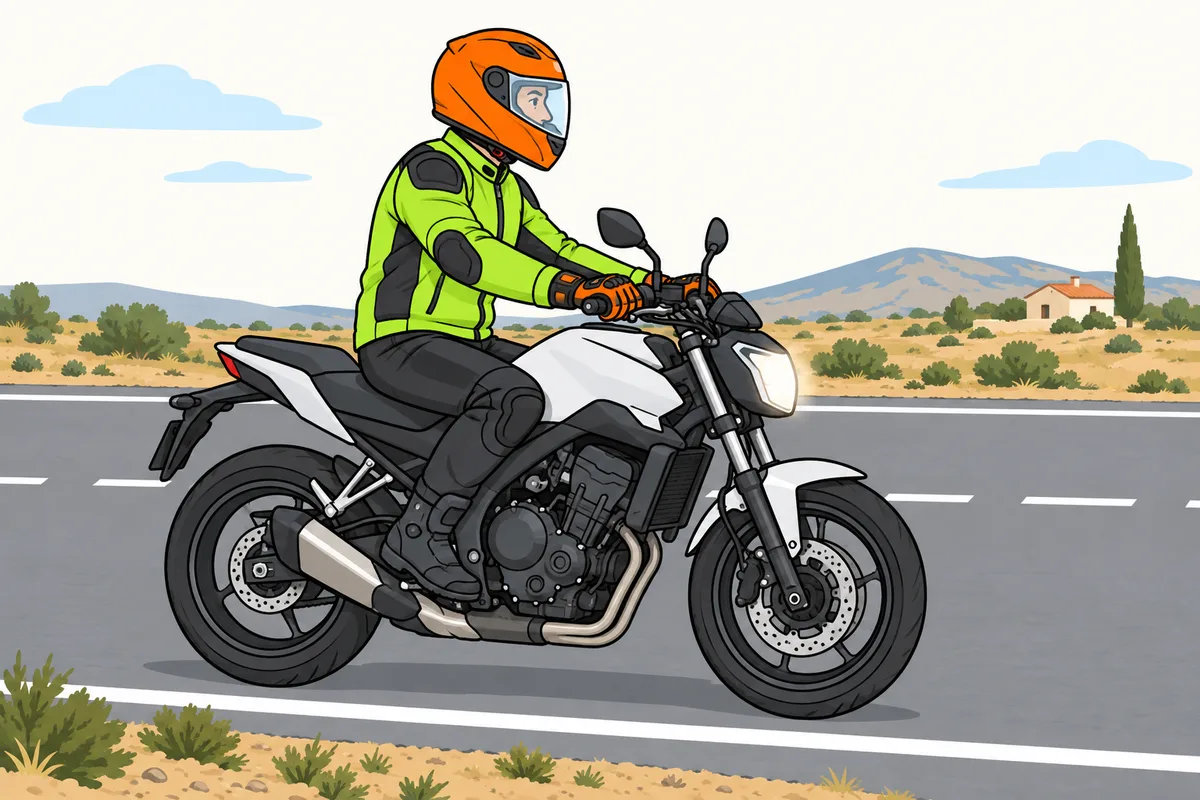
On a motorcycle, the helmet is compulsory, but serious study also covers gloves, boots, jacket, technical trousers and visibility. Good technique does not remove the risk of injury. Study each item of gear for the protective function it serves, and learn to separate what's compulsory from what's merely advisable.
Step 2. The syllabus
2.1The helmet, your main protection
The helmet is the only equipment compulsory for every occupant of the motorcycle, and in the exam it's usually the safe answer to any doubt about the rider's protection.
- It must be approved, the right size, well adjusted and with the strap fastened: a loose helmet can fly off on impact and stop protecting you exactly when you need it most.
- It protects the most vulnerable part of the body, the head, so no other item of gear replaces it or makes up for its absence; riding without one is both an offence and a direct risk.
- Carrying it on your arm, resting it on the fuel tank or wearing it unfastened is the same as not wearing it at all: the protection only exists when the helmet is properly fitted and secured.
2.2When a helmet stops protecting you
An old, knocked or badly fitted helmet can look usable at first glance and still have lost much of its ability to absorb an impact on the inside.
- After a fall it should be inspected or replaced even if there's no visible external damage, because the material that cushions the blow works only once and can be rendered useless without warning.
- On the road a full-face helmet is especially advisable for the level of coverage it gives to the face and jaw, areas that an open-face helmet leaves exposed.
- The visor must be clean and scratch-free: a damaged visor dazzles at night and reduces vision exactly when you need to read the road and the signage well.
2.3The rest of the gear
Gloves, boots and abrasion-resistant clothing reduce damage from impact or sliding in a fall, something that everyday clothes don't prevent even if they're comfortable.
- Protection over critical areas such as elbows, shoulders, back and knees cushions the most frequent blows when the body hits or slides across the tarmac.
- Footwear must support the ankle and allow the controls to be operated firmly; riding in flip-flops or loose footwear compromises control of the foot over the brake and gear lever.
- Even though only the helmet is compulsory, a responsible riding school treats the rest of the gear as part of the safe habit, not as an optional extra.
2.4Visibility: being seen first
Visibility matters as much as resistance: light colours, reflective elements and a visor in good condition help other drivers spot you before they manoeuvre.
- On a motorcycle you must never assume you've been seen; dressing visibly is an active way of reducing the risk of another vehicle cutting across your path.
- At night, in rain or in fog, visibility drops for everyone, and that's when reflective elements and a clean visor make the difference between being spotted in time and going unnoticed.
2.5Gear must not get in the way
Gear must also allow enough mobility, ventilation and feel to act precisely on the throttle, brakes and steering without the clothing dulling your touch.
- Gloves that are too thick or a suit that's too stiff can reduce feel on the controls; good gear protects without turning every manoeuvre into a clumsy or slow movement.
- Heat and discomfort also distract, so breathable gear helps you keep your concentration on long journeys or on hot days.
2.6Compulsory, advisable and prohibited
In the exam it's worth distinguishing three categories that tend to get mixed up: what's compulsory, what's advisable and what's prohibited, without confusing real safety with personal habit.
- An item not being compulsory in every case doesn't make it useless: many questions are testing whether you separate the legal obligation from good riding practice.
- Handling or removing the helmet while riding, or using items that block vision or hearing, falls into the territory of what's prohibited and clearly unsafe conduct.
2.7How this topic comes up in the exam
The motorcycle-specific test includes questions on equipment and safety, within a 20-question exam with a maximum of 2 errors and around 20 minutes.
- Faced with a doubt about protection, the answer that prioritises an approved helmet, suitable clothing and visibility is almost always correct over the one that minimises the risk.
- Be wary of options that present the gear as dispensable or that reduce all protection solely to the helmet, forgetting the visor, gloves or footwear.
Step 3. Key points
If you only have a minute before the exam, revise this.
- 1.Approved helmet, your size, adjusted and with the strap fastened.
- 2.Inspect or replace the helmet after any knock or fall.
- 3.Use gloves, boots and abrasion-resistant clothing, not just the helmet.
- 4.Keep the visor clean and scratch-free to see well at night.
- 5.Choose visible, reflective gear, especially in rain or at night.
- 6.Check that the gear doesn't reduce feel or mobility on the controls.
- 7.In each question, tell apart what's compulsory, advisable and prohibited.
Step 4. Exam traps
Mistakes the DGT uses again and again on this topic.
- Answering as if all the gear were compulsory, when only the helmet is for every occupant.
- Reducing protection solely to the helmet and forgetting gloves, footwear or abrasion-resistant clothing.
- Forgetting that the visor and glasses also affect vision and therefore real safety.
- Assuming an old or knocked helmet is fine because it looks usable at first glance.
- Confusing what's advisable with what's prohibited and marking unsafe conduct as legal.
- Thinking visibility is only cosmetic rather than an active safety measure on a motorcycle.
Step 5. Quick check
Four real exam questions on what you have just read.
What footwear is recommended for protective motorcycle riding and good control of the foot controls?
Step 6. Frequently asked questions about protective equipment
- Which clothing helps protect a motorcycle rider’s body against abrasion and impacts in a fall?
- Motorcycle-specific abrasion-resistant jacket and trousers with protectors. Motorcycle-specific jacket and trousers with abrasion-resistant materials and protectors over vulnerable areas. Suitable leather or technical textiles can be used; textile protective clothing is not all equivalent to ordinary street clothing. It should fit properly and be fastened correctly without hindering control operation. It reduces injury severity but does not guarantee freedom from injury.See full question
- Why is an approved, correctly fitted full-face helmet recommended over an open-face helmet for motorcycle riding?
- Because it also protects the face and jaw, including the chin. Because it adds protection for the face and jaw, including the chin. It must fit correctly and be properly fastened; its retention system is not an optional accessory. A helmet does not guarantee prevention of every injury.See full question
- What is the function of the impact-absorbing inner layer, usually expanded polystyrene (EPS), beneath a helmet’s outer shell?
- Absorb part of the impact energy by deforming. It absorbs part of the impact energy by deforming and helps reduce the force transmitted to the head. This protective layer is different from removable textile padding intended for comfort and fit. Deformation may remain hidden: after an accident involving an impact to the helmet, replace it according to manufacturer instructions even if external damage is not visible.See full question
- Which helmet feature helps reduce visor misting?
- Adequate ventilation. Adequate ventilation helps remove moisture and reduce visor misting. It does not by itself guarantee perfect vision in every condition: keep the visor clean and use anti-mist systems according to the manufacturer’s instructions. Correct fit, approval and helmet condition are also essential for safety.See full question
- On a motorcycle without a protective structure and seat belt qualifying for the regulatory exemption, what head protection does Spain’s General Traffic Regulation require?
- A UNECE R22-approved helmet, properly fastened. A protective helmet approved under UNECE Regulation R22, properly fastened, on all roads. A hat or glasses cannot replace it. Article 118 also requires closed footwear covering the entire foot on all roads and protective gloves on interurban roads. It is therefore incorrect to describe all other equipment as merely recommended. The exemption for vehicles with protective structures and seat belts must be recorded in their technical documentation.See full question