Step 1. The big picture
In one sentence…
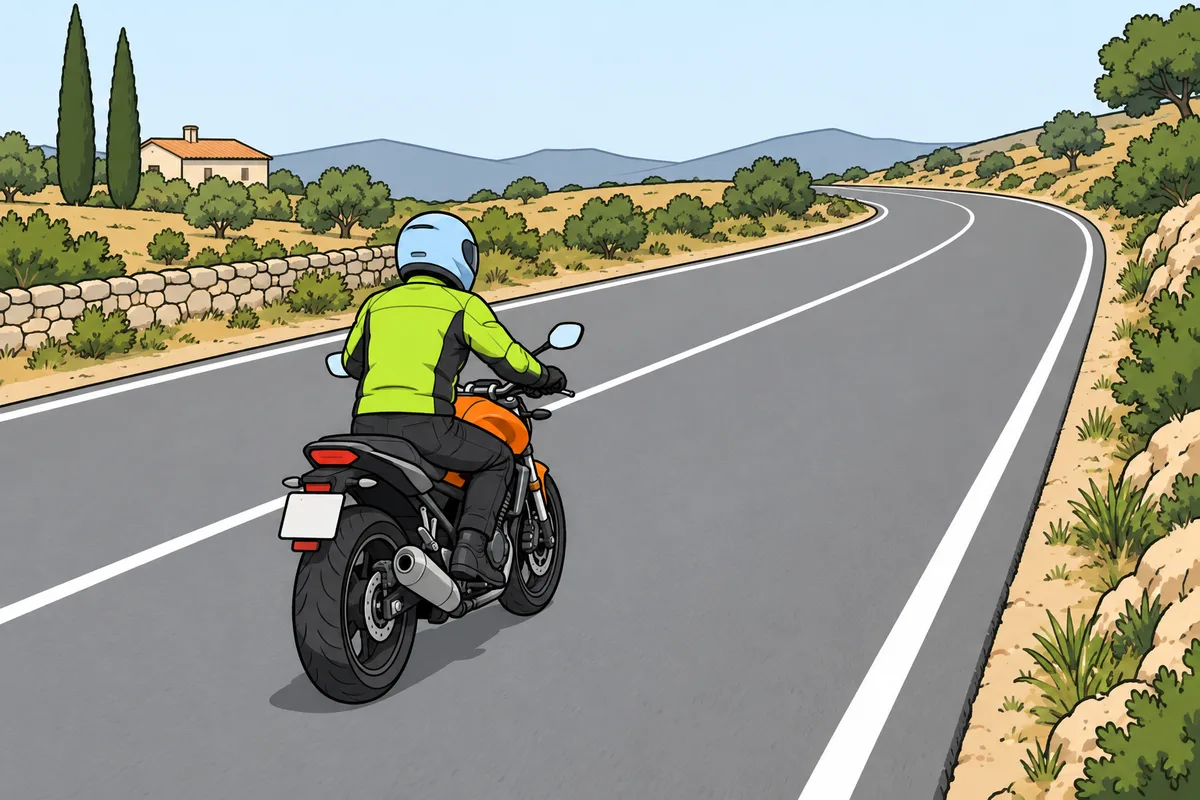
Technique on a motorcycle demands looking well ahead, combined braking, lean angle compatible with available grip, a clean line and special care with slippery surfaces and blind spots. Study each technique for what it prevents, because on a motorcycle the margin to correct an error is minimal.
Step 2. The syllabus
2.1Position on the motorcycle
Posture must allow fine control of the throttle, brakes and steering, with the body relaxed and no tension in the arms so as not to transmit sudden movements to the handlebars.
- A balanced position improves stability and leaves the hands and feet free to act precisely on the controls in any manoeuvre.
- Stiffening the arms or sitting badly reduces feel and control exactly when you need to correct your line smoothly.
2.2The eyes as a tool
Keep your eyes far ahead and your head free to check the surroundings and your line; the motorcycle tends to go where you look.
- Looking towards the exit of the bend improves balance and avoids target fixation on the obstacle, a typical error that pulls the motorcycle straight towards what you want to avoid.
- At intersections, look twice: many drivers don't spot a motorcycle well even though they think they've looked, so anticipate their possible mistake.
- Practising a long-range gaze gives you more time to read the road, choose your line and decide before reaching the critical point.
2.3Effective braking
Effective braking relies on progressiveness and a correct balance between the front and rear brake depending on the situation and the available grip.
- Sudden braking with the motorcycle leaning or on a slippery surface greatly increases the risk of losing control and falling.
- Braking early and progressively is safer than relying on a hard, last-moment brake, which leaves little margin if grip fails.
2.4Stability and grip
Grip is limited and is shared between braking, turning and accelerating; asking for everything at once, such as braking hard mid-bend, easily exceeds that limit.
- Surfaces such as paint, sand, gravel or a wet road surface reduce grip suddenly, so it's worth spotting them in time and smoothing out any action on the motorcycle.
- Smooth, anticipated manoeuvres preserve stability; violent movements on the throttle, brake or steering compromise it immediately.
2.5Line through a bend
In a bend, select your speed before entering, avoid sudden corrections and stay within your lane without invading the path of others.
- Entering too fast thinking you can correct afterwards is a frequent error: the motorcycle has less margin than a car to adjust on the move.
- A clean, predictable line makes balance easier and avoids surprises both for you and for other road users.
2.6Overtaking with margin
When overtaking, weigh up the wind, slipstream, lateral distance and the space to return; what a motorcycle gains in acceleration it can lose in stability.
- Leave a wide lateral margin when passing and don't return to the lane until you can see the overtaken vehicle in the mirror with sufficient distance.
- A tight overtake on a motorcycle combines several risks at once, so it should only be started when visibility and space clearly allow it.
2.7Visibility and electronic aids
Your own visibility and that of others is a riding technique: positioning yourself to be seen improves safety as much as braking better does.
- ABS and other aids don't remove the need to anticipate; they only reduce part of human error and don't make up for poor technique.
- Relying on electronics to fix a bad decision is a common trap: aids work best when you're already riding with foresight and smoothness.
Step 3. Key points
If you only have a minute before the exam, revise this.
- 1.Keep a relaxed posture that allows fine control of the controls.
- 2.Keep your gaze long and direct it towards the exit of the bend.
- 3.Look twice at intersections and anticipate others' mistakes.
- 4.Brake progressively, adapted to the available grip.
- 5.Avoid sudden manoeuvres with the motorcycle leaning or on a slippery surface.
- 6.Select your speed before entering the bend, not inside it.
- 7.Overtake only with visibility, lateral margin and space to return.
Step 4. Exam traps
Mistakes the DGT uses again and again on this topic.
- Entering a bend fast, thinking you can always correct afterwards.
- Relying on ABS or electronic aids to make up for poor technique.
- Fixing your gaze on the obstacle instead of looking towards the exit of the bend.
- Braking hard with the motorcycle leaning or on a slippery surface.
- Assuming other drivers have always seen you at a junction.
- Returning to the lane after overtaking without leaving distance from the vehicle passed.
Step 5. Quick check
Four real exam questions on what you have just read.
You use panniers compatible with your motorcycle and fitted according to the manufacturer’s instructions. How should you load luggage?
Step 6. Frequently asked questions about driving techniques
- When carrying an authorised passenger on your motorcycle, what possible effect of the additional load must you consider when braking?
- A longer braking distance may be needed. Additional load may increase the distance needed to brake and change how the motorcycle handles. Adapt speed and following distance, and adjust tyres and suspension to the manufacturer’s guidance for that load. A passenger does not by itself increase the rider’s reaction time.See full question
- Does an A1 licence authorise you to ride a motorcycle with a sidecar?
- Yes, up to 125 cm³, 11 kW and a power-to-weight ratio of 0.1 kW/kg. The A1 licence permits motorcycles with or without a sidecar within its limits: maximum engine capacity 125 cm³, maximum power 11 kW and maximum power-to-weight ratio 0.1 kW/kg. A sidecar does not remove any of these limits.See full question
- When carrying a passenger on your motorcycle, to make driving safer, you must tell them to...
- To lean when taking the bends on the same side as the driver. When carrying a passenger on your motorcycle, to make driving safer, you must tell them to lean into the bends on the same side as the driver.See full question
- With no signs setting a different limit, on which urban road does Article 50 set a general 20 km/h limit for a motorcycle?
- On a road with a shared carriageway and pavement platform. On roads with a shared carriageway and pavement platform. Article 50 sets general urban limits of 20 km/h for shared platforms, 30 km/h for one lane in each direction and 50 km/h for two or more lanes in each direction, excluding reserved lanes. Observe specific signed limits. Do not confuse this with the 2025 catalogue’s S-28 living and play zone, whose limit is 10 km/h.See full question
- When exiting a motorcycle bend with good grip, a clear road and an appropriate speed, how should you progressively resume riding?
- Gradually bring the motorcycle upright and accelerate smoothly if conditions allow. Gradually bring the motorcycle upright and accelerate smoothly as grip, visibility, the road and speed limits allow. Avoid abrupt acceleration while heavily leaned over. This advice for a normal clear exit does not prevent braking for a hazard or require acceleration in every bend.See full question