Step 1. The big picture
In one sentence…
Master the hierarchy between officers, temporary signage, traffic lights, vertical signs and road markings, and study the current official catalogue with attention to the most recent updates. In the moped exam, many questions are solved by correctly applying that priority order.
Step 2. The syllabus
2.1Hierarchy of signage
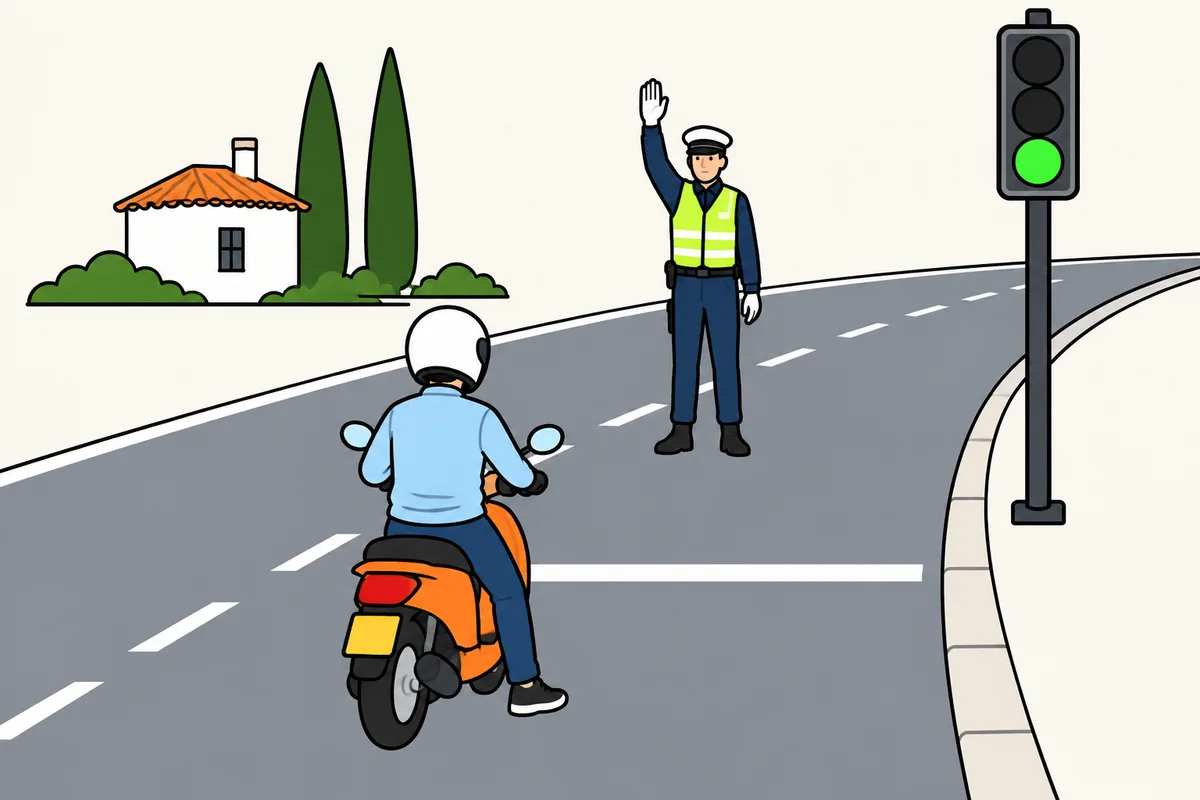
The priority between signs is not arbitrary: first you obey officers' orders, then temporary signage, then traffic lights, then vertical signs and finally road markings.
- If two signs appear to contradict each other, the higher-ranking one prevails. In the exam, many questions are solved by remembering this hierarchy before looking at shape or colour.
- Signs apply from the point where they are placed, unless they indicate a distance, the length of a stretch, or the end of a prohibition.
- Memorise the full order because it's the key to solving situations where several indications coincide at the same point.
2.2Families of signs
Danger warning signs warn of a risk; regulatory signs impose prohibitions or obligations; information signs guide, confirm or inform about the use of the road.
- Identifying which family a sign belongs to by its shape and colour tells you immediately whether it warns, prohibits, obliges or informs.
- Regulatory signs have the most influence on your conduct, because a prohibition or obligation directly affects what you can do.
- Studying by family avoids memorising isolated pictures and lets you work out the meaning of a sign you haven't seen before.
2.3Traffic lights and road markings
Traffic lights regulate passage with priority over an incompatible vertical sign; the lights may be aimed at all road users or at a specific lane, vehicle or manoeuvre.
- Road markings define lanes, excluded areas, pedestrian crossings, continuous or broken lines, and rules on stopping, parking and priority.
- A continuous longitudinal line must not be crossed; a broken one allows certain manoeuvres when safety permits.
- On a moped it's worth reading the lane markings carefully so you position yourself visibly and don't enter reserved areas.
2.4Practical reading in the exam and on the road
Don't study signs as isolated pictures: link each one to the required conduct, the vehicle's position and the anticipation needed.
- At a junction, a priority sign outweighs the general priority-to-the-right rule; at roadworks, temporary signage can override the permanent signage.
- When the question mentions a reversible lane, an extra lane or a temporary diversion, pay attention to road delineation devices, arrows and variable message signs.
- For each sign, ask yourself what it orders you to do and how far in advance you must start acting.
2.5Official catalogue and the 2025 update
The official sign catalogue was updated in 2025; the reform introduces new representations and adapts pictograms and panels to current mobility.
- To study rigorously, use up-to-date material and be wary of old diagrams that still include discontinued signs or incomplete meanings.
- If a question pits a new sign against a classic one, the key remains identifying danger, prohibition, obligation or information and applying the correct conduct.
- Whenever in doubt between an old version and a recent one, the current official catalogue must always prevail.
2.6Signs relevant to mopeds
On a moped, pay special attention to signs prohibiting access to certain roads and to restrictions by vehicle type.
- Remember that there are roads, such as motorways and dual carriageways, where mopeds cannot ride, and certain signs state this expressly.
- Road delineation devices that require you to reduce speed a lot deserve attention because on two wheels sudden changes in road surface are more dangerous.
- Link each sign to how it affects a slow, exposed vehicle, not only its general meaning.
2.7Method for studying signs
Group signs by family and by expected conduct, and review the ones that are most often confused with each other until you can tell them apart without doubt.
- Practise with multiple-choice questions that place the sign in a real context of a junction, bend or lane, not just as an isolated image.
- When you get a question wrong, note why you confused the meaning and review that family before the next revision.
- Reviewing little and often fixes the catalogue in your memory better than a single long session the night before the exam.
Step 3. Key points
If you only have a minute before the exam, revise this.
- 1.Recognise the full hierarchy of signage.
- 2.Tell apart danger, regulatory, information signs and road delineation devices.
- 3.Understand the priority of traffic lights over an incompatible vertical sign.
- 4.Link each sign to the required conduct and the stretch it affects.
- 5.Pay attention to roads that are prohibited for mopeds.
- 6.Study the updated catalogue and not just old images.
- 7.Practise with questions that place the sign in a real context.
Step 4. Exam traps
Mistakes the DGT uses again and again on this topic.
- Confusing the general priority rule with a vertical sign or an operating traffic light.
- Forgetting that temporary roadworks signage can change the usual regime.
- Reading a road marking in isolation without linking it to the rest of the lane's or junction's signage.
- Studying with old diagrams instead of the current official catalogue.
- Not remembering that mopeds are banned from certain roads.
Step 5. Quick check
Four real exam questions on what you have just read.
On an urban road with a posted 50 km/h limit, may a moped travel at that speed?
Step 6. Frequently asked questions about traffic signs
- At a junction, a steady circular red traffic light applies to your vehicle alongside a vertical give-way sign. There are no officers or other instructions changing the situation. What must you do?
- Stop for the red light, observing the stop line if present. Stop before the stop line or, if there is none, before the signal without passing it. Under Article 133, the traffic light takes precedence over the vertical sign, and steady red prohibits passage. Merely giving way and proceeding is insufficient.See full question
- By its meaning, does this sign prohibit entry on your moped?
- No; it prohibits cycles, rather than mopeds. Sign R-114 prohibits entry to cycles, such as bicycles. A moped is not a cycle, so this sign alone does not prohibit its entry. Any other restriction applicable to the road must still be respected.See full question
- What danger does the pictured sign warn of?
- A section where traffic congestion frequently occurs. The P-31 sign warns of an approaching section where traffic is frequently stopped or hindered by congestion. It does not mean a queue is necessarily present at that precise moment or that only cars may use the road. Adapt speed and maintain a safe following distance.See full question
- If a traffic officer is directing traffic while you drive an AM moped or light quadricycle, you must:
- Follow the officer's instructions. When traffic officers direct traffic, their instructions take precedence over fixed signs.See full question
- With no higher-priority signals or instructions, does this sign give priority at the junction when continuing straight ahead?
- Yes. Yes. R-3 gives priority at junctions over vehicles from other carriageways. The image has no supplementary panel limiting priority to a right turn. Obey higher-priority instructions and signals and avoid danger even when you have priority.See full question
Official sources
Signs catalogue
All Spanish traffic signs and their meanings
The full DGT catalogue — warning (P-), regulatory (R-) and information (S-) — with the official image and meaning of every sign.