Step 1. The big picture
In one sentence…
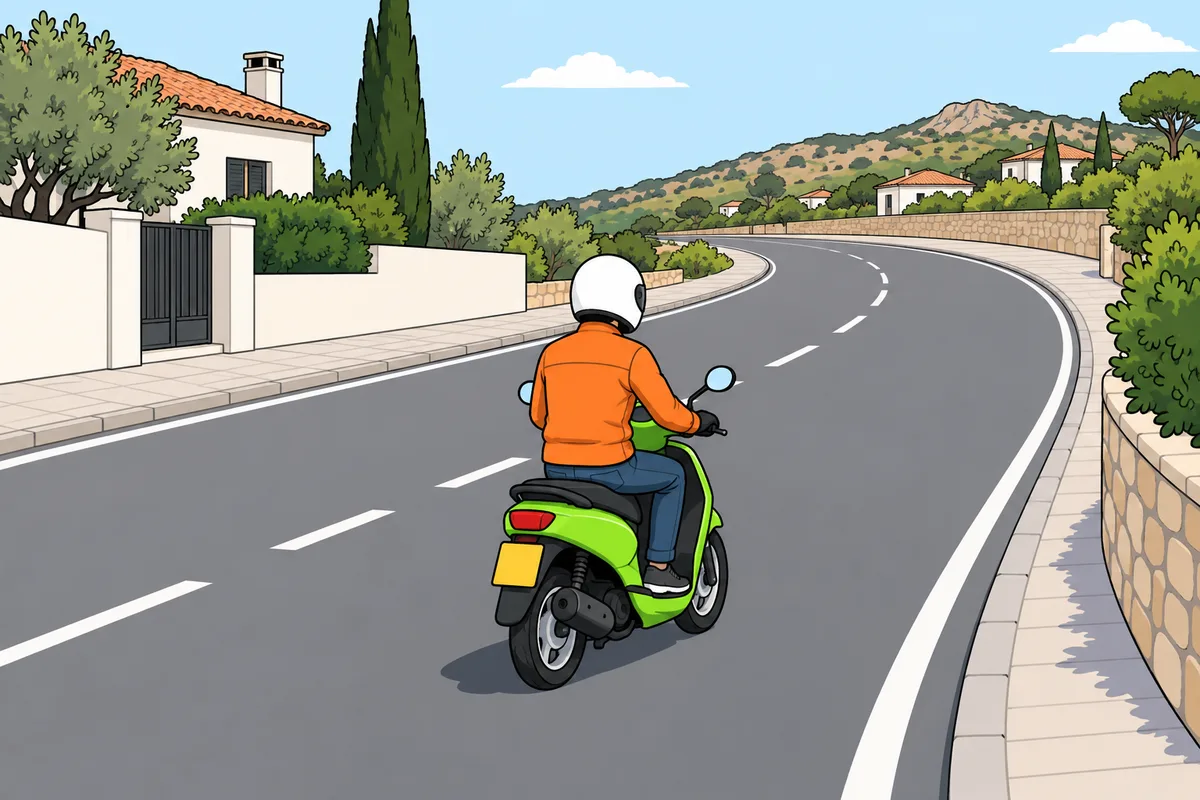
Moped technique focuses on balance, where you look, progressive braking and visible positioning. The typical learner mistake is looking too close and reacting late, which is why the exam insists on anticipation and on not mistaking the vehicle's agility for permission to take risks.
Step 2. The syllabus
2.1Where you look and your line
Where you look guides your line: look far ahead, identify an escape route and avoid fixing your eyes only on the immediate obstacle.
- The moped tends to go where you're looking, so keeping your eyes ahead helps you hold a stable line.
- Scan junctions, driveway exits and gaps between cars with your eyes to anticipate what might appear.
- Looking too close causes late, abrupt reactions; looking far ahead gives you time to smooth out any manoeuvre.
2.2Cornering technique
Enter a bend with moderate speed, a clear view towards the exit and a smooth line, without sharp corrections mid-turn.
- Braking or releasing the throttle abruptly within the bend destabilises the moped; adjust your speed before entering.
- Correcting forcefully within a bend is usually a sign of having entered too fast or of poor anticipation.
- Adapt your lean angle and speed to the radius of the bend and the condition of the road surface ahead.
2.3Progressive braking
Effective braking requires progressiveness and coordination; abrupt use can lock a wheel and cause a fall, especially on a slippery road surface.
- Combine the front and rear brakes in a balanced way instead of relying entirely on just one.
- Start braking gently and increase pressure gradually, easing off if you feel the wheel losing grip.
- Anticipating your braking lets you stop in a controlled way and avoids emergency stops that destabilise the vehicle.
2.4Balance in slow manoeuvres
In slow manoeuvres, control your balance smoothly with the throttle, brake and body posture, without jerky movements.
- Setting off, stopping and turning at low speed are where it's easiest to lose stability if you tense up.
- Keeping a minimum of momentum and a relaxed posture helps hold the moped upright at a junction or traffic light.
- Practising these manoeuvres at low speed improves the fine control you need in urban traffic.
2.5Slippery surfaces
On road markings, metal covers, gravel or wet crossings, reduce lean angle and abruptness because grip decreases a lot.
- Cross these surfaces as straight as possible and without braking or accelerating hard right on top of them.
- In rain, the first moment after it starts is usually the most slippery, because the water lifts dirt off the road surface.
- Anticipating these stretches and reaching them at an already reduced speed avoids most losses of grip.
2.6Visibility in urban surroundings
The moped is not very visible to other drivers, so you must be extra alert reading junctions, other people's turns and opening doors.
- Ride where you can be seen, avoiding other vehicles' blind spots or riding right alongside parked cars.
- Keep a predictable position in the lane and signal your manoeuvres in advance using the indicators.
- Assuming you've already been seen is a common mistake; ride as if the other party might not have detected you.
2.7Anticipation and safe decisions
Don't take advantage of doubtful gaps just because the vehicle is small; the correct manoeuvre still requires visibility and safe space.
- Always leave a margin of space next to parked vehicles in case a door opens unexpectedly.
- Anticipating means asking yourself what could go wrong in the next few seconds and having a response ready.
- The moped's agility is an advantage only if you use it to move away from risk, not to squeeze through without margin.
Step 3. Key points
If you only have a minute before the exam, revise this.
- 1.Look far ahead and look for an escape route, not the obstacle.
- 2.Adjust your speed before entering each bend.
- 3.Brake progressively, combining both brakes.
- 4.Control your balance smoothly in slow manoeuvres.
- 5.Reduce lean angle and braking on slippery surfaces.
- 6.Ride where you can be seen and signal every manoeuvre.
- 7.Don't squeeze through gaps without safe space or visibility.
Step 4. Exam traps
Mistakes the DGT uses again and again on this topic.
- Using only one brake or braking suddenly on a slippery surface.
- Confusing the moped's agility with permission to squeeze through without safe space.
- Looking at the immediate obstacle instead of looking far ahead and anticipating.
- Entering a bend too fast and correcting forcefully mid-turn.
- Assuming other drivers have already seen you.
Step 5. Quick check
Four real exam questions on what you have just read.
As a general rule, what is the maximum interval between examination attempts within the same application file for an AM licence?
Step 6. Frequently asked questions about moped riding techniques
- A moped travels on a conventional road with no route reserved for it. The right shoulder is not passable and adequate. Which part of the carriageway should it use?
- The necessary part of the carriageway near the right edge. The necessary part near the right edge, exercising care. Under Article 36, use the right shoulder when it is passable and adequate and no route or part is specifically reserved for the moped. Only when it fails those conditions should the necessary part of the carriageway be used. Do not ride on the centre line to be more visible or use an unsuitable shoulder.See full question
- When a vehicle makes a 180-degree turn to continue travelling on the same road but in the opposite direction, what is this manoeuvre called?
- A U-turn. It is a U-turn: the vehicle turns around to continue along the same road in the opposite direction. It differs from turning into another road and from reversing. Identifying the manoeuvre does not establish that it is permitted there; prohibitions and safety conditions must be observed.See full question
- In rain, what should you consider when riding a moped over painted road markings and metal covers?
- They can offer less grip when wet. They can be particularly slippery when wet. Moderate speed before reaching them and avoid abrupt braking, acceleration or steering on them. Keep a safe line without sudden swerves to avoid them. Do not assume every marking or cover has the same grip as dry pavement.See full question
- On a moped, to keep stability while braking you should:
- Brake progressively and in a controlled way. Brake progressively and in a controlled way, using the brakes under the moped’s instructions and available grip. Locking the wheels can cause loss of control. Keep both hands on the handlebars and do not assume ABS removes every risk.See full question
- Before turning with an AM moped or light quadricycle, besides signalling, what must you check?
- Check the surroundings of the vehicle carefully. Check that the turn can be performed safely by observing the surroundings, mirrors and blind spots where relevant. Signalling does not confer priority or replace checking that others are not endangered. Adapt speed and give way when needed.See full question