Step 1. The big picture
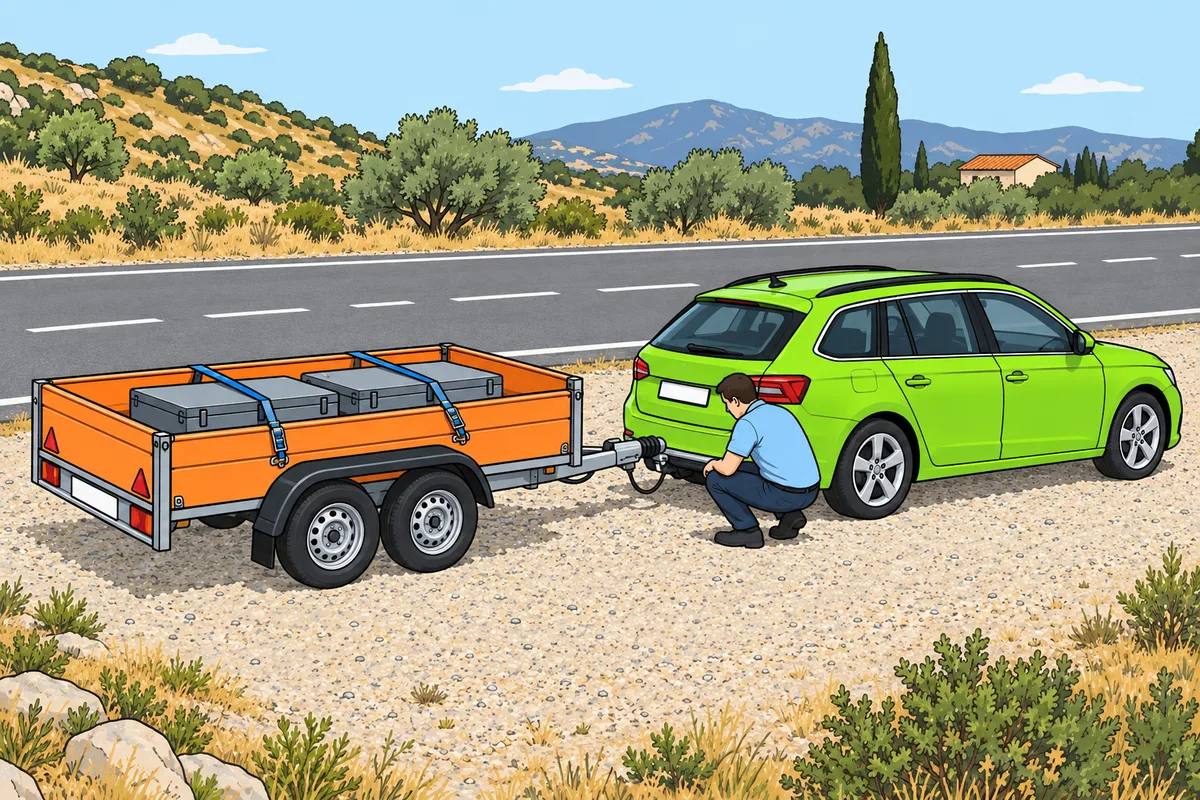
In one sentence…
In B+E you must study authorised masses, coupling, load distribution, the stability of the combination and specific signalling for driving with a trailer or semi-trailer within the framework allowed by this class. The key is always to think of the towing vehicle and trailer as a single unit that is longer, heavier and slower to react.
Step 2. The syllabus
2.1Scope of the B+E licence
B+E qualifies you for a class B towing vehicle with a trailer or semi-trailer of up to 3,500 kg. Don't confuse it with heavier combinations.
- The driver's authorisation doesn't replace the limitations of the vehicle, the trailer, the hitch or the combination's technical documentation.
- Before driving you must check that the hitch, mass and load distribution are compatible with the administrative and technical authorisation.
- The B+E specific exam has 20 questions, a maximum of 2 errors and 20 minutes. It's worth mastering the definitions, because each mistake weighs more than in B.
2.2Mass and technical documentation
The combination's authorised mass isn't decided by visual impression. You must refer to documentation, authorisation, the trailer, the hitch and the towing vehicle's technical conditions.
- A tractor vehicle capable of moving a trailer doesn't mean the combination is legal. The rule distinguishes physical capability, homologation and the driver's licence.
- In the exam, if several mass figures appear, don't invent roundings or exceptions. Apply only the limits stated and the licence class indicated.
- If a question doesn't give a figure you need, answer qualitatively: check documentation, respect technical limitations and don't drive outside the permitted framework.
2.3Coupling and prior checks
The coupling must be locked, secured and compatible before starting to drive. A half-completed union turns any manoeuvre into a serious risk.
- Check electrical connections, lights, brakes where fitted, the auxiliary safety system, supports, catches and the trailer's general condition before setting off.
- The prior check is part of driving, not of the workshop. The exam may ask what you must verify before setting off with a combination.
- If you detect play, unsafe catches or lighting faults, don't drive trusting that going slowly is enough. The fault affects other road users too.
2.4Stability and mass distribution
The combination's stability depends on weight distribution, tyre pressure, speed, crosswind and smoothness on the steering wheel and brakes.
- A badly positioned or excessive load favours oscillation, loss of grip and an increase in braking distance in any demanding manoeuvre.
- With a trailer, manoeuvres lengthen, the line through a bend changes and the response to sudden swerves or unexpected braking worsens.
- The load must stay balanced and secured. If it shifts, it changes the combination's behaviour and can trigger swaying or loss of control.
2.5Driving with a trailer
You must adapt speed to the combination's own limits and to the trailer's real stability, even if the road seems favourable.
- Overtaking, joining traffic and parking need more space, better observation and extra margin so as not to invade other users' paths.
- On bends, roundabouts and tight turns, the trailer cuts the corner. Widen your line with care, without occupying prohibited spaces or surprising other users.
- The safety distance must increase because the combination takes longer to stabilise and stop. The correct answer is rarely to act as if it were a solo passenger car.
2.6Signalling and lighting
The rear signalling, the lighting, the trailer's number plate where it applies, and the coupling's safety devices must all be correct.
- A long or loaded trailer can hide the tractor vehicle's lights, which is why the rear of the combination must clearly communicate braking, turning and presence.
- Clean the lamps, reflectors and plate before driving. Dirt can make a manoeuvre invisible even if the system works electrically.
- If the scenario shows a sign restricting trailers, masses, length or the passage of certain vehicles, apply it to the whole combination, not just to the tractor vehicle.
2.7Common exam errors
Many mistakes come from answering as if the trailer didn't exist. Always think about length, mass, turning, braking, visibility and the combination's documentation.
- Another trap is relying on the tractor vehicle's power. Legality and safety also depend on the trailer, the hitch, the load and the limits in force.
- Practise questions by separating three levels: the driver's licence, the combination's technical fitness and safe conduct while driving, so you don't mix them up.
- When an option promises manoeuvring quickly or correcting with a sudden movement, it's usually wrong. With B+E, smoothness, margin and prior checking are almost always the answer.
2.8Licence entitlement and road speed are different questions
With B, a trailer up to 750 kg is permitted even when the combination reaches 4,250 kg if the technical conditions allow it. With a trailer over 750 kg, plain B covers a combination up to 3,500 kg; above 3,500 kg and up to 4,250 kg, the additional requirement must be recorded as code 96.
- B+E authorises a class B towing vehicle with a trailer or semi-trailer whose MAM does not exceed 3,500 kg. For example, a 3,500 kg car plus a 2,000 kg trailer is within the B+E trailer ceiling if the technical documents permit it; B+E is not a shorthand for every heavy combination.
- The licence category answers whether you may drive the combination. Road signs, vehicle type and circulation rules answer its speed; for the general table, a trailer combination may be limited to 90 km/h on motorways and 80 km/h on conventional roads. A B+E licence does not create a higher limit.
- Keep entitlement, MAM, technical authorisation and speed as separate checks. A combination can be authorised by licence and still be subject to a lower posted or vehicle-specific limit.
Step 3. Key points
If you only have a minute before the exam, revise this.
- 1.Know the exact scope of the B+E licence.
- 2.Check documentation, hitch, mass and load distribution before setting off.
- 3.Check lights, connections, brakes, supports and safety systems.
- 4.Adapt speed and manoeuvring space to the combination's length.
- 5.Increase distance and smoothness in braking, turning and joining traffic.
- 6.Apply sign restrictions to the whole combination.
- 7.Don't confuse technical capability with administrative authorisation.
Step 4. Exam traps
Mistakes the DGT uses again and again on this topic.
- Thinking that if the towing vehicle can handle the trailer, administrative or technical limits no longer matter.
- Answering as if a combination braked and turned the same as a passenger car without a trailer.
- Ignoring that the trailer needs its own signalling, lighting and devices in good condition.
- Applying a restriction only to the tractor vehicle when it affects the whole combination.
- Trusting sudden manoeuvres to correct swaying.
- Forgetting that the B+E exam has less margin for error than the common B theory test.
Step 5. Quick check
Four real exam questions on what you have just read.
The B+E licence authorizes you to tow a trailer or semi-trailer whose maximum authorized mass does not exceed:
Step 6. Frequently asked questions about vehicle combination rules
- In the specific knowledge test for B+E, the expected time is:
- 1 minute per question. Annex VI of the General Drivers Regulation sets one minute per question for knowledge tests.See full question
- For the issue of the B+E licence, the applicant must hold:
- A B licence. The B+E licence extends category B, so the applicant must already hold a B licence.See full question
- To obtain B+E by examination, without an applicable exemption from the specific test, which specific theory test must be passed?
- A B+E specific knowledge test. The B+E specific knowledge test. Annex V. B.2.6 of the General Driver Regulations covers trailer categories and topics on combinations, loads, coupling and driving technique. Holding B avoids repeating the common test on that basis but does not automatically exempt the holder from the specific test. The question excludes any applicable exemptions.See full question
- The B+E licence authorizes combinations with a trailer or semi-trailer whose MAM:
- Does not exceed 3,500 kg. The B+E licence authorizes combinations made up of a vehicle covered by a B licence and a trailer or semi-trailer whose maximum authorized mass does not exceed 3,500 kg.See full question