Step 1. The big picture
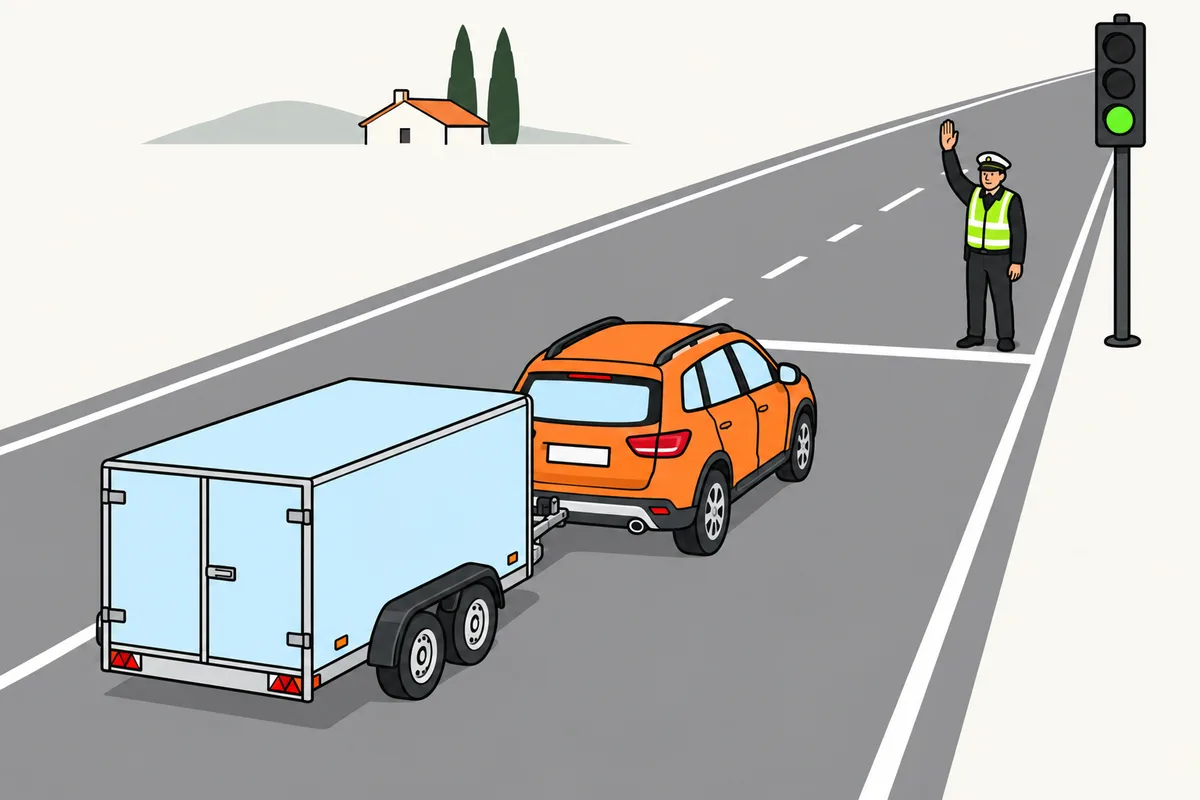
In one sentence…
Master the hierarchy between officers, circumstantial signalling, traffic lights, vertical signs and road markings, and study the current official catalogue paying attention to how combinations with a trailer behave. In B+E you must read every sign thinking about mass, length, lane, stability and the section affected.
Step 2. The syllabus
2.1Hierarchy of signalling
The priority between signs isn't arbitrary: first you obey officers' orders, then circumstantial signalling, then traffic lights, vertical signs and finally road markings.
- If two signs appear to contradict each other, the higher-ranking one prevails. In the exam, many questions are solved by remembering this hierarchy before looking at shape or colour.
- Signs apply from the place where they're positioned, unless they indicate a distance, the length of a section or the end of a prohibition.
- With a trailer, the hierarchy doesn't change. What changes is that you need more time and space to comply with the order smoothly.
2.2Families of signs
Danger warning signs warn of a risk; regulatory signs impose prohibitions or obligations; information signs guide, confirm or inform about the use of the road.
- Traffic lights regulate the right of way with priority over an incompatible vertical sign. Their lights can be aimed at all users or at a specific lane, vehicle or manoeuvre.
- Road markings define lanes, excluded zones, pedestrian crossings, continuous or broken lines and rules for stopping, parking and priority.
- In B+E, identify whether the sign affects all vehicles, trailers, specific lanes or manoeuvres such as overtaking, turning or parking.
2.3Restrictions on the combination
In combinations with a trailer, pay attention to signs limiting mass, length, prohibitions to trailers, lanes on a gradient and restrictions due to wind or for overtaking.
- A restriction can affect the whole combination even if the tractor vehicle alone appears authorised. Read the scenario as vehicle plus trailer, not as a car on its own.
- If the question doesn't give a figure you need, don't invent it. Apply the safe idea: respect the sign and check the rule or documentation in force.
- Signs for gradients, narrowing, roadworks or crosswind require anticipating stability. With a trailer, complying late can produce swaying or invading another lane.
2.4Practical reading in the exam
Don't study signs as loose drawings: relate each one to the conduct required, the position of the vehicle and the anticipation needed.
- At a junction, a priority sign is worth more than the general rule of giving way to the right. At roadworks, temporary signalling can override the permanent signalling.
- When a question mentions a reversible lane, an extra lane or a temporary diversion, pay attention to the road delineation devices, the arrows and the variable message panels.
- With a combination, check whether the manoeuvre needs a wider turning radius or more distance. The correct answer must not force you to react late.
2.5Road markings and lanes
Road markings show where you can drive, stop, change lane or wait. With a trailer, crossing a marking due to a poor line is still an error.
- A narrow, reversible or reserved lane may have its own rules. Read the arrows, panels and road delineation devices before deciding if the combination can use it.
- Stop lines matter more with a trailer because the total length determines where you end up positioned and whether you block a junction or crossing.
- In images, look at the whole imaginary rear part of the combination. Many answers fail because they only consider where the tractor vehicle fits.
2.6Official catalogue and the 2025 update
The official catalogue of signs was updated in 2025. The reform introduces new representations and adapts pictograms and panels to current mobility.
- To study rigorously, use up-to-date material and be wary of old diagrams that keep discontinued signs or incomplete meanings in their examples.
- If a question sets a new sign against a classic one, the key remains the same: identify danger, prohibition, obligation or information and apply the correct conduct.
- The B+E licence doesn't change the meaning of a sign, but it does make it more important to apply that sign with anticipation and sufficient margin.
2.7B+E revision method
Group your mistakes by cause: you didn't see the restriction, you applied the sign to the wrong vehicle, you forgot length, or you answered as if it were a solo car.
- Practise describing each image in two steps: what the sign orders, and what the combination needs to comply with it safely.
- In the specific exam, with 20 questions and a maximum of 2 errors, avoid answering from visual memory. Read who it's aimed at, the section affected and any exceptions.
- When an option allows you to continue despite doubt about mass, length or the trailer, be suspicious. The safe conduct is to check and respect the sign in force.
2.8Shortened broken lines, reversible and additional lanes
A shortened broken line can warn that a continuous line is near or that visibility or another special risk reduces the safe gap; read the complete marking before changing the combination's path.
- A reversible lane is delimited by double broken lines on both sides and controlled by lane signals; a short line alone does not reverse a lane.
- A temporary additional lane is enabled and controlled for a stretch and is not automatically reversible. Apply cones, signs, arrows and markings to the whole combination.
- If the operating indication is missing from the scene, do not infer a direction or trailer exception.
Step 3. Key points
If you only have a minute before the exam, revise this.
- 1.Recognise the full hierarchy of signalling.
- 2.Distinguish danger, regulatory, information, traffic lights, markings and temporary signalling.
- 3.Relate each sign to the conduct required and the section affected.
- 4.Check whether the sign affects the whole combination or just one specific user.
- 5.Pay attention to restrictions on mass, length, trailers, lane and gradient.
- 6.Study the updated catalogue, not just old images.
- 7.Practise applying every sign with more distance and smoothness than in a solo car.
Step 4. Exam traps
Mistakes the DGT uses again and again on this topic.
- Confusing the general priority rule with a vertical sign or an operating traffic light.
- Forgetting that temporary roadworks signalling can modify the usual regime.
- Reading a road marking in isolation without relating it to the rest of the signalling on the lane or at the junction.
- Answering as if a restriction affected only the tractor vehicle and not the trailer.
- Inventing whether the combination exceeds a limit when the scenario doesn't give enough data.
- Thinking a new sign changes the basic hierarchy of signalling.
Step 5. Quick check
Four real exam questions on what you have just read.
At a yield sign with a B+E combination, you must:
Step 6. Frequently asked questions about traffic signs
- If you are driving a car with a trailer and you encounter a STOP sign, you must:
- Come to a complete stop and yield if needed. At a STOP sign you must bring the vehicle to a complete stop and yield when required.See full question
- At a STOP sign with a B+E combination, you must:
- Come to a complete stop and yield if necessary. At a STOP sign, the vehicle must come to a complete stop and yield when required.See full question
- If a traffic officer is directing traffic while you drive a B+E combination, you must:
- Follow the officer's instructions. When traffic officers direct traffic, their instructions take precedence over fixed signs.See full question
Official sources
Signs catalogue
All Spanish traffic signs and their meanings
The full DGT catalogue — warning (P-), regulatory (R-) and information (S-) — with the official image and meaning of every sign.